Learning Recursive Segments for Discourse Parsing
Stergos Afantenos
∗, Pascal Denis
†, Philippe Muller
∗ †, Laurence Danlos
†∗Institut de recherche en informatique de Toulouse (IRIT)
Université Paul Sabatier
118 route de Narbonne, 31062 Toulouse Cedex 9, France
{stergos.afantenos, philippe.muller}@irit.fr
†
Equipe-Projet Alpage INRIA & Université Paris 7
30 rue Château des Rentiers, 75013 Paris, France
[email protected], [email protected]
Abstract
Automatically detecting discourse segments is an important preliminary step towards full discourse parsing. Pre-vious research on discourse segmentation have relied on the assumption that elementary discourse units (EDUs) in a document always form a linear sequence (i.e., they can never be nested). Unfortunately, this assumption turns out to be too strong, for some theories of discourse like SDRT allows for nested discourse units. In this paper, we present a simple approach to discourse segmentation that is able to produce nested EDUs. Our ap-proach builds on standard multi-class classification techniques combined with a simple repairing heuristic that enforces global coherence. Our system was developed and evaluated on the first round of annotations provided by the French Annodis project (an ongoing effort to create a discourse bank for French). Cross-validated on only 47documents (1,445EDUs), our system achieves encouraging performance results with an F-score of73% for finding EDUs.
1.
Introduction
Discourse parsing is the analysis of a text from a global, structural perspective: how parts of a dis-course contribute to its global interpretation, ac-counting for semantic and pragmatic effects be-yond simple sentence concatenation. This task consists in two main steps: (i) finding the ele-mentary discourse units (henceforth EDUs), and (ii) organizing them in a way that make explicit their functional (aka rhetorical) relations. Popu-lar theories of discourse include Rhetorical Struc-ture Theory (RST) (Mann and Thompson, 1987), Discourse Lexicalized Tree-Adjoining Grammar (DLTAG) (Webber, 2004), Segmented Discourse Representation Theory (SDRT) (Asher, 1993). Each of these theoretical frameworks has been at the center of important corpus building efforts, see (Carlson et al., 2003; Prasad et al., 2004; Baldridge et al., 2007) respectively. In the present work, we focus on the first step, namely segment-ing a discourse into EDUs, within a larger project aiming at building an SDRT discourse corpus of
French texts.
In addition to being a necessary step in discourse parsing, discourse segmentation, could also be useful as a stand-alone application for a variety of other tasks where EDUs could provide sim-pler input than sentences. Examples of such tasks are: automatic summarization and sentence com-pression, bitext alignment, translation, chunk-ing/syntactic parsing.
the RST corpus.
Discourse segmentation is to large extent theory dependent, for different theories make different assumptions on what EDUs can be. Carried out on the RST corpus, previous work on discourse segmentation has exploited an important particu-larity of this corpus: namely, the fact that it does not have any embedded EDUs. These approaches have been able to recast discourse segmentation as a binary classification problem: that is, each text position (token or token separator) is either a segment boundary or not. By contrast to RST, other theories like SDRT allows for embedded EDUs: embedding is used to encode modifying clauses like non restrictive relatives (including re-duced relatives) and appositions. As will be dis-cussed in Section 2., our SDRT-based corpus does contain close to10% of nested EDUs.
Predicting nested structures introduces additional difficulties, in particular that of outputting a co-herent, balanced bracketing. This characteristic renders discourse segmentation akin to syntac-tic clause boundary identification (CBI), a task which has received some attention from the CL community. The main approach to CBI is to clas-sify tokens intothreeclasses for clause start, end, or inside. The best results obtained during the CoNLL-2001 campaign were89-90% for bound-ary detection and81.73% for correct clause iden-tification (correct guessing of start and end), with boosted decision trees (Carreras and Màrquez, 2001).
We have adapted this general setting to the prob-lem of discourse segmentation, with possible em-bedded segments, and applied it to a corpus of French discourses, part of an on-going corpus building project.
2.
Data and Evaluation
2.1. CorpusThe corpus we use has been developed as part of the Annodis project1, an on-going effort to anno-tate French discourses from various genres with both top-level, typographic structures and local coherence relations. About 100-150 texts are being segmented and annotated with coherence relations. These documents are drawn mainly
1http://w3.erss.univ-tlse2.fr/
textes/pagespersos/annodis/
for wikipedia articles and from L’est républicain
newspaper 2. Text length varies from300 to900 tokens. Annotations are performed by pairs of human annotators in a two-step process: (i) in-dividual annotations, and (ii) adjudication. The present work considers the47texts that have un-dergone validation. The average number of EDUs per document in this set is33.
Segments typically correspond to verbal clauses, but also other syntactic units describing eventu-alities (such as prepositional phrases), adjuncts such as appositions or cleft constructions with discursive long-range effects such as frame ad-verbials. A particularity of the discourse units in Annodis is that they can be embedded in one an-other, as in example in figure 1 (brackets mark segmentation).
In this example, the EDUsπ1 mondialement
con-nues, and π2 donc difficilement écoulables, are nested within the the main, discontinuous EDU π0 Ces pièces avaient été repérées chez un riche
amateur nippon.
2.2. Evaluation
Discourse segmentation evaluation is typically performed in terms of precision, recall, and F-score for segment boundaries (Soricut and Marcu, 2003; Fisher and Roark, 2007; Sporleder and Lapata, 2005). Previous work differ as to whether they include sentence boundaries (e.g., (Soricut and Marcu, 2003) are only interested in sentence-internal segmentation) and whether they additionally require labeling of the segments (Sporleder and Lapata, 2005).
Since the type of segmentation we produce in-cludes nested EDUs, we have to resort to an-other type of evaluation. For this paper, we use the three metrics commonly used for evaluating clause detection: (i) precision, recall, and F-score for segment start position, (ii) precision, recall, and F-score for segment end position, and (iii) precision, recall, and F-score for complete seg-ments. These metrics correspond to three tasks included in the CoNLL 2001 shared task.
2http://www.cnrtl.fr/corpus/
Feature Description
Lemma the token’s lemma (Syntex)
POS Part of speech (Macaon)
Grammatical category the main grammatical category of the token: V, N, P, etc. (Syntex) start of a discourse marker boolean, indicating whether the tokens starts a discourse marker indirect speech report verb boolean, indicating whether the token belongs to a predefined
list of verbs.
dependency path the dependency path from the word towards the root, limited to distance 3 (Syntex)
inbound dependencies the inbound dependency relations for each token (Syntex) syntactic projections the number of times that the token is at the start, end or middle
of an NP, VP, PP projection (Syntex)
distance from sentence boundaries the relative distance from each of the sentence boundaries context 3-grams the lemma and POS 3-grams before and after the
token (Syntex & Macaon)
chunk start/end boolean features; token coincides with a chunk start/end (Macaon) outward chunk tag sequence the sequence of chunk tags from the innermost to the
outermost chunk (Macaon)
context n-gramms all the n-gramms (1< n≤6) that include the token and do not exceed the limits of the sentence. The n-grams include Lemmas (Syntex), POS tags (Macaon) and Chunk tags (Macaon)
Table 1: Features used for the second approach (including chunks).
Input from classifier:
[The pieces,] worldwide famous,] thus hard to resell,] had been located [at a rich japanese art lover’s]
First pass left-to-right:
[The pieces,] [worldwide famous,] [thus hard to resell,] [had been located [at a rich japanese art lover’s]
First pass right-to-left: [The pieces,] [worldwide famous,] [thus hard to resell,] [had been located] [at a rich japanese art lover’s]
Figure 2: Example repairing of a not well-formed segmentation with additions underlined. The sen-tence can now be compared to the reference, cf figure 1.
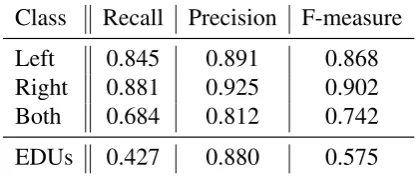
sentences is 35%, our post-processing heuristics yield 98% well-formed segmentations. The im-pact on precision/recall is shown in table 3.
The overall bad performance on both is due to the lack of data for this class: there are less than 20 examples in the entire corpus. When it comes to the segment evaluation, again the best results were achieved by the second approach which managed to correctly identify 73% of the manually annotated segments. These results are slightly less, but close to, the best results obtained
by systems on the CBI task. Of course, the main reason post-processing boosts the EDU score is that a third more of the sentences are now evalu-ated, since they are well-formed. But the decline in precision is much less than the gain in recall.
4.1. Learning Curve
For their RST EDU segmentation experiments, Fisher and Roark (2007) have been using the RST-DT corpus which consists of a total of
Class Recall Precision F-measure
Left 0.845 0.891 0.868
Right 0.881 0.925 0.902
Both 0.684 0.812 0.742
EDUs 0.427 0.880 0.575
Table 2: Evaluation without post-processing.
Class Recall Precision F-measure
Left 0.876 0.880 0.878
Right 0.885 0.889 0.888
Both 0.684 1.0 0.812
EDUs 0.719 0.748 0.733
Table 3: Evaluation with post-processing.
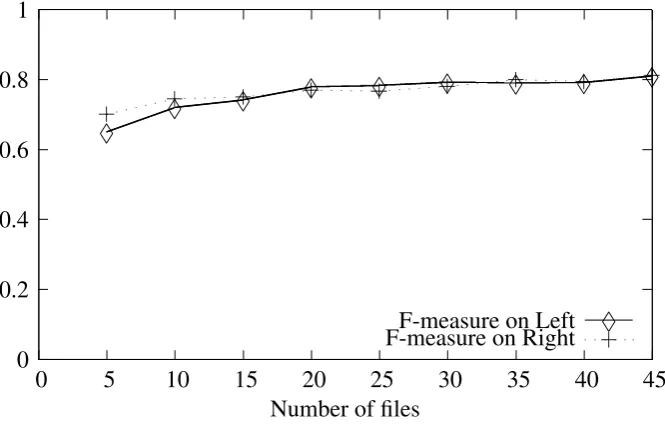
Màrquez (2001) have used the CoNLL 2001 cor-pus for the task of clause boundaries identifica-tion: this corpus includes sections15−18of the Penn Treebank for training (211,727tokens) and section20for test (47,377tokens). In contrast to those approaches we have worked, as mentioned in section 2. we have been working with 47 val-idated documents (14384 tokens) from the Ann-odis project. Given that the number of documents that we have been working with is limited, at least in comparison with other approaches, we have calculated the learning curve for this number of documents in order to understand how the learn-ing procedure will be influenced once we have the totality of our documents annotated. As men-tioned in section 2. the total number of documents expected will be in the range of100to150. In order to calculate our learning curve, we di-vided our corpus into 9 different learning sets, starting from5random documents and incremen-tally adding5random documents into each learn-ing set. For each such set we performed a ten-fold cross-validation, in the same way as described in section 4., using the feature set shown in table 1. The learning curve is shown in figure 3. As it can be seen from this figure, the curves for both classes (left and right) grow regularly be-tween sets 5 to 30while it seems to plateau be-tween sets30and40only to start going up again during the last set of documents. In general, it seems that the addition of more documents will only slightly increase the performance of our
ap-proach.
5.
Conclusions and Future Work
Discourse segmentation is a crucial preprocess-ing stage for discourse analysis, and the global reliability of discourse parsing is heavily deter-mined by success at this level. We have proposed a simple approach combining a 3-class classifier with a post-processing heuristics that achieve rea-sonable results, although the data available at the moment is limited. We need to see how this gen-eralizes to the whole corpus, and to check how dependent it is on the nature of the corpus (news-paper articles and encyclopedia article). Another angle we plan to investigate is the usefulness of a non-perfect segmentation to help annotators start discourse annotation. Given the cost of human annotation of discourse, saving time on the seg-mentation would be a boost to annotators pro-ductivity, provided we verify that time spent is roughly proportional to the number of errors in the automated preprocessing; that hypothesis is not necessarily true, and there might be a thresh-old on the precision of the processing that is ac-ceptable. Mainly, the ideal trade-off between pre-cision and recall remains to be investigated.6.
References
N. Asher. 1993. Reference to Abstract Objects in Discourse. Kluwer.
J. Baldridge, N. Asher, and J. Hunter. 2007. An-notation for and robust parsing of discourse structure on unrestricted texts. Zeitschrift fur Sprachwissenschaft, 26:213–239.
A. Berger, S. Della Pietra, and V. Della Pietra. 1996. A maximum entropy approach to natural language processing. Computational Linguis-tics, 22(1):39–71.
D. Bourigault, C. Fabre, C. Frérot, M.-P. Jacques, and S. Ozdowska. 2005. Syntex, analyseur syntaxique de corpus. In Actes des 12èmes journées sur le Traitement Automatique des Langues Naturelles.
0 0.2 0.4 0.6 0.8 1
0 5 10 15 20 25 30 35 40 45
Number of files
F-measure on Left
♦ ♦
♦ ♦ ♦ ♦ ♦ ♦ ♦
♦ F-measure on Right
+ + +
+ + + + + +
+
Figure 3: Learning curve for the series of experiments including chunking.
Xavier Carreras and Luís Màrquez. 2001. Boost-ing trees for clause splittBoost-ing. In Walter Daele-mans and Rémi Zajac, editors, Proceedings of CoNLL-2001, pages 73–75. Toulouse, France. Eva Ejerhed. 1996. Finite state segmentation of
discourse into clauses. In Proceedings of the ECAI ’96 Workshop on Extended finite state models of language, Budapest.
Seeger Fisher and Brian Roark. 2007. The util-ity of parse-derived features for automatic dis-course segmentation. InACL.
Robert Malouf. 2002. A comparison of algo-rithms for maximum entropy parameter esti-mation. InProceedings of the Sixth Workshop on Natural Language Learning, pages 49–55, Taipei, Taiwan.
W. Mann and S. Thompson. 1987. Rhetorical structure theory : a theory of text organization. Technical report, Information Science Institute. Daniel Marcu. 2000. The rhetorical parsing of unrestricted texts: a surface-based approach. 26(3):395–448.
Alexis Nasr and Alexandra Volanschi, 2006.
Finite-State Methods and Natural Language Processing, volume 4002 of Lecture Notes in Computer Science, chapter Integrating a Part of Speech Tagger and a Chunker Implemented as Weighted Finite-State Machines, pages 167– 178. Springer.
Rashmi Prasad, Eleni Miltsakaki, Aravind Joshi, and Bonnie Webber. 2004. Annotation and
data mining of the penn discourse treebank. In Proceedings of the ACL Workshop on Dis-course Annotation, Barcelona, Spain.
Radu Soricut and Daniel Marcu. 2003. Sentence level discourse parsing using syntactic and lex-ical information. In HLT/NAACL, Edmonton, Canada.
Caroline Sporleder and Mirella Lapata. 2005. Discourse chunking and its application to sen-tence compression. InHLT/EMNLP.
Milan Tofiloski, Julian Brooke, and Maite Taboada. 2009. A syntactic and lexical-based discourse segmenter. In Proceedings of the ACL-IJCNLP 2009 Conference Short Papers, pages 77–80, Suntec, Singapore, August. As-sociation for Computational Linguistics. Bonnie L. Webber. 2004. D-ltag: extending