A Study of the Effectiveness of Suffixes for Chinese Word
Segmentation
Xiaoqing Li
†Chengqing Zong
†Keh-Yih Su
‡ †National Laboratory of Pattern Recognition, Institute of Automation,
Chinese Academy of Sciences, Beijing, China
‡
Behavior Design Corporation, Taiwan
{xqli, cqzong}@nlpr.ia.ac.cn,
[email protected]
Abstract
We investigate whether suffix related features can significantly improve the performance of character-based approaches for Chinese word segmentation (CWS). Since suffixes are quite productive in forming new words, and OOV is the main error source for CWS, many researchers expect that suffix information can further improve the performance. With this belief, we tried several suffix related features in both generative and discriminative approaches. However, our experiment results have shown that significant improvement can hardly be achieved by incorporating suffix related features into those widely adopted surface features, which is against the commonly believed supposition. Error analysis reveals that the main problem behind this surprising finding is the conflict between the degree of reliability and the coverage rate of suffix related features.
1
Introduction
As words are the basic units for text analysis, Chinese word segmentation (CWS) is critical for many Chinese NLP tasks such as parsing and
machine translation. Although steady
improvements have been observed in previous CWS researches (Xue, 2003; Zhang and Clark, 2007; Wang et al., 2012; Sun et al., 2012), their performances are only acceptable for in-vocabulary (IV) words and are still far from satisfactory for those out-of-vocabulary (OOV) words. According to the Zipf's law (Zipf, 1949), which states that the frequency of a word is inversely proportional to its rank in the frequency
table for a given corpus, it is unlikely to cover all the words of a language in the training corpus. OOV words are thus inevitable in real applications.
To further improve the performance for OOV words, various approaches have been proposed. Most of them aim to add additional resources, such as external dictionaries (Low et al., 2005; Zhao et al., 2010; Li et al., 2012) or unlabeled data (Zhao and Kit, 2008; Sun and Xu, 2011). However, additional resources are not always available and their coverage for OOV words is still limited. Researchers, especially linguists (Dong et al., 2010), thus seek to further improve
the performance of OOV words by
characterizing the word formation process (Li, 2011).
According to the internal structures of OOV words, they can be divided into three categories: (1) character-type related OOV, which consists of Arabic digits and foreign characters, and usually denotes time, date, number, English word, URL, etc. This kind of OOV can be well handled by rules or character-type features if the character-type information can be utilized (Low et al., 2005; Wang et al., 2012); (2) morpheme related OOV, which mainly refers to a compound
word with prefix/suffix or reduplication (e.g. “高
高兴兴” (happily)). According to (Wang et al.,
2012), the errors related with suffix are the major type (more than 80%) within this category; (3) others (such as named entities, idioms, terminology, abbreviations, new words, etc.), which are usually irregular in structure and are difficult to handle without additional resources. Since extra knowledge about character-type and additional resources are forbidden in the
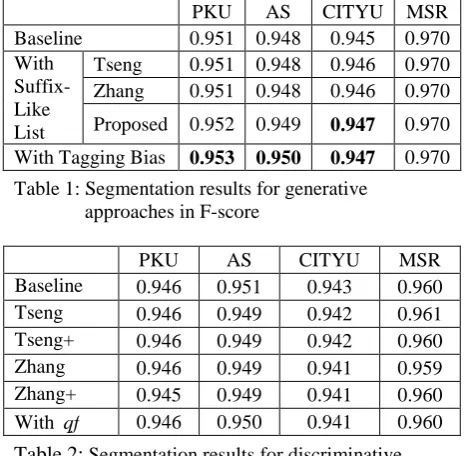
PKU AS CITYU MSR Baseline 0.951 0.948 0.945 0.970 With
Suffix-Like List
Tseng 0.951 0.948 0.946 0.970 Zhang 0.951 0.948 0.946 0.970 Proposed 0.952 0.949 0.947 0.970 With Tagging Bias 0.953 0.950 0.947 0.970 Table 1: Segmentation results for generative
approaches in F-score
PKU AS CITYU MSR
Baseline 0.946 0.951 0.943 0.960 Tseng 0.946 0.949 0.942 0.961 Tseng+ 0.946 0.949 0.942 0.960 Zhang 0.946 0.949 0.941 0.959 Zhang+ 0.945 0.949 0.941 0.960 With qf 0.946 0.950 0.941 0.960
Table 2: Segmentation results for discriminative approaches in F-score
proposed way. To inspect if the quality of the suffix-list will affect the performance, we manually remove those characters which should not be regarded as suffixes in each list (such as
Arabic numbers, and characters like “斯”, “尔”,
which always appear at the end of transliteration). However, the performances are almost the same even with those cleaned lists (thus not shown in the table). The reasons will be found out and explained in Section 5.
4.3
Results of discriminative approachesTable 2 shows the segmentation results for various discriminative approaches. ‘Baseline’ in the table denotes the discriminative model that adopts features (a)-(c) described in Section 3.2; ‘Tseng’ denotes the model with additional feature (d); and ‘Tseng+’ adopts the same feature set as ‘Tseng’, but the suffix-like list is obtained and used in our proposed way; similarly, the same interpretation goes for ‘Zhang’ and
‘Zhang+’. Last, ‘with qf ’ denotes the model
with additional feature (f), instead of features (d)
and (e). Please note that qs(also ql and qr) is
not adopted (explained above in Section 3.2). The results in Table 2 show that neither the suffix-like list related feature nor the context-free tagging bias feature can provide any help for the
discriminative approach. Similar to the
generative approach, no significant benefit can be brought in even if the list is further cleaned by the human. This seems contradictory to the claims given at (Tseng et al., 2005; Zhang et al., 2006) and will be studied in the next section.
5
Problems Investigation
5.1
Suffix information is unreliable whenassociated context is not seen
Whether a character can act as a suffix is highly context dependent. Although context has been taken into consideration in our proposed suffix-list approach and tagging bias approach, the preference implied by the suffix list or tagging bias level becomes unreliable when the context is unfamiliar. Table 3 shows the percentage that the preference of different tagging bias factors matches the real tag in the training set. It can be seen that the matching rate (or the influence
power) is higher with broader seen context.
When no context is available (the last column; the suffix-list approach), it drops dramatically. As a result, many over-generalized words are
produced when qf must be adopted. For example,
two single-character words “该/局” (this
bureau) are wrongly merged into a pseudo OOV
“该局”. As another example, the first three
characters in the sequence “冠 军/ 奖 碟”
(championship award-tray) are wrongly merged
into a pseudo OOV “冠军奖”
(championship-award). Because the related context “奖碟” is
never seen for the character ‘奖’, it is thus
regarded as a suffix in this case (as it is indeed a
suffix in many other cases such as “医学奖”
(medicine-prize) and “一等奖” (first-prize)).
Corpus qs ql qr qf
PKU 0.996 0.977 0.923 0.686 AS 0.993 0.970 0.899 0.662 CITYU 0.997 0.976 0.919 0.653 MSR 0.992 0.970 0.898 0.662 Table 3: The matching rates of various tagging bias
factors in the training set
Corpus qs ql qr qf
PKU 0.457 0.135 0.135 0.002 AS 0.374 0.083 0.082 0.004 CITYU 0.515 0.148 0.149 0.008 MSR 0.299 0.060 0.060 0.0003 Table 4: Unseen ratios for qs,ql,qr and qf in the
testing set
5.2
Required context is frequentlyunobserved for testing instances
corpus size, roughly due to Zipf’s law; and n-gram is expected to also follow this pattern (Marco, 2009). Therefore, the sparseness problem gets more serious for the n-gram with a
larger “n” (i.e., with wider context) because its
number of possible distinct types would become much greater. As a consequence, there will be much more unseen bigrams than unseen unigrams in the testing set (Of course, unseen trigrams will be even more). Table 4 shows the
unseen ratios for qs, ql, qr and qf in the testing
set. It is observed that the unseen ratio for qs is
much larger than that for qf. However, according
to the discussion in the previous subsection, the preference of tagging bias level is not reliable for
qf. Therefore, more reliable a suffix-feature is,
less likely it can be utilized in the testing-set. As the result, no significant improvement can be brought in by using suffix related features.
6
Conclusion
Since suffixes are quite productive in forming new words, and OOV is the main error source for all state-of-the-art CWS approaches, it is
intuitive to expect that utilizing suffix
information will further improve the performance. Some papers even claim that suffix-like list is useful in their discriminative models, though
without presenting direct evidence.
Against the above intuition, the empirical study of this paper reveals that when suffix related features are incorporated into those widely
adopted surface features, they cannot
considerably improve the performance of character-based generative and discriminative models, even if the context is taken into consideration. Error analysis reveals that the main problem behind this surprising finding is the conflict between the reliability and the coverage of those suffix related features. This conclusion is valuable for those relevant researchers in preventing them from wasting time on similar attempts.
Last, the reason that humans can distinguish suffixes correctly is largely due to their ability in utilizing associated syntactic and semantic knowledge of the plain text. We still believe suffix information can help for CWS if such knowledge can be effectively incorporated into the model. And this will be our future work.
Acknowledgments
The research work has been partially funded by the Natural Science Foundation of China under
Grant No. 61003160 and Hi-Tech Research and Development Program (“863” Program) of China
under Grant No. 2012AA011101 and
2012AA011102.
References
Andreas Stolcke. 2002. SRILM - an extensible language modeling toolkit. In Proceedings of the International Conference on Spoken Language Processing, pages 311-318.
Baroni Marco. 2009. Distributions in text. In A. Lüdeling and M. Kytö (eds.), Corpus linguistics: An international handbook. Mouton de Gruyter, Berlin, Germany.
Franze Josef Och. 2003. Minimum error rate training in statistical machine translation. In Proceedings of the 41st Annual Meeting on Association for
Computational Linguistics, pages 160-167,
Sapporo, Japan.
Fuchun Peng, Fangfang Feng and Andrew McCallum. 2004. Chinese segmentation and new word detection using conditional random fields. In
Proceedings of COLING, pages 562–568.
George Kingsley Zipf. 1949. Human Behavior and the Principle of Least Effort: An Introduction to Human Ecology. Addison-Wisley. Oxford, UK. Hai Zhao, Chang-Ning Huang, Mu Li and Bao-Liang
Lu. 2010. A Unified Character-Based Tagging Framework for Chinese Word Segmentation. ACM Transactions on Asian Language Information Processing (TALIP), 9 (2). pages 1-32.
Hai Zhao and Chunyu Kit. 2008. Unsupervised Segmentation Helps Supervised Learning of Character Tagging for Word Segmentation and Named Entity Recognition. In Sixth SIGHAN
Workshop on Chinese Language Processing.
Hai Zhao, Yan Song and Chunyu Kit. 2010. How Large a Corpus do We Need : Statistical Method vs. Rulebased Method. In Proceedings of LREC-2010. Malta.
Huaping Zhang, Hongkui Yu, Deyi Xiong and Qun Liu. 2003. HMM-based Chinese lexical analyzer ICTCLAS. In Proceedings of the Second SIGHAN
Workshop on Chinese Language Processing, pages
184-187.
Huihsin Tseng, Pichuan Chang, Galen Andrew, Daniel Jurafsky and Christopher Manning. 2005. A Conditional Random Field Word Segmenter for Sighan Bakeoff 2005. In Proceedings of the Fourth
SIGHAN Workshop on Chinese Language
Processing, pages 168-171.
named entity recogni-tion: a pragmatic approach.
Computational Linguistics, 31(4), pages 531-574. Jin Kiat Low, Hwee Tou Ng and Wenyuan Guo. 2005.
A Maximum Entropy Approach to Chinese Word Segmentation. In Proceedings of the Fourth
SIGHAN Workshop on Chinese Language
Processing, pages. 161-164, Jeju Island, Korea. Kun Wang, Chengqing Zong and Keh-Yih Su. 2009.
Which is more suitable for Chinese word segmentation, the generative model or the discriminative one? In Proceedings of PACLIC, pages 827-834, Hong Kong, China.
Kun Wang, Chengqing Zong and Keh-Yih Su. 2010. A Character-Based Joint Model for Chinese Word Segmentation. In Proceedings of the 23rd
International Conference on Computational
Linguistics, pages 1173-1181, Beijing, China. Kun Wang, Chengqing Zong and Keh-Yih Su. 2012.
Integrating Generative and Discriminative Character-Based Models for Chinese Word Segmentation. ACM Transactions on Asian Language Information Processing, Vol.11, No.2, June 2012, pages 7:1-7:41.
Nianwen Xue. 2003. Chinese Word Segmentation as Character Tagging. Computational Linguistics and Chinese Language Processing, 8 (1). pages 29-48. Ruiqiang Zhang, Genichiro Kikui and Eiichiro Sumita.
2006. Subword-based Tagging for Confidence-dependent Chinese Word Segmentation. In
Proceedings of the COLING/ACL, pages 961-968, Sydney, Australia.
Stanley F. Chen and Joshua Goodman. 1998. An empirical study of smoothing techniques for language modeling. Technical Report TR-10-98, Harvard University Center for Research in
Computing Technology.
Thomas Emerson. 2005. The second international Chinese word segmentation bakeoff. In
Proceedings of the Fourth SIGHAN Workshop on
Chinese Language Processing, pages 123-133.
Weiwei Sun. 2010. Word-based and character-based word segmentation models: Comparison and combination. In Proceedings of the 23rd
International Conference on Computational
Linguistics (Coling 2010), pages 1211-1219,
Beijing, China.
Weiwei Sun and Jia Xu. 2011. Enhancing Chinese Word Segmentation Using Unlabeled Data. In
Proceedings of the 2011 Conference on Empirical Methods in Natural Language Processing, pages 970-979, Edinburgh, Scotland, UK.
Xiaoqing Li, Kun Wang, Chengqing Zong and Keh-Yih Su. 2012. Integrating Surface and Abstract Features for Robust Cross-Domain Chinese Word Segmentation. In Proceedings ofthe 24th
International Conference on Computational
Linguistics (COLING). Pages 1653-1669, Mumbai,
India.
Xu Sun, Houfeng Wang and Wenjie Li. 2012. Fast Online Training with Frequency-Adaptive Learning Rates for Chinese Word Segmentation and New Word Detection. In Proceedings of the 50th Annual Meeting of the Association for Computational Linguistics, pages 253-262, Jeju Island, Korea.
Ying Zhang, Stephan Vogel and Alex Waibel, 2004. Interpreting BLEU/NIST scores: How much improvement do we need to have a better system. In Proceedings of LREC, pages 2051–2054. Yue Zhang and Stephen Clark, 2007. Chinese
Segmentation with a Word-Based Perceptron Algorithm. In Proceedings of ACL, pages 840-847, Prague, Czech Republic.
Zhengdong Dong, Qiang Dong and Changling Hao. 2010. Word segmentation needs change - from a linguist's view. In Proceedings of CIPS-SIGHAN
Joint Conference on Chinese Language Processing.
Beijing, China.
Zhongguo Li. 2011. Parsing the Internal Structure of Words: A New Paradigm for Chinese Word Segmentation. In Proceedings of the 49th Annual Meeting of the Association for Computational
Linguistics: Human Language Technologies, pages