Odds of Successful Transfer of Low-level Concepts:
A Key Metric for Bidirectional Speech-to-speech Machine Translation
in DARPA’s TRANSTAC Program
Gregory A. Sanders
1, Sébastien Bronsart
1, Sherri Condon
2, Craig Schlenoff
1 National Institute of Standards and Technology1 The MITRE Corporation2Gaithersburg, MD 20899–8940 McLean, VA 22102
E-mail: [email protected], [email protected], [email protected], [email protected]
Abstract
The Spoken Language Communication and Translation System for Tactical Use (TRANSTAC) program is a Defense Advanced Research Agency (DARPA) program to create bidirectional speech-to-speech machine translation (MT) that will allow U.S. Soldiers and Marines, speaking only English, to communicate, in tactical situations, with civilian populations who speak only other languages (for example, Iraqi Arabic). A key metric for the program is the odds of successfully transferring low-level concepts, defined as the source-language content words. The National Institute of Standards and Technology (NIST) has now carried out two large-scale evaluations of TRANSTAC systems, using that metric. In this paper we discuss the merits of that metric. It has proven to be quite informative. We describe exactly how we defined this metric and how we obtained values for it from panels of bilingual judges—allowing others to do what we have done. We compare results on this metric to results on Likert-type judgments of semantic adequacy, from the same panels of bilingual judges, as well as to a suite of typical automated MT metrics (BLEU, TER, METEOR).
1.
Overview
The Spoken Language Communication and Translation System for Tactical Use (TRANSTAC) program is a Defense Advanced Research Projects Agency (DARPA) advanced technology research and development program. The goal of the TRANSTAC program is to demonstrate capabilities to rapidly develop and field free-form, two-way speech-to-speech machine translation systems that enable speakers of different languages to communicate with one another without a human interpreter — particularly to allow English-speaking U.S. Soldiers and Marines in real-world tactical situations to communicate with civilian populations who speak other languages. While the military personnel will be trained to use the systems, the assumption is that the foreign language users will have little or no chance to become familiar with using the system in advance. To date, several prototype TRANSTAC systems have been developed and formally evaluated (Weiss, et al., 2008) for force protection, civil affairs, and medical screening domains in Iraqi Arabic, and in an Indo-European ―surprise language‖ for which the system developers were given 90 days to create a system for evaluation. Systems have been demonstrated on both PDA and laptop-grade platforms with varying performance.
A key metric for the TRANSTAC program has been the odds of successful transfer of low-level concepts (elements of meaning) from the source-language spoken input, into the target-language output, via automatic speech recognition (ASR) pipelined with machine translation (MT). The National Institute of Standards and Technology leads the evaluation team for TRANSTAC. We were asked to define a reasonable measure of the transfer of low-level concepts, and we have chosen to consider the low-level concepts to be the source-language
content words or open-class words (nouns, verbs, adjectives, adverbs) plus important quantifiers and prepositions. Transfer of the low-level concepts is scored one concept at a time, as successfully transferred, deleted, or substituted (judges can also identify inserted concepts). NIST has now carried out two large-scale evaluations of TRANSTAC systems including that metric. In this paper we discuss the merits of the metric. It has proven to be quite informative.
In this paper, we take a look back at exactly how we defined the metric and at how we obtained values for it from panels of bilingual human judges — which should enable others to do what we did. To examine the performance of this metric, we present comparisons of the results from the metric to the results from other MT metrics on the same data, comparing this metric to Likert-type judgments of semantic adequacy from the same panels of bilingual human judges as well as to a suite of typical automated MT metrics (BLEU, TER, METEOR).
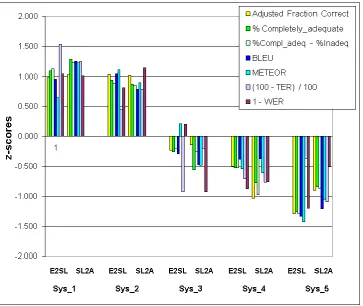
Figure 1: Synoptic overview of metrics for Arabic, converted to standard normal distribution z-scores.
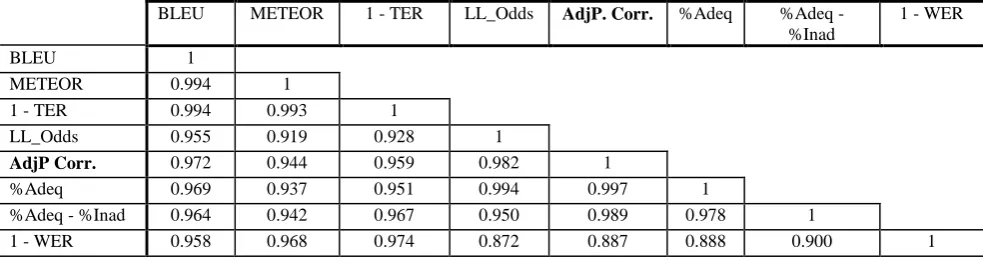
BLEU METEOR 1 - TER LL_Odds AdjP. Corr. %Adeq %Adeq - %Inad
1 - WER
BLEU 1
METEOR 0.994 1
1 - TER 0.994 0.993 1
LL_Odds 0.955 0.919 0.928 1
AdjP Corr. 0.972 0.944 0.959 0.982 1
%Adeq 0.969 0.937 0.951 0.994 0.997 1
%Adeq - %Inad 0.964 0.942 0.967 0.950 0.989 0.978 1
1 - WER 0.958 0.968 0.974 0.872 0.887 0.888 0.900 1
Table 2. Pearson correlations for English to Iraqi Arabic
BLEU METEOR 1 - TER LL_Odds AdjP Corr. %Adeq %Adeq -
%Inad
1 - WER
BLEU 1
METEOR 0.974 1
1 – TER 0.982 0.945 1
LL_Odds 0.978 0.990 0.972 1
AdjP Corr. 0.953 0.996 0.924 0.986 1
%Adeq 0.979 0.988 0.930 0.971 0.978 1
%Adeq - %Inad 0.966 0.991 0.917 0.965 0.982 0.994 1
1 - WER 0.813 0.906 0.756 0.847 0.912 0.880 0.924 1
Table 3. Pearson correlations for Iraqi Arabic to English
BLEU METEOR 1 - TER LL_Odds AdjP Corr. %Adeq %Adeq - %Inad 1 - WER
BLEU 1
METEOR 0.953 1
1 – TER 0.730 0.542 1
LL_Odds 0.983 0.921 0.810 1
Adj. Corr. 0.998 0.958 0.746 0.989 1
%Adeq 0.992 0.940 0.787 0.988 0.997 1
%Adeq - %Inad 0.989 0.940 0.783 0.982 0.994 0.999 1
1 – WER 0.930 0.949 0.704 0.932 0.951 0.956 0.961 1
Table 4. Pearson correlations for English to SurpriseLang
BLEU METEOR 1 - TER LL_Odds AdjP Corr. %Adeq %Adeq - %Inad 1 - WER
BLEU 1
METEOR 0.988 1
1 - TER 0.970 0.986 1
LL_Odds 0.922 0.967 0.976 1
Adj. Corr. 0.908 0.955 0.973 0.998 1
%Adeq 0.961 0.990 0.976 0.974 0.960 1
%Adeq - %Inad 0.933 0.972 0.987 0.992 0.990 0.983 1
1 - WER 0.869 0.920 0.867 0.919 0.893 0.949 0.904 1
9.
Acknowledgments
We acknowledge Mari Maeda, the DARPA Program Manager for TRANSTAC, who has funded us to investigate these challenging, interesting scientific problems of how to evaluate multi-lingual speech-to-speech machine translation.
We wish to particularly acknowledge assistance from Jon Philips at MITRE who generated normalizations and ran the scoring software for Arabic and our surprise language, and we wish to acknowledge Arabic annotation assistance from Luma Ateyah of the Linguistic Data Consortium. We also acknowledge substantial helpful advice from Dan Parvaz of MITRE and Mohamed Maamouri of the Linguistic Data Consortium on various characteristics of Arabic. And of course we are grateful for the careful analyses from our panels of bilingual judges.
10.
References
Banerjee, S., and A. Lavie (2005). METEOR: An Automatic Metric for MT Evaluation with Improved Correlation with Human Judgments. In Proceedings of the Workshop on Intrinsic and Extrinsic Evaluation Measures for MT and/or Summarization at the 43rd Annual Meeting of the Association for Computational Linguistics (ACL). Ann Arbor, MI.
Cohen, J. (1960). A coefficient of agreement for nominal scales. Educational and Psychological Measurement, (10), pp. 37–46.
Condon, S., J. Phillips, C. Doran, J. Aberdeen, D. Parvaz, B. Oshika, G. Sanders, and C. Schlenoff (2008). Applying Automated Metrics to Speech Translation Dialogs. In Proceedings of LREC-2008.
Frederking, R. and S. Nirenburg (1994). Three Heads are Better Than One. In Proceedings of the Fourth Conference on Applied Natural Language Processing (ANLP), pp. 95–100.
Frederking, R., A. W. Black, R. D. Brown, J. Moody, and E. Steinbrecher (2002). Field Testing the Tongues Speech-to-Speech Machine Translation System. In Proceedings of LREC-2002 (Las Palmas, Gran Canaria, Canary Islands, Spain), pp. 160–164.
Hogan, C., and R. E. Frederking (1998). An Evaluation of the Multi-Engine MT Architecture. In Proceedings of AMTA-1998, pp. 113–124.
King, M. (1996). Evaluating Natural Language Processing Systems. In Communications of the ACM (39)1, pp. 73–79.
Knight, K. and I. Chander (1994). Automated Postediting of Documents. In Proceedings of the National Conference on Artificial Intelligence (AAAI).
Lavie, A., K. Sagae, and S. Jayaraman (2004). The Significance of Recall in Automatic Metrics for MT Evaluation. In Proceedings of the 6th Conference of the Association for Machine Translation in the Americas (AMTA). Washington, DC.
Lita, L. V., M. Rogati, and A. Lavie (2005). BLANC: Learning Evaluation Metrics for MT. In Proceedings of Human Language Technology Conference and
Conference on Empirical Methods in Natural Language Processing (HLT/EMNLP). (Vancouver, Canada, October 2005). pp. 740–747.
Melamed, I. D., R. Green, and J. P. Turian (2003). Precision and Recall of Machine Translation. Proceedings of HLT/NAACL 2003 (Edmonton, Alberta, Canada), pp. 61–63.
Papineni, K., S. Roukos, T. Ward, and W. Zhu (2001). BLEU: A Method for Automatic Evaluation of Machine Translation. (IBM research report available at http://domino.watson.ibm.com/library/cybergig.nsf/). Polzar, M., and E. Charniak (2006). Bllip: An Improved
Evaluation Metric for Machine Translation. Brown University, Providence, Rhode Island. (Available as: http://www.cs.brown.edu/research/pubs/theses/masters /2006/mpozar.pdf)
Russo-Lassner, G., J. Lin, and P. Resnik (2005). A Paraphrase-based Approach to Machine Translation Evaluation. LAMP-TR-125 CS-TR-4754 UMIACS-TR-2005-57, University of Maryland, College Park, MD, August, 2005.
Snover M., B. Dorr, R. Schwartz, J. Makhoul, L. Micciulla, and R. Weischedel (2005). A Study of Translation Error Rate with Targeted Human Annotation. LAMP-TR-126, CS-TR-4755, UMIACS-TR-2005-58, University of Maryland, College Park, MD, July, 2005