Borrowing Language Resources for Development of Automatic Speech
Recognition for Low- and Middle-Density Languages
Lynette Melnar, Chen Liu
Application and Software Research Center, Motorola Labs Motorola, Schaumburg, IL 60196, USA
Lynette.Melnar, [email protected]
Abstract
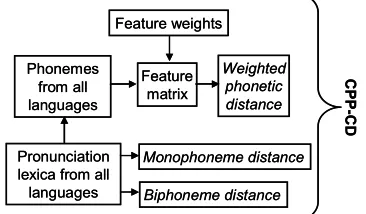
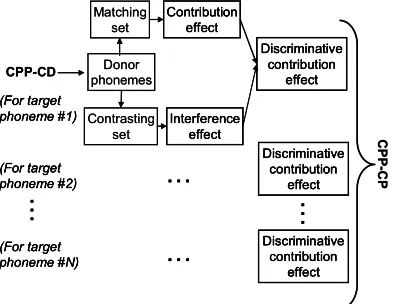
In this paper we describe an approach that both creates crosslingual acoustic monophone model sets for speech recognition tasks and objectively predicts their performance without target-language speech data or acoustic measurement techniques. This strategy is based on a series of linguistic metrics characterizing the articulatory phonetic and phonological distances of target-language phonemes from source-language phonemes. We term these algorithms the Combined Phonetic and Phonological Crosslingual Distance (CPP-CD) metric and the Combined Phonetic and Phonological Crosslingual Prediction (CPP-CP) metric. The particular motivations for this project are the current unavailability and often prohibitively high production cost of speech databases for many strategically important low- and middle-density languages.
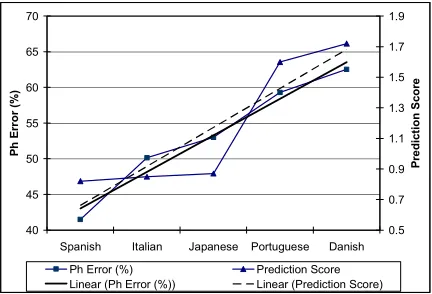
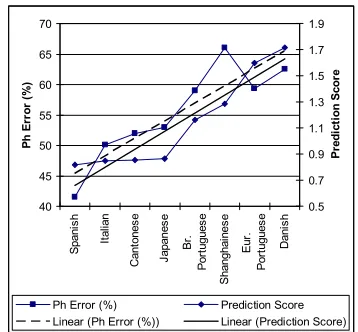
First, we describe the CPP-CD approach and compare the performance of CPP-CD-specified models to both native language models and crosslingual models selected by the Bhattacharyya acoustic-model distance metric in automatic speech recognition (ASR) experiments. Results confirm that the CPP-CD approach nearly matches those achieved by the acoustic distance metric. We then test the CPP-CP algorithm on the CPP-CD models by comparing the CPP-CP scores to the recognition phoneme error rates. Based on this comparison, we conclude that the CPP-CP algorithm is a reliable indicator of crosslingual model performance in speech recognition tasks.
1.
Introduction
Speech technologists typically use acoustic measurements to determine similarity among acoustic speech models for crosslingual modeling and there are a variety of distance metrics available (e.g., Sooful & Botha, 2002). Additionally, HMM similarity can be evaluated indirectly through comparison of HMM performances in ASR experiments. For acoustic measurements, speech data must be accessible for model training. However, speech data unavailability is a practical concern in that most commercially available speech databases are principally restricted to high-density languages while the vast majority of languages are low- and middle-density languages. Low- and middle-density languages have not been exposed to intense data collection and resources for these languages are subsequently either limited or completely unavailable.
A high-density language is characteristically a majority language associated with a large, economically advantaged population of speakers, a significant proportion of which regularly uses computers or has computer experience. The language bears official status or non-official predominant use in one or more countries and is also recognized as important by foreign governments. Finally, the language is supported by a writing tradition and has been studied and well documented in various types of language resources. In regards to speech modeling, it is this last factor of language resource availability that proves most significant. In particular, a high-density language is associated with several commercially available speech resources of various types (and quality). Examples of such high-density languages are major dialects of Arabic, English, Mandarin, and Spanish.
A low-density language, in contrast, lacks many of the high-density characteristics. The population of speakers may be quite small, economically disadvantaged, and have little or no computer experience. The language may be considered a minority language in the countries where it is spoken and is not judged to be very significant by foreign governments or language researchers. A writing system may be completely lacking for the low-density language or only non-standardized writing systems may exist in limited use; thus language resources are sparse or non-existent. Many Native American and minor African languages would fall into this category. Finally, a middle-density language shows a balance of those extremes exhibited by high- and low-density languages and would include, for example, many Chinese, Indian, and African languages in the emerging market.
Hence crosslingual modeling and performance prediction that necessitate no target-language speech data have a great value for the resource limited low- and middle-density languages by taking advantage of the well-trained models of, typically, high-density languages. Our approach is specifically suited to target low- and middle-density languages that are (1) associated with a writing system but perhaps lack significant, readily available language resources and (2) related to other, typically high-density languages for which language resources are easily accessible.
pp. 29-37.
Kessler, B. (1995). Computational dialectology in Irish Gaelic. Proc. 6th Conf. European Chapter of ACL, pp. 60–67.
Kessler, B. (2005). Phonetic comparison algorithms. Transactions of the Philological Society, v. 103, pp. 243-260.
Köhler J. (1996). Multilingual phoneme recognition exploiting acoustic-phonetic similarities of sounds. ICSLP’96, pp. 2195-2198.
Kondrak, G. (2002). Algorithms for Language Reconstruction, Ph.D. thesis, University of Toronto. Liu, C. & Melnar, L. (2005). An automated linguistic
knowledge-based cross-language transfer method for building acoustic models for a language without native training data. Interspeech’2005-Eurospeech, pp. 1365-1368.
Mak, B. & Barnard, E. (1996). Phone clustering using the Bhattacharyya distance. ICSLP’96, 2005-2008. Nerbonne, J. & Heeringa, W. (1997). Measuring dialect
distance phonetically. Proc. 3rd Meeting ACL Special Interest Group in Comp. Phonology, pp. 11-18. Schultz, T. & Waibel, A. (1997). Fast bootstrapping of
LVCSR systems with multilingual phoneme sets. Proc. Eurospeech 97, pp. 371-374.
Schultz, T. & Waibel, A.. (2000). Polyphone decision tree specialization for language adaptation. Proc. of ICASSP. Istanbul.
Somers, H.L. (1998). Similarity metrics for aligning children’s articulation data. Proc. 36th Annual Meeting ACL and 17th Int. Conf. Comp. Ling., pp. 1227–1231. Sooful, J.J. & Botha, E.C. (2002). Comparison of acoustic distance measures for automatic cross-language phoneme mapping. ICSLP’02, pp. 521-524.