CSEIT21831439 | Received : 16 Feb 2018 | Accepted : 27 Feb 2018 | January-February-2018 [(3) 2 : 66-73 ]
International Journal of Scientific Research in Computer Science, Engineering and Information Technology © 2018 IJSRCSEIT | Volume 3 | Issue 2 | ISSN : 2456-3307
66
User and Location Based Collaborative Filtering
Recommendation in Social Networks
T. Manjula1, P. S. Naveen Kumar2
1PG Scholar, Department of MCA, St. Ann’s College of Engineering & Technology, Chirala, Andhra Pradesh, India
2Assistant Professor, Department of MCA, St. Ann’s College of Engineering & Technology, Chirala, Andhra Pradesh,
India
ABSTRACT
The social networks are utilized to share data between the clients. The Location Based Social Networks (LBSN) is examined with location and time data on check in points of interest. The administration rating forecast operations are completed with the client location and audit points of interest. The Location Based Rating Prediction (LBRP) algorithm is connected for the administration rating expectation process. The LBRP utilizes the three estimations for the forecast procedure. The client thing geological associations, client land associations and relational intrigue similitude measures are assessed for the rating forecast process. The client – thing geological association demonstrates the separation between the client appraisals and the client – thing land locations. The client – client land association shows the client rating contrasts and the client – client geographical location separations. The administration rating expectation process is developed with client conduct disclosure and administration score file strategies. The client conduct estimation process is done with multi movement focuses. The administration score estimation and file operations are performed with the characteristics of the Point of Interests (POI). The client proposal assignment is coordinated with the framework to recommend better administrations with reference to the client conduct and evaluations. The client classification, locale and occasional perspectives are engaged in the recommendation process.
Keywords :Service Rating Prediction, Location Based Social Networks, Location Based Rating Prediction, User Behaviors and Service Recommendation Process
I.
INTRODUCTION
Social network is a social structure made up of an arrangement of social actors and an arrangement of the dyadic ties between these on-screen characters. The social network point of view gives an arrangement of strategies to investigating the structure of entire social substances and additionally an assortment of speculations clarifying the examples saw in these structures. The investigation of these structures utilizes social network examination to recognize nearby and worldwide examples, find compelling substances and analyze arrange
network examination is currently one of the significant ideal models in contemporary human science and is likewise utilized in various other social and formal sciences. Together with other complex systems, it frames some portion of the early field of system science. The social network is a hypothetical develop valuable in the sociologies to think about hypothetical approach is, fundamentally, social. An aphorism of the social network way to deal with understanding social association is that social wonders ought to be basically considered and examined through the properties of relations between and inside units, rather than the properties of these units themselves. In this way, one regular feedback of social network hypothesis is that individual office is frequently disregarded in spite of the fact that this may not be the situation by and by. Definitely in light of the fact that various kinds of relations, solitary or in mix, shape these system setups, organize examination are valuable to a wide scope of research undertakings. In sociology, these fields of study incorporate, however are not constrained to human sciences, science, financial matters, geology, authoritative investigations, social brain research, social science and sociolinguistics. The sheer number of things accessible in online frameworks can be overpowering for clients and makes discovering things of intrigue amazingly difficult. Besides the quick and ceaseless development of the Web makes it difficult to physically assess each new thing to decide whether it may be of intrigue. Content separating frameworks, in view of methods from data recovery, are intended to aid this procedure by narrowing down the quantity of things a client needs to look through with a specific end goal to satisfy a specific data require. These frameworks depend on literary portrayals of things and try to coordinate these
II.
RELATED WORK
Bond et al. directed a 61-million-man try about social effect on Facebook amid the 2010 U.S. congressional decisions. They exhibited that solid ties in OSNs can impact individuals' reception of voting exercises. Not quite the same as, we think about social impact on client's selection of online social voting’s, which are started and engender simply in OSNs. Collective sifting based RSs utilize client criticism information to anticipate client interests, prompting extremely exact proposals. Adomavicius and Tuzhilin displayed a review of RSs. Koren and Salakhutdinov and Mnih proposed MF-based models for rating forecast. Shi et al. considered community oriented sifting for top-k suggestion. Rendle et al. introduced a nonexclusive streamlining model Bayesian Personalized Ranking (BPR) - Optimization (Opt) got from the most extreme back estimator for ideal customized positioning. Rendle et al. proposed a non specific learning algorithm LearnBPR to improve BPROpt. BPR can chip away at best of our proposed strategies, for example, Weibo-MF and NN ways to deal with streamline their execution. The undeniably famous OSNs give extra data to improve unadulterated rating-based RSs. There are numerous past examinations concerning how to coordinate social network data to build suggestion exactness, just to give some examples. Mama et al. proposed to factorize client thing rating grid and user– client relationship lattice together for thing rating forecast. Mama et al. asserted that a client's evaluating of a thing is affected by his/her companions. A client's evaluating to a thing comprises of two sections, the client's own rating of the thing and the client's companions' appraisals of the thing. The creators at that point proposed to join the two appraisals directly to get a last anticipated rating. Jamali and Ester guaranteed that a client's advantage is affected by his/her companions. Along these lines, a client's inert component is obliged to be like his/her companions' dormant highlights during the time spent MF. Yang et al. asserted that a client's advantage is multifaceted and proposed to part the first social network into
circles. Contrast circles are utilized to foresee evaluations of things in various classes.
various channels, comprising of twofold client voting exercises, user– client trust connections and client bunch affiliations. We are the first to think about proposal of the rising on the web social votings to the best of our insight. NN algorithms distinguish the purported neighbors of an objective client. An expectation of thing inclinations or a rundown of suggested things for the objective client can be delivered by consolidating inclinations of the neighbors.
Jamali and Ester proposed an approach, to be specific Trust-CF, to join social network into NN-based best k RSs. Trust-CF figures the anticipated rating for an applicant thing as the weighted normal of every single watched rating in the customary CF neighborhood and social neighborhood. Trust-CF does not work with paired informational collection, as the weighted normal of every single watched thing is 1. Yang et al. proposed Trust-client inert component space based synergistic separating approach (Trust-CF-ULF) to consolidate social network data into top-k RSs. Trust-CF-ULF approach is the mix of CF-ULF and social network based approach. Utilizing met path-based methodologies, we consider a more extensive arrangement of neighborhoods than can be dealt with as an uncommon instance of our half and half NN approaches. Social voting as another social network application has not been contemplated much in the current writing. Contrasted and customary things for suggestion, the uniqueness of online social voting lays in its social proliferation along social connections. Additionally, the motivation behind instating a voting is to connect with individuals to express their assessments. Consequently, the subjects shrouded in online social votings are for the most part more captivating than different applications in OSNs. Some intriguing measurements of our online social voting information follow.
III. SERVICE RATING PREDICTION IN LBSN
As of late, with the quick advancement of mobile devices and universal Internet get to, social network
that as it may, if recommender frameworks consider land location factor, the suggestions might be more refined and keen. These are the inspirations why we use geographical location data to make rating forecast. With the above inspirations, the objectives of this paper are: 1) to mine the pertinence between client's evaluations and user item geographical location separations, called as client thing land association, 2) to mine the significance between clients' appraising contrasts and client geological location separations, called as client geographical association and 3) to discover the general population whose intrigue is like clients. In this paper, three components are mulled over for rating forecast: client thing land association, client geographical association and relational intrigue similitude. These variables are combined into a location based rating forecast display. The oddities of this paper are client thing and client land associations, i.e. we investigate clients' appraising practices through their geological location separations.
IV. ISSUES ON SERVICE RATING PREDICTION
SCHEMES
The social network keeps up the client survey subtle elements to gauge the administration rating esteems. The administration rating expectation operations are done with the client location and survey subtle elements. The Location Based Rating Prediction (LBRP) algorithm is connected for the administration rating forecast process. The LBRP utilizes the three estimations for the expectation procedure. They are client thing geological associations, client geographical associations and relational intrigue similitude measures. The client – thing geographical association shows the separation between the client evaluations and the client – thing land locations. The client – client land association demonstrates the client rating contrasts and the client – client geographical location separations. The classification conveyance vector is developed with bury individual intrigue comparability measures. The accompanying issues are recognized from the present administration rating forecast plans.
User conduct estimation isn't performed Service score ordering process isn't upheld Point of Interest (POI) traits are not utilized as
a part of the rating procedure
Recommendation process isn't advanced
V.
SERVICE RECOMMENDATION IN
LOCATION BASED SOCIAL NETWORKS
registration scene and time points of interest are kept up in location information esteems. Client submitted messages are kept up under client survey information gathering. The Location Based Rating Prediction (LBRP) algorithm is connected for the administration rating forecast process. Client surveys and location points of interest are broke down to gauge the administration rating esteems. Client Item land associations and client geological associations are assessed in the rating forecast process. Bury individual intrigue similitude is utilized to assemble class circulation vector for rating expectation process. The client practices are found with the help of the multi movement focuses. Client audits, location and rating points of interest are utilized as a part of the client conduct estimation process. Client and thing association with location points of interest are dissected in the client conduct estimation process. Client practices are spoken to as client group classifications. Administration score esteems are evaluated with benefit rating data. Administration scores are ordered with benefit need levels. Purpose of intrigue characteristics are utilized as a part of the score estimation and ordering process. The administration score file is passed to the administration suggestion process. Administration proposal process is work to recommend better administrations in light of the client surveys. Client conduct and administration score file are utilized as a part of the administration proposal process. Single and different property based suggestion process is upheld in the framework. Client class, locale and occasional elements are utilized as a part of the multi trait based proposal process.
VI. EXPERIMENTAL ANALYSIS
The administration rating expectation and suggestion undertakings are completed on the social network audit points of interest. The Location Based Rating Prediction (LBRP) conspire is utilized to appraise the administration rating levels. The User Behavior Discovery with Service Score Index (UBD-SSI) conspire is work to appraise benefit score and
suggestion errands. The similar investigation is completed utilizing three parameters. They are Service Rating Precision, Community Relevancy and computational multifaceted nature measures.
Figure 1. Service Rating Precision Analysis between LBRP and UBD-SSI techniques
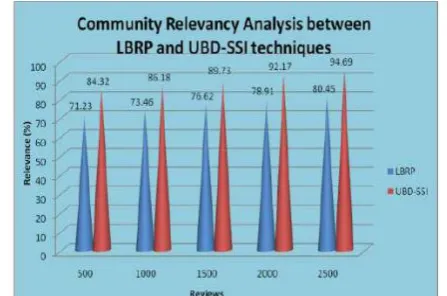
Figure 2. Community Relevancy Analysis between LBRP and UBD-SSI techniques
The service scores and their ratings are assessed with the client surveys that are distributed in the Location Based Social Networks (LBSN). The exactness examination is assessed to assess the rating expectation precision levels. The Service Rating Precision investigation between the Location Based Rating Prediction (LBRP) and User Behavior Discovery with Service Score Index (UBD-SSI) is appeared in figure 1. The User Behavior Discovery with Service Score Index (UBD-SSI) strategy expands the Service Rating Precision 20% than the Location Based Rating Prediction (LBRP) procedure.
examination between the Location Based Rating Prediction (LBRP) and User Behavior Discovery with Service Score Index (UBD-SSI) is appeared in figure 2.
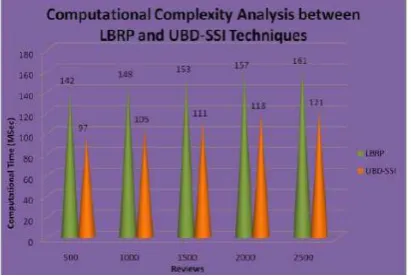
Figure 3. Computational Complexity Analysis between LBRP and UBD-SSI techniques
The User Behavior Discovery with Service Score Index (UBD-SSI) system builds Community Relevancy examination rate 15% than the Location Based Rating Prediction (LBRP) procedure. The computational intricacy examination is completed to evaluate the preparing time taken for the client conduct investigation and suggestion process. The computational multifaceted nature examination between The Location Based Rating Prediction (LBRP) and User Behavior Discovery with Service Score Index (UBD-SSI) is appeared in figure 3. The User Behavior Discovery with Service Score Index (UBD-SSI) strategy decreases the computational many-sided quality 30% than the Location Based Rating Prediction (LBRP) procedure.
VII.
CONCLUSION
Location based Social Networks (LBSNs) deals with the clients with their entrance location points of interest. The Location Based Rating Prediction (LBRP) algorithm is utilized to suggest administrations. Client conduct estimation and administration score list models are joined for the rating expectation and suggestion process. The suggestion procedure is enhanced with client classification, location and regular perspectives. The Location Based Social Network (LBSN) information
esteems are investigated for benefit rating expectation process. Client practices are assessed with client, thing and location connections. The rating forecast process is enhanced with benefit score estimation and file operations. Spatial locations and transient interims are utilized as a part of the suggestion procedure.
VIII. REFERENCES
[1]. Vincent Wenchen Zheng, Yu Zheng, and Qiang Yang. Joint learning user’s activities and profiles from gps data. In Proceedings of the 2009 International Workshop on Location Based Social Networks, pages 17–20. ACM, 2009. [2]. Yu Zheng, Licia Capra, Ouri Wolfson, and Hai
Yang. Urban computing: Concepts,
methodologies, and applications. ACM
Transaction on Intelligent Systems and Technology (ACM TIST), 2014.
[3]. Yu Zheng, Yukun Chen, Xing Xie, and Wei-Ying Ma. GeoLife2.0: A Location-Based Social Networking Service. In MDM, 2009c.
[4]. Yu Zheng and Xing Xie. Learning location correlation from gps trajectories. In Mobile Data
Management (MDM), 2010 Eleventh
International Conference on, pages 27–32. IEEE, 2010.
[5]. M. Jiang, P. Cui, X. Chen, F. Wang, W. Zhu and S. Yang, "Social recommendation with cross-domain transferable knowledge," IEEE Trans. Knowl. Data Eng., vol. 27, no. 11, pp. 3084– 3097, Nov. 2015.
[6]. Y. Sun, N. J. Yuan, X. Xie, K. McDonald and R. Zhang, "Collaborative nowcasting for contextual recommendation," in Proc. 25th Int. World Wide Web Conf. (WWW), 2016, pp. 1407–1418. [7]. Y. Zhang, B. Cao and D.-Y. Yeung,
"Multi-domain collaborative filtering," in Proc. 26th Conf. Uncertainty Artif. Intell. (UAI), Catalina Island, CA, USA, 2010, pp. 725–732.
[8]. H. Gao, J. Tang, X. Hu and H. Liu, "Content-aware point of interest recommendation on location-based social networks," in Proc. 29th AAAI Conf. Artif. Intell. (AAAI), 2015, pp. 1721–1727.
[10]. Facebook, accessed on 2013. OnlineAvailable: http://www.facebook.com
[11]. S.-H. Yang, B. Long, A. Smola, N. Sadagopan, Z. Zheng and H. Zha, "Like like alike: Joint friendship and interest propagation in social networks," in Proc. WWW, 2011, pp. 537–546. [12]. Y. Shi, A. Karatzoglou, L. Baltrunas, M. Larson,
N. Oliver and A. Hanjalic, "CLiMF: Learning to maximize reciprocal rank with collaborative less-is-more filtering," in Proc. ACM RecSys, 2012, pp. 139–146.
[13]. X. Yang, H. Steck and Y. Liu, "Circle-based recommendation in online social networks," in Proc. ACM KDD, 2012, pp. 1267–1275.
[14]. X. Yang, H. Steck, Y. Guo and Y. Liu, "On top-k recommendation using social networks," in Proc. ACM RecSys, 2012, pp. 67–74.
[15]. Xiwang Yang, Chao Liang, Miao Zhao, Hongwei Wang, Hao Ding, Yong Liu, Yang Li and Junlin Zhang, "Collaborative Filtering-Based Recommendation of Online Social Voting", IEEE Transactions On Computational Social Systems, March 2017.
About Authors:
T. Manjula is currently pursuing her MCA in MCA Department, St. Ann’s College of Engineering & Technology Chirala, A.P. She received her Bachelor of Science from ANU.