CSEIT1831412 | Received : 12 March 2018 | Accepted : 24 March 2018 | March-April-2018 [ (3 ) 3 : 781-792 ]
© 2018 IJSRCSEIT | Volume 3 | Issue 3 | ISSN : 2456-3307
781
Analysis of Techniques to Tackle the Issues of Root Disease
Detection- A Review
Hardeep Singh, Sandeep Sharma
Department of Computer Engineering & Technology, Guru Nanak Dev University, Amritsar, Punjab, India
ABSTRACT
Agriculture is the mother of all societies. It has assumed a vital part in the advancement of human development. Diseases in organic product cause significant issue in agrarian industry and furthermore cause monetary loss. The diseases in natural products diminish the yield and furthermore crumble the assortment and its pull back from the cultivation. So, prior detection of symptoms of organic product disease is required. This paper holds a study on natural product disease detection utilizing picture handling procedure. Advanced picture preparing is quick and exact method for detection of diseases in organic products. ID and arrangement of diseases of organic products are done through different calculations. This paper presents organic product disease distinguishing proof and grouping strategies .Although diseases and creepy crawly vermin can cause extensive yield misfortunes or convey demise to plants and it's likewise specifically influence to human wellbeing. These require cautious finding and opportune taking care of to shield the harvests from overwhelming misfortunes. In plant, diseases can be found in different parts, for example, natural product, stem and takes off. This paper speaks to the review of different methodologies for division strategy alongside highlight extraction and classifiers for detection of diseases in natural product.
Keywords: Fruit Disease, Image classification, pre-processing, Segmentation, Clustering, Classification, MSVM
I.
INTRODUCTION
Health issues as growing vastly, prohibitive demands of healthy food are also growing. For this purpose manual monitoring of fruits and vegetables becomes critical. Fungicide, pesticide and other chemical applications are available and are used to enhance quality of fruits. Discuss fruit disease detection using image processing techniques [1]. [2]suggested Smart farming approach that provides farmers with the decision and automation tools that seamlessly integrate knowledge and services for better quality and productivity. This manual monitoring is performed largely by farmers. Manual mentoring however does not give productive results all the times and hence expert advice is needed. [3]discuss disease in fruits and vegetables cause devastating
effect on economic conditions and agriculture industry greatly. Fruits considered for our work includes grapes, apples and pomegranate. Detailed description of disease affecting these fruits is listed as under
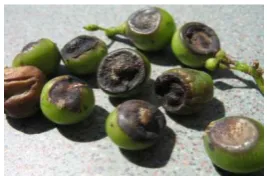
1.1 Grapes 1.1.1 Black Rot
Figure 1. Black rots disease in Grapes
1.1.2 Powdery Mildew
[5]This is caused by fungus Uncinulanecator. This is a common type of oidium. Grapes and some other species are affected by this disease. Whitish or greenish powdery patches are formed on grapes as a result of this disease. This disease also causes leaf curling. Cracking of fruits makes them rendered unusable hence productivity and quality is lost.
Figure 2. Powdery Mildew
1.1.3 Downy Mildew
[6]It is devastating infection present on grape wine. During summer and rain fall season this disease occurs. This disease is caused due to virus Plasmoparaviticola. Almost all the portion of green grapes becomes susplectible. Circular spots appear on leaf of grapes. Growth of grapes under this disease becomes downy hence the name downy mildew.
Figure 3. Downy Mildew in grapes
1.2 Apples
1.2.1 Apple Scab
[7]This disease cause most devastating apple infection that destroy the breed and reduces productivity and quality. The starting symptom appears on the outer surface of leafs of apple. Three stages of apple rot is present. At first stage infection is visible only on the outer surface of leaf, at second stage spots becomes brown and spot appear at the centre of the leaf. At the third stage apple fruit is infected and becomes brownish.
Figure 4. Apple Scab 1.2.2 Apple Rots
[5]This is fungus infection caused due to Botryosphaeriaobtusa. It affect leafs and main apple fruit. Infection increases from mild to severe in 1 to 3 weeks. Moist areas enhance such disease. Fruit becomes yellowish and brown.
Figure 5. Apple Rots 1.3 Pomegranate
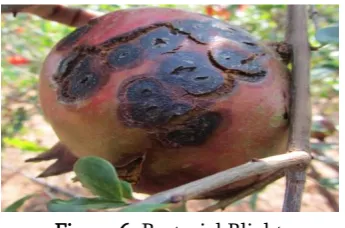
1.3.1 Bacterial Blight
Figure 6. Bacterial Blight
1.3.2 Aspergillus Fruit Rot
This disease is caused due to infection. The infection spread as fruit flower starts to open after a rain fall. The internal portion of pomegranate is infected through this disease.
Figure 7. Aspergillus Fruit Rot
Proposed writing utilizes innovation to precisely characterize the natural products in classes to distinguish sickness. Picture preparing strategies give simple and quicker approach to order picture introduced into classes for malady discovery. The work done in this approach is composed as under:
a. Image is gotten from dataset that is gotten from the web.
b. Image is nourished into the MSVM framework and K means clustering is connected
c. Multiple division levels are produced and client chooses the cluster level.
d. Final result is delivered by applying Fuzzy method. Fluffy framework is utilized to hold just the required bit of group, as it were includes required to recognize contamination is held utilizing fluffy neural system.
Next section gives literature survey of techniques that are used for clustering , segmentation and classification.
II.
EARLIER WORK
The techniques discussed in this section provide in depth into disease detection and prediction mechanisms to enhance quality and ultimately quality.
2.1 SVM
[9] proposes SVM for oil palm based division. Bolster vector machine is straight classifier which partitions the picture fragments into two classes. Bolster vector machine is information indicates that are broadened oblige point from the inside the picture to wanted level of division. The hyper plane used to characterize division incorporates
( )
Equation 1: Hyper plane used in SVM The margin is denoted with ρ.
( )
( ) ( )
Equation 2: Margin parameter for SVM
Larger the value of ρ more pixel values will be accommodated within the Segmentation.
2.2 K MEANS CLUSTERING
[10][11] utilizes a K-implies procedure for recognizing ailment and performing forecast precisely by disentangling parameters. The components that have homogenous properties are gathered together by utilizing gathering capacities and these components have been distinguished by closest neighbourhood calculation. For deciding the issue the correlation of edge esteems against the qualities created by gathering capacity are to be finished. Issues are reflected as deviation. The procedure is depicted by considering two focuses 'An' and 'B'. Let distance(A,B) is the separation between focuses An and B at that point distance(A,B)=0 and distance(A,B) >=0 iff A=B
a. distance(A,B)=distance(B,A)
metric is connected to decide exactness of the approach. Precision is given as Accuracy=1-Error_rate
Where Error_rate is given as
Error_rate=| |
KNN is utilized as a part of numerous unmistakable conditions, for example, order, addition, critical thinking, instructing and learning and so on. Significant constraint of K implies is that its execution relies on estimation of k. Exactness is low and further work is required to be done to enhance precision.
Metric Evaluation
[12]The easiest technique for forecast and gathering is Euclidean separation where the separation has been used so as to assess the deviations. Separation can be characterized in a few ways. Let [x_1,x_2, ,x_n] is the separation of focuses as far as x facilitate and [y_1,y_2,- - ,y_n]is the separation regarding y arrange. The Euclidean separation is characterized as
∑( )
Where i define range of values from 1 to n. All the components of vectors are taken equally and no correlation is evaluated in this case. The result of
Euclidean distance equation can be normalized. This is accomplished as
( )
Where averaging is taken over all the vectors in the dataset. The scaled distance is obtained using the following equation
∑( )
The scaled distance is adjusted value so that obtained result lie between the specified range. The metric is used to evaluate errors.
[13]–[15] For observing errors and accuracy Mean root square error mechanism is to be utilized. Accuracy and error rate is inversely proportional to each other.
√( )
This equation is used to evaluate Root Mean square error. Lower the value of RMS more accurate a prediction. Advantage of this approach is, convergence rate is better but disadvantage is that it can work over limited values. Non negative values are allowed and hence result always lies between 0 and 1.
Table 1
Technique Advantage Disadvantage
SVM Simple geometric interpretation
and a sparse solution.
Robust, when sample has some bias.
Slow training.
Difficult to Understand for classification large support vector
K-means Clustering Simpler classifier as exclusion of any training process.
Applicable in case of a small not trained dataset.
More training samples
More speed of computing distances sensitive to irrelevant inputs so expensive testing every time.
Metric Evaluation Convergence rate is
better
III.
FRUIT DISEASES
Fruit diseases harm the health and well being of human beings. There are two kind of natural product disease: Biotic and Abiotic. Biotic disease caused by contaminations operators like organisms, microbes, infections and nematodes. While Abiotic disease caused by non-infectious, climate stretch,
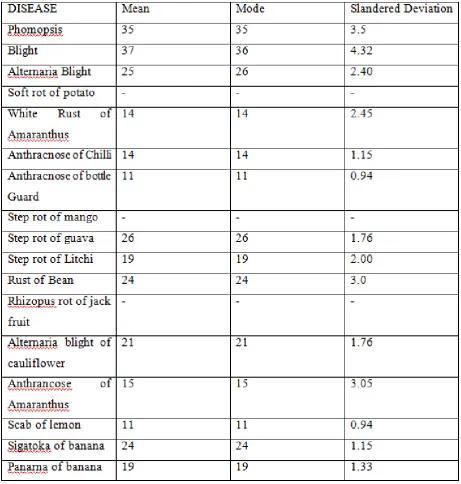
supplement lack, concoction damage and soil factors. The research in this regard has been conducted and following diseases has been discovered along with incidence level.
The tabular structure indicates that blight has highest slandered deviation consequently is regular among most of the fruits.
2. Study of techniques used to dissect Diseases in Fruits
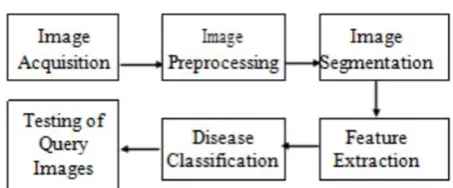
Techniques of image handling are utilized with a specific end goal to detect the diseases at beginning period. These techniques are portrayed as under
Figure 1. Basic Concepts for Disease Detection
a) Image Acquisition
The pictures of natural products are caught through the camera. These caught pictures are in RGB (Red, Green And Blue) shape. Shading chaange structure for the RGB natural product picture is made, from that point onward, for the shading change structure, a gadget free shading space change is connected.
b) Image Pr e-preparing
To expel commotion from picture or other question expulsion, there are different systems are accessible. For picture cutting, trim the Fruit picture to get the intrigued picture district, For smoothing, smoothing channel is utilized. Picture improvement is improved the situation expanding the difference, the RGB pictures into the dark pictures utilizing shading transformation after that the histogram levelling is connected to circulate the forces of the pictures.
c) Image Segmentation
It implies dividing of picture into different piece of same highlights or having some closeness. The division should be possible utilizing different strategies like otsu' strategy, k-implies grouping, changing over RGB picture into HIS model and so forth . Image may winds up plainly harmed or corrupted on eve of noise[20]. The issue for the most
part happens because of transmission medium, temperature or some other corruption happens because of unauthorized access. Commotion is further separated into following categories.
3.3.1 Salt and Pepper Noise
This is likewise called information drop noise since statistically its drop the first information esteems. This noise is likewise eluded as salt and pepper noise. However the picture isn't completely tainted by salt and pepper commotion rather than some pixel esteems are changed in the picture. In spite of the fact that in uproarious picture, there is a potential outcome of a few neighbours does not changed. This commotion is found in information transmission. Picture pixel esteems are supplanted by adulterated pixel esteems either greatest 'or' least pixel esteem i.e., 255 ' or' 0 separately, if number of bits are 8 for transmission. Give us a chance to consider 3x3 picture lattices which are appeared in the Fig. 3. Assume the focal estimation of grids is ruined by Pepper commotion. Accordingly, t his focal esteem i.e., 212 is given in Fig. 3 is supplanted by esteem zero. In this association, we can state that, this noise is embedded dead pixels either dull or brilliant. So in a salt and pepper noise, dynamically dull pixel values are available in brilliant area and the other way around [21]
Salt Pepper Noise 3.3.1 Gaussian Noise
It is likewise called as electronic noise since it arises in intensifiers or indicators. Gaussian noise caused by
questions [5]. Gaussian noise for the most part irritates the dark esteems I n computerized pictures.
That is the reason Gaussian noise show basically outlined and attributes by Its PDF or standardizes
histogram as for dim esteem. [22]
3.3.2 Shot Noise
The presence of this noise is seen because of the factual idea of electromagnetic waves, for example, x-beams, unmistakable lights and gamma beams. The x-beam a d gamma beam sources radiated number of photons per unit time. These beams are infused in patient's body from its source, in therapeutic x beams
and gamma beams imaging frameworks. These sources are having irregular variance of photons. Result accumulated picture has spatial and worldly irregularity. This noise is likewise called as quantum (photon) noise or shot noise.23]
Table 2
Noise Description
Gaussian Noise Gaussian noise is a factual noise. It is equitably disseminated over the signal. It is a noteworthy piece of "read noise‟ of a picture sensor i.e. of the consistent noise level in dull zones of the picture. The portability density function (PDF) of Gaussian noise is equivalent to that of the typical appropriation, otherwise called Gaussian conveyance. It is normally utilized as added substance repetitive sound give added substance white Gaussian noise (AWGN).
Salt-pepper Noise Fat-tail circulated or implusive noise is now and again called salt and pepper noise or spike noise. A picture containing salt and pepper noise will have dim pixels (dark specks or pepper) in bright pixel and splendid pixels (white dabs or salt) in dim area. A compelling strategy to evacuate this sort of noise includes the utilization of middle channel, morphological channel or a contra harmonic median channel.
Because of these noises in picture twisting happens. Remembering the true objective to decide the issue sifting framework is required.
2. Filtering Techniques
The noise dealing with frameworks are used as a piece of demand to deal with the commotion show inside the picture. Diverse separating instruments are open to ensure smoothening of picture. These frameworks are discussed in this segment.
2.1.1 Median Filter
This channel is used as a piece of demand to deal with salt and pepper noise or inspiration commotion. The middle channel empty pixels which are energized past certain limit level. [24] The overhauled or balanced interpretation of middle channel is used as a piece of demand to deal with salt and pepper noise(SAP). It is a non coordinate channel which is extensively used in view of slightest computational multifaceted nature. The unpredictability factor makes its ideal to deal with starting circumstances of SAP from inside the picture. [21] Run time window length one dimensional middle channel similarly exists which is used as a piece of demand to deal with hardware usage of middle channel. [25]
2.1.2 Mean Filter
The nature of the picture is basic parameter which is used to judge whether picture is adequately talented for use or not. The mean channel is one such picture improvement procedure which is used to redesign the normal for the picture. The high thickness drive commotion can be dealt with by the use of mean channel. The weighted entire of the adjoining pixel is used to enhance the pixel. The thickness of the pixel is improved as uproarious pixel is supplanted by pixel acquired from weighted mean pixel. [26]image corruption is typical issue that exist inside the picture. The upgrade of the picture can be expert by the use of nonlinear channel. Mean channel is the answer for this issue. Alone mean channel may not deal with
noise totally. Remembering the ultimate objective to decide the issue feathery strategies are met with the mean channel. This will outline soft mean channel. [21]
2.1.3 Contrast Enhancement Schemes
The clearness of picture is appealing in restorative pictures. The clearness of picture is lost as a result of wide assortment of reasons. One of the normal reasons could be temperature or medium through which picture is transmitted. The picture in PC framework is spoken to fit as a fiddle. These bits can be defiled in the midst of the transmission of picture. With a particular true objective to decide the issue differentiate improvement methodologies are required. One such system to update the differentiation is histogram evening out. The histogram indistinguishable quality system relies upon repeat of pixel occurring inside the picture. The complexity is basic parameter in order to scrutinize the data successfully from the picture. [27]– [29]
2.1.4 Particle Filter
Non nice cloud can be taken care of by the use of molecule channel. The simultaneous and novel approach is used as a piece of demand to deal with the commotion introduce inside the sections of the picture. The picture is smoothening by the usage of this technique. The many-sided quality of the picture is diminished and picture is also pressed. Slightest data transmission is used remembering the true objective to exchange the picture toward the goal. [30]SVD approach is similarly helpful in achieving molecule sifting design. The molecule sifting design using specific regarded disintegration to enhance distinctive levels of picture lucidity through division procedure.[31]
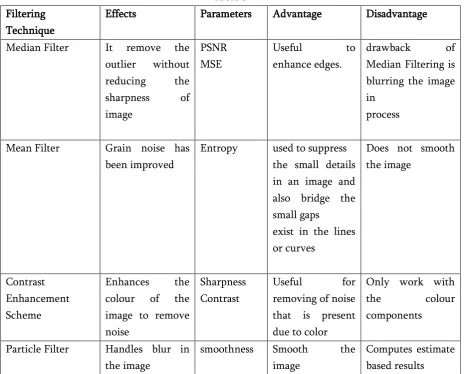
Comparison table of different filtering techniques
Table 3 Filtering
Technique
Effects Parameters Advantage Disadvantage
Median Filter It remove the
Particle Filter Handles blur in the image
smoothness Smooth the
image
Computes estimate based results
d) Feature Extraction
Feature Extraction is utilized to approve the precision and effectiveness of picture utilizing highlights like shading, surface, shape and so on. There are different systems to remove include from picture like Global Color Histogram, Color Coherence Vector, Local Binary Pattern and Complete Local Binary Pattern[3].
1) Global Color Histogram (GCH)
For encoding to the data introduce in picture Global Color Histogram (GCH) is utilized. It is the most straightforward approach for that. A GCH is an arrangement of requested esteems, for each unmistakable shading, speaking to the likelihood of a pixel being of that shading. Uniform standardization and quantization are utilized to abstain from scaling
inclination and to decrease the quantity of particular hues.
2) Color Coherence Vector (CCV)
characterizing the picture pixels, CCV registers two shading histograms: one for lucid pixels and another for incomprehensible pixels. The two histograms are put away as a solitary histogram.
3) Local Binary Pattern (LBP)
Local Binary Pattern is a straightforward yet exceptionally effective administrator to characterize neighbourhood picture example, and it has announced amazing characterization results on agent surface databases. Neighbourhood Binary Pattern has likewise been adjusted by different applications, for example, confront acknowledgment dynamic surface acknowledgment and shape confinement
4) Complete Local Binary Pattern (CLBP)
LBP include thinks about just indications of nearby specifically CLBP_S, CLBP_M, and CLBP_C. CLBP_S is the same as the first LBP and used to code the sign data of neighbourhood contrasts. CLBP_M is utilized to code the extent data of neighbourhood contrasts. CLBP_C is utilized to code the data of unique focus dim level esteem. e) Classification There are different procedure for arrangement: Artificial Neural Network, Backbone Propagation Neural Network, Feed forward Back proliferation Neural Network, Probabilistic Neural Network, Support Vector Machine, Multiclass Support Vector Machine and so on. Some of them are as beneath:
1) Artificial Neural Network (ANN): After component extraction is done, the learning database pictures are arranged by utilizing neural system. These component vectors are considered as neurons in ANN. The yield of the neuron is the capacity of weighted aggregate of the sources of info. The back proliferation calculation altered SOM; Multiclass Support vector machines can be utilized.
2) Backbone Propagation Neural Network (BPNN): BPNN calculation is utilized as a part of a repetitive system. Once prepared, the neural system weights are settled and can be utilized to register yield esteems for new question pictures which are absent in the learning database.
3) Support Vector Machine (SVM): A help vector machine develops a plane or set of hyper-planes in a high-or interminable dimensional space, which can be utilized for order, relapse, or other tasks.SVM is regulated learning model with related learning calculations that dissect information and perceive designs, utilized for grouping and relapse investigation. Given an arrangement of preparing cases, each set apart to belong to one of two classifications, a SVM preparing calculation manufactures a model that doles out new cases into one class or the other, making it a non - probabilistic paired straight classifier.
IV.
CONCLUSION AND FUTURE WORK
V.
REFERENCES
[1]. A. Awate and D. Deshmankar, "Fruit Disease Detection using Color , Texture Analysis and ANN," pp. 970–975, 2015.
[2]. M. Chetan Dwarkani, R. Ganesh Ram, S. Jagannathan, and R. Priyatharshini, "Smart farming system using sensors for agricultural task automation," Proc. - 2015 IEEE Int. Conf. Technol. Innov. ICT Agric. Rural Dev. TIAR 2015, no. Tiar, pp. 49–53, 2015.
[3]. S. R. Dubey, "Detection and Classification of Apple Fruit Diseases using Complete Local Binary Patterns," 2012.
[6]. B. Blight, "1. Brown Blight."
[7]. S. Von Broembsen and P. W. Pratt, "Common Diseases of Stone Fruit Trees and Their Control."
[8]. K. J. Patil, M. Z. Chopda, and R. T. Mahajan, "Lipase biodiversity," Indian J. Sci. Technol., vol. 4, no. 8, pp. 971–982, 2011.
[9]. S. Daliman, S. A. Rahman, and I. Busu, "Segmentation of Oil Palm Area Based on GLCM- SVM and NDVI," pp. 645–650, 2014. [10]. M. A. Jabbar, B. L. Deekshatulu, and P.
Chandra, "Classification of Heart Disease Using K- Nearest Neighbor and Genetic Algorithm," Procedia Technol., vol. 10, pp. 85–94, 2013. [11]. I. K. A. Enriko, M. Suryanegara, and D.
Gunawan, "Heart Disease Prediction System using k-Nearest Neighbor Algorithm with Simplified Patient â€TM s Health Parameters," vol. 8, no. 12, 1843.
[12]. B. Veytsman, L. Wang, T. Cui, S. Bruskin, and A. Baranova, "Distance-based classifiers as potential diagnostic and prediction tools for human diseases," BMC Genomics, vol. 15 Suppl 1, no. Suppl 12, p. S10, 2014.
[13]. M. M. El-Hattab, "Applying post classification change detection technique to monitor an Egyptian coastal zone (Abu Qir Bay)," Egypt. J. Remote Sens. Sp. Sci., vol. 19, no. 1, pp. 23–36, 2016.
[14]. C. Chen, M. Won, R. Stoleru, and G. G. X. Member, "Energy-Efficient Fault-Tolerant Data Storage & Processing in Mobile Cloud," vol. 3, no. 1, pp. 1–14, 2014.
[15]. D. Bui, S. Hussain, E. Huh, and S. Lee, "Adaptive Replication Management in HDFS based on Supervised Learning," vol. 4347, no. c, pp. 1–14, 2016.
[16]. "One-Pass Preprocessing Algorithm," pp. 851– 853, 1988.
[17]. M. K. R. Gavhale, "Unhealthy Region of Citrus Leaf Detection Using Image Processing Techniques," pp. 2–7, 2014.
[18]. C. Engineering, A. Kumar, and G. S. Gill, "Automatic Fruit Grading and Classification System Using Computer Vision : A Review," no. I, pp. 598–603, 2015.
[19]. R. A. Sadek, "SVD Based Image Processing Applications : State of The Art , Contributions and Research Challenges," vol. 3, no. 7, pp. 26– 34, 2012.
[20]. "Noise image."
[21]. Y. Wang, J. Wang, X. Song, and L. Han, "An Efficient Adaptive Fuzzy Switching Weighted Mean Filter for Salt-and-Pepper Noise Removal," vol. 23, no. 11, pp. 1582–1586, 2016. [22]. Y. I. Abramovich, O. Besson, S. Member, B. A.
Johnson, and S. Member, "Conditional expected likelihood technique for compound Gaussian and Gaussian distributed noise mixtures," no. c, pp. 1–12, 2016.
Phosphorescent Organic Light-Emitting Diodes," vol. 61, no. 9, pp. 3252–3257, 2014. [24]. B. Ghandeharian, "Modified Adaptive Center
Weighted Median Filter for Suppressing Impulsive Noise in Images," Int. J. Res. Rev. Appl. Sci., vol. 177, no. 4, pp. 1073–1087, 2009. [25]. E. Nikahd, P. Behnam, S. Member, R. Sameni,
and S. Member, "High-Speed Hardware Implementation of Fixed and Run-time Variable Window Length 1-D Median Filters," vol. XX, no. c, pp. 1–5, 2015.
[26]. N. Chithirala, A. Radhakrishnan, and P. O. Amritanagar, "Weighted Mean Filter for Removal of High Density Salt and Pepper Noise," pp. 1–4, 2016.
[27]. P. Mehta and B. Shah, "Review on Techniques and Steps of Computer Aided Skin Cancer Diagnosis," Procedia - Procedia Comput. Sci., vol. 85, no. Cms, pp. 309–316, 2016.
[28]. N. Situ, X. Yuan, N. Mullani, and G. Zouridakis, "AUTOMATIC SEGMENTATION
OF SKIN LESION IMAGES USING
EVOLUTIONARY STRATEGY 2 . Engineering Technology Department , University of Houston," pp. 1–4.
[29]. R. Parekh, "Analysis Diagnosis," pp. 28–37, 2012.
[30]. J. K. Prasanna and A. N. Rajagopalan, "Image restoration using the particle filter : handling non-causality," vol. 153, no. 5, pp. 650–656, 2006.