Classification of Attributes in a Natural Language
Query into Different SQL Clauses
Ashish Palakurthi†, Ruthu S. M.†, Arjun R. Akula†,∗and Radhika Mamidi† †Language Technologies Research Center, IIIT Hyderabad, India.
∗IBM Research, Bangalore, India.
[email protected], [email protected], [email protected]
Abstract
Attribute information in a natural language query is one of the key features for con-verting a natural language query into a Structured Query Language1(SQL) in
Nat-ural Language Interface to Database sys-tems. In this paper, we explore the task of classifying the attributes present in a natural language query into differentSQL clauses in a SQL query. In particular, we investigate the effectiveness of various features and Conditional Random Fields for this task. Our system uses a statisti-cal classifier trained on manually prepared data. We report our results on three differ-ent domains and also show how our sys-tem can be used for generating a complete SQLquery.
1 Introduction
Databases have become one of the most efficient ways to store and retrieve information. Database systems require a user to have the knowledge of structured languages in order to be able to retrieve information from them. As a result, it becomes difficult for people of non-technical background to use databases. Natural Language Interface to Database (NLIDB) (Androutsopoulos et al., 1995; Catalina Hallett and David Hardcastle, 2008; Pa-zos et al., 2002; Popescu et al., 2003; Giordani and Moschitti, 2009; Gupta et al., 2012) systems provide an interface through which a user can ask a query in natural language and get the required information from the database. NLIDB systems translate the user’s natural language (NL) query into aSQLquery, thereby allowing the user to re-trieve the answer from the database. However,
1Structured Query Language is a specialized language
used for relational database management and data manipu-lation.
NLIDB systems are not widely used because of their inability to process ambiguity and complex-ity of natural language, which makes them more error prone. Thus, it becomes very important to capture even the smallest of the information from aNLquery before converting it into aSQLquery.
A relational database contains objects called ta-bles in which information is stored. These tata-bles contain columns and rows. The column names in the tables are known as attributes. ASQLquery is composed of different SQL clauses like SELECT, FROM,WHERE,GROUP BY, HAVINGandORDER BY. Since clauses in aSQL query have attributes, attribute information becomes very important for an effective conversion of aNL query into a SQL query. Explicit attributes are the attributes men-tioned by the user in the NL query text. When a NL query is converted into SQL query, explicit attributes may belong to different SQL clauses. In this paper, we use Conditional Random Fields (CRF) for classifying the explicit attributes in aNL query to differentSQLclauses.
2 Related Work
There have been significant research efforts in the area ofNLIDBsystems. Different approaches have been proposed to deal with these systems.
In (Gupta et al., 2012), the authors propose a NLIDB system based on Computational Paninian Grammar (CPG) Framework (Bharati et al., 1996). They emphasize on syntactic elements as well as the semantics of the domain. They convert a NL query into aSQLquery by processing theNLquery in three stages, viz. the syntactic stage, the seman-tic stage and the graph processing stage. In the semantic stage, they identify attribute-value pairs for various entities using noun frames. The prob-lem with this proposal is that it becomes costly in terms of space to use high number of frames in large domains. In (Khalid et al., 2007), machine learning was used in Question Answering systems.
The system proposed by them maps an input query to certain tables containing attributes which can provide the required answer. They specify that identifying the related tables and attributes from the knowledge base is very important for answer-ing an incomanswer-ing question. Amany Sarhan (2009) emphasized on the importance of identifying the table names of attributes in aNLquery. He shows that attribute and table information help in mini-mizing the effort to build SQL queries. Thus, at-tribute information plays a very important role in bothNLIDBsystems and Question Answering sys-tems. To our knowledge, this work is the first attempt to classify attributes directly from a NL query to differentSQLclauses in theirSQLqueries. In (Srirampur et al., 2014), the authors address the problem of Concepts Identification of a NLquery inNLIDB, which plays a crucial role for our sys-tem to generate a completeSQLquery.
The remainder of this paper is structured as fol-lows. Section 3 describes the problem. In sec-tion 4, we illustrate the concept of explicit attribute classification. Section 5 explains the methodology along with the features adopted for the classifica-tion. We also discuss on generating the complete SQL query. In section 6, we show experimenta-tions and results along with error analysis. We conclude in section 7.
3 Problem
An attribute in aNLquery can correspond to vari-ousSQLclauses. We define two types of attributes which can be found in aNLquery.
Explicit attributes: Explicit attributes are the at-tributes which are directly mentioned by the user in theNLquery.
Implicit attributes: Implicit attributes are not directly mentioned by the user in the NL query. These attributes are identified with the help of val-ues mentioned by the user in the NL query. For identifying these attributes, domain dictionaries can be used. Table 1 shows a sample domain dic-tionary. The following examples illustrate explicit and implicit attributes in a user query.
Example 1: List the grades of all the students in Mathematics.
In this example,gradeis an explicit attribute as it is directly mentioned by the user in theNLquery. The user also mentions the value Mathematics. This value when checked in the domain dictionary gives the attribute course name asMathematicsis
the name of a course. Thus, course name is an implicit attribute. The attribute students or stu-dent name is another explicit attribute in the above example.
Example 2:What course does Smith teach? In this example, courseor course name is an ex-plicit attribute as it is directly mentioned by the user. The user mentions the value Smith. This value when checked in the domain dictionary gives the attribute professor name if Smith is a name of a professor. Thus, the attribute profes-sor name is an implicit attribute.
Implicit attributes generally correspond to the WHEREclause in a SQLquery as they are associ-ated with a value. This paper focusses on classify-ing explicit attributes into differentSQLclauses in aSQLquery.
Value Attribute Smith professor name
ABCD lab name
John student name
Science course name
Table 1: Sample domain dictionary
4 Explicit Attribute Classification
two explicit attributes mentioned by the user are professors and courses. Here, the user is asking to list only those professors who teach more than two courses. Here, we group according to professors and then for each professor, we count the number of courses taught. Only if the count is greater than 2, we select the professor and list his name. Thus, professor name belongs to the GROUP BY clause. The condition on professors is COUNT (course name) > 2. Therefore, the attribute courses or course name belongs to the HAVING clause. In this way, by identifying the clauses to which the attributes belong, we can improve the translation of NL queries to SQL queries. In the next section, we describe how we classify these explicit attributes to their SQL clauses.
1.What are the courses taught by Smith? SELECTcourse name
FROMCOURSES,TEACH,PROFESSOR
WHEREprofessor name= “Smith”AND
prof id=prof teach idAND
course teach id=course id. 2.Who teaches Science course? SELECTprofessor name
FROMCOURSES,TEACH,PROFESSOR
WHEREcourse name=“Science”AND
course id =course teach idAND
prof teach id=prof id
3.List a student from each course. SELECTstudent name, course name FROMSTUDENTS,REGISTER,COURSES
WHEREstud id=stud reg idAND
reg id=course id GROUP BYcourse name
4.Who are the professors teaching more than 2 courses? SELECTprofessor name
FROMCOURSES,TEACH,PROFESSOR
WHEREcourse id=course teach idAND
prof teach id =prof id GROUP BYprofessor name HAVINGCOUNT(course name)>2
Figure 1: Examples ofNLqueries and their SQLqueries
5 Methodology
We manually prepared a dataset of queries on the Academic domain of our university. The uni-versity database was used as the source of
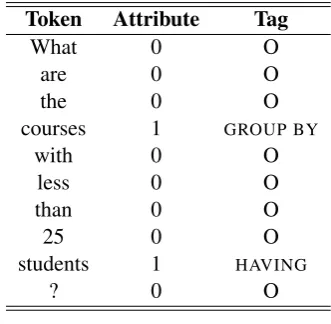
in-formation. Examples of tables in the database schema are courses, labs, students consisting of attributes like course name, course id, stu-dent name, lab name etc. The database has relationships like register (between student and course), teach (between professor and course) etc. Each token in the sentence is given a tag and a set of features. If a token is an attribute, it is assigned a tag which corresponds to aSQLclause to which the attribute belongs. If a token is not an attribute, it is given aNULL(O) tag. The tagging was done manually. Our tag set is simple and consists of only 4 tags, where each tag corresponds to a SQL clause. The tags areSELECT,WHERE,GROUP BY, HAVING. Formally, our task is framed as assigning label sequences to a set of observation sequences.
Token Attribute Tag
What 0 O
are 0 O
the 0 O
courses 1 GROUP BY
with 0 O
less 0 O
than 0 O
25 0 O
students 1 HAVING
? 0 O
Table 2: Example of tagging scheme
describes the features employed for the classifica-tion of explicit attributes in aNLquery.
5.1 Classification Features
The following features were used for the classifi-cation of explicit attributes in aNLquery.
Token-based Features These features are based on learning of tokens in a sentence. The isSym-bolfeature checks whether a token is a symbol (>,
<) or not. Symbols like>(greater than),<(less than) are quite commonly used as aggregations in NLqueries. This feature captures such aggregates. We also took lower case form of a token as a fea-ture for uniform learning. We considered a par-ticular substring as a feature. If that substring is found in the token, we set the feature to 1 else 0 (for example, in batch wise or batchwise, the at-tributebatchis identified asGROUP BY clause at-tribute using substringwise).
Grammatical Features POS tags of tokens and grammatical relations (e.g. nsubj, dobj ) of a token with other tokens in the sentence were considered. These features were obtained using the Stanford parser2(Marneffe et al., 2006).
Contextual Features Tokens preceding and fol-lowing (local context) the current token were also considered as features. In addition, we took the POS tags of the tokens in the local context of the current token as features. Grammatical relations of the tokens in local context of the current token were also considered for learning.
Other Features:
isAttributeThis is a basic and an important fea-ture for our problem. If a token is an attribute, we set the feature to 1, else 0.
Presence of other attributesThis feature aims to identify the GROUP BY clause attributes only. In SQL, theHAVINGclause generally contains a con-dition on theGROUP BY clause. If aNL query is very likely (>95%) to have a HAVING clause at-tribute, then the SQL clause will certainly have a GROUP BY clause as well. This feature is marked as 1 for an attribute if it has a local context which may trigger a GROUP BY clause and at the same time if theNLquery is very likely to have theHAV -INGclause attribute. The likeliness of theHAVING clause attribute is again decided based on the local context of the attribute. Thus, GROUP BY clause attribute is not just identified using its local con-text, but also depending on the presence of HAV
-2http://nlp.stanford.edu/software/lex-parser.shtml
INGclause attribute. In simple terms, this feature increases the weight of an attribute to belong to the GROUP BYclause of theSQLquery.
Trigger words An external list is used to deter-mine whether a word in the local context of an attribute may trigger a certain SQL clause for the attribute. (eg., the wordeachmay triggerGROUP BYclause).
5.2 Completing the SQL Query
Until now, we have only identified attributes and their corresponding SQL clauses. But this is not sufficient to get a completeSQLquery. In this sec-tion, we describe how we can generate a complete SQLquery after the classification of attributes. To build a completeSQLquery we would require: 1. Complete attribute and entity information. 2. Concepts3of all the tokens in the given query.
3. Mapping of identified entities and relationships in the Entity Relationship schema to get the joint conditions inWHEREclause.
Our system can extract attribute information using explicit attribute classifier for explicit attributes and domain dictionaries for implicit attributes. Sometimes, we may not have complete attribute information to form a SQL query. That is, there can be attributes other than explicit attributes and implicit attributes in a SQL query. For example, consider:
Example 1:Which professor teachesNLP? Example 2:Who teachesNLP?
TheSQLquery for both the examples is: SELECTprofessor name
FROMprof, teach, course WHEREcourse name=NLP AND course id=course teach idAND prof teach id=prof id .
In example 1, our system has complete attribute information to form the SQL query. Since pro-fessor is explicitly mentioned by the user in the query, here professor name is identified as a SE -LECTclause attribute by our system. But in exam-ple 2, we do not have comexam-plete attribute informa-tion. Here identifying theSELECTclause attribute professor name is a problem, as there is no clue (neither explicit attribute nor implicit attribute) in the query which points us to the attribute pro-fessor name. To identify attributes which cannot be identified as implicit attributes or explicit
at-3Concept of aNLtoken maps theNLtoken to the database
tributes, Concepts Identification (Srirampur et al., 2014) is used. In Concepts Identification, each to-ken in the NL query is tagged with a concept. Us-ing Concepts Identification, we can directly iden-tifyWhoas professor name. These attributes are known as theQuestion class attributes. Most of the times, since question words are related to the SELECT clause, the attribute professor name can be mapped to the SELECTclause, thereby giving us complete information of attributes. We also use Concepts Identification to identify relation-ships in theNLquery. In both the examples,teach which is a relationship in the Entity Relationship schema can be identified through Concepts Iden-tification (CI). Once the attributes are identified, entities can be extracted. For example, entities for the attributes course name, professor name are COURSESandPROFESSORrespectively. The iden-tified entities and relationships are added to the FROMclause.
All the identified entities and relationships can now be mapped to the Entity Relationship (ER) schema to get the joint conditions (Arjun Reddy Akula, 2015) in the WHERE clause. We create an ERgraph using the ERschema of the database with entities and relationships as vertices in the ER graph. We apply a Minimum spanning tree (MST) algorithm on the ER graph to get a non-cyclic path connecting all the identified vertices in the ER graph. With this, we get the required join conditions in theWHEREclause. Arjun Reddy Akula (2015) discusses the problem of handling joint conditions in detail. Note that new enti-ties and relationships can also be identified while forming the MST. These extra entities and rela-tionships are added to theFROMclause in theSQL query. We now have a completeSQLquery. 6 Experiments and Discussions 6.1 Data
We manually prepared a rich dataset ensuring that NL queries when converted into SQL queries, a wide variety of SQL queries are covered for the classification. We tested our classifier on these queries. Apart from the Academic domain, we also experimented on Mooney’s dataset4. We
con-sidered the Restaurant and the Geoquery domains (Wong and Mooney, 2006) in Mooney’s dataset. The Geoquery dataset (GEO880) consisted of 880 queries. Since we are not addressing nested
4http://www.cs.utexas.edu/users/ml/nldata.html
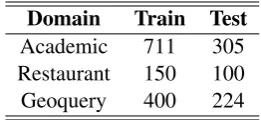
SQL queries, we removed queries which when converted to SQL queries, involve nested SQL queries. This task was done manually. There were 256 nested SQL queries in the Geoquery dataset. Regarding classification, we mainly focused on the Academic domain as it consists of queries with the SELECT, WHERE, GROUP BY and the HAVING clause attributes. The Restaurant and Geoquery domains had queries with only the SELECT and WHERE clause attributes. This is one of the reasons why we prepared the data ourselves. Table 3 shows the number of sentences considered for training and testing in each domain.
Domain Train Test
Academic 711 305
Restaurant 150 100
Geoquery 400 224
Table 3: Corpus statistics
6.2 Experimental Results
We used the metrics of Precision (P), Recall (R) and F-measure5(F) for evaluation.
6.2.1 Baseline Method
We first determine the majority class C of an explicit attributeAfound in the training data. The baseline system then labels all occurrences of A found in the test data with class C, irrespective of the context of the attribute. In all the three do-mains, SELECT clause attribute was the majority class attribute. Table 4 summarizes the results of the baseline method in all the domains.
Domain P(%) R(%) F(%) Academic 46.29 46.37 46.33 Restaurant 47.75 43.80 45.69 Geoquery 63.08 63.08 63.08
Table 4: Baseline method results
6.2.2 Conditional Random Fields
We used Conditional Random Fields for the clas-sification experiments since it represents the state
5
of the art in sequence modeling and has also been very effective at Named Entity Recognition (NER). As our problem is very similar to NER, we used CRF. CRF++6tool kit was used for this. CRFs are a probabilistic framework used for label-ing sequence data. CRF models effectively solve the label bias problem, which make it better than HMMs which are generally more likely to be sus-ceptible to the label bias problem. Our discussions mainly focus on Academic domain.
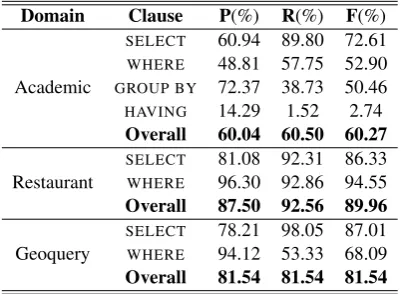
We conducted experiments in three phases. Phase one involved using features only for the cur-rent token. The system achieved a F-measure of 60.27%.
Domain Clause P(%) R(%) F(%)
Academic
SELECT 60.94 89.80 72.61 WHERE 48.81 57.75 52.90 GROUP BY 72.37 38.73 50.46 HAVING 14.29 1.52 2.74
Overall 60.04 60.50 60.27
Restaurant SELECTWHERE 81.08 92.31 86.3396.30 92.86 94.55
Overall 87.50 92.56 89.96
Geoquery SELECTWHERE 78.21 98.05 87.0194.12 53.33 68.09
Overall 81.54 81.54 81.54
Table 5: Results obtained without considering contextual features.
In phase two, we added contextual features as well. The contextual features include tokens surrounding the current token, POS tags of the tokens surrounding the current token and also the grammatical relations of the tokens surrounding the current token.
Incorporating contextual features showed a sig-nificant improvement in the classification. At the end of phase two, the F-measure of the system was 83.73%. This shows that the local context of an attribute is important in deciding its SQL clause. Table 5 and Table 6 show the classification results of phase one and phase two respectively. By lo-cal context, we mean the neighbouring tokens or features of neighbouring tokens of the attribute in theNLquery. After a few pilot experiments, con-text window of size three was found to be opti-mal in Academic domain and context window of size one was enough for Restaurant and Geoquery domains. Window size of three was required
spe-6https://code.google.com/p/crfpp
Domain Clause P(%) R(%) F(%)
Academic
SELECT 88.12 93.88 90.91 WHERE 56.41 92.96 70.21 GROUP BY 96.58 79.58 87.26 HAVING 96.88 46.97 63.27
Overall 83.49 83.97 83.73
Restaurant
SELECT 94.64 81.54 87.60
WHERE 100.00 98.21 99.10 Overall 97.30 89.26 93.10
Geoquery SELECTWHERE 89.0497.94 99.02 93.7679.17 87.56 Overall 91.69 91.69 91.69
Table 6: Results obtained on adding contextual features.
cially forHAVINGclause attributes. This is proba-bly because HAVING clause attributes are gener-ally associated with aggregations. Hence, local context of an attribute is very important for the HAVINGclass attributes. As can be seen from Ta-ble 5 and TaTa-ble 6, adding contextual features in-creased the F-measure ofHAVINGclause attributes by 60.53 percentage points. The presence of at-tribute feature is very important for identifying the GROUP BYclause attributes. F-measure ofGROUP BY clause attributes increased by 11.72 percent-age points on adding this feature. The reason for higher F-measures in the Restaurant and the Geoquery domains is mainly because these do-mains had NL queries with only the SELECT and the WHEREclause attributes, thus making classi-fication much easier. Moreover, the randomness found in queries was comparatively lesser than the Academic domain. In addition, the problem of contextual conflicts was not seen in these do-mains. Contextual conflicts are discussed in the error analysis section.
Train Test P(%) R(%) F(%) Academic Restaurant 69.63 77.69 73.44 Academic Geoquery 70.99 70.77 70.88 Restaurant Academic 52.55 51.15 51.84 Restaurant Geoquery 80.66 60.31 69.01 Geoquery Academic 50.57 50.95 50.76 Geoquery Restaurant 77.78 86.78 82.03
Table 7: Cross domain results
to-ken as a feature since the attributes are different in each domain. But, features likePOSand gram-matical relations of the current token were taken. Contextual tokens and other features of contextual tokens were considered. Table 7 shows the results of phase three experiments. Using contextual fea-tures in a supervised machine learning framework captures a strong generalization for classifying the attributes.
Finally, we compare the final results we were able to achieve to the state-of-the-art. Many NLIDB systems have been proposed using differ-ent approaches. We discuss few of them. PRE -CISE(Popescu et al., 2003) is a system which con-verts semantic analysis to a graph matching prob-lem using schema eprob-lements. A class of semanti-cally tractable queries is proposed and the system can form SQL queries only if a query belongs to the proposed class. PRECISE achieves an overall F-measure of 87% on 700 tractable queries from theGEO880 (Geoquery domain) corpus and a re-call of 95% in restaurant domain. InKRISP(Kate et al., 2006), a user query is mapped to its formal meaning representations using kernel based classi-fiers. These classifiers were trained on string sub-sequence kernels and were used to build complete meaning representation of the user query. They achieve a precision of 94% and recall of 78% on theGEO880 corpus.
Support Vector Machines with kernel methods (Giordani et al., 2009) were adopted to repre-sent syntactic relationships between NL and SQL queries. The authors apply different combinations of kernels and derive an automatic translator of NL query toSQL query. Their system achieves an overall accuracy of 76% and 84.7% for forming SQL queries in the Geoquery and the Restaurant domains respectively.
A set of candidate SQL queries (Giordani et al., 2012) are produced using lexical dependencies and metadata of the database. TheseSQL queries are then re-ranked using SVM with tree kernels. Using few heuristics they generate final list ofSQL queries. They achieved F-measure of 85% on the GEO880 corpus. Recent work (Clarke et al., 2010) tackles semantic parsing using supervision. Here, the system predicts complex structures based on feedback of external world. From the GEO880 corpus, they randomly select 250 queries for train-ing and 250 queries for testtrain-ing and achieved an overall F-measure of 73%.
However, there have not been any efforts in mapping NL queries to SQL queries exclusively from an attribute point of view. Attributes being the building blocks of aSQLquery, we focus on at-tributes to build aSQLquery. After attribute classi-fication, Concept Identification and identification of the joint conditions in the WHERE clause, we evaluate the overallSQLquery formation. Even if one attribute is wrongly tagged, we consider the SQL query wrong. After accounting to Concepts Identification errors and domain dictionary errors, the final accuracies achieved by our system were 75%, 71% and 64% in Restaurant, Geoquery7and
Academic domains respectively. We define accuracy as
Accuracy =Number of correctly retrieved SQL queries Total Number of queries
These accuracies8 are on the same test datasets
used for attribute classification(Table 3). Apart from wrong tagging of attributes, one interesting error we found while forming SQL queries was domain dictionary error. For example, consider the query, What length is the Mississippi?. Here, the user is talking about Mississippi river, but the domain dictionary tags Mississippi as state name. However, if the query had been asked as What length is the Mississippi river ?, the system uses the explicit attribute river and retrieves Missis-sippi as river name. In summary, we achieve com-petitive results using a novel approach and move towards tackling domain independency.
6.3 Error Analysis in Attribute Classification Most of the errors occurred due to contextual flicts which are of two types. Contextual con-flict between two attributesAandBis an instance wherein both the attributesAandBhave same lo-cal context but are found to be classified under dif-ferent SQL clauses Aˆ andBˆ. We say that there is a contextual conflict betweenAˆ andBˆ clause attributes. The observed contextual conflicts (>
90%) were:
SELECTclause vsGROUP BYclause attributes.
7The results on Geoquery domain may actually be worse
as the data (Table 3) we considered is a subset of theGEO880.
8Various state-of-the-art approaches show results on
For example, considerList the courses in our col-legeandList the batches in our college with more than 100 students. Here, context ofcourses and batches is same. In the first example, the at-tributecourses(course name) is aSELECT clause attribute and in the second example, the attribute batches (batch name) is a GROUP BY clause at-tribute. Butbatcheswas misclassified asSELECT clause attribute. It should belong to theGROUP BY clause according to our annotation guidelines. WHEREclause vsHAVINGclause attributes. In the examples,Who are the students with more than 8 marks in NLP? andWhat are the batches with more than 8 students?, the prefix context of marks in the first example is same as the pre-fix context of students (more than 8) in the sec-ond example. The attribute marksin the first ex-ample belongs to theWHEREclause andstudents in the second example belongs to the HAVING clause. Butstudentswas misclassified asWHERE clause attribute. Another reason why one yields WHERE and the other HAVING is due to the way the database is organized internally. If thebatch table has anumber of students attribute, then the second example would also yield aWHEREclause. This is an inherent limitation of the NLIDB ap-proach, not related to the features, classifier or the overall approach used.
Contextual conflicts were less in the Restaurant and the Geoquery domains when compared to the Academic domain, as they consisted of only SE -LECTandWHEREclause attributes. Errors in these domains were mainly token based errors.
7 Conclusion and Future Work
In this paper, we investigate aCRFmodel to clas-sify attributes present in aNLquery into different SQL clauses in aSQL query. We believe that this is the core part of SQL query formation. For ex-plicit attribute classification, our system achieved overall F-measures of 83.73%, 93.10%, 91.69% in Academic, Restaurant and Geoquery domains re-spectively. We also achieved accuracies of 64%, 75% and 71% in forming SQL queries in Aca-demic, Restaurant and Geoquery domains respec-tively. The main contributions of this paper are:
• We show that within a sentence, attributes can be used to build a SQL query. For this, the local context of an attribute can be help-ful to identify its clause in theSQLquery.
• We primarily focus on attribute classification as they are the building blocks of the SQL query. We then use an existing system to complete the SQL formation. We achieved promising results in formingSQLqueries us-ing a novel approach.
• The work presents a significant study onSQL clauses likeGROUP BYandHAVINGby man-ually creating a new dataset. To the best of our knowledge, benchmark datasets do not cover theseSQLclauses as good as they cover SQLclauses likeSELECTandWHERE. • Experiments in cross domain datasets suggest
that the proposed feature set learns a strong generalization for classifying the attributes in theNL query. To an extent, this certainly ad-dresses the disadvantage of domain indepen-dency inNLIDBsystems. Another advantage of learning the context of an attribute is that, it can be useful in classifying an unseen at-tribute within the same domain.
Finally, we claim that attributes are an important part of a user query to aNLIDBsystem. Exploring patterns on how these attributes are used by a user in aNL query can be useful to form aSQL query. The proposed approach may break down withNL queries having less explicit attributes, where the NLquery may require deeper semantic processing. It would be interesting if we can combine our ap-proach with existing parsing based apap-proaches. In our future work, we will further improve the ex-plicit attribute classification, incorporate semantic features to improveSQLquery formation and han-dle nestedSQLqueries.
Acknowledgements
References
Rashid Ahmad, Mohammad Abid Khan, and Rahman Ali 2009. Efficient Transformation of a Natural
Language Query to SQL for Urdu. InProceedings
of the Conference on Language & Technology, page
p53.
Arjun R. Akula, Rajeev Sangal, Radhika Mamidi. 2013. A Novel Approach Towards Incorporating Context Processing Capabilities in NLIDB System.
In Proceedings of the International Joint Conference
on Natural Language Processing (IJCNLP),pages
1216-1222, Nagoya, Japan.
Arjun R. Akula. 2015. A Novel Approach Towards Building a Generic, Portable and Contextual NLIDB System. International Institute of Information Tech-nology Hyderabad.
Ioannis Androutsopoulos, Graeme D. Ritchie, and Pe-ter Thanisch. 1995. Natural language inPe-terfaces to
databasesan introduction. Natural language
engi-neering,1(01), 29-81.
Raffaella Bernardi and Manuel Kirschner. 2008. Con-text modeling for iqa: the role of tasks and
enti-ties. InColing 2008: Proceedings of the workshop
on Knowledge and Reasoning for Answering
Ques-tions, pages 2532. Association for Computational
Linguistics.
Nuria Bertomeu, Hans Uszkoreit, Anette Frank, Han-sulrich Krieger and Brigitte Jorg. 2006. Contextual phenomena and thematic relations in database qa di-alogues: results from a wizard-of-oz experiment. In
Proceedings of the Interactive Question Answering
Workshop at HLT-NAACL , pages 1-8 Association
for Computational Linguistics.
Akshar Bharati, Medhavi Bhatia, Vineet Chaitanya, and Rajeev Sangal. 1996. Paninian grammar
frame-work applied to English. InTechnical Report
TRCS-96-238,CSE,IIT Kanpur, Tech.Rep.
Joyce Y Chai and Rong Jin. 2004. Discourse structure
for context question answering. In Proceedings of
the Workshop on Pragmatics of Question Answering
at HLT-NAACL, pages 23-30.
James Clarke, Dan Goldwasser, Ming-wei Chang and Dan Roth. 2010. Driving semantic parsing from
the worlds response. InACL Conference on Natural
Language Learning (CoNLL).
Faraj A. El-Mouadib, Zakaria Suliman Zubi, Ahmed A.Almagrous, I. El-Feghi 2009. Generic interactive natural language interface to databases(GINLIDB).
InInternational Journal of Computers3(3).
Alessandra Giordani. 2008. Mapping Natural
Lan-guage into SQL in a NLIDB. In Natural Language
and Information Systems (pp. 367-371). Springer
Berlin Heidelberg.
Alessandra Giordani and Alessandro Moschitti. 2009. Syntactic structural kernels for natural language
in-terfaces to databases. In Machine Learning and
Knowledge Discovery in Databases,pages 391406.
Springer.
Alessandra Giordani and Alessandro Moschitti. 2009. Semantic Mapping between Natural Language Questions and SQL Queries via Syntactic Pairing.
In 14th International Conference on Applications
of Natural Language to Information Systems,
Saar-brucken, Germany.
Alessandra Giordani and Alessandro Moschitti. 2010. Corpora for Automatically Learning to Map
Natu-ral Language Questions into SQL Queries. In
Pro-ceedings of the Seventh conference on International Language Resources and Evaluation(LREC), Malta.
Alessandra Giordani and Alessandro Moschitti. 2012. Generating SQL Queries Using Natural Language
Syntactic Dependencies and Metadata. NLDB
164-170.
Alessandra Giordani and Alessandro Moschitti. 2012. Automatic Generation and Reranking of
SQL-Derived Answers to NL Questions. In
Proceed-ings of the Joint workshop on Intelligent Methods for Software System Engineering (JIMSE)held in ECAI 2012. Montpellier, France.
Alessandra Giordani and Allesandro Moschitti 2012. Translating Questions to SQL Queries with
Genera-tive Parsers DiscriminaGenera-tively Reranked COLING.
Abhijeet Gupta, Arjun Akula, Deepak Malladi, Puneeth Kukkadapu, Vinay Ainavolu and Rajeev Sangal. 2012. A novel approach towards build-ing a portable nlidb system usbuild-ing the computational
paninian grammar framework. In Asian Language
Processing (IALP), 2012 International Conference on(pp. 93-96). IEEE.
Catalina Hallett and David Hardcastle 2008. Towards
a bootstrapping nlidb system InNatural Language
and Information Systems, Springer, 2008, pp.
199-204.
Xiaofei Jia, and Mengchi Liu. 2003. Towards an
Intel-ligent Information System SBBD.
Rohit J. Kate and Raymond J.Mooney. 2006. Us-ing strUs-ing-kernels for learnUs-ing semantic parsers. In
Proceedings of the 21st International Conference on Computational Linguistics and the 44th annual meeting of the Association for Computational
Lin-guistics. ACL.
Mahboob Alam Khalid, Valentin Jijkoun and Maarten
de Rijke 2007. Machine learning for
ques-tion answering from tabular data. In Proceedings
of Database and Expert Systems Applications
John Lafferty, Andrew McCallum, and Fernando CN Pereria. 2001. Conditional random fields: Prob-abilistic models for segmenting and labeling
se-quence data. In Int.Conf. Machine Learning, San
Francisco, CA.
Yunyao Li, Huahai Yang, and HV Jagadish 2005. Nalix: an interactive natural language interface for querying xml. In Proceedings of the 2005 ACM SIGMOD international conference on Management of data, pages 900902. ACM.
Marie-Catherine de Marneffe, Bill MacCartney and Christopher D.Manning. 2006. Generating Typed Dependency Parses from Phrase Structure Parses. In
Proceedings of LREC.
Xiaofeng Meng and Shan Wang. 2001 Nchiql: The chinese natural language interface to databases. In
Database and Expert Systems Applications pages
145154. Springer.
M.Minock, Peter Olofsson and Alexander Nasslund. 2008. Towards building robust natural language
interfaces to databases. In Natural language and
Information systems. Springler Berlin Heidelberg.
187-198.
Ana-Maria Popescu, Oren Etzioni and Henry Kautz 2003. Towards a theory of natural language
inter-faces to databases. In Proceedings of the 8th
in-ternational conference on Intelligent user interfaces.
ACM.
Filipe P. Porfirio , and Nuno J. Mamede. 2000.
Databases and Natural Language InterfacesJISBD.
Rodolfo A. Pazos Rangel , Alexander Gelbukh , J. Javier Gonzlez Barbosa , Erika Alarcn Ruiz , Ale-jandro Mendoza Meja , and A. Patricia Domnguez Snchez 2002. Spanish Natural Language Interface
for a Relational Database Querying System. In
So-jka, P., Kopeek, I., Pala, K. (eds.) TSD 2002. LNCS
(LNAI), vol. 2448, pp. 123-130. Springer,
Heidel-berg (2002).
Amany Sarhan. 2009. A proposed architecture for
dynamically built NLIDB systems. In
Knowledge-based and Intelligent Engineering Systems Journal
13(2),IOS.
Saikrishna Srirampur, Ravi Chandibhamar, Ashish Palakurthi and Radhika Mamidi. 2014 Concepts identification of an NL query in NLIDB systems. In
Asian Language Processing (IALP), 2014
Interna-tional Conferenceon, pp. 230-233. IEEE.
Niculae Stratica, Leila Kosseim, and Bipin C Desai 2005 Using semantic templates for a natural lan-guage interface to the cindi virtual library. Data and
Knowledge Engineering, 55(1):4-19.
Lappoon R. Tang and Raymond J. Mooney. 2001. Us-ing Multiple Clause Constructors in Inductive Logic
Programming for semantic Parsing In
Proceed-ings of the 12th European Conference on Machine
Learning(ECML):466-477.
Kristina Toutanova, Dan Klein, Christopher Manning and Yoram Singer. 2003. Feature-Rich Part-of-Speech Tagging with a Cyclic Dependency
Net-work. InProceedings of HLT-NAACL252-259.
Y. W. Wong and R. J. Mooney. 2006. Learning for se-mantic parsing with statistical machine translation.
In In Proceedings of HLT-NAACL-06, pages