Unsupervised Relation Extraction for Automatic Generation of
Multiple-Choice Questions
Naveed Afzal
Research Institute for Information and Language Processing University of Wolverhampton
Wolverhampton, UK [email protected]
Viktor Pekar Oxford University Press
Great Clarendon St. Oxford, OX2 6DP, UK [email protected]
Abstract
In this paper, we investigate an unsupervised approach to Relation Extraction to be applied in the context of automatic generation of multiple-choice questions (MCQs). The approach aims to identify the most important semantic relations in a document without assigning explicit labels to them in order to ensure broad coverage, unrestricted to predefined types of relations. The paper examines three different surface pattern types, each implementing different assumptions about linguistic expression of semantic relations between named entities. Our main findings indicate that the approach is capable of achieving high precision rates and its enhancement with linguistic knowledge helps to produce significantly better patterns. The intended application for the method is an e-learning system for automatic assessment of students’ comprehension of training texts; however it can also be applied to other NLP scenarios, where it is necessary to recognise important semantic relations without any prior knowledge as to their types.
Keywords
Information Extraction, Relation Extraction, Biomedical domain, MCQ generation.
1.
Introduction
Information Extraction (IE) is an important problem in many information access applications. The goal is to identify instances of specific semantic relations between named entities of interest in the text. As is known from the literature, Relation Extraction in the biomedical domain is quite difficult compared to other domains, such as news domain, due to the inherently complex nature of its texts: biomedical Named Entities (NEs) are expressed in various linguistic forms such as abbreviations, plurals, compounds, coordination, cascades, acronyms and apposition. Sentences in such texts are syntactically complex as the subsequent Relation Extraction phase depends upon the correct identification of the named entities and correct analysis of linguistic constructions expressing relations between them (e.g., [3, 21]).
The main advantage of the approach presented in this paper is that it can cover a potentially unrestricted range of semantic relations while most supervised and semi-supervised approaches can learn to extract only those relations that have been exemplified in annotated text,
seed patterns or seed named entities. Moreover, our approach is suitable in situations where a lot of unannotated text is available as it does not require manually annotated text or seeds. These properties of the method can be useful, specifically, in such applications as Multiple-Choice Question generation [12] or a pre-emptive approach in which viable IE patterns are created in advance without human intervention [20,15].
In the future, we plan to employ the Relation Extraction method for automatic MCQ generation, where it will be used to find relations and named entities in educational texts that are important for testing students’ familiarity with key facts contained in the texts. In order to achieve this, we need an IE method that has a high precision and at the same time works with unrestricted semantic types of relations (i.e. without reliance on seeds), while recall is of secondary importance to precision.
2.
Related Work
There is a large body of research dedicated to the problem of extracting relations from general-domain texts, and from biomedical texts in particular. Most previous work focused on supervised methods and tried to both extract relations and assign labels describing their semantic types [16 and 5, among many others]. As a rule, these approaches required a manually annotated corpus, which is very laborious and time-consuming to produce. Semi-supervised and unsupervised approaches relied on seeds patterns and/or examples of specific types of relations [1, 17, 20, and 15]. They often employ bootstrapping techniques which use a small set of seeds in order to start the learning process. An unsupervised approach based on clustering of candidate patterns for the discovery of the most important relation types among NEs from a newspaper domain was presented by [6]. In the biomedical domain, most approaches were supervised and relied on regular expressions to learn patterns [4], while semi-supervised approaches exploited pre-defined seed patterns and cue words [2, 7, 11].
inadequate in scenarios where relation types of interest are not known in advance. In the following section, we describe our method for finding such relations in an unsupervised manner.
3.
Extraction of candidate patterns
Our general approach to the discovery of interesting extraction patterns consists of two main stages: (i) the construction of potential patterns from an unannotated domain corpus and (ii) their relevance ranking.
3.1
Pre-processing steps
The first step in constructing candidate patterns is to perform part-of-speech tagging and NE recognition in an unannotated domain corpus. To do that, we employed the Genia1 tagger. The Genia tagger tags the following five types of biomedical named entities: Protein, DNA, RNA, Cell Type, and Cell Line. The Genia PoS tagger has been reported to achieve over 96% accuracy on a general corpus (Wall Street Journal) and over 98% on the biomedical Genia corpus [18, 19].
3.2
Linguistic types of patterns
Once the training corpus has been tagged with the Genia tagger, the process of pattern building takes place. Its goal is to identify which NEs are likely to be semantically related to each other. The procedure for constructing candidate patterns is based on the idea that important semantic relations are expressed with the help of recurrent linguistic constructions, and these constructions can be recognised by examining sequences of content words (nouns, verbs, adjectives and adverbs) appearing between NEs. To find such constructions, we impose a limit on the number of content words intervening between two NEs. We experimented with different thresholds and finally settled on minimum one content word and maximum three content words to be extracted between two NEs. The reason for introducing this condition is that if there are no content words between two NEs then, although some relation might exist between them, it is likely to be a very abstract grammatical relation. For example, in “X of Y” there is a relation between X and Y, but the phrase does not explicitly express any domain-specific knowledge. On the other hand, if there are too many content words intervening between two NEs, then it is likely they are not related at all. We build patterns using this approach and store each pattern along with its frequency in a database. In this paper we describe experiments with three different pattern types:
1. Untagged word patterns 2. PoS-tagged word patterns
1 http://www-tsujii.is.s.u tokyo.ac.jp/GENIA/tagger/
3. Verb-centred patterns
Untagged word patterns consist of named entities and
the content words intervening between them. The reason for choosing these different types of surface patterns is that verbs typically express semantic relations between nouns that are used as their arguments. Some examples of untagged word patterns along with their frequencies
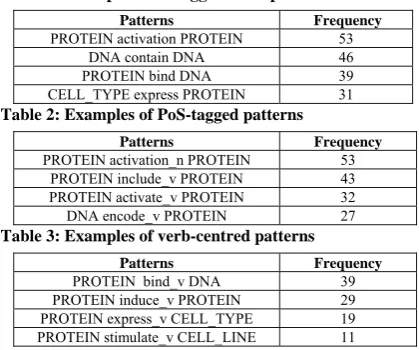
are shown in Table 1. Table 2 (PoS-tagged word
patterns) contains the PoS of each content word, while
Table 3 (verb-centred patterns) contains patterns where the presence of a verb is compulsory in each pattern. We require the presence of a verb in the verb-based patterns as verbs are the main predicative class of words, expressing specific semantic relations between two named entities.
Table 1: Examples of untagged word patterns
Patterns Frequency
PROTEIN activation PROTEIN 53
DNA contain DNA 46
PROTEIN bind DNA 39
CELL_TYPE express PROTEIN 31
Table 2: Examples of PoS-tagged patterns
Patterns Frequency
PROTEIN activation_n PROTEIN 53
PROTEIN include_v PROTEIN 43
PROTEIN activate_v PROTEIN 32
DNA encode_v PROTEIN 27
Table 3: Examples of verb-centred patterns
Patterns Frequency
PROTEIN bind_v DNA 39
PROTEIN induce_v PROTEIN 29
PROTEIN express_v CELL_TYPE 19
PROTEIN stimulate_v CELL_LINE 11
Moreover, in the pattern building phase, patterns containing passive forms of the verb like:
PROTEIN be_v express_v CELL_TYPE
are converted into the active voice form of the verb: CELL_LINE express_v PROTEIN
Because such patterns were taken to express a similar semantic relation between NEs, passive to active conversion was carried out in order to relieve the problem of data sparseness: it helped to increase the frequency of unique patterns and reduce the total number of patterns. For the same reason, negation expressions (not, does not, etc) were also removed from the patterns as they express a semantic relation between NEs equivalent to one expressed in patterns where a negation particle is absent.
4.
Pattern Ranking
Annotation corpus4 is used [8]. It consists of 9,372 sentences.
5.2
Evaluation method
In order to evaluate the quality of the extracted patterns, we examined their ability to capture pairs of related named entities in the manually annotated evaluation corpus, without recognising the type of semantic relation. Selecting a certain number of best-ranking patterns, we measure precision, recall and F-score. To test the statistical significance of differences in the results of different methods and configurations, we used a paired t-test, having randomly divided the evaluation corpus into 20 subsets of equal size; each subset containing 461 sentences on average.
6.
Results
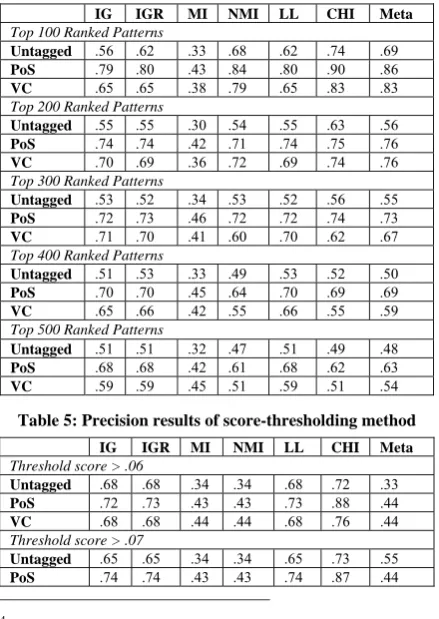
Table 4 shows the results of top-ranked patterns for each approach respectively while Table 5 shows the results of the score-thresholding method for each approach respectively (for space considerations, the tables show only precision scores; “Untagged” stands for “untagged word patterns”, “PoS” – for “PoS-tagged word patterns”, “VC” – for “verb-centred patterns”).
Table 4: Precision results of rank-thresholding method
IG IGR MI NMI LL CHI Meta
Top 100 Ranked Patterns
Untagged .56 .62 .33 .68 .62 .74 .69
PoS .79 .80 .43 .84 .80 .90 .86
VC .65 .65 .38 .79 .65 .83 .83
Top 200 Ranked Patterns
Untagged .55 .55 .30 .54 .55 .63 .56
PoS .74 .74 .42 .71 .74 .75 .76
VC .70 .69 .36 .72 .69 .74 .76
Top 300 Ranked Patterns
Untagged .53 .52 .34 .53 .52 .56 .55
PoS .72 .73 .46 .72 .72 .74 .73
VC .71 .70 .41 .60 .70 .62 .67
Top 400 Ranked Patterns
Untagged .51 .53 .33 .49 .53 .52 .50
PoS .70 .70 .45 .64 .70 .69 .69
VC .65 .66 .42 .55 .66 .55 .59
Top 500 Ranked Patterns
Untagged .51 .51 .32 .47 .51 .49 .48
PoS .68 .68 .42 .61 .68 .62 .63
VC .59 .59 .45 .51 .59 .51 .54
Table 5: Precision results of score-thresholding method
IG IGR MI NMI LL CHI Meta
Threshold score > .06
Untagged .68 .68 .34 .34 .68 .72 .33
PoS .72 .73 .43 .43 .73 .88 .44
VC .68 .68 .44 .44 .68 .76 .44
Threshold score > .07
Untagged .65 .65 .34 .34 .65 .73 .55
PoS .74 .74 .43 .43 .74 .87 .44
4
http://www-tsujii.is.s.u-tokyo.ac.jp/GENIA/home/wiki.cgi?page=Event+Annotation
VC .70 .71 .44 .44 .71 .89 .44
Threshold score > .08
Untagged .62 .62 .34 .34 .62 .78 .55
PoS .71 .71 .43 .43 .71 .92 .72
VC .66 .69 .44 .44 .69 .88 .76
Threshold score > .09
Untagged .57 .57 .34 .34 .57 .82 .56
PoS .70 .72 .43 .43 .72 .96 .72
VC .67 .67 .44 .44 .67 .88 .75
Threshold score > .1
Untagged .50 .50 .34 .34 .50 .81 .55
PoS .70 .70 .43 .43 .70 .95 .74
VC .65 .66 .44 .44 .65 .95 .75
Threshold score > .2
Untagged 0 0 .34 .34 0 .86 .82
PoS .86 .86 .43 .44 .86 1.00 .90
VC .85 .85 .43 .44 .85 1.00 .87
6.1
Ranking methods
In both tables, the results of the best performing ranking method are shown in bold font.
The CHI-score method performs best for the selected 100 top ranked patterns while the meta-ranking method comes out second best in all three patterns types. The difference between CHI-score and the second-best method (meta-ranking) is significant at p < 0.05 level. In Table 5, the CHI-score ranking method outperforms all the other ranking methods for all three patterns types while IG, IGR and LL come out second best for most of the thresholding score values. Here also the difference from the second-best ranking method is significant (p < 0.05). IG, IGR and LL ranking methods perform quite similarly to each other and in general, there is no statistically significant difference between them. While literature on the topic suggests that IGR performs better than the IG [14, 10], we found that in general there is no statistically significant difference between IG and IGR, IGR and LL in all three pattern types. In both sets of experiments, obviously due to the aforementioned problem, MI performs quite poorly; the normalised version of MI helps to alleviate this problem. Moreover, there exists a statistically significant difference (p < 0.01) between NMI and the other ranking methods in all three pattern types.
The meta-ranking method did not improve on the best individual ranking method as expected. In Table 4, the meta- ranking method comes out second best for 100, 200 and 300 top ranked patterns but then its performance decreases. Similarly for thresholding score values it comes out second best for all thresholds greater than 0.09. Moreover, we found that there is a statistically significant difference (p < 0.05) between the meta-ranking method and all the other meta-ranking methods for all three patterns types.
6.2
Score vs. rank thresholding
able to achieve up to 100% precision with the former technique.
6.3
Types of patterns
PoS-tagged word patterns and verb-centred patterns perform better than untagged word patterns. Verb-centred patterns work well, because verbs are known to express semantic relations between named entities using syntactic arguments to the verb; PoS-tagged word patterns add important semantic information into the pattern and possibly disambiguate words appearing in the pattern. In order to find out that whether the differences between the three patterns types are statistically significant, we carried out a paired t-test again. We found that there is no statistically significant difference between PoS-tagged word patterns and verb-centred patterns. Apart from IG, IGR and LL there is a statistically significant difference between all the ranking methods of untagged word patterns and PoS-tagged word patterns, untagged word patterns and verb-centred patterns respectively.
6.4
Precision vs. F-measure optimisation
The score-thresholding method achieves higher precision than the rank-thresholding method. High precision is quite important in applications such as MCQ generation. In thresholding scores, it is possible to optimise for high precision (up to 100%), though F-measure is generally quite low. MCQ applications rely on the production of good questions rather than the production of all possible questions, so high precision plays a vital role in such applications.
7.
Conclusion
In this paper, we have presented an unsupervised approach for Relation Extraction from surface-based patterns intended to be deployed in an e-Learning system for automatic generation of multiple choice questions. We experimented with three different surface-based approaches and showed that PoS-based and verb-centred patterns achieve higher precision compared to untagged word patterns. We explored different ranking methods and found that the Chi-Square ranking method obtained higher precision than the other ranking methods. We employed two techniques: the rank-thresholding method and score-thresholding method and found that thresholding scores perform better.
For future work, we are going to investigate other meta-ranking methods and carry out a task-embedded evaluation, in the context of the multiple-choice question generation problem.
8.
References
[1] Agichtein E. and Gravano L. Snowball: Extracting Relations from Large Plaintext Collections. In Proc. of the 5th ACM International Conference on Digital Libraries (DL-00), 2000.
[2] Blaschke A., Andrade M. A., Ouzounis C., and Valencia A. Automatic Extraction of Biological Information from Scientific Text: Protein-Protein interactions, in Proc. of ISMB99, pp. 60-67, 1999.
[3] Cohen A. M., and Hersh W. R. A Survey of Current Work in Biomedical Text Mining. Briefings in Bioinformatics, pp. 57-71, 2005.
[4] Corney D. P., Jones D., Buxton B., and Langdon W. BioRAT: Extracting Biological Information from Full-length Papers. Bioinformatics, pp. 3206-3213, 2004.
[5] Cunningham H., Maynard D., Bontcheva K., and Tablan V. GATE: A framework and graphical development environment for robust NLP tools and applications. In Proc. of ACL’02, Philadelphia, 2002.
[6] Hasegawa T., Sekine S., and Grishman R. Discovering relations among named entities from large corpora. In Proc. of ACL’04, 2004.
[7] Huang M., Zhu X., Payan G. D., Qu K., and Li M. Discovering patterns to extract protein-protein interactions from full biomedical texts. Bioinformatics, pp. 3604-3612, 2004. [8] Kim J-D., Ohta T., and Tsujii J. Corpus Annotation for Mining
Biomedical Events from Literature, BMC Bioinformatics, 2008. [9] Lin D. and Pantel P. Concept Discovery from Text. In Proc. of
Conference on CL 2002. pp. 577-583. Taipei, Taiwan, 2002. [10] Manning C. and Schütze H. Foundations of Statistical Natural
Language Processing. The MIT Press, Cambridge, US, 1999. [11] Martin E. P., Bremer E., Guerin G., DeSesa M-C., Jouve O.
Analysis of Protein/Protein Interactions through Biomedical Literature: Text Mining of Abstracts vs. Text Mining of Full Text Articles. Berlin: Springer-Verlag, pp. 96-108, 2004.
[12] Mitkov, R., Ha, L. A. and Karamanis, N. A computer-aided environment for generating multiple-choice test items. Natural Language Engineering 12(2). Cambridge University Press, pp. 177-194, 2006.
[13] Ono T., Hishigaki H., Tanigami A. and Takagi T. Automated Extraction of Information on Protein–Protein Interactions from the Biological Literature. Bioinformatics, pp. 155-161, 2001. [14] Quinlan J.R. Induction of decision trees. Machine Learning, 1(1),
pp. 81-106, 1986.
[15] Satoshi Sekine. On-Demand Information Extraction. Proc. of the COLING/ACL. Sydney, pp. 731-738, 2006.
[16] Soderland S. Learning Information Extraction Rules for Semi-Structured and Free Text. Machine Learning, 34(1-3):233–272, 1999.
[17] Stevenson M. and Greenwood. A Semantic Approach to IE Pattern Induction. In Proc. of ACL’05, pages 379-386, 2005. [18] Tsuruoka Y., Tateishi Y., Kim J-D., Ohta T., McNaught J.,
Ananiadou S., and Tsujii J. Developing a Robust PoS Tagger for Biomedical Text. Advances in Informatics - 10th Panhellenic Conference on Informatics, LNCS 3746, pp. 382-392, 2005. [19] Tsuruoka Y. and Tsujii J. Bidirectional Inference with the
Easiest-First Strategy for Tagging Sequence Data. Proc. of HLT/EMNLP, pp. 467-474, 2005.
[20] Yusuke Shinyama and Satoshi Sekine. Preemptive Information Extraction using Unrestricted Relation Discovery. Proc. of the HLT Conference of the North American Chapter of the ACL. New York, pp. 304-311, 2006.