International Journal of Asian Social Science, 2014, 4(2): 152-159
INVESTIGATING IMPEDING FACTORS OF GENERIC SKILLS' TEACHING
AND LEARNING IN PRIVATE HIGHER EDUCATION INSTITUTIONS: AN
ANALYSIS
OF
PERCEPTION
BY
PRIVATE
HIGHER
EDUCATION
INSTITUTIONS’ STUDENTS IN MALAYSIA
Rosima Alias
College of Foundation and General Studies, Universiti Tenaga Nasional, Kajang, Selangor
Mohd Izham Mohd Hamzah
Education Faculty, Universiti Kebangsaan Malaysia, Kajang, Selangor
Noor Hafiza Nor Azmi
†College of Foundation and General Studies, Universiti Tenaga Nasional, Kajang, Selangor
ABSTRACT
This study discusses the impeding factors of Generic Skills' (GS) Teaching and Learning in Private Higher Education Institutions (PHEI) in Malaysia. A total of 365 respondents from PHEIs’ Year 3 and 4 students were involved in this study. Data was collected through questionnaires and
interview. Reliability and validity of the instrument have been proven through Cronbach
Coefficient values and Rasch Measurement Model. The results showed: (1) There are four main
impeding factors that hindered GS in Teaching & Learning based on the students' perception
which is lack of time, extra workload), multiple responsibilities and students' own attitudes, and (2) incompatibility factor of PHEIs' curriculum is not a major obstacle in GS’ Teaching & Learning. The study also shows that there is a need for PHEIs and policy makers to improve the existing GS
module as well as PHEIs' policies, taking into account the impeding factors.
© 2014 AESS Publications. All Rights Reserved.
Keywords:
Generic skills, PHEI students, PHEI, Students' Perception, Teaching & Learning, Employability.
1. INTRODUCTION
Higher Education Institutions (HEI) in Malaysia have started focusing on generic skills (GS)
due to the implementation of Malaysian Qualification Framework (MQF) in 2006 (Sharifah
Hapsah, 2006) that are needed in forming a balanced human capital (Biggs, 2003; Smith and Bath,
International Journal of Asian Social Science
ISSN(e): 2224-4441/ISSN(p): 2226-5139Special Issue:
International Conference on Teaching and
Learning in Education, 2013
© 2014 AESS Publications. All Rights Reserved.
2006; Allan and Clarke, 2007), the formation of outstanding individuals in terms of personal,
interpersonal and organizational (Birkett, 1993; Coll and Zegwaard, 2006), has become the priority
of corporate world to recruit future graduates with work experience and sufficient GS (Ahmad,
2005; Syed, 2005; Mohd et al., 2011) as well as to better prepare students in the work field (Ranjit
and Wahab, 2008).
In terms of employers’ priority and needs, they are giving priority to employees who have a variety of skills according to studies by (Mason, 1992); (Quek, 1996a); (Lee, 2000); (Ball, 1989);
(Bould and Middleton, 2003); (Kanapathy, 2001); (Schroder, 1989); (Jacobsen, 1993) ; (Lee et al.,
2001). However, the present scenario showed poor command of GS among the graduates in this
country according to (Malaysian Employers Federation, 2005); (Hasliza, 2002); (Ungku Harun,
2004); (Ahmad, 2005) and (Ranjit, 2009) and do not meet the employer’s standard (Bank Negara
Malaysia, 2003; Cruez, 2003; Cox and King, 2006; Sonia, 2008). This contributes to a very low
level of employability and serious cause of unemployment among this group (Cruez, 2003; Ungku
Harun, 2004; Malaysian Employers Federation, 2005; Razak, 2005; Hariati, 2007; Ranjit, 2009).
The situation occurred due to the various obstacles that exist in GS T & L in HEI. There are
HEIs in the country that have put less emphasis on the mastery of GS among their students (Asma
and Lim, 2000; Lee, 2000; Quek, 2000; Kanapathy, 2001). In fact, not all of the HEIs especially
private institutions, provide clear T & L methods in inculcating and enhancing GS among their
students as well as explicit in nature (Zalizan et al., 2007). It is also stated that though GS T & L
can increase the employability of students, it would undermine the value of academic learning and
higher education institutions should only serve for the purpose of learning process, rather than
aiming to get a job and educators are not supposed to follow the market trend (Dzulkifli, 2009).
Based on the literature review and problem statement, the objective of this study is to identify
the main impeding factors in implementing GS T & L based on the perception of students in
private universities.
2. RESEARCH METHODOLOGY
This study is a quantitative study as the primary method of data collection that involved a total of 365 respondents consisting of PHEI’s students in year 3 and 4 from 11 private higher educational institutions (PHEIS) with the university status in the country. Meanwhile, qualitative
data obtained through interviews involved 2 students from PHEI.
The construction of the questionnaire items involved with the impeding construct in
implementing GS T & L was adapted and modified from a study carried out by Zalizan et al.
(2007). Questionnaire items used Cronbach Alpha Coefficients to measure the reliability of the
items and Rasch model analysis to evaluate the validity of the items. To classify coefficient of
Cronbach Alpha coefficients, the classification is based on the reliability index by Babie (1992)
Table-1. Classification Index Cronbach Alpha
Indicator Cronbach Alpha Value
>0.90 Very high
0.70 -0.89 High
0.30- 0.69 Moderate
<0.30 Low
Source: Babie (1992)
Cronbach Alpha value that is adequate for a Social Science study is 0.60 (Nunnally, 1978;
Rahayah and Rashid, 2001; Mohd, 2005). Cronbach Alpha values obtained from this survey is
0635 and in the moderate scale (0.30-0.69). However, the value of 0.60 for this study was
sufficient. Meanwhile, the interpretation of the data is made in the form of frequency as shown in
Table 2.0 below.
Table-2. Frequency Percentage Interpretation
Frequency Percentage Interpretation
75% - 100% Very frequently
50% - 74% Frequently
0% - 49% Rarely
Source: Alias (1999); Tuckman (1999); Gay and Airasian (2003)
The background of PHEI’s students who are the respondents in this study consists of 53.2% male and 46.8% female students. Students from the Faculty of Science / Technical are 54.5%,
while the students not from the Faculty of Science / Technical are 45.5%. 4th year student
respondents of the study are 25.2% and 74.8% for 3rd year students.
3. FINDINGS
The findings of the study have been able to prove that all of the items used in the questionnaire
to measure the construct of the obstacles in GS T&L were able to measure these constructs.
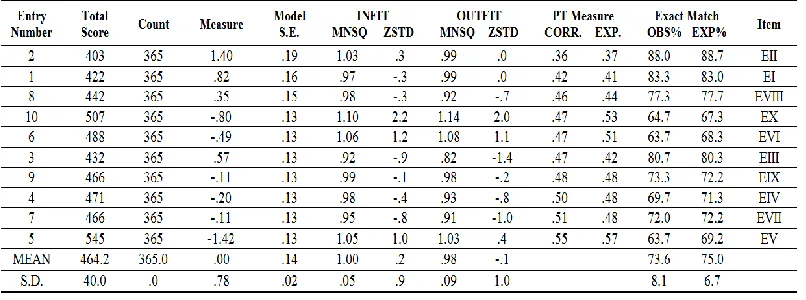
Validity of these items has used Rasch Measurement Model as shown in Table 3.0 below.
© 2014 AESS Publications. All Rights Reserved.
From table 3.0, Point Measure Correlation-PTMEA CORR for items of 10 constructs that is
available in the questionnaire. All items indicate positive values (> 0.30), ranging from 0.36 to
0.55. According to Bond and Fox (2001) CORR PTMEA positive values validated that the items
have measured the construct it is supposed to be measured. Therefore, all items for impeding
factors are working in tandem, in measuring 10 items of impeding factors of GS development. This
analysis is a fundamental step to measure the validity of the constructs used to design and validate
questionnaires. Results from the analysis of the reliability and validity of the items have concluded
that the construct for impeding factors that are used in the questionnaire are: i) insufficient time, ii)
workload, iii) various responsibilities, iv) student attitudes, v) university culture, vi) too
exam-oriented, vii) the attitudes and abilities of lecturers, viii) insufficient facilities, ix) English language
proficiency and x) curriculum incompatibility.
Based on the impeding factors that have been identified, the results show factors that become
major obstacles in GS T & L according to the perceptions of PHEI students is the insufficient time
factor (89.6%), followed by work load (84.4), various responsibility (81.6%) and attitudes (78.9%).
These four factors are the main impeding factors of GS T & L among the students based on the
frequency percentage interpretation as it is on the very frequently scale (75% -100%). Overall, the impeding factors of GS development based on the PHEI students’ perception are shown in Table 4.0:
Table- 4. Frequency of Impeding Factors in Generic Skills Implementation from PHEIs Students’ Perceptions
Factor Category Frequency (%) Interpretation
Insufficient time 89.6 Very frequently
Work load 84.4 Very frequently
Various responsibilities 81.6 Very frequently
Students’ Attitude 78.9 Very frequently
University’s culture (PHEI) 72.3 Frequently
Too exam-oriented 72.3 Frequently
Lecturer’s attitude and ability 71.0 Frequently
Inadequate facilities 66.3 Frequently
English profiency 61.1 Frequently
Curriculum incompability 50.7 Frequently
Frequency percentage of factors such as university culture, too exam-oriented, attitude and
ability of the lecturer is placed on the frequently scale. This shows that these factors are also major
obstacles in developing GS based on the students' perception. Meanwhile, factors such as
insufficient facilities and English language proficiency will moderately affect the GS T & L.
However, factor like curriculum incompatibility is not perceived as a major obstacle for these
students in learning GS.
Besides, the findings from the quantitative data are also supported by data obtained from
interviews with 2 students from private institutions. Interview with Student 1 (S1) and Student 2
(S2) showed negative attitudes of the students on the importance of GS and even considered GS
".... don’t need to have generic skills. Uh ... why do I have to learn this skill .., why do I have to study organizational leadership ... people say if I work later..for the people .. I want this job, I will weld and all…operate machine and all , I do not have to use this GS .. at least I can talk, can make people understand, that is enough .. Why do I need GS? People really feel that this really burdens
them ... (S2)
S2 statement is supported by S1 responses as follows:
"Like I was saying earlier, it comes from the student’s attitude ... and also coming from lecturer’s attitude... lecturer’s ability .... I mean there are lecturers who do not know how to talk ... or deliver contents. So, how to show to the student that soft skills are important? Others, I think we're too
focussed on exam, lecturer is trying to finish off the syllabus, so they do not really care about these
soft skills "(S1).
The most interesting findings of the two methods are students' perception of lecturers’ attitude
and ability as one of the main factors contributing to the GS T & L barriers in HEI. Moreover, in
terms of percentage, this factor contributes a high percentage of 71%. This finding is actually in
line with the study of Ahmad and Hisham (2009) who found that the role of the lecturer can
improve the ability and competency of students. This indirectly demonstrated that the lecturer is a
mentor to students. There is a demand for lecturers that can be role models to the students and
capable in many respects. However, there are still many students who question the quality of the
lecturers for their teaching is boring, not associating knowledge with the current state of the world
and consequently make T & L devoid of fun (Robiah, 2000). Apart from the views of the students,
the study by Sufean (2002) and Chua and Adi (2002) found that the lecturers are not skilled in
dealing with teaching as well as lack of creativity. This is consistent with the findings that found
that teachers who are less experienced and high trade-off of staffs among PHEIs’ lecturers
(Baharudin, 2003; Baharin and Magrit, 2010) and moderate commitment of academic staff
(Rusinah, 2005). Negative perception of the students on the lecturer is a also a form of barriers to
GS T & L. This data is actually in line with a study carried out by Jeffrey and David (2007) which
show time factor as the key factor that caused most organizations to face problem in providing employees’ T & L. In fact, these findings supported the findings of the study by Zalizan et al. (2007) and Baharin and Magrit (2010).
Based on the interview data, this study is also able to grasp the impeding issues in detailed as
perceived by the students as follows:
1. Lack of knowledge and understanding of lecturers in GS will lead to inability to deliver
and implement aspects of GS effectively.
2. Lack or absence of exposure to the students on the GS concept will cause them not to
appreciate the current T & L conducted.
3. An additional burden on students and with the addition of the subjects will increase tuition
fees to students.
4. Narrow knowledge related to the GS interests and needs of students for their future.
Shortage or obstacles must be overcome before GS T & L can be implemented. It should be taken
© 2014 AESS Publications. All Rights Reserved.
4. CONCLUSION
It is very clear that every aspect of an individual's life and work requires GS as the main criteria
in addition to technical skills as a basic skill. Thus, the main factors that impede the increase of GS T & L such as workload, time constraints, various responsibilities and students’ negative attitudes need to be addressed by the students, higher education institutions, the Ministry of Higher Education and also school authority and parents. Lecturers’ role is critical in ensuring that GS T & L can be implemented effectively, the negative perception of lecturers and efficiency needs to be
changed and improved. Moreover, GS development methods need to be implemented as standalone
methods, across the curriculum and the method is carried out indirectly. It shall be the
responsibility of HEIs to provide their students with the aspects of GS that is in high demand,
especially from the organization as well as to fulfill the dream of the government to produce
excellent human capital.
REFERENCES
Ahmad, E. and J. Hisham, 2009. Peranan Kokurikulum Di Universiti Dalam Membentuk Keterampilam
Mahasiswa, Universiti Tun Hussein Onn Malaysia.
Ahmad, S., 2005. Perutusan hari guru 2005. Available from
http://www.moe.edu.my/hariguru/perutusanKPPM.htm.
Alias, B., 1999. Statistik penyelidikan dalam pendidikan dan sains social. Bangi: Penerbit Universiti
\Kebangsaan Malaysia.
Allan, J. and K. Clarke, 2007. Nurturing supportive learning environments in higher education through the
teaching of study skills: To embed or not to embed? International Journal of Teaching and Learning
in Higher Education, 19(1): 64-76.
Asma, A. and L. Lim, 2000. Cultural dimensions of Anglos, Australians and Malaysians. Malaysian
Management Review, December: 9-17.
Azhar, A., 2006. Strategi pembelajaran pengaturan kendiri pendidikan Islam dan penghayatan akhlak pelajar
sekolah sekolah menengah. Tesis PhD, Pendidikan Islam, Universiti Kebangsaan Malaysia.
Babie, E., 1992. Survey research methods. 2nd Edn., Belmont, CA: Wadsworth.
Baharin, A. and O. Magrit, 2010. Tahap kesediaan kemahiran generikn pelajar PKPG Tahun Akhir Yang
Mengambil Mata Pelajaran Kemahiran Hidup Di Fakulti Pendidikan UTM, Skudai, Universiti
Teknologi Malaysia Malaysia.
Baharudin, H.P., 2003. Kualiti perkhidmatan institusi pengajian tinggi swasta (IPTS) Di Melaka: Satu
Tinjauan. Tesis PhD Fakulti Pendidikan, UKM, Bangi.
Ball, C., 1989. Towards an enterprising culture. Paris: OECD/CERI.
Bank Negara Malaysia, 2003. Annual report 2002. Kuala Lumpur: Bank Negara Malaysia.
Biggs, J., 2003. Maidenhead: Society for Research into Higher Education & Open University Press.
Birkett, W.P., 1993. Competency based standards for professional accountants in Australia and New Zealand.
Melbourne: Australian Society of Certified Practising Accountants.
Bond, T.G. and C. Fox, 2001. Applying the rasch model: Fundamental measurement in the human sciences.
ERL Lawrence Baum Associates Publishers London.
Bould, D. and H. Middleton, 2003. Learning from others at work; communities of practices and informal
Chua, B.S. and F. Adi, 2002. Tekanan pekerjaan, kepuasan kerja dan implikasinya terhadap proses
pengajaran-pembelajaran di sekolah: Satu kajian ke atas guru-guru sekolah menengah di Kota
Kinabalu, Sabah. Prosiding seminar Kebangsaan Profesion Perguruan 2002w. pp: 198-207.
Coll, R.K. and K.E. Zegwaard, 2006. Perceptions of desirable graduate competencies for science and
technology new graduate. Research in Science & Technological Education, 24(1): 29-58.
Cox, S. and D. King, 2006. Skill sets: An approach to embed employability in course design. Education
Training, 48(4): 262-274.
Cruez, A.F., 2003. 60,000 graduates unemployed. New Straits Times: 12.
Dzulkifli, A.R., 2009. Returning our education to learning. New Sunday Times: 35.
Gay, L.R. and P. Airasian, 2003. Educational research: Competencies for analysis and applications. Ke-7
Edn., New Jersey: Prentice Hall.
Hariati, A., 2007. Congratulations, you fit our bill! Sunday Star: E10.
Hasliza, H., 2002. Ciri-ciri kualiti pelajar untuk keperluan pekerja pada masa kini. Seminar Antara Industri
Dan Institusi Pendidikan Awam, UKM, Bangi.
Jacobsen, R.L., 1993. Shaking up the MBA. Chronicle of Higher Education, 40(15): 18-19.
Jeffrey, K.L. and P.M. David, 2007. Developing your people the toyota way. McGraw- Hill.
Kamarul, A.J., 2010. Guru cemerlang pendidikan Islam sekolah menengah di Malaysia: Satu Kajian Kes.
Tesis PhD, Universiti Kebangsaan Malaysia.
Kanapathy, V., 2001. Building Malaysia’s IT society. Raffless Review, 5(1): 1-14.
Lee, K.H., A.H. Quek and S.B. Chew, 2001. Education and work: The state of transition. Kuala Lumpur:
University of Malaya Press.
Lee, S.K.V., 2000. The demand for business and management education in Hong Kong beyond 1997, In
Rowley, C., Fitzgerald, R. (Eds), Managed in Hong Kong. London: Adaptive Systems,
Entrepreneurship and Human Resource, Frank Cass.
Malaysian Employers Federation, 2005. Facing the realities of the world of work. (Atas talian). Available
from http://www.epu.jpm.my/new%20folder/seminar/stm [Accessed 22Feb.2006].
Mason, J.C., 1992. Business schools: Striving to meet customer demand. Management Review, 81(9): 10-14.
Mohd, I.M.H., L. Juriah, A. Khalid, M. Zaini, Y. Hamidah, I. Zarin, L.A.W. Jamalul, F. Nor and A. Rosima,
2011. Analisis Keperluan Majikan Terhadap Kemahiran Generik Bagi Pembangunan Modal Insan,
Dlm. Transformasi Dan Inovasi Dalam Penyelidikan, Zamri Mahamod, Jamalul Lail Abdul Wahab
& Mohammed Sani Ibrahim(Pnyt.). Bangi: Penerbit UKM.
Mohd, M.K., 2005. Kaedah penyelidikan pendidikan. Ke-7 Edn., Kuala Lumpur: Dewan Bahasa dan Pustaka.
Nunnally, J., 1978. Psychometric theory. New York: McGraw Hill.
Quek, A.H., 1996a. World culture and values: A process perspective, paper presented at the Seminar on
European Business, Baden-Wurttemberg,October.
Quek, A.H., 2000. Career choice and vocational fitness. Asian Psychologist, 2(1): 56-58.
Rahayah, S. and J.A. Rashid, 2001. Isu pengukuran dan penilaian dalam pendidikan. UKM.
Ranjit, S.M., 2009. Make yourself employable: How graduates can hit the ground running! Kuala Lumpur:
TQM Consultants Sdn. Bhd.
Ranjit, S.M. and A.B. Wahab, 2008. Your dream job: How to get it and excel. Kuala Lumpur: TQM
Consultants Sdn. Bhd.
© 2014 AESS Publications. All Rights Reserved.
Robiah, S., 2000. Kualiti pengajaran dan pembelajaran universiti tempatan. Akademik, 57(1): 25-40.
Rusinah, S., 2005. Komitmen pensyarah institusi pendidikan tinggi swasta bertaraf universiti terhadap
organisasi. Tesis PhD. Universiti Putra Malaysia, Serdang
Schroder, H.M., 1989. Managerial competences: The key to excellence, Kendall-Hunt, Dubuque, 1A.
Sharifah Hapsah, S.H.S., 2006. Kerangka kelayakan Malaysia. Lembaga Akreditasi Negara
Smith, C. and D. Bath, 2006. The role of the learning community in the development of discipline knowledge
and generic graduate outcomes. Higher Education, 51(2): 259-289.
Sonia, R., 2008. Are foreign graduates better than locals? New Sunday Times.
Sufean, H., 2002. Inovasi ke arah pembangunan pendidikan dinamik. Dlm Sufean Hussin. Inovasi dasar
pendidikan: Perspektif sistem dan organisasi. Kuala Lumpur: Penerbit Universiti Malaya.
Syed, H., 2005. Meeting the needs of employers. Proceedings of National Seminar’ The Development of
Technology And Technical-Vocational Education And Training In An Era of Globalization: Trend
and Issues. Kuala Lumpur.
Tuckman, B.W., 1999. Conducting education research. Belmort CA: Wardworth Group.
Ungku Harun, A.R.A., 2004. Meeting the demand of global firms. (Atas talian). Available from
http://www.epu.jpm.my/new%20folder/seminar/stm/slideungku%20harun [Accessed 22 Feb.2006].
Zalizan, M.J., A. Norzaini, M.N. Norazah, M.A. Manisah and T.A. Halim, 2007. Developing core
competencies of graduates: A study of effective of higher education practices in Malaysian
universities. IRPA ID:0702-02-0041-EA229. Universiti Kebangsaan Malaysia.