Article
Diethyl Carbonate Synthesis from CO
2, Ethanol and
Propylene Oxide in the presence of Dehydrating Agent of
Ethylene over the novel catalysts of Supported
Ni-Cu@Na
3PW
12O
40and Mixed Ni-Cu@Na
3PW
12O
40Meng Zhang 1,*
1 School of Biomedical Engineering, Southern Medical University, Guangzhou, 510515, China; [email protected]
* Correspondence: [email protected] (M. Zhang);
Abstract: Excessive CO2 emissions and alternative energy fuels are two major difficult issues. The
utilization of CO2 into fine chemicals is an optimal route. Diethyl carbonate (DEC) is an extremely
versatile chemical intermediate. DEC is used in gasoline, pharmaceutical, chemical and other fields. DEC synthesis from CO2 and ethanol is a typical green synthetic route. Ni-Cu@Na3PW12O40
catalysts were synthesized by two novel methods of supported and mixed. The catalyst prepared by mixed method showed nice catalytic performance. It was confirmed that water removal was the key to improving conversion efficiency. In the presence of dehydrating agent of ethylene, ethanol conversion increased from ca. 3% to ca. 40%. Propylene oxide (PO) was participated in the reaction and ethanol conversion continued to reach to ca.90% while DEC selectivity dropped by half. Under optimal conditions, our Ni-Cu@Na3PW12O40 catalyst effectively solved the two major
issues above.
Keywords: CO2; Diethyl Carbonate; Ethanol; Dehydrating Agent; Catalyst;
1. Introduction
Two major issues of excessive CO2 emissions [1] and alternative energy fuels [2] are getting
global attention due to various disasters in recent years. Some cities had to relocate as a whole due to rising sea levels. The culprit was excessive CO2 emissions. Therefore, how to reduce the emission
of CO2 and how to make rational use of existing CO2 had become the focus of research [3-6]. Also,
with the development of the economy, the energy consumed in total was growing exponentially. If no alternative energy could be found, social development will be forced to stop, which will lead to a series of social disasters. Among the various solutions [7, 8], the route of catalytic conversion of CO2
into energy substances stands out based on weighing the advantages and disadvantages.
Diethyl carbonate (DEC) is a very common intermediate for chemical synthesis and it has a very wide range of uses. DEC is a commonly used carboxylation reagent [9]. It can be used to synthesize ketones, tertiary alcohols and heterocyclic compounds [10]. DEC can also be used as an alkylating agent for silicon carbonate and nucleophile substrates [11]. DEC is commonly used for carbonization, cyanogenation, esterification and alkylation of amines [12]. In addition, DEC has a wide range of applications in the pharmaceutical industry, chemical industry and battery industry. DEC is essential in the synthesis of products of phenobarbital and insect chrysanthemum [13]. DEC is also a chemical agent that has to be used in instrument sealing liquids and analytical chemistry [14]. And most importantly, the octane number of gasoline can be greatly increased by adding DEC into gasoline [15].
The industrial synthesis methods of diethyl carbonate include phosgene method, ethanol oxidative carbonylation and transesterification method. The phosgene method [16] was not only
10 20 30 40 50 60 0 1000 2000 3000 4000 5000 In te n si ty 2 Theta
Supported Ni-Cu@Na3PW12O40
N i (1 1 1 ) N i (2 0 0 )
10 20 30 40 50 60
0 1000 2000 3000 N i (2 0 0 ) In te n si ty 2 Theta
Mixed Ni-Cu@Na3PW12O40
C u (1 1 1 ) C u (2 0 0 )
highly toxic to the raw materials, but also had a severe corrosion effect on the equipment. This method had been phased out by the industry. The product yield of ethanol oxidative carbonylation method [17] was not ideal and catalysts were easily deactivated. The transesterification method [18] not only had a high cost of raw materials, but also had a low product yield, which had no industrial competitive advantage. Direct DEC synthesis from CO2 and ethanol is a green and streamlined
method [19-22]. The price of raw materials was low and the utilization rate of atoms was high [23, 24]. The whole process was nontoxic and green [25-27]. Consequently, this route attracts more and more attention of researchers.
As is known to all, CO2 is a very chemically inert gas and it is difficult to react [28-30]. Thus,
the route of DEC synthesis from CO2 and ethanol has low conversion [31, 32]. However, the issue of
low conversion can be solved by adding dehydrating agent [33-35]. The dehydrating agents can remove water in situ [36-38] and continuously move the chemical equilibrium forward, which greatly increases the conversion.
In this paper, Ni-Cu@Na3PW12O40 catalysts synthesized by mixed synthetic method and
supported synthetic method was prepared. The catalysts were estimated for direct synthesis DEC from CO2 and ethanol. And the catalyst prepared by mixed method showed better performance.
Ethylene was chosen to be as dehydrating agent and mixed with CO2 together. Surprisingly,
ethanol conversion increased from ca. 3.5% to ca. 40% for the route of DEC synthesis from CO2 and
ethanol in the presence of dehydrating agent of ethylene under Ni-Cu@Na3PW12O40 catalyst
synthesized by mixed synthetic method. For further research, propylene oxide (PO) was added to the reaction and the ethanol conversion of ca. 90% was obtained under mixed Ni-Cu@Na3PW12O40
catalyst.
2. Results and Discussion
2.1 Characterization of Synthesized Catalysts
2.1.1 X-ray diffraction (XRD) spectra
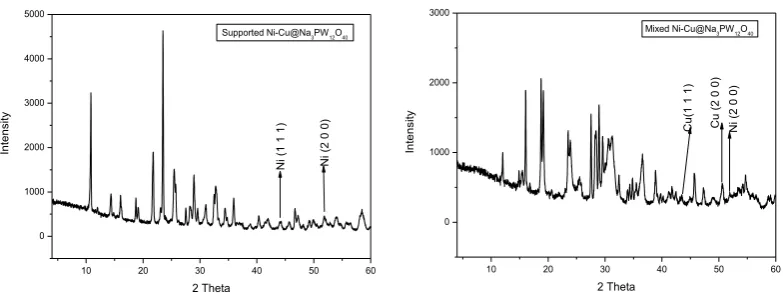
Figure 1 XRD patterns of Supported Ni-Cu@Na3PW12O40 and Mixed Ni-Cu@Na3PW12O40
The X-ray diffraction (XRD) spectra in Figure 1 demonstrate the peaks of Ni-Cu@Na3PW12O40
catalysts synthesized by two different methods of supported method and mixed method. For the supported Ni-Cu@Na3PW12O40 catalyst, two peaks of Ni (1 1 1) and Ni (2 0 0) were obtained. There
were no peaks of Cu in the XRD spectra. For the mixed Ni-Cu@Na3PW12O40 catalyst, three peaks of
Cu (1 1 1), Cu (2 0 0) and Ni (2 0 0) were obtained. As we known, diethyl carbonate synthesis from CO2 and ethanol was catalyzed by crystal planes. Owing to some uncertain reasons, Cu (1 1 1) and
synthesized by supported method. The catalytic performance of mixed Ni-Cu@Na3PW12O40 catalyst
could be better than supported one based on this XRD results.
2.1.2 Morphology of Synthesized Catalysts
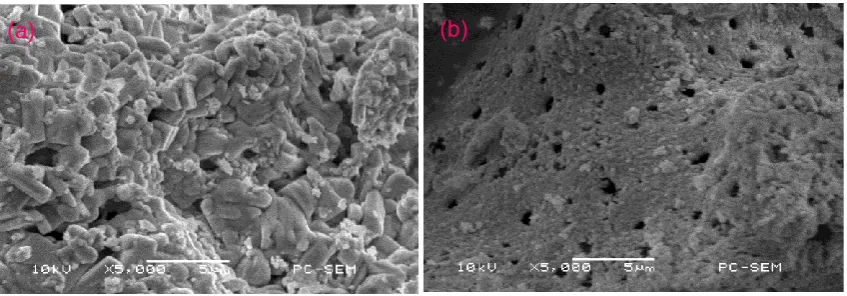
Figure 2 SEM profiles (picture a was supported Ni-Cu@Na3PW12O40 and picture b was mixed
Ni-Cu@Na3PW12O40)
Morphology of Ni-Cu@Na3PW12O40 catalysts synthesized by two different methods of
supported method and mixed method was estimated by Scanning Electron Microscopy (SEM) as shown in Figure 2. Catalyst obtained by supported method consisted of larger particles than mixed method. Obviously, a large number of channels of micron level were distributed in the surface of catalyst synthesized by mixed method. And no channels were detected in the surface of catalyst synthesized by supported method. These channel structures were more conducive to the occurrence of catalytic reaction.
2.1.3 Temperature Programmed Reduction (TPR) measurement
100 200 300 400 500 600 700
0 50 100 150 200 250
Si
g
n
a
l/mv
Temperature/OC Mixed NiO-CuO@Na3PW12O40
Supported NiO-CuO@Na3PW12O40
392 493
529
682
624
Figure 3 Temperature Programmed Reduction (TPR) profiles of Supported
NiO-CuO@Na3PW12O40 and Mixed NiO-CuO@Na3PW12O40
Temperature Programmed Reduction (TPR) characterization (Figure 3) was measured to analyze the interaction between catalysts components and determine the best hydrogen reduction temperature [39] in the step of catalyst preparation. The characteristic reduction peak of CuO was 392℃; The characteristic reduction peak of NiO was 493℃; And the decomposition temperature of sodium phosphotungstate was 682℃ for supported NiO-CuO@Na3PW12O40. The characteristic
reduction peak of CuO was 392℃; The characteristic reduction peak of NiO was 529℃; And the
decomposition temperature of sodium phosphotungstate was 624 ℃ for mixed
NiO-CuO@Na3PW12O40. Therefore, hydrogen reduction temperature in the next step of catalyst
preparation was determined to be 550℃. In the case of NiO-CuO@Na3PW12O40 catalysts synthesized
by supported method and mixed method, two NiO reduction peaks were appeared at 493℃ and 529℃. Therefore, the interaction mode between NiO and Na3PW12O40 was significantly different,
which led to different catalytic properties.
2.1.4 Temperature Programmed Desorption (TPD) measurement
100 200 300 400
-10 0 10 20 30
CO
2
D
e
so
rp
tio
n
Si
g
n
a
l/mV
Temperature/oC 179
230
1
2
1 Mixed Ni-Cu@Na3PW12O40 2 Supported Ni-Cu@Na3PW12O40
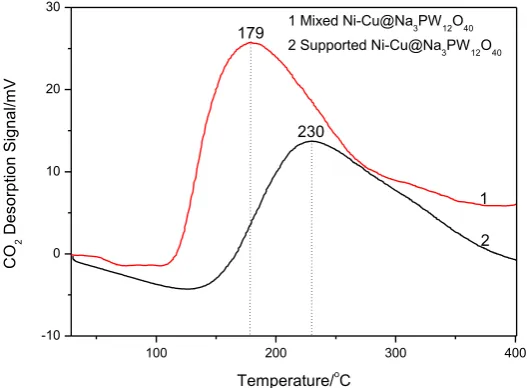
Figure 4 TPD-CO2 profiles of Mixed Ni-Cu@Na3PW12O40 and Supported Ni-Cu@Na3PW12O40
Temperature programmed CO2 desorption (TPD-CO2) spectra revealed the characteristics of
basicsites on the catalyst surface and the absorption capacity of CO2 as shown in Figure 4. The
number of peaks stands for the number of types of active centers and the area of a peak indicates the amount of one certain active site of the catalyst [40]. There was only one peak around 179 °C and 230 °C for Ni-Cu@Na3PW12O40 catalysts obtained by mixed method and supported method,
respectively. Thus, it was indicated that only one type of active center bonding CO2 exists in each
case. Based on peak area values, the amount of active center for the catalyst that is prepared by mixed method is much higher than that for the catalyst prepared by supported method. Therefore, the absorption strength of CO2 and the activation extent of CO2 for Ni-Cu@Na3PW12O40 catalyst
100 200 300 400 500 -10
0 10 20 30 40
NH
3
D
e
so
rp
tio
n
Si
g
n
a
l/mV
Temperature/oC
191
191
378 418
1
2
1 Mixed Ni-Cu@Na3PW12O40 2 Supported Ni-Cu@Na3PW12O40
Figure 5 TPD-NH3 profiles of Mixed Ni-Cu@Na3PW12O40 and Supported Ni-Cu@Na3PW12O40
Temperature programmed NH3 desorption (TPD-NH3) spectra (Figure 5) revealed the
characteristics of acid sites [41] on the catalyst surface and allowed to investigate the activation of ethanol on catalyst. There were two peaks of NH3 desorption, corresponding to two types of acid
active centers, at around 191℃and 418℃, for Ni-Cu@Na3PW12O40 catalyst prepared by mixed
method. Also, there were two peaks of NH3 desorption at around 191℃and 378℃ for catalyst
synthesized by supported method. Based on peak area values, much more acid active centers were produced when catalysts were synthesized by mixed method. Consequently, the activation of ethanol for the catalyst is expected to be stronger than the catalyst synthesized by supported method. The observed differences between the two catalysts in TPD-CO2 and TPD-NH3 spectra
could be attributed to well-dispersed and large numbers of channels, which produced extra acid and base active centers.
2.1.5 Thermo-gravimetric analysis (TGA) measurement
100 200 300 400 500
97 98 99 100
T
G
%
Temperature/OC
Air
N2
100 200 300 400 500 600
75 80 85 90 95 100
T
G
%
Temperature/OC
Supported
Mixed
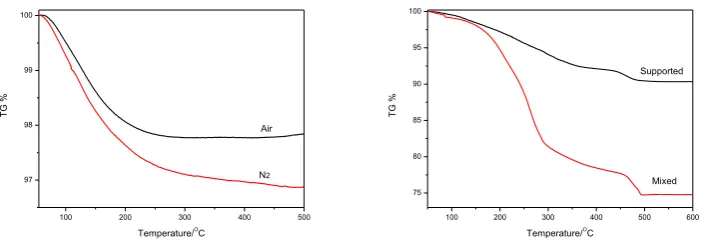
Figure 6 Thermo-gravimetric analysis (TGA) profiles (Left: Na3PW12O40; Right: Supported
The influence of different atmosphere nitrogen or air on the thermal stability of sodium phosphotungstate was different as shown in Figure 6. The loss of free water and crystal water occurred before 250℃. There was a relatively stable platform from 250℃ to 500℃. They had the same thermal decomposition trend as shown in Figure 6. After 500℃, the weight was no longer reduced and maintained constant. Therefore, the calcination temperature in the next step of catalyst preparation was determined to be 500℃.
2.2 Catalytic Performance Characterization
2.2.1 Diethyl Carbonate (DEC) Synthesis from CO2 and Ethanol
Table 1 Effect of reaction temperature on the performance of Ni-Cu@Na3PW12O40 catalyst synthesized
by mixed method for DEC synthesis from CO2 and ethanol
Temperature/°
C
Ethanol
Conversion/%
DEC
Selectivity/%
DEC
Yield/%
90
0.66
90.6
0.60
110
1.76
91.2
1.61
130
2.39
90.2
2.16
150
3.11
95.0
2.95
170
2.85
92.5
2.64
190
2.14
91.4
1.96
80 100 120 140 160 180 200
0 1 2 3 4
Et
h
a
n
o
l C
o
n
ve
rsi
o
n
/%
Temperature/oC
D
EC
Se
le
ct
ivi
ty/
%
85 90 95 100
synthesized by mixed method for DEC synthesis from CO2 and ethanol
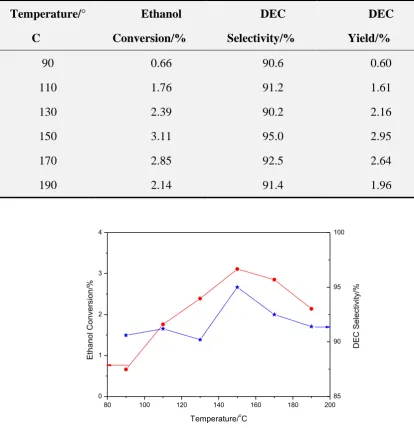
Catalytic performance of Ni-Cu@Na3PW12O40 catalyst synthesized by mixed method was
measured for the reaction of DEC synthesis from CO2 and ethanol. The detailed result was shown
in Table 1 and the changing tendency was shown in Figure 7, respectively. With the increasing of reaction temperature, ethanol conversion became larger. And it was reached up to the max value when temperature was 150℃. When the temperature continued to rise, ethanol conversion declined. DEC selectivity did not show obvious changing tendency.
Table 2 Effect of reaction pressure on the performance of Ni-Cu@Na3PW12O40 catalyst synthesized by
mixed method for DEC synthesis from CO2 and ethanol
Pressure/MPa
Ethanol
Conversion/%
DEC
Selectivity/%
DEC Yield/%
0.6
0.26
96.8
0.25
1.0
0.86
95.1
0.82
1.4
1.95
92.6
1.81
1.8
2.69
95.7
2.57
2.2
3.11
95.0
2.95
2.6
2.88
90.5
2.61
3.0
2.13
92.9
1.98
0.4 0.8 1.2 1.6 2.0 2.4 2.8 3.2
0.0 0.5 1.0 1.5 2.0 2.5 3.0 3.5
Et
th
a
n
o
l C
o
n
ve
rsi
o
n
/%
Pressure/oC
D
EC
Se
le
ct
ivi
ty/
%
85 90 95 100
mixed method for DEC synthesis from CO2 and ethanol
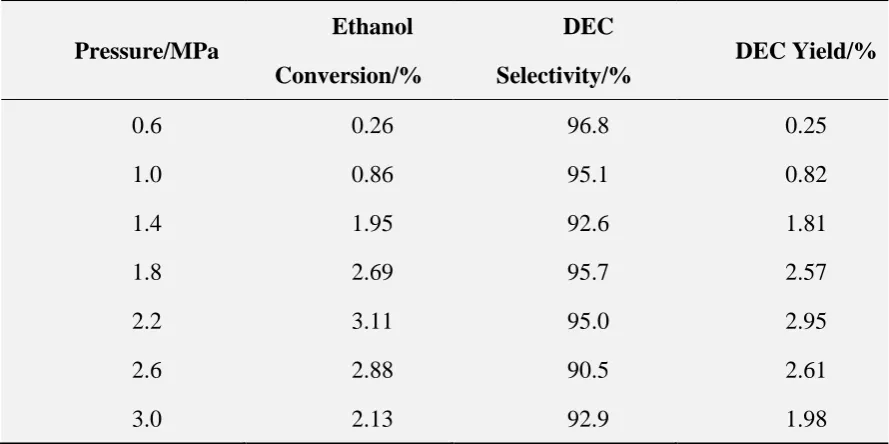
Effect of reaction pressure on the performance of Ni-Cu@Na3PW12O40 catalyst synthesized by
mixed method was measured for the reaction of DEC synthesis from CO2 and ethanol. The detailed
result was shown in Table 2 and the changing tendency was shown in Figure 8, respectively. With the increasing of reaction pressure, ethanol conversion increased and reached up to the max value of 3.11% when the pressure was 2.2 MPa. Beyond this pressure, ethanol conversion declined. DEC selectivity showed changing tendency of wave properties.
Table 3 Effect of reaction temperature on the performance of Ni-Cu@Na3PW12O40 catalyst synthesized
by supported method for DEC synthesis from CO2 and ethanol
Temperature/°
C
Ethanol
Conversion/%
DEC
Selectivity/%
DEC
Yield/%
90
0.36
91.6
0.33
110
1.47
91.3
1.34
130
1.91
90.6
1.73
150
2.75
95.8
2.63
170
2.10
94.5
1.98
190
1.63
91.9
1.50
80 100 120 140 160 180 200
0 1 2 3 4
Et
h
a
n
o
l C
o
n
ve
rsi
o
n
/%
Temperature/oC
D
EC
Se
le
ct
ivi
ty/
%
85 90 95 100
Figure 9 Effect of reaction temperature on the performance of Ni-Cu@Na3PW12O40 catalyst synthesized
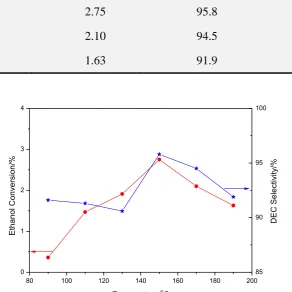
Catalytic performance of Ni-Cu@Na3PW12O40 catalyst synthesized by supported method was
measured for the reaction of DEC synthesis from CO2 and ethanol. The detailed result was shown
in Table 3 and the changing tendency was shown in Figure 9, respectively. With the increasing of reaction temperature, ethanol conversion increased and arrived at the max value of 2.75% when temperature was 150℃. When temperature continued to rise, ethanol conversion declined. DEC selectivity showed changing tendency of wave. The catalytic performance was less than catalyst by mixed method.
Table 4 Effect of reaction pressure on the performance of Ni-Cu@Na3PW12O40 catalyst synthesized by
supported method for DEC synthesis from CO2 and ethanol
Pressure/MPa
Ethanol
Conversion/%
DEC
Selectivity/%
DEC Yield/%
0.6
0.12
95.4
0.11
1.0
0.47
94.7
0.45
1.4
1.32
96.0
1.27
1.8
2.14
93.1
1.99
2.2
2.75
95.8
2.63
2.6
1.98
91.5
1.81
3.0
1.24
92.4
1.15
0.4 0.8 1.2 1.6 2.0 2.4 2.8 3.2
0 1 2 3 4
Et
h
a
n
o
l C
o
n
ve
rsi
o
n
/%
Pressure/MPa
D
EC
Se
le
ct
ivi
ty/
%
85 90 95 100
Figure 10 Effect of reaction pressure on the performance of Ni-Cu@Na3PW12O40 catalyst synthesized
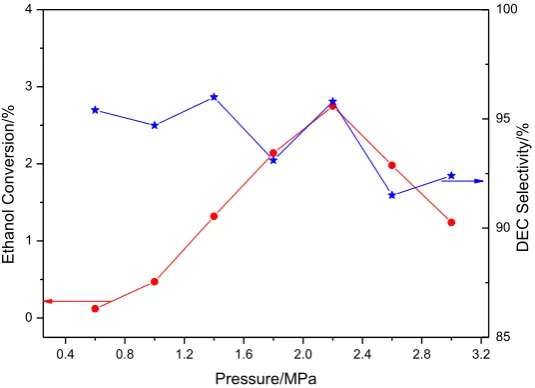
Effect of reaction pressure on the performance of Ni-Cu@Na3PW12O40 catalyst synthesized by
supported method was measured for the reaction of DEC synthesis from CO2 and ethanol. The
detailed result was shown in Table 4 and the changing tendency was shown in Figure 10, respectively. With the increasing pressure, ethanol conversion became larger and obtained max value of 2.75% when pressure was 2.2 MPa. Beyond this pressure, ethanol conversion decreased. DEC selectivity did not show obvious changing tendency. And the results were less than the catalyst prepared by mixed method.
2.2.2 Diethyl Carbonate (DEC) Synthesis from CO2 and Ethanol in the presence of Dehydrating
Agent of Ethylene
Table 5 Catalytic performance of Ni-Cu@Na3PW12O40 catalyst synthesized by mixed method for DEC
synthesis from CO2 and ethanolin the presence of Dehydrating Agent of Ethylene
Temperature/°
C
Ethanol
Conversion/%
DEC
Selectivity/%
DEC
Yield/%
90
19.5
90.1
17.6
110
27.9
92.4
25.8
130
36.5
91.6
33.4
150
41.3
90.6
38.2
170
38.8
88.7
34.4
190
30.1
89.0
26.8
80 100 120 140 160 180 200
0 5 10 15 20 25 30 35 40 45
Et
h
a
n
o
l C
o
n
ve
rsi
o
n
/%
Temperature/oC
D
EC
Se
le
ct
ivi
ty/
%
85 90 95 100
Figure 11 Catalytic performance of Ni-Cu@Na3PW12O40 catalyst synthesized by mixed method for
Effect of reaction temperature on the performance of Ni-Cu@Na3PW12O40 catalyst synthesized
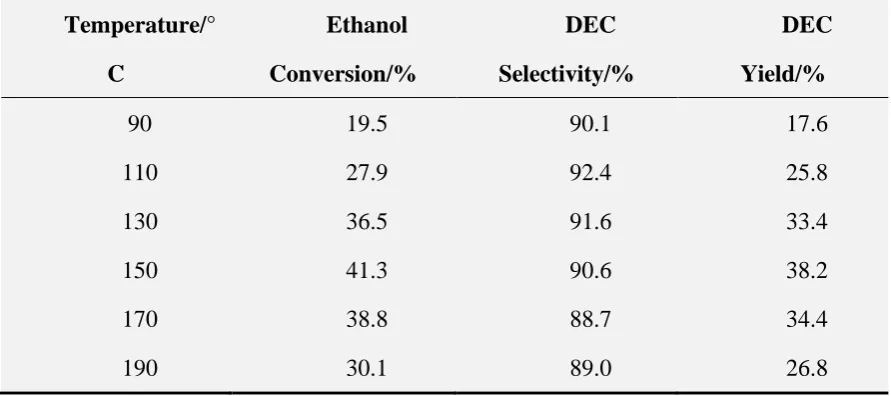
by mixed method was measured for the reaction of DEC synthesis from CO2 and ethanol in the
presence of dehydrating agent of ethylene. The detailed result was shown in Table 5 and the changing tendency was shown in Figure 11, respectively. Ethanol conversion became larger and reached to the max value of 41.3% when temperature was 150℃. Temperature continued to raise, ethanol conversion decreased. DEC selectivity was around 90% and slightly fluctuated. In the presence of dehydrating agent of ethylene, ethanol conversion increased from ca. 3% to ca. 40%. The constant removal of water from ethylene caused the chemical equilibrium to continuously move forward, which made ethanol conversion improve more than 10 times.
Table 6 Catalytic performance of Ni-Cu@Na3PW12O40 catalyst synthesized by mixed method for DEC
synthesis from CO2 and ethanolin the presence of Dehydrating Agent of Ethylene
Pressure/MPa
Ethanol
Conversion/%
DEC
Selectivity/%
DEC Yield/%
0.6
14.5
96.4
14.0
1.0
20.3
92.2
18.7
1.4
28.8
90.8
26.2
1.8
35.7
89.6
32.0
2.2
41.3
90.6
38.2
2.6
36.4
89.7
32.7
3.0
24.5
90.1
22.1
0.4 0.8 1.2 1.6 2.0 2.4 2.8 3.2
10 15 20 25 30 35 40 45
Et
h
a
n
o
l C
o
n
ve
rsi
o
n
/%
Pressure/MPa
D
EC
Se
le
ct
ivi
ty/
%
85 90 95 100
Figure 12 Catalytic performance of Ni-Cu@Na3PW12O40 catalyst synthesized by mixed method for
Effect of reaction pressure on the performance of Ni-Cu@Na3PW12O40 catalyst synthesized by
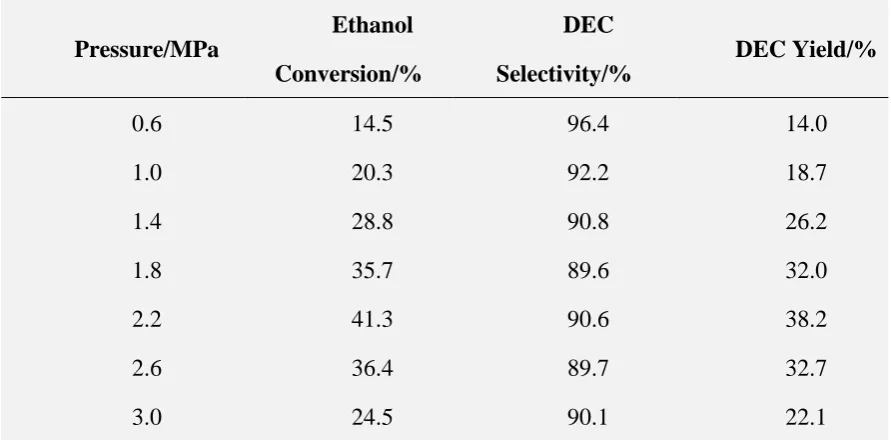
mixed method was measured for the reaction of DEC synthesis from CO2 and ethanol in the
presence of dehydrating agent of ethylene. The detailed result was shown in Table 6 and the changing tendency was shown in Figure 12, respectively. With the increasing reaction pressure, ethanol conversion improved and got the best value when pressure was 2.2 MPa. Surpass this pressure, ethanol conversion would decrease. DEC selectivity showed changing tendency of reduce and the best DEC selectivity was 96.4%. The usage of dehydrating agent of ethylene played the most important role.
Table 7 Catalytic performance of Ni-Cu@Na3PW12O40 catalyst synthesized by supported method for
DEC synthesis from CO2 and ethanolin the presence of Dehydrating Agent of Ethylene
Temperature/°
C
Ethanol
Conversion/%
DEC
Selectivity/%
DEC
Yield/%
90
9.80
90.8
8.90
110
18.4
90.5
16.7
130
28.3
96.2
27.2
150
32.7
92.4
30.2
170
28.9
89.2
25.8
190
20.6
86.5
17.8
80 100 120 140 160 180 200
0 5 10 15 20 25 30 35
Et
h
a
n
o
l C
o
n
ve
rsi
o
n
/%
Temperature/oC
D
EC
Se
le
ct
ivi
ty/
%
85 90 95 100
Figure 13 Catalytic performance of Ni-Cu@Na3PW12O40 catalyst synthesized by supported method for
Effect of reaction temperature on the performance of Ni-Cu@Na3PW12O40 catalyst synthesized
by supported method was measured for the reaction of DEC synthesis from CO2 and ethanolin the
presence of dehydrating agent of ethylene. The detailed result was shown in Table 7 and the changing tendency was shown in Figure 13, respectively. With the increasing temperature, ethanol conversion improved and obtained the best value of 32.7% when temperature was 150℃. Beyond this point, ethanol conversion became decreased. DEC selectivity showed changing tendency of wave from 86.5% to 96.2%. The catalytic performance was less than the catalyst prepared by mixed method.
Table 8 Catalytic performance of Ni-Cu@Na3PW12O40 catalyst synthesized by supported method for
DEC synthesis from CO2 and ethanolin the presence of Dehydrating Agent of Ethylene
Pressure/MPa
Ethanol
Conversion/%
DEC
Selectivity/%
DEC Yield/%
0.6
6.70
93.4
6.26
1.0
11.8
93.5
11.0
1.4
19.5
91.4
17.8
1.8
26.6
86.5
23.0
2.2
32.7
92.4
30.2
2.6
27.5
84.8
23.3
3.0
16.7
92.5
15.4
0.4 0.8 1.2 1.6 2.0 2.4 2.8 3.2
0 5 10 15 20 25 30 35
Et
h
a
n
o
l C
o
n
ve
rsi
o
n
/%
Pressure/MPa
D
EC
Se
le
ct
ivi
ty/
%
80 85 90 95 100
Figure 14 Effect of pressure for Ni-Cu@Na3PW12O40 catalyst synthesized by supported method
Effect of reaction pressure on the performance of Ni-Cu@Na3PW12O40 catalyst synthesized by
supported method was measured for the reaction of DEC synthesis from CO2 and ethanol in the
presence of dehydrating agent of ethylene. The detailed result was shown in Table 8 and the changing tendency was shown in Figure 14, respectively. Ethanol conversion improved with the increasing pressure and obtained the max value when pressure was 2.2 MPa. Beyond this pressure, ethanol conversion declined. DEC selectivity showed changing tendency of symbol of “W” from 84.8% to 93.5%.
2.2.3 Diethyl Carbonate (DEC) Synthesis from CO2, Ethanol and Propylene Oxide (PO) in the
presence of Dehydrating Agent of Ethylene
Table 9 Effect of reaction temperature on the performance of Ni-Cu@Na3PW12O40 catalyst synthesized
by mixed method for DEC synthesis fromCO2, Ethanol and Propylene Oxide (PO) in the presence of
Dehydrating Agent of Ethylene
Temperature/°
C
Ethanol
Conversion/%
DEC
Selectivity/%
DEC
Yield/%
90
87.3
51.7
45.1
110
90.7
54.3
49.3
130
96.9
56.8
55.0
150
100
56.2
56.2
170
98.5
55.1
54.3
190
94.1
57.4
54.0
80 100 120 140 160 180 200
80 85 90 95 100
Et
h
a
n
o
l C
o
n
ve
rsi
o
n
/%
Temperature/oC
D
EC
Se
le
ct
ivi
ty/
%
50 52 54 56 58 60
Figure 15 Effect of reaction temperature on the performance of Ni-Cu@Na3PW12O40 catalyst
presence of Dehydrating Agent of Ethylene
Effect of reaction temperature on the performance of Ni-Cu@Na3PW12O40 catalyst synthesized
by mixed method was measured for the reaction of DEC synthesis from CO2, ethanoland propylene
oxide (PO) in the presence of dehydrating agent of ethylene. The detailed result was shown in
Table 9 and the changing tendency was shown in Figure 15, respectively. Ethanol conversion increased with the increasing reaction temperature and got the highest value of 100% when temperature was 150℃. Surpass this temperature, ethanol conversion became declined. DEC selectivity showed changing tendency of symbol of “N” from 51.7% to 57.4%. Owing to participation of PO, ethanol conversion increased up to 100% and DEC selectivity substantially reduced to ca. 50%.
Table 10 Effect of reaction pressure on the performance of Ni-Cu@Na3PW12O40 catalyst synthesized by
mixed method for DEC synthesis fromCO2, Ethanol and Propylene Oxide (PO) in the presence of
Dehydrating Agent of Ethylene
Pressure/MPa
Ethanol
Conversion/%
DEC
Selectivity/%
DEC Yield/%
0.6
86.3
58.5
50.5
1.0
92.4
56.3
52.0
1.4
96.9
55.8
54.1
1.8
97.6
56.4
55.0
2.2
100
56.2
56.2
2.6
98.6
54.1
53.3
0.4 0.8 1.2 1.6 2.0 2.4 2.8 3.2 80
85 90 95 100
Et
h
a
n
o
l C
o
n
ve
rsi
o
n
/%
Pressure/MPa
D
EC
Se
le
ct
ivi
ty/
%
50 55 60 65
Figure 16 Effect of reaction pressure on the performance of Ni-Cu@Na3PW12O40 catalyst synthesized
by mixed method for DEC synthesis fromCO2, Ethanol and Propylene Oxide (PO) in the presence of
Dehydrating Agent of Ethylene
Effect of reaction pressure on the performance of Ni-Cu@Na3PW12O40 catalyst synthesized by
mixed method was measured for the reaction of DEC synthesis from CO2, ethanoland propylene
oxide (PO) in the presence of dehydrating agent of ethylene. The detailed result was shown in
Table 10 and the changing tendency was shown in Figure 16, respectively. With the increasing pressure, ethanol conversion improved and obtained its highest value when pressure was 2.2 MPa. DEC selectivity showed slightly fluctuation from 54.1% to 58.5%. The participation of PO made ethanol conversion a sharp rise and DEC selectivity a sharp decline.
Table 11 Effect of reaction temperature on the performance of Ni-Cu@Na3PW12O40 catalyst synthesized
by supported method for DEC synthesis fromCO2, Ethanol and Propylene Oxide (PO) in the presence
of Dehydrating Agent of Ethylene
Temperature/°
C
Ethanol
Conversion/%
DEC
Selectivity/%
DEC
Yield/%
90
76.5
44.6
34.1
110
81.3
47.2
38.4
130
85.7
45.8
39.3
150
91.4
49.5
45.2
190
76.1
51.4
39.1
80 100 120 140 160 180 200
70 75 80 85 90 95
Et
h
a
n
o
l C
o
n
ve
rsi
o
n
/%
Temperature/oC
D
EC
Se
le
ct
ivi
ty/
%
40 45 50 55 60
Figure 17 Effect of reaction temperature on the performance of Ni-Cu@Na3PW12O40 catalyst
synthesized by supported method for DEC synthesis fromCO2, Ethanol and Propylene Oxide (PO) in
the presence of Dehydrating Agent of Ethylene
Effect of reaction temperature on the performance of Ni-Cu@Na3PW12O40 catalyst synthesized
by supported method was measured for the reaction of DEC synthesis from CO2, ethanol and
propylene oxide (PO) in the presence of dehydrating agent of ethylene. The detailed result was shown in Table 11 and the changing tendency was shown in Figure 17, respectively. The ethanol conversion increased with the increasing temperature and obtained its best value of 91.4% when temperature was 150℃. Beyond this reaction temperature, ethanol conversion declined substantially. DEC selectivity (44.6%~51.4%) did not show obvious changing tendency. Compared to the results of mixed catalyst, supported catalyst had less catalytic performance.
Table 12 Effect of reaction pressure on the performance of Ni-Cu@Na3PW12O40 catalyst synthesized by
supported method for DEC synthesis fromCO2, Ethanol and Propylene Oxide (PO) in the presence of
Dehydrating Agent of Ethylene
Pressure/MPa
Ethanol
Conversion/%
DEC
Selectivity/%
DEC Yield/%
0.6
70.5
47.1
33.2
1.0
79.6
51.9
41.3
1.8
88.6
50.6
44.8
2.2
91.4
49.5
45.2
2.6
87.2
51.4
44.8
3.0
85.7
49.7
42.6
0.4 0.8 1.2 1.6 2.0 2.4 2.8 3.2
60 65 70 75 80 85 90 95
Et
h
a
n
o
l C
o
n
ve
rsi
o
n
/%
Pressure/MPa
D
EC
Se
le
ct
ivi
ty/
%
40 45 50 55 60
Figure 18 Effect of reaction pressure on the performance of Ni-Cu@Na3PW12O40 catalyst synthesized
by supported method for DEC synthesis fromCO2, Ethanol and Propylene Oxide (PO) in the presence
of Dehydrating Agent of Ethylene
Effect of reaction pressure on the performance of Ni-Cu@Na3PW12O40 catalyst synthesized by
supported method was measured for the reaction of DEC synthesis from CO2, ethanol and
propylene oxide (PO) in the presence of dehydrating agent of ethylene. The detailed result was shown in Table 12 and the changing tendency was shown in Figure 18, respectively. Ethanol conversion increased a sharp with the increasing pressure and got its highest value when pressure was 2.2 MPa. Surpass this pressure, ethanol conversion declined slightly. DEC selectivity ranged from 47.1% to 51.9%. PO raised ethanol conversion and decreased DEC selectivity. The best result of supported method was less than the result of mixed method. Compared with the literatures [42-52] reported in recent years, this result was a major breakthrough.
3. Materials and Methods
3.1. Catalysts Synthesis
3.1.1 Mixed Synthetic Method of Ni-Cu@Na3PW12O40 Catalyst
An aqueous ammonia solution of copper nitrate and nickel nitrate was prepared, in which Cu
was 0.4 mol / L and Ni was 0.2 mol / L. Dissolve the powder of Na3PW12O40 in ammonia water and
stirred evenly. Rotary evaporation was used to remove ammonia. Put into 100℃ oven for drying. And grind with agate mortar and pass through 200 mesh sieve. Put it into a 500 ℃ muffle furnace
under air atmosphere for 12h, and the heating rate is 1 ℃ / min. It was reduced with hydrogen for 12h at 550 ℃, and the heating rate was 1 ℃/ min. Mixed Ni-Cu@Na3PW12O40 catalyst was obtained.
3.1.2 Supported Synthetic Method of Ni-Cu@Na3PW12O40 Catalyst
An aqueous ammonia solution of copper nitrate and nickel nitrate was prepared, in which Cu was 0.4 mol / L and Ni was 0.2 mol / L. The ammonia complex solution of copper and nickel was placed in a spray bottle of 50mL. Take a glass plate and flatten aluminum foil on it. Spread the
Na3PW12O40 powder (fully dried, milled through a 200 mesh sieve) evenly on the aluminum foil.
Spray the powder sample on the aluminum foil with a spray bottle, and put an infrared lamp
beside it for quick drying. So as to spray intermittently until the solution was exhausted. Put into 100℃ oven for drying. And grind with agate mortar and pass through 200 mesh sieve. Put it into a
500 ℃ muffle furnace under air atmosphere for 12h, and the heating rate is 1 ℃ / min. It was reduced with hydrogen for 12h at 550 ℃, and the heating rate was 1 ℃/ min. Supported
Ni-Cu@Na3PW12O40 catalyst was obtained.
3.2. Catalysts Characterization
SEM was performed on a HitachiS-3000N (Hitachi Company, Tokyo, Japan) with electronic light source of tungsten filament.
The X-ray powder diffraction was performed on Shimadzu XRD-7000 (Shimadzu Company, Tokyo, Japan) with generator power of 3 kW. The sample was scanned from 3°to 60°at a rate of 3°
/min.
TPD and TPR were performed on Biod PCA-1200 (Biod Electronics Company, Beijing, China) with TCD detector.
TGA was performed on Mettler Toledo TGA2 (Mettler Toledo Company, Berne, Switzerland) with temperature accuracy of ±1 K and balance sensitivity of 0.1μg.
3.3. Evaluation of Catalytic Performance
The direct DEC synthesis from CO2 and ethanol was carried out in a continuous micro-reactor
(Yanzheng Company, Shanghai, China). The resulting products of the reaction were analyzed bya GC-112N chromatograph (INESA Company, Shanghai, China) equipped with a flame ionization detector.
4. Conclusions
Ni-Cu@Na3PW12O40 catalysts prepared by mixed synthetic method and supported synthetic
method was synthesized and estimated for the route of direct DEC synthesis from CO2 and ethanol.
For mixed Ni-Cu@Na3PW12O40 catalyst, ethanol conversion of 3.11% was obtained when the
temperature was 150℃ and pressure was 2.2 MPa. For the supported catalyst, ethanol conversion of 2.75% was obtained under same conditions. When adding dehydrating agent of ethylene, ethanol conversion of ca. 40% was obtained under 150℃, 2.2 MPa. PO was participated in the reaction and the ethanol conversion of ca. 90% was obtained under same conditions. Also, microstructure of mixed catalyst and supported catalyst were measured by XRD, TGA, TPR, TPD-NH3, TPD-CO2 and
Author Contributions: Conceptualization, M. Zhang; Validation, M. Zhang; Writing—original draft preparation, M. Zhang;
Funding: This research was funded by Characteristic Discipline Construction of Southern Medical University, grant number G619299517.
Acknowledgments: Thanks the Central Laboratory of Southern Medical University for the support of materials characterization instruments.
Conflicts of Interest: The authors declare no conflict of interest. The funders had no role in the design of the study; in the collection, analyses, or interpretation of data; in the writing of the manuscript, or in the decision to publish the results.
References
1. Peters, G. P. ; Quere, C. L.; Andrew, R. M.; Canadell, J. G. ; Friedlingstein, P.; Llyina, T.; Jackson, R. B. ; Joos, F. ; Korsbakken, J. ; McKinley, G. A.; Sitch, S.; Tans, P.; Towards real-time verification of CO2 emissions, Nat. Clim. Change, 2017, 7, 848-852
2. Brethome, F. M.; Williams, N. J.; Seipp, C. A.; Kidder, M. K.; Custelcean, R. ; Direct air capture of CO2 via aqueous-phaseabsorption and crystalline-phase release using concentrated solar power, Nat. Energy, 2018, 3, 553-559
3. Midgley, G. F.; Bond, W. J.; Future of African terrestrial biodiversity and ecosystems under anthropogenic climate change, Nat. Clim. Change, 2015, 5, 823-829
4. Seneviratne, S. ; Rogelj, J. ; Seferian, R. ; Wartenburger, R. ; Allen, M. R.; Cain, M. ; Millar, R. J. ; Ebi, K. L.; Ellis, N. ; Guldberg, O.; Payne, A. J. ; Schleussner, C. ; Tschakert, P. ; Warren, R. F. ; The many possible
climates from the Paris Agreement’s aim of 1.5 °C warming, Nature, 2018, 558, 41-49
5. Friedlingstein, P. ; Andrew, R. M. ; Rogelj, J. ; Peters, G. P.; Canadell, J. G.; Knutti, R.; Luderer, G. ; Raupach, M. R. ; Schaeffer, M. ; Vuuren, D. P. V. ; Le Quere, C. ; Persistent growth of CO2 emissions and implications for reaching climate targets, Nature Geosci., 2014, 7, 709-715
6. Baker, H. S. ; Millar, R. ; Karoly, D. ; Beyerle, U. ; Guillod, B. ; Mitchell, D. ; Shiogama, H. ; Sparrow, S. ; Woollings, T. ; Allen, M. R. ; Higher CO2 concentrations increase extreme event risk in a 1.5 °C world, Nat. Clim. Change, 2018, 8, 604-608
7. Zhang, L.; Zhu, C.; Shi, C.; Wang, J.; Thermodynamic estimation of direct synthesis of diethyl carbonate from ethanol and CO2, Spec. Petrochem., 2004, 3, 30-33
8. Leino, E.; Mäki-Arvela, P.; Eta, V.; Kumar, N.; Demoisson, F.; Samikannu, A.; Leino, A.R.; Shchukarev, A.; Murzin, D.Y.; Mikkola, J.P.; The influence of various synthesis methods on the catalytic activity of cerium oxide in one-pot synthesis of diethyl carbonate starting from CO2, ethanol and butylene oxide, Catal. Today, 2013, 210, 47-54
9. Tamura, M.; Kitanaka, T.; Nakagawa, Y.; Tomishige, K.; Cu Sub-Nanoparticles on Cu/CeO2 as an Effective Catalyst for Methanol Synthesis from Organic Carbonate by Hydrogenation, ACS Catal.; 2016, 6, 376-380 10. Tamura, M.; Honda, M.; Noro, K.; Nakagawa, Y.; Tomishige, K.; Heterogeneous CeO2-catalyzed selective
synthesis of cyclic carbamates from CO2 and aminoalcohols in acetonitrile solvent, J. Catal.; 2013, 305, 191-203
11. Zhang, J.; Lan, R.; Jia, D.; Sun, Y.; Zhang, X.; Sun, Y.; Synthesis of diethyl carbonate from CO2 and ethanol, Chem. Engin., 2014, 42, 58-62
12. Avedisian, C. T.; Kuo, W.; Tsang, W.; Lowery, A.; High Temperature Thermal Decomposition of Diethyl Carbonate by Pool Film Boiling, J. Heat Transfer, 2018, 140, No. 061501
13. Jonathan, Z.; William, E.; Michael, H.; Abraham model correlations for enthalpies of solvation of organic solutes dissolved in methyl acetate and octane, Phys. Chem. Liq.; 2020, 58, 18-30
14. Yoshida, Y.; Arai, Y.; Kado, S.; Kunimori, K.; Tomishige, K.; Direct synthesis of organic carbonates from the reaction of CO2 with methanol and ethanol over CeO2 catalysts, Catal. Today, 2006, 115, 95-101 15. Briggs, D.N.; Lawrence, K.H.; Bell, A.T.; An investigation of carbon-supported CuCl2/PdCl2 catalysts for
diethyl carbonate synthesis, Appl. Catal. A-Gen., 2009, 366, 71-83
17. Leino, E.; Kumar, N.; Mäki-Arvela, P.; Rautio, A.R.; Dahl, J.; Roine, J.; Mikkola, J.P.; Synthesis and characterization of ceria-supported catalysts for carbon dioxide transformation to diethyl carbonate, Catal. Today, 2018, 306, 128-137
18. Honda, M.; Kuno, S.; Begum, N.; Fujimoto, K.; Suzuki, K.; Nakagawa, Y.; Tomishige, K.; Catalytic synthesis of dialkyl carbonate from low pressure CO2 and alcohols combined with acetonitrile hydration catalyzed by CeO2, Appl. Catal. A-Gen.; 2010, 384, 165-170
19. Gasc, F.; Thiebaud-Roux, S.; Mouloungui, Z.; Methods for synthesizing diethyl carbonate from ethanol and supercritical carbon dioxide by one-pot or two-step reactions in the presence of potassium carbonate, J. Supercrit. Fluid., 2009, 50, 46-53
20. Briggs, D.N.; Bong, G.; Leong, E.; Oei, K.; Lestari, G.; Bell, A.T.; Effects of support composition and pretreatment on the activity and selectivity of carbon-supported PdCunClx catalysts for the synthesis of diethyl carbonate, J. Catal.; 2010, 276, 215-228
21. Leino, E.; Mäki-Arvela, P.; Eränen, K.; Tenho, M.; Murzin, D.; Salmi, T.; Mikkola, J.P.; Enhanced yields of diethyl carbonate via one-pot synthesis from ethanol, carbon dioxide and butylene oxide over cerium (IV) oxide, Chem.Engin. J., 2011, 176, 124-133
22. Xue, B.; Xu, J.; Liu, P.; Lv, L.; Xu, C.; Li, Y.; Zhang, K.; J. Mole. Catal. A: Chem., 2012, 357, 50-58
23. Arbela´ez, O.; Orrego, A.; Bustamante, F.; Villa, A.L.; Direct Synthesis of Diethyl Carbonate from CO2 and CH3CH2OH Over Cu–Ni/AC Catalyst, Top Catal., 2012, 55, 668–672
24. Leino, E.; Kumar, N.; Mäki-Arvela, P.; Aho, A.; Kordás, K.; Leino, A. R.; Shchukarev, A.; Murzin, D.; Mikkola, J.P.; Influence of the synthesis parameters on the physico-chemical and catalytic properties of cerium oxide for application in the synthesis of diethyl carbonate, Mater. Chem. Phys., 2013, 143, 62-75 25. Wang, L.; Li, H.; Xin, S.; He, P.; Cao, Y.; Li, F.; Hou, X.; Highly efficient synthesis of diethyl carbonate via
one-pot reaction from carbon dioxide, epoxides and ethanol over KI-based binary catalyst system, Appl. Catal. A: Gen., 2014, 471, 19-27
26. Lim, Y.; Wang, X.; Park, E.; Jang, H.; Direct Coupling of Cs2CO3 and Alcohols for the Synthesis of Dimethyl, Diethyl, and Various Dialkyl Carbonates, Bull. Korean Chem. Soc., 2014, 35, 622-624
27. Sanapureddy, S.R.; Plasseraud, L.; (n‐Bu2Sn)2O(CO3): An active, robust and recyclable organotin(IV) for the direct synthesis of linear organic carbonates from carbon dioxide and alcohols, Appl. Organometal. Chem., 2017, 31, e3807
28. Zhang, X.; Jia, D.; Zhang, J.; Sun, Y.; Direct Synthesis of Diethyl Carbonate from CO2 and Ethanol Catalyzed by ZrO2/Molecular Sieve, Catal. Lett., 2014, 144, 2144–2150
29. Honda, M.; Tamura, M.; Nakagawa, Y.; Nakao, K.; Suzuki, K.; Tomishige, K.; Organic carbonate synthesis from CO2 and alcohol over CeO2 with 2-cyanopyridine: Scope and mechanistic studies, J. Catal., 2014, 318, 95-107
30. Xin, S.; Wang, L.; Li, H.; Huang, K.; Li, F.; Synthesis of diethyl carbonate from urea and ethanol over lanthanum oxide as a heterogeneous basic catalyst, Fuel Process. Technol., 2014, 126, 453-459
31. Shukla, K.; Srivastava, V.C.; Diethyl carbonate synthesis by ethanolysis of urea using Ce-Zn oxide catalysts, Fuel Process. Technol., 2017, 161, 116-124
32. Li, F.; Li, H.; Wang, L.; He, P.; Cao, Y.; Magnesium oxide nanosheets as effective catalysts for the synthesis of diethyl carbonate from ethyl carbamate and ethanol, Catal. Sci. Technol., 2015, 5, 1021-1034
33. Dibenedetto, A.; Aresta, M.; Angelini, A.; Ethiraj, J.; Aresta, B.M.; Synthesis, Characterization, and Use of NbV/CeIV-Mixed Oxides in the Direct Carboxylation of Ethanol by using Pervaporation Membranes for Water Removal, Chem. Eur. J., 2012, 18, 10324-10334
34. Chai, M.; Zhao, W.; Li, G.; Xu, S.; Jia, Q.; Chen, Y.; Novel SO2 Phase-Change Absorbent: Mixture of
N,N‐Dimethylaniline and Liquid Paraffin, Ind. Eng. Chem. Res., 2018, 57, 12502−12510
35. Arbela´ez, O.; Orrego, A.; Bustamante, F.; Villa, A.L.; Effect of Acidity, Basicity and ZrO2 Phases of Cu– Ni/ZrO2 Catalysts on the Direct Synthesis of Diethyl Carbonate from CO2 and Ethanol, Catal. Lett., 2016, 146, 725–733
36. Wang, D.; Zhang, X.; Liu, C.; Cheng, T.; Wei, W.; Sun, Y.; Transition metal-modified mesoporous Mg-Al mixed oxides: Stable base catalysts for the synthesis of diethyl carbonate from ethyl carbamate and ethanol, Appl. Catal. A: Gen., 2015, 505, 478-486
38. Zhang, M.; Xiao, M.; Wang, S.; Han, D.; Lu, Y.; Meng, Y.; Cerium oxide-based catalysts made by template-precipitation for the dimethyl carbonate synthesis from Carbon dioxide and methanol, J. Clean. Prod., 2015, 103, 847-853
39. Zhang, M.; Alferov, K.A.; Xiao, M.; Han, D.; Wang, S.; Meng, Y.; Continuous Dimethyl Carbonate Synthesis from CO2 and Methanol Using Cu-Ni@VSiO as Catalyst Synthesized by a Novel Sulfuration Method, Catalysts, 2018, 8, 142-155
40. Zhang, M.; Fu, Z.; Xiao, M.; Yu, Y.; Wang, S.; Choi, M.J.; Meng, Y.; Synthesis of Co1.5PW12O40 and its catalytic performance of completely converting methanol to ethylene, Chem. Commun., 2016, 52, 1151-1153
41. Zhang, M.; Direct Synthesis of Diethyl Carbonate from CO2 over ZnO@Na3PW12O40 Heterogeneous Material, Sci. J. Chem., 2019, 7, 105-109
42. Wang, Y.; Jia, D.; Zhu, Z.; Sun, Y.; Synthesis of Diethyl Carbonate from Carbon Dioxide, Propylene Oxide and Ethanol over KNO3-CeO2 and KBr-KNO3-CeO2 Catalysts, Catalysts, 2016, 6, 52-62
43. Shukla, K.; Srivastava, V.C.; Alkaline Earth (Ca, Mg) and Transition (La, Y) Metals Promotional Effects on Zn–Al Catalysts During Diethyl Carbonate Synthesis from Ethyl Carbamate and Ethanol, Catal. Lett., 2017, 147, 1891–1902
44. Wang, L.; Ammar, M.; He, P.; Li, Y.; Cao, Y.; Li, F.; Han, X.; Li, H.; The efficient synthesis of diethyl carbonate via coupling reaction from propylene oxide, CO2 and ethanol over binary PVEImBr/MgO catalyst, Catal. Today, 2017, 281, 360-370
45. AlAbbad, M.; Giri, B. R.; Szori, M.; Viskolcz, B.; Farooq, A.; A high temperature kinetic study for the thermal unimolecular decomposition of diethyl carbonate, Chem. Phys. Lett., 2017, 684, 390-396
46. Sun, W.; Huang, C.; Tao, T.; Zhang, F.; Li, W.; Hansen, N.; Yang, B.; Exploring the high-temperature kinetics of diethyl carbonate (DEC) under pyrolysis and flame conditions, Combust. Flame, 2017, 181, 71-81
47. Wang, D.; Zhang, X.; Zhou, D.; Liu, S.; Wei, W.; Influence of Y on the performance of Mg-Al-Y catalysts via hydrotalcite-like precursors for the synthesis of diethyl carbonate from ethyl carbamate and ethanol, Fuel Proces. Technol., 2017, 167, 404-415
48. Wang, J.; Hao, Z.; Wohlrab, S.; Continuous CO2 esterification to diethyl carbonate (DEC) at atmospheric pressure: application of porous membranes for in situ H2O removal, Green Chem., 2017, 19, 3595-3600 49. Iida, H.; Kawaguchi, R.; Okumura, K.; Production of diethyl carbonate from ethylene carbonate and
ethanol over supported fluoro-perovskite catalysts, Catal. Commun., 2018, 108, 7-11
50. Giram, G.G.; Bokade, V.V.; Darbha, S.; Direct synthesis of diethyl carbonate from ethanol and carbon dioxide over ceria catalysts, New J. Chem., 2018, 42, 17546-17552
51. Yan, T.; Bing, W.; Xu, M.; Li, Y.; Yang, Y.; Cui, G.; Yang, L.; Wei, M.; Acid–base sites synergistic catalysis over Mg–Zr–Al mixed metal oxide toward synthesis of diethyl carbonate, RSC Adv., 2018, 8, 4695-4702 52. Arbela´ez, O.; Herna´ndez, E.; Gonza´ lez, L.M.; Bustamante, F.; Villa, A.L.; Enhanced Conversion in the