Parental overprotection and emotional abuse predict the presence of psychopathic traits in
adulthood
Guillaume Durand1*, Polett Bali2
1
Department of Psychiatry & Neuropsychology, Maastricht University, P.O. Box 616,
Maastricht 6200 MD, The Netherlands
2
Department of Clinical Psychological Science, Maastricht University, P.O. Box 616, Maastricht
6200 MD, The Netherlands
* Corresponding author: [email protected]
Abstract
Recent findings support an association between childhood maltreatment and the presence of
elevated psychopathic traits in adulthood. Using a community sample recruited online (N = 210),
we sought to (1) confirm the relationship between childhood traumas and psychopathic traits, and
(2) investigate the role of parenting styles in psychopathic traits. Consistent with our predictions,
we found an association between all types of childhood traumas and disinhibition. Age and
gender moderated the relations between psychopathic traits and childhood maltreatments.
Parental rejection and overprotection were positively correlated with the presence of
psychopathic traits, while parental emotional warmth was negative correlated. Although our
results converge with previous findings, the strength of the correlations observed was not as
compelling as in research on undergraduate students. We discuss the numerous interpretations for
our findings, and highlight the limitations of research in the field of psychopathy and childhood
trauma in the general population.
Keywords
Psychopathy; Childhood maltreatment; Parenting styles; Rejection; Overprotection
1. Introduction
Psychopathy is a multidimensional personality disorder characterized by a lack of empathy, guilt,
and behavioral inhibition, combined with high levels of superficial charm, deceitfulness, egoism,
and fearlessness (Berg et al., 2013; Hart, Cox, & Hare, 2003). Although psychopathy can be
conceptualized through numerous models, a recently developed model, the Triarchic model of
psychopathy (Patrick, Fowles, & Krueger, 2009), has shown great promises due to its inclusion
of maladaptive and adaptive components, which is a distinction from the vast majority of models,
defining psychopathy as a fully maladaptive disorder. The model is divided in three traits
dimensions: Meanness, Disinhibition, and Boldness. Meanness refers to a lack of empathy, low
socialization and attachment, an absence of guilt, and a general mean attitude towards others.
Disinhibition relates to the inability to control one’s impulses, which creates the inability to
weigh consequences of one’s actions. Together, these two traits encompass the maladaptive
component of psychopathy. Alternatively, Boldness, which refers to fearlessness, social
dominance, stress immunity, and thrill seeking, assesses the adaptive component of psychopathy.
Although the Triarchic model of psychopathy, as well as the Psychopathic Personality Inventory
(PPI; Lilienfeld & Andrews, 1996) both include an adaptive component, several models,
including early conceptualizations prior to the PPI, examine psychopathy from an exclusively
maladaptive point of view.
The lack of consensus regarding the personality traits related to psychopathy stems from
the debate on genetic versus environmental factors. According to Frick, Bodin, and Barry (2000),
several studies found evidences supporting a combination of both biological and environmental
factors to be responsible for the development of psychopathic traits in youth. Levenson, Kiehl,
from social learning rather than biology in psychopathic behaviors. Psychopathy was later
described in detail through three distinct components: behavioral, interpersonal, and affective
characteristics (Hart & Hare, 1998). Behaviorally, a psychopathic trait should include risk-taking,
sensation seeking, and impulsivity. Interpersonally, a psychopathic trait should include
grandiosity, egocentricity, manipulation, and arrogance. Affectively, a psychopathic individual is
unable to form strong emotional bonds and has shallow emotions.
1.1. Psychopathy, parental behaviors, and early traumatic experiences
Deficiencies in emotional bonding can be observed in children manifesting early
psychopathic tendencies. Early exposure to dysfunctional family environments can influence a
child's personality and increase the likelihood of developing psychopathic traits (Belsky,
Steinberg, & Draper, 1991; Saltaris, 2002). Among other familial dysfunctionalities, the lack of
discipline has been related to an increase of antisocial behaviors in adulthood (Klonsky,
Oltmanns, Turkheimer, & Fiedler, 2000; Robins, 1966). The lack of parental discipline could
stem from stress levels of the parents themselves. Previous investigations concluded that
distressed parents use unstable and unsuccessful parenting methods, which worsens their
children’s behavioral problems (Fite, Greening, & Stoppelbein, 2008; Patterson, 1988). Further
investigations revealed associations between parenting stress and callous and unemotional trait,
which is one of the hallmark of psychopathic characteristics (Fite et al., 2008). Moreover, when
considering the different parental stress dimensions, the authors concluded that attachment
difficulties and role restrictions were also related to psychopathic traits.
In addition to parental stress, lack of parental affection (i.e. emotional neglect), as well as
childhood abuse (i.e. emotional, physical, sexual), have been associated with the development of
2002; McCord & McCord, 1964; Watts, Donahue, Lilienfeld, & Latzman, 2017). Weiler and
Widom (1996) examined psychopathy and violent behaviors in a sample of individuals who
reported abuse and/or neglect during their childhood and in a controlled sample. After controlling
for demographics and criminal history, victims of childhood abuse psychopathy’ scores remained
significantly higher than the control group. In addition, both psychopathy score and childhood
abuse were predictors of violence. However, as noted by Watts and colleagues (2017) while
multiple studies reported a correlation between childhood abuse and psychopathy, the extent to
which these findings reflect a causal link remains unclear.
Aside from a relationship between childhood maltreatment and general psychopathy, multiple
studies divided their analyses by psychopathic subtypes. For instances, Watts and colleagues
(2017) identified a positive relationship between childhood maltreatment and both disinhibition
and meanness, and a negative relationship between early trauma and boldness. Similar findings
were found in previous research, where disinhibition has been associated with neglect and abuse,
while other components of psychopathy were associated with sexual abuse exclusively (Graham,
Kimonis, Wasserman, & Kline, 2012).
1.2. Psychopathy and gender
Historically, the vast majority of studies in the field of psychopathy were performed exclusively
in male samples, leading to a lack of information regarding gender differences (Cale &
Lilienfeld, 2002). Although multiple studies reported significantly higher scores in males than
females (Durand, 2016; Durand & Plata, 2017; Hicks et al., 2012; Lee & Salekin, 2010;
Lilienfeld & Hess, 2001), an extensive examination by Miller, Watts, and Jones (2011) supported
the finding that despite mean-level differences observed across many studies, the manifestation
impulsivity and Openness). However, while the gender difference in psychopathy is debatable,
numerous studies identified significant differences between genders in childhood abuse reports,
whereas some researchers found higher reported trauma in males (Watts et al., 2017) while others
found higher reported trauma in females (Láng & Lénárd, 2015).
2. Present study
The present study investigated the effect of early parental behaviors and childhood trauma
on psychopathy expressions at a later stage of life. We hypothesized that abusive parental
behaviors and early childhood trauma would be significantly positively correlated with
disinhibition and meanness, but not with boldness. Additionally, due to the discrepancy within
results pertaining to the influence of genders in childhood trauma, we examined the relationship
between psychopathy, parental behaviors, and childhood trauma, as well as the moderating effect
of gender on the aforementioned variables.
3. Method
3.1 Participants and Procedures
All participants received informed consent and received a debriefing at the end of the study. Two
hundred-ten (N = 210) participants were recruited online via social media and websites dedicated
to psychological research. There was no missing data for any of the responses. Inclusion criteria
to the study were to be over 18 years old and be fluent in English. Examination of potential
outliers was done by analyzing the Stem-and-Leaf plot for each scale of each questionnaires used
in the present study. We did not identify any outlier, and hence the full dataset was kept for
further analyses. Most of the participants were females (N = 155; 74%). Participants reported
participants reported being Caucasian (80%) or Asian (10%). Almost half the participants
reported being currently enrolled as full-time students in a university (44%). In terms of
relationship status, most participants reported being single (42%), followed by in a relationship
(21%), in a common-law partnership (18%), married (13%) or other (6%). Participants age
ranged from 18 to 75 years old, with a mean age of 28.4 (SD = 11.22).
3.2 Materials
Triarchic Psychopathy Measure (TriPM; Patrick, 2010). The TriPM is a self-reported
questionnaire containing 58 items assessing psychopathic traits. Items are rated on a 4-point
Likert scale from 1 (True) to 4 (False). The instrument was designed to assess psychopathic traits
using the Triarchic model of psychopathy, and provides a total score alongside three subscale
scores: Disinhibition, Meanness, and Boldness. Cronbach αs ranged between .84 and .89 for the
TriPM total score and the three subscales.
Short-EMBU (s-EMBU; Arrindell et al., 1999). The s-EMBU is a 23-item questionnaire,
derived from the original 81-item version, and is used for assessing the perceived parental rearing
behavior on a 4-point Likert scale. Participants responded to the questionnaire twice, once in
relation to their father’s behavior and once in relation to their mother’s behavior. The s-EMBU is
divided in three factors, namely Rejection, Overprotection, and Emotional Warmth. The short
version of the questionnaire was subsequently validated internationally, providing a reliable
alternative to its extended version (Arrindell et al., 1999; Arrindell et al., 2001). In the present
study, Cronbach αs ranged between .88 and .94 for the three subscale for the mother and between
.86 and .91 for the father.
Childhood Trauma Questionnaire (CTQ; Bernstein et al., 1994). The CTQ is a 28-item
namely Emotional abuse, Physical abuse, Sexual abuse, Emotional neglect, and Physical neglect.
Previous studies established adequate internal consistency reliability on all subscales (Watts et
al., 2017). Cronbach αs ranged between .78 and .96 for the CTQ total score and the five
subscales.
4. Results
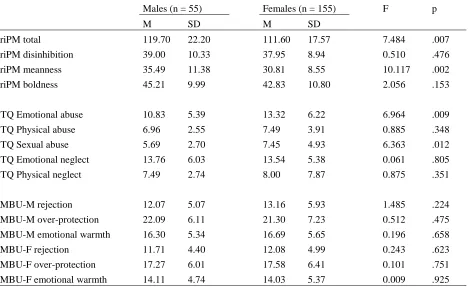
As shown in Table 1, ANOVAs revealed several significant gender differences in psychopathic
traits and childhood trauma. Males reported higher global psychopathic traits and higher levels of
meanness. Females reported more emotional and sexual abuse during childhood.
Table 1
Gender differences on the measured variables; results of ANOVAs.
Males (n = 55) Females (n = 155) F p
M SD M SD
TriPM total 119.70 22.20 111.60 17.57 7.484 .007
TriPM disinhibition 39.00 10.33 37.95 8.94 0.510 .476
TriPM meanness 35.49 11.38 30.81 8.55 10.117 .002
TriPM boldness 45.21 9.99 42.83 10.80 2.056 .153
CTQ Emotional abuse 10.83 5.39 13.32 6.22 6.964 .009
CTQ Physical abuse 6.96 2.55 7.49 3.91 0.885 .348
CTQ Sexual abuse 5.69 2.70 7.45 4.93 6.363 .012
CTQ Emotional neglect 13.76 6.03 13.54 5.38 0.061 .805
CTQ Physical neglect 7.49 2.74 8.00 7.87 0.875 .351
EMBU-M rejection 12.07 5.07 13.16 5.93 1.485 .224
EMBU-M over-protection 22.09 6.11 21.30 7.23 0.512 .475
EMBU-M emotional warmth 16.30 5.34 16.69 5.65 0.196 .658
EMBU-F rejection 11.71 4.40 12.08 4.99 0.243 .623
EMBU-F over-protection 17.27 6.01 17.58 6.41 0.101 .751
EMBU-F emotional warmth 14.11 4.74 14.03 5.37 0.009 .925 Note. EMBU-M = EMBU-Mother; EMBU-F = EMBU-Father.
In order to test the association between psychopathic traits, childhood trauma and parenting style,
were not correlated with childhood trauma, but positively correlated with over protection from
both parents and negatively correlated with emotional warmth from the father. Subscale
examination of the TriPM identified additional results. Disinhibition correlated positively with all
forms of abuses and neglects in childhood, as well as with rejection from both parents and over
protection from the mother, but correlated negatively with emotional warmth from the father.
Meanness correlated positively with emotional neglect in childhood, alongside over protection
from the mother and rejection from the father, but correlated negatively with emotional warmth
from the father. Boldness was negatively correlated with emotional abuse and emotional neglect,
and positively correlated with emotional warmth from the mother.
Table 2
Results of Pearson's correlation for TriPM, CTQ, and EMBU
TriPM total TriPM disinhibition TriPM meanness TriPM boldness TriPM total
TriPM disinhibition .59
TriPM meanness .81 .42
TriPM boldness .56 -.19 .20
CTQ Emotional abuse .09 .31 .11 -.22
CTQ Physical abuse .09 .23 .03 -.07
CTQ Sexual abuse .10 .17 .02 .02
CTQ Emotional neglect .08 .16 .17 -.15
CTQ Physical neglect .06 .20 .04 -.10
EMBU-M rejection .08 .22 .08 -.13
EMBU-M over-protection .16 .17 .14 .02
EMBU-M emotional warmth -.05 -.12 -.13 .14
EMBU-F rejection .11 .21 .14 -.12
EMBU-F over-protection .14 .12 .13 .03
EMBU-F emotional warmth -.16 -.15 -.20 .02
Note. Bold indicates p < .01, italic indicates p < .05
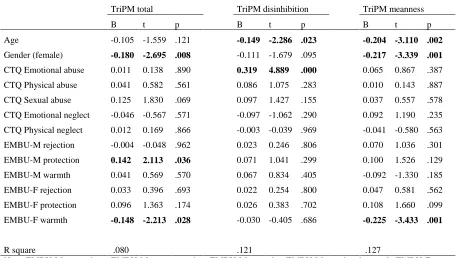
performed additional analyses through multiple linear regressions to control for the effects of age
and gender (Table 3). Results show that for general psychopathic traits, gender, over protection of
the mother, and emotional warmth of the father are the only significant predictor. Scale by scale
examination show that age and emotional abuse are predictors of disinhibition, age, gender, and
emotional warmth of the father are predictor of meanness, and only emotional abuse is a
predictor of Boldness (β = -0.215, t = -3.174, p = .002, R² = .046).
Table 3
Results of multiple linear regressions for TriPM, CTQ, and EMBU
TriPM total TriPM disinhibition TriPM meanness
B t p B t p B t p
Age -0.105 -1.559 .121 -0.149 -2.286 .023 -0.204 -3.110 .002
Gender (female) -0.180 -2.695 .008 -0.111 -1.679 .095 -0.217 -3.339 .001
CTQ Emotional abuse 0.011 0.138 .890 0.319 4.889 .000 0.065 0.867 .387
CTQ Physical abuse 0.041 0.582 .561 0.086 1.075 .283 0.010 0.143 .887
CTQ Sexual abuse 0.125 1.830 .069 0.097 1.427 .155 0.037 0.557 .578
CTQ Emotional neglect -0.046 -0.567 .571 -0.097 -1.062 .290 0.092 1.190 .235
CTQ Physical neglect 0.012 0.169 .866 -0.003 -0.039 .969 -0.041 -0.580 .563
EMBU-M rejection -0.004 -0.048 .962 0.023 0.246 .806 0.070 1.036 .301
EMBU-M protection 0.142 2.113 .036 0.071 1.041 .299 0.100 1.526 .129
EMBU-M warmth 0.041 0.569 .570 0.067 0.834 .405 -0.092 -1.330 .185
EMBU-F rejection 0.033 0.396 .693 0.022 0.254 .800 0.047 0.581 .562
EMBU-F protection 0.096 1.363 .174 0.026 0.383 .702 0.108 1.660 .099
EMBU-F warmth -0.148 -2.213 .028 -0.030 -0.405 .686 -0.225 -3.433 .001
R square .080 .121 .127
Note. EMBU-M protection = EMBU-M over protection; EMBU-M warmth = EMBU-M emotional warmth; EMBU-F protection = EMBU-F over protection; EMBU-F warmth = EMBU-F emotional warmth
5. Discussion
The results partially confirmed our hypothesis. Psychopathic traits were associated with
childhood traumas and parenting styles. While all types of childhood traumas were linked with
Furthermore, negative (rejection and over protection) and positive (emotional warmth) parenting
styles for both parents were associated with various subscales of the TriPM. These results
partially support findings from Watts and colleagues (2017). Indeed, when focusing on
undergraduate students, the aforementioned authors found multiple correlations between all CTQ
scales and psychopathic traits to a stronger degree than in the present study, with most
correlations being moderate. It is possible that the age of the sample weaken the association
between psychopathic traits and childhood traumas. In their study, Watts and colleagues’ (2017)
participants mean age was 20.71 (SD = 4.65) as opposed to 28.4 (SD = 11.22) in the present
study. Considering that being of lower age was significantly predicting higher disinhibition and
meanness, investigating the relationship between psychopathy and childhood traumas in younger
samples might provide better results due to higher levels of psychopathy in the sample. This
possibility is further corroborated by the results obtained from Poythress, Skeem, and Lilienfeld
(2006) who found significant, but also weak, correlations in a sample with a mean age of 30.5
(SD = 6.2).
Alongside childhood traumas, parenting styles have shown various associations with
psychopathic traits in adulthood. Our results show that rejection and over protection of the
mother or the father are positively correlated with maladaptive psychopathic traits (meanness and
disinhibition). Additionally, emotional warmth from the father is negatively associated with
meanness and disinhibition, while emotional warmth from the mother is positively associated
with boldness. These results corroborate past studies identifying a relationship between parental
rejection, emotional warmth, and psychopathy (Fodor, 1973; Marshall & Cooke, 1999).
Interestingly, past studies investigating the relationship between over-protection and psychopathy
Mednick, 2013). The aforementioned results conflict with other research supporting a
relationship between higher overprotection and depression (Avagianou & Zafiropoulou, 2008) or
with sexual delinquency (Bogaerts, Vervaeke, & Goethals, 2000). It is possible that extremely
low or high parental overprotection increase the probabilities of developing psychopathic traits
later on in life, while moderate levels of overprotection is not a significant predictor.
5.1 Limitations
The current study expend on the results obtained by Watts and colleagues (2017) by replicating
the findings from the CTQ in a general population, and by providing additional information
regarding the role of parental styles. Our results must however be considered under several
limitations. First, our community sample is significantly older than general undergraduate
samples, such as the one used by Watts and colleagues (2017). It is possible that restricting our
recruitment to a younger age range might have provided us with correlations as strong as those
obtained by Watts and colleagues (2017). Second, the present study used self-reported
questionnaire through a web-based platform. While this method provides anonymity to all
participants, participants might tend to minimize certain traits or past events, rendering it difficult
to establish the real relationship between psychopathic traits, childhood traumas, and parental
style. Third, the normative nature of the sample might have been problematic. For the CTQ, the
mean of sexual and physical abuse, alongside physical neglect, was between 5 (Never true) and
10 (Rarely true). The overwhelming majority of individuals unaffected by childhood adversities
might lower the power of the results. Future studies should consider investigating the relationship
between psychopathic traits, childhood traumas and parenting styles in population at risk, such as
6. Funding and conflict of interests
This research did not receive any specific grant from funding agencies in the public, commercial,
or not-for-profit sectors. No authors report any conflicts of interests.
7. References
Avagianou, P.-A., & Zafiropoulou, M. (2008). Parental bonding and depression: personality as a
mediating factor. International Journal of Adolescent Medicine and Health, 20(3), 261–269.
https://doi.org/10.1515/IJAMH.2008.20.3.261
Belsky, J., Steinberg, L., & Draper, P. (1991). Childhood experience, interpersonal development,
and reproductive strategy: and evolutionary theory of socialization. Child Development,
62(4), 647–670. https://doi.org/10.1111/1467-8624.ep9109162242
Berg, J. M., Smith, S. F., Watts, A. L., Ammirati, R., Green, S. E., & Lilienfeld, S. O. (2013).
Misconceptions regarding psychopathic personality: implications for clinical practice and
research. Neuropsychiatry, 3, 63–74. https://doi.org/10.2217/npy.12.69
Bernstein, D. P., Stein, J. A., & Handelsman, L. (1998). Predicting personality pathology among
adult patients with substance use disorders: effects of childhood maltreatment. Addict
Behav, 23(6), 855–868.
Bernstein, P., Ph, D., Fink, L., Foote, J., Lovejoy, M., & Ruggiero, J. (1994). Initial reliability
and validity of a new retrospective measure of child abuse and neglect. American Journal of
Psychiatry, 151(8), 1132–1136. https://doi.org/10.1176/ajp.151.8.1132
Bogaerts, S., Vervaeke, G., & Goethals, J. (2000). Research on Parental Sensitivity, Trust,
Intimacy and Adult Romantic Attachment as Predictors for Sexual Delinquency. European
https://doi.org/10.1023/A:1008756518205
Cale, E. M., & Lilienfeld, S. O. (2002). Sex differences in psychopathy and antisocial personality
disorder: A review and integration. Clinical Psychology Review.
https://doi.org/10.1016/S0272-7358(01)00125-8
Durand, G. (2016). Demystification of the Relationship Between Psychopathy and Happiness.
Journal of Happiness Studies. https://doi.org/10.1007/s10902-016-9823-0
Durand, G., & Plata, E. M. (2017). The effects of psychopathic traits on fear of pain , anxiety ,
and stress. Personality and Individual Differences, 119(C), 198–203.
https://doi.org/10.1016/j.paid.2017.07.024
Fite, P. J., Greening, L., & Stoppelbein, L. (2008). Relation between parenting stress and
psychopathic traits among children. Behavioral Sciences & the Law, 26(2), 239–248.
Fodor, E. M. (1973). Moral develpment and parent behavior antecedents in adolescent
psychopaths. Journal of Genetic Psychology, 122, 37–43.
https://doi.org/10.1080/00221325.1973.10533168
Frick, P. J., Bodin, S. D., & Barry, C. T. (2000). Psychopathic traits and conduct problems in
community and clinic-referred samples of children: further development of the psychopathy
screening device. Psychological Assessment, 12(4), 382–93.
https://doi.org/10.1037/1040-3590.12.4.382
Gao, Y., Raine, A., Chan, F., Venables, P., & Mednick, S. (2013). Early maternal and paternal
bonding, childhood physical abuse and adult psychopathic personality. Psychological
Medicine, 40(6), 1007–1016. https://doi.org/10.1017/S0033291709991279.Early
childhood abuse and psychopathy facets in male sexual offenders. Personality Disorders:
Theory, Research, and Treatment, 3(1), 66–75. https://doi.org/10.1037/a0025605
Hart, S. D., Cox, D. N., & Hare, R. D. (1995). Hare Psychopathy Checklist Screening Version.
Toronto: Multi-Health Systems.
Hart, S., & Hare, R. (1998). Association between psychopathy and narcissism: Theoretical views
and empirical evidence. In E. F. Ronningstam (Ed.), Disorders of narcissism: Theoretical,
empirical, and clinical implications (pp. 415–436). American Psychiatric Press.
Hicks, B. M., Carlson, M. D., Blonigen, D. M., Patrick, C. J., Iacono, W. G., & MGue, M.
(2012). Psychopathic personality traits and environmental contexts: Differential correlates,
gender differences, and genetic mediation. Personality Disorders: Theory, Research, and
Treatment, 3(3), 209–227. https://doi.org/10.1037/a0025084
Klonsky, E. D., Oltmanns, T. F., Turkheimer, E., & Fiedler, E. R. (2000). Recollections of
conflict with parents and family support in the personality disorders. Journal of Personality
Disorders, 14(4), 327–38. https://doi.org/10.1521/pedi.2000.14.4.327
Láng, A., & Lénárd, K. (2015). The relation between memories of childhood psychological
maltreatment and Machiavellianism. Personality and Individual Differences, 77(April), 81–
85. https://doi.org/10.1016/j.paid.2014.12.054
Lang, S., Klinteberg, B. A., & Alm, P. (2002). Adult psychopathy and violent behavior in males
with early neglect and abuse. Acta Psychiatrica. Retrieved from
http://onlinelibrary.wiley.com/doi/10.1034/j.1600-0447.106.s412.20.x/full
Lee, Z., & Salekin, R. T. (2010). Psychopathy in a noninstitutional sample: Differences in
1(3), 153–169. https://doi.org/10.1037/a0019269
Levenson, M. R., Kiehl, K. A., & Fitzpatrick, C. M. (1995). Assessing Psychopathic Attributes in
a Noninstitutionalized Population. Journal of Personality and Social Psychology, 68(1),
151–158.
Lilienfeld, S. O., & Andrews, B. P. (1996). Development and Preliminary Validation of a
Self-Report Measure of Psychopathic Personality Traits in Noncriminal Populations. Journal of
Personality Assessment, 66(3), 488–524. https://doi.org/10.1207/s15327752jpa6603_3
Lilienfeld, S. O., & Hess, T. H. (2001). Psychopathic personality traits and somatization: Sex
differences and the mediating role of negative emotionality. Journal of Psychopathology
and Behavioral …, 23(1), 11–24. https://doi.org/10.1023/A:1011035306061
Marshall, L. A., & Cooke, D. J. (1999). The Childhood Experiences of Psychopaths: A
Retrospective Study of Familial and Societal Factors. Journal of Personality Disorders,
13(3), 211–225. https://doi.org/10.1521/pedi.1999.13.3.211
McCord, W., & McCord, J. (1964). The psychopath: An essay on the criminal mind. Retrieved
from http://psycnet.apa.org/psycinfo/1965-02394-000
Miller, J. D., Watts, A., & Jones, S. E. (2011). Does psychopathy manifest divergent relations
with components of its nomological network depending on gender? Personality and
Individual Differences, 50(5), 564–569. https://doi.org/10.1016/j.paid.2010.11.028
Patrick, C. J. (2010). Operationalizing the Triarchic conceptualisation of psychopathy:
Preliminary description of brief scales for assessment of boldness, meanness, and
disinhibition. PhenX Toolkit Online Assessment Catalog.
psychopathy: Developmental origins of disinhibition, boldness, and meanness. Development
and Psychopathology, 21(3), 913. https://doi.org/10.1017/S0954579409000492
Patterson, J. M. (1988). Families experiencing stress. Family Systems Medicine, 6(2), 202–237.
https://doi.org/10.1037/h0089739
Poythress, N. G., Skeem, J. L., & Lilienfeld, S. O. (2006). Associations among early abuse,
dissociation, and psychopathy in an offender sample. Journal of Abnormal Psychology,
115(2), 288–297.
Robins, L. (1966). Deviant children grown up. A sociological and psychiatric study of
sociopathic personality. The Eugenics Review, 59(1), 59–60.
Saltaris, C. (2002). Psychopathy in juvenile offenders - Can temperament and attachment be
considered as robust developmental precursors? Clinical Psychology Review, 22(5), 729–
752. https://doi.org/10.1016/S0272-7358(01)00122-2
Watts, A. L., Donahue, K., Lilienfeld, S. O., & Latzman, R. D. (2017). Gender moderates
psychopathic traits’ relations with self-reported childhood maltreatment. Personality and
Individual Differences, 119, 175–180. https://doi.org/10.1016/j.paid.2017.07.011
Weiler, B., & Widom, C. S. (1996). Psychopathy and violent behavior in abused and neglected