O R I G I N A L R E S E A R C H
Rapid simultaneous detection of
bla
oxa-23
,
Ade-B,
int-1,
and
ISCR-1
in multidrug-resistant
Acinetobacter baumannii
using single-tube multiplex
PCR and high resolution melting assay
This article was published in the following Dove Press journal: Infection and Drug Resistance
Hengbiao Sun1,*
Gang Xiao1,*
Jing Zhang1
Zuhan Pan1
Youming Chen1
Fu Xiong2
1Department of Clinical Laboratory, The
Third Affiliated Hospital of Southern Medical University, Guangzhou 510630, People’s Republic of China;2Department
of Medical Genetics, School of Basic Medical Sciences, Southern Medical University, Guangzhou 510515, People’s Republic of China
*These authors contributed equally to this work
Objective:The aim of this study was to develop a multiplex PCR system for the rapid and simultaneous detection of blaoxa-23,Ade-B, int-1, and ISCR-1genes in multidrug-resistant
Acinetobacter baumannii(MDRAB) using high resolution melting (HRM) assay.
Methods: Four pairs of primers were designed, and PCR amplification products were sequenced and compared with NCBI GeneBank sequences to ensure primer specificity. Multiplex PCR was performed using a dedicated HRM reagent, and melting curves and temperatures were able to distinguish the four genes. This method was subsequently used to detect these genes in 79 MDRAB isolates from the Third Affiliated Hospital of Southern Medical University in southern China.
Results:Using the HRM assay, 73 out of 79 isolates were found to carry bothblaoxa-23and
Ade-B, one isolate carriedint-1, two isolates carried bothint-1andISCR-1, and three isolates
carriedAde-B, int-1, andISCR-1. No isolates carried all four genes.
Conclusion: Compared with traditional resistance gene detection methods–PCR and agarose gel electrophoresis-based resistance gene detection methods–the multiplex PCR and HRM assay method was simple, rapid, highly efficient, and cost-effective. Our results showed that blaoxa-23 and Ade-B were the main resistance genotypes in
MDRAB.
Keywords:blaoxa-23,Ade-B,int-1,ISCR-1, multiplex PCR, high resolution melting
Introduction
Acinetobacter baumanniiis an aerobic, non-fermenting, Gram-negative opportunistic pathogen that causes pneumonia, secondary meningitis, and a variety of other infec-tions following incisions or wounds to the skin and soft tissues.1–3 The ability of A. baumanniito survive under a wide range of environmental conditions for a long time ensures this species is a prevalent nosocomial pathogen worldwide, especially in the intensive care, neurosurgery, and burns departments of hospitals.4–6 Owing to the ability ofA. baumanniito develop and/or acquire a variety of resistance mechanisms, currently susceptible bacteria may soon evolve into multidrug-resistantA. baumannii (MDRAB) that are resistant to a wide variety of antibacterial agents including β -lactams, cephems, carbapenems, aminoglycosides, tetracyclines, fluoroquinolones, and folate pathway inhibitors.7MDRAB infections can ultimately lead to increased morbidity and mortality.
Correspondence: Fu Xiong
Department of Medical Genetics, School of Basic Medical Sciences, Southern Medical University, No. 1023-1063, South of Shatai Road, Baiyun District,
Guangzhou 510515, People’s Republic of China
Tel +86 20 6164 8510 Email [email protected]
Youming Chen
Department of Clinical Laboratory, The Third Affiliated Hospital of Southern Medical University, No. 183, West of Zhongshan Avenue, Tianhe District, Guangzhou 510630, People’s Republic of China
Tel +86 20 6278 4789 Email [email protected]
Infection and Drug Resistance
Dove
press
open access to scientific and medical research
Open Access Full Text Article
Infection and Drug Resistance downloaded from https://www.dovepress.com/ by 118.70.13.36 on 22-Aug-2020
Genomics analysis revealed that MDRAB contain sev-eral large resistance islands that contain 24 genes associated with antibiotic resistance and 16 genes associated with resistance to heavy metal salts or quaternary ammonium compounds commonly used in disinfectants. These resis-tance genes were reportedly acquired from Pseudomonas aeruginosa, Salmonellaspp., Escherichia coli, and other Gram-negative bacteria.8Multiple mechanisms are involved in resistance in A. baumannii, including the production of inactivating enzymes, deletion, or mutation of outer mem-brane proteins, expression of multidrug efflux systems, changing or protecting the target sites of antibacterial agents, and transferring resistance genes through mobile genetic elements.9 Theblaoxa-23gene is the most common
carbapenem resistance gene in MDRAB clinical isolates from most regions of the world. This gene encodes a carbapenem-hydrolyzing class D oxacillinase, and produc-tion of this enzyme is not inhibited by clavulanic acid.10–12 Multidrug efflux systems such asAde-ABChave a tripartite structure comprising an inner membrane component (AdeA), an antibacterial agent transport component (AdeB), and an outer membrane component (AdeC). Resistance to β-lactams, erythromycin, aminoglycosides, tetracyclines, and chloramphenicol is dependent on over-expression of Ade-ABC.13–15 The class 1 integron int-1is a three-part bacterial mobile genetic element found in A. baumannii. The 5ʹ conserved region of int-1 encodes a site-specific integrase, the central variable region encodes several gene cassettes, and there is also a 3ʹ conserved region.16The class 1 integron can capture resistance genes and integrate the associated gene cassettes into the A. baumannii genome to generate MDRAB.17 Insertion sequence common region 1(ISCR-1) is a special mobile genetic element that is similar to IS91-like and shares a sustaining transpose rolling-circle mechanism.18Like the class 1 integron,ISCR-1has the ability to capture resistance genes from other bacteria.19 The ability to detectOXA-23, Ade-ABC, class 1 integron, andISCR-1resistance genes is crucial for identifying and treating MDRAB.
Recent improvements in the molecular methods used to detect resistance genes have decreased turnaround time and increased the specificity and sensitivity of testing procedures.20,21 There are existing molecular assays that can detectblaoxa-23,Ade-B, int-1, andISCR-1, but these are
time-consuming and unable to detect all four resistance genes in a single assay.19,22Although detection of these genes may not revolutionize clinical treatment, their identification will assist epidemiological investigations and help to control
hospital-acquired infections. Our objective was to develop a single-tube multiplex PCR assay that can detect these four genes simultaneously using a dedicated high resolution melt-ing (HRM) assay reagent. The established method was used to characterize the four resistance genes in MDRAB isolates collected in 2014 from the Third Affiliated Hospital of Southern Medical University in southern China.
Materials and methods
De
fi
nition of MDRAB
MDRAB is defined as non-susceptible to at least one agent in ≥3 antimicrobial categories of aminoglycosides, anti-pseudomonal carbapenems, antianti-pseudomonalfl uoroquino-lones, antipseudomonal penicillins + β-lactamase inhibitors, extended-spectrum cephalosporins, folate path-way inhibitors, penicillins + β-lactamase inhibitors, and tetracyclines.23
Bacterial strains and antibiotic
susceptibility testing
After exclusion of strains isolated repeatedly from one patient, a total of 87 MDRAB strains were isolated from various clinical specimens at the Third Affiliated Hospital of Southern Medical University, a comprehensive teaching hospital in southern China. All isolates were identified and tested for drug sensitivity using Microscan Walkaway 40 Plus (Beckman Coulter, West Sacramento, USA), and the results were interpreted according to the Clinical and Laboratory Standards Institute 2017 guidelines.
DNA isolation
Total DNA was extracted from well-established colonies using the Rapid Ezup Column Genomic DNA Extraction Kit (Sangon Biotech, Shanghai, China) according to the recommendations of the manufacturer. DNA was eluted with 100μL CE buffer and stored at–80°C.
Primer design
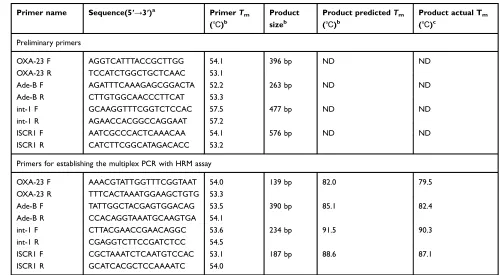
With reference to sequences from the NCBI database (http:// www.ncbi.nlm.nih.gov/gene/), we designed two pairs of pri-mers for each of the four genes, one of which was used for preliminary screening of the target gene, and another that was used to establish the multiplex PCR assay. The four sets of primers used for multiplex PCR were designed to have a similar annealing temperature, and to amplify predicted products of different sizes and melting temperatures (Table 1).
Infection and Drug Resistance downloaded from https://www.dovepress.com/ by 118.70.13.36 on 22-Aug-2020
Preliminary screening of bla
oxa-23,
Ade-B
,
int-1, and ISCR-1
Four sets of preliminary primers were used to characterize the four genes in the 8 of 87 MDRAB isolates. Each 20 μL PCR contained 10 μL of 2× PCR master mix (Generay Biotech, Shanghai, China), 0.6 μL of 10 μM forward and reverse primers, 1.4 μL of template DNA, and 7.4 μL of double-distilled water. Amplification was performed using the following conditions: initial denaturation at 95°C for 3 mins, followed by 40 cycles of denaturation (95°C, 30 s), annealing (56°C forblaoxa-23, 55°C forAde-B, 59°C forint-1,
56°C forblaoxa-23, 45 s), extension (72°C, 1 min), and afinal
extension at 72°C for 5 mins. To validate the PCR products they were separated by agarose gel electrophoresis, stained with GoldView TM(nontoxic) and photographed on a UV transilluminator.
DNA sequencing and actual melting
temperature (
t
m) determination
To ensure the specificity of the primers used for the multi-plex PCR with HRM assay, the four sets of the primers were used to detect the four genes that were amplified
using the preliminary primers. Reactions were similar to the preliminary screening conditions but contained 10μL of 2× HRM FAST PCR master mix (Kapa Biosystems, Cape Town, South Africa), 0.6μL of 10μM forward and reverse primers, 1.4μL of template DNA, 2μL of 25 mM Mgcl2, and 5.4 μL of double-distilled water.
Amplifications were performed as described above but with an annealing temperature of 56°C for all four sets of primers. PCR products were separated by agarose gel electrophoresis and sequenced, and data were analyzed using the Basic Local Alignment Search Tool (BLAST, http://blast.ncbi.nlm.nih.gov/Blast.cgi).
In addition to determining the actual melting tempera-ture (Tm) using HRM analysis with the LightScanner
System (Idaho Technology Inc., Cape Town, South Africa), melting curves were performed by measuring the decrease influorescent signal with increasing temperature by ramping at 0.02°C/s with 25 acquisitions/°C. Tm is
defined as the temperature at which 50% of the amplified product dissociated into single-stranded DNA, and the actual Tm of the four genes was used as a reference to
determine which gene was present in amplification reac-tions from the isolates.
Table 1Primers used in this study
Primer name Sequence(5ʹ→3ʹ)a PrimerT
m
(℃)b
Product sizeb
Product predictedTm
(℃)b
Product actual Tm
(℃)c
Preliminary primers
OXA-23 F AGGTCATTTACCGCTTGG 54.1 396 bp ND ND
OXA-23 R TCCATCTGGCTGCTCAAC 53.1
Ade-B F AGATTTCAAAGAGCGGACTA 52.2 263 bp ND ND
Ade-B R CTTGTGGCAACCCTTCAT 53.3
int-1 F GCAAGGTTTCGGTCTCCAC 57.5 477 bp ND ND
int-1 R AGAACCACGGCCAGGAAT 57.2
ISCR1 F AATCGCCCACTCAAACAA 54.1 576 bp ND ND
ISCR1 R CATCTTCGGCATAGACACC 53.2
Primers for establishing the multiplex PCR with HRM assay
OXA-23 F AAACGTATTGGTTTCGGTAAT 54.0 139 bp 82.0 79.5
OXA-23 R TTTCACTAAATGGAAGCTGTG 53.3
Ade-B F TATTGGCTACGAGTGGACAG 53.5 390 bp 85.1 82.4
Ade-B R CCACAGGTAAATGCAAGTGA 54.1
int-1 F CTTACGAACCGAACAGGC 53.6 234 bp 91.5 90.3
int-1 R CGAGGTCTTCCGATCTCC 54.5
ISCR1 F CGCTAAATCTCAATGTCCAC 53.1 187 bp 88.6 87.1
ISCR1 R GCATCACGCTCCAAAATC 54.0
Notes:aThe sequence of primer was designed by using primer premier 5.0 software.bThe primerTm, product size and product predictedTmwere provided by primer premier 5.0 software.c
The product actualTmwere observed in this assay.
Abbreviation:ND, not determined.
Infection and Drug Resistance downloaded from https://www.dovepress.com/ by 118.70.13.36 on 22-Aug-2020
Development of the multiplex PCR and
HRM assay
Template DNA used in multiplex PCR was a mixture of isolates, and these were tested for the presence of blaoxa-23, Ade-B, int-1, and ISCR-1. Multiplex PCR
was performed in single-tube 20 μL reactions containing 10 μL of 2× HRM FAST PCR master mix, 0.4 μL of 10 μM forward and reverse primers (total of 3.2 μL), 1.4 μL of compound template DNA, 2 μL of 25 mM Mgcl2, and 3.4 μL of double-distilled water. To ensure
the sensitivity and specificity of multiplex PCR, anneal-ing was tested at 54°C, 56°C, 58°C, and 60°C. All other reaction conditions were as described above. Melting curves from all multiplex PCR amplification products were generated using a LightScanner System, and pro-ducts were separated by agarose gel electrophoresis following HRM analysis.
Screening of clinical isolates
Seventy-nine of the remaining 87 MDRAB strains were screened for the presence of the four genes using the multiplex PCR and HRM assay described above. We also tested for the presence of the four genes using traditional PCR and agarose gel electrophoresis-based methods (one PCR reaction detecting one gene) to verify the accuracy of the multiplex PCR and HRM assay.
Results
Preliminary screening for bla
oxa-23,
Ade-B
,
int-1, and ISCR-1
Preliminary screening of eight MDRAB isolates for the four genes was performed to provide positive controls for developing multiplex PCR of unknown samples. Agarose gel electrophoresis demonstrated the presence of Ade-B, int-1,andISCR-1in strain 1, andblaoxa-23andAde-Bin all
of the other seven strains (Figure 1).
DNA sequencing and differentiation of
the four genes using HRM curve analysis
Strains 1 and 2 were used as positive controls for estab-lishing the multiplex PCR with HRM assay. Four sets of the primers were used to detect the four genes in these strains, and agarose gel electrophoresis resulted in bands of 139, 390, 234, and 187 bp as expected (Figure 2). The BLAST results confirmed that the sequences of the PCR amplification products were the same as those previously published.The PCR amplification products were differentiated by HRM curve analysis. The presence ofblaoxa-23was revealed
by a single dominant peak with a melting temperature of 79.5° C in the melting curve analysis (Figure 3A), whileAde-B int-1 andISCR-1corresponded to single dominant peaks at 82.4°C, 90.3°C, and 87.1°C, respectively (Figure 3B–D). All melting
1
1
100bp
100bp 300bp
300bp 500bp
500bp 700bp
700bp 900bp
900bp 1200bp
1200bp 3
3 3
3 2 1
1 2
2
2 Marker
Marker
Marker Marker 8
8
8
8 7
7
7
7 6
6
6
6 5
5
5
5 4
4
4
4
Figure 1Agarose gel electrophoresis of the PCR amplification products of the four genes from eight MDRAB isolates using preliminary primers.
Infection and Drug Resistance downloaded from https://www.dovepress.com/ by 118.70.13.36 on 22-Aug-2020
temperatures were lower than predicted, and differences in the actual melting temperatures allowed the four genes to be easily distinguished by HRM curve analysis (Figure 4).
Development of the multiplex PCR and
HRM assay
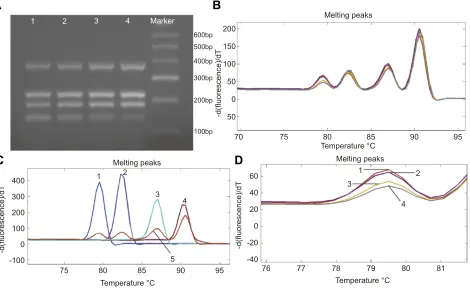
Multiplex PCR amplification products with different annealing temperatures were separated by agarose gel electrophoresis and photographed, and melting curve analysis was performed after electrophoresis. Multiplex PCR amplification generated four products with sizes corresponding to the four genes (Figure 5A).
Additionally, HRM analysis showed that the melting curves of multiplex PCR amplification products produced four peaks with the same melting temperature as the four genes (Figure 5B–C). Agarose gel electrophoresis showed that theblaoxa-23amplification product decreased
with increasing annealing temperature (Figure 5A), and the melting curve of blaoxa-23 similarly decreased with
increasing annealing temperature (Figure 5D). Since the blaoxa-23 peak was the lowest of all four peaks, we
selected 54°C as the most appropriate annealing tempera-ture to improve the sensitivity ofblaoxa-23detection in the
multiplex PCR with HRM assay.
Screening clinical isolates for the
presence of the four genes
Seventy-nine MDRAB clinical isolates were screened for the presence of the four genes using the multiplex PCR with HRM assay. From the melting curves, the HRM assay identifiedblaoxa-23andAde-Bin 73/79 isolates, whileint-1
was present one isolate, bothint-1 andISCR-1 were pre-sent in two isolates, and Ade-B, int-1 and ISCR-1 were present in three isolates (Figure 6). No isolates were found to be carried all four genes (Figure 6). The presence of the four genes detected using the multiplex PCR with HRM Ade-B
Marker
100bp 200bp 300bp 400bp 500bp 600bp ISCR-1
Int-1 Blaoxa-23
Figure 2Agarose gel electrophoresis of PCR amplification products of the four genes using multiplex PCR primers.
Melting peaks
Melting peaks Melting peaks
Melting peaks
D
C
B
A
95
95 95
95 90
90 90
90 85
85
85
85
80 80
80 80
75
75
75
75
0 0
0 0
-100
-100 -100
100
100 100
200
200 200
300
300 300
400
400 400
-d (fluorescence)/dT
-d(fluorescence)/dT
-d(fluorescence)/dT
-100 100 200 300 400
-d(fluorescence)/dT
Temperature°C Temperature°C
Temperature°C Temperature°C
Figure 3Melting curves of PCR amplification products of the four genes used in HRM analysis.–d[Fluorescence]/dT (y-axis) is plotted against temperature (C) on thex-axis. The melting curves ofblaoxa-23,Ade-B, int-1, andISCR-1are shown inA,B,C, andD, respectively.
Abbreviation:HRM, high resolution melting.
Infection and Drug Resistance downloaded from https://www.dovepress.com/ by 118.70.13.36 on 22-Aug-2020
assay was consistent with data from traditional methods (Figure7,Table 2).
Discussion
A. baumannii causes nosocomial infections in hospitals and health care departments and is difficult to treat in
multidrug-resistant organisms that often carry OXA-23, Ade-ABC, Class 1 integron, andISCR-1.9,24Accurate and rapid detection of blaoxa-23, Ade-B, int-1, and ISCR-1 in
clinical microbiology laboratories is important for preven-tion and treatment of MDRAB.25Conventional assays for screening these genesare expensive and time-consuming.
-d(fluorescence)/dT
Melting peaks
400
200
int-1 ISCR-1 Ade-B
blaoxa-23
95 90
85 80
75 70
0
-100 100 300
Temperature°C
Figure 4Melting curves of the four genes form HRM analysis plotted on the same graph.
Abbreviation:HRM, high resolution melting.
75 -100
0 100 200 300 400
80 85 90 95
75 70
1 2 3 4 Marker
50
1 2 1 2
3
3
4
5
4 0
50 100 150 200 600bp
500bp
400bp
300bp
200bp
100bp
80 85 90 95
76 -40 -20 0 20 40 60
77 78 79 80 81
Temperature °C Temperature °C
Temperature °C
Melting peaks Melting peaks
Melting peaks
-d(fluorescence)/dT -d(fluorescence)/dT
-d(fluorescence)/dT
A
B
C
D
Figure 5(A) Representative agarose gel electrophoresis of multiplex PCR products of the four genes with different annealing temperatures amplified in a single tube. 1–4= annealing temperatures of 54°C, 56°C, 58°C, and 60°C, respectively. (B) Representative melting curves of the single-tube multiplex PCR with HRM assay performed with different annealing temperatures. (C) Melting curves of the four genes (1–4) and that of the multiplex PCR with HRM assay (5) plotted on a single graph. (D) Representative enlargement ofblaoxa-23peaks from melting curves derived from a single-tube multiplex PCR with HRM assay with different annealing temperatures. 1–4= annealing temperatures of 54°C, 56°C, 58°C, and 60°C, respectively.
Infection and Drug Resistance downloaded from https://www.dovepress.com/ by 118.70.13.36 on 22-Aug-2020
In contrast, HRM analysis is a rapid, cost-effective, and high-throughput method. We, therefore, sought to develop a rapid assay for detecting these genes without the need to perform agarose gel electrophoresis in this study.
We designed two sets of primers for each gene and PCR amplification products were sequenced to ensure the specificity of the multiplex PCR with HRM assay. The melting temperatures of the amplified products were different enough to allow us to distinguish between them.
Compared with traditional phenotypic assays, our mul-tiplex PCR with HRM assay has a number of advantages; (1) It is significantly faster and more high-throughput. All four genes are detected simultaneously in the multiplex PCR with HRM assay in a single tube, minimizing con-tamination and improving efficiency since an agarose gel electrophoresis step is not required. The multiplex PCR with HRM assay could test 96 clinical isolates in 2 hrs 30 mins. (2) The novel assay is cost-effective. The approx-imate cost of this assay from DNA template extraction to
-d(fluorescence)/dT
70
Temperature °C Melting peaks
75 80 85 90 95
0 200 100 600 800 1000 1200 1400
Figure 6Melting curves of the four genes detected in 79 clinical isolates using the single-tube multiplex PCR with HRM assay.
Abbreviation:HRM, high resolution melting.
Marker 500bp 400bp 300bp 500bp 400bp 300bp 500bp 400bp 300bp 500bp 400bp 300bp 500bp 400bp 300bp Marker Marker Marker Marker
1 2 3 4 5 6 7 8 9 10 11 12 13 14 15 16 17
35 36 37 38 39 40 41 42 43 44 45 46 47 48 49 50 51
52 53 54 55 56 57 58 59 60 61 62 63 64 65 66 67 68
69 70 71 72 73 73 75 76 77 78 79
18 19 20 21 22 23 24 25 26 27 28 29 30 31 32 33 34
Marker 400bp 300bp 200bp 400bp 300bp 200bp 400bp 300bp 200bp 400bp 300bp 200bp 400bp 300bp 200bp Marker Marker Marker Marker
1 2 3 4 5 6 7 8 9 10 11 12 13 14 15 16 17
35 36 37 38 39 40 41 42 43 44 45 46 47 48 49 50 51
52 53 54 55 56 57 58 59 60 61 62 63 64 65 66 67 68
69 70 71 72 73 74 75 76 77 78 79
18 19 20 21 22 23 24 25 26 27 28 29 30 31 32 33 34
Marker 300bp 200bp 100bp 300bp 200bp 100bp 300bp 200bp 100bp 300bp 200bp 100bp 300bp 200bp 100bp Marker Marker Marker Marker
1 2 3 4 5 6 7 8 9 10 11 12 13 14 15 16 17
35 36 37 38 39 40 41 42 43 44 45 46 47 48 49 50 51
52 53 54 55 56 57 58 59 60 61 62 63 64 65 66 67 68
69 70 71 72 73 73 75 76 77 78 79
C
B
D
18 19 20 21 22 23 24 25 26 27 28 29 30 31 32 33 34
Marker 200bp 100bp 200bp 100bp 200bp 100bp 200bp 100bp 200bp 100bp Marker Marker Marker Marker
1 2 3 4 5 6 7 8 9 10 11 12 13 14 15 16 17
35 36 37 38 39 40 41 42 43 44 45 46 47 48 49 50 51
52 53 54 55 56 57 58 59 60 61 62 63 64 65 66 67 68
69 70 71 72 73 73 75 76 77 78 79
18 19 20 21 22 23 24 25 26 27 28 29 30 31 32 33 34
A
Figure 7(A) Agarose gel electrophoresis of the resistance geneblaoxa-23in 79 clinical isolates. (B) Agarose gel electrophoresis of the resistance geneint-1in 79 clinical isolates. (C) Agarose gel electrophoresis of the resistance geneISCR-1in 79 clinical isolates. (D) Agarose gel electrophoresis of the resistance geneAde-Bin 79 clinical isolates.
Infection and Drug Resistance downloaded from https://www.dovepress.com/ by 118.70.13.36 on 22-Aug-2020
multiplex PCR with HRM analysis is $2 per sample for the detection of all four genes. (3) The novel assay is non-destructive and environmentally friendly since no harmful ethidium bromide is used because an agarose gel electro-phoresis step is not performed.
The four genes are known to play an important role in the evolution if resistance inA. baumannii, and in MDRAB in particular. In the 79 clinical isolates tested,blaoxa-23and
Ade-B were the most common, in accordance with published literature.26,27Our results also demonstrate the co-existence ofISCR-1and int-1in bacteria. This may be related to the fact that ISCR1 can insert DNA into the 3ʹconserved regions of class 1 integrons to generate complex class 1 integrons carrying the sul1, resX, and trIb resistance genes.24,28
In conclusion, we have developed a single-tube multi-plex PCR with HRM assay which can reliably detect the presence ofblaoxa-23,Ade-B, int-1, andISCR-1separately
or in combination. This assay is rapid, cost-effective, non-destructive, easy to set-up, and has high-throughput in nature.
Disclosure
The authors report no conflicts of interest in this work.
References
1. Towner KJ. Acinetobacter: an old friend, but a new enemy.J Hosp
Infect.2009;73(4):355–363. doi:10.1016/j.jhin.2009.03.032
2. Poulakou G, Renieris G, Sabrakos L, et al. Daptomycin as adjunctive treatment for experimental infection by Acinetobacter baumannii with
resistance to col1istin. Int J Antimicrob AG. 2019;53(2):190–194.
doi:10.1016/j.ijantimicag.2018.10.024
3. Schuertz KF, Tuon FF, Palmeiro JK, et al. Bacteremia and
menin-gitis caused by OXA-23-producing Acinetobacter baumannii –
molecular characterization and susceptibility testing for alternative
antibiotics. Braz J Microbiol. 2018;49:199–204. doi:10.1016/j.
bjm.2018.04.002
4. Chuang Y, Cheng A, Sun H, et al. Microbiological and clinical characteristics of Acinetobacter baumannii bacteremia: implications
of sequence type for prognosis. J Infect. 2019;78(2):106–112.
doi:10.1016/j.jinf.2018.10.001
5. Rocha IV, Xavier DE, Almeida KRHD, Oliveira SRD, Leal NC. Multidrug-resistant Acinetobacter baumannii clones persist on
hospi-tal inanimate surfaces. Braz J Infect Dis. 2018;22(5):438–441.
doi:10.1016/j.bjid.2018.08.004
6. Jain M, Sharma A, Sen MK, Rani V, Gaind R, Suri JC. Phenotypic and molecular characterization of Acinetobacter baumannii isolates
causing lower respiratory infections among ICU patients. Microb
Pathog.2019;128:75–81. doi:10.1016/j.micpath.2018.12.023 7. Lee M, Chen T, Lee Y, et al. Dissemination of multidrug-resistant
Acinetobacter baumannii carrying BlaOxA-23 from hospitals in
cen-tral Taiwan. J Microbiol Immunol Infect. 2013;46(6):419–424.
doi:10.1016/j.jmii.2012.08.006
8. Fournier PE, Vallenet D, Barbe V, et al. Comparative genomics of
multidrug resistance in Acinetobacter baumannii. PLoS Genet.
2006;2(1):e7. doi:10.1371/journal.pgen.0020007
9. Jamal S, Al Atrouni A, Rafei R, Dabboussi F, Hamze M, Osman M. Molecular mechanisms of antimicrobial resistance in acinetobacter baumannii, with a special focus on its epidemiology in Lebanon.
J Glob Antimicrob Re. 2018;15:154–163. doi:10.1016/j. jgar.2018.05.022
10. Charfi-Kessis K, Mansour W, Ben Haj Khalifa A, et al.
Multidrug-resistant Acinetobacter baumannii strains carrying the blaOxA-23 and the blaGES-11 genes in a neonatology center in Tunisia.
Microb Pathog.2014;74:20–24. doi:10.1016/j.micpath.2014.07.003 11. Da Silva KE, Maciel WG, Croda J, et al. A high mortality rate
associated with multidrug-resistant Acinetobacter baumannii ST79
and ST25 carrying OXA-23 in a Brazilian intensive care unit.PLoS
One.2018;13(12):e209367. doi:10.1371/journal.pone.0209367
12. Petrović T, Uzunović S, Barišić I, et al. Arrival of
carbapenem-hydrolyzing-oxacillinases in Acinetobacter baumannii
in Bosnia and Herzegovina. Infect Genet Evol. 2018;58:192–198.
doi:10.1016/j.meegid.2017.12.021
13. Costa EM, Silva S, Vicente S, Veiga M, Tavaria F, Pintado MM. Chitosan as an effective inhibitor of multidrug resistant Acinetobacter
baumannii. Carbohydr Polym. 2017;178:347–351. doi:10.1016/j.
carbpol.2017.09.055
14. Lee S, Oh MH, Yun SH, et al. Genomic characterization of exten-sively drug-resistant Acinetobacter baumannii strain, KAB03
belong-ing to ST451 from Korea. Infect Genet Evol. 2018;65:150–158.
doi:10.1016/j.meegid.2018.07.030
15. Almasaudi SB. Acinetobacter spp. as nosocomial pathogens:
epide-miology and resistance features. Saudi J Biol Sci. 2018;25
(3):586–596. doi:10.1016/j.sjbs.2016.02.009
16. Poey ME, Laviña M. Horizontal transfer of class 1 integrons from
uropathogenic Escherichia coli to E. coli K12. Microb Pathog.
2018;117:16–22. doi:10.1016/j.micpath.2018.02.006
17. Liu C, Tang CY, Chang K, Kuo H, Liou M. A comparative study of
class 1 integrons in acinetobacter baumannii. Gene. 2014;544
(1):75–82. doi:10.1016/j.gene.2014.04.047
18. Rui Y, Lu W, Li S, Cheng C, Sun J, Yang Q. Integrons and insertion sequence common region 1 (ISCR1) of carbapenem-non-susceptible gram-negative bacilli in fecal specimens from 5000 patients in
south-ern China.Int J Antimicrob AG.2018;52(5):571–576. doi:10.1016/j.
ijantimicag.2018.06.015
19. Zheng F, Sun J, Cheng C, Rui Y. Molecular characteristics of carbapenem-resistant gram-negative bacteria in Southern China.
Microb Drug Resist.2015;21(2):178–185. doi:10.1089/mdr.2014.0085 20. Yong TB, Hashim R, Noor AM, Hamzah SH, Ahmad N.
Identification of brucella spp. isolated from human brucellosis in
Malaysia using high-resolution melt (HRM) analysis. Diagn Micr
Infect Dis. 2015;81(4):227–233. doi:10.1016/j.diagmicr obio.2014.12.012
Table 2Presence of the four genes in clinical isolates detected by multiplex PCR with HRM assay and traditional method
Gene Isolates
(Detection by
multiplex PCR
with HRM assay)
Isolates
(Detection by
tra-ditional method)
blaoxa-23andAde-B 73 73
int-1 1 1
int-1andISCR-1 2 2
Ade-B, int-1andISCR-1 3 3
Total 79 79
Abbreviation:HRM, high resolution melting.
Infection and Drug Resistance downloaded from https://www.dovepress.com/ by 118.70.13.36 on 22-Aug-2020
21. Pasanen T, Koskela S, Mero S, et al. Rapid molecular characteriza-tion of Acinetobacter baumannii clones with rep-PCR and evaluacharacteriza-tion of carbapenemase genes by new multiplex PCR in hospital district of
helsinki and uusimaa. PLoS One. 2014;9(1):e85854. doi:10.1371/
journal.pone.0085854
22. Lee Y, Yum JH, Kim C, et al. Role of OXA-23 and AdeABC efflux
pump for acquiring carbapenem resistance in an Acinetobacter
bau-mannii strain carrying the blaOXA-66 gene. Ann Clin Lab Sci.
2010;40(1):43–48.
23. Magiorakos AP, Srinivasan A, Carey RB, et al. Multidrug-resistant, extensively drug-resistant and pandrug-resistant bacteria: an
interna-tional expert proposal for interim standard definitions for acquired
resistance.Clin Microbiol Infect.2012;18(3):268–281. doi:10.1111/
j.1469-0691.2011.03570.x
24. Guan X, He L, Hu B, et al. Laboratory diagnosis, clinical management and infection control of the infections caused by extensively drug-resistant
gram-negative bacilli: a Chinese consensus statement.Clin Microbiol
Infect.2016;22:S15–25. doi:10.1016/j.cmi.2015.11.004
25. Roth AL, Hanson ND. Rapid detection and statistical differentiation of KPC gene variants in Gram-negative pathogens by use of
high-resolution melting and ScreenClust analyses.J Clin Microbiol.
2013;51(1):61–65. doi:10.1128/JCM.02193-12
26. Lin M, Lin Y, Tu C, Lan C. Distribution of different efflux pump
genes in clinical isolates of multidrug-resistant Acinetobacter
bau-mannii and their correlation with antimicrobial resistance.
J Microbiol Immunol Infect. 2017;50(2):224–231. doi:10.1016/j. jmii.2015.04.004
27. Pournaras S, Dafopoulou K, Del Franco M, et al. Predominance of international clone 2 OXA-23-producing-Acinetobacter baumannii clinical isolates in Greece, 2015: results of a nationwide study.
Int J Antimicrob AG. 2017;49(6):749–753. doi:10.1016/j. ijantimicag.2017.01.028
28. Ramírez MS, Vilacoba E, Stietz MS, et al. Spreading of AbaR-type genomic islands in multidrug resistance acinetobacter baumannii
strains belonging to different clonal complexes. Curr Microbiol.
2013;67(1):9–14. doi:10.1007/s00284-013-0326-5
Infection and Drug Resistance
Dove
press
Publish your work in this journal
Infection and Drug Resistance is an international, peer-reviewed open-access journal that focuses on the optimal treatment of infection (bacterial, fungal and viral) and the development and institution of preventive strategies to minimize the development and spread of
resis-tance. The journal is specifically concerned with the epidemiology of
antibiotic resistance and the mechanisms of resistance development and diffusion in both hospitals and the community. The manuscript manage-ment system is completely online and includes a very quick and fair peer-review system, which is all easy to use. Visit http://www.dovepress.com/ testimonials.php to read real quotes from published authors.
Submit your manuscript here:https://www.dovepress.com/infection-and-drug-resistance-journal
Infection and Drug Resistance downloaded from https://www.dovepress.com/ by 118.70.13.36 on 22-Aug-2020