ISSN 2348 – 7968
An Energy Efficient Air Conditioner System without Compressor:
Application of Embedded System
Poonam Shelke1, Gajanan Malwatkar2
Department of Electronics and Telecommunication Engineering, Dnyanganga College of Engineering and Research
Pune, 411041, India
Abstract
This paper represents the adsorption air conditioner system. An activated carbon and methanol is used as working pair. To get 24 hours cooling effect two adsorbent beds and halogen tube are used. One bed maintains high pressure and high pressure. Another maintains low pressure and low temperature. The halogen tube is used as energy source for experimentation purpose. The system is based on adsorption-desorption cycle. The natural working fluid prevents ozone layer. There are no moving parts therefore little maintenance. The system can operate on solar energy also and this is environmental friendly. Keywords: Adsorption, Desorption, Natural working fluid, Activated Carbon-Methanol .
1. Introduction
Due to increasing concentration of green house gases environment changes and global warming effect the need of renewable energy source is greater than ever. Since fossil fuels are nonrenewable energy so we cannot depend on forever. As per the Dr. A.P.J. Abdul Kalam though nuclear energy is clean and green there are some problem associated with it. Therefore only one option is solar energy. Because solar energy is outstanding energy source and it is renewable energy. It consists of radiant light and it comes free on earth. It is non-polluting and thre is less maintenance. Solar energy system are now designed for particular needs like solar water heating, cooking, food drying, preserving, refrigeration, etc. Solar panels are used for electricity generation. Now a day’s solar panel improves value of property.
The temperature of earth increases due to global warming. So the need of air conditioner system and refrigerator increases. Somewhere in the world there is no reliable electricity supply but there are high potentials of solar energy. The refrigerator and air conditioner mainly works on compression system which consumes maximum amount of electricity due to compressor. This increases 25-40%
annual energy cost. Many people cannot afford this and cannot live without air conditioner in summer days. Due to overheat senior citizens and children faces heat related deaths. The fans are useless above 90̊F, it increases body stress, body hearting increases and increases body temperature. The compressor is heart of vapour compression system. The chlorofluorocarbon (CFC) and hydro-chlorofluorocarbon (HCFC) used in this system. The emission of CFC and HCFC depletes ozone layer. Emission of carbon dioxide increases pollution. In the vapour absorption system compressor is replaced by generator and absorber. But use of CFC and HCFC causes ozone depletion.
Due to these problems it is becoming urgent to find out energy resource in which efficiency also improves. The adsorption machines which can recover waste heat at low temperature levels. Also it can be interesting alternative for wiser heat management.
The use of solar powered adsorption refrigerator and air conditioning system is best solution. It works on solar energy therefore it reduces electricity bills. The CFC and HCFC are not used in it therefore it prevents ozone layer. It is environmental friendly system.
ISSN 2348 – 7968
noncorrosive and chemically stable, easily adsorption and high latent heat per unit volume, Also it should be environmental friendly [5]. The solar powered air conditioning system based on adsorbent and refrigerant pair. Also Pons and Grenier demonstrated [6],[7] that activated carbon and methanol can serve as most suitable pair for solar powered solid adsorption ice maker than other pairs. Here activated carbon used as adsorbent and methanol is used as refrigerant because it gives best coefficient of performance [8], [9].
3. Adsorption Refrigeration Process
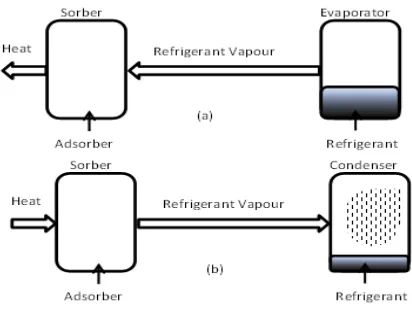
The adsorption process is caused by the Van der Vaals force between adsorbate and atoms or molecules at the adsorbent surface. The adsorbent is characterized by the surface and porosity. In the adsorption refrigeration cycle, refrigerant not compressed to a higher temperature and pressure by the compressor but it is adsorbed by a solid with a very high microscopic porosity. This process requires only thermal energy, no mechanical energy requirement. The principles of the adsorption process provide two main processes adsorption or refrigeration and desorption or regeneration
.
Fig. 1 (a) Adsorption (Refrigeration) Process
(b) Desorption (Regeneration) Process
The operation of the solid adsorption refrigeration system utilizing solar heat is shown in fig. 1. The system is composed of the container of adsorbents, which serves as solar collector, a condenser and evaporator which acts as a refrigerator and refrigerator cabinate. A combination of adsorbent and adsorbate is confirmed in closed system where no gas carrier exists. The collector is supplied with adsorbent which is adsorbed with adsorbate. During day time adsorbent along with the refrigerant is heated in the collector. As the temperature in collector increases, refrigerent evaporates from the adsorbent bed and then
cooled by condenserand stored in the evaporator. During night time the collector is cooled by ambient air and the temperature of bed reaches minimum. In this period, refrigerant begins to evaporate by adsorbing heat from water to be frozen and adsorbed by adsorbent. As the evaporation of refrigerant contineous water temperature decreases until it reaches 0̊C, when ice formation starts. The same principle is used in the air conditioner system to cool air.
In this paper, to achieve 24 hours cooling effect two beds are used[10]. In stead of solar energy here halogen tube is used as contineous energy source for experiment purpose. The microcontroller is used to maintain between 90̊C to 110̊C. First adsorbent bed 1 maintains high pressure and high temperature. The second adsorbent bed maintains low pressure and low temperature. To maintain this cold water is filled at the bottom of bed2. These bed creates pressure drop. Due to this the process of heating-desorption-condensation and cooling-adsorption-evaporation are occure contineously. The evaporator is able to cool 10̊C less than room temperature. Two beds and haogen tube able to achieve 24 hours cooling effect.
3. Apparatus Description
The selection of adsorbent depends on its good thermal conductivity, availability in market, compatibility with chemical, etc. The selection of refrigerant depends on good thermal conductivity, low viscosity, its easily adsorption, etc. After considering these factors activated carbon (charcoal) and methanol is selected as refrigerant. It is easily adsorbed in activated carbon.
The system consists of two beds, condenser, expansion valve, evaporator, reservoir and 12VDC pump. The pressure gauge and temperature sensors are used to measure pressure and temperature. The microcontroller is used to maintain temperature in adsorbent bed 1 between 90̊C to 110̊C.
ISSN 2348 – 7968
heat is removed from air or water to be cooled by the evaporating refrigerant. The evaporator must have sufficient volume to collect condensed methanol. In order to enhance the heat transfer effect, the heat exchange surface is designed as a series of five trapezoidal cells. The adsorbent bed 2 structure is same as bed 1. It maintains ambient temperature. To maintain cold water is filled at bottom of bed 1. This bed 2 adsorbs methanol vapours from evaporator. The evaporator produces cooling effect. It cools temperature 10̊C less than room temperature. The bed 2 converts vapour in to liquid and stored in reservoir. The 12VDC pump is used to forward this liquid from bed 2 to bed1.
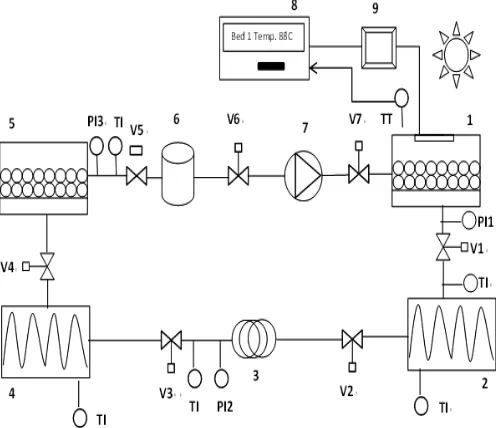
The PIC microcontroller is used here. The PIC microcontroller has in build ADC, high speed, it is widely available and its cost is low [12]. It is connected to halogen tube through relay. The LM35 is used to give input of microcontroller. The LM35 is used as temperature sensor. The LM35 series are precision integrated-circuit temperature sensors, whose output voltage is linearly proportional to Celsius temperature. It can work in -55̊C to +150̊C temperature range. The LM35‘s low output impedance, linear output, and precision inherent calibration make interfacing to readout or control circuitry especially easy. It is connected to microcontroller. It gives input to microcontroller and LCD displays the temperature of adsorbent bed 1. Whenever temperature of adsorbent bed 1 is less than or equal to 90̊C then it turns on the halogen tube and when it goes above 110̊C it turns off halogen tube. This is able to maintain temperature of bed 1 between 90̊C to 110̊C. The Figure 2 shows An Energy Efficient Air Conditioner System without Compressor: Application of Embedded Systems.
3.1 Desorption Cycle
When the halogen tube is on the temperature of adsorbent bed1 increases and when it comes to desorption temperature. Then the methanol desorbs in condenser. The microcontroller maintains the temperature of bed 1 in 90̊C to 110̊C therefore the desorption process continuous. The condenser cools refrigerant vapour and condenses this vapour into liquid. The liquid is passed through expansion valve and stored in evaporator. This process is called desorption or regeneration process.
3.2 Adsorption Cycle
The temperature of adsorbent bed 2 maintains low pressure and low temperature i.e. ambient temperature. Due to this pressure drop adsorbent bed 2 adsorbs vapour of methanol from evaporator. When temperature of bed 2 equals to
ambient temperature the vapours are passed from evaporator to adsorbent bed 2. This produces cooling
Fig. 2 Experimental setup of An Energy Efficient Air Conditioner System without Compressor: Application of Embedded Systems. (1-Adsorbent Bed1, 2-Condenser, 3-Expansion valve, 4-Evaporator, 5-Adsorbent Bed2, 6-Reservoir, 7-12 VDC Pump, 8-Microcontroller, 9-Power Control Device, PI- Pressure Indicator, TI-Temperature Indicator, TT-Temperature Transmitter, V1-V7 Valves )
effect. The evaporator cools 10̊C less than room temperature. This process is called adsorption or regeneration process.
In adsorbent bed 2 this vapour again converts in to the liquid. This liquid is store in the reservoir. The 12VDC pump is used to forward liquid from bed2 to bed 1. Due to this arrangement the heating-desorption-condensation and cooling-adsorption-evaporation process goes on continuously. Therefore system is able to achieve 24 hours cooling effect. The system is able to cool temperature 10̊C less than room temperature. Here we can use the combination of solar energy and halogen tube. Whenever solar radiations are strong between 10am to 4pm at that time we can use solar energy to maintain the temperature in adsorbent bed 1 between 90̊C to 110̊C. Thus we can save the energy. There are no moving parts so there is less maintenance. The system uses natural working fluid therefore there is no emission of chlorofluorocarbon and hydro-chlorofluorocarbon and it prevents ozone layer.
4. Result and Discussions
ISSN 2348 – 7968
evaporator, reservoir, adsorbent bed 2 and 12VDC pump were connected with connecting pipes and valves. All fittings and leakages are checked out. It is sealed with teflon and Mseal if necessary. Then methanol is filled in all system and reservoir. The controller is used to maintain temperature of adsorbent bed 1 in between 90̊C to 110̊C.
The adsorbent bed 1 is heart of an energy efficient air conditioner system without compressor application of embedded systems. In the adsorption air conditioning system compressor is replaced by using this adsorbent bed 1.The adsorbent bed 1 receives energy from halogen tube so it can able to achieve desired temperature as soon as possible. Boiling point of methanol is 65̊C. Whenever it reaches of desorption temperature it is nothing but 70̊C then it starts to desorb refrigerant in condenser. The expansion valve reduces pressure of condensed liquid and stores it in to evaporator.
The adsorbent bed 2 maintains low pressure low temperature i.e. ambient temperature. It adsorbs methanol vapour from evaporator and it produces cooling effect. The evaporator is able to cool temperature 10̊C less than room temperature. This process is called as adsorption process. This converts vapours into liquid and stores in reservoir. The 12VDC pump passes liquid from adsorbent bed 2 to adsorbent bed 1. These two beds are able to achieve 24 hours cooling effect.
The LM35 is temperature sensor it gives input to microcontroller. It continuously senses temperature and it displays on LCD. The output of microcontroller is connected to halogen tube through relay. Whenever temperature is within range i. e. less than or equal to 90̊C then it switch on the halogen tube. Whenever it goes above 110̊C then it switches off halogen tube. Thus it maintains temperature of adsorbent bed 1 between 90̊C to 110̊C. The fig. 3 shows the graphical representation of maintained temperature in adsorbent bed 1.
Fig3. The Maintained Temperature in Adsorbent Bed 1
Fig4. Temperature in Evaporator.
Once the temperature is maintained in adsorbent bed1 then the pressure also maintains. Then condensation takes place. It requires six hours for condensation The temperature of bed 2 is equal to ambient temperature. Then the adsorption takes place and evaporator produces cooling effect. It cools the temperature 10̊C less than room temperature. The adsorbent bed 2 converts adsorbed vapours from evaporator in to the liquid. The reservoir stores this. The fig. 4 shows the graphical representation of reduced temperature in evaporator.
4. Conclusions
cooling-ISSN 2348 – 7968
adsorption-evaporation process goes continuously and system is able to produce 24 hours cooling effect. If combination of solar energy and halogen tube is used then system is able to save energy and reduces electricity bills. Therefore system is very useful during summer.The natural working fluid is used in this system; therefore there is no emission of CFC and HCFC. It can prevent ozone layer. There are no moving parts and compressor therefore less maintenance. It is environmental friendly system.
Acknowledgments
Our thanks to Department and staff of Electronics and Telecommunication of Dnyanganga College of Engineering and Research Pune for continue support and appreciation.
References
[1] M. Li. R. Z. Wang, H. L. Luo, L. L. Wang, H. B. Huangl, “Experiments of Solar Flat plate Hybrid System with Heating and Cooling”, Applied Thermal Engineering, vol. 22, 2002, pp. 1445-1454.
[2] M. Li. C. J. Sun, R. Z. Wang, W. D. Cai, “Development of No Valve Solar Ice Maker”, Applied Thermal Engineering, vol. 24, 2002, pp. 865-872.
[3] M. Pons, J.J. Gulleminot “Design of An Experimental Solar Powered, Solid Adsorption Ice Maker”, Int. J. Solar Energy Engineering, vol. 108, 1986, pp. 332-337.
[4] N. M. Khatlab, “A Novel Solar Adsorption Refrigeration Module”, Applied Thermal Engineering, vol. 24, 2004, pp. 2747-2760.
[5] K. Sumathy, K. H. Yeung, Li. Yong, “Technology Development in Solar Adsorption Refrigeration System”, Process in Energy and ComBustion Science, vol. 29, 2003, pp. 301-327.
[6] M. Pons, P. H. Grenier “Experimental Data on Solar Powered Ice Maker using Activated Carbon and Methanol Adsorption Pair”, ASME J. Solar Energy Engineering, vol. 108, 1987, pp. 303-310.
[7] M. Pons, P. H. Grenier “A Phenomenological Adsorption Equilibrium Law Extracted from Experimental and Theoretical Consideration Applied to The Activated Carbon + Methanol”, Carbon, vol. 24, no. 5, 1987, pp. 615-625. [8] M. Li, H. B. Huang, R. Z. Wang, L.L. Wang, W. D. Cai, W.
M. Yang, “Experimental Study on Adsorbent of Active Carbon with refrigerant of Methanol and Ethanol Solar Ice Maker”, Renewable Energy, vol. 29, 2004, pp. 2235-2244. [9] I. I. El-Shanrkawy, K. Kuwahara, B. B. Saha, S. Koyama,
K.C.Ng, “Experimental Investigation of Activated Carbon Fibers/Ethanol for Adsorption Cooling System Application”, Applied Thermal Engineering, vol. 26, 2006, pp. 859-865.
[10]Abdul Hadi N. Khalifa, Fawziea M. Hussein, Faeza M. Hadi, “Experimental Study on Two beds Adsorption Chiller with Regenaration” Modern Applied Science, vol. 5, no. 4, 2001, pp. 43-52.
[11] C. P. Arrora, Refrigeration and Air Conditioning, New Delhi, Mc Graw Hill, 2009.
[12] Muhammad Ali Mazidi, Rolin D. Mckinlay, Danny Causey, PIC Microcontroller and Embedded Systems, New Delhi, Personal Education, 2009.
Poonam Shelke is student of Masters in Electronic and
Telecommunication (VLSI and Embedded Systems) in Dnyanganga College of Engineering and Research under University of Pune. She completed Degree of B.E. in Electronics and Telecommunication in 2012.
Gajanan Malwatkar received his PhD Degrees in Instrumentation