The relationship between family violence and self-control in adolescence: a multi-level
meta-analysis
Yayouk E. Willems1,2,3*, Jian-Bin Li4*, Anne M. Hendriks1,2, Meike Bartels1,2,5, Catrin
Finkenauer1,2,3
1Department of Biological Psychology, Vrije Universiteit Amsterdam, The Netherlands 2Amsterdam Public Health research institute, Vrije Universiteit Amsterdam, The Netherlands. 3Department of Interdisciplinary Social Science, Universiteit Utrecht, The Netherlands 4 Center for Child and Family Science, The Education University of Hong Kong, Hong Kong 5Neuroscience Campus Amsterdam, Amsterdam, The Netherlands
*Author note: Y.E. Willems & J.B. Li contributed equally to the paper and are shared first authors.
Corresponding authors: Y.E. Willems, van der Boechorststraat 1, 1081 BT, Amsterdam, The
Netherlands. E-mail: [email protected], Phone nr: +31205984382 and J. B. Li at 10, Lo Ping
Road, Tai Po, New Territories, Hong Kong. E-mail: [email protected], Phone nr: +852 2948
7587
Funding:
Y. Willems is supported by NWO (Research Talent, 406-15-132), and the Amsterdam Public Health travel grant. M. Bartels, C. Finkenauer and A. Hendriks are supported by the European Union Seventh Framework Program (FP7/2007-2013, Grant No. 602768). M. Bartels is supported by an ERC consolidator grant (WELL-BEING 771057)
Abstract
Theoretical studies propose an association between family violence and low self-control
in adolescence, yet empirical findings of this association are inconclusive. The aim of the present
research was to systematically summarize available findings on the relation between family
violence and self-control across adolescence. We included 27 studies with 143 effect sizes,
representing more than 25,000 participants of eight countries from early to late adolescence.
Applying a multi-level meta-analyses, taking dependency between effect sizes into account while
retaining statistical power, we examined the magnitude and direction of the overall effect size.
Additionally, we investigated whether theoretical moderators (e.g., age, gender, country), and
methodological moderators (cross-sectional/longitudinal, informant) influenced the magnitude of
the association between family violence and self-control. Our results revealed that family
violence and self-control have a small to moderate significant negative association (r = -.191).
This association did not vary across gender, country, and informants. The strength of the
association, however, decreased with age and in longitudinal studies. This finding provides
evidence that researchers and clinicians may expect low self-control in the wake of family
violence, especially in early adolescence. Recommendations for future research in the area are
discussed.
Introduction
Family violence – relational escalations in which one or more family members engage in
verbal or physical aggression – is common and brings tremendous costs to individuals,
communities and society. Individuals exposed to family violence show increased vulnerability to
decrements in physical, mental, and social wellbeing across the lifespan [3]–[5]. It is a
particularly harmful risk factor during adolescence, as family violence may jeopardize not only
adolescents’ current wellbeing, but also their wellbeing as adults, and even the wellbeing of their
future children [1], [2]. Importantly, experiencing family violence predicts adolescents’ use of
violence themselves, generating a vicious circle of conflict from one generation to the next [6],
[7]. Although there is a consistent link between family violence and adverse outcomes for
adolescents, development of effective prevention and intervention strategies would benefit from
more knowledge on the specific processes underlying this link.
Recent theoretical studies propose that self-control plays a key role in the family violence
– adverse outcome link because of its foundational function in regulating behavior, emotions,
and cognition [8], [9]. Family violence may decrease adolescents’ self-control, and this decrease,
in turn, is likely to carry over to cause adverse outcomes in other domains such as school, with
peers, and in romantic relationships. Moreover, lowered self-control as a result of repeated
exposure to family violence could make adolescents more likely lose self-control in stressful
situations [10], thereby exacerbating violence within their family. Empirical evidence of these
two theoretical core propositions, however, has produced mixed results. To illustrate, some
studies do not find a significant association [11], while others show support for a cross-sectional
and a longitudinal link between family violence and low adolescent self-control [12], and again
from low self-control to family violence but no evidence for the reverse relation [15], [16]. To
shed light on the relation between family violence and self-control, this paper aims to summarize
and quantify the association between family violence and self-control across adolescence
through applying a multi-level meta-analysis.
Conceptualization of Self-Control
Self-control involves the ability to initiate desirable actions and behavior (e.g., finish
homework, concentrate in class, achieve goals), and the capacity to inhibit undesirable impulses
(e.g., suppress procrastination, overcome temper tantrums, avoid rule breaking; [17], [18]).
Self-control is an important concept within diverse research traditions, with criminologists and social
psychologists embracing the term self-control, developmental psychologists using the terms
effortful control, and clinical psychologists preferring the term self-regulation [18]. Empirical
research shows that these terms collectively tap into the capacity to alter unwanted impulses and
behavior and bring them into agreement with standards [19]–[23].
The capacity to perform self-control is of specific importance to adolescents. The teenage
years are marked by a range of normative biological and social challenges [24], including
increases in risk-taking behavior [25], and social reward seeking [26]. Low self-control hinders
adolescents’ capacity to deal with these challenges. For example, adolescents with low
self-control are less happy, have more negative social interactions, perform worse in school, and are
more likely to get involved in oppositional behaviors and substance use than adolescents with
high self-control [27]–[30]. Together, these findings highlight the importance of self-control
during adolescence for healthy development across the lifespan.
The Relationship Between Family Violence and Self-Control
putting adolescents at elevated risk for poor psychological health and wellbeing. That is, family
violence comprises of conflict that is a threat for adolescents because it is frequent, involves
verbal and/or physical overt aggression, and is rancorous or hostile in form and content [31],
[32]. There are different pathways by which family violence may affect self-control. Family
violence induces emotional stress in adolescents, resulting in behavioral, physiological, and
cognitive dysregulation and lower self-control [33]–[35]. Additionally, studies show that family
violence is a strong predictor of sleep problems, which, in turn, predicts self-control problems
[35]–[37]. Also, rumination as a result of violent interaction is also likely to reduce self-control
[38].
Moreover, studies suggest that family violence decreases self-control indirectly through
processes associated with the family or the household. For example, family violence is predictive
of more harsh discipline and less parental warmth and acceptance, limiting adolescents’
opportunities to learn through social observation how to manage their impulses and emotions
[32], [39]. Similarly, in families with family violence studies report lower parent-child
relationship quality and lower sibling relationship quality which, in turn, undermines
adolescents’ ability to develop self-controlled behavior [40]–[42]. These findings are consistent
with the suggestion that family violence is negatively related to adolescents’ self-control at the
within person level (stress, sleep, rumination) and through processes associated with the family
and living conditions (parenting, family relationships).
Adolescents, nonetheless, are not passive recipients of their environment and some recent
research suggests that adolescents with low self-control may evoke or maintain violence within
the family. Adolescents with low self-control are more likely to undermine parental rules, which
within the family [43]. This is in line with the behavior genetic literature, indicating that
genetically influenced traits such as low self-control evoke harsh parenting responses,
emphasizing the importance of taking child-driven effects into account [44], [45]. Additionally,
adolescents with low self-control are considered as less trustworthy by their family members and
are less successful in de-escalating conflict [46], [47]. Also, individuals with low self-control are
more likely to show aggressive behaviour in close relationships [48], [49]. As such, the
association between family violence and self-control can be understood as a transactional or
reciprocal process, where contextual factors (family violence) affect the development of
adolescents (self-control) and adolescents’ behavior evokes or maintains the context in which
they develop.
In sum, in order to better understand the association between family violence and
self-control, it is important to investigate the magnitude and the directional effect from family context
to adolescent and from adolescent to family context [8], [50], [51]. A meta-analysis including
longitudinal studies allows researchers to pit these effects against each other. Longitudinal
studies include (a) an effect size where family violence is measured at one time point and
self-control is measured at a succeeding time point and/or, (b) an effect size where self-self-control is
measured at one time point and family violence at a succeeding time point, c) or both. Including
these effect sizes a meta-analysis examines the average effect size of family violence to
self-control and vice versa.
Moderators of the Link Between Family Violence and Self-Control
An additional key strength of a meta-analysis is that it allows researchers to examine
potential boundary conditions under which the relation between family violence and self-control
as age, gender, or country, and as a function of methodological moderators, such as whether the
correlation pertains to cross-sectional assessments or longitudinal assessments or to the type of
informant.
Theoretical Moderators
Age. Research shows that youth of all ages are adversely affected by family violence, yet
the magnitude of the effect may vary across adolescence [32]. Throughout adolescence,
teenagers increasingly claim more autonomy. As a result, some researchers argue that the
association between family violence and low self-control is stronger during early adolescence,
when teenagers are on the verge of gaining independence but still rely on parental support, than
in later adolescence, when other social contexts and socializing agents become increasingly
important (e.g., peers, school, neighborhood, [52] ). Other evidence, however, suggests the
association to increase over the course of adolescence because older children are likely to have
been exposed to violence for a longer period of time [31], [53]. Accordingly, in this
meta-analysis we will explore whether the association between family violence and self-control
changes as adolescents become older.
Adolescent gender. Evidence suggests that the effects of family violence are equally
harmful for boys and girls [32]. Differences between boys and girls do become apparent in the
way they perceive family violence; boys are more likely to perceive violence as a personal threat
while girls are more likely to perceive it as a threat to the harmony of the family system [54]. As
a result, some research suggests gender differences in the developmental trajectories of the
association between family violence and self-control. Specifically, research found that for girls
the association was stronger during adolescence while for boys it was stronger in early childhood
moderated by child gender.
Parent gender. Some studies state that family violence differently affects adolescents
when family violence involves mothers or fathers. For instance, because mothers are more likely
to separate their role as partner and parent than fathers, the effects of family violence are more
likely to spill over in father-child relationships than mother-child relationships [32]. However,
other studies suggest that mothers are more likely to compensate for conflicts in the family by
becoming more controlling and intrusive with their children than fathers [55]. This meta-analysis
will explore whether parent gender moderates the association between family violence and
self-control.
Country. Prior research on general parenting shows cultural differences in the use of
harsh parenting. For instance, Chinese parents are thought to use a harsher parenting than
Western parents [56]. However, scholars argue that parenting is closely dependent on cultural
contexts and therefore any type of parenting, no matter whether it is positive or negative, should
be effective in socializing children in a given culture [57]. To date, numerous studies
investigated the association between family-related variables and self-control across countries.
Research including data from countries including the United States, China, Italy, the
Netherlands, and Japan shows similarities in the magnitude of the association between parenting
and self-control across cultures and ethnicities, although some studies report differences in the
strength of the association across countries [58], [59]. The present study will also assess whether
the magnitude of the association between family violence and self-control is similar across
countries.
Methodological Moderators
self-control have applied concurrent and/or prospective study designs: some assessed the
cross-sectional association between family violence and self-control whereas others examined a
longitudinal association. The differences in the magnitude of cross-sectional versus longitudinal
studies are, however, not well quantified. Earlier meta-analyses on the link between attachment
and self-control across the lifespan found larger effect sizes for smaller time differences and
larger effect sizes for cross-sectional studies as compared to longitudinal studies [60]. In the
same vein, this meta-analysis will explore whether the magnitude of the association between
family violence and self-control differs for cross-sectional and longitudinal studies.
Informants. The magnitude of the association between family violence and self-control
is also likely to vary depending on methodological specifications, such as the way violence and
self-control are assessed (e.g., parent report or adolescent self-report), and whether they are
assessed by the same informant (e.g., both self-report or both parent report, [19]). Correlations
between self-reports are on average stronger than correlations between self-reports and other
reports [61]. As such, we explore whether the association between family violence and
self-control is stronger when both are assessed by the same person.
The Present Study
While there is evidence for the link between family violence and self-control, empirical
evidence regarding the magnitude and the direction of the effect remains inconclusive. The aim
of the present study is to ‘take stock’ of the published literature so far by applying a multi-level
meta-analysis. A meta-analysis is ideal to summarize the published literature, because it allows
for aggregating diverse individual study results to identify the overall mean effect and investigate
the role of possible moderators on the magnitude of this effect. Doing so allows us to 1) quantify
influence of theoretical and methodological moderators, and 3) elucidate gaps and questions that
require attention in future research.
Method
Literature Search
We collected data through systematic database search of ERIC, PsycInfo, Pubmed, and
Web of Science until September 2018 following the PRISMA checklist. Search terms included
family variables (parent* or mother* or father* or parental or maternal* or attachment* or
family* or bond*), self-control variables (self-control or self control or self-regulation or self
regulation or self-discipline or self discipline or effortful-control or effortful control), and
adolescent variables (adolescent* or adolescence or teen* or youth* or child* or student* or
undergraduate or emerging adult* or young adult*). We chose the adolescent age span from age
10 to 22 years to capture the broad developmental range of teenage development [24].
In order to ensure extensive search outcomes, we applied search terms capturing broad
family variables. First, when reporting on family violence, it is common to mention a family
related keyword in the title or abstract (e.g., parent, adolescent, the whole family). In our search,
we included all studies that mentioned family related key words in the title or abstract for full
text screening (e.g., parent, mother, father, parental, family, bond, adolescent, child). Second, in
some studies family violence is not the key focus but included for exploratory analyses. By
applying these broad terms, we were able to include studies that specifically focus on the family
– self-control association and capture studies that have a different research question but include
violence as an explorative variable or covariate. Third, some studies do not explicitly mention
family violence in their abstract but apply measures assessing family violence (for example as a
studies and inspecting parenting measures thoroughly to detect studies including effect sizes on
family violence and self-control.
Studies were included if 1) the study included a correlation between parenting and
self-control, 2) the study assessed a non-clinical sample, 3) the study was published in English, in a
peer-reviewed journal, 4) the age of the participating adolescents was between 10 and 22 years.
This wide age range was selected to explore the association from the start of puberty into
solidification of adulthood [62], 5) the parenting measure tapped into family violence as defined
in the present study. That is, it included measures of severe punishment, slapping / hitting,
physical coercion, severe verbal fights within the family, heatedly shouting and criticizing within
the family, expressive anger and frequency of violence [32].
Selection of Studies
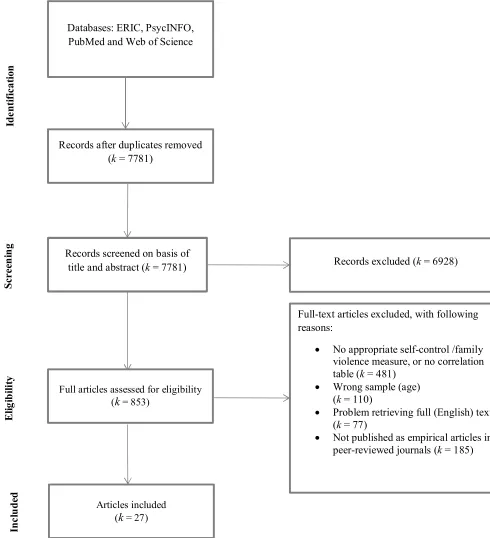
Our search yielded 7781 hits, which after removing duplicates of the multiple search
engines and applying inclusion criteria to the title and abstract resulted in 853 potentially
relevant articles for full text screening. Of the 853 articles, 27 studies met the abovementioned
inclusion criteria and were included in the present meta-analysis (see Figure 1 for the flowchart).
We collected relevant information of the studies and organized them according to a
detailed coding scheme [63]. This coding scheme included study descriptors (e.g., author names,
title, year of publication, data collection details, sample size), moderator variables (e.g. study
design, age, country, informant), and the correlation between family violence and self-control
(retrieved from correlation tables or provided by contacted authors).
Inter-Rater Agreement
To calculate inter-rater reliability, the first two authors coded 20% of all the articles. This
continuous variables (ranging between 0.78 for age to 0.99 for sample size) and high Cohen’s
Kappa for the categorical variables (ranging between 0.86 for informant, and 1.00 for country of
the study, and study design). In case of disagreement, in-depth discussions were held to reach
agreement on the specific content of the article. The remaining 80% was divided equally among
both authors.
Theoretical Moderators
Age. We coded age at assessment continuously. For studies not reporting age but school
grade, the average age of students in that school year was coded. For example, when the study
mentioned adolescents were in sixth grade in the USA, we coded mean age as 11.5 years.
Adolescent gender. Proportion of boys and girls participating in the study was
categorically coded with 1 = overall balanced (the percentage of boys or girls of the sample
ranging between 40% and 60%), 2 = greater proportion of boys (>60% boys), 3 = greater
proportion of girls (>60% girls). This allowed us to explore whether gender of the adolescents
moderates the association between family violence and self-control.
Parent gender. In order to explore the influence of the gender of the parent, studies were
coded whether the effect size reflected mother-child interaction, father-child interaction, or
parent-child interaction. Notably, many studies assessed ‘violence in the family’ without
referring specifically to father or mother. As a result, studies were coded according to the
following categories: 1 = greater proportion of mother-child interaction (> 60% of the sample), 2
= greater proportion of father-child interaction (> 60% of the sample), 3 = both parents, no clear
proportion.
Countries. The influence of country was assessed according to two dimensions. First,
femininity-masculinity score (see https://geert-hofstede.com/countries.html). These are
frequently applied measure to score societies according to i) the value of individualism (identity
based on self-orientation and emphasis on individual achievement and initiative) or collectivism
(identity based on group orientation with emphasis on social system and belonging); ii) power
distance expresses the attitude of the country towards unequal distribution of power; iii) a high
score on masculinity postulates a society driven by competition, and achievement while low
score postulates the emphasis on quality of life and doing what you like best such as life/work
balance.
Second, proportion of different ethnicities participating in the study was coded. This was
coded categorically, with 1 = balanced (i.e., no ethnicity exceeded 60% of the sample), 2 = more
than 60% identified themselves as Caucasian, 3 = more than 60% identified themselves as
African/African-American, 4 = more than 60% identified themselves as Asian/Asian-America, 5
= more than 60% identified themselves as South-American/Hispanic, 6 = other.
Methodological Moderators
Study design. For every study, we coded the time lag between the assessment of family
violence and the assessment of self-control continuously in years (starting with a code of 0 for
cross-sectional studies).
Informants. For every effect size, we coded whether family violence was assessed by
adolescents themselves (1 = self-report), by someone else such as one of the parents (2 =
other-report), or whether the measure was a composite of different informants (3 = composite).
Similarly, informant of the self-control measure was coded according to the reporting informant
(1 = self-report, 2 = other-report, such as parent report, 3 = composite of measures, for example
Furthermore, studies were coded with 1 = consistent when family violence and
self-control were assessed by the same informant (e.g., both by adolescents themselves) and coded
with 2 = inconsistent when family violence and self-control were assessed by different
informants (e.g., family violence by parents and self-control by adolescents themselves).
Important to note is that when both consisted of composite measures, specific attention was paid
to check whether these composite scores comprised of the same informants. For example, a code
of 1 was given when parenting was measured with a composite score consisting of self-report
and mother report and control was also measured with a composite score consisting of
self-report and mother self-report. However, when parenting was measured with a composite score of
self-report and parent report and self-control with a composite score of self-report and
teacher-report a score of 2 was given.
Effect Sizes
We obtained Pearson correlation coefficients to examine the strength of the association
between parenting and adolescent self-control. The correlations were either derived from the
studies or retrieved upon request if they were not present in the published paper. For consistency,
effect sizes in which self-control was assessed as ‘lack of self-control’ or ‘low self-control’ were
recoded. For normalization and standardization, correlations were transformed into Fisher’s z
scores ESZ [63]. The ESZ were the input for the analyses; after the analyses they were
transformed back to r for interpretation1. Categorical moderator variables were dummy-coded with k-1 dummy variables [64].
1 The Fisher’s transformation of r was done using the following formula: ES
Zr = log . Any ESZr can be transformed back
into standard correlation form using the inverse of the ESZr transformation using the following formula: = (see Field,
Publication Bias
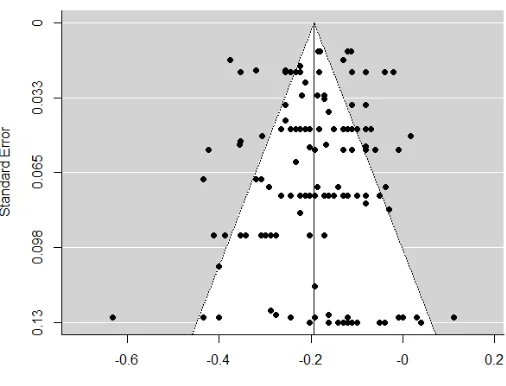
To take the possibility of publication bias into account, we created a funnel plot and
performed an Egger’s test on the effect sizes. The funnel plot allowed us to inspect the
distribution of the effect sizes by displaying each individual effect size in a figure with the effect
sizes on the horizontal axis and study precision as a function of standard errors on the vertical
axis [65]. Publication bias would occur if the funnel plot displayed an asymmetrical distribution
[65]. In order to formally test whether there was an asymmetrical distribution of effect sizes, we
conducted an Egger’s regression test [66].
Data Analyses
We performed all our analyses in R version 3.4.2, using the Metafor package [67].
Because most studies reported multiple effect sizes, there was a likely dependency between
effect sizes derived from the same studies (e.g., these effect sizes are not independent as they are
part of the same sampling process, study group, and study population). To take this dependency
into account, we applied a three-level meta-analysis, an approach that allows us to use all
available information (i.e., multiple effect sizes) and thus optimizes the statistical power [64],
[68], [69].
The three-level model specifies the following levels of variance: 1) sampling variance of
the effect sizes, 2) variance between effect sizes within studies using the same dataset, and 3)
variance between studies [69]. Studies using the same dataset are treated as if they all come from
the same study. In this approach, studies with multiple effect sizes will not necessarily be
assigned more weight because the dependency between effect sizes is taken into account.
Furthermore, it enables to optimally use the available information, while simultaneously
possible dependency between studies using the same dataset, we used the number of independent
studies (i.e., data sets) as the mode of analysis [64].
To examine the association between family violence and adolescent self-control and
moderator effects, we performed the following analyses. First, we estimated the overall mean
effect size of the association. Second, we assessed between-study and within-study variance
using a likelihood ratio test, and partitioned the total variance into percentages for the sampling
variance, variance within studies, and variance between studies, applying earlier proposed
methods [68]–[70]. Third, based on whether there was evidence for heterogeneity among effect
sizes, we performed univariate-moderator analyses. Fourth, we conducted multivariate moderator
analyses to assessing significance of each moderator while taking into account other significant
moderators to avoid multicollinearity problems in the analyses. The analyses were performed in
line with earlier described procedures [64], estimating parameters using restricted maximum
likelihood.
Results
Descriptives
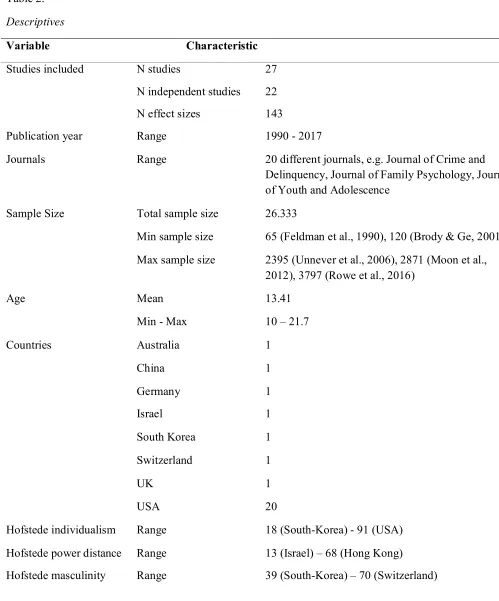
The present meta-analysis included 27 studies reporting on the association between
family violence and self-control (see Supplemental Table 1). Of the 27 studies, 22 reported on
independent studies, including 143 effect sizes and a total sample size of N = 26,333. Studies
were published in a wide range of journals for example in the Journal of Family Studies, Journal
of Youth and Adolescence and Journal of Crime and Delinquency, and were published between
1990 and 2017. Most studies were conducted in the USA, followed by studies conducted in Asia
mean age of 13.41 years (See Table 2 for more details). Most studies reported cross-sectional
associations (24 studies, 104 effect sizes), with 5 studies (39 effect sizes) reporting longitudinal
associations from family violence to self-control.
Studies focusing on the effect from self-control to family violence were scarce. Of the 27
included studies, we only identified two studies reporting longitudinal associations where
self-control was measured first and family violence at a subsequent time point. While some argue two
studies are enough to meta-analyze an effect, parameter estimates are poor when the number of
studies is below five [71]. As a result, we could not meta-analyze the magnitude of the effect
from self-control to family violence nor could we address the question regarding reverse
causality, namely whether the magnitude of the directional effects differed. The results therefore
only present cross-sectional effect sizes and longitudinal effect size from family violence to
self-control.
Publication Bias
As shown in Figure 3, the distribution of the effect sizes in the funnel plot appeared to be
symmetrical. In addition, the Egger’s test was nonsignificant z = -0.994, p = 0.329. This
suggested that there was no publication bias in the present meta-analysis.
Overall Effect Size
We found a negative small to medium significant overall effect size for the association
between family violence and adolescent self-control (ESZ = -0.194, S.E. = 0.015, t = -12.982, p <
.001, 95% CI = [-0.223, -0.164], r = -.191). This indicated that more family violence is
Variance of the Overall Effect Size
There was significant variance within studies (estimate = .006, p < .001) and between
studies (estimate = .003, p < .001). Partitioning the variance into percentages for the three levels
revealed that the variance at the sampling level was 13.62%, variance within studies using the
same dataset was 61.20%, and variance between studies using different datasets was 25.18%.
These results, in addition to the significant residual heterogeneity of the overall effect size
(QE(141) = 1017.972, p < .001), indicated appropriateness for further moderator analyses.
Univariate Moderator Analyses
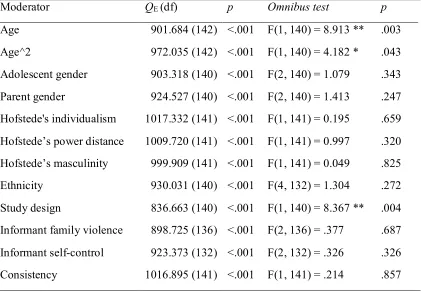
We performed univariate moderator analyses; Table 3 displays the statistics for the
results. Significant moderators were age (QE(136) = 901.684, p < .001; Omnibus test: F(1, 140)
= 8.913, p = .003) and study design QE(140) = 836.663, p < .001; Omnibus test: F(1, 140) =
8.367 p = .004). We explored the possibility that age as a moderator would show a non-linear
pattern. Comparing models with age with a linear pattern versus age with a non-linear pattern
indicated the linear pattern to fit the data best (cf. lower AIC values). The other moderators were
not significant, including adolescent gender, parent gender, Hofstede’s individualism, ethnicity,
informant family violence, informant self-control, and consistency in informants.
Significant Moderators
Based on the significant moderators found in the previous analyses (age and study
design), we conducted a follow-up comparison as summarized in Table 4. Regarding age,
centered for age 10, we found a significant mean effect size (ESZ = 0.249, S.E. = 0.024, t =
-10.288, p < .001, 95% CI = [-0.297, -0.202], r = -0.243), and a significant positive slope (ESZ =
0.015, S.E. = 0.005, t = 2.985, p < .001, 95% CI = [0.005, 0.025]). This indicates a decrease in
positive slope will thus mitigate the starting value).
Regarding study design, we found a significant effect (ESZ = 0.201, S.E. = 0.015, t =
-13.505, p < .001, 95% CI = [-0.230, -0.171], r = -0.198), and a significant slope (ESZ = 0.036,
S.E. = 0.012, t = 2.893, p =0.004, 95% CI = [0.011, 0.061]). This indicated that the longer the
time in-between measurements, the smaller the effect size.
Multiple Moderator Model
We conducted a multiple moderator model including both significant moderators from
the univariate moderator analyses to assess their unique contribution in a multivariate model (i.e.,
study design and age). The results of this model are summarized in Table 5. The significant
omnibus test (F(2, 139) = 8.459, p < .001) suggested that at least one of the parameter estimates
of the moderators significantly deviated from zero. Subsequent comparison indicated that study
design and age had unique moderating effects on the relationship between family violence and
self-control.
Discussion
In the present meta-analysis, we synthesized research on the association between family
violence and self-control across adolescence. We included 27 studies, conducted in eight
countries, containing 143 effect sizes, with a total sample size of N = 26,333. The findings from
the multi-level meta-analysis revealed that family violence and self-control are significantly,
small to moderately, negatively associated (r = -.191). This indicates that family violence and
low self-control coincide.
Moderators
self-control did not differ significantly across country, gender, and informant. We did find a linear
moderator effect for age; the magnitude of the association between family violence and
self-control decreased over the course of adolescence. This finding suggests that adolescents
gradually transform from parent-dependent to self-sustaining independent individuals [52], [72],
[73]. As a result, the influence of family factors such as family violence on adolescents may
decrease, while the role of other contextual factors may increase. In the context of family
violence, this could indicate that the influence of family violence is more encompassing and
affects most of adolescents’ life domains, such as school and leisure, whereas this dependency
and influence decreases when adolescents get older.
We also found a moderator effect for the time between measurement of family violence
and self-control, with decreasing effect sizes for studies with a longer time gap between the
assessment of family violence and subsequent self-control. This is in line with earlier
methodological studies on the link between family factors and self-control, similarly indicating
that the association is stronger when measured concurrently as compared to longitudinal
assessments [60]. This is likely a result of more intervening processes taking place along the
way, waning the direct effects of family violence on adolescent self-control.
Important to note is that we should be cautious in interpreting the direction of the effect.
The association between family violence and self-control is likely to reflect a transactional
process by which family violence and adolescent self-control mutually affect each other [44],
[52], [76]. As such, family violence is likely to decrease self-control, which is in turn likely to
evoke or exacerbate family violence [8], [9]. The present meta-analyses revealed that most of the
longitudinal studies included an effect from family to adolescent, but failed to examine the
suggesting that self-control may play a role in explaining the link between family violence and
myriad psychosocial problems, future research on the links between family violence,
self-control, and ideally health and wellbeing in a time sequential design would be promising (for
example through random intercept cross-lagged panel models [77]).
Implications
Adolescents exposed to family violence show heightened vulnerability to decrements in
physical, mental, and social wellbeing. Although linkages between family violence and various
problems are well-established, the specific processes underlying these associations are poorly
understood. Recent theoretical work proposes self-control to play an important role in explaining
these links. On the one hand low self-control may function as a possible mechanism because it is
affected by family violence and contributes to maintaining violence [8], [9]. On the other hand,
low self-control is reliably related to poorer physical, mental, and social health and wellbeing
[30], [80]. Supporting these theoretical suggestions, we found a significant association between
family violence and self-control across adolescence, suggesting that self-control may play an
important role in the link between family violence and adverse outcomes. As such, researchers
and clinicians can expect low self-control in the presence of family violence, as opposed to
treating low self-control and family violence as separate problems. For instance, family based
therapies targeting both family violence and self-control may well result in increased adolescent
well-being and better family functioning, yet controlled trials are necessary to confirm this
suggestion.
Limitations
First, we did not distinguish between interparental, child, sibling-child, and
specifically specifying the family (sub)relationships involved in the conflict. While both
witnessing violence and experiencing violence are considered as detrimental for adolescents
[82], further research is recommended to more specifically measure and compare different types
of violence and their association with self-control in adolescents [32].
Second, it is important to acknowledge that, when investigating interactions within
families, not only environmental but also genetic factors play a role [44]. This is evidenced by
studies reporting on the intergenerational transmission and the heritability of family violence
[78], [79] , and the intergenerational transmission and the heritability of self-control [33], [80].
As a result, it may be that the observed association is partly explained by common genetic
factors that simultaneously influence both family violence and self-control [44], [81]. To paint a
more complete picture of the association, future studies that integrate genetically sensitive
designs investigating both environmental and genetic influences on the association between
family violence, self-control and psychosocial problems and wellbeing would be particularly
helpful.
Conclusion
Self-control, the capacity to regulate thoughts, emotions, and behavior is a core
component of healthy adolescent development. Results from the current meta- analysis indicate
that family violence and adolescent self-control are negatively related, especially among younger
adolescents. Because low self-control and family violence are reliably related to poorer health
and wellbeing across the lifespan, these findings underscore the importance of considering both
contextual and individual factors in treatment and policy addressing family violence. Although
family violence is clearly linked with adolescent self-control, and is not affected by a broad
delay. The meta-analysis also identified important gaps in our knowledge on the influence of
genetic factors and reverse causality thereby providing promising inroads to enhance our
The following studies are included in the meta-analysis:
*Agbaria, Q., Hamama, L., Orkibi, H., Gabriel-Fried, B., & Ronen, T. (2016). Multiple
mediators for peer-directed aggression and happiness in Arab adolescents exposed to
parent–child aggression. Child Indicators Research, 9, 785–803.
*Beckmann, L., Bergmann, M. C., Fischer, F., & Mößle, T. (2017). Risk and Protective Factors
of Child-to-Parent Violence: A Comparison Between Physical and Verbal
Aggression. Journal of interpersonal violence.
*Bradley, R. H., & Corwyn, R. F. (2007). Externalizing problems in fifth grade: Relations with
productive activity, maternal sensitivity, and harsh parenting from infancy through middle
childhood. Developmental Psychology, 43, 1390–1401.
*Brody, G. H., & Ge, X. (2001). Linking parenting processes and self-regulation to
psychological functioning and alcohol use during early adolescence. Journal of Family
Psychology, 15, 82–94.
*Cheung, N. W., & Cheung, Y. W. (2008). Self-control, social factors, and delinquency: A test
of the general theory of crime among adolescents in Hong Kong. Journal of Youth and
Adolescence, 37(4), 412-430.
*Cheung, N. W. T., & Cheung, Y. W. (2010). Strain, self-control, and gender differences in
delinquency among Chinese adolescents: Extending general strain theory. Sociological
*Eisenberg, N., Hofer, C., Spinrad, T. L., Gershoff, E. T., Valiente, C., Losoya, S., … Maxon, E.
(2008). Understanding mother-adolescent conflict discussions: Concurrent and across-time
prediction from youths’ dispositions and parenting. Monographs of the Society for Research
in Child Development, 73, 1–160.
*Evans, S. Z., Simons, L. G., & Simons, R. L. (2012). The effect of corporal punishment and
verbal abuse on delinquency: mediating mechanisms. Journal of Youth and
Adolescence, 41, 1095–1110.
*Feldman, S. S., & Wentzel, K. R. (1990). Relations among family interaction patterns,
classroom self-restraint, and academic achievement in preadolescent boys. Journal of
Educational Psychology, 82, 813–819.
*Feldman, S. S., & Wentzel, K. R. (1990). The relationship between parenting styles, sons'
self-restraint, and peer relations in early adolescence. The Journal of Early Adolescence, 10,
439–454.
*Fosco, G. M., & Grych, J. H. (2013). Capturing the family context of emotion regulation: A
family systems model comparison approach. Journal of Family Issues, 34, 557–578.
*Fosco, G. M., Caruthers, A. S., & Dishion, T. J. (2012). A six-year predictive test of adolescent
family relationship quality and effortful control pathways to emerging adult social and
emotional health. Journal of Family Psychology, 26, 565–575.
*Hallquist, M. N., Hipwell, A. E., & Stepp, S. D. (2015). Poor self-control and harsh punishment
in childhood prospectively predict borderline personality symptoms in adolescent girls.
*Kim-Spoon, J., Farley, J. P., Holmes, C. J., & Longo, G. S. (2014). Does adolescents’
religiousness moderate links between harsh parenting and adolescent substance use?
Journal of Family Psychology, 28, 739–748.
*Loukas, A., & Roalson, L. A. (2006). Family environment, effortful control, and adjustment
among European American and Latino early adolescents. The Journal of Early
Adolescence, 26, 432–455.
*Moon, B., Morash, M., & McCluskey, J. D. (2012). General strain theory and school Bullying:
An empirical test in South Korea. Crime & Delinquency, 58, 827–855.
*Moilanen, K. L., Rasmussen, K. E., & Padilla‐Walker, L. M. (2015). Bidirectional associations
between self‐regulation and parenting styles in early adolescence. Journal of Research on
Adolescence, 25(2), 246-262.
*Park, I. J. K., & Kim, P. Y. (2012). The role of self-construals in the link between anger
regulation and externalizing problems in Korean American adolescents: Testing a moderated
mediation model. Journal of Clinical Psychology, 68, 1339–1359.
*Patouris, E., Scaife, V., & Nobes, G. (2016). A behavioral approach to adolescent cannabis use:
Accounting for nondeliberative, developmental, and temperamental factors. Journal of
Substance Use, 21(5), 506-514.
*Rowe, S. L., Gembeck, Z. M. J., & Hood, M. (2016). From the child to the neighbourhood:
Longitudinal ecological correlates of young adolescents’ emotional, social, conduct, and
*Schofield, T. J., Conger, R. D., & Conger, K. J. (2017). Disrupting intergenerational continuity
in harsh parenting: Self-control and a supportive partner. Development and
psychopathology, 29(4), 1279-1287.
*Shin, S. H., Cook, A. K., Morris, N. A., McDougle, R., & Groves, L. P. (2016). The different
faces of impulsivity as links between childhood maltreatment and young adult crime.
Preventive Medicine, 88, 210–217.
*Simons, R. L., Simons, L. G., Chen, Y. F., Brody, G. H., & Lin, K. H. (2007). Identifying the
psychological factors that mediate the association between parenting practices and
delinquency. Criminology, 45, 481–517.
*Simons, L. G., Simons, R. L., Landor, A. M., Bryant, C. M., & Beach, S. R. H. (2014). Factors
linking childhood experiences to adult romantic relationships among African Americans.
Journal of Family Psychology, 28, 368–379.
*Simons, L. G., Sutton, T. E., Simons, R. L., Gibbons, F. X., & Murry, V. M. (2016).
Mechanisms that link parenting practices to adolescents’ risky sexual behavior: A test of six
competing theories. Journal of Youth and Adolescence, 45, 255–270.
*Unnever, J. D., Cullen, F. T., & Agnew, R. (2006). Why is “bad” parenting criminogenic?
Implications from rival theories. Youth Violence and Juvenile Justice, 4, 3–33.
*Wang, M.-T., Brinkworth, M., & Eccles, J. (2013). Moderating effects of teacher-student
relationship in adolescent trajectories of emotional and behavioral adjustment.
Author Contributions
Conceptualization, Yayouk Willems and Jianbin Li; Formal analysis, Yayouk Willems and
Jianbin Li; Methodology, Yayouk Willems, Jianbin Li and Anne Hendriks; Resources, Meike
Bartels and Catrin Finkenauer; Supervision, Meike Bartels and Catrin Finkenauer; Writing –
original draft, Yayouk Willems, Jianbin Li, Anne Hendriks, Meike Bartels and Catrin
Finkenauer.
References
[1] Kessler, R. C., Angermeyer, M., Anthony, J. C., De Graaf, R. O. N., Demyttenaere, K.,
Gasquet, I., ... & Kawakami, N. (2007). Lifetime prevalence and age-of-onset distributions
of mental disorders in the World Health Organization's World Mental Health Survey
Initiative. World psychiatry, 6(3), 168.
[2] Patton, G. C., Coffey, C., Romaniuk, H., Mackinnon, A., Carlin, J. B., Degenhardt, L., ...
& Moran, P. (2014). The prognosis of common mental disorders in adolescents: a 14-year
prospective cohort study. The Lancet, 383(9926), 1404-1411.
[3] Buehler, C., Anthony, C., Krishnakumar, A., Stone, G., Gerard, J., & Pemberton, S.
(1997). Interparental conflict and youth problem behaviors: A meta-analysis. Journal of
Child and family studies, 6(2), 233-247.
Catalano, R. F. (2014). Prevalence and community variation in harmful levels of family
conflict witnessed by children: Implications for prevention. Prevention science, 15(5),
757-766.
[5] Repetti, R. L., Taylor, S. E., & Seeman, T. E. (2002). Risky families: family social
environments and the mental and physical health of offspring. Psychological
bulletin, 128(2), 330.
[6] Cui, M., Durtschi, J. A., Donnellan, M. B., Lorenz, F. O., & Conger, R. D. (2010).
Intergenerational transmission of relationship aggression: A prospective longitudinal
study. Journal of Family Psychology, 24(6), 688.
[7] Ehrensaft, M. K., Cohen, P., Brown, J., Smailes, E., Chen, H., & Johnson, J. G. (2003).
Intergenerational transmission of partner violence: a 20-year prospective study. Journal of
consulting and clinical psychology, 71(4), 741.
[8] Finkenauer, C., Buyukcan-Tetik, A., Baumeister, R. F., Schoemaker, K., Bartels, M., &
Vohs, K. D. (2015). Out of control: Identifying the role of self-control strength in family
violence. Current Directions in Psychological Science, 24(4), 261-266.
[9] Finkenauer, C., Büyükcan Tetik, A., Schoemaker, K., Willems, Y. E., Bartels, M., &
Baumeister, R. (2016). Examining the role of self-regulatory strength in family violence.
in The Routledge International Handbook of Self-Control in Health and Wellbeing,
London, United Kingdom: Routledge, 2018, pp. 340–352.
[10] DeWall, C. N., Finkel, E. J., & Denson, T. F. (2011). Self‐control inhibits
[11] Agbaria, Q., Hamama, L., Orkibi, H., Gabriel-Fried, B., & Ronen, T. (2016). Multiple
mediators for peer-directed aggression and happiness in Arab adolescents exposed to
parent–child aggression. Child Indicators Research, 9(3), 785-803.
[12] Hallquist, M. N., Hipwell, A. E., & Stepp, S. D. (2015). Poor self-control and harsh
punishment in childhood prospectively predict borderline personality symptoms in
adolescent girls. Journal of abnormal psychology, 124(3), 549..
[13] Moilanen, K. L., Rasmussen, K. E., & Padilla‐Walker, L. M. (2015). Bidirectional
associations between self‐regulation and parenting styles in early adolescence. Journal of
Research on Adolescence, 25(2), 246-262.
[14] Park, I. J., & Kim, P. Y. (2012). The role of self‐construals in the link between anger
regulation and externalizing problems in Korean American adolescents: Testing a
moderated mediation model. Journal of clinical psychology, 68(12), 1339-1359.
[15] Caprara, G. V., Gerbino, M., Paciello, M., Di Giunta, L., & Pastorelli, C. (2010).
Counteracting depression and delinquency in late adolescence. European Psychologist.
[16] Brody, G. H., & Ge, X. (2001). Linking parenting processes and self-regulation to
psychological functioning and alcohol use during early adolescence. Journal of Family
Psychology, 15(1), 82.
[17] De Ridder, D. T., & Lensvelt-Mulders, G. (2018). Taking stock of self-control: A
meta-analysis of how trait self-control relates to a wide range of behaviors. In Self-Regulation
and Self-Control (pp. 221-274). Routledge.
perspectives, 9(1), 32-37.
[19] Duckworth, A. L., & Kern, M. L. (2011). A meta-analysis of the convergent validity of
self-control measures. Journal of Research in Personality, 45(3), 259-268.
[20] Nigg, J. T. (2017). Annual Research Review: On the relations among self‐regulation, self‐
control, executive functioning, effortful control, cognitive control, impulsivity, risk‐
taking, and inhibition for developmental psychopathology. Journal of child psychology
and psychiatry, 58(4), 361-383.
[21] Fan, J., Flombaum, J. I., McCandliss, B. D., Thomas, K. M., & Posner, M. I. (2003).
Cognitive and brain consequences of conflict. Neuroimage, 18(1), 42-57.
[22] Allan, N. P., & Lonigan, C. J. (2014). Exploring dimensionality of effortful control using
hot and cool tasks in a sample of preschool children. Journal of experimental child
psychology, 122, 33-47.
[23] Vazsonyi, A. T., Mikuška, J., & Kelley, E. L. (2017). It's time: A meta-analysis on the
self-control-deviance link. Journal of Criminal Justice, 48, 48-63.
[24] Crone, E. A., & Dahl, R. E. (2012). Understanding adolescence as a period of social–
affective engagement and goal flexibility. Nature Reviews Neuroscience, 13(9), 636.
[25] Boyer, T. W. (2006). The development of risk-taking: A multi-perspective
review. Developmental review, 26(3), 291-345.
[26] Smetana, J. G., Campione-Barr, N., & Metzger, A. (2006). Adolescent development in
interpersonal and societal contexts. Annu. Rev. Psychol., 57, 255-284.
children. Educational Psychologist, 49(3), 199-217.
[28] Finkenauer, C., Engels, R., & Baumeister, R. (2005). Parenting behaviour and adolescent
behavioural and emotional problems: The role of self-control. International Journal of
Behavioral Development, 29(1), 58-69.
[29] Laceulle, O. M., Veenstra, R., Vollebergh, W. A., & Ormel, J. (2017). Sequences of
maladaptation: Preadolescent self-regulation, adolescent negative social interactions, and
young adult psychopathology. Development and psychopathology, 1-14.
[30] Moffitt, T. E., Arseneault, L., Belsky, D., Dickson, N., Hancox, R. J., Harrington, H., ... &
Sears, M. R. (2011). A gradient of childhood self-control predicts health, wealth, and
public safety. Proceedings of the National Academy of Sciences, 108(7), 2693-2698.
[31] Rhoades, K. A. (2008). Children’s responses to interparental conflict: A meta‐analysis of
their associations with child adjustment. Child development, 79(6), 1942-1956.
[32] Harold, G. T., & Sellers, R. (2018). Annual Research Review: Interparental conflict and
youth psychopathology: an evidence review and practice focused update. Journal of child
psychology and psychiatry, 59(4), 374-402.
[33] Bridgett, D. J., Burt, N. M., Edwards, E. S., & Deater-Deckard, K. (2015).
Intergenerational transmission of self-regulation: A multidisciplinary review and
integrative conceptual framework. Psychological bulletin, 141(3), 602.
[34] Davies, P. T., & Cummings, E. M. (1994). Marital conflict and child adjustment: An
emotional security hypothesis. Psychological bulletin, 116(3), 387.
adolescents’ cognitive functioning: Sleep as a protective factor. Journal of Family
Psychology, 28(6), 887.
[36] Meldrum, R. C., Barnes, J. C., & Hay, C. (2015). Sleep deprivation, low self-control, and
delinquency: A test of the strength model of self-control. Journal of youth and
adolescence, 44(2), 465-477.
[37] Baumeister, R. F., Vohs, K. D., & Tice, D. M. (2007). The strength model of
self-control. Current directions in psychological science, 16(6), 351-355.
[38] Denson, T. F., Pedersen, W. C., Friese, M., Hahm, A., & Roberts, L. (2011).
Understanding impulsive aggression: Angry rumination and reduced self-control capacity
are mechanisms underlying the provocation-aggression relationship. Personality and
Social Psychology Bulletin, 37(6), 850-862.
[39] Krishnakumar, A., & Buehler, C. (2000). Interparental conflict and parenting behaviors: A
meta‐analytic review. Family relations, 49(1), 25-44.
[40] Brody, G. H., Stoneman, Z., Smith, T., & Gibson, N. M. (1999). Sibling relationships in
rural African American families. Journal of Marriage and the Family, 1046-1057.
[41] Davies, P. T., Sturge‐Apple, M. L., Cicchetti, D., Manning, L. G., & Zale, E. (2009).
Children’s patterns of emotional reactivity to conflict as explanatory mechanisms in links
between interpartner aggression and child physiological functioning. Journal of Child
Psychology and Psychiatry, 50(11), 1384-1391.
[42] Deković, M. (1999). Parent-adolescent conflict: Possible determinants and
[43] Wiener, J., Biondic, D., Grimbos, T., & Herbert, M. (2016). Parenting stress of parents of
adolescents with attention-deficit hyperactivity disorder. Journal of abnormal child
psychology, 44(3), 561-574.
[44] Harold, G. T., Leve, L. D., & Sellers, R. (2017). How Can Genetically Informed Research
Help Inform the Next Generation of Interparental and Parenting Interventions?. Child
development, 88(2), 446-458.
[45] Plomin, R., & Daniels, D. (2011). Why are children in the same family so different from
one another?. International journal of epidemiology, 40(3), 563-582.
[46] Righetti, F., & Finkenauer, C. (2011). If you are able to control yourself, I will trust you:
The role of perceived self-control in interpersonal trust. Journal of Personality and Social
Psychology, 100(5), 874.
[47] Vohs, K. D., & Faber, R. J. (2007). Spent resources: Self-regulatory resource availability
affects impulse buying. Journal of consumer research, 33(4), 537-547.
[48] Finkel, E. J., DeWall, C. N., Slotter, E. B., Oaten, M., & Foshee, V. A. (2009).
Self-regulatory failure and intimate partner violence perpetration. Journal of personality and
social psychology, 97(3), 483.
[49] Payne, B. K., Higgins, G. E., & Blackwell, B. (2010). Exploring the link between
self-control and partner violence: Bad parenting or general criminals. Journal of Criminal
Justice, 38(5), 1015-1021.
[50] Chapple, C. L., Tyler, K., & Bersani, B. E. (2005). Child neglect and adolescent violence:
Publications, 67.
[52] Sameroff, A. (2010). A unified theory of development: A dialectic integration of nature
and nurture. Child development, 81(1), 6-22.
[53] Pinquart, M. (2017). Associations of parenting dimensions and styles with externalizing
problems of children and adolescents: An updated meta-analysis. Developmental
psychology, 53(5), 873.
[54] Davies, P. T., & Lindsay, L. L. (2004). Interparental conflict and adolescent adjustment:
Why does gender moderate early adolescent vulnerability?. Journal of Family
Psychology, 18(1), 160.
[55] Cummings, E. M., & Watson O'Reilly, A. (1997). Fathers in family context: Effects of
marital quality on child adjustment, in The role of the father in child development, L. ME,
Ed. Hoboken, NJ, USA: John Wiley & Sons, 1997, pp. 49–65.
[56] Ng, F. F. Y., Pomerantz, E. M., & Deng, C. (2014). Why are Chinese mothers more
controlling than American mothers?“My child is my report card”. Child
development, 85(1), 355-369.
[57] Smetana, J. G. (2017). Current research on parenting styles, dimensions, and
beliefs. Current opinion in psychology, 15, 19-25.
[58] Li, J. B., Delvecchio, E., Lis, A., Nie, Y. G., & Di Riso, D. (2015). Parental attachment,
self-control, and depressive symptoms in Chinese and Italian adolescents: Test of a
mediation model. Journal of adolescence, 43, 159-170.
use, and drug use: a comparison of Eastern and Western European adolescents. Journal of
Adolescent Health, 39(5), 753-e1.
[60] Pallini, S., Chirumbolo, A., Morelli, M., Baiocco, R., Laghi, F., & Eisenberg, N. (2018).
The relation of attachment security status to effortful self-regulation: A
meta-analysis. Psychological bulletin, 144(5), 501.
[61] Willems, Y. E., Dolan, C. V., van Beijsterveldt, C. E., de Zeeuw, E. L., Boomsma, D. I.,
Bartels, M., & Finkenauer, C. (2018). Genetic and environmental influences on
self-control: Assessing self-control with the ASEBA self-control scale. Behavior
genetics, 48(2), 135-146.
[62] Cohen, A. O., Breiner, K., Steinberg, L., Bonnie, R. J., Scott, E. S., Taylor-Thompson, K.,
... & Silverman, M. R. (2016). When is an adolescent an adult? Assessing cognitive
control in emotional and nonemotional contexts. Psychological Science, 27(4), 549-562.
[63] D. B. Lipsey, M. W., & Wilson, Practical meta-analysis. housand Oaks, CA, US: : Sage
Publications, Inc., 2001.
[64] Assink, M., & Wibbelink, C. J. (2016). Fitting three-level meta-analytic models in R: A
step-by-step tutorial. The Quantitative Methods for Psychology, 12(3), 154-174.
[65] Torgerson, C. J. (2006). Publication Bias: The achilles'heel of systematic review?. British
Journal of Educational Studies, 54(1), 89-102.
[66] Egger, M., Smith, G. D., Schneider, M., & Minder, C. (1997). Bias in meta-analysis
detected by a simple, graphical test. Bmj, 315(7109), 629-634.
package. Journal of statistical software, 36(3)..
[68] Hendriks, A. M., Van der Giessen, D., Stams, G. J. J. M., & Overbeek, G. (2018). The
association between parent-reported and observed parenting: A multi-level
meta-analysis. Psychological assessment, 30(5), 621.
[69] Van den Noortgate, W., López-López, J. A., Marín-Martínez, F., & Sánchez-Meca, J.
(2013). Three-level meta-analysis of dependent effect sizes. Behavior research
methods, 45(2), 576-594.
[70] Cheung, M. W. L. (2014). Modeling dependent effect sizes with three-level
meta-analyses: a structural equation modeling approach. Psychological Methods, 19(2), 211.
[71] Weisz, J. R., Kuppens, S., Ng, M. Y., Eckshtain, D., Ugueto, A. M., Vaughn-Coaxum, R.,
... & Weersing, V. R. (2017). What five decades of research tells us about the effects of
youth psychological therapy: a multilevel meta-analysis and implications for science and
practice. American Psychologist, 72(2), 79.
[72] Laursen, B., Coy, K. C., & Collins, W. A. (1998). Reconsidering changes in parent‐child
conflict across adolescence: A meta‐analysis. Child development, 69(3), 817-832.
[73] Tiberio, S. S., Capaldi, D. M., Kerr, D. C., Bertrand, M., Pears, K. C., & Owen, L. (2016).
Parenting and the development of effortful control from early childhood to early
adolescence: A transactional developmental model. Development and
psychopathology, 28(3), 837-853.
[74] Caspi, A., Houts, R. M., Belsky, D. W., Harrington, H., Hogan, S., Ramrakha, S., ... &
large economic burden. Nature human behaviour, 1(1), 0005.
[75] Duckworth, A. L., Kim, B., & Tsukayama, E. (2013). Life stress impairs self-control in
early adolescence. Frontiers in psychology, 3, 608.
[76] Bandura, A. (1978). Social learning theory of aggression. Journal of
communication, 28(3), 12-29.
[77] Hamaker, E. L., Kuiper, R. M., & Grasman, R. P. (2015). A critique of the cross-lagged
panel model. Psychological methods, 20(1), 102.
[78] Van der Aa, N., Boomsma, D. I., Rebollo-Mesa, I., Hudziak, J. J., & Bartels, M. (2010).
Moderation of genetic factors by parental divorce in adolescents' evaluations of family
functioning and subjective wellbeing. Twin Research and Human Genetics, 13(2),
143-162.
[79] Ehrensaft, M. K., & Cohen, P. (2012). Contribution of family violence to the
intergenerational transmission of externalizing behavior. Prevention Science, 13(4),
370-383.
[80] Willems, Y. E., Dolan, C. V., van Beijsterveldt, C. E., de Zeeuw, E. L., Boomsma, D. I.,
Bartels, M., & Finkenauer, C. (2018). Genetic and environmental influences on
self-control: Assessing self-control with the ASEBA self-control scale. Behavior
genetics, 48(2), 135-146.
[81] Boomsma, D., Busjahn, A., & Peltonen, L. (2002). Classical twin studies and
beyond. Nature reviews genetics, 3(11), 872.
Intersection of child abuse and children's exposure to domestic violence. Trauma,
Figure 1. PRISMA flowchart used to identify studies for detailed analysis of family violence and self-control Id e n ti fi ca ti o n
Databases: ERIC, PsycINFO, PubMed and Web of Science
Records after duplicates removed (k = 7781)
Records screened on basis of
title and abstract (k = 7781) Records excluded (k = 6928)
Full-text articles excluded, with following reasons:
No appropriate self-control /family violence measure, or no correlation table (k = 481)
Wrong sample (age) (k = 110)
Problem retrieving full (English) text (k = 77)
Not published as empirical articles in peer-reviewed journals (k = 185)
S cr ee n in g E li g ib il it y In c lu d ed
Full articles assessed for eligibility (k = 853)
Table 2.
Descriptives
Variable Characteristic
Studies included N studies 27
N independent studies 22
N effect sizes 143
Publication year Range 1990 - 2017
Journals Range 20 different journals, e.g. Journal of Crime and
Delinquency, Journal of Family Psychology, Journal of Youth and Adolescence
Sample Size Total sample size 26.333
Min sample size 65 (Feldman et al., 1990), 120 (Brody & Ge, 2001)
Max sample size 2395 (Unnever et al., 2006), 2871 (Moon et al., 2012), 3797 (Rowe et al., 2016)
Age Mean 13.41
Min - Max 10 – 21.7
Countries Australia 1
China 1
Germany 1
Israel 1
South Korea 1
Switzerland 1
UK 1
USA 20
Hofstede individualism Range 18 (South-Korea) - 91 (USA)
Hofstede power distance Range 13 (Israel) – 68 (Hong Kong)
Dataset Including Flourishing families project, Healthy Families America (HFA) San Diego study, Longitudinal Study of Australian Children (LSAC), NICHD Study of Early Child Care and Youth Development
(SECCYD), the Family and Community Health Study (FACHS)
Ethnicity Balance 14% of the effect sizes
Mostly Caucasian 67% of the effect sizes
Mostly other than Caucasian
19% of the effect sizes
Research design Cross-sectional 73% of the effect sizes
Longitudinal effect 27% of the effect sizes
Average longitudinal delay
1.30 years
Gender parent More mothers 49 effect sizes
More fathers 20 effect sizes
No clear divide 74 effect sizes
Gender adolescent Overall balanced 87 effect sizes
More boys 22 effect sizes
More girls 34 effect sizes
Informant parenting Self-report 79 effect sizes
Other report 6 effect sizes
Composite 54 effect sizes
Informant self-control Self-report 56 effect sizes
Other report 59 effect sizes
Composite 20 effect sizes
Consistency Consistent 67 effect sizes
Table 3.
Assessing moderators: the QE statistics illustrating residual heterogeneity, and the
Omnibus to test the effect of the moderators on the family conflict-self-control association
Moderator QE (df) p Omnibus test p
Age 901.684 (142) <.001 F(1, 140) = 8.913 ** .003
Age^2 972.035 (142) <.001 F(1, 140) = 4.182 * .043
Adolescent gender 903.318 (140) <.001 F(2, 140) = 1.079 .343
Parent gender 924.527 (140) <.001 F(2, 140) = 1.413 .247
Hofstede's individualism 1017.332 (141) <.001 F(1, 141) = 0.195 .659
Hofstede’s power distance 1009.720 (141) <.001 F(1, 141) = 0.997 .320
Hofstede’s masculinity 999.909 (141) <.001 F(1, 141) = 0.049 .825
Ethnicity 930.031 (140) <.001 F(4, 132) = 1.304 .272
Study design 836.663 (140) <.001 F(1, 140) = 8.367 ** .004
Informant family violence 898.725 (136) <.001 F(2, 136) = .377 .687
Informant self-control 923.373 (132) <.001 F(2, 132) = .326 .326
Consistency 1016.895 (141) <.001 F(1, 141) = .214 .857
Note: * indicates p <.05, ** indicates p <.01
Table 4.
Univariate analyses presenting slopes of the significant moderators
Moderators #ES ESz SE t 95% CI p r
Age 142 -.249 .024 -10.288 [-.297, -.202] <.001 -.244
.015 .005 2.985 [.005, .025] .003
Table 5.
Results for the multiple moderator model
Moderator variables ESz (SE) 95% CI t-statistic p-value
Intercept -.248 (.022) ** [-.291, -.204] -11.334 <.001
Age .013 (.005) ** [.004, .022] 2.793 .006
Study design .033 (.012) ** [.009, .057] 2.725 .007
Omnibus test: F(2, 139) = 8.459, p <.001
Variance level 2 .005, p <.001
Variance level 3 .002, p <.001
# ES 142