DEFINITY
®
Enterprise Communications Server
Release 5
CallVisor
®
PC ASAI
Installation and Reference
555-230-227
Notice
While reasonable efforts were made to ensure that the information in this document was complete and accurate at the time of printing, Lucent Technologies can assume no responsibility for any errors. Changes and corrections to the information contained in this document may be incorporated into future reissues. Your Responsibility for Your System’s Security You are responsible for the security of your system. Lucent Technologies does not warrant that this product is immune from or will prevent unauthorized use of common-carrier telecommunication services or facilities accessed through or connected to it. Lucent Technologies will not be responsible for any charges that result from such unauthorized use. Product administration to prevent
unauthorized use is your responsibility and your system
administrator should read all documents provided with this product to fully understand the features available that may reduce your risk of incurring charges.
Federal Communications Commission Statements Part 15: Class A Statement. This equipment has been tested and found to comply with the limits for a Class A digital device, pursuant to Part 15 of the FCC Rules. These limits are designed to provide reasonable protection against harmful interference when the equipment is operated in a commercial environment. This
equipment generates, uses, and can radiate radio-frequency energy and, if not installed and used in accordance with the instruction manual, may cause harmful interference to radio communications. Operation of this equipment in a residential area is likely to cause harmful interference, in which case the user will be required to correct the interference at his or her own expense.
Part 68: Network Registration Number. This equipment is registered with the FCC in accordance with Part 68 of the FCC Rules. It is identified by FCC registration number
AS593M-13283-MF-E.
Part 68: Answer-Supervision Signaling. Allowing this equipment to be operated in a manner that does not provide proper answer-supervision signaling is in violation of Part 68 rules. This equipment returns answer-supervision signals to the
public-switched network when:
■ Answered by the called station
■ Answered by the attendant
■ Routed to a recorded announcement that can be administered by the CPE user
■ A busy tone is received
■ A reorder tone is received Trademarks
CallVisor is a registered trademark of Lucent Technologies. DEFINITY is a registered trademark of Lucent Technologies in the USA and throughout the world.
Solaris is a trademark of Sun Microsystems, Inc. in the USA and other countries.
UNIX is a registered trademark in the USA and other countries, licensed exclusively through X/Open Company Limited.
UnixWare is a registered trademark of the Santa Cruz Operation, Inc. in the USA and other countries.
Windows is a registered trademark of Microsoft Corporation. Windows NT is a trademark of Microsoft Corporation. Ordering Information
The ordering number for this document is 555-230-227. To order this document, call the BCS Publications Center at 1 800 457-1235 (international callers use 1 317 361-5353). For more information about Lucent Technologies documents, refer to Business Communications Systems Publications Catalog, 555-000-010. You can be placed on a Standing Order list for this and other BCS documents you may need. Standing Order will enable you to automatically receive updated versions of individual documents or document sets, billed to account information that you provide. For more information on Standing Orders, or to be put on a list to receive future issues of this document, please contact the Lucent
Technologies BCS Center.
Lucent Technologies Fraud Intervention
If you suspect you are being victimized by toll fraud and you need technical support or assistance, call the BCS Technical Service Center Toll Fraud Intervention Hotline at 1 800 643-2353. Comments
To comment on this document, return the comment card at the end of the document.
Acknowledgment
This document was prepared by the
BCS Product Documentation Development Group, Lucent Technologies
Contents
About This Document
xi■ Intended Audience xii
■ Reason for Reissue xiii
■ How to Comment on This Document xiv
■ Organization of This Document xv
■ Related Documents xvi
■ Technical Service Center xvi
1
Installation
1-1■ CVLAN Product Description 1-10
■ DEFINITY ECS Administration 1-18
■ Configuration 1-19
2
Administration
2-1■ The ASAI Log File 2-2
■ OA&M Manual Pages 2-3
■ admin(7) 2-4
■ asai(4) 2-5
■ asai(7) 2-6
■ asai.Date(4) 2-7
■ asai.Name(4) 2-8
■ asai_admin(1) 2-9
■ asai_cause(1) 2-11
■ asai_hb(1) 2-14
■ asai_log(4) 2-16
■ asai_test(1) 2-17
■ asai_trace(1) 2-18
■ asai_ver(1) 2-21
■ boot.bin(4) 2-22
■ ipci(4) 2-29
■ ipci_admin(1) 2-30
■ ipci_off(1) 2-33
■ ipci_on(1) 2-34
■ ipci_stat(1) 2-36
■ ipci_test(1) 2-37
■ ipci_ver(1) 2-38
■ isdn_alarm(1) 2-39
■ isdn.Date(4) 2-41
■ isdn_11_r(1) 2-42
■ isdn_12_r(1) 2-43
■ isdn.Name(4) 2-44
■ isdn_trace(1) 2-45
■ lan_stat(1) 2-48
■ link_alarm(1) 2-50
■ link_change(1) 2-51
■ link_offline(1) 2-52
■ link_restart(1) 2-53
■ link_status(1) 2-54
■ log_msgs(4) 2-55
■ pcisdn.bin(4) 2-56
■ signal(7) 2-57
■ CVLAN Administration 2-58
3
Introduction to ASAI
3-1■ Terms and Concepts 3-3
■ The ASAI Library Functions 3-5
■ Matching Versions Requirement 3-8
■ Detecting Failed ASAI Links 3-9
■ Application Service Elements 3-10
Contents
■ asai_errval ( ) 4-4
■ asai_set_env( ) 4-6
■ asai_get_env( ) 4-9
■ Matching Versions Requirement 4-10
■ asai_send( ) 4-11
■ asai_rcv( ) 4-13
■ asai_close( ) 4-14
■ Sample Code 4-15
5
ASAI Capabilities
5-1■ Event Notification 5-2
■ Event Notification Request 5-3
■ Event Notification End 5-4
■ Event Notification Cancel 5-5
■ Event Notification Stop Call Notification 5-6
■ Event Report 5-7
■ Third Party Call Control Capabilities 5-11
■ Third Party Answer Call 5-13
■ Third Party Auto Dial 5-14
■ Third Party Call Ended 5-16
■ Third Party Clear Call 5-17
■ Third Party Domain Control 5-18
■ Third Party Domain Control End 5-19
■ Third Party Listen-Disconnect 5-20
■ Third Party Listen-Reconnect 5-21
■ Third Party Make Call 5-22
■ Third Party Merge 5-25
■ Third Party Reconnect 5-27
■ Third Party Redirect Call 5-28
■ Third Party Relinquish Control 5-29
■ Third Party Selective Drop 5-30
■ Third Party Selective Hold 5-32
■ Third Party Send DTMF Signals 5-33
■ Third Party Take Control 5-34
■ Value Query Response 5-39
■ Request Feature Capabilities 5-40
■ Adjunct Routing Capabilities 5-42
■ Routing 5-43
■ Route Select 5-45
■ Route End 5-47
■ Maintenance Capabilities 5-48
■ Heartbeat 5-49
■ Abort Capabilities 5-50
6
CVLAN Programming
6-1■ Introduction to CVLAN 6-1
■ asai_open 6-4
■ asai_errval 6-5
■ asai_set_env() 6-6
■ asai_get_env() 6-7
■ Matching Versions Requirement 6-8
■ asai_send() 6-9
■ asai_rcv() 6-10
■ asai_close() 6-11
7
Error Messages
7-1■ Library Error Messages 7-1
8
ASAI Capability Primitives
8-1■ asai_common 8-3
■ Identifiers 8-5
■ cause_value 8-11
Contents
9
Programming Manual Pages
9-1■ ASAI Library Manual Pages 9-1
■ asai_close (3ASAI) 9-4
■ asai_errval (3ASAI) 9-5
■ asai_get_env (3ASAI) 9-6
■ asai_open (3ASAI) 9-9
■ asai_rcv (3ASAI) 9-11
■ asai_send (3ASAI) 9-14
■ asai_set_env (3ASAI) 9-17
■ ASAI Capability Manual pages 9-20
■ C_3PAD (3ASAI) 9-22
■ C_3PAD_CONF (3ASAI) 9-25
■ C_3PANS (3ASAI) 9-27
■ C_3PANS_CONF (3ASAI) 9-29
■ C_3PCC (3ASAI) 9-31
■ C_3PCC_CONF (3ASAI) 9-33
■ C_3PCE (3ASAI) 9-35
■ C_3PDC_CONF (3ASAI) 9-37
■ C_3PDC_REQ (3ASAI) 9-39
■ C_3PDCE (3ASAI) 9-41
■ C_3PM (3ASAI) 9-43
■ C_3PM_CONF (3ASAI) 9-45
■ C_3PMC_CONF (3ASAI) 9-48
■ C_3PMC_REQ (3ASAI) 9-51
■ C_3PR (3ASAI) 9-55
■ C_3PR_CONF (3ASAI) 9-57
■ C_3PRC (3ASAI) 9-59
■ C_3PRC_CONF (3ASAI) 9-61
■ C_3PREDIR (3ASAI) 9-63
■ C_3PREDIR_ACK (3ASAI) 9-65
■ C_3PSD (3ASAI) 9-67
■ C_3PSD_CONF (3ASAI) 9-70
■ C_3PSDS (3ASAI) 9-72
■ C_3PSDS_CONF (3ASAI) 9-74
■ C_3PSH (3ASAI) 9-76
■ C_3PSH_CONF (3ASAI) 9-78
■ C_3PSL_RECONN_ACK (3ASAI) 9-86
■ C_3PTC_CONF (3ASAI) 9-88
■ C_3PTC_REQ (3ASAI) 9-90
■ C_ABORT (3ASAI) 9-92
■ C_EN_CAN (3ASAI) 9-94
■ C_EN_CAN_CONF (3ASAI) 9-95
■ C_EN_CONF (3ASAI) 9-97
■ C_EN_END (3ASAI) 9-99
■ C_EN_REP (3ASAI) 9-101
■ C_EN_REQ (3ASAI) 9-121
■ C_EN_SCN (3ASAI) 9-123
■ C_EN_SCN_CONF (3ASAI) 9-125
■ C_HB_CONF (3ASAI) 9-127
■ C_HB_REQ (3ASAI) 9-129
■ C_RF_CONF (3ASAI) 9-130
■ C_RF_REQ (3ASAI) 9-132
■ C_RT_END (3ASAI) 9-136
■ C_RT_REQ (3ASAI) 9-138
■ C_RT_SEL (3ASAI) 9-142
■ C_SV_CONF (3ASAI) 9-146
■ C_SV_REQ (3ASAI) 9-148
■ C_VQ_CONF (3ASAI) 9-151
■ C_VQ_REQ (3ASAI) 9-160
■ C_VQ_RESP (3ASAI) 9-165
10
Testing
10-1■ Integration Test Tool 10-1
■ Executing the ITT Program 10-3
■ Scripts 10-4
■ Manual Pages 10-19
■ close_dialog_out(3) 10-20
■ get_long(3) 10-21
■ get_string(3) 10-22
Contents
■ t_output(3) 10-28
■ CVLAN Testing 10-29
11
Troubleshooting
11-1■ ECS Administration 11-2
■ Message Trace Capability 11-2
■ IPCI_ON 11-2
■ Application Programming 11-3
■ Cause Values 11-3
■ Nonblocking I/O 11-3
■ Integration Test Tool 11-3
■ Responding to Heartbeat 11-3
■ Link Startup Failure 11-4
■ Version Selection 11-4
■ Inoperable System Errors 11-5
■ CVLAN Troubleshooting 11-6
■ Client Side OA&M Utilities 11-6
A
ISO Characters
A-1GL
Glossary
GL-1About This Document
This reference guide is for Lucent Technologies’ DEFINITY® Enterprise Communications Server (ECS) CallVisor® PC Adjunct-Switch Application Interface (ASAI) platform for UNIX® and Windows® NT™.
NOTE:
This documentcan be used with the earlier versions of DEFINITY Communications System products.
The information in this document relates to a specific implementation of ASAI: the interface between an adjunct and DEFINITY ECS. Emphasis is on the interface itself rather than on the adjunct, or DEFINITYECS. Specific information
concerning these products is readily available in other documents. (See the section ‘‘Related Documents’’ at the end of this preface.)
DEFINITY ECS utilizes the following products made by other computer manufacturers:
■ Solaris™ of Sun Microsystems, Inc.
■ UNIX® is licensed exclusively through X/Open Company Limited ■ UnixWare® of the Santa Cruz Operation, Inc.
Intended Audience
This document is intended for system administrators, programmers and testers. It provides step-by-step procedures for installation and administration of CallVisor PC. This document also describes the interaction between the UNIX ASAI adjunct and DEFINITY ECS. It is intended to assist applications programmers in
developing applications for the adjunct. It includes complete information on all the ASAI library functions, capabilities and capability primitives. Integration Test Tool (ITT) is designed to help in testing the library functions. A number of issues and problems that may be encountered during various phases, from installation to regular administration, are also addressed.
Reason for Reissue
Reason for Reissue
This section summarizes major enhancements for Release 5 of CallVisor ASAI PC.
■ Reason Codes
ASAI will allow adjuncts to enter a reason code when an agent’s work mode changes to AUX work or when an agent logs out. In addition, the adjunct can also query for an agent’s reason code status. This feature must be optioned and it is mandatory that the AUX Work Reason Codes and the Agent Logout Reason Codes be set to “forced” or “requested.”
■ ASAI Selective Listening
This feature allows an ASAI adjunct application to disconnect or reconnect selected listening paths. An application can use this feature to prevent one or more parties on a call from hearing communications among other parties on that call.
■ II-Digits
II-Digits provide information about the originating line. For example, these digits will indicate if the call is originating from a prison, a cellular system, a coin machine, or special operator, etc. II-Digits are passed to DEFINITY ECS by the network on Integrated System Digital Network Primary Rate Interface (ISDN-PRI) trunks and are then passed to the adjunct over an ASAI link. An ASAI application can use the information provided by II-Digits to properly route or provide special treatment for the incoming call. This feature can also be used to prevent fraud.
II-Digits will be populated in the Call Offered, Alerting, Connected Event Reports and in Route Request.
■ 27-Character Display
The ASAI-Accessed Integrated Directory query has been modified to return up to 27 characters for names when extensions are retrieved from the Integrated Directory of ECS. Link version 3 must be negotiated between ECS and the adjunct for this enhancement to work (otherwise, only 15 characters will be passed). International Standards Organization (ISO) certified optrex characters are also included in the ASAI-Accessed Integrated Directory.
■ OPTREX Characters
Some newer phones support escape sequences to display certain
How to Comment on This Document
A reader comment card is provided at the end of this document. While we have tried to make this document meet your needs, we are interested in your
suggestions for improving it and urge you to complete and return the reader comment card.
You may send additional comments to:
Lucent Technologies
Product Documentation Development Group Room 4E-317
Organization of This Document
Organization of This Document
This document is organized as follows:
Chapter 1, "Installation" provides detailed installation steps.
Chapter 2, "Administration" describes CallVisor PC administration.
Chapter 3, "Introduction to ASAI" is an overview of the Adjunct-Switch Application Interface. It presents the terms and concepts specific to ASAI and includes an overview of the ASAI library: the functions, the application service elements (ASEs) and the capability primitives.
Chapter 4, "ASAI Library Functions" describes the ASAI library functions and their use and contains a number of coding examples.
Chapter 5, "ASAI CAPABILITIES" has all the ASAI application service elements, providing details about the capabilities that comprise each ASE.
■ Event Notification and Event Reports ■ Third Party Call Control Capabilities ■ Set Value
■ Value Query ■ Request Feature ■ Adjunct Routing ■ Maintenance ■ Abort Capabilities
Chapter 6, "CVLAN Programming" introduces a new feature — CVLAN.
Chapter 7, "Error Messages" has a detailed list of error messages.
Chapter 8, "ASAI Capability Primitives" is an introduction to ASAI capability primitives.
Chapter 9, "Programming Manual Pages" contains manual pages for ASAI library functions, ASAI capabilities and primitive types in detail.
Chapter 10, "Testing" is an overview of Integration Test Tool (ITT) and its functions.
A Glossary and Index are also provided for easy access to terms and definitions.
Related Documents
For specific information concerning DEFINITY ECS Release 5 ASAI, the following documents are available from Lucent Technologies Publications Center (1 800 457-1235) :
■ DEFINITY Enterprise Communications Server Release 5 CallVisor ASAI
Technical Reference, 555 230-220
■ DEFINITY Enterprise Communications Server Release 5 CallVisorASAI
Protocol Reference, 555 230-221
■ DEFINITY Enterprise Communications Server Release 5 Feature
Description, 555-230-301
■ PC/ISDN Interface Software Developer’s Guide, 555-016-103
■ PC/ISDN Platform Installation and Reference, 555-016-102
■ DEFINITY Enterprise Communications Server Installation, Administration,
and Maintenance of CallVisor ASAI over the DEFINITY LAN GATEWAY, 555-230-223
Technical Service Center
The CallVisor PC helpline supports CallVisor PC customers who need technical assistance. Technical support is provided for installation, administration and functionality failures (“bugs”). The number of hours of technical support varies with the type of license purchased. The CallVisor PC helpline number is 1 908 957-5725.
1
Installation
This chapter provides all the information on DEFINITY ECS administration, system configuration, operation, and limits which is required to install CallVisor PC. This chapter also covers the procedure to install CVLAN on Windows NT and UNIX, and run the sample application. The following sequence of steps is necessary to install CallVisor PC ASAI package on a PC. The order of these steps eliminates excessive adjunct computer kernel rebuilds, reboots and powerdowns.
1. Disable COM 2 (only if IRQ3 is to be used)
2. Install the CallVisor PC ISDN software (IPCI) device driver 3. Install the CallVisor PC ASAI software
4. Install the PC/ISDN board (hardware) 5. Test the CallVisor PC ASAI link 6. Install the CallVisor PC ITT software 7. Install CVLAN Server software 8. Install CVLAN Client software
The next section of this chapter provides detailed instructions to install the CallVisor PC LAN GATEWAY package. The LAN GATEWAY package requires
ISDN links and two LAN links are installed, the ISDN links will be links 1, 2, 3 and the LAN links will be links 4 and 5. If no ISDN links are installed, LAN links will be configured starting at link number 1. The installation scripts will perform this numbering automatically. It is not possible to change the number of links (ISDN or LAN) without completely uninstalling and reinstalling the CallVisor PC ISDN, CallVisor PC LAN GATEWAY and CallVisor PC ASAI packages.
The following steps must be performed in the order specified. Throughout this document the PC/ISDN board is referred to as the ISDN PC interface (IPCI) board and the ASAI Multi-Function Board (for the optional LAN GATEWAY package) as the MFB. The IPCI device driver is part of the CallVisor PC ISDN software that is pumped to the board.
If this is an upgrade installation or the packages are being uninstalled and/or reinstalled to change the number of links, the current configuration parameters should be written down or printed out for future reference. These parameters can be found in the files /usr/adm/isdn/ipci_parms,
/usr/adm/asai/asai_parms, and /usr/adm/isdn/lan_parms. Enter the following commands:
cat/usr/adm/isdn/ipci_parms
and
cat/usr/adm/asai/asai_parms
and
cat/usr/adm/isdn/lan_parms
to see the parameters.
NOTE:
Before beginning, the installer must make sure that the Network Support Utilities package has been installed.
1. If no ISDN links are going to be installed, skip to Step 3.
Installation
PC/ISDN Platform Installation and Reference for details on setting the address selection switches to use the desired address; also see Table 3-3,
“Switch Settings for PC/ISDN Interface Card Base Addresses.”
3. When no one else is using the computer, log in as root. Bring the computer to single-user mode and then run state 1 by entering the command:
Shutdown -iS -y -g120
Press ctrl-d to proceed and enter 1 for the selected run state. 4. Copy /unix to stand/unixold as a safety precaution in case of
disaster. Enter the command:
cp /unix /stand/unixold
5. Enter the command:
pkgadd -d diskette1
Place the disk in the appropriate drive and follow the online instructions. The Pkgadd displays that the CallVisor PC ISDN package is available to process. Press to continue the installation.
6. After several minutes the installation procedure asks how many IPCI boards are installed on the machine. Enter the number of IPCI boards that are already installed or the number which will be installed on the machine. The default is 1. If your installation will have only CallVisor PC LAN GATEWAY links, enter 0. Entering 0 will cause the installation to skip to the link version administration step. Enter the correct number (0, 1, 2, 3) or press for the default.
7. The installation procedure asks to enter the IVN number. This is the IRQ/IVN number for the IPCI boards that you decided to use in Step 1. The default is 2. Enter the correct number (2, 3) or press for the default.
8. The installation procedure asks you to enter the 5-digit SCMA address value. This is the shared memory address selected in Step 2. Be sure to use lowercase letters. The defaults are available for four boards and online help displays the available values. Enter the correct numbers or press
for the default.
9. The installation procedure asks you to enter the desired version. The ISDN protocol stack, specifically the QP module, supports link version selection. Version 1 (default) corresponds to G3V3, version 2 corresponds to G3V4 and version 3 corresponds to release 5. For release 5, the default also is 3. See the ‘‘DEFINITY ECS Administration’’’ section of this chapter for more information about how to get the DEFINITY ECS Software Version. Enter the correct number or press for the default.
RETURN
RETURN
RETURN
RETURN
NOTE:
Most of the 94 features (except for new Event Reports) will be provided to the applications regardless of whether link version 1, version 2 or version 3 is selected. The TSC may have to activate a number of new ASAI features. ASAI version control is used to allow applications to work even though certain protocol features may not be totally forward compatible. The approach used by DEFINITY ECS is that new ASAI messages that were unsolicited by the adjunct are under version control, but those messages which were requested by the adjunct are not. For example, the G3V4 Event Reports (Logout and Call Originated) would not be sent if the adjunct had negotiated a version 1 (G3V3) link, but the adjunct could request the new Send DTMF Signals feature on G3V4 even under link version 1. This way, the adjunct can still have access to the new functionality without being concerned about receiving unexpected ASAI messages.
In CallVisor, QP_HIGHERVER_OK and QP_LOWERVER_OK have been changed to QP_HIGHERVER and QP_LOWERVER, respectively. The former represents boolean values used to allow or disallow support for other link versions. They now represent a list of versions supported by the adjunct. When necessary, the CallVisor PC administration can limit the versions at which the protocol will run to meet their application’s needs. Three kernel tunables are used to negotiate the ASAI link version:
*
QP_DESIRED_VER - the preferred version*
QP_HIGHERVER - the highest allowed version*
QP_LOWERVER - the lowest allowed versionThe version will be negotiated to the first acceptable one in the list. First try qp_ver, then qp_high, then qp_high-1.... and finally qp_low. If ECS or CV/PC does not support version control, it will be negotiated as though the list contained only the lowest version, that is, 1. If the version negotiation fails, there will be no error message and the link will not come up. This can be diagnosed by running isdn_trace and seeing restarts (08 02 00 00 46 79 ...). No restart acks (08 02 00 00 46 79 ...) will be run.
10. The installation procedure asks you to enter higher version operation. QP_HIGHERVER is provided to allow higher (later) version operation. These values are “0” to prevent higher version numbers and “1” (default) to permit higher version numbers. Please enter 0 or 1 or press for the
default.
11. The installation procedure asks to enter lower version operation. QP_LOWERVER is provided to allow lower (earlier) version operation. Enter 0 or 1 or press for the default.
NOTE:
RETURN
Installation
to DEFINITY ECS release 5. For release 5, the default also is 3. So for release 5, QP_HIGHERVER and QP_DESIRED_VER should be set to 3.
12. The installation procedure asks you to remove the diskette from the disk drive and displays shutdown instructions. The message Installation of <cvisdn> was successful is also displayed.
If you are not installing the optional CallVisor PC LAN GATEWAY package, skip to Step 18.
NOTE:
The CallVisor PC LAN GATEWAY installation script assumes that you have completed the ASAI MFB installation prior to the CallVisor PC LAN
GATEWAY installation. This is preferred but not required.
13. Verify that the hostname and IP address of the ASAI MFB board(s) for each CallVisor LAN link destination are in the /etc/hosts file on the adjunct PC. If they are not, then add them now.
NOTE:
If your LAN installation uses a Domain Name Service such as NIS instead of /etc/hosts for host name resolution, The Network Administrator’s Guide manual for your operating system should be consulted for information on how to add hostnames and IP addresses.
14. Place the (optional) CallVisor PC LAN GATEWAY product disk in the appropriate drive and enter the command pkgadd -d diskette1 and follow the online instructions.
15. The installation script will ask you to enter the number of LAN links you wish to install, enter one number from 1 to 4, the default is 1.
16. For each LAN link entered in the previous step, the installation script will ask you to provide a valid host name for the LAN link destination. This will be the host name of the MFB(s) added to /etc/hosts in Step 13. The default is DEFINITY ECS.
NOTE:
The installation script will attempt to verify the hostname of each LAN destination entered in the previous step and print a warning message if it cannot. Installation will proceed regardless of the outcome.
17. The installation script will verify system requirements and complete the installation. If error messages occur, follow the instructions provided by the messages. Otherwise, the message Installation of <cvesai> was successful is displayed.
19. After several minutes the installation procedure displays the number of ASAI nodes that the package is configuring. If this information is not available, the installation procedure asks you to enter the number of ASAI nodes. This is the combined total number of IPCI boards that are already installed or that are going to be installed and the number of LAN links being installed on the machine. The default is 1. Enter the correct number (1 to 8) or press for the default.
20. After the installation procedure rebuilds the kernel, the installation program asks you to remove the diskette from the disk drive and shutdown
instructions are displayed. The message Installation of <cvasai> was successful is also displayed.
■ If this is an upgrade, enter the command:
shutdown -i6 -y -g0
and return to step 19 and proceed.
■ If hardware is to be installed, enter the command:
shutdown -i0 -y -g0
When the screen message reboot the computer now appears, shut off the power.
21. If no ISDN links were installed, proceed to Step 27.
With the power shut off, install the IPCI board by completing the Steps 2 and 3 listed in Chapter 3 of PC/ISDN Platform Installation and Reference manual.
Do not do Step 4 or any subsequent steps listed in PC/ISDN Platform Installation and Reference.
In Step 3, you do not have to connect either a headset or a voice terminal (phone). You must use a terminating resistor to connect the LINE connector to the wall jack going to the DEFINITY ECS BRI line.
NOTE:
Most ISDN voice terminals require power to operate. This may involve additional equipment depending on the wire installation and equipment in your building. Consult your DEFINITY ECS administrator or
telecommunications consultant for additional information.
Do not turn the power on yet.
If you can see the LED with the cover on the computer, you may put the cover on. Otherwise, leave the cover off until instructed to put it back on after all the software is installed and the LED has confirmed the basic sanity of the IPCI board. If in doubt, leave the cover off.
Installation
22. If IRQ 3 was chosen, disable the COM2 port. Most 386/486-class
computers have COM1 and COM2 on the motherboard. If this is the case, use the CMOS configuration utility to disable COM2 according to your computer user manual.
If you do not have COM2 on the motherboard, check to see if you have an expansion board that provides COM2. If you do, disable it according to the manufacturer’s documentation.
23. Power up the computer.
The UNIX system should come up. If it does, proceed to the next step. If it does not, reboot again. When the message Booting the UNIX system appears, press the space bar. When the system asks which file to boot from? Enter the command:
/stand/unixold
The system now boots using the kernel that was copied in the earlier step. Call the CallVisor PC helpline number at 1 908 957-5725 for assistance before proceeding.
24. At the login prompt, log in as root.
25. Observe the LED on the IPCI board. This LED will normally begin to flash within 90 seconds after you log in. If it does not flash, call the CallVisor PC helpline number at 1 908 957-5725.
A flashing LED means the board hardware and software are operating correctly.
26. Be sure that the DEFINITY ECS administration has been completed and the BRI line is connected to the LINE connector on the IPCI board. 27. Enter the command:
asai_test
This tests the connection from the adjunct to the DEFINITY ECS and verifies that the administration is correct. All boards and connections (ISDN and LAN) are tested. If the test passes, a success report is displayed. The QP module logs link startup failures to both the system consoles and the crash buffer. If the QP module has failed, it is probably because of DEFINITY ECS and adjunct version incompatibility. If QP messages are seen on the console, correct the parameters as described in the
‘‘Configuring and Reconfiguring Software’’’ section of this chapter. Use crash (1m) to examine the crash buffer.
28. Shut down the computer. Enter the command:
shutdown -i0 -y -g0
Switch off power and install the cover. 29. Power up the computer.
30. At the login prompt, log in as root and give the IPCI board one minute to come up. Recheck connectivity to the DEFINITY ECS using the asai_test command.
If the test fails, consult the DEFINITY ECS administrator. If the DEFINITY ECS is properly administered and the wiring checks out, and the test still fails, call the CallVisor PC helpline number at 1 908 957-5725.
If the connectivity fails for LAN type links, use the link_status(1)
command to obtain the current status of LAN link(s).
If the status is other than Talking, use the ping command to verify connectivity to the host; for example, /usr/sbin/ping hostname
where hostname is the hostname of the MFB administered in Step 13. If the ping command returns an affirmative response yet asai_test fails, check the /usr/adm/isdn/lan_parms file for typographical errors. If there are none, verify that the MFB administration is correct by following the procedures in the DEFINITY ECS Installation, Administration, and Maintenance of CallVisor ASAI over the DEFINITY LAN Gateway for your operating system.
If the ping command returns a negative response, either the ASAI MFB is not properly configured, not connected to the LAN or there may be other LAN problems (for example, LAN administration or routing). Consult the
DEFINITY ECS Installation, Administration, and Maintenance of CallVisor ASAI over the DEFINITY LAN Gateway and the Network Administrators’ Manual for these types of problems.
If the DEFINITY ECS and ASAI MFB are properly administered and the LAN checks out, call the CallVisor PC helpline number at
1 908 957-5725.
If the connectivity test succeeds, you have demonstrated the compatibility of the computing platform and the CallVisor PC package.
Congratulations, you have successfully installed the CallVisor PC package.
NOTE:
Installation
However, if the adjunct processor has a limited amount of memory or if a running ASAI application is controlling a large number of stations or calls, NCLID may need to be changed. In any case, NCLID should be set to conform to your system’s specific operational needs. For more details, see ‘‘Configuration’’ section later in this chapter.
You can install the CallVisor PC ITT package at any time. Enter the command:
pkgadd -d diskette1
Place the CallVisor PC ITT product disk in the appropriate drive and follow the online instructions.
Pkgadd displays that the CallVisor PC ITT package is available to process.
Press to continue installation.
After the installation procedure is complete, remove the diskette from the disk drive. The message Installation of <cvitt> was
successful is displayed.
CVLAN Product Description
Installation
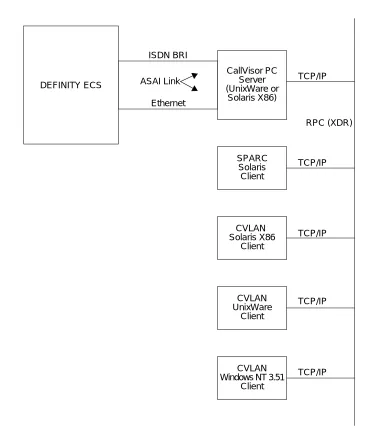
Figure 1-1. CVLAN Client-Server Connectivity
CVLAN speeds up ASAI adjunct application development by taking care of the network connectivity and message transfer between client and server.
This present release of CVLAN can only handle one client application per user. CVLAN client is supported over the following platforms: UNIX SVR4.2,
UnixWare 1.1 and 2.x, Solaris x86, Sparc Solaris, and Windows NT 3.51. The
DEFINITY ECS
ISDN BRI
ASAI Link
Ethernet
CallVisor PC Server
SPARC
Solaris TCP/IP RPC (XDR) TCP/IP
TCP/IP
TCP/IP
TCP/IP CVLAN
Solaris X86
CVLAN UnixWare
Client
CVLAN Windows NT 3.51
Client (UnixWare or
Solaris X86)
Client
System Configuration
Each client communicates with the server through any Ethernet interface card supporting Unixware, Solaris x86, Sparc Solaris, or Windows NT 3.51. Application software on the clients has access to the full range of ASAI features supported by the CallVisor PC ASAI interface.
The CVLAN server runs on Unixware and Solaris x86 operating system and requires the CallVisor PC ASAI library package. The interface card between the server and DEFINITY ECS may consist of the PC/ISDN BRI card or the DEFINITY ECS LAN Gateway card. The server communicates with clients over the LAN through any Ethernet interface card supporting Unixware or Solaris x86.
Both the client and the server hardware must be INTEL 386/486 processors but the client can also run on a Sparc Solaris platform. A client can communicate with only one server at a time. One server can communicate with up to four DEFINITY ECS PBXs. Clients indicate which PBX they wish to access when they connect to the server.
Software Configuration
CVLAN client side library must be installed on each client. Client administration specifies a “well known address” to access a server. In addition to UNIX, the server must be running the CallVisor PC ASAI library package and CVLAN server software.
System Operation and Limits
Client applications use CVLAN client side library to establish communication with a server. This process is nearly identical to that used with the CallVisor PC ASAI library (server addresses must be specified by the client; this is not required in the PC ASAI library). Once a connection is established, the applications use library routines asai_send() and asai_rcv() to send and receive ASAI messages. The server routes the messages to and from the proper DEFINITY ECS PBX. The format of the messages matches exactly those used with the CallVisor PC/ASAI library. Except for small changes in the communication establishment, it is expected that the applications developed with the CallVisor PC/ASAI library could run unchanged on a client system using CVLAN client side library.
Installation
Server Installation on UNIX
For the CVLAN, UNIX Platform refers to both UNIXWARE and Solaris x86.
The CVLAN server can only be installed after CVISDN and CVASAI have been installed.
1. To install the CVLAN server, type the command:
pkgadd -d diskette1
2. Place the Lucent Technologies CallVisor PC CVLAN Server disk in the appropriate drive and follow the online instructions. Pkgadd displays that the package is available to process. Press to continue the installation.
After the installation procedure is complete, the installation program asks you to remove the diskette from the disk drive. Shutdown instructions and the message
Installation of <cvlansrv> was successful are also displayed.
Client Installation on UNIX
You can install the PC CVLAN Client package at any time. 1. Enter the command:
pkgadd -d diskette1
2. Place the PC CVLAN Client disk in the appropriate drive and follow the online instructions.
3. Pkgadd displays that the PC CVLAN Client package is available to process. Press to continue the installation.
4. After the installation procedure is complete, remove the diskette from the disk drive. The message Installation of <cvlanxcl> was successful is displayed.
Client Installation on Windows NT
1. To install the CVLAN Client on a Windows NT 3.51 system, insert the Client diskette in drive A.
2. Click on the RUN File Menu Item under Program Manager or File Manager and type Setup in the dialog box and press OK.
3. Follow Setup instructions.
RETURN
NOTE:
After Setup is complete, CVLAN.DLL, the dynamic link library and
CVLAN.LIB, the import library, will be installed under a subdirectory called
Program.
Running the Sample Application
1. To run the application on UNIX, at the prompt enter the command:
cvln_itt <Script-name>
2. For Windows NT 3.51 system, double-click on the CVLAN Client program icon. Select the ITT Scripts item under the Execute popup menu as shown below:
NOTE:
After the installation, check that the CVLAN Client program group has been created under Windows NT 3.51.
CVLAN Sample Client Application
Installation
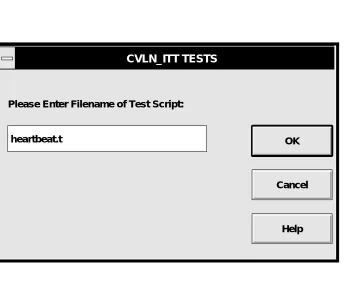
3. Enter the name of the ITT Script that you would like to execute. An example is shown below:
Figure 1-3. CVLAN Test
CVLN_ITT TESTS
Please Enter Filename of Test Script:
heartbeat.t OK
Cancel
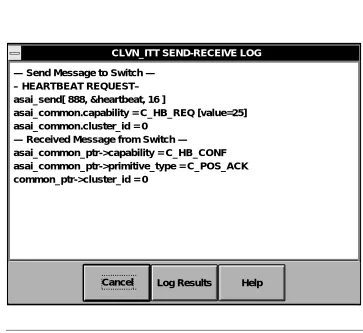
4. Pressing OK starts the execution of the test specified in the ITT Script. As the requests are sent and ECS responses received, these requests are displayed in the CVLN_ITT SEND-RECEIVE LOG, as shown in the screen below:
Figure 1-4. CVLAN Client Log
CLVN_ITT SEND-RECEIVE LOG
— Send Message to Switch — – HEARTBEAT REQUEST– asai_send[ 888, &heartbeat, 16 ]
asai_common.capability = C_HB_REQ [value=25] asai_common.cluster_id = 0
— Received Message from Switch —
asai_common_ptr->capability = C_HB_CONF asai_common_ptr->primitive_type = C_POS_ACK common_ptr->cluster_id = 0
Cancel Log Results Help ...
.....
..
.
..
..
Installation
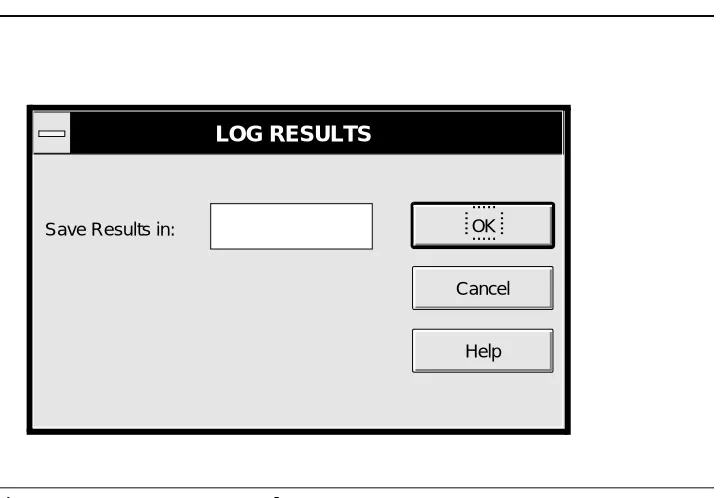
5. If you click on Cancel, the results currently displayed in the window will be permanently lost. However, you can click on Log Results as shown in Figure 1-4 to save the test results in a file of your choice as seen below:
Figure 1-5. CVLAN Log Results
LOG RESULTS
Save Results in: OK
Cancel
Help ... ... ....
.
....
DEFINITY ECS Administration
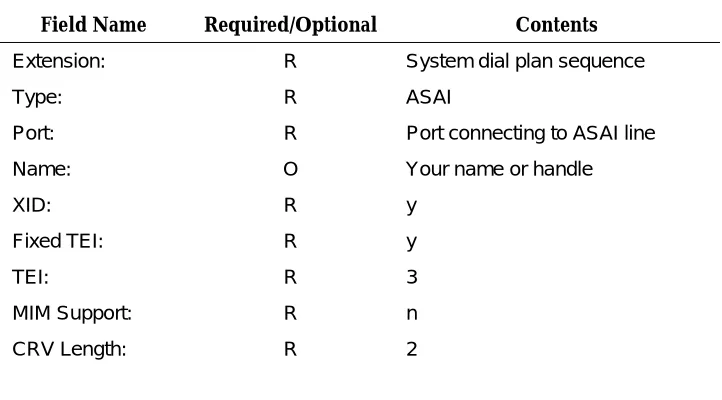
The DEFINITY ECS BRI line must be administered to establish ASAI connectivity between DEFINITY ECS and the adjunct computer. Use the
add station or change station command to administer the BRI line. Use the following table as a guide.
The Type, XID, Fixed TEI, TEI, MIM Support and CRV Length fields all must have the indicated required contents in order to match the built in administration of the IPCI board and CallVisor PC ASAI software.
The ISDN protocol stack, specifically the QP module, supports version selection. Version 1 (default) corresponds to G3V3, Version 2 corresponds to G3V4 and Version 3 corresponds to DEFINITY ECS release 5. For release 5, the default also is 3. To find out which software version is on the DEFINITY ECS, use the list conf
soft command. The Software Version is displayed on the Memory Resident: line.
Table 1-1. Field Name and Requirements
Field Name Required/Optional Contents
Extension: R System dial plan sequence
Type: R ASAI
Port: R Port connecting to ASAI line Name: O Your name or handle
XID: R y
Fixed TEI: R y
TEI: R 3
MIM Support: R n
Installation
Configuration
This section assumes that you have read the installation steps in this document.
NOTE:
The Network Support Utilities (NSU) package must be installed before you can install the CallVisor software packages.
The NSU package contains the streams utilities, header files, libraries and other files that are needed to add streams modules to the UNIX system kernel.
Upgrading Software
The upgrade procedure consists of removing the existing packages and installing the new packages as described in ‘‘DEFINITY ECS Administration’’’ section of this chapter. Upgrade the system when no one else is using the computer.
You must supply the configuration information as part of the upgrade procedure.
NOTE:
Before beginning the upgrade, copy or print the current configuration parameters for future reference.These parameters can be found in the files
/usr/adm/asai/asai_parms and /usr/adm/isdn/ipci_parms.
1. Log in as root. Bring the computer to single-user mode and then run state 1 by entering the command:
shutdown -iS -y -g120
2. Press Ctrl-d to proceed and enter 1 for the selected run state. 3. Remove the CallVisor PC software by entering the commands:
pkgrm cvasai and pkgrm cvisdn
4. Now install the new version. Configure the software as described in the ‘‘Configuring and Reconfiguring Software’’ section later in this chapter.
Removing Software
To remove software, enter the command:
pkgrm cvasai
and
pkgrm cvisdn
pkgrm command removes all package-created and installed files, along with
directories created when the package was installed.
When you execute pkgrm cvasai, all files in the /usr/adm/asai directory, along with all other files belonging to the ASAI package, are removed.
Also, for isdn package, when you execute pkgrm cvasai, all files in the
/usr/adm/isdn directory, along with all other files belonging to the ASAI package, are removed.
All ASAI header files installed in /usr/include/asai and ISDN/IPCI headers for the ISDN package in the /usr/include/isdn directory are removed. The directories are removed only if they are empty.
NOTE:
If you have local header files or other files in these directories, they will not be removed and neither will the directory.
The pkgrm procedure will build a new UNIX kernel. When this is completed, a message will be displayed requesting to reboot the system. After both packages have been removed, execute the command
shutdown -i6 -y -g0
to reboot the system.
Configuring and Reconfiguring Software
The initial part of the installation and upgrade procedure consists of configuring the software. You must enter the information when prompted by the software. See the ‘‘Configuration’’ section earlier in this chapter for more details. For the ISDN package, you must enter the number of IPCI boards to be installed or those already installed, the IRQ number, the PC memory addresses as well as the matching version parameters. Refer to the table below for default IPCI values:
Table 1-2. Default IPCI Configuration Values
ISDN board # IRQ/IVN PC memory address
1 2 d0000
2 2 d4000
3 2 d8000
Installation
link will not come up. Three new tunable parameters are provided to allow selecting the desired version and allowable alternatives. QP_DESIRED is set to the desired version. Version 1 corresponds to G3V3, Version 2 corresponds to G3V4 and Version 3 corresponds to DEFINITY ECS release 5. For release 5, the default also is 3. QP_HIGHERVER and QP_LOWERVER are provided to allow higher version and/or lower version operation.
The tunable parameters are located in /etc/conf/cf.d/stune. The defaults are:
QP_DESIRED_VER is set to 3 (release 5)
QP_HIGHERVER is set to 3 to allow higher (later) versions QP_LOWERVER is set to 1 to allow lower (earlier) versions
If you have to reconfigure your adjunct computer system (to change the version, for example), do so when no one else is using the adjunct.
To change the values, edit the /etc/conf/cf.d/stune file. Follow the standard tuning procedures and rebuild the kernel, then reboot the system. Execute the command
shutdown -i6 -y -g0
to reboot the system.
If the version parameters are incompatible with ECS version, the BRI link will not start up. The QP module will log this error to the system console and the crash buffer.
For the ASAI package, you must enter the number of ASAI nodes/IPCI boards installed: 1, 2, 3, or 4 (if that information is not available at the time of installation). If the ISDN package was installed first, this information is available to the ASAI package.
If only one IPCI board was configured for the ISDN package, the following message is displayed:
Configuring <cvasai> for 1 ASAI Nodes.
Reconfiguring the packages requires you to reinstall the ISDN and ASAI software.
If you have to reconfigure your adjunct computer system (to add a board, for example), do so when no one else is using the adjunct.
NOTE:
Memory Considerations
This section introduces a number of concepts that assume practical experience with administration of the ASAI applications package. The material presented here is discussed in detail in Chapter 1, “ASAI and Capability Groups” of
DEFINITY Enterprise Communications Server Release 5 CallVisor ASAI Technical Reference.
ASAI services are broken down into functional sets called capability groups. Capability groups enable the adjunct to communicate and control the DEFINITY ECS. Central to the idea of capability groups and ASAI in general is the concept of an association.
An association is a channel of communication between the adjunct and the DEFINITY ECS that is used for messaging purposes. An association begins with initiating capabilities, controlling capabilities manipulate messages during an association and terminating capabilities end an association.
An adjunct or more specifically, each BRI board installed on an adjunct, can manage many active associations at one time and each association must be tracked by the CallVisor ASAI software drivers. Tracking consumes adjunct memory that must be reserved for the CallVisor drivers (148 bytes are required to track a single association).
The amount of memory to be reserved is specified by the NCLID (number of cluster ids) environment variable. NCLID effectively limits the number of active ASAI associations that are allowed to run on each BRI board. It is important to note that the NCLID specifies the maximum number of associations that may run on each BRI board, not the maximum number for all boards combined.
The NCLID default is 2048. This should be sufficient for the majority of
applications using ASAI. However, if the adjunct processor has a limited amount of memory, or if the ASAI application is controlling a large number of stations or calls, the NCLID will need to be adjusted. In any case, the NCLID value should always be set to conform to your system’s specific operational needs.
The default of 2048 specifies that each BRI board installed be limited to 2048 active associations and that approximately 296K of adjunct memory be reserved on behalf of each board (2048 x 148 bytes per association = 296K). If four boards are installed, a total of approximately 4 x 296K will be reserved for tracking their combined associations.
Installation
For instance, setting the NCLID to 1024 reduces the number of active associations per board to 1024 and cuts the amount of reserved memory per board to 148K (1024 x 148). Alternately, setting the NCLID to 512 reduces the number of active associations per board to 512 and cuts the amount of reserved memory per board to 74K (512 x 148). These settings are not likely to impact the performance of most applications.
Certain ASAI applications may require the NCLID to be increased above the default of 2048. If the ASAI application is using one ASAI link to control a large number of calls on a R5r, the NCLID may need to be increased. There is, however, a practical limit to which the NCLID value may be raised. Appendix B “ASAI and Release 5 Requirements” of DEFINITY ECS Release 5 CallVisor ASAI Technical Reference discusses the capacity requirements and constraints for the DEFINITY ECS release 5 in detail.
For example, Table B-1 of that appendix lists all the R5r systemwide ASAI limits for the maximum number of domain-control station associations as 6000. However, setting the NCLID to a value between the default (2048) and the maximum (9600), (for example 5000), will not always guarantee that 5000 active ASAI associations can be supported.
Despite the fact that the theoretical maximum number of domain-control station associations is 6000, the actual maximum number of associations is limited by the availability of a variety of other system resources.
For this reason, you must consider several factors when setting the NCLID in the hope of maximizing performance. The amount of memory available on the adjunct processor, as well as the number of BRI boards installed, greatly affect system capabilities.
It must also be noted that the capacity requirements and constraints on DEFINITY ECS release 5 apply equally to all ASAI links. If an application uses more than one ASAI link or if other ASAI applications are connected to the same DEFINITY ECS, the maximum number of associations per link will be lower than normal. This will also affect the actual maximum number of associations that can be realized.
Set NCLID using the idtune(1M) command. Follow the procedures outlined in
Starting Up the System
System startup for CallVisor PC ASAI is automatic. When you boot the adjunct, the asai_admin daemon is started. asai_admin completes the protocol stack and begins the process of message writing to the asai_log. If there is an existing log, it is moved to old_asai_log.
The asai_log contains messages about the startup process. The sample below shows typical log entries for a successful startup.
910318165042:asai_admin: ASAI administration daemon has started.
910318165042:asai_admin: Push of FEL onto /dev/isdn/ipci/signal01 succeeded. 910318165042:asai_admin: Link of /dev/asai/asai file with /dev/isdn/ipci/signal. 910318165042:asai_admin: l01 succeeded.
910318165042:asai_admin: ASAI stack setup was successful.
Matching Versions Requirement for the ISDN protocol stack, specifically the QP module, must be done correctly or the ASAI link will not come up. Three new tunable parameters are provided to allow selecting the desired version and allowable alternatives. QP_DESIRED_VER is set to the desired version. Version 1 corresponds to G3V3, Version 2 corresponds to G3V4 and Version 3 corresponds to DEFINITY ECS release 5. For release 5, the default also is 3. QP_HIGHERVER and QP_LOWERVER are provided to allow higher version and/or lower version operation; these parameters are 0 to prevent higher and/or lower version numbers and 1 to permit them.
The tunable parameters are located in /etc/conf/cf.d/stune. The defaults are:
QP_DESIRED_VER is set to 3 (release 5)
QP_HIGHERVER is set to 3 to allow higher (later) versions QP_LOWERVER is set to 1 to allow lower (earlier) versions
For Solaris, the tunable parameters are located in /etc/system directory.
To change the values, edit the /etc/conf/cf.d/stune file. Follow the standard tuning procedures and rebuild the kernel, then reboot the system. Execute the command
shutdown -i6 -y -g0
to reboot the system.
2
Administration
ASAI administration consists of a few tasks that have to be performed at regular intervals and/or under certain conditions. These tasks are referred to as
operation, administration and maintenance (OA&M). For the most part, they are simple, merely requiring you to enter a command. However, it cannot be denied that the process of communicating with ECS is a complex one. Unexpected results can disrupt the smooth operation of your system. You may also find that you are regarded as the resident ASAI expert. Therefore, you will probably benefit from reading all of the ASAI documentation. A list of all ASAI documents can be found in the ‘‘Related Documents’’ section in the,Chapter , ‘‘About This
Document’’.
The ASAI Log File
The ASAI log file, asai_log, is stored in /usr/adm/asai and can be examined using vi or cat.
Each time the UNIX system is started, the existing log file is moved to
old_asai_log and a new log file is created. This old_asai_log file is located in the same directory as asai_log. In addition, if asai_log becomes ‘‘full” (close to ulimit in size), it is moved to old_asai_log. Note that this overwrites an existing old_asai_log.
You can split or copy a log file; however, only root has write permission in the
/usr/adm/asai directory. Therefore, you will have to use a directory in which you have write permission to execute the split or cp command. (The ASAI Administration menu provides access to UNIX system commands, so you can do this by escaping from the menu, if you prefer.)
The log file contains entries consisting of a date and time stamp followed by a colon, the name of the ASAI process that wrote the message, another colon and the message. The message tells you whether or not the process executed successfully.
Figure 2-1. An ASAI Log File
In the sample shown above, the first 12 characters represent a date and time stamp. The date is in the form yymmdd; the time is in the form hhmmss, based on a 24-hour clock. Thus 11:30 p.m. appears as 2330.
910318165042: asai_admin: ASAI administration daemon has started. 910318165042: asai_admin: Push of FEL onto /dev/isdn/ipci/signal01 succeeded.
910318165042: asai_admin: Link of /dev/asai/asai with /dev/isdn/ipci/signal.
910318165042: asai_admin: 101 succeeded.
OA&M Manual Pages
OA&M Manual Pages
This section contains manual pages for the commands and files that comprise ASAI Operations, Administration and Maintenance (OA&M). For ease of reference, commands and files appear in alphabetical (ASCII) order.
Command name prefixes and suffixes imply the following:
admin(7) ipci_off(1) asai(4) ipci_on(1) asai(7) ipci_stat(1) asai.Date(4) ipci_test(1) asai.Name(4) ipci_ver(1)) asai_admin(1) isdn_alarm(1) asai_cause(1) isdn.Date(4) asai_hb(1) isdn_l1_r(1) asai_log((4) isdn_l2_r(1) asai_test(1) isdn.Name(4) asai_trace(1) isdn_trace(1) asai_ver(1) lan_status(1) boot.bin(4) log_msgs(4) cmd(7) link_alarm(1) command(7) link_offline(1) esai_alarm(1) link_restart(1) esai_trace(1) link_status(1) ipci_admin(1) pcisdn.bin(4) ipci_init(1) signal(7)
asai_ Commands related to the kernel ASAI protocol stack or the ASAI library
ipci_ Commands related to the ipci device drivers
isdn_ Commands related to the BRI link between the BRI board and ECS
.bin Commands related to software that is downloaded (‘‘pumped”) to the BRI board
esai_ Commands related to the CallVisor LAN GATEWAY interface
admin(7)
Name
admin — IPCI and LAN GATEWAY Streams Device Driver Communication File
Description
The admin file allows communication between the ipci_admin(1) program, the IPCI streams device driver and the LAN GATEWAY streams module. The IPCI streams device driver communicates with the IPCI board and with software on the board.
This file is meant to be used only by the ipci_admin(1) program. Information flows only one way from the IPCI device driver to the ipci_admin(1) program.
This file will have the same major device number as the signal(7) and command(7) files. Its minor device number is 0.
Files
/dev/isdn/ipci/admin /dev/esai/admin
See Also
asai(4)
asai(4)
Name
asai — Start ASAI administration
Synopsis
asai
Description
asai is a shell script that starts the ASAI administration daemon process,
asai_admin(1), located in /etc/idrc.d.
Operation
The asai program is executed once per machine boot in the multiuser init level 2. The name of the log file (asai_log) is changed to old_asai_log. The administration daemon asai_admin(1) is then started. When this is done, the standard error device is defined as /dev/console for asai_admin(1).
Files
/usr/adm/asai/asai_log
See Also
asai(7)
asai(7)
Name
asai — ASAI communication file
Description
This file allows communication with ECS via the ASAI library functions. It is meant to be opened by the ASAI library function asai_open().
This file is created when the software is installed.
Files
/dev/asai/asai
See Also
asai.Date(4)
asai.Date(4)
Name
asai.Date — Date file for UNIX ASAI
Description
This file contains the date and time the software for ASAI product was manufactured.
Files
asai.Name(4)
Name
asai.Name — Name file for UNIX ASAI
Description
This file contains the name of the ASAI software package. The content of the file is:
Lucent Technologies CallVisor ASAI
Files
asai_admin(1)
asai_admin(1)
Name
asai_admin — Administer ASAI file
Synopsis
asai_admin
Description
asai_admin sets up the protocol stack for the ASAI device file and sends necessary parameters to the ASAI provider.
Operation
The asai_admin program is executed once per machine boot. It is started by
asai(4) and becomes a daemon process.
This program has two tasks.
a. To perform the necessary streams operations with UNIX kernel module(s) and the signal streams to complete the ASAI streams protocol stack. b. To condition each protocol stack with the board node ID value and ECS
protocol value.
The protocol stack can be used after asai_admin has built the protocol stack. When asai_admin has built the stack, the /dev/asai/asai file is available for use.
The ASAI stream file is always kept open by asai_admin.
Messages
Messages (status and error information) are written to the asai_log file. Some of these messages may come from the ASAI provider streams module.
Exit Codes
Files
/dev/asai/asai
/usr/adm/asai/asai_log
See Also
asai(4) asai(7)
asai_cause(1)
asai_cause(1)
Name
asai_cause — Logs cause values to stdout
Synopsis
asai_cause [-h] [-v] [-t logtime] [-?] process ids
Description
When asai_cause is activated for a process (an ASAI application that is running) and the application receives an ASAI message which contains a cause value from ECS, the library function asai_rcv() sends an Interprocess Communication (IPC) message containing the necessary information to
asai_cause. asai_cause reads the IPC queue, formats the cause information and writes it to stdout.
asai_cause is activated by including at least one valid process id. Process ids are not checked for validity. asai_cause may be activated remotely or from any login in the system. It is not necessary to be logged in as root to access
asai_cause.
asai_cause prints cause values to stdout. The following information is logged:
■ Date and time ■ Process id
■ ASAI capability name or the hexadecimal operation value (indicates
message type)
■ sao_id (formerly known as cluster_id) identifies the particular association for which the message is intended
■ Contents of the cause information element (IE) that includes the coding
standard and the cause value. The cause value is actually the combination of two fields: a class and a value within the class. The DEFINITY ECS value and the ASAI library interpretation of the cause value is also included.
The set of PIDs (process identification) being monitored by asai_cause can be changed by reinvoking the command with a new set of PIDs. However, other parameters cannot be changed in this way. The second invocation of
The set of input options includes:
-h
Causes SIGHUP to be ignored. Default is to exit asai_cause on SIGHUP (hangup).
-v
Causes the one-byte hexadecimal operation value from the Facility Information Element (FIE) to reference the ASAI capability rather than include the capability name itself.
-t log time
Specifies a decimal digit string indicating the maximum number of seconds that
asai_cause will run. Default is -t 0xffffffff, which is (2**32)-1 seconds.
-?
Causes a command usage line to be returned.
process ids
Specifies a list of process ids (decimal digit strings) separated by blanks for which cause value logging is to be performed. An empty list turns off cause value logging, but leaves the asai_cause process running. An easier way of
terminating cause value logging is to kill the asai_cause process. A maximum of 160 process ids may be included.
Example
Following is an example of the format used for logging cause values to stdout
when the -v option is not included.
DATE TIME PID CAPABILITY SAO ID
DEFINITY
ECS ASAI
08/27/92 11:35:33 123456 C_3PMC_CONF 4444 CS3/38 C_NETWORK_OUT_OF_O
08/27/92 11:38:12 123456 C_EN_CAN_CONF 1 CS0/100 C_INVLDIE
08/28/92 07:49:52 55555 C_3PAD_CONF fffffffd CS0/17 C_USER_BUSY
asai_cause(1)
Following is an example of the format used for logging cause values to stdout
when the -v option is specified.
See Also
asai_trace(1) isdn_trace(1)
Shared Resources
■ Message Queue ■ Shared Memory
Exit Codes
If asai_cause fails, one of the following exit codes is returned:
DATE TIME PID CAPABILITY SAO ID
DEFINITY
ECS ASAI
08/27/92 11:35:33 123456 0x83 4444 CS3/38 C_NETWORK_OUT_OF_O
08/27/92 11:38:12 123456 0x94 1 CS0/100 C_INVLDIE
08/28/92 07:49:52 55555 0xc6 fffffffd CS0/17 C_USER_BUSY
08/28/92 09:06:02 55555 0x95 ffffffff CS0/16 C_NORMAL
1 = ftok() failed to determine key 2 = Error in getting shared memory 3 = Error in getting message queue 4 = Error in getting a semaphore 5 = Attempt to ignore SIGHUP failed
6 = asai_cause command-line usage problem 7 = Error in attaching to shared memory 8 = Error in setting the value of the semaphore 9 = Error in receiving a message
asai_hb(1)
Name
asai_hb — Acknowledges heartbeats for a Node
Synopsis
asai_hb [-v] [-?] [1-8] -n
Description
When asai_hb is activated for an ASAI Node it registers itself as a maintenance server for that Node and calls the library function asai_rcv(). If the message received is an ASAI heartbeat, an ASAI heartbeat acknowledgment is sent.
If an ASAI heartbeat is not received from ECS within two minutes, asai_hb
sends a heartbeat request to ECS. If ECS does not confirm the request, and the -n option has not been specified, the specified Node is brought down using
ipci_off.
-v
Causes asai_hb responses to be printed on the user’s terminal (stdout).
-?
Causes command-line usage information to be printed on the user’s terminal.
1-8
1-8 is the Node number that corresponds to the board for which heartbeats will be acknowledged. Node number information can be found in the files
/usr/adm/asai/asai_parmsand/usr/adm/isdn/lan_parms.
The contents of asai_parms for one installed IPCI board are:
Node ID for ASAI Node 1 = signal01
-n
Disables the shutdown ipci_off of the link. This option should be used for all LAN type links. It must be the last option specified on the command line.
asai_hb(1)
Files
/usr/bin/asai_hb /dev/asai/asai /usr/bin/ipci_off
/usr/adm/asai/asai_parms /usr/adm/isdn/lan_parms
See Also
asai_log(4)
Name
asai_log — Log file for UNIX ASAI
Description
This file contains all status and error messages. It resides in the /usr/adm/asai
directory.
The format is:
time stamp: program name: ASCII message newline character
time stamp consists of 12 characters in the format of: yymmddhhmmss.
Programname is a 12-character field containing the name of the program (left-justified) that contributed the message to the file. The program name is padded on the right with space characters as needed to fill the field.
ASCII message consists of 0 through 53 ASCII characters. Every line is ended by a newline character as shown.
This file should not grow quickly. The programmer can monitor the size of this file, if desired. If this file does get close to the ulimit value, it is renamed
old_asai_log and subsequent messages are written to a new asai_log.
When the system is booted, the old version of this file is renamed
old_asai_log. A new asai_log file of 0 length is then created. Subsequent messages are written to this new file. Any previous copy of old_asai_log is removed by this operation.
Files
/usr/adm/asai/asai_log
See Also
asai(4)
asai_test(1)
asai_test(1)
Name
asai_test — Test connection(s) with ECS
Synopsis
asai_test
Description
For all ASAI nodes, the connection to the corresponding ECS is tested.
Operation
For each ASAI node, an ASAI heartbeat request is sent to the corresponding ECS. The response from ECS is tested for correctness.
Return Value
For success, 0 is returned. If an error is detected, 1 is returned.
Output
If the response is correct, a success message is printed on stdout. If there is an error, the corresponding error message is printed on stderr.
Files
/dev/asai/asai
asai_trace(1)
Name
asai_trace — Decodes an ASAI message stream
Synopsis
asai_trace [-a] [-c] [-E] [-e] [-f] [-h] [-i] [-m] [-n] [-o] [-q] [-r] [-s] [-v] [-?]
Description
asai_trace decodes an ASAI message stream and can be called with command-line options or options can be set using an online help facility.
-a
Use short mnemonics (abbreviated mode)
-c
Coding standard information is included
-E
Expect LAN GATEWAY format messages on stdin; for example, esai_trace | nawk -f /usr/adm/isdn/bin/xlat.k | asai_trace -E
-e
Causes input to be taken from the command esai_trace
-f
Creates from 1 to 6 raw hex files (in addition to the trace information). The first file created is rawtrace.out.0. If it overflows, output goes to a second file
rawtrace.out.1. If this file also overflows, rawtrace.out.2 is created and so on, up to a maximum of six files. If the sixth file overflows, the entire process begins again and rawtrace.out.0 is overwritten.
-h
Displays the verbose help menu