CUSTOMER RELATIONSHIP MANAGEMENT MODEL FOR ALU (UTM)
HOSSEIN AHMADI
A dissertation submitted in partial fulfillment of the requirements for the award of the degree of
Master of Science (Information Technology - Management)
Faculty of Computer Science and Information Systems Universiti Teknologi Malaysia
iii
iv
ACKNOWLEDGEMENT
First and foremost, I would like to express heartfelt gratitude to my supervisor Associate Professor Dr. Othman bin Ibrahim for his constant support during my study at UTM. He inspired me greatly to work in this project. His willingness to motivate me contributed tremendously to our project. I have learned a lot from him and I am fortunate to have him as my mentor and supervisor
v
ABSTRACT
vi
ABSTRAK
vii
TABLE OF CONTENTS
2.2 Customer 9 2.2.1 Definition of Customer 10
CHAPTER TITLE PAGE
DECLARATION Ii
DEDICATION Iii
ACKNOWLEDGMENT Iv
ABSTRACT V
ABSTRAK Vi
TABLE OF CONTENTS Vii
LIST OF TABLES Xii
LIST OF FIGURES Xiv
LIST OF ABBREVIATION Xv
LIST OF APPENDICES Xvi
1 INTRODUCTION
1.1 Introduction 1
1.2 Background of Problem 3
1.3 Problem Statement 5
1.4 Research Objectives 6
1.5 Scope 6
1.6 Significant of the project 7
1.7 Conclusion 7
2 LITERATURE REVIEW
viii
2.2.2 Customer Satisfaction 10
2.3 Customer Relationship Management 11
2.3.1 CRM Definition 11
2.3.2 CRM Components 13
2.3.2.1 People 14
2.3.2.2 Process 14
2.3.2.3 Technology 15
2.3.3 CRM Value Cycle 15
2.4 Three CRM Process Models reviews 16
2.4.1 CRM Adoption Model 17
2.4.2 CRM Process Model 22
2.4.3 IDIC Process Model 23
2.4.3.1 Identify 24
2.4.3.2 Differentiate 25
2.4.3.3 Customize 25
2.4.3.4 Interact 26
2.4.3.5 Summary for IDIC Process Model 27
2.4.4 Justification for the Selection Model (IDIC Model) 29
2.4.4.1 The First Phase Justification (Identification) 29
2.4.4.2 The Second Phase Justification (Differentiation) 29
2.4.4.3 The Third Phase Justification (Customization) 30
2.4.4.4 The Fourth Phase Justification (Interaction) 30
2.4.4.5 Summary for IDIC Model Selection 31
2.5 CRM Technology 31
2.5.1 Web Portal 33
2.5.2 The Role of Internet in Web Portal Application 33
2.5.3 Medium of Communication 34
2.6 Summary 35
ix
3.1 Introduction 36
3.2 Case Study Approach 36
3.2.1 Exploratory Case Study 37
3.2.2 Explanatory Case Study 37
3.2.3 Descriptive Case Study 38
3.2.4 Summary of the Case Study Research 38
3.3 Research Methodology 39
3.3.1 Research Flow Chart 39
3.3.1.1 Operational Framework 40
3.3.2 Conceptual Framework 43
3.4 Research Approach 44
3.4.1 Quantitative and Qualitative Research 44
3.5 Data Collection 46
3.5.1 Secondary Data 47
3.5.2 Primary Data 47
3.5.2.1 Interview 48
3.5.2.2 Questionnaire 50
3.5.2.2.1 Justification of the Questionnaire 51
3.6 Research Quality 52
3.6.1 Validity 52
3.6.2 Reliability 53
3.7 Conclusion 55
4 FINDING 4.1 Introduction 56
4.2 Demographic of Respondents in this Thesis 57
4.2.1 Questionnaire Group 57
4.2.2 Interview Group 58
4.3 Interview Finding 58
4.3.1 Alumni Liaison Unit Organizational Background 60
4.3.2 Alumni Liaison Unit Mission and Vision 62
x
4.3.4 Membership Process of UTM Alumni 63
4.3.5 The Benefit for the UTM organization and Alumni 63
4.3.6 Alumni Medium of Communication 64
4.3.7 Summary for the Interview Finding 66
4.4 The Questionnaire Finding 67
4.4.1 Information in UTM Alumni Liaison Unit Website 69
4.4.2 Alumni Liaison Unit Medium of Communication 69
4.4.3 Suggestion for ALU Medium of Communication 70
4.4.4 ALU Interaction with its Members 71
4.4.5 Need for Identification 72
4.4.6 Need for Alumni differentiation 73
4.4.7 Need for Customization towards Service Based on Alumni’s Value 74
4.4.8 Need for Customization towards Service Based on Alumni’s Requirement 75
4.4.9 Need for Interaction based on Alumni’s Value 76
4.4.10 Need for Interaction based on Alumni’s Requirement 77
4.5 Summary of the Questionnaire Finding 78
4.6 Chapter Summary 79
5 DESIGN 5.1 Introduction 80
5.2 Compare IDIC Model and New CRM Strategy Model 81
5.3 Model Design 81
5.3.1 Phase 1- Identify 84
5.3.2 Phase 2- Differentiate 84
5.3.3 Phase 3- Customize 85
5.3.4 Phase 4- Interact 85
5.3.5 Summary of the Phases with Benefit 86
xi 6 CONCLUSION
6.1 Introduction 88
6.2 Research Achievements 88
6.3 Constraints and Challenges 89
6.4 Future study 90
6.5 Recommendation 91
6.6 Chapter Summary 91
REFERENCES 92
xii
LIST OF TABLES
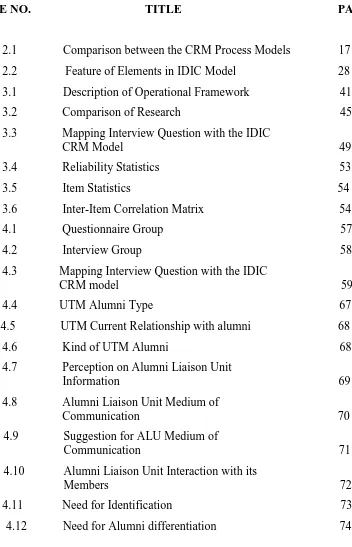
TABLE NO. TITLE PAGE
2.1 Comparison between the CRM Process Models 17
2.2 Feature of Elements in IDIC Model 28
3.1 Description of Operational Framework 41
3.2 Comparison of Research 45
3.3 Mapping Interview Question with the IDIC CRM Model 49
3.4 Reliability Statistics 53
3.5 Item Statistics 54
3.6 Inter-Item Correlation Matrix 54
4.1 Questionnaire Group 57
4.2 Interview Group 58
4.3 Mapping Interview Question with the IDIC CRM model 59
4.4 UTM Alumni Type 67
4.5 UTM Current Relationship with alumni 68
4.6 Kind of UTM Alumni 68
4.7 Perception on Alumni Liaison Unit Information 69
4.8 Alumni Liaison Unit Medium of Communication 70
4.9 Suggestion for ALU Medium of Communication 71
4.10 Alumni Liaison Unit Interaction with its Members 72
4.11 Need for Identification 73
xiii
4.13 Need for Customization towards Service 75
4.14 Need for Customization towards Service 76
4.15 Need for Interaction 77
4.16 Need for Interaction 78
xiv
LIST OF FIGURE
FIGURE NO. TITLE PAGE
2.1 Framework of Literature Review 9
2.2 CRM components (source: Goldenberg, 2003) 13
2.3 Pyramid Framework of a CRM Value Cycle 16
2.4 A Model for CRM Adoption (Source: Reinarts, 2003) 18
2.5 CRM Process Model (Source: Kincaid, 2008) 22
2.6 IDIC Model (source: Siddiqi, 2002) 24
3.1 Research Flow Chart 40
3.2 IDIC Model (source: Siddiqi, 2002) 43
4.1 Alumni Organizational Chart 61
xv
LIST OF ABRREVIATION
ALU Alumni Liaison Unit
AOL American Online
CRM Customer Relationship Management ICT Information Communication Technology IDIC Identification Differentiation Customization IRC Internet Relay Chat
IT Information Technology ROI Return on Investment SPS School of Graduate Studies
SPSS Statistical Package for the Social Sciences UPA Unit Perhubungan Alumni
UTM University Technology Malaysia
xvi
LIST OF APPENDIX
APPENDIX TITLE PAGE
A Interview Question 95
B Questionnaire Question 96
1
CHAPTER 1
INTRODUCTION
1.1 Introduction
This chapter will present readers with the background of an educational institution and UTM Alumni Liaison Unit as well as the problem to be studied. Besides that, research questions and the purpose of this research as well as delimitation and definition of key terms will be presented respectively.
Customer Relationship Management (CRM) is becoming an imperative strategyfor virtually every sector of a business organization.. Organizations are moving closer to their customers, putting in more effort in seeking new ways to create value for their customers, and transforming customer relationship into one of solution finding and partnering instead of one of selling and order taking (El Sawy and Bowles, 1997).
2
especially for customer satisfaction in higher education institutions. Because of this need, many institutions are taking this opportunity to use technology in achieving their objectives. One of the most popular strategies that has been accepted and confirmed by researchers and many organizations is, Customer Relationship Management (CRM). CRM helps in automating and improving process, and contributing towards the management of customer relationships in the area of recruitment, marketing, communication management, services and support.
To ensure that the proposed model developed meets the objective of development, the developed system used the concept of Customer Relationship Management (CRM) strategy based on CRM model which has been recognized for its effectiveness in higher education. However, CRM was initially applied in the world of information technology (Randy Harris, 2003). In a university such as University Technology Malaysia (UTM), satisfying its alumni is essential and one of the university targets is to continue the communication with them but without a suitable CRM strategy, it may not be possible. The approach to CRM concepts will be discussed further in the literature review.
The emphasis of this research is on the proposed model of the strategy of Customer Relationship Management (CRM) in the higher education field. The model will act as an agent of the supplier, storage, transmission and contain a variety of current information on its database systems to support potential more effective customer service delivery. The model will also improve the communication and interaction system in the process of establishing a friendly relationship, and address the concerns with regards to the knowledge about rights and responsibilities between the customer and university.
3
1.2 Background of Problem
Information and communication technology (ICT) is “a diverse set of technological tools and resources used to communicate, and create, disseminate, store, and manage information” (Blurton, 2002). ICT includes computers, the internet, broadcasting technology and telephones. Recently, there is an interest towards the use of computers and internet which have had a positive effect on improving the efficiency and effectiveness of education at all levels. It has become necessary that organizations in higher education must focus on the development of such technology and use them to address their customer’s needs by providing the best services possible.
The Alumni Liaison Unit has an official and long history of service with University Technology Malaysia (UTM). It was set up on April 1, 1996 with the aim of establishing relationships between UTM and its alumni members. The objectives of the Alumni Liaison Unit are to sustain in a good relationship between UTM and alumni, and foster a sense of belonging among UTM Alumni. Following that, the is the center in UTM for sustaining communication with its alumni and this could be possible only by providing a good information and service according to their needs of the alumni.
4
segmentation or market segmentation to develop its interaction that focuses on a particular market segment or alumni segment.
According to Payne (2005) “market segmentation or (customer segmentation) is a key aspect in CRM and it involves dividing a potential market up into a series of sub markets based on customer characteristic”. This is supported by Johnson (2009) who provided the definition in which market segment is “a group of customers who have similar needs that are different from customer’s needs in other parts of the market and consequently it helps organization to identify their strategic customers who have the most influence on the organization’s revenue” (P.46).
On the other hand, based on initial observations the Alumni Liaison Unit as the UTM center of for organizing the alumni was weak by not understanding the alumni, managing the alumni’s information and providing the services needed. As a result, a member of the alumni has no idea about the privileges that are offered by the Alumni Liaison Unit as many do not know of the benefits and potential opportunities of being a UTM Alumni member. Thus, there is a need for the Alumni liaison Unit to portray a good image of its organization towards its members and also potential members by having Customer Relationship Management (CRM).
5
Therefore, each type of needed service and information delivered must lead to customer satisfaction and even higher than the expected level of satisfaction. Thus, the spread of new pace in Information and Communication Technologies (ICT) effectively emerged to organize such relationships between university and its students by powering them to systematically identify, collect, analyze, and satisfy their needs and preferences.
1.3 Problem Statement
By looking back at the background of problem, the researcher believes that university is forced to stay relevant in this competitive era by having a customer-orientated strategy that concentrates on building effective and enduring relationships with the local and international UTM Alumni. Not surprisingly, Information and Communication Technology (ICT) has a vital responsibility here. For this reason, studying the field of information technology and management as well as the novelty of this area inspired the researcher to dissect this problem and look at it from the ICT position within the framework of business. Thus, the main problem identified was "How Customer Relationship Management Model can be cultivated in assisting Alumni Liaison Unit for improving relationship with UTM Alumni?’’
The main problem was analyzed from the following aspects:
i. What is the alumni’s segmentation need from the Alumni Liaison Unit in UTM?
ii. What are the elements of satisfaction for UTM Alumni?
6
1.4 Research Objective
The research objectives based on the UTM Alumni Liaison Unit are as follows:
i. To identify the alumni’s segmentation for improving alumni’s needs. ii. To identify the elements of UTM Alumni satisfaction related to CRM. iii. To develop a CRM model for improving the relationship between the
Alumni Liaison Unit and Alumni of UTM.
Therefore, by considering the aforementioned discussions, the researcher explored the coherent elements and transferred them into an integrated model and finally described them according to their essence needed to form the proposed CRM model.
1.5 Scope
This study was conducted in UTM Alumni Liaison Unit and considered the following aspects:
i. This research was restricted to Alumni Liaison Unit as its design for UTM Alumni.
7
1.6 Significance of the Project
.
i. This research will enhance the understanding on the abilities to establish, manage and retain effective relationship between UTM and its alumni by satisfying their requirements, preferences and values as well as by solving problems and addressing complaints.
ii. The research will also increase the awareness of UTM Alumni Liaison Unit about its students who are part of the UTM environment and those who are directly or indirectly interacting with the unit.
iii. The research will provide a model for effective services to be provided by the alumni based on their values and requirements which were gained through the segmentation process after students’ graduation as they become alumni groups. As a result, the university will be able to satisfy the needs of the alumni and finally renders its services to be increasingly engaged in sponsoring and fundraising activities among its alumni members as well as obtain other beneficial contributions.
1.7 Conclusion
92
REFERENCES
Adrian Payne and Pennie Frow(2005), “A Strategic Framework for Customer Relationship Management”, Journal Of Marketing, Vol.69 167-176.
A. Payne and P. Frow, "A Strategic Framework for Customer Relationship Management," Journal of Marketing, vol. 69, pp. 167-176, 2005.
Anton, J., & Petouhoff, N. L. (2002). Customer Relationship Management: The Bottom Line to Optimizing Your ROI (2nd ed.). UK: Prentice Hall.
Atul Parvatiyar and Jagdish N.Sheth (2002), Customer Relationship Management: Emerging Practice, Process, and Discipline, Journal of Economic and
Social Research, 1-34.
Blurton, C. (2002). New Directions of ICT-Use in Education.
http://www.unesco.org/education/educprog/lwf/dl/edict.pdf; viewed 7 August. Deck, S. (2003). What is CRM? Retrieved May 21, 2003, from:
http://www.cio.com/research/crm/edit/crmabc.html
El Sawy, O.A. and Bowles, G. (1997), “Redesigning the customer support process
for the electronic economy: insights from storage dimensions”, MIS
Quarterly, Vol. 21 No. 4, pp. 457-83.
Ghauri, P., & Gronhaug, K. (2005). Research Methods in Business Studies: A Practical Guide (3rd ed.). UK: Prentice Hall.
Goldenberg, B. J. (2003). CRM Automation. US: Prentice Hall.
Greenberg, P., (2001). CRM at the Speed of Light: Capturing and Keeping Customers in Internet Real Time, McGraw-Hill Companies.
Google Commercial (2005). What is Web Portal? Retrieved January 8, 2005, from: http://www.google.com.my/web portal.html
93
Kalatoka, R. (2002). Roadmap to Success of CRM, Addison-Wesley. Retrieved July 10, 2002, from: http://www.ejise.com/volume6-issue2/issue2-art17-sammon. Pdf
Kenneth, C.L., and Jane, P.L. (2001). The roles and functionalities of international networking. San Francisco: Jossey-Bass.
Kevin Jones (2005). Opportunity Wales e-Commerce. Retrieved January 18, 2005, from: http://www.ogc.gov.uk/embedded_object.asp?docid=672
Khalilabad, H. N., Mazandarani, O. N., Sentosa, I., & Piaralal, S. K. (2006).The Impact of Knowledge Management on Customer Relationship Management. Journal of American Academy of Business, 9 (2).
Kincaid, J. W., (2003). Customer Relationship Management: Getting It Right, Hewlett-Packard Company.
Kotler, P., & Fox, K. F. A. (1995). Strategic Marketing for Educational Institutions (2 ed.). New Jersey: Prentice Hall.
Kumar, R. (2005). Research methodology: a step-by-step guide for beginners (2 ed.). London: SAGE Publications.
Peppers & Rogers. 2001. “Maximizing ROI from your customer based strategy”. Insight Report 2001.
Pyecha, J., (1988). A Case Study Of The Application Of Noncategorical Special Education In Two States Chapel Hill, NC: Research Triangle Institute.
Randy Harris (2003). What is Customer Relationship Management (CRM) System? United States: Darwin Magazine. Retrieved May 8, 2003, from:
http://www.darwinmag.com/read/120103/index.html
Richard N. Katz (2002), Customer Relationship Management : Web Portal and Higher Education Technologies to make IT Personal, Jossey-Bass Inc.
Saren, M. (2006). Marketing graffiti: the view from the street (1st ed.). Oxford: Butterworth Heinemann.
Siddiqi. J. Babak. A. Wise. T. 2002. “A framework for implementation of a Customer relationship management strategy in retail sector”.
Sheffield Hallam University (UK).
Sweeney Group (2000). C2 CRM V5.4 by Clear Technologies. Retrieved March 25, 2000, from: http://www.clearc2.com
94
North, New Zealand.
Yin, R. K. (1993). Application of case study research. (Vol. Sage Publication): Thousand Oaks.