LIP SYNCING METHOD FOR REALISTIC EXPRESSIVE THREE-DIMENSIONAL FACE MODEL
ITIMAD RAHEEM ALI AL-RUBAYE
LIP SYNCING METHOD FOR REALISTIC EXPRESSIVE THREE-DIMENSIONAL FACE MODEL
ITIMAD RAHEEM ALI AL-RUBAYE
A thesis submitted in fulfilment of the requirements for the award of the degree of
Doctor of Philosophy (Computer Science)
Faculty of Computing Universiti Teknologi Malaysia
To the tender fountain who provided me with perseverance, My Parents
To the source of kindness who provided me with ambition, My Sister (Fayza), My Husband (Qays) and My Kids (Farah and Yousif)
For those who provided me with supervision and constant support, My Supervisors
To my virtuous professors who taught me in a truthful, fair, and honorable way
To my colleagues in the Universiti Teknologi Malaysia
To all those who contributed to the success of this research
ACKNOWLEDGEMENT
Initially, all praise is to Allah, the most kind and the merciful for helping me to accomplish this study. Special appreciation goes to my family, friends, study colleagues and supervisors for standing beside me in the good and bad times spent to complete this research. First, I would like to extend my heartfelt gratitude to my family.
During the time spent to complete this thesis, I dealt with various qualified researchers, academics, experts and practitioners who are specialized in various scientific fields. I would like to show my high appreciation and thank them for their valuable guidance to provide significant remarks that changed the course of the research to the correct direction. In particular, I want to share my truthful gratitude to my supervisor, Prof. Dr. Ghazali Sulong, and my co-supervisor Dr. Hoshang Kolivand, for their valuable support of productive comments and ideas which have contributed to the success of this research.
ABSTRACT
Lip synchronization of 3D face model is now being used in a multitude of important fields. It brings a more human and dramatic reality to computer games, films and interactive multimedia, and is growing in use and importance. High level realism can be used in demanding applications such as computer games and cinema. Authoring lip syncing with complex and subtle expressions is still difficult and fraught with problems in terms of realism. Thus, this study proposes a lip syncing method of realistic expressive 3D face model. Animated lips require a 3D face model capable of representing the movement of face muscles during speech and a method to produce the correct lip shape at the correct time. The 3D face model is designed based on MPEG-4 facial animation standard to support lip syncing that is aligned with input audio file. It deforms using Raised Cosine Deformation function that is grafted onto the input facial geometry. This study also proposes a method to animate the 3D face model over time to create animated lip syncing using a canonical set of visemes for all pairwise combinations of a reduced phoneme set called ProPhone. Finally, this study integrates emotions by considering both Ekman model and Plutchik’s wheel with emotive eye movements by implementing Emotional Eye Movements Markup Language to produce realistic 3D face model. The experimental results show that the proposed model can generate visually satisfactory animations with Mean Square Error of 0.0020 for neutral, 0.0024 for happy expression, 0.0020 for angry expression, 0.0030 for fear expression, 0.0026 for surprise expression, 0.0010 for disgust expression, and 0.0030 for sad expression.
ABSTRAK
TABLE OF CONTENTS
CHAPTER TITLE PAGE
DECLARATION ii
DEDICATION iii
ACKNOWLEDGEMENT iv
ABSTRACT v
ABSTRAK vi
TABLE OF CONTENTS vii
LIST OF TABLES xii
LIST OF FIGURES xiv
LIST OF ABBREVIATIONS xx
LIST OF SYMBOLS xxii
LIST OF APPENDICES xxiii
1 INTRODUCTION 1
1.1 Introduction 1
1.2 Problem Background 4
1.3 Problem Statement 9
1.4 Research Aim 10
1.5 Research Objectives 10
1.6 Research Scope 10
1.7 Significance of the Study 11
2 LITERATURE REVIEW 13
2.1 Introduction 13
2.2 Facial Animation 14
2.2.1 A Brief History of Facial Animation 15 2.2.2 Facial Animation in Films and Games 17
2.2.3 Facial Animation Techniques 18
A. FACS Approach 19
B. Interpolation 21
C. Parameterization 21
D. Image Morphing 22
E. Pseudo Muscle Model 22
F. Physics based Muscle Model 23 G. MPEG-4 Facial Animation Approach 23
2.3 Lip Syncing 31
2.3.1 Lips Motion Synthesis 31
2.3.2 Effect of Speech Animation 35
2.3.3 Co-articulation 37
2.3.4 Tongue Action 38
2.3.5 Teeth 38
2.4 Vocal and Structural Properties of English Language 38 2.4.1 Vocal properties of English Language 39 2.4.2 Structural properties of English Language 40
2.4.3 Phonemes and Lip Syncing 40
2.4.4 Visual Phonemes 41
2.4.5 Phoneme Classification 43
2.4.6 Point of Articulation 44
2.5 Realistic 3D Face Model 46
2.5.1 Modeling Emotions 46
A. Ekman Model 47
B. Plutchick’s Wheel of Emotions 47
2.5.2 Facial Expression 49
2.5.3 Eye Behavior 54
B. Eye Blinking, Manipulators and Social Behaviours
56
C. Eye Saccades 57
2.6 Current 3D Face Model Systems 58
2.6.1 Microsoft Agents 58
2.6.2 Emotional Chinese Talking Head 59
2.6.3 GRETA 59
2.6.4 Xface Engine 60
2.6.5 LUCIA 61
2.7 Critical Analysis on Lip Syncing and Realistic Expressive 3D Face Model Systems
62
2.8 Summary 65
3 RESEARCH METHODOLOGY 67
3.1 Introduction 67
3.2 Research Framework 68
3.3 Stages of Research Framework 72
3.3.1 Problem Definition (Stage 1) 72 3.3.2 Research Methodology (Stage 2) 75
A. 3D Face Model 75
B. Formulating Motion Parameters for Lip
Region of 3D Face Model 76
C. Lip Syncing 81
D. Proposing New Lip Syncing Method 82
E Realistic 3D Face Model 84
F. Integrating Facial Expression and Eye
Behaviour with 3D face model 86
3.3.3 System Rendering (Stage 3) 89
A. Synthesis Face Motion based on
MPEG-4 approach 89
B. Face Interpolation 90
3.3.4 Research Evaluation (Stage 4) 91
3.5 Summary 98
4 DETAILED DESIGN AND IMPLEMENTATION OF
PROPOSED METHODS 99
4.1 Introduction 99
4.2 Formulating Motion Parameters of 3D Face Model 100 4.2.1 Description of Parameters using Xface
Engine (Input Stage) 104
4.2.2 Calculation of FAPU(Process Stage) 112 4.2.3 Generation of Polygonal Mesh (Process
Stage) 113
4.2.4 Subdivision of the Proposed Face Model
(Process Stage) 117
4.2.5 Reduction Parameters using PCA
method(Process Stage) 118
4.2.6 3D FaceModel (Output Stage) 124
4.3 Proposing a New Lip Syncing Method 125 4.4 Integrating Facial Expression and Eye Behaviours
with the Proposed 3D Face Model 135
4.5 Synthesize Face Motion based on MPEG-4 Approach 148
4.6 Face Interpolation 150
4.7 Summary 152
5 IMPLEMENTATION, RESULT AND DISCUSSION 153
5.1 Introduction 153
5.2 Analysis of 3D Face Model 154
5.3 ProPhone Lip Syncing Method 157
5.4 Integrating Facial Expression and Eye Behaviours
with the Proposed 3D Face Model 161
5.5 Research Evaluation 166
5.5.1 Real Benchmarking Evaluation 166
5.5.2 Objective Evaluation 169
Parameters
5.6 Discussion 180
5.7 Summary 181
6 CONCLUSION AND FUTURE OUTLOOK 182
6.1 Overall Conclusion 182
6.2 Research Achievement 184
6.3 Future Outlook 186
REFERENCES 188
LIST OF TABLES
TABLE NO TITLE PAGE
2.1 FAP groups in MPEG-4 (Deng and Neumann,
2008) 26
2.2 The description and value of FAPUs 30
2.3 English phonemes (Kalwick, 2006) 41
2.4 The basic and advance emotions of Plutchik’s
wheel of emotion 49
2.5 A critical analysis on lip syncing and realistic
expressive 3D face model 65
3.1 Operational framework of the proposed system 97 4.1 Set of Frequency English phonemes that generated
by SAPI (TTS Microsoft Speech API 5.4) for 200 sentences (TRueSpel, 2001; Brett et al., 2002;
James, 2006) 128
4.2 Selected emotion from Raouzaiou et al. (2009) and
Nishida and Faucher (2010) 141
4.3 The total of FAPs used to describe the six basic
emotions 143
4.4 The profile the range of variation of the proposed
hybrid synthesis method. 144
5.1 Comparison between existing 3D face models with
the proposed system 155
5.2 The result of visual phonemes of the lip syncing
5.3 Expression generated from the facial expression
synthesis 162
5.4 Screenshot of the upper face for multiple type of
expressive speech real human and proposed system 168
5.5 Evaluation results for Xface 170
5.6 Evaluation results for GRETA 170
5.7 Evaluation results for the proposed 3D face model 171 5.8 Number of implemented FAPs and number of FAPs
that are has been given a certain score 175 5.9 Average score for each of the faces with and
without non-executed FAPs. 175
5.10 Scores given to all individual FAP movements to all faces. For bidirectional FAPs, scores are given for respect the negative and the positive value. PS, LU XF, and GR are short for Proposed Model, LUCIA, Xface, and GRETA. Red cells are the situations in which the Proposed Model performs worse than at
least one of the other faces. 176
5.11 Scores given to all individual FAP movements to all faces. For bidirectional FAPs, scores are given for respect the negative and the positive value. PS, LU XF, and GR are short for Proposed Model, LUCIA, Xface, and GRETA. Red cells are the situations in which the Proposed Model performs worse than at
LIST OF FIGURES
FIGURE NO TITLE PAGE
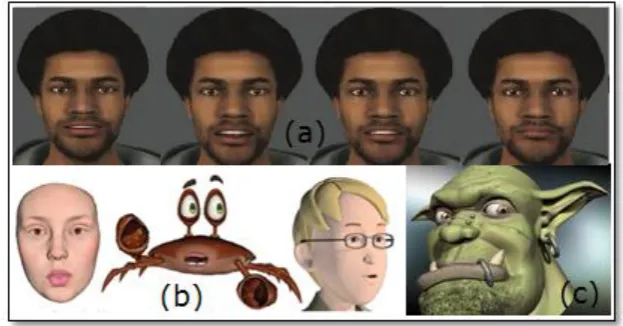
1.1 Examples on Lip Syncing of 3D Face Models (a) Wei and Deng, 2015 (b) Xu et al., 2013 (c) Maya Lip
Syncing 2014. 2
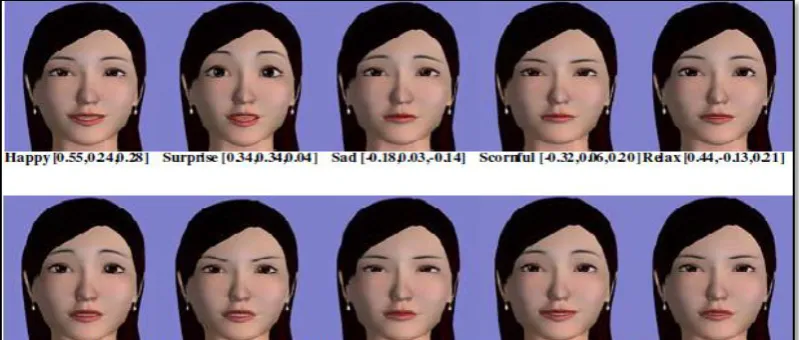
1.2 Synthesized facial expressions based on emotion of
talking Avatar (Zhang et al., 2010) 4
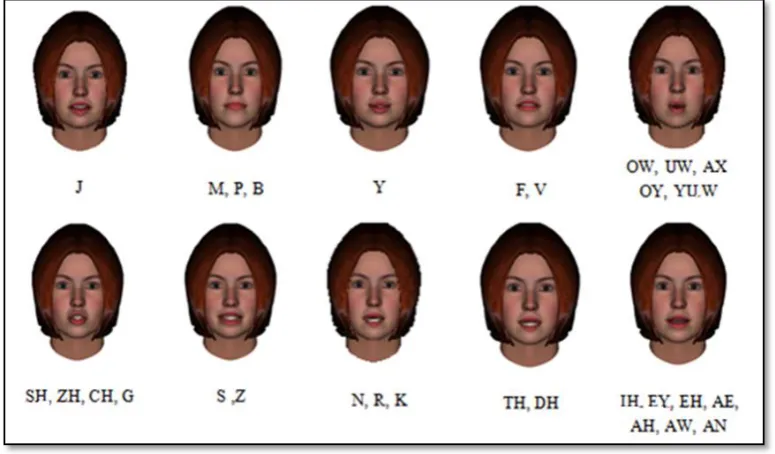
1.3 Visual phoneme (Balci et al., 2007) 6
1.4 Previous researches concerning facial expressions, eye
movements, and speech systems 8
2.1 Implementation of the FACS onto a 3D character. (a) AU2 (outer brows raised), (b) AU2+4 (outer brows raised and brows lowered), (c) AU R6 (right cheek raise) and (d) AU4+6 (brows lowered and cheeks
raised) (Platt and Badler, 1981; Morten, 2012) 16 2.2 Animated picture from Pixar Animation Studios
(Morten, 2012) showing two characters of Merida in
‘Brave’ (2012) and Carl Fredricksen in‘Up’ (2009) 17
2.3 Skull of Shape 19
2.4 Various AUs major codes on the face indicating movements directions of the AU movement (red
arrows) as center of mass (red dots) (Morten, 2012) 20
2.5 MPEG-4 Feature Points 25
2.6 The FPs in MPEG-4 FAP (Shapiro, 2011) 26
2.8 MPEG-4 FAPUs (Queiroz et al., 2009) 29 2.9 Mandarin vowels classification procedure (shih et al.,
2010) 33
2.10 Visual phonemes of (Kalwick, 2006) 42
2.11 Shorter list of another visual phoneme of (Kalwick,
2006) 43
2.12 The place of articulation (TRueSpel, 2001) (Brett Kessler and Rebecca Treiman, 2002), (James M.
Scobbie, 2006) 44
2.13 Plutchik’s Wheel of Emotion (Plutchik, 1980) 48 2.14 Six essential emotions from left to right (from the top,
left to right) anger, fear, and disgust, surprise,
happiness and sadness (Ekman, 1979) 52
2.15 The emotion face appearance wheel of Plutchik (Mac
Kim, 2011) 52
2.16 Emotion face appearances (Kalwick, 2006) 54
2.17 3D Face Model of GRETA 60
2.18 3D Face Model of Xface 60
2.19 SMIL-Agent script processing (Balcı et al., 2007) 61
2.20 3D face model of LUCIA 62
3.1 Research Framework 70
3.2 Research Methodology 71
3.3 SmartBody 3D face model from USC Institute for
Creative Technologies(Feng and Shapiro, 2013) 76 3.4 Sample face reduction using PCA method from (Wei
and Deng, 2015) (a) Among the 102 parameters, used the 39 green parameters. (b) Illustration of the average
face parameters. 79
3.5 Overview of the basic speech animation 82
3.6 Screenshots of expressive 3D face model of (Paul, 2010). (a) joy (b) sad (c) anger (d) fear (e) disgust (f)
surprise. 85
3.7 The direction of eye movements 86
points
3.9 Talking Head Systems (a) Greta((Pasquariello and Pelachaud, 2002), (b) Xface (Balcı, 2007), and (c)
Lucia (Leone et al., 2012) 91
4.1 MPEG-4 FPs for human head 101
4.2 The steps of developing proposed 3D face model 103
4.3 Selecting a specific FP 105
4.4 Selecting a specific FAP 105
4.5 Illustration of the vertices from one region to the application of a Raised Cosine Deformation Functions (RCDF) (a) before and (b) after applying RCDF
(Queiroz et al., 2009) 107
4.6 Deformation within a region of influence (a) null intensity, (b) medium intensity, and (c) maximum
intensity 108
4.7 Two skin regions and FPs 108
4.8 Fixing the weights and deformation functions for the
3D model 110
4.9 The action of enhanced values of FAP 31, FAP 33, and
FAP35 111
4.10 The influence of increased FAP31, FAP33, and FAP35
to entire face 111
4.11 FAPU of MPEG-4 approach 112
4.12 Texture map, mesh polygonal, and the internal anatomic components of the proposed 3D face model, where (a) is texture skin256 x 256, (b) mesh polygonal,
(c) Tongue, (d) Sock, (e) Teeth and (f) Eyes 113 4.13 Proposed 3D model (a) front view, (b) side view 114
4.14 Polygon mesh of mouth of 3D face model 115
4.15 Polygon mesh of eye of 3D model (wireframe shade
visualization) 115
3D face model
4.18 Subdivision of proposed 3D model in “two specific
areas” 117
4.19 50 FPs of the proposed 3D face model 119
4.20 FP’s Reduction (a) The facial mesh (b) facial mesh of the proposed system (c) application of PCA on the
proposed system 121
4.21 The proposed 3D Face Model 124
4.22 Schematic diagram of ProPhone lip syncing method 126 4.23 Classification of English phonemes (TRueSpel, 2001;
Brett et al., 2002; James, 2006) 127
4.24 The speech signal of the sentence “when you happy in your inside, the natural beauty will shine in your
inside” 129
4.25 Screen capture showing the speech signal and the phoneme-word audio segmentation of the neutrally
spoken sub-sentence “the natural beauty” 129 4.26 Phoneme timeline resulted from SAPI engine 131 4.27 Example on construction of the viseme for the word
”the” 133
4.28 Schematic block diagram of facial expressions
synthesis 136
4.29 The angular of Paul Ekman (Paul Ekman, 1999) 137 4.30 The facial expressions synthesize method showing the
relations between emotion concepts 138
4.31 Archetypal emotions of facial expressions synthesize
method 139
4.32 A situation in which a new profile (aI) is calculated
which lies in between two different archetypal
emotions 142
4.33 The eye movements framework of EEMML (Li and
Mao, 2011) 147
Mao, 2011)
4.35 MPEG-4 animated face (a) FPs of MPEG-4 Standard and (b) FAPUs scale factor, and (c) FPs of the
proposed work 148
4.36 The FPs of the inside of the lips, their animation parameters in the direction of the axes x and y and their corresponding FAPUs. Animation parameter animation in red corresponds to the parameters that
were included in MPEG-4 (black and red). 149 5.1 Comparison of the proposed 3D face animation model
with and without tongue in the phoneme position /th/. (a) Without incorporating the tongue movement. (b) Presence of tongue movement is included in the
proposed 3D face model 156
5.2 Sound signal of the audio for the sentence “the natural
beauty...” 160
5.3 English visual phoneme articulations with normal
expression for the sentence “the natural beauty”. 160 5.4 The result of facial expression method for six basic
emotions 161
5.5 Result of the facial expression in the presence of eye
behavior 163
5.6 The sound signal of the audio for the sentence “I
wanna discuss all this behavior” 164
5.7 20 frames for the English phonemes with angry emotion for the sentence “I wanna discuss all this
behavior” 164
5.8 The sound signal of the audio for the sentence
“unbelievable” 165
5.9 Significant 8 frames for the English phonemes with
surprise emotion for the word “unbelievable” 165 5.10 The sound signal of the audio for the sentence “Ha u r
so funny” 165
happy emotion and eye blink for the sentence “you are so funny”
5.12 The real actor compared with the proposed system
where (a) the real actor and (b) the proposed system 167 5.13 3D expressive talking system used to evaluate the
proposed system. From left to right: (a) LUCIA (Leone et al., 2012), (b) Xface (Balcı, 2007), and (c)
GRETA (Pasquariello et al., 2001) 169
5.14 The relative change for happy expression to the upper
lip 172
5.15 The relative change for anger expression to the upper
lip 172
5.16 The relative change for sad expression to the upper lip 173 5.17 The relative change for disgust expression to the upper
lip 173
5.18 The relative change for fear expression to the upper lip 174 5.19 The relative change for surprise expression to the
upper lip 174
5.20 The new archetypal profiles displayed in the proposed system, LUCIA, Xface, and GRETA. Expressions for both subjects (male and female) from left to right:
happy, sad, angry, fear, disgust, and surprise 178 5.21 The gap in displacements of the eyelids and lip
LIST OF ABBREVIATIONS
3D - Three Dimension
APML - Affective Presentation Markup Language AU - Action Unit
BEAT - Behavior Expression Animation Toolkit BML - Behavioural Markup language
CCA - Canonical Correlation Analysis CFDF - Raised Cosine Deformation Functions CML - Cognitive Modelling Language ECA - Embodied Conversational Agent
EEMML - Emotional Eye Movement Markup Language FACS - Face Action Coding System
FaceGen - Face Generation
FAP - Face Animation Parameter FAPU - Face Animation Parameter Unit FAT - Face Animation Tables
FDP - Feature Description Parameter
FP - Feature Points
HML - Virtual Human Markup Language LDA - Linear Discriminant Analysis MPEG-4 - Moving Picture Experts Group
MPML - Multimodal Presentation Markup Language OCC - Ortony Clore and Collins Model for emotions PAD - Pleasure, Arousal and Dominance
PCA - Principle Components Analysis ProPhone - Priority Phone
SAPI - Speech Application Program Interface
SMIL - Synchronized Multimedia Integration Language
TTS - Text To Speech
VC - Virtual Character
LIST OF SYMBOLS
CC - Correlation Coefficient
D - Dimension
γ - Dimension of the ground truth υ j - The set of vertices
υ - Average standard deviation
LIST OF APPENDICES
APPENDIX TITLE PAGE
CHAPTER 1
INTRODUCTION
1.1 Introduction
Face is the central element for expressing human emotion and personality (Xu et al., 2013). Lip syncing is a process of speech assimilation with the lip motions of a 3D face model. A talking model is a challenging task because it should provide control of all articulatory movements and must be synchronized with the speech signal. Many different types of vital information are detectable through lip syncing. Lately, many applications of computer facial animation in the foundation of 3D face model with diverse facial expressions are used in entertainment and other fields. An attractive application can advance the interaction between users and devices via interactive virtual speech, and thereby attract users by providing a pleasant interface. With the advent of computer-aided technologies, animated virtual characters are widely used in movies, games and embodied conversational agents (ECAs) to provide an effective and realistic human computer interaction.
has been one of the long term goals in this area of research and has become one of the most significant branches of Human Computer Interaction research (HCI). Figure 1.1 shows some examples on lip syncing of 3D face model.
Figure 1.1 Examples on Lip Syncing of 3D Face Models (a) Wei and Deng, 2015, (b) Xu et al., 2013, (c) Maya Lip Syncing 2014.
Recently lip syncing has gained wide acceptance in the field of Human-Computer Interaction. These models show a realistic human face and talk in social situations with emotions such as in e-learning system, healthcare system, e-retail environments and games. Lip syncing usually has an interface which is backed up by a suitable dialogue manager and knowledge base. The 3D face model are capable of using voice; animated dialogue with lips and face appearances; eye, head, and body movements to comprehend signals; expressions of emotions; and execute actions or exhibit hearing or imagining postures (Xu et al., 2013). The presence of these 3D face models has had a positive impact on user experience as reported in previous works (Cassell, 2000; Oyarzun et al., 2010; Yang et al., 2011; Stevens et al., 2013; Ding et al., 2013)
amalgamation between eye movements, lip syncing, motions, appearances of emotions on face, and body direction provide clues regarding flow of thoughts, sequences of thoughts in decision making and depth of understanding and knowing. The alignment of audio with the utterance is so important to get realistic lip syncing. The gaze and saccadic eye movements that speak a lot about the thinking process in human mind are often referred as "window to the mind". Eye movements blended with the expressive gaze convey significant nonverbal information and emotional intentions when a person speaks.
The efficacy of an agent banks on a major factor which is credibility. 3D face models have been made more believable by incorporating emotions. It is very important for these characters to have emotions because they will absolutely increase the user understanding and experience (Cassell, 2000; Deng and Neumann, 2008; Mlakar and Rojc, 2011; Zhao et al., 2013). One of the first major 3D face models that hit the market was the Microsoft Agent which was introduced to help the users of Microsoft products. Microsoft Agent used simple 2D cartoon characters called Merlin, Peedy, Genie and Robby. They were simple speakable characters with a Speech API (SAPI) text to speech engine.
1.2 Problem Background
Over the last few years, Virtual Worlds (VWs) particularly 3D graphics contents have advanced significantly. Technological advances in the hardware and software sectors have resulted in tremendous advancement in the technology including animation, display, graphics, distribution network, and mobile communications. Such progress has allowed nearly all users to have access to different tools and applications for the virtual worlds. Creating a 3D face model requires the contribution of several skills for the precise integration of lip syncing with eye gaze and facial expression. Figure 1.2 displays several important facial features that exemplify much of the verbal and non-verbal information required for such combination (Zhang et al., 2010).
Figure 1.2 Synthesized facial expressions based on talking 3D face model (Zhang et al., 2010)
human and a human to virtual conversational agent. The central aim was to configure the mutual gaze patterns in the interaction using innovative instruments. Some measures of the effects of thinking states on communication functioning are demonstrated. A limitation of this work is the weak reproduction of the face deformations around the eyes of the Embodied Conversation Agents (ECA) during eye gaze deviation from the direction of head.
According to Balci et al. (2007), it is easy to extend research on virtual face by using Xface Open Source Project and SMIL-Agent Scripting Language. Figure 1.3 illustrates the creation of animated 3D face model. MPEG-4 cannot render an animated language but only a set of low- and high-level considerations. Though Xface is a dominant system in face animation it further needs higher levels abstraction, time control and incident organization. Another limitation of Xface is the non-implementation of various Facial Animation Parameters (FAPs), (such as the FAPs 14, 15, 23-30, 35, 36, 39-47). Therefore, this research implemented more FAPs than was implemented in Xface to give a more realistic motion and smooth blending.
Leuskia et al. (2014) demonstrated 3D face model assisted portable private health-care system, which is a model interface for user-level medical diagnoses gadgets with various subjects.
Figure 1.3 Visual phoneme (Balci et al., 2007)
Making an accurate synchronization with the event expected for normal behaviour is the main challenge in designing real-time voice driven lip shape character generation system. Li Zheng and Mao (2011) proposed an Emotional Eye Movement Markup Language (EEMML) as a script instrument. This aids in designing eye movements in face to face conversation that describes non-verbal interactions and intention of emotions. Based on lively talking, a real-time pragmatic talking animation is created by decomposing lower face movements and ending with applying motion blending. The issue of this work is a very high missing rate because it used a limited size of the captured dataset (Wei and Deng, 2015).
Figure 1.4 Previous researches concerning 3D face models, facial expressions, and eye movements.
In summarizing these works, it is concluded that 3D face models carry remarkable information about an individual. It is evident from the wide range of applications of 3D model. Indeed, this is the motivating factor to choose a 3D face model as the research domain. Actually, facial animation is a wide research area focusing on very important aspects of combination between eye behaviours, emotional facial expression, and lip syncing according to the input text with optimal real-time interaction. 2010 Shih P. Real time voice driven Cereckovic A. Developed BNN Gillies M.
Real time lip
syncing Zhang S. Emotional facialexpress 2003 Yotsukur aDevelop ed FSM 2007 Balci K. Developed Xface Lance B. Emotion head movement 2011 Cerekovic
A. Devised
1.3 Problem Statement
Despite continuous research progression and model development the animation of realistic facial appearances remains a critical challenge (Yu et al., 2014). The most sophisticated component in the face is the lip movements (Fratarcangeli, 2013). As mentioned above, this is mainly due to depiction of emotions which is a vital course of action in human intellect (Ichim, 2015). Therefore, it is imperative to produce 3D face model in terms of practical utterances with correct lip synchronized face animation involving close-to-nature lip movements and to integrate face expressions with eye movements to improve the realism of the 3D model (Kang et al., 2015). The emerging issues can be stated as follows based on the problem background and research questions:
1. The motion parameters of 3D face model have been the focal issue of generating an efficient 3D model in computer graphics for a few decades. Much effort has been put into creating models that can heighten the believability of animated models in social science, yet this issue has not been solved (Pasquariello and Pelachaud, 2002; Tao and Tan, 2004; Balci, 2007; Paul, 2010; Shapiro, 2011; Leone et al., 2012) (Cai et al., 2010) (Lee et al., 2011).
2. Inaccurate alignment in lip syncing is an important issue that must be addressed. Lip shapes for many phonemes are modified based on phoneme. Although previous efforts focused on lip syncing, this issue has not been solved yet (Queiroz et al., 2009; Lee et al., 2011; Serra et al., 2012; Taylor et al., 2012; Leuski and Richmond, 2014; Wei and Deng, 2015).
3. Realistic 3D model issue is insufficient in facial animation area. Inspection of the eye movements with expressions to the 3D face model will increase the realism (Bailly et al., 2010; Fagel and Bailly, 2011). Previous efforts (Lee et al., 2010; Moussa et al., 2010; Tinwell et al., 2011; Mlakar and Rojc, 2011; Pelachaud, 2011; Ibbotson and Krekelberg, 2011; D’Mello et al., 2012; Zhao et al., 2012; Sun et al., 2014) offered a series of eye behaviours, which are combined with diverse emotions, but also have not solved the realism issue.
1.4 Research Aim
The aim of this research is to improve the motions of the parameters in the lip regions and to propose a new lip syncing method that aligns the text or audio file with the lip movements of the 3D face model and to improve the realism of the proposed 3D face model by integrating facial expression and eye behaviours.
1.5 Research Objectives
To achieve the aim, the following objectives need to be followed:
1. To formulate the motion parameters of the lip region to get believable 3D face model.
2. To propose a new lip syncing method for aligning the lip movements with the input text or audio file.
3. To integrate facial expressions and eye behaviours with 3D face model to improve the realism of the 3D face model.
1.6 Research Scope
To accomplish the proposed research objectives, the following research scopes are set:
1. MPEG-4 facial animation approach is used to animate the feature points in the 3D face model.
2. The proposed lip syncing method used 15 phonemes of English Language. 3. EEMML is used to implement the eye movements and combine with the
1.7 Significance of the Study
1.8 Thesis Outline
This thesis consists of six chapters. Chapter 2 provides a thumb nail sketch of the recent relevant literatures. Some of the exhaustively reviewed topics are facial animation, facial animation techniques, lip syncing, vocal and structural properties of English language, realistic 3D face model consist of emotion modelling, facial expression, and eye behaviour, current 3D face model systems and vital analysis on realistic expressive 3D face model systems.
Chapter 3 describes the detailed research methodology. It highlights the proposed model including research framework, stages of research methodology, literature review and problem definition, system design and implementation, system motion and rendering, evaluation and operational framework. Chapter 4 describes the proposed methodology in detail with respect to formulating motion parameters of 3D face model, proposing new lip syncing method, improving the realism by integrating facial expressive synthesise and eyes movements method then synthesizing facial motion with MPEG-4 approach, interpolation and smoothing, employing interpolation and smoothing rendering and SMIL scripting language.
Chapter 5 describes the experimental results based on the newly formulated model. The implementation and benchmarking of the model are also highlighted. This chapter renders experimental setting, details of the conducted performance evaluations, and the implementation results of analysis of the facial model, the result of lip syncing method, the result of integration, animation results, evaluation of the experimental results, real benchmark, objective evaluation, and analysis of the displacements of motion parameters.
REFERENCES
Albrecht, I., Haber, J., and Seidel, H. P. (2002). Speech Synchronization for Physics-based Facial Animation. Proceedings of WSCG, 9–16.
Argyle, M., Cook, M. (1976). Gaze and Mutual Gaze. Cambridge University Press. London.
Arsov, I., Jovanova, B., Preda, M., and Preteux, F. (2010). On-Line Animation System for Learning and Practice Cued Speech. ICT Innovations, 315-325. Springer Berlin Heidelberg.
Asadpour, V., Homayounpour, M., and Towhidkhah, F. (2011). Audio–visual Speaker Identification using Dynamic Facial Movements and Utterance Phonetic Content. Applied Soft Computing, 11(2), 2083-2093.
Avaro, O., Eleftheriadis, A., Herpel, C., Rajan, G., and Ward, L. (2000). MPEG-4 Systems: Overview. Signal Processing Image Communication, 15(4), 281– 298.
Bailly, G., Raidt, S. and Elisei, F. (2010). Gaze, Conversational Agents and Face-To-Face Communication. Speech Communication, 52(6), 598–612.
Balci, K. (2004). Xface: Mpeg-4 based Open Source Toolkit for 3D Facial Animation. Proceedings of the working conference on Advanced visual interfaces, 399-402. ACM
Balcı, K., Zancanaro, M. and Pianesi, F. (2007). Xface Open Source Project and SMIL-Agent Scripting Language for Creating and Animating Embodied Conversational Agents. Proceedings of the 15th International Conference on Multimedia, 1013–1016. ACM.
Berger, M. A., Hofer, G., and Shimodaira, H. (2011). Carnival—Combining Speech Technology and Computer Animation. Computer Graphics and Applications, 31(5), 80-89. IEEE
Blanz, V., and Vetter, T., (1999). A Morphable Model for the Synthesis of 3D Faces. Proceedings of the 26th Annual Conference on Computer Graphics and Interactive Techniques. 187–194. ACM.
Brand, M. (1999). Voice Puppetry. Proceedings of the 26th Annual Conference on Computer Graphics and Interactive Techniques, 21-28. ACM.
Bregler, C., Covell, M., and Slaney, M. (1997). Video rewrite: Driving visual speech with audio. Proceedings of the 24th annual conference on Computer graphics and interactive techniques. 353-360. ACM Press/Addison-Wesley Publishing Co..
Brett, K and Rebecca, T. (2002). Syllable Structure and the Distribution of Phonemes in English Syllables. Journal of Memory and Language. 37(3), 295-311. Cai, Q., Gallup, D., Zhang, C., and Zhang, Z. (2010). 3D Deformable Face Tracking
with a Commodity Depth Camera, Computer Vision–ECCV, 229–242. Springer Berlin Heidelberg
Cao, Y., Tien, W. C., Faloutsos, P., and Pighin, F. (2005). Expressive Speech-Driven Facial Animation. ACM Transactions on Graphics, 24(4), 1283–1302.
Cassell, J. (2000). Embodied Conversational Agents. MIT press.
Cassell, J., Pelachaud, C., Badler, N., Steedman, M., Achorn, B., Becket, T. andStone, M. (1994). Animated Conversation: Rule-Based Generation of Facial Expression, Gesture and Spoken Intonation for Multiple Conversational Agents. Proceedings of the 21st annual conference on Computer graphics and interactive techniques, 413- 420. ACM.
Cassell, J., Vilhjálmsson, H. H., and Bickmore, T. (2004). Beat: The Behavior Expression Animation Toolkit. Life-Like Characters,163-185. Springer Berlin Heidelberg
Cassell, J., Bickmore, T., Campbell, L., and Vilhjdlmon, H. (2000). Human conversation as a system framework: designing embodied conversational agents, Embodied conversational agents, MIT Press, Cambridge, MA, USA. 29-63. ACM
Behaviors. Development of Multimodal Interfaces: Active Listening and Synchrony, 80-91. Springer Berlin Heidelberg.
Čereković, A., and Pandžić, I. S. (2011). Multimodal Behavior Realization for Embodied Conversational Agents. Multimedia tools and applications, 54(1), 143-164.
Chelali, F. Z., and Djeradi, A. (2011). Audiovisual Speech/Speaker Recognition, Application to Arabic Language. Procedding of Multimedia Computing and Systems, 1-7. IEEE.
Chiu, C., and Marsella, S. (2011). How to Train Your Avatar : A Data Driven Approach to Gesture Generation, 127–140.
Chou, Y.-F., and Shih, Z.-C., (2010). A Nonparametric Regression Model for Virtual Human’s Generation. Multimedia Tools and Applications, 47(1).163–187. Chuensaichol, T., Kanongchaiyos, P., and Wutiwiwatchai, C. (2011). Lip
Synchronization from Thai speech. Proceedings of the 10th International Conference on Virtual Reality Continuum and Its Applications in Industry. 355-358. ACM.
Cohn, J. F. (2010). Advances in Behavioral Science Using Automated Facial Image Analysis and Synthesis. Signal Processing Magazine, 27(6). 128–133. IEEE Colburn, A., Cohen, M. F., and Drucker, S. (2000). The Role of Eye Gaze in avatar
Mediated Conversational Interfaces. Sketches and Applications, SIGGRAPH. Collins, B., and Mees, I. M. (2003). The Phonetics of English and Dutch. Brill
Academic Pub.
Cosker, D., Marshall, D., Rosin, P. L., and Hicks, Y. (2004). Speech Driven Facial Animation Using a Hidden Markov Coarticulation Model. In Pattern Recognition, ICPR 2004. Proceedings of the 17th International Conference, 1, 128-131. IEEE.
D’Mello, S., Olney, A., Williams, C., and Hays, P. (2012). Gaze Tutor: A Gaze-Reactive Intelligent Tutoring System. International Journal of Human-Computer Studies, 70(5), 377–398.
Darwin, C. (1965). The Expression of the Emotions in Man and Animals (Second edi.). Aylesbury, UK: Hazell, Watson and Viney.
DeCarlo, D., Metaxas, D., and Stone, M. (1998). An Anthropometric Face Model using Variational Techniques. Proceedings of the 25th annual conference on Computer graphics and interactive techniques, 67-74. ACM.
Deena, S. P. (2012). Visual Speech Synthesis by Learning Joint Probabilistic Models of Audio and Video. The University of Manchester.
Deng, Z., and Neumann, U. (2006). eFASE : Expressive Facial Animation Synthesis and Editing with Phoneme-Isomap Controls, Proceedings of the 2006 ACM SIGGRAPH/ Eurographics Symposium on Computer Animation, 251-260. Eurographics Association
Deng, Z., and Neumann, U. (2008). Data-driven 3D Facial Animation. 1st edition Springer.
Ding, Y., Pelachaud, C., and Arti, T. (2013). Modeling Multimodal Behaviors from Speech Prosody. In Intelligent Virtual Agents, 217–228. Springer Berlin Heidelberg
Dulguerov, P., Marchal, F., Wang, D., and Gysin, C. (1999). Review of Objective Topographic Facial Nerve Evaluation Methods. The American Journal of Otology and Neurotology, 20(5), 672-678.
Dupont, S., Aubin, J. and Ménard, L. (2005). A study of the McGurk Effect in 4-and 5-year-old French Canadian Children. ZAS Papers in Linguistics, 40. 1-17. Egges, A., Kshirsagar, S., and Magnenat-Thalmann, N. (2003). A model for
personality and emotion simulation. In Knowledge-based intelligent information and engineering systems. 453-461. Springer Berlin Heidelberg. Ekman, P., and Friesen, W. V. (1978). Manual for Facial Action Coding System.
Consulting Psychologists Press.
Ekman, P., and Friesen, W. V. (2003). Unmasking the Face: A Guide to Recognizing Emotions from Facial Clues. Ishk Englewood Cliffs New Jersey: Prentice-Hall.
Ekman P. (1999). Basic Emotions. University of California, San Francisco, Handbook of Cognition and Emotion, Chapter 3.
Ekman P. (2004). Emotional and Conversational Nonverbal Signals. Language, Knowledge, and Representation, 39-50. Springer Netherlands
El Ayadi, M., Kamel, M. S., and Karray, F. (2011). Survey on Speech Emotion Recognition: Features, Classification Schemes, and Databases. Pattern Recognition, 44(3). 572–587.
Essa, I. and Pentland, A. P. (1995). Facial Expression Recognition using a Dynamic Model and Motion Energy. Proceedings of Computer Vision, Fifth International Conference, 360-367. IEEE.
Ezzat, T., Geiger, G. and Poggio, T. (2002). Trainable Videorealistic Speech Animation. SIGGRPAH, 21(3). 388–398. ACM
Face FX. (2015). Retrieved from https://www.facefx.com/ FaceGen. (2014). Retrieved from http://facegen.com/
Fagel, S., and Bailly, G. (2011). Speech , Gaze and Head Motion in a Face-to-Face Collaborative Task. Toward Autonomous, Adaptive, and Context-Aware Multimodal Interfaces, Theoretical and Practical Issues, 256–264. Springer Berlin Heidelberg
Fasel, B. and Luettin, J. (2003). Automatic Facial Expression Analysis: A Survey. Pattern Recognition, 36(1). 259-275.
Feng A. and Shapiro A. (2013). SmartBody. Institute for Creative Technologies University of Southern California
Feng, G. C., and Yuen, P. C. (2000). Recognition of Head-and-Shoulder Face Image using Virtual Frontal-View Image. Systems, Man and Cybernetics, Part A: Systems and Humans, IEEE Transactions, 30(6), 871-882.
Fratarcangeli, M. (2013). Computational Models for Animating 3D Virtual Faces. Linköping Studies in Science and Technology Thesis, No. 1610, Division of Image Coding, Department of Electrical Engineering, Linköping University, 58-83.
Fu, Y., Tang, H., Tu, J., Tao, H., and Huang, T. S. (2010). Human-Centered Face Computing in Multimedia Interaction and Communication. Proceeding of Intelligent Multimedia Communication: Techniques and Applications Springer Berlin Heidelberg, 280. 465-505.
Gibert, G., Leung, Y., and Stevens, C. J. (2013). Control of Speech-Related Facial Movements of an Avatar from Video. Speech Communication, 55(1). 135-146.
Gillies, M., Pan, X., and Slater, M. (2010). Piavca: A Framework for Heterogeneous Interactions with Virtual Characters. Virtual Reality, 14(4), 221–228.
Gonseth, C., Vilain, A., and Vilain, C. (2013). An Experimental Study of Speech/Gesture Interactions and Distance Encoding. Speech Communication, 55(4). 553-571.
Guenter, B., Grimm, C., Wood, D., Malvar, H., and Pighin, F., (1998). Making Faces. Proceedings of the 25th Annual Conference on Computer Graphics and Interactive Techniques. 55-66. ACM
Gunes, H., and Pantic, M., (2010). Automatic, Dimensional and Continuous Emotion Recognition. International Journal of Synthetic Emotions, 1(1). 68–99. Hjortsjo, C. H. (1969). Man’s Face and Mimic Language. Lund, Sweden.
Hong, P., Wen, Z., and Huang, T. S. (2002). Real-Time Speech-Driven Face Animation with Expressions using Neural Networks. IEEE Transactions on Neural Networks / a Publication of the IEEE Neural Networks Council, 13(4), 916–27
Ibbotson, M., and Krekelberg, B. (2011). Visual Perception and Saccadic Eye Movements. Current Opinion in Neurobiology, 21(4), 553–8.
Ichim, A. E. (2015). Dynamic 3D Avatar Creation from Hand-held Video Input. Transactions on Graphics. 34(4). 45. ACM
ISO/IEC 14496. (2014). MPEG-4. Retrieved from
http://mpeg.chiariglione.org/standards/mpeg-4
Jaimes, A., and Sebe, N. (2007). Multimodal human–Computer Interaction: A Survey. Computer Vision and Image Understanding, 108(1), 116–134.
James, M. Scobbie, O. B. G. and B. M. (2006). QMUC Speech Science Research Centre Working. Queen Margaret University College, 7. 3–30.
Jung, Y., Kuijper, A., Fellner, D., Kipp, M., Miksatko, J., Gratch, J., and Thalmann, D. (2011). Believable Virtual Characters in Human-Computer Dialogs. Eurographics. 75-100.
Kalra, P., Mangili, A., Magnenat-Thalmann, N., and Thalmann, D. (1991). Smile: A Multilayered Facial Animation System. In Modeling in Computer Graphics, 189-198. Springer Japan.
Kalwick, D. (2006). Animating Facial Features and Expressions (Graphics Series). Charles River Media. 51-67.
Kang, S. H., Feng, A. W., Leuski, A., Casas, D., and Shapiro, A. (2015). Smart Mobile Virtual Humans: “Chat with Me!”. Intelligent Virtual Agents, 475-478. Springer International Publishing
Kessous, L., Castellano, G., and Caridakis, G. (2010). Multimodal Emotion Recognition in Speech-Based Interaction using Facial Expression, Body Gesture and Acoustic Analysis. Journal on Multimodal User Interfaces, 3(1-2), 33-48.
Kim, Y., and Neff, M. (2012). Component-based Locomotion Composition. In Proceedings of the ACM SIGGRAPH/Eurographics Symposium on Computer Animation, 165-173. Eurographics Association.
King, S. A. (2001). A Facial Model and Animation Techniques for Animated Speech. Doctoral dissertation. The Ohio State University.
Kopp, S., Krenn, B., Marsella, S., Marshall, A. N., Pelachaud, C., Pirker, H. and Vilhjálmsson, H. (2006). Towards a Common Framework for Multimodal Generation: The Behavior Markup Language. Intelligent virtual agents. 205-217. Springer Berlin Heidelberg.
Kowler, E. (2011). Eye Movements: The Past 25 Years. Vision Research, 51(13). 1457-1483.
Lance, B., and Marsella, S. C. (2007). Emotionally Expressive Head and Body Movement during Gaze Shifts. Intelligent Virtual Agents. 72-85. Springer Berlin Heidelberg
Lee, C., Lee, S., and Chin, S. (2011). Multi-layer Structural Wound Synthesis on 3D Face. Computer Animation and Virtual Worlds. 22(23), 177-185.
Lee, S., Carlson, G., Jones, S., Johnson, A., Leigh, J., and Renambot, L. (2010). Designing an Expressive Avatar of a Real Person. Intelligent Virtual Agents, 64–76. Springer Berlin Heidelberg
Lee, Y., Terzopoulos, D., and Walters, K. (1995). Realistic Modeling for Facial Animation. Proceedings of the 22nd Annual Conference on Computer Graphics and Interactive Techniques SIGGRAPH 95, 95(1). 55-62. ACM Leone, G. R., Paci, G., and Cosi, P., (2012). LUCIA: An Open Source 3D Expressive
Avatar for Multimodal hmi. Intelligent Technologies for Interactive Entertainment, 193-202. Springer Berlin Heidelberg
Leuski, A., and Richmond, T. (2014). Mobile Personal Healthcare Mediated by Virtual Humans. Proceedings of the Companion Publication of the 19th International Conference on Intelligent User Interfaces, 21-24. ACM
Lewis, J. P., Anjyo, K., Rhee, T., Zhang, M., Pighin, F., and Deng, Z. (2014). Practice and Theory of Blendshape Facial Models.
Li, B., Zhang, Q., Zhou, D., and Wei, X. (2013). Facial Animation Based on Feature Points. TELKOMNIKA Indonesian Journal of Electrical Engineering, 11(3), 1697-1706
Li, Z., and Mao, X. (2011). EEMML: The Emotional Eye Movement Animation Toolkit. Multimedia Tools and Applications, 60(1), 181–201.
Lien, J. J., Kanade, T., Cohn, J. F., and Li, C. C., (1998). Automated Facial Expression Recognition based on FACS Action Units. Automatic Face and Gesture Recognition, 1998. Proceedings Third IEEE International Conference, 390-395. IEEE.
Liu, C. (2009). An Analysis of the Current and Future State of 3D Facial Animation Techniques and Systems, Doctoral dissertation, School of Interactive Arts and Technology-Simon Fraser University Canada.
López-Colino, F., and Colás, J. (2012). Spanish Sign Language Synthesis System. Journal of Visual Languages and Computing, 23(3). 121–136.
Mac Kim, S., (2011). Recognising Emotions and Sentiments in Text. University of Sydney.
Maestri, G. (2011). FaceFX Studio 2010. Computer Graphics World, 34(4), 44-45 Malatesta, L., Raouzaiou, A., Karpouzis, K., and Kollias, S. (2009). MPEG-4 Facial
Expression Synthesis. Personal and Ubiquitous Computing, 13(1), 77-83. Martino, J. M. De. (2007). Benchmarking Speech Synchronized Facial Animation
Based on Context-Dependent Visemes.
Massaro, D. W., and Cohen, M. M., (1983). Evaluation and Integration of Visual and Auditory Information in Speech Perception. Journal of Experimental Psychology. Human Perception and Performance, 9(5). 753–71.
Massaro, D. W., Cohen, M. M., Tabain, M., Beskow, J., and Clark, R. (2012). Animated Speech: Research Progress and Applications. Processing of Auditory-Visual Speech, 1-24.
McAllister, D. F., Rodman, R. D., Bitzer, D. L., and Freeman, A. S. (1997). Lip Synchronization for Animation. ACM SIGGRAPH 97 Visual Proceedings: The art and Interdisciplinary Programs of SIGGRAPH'97, 225. ACM
Microsoft (2015). TTS Engine Vendor Porting Guide (SAPI 5.3)
Mlakar, I., and Rojc, M. (2011). Towards ECA’s Animation of Expressive Complex. Analysis of Verbal and Nonverbal Communication and Enactment. 185–198. Springer Berlin Heidelberg
Morten, H. L. (2012). Partially Automated System for Synthesizing Human Facial Expressions in Interactive Media. Aalborg University
Moussa, M. B., Kasap, Z., Magnenat-Thalmann, N., Chandramouli, K., Haji Mirza, S. N., Zhang, Q., and Daras, P. (2010). Towards an Expressive Virtual Tutor: an Implementation of a Virtual Tutor based on an Empirical Study of Non-Verbal Behaviour. Proceedings of the 2010 ACM workshop on Surreal Media and Virtual Cloning. 39-44. ACM
Naturwissenschaften, B. (2013). Affective and Attentive Interaction with Virtual Humans in Gaze-based Settings. Doctoral dissertation, Augsburg, Universität Augsburg.
Nicolaou, M. A., Gunes, H., and Pantic M. (2011). Continuous Prediction of Spontaneous Affect from Multiple Cues and Modalities in Valence-Arousal Space. Affective Computing Transactions on IEEE, 2( 2) .92-105.
Niewiadomski, R., Obaid, M., Bevacqua, E., Looser, J., Anh, L. Q., and Pelachaud, C. (2011). Cross-Media Agent Platform. Proceedings of the 16th International Conference on 3D Web Technology, 11-19. ACM.
Nishida, T., and Faucher, C. (2010). Modelling Machine Emotions for Realizing Intelligence: Foundations and Applications. Springer Science and Business Media, 1.
Oyarzun, D., Mujika, A., Álvarez, A., Legarretaetxeberria, A., Arrieta, A., and del Puy Carretero, M. (2010). High-realistic and Flexible Virtual Presenters. Articulated Motion and Deformable Objects, 108-117. Springer Berlin Heidelberg.
Pai, N. S., and Chang, S. P. (2011). An Embedded System for Real-Time Facial Expression Recognition based on the Extension Theory. Computers and Mathematics with Applications, 61(8), 2101-2106.
Pandzic, I. S., and Forchheimer, R. (2003). MPEG-4 Facial Animation: The Standard, Implementation and Applications. John Wiley and Sons.
Parke, F. I. (1974). A Parametric Model for Human Faces. University of Utah. Computer Science.
Parke, F. I. (1982). Parameterized Models for Facial Animation. IEEE Computer Graphics and Applications, 9(2), 61–68 .
Parke, F. I., and Waters, K., (2008). Computer Facial Animation. 2nd editionCRC Press, 289. 291-328.
Pasquariello, S., and Pelachaud, C. (2002). Greta: A Simple Facial Animation Engine. Soft Computing and Industry, 511-525. Springer London
Patel, N., and Zaveri, M. (2010). 3D Facial Model Construction and Expressions Synthesis using a Single Frontal Face Image. International Journal of Graphics, 1(1), 1-18.
Paul, R. (2010). Realization and High Level Specification of Facial Expressions for Embodied Agents. Master thesis. Electrical Engineering, Mathematics and Computer Science.
Pearson, K. (1901). On Lines and Planes of Closest Fit to Systems of Points in Space. The London, Edinburgh, and Dublin Philosophical Magazine and Journal of Science, 2(11). 559–572.
Pelachaud, C. (2009). Studies on Gesture Expressivity for a Virtual Agent. Speech Communication, 51(7), 630-639.
Pelachaud, C. (2011). Expressive Gesture Model for Humanoid Robot. Affective Computing and Intelligent Interaction, 224–231. Springer-Verlag Berlin Heidelberg
Pelachaud, C., Badler, N. I., and Steedman, M. (1991). Linguistic Issues in Facial Animation. Proceeding of the 91 Computer animation, 15-30. Springer Japan. Petajan, E. (1999). Very Low Bitrate Face Animation Coding in MPEG-4.
Encyclopedia of Telecommunications, 17, 209-231.
Pighin, F., Hecker, J., Lischinski, D., Szeliski, R., and Salesin, D. H. (2006). Synthesizing Realistic Facial Expressions from Photographs. ACM SIGGRAPH 2006 Courses, 2(3). 19. ACM
Platt, S. M., and Badler, N. I. (1981). Animating Facial Expressions. ACM SIGGRAPH Computer Graphics ACM, 15(3), 245-252. ACM.
Plutchik, R. (1980). Emotion: A Psychoevolutionary Synthesis.
Plutchik, R., and Kellerman, H. (Eds.). (2013). The Measurement of Emotions. Academic Press. 4. Elseiver
Preda, M., and Jovanova, B. (2013). Avatar Interoperability and Control in Virtual Worlds. Signal Processing: Image Communication, 28(2), 168-180
Queiroz, R. B., Cohen, M., and Musse, S. R. (2009). An Extensible Framework for Interactive Facial Animation with Facial Expressions, Lip Synchronization and Eye Behavior. Computers in Entertainment (CIE), 7(4), 58
Quené, H., Semin, G. R., and Foroni, F. (2012). Audible Smiles and Frowns Affect Speech Comprehension. Speech Communication, 54(7), 917-922.
Saisan, P., Bissacco, A., Chiuso, A., and Soatto, S. (2004). Modeling and Synthesis of Facial Motion Driven by Speech. Computer Vision-ECCV 2004. 456-467. Springer Berlin Heidelberg
Schuller, B., Steidl, S., Batliner, A., Burkhardt, F., Devillers, L., MüLler, C., and Narayanan, S. (2013). Paralinguistic in Speech and Language—State-Of-The-Art and the Challenge. Computer Speech and Language, 27(1), 4-39.
Seongah Chin, Chung yean Lee, S. L. (2011). Multi-layer Structural Wound Synthesis on 3D face. Computer Animation and Virtual Worlds, 22(2-3), 177–185.
Serra, J., Ribeiro, M., Freitas, J., and Orvalho, V. (2012). A Proposal for a Visual Speech Animation System. Advances in Speech and Language Technologies for Iberian Languages. 267–276. Springer-Verlag Berlin Heidelberg
Shih, P. Y., Wang, J. F., and Chen, Z. Y. (2010). Kernel-Based Lip Shape Clustering with Phoneme Recognition for Real-Time Voice Driven Talking Face. Advances in Neural Networks-ISNN 2010, 516-523. Springer Berlin Heidelberg
Sibbing, D., Habbecke, M., and Kobbelt, L. (2011). Markerless Reconstruction and Synthesis of Dynamic Facial Expressions. Computer Vision and Image Understanding, 115(5), 668-680.
Skantze, G., and Al Moubayed, S. (2012). IrisTK: A Statechart-Based Toolkit for Multi-Party Face-To-Face Interaction. Proceedings of the 14th ACM international conference on Multimodal interaction, 69-76. ACM.
Skantze, G., and Gustafson, J. (2009). Attention and Interaction Control in a Human-Human-Computer Dialogue Setting. Proceedings of the SIGDIAL 2009 Conference: The 10th Annual Meeting of the Special Interest Group on Discourse and Dialogue. 310-313. Association for Computational Linguistics Somasundaram, A. (2006). A Facial Animation Model for Expressive Audio-Visual
Speech. Doctoral dissertation. The Ohio State University.
Stevens, C. J., Gibert, G., Leung, Y., and Zhang, Z. (2013). Evaluating a Synthetic Talking Head Using a Dual Task: Modality Effects on Speech Understanding and Cognitive Load. International Journal of Human-Computer Studies, 71(4), 440-454.
Sun, X., Yao, H., Ji, R., and Liu, X. M. (2014). Toward Statistical Modeling of Saccadic Eye-Movement and Visual Saliency. Image Processing, IEEE Transactions on, 23(11), 4649-4662.
Tao, J., and Tan, T. (2004). Emotional Chinese Talking Head System. Proceedings of the 6th International Conference on Multimodal Interfaces, 273-280. ACM.
Taylor, S. L., Mahler, M., Theobald, B., and Matthews, I. (2012). Dynamic Units of Visual Speech. Proceedings of the 11th ACM SIGGRAPH/Eurographics Conference on Computer Animation, 275-284. Eurographics Association. Theune, M., Meijs, K., Heylen, D., and Ordelman, R. (2006). Generating Expressive
Speech for Storytelling Applications. Audio, Speech, and Language Processing IEEE Transactions, 14(4), 1137-1144.
the 7th International Joint Conference, 1. 151-158. Autonomous Agents and Multiagent Systems
Tinwell, A., Grimshaw, M., Nabi, D. A., and Williams, A. (2011). Facial Expression of Emotion and Perception of the Uncanny Valley in Virtual Characters. Computers in Human Behavior, 27(2), 741–749
Torre, D., F., and Cohn, J. F. (2011). Facial Expression Analysis. Visual Analysis of Humans. 377-409. Springer London
TRueSpel. (2001). English-Truespel (USA Accent) Text Conversion Tool. Retrieved from http://www.foreignword.com/dictionary/truespel/transpel.htm
Tony de Peltrie (1985). Groupe Multi-média du Canada.
Tu, B. and Yu, F. (2012). Bimodal Emotion Recognition based on Speech Signals and Facial Expression. Foundations of Intelligent Systems, 691-696. Springer Berlin Heidelberg.
Van Welbergen, H., Nijholt, A., Reidsma, D., and Zwiers, J. (2005). Presenting in virtual worlds: Towards an architecture for a 3D presenter explaining 2D-presented information. Lecture notes in computer science, 3814, 203.
Vertegaal, R., Slagter, R., Van der Veer, G., and Nijholt, A. (2001). Eye Gaze Patterns in Conversations: There is More To Conversational Agents than Meets the Eyes. Proceedings of the SIGCHI Conference on Human Factors in Computing Systems, 301-308. ACM.
Vertegaal, R., van der Veer, G., and Vons, H. (2000). Effects of Gaze on Multiparty Mediated Communication. Graphics Interface, 95-102.
Vijayarangan, R. (2011). Emotion based Facial Animation using Four Contextual Control Modes. Master Thesis. Faculty of Graduate Studies, Ontario, Canada. Vinciarelli, A., Pantic, M., Heylen, D., Pelachaud, C., Poggi, I., D'Errico, F., and Schröder, M. (2012). Bridging the Gap between Social Animal and Unsocial Machine: A Survey of Social Signal Processing. IEEE Transactions on Affective Computing, 3(1). 69-87.
Wang, L., Chen, H., Li, S., and Meng, H. M. (2012). Phoneme-Level Articulatory Animation in Pronunciation Training. Speech Communication, 54(7), 845-856.
Watson, M. J. (2013). Mass Effect. Electronic art the Jennifer Hale Handbook, 308. Retrieved from http://www.masseffect.com
Wei, L. and Deng, Z. (2015). A Practical Model for Live Speech-Driven Lip-Sync. Computer Graphics and Applications, 35(2), 70-78. IEEE
Whissell, C. (2010). Whissell’s Dictionary of Affect in Language: Technical Manual and User’s Guide. Laurentian University, http://www. hdcus. com/manuals/wdalman.
Wilson M. H. (2005). Face Robot Facial Animation Technology Pioneers New Approach to Believable Emotional Digital Acting. http://www.gizmag.com/go/4364/ 2005.
Wolff, R., Roberts, D., Murgia, A., Murray, N., Rae, J., Steptoe, W., and Sharkey, P. (2008). Communicating Eye Gaze Across a Distance Without Rooting Participants to the Spot. Proceedings of the 2008 12th IEEE/ACM International Symposium on Distributed Simulation and Real-Time Applications. 111-118. IEEE Computer Society
Woodward, A., Delmas, P., Chan, Y. H., Strozzi, A. G., Gimel’farb, G., and Flores, J. M. (2012). An Interactive 3D Video System for Human Facial Reconstruction and Expression Modeling. Journal of Visual Communication and Image Representation, 23(7), 1113–1127.
Wu, Z., Zhang, S., Cai, L., and Meng, H. M. (2006). Real-time Synthesis of Chinese Visual Speech and Facial Expressions using MPEG-4 FAP Features in a three-Dimensional Avatar. INTERSPEECH.
Xu, M., Ouyang, J., and Huang, Y. (2011). The Continuous Speech Triseme Reccognition Approach and Syncronized Mouth Animation System. Journal of Computer and Information Technology. 1(1), 1-5.
Xu, Y., Feng, A. W., Marsella, S., and Shapiro, A. (2013). A Practical and Configurable Lip Sync Method for Games. Proceedings of the Motion on Games, 131–140. ACM
Yang, M., Tao, J., Mu, K., Li, Y., and Che, J. (2011). A Multimodal Approach of Generating 3D Human-Like Talking Agent. Journal on Multimodal User Interfaces, 5(1-2), 61–68.
Conference on Graphic and Image Processing. International Society for Optics and Photonics. 906903. 1-5.
Zeng, Z., Pantic, M., Roisman, G. I., and Huang, T. S. (2009). A Survey of Affect Recognition Methods: Audio, Visual, and Spontaneous Expressions. IEEE Transactions on Pattern Analysis and Machine Intelligence, 31(1), 39-58. Zhang, L., Jiang, M., Farid, D., and Hossain, M. A. (2013). Intelligent Facial
Emotion Recognition and Semantic-Based Topic Detection for a Humanoid Robot. Expert Systems with Applications, 40(13), 5160-5168.
Zhang, S., Wu, Z., Meng, H. M., and Cai, L. (2010). Facial Expression Synthesis Based on Emotion Dimensions for Affective Talking Avatar. Modelling Machine Emotions for Realizing Intelligence, 109-132. Springer Berlin Heidelberg
Zhang, Y., Prakash, E. C., and Sung, E. (2001). Animation of Facial Expressions by Physical Modelling. Eurographics. 1017-1027
Zhao, M., Gersch, T. M., Schnitzer, B. S., Dosher, B. A., and Kowler, E. (2012). Eye Movements and Attention: The role of Pre-Saccadic Shifts of Attention in Perception, Memory and the Control of Saccades. Vision research, 74. 40-60. Zhao, X., Dellandréa, E., Zou, J., and Chen, L. (2013). A Unified Probabilistic
Framework for Automatic 3D Facial Expression Analysis based on a Bayesian Belief Inference and Statistical Feature Models. Image and Vision Computing. 31(3), 231-245.