A DECISION SUPPORT SYSTEM FOR PLACEMENT AND TRANSFER OF TEACHERS
WANG CHIH FONG, DR. AZIZAH ABDUL RAHMAN
Faculty of Computer Science and Information Systems, Universiti Teknologi Malaysia, Skudai, Johor, Malaysia [email protected]
Faculty of Computer Science and Information Systems, Universiti Teknologi Malaysia, Skudai, Johor, Malaysia [email protected]
Abstract: One of the core functions of HRM is about assigning the right people to the right post. With changing organization and personal needs as time goes by, location and relocation of personnel can be an on going exercises in an organization. In Malaysia, teacher and school is a part of the public service. With centralized administration and life long employment, matching organization needs with personnel requirements through recruitment, placement and transfer is a challenge. For education, matching teachers with the right academic qualifications and subjects taught is crucial to ensure quality education in school. The District Education Office (DEO) plays a crucial role in matching available teacher resources with subject-teacher vacancies available in schools. DEO needs to ensure that schools have enough teachers with the right options, but at the same time, take care of the welfare of teachers by placing them in their preferred schools. The two needs were satisfied through two separate but mutually influencing processes, i.e. transfer and placement of teachers. The purpose of this paper is to discuss the use of decision models and IT to facilitate the matching process. The paper compares the use of weighting methods, sequential elimination by conjunctive constraints and sequential elimination by Lexicography, and in making the decision.
Keywords: Teacher Transfer & Placement, Decision Support System, Lexicography, Sequential elimination.
1. Introduction
With globalisation, libralisation of trade and continuous growth on service industry, the quality of human resource and the ability to use them effectively becomes one of the most important factors to sustain growth and competitive advantage of organisations and the country.
The Third Outline Perspective Plan (OPP3) outlines the policies and direction of Malaysia’s development from 2001 to 2010. The Plan highlighted that Malaysia’s capability and capacity in acquiring and utilizing new knowledge and technologies will be determined by the quality of its human resource. The building of such resources relies on the availability of quality education and training systems. Effort needs to make to ensure that the education and training system of the country has the capacity to enhance the quality of intellectual capital as well as expand the human resource base.
The Profile of Labour Force, 1990 – 2010 showed that 65% of the work force consists of labours with secondary education (OPP3, pg 151). This showed that quality of secondary education plays a crucial role in raising the overall quality of labours in the country. Quality of education system is affected by its inputs, physical and non physical. (Ministry of Education, 2002). These inputs include delivery systems, qualified teaching work force, and up-to-date curriculum. Qualified teachers are those with content knowledge and pedagogical knowledge. They are professionally trained, responsible, and able to conduct teaching and learning effectively.
Translate the requirement to real life situation, it means that we need to match the options of teachers with subject taught in the classroom. The Ministry of Education (MOE) needs to supply schools with teachers with the right options in right numbers. The challenge is huge. In year 2003, MOE had administered the need of 5.14 million students, 310,000 trained teachers from 9,519 schools (from preschool to Form Six) (Ministry of Education, 2002). The matching exercise is never easy. Among them:
(a) In 2000, 61.8% secondary school teachers are women, causing imbalance of teachers by genders in school;
(c) Mismatch in the placement of teachers raised the problem of teaching and learning in school, particularly for English in rural schools.
Currently matching of options with school subject-teacher requirement is done manually. Common weaknesses of manual process include lack of transparency, limited by human brain processing power and individual biasness. The process can be improve by a decision support system (DSS), that will facilitate the process by providing easy-to-comprehend models or analogies (Kendall and Kendall, 2003).
A study was done to develop a DSS for placement and transfer of teachers (Sistem Bantuan Keputusan Penempatan dan Pertukaran Guru (or SBKPPG)) for the Kulai District Education Office (DEO) from 2004 – 2005 (Wang, 2005). This paper discussed the development of an appropriate model for ranking of teachers applying for transfer. Ten (10) pseudo applicants were created. These applicants were rank separately using three methods commonly used for multi-criteria, semi-structured decision-making – Weighting Methods, Sequential Elimination by Conjunctive Constraints, and Sequential Elimination by Lexicography. The ranking was shown to the user, the officer in charge of transfer. The three methods were evaluated based on their ability to rank the applicants according to the manual (ideal) ranking of applicants by the user.
2. Placement and Transfer of Teachers
As a government servant, trained teachers may be placed in any government schools in Malaysia. Subsequently, teacher may apply for transfer to another school based on personal reason. The reasons include: follow husband/wife who was transferred to another locality, health (personal, parent or children), intent to go back to hometown, security threat and others. Fig. 1 illustrates the relationship between transfer and placement of teachers.
As illustrated in Fig.1, when there is a vacancy, school will receive teachers through placement. The post is filled. Teachers in the school may apply for transfer. If the application is approved, the post is vacant, and will be filled by another replacement.
Fig.1: Transfer and Placement of Teachers Flow Chart
approved
rejected Teaching Post is
vacant
Placement
Post is filled
approval Transfer Application
The District Education Office (DEO) is the agency in charge of placement of teachers and approval of inter school (within the district) transfer applications. The matching of needs with supply is most complicated at this stage. According to the officer in charge, schools are concerned that once a teacher is transferred out, they could not received a replacements with the same option combinations, especially for critical subjects such as English Language, Malay Language and History.
3. Decision Support System (DSS)
Gorry and Scott Morton (1989) defined a DSS as follows:
DSS couple the intellectual resources of individuals with the capabilities of the computer to improve the quality of decisions. [They comprise] a computer-based support system for management decision makers who deal with semi-structured problems. (p.60)
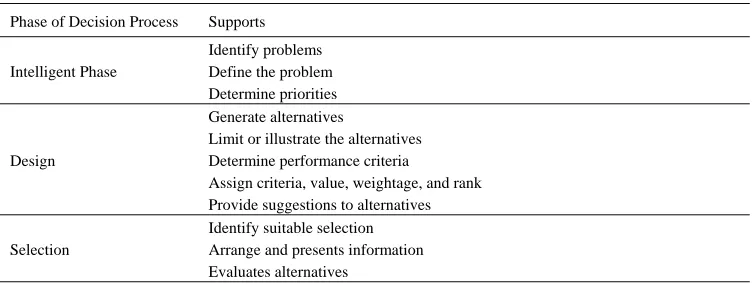
DSS was developed to assist the user to analyze and extract useful information from a large pool of data. It can function in many ways. They can organize information for decision situations, interact with decision makers, expand the decision maker’s horizons, present information for decision makers’ understanding, add structure to decisions and use multi-criteria decision-making models (Kendall and Kendall, 2003). DSS can provide the following support to decision makers (Table 1):
Table 1: Decision Support Provided by DSS
Phase of Decision Process Supports
Intelligent Phase
Identify problems Define the problem Determine priorities
Design
Generate alternatives
Limit or illustrate the alternatives Determine performance criteria
Assign criteria, value, weightage, and rank Provide suggestions to alternatives
Selection
Identify suitable selection Arrange and presents information Evaluates alternatives
4. Decision Methods
Decisions may be structured, semi-structured or unstructured (Kendall and Kendall, 2002). Structured decision involves fixed attributes; it can be easily automated using information systems. Semi-structured decisions involved multiple attributes. Ranking of transfer applicants is considered as a semi-structured decision as it involved the following:
(a) Reasons for application
(b) Support by the school principal
(c) Years of service in other school
(d) Years of service in current school
Multiple-criteria approaches allow decision makers to set priorities, and most allow the decision maker to perform sensitivity analysis by asking what-if type of questions (Kendall and Kendall, 2002). Prioritization of these attributes based on agreed/preset criteria would help the decision maker to rank the transfer applicants objectively. Methods commonly used for semi-structured decisions include weighting methods, sequential elimination by conjunctive constraints, sequential elimination by Lexicography, goal programming and analytical hierarchy processing. The last two methods are not suitable for the problem under study. This paper therefore, focused on the first three methods.
5. Research Methodology
5.1. Current Decision Process on Approval for Transfer of Teachers at DEO
Initial findings showed that the processes were done manually. Information related to requirement of teachers and status of availability using a standard form called the BSKG form. The form listed subjects offered by school, number of teachers required and current state of supply. Information required for transfer applications was obtained from the transfer application forms. In inter school (within the same district) transfer application, each applicant can list two preferred schools, and up to six (6) subjects that he or she can teach. Decisions, however, will normally be based on his/her options.
Currently approval for transfer application is done based on reasons, support by the school principal and vacancies available. DEO’s main concerned is to make sure that school has enough teachers. Matching of options with subjects is of second priority. Fig. 2 illustrates the current decision process.
The end result is schools has enough teachers but discrepancies showed in the subject-option match. If there is an IT system that helps the decision maker identify vacancies by subject-option, and rank the applicants base on his or her attribute, the matching process can be improve. This paper discussed the development of a decision model for ranking of transfer applicants, and how it is use in final approval and placement of transfer applicants
5.2. Attributes and Samples for testing of decision models
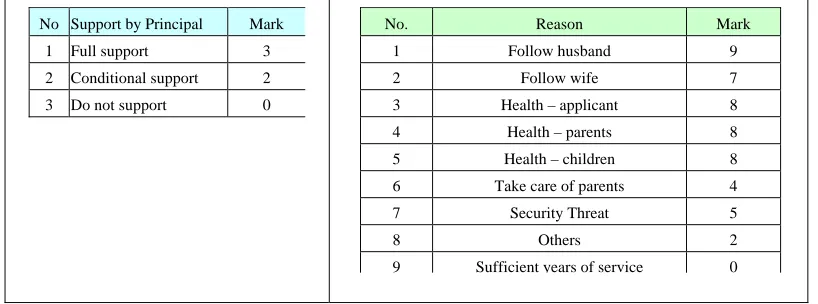
Since support by principal and reasons for transfer application have been identified as the main criteria for application approval, the attributes were listed and marks were assigned accordingly (Table 2).
Table 2. Marks Assigned to Key Attributes for Ranking of Transfer Applicant: Support by Principal and Reason for Application Fig. 2: Current Process for Approval of Transfer Applications
check vacancies in
School 1
Transfer Application 1
2 2
reject application Application Not
Supported by Principal
Application supported by
Principal 3 4
5
Vacancies available
6
Vacancies not available
7
check vacancies in
School 2
vacancies available
9
no vacancies
reject application
1
2
conditions actions
approve transfer application
8
approve transfer application
No. Reason Mark
1 Follow husband 9
2 Follow wife 7
3 Health – applicant 8
4 Health – parents 8
5 Health – children 8
6 Take care of parents 4
7 Security Threat 5
8 Others 2 9 Sufficient years of service 0
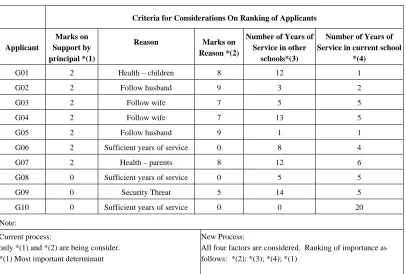
Ten (10) pseudo applicants were created to facilitate creation and testing of decision methods (Table 3). Initially only Support by Principal and Reason for Transfer were used. Subsequently, as the prototype develops, the user requested to include Years of Service in
Current School and Other Schools.
Table 3. Pseudo Transfer Applicants and Their Attributes
Criteria for Considerations On Ranking of Applicants
Applicant
Marks on Support by principal *(1)
Reason Marks on Reason *(2)
Number of Years of Service in other
schools*(3)
Number of Years of Service in current school
*(4)
G01 2 Health – children 8 12 1
G02 2 Follow husband 9 3 2
G03 2 Follow wife 7 5 5
G04 2 Follow wife 7 13 5
G05 2 Follow husband 9 1 1
G06 2 Sufficient years of service 0 8 4
G07 2 Health – parents 8 12 6
G08 0 Sufficient years of service 0 5 5
G09 0 Security Threat 5 14 5
G10 0 Sufficient years of service 0 0 20
Note: Current process:
only *(1) and *(2) are being consider. *(1) Most important determinant
New Process:
5.3. Ranking of Applicants by Weightage Method
In weighting method, the decision maker would list the attributes required for a selection, and assigned an appropriate weightage for the selected attributes. Formula used for weightage method is as follows:
Weighted score for an attribute = marks x weightage
Total Score (for a candidate) = sum (weighted scores)
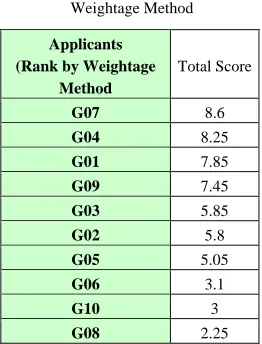
Table 4 lists the applicants, their attributes, marks assigned, weightage and weighted scores, and total score obtained by each applicant. The resultant ranking is shown in Table 5.
Table 4. Ranking of Transfer Applicants by Weighted Score Method
Attributes and Weighted Scores
Transfer Applicants
Reason (R)
Marks for Reason
Weighted Score for Reason
(RS)
Years of service
(other schools)
Weighted Score (YS1)
Years of Service in
current school
Weighted Score (YS2)
Marks on Principal Support
Weighted Score
(PS)
Total (Weighted
Score)
Attribute
Weightage 0.5 0.3 0.15 0.05 1
G01 Health - children 8 4 12 3.6 1 0.15 2 0.1 7.85
G02 Follow husband 9 4.5 3 0.9 2 0.3 2 0.1 5.8
G03 Follow wife 7 3.5 5 1.5 5 0.75 2 0.1 5.85
G04 Follow wife 7 3.5 13 3.9 5 0.75 2 0.1 8.25
G05 Follow husband 9 4.5 1 0.3 1 0.15 2 0.1 5.05
G06 Sufficient years of
service 0 0 8 2.4 4 0.6 2 0.1 3.1
G07 Health - parents 8 4 12 3.6 6 0.9 2 0.1 8.6
G08 Sufficient years of
service 0 0 5 1.5 5 0.75 0 0 2.25
G09 Security Threat 5 2.5 14 4.2 5 0.75 0 0 7.45
G10 Sufficient years of
service 0 0 0 0 20 3 0 0 3
Table 5. Ranking of Applicants by Weightage Method Applicants (Rank by Weightage
Method
Total Score
G07 8.6
G04 8.25
G01 7.85
G09 7.45
G03 5.85
G02 5.8
G05 5.05
G06 3.1
G10 3
G08 2.25
5.4. Ranking Using Sequential Elimination by Conjunctive Constraints
Compare to the Weightage Method, The Conjunctive Constraints approach selects the alternatives available by the other extreme, it eliminates alternatives that failed to meet the constraints. The decision maker sets the constraints, or standards, and then proceeds to eliminate all alternatives that do not satisfy the set of all constraints (Kendall and Kendall, 2003). The list of alternatives selected can be sequentially eliminated by tightening the standards or vice versa.
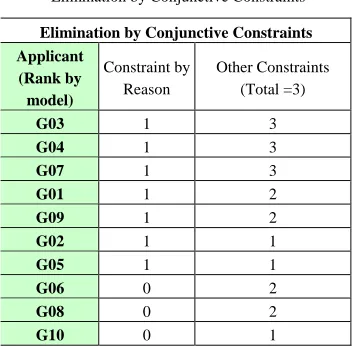
Table 6 lists the applicants and score their attribute as ‘1’ if they passed the constraint, and ‘0’ if they failed. Based on the conjunctive approach, applicants who failed to fulfill the constraints will be eliminated. Therefore, applicant G06, G08 and G10 will be eliminated on the first round. Table 7 showed the ranking of the applicants by Conjunctive Constraints.
Table 6. Sequential Elimination by Conjunctive Constraints
APPLICANT ATTRIBUTES/Conditions for Elimination
Transfer Applicants
Reasons Eliminate ?
Years of Service in
current school
Eliminate ?
Years of service (other
schools)
Eliminate ?
Support by Principal
Eliminate ?
Score >=3 Score >=5 Score >=5 Score >=2
G01 Health - children 8 1 1 0 12 1 2 1
G02 Follow husband 9 1 2 0 3 0 2 1
G03 Follow wife 7 1 5 1 5 1 2 1
G04 Follow wife 7 1 5 1 13 1 2 1
G05 Follow husband 9 1 1 0 1 0 2 1
G06 Sufficient years of
service 0 0 4 0 8 1 2 1
G07 Health - parents 8 1 6 1 12 1 2 1
G08 Sufficient years of
service 0 0 5 1 5 1 0 0
G09 Security Threat 5 1 5 1 14 1 0 0
G10 Sufficient years of
service 0 0 20 1 0 0 0 0
Using this approach, only applicant G03, G04, and G07 passed the selection. The decision maker may relaxed the rule and allows G01 and G09 (who passed the most important constraint, and two out three supporting constraints to pass, and enter the next stage of processing.
However, the weakness of this approach is the decision maker could not rank the applicants. Among the first three applicants who passed all the constraints, who should received the first preference? This method does not provide any answer to this. Table 7. Ranking of Applicants using Sequential
Elimination by Conjunctive Constraints
Elimination by Conjunctive Constraints Applicant
(Rank by model)
Constraint by Reason
Other Constraints (Total =3)
G03 1 3
G04 1 3
G07 1 3
G01 1 2
G09 1 2
G02 1 1
G05 1 1
G06 0 2
G08 0 2
5.5. Ranking Using Sequential Elimination by Lexicography
This method allows the decision maker to overcome the weakness of using weightage method or elimination by Conjunctive Constraints. In this approach, the decision maker rank the applicants in stages, first by the most important attribute (i.e. reason for transfer), followed by the second most important attribute and so on. The resulting ranking of applicants is shown in Table 9.
Table 8. Sequential Elimination by Lexicography APPLICANT ATTRIBUTES
Reason Marks for Reasons
Years of service (other schools)
Years of Service in current school
Marks for Support Transfer
Applicants
Importance 1 2 3 4
G01 Health - children 8 12 1 2
G02 Follow husband 9 3 2 2
G03 Follow wife 7 5 5 2
G04 Follow wife 7 13 5 2
G05 Follow husband 9 1 1 2
G06 Sufficient years of service 0 8 4 2
G07 Health - parents 8 12 6 2
G08 Sufficient years of service 0 5 5 0
G09 Security Threat 5 14 5 0
G10 Sufficient years of service 0 0 20 0
This approach allows the decision maker to group the applicants according to the importance of the attributes, and later, rank them by the marks of the attributes.
5.6. Evaluate the approaches
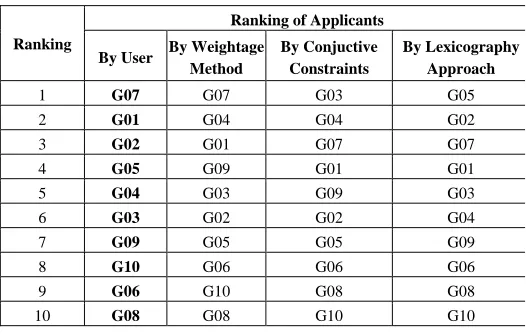
The resulting rankings of the applicants using the three approaches were shown to the user. The user was not satisfied with the rankings. The user was requested to rank the applicants manually according to his ideal (Table 10). From the table it is cleared that none of the current approaches could meet the ideal ranking.
Table 9. Ranking of Transfer Applicants Using Elimination by Lexicography
Applicants (by rank)
Marks for Reason
Years of service (other schools)
Years of Service in current school
Marks for Support
G05 9 5 5 2
G02 9 3 2 2
G07 8 13 5 2
G01 8 1 1 2
G03 7 12 6 2
G04 7 8 4 2
G09 5 5 5 0
G06 0 14 5 2
G08 0 0 20 0
G10 0 0 0 0
Table 10. Ranking of Transfer Applicants by Decision Methods and User Ranking of Applicants
Ranking
By User By Weightage Method
By Conjuctive Constraints
By Lexicography Approach
1 G07 G07 G03 G05
2 G01 G04 G04 G02
3 G02 G01 G07 G07
4 G05 G09 G01 G01
5 G04 G03 G09 G03
6 G03 G02 G02 G04
7 G09 G05 G05 G09
8 G10 G06 G06 G06
5.7. Modified Decision
On further discussion with the user on his choice of ranking, the researcher found out that the user gave equal weightage for ‘health’ reason and ‘follow husband’. The rationale behind the decision is because Kulai is not a big district; schools are not too far away from each other. ‘Health’
problem warrants higher considerations than ‘follow husband’. However, the system should not reduce the marks for ‘follow husband’ for it is the most important reason by policy.
To overcome the constraint, the attribute
‘reasons’ were
regroup based on their perceived importance (Table 11.) Using this approach, the researcher was able to rank the applicants according to the user’s rationale.
Table 11. Ranking using Sequential Elimination by Lexicography (Modified)
Applicant (Rank by new Model) Marks on Reason Marks on Reason (after grouping) Years of service (other schools) Years of Service in current school Marks on Support
Priority 1 1a 2 3 4
Applicant (Manual Ranking by
user)
G07 8 3 12 6 2 G07
G01 8 3 12 1 2 G01
G02 9 3 3 2 2 G02
G05 9 3 1 1 2 G05
G04 7 2 13 5 2 G04
G03 7 2 5 5 2 G03
G09 5 1 14 5 0 G09
G06 0 0 8 4 2 G10
G08 0 0 5 5 0 G06
G10 0 0 0 20 0 G08
6. Propose Process for Processing of Transfer Application
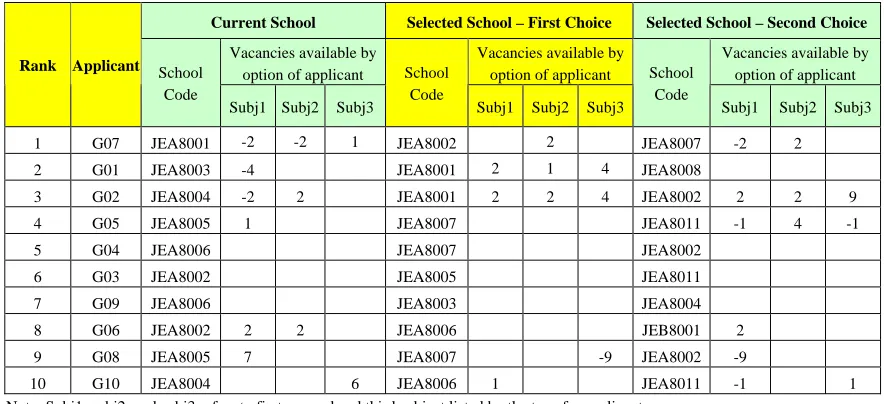
Based on the ranking, the DSS for transfer and placement of teachers would provide an interface that combine the matched data of applicant options and schools subject-teacher requirement (Table 12). The combined data allows an immediate decision on processing of transfer applications. The resulting decision helps to reduce the gap of option-subject mismatch in school.
Table 12. Interface of the DSS for Transfer of Teachers
Current School Selected School – First Choice Selected School – Second Choice
Vacancies available by option of applicant
Vacancies available by option of applicant
Vacancies available by option of applicant Rank Applicant School
Code
Subj1 Subj2 Subj3
School Code
Subj1 Subj2 Subj3
School Code
Subj1 Subj2 Subj3
1 G07 JEA8001 -2 -2 1 JEA8002 2 JEA8007 -2 2
2 G01 JEA8003 -4 JEA8001 2 1 4 JEA8008
3 G02 JEA8004 -2 2 JEA8001 2 2 4 JEA8002 2 2 9
4 G05 JEA8005 1 JEA8007 JEA8011 -1 4 -1
5 G04 JEA8006 JEA8007 JEA8002
6 G03 JEA8002 JEA8005 JEA8011
7 G09 JEA8006 JEA8003 JEA8004
8 G06 JEA8002 2 2 JEA8006 JEB8001 2
9 G08 JEA8005 7 JEA8007 -9 JEA8002 -9
10 G10 JEA8004 6 JEA8006 1 JEA8011 -1 1
Note: Subj1, subj2, and subj3 refers to first, second and third subject listed by the transfer applicant.
Negative number indicates the number of shortages, positive integer indicates exccess number of teachers by subject.
The interface indicate the alternatives available and decisions required from the decision maker: (a) G07 may be transfer to school of second choice, but the vacancies left must be replaced
(b) G01, G02 cannot be transfer to any school. No vacancies available. Current schools also need their services.
(c) G05 should be transfer to school of second choice.
(d) Subject vacancies information is not available for G04, G03, and G09. No decision can be made.
(e) His current school or schools of his selection do not need G06’s expertise. No transfer is probably better.
(f) G08 can be transfer, to either one school of his choice. Probably first preference will be given to school of second choice as the vacancy available matches his first option.
(g) G10 should be transfer to school of second choice. But if Subj1 of G05 and G10 is the same, the vacancies would have been filled by G05. No more vacancies available for G10. Priority is given to G05 as the applicant ranks higher then G10.
The decisions discussed fulfilled the needs of transparent and quality decision on transfer and placement of teachers, every approval and placement move towards reducing the gap of shortage of subject-teacher in school.
7. Conclusion
This paper discussed the testing of three decision methods for ranking of teacher transfer applicants based on individual attributes, followed by matching of applicants options (subj1, subj2 and subj3) with vacancies available for the specific subjects in school. Ranking of applicants ensure that all applicants received a fair consideration based on individual attributes. This ensures transparency and reduces dissatisfaction when application is rejected.
Decision of placement made based on matched value of option-subjects ensures that transfer and placement of teachers complement each other. The process helps to reduce the gap between subject requirement with teacher options in school, the base for quality teaching and learning in school.
The system, however, is limited by of the current requirement practiced. The decision maker needs to consider other factors, such as the balance of male and female teachers, attitudes of applicants, special responsibilities of teachers and presence of problem cases. The final decision will still requires the fine art of balancing through human manipulation. However, the manipulation is now be done with full awareness of situation of option-subject match of applicants with all schools involved – current school and selected schools.
References
Gorry dan Scott-Morton (1971). “A Framework for Management Information Systems.” Sloan Management Review 13, no. 1
Kendall, K.E and Kendall, J.E (2002). Systems Analysis and Design, Fifth Edition. Upper Saddle River, New Jersey: Prentice-Hall International, Inc.
Laudon, K.C. & Laudon, J.P. (2004). Management Information Systems: Managing the Digital Firm. 8th Edition. Upper Saddle River, New Jersey: Pearson Education, Inc.
Simon, H. A. (1960). The New Science of Management Decision. New York: Harper & Row
The Education Planning, Research and Policy Division, (EPRD) (2004). Perangkaan Pendidikan: as of 31 January 2004. Kuala Lumpur: The Education Planning, Research and Policy Division
The Ministry of Education (2002). Pembangunan Pendidikan 2001-2010: perancangan bersepadu penjana kecemerlangan pendidikan. Kuala Lumpur: The Education Planning, Research and Policy Division
The Schools Division (2004). Misi, Objektif, Fungsi dan Piagam Pelanggan Bahagian Sekolah.www.moe.gov.my/jabsek.htm
The Sun 21 May 2001. Shortage of 4000 English Teachers