ABSTRACT
WU, NING. Adsorption and Diffusion of Highly Charged Cationic Polyelectrolyte into Silica Gel Particles. (Under the direction of Martin A. Hubbe and Orlando J. Rojas.)
An understanding and ability to predict permeation behavior is important when applying polyelectrolyte treatments in enhanced oil recovery, papermaking, biomass hydrolysis, catalytic process, chromatographic separation, water treatment etc. In this research, polydiallyldimethylammonium chloride (poly-DADMAC) was used as a probe molecule to investigate major factors affecting penetration of polyelectrolyte into small pores, including time, polyelectrolyte concentration, substrate consistency, molecular mass, pH, conductivity, etc. Streaming potential tests were used innovatively to
understand polyelectrolyte diffusion and adsorption on external surface and in nanopore networks. The magnitude change in streaming potential, which was taken as evidence of permeation, increased with increasing polyelectrolyte dosage, with decreasing molecular mass. Increasing ionic strength tended to enhance adsorption of high-mass cationic polymers on the outer surfaces, but only a relatively small effect on permeation of high-mass cationic polymer into silica gel (nominal pore sizes of 6 nm or 30 nm) was
particles at levels of the above factors. The diffusion slowed down as the extension of the time for adsorption experiment. The adsorbed amount of poly-DADMAC was controlled by both the pore size and the surface area. The highest adsorption amount, based on mass of the substrate, was achieved when using silica gel having an intermediate pore size (15 nm) at a relatively high solution concentration of very-low-mass poly-DADMAC. The results were fit well to an assumed Langmuir model of the adsorption process. Streaming potential tests and streaming current tests may produce different result due to the
difference in measurement principles. Further investigation may be needed for
Adsorption and Diffusion of Highly Charged Cationic Polyelectrolyte into Silica Gel Particles
by Ning Wu
A thesis submitted to the Graduate Faculty of North Carolina State University
in partial fulfillment of the requirements for the degree of
Master of Science
Wood and Paper Science
Raleigh, North Carolina 2009
APPROVED BY:
_______________________________ ______________________________ Dr. Sunkyu Park Dr. Orlando J. Rojas
Committee Member Committee Co-Chair
________________________________ Dr. Martin A. Hubbe
ii BIOGRAPHY
iii
ACKNOWLEDGEMENTS
I would like to express my uttermost gratitude to my chair advisor, Dr. Martin A. Hubbe, for his precious advice, encouragement, patience, and directions in finishing this
research. I also thank my co-adivisor Dr. Rojas, for his many helps, suggestion, and encouragement. Dr. Sunkyu Park is also thanked for his help. I would like to express my sincere appreciation to all the members in the Colloidal and Interfacial Group in the Department of Wood and Paper Science. I also acknowledge our faculty and staff members in this department for all the helps they have provided. I would also like to thank Guillermo Toriz in Mexico for his help with BET tests.
I am very thankful for the financial support provided by a grant from the American Chemical Society Petroleum Research Fund.
iv
TABLE OF CONTENTS
LIST OF TABLES ... vii
LIST OF FIGURES ... viii
Chapter 1 Permeation of Polyelectrolytes and Other Solutes into the Pore Spaces of Water-Swollen Cellulose: A Review ... 1
Abstract ... 1
1. Introduction ... 2
2. Organization of this Article ... 4
3. Overview of Factors Affecting Diffusion and Flow in Pores ... 5
3.1 Pore Attributes: Case of Cellulosic Materials ... 5
3.2 Fluid Attributes ... 15
3.3 Interactions that Affect Flow and Diffusion into Pores ... 18
4. Mechanisms of Diffusion and Flow into a Porous Substrate ... 23
4.1 Pure Water ... 23
4.2 Molecules in Solution ... 31
4.3 Surfactant Solutions ... 33
4.4 Polyelectrolytes in Solution ... 35
4.5 Colloidal Particles in Suspension... 46
5. Enablers for Diffusion and Flow... 51
5.1 Strategies to Widen Cellulosic Pores ... 53
6. Concluding Remarks ... 58
References ... 58
Chapter 2 Permeation of a Cationic Polyelectrolyte into Meso-porous Silica. Part 1. Factors Affecting Changes in Streaming Potential ... 85
Abstract ... 85
1. Introduction ... 85
2. Experimental ... 89
2.1 Materials ... 89
2.2 Dialysis and Gel Permeation Chromatography (GPC) ... 90
2.3 Equilibrium of Adsorbate and Adsorbent ... 91
v
2.5 Streaming Potential Tests ... 92
3. Results and Discussion ... 94
3.1 Repeatability of Streaming Potential Measurements ... 94
3.2 Tests with Dialyzed Poly-DADMAC ... 95
3.3 Effects of Polyelectrolyte Dosage and Molecular Mass ... 97
3.4 Effects of pH ... 99
3.5 Effects of Salt Concentration ... 103
4. Conclusions ... 104
References ... 105
Chapter 3 Permeation of a Cationic Polyelectrolyte into Meso-porous Silica. Part 2. Effects of Time and Pore Size on Streaming Potential ... 110
Abstract ... 110
1. Introduction ... 111
2. Experimental ... 112
2.1 Materials ... 112
2.2 Adsorption Tests by Streaming Potential ... 113
2.3 Desorption Tests by Streaming Potential ... 115
2.4 Desorption Tests by Streaming Current ... 116
3. Results and Discussion ... 118
3.1 Effect of Equilibration Time on Polymer Permeation ... 118
3.2 Evidence of Desorption, and Extrapolation to Zero Time of Desorption ... 119
3.3 Desorption Tests Following Different Concentration and Molecular Mass Exposure ... 122
3.4 Streaming Current Titrations to Evaluate Desorbed Amounts ... 127
3.5 Effects of Large Pore Size, Molecular Mass, and Salt Content ... 128
3.6 Effects of Small Pore Size, Molecular Mass, and Salt Content ... 132
4. Conclusions ... 137
References ... 138
Chapter 4 Permeation of a Cationic Polyelectrolyte into Meso-porous Silica. Part 3. Adsorption Isotherms ... 143
Abstract ... 143
vi
2. Experimental ... 146
2.1 Materials ... 146
2.2 Adsorption Tests ... 148
2.3 Streaming Current Measurements... 149
2.4 Titration Stoichiometry ... 149
3. Results and Discussion ... 151
3.1 Effect of Equilibration Time on Polyelectrolyte Adsorption ... 151
3.2 Effects of Concentration of Poly-DADMAC ... 154
3.3 Effects of pH ... 158
4. Conclusions ... 160
vii
LIST OF TABLES
Table 1. 1 Polyelectrolyte Adsorption as a Factor Related to Permeation ... 22
Table 2. 1 Levels of independent variables and default conditions ... 88
Table 2. 2 Characteristics of silica gel particles ... 90
Table 3. 1 Characteristics of silica gel particles ... 113
Table 3. 2 Levels of independent variables and default conditions ... 114
Table 3. 3 Suppression factors giving relative magnitude of electrokinetic effects within pores, compared to outer exposed surfaces, for various electrolyte conditions and pore sizes.* ... 135
Table 4. 1 Independent variables & ranges ... 146
Table 4. 2 Characteristics of silica gel particles ... 147
viii
LIST OF FIGURES
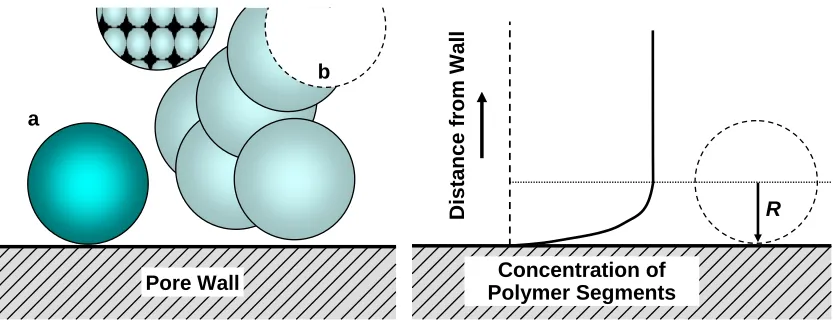
Figure 1. 1. Illustration of the concept of excluded volume. Left: Dissolved polymers modeled as spheres, the centers of which cannot approach closer than one radial length from a smooth wall, but which otherwise are uniformly distributed in the solution. Right: Example of an expected concentration distribution of polymer segments (for instance, if the spheres are taken as being of uniform density of polymer segments). ... 42 Figure 1. 2. Schematic illustration of reptation, a mechanism by which a solubilized
polymer chain can crawl through tortuous pore passages, even if the pore size is smaller than the polymer‟s persistence length. ... 45 Figure 1. 3. Principle underlying faster migration of particles that are repelled by pore
walls during flow of a suspension. Left: The expected parabolic flow velocity profile favors faster movement of particles near the center of flow (a) relative to near the pore walls (c). Right: Particles that are repelled from the walls tend to be enriched near the center of flow (d). Particles that are neither attracted nor repelled from the walls are still influenced by Brownian motion and a hydrodynamic effect that favors movement away from the pore wall (e). ... 50 Figure 2. 1. System for stirring 6 SiO2 gel samples in parallel for comparative testing of
ix
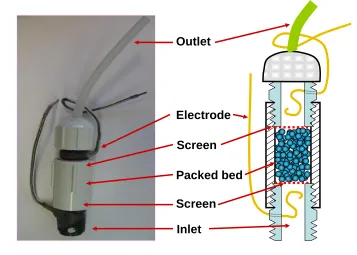
Figure 2. 2. Sample cell for the Streaming Potential Jar (SPJ) apparatus to allow for a “packed bed” format during semi-automated streaming potential tests. ... 93 Figure 2. 3. Results of streaming potential tests at increasing levels of either undyalized
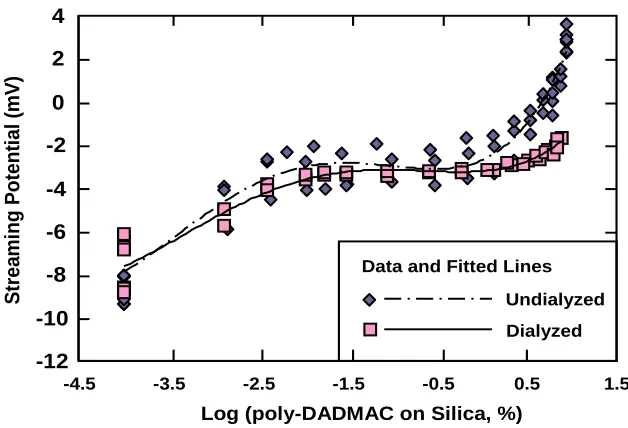
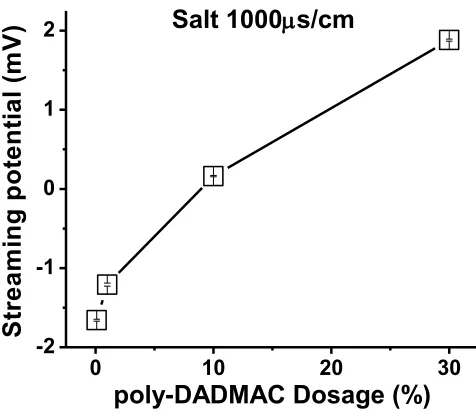
(top curves) or dialyzed (bottom curves) high-mass poly-DADMAC to silica gel suspensions under the default conditions. ... 96 Figure 2. 4. Effect of dosage of high-mass cationic polymer in the bulk solution during
equilibration (relative to the dry mass of silica gel) on the streaming potential measured in the presence of fresh default buffer. Note that the error limits are small relative to the size of the plotted symbols. ... 98 Figure 2. 5. Effect of cationic polymer dosage (very low vs. high mass) on the streaming
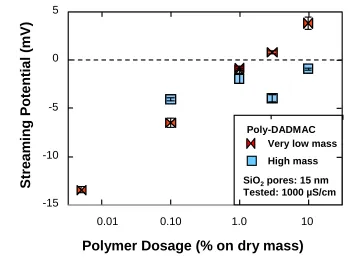
potential of silica gel particles, with tests carried out in the presence of fresh default buffer. ... 99 Figure 2. 6. Effect of pH on the streaming potential of silica gel particles treated with
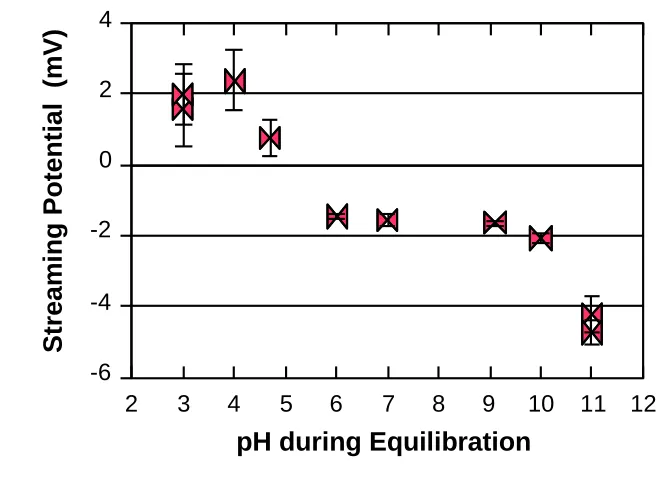
very-low-mass poly-DADMAC and evaluated with fresh default buffer solution. The limit bars shown 95% confidence intervals for the observations. ... 100 Figure 2. 7. Effect of pH on the streaming potential of silica gel particles treated with
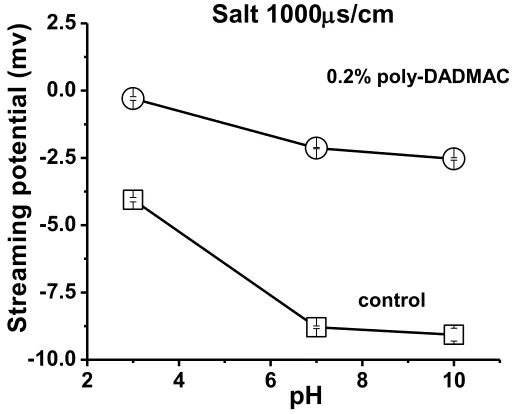
high-mass poly-DADMAC (0.2% level) and evaluated with fresh default buffer. The control tests were without the presence of poly-DADMAC. ... 102 Figure 2. 8. Effect of electrical conductivity during equilibration (adjusted by sodium
very-x
low-mass versus high-mass poly-DADMAC at the 1% level on SiO2 solids
with evaluation carried out with default buffer. ... 104 Figure 3. 1. Effect of equilibration time on the streaming potential of silica gel particles
measured in fresh default buffer. ... 119 Figure 3. 2. Fall-off of streaming potential with time when in fresh default buffer during
streaming potential analyses. Note that the initial streaming potential increased with increasing time of the initial equilibration, before the solids were exposed to polymer-free solution. ... 121 Figure 3. 3. Streaming potential as a function of equilibration time. The streaming
potential value was obtained by extrapolating the data in Fig. 2 to time equal to zero, using the regression results. ... 121 Figure 3. 4. Fall-off of streaming potential with time when in the fresh default buffer
during streaming potential analyses after equilibration of the silica gel with different dosages of very-low-mass poly-DADMAC (based on SiO2 dry mass
for about 20 hours. ... 123 Figure 3. 5. Fall-off of streaming potential with time when in the fresh default buffer
during streaming potential analyses after equilibration of the silica gel with different dosages of high-mass poly-DADMAC (based on SiO2 dry mass) for
about 20 hours. ... 125 Figure 3. 6. Desorption amount of very low mass poly-DADMAC from SiO2 with 15nm
xi
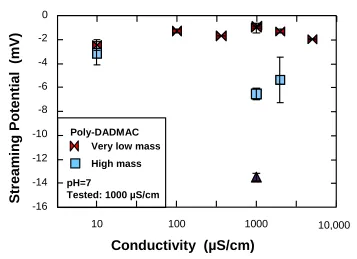
Figure 3. 7. Effect of electrical conductivity during equilibration with poly-DADMAC of very low vs. high mass on the streaming potential of the outer surfaces, later measured with fresh salt-free buffer solution on silica gel having 30 nm a pore size. ... 129 Figure 3. 8. Effect of electrical conductivity during equilibration with poly-DADMAC of
very low vs. high mass on the streaming potential (with the major contribution to effect coming from pre surfaces) the later measured with fresh 1000 µS/cm buffer solution on silica gel having 30 nm a pore size. . 130 Figure 3. 9. Results for salt-free system with smaller pores: Effect of electrical
conductivity during equilibration with poly-DADMAC of very low vs. high mass on the streaming potential of the outer surfaces, later measured with fresh salt-free buffer solution on silica gel having 6 nm a pore size. ... 133 Figure 3. 10. Same system as the previous (6 nm pore size), but with streaming potential
evaluation in the presence of 1000 µS/cm buffer solution. ... 135 Figure 3. 11. Same system as the previous (6 nm pore size), but with streaming potential
evaluation in the presence of 8000 µS/cm buffer solution. ... 137 Figure 4. 1. Adsorption kinetics curve for high mass poly-DADMAC on S15 and S30 .. 152
Figure 4. 2. Adsorption kinetics curve of very low mass poly-DADMAC on S6, S15, S30
... 153 Figure 4. 3. Very low mass poly-DADMAC adsorption isotherm on S6, S15, and S30. .. 155
xii
Figure 4. 5. Adsorption isotherm of high mass and very low mass poly-DADMAC on silica gel (pH 7, 1000µs/cm) with pore size of 30 nm. ... 157 Figure 4. 6. Adsorption curve of very low mass poly-DADMAC on 15 nm silica gel at
1
Chapter 1 Permeation of Polyelectrolytes and Other Solutes into the Pore Spaces of Water-Swollen Cellulose: A Review
Abstract
The rate and extent of transport of macromolecules and other solutes into cellulosic materials and fibers have important applications in such fields as papermaking, textiles, medicine, and chromatography. This review considers how diffusion and flow affect permeation into wood, paper, and other lignocellulosic materials. Because pore sizes within such materials can range from nanometers to millimeters, a broad perspective will be used, also considering some publications related to other porous materials. Factors that limit the rate or extent of polymer or other solute transport into pores can involve thermodynamics (affecting the driving motivation for permeation), kinetics (if there is insufficient time for the system to come to equilibrium), and physical barriers. Molecular flow is also affected by the attributes of the solute, such as molecular mass and charge, as well as those of the substrate, such as the pore size, interconnectedness, restricted areas, and surface characteristics. Published articles have helped to clarify which of these factors may have a controlling influence on molecular transport in different situations.
2 1. Introduction
Permeation of macromolecules and other dissolved or suspended matter from aqueous solution into cellulosic material is important in the manufacture of paper, in the sizing of textile fibers, in filtration, in various types of absorption processes, and in the manufacture of cellulosic composites or nanocomposites. In each of these domains it is important to understand factors that affect the degree to which molecules, ions,
surfactants, polyelectrolytes, or colloids penetrate into the interior pores of lignocellulosic matter. Polyelectrolytes are of particular interest. In papermaking, often it is considered advantageous for polyelectrolytes to remain at or near to the outer surface of cellulosic fibers, thereby maximizing their contributions to various processes, such as fine-particle retention, dewatering, or the development of inter-fiber bonding. In the textile industry surface-finishing with polymers and other additives is important for fiber processing and use. In bioethanol production the diffusion of enzymes determines the efficiency with which cellulose hydrolysis can take place. In the wood industry it is important to
understand the permeation of preservatives, components of surface finishes, and even of rot-related enzymes.
3
et al. 1997). The interior part of the wood chips is not easily reached by chemicals. Thus, short contact times of wood chips with reactive liquor may result in non-uniform cooking of cellulose pulp. Polymer permeation phenomena also are important in fields such as enhanced oil recovery; polymers may be used to influence the channeling of flow through oil-containing strata (Babadagli 2007).
Publications considered in this review article provide evidence of factors and mechanisms that affect the rate or extent to which solute transport occurs into the fine pores of cellulosic materials. The review takes advantage of the fact that relevant work also has been carried out with such materials as silica gel, mineral beds, and plastic materials. Emphasis will be placed on charged polymers, especially in cases where opposite charges contribute to a driving force favoring permeation. For completeness, such situations will be contrasted with cases where adsorption may be favored by changes in entropy accompanying permeation and adsorption. Both bulk transport by convection and molecular diffusion will be considered. Aspects of the fine-scale porosity, pore sizes, and interconnectedness of pores within cellulosic materials (tortuosity) also will be considered.
4
et al. 2007; Kamke and Lee 2007; Chavez-Rojo et al. 2008). Also it is worth noting several articles dealing with nonuniformities in transport rates through packed columns, which can result in “tails” in eluted solutes (Newman and Walker 1992; Kosakowski 2004; Obi and Blunt 2004; Delgado 2006).
2. Organization of this Article
This article is organized into three main sections, the first of which deals with factors that can affect permeation. Emphasis is placed on publications reporting practical observations. Factors affecting permeation, relating to the nature of the pores, the fluids, and interactions at interfaces, tend to apply for a broad range of applications; therefore citations will be considered from diverse fields.
The next main section considers mechanisms of permeation, with emphasis on flow and diffusion. Flow can be defined as movement of a fluid phase relative to its surroundings. Diffusion can be defined as a mechanism by which transport is driven by a gradient in concentration. In many practical situations transport of solutes will result from a combination of diffusion and fluid motion. Flow is important in cases where liquid moves either into or through a porous material; in such cases the moving fluid may or may not be able to carry along various dissolved or entrained substances. As will be discussed, barriers related to entropy, charge, or physical inaccessibility may tend to exclude the polymeric material in some instances.
5
a third section of this article will be devoted to “enablers” of permeation. An enabler is defined here as anything that promotes either more rapid or more complete penetration, either by flow or by diffusion through aqueous solution.
3. Overview of Factors Affecting Diffusion and Flow in Pores
Various factors can affect the progress of dissolved or very finely suspended substances into porous media. These factors generally can be grouped into the pore attributes, the nature of the fluid (carrier), and the interactions between the fluid medium and the solids, including any dispersed substances (soluble, colloidal, or particulate) (Lönnberg et al. 1992; Lebon et al. 2006). The complexity of diffusion and flow in pores involves many branches of science, of which thermodynamics deserves special attention. Variables of interest for diffusion and flow in pores include the set of classical variables, e.g. mass, momentum, and heat, as well as the corresponding fluxes of these quantities. 3.1 Pore Attributes: Case of Cellulosic Materials
Cellulose is a porous material, especially when it is wet with water. Many applications of cellulose involve its interaction with fluids that flow or diffuse into its porous structure. Knowing the physical-chemical structures and attributes of these pores helps to understand associated interactions of cellulose‟ surface with fluids and provides guidance for related applications. For instance, Kamke and Lee (2007) have considered many such factors in their review of adhesive penetration into wood.
6
Permeability of cellulosic materials can be expected to increase with increasing pore size or with the removal of obstructions from pores. For instance, alkaline conditions tend to promote more rapid penetration into cellulosic materials (Scallan 1983); this has been attributed to increased swelling, an effect that can increase the sizes of pores.
There are at least two classes of pores within different types of cellulosic materials. Relatively large pores, often in the range of 0.1 to 100 µm, may exist either between the fibers (as in the case of paper products) or inside the fibers (i.e. the uncollapsed lumens of fibers in wood). Relatively small pores will be present within the cell walls of the fibers. The sizes of the latter pores have been the subject of considerable interest and discussion. Elegant work by means of the solute exclusion principle was used as evidence for pores in the cell walls of never-dried sulfite fibers having widths generally in the range of 2 to 20 nm (Stone and Scallan 1968). However, these estimates were later disputed as being too low, since the analysis was said not to take into account various entropic factors (Alince and van de Ven 1997). Based on adsorption of polyelectrolytes, the latter authors concluded that the pores in never-dried chemical pulps should mostly be larger, possibly 40 to 100 nm. Analyses of penetration into cellulosic materials also need to take into account the effects that the diffusing solution may have on the swelling, and thus the pore sizes within the material.
7
vehicle though a surface of a paper. In such cases a higher amount of micro-pores near the surface of paper may allow more ink pigments to be held near the paper surface, and this would be expected to result in a higher density of the printed image. It was noted that different micro-pore systems imbibe liquids at different rates, depending on their geometries. For instance, converging pore features can promote more rapid permeation, whereas sharply diverging features, as one passes toward the interior of a porous material, can act as blocks to capillary penetration.
Pore Volume
The fractional porosity can be defined as the ratio of the voids volume to the total volume of that material. In other words, porosity represents the storage capacity. However, a high porosity doesn‟t necessarily mean that the material has a high permeability, since the void spaces may be either interconnected or isolated. To give an example from geology, shales tend to have high porosity but very low permeability due to the poorly interconnected voids. By contrast, sandstones generally can have both high porosity and high permeability.
8
expected to be more important than flow through fiber lumens and pits (Stone and Green 1958).
Flow also can occur through the cell walls of cellulosic materials, especially when the material is water-saturated. The mesopores within cellulosic material tend to become somewhat enlarged during pulping operations due to the combined influences of swelling of the material and removal of lignin-rich domains, leaving behind the spaces once occupied by these domains (Berthold and Salmén 1997). The shapes and connections within the pore structure can be expected to change also as a result of mechanical refining of cellulosic pulps. When the pulp has been dried, some of pores will be irreversibly closed (Stone and Scallan 1966).
Dimensions of the substrate
9
Tortuosity can be loosely defined as the ratio between the average distance that fluid has to travel to get through a material, compared to an imaginary straight-line distance. One way to quantify tortuosity of a non-conductive porous solid is by measuring the net conductivity when it is saturated with a salt solution of known bulk conductivity (Barrande et al. 2007). There also have been attempts at numerical simulation of tortuous pathways through a compact bed of particles (Ito et al. 2003). High tortuosity generally means that there are many twists and turns within the pore spaces.
In the case of pine and aspen wood, Jacobson and Banerjee (2006) estimated a tortuosity of 1.6, relative to the diffusion of the same aqueous solution in the absence of wood. A somewhat higher value for aspen, relative to pine was attributed to a finer fiber structure. Leyvaramos and Geankoplis (1994) obtained a tortuosity value of 3.5 for activated carbon, a material that can retain various structural features related to its origin as wood.
10
Törnqvist et al. (2001, 2004) measured the progress of HS- ions through individual wood chips, when pulping liquor was placed on one side of the chip and deionized water was placed on the other. Though the movement of the front of ions (the drift speed) was similar to what was predicted by ion diffusions rates, there also was evidence that the nature of the pulping chemicals changed to degree of swelling of the pores in the chip. Pore orientation
11
different diffusion periods) of the treated samples was measured using a slicing technique.
Directional dependencies have been observed also in the case of pressure-induced flows through wood material. Stamm (1953) cited studies showing that flow in the direction of fibers can be 50 to 200 times greater than flow perpendicular to the fiber orientation under matched conditions. Sernek et al. (1999) studied the penetration of a liquid urea-formaldehyde adhesive (UF) into beech (Fagus sylvatica L.) wood. They found that penetration in the tangential direction was greater than in the radial direction. They also concluded that external pressure can expedite penetration.
Another factor that can affect permeability of a porous material in different directions is the presence of channels, cracks, or fractures (Wallstrom and Lindberg 1999; Zvikelksy and Weisbrod 2006; Maatinen and Tikka 2008). It has been shown that a disproportionate amount of fluid may pass through such favorable routes, especially when one is concerned with colloidal matter (Kjaergaard et al. 2004a).
Interconnectedness
12
To predict effects of interconnectedness on diffusion of polymers in solution, Gauthier and Slater (2008) proposed a new one-dimensional lattice Monte Carlo algorithm that considered the polymer as single Brownian diffusing particle. They integrated various effectssuch as the entropic forces acting on the polymer segments that are outside the channel, the external forces that are pulling the polymer through the pore, and the frictional effects (inside and outside the pores) involving the polymer chains and their environment.
Pinch-points
The velocity of an incompressible Newtonian fluid passing through a smooth cylindrical pore under a specified pressure, assuming laminar flow, is proportional to the square of the radius. It follows that if a channel contains portions in which the radius is smaller, such restricted areas will have a disproportionate effect on the overall resistance to flow. For permeation in solid wood, one of the best examples of a pinch-point consists of the pit junctions that join fiber lumens (Meyer 1974). It has been shown that pretreatment with cellulase enzymes can break down the pit membranes that obstruct flow through the lumen network within wood (Jacobs-Young et al. 1998); such treatment was found to greatly increase the penetration rates of pulping liquors, especially in the direction of the fibers within a chip.
13
(e.g. elongated or stretched) in order to pass through the pore, then one can expect an additional contribution to flow resistance (Andrews et al. 1998; Odell and Haward 2008). If a pinch-point is small enough to effectively prevent a polyelectrolyte molecular from passing through, then the molecule may have to take a more circuitous path, effectively increasing the tortuosity in terms of that substance (Olson et al. 2005).
Wettability
14
Rabinovitch 1958; Malkov et al. 2003; Törnqvist et al. 2004). In principle, the same effect could be achieved by applying vacuum to wood before addition of a penetrating liquid (Stamm 1953).
The surface free energy of cellulosic surfaces can be expected to have a major impact on permeability of liquids into initially dry material. Dourado et al. (1998) showed that rates of wicking can be used as a sensitive means of determining the free energy of microcrystalline cellulose. The system‟s capillary force can be basically described in terms of two variables, the radius (or an equivalent radius) of the capillary, and the interfacial surface energies of the solid-liquid-gas interfaces. When the interfacial surface energies change, the contact angle (meniscus shape) and consequently the pressure difference across a liquid-gas interface will change to reestablish equilibrium.
15
a fabric than by the finish applied. Lin and Jorge (2005) modeled the wicking of liquid through paperboard, taking into account various properties of both the liquid and the solid surfaces.
Ershov et al. (2003) showed that polyelectrolytes can have a subtle effect on wettability when their solutions are allowed to flow into quartz capillaries. The polyelectrolytes did not affect the surface tension at the air-liquid interface. However, large hysteresis effects were observed when comparing advancing vs. receding contact angles; these effects were attributed to the formation of a polyelectrolyte film on the quartz surfaces.
3.2 Fluid Attributes
16
Flow fields can affect the conformation of an adsorbed polyelectrolyte, depending on the flow and shear rate relative to the wall of a pore (Fleer et al. 1993). Adsorbed chains can be either deformed by the fluid field (compressed against the substrate, or stretched in the flow direction) or desorbed from the substrate. This is especially important if the flow rate is sufficiently high and the polymer used has high molecular mass or is strongly swollen. Under some conditions in which adsorption is relatively weak, it is expected that polymer chains that first are stretched by a flow field would subsequently become adsorbed in higher amounts and adhere the substrate more tenaciously. Experiments have shown that hydrodynamic thickness can depend on flow-rate. Similarly, it is reasonable to expect that flow-induced changes to conformation may have an effect on pore penetration.
Viscosity
17
Dissolved polymer attributes that can affect permeation
The adsorbed amount of polyelectrolytes within cellulosic fibers or other porous media depends on the molecular mass of the polyelectrolyte. A decrease in molecular mass tends to increase the adsorbed amount. This rule holds true for many cationic water-soluble polyelectrolytes, such as polyethyleneimine, cationic dextran, and polydiallyl-dimethylammonium chloride (Wågberg 2000). By contrast, earlier work by Tatsumi and Yamauchi (1997) showed that a high-mass cationic copolymer of acrylamide remained mostly on the outer surfaces of cellulose fibers in solution. A distribution of molecular mass of the polyelectrolyte implies that some of the material can reach different sites within the fine-scale porous structure of a cellulosic substrate. However, because polyelectrolyte diffusion into porous media involves conformational changes, in addition to the strength of interaction with substrate surfaces, it is possibly misleading to attribute such effects to size considerations alone.
18
By contrast, increased diffusion into cellulose fiber cell walls was observed with increasing salt content of the solution. The adsorbed amount increased roughly in proportion to the logarithm of elapsed time in contact with the polyelectrolyte solution.
One of the most intriguing findings of the cited work was that cationic polyelectrolytes adsorbing near to the surface of the cellulosic fibers did not appear to progress further into the cellulose with the passage of time (Horvath et al. 2008). Rather, the initial adsorbing macromolecules became more or less fixed in location, and later-arriving macromolecules had to diffuse past the already-adsorbed molecules.
Another event that can arrest the flow of polyelectrolyte-containing solution through the channels of a packed bed is the formation of polyelectrolyte complexes (De et al. 1997). The cited authors found that because the complexes required sufficient space in which to form, they tended to precipitate within relatively large pores of a packed bed, leaving the smaller channels in the bed relatively free of obstructions to flow. In this way, the formation of polyelectrolyte complexes could be used as a means of directing more of the flow towards smaller channels.
3.3 Interactions that Affect Flow and Diffusion into Pores
19
affect the swelling of the material, thus affecting pores size. And third, the solute may either be attracted or repelled from the surfaces; the strength of adsorption of solute molecules onto the pore walls can be expected to affect surface charge, and in some cases adsorption can have a significant effect on the remaining open area for solution and solutes to pass through constricted areas of the pore network.
The work of Sekine and Nakatani (2002) provides a good example of how the charged nature of a solute can promote its permeation into porous material. The role of electrostatic attractions between a cationic dye and the negatively charged internal surfaces of silica gel were demonstrated by varying the pH and ionic strength. Greater dye permeation and sorption occurred at higher pH, conditions that favor a stronger negative charge at the silica surface. Less permeation occurred at higher ionic strength, consistent with a weakening of electrostatic effects. Permeation was also strongly affected by the pore size of the silica gel (Sekine and Nakatani 2004). An apparently increasing diffusion constant of dye molecules was observed for increasing pore size of the substrate.
Interactions that may affect pore size
20
and Carlsson 1982; Scallan 1993). By shortening the range over which electrostatic forces of repulsion can act, the carboxyl groups that are found in many cellulosic materials become less effective in swelling the material. What is less often noted is that such salt effects can have an opposite trend at the limit of very low levels of ions in solution. Thus, relatively low levels of swelling have been observed in cases where deionized water has been used to suspend ion-free cellulosic fibers (Fält and Wågberg 2003; Li and Dai 2004). The latter observations have been attributed to a mismatch between the size of the available pore spaces and the space required for the existence of counter-ions in a diffuse double layer (Hubbe 2006).
21
electrolyte concentration, since double-layer thickness becomes very small in the presence of salt ions (Hiemenz and Rajagopalan 1997).
Interaction effects of polyelectrolytes
The degree to which a polyelectrolyte is either attracted or repelled from a substrate can have manifold consequences relative to its permeation. Before considering other, more subtle effects related to permeation, it can be useful to review how charge characteristics of a polymer and substrate are likely to affect adsorption. There often is a mechanistic relationship between a polymer‟s adsorption characteristics and its rate or extent of permeation.
In the case of a charged polymer one can expect mutual repulsion between the like-charged segments. This repulsion can oppose accumulation in a surface region. A surface can carry a charge as well, and it is expected that changing the environmental conditions such as pH, salt concentration, etc., would change the number of active surface sites. In particular, an increase in salt can decrease the energy penalty resulting from charge accumulation at a surface. But at the same time, increasing salt will tend to weaken electrostatic interactions between a charged polymer segment and an oppositely charged site on a substrate.
22
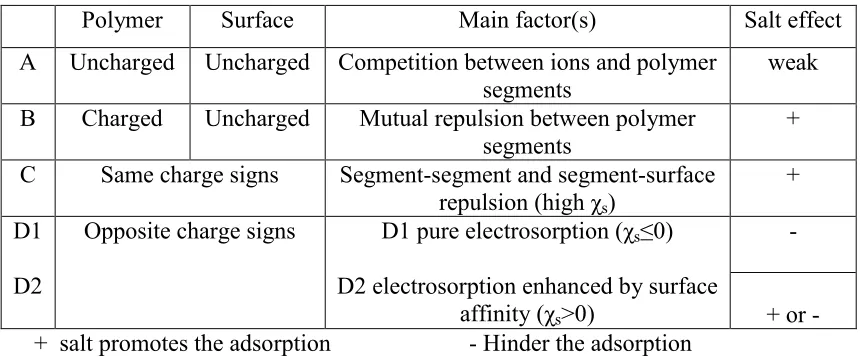
expected to affect adsorption, with special attention paid to the effects of salt addition. The quantity χs in Table 1.1 is the adsorption energy parameter, given by the difference in
adsorption energy of the solvent vs. that of the polymer, all divided by the thermal energy kT. Spontaneous adsorption from the solvent onto the substrate occurs if χs has a positive value (Fleer et al. 1993).
Table 1. 1Polyelectrolyte Adsorption as a Factor Related to Permeation
Polymer Surface Main factor(s) Salt effect
A Uncharged Uncharged Competition between ions and polymer
segments weak
B Charged Uncharged Mutual repulsion between polymer
segments +
C Same charge signs Segment-segment and segment-surface repulsion (high χs)
+ D1
D2
Opposite charge signs D1 pure electrosorption (χs≤0) D2 electrosorption enhanced by surface
affinity (χs>0)
-
+ or - + salt promotes the adsorption - Hinder the adsorption
23
hinder the adsorption. As this kind of electrostatic forces can be screened by salt ions, it is reasonable to expect results to be affected by the type of ions, their concentrations, as wells as the pH.
4. Mechanisms of Diffusion and Flow into a Porous Substrate
The previous section highlighted examples showing the effects of different factors on the permeation of polyelectrolytes and other substances from solution into porous materials. A number of mechanisms were mentioned to account for these effects. The present section considers some of these mechanisms in greater detail. By applying such concepts, permeation phenomena can be understood as an overlapping set of thermodynamic, kinetic, substrate morphological, and mechanical considerations that together govern the location of a polyelectrolyte as a function of time.
The fluid phase will be considered first. The fluid system may be a single phase, such as pure water, an aqueous solution, or multi-phase (such as water with air or oil, or others). In the case of multiple phases, the fluids might be immiscible or miscible. Solutes can significantly affect flow behavior. The discussion below will start with simple cases and works toward more complicated cases.
4.1 Pure Water
24
permeation into porous solids can be expected to occur by means of diffusion and/or flow.
Diffusion (ordinary and anomalous)
Though many details of diffusion theory are beyond the scope of this article, some general concepts can be summarized. Diffusion phenomena generally obey Fick‟s first law (1855), which for the flux of a selected substance in an isotropic material can be written as,
Jx = - D ( C/ x) (1)
where D is the diffusivity constant, C is the concentration or number density, and x is the distance in the direction perpendicular to the gradient of concentration. This relationship follows from a “random walk” analysis of motions at the level of individual particles or molecules undergoing the diffusion process. The diffusion constant is generally related to the thermal energy of the system (i.e. the temperature), the viscosity of the fluid, and the size of the particle. In the case that a diffusing particle can be described as a sphere, its diffusivity is given by the Stokes–Einstein relation,
D = k T / [ 6 r ] (2)
where k is the Boltzmann constant, T is the absolute temperature, is the solution viscosity, and ris the particle‟s radius.
25
increasing temperature. Robertson and Lönnberg (1991) observed, however, that rates of diffusion of solutes in wood increased with temperature according to an Arrhenius relationship, suggesting that the rate-limiting step involved overcoming of an energy barrier (see also Stamm 1959).
26
The term “anomalous diffusion” has been used to describe the mobility of water that is very close to a solid surface. Mitra et al. (2001) employed quasi-elastic neutron scattering to distinguish between different types of water within porous alumina having a mean pore size of 5 nm. Some of the water appeared to be essentially bound to the solid surfaces. Other water displayed restricted diffusion. Ironically, the results showed higher self-diffusion rates of the non-attached water within small pores at temperatures near of below the freezing point of bulk water, suggesting that freezing did not occur within the pores of alumina under the conditions of testing. In other words, the water within the tiny pores appeared to be super-cooled liquid below the freezing point of bulk water. These ideas are consistent with the findings of Weise et al. (1996) and Maloney et al. (1998), who used differential scanning calorimetry to quantify the amounts of bulk-like water, freezing bound water, and non-freezing bound water within the small pores of fiber cell walls. Nakashima (2003), who used a spin-echo type NMR method, reported similar observations in the case of clay suspensions of the type that delaminate to a great extent in suspension. Topgaard and Soderman (2001), who used a similar approach to study wetted paper, obtained information about the pore structure within fibers. Tovbin (2005) carried out numerical simulations that helped to support the interpretation of data from these types of observations. Likewise Kim et al. (2005) concluded, based on numerical simulations, that simple fluids would experience restricted diffusion when the pore size was less than twice the diameter of the diffusing molecules.
27
In the simplest case of an incompressible Newtonian liquid entering a smooth, cylindrical pore under laminar flow conditions, the average fluid velocity can be estimated by considering the contributing effects of viscous resistance to flow, capillary pressure, and any externally applied pressure. For a cylindrical capillary the viscous resistance to flow can be expressed in terms of a pressure as,
Pviscous = 8 v L / R2 (3)
where is the viscosity of the fluid, v is the average velocity in the pore, L is the wetted length of pore, and Ris the pore‟s radius. The capillary pressure is given by
Pcapillary = 2 cos / R , (4) where is the tension at the air-liquid interface and is the angle of contact between the liquid and the solid (measured through the liquid phase). In cases where only capillary and viscous forces are opposing each other, these two expressions can be set equal to each other, yielding the following expression,
dL / dt = R cos / [ 4 L ] (5) where L is the distance that the liquid already has penetrated into the pore and t is time. Equation 5 then can be integrated to give the well-known Lucas-Washburn equation,
L = {(2r LV cos t /(4) } ½ (6)
28
L = {[(2r LV cos + Pappl. r2 ] t /(4) } 1/2 (7) where Pappl is the applied pressure difference between the liquid phase and the interior of a porous material.
Because the foregoing equations were based on simple, cylindrical pores, one would not necessarily expect that they could be applied to real cellulosic materials. Nevertheless, the square-root dependency of penetration depth vs. time, as predicted by Eq. 6, has been observed in the case of low-surface-energy fluids penetrating into paper (Bristow 1967; Lyne and Huang 1993). Deviations from that relationship have been attributed to surface roughness of paper and to delayed wetting of cellulosic surfaces due to gradual rehydration (Lyne and Aspler 1982). In addition, it has been shown that the liquid-gas interfacial tension term LV can be strongly time-dependent; thus, values of LV determined under quasi-static conditions, as with a Denouy tensometer, are not necessarily expected to give accurate predictions for rapid wetting phenomena, as occur during lithographic printing (Aspler et al. 1987). The discrepancy was attributed to the fact that surfactant molecules may require time to migrate to an interface, especially if the interfacial area is being created at a relatively rapid rate.
29
can be expected if the conventional boundary assumptions are replaced by a “partial slip” condition. It was proposed that their calculated results could be used to establish whether such boundary conditions provide a useful description of any real systems.
Capillary forces (and geometrical effects)
Interfacial tension is the amount of work per unit area that has to be done in order to separate one phase, say a liquid, from another phase, say, a solid, gas, or another immiscible liquid. Interfacial tension comes from the inward attraction of the molecules towards the interior of a substance upon those on the surface. The work required to separate a unit area of a solid from a liquid is related to the corresponding surface and interfacial tensions by,
WSL =γS + γL–γSL (8)
where the subscripts refer to the solid-gas, liquid-gas, and solid-liquid interfaces.
Capillary forces resulting from interfacial tensions may cause a fluid to penetrate into small spaces that are filled with another liquid or air. As discussed by Senden et al. (2000), significant research in this area started in the 1950s. Calderwood and Mardles (1955) studied the rate of flow of liquids into capillaries. Tollenaar (1954) investigated the rise of liquids into a wedge-shaped crevice.
30
(Eq. 6) to obtain an “imbibition-equivalent” pore size. Although it is difficult to relate pore sizes measured in this way to the real geometry of a fiber mat, it would nevertheless be valuable to seek empirical correlations to such variables as fiber diameter and packing density. Pre-wetting of the porous substrate was found to decrease the rate constant for subsequent imbibition. Bousfield and Karles (2004) likewise were able to use simpli-fying assumptions to model the capillary penetration of printing ink vehicle and related fluids into porous coatings on the paper surface.
Thermal transport of water through cellulosic material
31 4.2 Molecules in Solution
Another layer of complexity needs to be considered when the liquid phase contains a solute, even in cases where the solute molecules are very small relative to the size of pores. For instance, many researchers have studied the diffusion of metal ions in cellulosic (Cooper 1998; Ra et al. 2001, 2002; Davis and Van Hise 2006; Srivastava et al. 2006) and other porous materials (Osaki et al. 1993; Kunetz and Hench 1998; Tantemsapya and Meegoda 2004; Fisher and Eizenberg 2008). In bulk solution the diffusion of ions in aqueous solution can be expected to be proportional to a concentration gradient; in other words, rates of diffusion ought to obey Eq. (1). Diffusion generally can be explained in terms of a “random walk” process, which over the passage of time would be expected to yield a more uniform concentration.
Ion exchange
32
of cellulosic materials have been found to vary within wide limits, depending on conditions of preparation and purification (Herrington and Petzold 1992).
Osaki et al. (1993) found that the diffusion coefficients of Sr and Co in silica gel layers decreased with the second power of porosity. If the porosity was kept constant, the diffusion coefficients depended on the distribution coefficients (K) of Sr and Co between silica gel and water in pores as a function of 1/(1 + K) at various pHs. Kanungo and Collinson (2003) observed that the diffusion rates of some ions were the same in silica gel medium, compared to the bulk solution, whereas other ions displayed sharply reduced diffusion rates in the gel. The latter effect was attributed to relatively strong molecular interactions.
Cooper (1998) found that the diffusion coefficients of copper in wood samples were about 1/10 to 1/10,000 times those of water molecules, depending on pH and temperature conditions. Durr et al. (2005) studied the adsorption of ruthenium-dye molecules out of ethanol solution onto and through nanoporous TiO2 films. They found
these diffusion constants through the fine porous network were up to three orders of magnitude lower than in bulk ethanol; the results were discussed with respect to the material properties and pore structrure.
33 4.3 Surfactant Solutions
Surfactants can be expected to have an especially large effect on transport into or through porous materials in cases involving more than one fluid phase, e.g. water and air or water and oil. However, it is not always legitimate to expect well-established laws governing macroscopic aspects of capillarity to remain true for interactions at the submicroscopic level. Thus Starov et al. (2004) considered spreading of small liquid drops over thin dry porous layers. They proposed that drop motion over a porous layer is caused by interplay between the two processes of spreading (expanding of the drop base) and imbibition (drop shrinkage during expansion of a wetted region inside the porous layer). If the mean pore size was below a critical value, then the permeability of the porous medium was not influenced by the presence of surfactants, whatever the value of the concentration. If the mean pore size was larger than the critical value, then the permeability increased with increasing surfactant concentration. Such results suggest that surface-active agents require a certain minimum of space in order to exhibit the kinds of effects that can be observed as a macroscopic scale.
34
membrane permeability. It was proposed that the sorption of the diffusing substances largely depends on van der Waals interactions instead of electrostatic forces.
Surface diffusion
In cases where solute molecules are attracted to pore wall surfaces it is reasonable to consider whether such solute material can migrate while in contact with the surface (Alanissila and Ying 1992; Ho et al. 2000; Choi et al. 2001). As a prime example, it is reasonable to expect cellulase molecules to diffuse along cellulosic surfaces (Jervis et al. 1997). Such “surface diffusion” also has been proposed to explain rates of permeation of direct dyes into water-swollen cellulose membranes (Gutsche and Yoshida 1994; Maekawa et al. 1995).
Emulsification
35
oil was proposed as the main washing mechanism. Supplementary mechanisms of oil removal were dispersion of oil (due to reduced surface tension), and the solubilization of oil by surfactant micelles.
Vesicles, which can be described as droplets defined by surfactant bilayers, can serve as models for biological cells. Linke et al. (2006) carried out a theoretical study of their passage through fine pores. Rates of passage were predicted based on the thermodynamic fluctuations of the membrane shape, and also the requirement of water to pass through the bilayer in order for the vesicle to be small enough to get past narrow points in the pore.
Multiphase flow in porous media
Complex interactions take place if an immiscible mixture is forced through an array of capillaries. As a general rule, a given channel can be expected to contain a single fluid phase, and other components of an immiscible mixture will generally be found in other channels. The mixing of miscible liquids in capillary networks also has been considered (Levenspiel and Smith 1957; Levenspiel 1958); though the details of mixing present computational challenges even in that case, diffusion processes ensure that the system tends toward a uniform mixture with the passage of time.
4.4 Polyelectrolytes in Solution
36
groups. All of these factors can be expected to influence their diffusion, as well as their flow behavior in pores.
Wettability effects
It is reasonable to expect that the presence of polyelectrolyte in a fluid ought to affect wetting and capillary imbibition phenomena. Ershov et al. (2003) found such evidence when they measured the flow rates and the dynamic contact angles of aqueous solutions of a cationic polyelectrolyte in quartz capillaries. Their results showed that the macromolecules adsorbed on the negatively charged quartz surface, resulting in a change of contact angle. As the solution concentration increased, the advancing contact angles were reduced, favoring wetting.
37
(1996) used extensional flow measurements to find evidence of intermolecular effects affecting the flow behavior of xanthan gum solutions.
Molecular mass
Effects of molecular mass on the adsorption of polyelectrolytes onto cellulose and other porous materials have been shown in various studies. In contrast to what would be expected in the case of non-porous surfaces, many studies have shown increasing adsorbed amount with deceasing molecular mass of the polyelectrolyte (Hostetler and Swanson 1974; Petlicki and van de Ven 1994; Gruber et al. 1996; Alince and van de Ven 1997; Hubbe et al. 2007b; Wang et al. 2007). Petlicki and van de Ven (1994) investigated the adsorption of a low and a high molecular weight polyethylenimine (PEI) onto pulp fibers. They found that low molecular weight PEI could penetrate into the porous wall of the fibers, while for high molecular weight PEI, adsorption in pores was negligible. Evidence of much slower penetration of polyelectrolytes, with increasing mass, has been found in studies that employed electrokinetic measurements (Koethe and Scott 1993; Farley 1997; Wang and Hubbe 2002; Hubbe et al. 2007b; Wu et al. 2008). By contrast, Jeremic et al. (2007) observed that poly(ethylene glycol) penetrated the cell walls of red pine wood without any obvious effects of molecular mass in the relatively low range of 1000 to 20,000 Daltons.
Charge density
38
discussed, ionic charges on a dissolved polymer cause it to adopt a more expanded molecular conformation. But in addition, one can expect interactions with charged groups on and within pores of the substrate should become stronger with increasing charge density of the polyelectrolyte. The adsorption of polyelectrolyte on an oppositely charged substrate can be considered to be a form of polyelectrolyte complexation, and such interactions become stronger with increasing charge densities (Fleer et al. 1993). Such an effect may at least partly explain why Horvath et al. (2008) observed very slow adsorption of high-charge-density cationic polymers into cellulose, in comparison to lower-charge-density polyelectrolytes. If a polyelectrolyte molecule becomes strongly adsorbed and essentially immobilized in the entrance region of a porous system, then it is reasonable to expect that like-charged polyelectrolytes will experience electrostatic forces of repulsion and be less likely to diffuse into such pores. However, as was actually observed in the cited study, diffusion past or through the obstructing polyelectrolytes would be expected to be facilitated by the presence of salt ions, which would tend to screen the electrostatic effects. Kim and Anderson (1991) and Linden et al. (1999) earlier considered the degree to which adsorbed polyelectrolyte may hinder the diffusion and flow of solvents and solutes, including macromolecules; Idol and Anderson (1986) showed already that adsorbed polyelectrolytes can hinder solvent convection and diffusion.
39
increasing adsorbed amounts with decreasing charge density of the polyelectrolyte (Fleer et al. 1993; Wågberg 2000). Results of work by Wang et al. 2007 showed that the same trends remain true in the case of highly porous material. They used changes in pH to adjust the effective charge density of poly(acrylic acid) adsorbing from NaCl solution onto cationized nanoporous silica particles. The amount of polyelectrolyte adsorbed fell with increasing pH (and charge density) in the range 3 to 7, consistent with increasing dissociation of the carboxyl groups. In the case of the highest-mass polyelectrolyte tested, highest adsorbed amounts were obtained at an intermediate salt concentration; such results are consistent with a balance between (a) increasing salt tending to make the conformation of the polyelectrolyte less extended, allowing more to pack within a given space, and (b) increasing salt tending to weaken the charge interaction that favors adsorption (Fleer et al. 1993).
Flexibility and conformation of macromolecules
40
highly water-soluble dextran macromolecules in their work. It was assumed that the macromolecules were neither attracted nor repelled from the cellulosic surfaces.
Polyelectrolytes, due to their ionized groups, can be expected to have more expanded macromolecular conformations, compared to their uncharged counterparts. As noted by Horvath et al. (2008), increasing charge density of a polyelectrolyte can be expected to increase its stiffness. This expansion tends to be reduced with increasing electrolyte concentrations (Beer et al. 1997; Lin and Cheng 2000); the effect is consistent with a decrease in the Debye-Hückel length with increasing ionic strength. What is less certain is whether such considerations will still apply when a polyelectrolyte is interacting with pore walls that have charged groups of the opposite sign. In that case it may be more reasonable to expect counter-ions to diffuse away from the site of adsorption. A possible alternative contributing explanation for why Horvath et al. (2008) observed extremely slow permeation of a high-charge cationic polymer into cellulose is that they employed poly-diallyldimethylammonium chloride, which is known to have a relatively stiff molecular structure (Brand et al. 1997).
41
in which the porous material contains interconnected pores having a wide range of sizes; possibly this kind of modeling would also be appropriate for wood-based porous materials, including carbon black. Neuman and Walker (1992), whose analysis was not limited to polymeric solutes, showed that a mathematical model combining both mass transfer and pore diffusion gave the best predictions for packed columns of relatively large cellulosic particles, whereas simpler models were adequate in some other cases. Excluded volume
Excluded volume is a term that is used to account for the fact that the average concentration of polymer segments at a specific location can be less than what would be calculated based on a completely random distribution of matter within a fluid phase. One type of excluded volume is due to the fact that one part of a long chain molecule cannot occupy space that is already occupied by another part of the same molecule. Such excluded volume causes the ends of a polymer chain in a solution to be further apart (on average) than they would be were there no excluded volume. This is an important factor in analyzing rates of polymer molecule penetration in porous media.
42
Figure 1. 1. Illustration of the concept of excluded volume. Left: Dissolved polymers modeled as spheres, the centers of which cannot approach closer than one radial length from a smooth wall, but which otherwise are uniformly distributed in the solution. Right: Example of an expected concentration distribution of polymer segments (for instance, if the spheres are taken as being of uniform density of polymer segments).
The concentration of polymer segments in the bulk of solution then can be estimated in a simple way, based on the volume fraction occupied by the spheres, relative to the solution as a whole. But locations very close to the wall can be occupied only by polyelectrolyte segments that are near to the outer extremities of polyelectrolyte macromolecules, since, according to the model, the centers of the molecules are held away from the wall. It follows that there will be a reduced concentration of macromolecule segments at locations less than one radial length of the macromolecule from the wall. As noted by Alince and van de Ven (1997), this kind of effect implies that the concentration of non-interacting polymer within a sufficiently small pore is likely to be lower in comparison to the bulk concentration of the polymer.
a
b
Pore Wall
Dista
nce
from
W
all
R
43
44 Reptation
Reptation is a term sometimes used to describe the manner in which a flexible polymer can pass through a pore space that might be too narrow to allow passage of the polymer in its average bulk-phase conformation (de Gennes 1971). As described by Teraoka et al.(1992), if a macromolecule‟s persistence length is greater than the characteristic size of the pores, then the macromolecule still might be expected to progress through the porous material by means of wiggling motions. The effect is illustrated in Fig. 1.2. Cule and Hwa (1998) predicted that rates of reptational migration can be critically dependent on polymer structure; in the cases that they considered, a copolymer was predicted to migrate much more slowly through narrow pores in
45
Figure 1. 2. Schematic illustration of reptation, a mechanism by which a solubilized polymer chain can crawl through tortuous pore passages, even if the pore size is smaller than the polymer‟s persistence length.
Guo et al. (1990) used quasi-elastic light scattering and observed two time scales associated with the permeation of polystyrene into porous glass saturated with toluene solution. The faster time scale was attributed to initial diffusion into the entrances of pores under conditions governed mainly by hydrodynamic interactions. The slower time scale was attributed to diffusion within the tortuous passages of the material. In general, as shown by the research group‟s earlier work (Bishop et al. 1986), the diffusion rate was significantly reduced relative to bulk diffusion. Lua and Grosberg (2005) modeled the migration of dissolved polymers within pores having a “sawtooth” distribution of potential energies and on this basis predicted that the time of passage may depend on the direction of diffusion.
Kabanov et al. (1989) suggested a mechanism in which polyelectrolyte molecules may follow each other in single file as they progress down especially narrow pores in a
Section of a Pore
Polyelectrolyte
46
substrate. Horvath et al. (2008) did not think that such a model applied to their systems, since they observed that polyelectrolytes adsorbing near to the surface of cellulosic fibers remained pretty much fixed in location; polyelectrolyte molecules penetrating further into the fibers had to diffuse past the initially adsorbed molecules. The expected repulsion between an adsorbed cationic polyelectrolyte and another such molecule trying to squeeze past it may well explain the effect of salt concentration in the cited work (Horvath et al. 2008). In the absence of salt the effective distance over which electrostatic forces can be effective may be several nanometers, and as a consequence the initially adsorbed polyelectrolyte molecules could block further permeation. In the case of lower-charge polyelectrolytes it is reasonable to expect that such blocking effects would be less effective. Miller and Bruening (2005) considered effects of more drastic treatment of a system with alternating layers of cationic and anionic polyelectrolytes, forming a multilayer film on a porous support; in that case it was possible to control permeability of the film by adjustments in the film components. Results were well correlated to the degree of swelling in the polyelectrolyte multilayer films.
4.5 Colloidal Particles in Suspension
Many of the same factors that affect ionic solutes, surfactants, and polyelec-trolytes in solution are also expected to affect the permeation of colloidal particles. This section with highlight some special circumstances that are likely to be important for colloidal particle permeation.
47
Compared to molecular substances in water, colloidal particles are much more likely to become mechanically entrapped of “sieved.” A recent review article (Hubbe et al. 2009) cited evidence that sieving is a leading cause of permeability reduction in porous media. Various publications have reported that sieving mechanisms may slow down the permeation of colloidal matter into porous materials (Inglezakis et al. 1999; Oswald and Ibaraki 2001; Yamamoto et al. 2004; Auset et al. 2005; Grznarova et al. 2005; Mays and Hunt 2005; Bauer and Nadler 2006; Shin 2006; Alvarez et al. 2007; Johnson et al. 2007; Bauer et al. 2008; Shen et al. 2008).
Brownian motion of particles
48
relationships were therefore derived under the assumption of single-file diffusion. Ten Bosch (2001) carried out detailed Brownian dynamics calculations leading to the conclusion that colloidal particles will tend to be more concentrated near the centers of pores, assuming that there are no significant forces of attraction with the pore walls. Chaplain and Mills (1992) carried out Brownian simulations to predict the movement of colloidal particles in groundwater; their results showed that two widely different outcomes are likely. On the one hand, the rate of diffusion of an individual particle in a porous medium can be more rapid in comparison to its diffusion in the bulk solution. On the other hand, some particles may spend an extremely long time in the porous medium before they diffuse out.
49
A more complete analysis based on Brownian motion needs to take into account electrostatic, dispersion, and hydrodynamic forces acting upon a diffusing particle. Revil (1999) and Chavez-Rojo et al. (2008) constructed models to consider all of these
influences. Their calculations were found to agree with published data. Chen (1998) predicted that attractive interactive forces with pore walls will tend to slow down the diffusion of Brownian particles in comparison to their bulk diffusion, whereas the opposite should be true in the case of repulsion from the wall. These tendencies were consistent with an expected enhancement of viscous resistance to motion in the case of particles near to a wall (Pawar and Anderson 1993; Dechadilok and Deen 2006).
50
Figure 1. 3. Principle underlying faster migration of particles that are repelled by pore walls during flow of a suspension. Left: The expected parabolic flow velocity profile favors faster movement of particles near the center of flow (a) relative to near the pore walls (c). Right: Particles that are repelled from the walls tend to be enriched near the center of flow (d). Particles that are neither attracted nor repelled from the walls are still influenced by Brownian motion and a hydrodynamic effect that favors movement away from the pore wall (e).
Chun (2005) predicted a partitioning effect, with particles having higher attraction to pore walls eluting later in comparison to particles that are less attracted to the walls. Johnson et al. (2007) considered mechanical filtering effects to explain hindered elution of colloidal particles in the presence of repulsive colloidal forces between the surfaces.
Substantial delay in permeation can be expected in ca