WONG YUEN HWA
WONG YUEN HWA
A project report submitted in partial fulfillment of the requirements for the award of the degree of Master of Science (Construction Contract Management)
Faculty of Built Environment Universiti Teknologi Malaysia
DEDICATION
To my beloved father and mother brother and sister
Kah Lun
ACKNOWLEDGEMENTS
First of all, I would like to express my highest gratitude to my supervisor, Encik Norazam Othman for his guidance, advice and support in order to complete this master project.
Next, thanks also go to all the lecturers for the course of Master of Science (Construction Contract Management), for their patient and kind advice during the process of completing the master project.
Not forgetting my dearest parents and sister, a token of appreciation goes to them for giving full support. Lastly, I would like to thank my classmates for giving me morale support and supplying me with the information on how to write a master
ABSTRACT
ABSTRAK
TABLE OF CONTENTS
CHAPTER TITLE PAGE
DECLARATION ii
DEDICATION iii
ACKNOWLEDGEMENTS iv
ABSTRACT v
ABSTRAK vi
TABLE OF CONTENTS vii
LIST OF TABLES x
LIST OF FIGURES xi
LIST OF ABBREVIATIONS xii
LIST OF STATUTES xiv
LIST OF CASES xvi
1 INTRODUCTION 1
1.1 Background Studies 1
1.2 Problem Statement 4
1.3 Objective of Research 6
1.4 Scope of Research 6
1.5 Importance of Research 6
1.6 Research Process and Methods of Approach 7
1.6.1 1st Stage 7
1.6.2 2nd Stage 7
1.6.3 3rd Stage 9
2.2 Equitable Remedies 11
2.2.1 Specific Performance 13
2.2.2 Injunction 15
2.3 Injunction Versus Specific Performance 16
2.4 Equitable Maxims 17
2.5 Conclusion 21
3 INJUNCTION 22
3.1 Introduction 22
3.2 Injunction 23
3.3 Classification of Injunctions 25
3.3.1 Prohibitory Injunctions Versus Mandatory Injunctions
26
3.3.2 Perpetual Injunctions Versus Interim and Interlocutory Injunctions
27
3.3.3 Ex parte Injunctions Versus Inter Parte Injunctions
29
3.3.4 Quia Timet Injunctions 30
3.3.5 Mareva Injunctions 31
3.4 Adequacy of Remedies 33
3.4.1 Adequacy of Damages 34
3.4.2 Adequacy of Other Legal Remedies 40 3.5 Principles Governing the Grant for Injunction 42
3.5.1 Interlocutory Injunction 42
3.5.2 Perpetual Injunction 47
3.5.3 Mandatory Injunction 48
CHAPTER TITLE PAGE
3.6 General Discretionary Considerations 52
3.6.1 Degree of Probability 53
3.6.2 Nature and Extent of the Injury 53
3.6.3 Hardship 54
3.6.4 Impossibility and Futility of Performance 55
3.6.5 Fraud and Unclean Hand 56
3.6.6 Delay on the Part of Plaintiff 56
3.6.7 Supervision 56
3.7 When Injunction Cannot Be Granted 57
3.8 Conclusion 59
4 CIRCUMSTANCES THAT THE INJUNCTION WILL
BE AVAILABLE TO PARTIES IN A BUILDING CONTRACT
60
4.1 Introduction 60
4.2 Circumstances that the Injunction Will be Available to Parties in a Building Contract
60
4.3 Conclusion 97
5 CONCLUSION AND RECOMMENDATIONS 99
5.1 Introduction 99
5.2 Summary of Research Findings 99
5.3 Problem Encountered During Research 104
5.4 Future Researches 104
5.5 Conclusion 105
REFERENCES 106
LIST OF TABLES
TABLE NO TITLE PAGE
5.1 Circumstances that the Injunction will be Available to Parties in a Building Contract
LIST OF FIGURES
FIGURE NO TITLE PAGE
LIST OF ABBRIEVATIONS
AC Law Reports: Appeal Cases
All ER All England Law Reports
AMR All Malaysia Reports
App Cas Appeal Cases
Build LR Building Law Reports
Cal LR California Law Review
Ch Cases in Chancery
Ch D The Law Reports, Chancery Division CIDB Construction Industry Development Board
CLJ Current Law Journal (Malaysia)
CLR Commonwealth Law Reports
Const LR Construction Law Reports
ER Equity Reports
EWCA Civ Court of Appeal, Civil Division (England & Wales) FMSLR Federated Malay States Law Reports
HL House of Lords
JKR Jabatan Kerja Raya
KB King Bench
Lloyd’s Rep Lloyd’s List Reports
LR Law Reports
MLJ Malayan Law Journal
PAM Pertubuhan Arkitek Malaysia
PC Privy Council
SCR Session Cases Report
SLR Singapore Law Report
LIST OF STATUTES
STATUTES PAGE
Arbitration Act 1952 (Act 93)
Section 25(2) 72
Section 26(2) 72
Civil Law Act 1956 (Act 67)
Section 3 1
Section 3(1)(b), (c) 19
Contracts Act 1950 (Act 136) 1
Section 24 58
Court of Judicature Act
Paragraph 6 of Schedule 32
Government Proceeding Act
Section 29 (2) 24
Rules of the High Court 1980
STATUTES PAGE
Specific Relief Act 1950 (Act 137) 1, 3, 5, 9, 13, 15, 16, 45, 59, 61, 95, 105
Section 20 (1)(a) 58
Section 50 2, 3, 12, 23, 25, 32, 57
Section 51 27
Section 51(1) 50
Section 51(2) 29
Section 52 48
Section 52(1) 48
Section 52(1)(a) to (e) 48
Section 52(2) 57
Section 54 57
Section 54(h) 96
LIST OF CASES
CASES PAGE
Ace King Pte Ltd v Circus Americano Ltd [1985] 2 MLJ 75 52
A-G (Hong Kong) v Reid [1994] 1 AC 324, [1994] 1 All ER 1, [1993] 3 WLR 1143
20
AG v Colchester Corp [1955] 2 QB 207, [1955] 2 All ER 124 3
Al-Wazir v Islamic Press Agency Inc [2001] EWCA Civ 1276, [2002] 1 Lloyd’s Rep 410
20
American Cyanamid v Ethicon Ltd [1975] AC 396 34, 42, 43, 45, 46, 47, 71 Arab Malaysian Corp Builders Sdn Bhd & Anor v ASM
Development Sdn Bhd [1998] 6 MLJ 136
5, 28, 95
Aramin Sdn Bhd v Juta Rasmi (M) Sdn Bhd (Adam Bin Mat
Sam, Intervenor)[2005] 4 MLJ 536
96
Aristoc Industries Pty Ltd. v RA Wenham (Builders) Pty Ltd
[1965] NSWR 581
36, 37
Associated Tractors Sdn Bhd v Chan Boon Heng [1990] 2 MLJ 408
57
Attorney-General v Nottingham Corporation [1904] 1 Ch 673 31
Attorney-General v Sheffield Gas Consumers Co [1852] 3 De GM & G 304
33, 54, 59
Australian Consolidated Press Ltd v Morgan [1965] 112 CLR 483, 498
21
CASES PAGE
Bank Bumiputra Malaysia Bhd v Australia Furniture (M) Sdn
Bhd [1995] 3 CLJ 57, [1995] AMR 1710
57, 58
Barry v Heider [1914] 19 CLR 197, 21 ALR 93 18
Batson v De Carvalho [1948] 48 SR (NSW) 417 41
Beddow v Beddow [1878] 9 Ch D 89 12
Bendigo and Country District Trustees and Executors and
Agency Co Ltd [1909] 9 CLR 474
31
Beswicke v Alner [1926] VLR 72 36
Bina Jati Sdn Bhd v Sum-Projects (Bros) Sdn Bhd [2002] 2 MLJ 71
73, 101
BNSC Leasing Sdn Bhd v Sabah Shipyard Sdn Bhd [2000] 2 MLJ 70
57
Bocotra Construction Pte Ltd & Ors v Attorney General (No 2)
[1995] 2 SLR 733
70, 71, 101
Bonner [1883] 24 Ch D 1, 10 53
Bremer Vulkan Schiffbau Und Maschinenfabrik v South India
Shipping Corp [1981] 1 All ER 289
72
Broome (Selangor) Rubber Plantations v R.H. Whitley [1919] 1 FMSLR 365
26
Burns Philp Trust Co Pty Ltd. v Kwikasair Freightlines Ltd
[1963] 80 WN (NSW) 801
15
Byrne v Castrique [1965] VR 171 31
Cam & Sons Pty Ltd v Chief Secretary of New South Wales
[1951] 84 CLR 442
39
Chappell v Times Newspapers Ltd [1975] 2 All ER 233, [1975] 1 WLR 482
19
Charrington v Simons & Co Ltd [1970] 2 All ER 257, [1970] 1 WLR 725
27, 49
Cheng Hang Guan & Ors v Perumahan Farlim (Penang) Sdn
Bhd & Ors [1988] 3 MLJ 90
Clowes v Staffordshire Potteries Waterworks Co [1872] LR 8 Ch 125
54
Collier-Garland (Properties) Pty Ltd v O’ Hair [1963] 63 SR (NSW) 500
38
Concorde Construction Co Ltd v Colgan Co Ltd [1984] 29 Build LR 120
83, 97, 102
Co-operative Insurance v Argyll Stores Ltd [1997] 2 WLR 898 24 Creative Furnishing Sdn Bhd v Wong Koi @ Wong Khoon Foh
t/a Syarikat Sri Jaya [1989] 2 MLJ 153
51
Daewoo Corp v Bauer (M) Sdn Bhd [1998] 7 MLJ 25 73, 101
De Mestre v AD Hunter Pty Ltd [1952] 77 WN (NSW) 143 45
Death v Railway Commissioners for NSW [1927] 27 SR (NSW) 187
55
Derby & Co. Ltd. v Weldon [1990] Ch 48, [1989] 1 All ER 469, [1989] 2 WLR 276
51
Doherty v Allman [1878] 3 App Cas 709 15, 26
Donmar Productions Ltd v Bart & Ors [1967] 2 All ER 388 46
Dougan v Ley [1946] 71 CLR 142, 150 14
Dowling v Betjemann [1862] 2 J & H 544 36
Dowsett v Reid [1912] 15 CLR 695, 705-706 12
Dowty Boulton Paul Ltd v Wolverhampton Corp [1971] 2 All ER 277, [1971] 1 WLR 204
3
Duchess of Argyll v Duke of Argyll [1967] Ch 302, [1965] 1 All ER 611
20
Emerald Resources Ltd v Sterling Oil Properties Management
Ltd. [1969] 3 DLR (3d) 630
24
Eshwara Engineering Sdn Bhd v Delta Structure Sdn Bhd
[2003] 4 MLJ 18
CASES PAGE
Evans v Manchester, Sheffield and Lincolnshire Ry Co [1877] 36 Ch D 626
55
Fasda Heights Sdn Bhd v Soon Ee Sing Construction Sdn Bhd
& Anor [1999] 4 MLJ 199
68, 101
Fitzgerald v Masters [1956] 95 CLR 420 56
Fullers’ Theatres Ltd. v Musgrove [1923] 31 CLR 524, 549 12
Garden Cottage Foods Ltd. v Milk Marketing Board [1984] AC 130
44
Garett v Salisbury and Dorset Railway [1866] LR 2 Eq 358 94, 103
Georg v. Animal Defense League [1950] 3
Goldsborough, Mort & Co v Quinn [1910] 10 CLR 674, 697-698
12
Goodson v Richardson [1874] LR 9 Ch 221 41
Hanson v Gariner [1802] 7 Ves 305 39
Harman Pictures NV v Osborne & Ors [1968] 2 All ER 324 46
Henry Boot Building Ltd v The Croydon Hotel & Leisure Co
Ltd[1985] 36 Build LR 41, [1986] 2 Const LJ 183
59, 87, 103
High Mark (M) Sdn Bhd v Pacto Malaysia Sdn Bhd [1987] 2 MLJ 85
57, 92, 103
Hirschberg v Flusser [1917] 87 NJ Eq 588 41
Hock Hua Bank (Sabah) Bhd v Yong Luik Thin [1995] 2 MLJ 213
51
Hock Hua Bank v Leong Yew Chin [1987] 1 MLJ 230 43
Hodson v Duce [1856] 2 Jur NS 1014 37
Hourigan v Trustees Executors and Agency Co Ltd [1934] 51 CLR 619
56
IE Contractors v Lloyd's Bank [1990] 2 Lloyd’s Rep 496 70
Jackson v Normanby Brick Co [1899] 1 Ch 438 27
Jackson v Sterling Industries Ltd [1987] 162 CLR 612, 71 ALR 457
JB Kulim Development Sdn Bhd v Great Purpose Sdn Bhd
[2002] 2 MLJ 298
91, 103
JC Willianson Ltd v Lukey and Mulholland [1931] 45 CLR 282 13, 17
Jefferys v Jefferys [1841] Cr & Ph 138, 41 ER 443 14
JF Finnegan Ltd v Ford Sellar Morris Developments Ltd (No 2)
[1991] 27 Const LR 41
86, 103
Johnson v Stresbury and Birmingham Ry Co [1853] 3 De G.M. & G 914
53
Keet Gerald Francis Noel John v Mohd Noor bin Abdullah &
Ors [1995] 1 MLJ 193
46, 47
Kong Wah Housing Development Sdn Bhd v Desplan
Construction Trading Sdn Bhd [1991] 3 MLJ 269
5, 62, 63, 100
Lamare v Dixon [1873] LR 6 HL 414. 2
Letang v Cooper [1965] 1 QB 232 43
Letrik Vista (M) Sdn Bhd v Lian Fah Engineering Sdn Bhd
[2002] 3 MLJ 381
79, 102
Lindsay Petroleum Co v Hurd [1874] LR 5 PC 19
Lingkaran Luar Butterworth (Penang) Sdn Bhd v Perunding
Jurutera Dah Sdn Bhd & Ors [2005] 7 MLJ 204
73, 96, 101
Loh Ah Sang v Tropicana Golf & Country Resort Sdn Bhd
[1993] 1 AMR 527
58
London & Blackwall Railway Co. v Cross [1886] 31 Ch D 354 34 London Borough of Hounslow v Twickenham Garden
Developments Ltd [1971] Ch 233, [1970] 3 All ER 326
65, 100
London City Agency (JCD) Ltd. v Lee [1970] 2 WLR 136 30, 37
Lord Manners v Johnson [1875] 1 Ch D 673 27
Lotteworld Engineering & Construction Sdn Bhd v Castle Inn
Sdn Bhd & Anor [1998] 7 MLJ 105
70, 101
CASES PAGE
Maiden v Maiden [1909] 7 CLR 727 42
Majlis Agama Islam Pulau Pinang v Isa Abdul Rahman & Anor
[1992] 2 MLJ 244
24
Malayan Flour Mill Bhd v Raja Lope & Tan Co [2000] 6 MLJ 591
59, 89, 103
Malaysian Invertec Sdn Bhd v Chan Mun Hong [1999] 5 CLJ 521
43
Marble Terrazzo Industries Sdn Bhd v Anggaran Enterprise Sdn
Bhd [1991] 1 MLJ 253
58
Mareva Campania Nariera SA of Panama v International Bulk
Carriers SA [1980] 1 All ER 213, [1975] 2 Lloyd’s Rep 509
32
MBF Holdings Bhd v East Asiatic Co (Malaysia) Bhd [1995] 3 MLJ 49
26
Mechanics’ Foundry of San Francisco v Ryall [1888] 75 Cal LR 601
53
Mehmet v Benson [1965] 113 CLR 295 12
Multimedia Development Corp Sdn Bhd v Pembinaan Purcon
Sdn Bhd [2006] 2 MLJ 653
89, 90, 103
Neoh Siew Eng & Anor v Too Chee Kwang [1963] MLJ 272 27
Ninemia Maritime Corporation v TraveSchiffahrtsgesellschaft
mbH UND CO KG [1984] 1 All ER 398
51
North v Great Northern Ry Co [1860] 2 Giff 64 39
P S Refson & Co Ltd v Saggers [1984] 3 All ER 111, [1984] 1 WLR 1025
52
Pedler v Washband [1949] QSR 116 41
Pekeliling Triangle Sdn Bhd & Anor v Chase Perdana Bhd
[2003] 1 MLJ 130
95
Penang Han Chiang Associated Chinese School Association v
National Union of Teachers in Independent School, West
Malaysia [1988] 1 MLJ 302, [1988] 1 SCR 108
Pianta v Nasional Finance & Trustees Ltd [1964] 38 ALJR 232 37 Pride of Derby and Derbyshire Angling Ass. Ltd v Celanese Ltd
[1953] Ch 149
36
Proctor v Bayley [1889] 42 Ch D 390 31
Puah Bee Hong v Pentadbir Tanah Daerah Wilayah
Persekutuan Kuala Lumpur (Teo Keng Tuan Robert, intervener)
[1994] 2 MLJ 601, [1994] 2 SCR 27, [1994] 2 AMR 1427
58
Ramal Properties Sdn Bhd v East West-Umi Insurance Sdn Bhd
[1998] 5 MLJ 233
70, 71, 101
Rasiah Munusamy v Lim Tan & Sons Sdn. Bhd. [1985] 2 MLJ 291
19
Rasu Maritime SA v Perusahaan Pertambangan Minyak dan
Gas Bumi Negara [1978] QB 644
52
Rayack Construction Ltd v Lampeter Meat Co Ltd [1979] 12 Build LR 30
83, 102
RCA Sdn Bhd v Pekerja-pekerja RCA Sdn Bhd & Ors [1991] 1 MLJ 127
15
Re An Arbitration between Bocotra Construction Pte Ltd and
Public Work Department, Government of the Republic of
Singapore [1995] 1 SLR 567
24
Re Anderson-Berry [1928] Ch 290 31
Re Dickens, Dickens v Hawksley [1935] Ch 267 19
Re Tout and Finch [1954] 1 WLR 178 82
Redland Bricks Ltd v Morris [1970] AC 652 31
Royal Design Studio Pte Ltd v Chang Development Pte Ltd
[1991] 2 MLJ 229
64, 72, 100
Sadijo (t/a Jojo’s Musical and Promotion House) v BMG Music
(M) Sdn Bhd & Ors [1996] 4 MLJ 515
43
CASES PAGE
Sia Siew Hong v Lim Gim Chian [1995] 3 MLJ 141 19
Sivaperuman v Heah Seok Yeong Sdn Bhd [1979] 1 MLJ 150 50
Strelley v Pearson [1880] 15 Ch D 113, 117 54
Tan Lay Soon v Kam Mah Theatre Sdn Bhd (Malayan United
Finance Bhd, Intervener [1992] 2 MLJ 434
12
Tansa Enterprise Sdn Bhd v Temenang Engineering Sdn Bhd
[1994] 2 MLJ 353
81, 102
Taylor Woodrow Construction (Midlands) Ltd v Charcon
Structures Ltd [1982] 7 Const LR 1
96
The Siskina [1977] 3 All ER 803 47
Third Chandris Shipping Corp v Unimarine SA [1979] QB 615 51
Thomas A. Edison Ltd v Bullock [1912] 15 CLR 679 30
Tinta Press Sdn Bhd v Bank Islam Malaysia Bhd [1987] 2 MLJ 192
50
Turner v Bladin [1951] 82 CLR 463, 472 14
Vethanayagam v Karuppiah [1969] 1 MLJ 283 58
Victorian Egg Marketing Board v Parkwood Enggs Pty Ltd
[1978] 20 ALR 129
45
Vistanet (M) Sdn Bhd v Pilecon Civil Works Sdn Bhd [2005] 6 MLJ 664
5, 63, 67, 100
Walsh v Lonsdale [1882] 21 Ch D 9 19
Warne Bros v Nelson [1937] 1 KB 209 24
William Jacks & Co Sdn Bhd v Chemquip (M) Sdn Bhd [1994] 3 MLJ 40.
4, 13
Wilson v Northhampton and Banbury Junction Railway Co
[1874] 9 Ch App 279, 284
14
Wood v Rowcliffe [1844] 3 Ha 304 39
Woolerton and Wilson Ltd v Richard Costain Ltd [1970] 1 WLR 411
INTRODUCTION
1.1 Background Studies
Remedy is defined in the Oxford Law Dictionary as: “any the methods available at law for the enforcement, protection, or recovery of rights or for
obtaining redress for their infringement”. Therefore, when there is infringement, or rather breach of contract, remedies are always available to the innocent parties.1
In Malaysia, the law relating to remedies is found in various sources. Some are statutory2, and some are adapted from the common law being principles of the common law and equity.3 Basically, those remedies found can be classified into: -
1
Martin, E., “A Dictionary of Law.” 5th Edition. (New York: Oxford University Press, 2003), pp. 423; Elliott, C. & Quinn, F., “Contract Law.” 4th Edition. (British: Longman, Pearson Education, 2003), pp. 263.
2 See in particular the Contracts Act 1950 which came into force on 23 May 1950 and the Specific
Relief Act 1950 which come into force on 4 July 1950. 3
the right, which was violated. On the other hand, specific remedies operate to restore to the plaintiff the exact item or state of being of which he was wrongfully deprived.4 According to Professor Barenson (2002), these two types of remedies can be further divided into four major remedial categories, i.e. damages remedies, coercive remedies, declaratory remedies, and restitutionary remedies. However, most of the authors classified remedies under the following categories: -
1. Restitution – in a sense, the innocent party will unilaterally ‘rescinds’ the agreement at the point of breach and demands the return of money he has paid thereunder or the value of goods he has delivered or of such work as he has done.5
2. Financial remedies – this includes damages and quantum meruit. Damages is a remedy which intends to compensate the innocent party for loss caused by breach of contract, i.e. to put the innocent party in the same financial position as he would have occupied had the contract been performed while quantum meruit is payment for what the parties have done under the contract.6
3. Equitable remedies
Equitable remedies are defined in the Oxford Law Dictionary as: “remedies granted by equity to redress wrong”.7They are generally granted at the discretion of the Court8 and they include specific performance and injunction.9
4
Prof. Berenson, “Remedies.” (US: Thomas Jefferson School of Law, summer 2002), pp. 1. 5
Bockrath, J.T., “Contracts and the Legal Environment.” 6th Edition. (UK: McGraw Hill, 2000), pp. 86.
6
Guest, A.G., “Anson’s Law of Contract.” 24th Edition. (London: Clarendon Press, Oxford, 1975), pp. 531; Barker, D. & Padfield, C., “Law Made Simple.” 11th Edition. (Great Britain: Made Simple Books, 2002) pp. 160 &164.
7
Martin, E., “A Dictionary of Law.” 5thEdition. (New York: Oxford University Press, 2003), pp. 178. 8
As per Lord Chelmsford in the case of Lamare v Dixon [1873] LR 6 HL 414 at 423; Section 50, Specific Relief 1950.
9
Specific performance is a decree of the court directing that the contract shall be performed specifically, that is, according to its terms. The elaborate provisions governing the decree are enacted in several sections of the Specific Relief Act.10
Injunction, on the other hand, is called “Preventive Relief” as defined in Part III of Specific Relief Act 1950. Section 50 of Specific Relief Act 1950 classify injunction as either “temporary” or “perpetual” injunction.11 However, there are other classifications such as interlocutory injunctions, quit timet injunctions, Mareva injunctions and mandatory injunctions, which are commonly used nowadays.12
Since injunction is an equitable remedy, it is conditioned upon the inadequacy of remedial alternatives.13However, in certain circumstances, a court may even deny in granting an injunction even though plaintiff’s legal remedy is inadequate. 14 This is where the court exercises its discretionary power. 15 Furthermore, it is trite law that an injunction will not be issued by the court in order to secure the provision of certain services or works, which the court cannot effectively superintend or supervise.16
Despite the facts that there are lots of rules and laws governing the granting
of injunction, injunction can be granted by the court when the court thinks that it is proper and just to grant it. However, if the court discovers later that the application for injunction was made on suppressed facts, or that the facts upon which the order was granted no longer exist, injunction can be varied or dissolved.17
10
Vohrah, B. & Wu, Min Aun, “The Commercial Law of Malaysia.” (Malaysia: Longman, 2004), pp. 179.
11
Specific Relief Act 1950. 12
Lee, Mei Pheng, “General Principle of Malaysian Law.” 4th Edition. (Ipoh, Malaysia: Penerbit Fajar Bakti Sdn Bhd, 2001), pp. 173.
13 Prof. Berenson, “Remedies.” (US: Thomas Jefferson School of Law, summer 2002), pp. 20.
14
Georg v. Animal Defense League [1950]. 15
Prof. Berenson, “Remedies.” (US: Thomas Jefferson School of Law, summer 2002), pp. 5. 16
Dowty Boulton Paul Ltd v Wolverhampton Corp[1971] 2 All ER 277, [1971] 1 WLR 204;AG v Colchester Corp [1955] 2 QB 207, [1955] 2 All ER 124.
17
where injunction being one type of equitable remedies.18Prof Barenson (2002) had mentioned that it is an effective and powerful remedy wielded by the courts today on the fact that injunction is capable of being enforced through the court’s contempt power.19In fact, it is also called coercive remedy where when a court renders an injunction, it orders the defendant to do,20 or refrain from doing, some act21. A defendant who refuses to comply can be held in contempt and subjected to prison or fine.22
Despite the fact that it is the effective and powerful remedy, injunction is
regarded as extraordinary. It is made available only in limited circumstances. Outside these circumstances, the victim of a default will have to rely on any rights he may have to withhold his own performance, terminate or claim compensation.23
Further to this, in relation to building contract, the normal remedy for breach of contract is the recovery of damages at common law, and not injunction.24 This is because majority of issues and disputes in building contract involves money where
the court contended that damages will be an adequate compensation in building contract.25For example, in respect of mandatory injunction, the court is reluctant to grant such injunction26to compel the contractor to build when the contractor stops work as damages may be an adequate remedy in the sense that the plaintiff can engage another builder.27Also, it would require supervision by the court.28 In respect
18
Guest, A.G., “Anson’s Law of Contract.” 24th Edition. (London: Clarendon Press, Oxford, 1975), pp. 531.
19
Prof. Berenson, “Remedies.” (US: Thomas Jefferson School of Law, summer 2002), pp. 4. 20
Such injunction is called mandatory injunction. 21 Such injunction is called prohibitory injunction.
22
William Jacks & Co Sdn Bhd v Chemquip (M) Sdn Bhd [1994] 3 MLJ 40. 23
Beale, H., “Remedies for Breach of Contract.” (London: Sweet & Maxwell, 1980), pp. 125-126. 24
Samuels, B. M., “Construction Law.” (US: Prentice Hall, 1996), pp. 19. 25 Ibid.
26
Which would be tantamount to a decree of specific performance. 27
of prohibitory injunction, the court had refused to grant such injunction in the case of Arab Malaysian Corp Builders Sdn Bhd & Anor v ASM Development Sdn Bhd29 on the ground that the application in the case was an action for money and not falling under the Specific Relief Act.
Therefore, it is clear from the above discussion that damages are always the main remedy for the parties in building contract in the event of breach30, while the equitable remedy, i.e. injunction is exceptional, extraordinary and less common. It is made available only in limited circumstances.31 But, what are those circumstances? Also, the question of “Whether injunction should be granted in this case?” is one of the most popular questions asked by judges when assessing the remedy (injunction) for parties in a building contract, such as the Abdul Malek J in Kong Wah Housing Development Sdn Bhd v Desplan Construction Trading Sdn
Bhd32, Peh Swee Chin J in Petowa Jaya Sdn Bhd v Binaan Nasional Sdn Bhd33, Abdul Malik Ishak J in Vistanet (M) Sdn Bhd v Pilecon Civil Works Sdn Bhd34 and so on. Hence it is important and necessary for us to understand the circumstances, which are limited, that will be available to the parties to a building contract. With the knowledge, parties in the building contract would have little idea on how could succeed in the application for injunction and when they can apply for injunction. Thus, the above-mentioned question forms the basis for this research which intends to identify the closest answers of it.
28
The supervision will be difficult as it requires continuous supervising of building work and the building specifications are often too imprecise; Paterson, J., Robertson, A. & Heffey, P., “Principles of Contract Law.” 2nd Edition. (Melbourne: Thomson Law Book Co., 2005), pp. 477.
29
[1998] 6 MLJ 136.
30 Samuels, B. M., “Construction Law.” (US: Prentice Hall, 1996), pp. 19.
31
Beale, H., “Remedies for Breach of Contract.” (London: Sweet & Maxwell, 1980), pp. 125-126; Paterson, J., Robertson, A. & Heffey, P., “Principles of Contract Law.” 2nd Edition. (Melbourne: Thomson Law Book Co., 2005), pp. 477.
32 [1991] 3 MLJ 269.
33
[1988] 2 MLJ 261. 34
1. To identify the circumstances that injunction will be available to the parties in a building contract.
1.4 Scope of Research
The following are the scopes for this study: -
1. Only cases related to building contract will be discussed in the study.
2. The circumstances discussed are those arising thereunder, in connection therewith and related to the building contract.
1.5 Importance of Research
1.6 Research Process and Methods of Approach
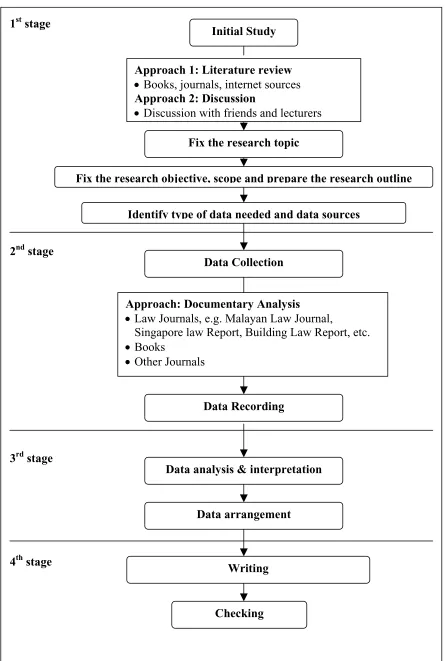
Research process and method of approach will be used as guidelines so that the research could be done in a systematic way to achieve the research objective. The research process generally consists of 4 stages, i.e. 1st stage: initial study and fixing research topic, objective, scope and outline, 2nd stage: data collection and recording, 3rd stage: data analysis and interpretation and 4th stage: writing. The following will be the research process and the methods of approach used for this research (refer to figure 1.1).
1.6.1 1st Stage
First stage of research involves initial study. Two approaches will be used in the initial study, i.e. discussion with friends and lecturers regarding what research topic can be done, and initial literature review to get idea of the research topic. After the initial study, the rough idea of the research topic is obtained. The objective and scope of the research are fixed then. Further to this, a research outline will be prepared in order to identify what kind of data will be needed in this research. Also, data sources will be identified as well.
1.6.2 2nd Stage
Report, Building Law Report, Construction Law Report and other law journals. It is collected through the LexisNexis law database. All the cases relating to the research topic will be collected. Next, those cases will be sorted according to different fields such as cases relating to construction industry, shipping industry, manufacturing industry, etc. Then, those cases will be sorted again to building contract cases, cases relating to land matters, etc. Important cases will be used for the analysis at the later stage.
1.6.2.2 Secondary Data
Secondary data is data obtained from research done by third parties other than the writer. Sources of secondary data consist of books, act, articles and seminar papers. These sources are important to complete the literature review chapter.
(a) Books
Books are the main secondary data sources. Books relating to equitable remedies and injunction will be read and understand to know in depth the theories relating to the research field. All the relevant books will be obtained from the library of University of Technology Malaysia.
(b) Seminar Papers And Articles
(c) Act
Act is an important source to support the literature review chapter and analysis done. Act used is mainly the Specific Relief Act 1950 (Act 137).
1.6.3 3rd Stage
3rd stage of research involves data analysis, interpretation and data arrangement. This process is to process and convert the data collected to information that is useful for the research. Arrangement of data tends to streamline the process of writing of the paper.
1.6.4 4th Stage
2nd stage
3rd stage
4th stage
Fix the research topic
Fix the research objective, scope and prepare the research outline
Data Collection
Data analysis & interpretation
Data arrangement
Writing
Checking
Identify type of data needed and data sources
Approach: Documentary Analysis xLaw Journals, e.g. Malayan Law Journal,
Singapore law Report, Building Law Report, etc. xBooks
xOther Journals
xBooks, journals, internet sources Approach 2: Discussion
xDiscussion with friends and lecturers
Data Recording
5.5 Conclusion
As a conclusion for all, injunction is found to be an equitable remedy which is extraordinary. The right of injunctions is not naturally arisen from the building contract itself. It is the supplement remedy for the parties in the event of the inadequacy of other remedies such as damages, quantum meruit, etc. In fact, it is a remedy provided by the statutory298 and is only available to parties when the circumstances show that it is just and convenience to do so.
In determining the question of “should an injunction be granted in this case”, it must first establish whether other legal remedies are inadequate the circumstances in that case. If the legal remedies are sufficient, injunction will be refused, and if the legal remedies are inadequate, injunction may be given. However, consideration must be made to where the balance of convenience lies with. Injunction will not be granted if it is found that its grant will cause hardship or inconvenience to the defendant. The research done which shows several circumstances that injunction will ordinary be granted may be some guidelines to parties in a building contract in finding the answer for the above question.
298
REFERENCES
Andrew Phang Boon Leong (1998). “Cheshire, Fifoot and Furmston’s Law of Contract.” 2nd Edition. Singapore: Butterworth Asia.
Asif Tufal (2004). “Remedies for breach – Equitable Remedies.” Law Teacher.net.
Barker, D. & Padfield, C. (2002). “Law Made Simple.” 11th Edition. Great Britain: Made Simple Books.
Beale, H. (1980). “Remedies for Breach of Contract.” 1st Edition. London: Sweet & Maxwell.
Bockrath, J.T. (2000). “Contracts and the Legal Environment.” 6th Edition. UK: McGraw Hill.
Civil Law Act 1956 (Act 67). Malaysia.
Elliott, C. & Quinn, F. (2003). “Contract Law.” 4th Edition. British: Longman, Pearson Education.
Graw, S. (2005). “An Introduction to the Law of Contract.” 5th Edition. Australia: Thomson Lawbook Co.
Halbury’s Laws of England, 3rd Edition., Volume 21.
Halson, R. (2001). “Contract Law.” 1st Edition. Great Britain: Longman, Pearson Education.
Lee, Mei Pheng (2001). “General Principle of Malaysian Law.” 4th Edition. Ipoh, Malaysia: Penerbit Fajar Bakti Sdn Bhd.
Martin, E. (2003). “A Dictionary of Law.” 5th Edition. New York: Oxford University Press.
Paterson, J., Robertson, A. & Heffey, P. (2005). “Principles of Contract Law.” 2nd Edition. Melbourne: Thomson Law Book Co.
Prof. Berenson (2002). “Remedies.” US: Thomas Jefferson School of Law.
Ravindran Nekoo (2002). “Practical Guide to Civil Procedure in Malaysia.” 2nd Edition. Malaysia: International Law Book Services.
Samuels, B. M. (1996). “Construction Law.” United States: Prentice Hall.
Smith, C. (2006). “Equitable Remedies.”
Obtained from: http://www.west.net/~smith/equity.htm.
Specific Relief Act 1950 (Act 137). Malaysia.
Spry, I.C.F. (2001). “The Principle of Equitable Remedies.” 6th Edition. Melbourne: The Law Book Company Limited.
Uff, J. (1991). “Construction Law.” 5th Edition. London: Sweet & Maxwell.
Vohrah, B. & Wu, Min Aun (2004). “The Commercial Law of Malaysia.” Malaysia: Longman.
Wallace, D.I.N. (1979). “Hudson’s Buildings & Engineering Contracts Including the Duties and Liabilities of Architects, Engineers and Surveyors.” 10th Edition. London: Sweet & Maxwell.
BIBLIOGRAPHY
Abdul Aziz Husin (1992). “Prosiding Garnismen Injuksi Mareva dan Perintah Anton Piller.” Kuala Lumpur: Dewan Bahasa dan Pustaka.
Anderson, A.J., Bickford-Smith, S., Palmer, N.E. and Redmond-Cooper, R. (1995). “Emden’s Construction Law.” London: Butterworth.
Annard, R. & Cain, B. (1988). “Remedies under the Contract.” London: Sweet & Maxwell.
Grace Chang. (1991). “Pengenalan Kepada Acara Civil.” 2nd Edition. Kuala Lumpur: Malayan Law Journal Sdn Bhd.
Halbury’s Law of Malaysia (2002). Volume 3: Building and Construction Revenue
Halbury’s Law of Malaysia (2002). Volume 23: Contract.
Khoury, D. & Yamouni, Y.S. (1985). “Understanding Contract Law.” Sydney: Butterworths.
Major, W.T. (1983). “The Law of Contract.” M & E Handbook Series. 6th Edition. Great Britain: Macdonald and Evans.
London: Sweet & Maxwell.
Thorpe, C.P. & Bailey, J.C.L. (1996). “Commercial Contracts: A practical Guide to Deals, Contracts, Agreements and Promises.” Cambridge, England: Woodhead Publishing Limited.