CONSTANTINESCU, ADRIAN C. Analysis of Projective-Iterative Methods for Solving
Multidimensional Transport Problems. (Under the direction of Dr. D.Y. Anistratov).
The particle transport equation has a wide range of applications: nuclear
engineer-ing, astrophysics, atmospheric science, medical physics, microelectronics manufacturengineer-ing, etc.
It is an integro-differential equation with seven independent variables: 3 spatial, 2 angular,
energy, and time, which cannot be solved analytically in most of the cases of interest. The
way to solve this equation is to discretize it in space, angle, energy, and time. In practical
cases, this leads to a huge sparse matrix. Iterative methods should be used even for solving
transport problems on the most powerful computers available nowadays. The need to
ana-lyze the behavior of these methods is obvious: knowledge about behavior of methods can
help us to improve them and avoid their use in cases in which they are not efficient. Also,
if we can predict what should happen in specific cases, we can verify and validate transport
codes. Analysis of iterative methods’ behavior in highly scattering and strong
heteroge-neous medium is very important from the point of view of solving various radiative and
particle transport problems. It became important for solving neutron transport equation
in full-core, due to current industry’s interest in obtaining very detailed transport solution
without homogenization. For these reasons, the main target of this thesis was to analyze
the convergence rate of four methods used to solve the steady state transport equation. We
were interested in studying behavior of these methods in case of one and two dimensional
strong heterogeneous and highly scattering medium with periodic structure, on rectangular
grids. In order to understand better these methods, we analyzed them as well in cases of
homogeneous and low scattering medium, uniform grids, etc. The main tool that we used
is Fourier analysis. Iteration matrix analysis was a secondary tool that we consider. It
proved to be restrictive in some cases but provided a good insight of the methods behavior.
In several difficult cases the Fourier analysis predicted degradation in efficiency or even
divergence for the methods that we’ve studied. In most of the cases, the numerical results
were consistent with the analytic predictions. In order to cover various areas where the
transport equation is used, we spanned wide ranges for parameters of transport equation.
Most of the cases in which the considered methods demonstrate slow convergence or even
by
Adrian C. Constantinescu
A thesis submitted to the Graduate Faculty of North Carolina State University
in partial fulfillment of the requirements for the Degree of
Master of Science
Nuclear Engineering
Raleigh
2006
Approved By:
Dr. D.Y. Anistratov Dr. Paul J. Turinsky
Chair of Advisory Committee
In memory of my father. . .
Biography
Adrian Constantinescu was born in 1976 in Bucharest, Romania. He graduated Nuclear
Power Engineering at Power Engineering Department, POLITEHNICA University of Bucharest
in 2000 and one year later he got his Master Degree in Modeling and Computer Based
Design in the same department. After a period of about 3 years, while he worked as
Teach-ing/Research Assistant at POLITEHNICA University, he decided to continue his education
in Nuclear Engineering at an American university. In August 2004 he started to work on
numerical methods for solving transport problems with Dr. Dmitriy Anistratov at NCSU.
Acknowledgements
The author would like to thank his adviser Dr. Dmitriy Anistratov for his valuable
advice and constant support. It was the first time and probably the last time he experienced
so long and fruitful discussions about numerical methods used to solve transport problems.
He also would like to thank his wife Cristina for all the patience and understanding
Contents
List of Figures viii
List of Tables xi
List of Symbols and Abreviations xiv
1 Introduction 1
1.1 Overview . . . 1
1.2 Iterative Methods Used for Acceleration of the Transport Equation . . . 3
1.3 Stability Analysis. Tools . . . 6
1.4 Homogeneous Medium Analysis . . . 8
1.5 Heterogeneous Medium Analysis . . . 8
1.6 Thesis’ Objectives . . . 9
1.7 Main Results Presented for Defense . . . 10
1.8 Thesis’s Content . . . 10
2 Stability Analysis of Source Iteration Method 11 2.1 The Source Iteration Method for the 1D Transport Equation in Differential Form . . . 11
2.2 The Source Iteration Method for the 1D Transport Equation in Discretized Form . . . 13
2.2.1 Fourier Analysis of SI Method in Infinite Heterogeneous Medium . . 14
2.2.2 Iteration Matrix Analysis of SI Method in Finite Heterogeneous Medium 16 2.3 The Source Iteration Method for the Transport Equation in 2D Cartesian Geometry . . . 20
2.4 The Source Iteration Method for the Discretized Transport Equation in 2D Cartesian Geometry . . . 22
2.4.1 Fourier Analysis of SI Method in Infinite Heterogeneous Medium . . 25
3.2 The Second Moment Method for the 1D Transport Equation in Discretized Form . . . 29 3.2.1 Fourier Analysis of SM Method in Infinite Heterogeneous Medium . 30 3.2.2 Iteration Matrix Analysis of SM Method in Finite Heterogeneous
Medium . . . 38 3.3 The Second Moment Method for the Transport Equation in 2D Cartesian
Geometry . . . 40 3.3.1 Fourier analysis of SM Method in Infinite Homogeneous Medium . . 41 3.4 The Second Moment Method for the Discretized Transport Equation in 2D
Cartesian Geometry . . . 42 3.4.1 Fourier Analysis of SM Method in Infinite Homogeneous Medium . . 44 3.4.2 Fourier Analysis of SM Method in Infinite Heterogeneous Medium . 47
4 Stability Analysis of Quasidiffusion Method 61
4.1 The Quasidiffusion Method for the 1D Transport Equation in Differential Form 61 4.2 The Quasidiffusion Method for the 1D Transport Equation in Discretized Form 62 4.2.1 Linearized Low-Order QD Equations in Discretized Form . . . 63 4.2.2 Fourier Analysis of QD Method in Infinite Heterogeneous Medium . 64 4.3 The Quasidiffusion Method for the Transport Equation in 2D Cartesian
Geometry . . . 68 4.4 The Quasidiffusion Method for the Discretized Transport Equation in 2D
Cartesian Geometry . . . 69 4.4.1 Linearized Low-Order QD Equations in Discretized Form . . . 71 4.4.2 Fourier Analysis of QD Method in Infinite Heterogeneous Medium . 73
5 Stability Analysis of First Moment Method 82
5.1 The First Moment Method for the 1D Transport Equation in Differential Form 82 5.2 The First Moment Method for the 1D Transport Equation in Discretized Form 83 5.2.1 Fourier Analysis of FM Method in Infinite Heterogeneous Medium . 83 5.3 The First Moment Method for the Transport Equation in 2D Cartesian
Geometry . . . 87 5.4 The First Moment Method for the Discretized Transport Equation in 2D
Cartesian Geometry . . . 87 5.4.1 Fourier Analysis of FM Method in Infinite Heterogeneous Medium . 88
6 Stability Analysis of Nonlinear Diffusion Acceleration Method 95
6.1 The Nonlinear Diffusion Acceleration Method for the 1D Transport Equation in Differential Form . . . 95 6.2 The Nonlinear Diffusion Acceleration Method for the 1D Transport Equation
in Discretized Form . . . 96 6.2.1 Numerically Estimated Spectral Radii for NDA in Infinite
Heteroge-neous Medium . . . 96 6.3 The Nonlinear Diffusion Acceleration Method for the Transport Equation in
6.4 The Nonlinear Diffusion Acceleration Method for the Discretized Transport Equation in 2D Cartesian Geometry . . . 99 6.4.1 Linearized Low-Order NDA Equations in Discretized Form . . . 100 6.4.2 Fourier Analysis of NDA Method in Infinite Heterogeneous Medium 101
7 Conclusion 104
List of Figures
2.1 PHI problem in 1D geometry . . . 15 2.2 Maximum eigenvalue vs. λfor SI with the DD transport discretization
pre-dicted by the Fourier analysis for PHI problem in 1D, ∆x1 = ∆x2 = 1,
Σt1 = Σt2 = 1,c1 = 1, andc2 = 0.1 . . . 19
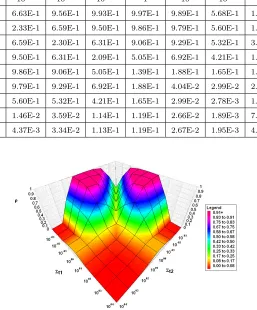
2.3 Eigenvalues spectrum of SI with the short characteristics transport discretiza-tion for a 3×3 homogeneous region with ideal and real BC, ∆x= ∆y = 1, and uniformc= 0.2 . . . 20 2.4 PHI problem in 2D geometry . . . 25 2.5 Maximum eigenvalue vs. λx and λy for SI with the short characteristics
transport discretization for PHI problem in 2D, Σt1 = 1 and Σt2 = 10−4 . . 27
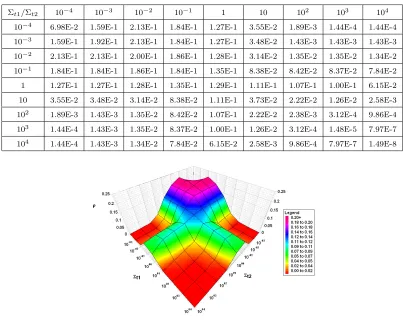
3.1 Analytic spectral radii of SM with the DD transport discretization for PHI problem in 1D, ∆x= 1, c=0.9999 . . . 33 3.2 Analytic spectral radii of SM with the step method transport discretization
for PHI problem in 1D, ∆x= 1, c=0.9999 . . . 33 3.3 Analytic spectral radii of SM with the step characteristics transport
dis-cretization for PHI problem in 1D, ∆x= 1, c=0.9999 . . . 34 3.4 Numerically estimated spectral radii of SM with the DD transport
discretiza-tion for PHI problem in 1D, ∆x= 1, c=0.9999 . . . 35 3.5 Numerically estimated spectral radii of SM with the step method transport
discretization for PHI problem in 1D, ∆x= 1, c=0.9999 . . . 35 3.6 Numerically estimated spectral radii of SM with the step characteristics
transport discretization for PHI problem in 1D, ∆x= 1, c=0.9999 . . . 36 3.7 Eigenvalues spectrum of SM with the short characteristics transport
dis-cretization for a 3×3 homogeneous region with ideal and real BC, ∆x = ∆y= 1, and uniform c= 0.9 . . . 39 3.8 Analytic spectral radii of SI and SM in 2D Cartesian geometry infinite
ho-mogeneous medium . . . 42 3.9 Analytic spectral radii of SM with the short characteristics transport
dis-cretization in infinite homogeneous medium . . . 47 3.10 Analytic spectral radii of SM with the DD transport discretization for PHI
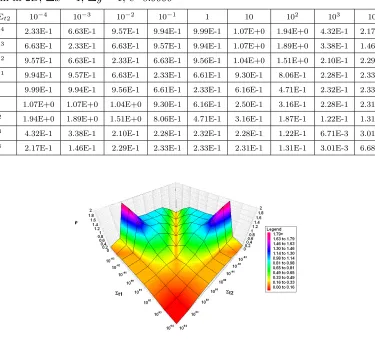
3.11 Analytic spectral radii of SM with the step method transport discretization for PHI problem in 2D, ∆x= 1, ∆y= 1, c=0.9999 . . . 52 3.12 Analytic spectral radii of SM with the short characteristics transport
dis-cretization for PHI problem in 2D, ∆x= 1, ∆y= 1, c=0.9999 . . . 53 3.13 Numerically estimated spectral radii of SM with the DD transport
discretiza-tion for PHI problem in 2D, ∆x= 1, ∆y= 1, c=0.9999 . . . 53 3.14 Numerically estimated spectral radii of SM with the step method transport
discretization for PHI problem in 2D, ∆x= 1, ∆y= 1, c=0.9999 . . . 54 3.15 Numerically estimated spectral radii of SM with the short characteristics
transport discretization for PHI problem in 2D, ∆x= 1, ∆y= 1, c=0.9999 55 3.16 Maximum eigenvalue vs. λx and λy for SM with the short characteristics
transport discretization for PHI problem in 2D, Σt1 = 1 and Σt2 = 10−4 . . 55
3.17 Analytic spectral radii of SM with the short characteristics transport dis-cretization for PHI problem in 2D, ∆x= 1, ∆y1 = 0.1, ∆y2= 10, c=0.9999 56
3.18 Numerically estimated spectral radii of SM with the short characteristics transport discretization for PHI problem in 2D, ∆x = 1, ∆y1 = 0.1, ∆y2 =
10, c=0.9999 . . . 57 3.19 Structure of checker-board problem . . . 58 3.20 Numerically estimated spectral radii of SM with the short characteristics
transport discretization for checker-board problem in 2D, ∆x = 1, ∆y = 1, c=0.9999 . . . 58 3.21 Numerically estimated spectral radii of SM with the short characteristics
transport discretization for two regions problem in 2D, ∆x = 1, ∆y = 1, c=0.9999 . . . 60
4.1 Analytic spectral radii of QD with the step characteristics transport dis-cretization for PHI problem in 1D, ∆x= 1, c=0.9999 . . . 66 4.2 Numerically estimated spectral radii of QD with the step characteristics
transport discretization for PHI problem in 1D, ∆x= 1, c=0.9999 . . . 66 4.3 Analytic spectral radii of QD with the short characteristics transport
dis-cretization for PHI problem in 2D, ∆x= 1, ∆y= 1, c=0.9999 . . . 75 4.4 Numerically estimated spectral radii of QD with the short characteristics
transport discretization for PHI problem in 2D, ∆x= 1, ∆y= 1, c=0.9999 76 4.5 Analytic spectral radii of QD with the short characteristics transport
dis-cretization for PHI problem in 2D, ∆x= 1, ∆y1 = 0.1, ∆y2= 10, c=0.9999 78
4.6 Numerically estimated spectral radii of QD with the short characteristics transport discretization for PHI problem in 2D, ∆x = 1, ∆y1 = 0.1, ∆y2 =
10, c=0.9999 . . . 78 4.7 Numerically estimated spectral radii of QD with the short characteristics
transport discretization for PHI problem in 2D, ∆x = 1, ∆y1 = 0.1, ∆y2 =
10, c=0.9999, using cell average E’s . . . 79 4.8 Numerically estimated spectral radii of QD with the short characteristics
transport discretization for checker-board problem in 2D, ∆x= 1, ∆y1 = 1,
4.9 Numerically estimated spectral radii of QD with the short characteristics transport discretization for two regions problem in 2D, ∆x = 1, ∆y = 1, c=0.9999 . . . 81
5.1 Analytic spectral radii of FM with the step characteristics transport dis-cretization for PHI problem in 1D, ∆x= 1, c=0.9999 . . . 85 5.2 Numerically estimated spectral radii of FM with the step characteristics
transport discretization for PHI problem in 1D, ∆x= 1, c=0.9999 . . . 87 5.3 Analytic spectral radii of FM with the short characteristics transport
dis-cretization for PHI problem in 2D, ∆x= 1, ∆y= 1, c=0.9999 . . . 90 5.4 Numerically estimated spectral radii of FM with the short characteristics
transport discretization for PHI problem in 2D, ∆x= 1, ∆y= 1, c=0.9999 91 5.5 Analytic spectral radii of FM with the short characteristics transport
dis-cretization for PHI problem in 2D, ∆x= 1, ∆y1 = 0.1, ∆y2= 10, c=0.9999 92
5.6 Numerically estimated spectral radii of FM with the short characteristics transport discretization for PHI problem in 2D, ∆x = 1, ∆y1 = 0.1, ∆y2 =
10, c=0.9999 . . . 92 5.7 Numerically estimated spectral radii of FM with the short characteristics
transport discretization for checker-board problem in 2D, ∆x = 1, ∆y = 1, c=0.9999, . . . 93 5.8 Numerically estimated spectral radii of FM with the short characteristics
transport discretization for two regions problem in 2D, ∆x = 1, ∆y = 1, c=0.9999 . . . 94
6.1 Numerically estimated spectral radii of NDA with the step characteristics transport discretization for PHI problem in 1D, ∆x= 1, c=0.9999 . . . 97 6.2 Analytic spectral radii of NDA with the short characteristics transport
dis-cretization for PHI problem in 2D, ∆x= 1, ∆y= 1, c=0.9999 . . . 102 6.3 Analytic spectral radii of NDA with the short characteristics transport
List of Tables
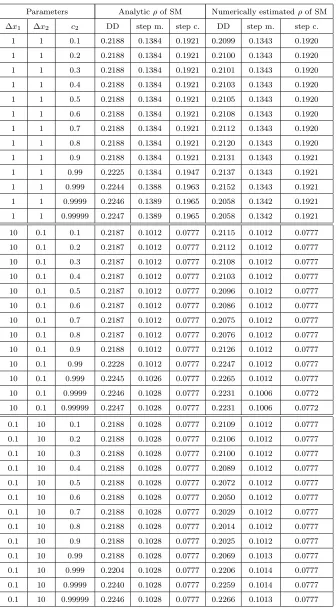
2.1 Analytic and numerically spectral radii of SI for PHI problem in 1D, with Σt= 1,c1 = 1 and variablec2 . . . 17
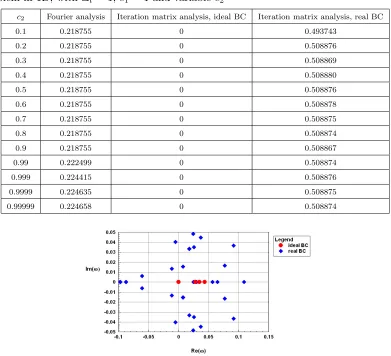
2.2 Analytic spectral radii of SI with the DD transport discretization for PHI problem in 1D, with ∆x1 = ∆x2 = 1, Σt1 = Σt2= 1, c1= 1, and variable c2 19
3.1 Analytic spectral radii of SM with the DD transport discretization for PHI problem in 1D, ∆x= 1, c=0.9999 . . . 32 3.2 Analytic spectral radii of SM with the step method transport discretization
for PHI problem in 1D, ∆x= 1, c=0.9999 . . . 33 3.3 Analytic spectral radii of SM with the step characteristics transport
dis-cretization for PHI problem in 1D, ∆x= 1, c=0.9999 . . . 34 3.4 Numerically estimated spectral radii of SM with the DD transport
discretiza-tion for PHI problem in 1D, ∆x= 1, c=0.9999 . . . 34 3.5 Numerically estimated spectral radii of SM with the step method transport
discretization for PHI problem in 1D, ∆x= 1, c=0.9999 . . . 35 3.6 Numerically estimated spectral radii of SM with the step characteristics
transport discretization for PHI problem in 1D, ∆x= 1, c=0.9999 . . . 36 3.7 Analytic and numerically estimated spectral radii of SM for PHI problem in
1D, with Σt= 1,c1 = 1 and variablec2 . . . 37
3.8 Analytic spectral radii of SM with the DD transport discretization for PHI problem in 1D, with Σt= 1,c1 = 1 and variablec2 . . . 39
3.9 Analytic spectral radii of SM with the short characteristics transport dis-cretization in infinite homogeneous medium . . . 46 3.10 Analytic spectral radii of SM with the DD transport discretization for PHI
problem in 2D, ∆x= 1, ∆y= 1, c=0.9999 . . . 51 3.11 Analytic spectral radii of SM with the step method transport discretization
for PHI problem in 2D, ∆x= 1, ∆y= 1, c=0.9999 . . . 52 3.12 Analytic spectral radii of SM with the short characteristics transport
dis-cretization for PHI problem in 2D, ∆x= 1, ∆y= 1, c=0.9999 . . . 52 3.13 Numerically estimated spectral radii of SM with the DD transport
3.14 Numerically estimated spectral radii of SM with the step method transport discretization for PHI problem in 2D, ∆x= 1, ∆y= 1, c=0.9999 . . . 54 3.15 Numerically estimated spectral radii of SM with the short characteristics
transport discretization for PHI problem in 2D, ∆x= 1, ∆y= 1, c=0.9999 54 3.16 Analytic spectral radii of SM with the short characteristics transport
dis-cretization for PHI problem in 2D, ∆x= 1, ∆y1 = 0.1, ∆y2= 10, c=0.9999 56
3.17 Numerically estimated spectral radii of SM with the short characteristics transport discretization for PHI problem in 2D, ∆x = 1, ∆y1 = 0.1, ∆y2 =
10, c=0.9999 . . . 57 3.18 Numerically estimated spectral radii of SM with the short characteristics
transport discretization for checker-board problem in 2D, ∆x= 1, ∆y1 = 1,
c=0.9999 . . . 58 3.19 Numerically estimated spectral radii of SM with the short characteristics
transport discretization for two regions problem in 2D, ∆x = 1, ∆y = 1, c=0.9999 . . . 59
4.1 Analytic spectral radii of QD with the step characteristics transport dis-cretization for PHI problem in 1D, ∆x= 1, c=0.9999 . . . 65 4.2 Numerically estimated spectral radii of QD with the step characteristics
transport discretization for PHI problem in 1D, ∆x= 1, c=0.9999 . . . 66 4.3 Analytic and numerically estimated spectral radii of QD for PHI problem in
1D, with Σt= 1,c1 = 1 and variablec2 . . . 67
4.4 Analytic spectral radii of QD with the short characteristics transport dis-cretization for PHI problem in 2D, ∆x= 1, ∆y= 1, c=0.9999 . . . 75 4.5 Numerically estimated spectral radii of QD with the short characteristics
transport discretization for PHI problem in 2D, ∆x= 1, ∆y= 1, c=0.9999 75 4.6 Analytic spectral radii of QD with the short characteristics transport
dis-cretization for PHI problem in 2D, ∆x= 1, ∆y1 = 0.1, ∆y2= 10, c=0.9999 77
4.7 Numerically estimated spectral radii of QD with the short characteristics transport discretization for PHI problem in 2D, ∆x = 1, ∆y1 = 0.1, ∆y2 =
10, c=0.9999 . . . 78 4.8 Numerically estimated spectral radii of QD with the short characteristics
transport discretization for PHI problem in 2D, ∆x = 1, ∆y1 = 0.1, ∆y2 =
10, c=0.9999, using cell average E’s . . . 79 4.9 Numerically estimated spectral radii of QD with the short characteristics
transport discretization for checker-board problem in 2D, ∆x= 1, ∆y1 = 1,
c=0.9999 . . . 80 4.10 Numerically estimated spectral radii of QD with the short characteristics
transport discretization for two regions problem in 2D, ∆x = 1, ∆y = 1, c=0.9999 . . . 81
5.1 Analytic spectral radii of FM with the step characteristics transport dis-cretization for PHI problem in 1D, ∆x= 1, c=0.9999 . . . 85 5.2 Numerically estimated spectral radii of FM with the step characteristics
5.3 Analytic and numerically estimated spectral radii of FM with the step charac-teristics transport discretization for PHI problem in 1D, with Σt= 1,c1 = 1
and variablec2 . . . 86
5.4 Analytic spectral radii of FM with the short characteristics transport dis-cretization for PHI problem in 2D, ∆x= 1, ∆y= 1, c=0.9999 . . . 90 5.5 Numerically estimated spectral radii of FM with the short characteristics
transport discretization for PHI problem in 2D, ∆x= 1, ∆y= 1, c=0.9999 91 5.6 Analytic spectral radii of FM with the short characteristics transport
dis-cretization for PHI problem in 2D, ∆x= 1, ∆y1 = 0.1, ∆y2= 10, c=0.9999 91
5.7 Numerically estimated spectral radii of FM with the short characteristics transport discretization for PHI problem in 2D, ∆x = 1, ∆y1 = 0.1, ∆y2 =
10, c=0.9999 . . . 92 5.8 Numerically estimated spectral radii of FM with the short characteristics
transport discretization for checker-board problem in 2D, ∆x = 1, ∆y = 1, c=0.9999 . . . 93 5.9 Numerically estimated spectral radii of FM with the short characteristics
transport discretization for two regions problem in 2D, ∆x = 1, ∆y = 1, c=0.9999 . . . 93
6.1 Numerically estimated spectral radii of NDA with the step characteristics transport discretization for PHI problem in 1D, ∆x= 1, c=0.9999 . . . 97 6.2 Numerically estimated spectral radii of NDA with the step characteristics
transport discretization for PHI problem in 1D, with Σt = 1, c1 = 1 and
variable c2 . . . 98
6.3 Analytic spectral radii of NDA with the short characteristics transport dis-cretization for PHI problem in 2D, ∆x= 1, ∆y= 1, c=0.9999 . . . 102 6.4 Analytic spectral radii of NDA with the short characteristics transport
List of Symbols and Abreviations
BC – Boundary Conditions
CG – Conjugate Gradient
DD – Diamond Differences
DSA – Diffusion Synthetic Acceleration
QD – Quasidiffusion
FM – First Moment
NDA – Nonlinear Diffusion Acceleration
PHI – Periodic Horizontal Interface
SI – Source Iteration
SM – Second Moment
TSA – Transport Synthetic Acceleration
Chapter 1
Introduction
1.1
Overview
Solving realistic transport problems has been, is, and will be a great challenge for
science & engineering community. The last decades were ones of important developments
in this area. However, no matter how much the tools for solving transport equation have
been improved, there will always be space for more, due to increasing needs in obtaining
more accurate solutions for more complicate problems as fast as possible.
The particle transport (linear Boltzmann) equation has a wide range of
applica-tions: nuclear engineering, astrophysics, atmospheric science, medical physics,
microelec-tronics manufacturing, etc. It is used to solve various problems: electron transport in
tomography, nuclear reactors assembly level calculations, full-core calculations, shielding,
radiative hydrodynamics with dynamic mesh, detection problems, photon transport in
at-mosphere, well-logging problems with unstructured mesh etc. Depending on the problem
that we solve, in addition to the transport equation we might need to solve some other
equa-tions related to the particular physics of the problem. Usually, this introduces nonlinear
terms, which complicate the problem even more. However, the structure of the transport
equation is the same no matter what problem we solve. For this reason we explored a wide
range for parameters of transport problems. Transport problem is not a new issue and
interested in this type of research. A good example is solving neutron transport problem
in full core. There is no method that can be used to solve efficiently this problem in 3D
(the number of coupled equations that have to be solved is O(1012)). There are methods
that can solve this problem in 2D, by considering a small number of energy groups. One
of them is Nonlinear Diffusion Acceleration method, which is implemented in CASMO-4
code. However, this method loses effectiveness in case of optically thick cells. If we need
to consider a large number of energy groups, it is inevitable to have optically thick cells for
some energy groups.
The transport equation is an integro-differential equation with seven independent
variables: 3 spatial, 2 angular, energy, and time, which cannot be solved analytically in
most of the cases of interest. The way to solve this equation is to discretize it in space,
angle, energy, and time. In practical cases, this leads to a huge sparse matrix that cannot be
inverted directly in a reasonable amount of time, even if use the most powerful computers
available nowadays. The alternative is to use efficient iterative methods that takes advantage
of the structure of the transport equation. However, the standard method converges slow
in important cases.
The simplest method for solving iteratively the steady-state transport equation
is Source Iteration (SI) [16]. The method converges very slow if the medium is highly
scattering and optically thick (the particle suffers many scattering collisions before it is
absorbed). Fourier stability analysis in homogeneous medium has shown that the spectral
radius equals the scattering ratio c and the slowest convergent error mode of SI is the flat one, no matter what is the spatial dimensionality of the problem [2]. Consequently, people
have tried to develop methods that ”kill” this flat mode very quickly and accelerates the
other modes as well. Most of the methods have one common feature. Instead of calculating
the scalar flux directly as a weighted sum of the angular flux over all directions in the
SI fashion, they project the high-order problem (the transport equation) into a low-order
problem by applying 0th, 1th, etc. moments to the transport equation, and define closure
relationships. One complete iteration implies sweeping for the angular fluxes (high-order
solution) at intermediary step (s+ 1/2) and solving the low-order problem to get the scalar fluxes and currents at iteration (s+ 1). The low-order problem can be based on several steps, or can be formulated as one matrix equation. In the second case, the matrix of the
low-order problem is too large to be inverted directly. Thus, iterative methods are used,
definite matrices one can use Conjugate Gradient method). In some methods the low-order
problem is defined on a coarse mesh compared to the one used for the high-order problem.
After the low-order problem is solved the solution is reconstructed at fine mesh level.
As we’ve just mentioned, SI converges very slow in highly scattering medium,
which is common to many diffusive problems. In this case, the diffusion approximation
works and people tried to develop methods that make the angular flux error disappear
in one iteration if it is isotropic or linearly anisotropic. This can be done by introducing
special terms in the low-order problem, which are based on integrals over the angles that
are equal to zero (for linear terms) or to a constant (for nonlinear terms) in case of isotropic
or linearly anisotropic angular flux. In this regard, some methods use Legendre moments
of the angular flux. It was shown that the diffusion operator works well for this purpose.
As we see, there are ways to eliminate some particular error modes in exactly
one iteration and most of the methods use them. However, this is not enough to assure
fast convergence, or at least convergence. For instance, the Coarse-Mesh Rebalance method
proved to be divergent even in 1D geometry homogeneous medium [11] for optically thin and
thick cells. Also, First Moment method (FM) [22] with the diffusion coefficient proposed by
Lewis and Miller proved to be divergent in 1D geometry homogeneous medium for optically
thick cells.
1.2
Iterative Methods Used for Acceleration of the
Trans-port Equation
Regarding the low-order problem discretization we should say that any iterative
method can use a consistent discretization, which means the low-order equations are
de-rived from the discretized transport equation by applying directly the projection operator,
in discrete form to the discretized transport equation. In this case the method purely
ac-celerates the transport equation and the solution of the low-order problem is identical with
the solution of the discretized transport equation. If an independent discretization is used
the method produces high-order and low-order solutions that are different on finite grids.
If the width of the spatial cell tends to zero, then the two solutions tend to each other.
which is a disadvantage in multidimensional geometries because it is difficult to construct
fully consistent discretization of the low-order problem, and such discretizations sometime
lead to a system of equations that is very costly to solve.
Another important feature of these methods is linearity and nonlinearity. In case
of a linear method, the left hand side of the low-order equations contains the solution
at the current iteration, but the right hand side retains terms that are calculated based
on the solution from the transport sweep. In case of a nonlinear method the low-order
equations contain nonlinear terms, which in general are products of the solution at the
current iteration and some coefficients calculated based on the solution of the transport
sweep. If the grid is uniform a linear method will produce a symmetric positive definite
matrix that can be solved easily with Conjugate Gradient method. A nonlinear method will
generate an asymmetric positive definite matrix, which is harder to be solved. Sometimes
there are ways to mitigate this problem by symmetrization of the low-order equations in
differential form. Miften and Larsen [27] did that for Quasidiffusion method (QD). It is
possible to formulate a linear version of a nonlinear method for solving transport equation.
This results in a new method which behaves differently.
An important class of iterative methods is Synthetic Acceleration methods. These
methods can be formulated as preconditioners of the Richardson iteration. They are linear
and their low-order problem is formulated in terms of additive corrections. In order to
converge most of them require consistent discretization. One of the best known methods
from this class is Diffusion Synthetic Acceleration (DSA) [24]. In this case, the low-order
problem is basically a diffusion equation in terms of additive corrections for the transport
sweep solution. DSA converges only if the low-order problem is consistently discretized, or at
most a slightly inconsistent discretization is used. Probably the biggest disadvantage of DSA
is that it is hard to discretize consistently the low-order problem for multidimensional cases.
Larsen proposed a four-step algorithm for consistent discretization [23] that is supposed to
work for any discretization of the transport sweep.
Another method in this class is Transport Synthetic Acceleration (TSA) [28][29].
The low-order problem of TSA is a modified transport equation which contains a free
parameter β ∈ [0,1]. For β ∈ [0,1] TSA suppresses the flat error mode. The low-order problem is not solved directly. One may use SI method or an algebraic acceleration scheme.
A different class of methods is represented by Quasidiffusion and related
are formulated in terms of the solution. Also, they can be formulated in terms of
multi-plicative corrections. QD was proposed by Gol’din [18], and improved and analyzed later
[3][20][4][6][27]. For the particular case of incident flux boundary conditions (BC), Gol’din
and Chetverushkin introduced in [19] special BC for QD. Later, Miften and Larsen
pro-posed alternative BC [27] as well. QD is a nonlinear method that is based on the idea that
the Quasidiffuion (Eddington) factors, which close the low-order problem, are stable. In
case of isotropic and linearly anisotropic angular flux the Eddington factors are constant.
It was not proved that QD method is unconditionally convergent in homogeneous medium
for any type of independent discretization, but so far there have been no reports either
about slow convergence or divergence. QD proved to be fast convergent in 1D problems
and multidimensional problems as well, even in tough cases as up-scattering problems.
Second Moment (SM) method [22] can be considered as the linear version of QD
when the linearization is done around a flat solution [10]. The same as in case of DSA, the
diffusion equation is the basis for the low-order problem. SM has an important disadvantage
that makes it un-attractive: due to the spatial derivatives of second order Legendre moments
of the angular flux at iteration (s+ 1/2), it may give non-physical negative scalar fluxes. Lewis and Miller also proposed First Moment method (FM) [22]. FM can be formulated
for either additive corrections or multiplicative corrections. In the first case, if we use the
standard diffusion coefficient 1/3Σt and independent discretization, FM converges slow or
even diverges for 2D, infinite homogeneous medium. The reason is that it is equivalent
to DSA with independent discretization. A nonlinear version of FM is Nonlinear Diffusion
Acceleration (NDA) [31]. NDA method is implemented in CASMO-4 transport code [32][33].
It proved to be very efficient in full core calculations for optically thin cells.
Anistratov and Larsen [7] proposed a family of α-weighted iterative methods for slab geometry. They derived both nonlinear and linear versions of the methods. This
family of methods is a generalization of first flux [17] and second flux [21] methods. Fourier
stability analysis demonstrated that both linear and nonlinear methods are fast convergent
in 1D even if the low-order problem is independently discretized.
Another family of methods that don’t require consistent discretization is the one
proposed by Adams [1]. In his formulation, the transport sweep is accelerated by a system
of ”S2-like” equations, which are obtained by applying 0th angular moment to a differently
discretized high-order problem. Depending on the discretization of the S2-like equations,
found out that in 1D geometry it was fast convergent in all cases.
1.3
Stability Analysis. Tools
Stability analysis is an inherent part of any iterative method development. It is
performed to verify the behavior of iterative methods. Its results are also used to understand
how they works. This way the methods can be improved, or at least fixed for some particular
cases. Another application of stability analysis is verification and validation of the transport
codes. Using the analysis we can create sophisticated benchmark problems that can be used
to check whether a transport code, which uses that particular method, works properly or
not.
The main tool used in stability analysis is Fourier transformation. It can be used
for linear methods and for nonlinear methods that are linearized close to a solution. The
assumption that the error of the iterative solution can be expanded in Fourier series has to
be made. In homogeneous medium there is separation of variables (angular and spatial) and
the eigenfunction depends only on particle’s direction. Instead, in heterogeneous medium
there is no separation of variables, which means the eigenfunction depends on position as
well.
Zika and Larsen [38][39] have shown for 1D geometry what is the actual problem
that is analyzed in case of heterogeneous medium problem with periodic structure. Starting
from the transport equation and assuming the error modes can be written as product
of the eigenfunction and the complex exponential, they’ve derived a differential equation
with complex coefficients, whose solutions are the eigenfunctions. They considered periodic
eigenfunctions, but dxidn’t assume separation of variables. The resulting equations for
eigenfunctions were solved numerically.
An alternative to Fourier analysis in infinite medium is the iteration matrix
analy-sis for problems in finite domain. In this case, one formulates the iteration process in the
matrix form
x(s+1) =M x(s). (1.1)
yes how fast convergent it is. For linear methods constructing matrixM is straightforward. One can use this approach for nonlinear methods as well if the equations are linearized in
the vicinity of the solution. This method can be used to analyze the behavior of methods
in finite medium problems, but not in infinite medium problems. Note that in order to
evaluate the spectral radius ofM we need to invert the high-order and low-order operators. Hence, an important limitation is the size of the problem that we can consider due to limited
efficiency of the software we need for this analysis and hardware resources.
Sanchez [30] has shown that use of real periodic BC (BC for the transport equation
are solved using the outgoing angular flux from the previous iteration) increases the spectral
radius of the iteration matrixM, due to iteration on boundaries. When the optical thickness tends to 0, the spectral radius tends to 1. Sanchez also has shown that if we increase the
number of cells to∞, the spectral radius ofM tends to the one given by Fourier analysis for infinite medium problem.
Regarding the analysis of nonlinear methods on heterogeneous problems, a
semi-analytic approach is possible. It was used by Yamamoto [37] for analysis of NDA in 1D
infinite heterogeneous medium. He linearized the method by frozen the nonlinear correction
factor and spanned the interval [−1,1] for it. A more general approach is the following. We can linearize the nonlinear method around a non-flat solution and do the Fourier analysis
using the solution obtained with a transport code. In this case two questions arise. First,
how do we get the infinite medium solution? Second, can we get the solution of a problem for
which the method diverges? Regarding the first question, it is possible to use a combination
of reflective and periodic BC in order to obtain the solution of an infinite heterogeneous
medium with periodic structure. The answer of the second problem is affirmative too. For
small problems with reflective and/or periodic BC the method is likely to be convergent,
even if it is divergent for the infinite medium problem. The reason is that most of the error
modes are killed because it is a problem in finite domain with finite number of spatial cells
and specific BC. Even if the optical thickness of the region is small and the spectral radius
is very close to 1, there is no trouble. One can afford to do a large number of iterations in
order to get the infinite medium solution. Finally we should note that in infinite medium
problems the spectral radius of a nonlinear method depends on the solution, which means
it depends on the external source used for obtaining the solution. It is not the same for a
1.4
Homogeneous Medium Analysis
The behavior of each of the previously mentioned methods has been analyzed for
various scenarios. For DSA it was shown that, if a consistent discretization is used, it is
fast convergent in infinite homogeneous medium on rectangular grids in 1D [24] and 2D [2]
geometries as well. However, if an independent discretization is used we should expect slow
convergence or even divergence.
On the other hand, SM and QD methods can be used with an independent
dis-cretization [2]. It has not been proved that they converge fast in any scenario, but for
infinite homogeneous medium tests neither slow convergence nor divergence has been
re-ported so far. QD is a nonlinear method. One can analyze it by linearizing it close to the
solution. For homogeneous medium, the linearized equations are identical to SM written
for errors. Cefus and Larsen [10] have shown this identity for 1D and derived the
expres-sion of the spectral radius. As far as we know there are no published results regarding
Fourier analysis for SM method for 2D geometry in homogeneous medium. We derived the
expression of the spectral radius (see Chapter 3) in differential form and discretized form
using diamond differences (DD), step method and short characteristics discretizations of
the transport equation.
FM’s behavior has been analyzed by Lewis and Miller [22] for 1D geometry in
infinite homogeneous medium. They haven’t reported the spectral radii but only numbers of
iterations necessary for ONETRAN code to converge. On the other hand, Smith and Rhodes
[32] have reported a fast DSA-like convergence for NDA. Cho and Park [14] have analyzed
Coarse Mesh Finite Difference (CMFD) acceleration method in 1D geometry homogeneous
medium. For the case that the low-order problem is discretized on the same spatial mesh
as the transport equation, this method is equivalent to NDA. They’ve used an independent
discretization which lead to spectral radii grater than 1 in some cases. We’ve also tested an
independently discretized version of FM (using the standard diffusion coefficient) and we
found divergence for some 1D geometry homogeneous problems.
1.5
Heterogeneous Medium Analysis
DSA is one of the most analyzed methods for heterogeneous problems. The reason
multidimensional heterogeneous medium is Azmy’s proof [9] that there is no unconditionally
stable adjacent cell diffusive preconditioner weighted diamond differencing discretizations.
As example, he has shown that DSA loses effectiveness in Periodic Horizontal Interface
(PHI) problem (see [8]). Warsa, Wareing, and Morel [35] have shown that even a robust
version of DSA, which has been consistently discretized and found efficient in 3D geometry,
diffusive homogeneous medium, and unstructured grids [34], loses its efficiency in diffusive
and highly heterogeneous tests. They also have analyzed a slightly inconsistent version
of DSA (SQLA DSA), which proved to have a similar behavior. The conclusion of these
authors is that degradation in effectiveness is an inherent property of the analytical DSA
method. As a solution to fix this problem they proposed acceleration of SI using GMRES
method preconditioned by DSA [36].
TSA method has been analyzed in diffusive heterogeneous medium as well. Chang
and Adams [12][13] have observed not only degradation in TSA’s effectiveness but even
divergence. They’ve also found out that the spectral radii greater than 1 are given by real
negative eigenvalues. As a result, they proposed a modification of the method by embedding
TSA inside a Krylov solver as CG or GMRES.
NDA has been analyzed in 1D geometry heterogeneous medium by Yamamoto
[37]. Using the standard diffusion coefficient, he has found spectral radii greater than 1 for
many cases. The way Yamamoto has analyzed NDA was discussed in the previous section.
1.6
Thesis’ Objectives
The main objective of this research was to perform the stability analysis of two
nonlinear iterative methods used for solving the transport equation: QD and NDA, and their
linear versions: SM and FM. We’ve considered mono-energetic case, isotropic scattering,
1D and 2D Cartesian geometry, highly scattering and strong heterogeneous medium. To
discretize the transport equation we use DD, step method, and step characteristics schemes
in 1D geometry, and DD, step method, and short characteristics schemes in 2D geometry.
For the low-order problem we use a finite volume discretization. Mainly we are interested
in analysis of the methods that use step characteristics and short characteristics transport
discretizations. However, it is instructive to analyze the other two discretizations as well to
1.7
Main Results Presented for Defense
In this thesis we present the following results:
1. Fourier analysis of SM for 2D Cartesian geometry infinite homogeneous medium in both
differential and discretized form.
2. Iteration matrix analysis of SI (in 2D Cartesian geometry) and SM (in 1D and 2D
Cartesian geometries) in case of finite heterogeneous medium with periodic BC.
3. Fourier analysis of SI, SM, and FM for 1D geometry infinite heterogeneous medium.
4. Fourier analysis of SI, SM, and FM in case of 2D Cartesian geometry infinite
heteroge-neous medium with periodic structure.
5. Stability analysis of the nonlinear methods, namely QD and NDA in the vicinity of the
solution of infinite heterogeneous medium problem with periodic structure.
6. Numerically evaluation of SM, QD, and FM spectral radii in case of checker-board
problem and two regions problem for 2D Cartesian geometry.
1.8
Thesis’s Content
The remaining of this thesis is structured as follows. In Chapter 2 we analyze
the behavior of the SI method in 1D slab and 2D Cartesian geometries for heterogeneous
medium problems, using iteration matrix analysis and Fourier analysis. Chapter 3 presents
the analysis of SM and QD in 1D slab and 2D Cartesian geometries for heterogeneous
medium. In order to perform the Fourier analysis we linearize the low-order QD equations.
For SM we show the Fourier analysis in 2D geometry for infinite homogeneous medium in
both differential and discretized form. Chapter 4 presents the stability analysis of FM in
heterogeneous medium for 1D and 2D geometries. For NDA we derive the linearized
low-order equations around a non-flat solution in 2D geometry and perform Fourier analysis as
well. The thesis concludes with Chapter 5, where a final discussion regarding the results is
Chapter 2
Stability Analysis of Source
Iteration Method
In this chapter we present the iteration matrix analysis and Fourier analysis of the
SI method for heterogeneous medium in 1D slab and 2D Cartesian geometries. The results
of this analysis are used to compare SI and the other four iterative methods under
consid-eration. These comparisons are important in order to see whether the slowly convergent
error modes are dumped by the acceleration methods or not and whether other modes are
excited or not. We did iteration matrix analysis of SI in 1D and 2D. In this Chapter we
only show how we build the iteration matrix in 1D. The procedure for 2D is similar.
2.1
The Source Iteration Method for the 1D Transport
Equa-tion in Differential Form
The steady state transport equation for 1D geometry, mono-energetic case, isotropic
scattering and external source is:
µ∂ψ
∂x + Σt(x)ψ(x, µ) =
Σs(x)
2
1 Z
−1
ψ x, µ′
dµ′+Q(x)
wherex∈[xL, xR],µ∈[−1,1] is the projection of particle’s direction vectorΩ on x-axis,~ ψ
is the angular flux, Σtis the total macroscopic cross section, Σsis the scattering macroscopic
cross section, andQis the external source. In order to solve this problem we need to specify BC. Vacuum BC in 1D are given by
ψ(xL, µ) = 0, µ >0,
ψ(xR, µ) = 0, µ <0.
(2.2)
Reflective BC in 1D have the form:
ψ(xL, µ) =ψ(xL,−µ), µ >0,
ψ(xR, µ) =ψ(xR,−µ), µ <0.
(2.3)
Periodic BC in 1D defined by:
ψ(xL, µ) =ψ(xR, µ), µ∈[−1,1]. (2.4)
SI for the transport equation in continuous form consists in a transport sweep that gives
one the angular flux at intermediary step (s+ 1/2):
µ∂ψ (s+1/2)
∂x + Σt(x)ψ
(s+1/2)(x, µ) =Σs(x)φ(s)(x) +Q(x)
2 , (2.5)
and integration of the angular flux over all directions in order to get the scalar flux at the
next iteration (s+ 1):
φ(s+1)(x) =
1 Z
−1
ψ(s+1/2)(x, µ)dµ. (2.6)
Vacuum BC:
ψ(xL, µ)(s+1/2) = 0, µ >0,
ψ(xR, µ)(s+1/2) = 0, µ <0.
(2.7)
Reflective BC:
ψ(xL, µ)(s+1/2) =ψ(xL,−µ)(s+1/2), µ >0,
ψ(xR, µ)(s+1/2) =ψ(xR,−µ)(s+1/2), µ <0.
(2.8)
Periodic BC:
ψ(xL, µ)(s+1/2) =ψ(xR, µ)(s+1/2), µ∈[−1,1]. (2.9)
Thereafter, we refer to the above formulations of reflective and periodic BC as “ideal” BC. It
in one transport sweep. There is another version of these two types of BC, which are
actually used in the discretized versions of SI and most acceleration methods. Thereafter,
we refer to the above formulations of reflective and periodic BC as “real” BC. In this case
even for the given right hand side one needs to iterate in order to get the converged angular
flux, due to BC.
Real reflective BC:
ψ(xL, µ)(s+1/2) =ψ(xL,−µ)(s−1/2), µ >0,
ψ(xR, µ)(s+1/2) =ψ(xR,−µ)(s−1/2), µ <0.
(2.10)
Real periodic BC:
ψ(xL, µ)(s+1/2) =ψ(xR, µ)(s−1/2), µ >0,
ψ(xR, µ)(s+1/2) =ψ(xL, µ)(s−1/2), µ <0.
(2.11)
2.2
The Source Iteration Method for the 1D Transport
Equa-tion in Discretized Form
In order to discretize SI in 1D we need to define the spatial mesh {xi−1/2, i =
1..N + 1, x1/2 =xL, xN+1/2 = xR} and the angular mesh µm, m= 1..Nm, whereN is the
number of the cells in the slab and Nm is the number of directions considered. Now we
can define the discretized solution: φi is the cell average scalar flux, ψm,i is the cell average
angular flux in ith cell for direction µ
m, and ψm,i±1/2 is the cell edge angular flux. In 1D
geometry discretized form of the SI method consists of a transport sweep (2.12), (2.13) and
evaluation of the average scalar flux at the next iteration (2.14)
µm
ψm,i(s+1+1/2)/2−ψm,i(s+1−/12)/2
∆xi
+ Σt,iψ(m,is+1/2) =
Σs,iφ(is)+Qi
2 , (2.12)
ψ(m,is+1/2) = 1 +αm,i
2 ψ
(s+1/2)
m,i+1/2+
1−αm,i
2 ψ
(s+1/2)
m,i−1/2, (2.13)
φsi+1=X
m
ψm,i(s+1/2)wm. (2.14)
Depending on the expression ofαmthe transport discretization corresponds to the following
methods:
1. The Diamond Differences
2. The step method
αm,i=µm/|µm|, (2.16)
3. The step characteristics
αm,i=
1 +e−
Σt,i∆xi
µm
1−e−
Σt,i∆xi
µm
−Σ2µm
t,i∆xi
. (2.17)
We can write the approximate solution at iteration s as the sum of the exact solution and the iterative error
ψ(m,is+1/2) =ψm,i+δψm,i(s+1/2), (2.18)
ψm,i(s+1+1/2)/2 =ψm,i+1/2+δψ(m,is+1+1/2)/2, (2.19)
φ(is)=φi+δφ(is). (2.20)
Hence, we can write SI method for the iterative error as
µm
δψm,i(s+1+1/2)/2−δψm,i(s+1−/12)/2
∆xi
+ Σt,iδψm,i(s+1/2) =
Σs,iδφ(is)
2 , (2.21)
δψ(m,is+1/2) = 1 +αm,i
2 δψ
(s+1/2)
m,i+1/2+
1−αm,i
2 δψ
(s+1/2)
m,i−1/2, (2.22) δφsi+1=X
m
δψm,i(s+1/2)wm, (2.23)
wherewm are the quadrature weights.
2.2.1 Fourier Analysis of SI Method in Infinite Heterogeneous Medium
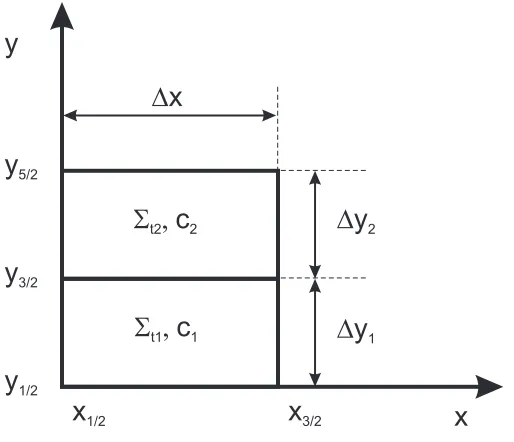
Let us consider a 1D version of the PHI problem [12]. This problem is defined by
two infinite layers of different materials repeated periodically. There is one spatial cell per
layer (see Fig. 2.1). We introduce the following ansatz:
δψm,i(s+1+2/2)k = ωs˜am,ie−ˆiλxi+2k
δψm,i(s+1+1/2)/2+2k = ωs˜bm,ie−ˆiλxi+1/2+2k
δφ(i+2s)k = ωsAie−ˆiλxi+2k
(2.24)
needs to analyze only two neighborly cells to evaluate the eigenvalues ω. We consider only such discretizations for which αm,i is an odd function of µm. If we use the above ansatz
in Eqs. (2.21) and (2.22) written for two adjacent cells we find that ˜am,i has the following
form:
˜
am,i=A1
aem,i,1+ ˆiaom,i,1+A2
aem,i,2+ ˆiaom,i,2 (2.25) where superscriptsestands for even ando means odd, i.e.
µm=−µn⇒aem,i,j=aen,i,j,
µm =−µn⇒aom,i,j =−aon,i,j.
We don’t show here the expressions of a coefficients because of their complexity. Using (2.24) and (2.25) in Eq. (2.23) written for two adjacent cells we obtain a system of 2
equations for 2 unknowns: ω and A1/A2. A1
A2ω =
P
m
A1
A2a
e
m,1,1+aem,1,2
wm
ω =P
m
A1
A2a
e
m,2,1+aem,2,2
wm
(2.26)
This system can be reduced to a second order equation inω that can be solved easily:
ω2
Ξ2,1 −
ωΞ2,2+ Ξ1,1
Ξ2,1
+Ξ2,2Ξ1,1 Ξ2,1 −
Ξ1,2 = 0, (2.27)
where Ξi,k=P m
aem,i,kwm. For every value ofλwe obtain two solutions forω. We evaluated
the spectral radii of the SM method in discretized form for PHI problem in 1D, non-uniform
scattering ratio c= Σs/Σt, but homogeneous Σt. The scattering ratio in the first cell was
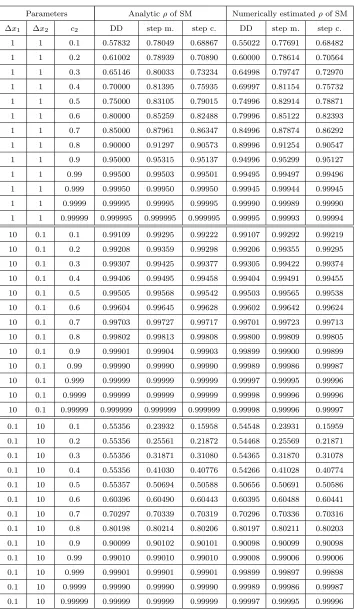
constant c1 = 1, but c2 varied. In Table 2.1 we show the analytic spectral radii of SM
obtained by means of Fourier analysis and the numerically estimated ones. We estimated
numerically the spectral radius inL2 norm ρ(s)= ||φ
(s)−φ(s−1)|| 2 ||φ(s−1)
−φ(s−2)
||2
, (2.28)
x
1/2x
3/2x
S
t1,
c
1D
x
1S
t2,
c
2X
5/2D
x
2using a 1000 cells slab, vacuum BC,Q= 1 for 250≤x≤750, Q= 0 in the rest of the slab,
ǫ= 10−6
point-wise convergence criteria
max
i
1−φ
(s+1)
i
φ(is)
≤ǫ1−ρ(s), (2.29)
We can see that SI is slowly convergent in most of the cases, especially when the scattering
ratio is high and the optical thickness of the cells (∆xΣt) is large.
2.2.2 Iteration Matrix Analysis of SI Method in Finite Heterogeneous Medium
In discretized form, ideal periodic BC for 1D geometry are defined as
ψm,(s+11//22)=ψm,N(s+1+1/2)/2, m= 1..Nm. (2.30)
We can write (2.30) in terms of iterative errors as well
δψ(m,s+11//22)=δψm,N(s+1+1/2)/2. (2.31) In this case, Eqs. (2.21), (2.22), and (2.23) can be reduced to the following matrix form
A1δψ(s+1/2)=δφ(s), (2.32)
where δψ is the vector of all angular flux errors (both edge and average), and δφ is the vector of all average scalar flux errors. Eq. (2.23) written for all cells forms the following
system of equations
δφ(s+1) =A2δψ(s+1/2). (2.33)
This means the iteration matrix is
M =A2A
−1
1 . (2.34)
Periodic real BC for 1D geometry are given by:
ψm,(s+11//22) =ψm,N(s−1+1/2)/2, µ >0,
ψm,N(s+1+1/2)/2 =ψm,(s−11/2/2), µ <0. (2.35)
We derive similar equations for the errors and form two matrix equations as above
Table 2.1: Analytic and numerically spectral radii of SI for PHI problem in 1D, with Σt= 1,
c1 = 1 and variablec2
Parameters Analyticρof SM Numerically estimatedρof SM ∆x1 ∆x2 c2 DD step m. step c. DD step m. step c.
δΦ(s+1)=A3δΦ (s+1/2)
, (2.37)
where δΦ is the vector of all angular flux errors (both edge and average), and all average scalar flux errors. Therefore, the iteration matrix is
M =A3A
−1
1 A2. (2.38)
We used the iteration matrix analysis to evaluate the spectral radii of SI for a 2
cells slab (see Fig. 2.1). We considered both ideal and real BC. The parameters of this
problem are the following: ∆x1 = ∆x2= 1, Σt1= Σt2 = 1, c1 = 1, c2 variable, and double
S4 GL quadrature. We built the iteration matrix in MATLAB 6.5, obtained the eigenvalues
ωi using function eig, and evaluated the spectral radius
ρ= max
i |ωi|. (2.39)
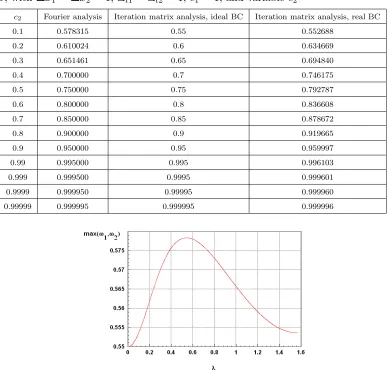
The analytic spectral radii are shown in Table 2.2. We included in the table the results of
Fourier analysis for infinite periodic medium problem with the same structure, to compare
the two types of analysis. In this particular case the iteration matrix has only 2
eigenfunc-tions and 2 eigenvalues. One of the eigenfunceigenfunc-tions is the spatially flat one, which means
that in some cases this type of analysis predicts exactly the spectral radius of SI for infinite
medium problems, if the ideal periodic BC are used. However, for c <0.7 we can see that iteration matrix analysis underestimates the spectral radius of the infinite periodic medium
problem. That can be explained by the fact that the slowest convergent error mode of the
infinite medium problem is not the flat one. In Fig. (2.2) we have the distribution of the
maximum eigenvalueω(for everyλwe get two solutionsω1andω2) with respect toλfor the
case c2= 0.1, which was obtained with the Fourier analysis. The spectral radius predicted
by the iteration matrix analysis with ideal BC is equal to ω(0), which corresponds to the flat error mode.
On the other hand, if SI with real periodic BC is considered then the iteration
matrix is not 2×2 anymore because one needs to include in the vector of unknowns all
cell average scalar flux errors and all angular flux errors. We get extra error modes and
eigenvalues because the transport sweep has to iterate on BC. In case of optically thin
cells, this analysis will predict a spectral radius greater than the one of the infinite medium
problem. In our case, this happens for c2 >0.1. An interesting feature of real BC is the
Table 2.2: Analytic spectral radii of SI with the DD transport discretization for PHI problem in 1D, with ∆x1 = ∆x2 = 1, Σt1 = Σt2= 1, c1 = 1, and variablec2
c2 Fourier analysis Iteration matrix analysis, ideal BC Iteration matrix analysis, real BC
0.1 0.578315 0.55 0.552688
0.2 0.610024 0.6 0.634669
0.3 0.651461 0.65 0.694840
0.4 0.700000 0.7 0.746175
0.5 0.750000 0.75 0.792787
0.6 0.800000 0.8 0.836608
0.7 0.850000 0.85 0.878672
0.8 0.900000 0.9 0.919665
0.9 0.950000 0.95 0.959997
0.99 0.995000 0.995 0.996103
0.999 0.999500 0.9995 0.999601
0.9999 0.999950 0.99995 0.999960
0.99999 0.999995 0.999995 0.999996
Figure 2.2: Maximum eigenvalue vs. λfor SI with the DD transport discretization predicted by the Fourier analysis for PHI problem in 1D, ∆x1= ∆x2= 1, Σt1= Σt2 = 1,c1 = 1, and c2 = 0.1
value of some complex eigenvalues had the same order of magnitude with the maximum
real eigenvalue. In Fig. 2.3 we show the spectrum of the eigenvalues in case of SI in
2D Cartesian geometry. We considered a homogeneous (Σt = 1) square region with 3×3
cells, uniform mesh ∆x= ∆y= 1, uniform scattering ratioc= 0.2, product quadratures set based on double S4 GL quadratures for azimuthal and polar angles, and short characteristics
discretization for the transport equation. We used both ideal and real periodic BC. As we
Figure 2.3: Eigenvalues spectrum of SI with the short characteristics transport discretization for a 3×3 homogeneous region with ideal and real BC, ∆x= ∆y= 1, and uniform c= 0.2
eigenvalues. The conjugate of each complex eigenvalue is an eigenvalue also. Also, we note
that all complex eigenvalues have negative real part.
This type of analysis proved to be a very useful tool that can enable one to obtain
valuable information about the structure of the error modes and their eigenvalues in finite
problems. The Fourier analysis can be used to obtain upper bounds for the spectral radii in
finite medium problem. The practical problems are finite. That’s why it is very important
to know as much as possible about the structure of the iterative error modes in finite medium
problems.
2.3
The Source Iteration Method for the Transport Equation
in 2D Cartesian Geometry
The steady state transport equation for 2D Cartesian geometry, mono-energetic
case, isotropic scattering, and external source is
Ωx
∂ψ ∂x + Ωy
∂ψ
∂y + Σt(x, y)ψ
x, y, ~Ω= Σs(x, y) 4π
Z
4π
ψx, y, ~ΩdΩ + Q(x, y)
4π , (2.40)
wherex∈[xL, xR],y ∈[yB, yT], Ωx is the x-component of particle’s direction vector ~Ω, Ωy
is the y-component of ~Ω, ψ is the angular flux, Σt is the total macroscopic cross section,
in 2D are defined as:
ψ(xL, y, ~Ω) = 0 ,Ω~ ·~n(xL, y)<0,
ψ(xR, y, ~Ω) = 0 ,Ω~ ·~n(xR, y)<0,
ψ(x, yB, ~Ω) = 0 ,Ω~ ·~n(x, yB)<0,
ψ(x, yT, ~Ω) = 0 ,Ω~ ·~n(x, yT)<0,
(2.41)
where~n(x, y) is the outward normal vector and (x, y) is a point on the boundary. Reflective BC in 2D have the form:
ψ(xL, y, ~Ω) =ψ(xL, y, ~Ω∗) , Ω~ ·~n <0,
ψ(xR, y, ~Ω) =ψ(xR, y, ~Ω∗) , Ω~ ·~n < 0,
ψ(x, yB, ~Ω) =ψ(x, yB, ~Ω∗) , Ω~ ·~n <0,
ψ(x, yT, ~Ω) =ψ(x, yT, ~Ω∗) , Ω~ ·~n <0.
(2.42)
whereΩ~∗
is the exiting direction that reflects ontoΩ. Periodic BC in 2D are given by:~
ψ(xL, y, ~Ω) =ψ(xR, y, ~Ω) , ∀~Ω,
ψ(x, yB, ~Ω) =ψ(x, yT, ~Ω) ,∀~Ω.
(2.43)
SI consists in a transport sweep that gives us the angular flux at intermediate step
(s+ 1/2):
Ωx
∂ψ(s+1/2) ∂x + Ωy
∂ψ(s+1/2)
∂y + Σt(x, y)ψ
(s+1/2)x, y, ~Ω=
Σs(x, y)φ(s)(x, y) +Q(x, y)
4π . (2.44)
The scalar flux is obtained by integrating the angular flux:
φ(s+1)(x, y) =
Z
4π
ψ(s+1/2)x, y, ~ΩdΩ. (2.45)
We also need BC.
Vacuum BC:
ψ(s+1/2)(xL, y, ~Ω) = 0 , ~Ω·~n(xL, y)<0,
ψ(s+1/2)(xR, y, ~Ω) = 0 , ~Ω·~n(xR, y)<0,
ψ(s+1/2)(x, y
B, ~Ω) = 0 , ~Ω·~n(x, yB)<0,
ψ(s+1/2)(x, yT, ~Ω) = 0 , ~Ω·~n(x, yT)<0.
Reflective BC:
ψ(s+1/2)(xL, y, ~Ω) =ψ(s+1/2)(xL, y, ~Ω∗) , ~Ω·~n <0,
ψ(s+1/2)(xR, y, ~Ω) =ψ(s+1/2)(xR, y, ~Ω∗) , ~Ω·~n <0,
ψ(s+1/2)(x, yB, ~Ω) =ψ(s+1/2)(x, yB, ~Ω∗) , ~Ω·~n <0,
ψ(s+1/2)(x, yT, ~Ω) =ψ(s+1/2)(x, yT, ~Ω∗) , ~Ω·~n <0.
(2.47)
Periodic BC:
ψ(s+1/2)(x
L, y, ~Ω) =ψ(s+1/2)(xR, y, ~Ω) , ∀Ω~,
ψ(s+1/2)(x, y
B, ~Ω) =ψ(s+1/2)(x, yT, ~Ω) , ∀Ω~.
(2.48)
As in 1D, we define ”real” BC that are actually used to perform the transport sweep. Real
Reflective BC:
ψ(s+1/2)(xL, y, ~Ω) =ψ(s−1/2)(xL, y, ~Ω∗) , Ω~ ·~n(xL, y)<0,
ψ(s+1/2)(xR, y, ~Ω) =ψ(s−1/2)(xR, y, ~Ω∗) , ~Ω·~n(xR, y)<0,
ψ(s+1/2)(x, yB, ~Ω) =ψ(s−1/2)(x, yB, ~Ω∗) ,Ω~ ·~n(x, yB)<0,
ψ(s+1/2)(x, y
T, ~Ω) =ψ(s−1/2)(x, yT, ~Ω∗) , Ω~ ·~n(x, yT)<0.
(2.49)
Real Periodic BC:
ψ(s+1/2)(x
L, y, ~Ω) =ψ(s−1/2)(xR, y, ~Ω) , ~Ω·~n(xL, y)<0,
ψ(s+1/2)(xR, y, ~Ω) =ψ(s−1/2)(xL, y, ~Ω) , ~Ω·~n(xR, y)<0,
ψ(s+1/2)(x, yB, ~Ω) =ψ(s−1/2)(x, yT, ~Ω) ,Ω~ ·~n(x, yB)<0,
ψ(s+1/2)(x, yT, ~Ω) =ψ(s−1/2)(x, yB, ~Ω) , ~Ω·~n(x, yT)<0,
(2.50)
2.4
The Source Iteration Method for the Discretized
Trans-port Equation in 2D Cartesian Geometry
To discretize SI in 2D we define the spatial mesh{xi+1/2, i= 1, Nx+ 1, yj−1/2, j=
1..Ny + 1}, and the angular meshµm, ηm, m= 1..Nm, where Nx is the cells number on
x-direction,Nyis the cells number on y-direction, andNmis the number of directions. Theµm
andηmare discrete directional cosines,φi,j is the cell average scalar flux,φi±1/2,jandφi,j±1/2
are the face average scalar fluxes,ψm,i,j is the cell average angular flux, andψm,i±1/2,j and
ψm,i,j±1/2 are the face average angular fluxes. SI method consists in a transport sweep and
evaluation of the average scalar flux at the next iteration:
φ(i,js+1)=X
m
where wm are the quadrature weights. If we use WDD discretization the transport sweep
equations are:
µm
ψm,i(s+1+1/2)/2,j−ψ(m,is+1−/12)/2,j
∆xi
+ηm
ψm,i,j(s+1/+12)/2−ψm,i,j(s+1/−2)1/2
∆yj
+Σt,i,jψm,i,j(s+1/2) =
Σs,i,jφ(i,js)+Qi,j
2 , (2.52)
ψ(m,i,js+1/2)= 1 +α
x m,i,j
2 ψ
(s+1/2)
m,i+1/2,j+
1−αxm,i,j
2 ψ
(s+1/2)
m,i−1/2,j, (2.53)
ψm,i,j(s+1/2) = 1 +α
y m,i,j
2 ψ
(s+1/2)
m,i,j+1/2+
1−αym,i,j
2 ψ
(s+1/2)
m,j,i−1/2. (2.54)
For DD discretization αxm,i,j =αym,i,j = 0 and for step method αxm,i,j =µm/|µm|,αym,i,j =
ηm/|ηm|. Assuming as before that the approximate solution is the sum of the exact solution
and the iterative error, we can write all equations in terms of errors:
µm
δψ(m,is+1+1/2)/2,j−δψ(m,is+1−/12)/2,j
∆xi
+ηm
δψ(m,i,js+1/+12)/2−δψ(m,i,js+1/−2)1/2
∆yj
,
+Σt,i,jδψ(m,i,js+1/2)=
Σs,i,jδφ(i,js)
2 , (2.55)
δψ(m,i,js+1/2) = 1 +α
x m,i,j
2 δψ
(s+1/2)
m,i+1/2,j+
1−αx m,i,j
2 δψ
(s+1/2)
m,i−1/2,j, (2.56)
δψm,i,j(s+1/2) = 1 +α
y m,i,j
2 δψ
(s+1/2)
m,i,j+1/2+
1−αym,i,j
2 δψ
(s+1/2)
m,j,i−1/2, (2.57)
δφ(i,js+1) =X
m
δψm,i,j(s+1/2)wm. (2.58)
For short characteristics discretization we used linear interpolation of the incident
flux, between the angular fluxes in the two adjacent vertexes. The transport sweep equations
are
ξm,i,j=
µm∆yj
ηm∆xi
Quadrant I (µm >0,ηm >0)
τm,i,j= Σt,i,j
∆yj
ηm
,ψ∗ =ψ(m,is+1+1/2)/2,j−1/2(1−ξm,i,j) +ψm,i(s+1−/12)/2,j−1/2ξm,i,j, for ξm,i,j ≤1,
τm,i,j= Σt,i,j
∆xi
µm
,ψ∗=ψm,i(s+1−/12)/2,j+1/2
1− 1
ξm,i,j
+ψm,i(s+1−/12)/2,j−1/2 1 ξm,i,j
ψ(m,is+1+1/2)/2,j+1/2=ψ∗e−τm,i,j + 1−e−τm,i,jΣs,i,jφ (s)
i,j +Qi,j
4Σt,i,j
. (2.59)
Quadrant II (µm>0, ηm<0)
τm,i,j = Σt,i,j
∆yj
−ηm
,ψ∗ =ψm,i(s+1−/12)/2,j−1/2(1−ξm,i,j) +ψ(m,is+1+1/2)/2,j−1/2xim,i,j, forξm,i,j ≤1,
τm,i,j= Σt,i,j∆xi
µm
,ψ∗=ψm,i(s+1+1/2)/2,j+1/2
1− 1
ξm,i,j
+ψm,i(s+1+1/2)/2,j−1/2
1
ξm,i,j
, forξm,i,j >1,
ψ(m,is+1−/12)/2,j+1/2=ψ∗e−τm,i,j + 1−e−τm,i,jΣs,i,jφ (s)
i,j +Qi,j
4Σt,i,j
. (2.60)
Quadrant III (µm<0,ηm<0)
τm,i,j = Σt,i,j
∆yj
−ηm
,ψ∗
=ψ(m,is+1−/12)/2,j+1/2(1−ξm,i,j) +ψm,i(s+1+1/2)/2,j+1/2ξm,i,j, forξm,i,j ≤1,
τm,i,j = Σt,i,j
∆xi
−µm
,ψ∗ =ψm,i(s+1+1/2)/2,j−1/2
1− 1
ξm,i,j
+ψm,i(s+1+1/2)/2,j+1/2 1 ξm,i,j
, forξm,i,j >1,
ψ(m,is+1−/12)/2,j−1/2=ψ∗
e−τm,i,j + 1−e−τm,i,jΣs,i,jφ (s)
i,j +Qi,j
4Σt,i,j
. (2.61)
Quadrant IV (µm <0,ηm>0)
τm,i,j = Σt,i,j
∆yj
−ηm
,ψ∗ =ψm,i(s+1+1/2)/2,j+1/2(1