POWERS, THOMAS CORNELIUS. Artificial Lumbered Flight for Autonomous Soaring. (Under the direction of Drs. Larry Silverberg and Ashok Gopalarathnam).
Soaring strategies are redefining the flight capabilities of small-class fixed-wing
UAVs. This dissertation presents an autonomous soaring strategy that exploits updraft energy
independent of the classification of an updraft. The strategy employs an artificial lumbered
flight algorithm (ALFA) that weighs near-field updraft velocity estimates and mission
priorities for navigation. This work raises the question of ALFA’s ability to handle classified updrafts. Indeed, ALFA does not explicitly consider the classification of the updraft. Instead,
ALFA measures updraft data along an aircraft’s flight path, estimates updraft data ahead of the
aircraft, generates candidate flightpaths ahead of the aircraft for evaluation, and then selects
the best candidate flightpath based on a reward function. This dissertation describes the
structure of ALFA and the tuning processes for the updraft estimator and the decision function.
Flight results demonstrate the ability of artificial lumbered flight to harness atmospheric energy
and complete its objectives. The flight results consider aircraft behavior in more detail,
examining ALFA’s effectiveness when flying among classified updrafts. They demonstrate the
ability of artificial lumbered flight to navigate unclassified updrafts and harvest energy from
thermal updrafts. Finally, this work highlights that autonomous flight design and control of
small-class aircraft is maturing into its own flight regime that lies between the flapping flight
© Copyright 2019 by Thomas Cornelius Powers
by
Thomas Cornelius Powers
A dissertation submitted to the Graduate Faculty of North Carolina State University
in partial fulfillment of the requirements for the degree of
Doctor of Philosophy
Aerospace Engineering
Raleigh, North Carolina
2019
APPROVED BY:
_______________________________ _______________________________ Dr. Larry Silverberg Dr. Ashok Gopalarathnam
Co-Chair of Advisory Committee Co-Chair of Advisory Committee
ii BIOGRAPHY
Thomas Cornelius Powers was born on September 5, 1988 in Woodland, California. After
spending 10 years of his childhood in the Netherlands, he attended Widefield High School in
Colorado Springs, and graduated in 2008. He attended Olivet Nazarene University in
Bourbonnais, Illinois, and graduated with a Bachelor of Science in Engineering in 2012. After
working for Case New Holland in the four-wheel drive tractor group for 14 months, he enrolled
in the direct-path PhD program at North Carolina State University in pursuit of Master and
Doctoral degrees in Aerospace Engineering. He earned his Master of Science in Aerospace
iii ACKNOWLEDGMENTS
First and foremost, I want to thank my wife Liz for supporting me throughout my studies and
for sacrificing to make this degree possible. We came to pursue a 2-year Master’s degree, and
5½ years later, I am finally getting ready to graduate. Thank you for all your help, support, and
encouragement throughout the time we have been here.
I also want to thank my co-advisors Dr. Silverberg and Dr. Gopalarathnam. Thank you
for all your guidance, support and insights as I lumbered through this degree, but also for the
career coaching and availability to talk about whatever I had going on. You have shared your
passions for research and flight, which I have come to share and will pursue for the rest of my
life. I also want to recognize my faculty committee, Dr. Ferguson and Dr. Lobaton. Thank you
for all your feedback and suggestions throughout this process.
I want to express my thanks to the members of the Flight Research Lab, who helped
me pick up the pieces after my many crashes and made sure my flight testing was a success.
Finally, a big thank you to my brother-in-law Cole Berkley for diving into flight control
iv TABLE OF CONTENTS
LIST OF TABLES ...v
LIST OF FIGURES ... vi
LIST OF SYMBOLS ... viii
Chapter 1: Introduction ...1
Chapter 2: Method ...6
2.1 The 3-DOF Model...6
2.2 The Reward Function ...9
2.3 Updraft Estimation ...11
2.4 Tuning the Reward Function ...13
2.5 Tuning the Updraft Estimation Method ...20
Chapter 3: Flight-testing Setup and Initial Results ...27
3.1 Flight Testing Setup ...27
3.2 Reducing the ALFA Flower...28
3.3 The Reward Pie ...30
3.4. Navigation Baseline ...31
3.5 Illustrative Flight ...32
Chapter 4: Detailed Flight Analysis ...37
4.1 Observed Behavior...39
4.2. Search and Return ...41
4.3 Circle Away ...43
4.4 Regional Loiter ...44
4.5 Sine Climb ...46
4.6 Loiter ...47
4.7 Thermal Loiter ...49
4.8 Angled Thermal ...51
4.9 Stationary Thermal...53
Chapter 5: Conclusions ...55
REFERENCES ...58
v LIST OF TABLES
Table 2.1 Aircraft Parameters: Phoenix 2000 Powered Glider ...13
Table 2.2 Performance Metrics for the Ridge Updraft Simulation ...16
Table 2.3 Performance Metrics for the Thermal Updraft Simulation ...18
Table 3.1 Sink Rates for Illustrative Flight Sections ...33
Table 4.1 Sink Rates for Detailed Flight Sections ...38
vi LIST OF FIGURES
Figure 2.1 The ALFA Flower...7
Figure 2.2 Free body diagram of the aircraft...8
Figure 2.3 The ALFA flight path matches the no-wind minimum glide slope ...14
Figure 2.4 Effect of navigation weight during a 30° approach to a ridge ...17
Figure 2.5 Effect of navigation weight when encountering a thermal ...19
Figure 2.6 Effect of updraft velocity on the transition wN...20
Figure 2.7 Test points for updraft estimation ...20
Figure 2.8 Updraft for testing and tuning the updraft estimation method ...22
Figure 2.9 Monte Carlo results for a single wind noise level with minimum MASE scores indicated ...23
Figure 2.10 The scaled error between estimated and measured updraft velocities along the flight path. ...24
Figure 2.11 Estimator performance at various locations about the aircraft ...25
Figure 2.12 Effect of sinusoidal flight path on updraft estimates ...26
Figure 3.1 Phoenix 2000 powered glider used for flight-testing ...27
Figure 3.2 The reward pie ...31
Figure 3.3 Altitude and flight path while prioritizing navigation ...32
Figure 3.4 Altitude flight profile ...33
Figure 3.5 Aircraft flight path over the test area ...34
Figure 3.6 Three-dimensional view of the illustrative flight...35
Figure 3.7 Detailed view on the 85-meter climb in section 1 ...36
Figure 4.1 The altitude profile of the flights ...38
Figure 4.2 Aircraft flight paths ...39
Figure 4.3 Eight common flight behaviors ...40
Figure 4.4 Left: Altitude profile for Search and Return. Right: Top view of flight path ...42
Figure 4.5 The flight path for Search and Return, with the reward pie at eight points along the path ...42
Figure 4.6 Left: Altitude profile for Circle Away. Right: Top view of flight path...43
Figure 4.7 The flight path for Circle Away, with the reward pie at eight points along the path ...44
Figure 4.8 Left: Altitude profile for Regional Loiter. Right: Top view of flight path ...45
Figure 4.9 The flight path for Regional Loiter, with the reward pie at eight points along the path ...45
Figure 4.10 Left: Altitude profile for Sine Climb. Right: Top view of flight path ...47
Figure 4.11 The flight path for Sine Climb, with the reward pie at seven points along the path ...47
Figure 4.12 Left: Altitude profile for Loiter. Right: Top view of flight path ...48
Figure 4.13 A 3D view of the Loiter flight path with the reward pie at six points along the path ...49
vii Figure 4.15 Left: Top view of the updraft measurement points and the contour of the
thermal. Right: A 3D view of the aircraft flight path ...51 Figure 4.16 Left: The altitude profile for Angled Thermal. Right: Top view of the flight path. 52 Figure 4.17 A 3D view of the Angled Thermal flight path with the reward pie at seven points
along the path. ... 52 Figure 4.18 Left: The altitude profile for Stationary Thermal. Right: Top view of the flight
path... 53 Figure 4.19 A 3D view of the Stationary Thermal flight path with the reward pie at seven
viii LIST OF SYMBOLS
, ,
x y z Aircraft position, m
, ,
V Velocity, m/s; Heading angle, rad; Velocity pitch angle, rad
Angle of attack, radm Aircraft mass, kg
g Gravitational acceleration, m/s2
Wx, Wy, U Wind velocity components, m/s T, L, D Thrust, N; Lift, N; Drag, N
t
Iteration time, s
d Distance to waypoint, m
(
L D)
est Estimated glide ratio, , , P K U N
R R R R Potential, Kinetic, Updraft, and Navigation rewards, J , , ,
P K U N
w w w w Reward weighing coefficients
Sz Vertical component of GPS velocity, m/s
Fz Z component of fuselage elements of the direction cosine matrix 1, 2, 3, 4
a a a a Updraft estimation coefficients
e Updraft estimation error, m/s
C Updraft estimation robustness coefficient
n Moving window size
AR Aspect ratio
e Span efficiency factor
D
C Drag coefficient
K Number of data points used for MASE calculation
1
Chapter 1
Introduction
An entirely new approach to autonomous flight has emerged in recent years for aircraft in the
2-55 lb. class. This approach focuses on harvesting energy from the atmosphere to keep the
aircraft aloft instead of relying on onboard fuel sources as aircraft do today. The viability of
harvesting atmospheric energy autonomously is no longer in question [1-4] and will likely
drive aircraft design and control strategies for aircraft of this size in the future. Soaring flight
is generally characterized in two ways. Static soaring refers to the use of atmospheric updrafts,
which are typically classified as thermals produced by irregular ground heating and convection
currents, ridges caused by air moving up over large physical objects, and waves resulting from
passing over large physical features. Dynamic soaring uses wind speed gradients within the
boundary layer to help propel a bird or an unmanned aerial vehicle (UAV) and increase its
velocity.
While early research centered on the dynamic soaring flight of the albatross, recent
work has explored the benefits of static soaring. Toward this end, methods of estimating
vertical wind profiles and the development of wind exploitation strategies are being advanced.
Allen [1] presented an in-flight method of tracking a thermal’s center. When the thermal center
is known, he applies a circling strategy that harvests energy from the thermal while taking
measurements to keep track of where the thermal may be moving. Kahn [5] used an energy
variometer to get more detailed wind updraft measurements to aid in the locating and centering
around thermals. Langelaan et al. developed a few methods for estimating the wind field for
2 different methods of estimating the wind field such as using vehicle dynamics and kinematics,
computing wind from the vehicle response, and direct computation using GPS and airspeed
measurements. Other methods of estimating the wind field that have been used include using
an unscented Kalman filter, extended Kalman filter, Weibull probability density function and
a vision-based camera system [7-12]. Cheng and Langelaan [13] incorporated a guided
exploration component to actively search for favorable updrafts and map the wind field in
various regions with a flock of UAVs. Chakrabarty and Langelaan [14] explored orographic
or ridge lift with a heuristic search and created a regional energy map that the aircraft uses to
locate updrafts. Other studies focus on harnessing ridge lift to soar in urban environments, the
transition between multiple ridges, and using tree-based path planning approaches to navigate
the wind fields [15-19]. Langelaan and Bramesfeld [20] wrote a feedback controller that
enabled gust soaring, unlocking the potential of rapid wind changes to increase the energy of
an aircraft. All of these strategies focus on keeping the aircraft centered around the best area
of lift or developing methods for finding the next updraft quickly.
Path planning and exploration algorithms are used to incorporate wind and soaring
knowledge, thereby extending the lumbering flight capability of birds to UAVs. The A*
algorithm, which is used in path planning problems and aerial sense and avoid, is well suited
to a general auto-soaring approach, as suggested in a preliminary study by Chakrabarty and
Langelaan [14]. In that study, they used the A* algorithm to build an energy map of a region
which, in turn, they used to determine a path through a set of waypoints. Silverberg and Bieber
[21] imbedded the A* algorithm in a new central command architecture for large systems of
UAVs and recently flight-tested this with four aircraft. Other path planning algorithms used in
3 (RRT) and Look ahead Tree Search (LTS). Lawrance and Sukkarieh [22], Langelaan [23] and
Nguyen et al. [24] developed these methods and demonstrated good behavior in thermal and
ridge soaring applications in simulation. Gudmondsson et al. developed a lift seeking sink
avoidance algorithm based on a potential flow method and best path search method and
simulated flight through mountainous terrain [19]. Reinforcement learning strategies have also
been applied to enable a UAV to autonomously harvest energy from the atmosphere [25-27]
Since this area of work is relatively new, most of the literature simulates soaring
methods without flight-testing. However, there are several notable exceptions. Allen [1]
demonstrated his circling algorithm with successful flight tests, climbing an average of 172
meters in 23 thermal encounters. Edwards and Silverberg [2] entered an autonomously soaring
UAV in a soaring competition where it performed well against manually piloted gliders,
demonstrating the high potential of autonomously soaring UAV. Depenbusch et al. [3, 4]
showed the successful culmination of their research with autonomous soaring flights in their
two-part paper series, where they demonstrated successful wind estimation, classified updraft
identification, thermal mapping and exploration methods. Reddy et al. recently demonstrated
successful energy harvesting using their reinforcement learning approach [27].
While the term soaring encompasses the field of atmospheric energy harvesting, it
logically divides into a structured approach and a lumbered approach. The structured approach
is performed in three steps: exploration – identification – exploitation. The aircraft can use
knowledge of the wind field to guide exploration or can simply travel directly to its destination.
The aircraft identifies updrafts by comparing updraft velocity measurements with its database
of classified updrafts. Once the measurements match a classified updraft, the aircraft can
4 type of classified updraft based on knowledge of its structure. However, it relies on the
identification of a classified updraft and can only exploit updrafts that are contained in its
library.
The lumbered approach is a method of soaring that explores and exploits updrafts,
whether classified or not. Inspired by the lumbering flight of birds such as eagles and hawks,
which can only sense the nearby updrafts, this approach uses local, real-time decision-making
to navigate the wind field. The term lumbering refers to the lazy motion observed in the flight
of eagles and hawks when soaring through the air rather than when they flap their wings. This
approach eliminates the need for knowledge of updraft classifications and expands the scope
of energy harvesting to updrafts of all kinds, including unclassified updrafts. A drawback of
this method is that it does not tailor energy gain to specific updraft classifications.
Most of the literature studies autonomous soaring with the structured approach,
focusing on a single updraft classification. The lumbered approach has received little attention,
and its feasibility is still in question. It is uncertain how well this approach can use classified
updrafts such as thermals or ridges, and whether it is able to exploit unclassified updrafts at
all. For this reason, this work seeks to determine the ability of a real-time decision-making
process with limited wind field knowledge to gain energy from the atmosphere. The first goal
is to determine whether an aircraft can harness energy from the larger, classified updrafts
commonly exploited with structured autonomous soaring methods. The second goal is to see
if this method can harvest energy from the weaker, variable wind gusts, or unclassified updrafts
which are found in the space between large classified updrafts. This dissertation addresses
these questions using the Artificial Lumbered Flight Algorithm (ALFA). ALFA is a path
5 autonomous soaring. For this work, the ability to exploit energy from the atmosphere is
indicated by a decrease in aircraft sink rate from a straight gliding baseline. Thus, any reduction
in sink rate signifies successful updraft exploitation. This work describes ALFA’s development
and flight-testing and investigates the behavior and flight performance of ALFA as a test
aircraft navigates various wind fields. The focus of this dissertation is on the physical
implementation and flight testing of the algorithm as this allows the algorithm performance to
be assessed in a real, changing wind field. This is especially important when attempting to
harness the energy in unclassified updrafts. Finally, interesting flight patterns produced by the
6
Chapter 2
Method
ALFA employs a 3 degree-of-freedom (3-DOF) aircraft flight model that predicts a family of
candidate flight paths over an iteration in time. These predicted flight paths employ a real-time
estimate of the updraft velocity that is determined from updraft measurements over current and
previous iterations. A reward function weighs local (short-term) and global (long-term) goals
in the spirit of the A* path planning algorithms [28]. Based on this flight model, the algorithm
uses the reward function to select the best candidate flight path. This chapter first describes the
3-DOF model, the reward function, and the estimation of the updraft velocity. Then, it
describes the tuning of the reward function and of the updraft estimator.
2.1 The 3-DOF Model
Over each iteration, ALFA estimates a set of candidate flight paths using a 3-DOF model. This
family of candidate paths is referred to as the ALFA flower and a single flight path as the
flower’s petal (see Fig. 2.1). The 3-DOF model is governed by the 3-DOF equations of motion
for a fixed-wing airplane, shown in Eq. (1) [29]. The current work uses a 2-meter wingspan
powered glider as the test aircraft, which is described later in section 2.4, so the 3-DOF model
7 Figure 2.1: The ALFA Flower.
Each petal of the ALFA flower corresponds to the predicted flight path due to a set of
control inputs of pitch angle, bank angle and thrust level. The flower encompasses a range of
flight paths resulting from control inputs that span the flight capabilities of the aircraft. The
initial model has a set of pitch angles made up of four angles equally distributed between -15
to 15 degrees. The set of bank angles is composed of six angles spanning -60 to 60 degrees.
The thrust levels considered are the no thrust, half throttle, and full throttle levels. Using these
parameters, the equations of motion are numerically integrated using the second order
Runge-Kutta method over a relatively small iteration time step, i.e. 0.5 – 2.5 seconds. Simulating the
full ALFA flower over a 2 second iteration time step on a computer takes roughly 0.064
seconds. While simulating more candidate paths within the ranges of the parameters would
smooth the total combined flight path, it would be at the cost of greater simulation time. The
set of candidate paths shown here provide a good general starting point and is used in the
simulation of the algorithm. For flight testing, the candidate paths were simplified based on
8 Figure 2.2: Free body diagram of the aircraft
(1)
(
)
(
)
cos cos cos sin sin 1 cos sin 1 sin sin cos 1sin cos cos
x y
x V W
y V W
h V U
V T D mg
m
T L
mV
T L mg
mV = + = + = + = − − = + = + −
In Eq. (1), γ is the velocity pitch angle, the heading angle, φ, is the angle between the aircraft’s horizontal heading and North, and μ is the bank angle. The estimated wind velocity
components are Wx, Wy and U. Fig. 2.2 shows the free-body diagram of the aircraft. The estimated updraft profile and control inputs are assumed constant over the iteration time step
t, so the accuracy of the simulated flight path increases with a reduction in the size of the
iteration time step or by increasing the discretization of the input variables. In the simulations,
the iteration time step ranged from 0.5 – 2.5 seconds. During flight testing, a time step of 2
9 common for autonomous aircraft of the selected size. When the time step was shorter than 2
seconds, the aircraft exhibited abrupt and inefficient turns. When the time step was larger than
2 seconds, the control input did not update fast enough, resulting in large turns that lasted too
long and overshooting the desired turn. This turning behavior depends on the specific type of
aircraft selected, and other time step values may suit different aircraft.
2.2 The Reward Function
As mentioned earlier, the reward function considers both local and global goals. Locally, the
reward function considers the changes in the aircraft’s potential and kinetic energies and the
total “updraft kinetic energy” over the iteration time step. The updraft kinetic energy provides
a measure of the usable energy available in the surrounding wind field. Globally, the reward
function favors traveling toward the next waypoint. The global reward estimates the potential
energy reduction during a direct glide to the waypoint. The reward function is comprised of
four terms, each expressed in terms of energy.
(2)
R R
=
P+
R
K+
R
U+
R
Nin which (3)
(
)
(
)
( )
(
)
(
)
1 2 2 1 1 1 1 Aircraft potential 1 Local Aircraft kinetic2 1 Updraft 1
2
Global Navigation
P P i i
K K i i
U U i i
i i
N N
est
R w mg z z
R w m V V
R w U U
d d R w mg
L D + + + + + = − = − = − =
10 priorities among the terms of the reward function, and ultimately govern the behavior of the
algorithm. Notice that these weights are not normalized. Also notice that the individual rewards are associated with the change in energy over an iteration time step; a large reward indicates a
correspondingly large improvement in the energy of the aircraft over the iteration time. The
exception is the updraft term, which just considers updraft velocity. Since the updraft term
reflects the kinetic energy contained in the atmosphere surrounding the aircraft, it must be
given a mass to bring the expression to energy units. However, it is unclear how mass of the
air should be represented in this situation. So, the mass is effectively absorbed into the updraft
coefficient wU. The tuning process sets the weights to produce the desired energy harvesting flight behavior, regardless of how the mass is included in the equations. If the mass were
calculated and included some other way, the value of the updraft coefficient that produces
desirable flight behavior would be different.
Lawrance and Sukkarieh [30] use a similar reward function in their paper to choose a
path from the set of candidate paths they produced using an expanding tree search. That reward
function uses the same potential, kinetic, and navigation terms as those shown in Eq. (3),
though they scale the terms with an exponential decay function rather than with coefficients as
shown here. Within the local considerations, they use an extra term which represents the
instantaneous power at the end of the flight segment,
K E
E i+1
t
. This term uses the fixedweight
K
E to prioritize the terminal power that can be used for further energy gain. Thisinstantaneous power term was replaced here with the updraft term to better represent and weigh
the impact of the vertical updraft velocity on the harvesting behavior. After choosing the path
11 the best petal repeats every iteration to produce a flight path that harvests energy from available
updrafts and can perform a desired mission.
2.3 Updraft Estimation
For successful lumbered flight, the reward function relies on an accurate estimate of updraft
wind velocity. Following the approaches discussed by Langelaan [6] and Premerlani [31], the
wind velocity components are estimated using the data from a typical IMU-GPS flight setup.
The updraft component U of the wind is
(4) , , 1
(
, , 1)
2z i z i z i z i
S S V F F
U = + + − + +
where Sz is the vertical component of the GPS velocity, V is airspeed, and Fz is the z component of the fuselage elements of the direction cosine matrix. As indicated, they are evaluated at two
consecutive data points. Using estimated updraft velocity data at points along the flight path,
a fit of the wind is created from which the updraft velocity along the candidate paths is
extrapolated. Several assumptions serve to simplify this fit. Since the reward function primarily
differentiates between the candidate paths to the right and left of the aircraft, the updraft
estimator must be able to do the same. A first order fit meets this requirement. The fit also
assumes that the updraft velocity near the aircraft does not vary with altitude, which further
simplifies the fit. This assumption is reasonable because the updraft velocity varies little in the
direction of the flow, and the difference between the final altitudes of the candidate paths are
small compared to the forward distance travelled by the aircraft. Since both the velocity
changes and the distances between the path endpoints are small, any change in updraft velocity
due to altitude is negligible. While these assumptions are valid over a short distance ahead of
12 over time, the fit includes a time component to account for this movement. Thus, this
lower-order fit, which corresponds to a highly filtered fit, suits the ALFA application. More
specifically, the updraft velocity distribution is a function of x, y, and t and is represented as a moving plane that is tilted with respect to a horizontal plane. Its general form
(
)
(
)
1 2 x 3 y
U = +a a x v t− +a y−v t , is written as
(5)
U a
= +
1a x a y a t
2+
3+
4where
a
4= −
a v
2 x−
a v
3 y and in which vx and vy are drift velocity components of the wind field.The coefficients a1, a2, a3 and a4 are calculated at each iteration using a moving window. Employing Eq. (5), the measurement equations over the moving window are:
(6)
U
i=
x a
Ti i+
e
i(
i
=
1, 2,
, )
n
xi =
1 x y −t
ai =
a a a a1 2 3 4
Equation (6) is n equations expressed in terms of four unknown coefficients at step j. In matrix form, the n equations at the jthstep and the augmented least square function are:
(7) Uj =X aTj j +ej T
(
1) (
T 1)
j j j j j j j
E =e e +C a −a − a −a −
in which =[ 1, 2, , ]
T
j n
U U U U and =[ 1, 2, ]
T T T T
j n
X x x x . Notice that the augmented least
square function has two parts – a least square error and a robustness term that penalizes changes
in the coefficients from the previous step. C is a weighing coefficient and aj-1 is the set of previously calculated coefficients. The minimization of Eq. (7) yields
(8)
(
T) (
1 1)
j j j C jUj C j−
−
= + +
a X X X a
Notice that the weight C guarantees robustness since it guarantees that the matrix
(
X Xj Tj +C)
has an inverse. The weight Calso eliminates large, rapid changes in the fit of the updraft wind
13 govern the behavior and success of ALFA. In preparation for flight-testing, these parameters
were tuned to produce desirable estimation and lumbered flight qualities, using the simulation
model as described in the next two sections.
2.4 Tuning the Reward Function
The aircraft used for simulations and flight-testing was the Phoenix 2000 powered glider. It is
a standard hobby-grade remote control glider with a built-in power system. Its interior space
housed the necessary equipment without being too large or having too much drag. Table 2.1
gives the aircraft’s physical parameters. The purpose of the simulations described below was
to tune the weights wP, wK, wUand wN of the reward function for this aircraft in the presence of a specified set of wind fields. The effect of the reward function weights and different wind
structures on the effectiveness of the flight paths was examined. The most suitable weights
from the simulation studies were then used in the flight-testing.
Table 2.1: Aircraft Parameters: Phoenix 2000 Powered Glider.
Weight (kg) 1.51
Average chord (m) 0.1715
Span (m) 2
Aspect ratio 11.62
0
D
C
0.00762The first step was to compare ALFA behavior with gliding-flight theory. For the
14 (9)
(
)
0
max
1
2 D
ARe L D
C
=
For this simulation, ALFA was started for flight at an altitude of 500 m, heading east, and
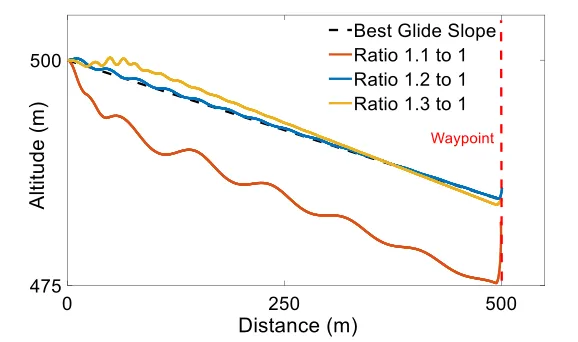
flying horizontally at a speed of 9 m/s. This initial condition differs slightly from the inclined
speed for the best glide-slope. With these initial conditions, the reward function weights were
adjusted to achieve the result shown in Fig. 2.3. In the tuning process, the weights were found
to separate into a set that controls steady glide (wP and wK) and a set that enables energy harvesting (wUand wN). This separation of the reward weights simplified the tuning, allowing for greater focus on the ratio of the terms, rather than exact values each should have.
Throughout this tuning process, the potential and kinetic energy weights wPand wKwere found to have the greatest impact on the smoothness of the flight path. The ratio of wP to wK that produced the best glide flight path shown in Fig. 2.3 was 1.2 to 1.
Figure 2.3: The ALFA flight path matches the no-wind minimum glide slope.
As shown, the selected path with ratio 1.2 to 1 (shown in blue) oscillated slightly toward
15 the optimal glide slope. As shown, the oscillations settled down to the best glide slope,
represented by the dashed black line. The settling time of the oscillation can be decreased by
increasing the number of pitch angle values being considered in the AFLA flower, but at the
expense of computation time. When deviating from the 1.2 to 1 ratio, the flight path showed
increased oscillations and would not approach the best glide slope. When the ratio is less than
1.2 to 1, the kinetic energy of the aircraft generally dominates the path decision, causing the
aircraft to trade altitude for velocity, diving down sharply with long oscillations as seen in Fig.
2.3. When the ratio was greater than 1.2 to 1, the increased role of the potential term causes
the aircraft to climb while sacrificing velocity until the aircraft stalls and pitches down to regain
its velocity. The aircraft then settles to a more constant slope, but one less than the best glide
slope. Keeping the potential energy weight slightly higher than the kinetic energy weight
stabilized the flight path and prevented small wind disturbances from having such large
impacts.
After the ALFA flight paths matched optimal theory, simulated classified updrafts such
as ridges and thermals, were used to determine a set of updraft and navigation weights that
provide a balance between reaching the waypoint and harvesting energy. The emphasis of this
portion of the tuning process was finding values that allowed the aircraft to harvest energy and
gain altitude. The ratio of wUto wN was adjusted by changing the navigation term. In this study, ridge lift with a region of high updraft velocity of 5 m/s was simulated. The area of updraft is
modeled with a parabolic updraft velocity profile that runs the length of the ridge. This simple
model helps pinpoint the weight values at which the flight behavior transitions between either
harvesting energy or reaching the waypoint. It narrows down the weight values that produce a
16 cause the path to harvest energy and reach the destination is the starting point for further tuning
through flight testing. More elaborate ridge models have been developed for use with ridge
studies such as those discussed in [14-18], but the simple model suffices for this application.
As shown in Fig. 2.4, the ridge is oriented at a 30-degree angle to the line joining the
start point [at (0,0)] and navigation waypoint [at (300,0)]. When the navigation priority was
set too low as is the case with the harvesting path, the aircraft remains in the favorable updraft
along the ridge without proceeding to its waypoint. When the navigation priority was set too
high as shown with the navigation path, the flight path passed through the favorable updraft
while gaining minimal energy. The region of transition between the two behaviors is shown
when the navigation weight is 11 and the aircraft exploits significant energy from the ridge
before traveling the remaining distance to the waypoint. Finally, the baseline flight path
indicates the energy gained when gliding along a straight-line path to the waypoint. Table 2.2
provides a summary of the differences in flight paths using flight time, final energy, distance
traveled and reaching the waypoint as metrics for comparison. The flights were simulated for
a maximum flight time of 100 seconds.
Table 2.2: Performance Metrics for the Ridge Updraft Simulation.
Metric Baseline Harvesting σ Transition σ Navigation σ
WN ---- 3 11 18
Flight Time (s) 48 92.3 14.87 76.9 23.35 52.8 11.51
Energy (J) 1193.3 4347.8 1241.8 3130.5 1460.2 1609.1 738.3
Distance (m) 295.3 580.5 84.2 147.8 142.5 72.8 75.5
Reached
17 Figure 2.4: Effect of navigation weight during a 30° approach to a ridge.
ALFA’s ability to ride a ridge updraft successfully also depended on its approach angle to the
ridge. When the flight path approached the ridge at an angle greater than 70 degrees, the
algorithm did not differentiate between the right and left sides of the aircraft well enough to
turn and exploit the ridge updraft. ALFA demonstrated the ability to follow a ridge and circle
to harvest energy when the navigational priority was not set excessively high.
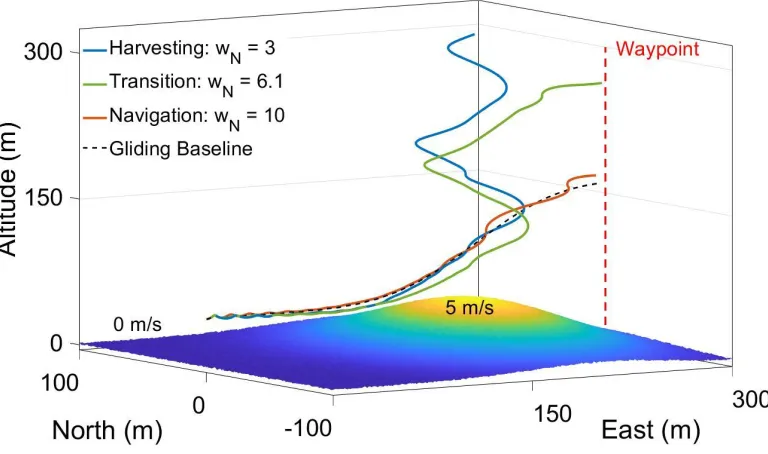
To study the effect of the navigation weights for a thermal updraft, a simulation was
conducted for a flight path that crosses a thermal (see Fig. 2.5). The set of weights that framed
the transition point between harvesting and reaching the waypoint for a classified ridge is
similar to the set of weights that frame the transition point for the classified thermal. This stems
from basing the algorithm on the measurement of updraft strength and decoupling it from the
identification of classified updrafts. For this simulation, the thermal was modeled as a vertical
column with a parabolic updraft profile. Like the ridge model, a simple model for a thermal
helps to narrow down the transition region between flight behaviors. More elaborate models
for thermals have been developed for in-depth simulations [1-3, 33-36]. When approaching a
18 was sufficiently low. As shown, the harvesting aircraft path circles the thermal, but does not
reach the destination. The navigation path travels directly to the destination without exploiting
much energy from the thermal. In the transition case, the aircraft exploits the thermal before
reaching the waypoint. The baseline flight path indicates the energy gained when gliding along
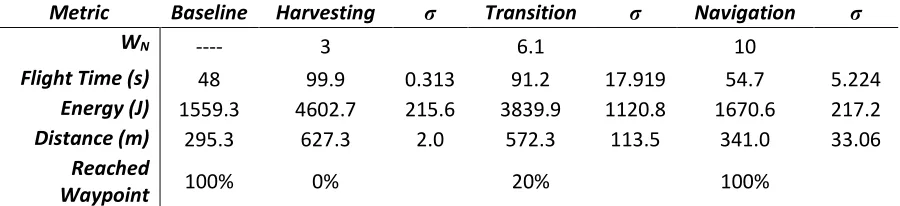
a straight line path to the waypoint. Table 2.3 provides a summary of the performance the
flights in Fig. 2.5. For these simulations, the maximum simulated flight time was 80 seconds.
In the rare situation when the aircraft approaches a thermal precisely toward its center, the
aircraft passes through it without engaging the thermal. Wind noise was added to this thermal
model as a random distribution with magnitude extremes of -0.1 to 0.1 m/s to evaluate the role
of wind noise on the flight behavior of the aircraft. Wind noise accounts for the changes in
updraft velocity that are rapid compared to changes in velocity due to the structure of a
classified updraft. In the first part of all three cases, the flight paths oscillated in response to
rapidly changing updraft velocity. As the updraft velocity from the thermal increases, it
overcomes the wind noise, allowing the updraft estimator to get better updraft measurements
and smoothing out the flight paths. These examples verified ALFA’s ability to achieve
desirable energy harvesting behavior without identifying classified updrafts. They also
provided a range of energy harvesting weights around the transition behavior of the flight paths
that serve as a starting point for further tuning the algorithm with flight testing.
Table 2.3: Performance Metrics for the Thermal Updraft Simulation.
Metric Baseline Harvesting σ Transition σ Navigation σ
WN ---- 3 6.1 10
Flight Time (s) 48 99.9 0.313 91.2 17.919 54.7 5.224
Energy (J) 1559.3 4602.7 215.6 3839.9 1120.8 1670.6 217.2
Distance (m) 295.3 627.3 2.0 572.3 113.5 341.0 33.06
Reached
19 Figure 2.5: Effect of navigation weight when encountering a thermal.
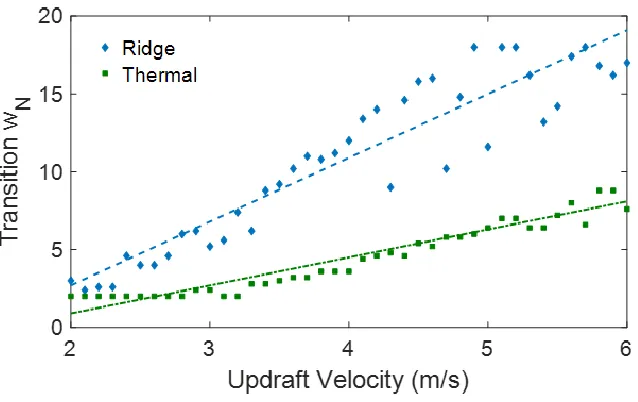
To understand the relationship between the maximum velocity of an updraft and tuning
parameters, Fig. 2.6 plots the last reward value at which the aircraft both harvests energy and
reaches its destination. This is indicative of the region in which transition takes place. In the
transition region, the reward function is balanced with the strength of the updraft. When this
happens, the stronger parts of the updraft cause the updraft term to dominate the reward value
of the candidate paths, making the aircraft stay in the high lift area. For any given updraft
velocity, the aircraft will stay in the region of updraft for wN values below the transition value, and the aircraft will reach the waypoint for wN values above the transition value. For both ridges and thermals, as the maximum updraft velocity increases, the aircraft needs a stronger
navigation weight to pull the aircraft out of the updraft. When navigating real updrafts, which
tend to get weaker with increasing altitude or time, the aircraft will break out of the updraft
when the updraft velocity sinks below the velocity corresponding to the selected transition
20 Figure 2.6: Effect of updraft velocity on the transition wN.
2.5 Tuning the Updraft Estimation Method
To ensure that the method of fit used to estimate the updraft velocity ahead of the aircraft is
accurate, the estimation of updraft velocities was simulated at five points around the front of
the aircraft (see Fig. 2.7). As shown, the points formed a semi-circle of radius r around the aircraft.
Figure 2.7: Test points for updraft estimation.
21 aircraft can update updraft measurements at 3 Hz, and the nominal gliding speed for the aircraft
is just over 9 m/s, r was set to 3 meters to simulate the distance traveled between measurements. The window size n and the weight C were tuned based on this setup.
When performing the tuning, the first simulation started with a constant updraft
velocity that stepped up to a higher velocity halfway along the flight path to see the updraft
estimation’s peak-overshoot and settling time characteristics. This addressed the estimation
problem along a straight-line flight path. Next, the estimation problem was extended to
two-dimensional space. Here, the problem considered a thermal updraft with a maximum strength
of 8 m/s, as shown in Fig. 2.8. Noise in the wind velocity was added to the model by adding a
sinusoidal noise function to the updraft distribution. This sinusoidal noise function was given
an amplitude that ranged from 0 – 0.5 m/s, and period that ranged from 0.1 meters to 2 meters.
The noise is always modeled as noise in the vertical direction. The amplitude and period of the
noise function were adjusted throughout the testing to simulate various noise conditions. The
sampling rate along the flight path coupled with the period of the noise function produced a
noise profile that appeared random. Two flight paths were simulated through the thermal, one
straight, and one sinusoidal, to compare the performance of the updraft fit in the regions to the
left and right of the aircraft. The sinusoidal path had an amplitude of 10 meters and a period of
40 meters. The updraft estimates along the straight flight path were compared with the updraft
estimates along the sinusoidal flight path to help determine the importance of data points
22 Figure 2.8: Updraft for testing and tuning the updraft estimation method (Umax = 8 m/s).
The tuning process considered the updraft estimator performance at each of the six
locations around the aircraft. The effect of changing the parameters n and C was studied. Increasing n and C were both found to increase lag (settling time), but there was a tradeoff between the lag and filtering the wind noise out of the signals. The primary effect of the
weighing coefficient C was in preventing large overshoot errors. The primary effect of the size of the moving window n was to filter out wind noise. With the effect of the parameters identified, Monte Carlo simulations were run to choose the parameters.
Since the parameters must be suited to many flight conditions, a metric was needed to
compare the estimation error during various situations. These situations considered various
levels of wind noise and considered the error at the six estimation locations discussed above.
Since the updraft error is dependent on the magnitude of the updraft velocity, the metric had
to be normalized to eliminate that factor. The Mean Absolute Scaled Error (MASE), which
normalizes the average error with the magnitude of the updraft velocity in order to weigh the
23 (10) 1
1 2 1 K k k K k k k e MASE K U U K = − = = − −
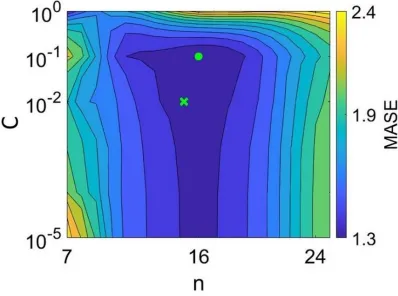
In Eq. (10), K is the number of total data points, ek is the error between the estimated and measured updraft velocities, and Uk is the updraft velocity at a given point. The results show the MASE values for a range of n and C for the simulated sinusoidal flight path for all of the six locations at one level of wind noise (see Fig. 2.9). The minimum MASE score for
this case is indicated by the green dot. The other simulations, which considered multiple
strengths and types of noise and varying levels of sinusoidal flight, were run and the combined
minimum MASE value is indicated by the green x. This combined minimum MASE value
indicates the chosen parameters of n = 15, and C = 0.01.
24 Using these parameters, Fig. 2.10 shows the error between the estimated and actual
updraft that has been scaled by the magnitude of the updraft velocity along the flight path.
When measuring at the aircraft, the error is below 2% for 93% of this flight path. The calculated
R2 value for the flight path is 0.991. This indicates that the updraft estimator should be sufficient for extrapolating the updraft values.
Figure 2.10: The scaled error between estimated and measured updraft velocities along the flight path.
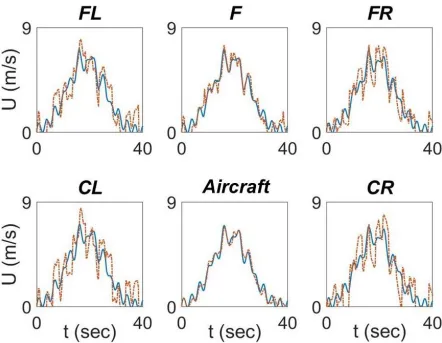
To help visualize the effect and performance of the selected parameters, Fig. 2.11
shows the measured updraft velocities (solid blue line) and estimated updraft velocities (dashed
orange line) along the simulated sinusoidal flight path for each of the six locations. The updraft
distribution includes wind noise with a strength up to 0.5 m/s. As shown, the estimate at the
aircraft, where the sensor is located, is better than at the other 5 points. Also shown, the
estimate at F is better than along the left and right sides of the aircraft. The updraft estimates at points FL, FR, CL, and CR were the least accurate. This indicates that the data is not “rich”. The “richness” of the data describes whether the data has enough points orthogonal to the flight
path to generate a realistic 2-dimensional updraft model. A model that produces small errors
25 later, a sinusoidal flight path improves the richness of the data, but even so, the aircraft’s
inability to measure data outside the flight path of the aircraft produces richness concerns.
However, the data did show that there is a distinction between the left and right sides of the
aircraft, which is necessary for successful energy harvesting.
Figure 2.11: Estimator performance at various locations about the aircraft.
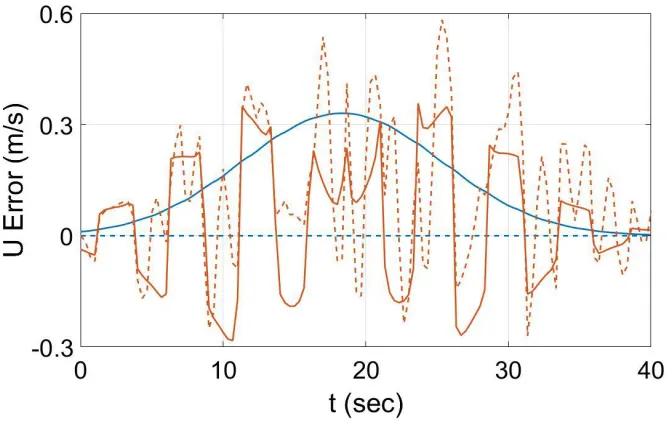
Now that the updraft estimation parameters are set, the differentiation between left and
right sides of the aircraft were analyzed to ensure the reward function could differentiate
26 color) and its improvements over the simulated straight flight path (blue color). The solid lines
indicate measured difference in updraft velocity between the two locations, and the dashed
lines show the estimated differences. While the measured velocities of the straight path
differentiated between the right and left sides, its estimated velocities did not register a
difference at all. When the aircraft followed a sinusoidal path, however, the estimated
velocities matched the measured velocities much better. This indicates that data richness
affects the success of the estimator and, if needed, prescribing a sinusoidal flight path can
produce better results. The estimates still overshoot changes in updraft velocity, but this
behavior is expected. Since the algorithm only needs to differentiate between the two sides of
the aircraft, the presence of exaggerated values can be beneficial.
27
Chapter 3
Flight-testing Setup and Initial Results
3.1 Flight Testing Setup
The test platform for ALFA was the Phoenix 2000 EPO Composite R/C Glider (see Fig. 3.1).
It has a two-meter wingspan foam wing, with the option of landing flaps, a 1.16-meter-long
blow-molded fuselage and is powered by a 1050KV brushless motor and folding propeller. A
powered glider was selected for ease of launch and recovery. Its loaded flight weight was 1.51
kg.
Figure 3.1: Phoenix 2000 powered glider used for flight-testing.
A flight controller (Pixhawk Mini) was used in conjunction with an open-source ground
control software (Mission Planner) to control the aircraft, and communication between the
aircraft and the ground control station (GCS) was accomplished with RFD-900 telemetry units.
28 to the aircraft. The flight data presented in this dissertation was collected in September 2018
at the North Carolina State University Lake Wheeler Road Field Laboratory. The flight area
consisted primarily of cornfields, with some trees around the border and a couple of buildings
and trees in the center. The rolling fields allowed for good thermal activity in the mornings and
afternoons. Throughout flight-testing, the reward function weights were adjusted to produce
desirable flight behaviors depending on the wind conditions. Several flights were conducted
with a set of weight values, and based on the behavior of the aircraft, the ratio was adjusted to
find the set of values that produced energy harvesting behavior. This process was repeated
every flight day as the wind conditions were a large factor in which sets of weights would
produce energy harvesting behavior. Over time, the parameter values were slightly adjusted
until the desired energy harvesting behavior was observed. This resulted in a wU to wN ratio of 5 to 1. Adjusting the iteration time step to a length of 2 seconds also helped produce smooth
energy harvesting flight behaviors.
3.2 Reducing the ALFA Flower
Before conducting flight tests, there are several considerations which allow the ALFA flower
to be reduced to fewer candidate paths, which in turn will improve the simulation time. Recall
that the reward function consists of four terms: potential, kinetic, updraft, and navigation. The
potential and kinetic energy terms primarily address the aircraft’s ability to maintain a steady
glide, as discussed previously. During flight-testing, the purpose of the flight controller is to
maintain steady glide and govern the flying characteristics of the aircraft, effectively handling
the potential and kinetic terms. This leaves the updraft and navigation terms for the ALFA
algorithm to control. Letting the flight controller manage the steady glide components of the
29 function, as they govern the steady glide of the aircraft in simulations. If ALFA was fully
implemented on the flight controller, all four terms would be governed by the reward function
as well. However, since the algorithm is run on the ground station, it is logical to let the flight
controller handle the terms it already governs. This consideration in addition to the
assumptions made in the updraft estimation process, namely that updraft velocity is
independent of altitude, allows the ALFA flower to be reduced to one pitch value producing
nearly planar flight. The second reduction is the removal of thrust levels from the candidate
paths. Since the focus of this dissertation is to investigate the energy harvesting capabilities of
the lumbered approach while gliding, the use of thrust is of secondary importance to this study.
The thrust is used to prevent the aircraft from descending below a minimum altitude of 30
meters. When gliding at a sufficient altitude, the thrust is set to zero for all candidates and is
not considered in the ALFA process. In the future, understanding the relationship between
thrust levels and navigating updrafts to harvest energy will be important to determine an
optimum way to incorporate energy harvesting in powered flight applications. However, these
considerations do not match the focus of this work, allowing the ALFA flower to be reduced
in this way. The resulting set of candidate paths considers the six nearly-horizontal flight paths
produced by various bank angles spanning from -60 to 60 degrees. It is important to note that
when six flight paths are equally distributed between -60 and 60 degrees there is no option for
the aircraft to fly straight. Preventing the aircraft from flying straight ensures that the flight
path always has a sinusoidal component to it, which is necessary to collect updraft data that is
rich enough for a good updraft estimate, as described in section 2.5.
With this simplified ALFA flower, the updraft and navigation terms of the reward
30 wind noise, and the navigation term is, in comparison, more robust and consistent, the flight
path selections can alternate between banking extremes. This would produce erratic flight
patterns that change drastically and are inefficient. To prevent these rapid changes from
occurring and produce a smoother flight path, the selected path number was constrained to be
no more than two paths removed from the previous path number. After the reward function
selects a flight path, it is compared to the previously selected path number to determine how
much it changed from the previous time step. When the difference is more than two paths, the
algorithm selects the path that is two paths toward the newly selected number. Thus, the new
selected path is constrained to be no more than two paths from the previous path number,
producing flight behavior more consistent with aircraft of this size class.
3.3 The Reward Pie
The previous section discussed ways in which the ALFA flower was simplified and that the
flight controller was set to handle the reward terms governing steady glide. This leaves the
updraft and navigation terms for the ALFA algorithm to use to determine the flight path. To
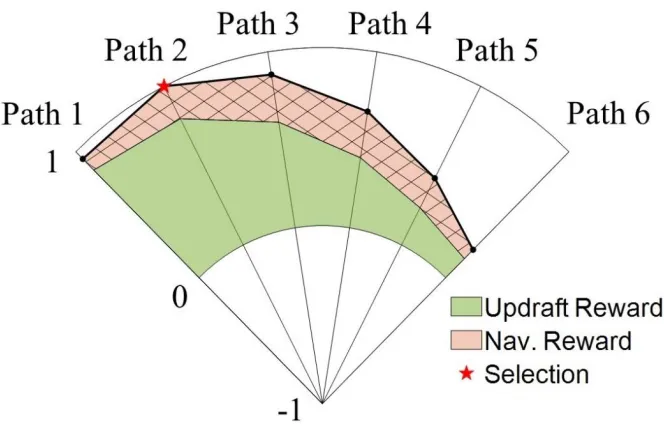
visualize the tradeoff between the updraft and navigation terms a visual aid was developed,
which is referred to as the reward pie. The updraft and navigation terms are represented in Fig.
3.2 as the green and red hatched areas respectively. The “spokes” on the pie chart represent the
six petals of the reduced ALFA flower. The reward is normalized by the maximum reward
value of the ALFA flower, allowing the reward values to stay between 1 and -1. As shown, the
updraft values begin at the center arc, representing zero, and the navigation values start where
the updraft values left off. The final reward values are represented with the bolded line, and
the red star indicates the selected path having the largest reward score. The reward pie is
31 Figure 3.2: The reward pie.
3.4 Navigation Baseline
The focus of this work is to determine whether this algorithm can enable the aircraft to harness
energy from the atmosphere. However, the ultimate goal of an aircraft mission is to reach the
waypoints and complete objectives. Using ALFA, the priority between reaching waypoints and
harnessing energy from updrafts can be adjusted to produce the flight behavior required for a
particular mission. The reward function priorities can be set such that the aircraft ignores all
updrafts and single-mindedly follows waypoints or only focuses on harnessing updrafts and
never reaching mission waypoints. Fig. 3.3 shows a flight conducted where the energy
harvesting ratio was set to heavily favor navigating to waypoints with a ratio of wU to wN of 1 to 5. The flight indicates that the aircraft flew directly to each waypoint with minimal
deviations from the straight path. The small sinusoidal motion observed along the flight path
is caused by the lack of a straight flight option in the ALFA flower as discussed previously.
32 following autopilot. From this point on, the updraft weight was increased so that the aircraft
was able to harvest energy. The remainder of this dissertation focuses on the behaviors
produced by the algorithm when set to harvest energy, and flights that harvest energy at the
expense of not reaching all waypoints are considered acceptable for analyzing the soaring
behavior produced.
Figure 3.3: Altitude and flight path while prioritizing navigation.
3.5 Illustrative Flight
The following flight case demonstrates the feasibility of ALFA. In this flight, the aircraft was
manually hand-launched, flown to an altitude of 170 meters, and then controlled by ALFA for
the remainder of the flight until landing. Fig. 3.4 shows the time variation of altitude for a
portion of an ALFA controlled flight. Fig. 3.5 shows the flight path over an image of the flight
field, and Fig. 3.6 shows a three-dimensional view of the flight path. The same color scale has
been used in all three figures. The aircraft’s mission is to fly a triangle between waypoints A,
B and C, and to exploit wind conditions whenever possible. The aircraft updates its waypoint
33 As shown in Figs. 3.4 to 3.6, to describe the ALFA behavior, the flight was divided
into four sections, separated by circled numbers. Section one (1 to 2) shows the aircraft gaining
altitude and circling in an updraft, as well as meandering between areas of good lift heading to
the first two waypoints. Waypoints are indicated by the white circles in Fig. 3.5. Section two
(2 to 3) shows an area where the aircraft exits the updraft to travel toward the next waypoint
and loiters in a weak area of lift. Section three (3 to 4) shows a period where there is almost no
updraft present, but the aircraft still searches the region for an updraft. In section four (4 to 5),
the aircraft has again found a good updraft and circles to gain altitude.
Figure 3.4: Altitude flight profile (color map represents aircraft altitude).
Table 3.1: Sink Rates for Illustrative Flight Sections (unassisted sink rate = 0.7 m/s).
Section 1 (m/s) -0.371
Section 2 (m/s) 0.359
Section 3 (m/s) 0.663
34 The constant exploitation of the small updrafts and wind variations while searching for
stronger updrafts allows the aircraft to fly at a reduced sink rate from that of a direct glide to
its destination. Herein ALFA’s potentially greatest benefit to soaring is demonstrated. For
comparison, the unassisted sink rate, which is the average sink rate along portions of the flight
where the aircraft glides unassisted by the algorithm, is 0.7 m/s. This value represents the
average sink rate of several flights that glided directly between these waypoints without using
power or ALFA to harness energy. Table 3.1 shows the average sink rates for the sections of
the flight path. In all the flight path sections, ALFA performed better than the unassisted sink
rate. In sections 1 and 4, the aircraft demonstrated a climb rate, which indicates the presence
of a strong updraft in the area and showed that ALFA was able to harvest energy from the
rising air successfully. Sections 2 and 3 brought the aircraft to a region of weaker updrafts
where it lost altitude, but still flew with a sink rate less than the unassisted sink rate.
35 While traveling toward waypoint A, the aircraft utilized updrafts and executed several
turns to remain in the favorable area of updraft. After reaching waypoint A, it started
meandering toward the second waypoint while staying in a favorable updraft. Near waypoint
B, the aircraft noticed a possible updraft south of the waypoint and executed three turns in the
updraft at that location. Then the navigation term gained priority over the updraft term and the
aircraft proceeded past waypoint B. Heading to waypoint C, the algorithm directed the aircraft
to loiter in an area of weaker updraft, and it stayed there slowly losing altitude until it reached
point 3. From point 3 to point 4, the updraft weakened or moved away, and the aircraft lost
altitude more rapidly. However, at point 4, the algorithm found another region of lift, and was
able to gain altitude by following the updraft and executing a couple of turns. After point 5,
the pilot took manual control and landed the aircraft. Throughout this flight, the aircraft never
reached waypoint C. While the ultimate goal for a soaring algorithm is to reach its objective
points while harvesting energy, the purpose of this work is to demonstrate the ability an aircraft
to harvest energy at all using the lumbered approach to autonomous soaring. So, while not
reaching waypoint C falls short of the ideal, this flight contains energy harvesting behaviors
that are valuable for this study.
36 As seen in Fig. 3.6, the flight section between points 1 and 2 shows circling behavior.
The aircraft appears to follow either a thermal that rose at an angle to the ground or one that
was moving along at some speed. Fig. 3.7 shows a detailed view of flight section 1. As seen in
this figure, the aircraft circled three times before moving toward the next waypoint and circling
again. Near the end of the climb, the updraft weakened to the point where the navigation term
of the reward function influenced the aircraft to begin heading toward the next objective point.
By this point, the aircraft had gained 85 meters in altitude and was heading toward the next
objective.
Figure 3.7: Detailed view on the 85-meter climb in section 1 (between points 1-2).
Throughout this flight, ALFA was able to identify and remain in areas of updraft. It
demonstrated an ability to meander and circle in a thermal. It was able to loiter in areas of a
weaker updraft, which allowed it to sink at a slower rate than the unassisted sink rate. With
ALFA, the endurance of the aircraft during this flight improved from an estimated total flight
time of 180 seconds associated with an unassisted glide, to 810 seconds, an improvement of
350%. The flight demonstrates the feasibility of using the lumbered approach for autonomous
37
Chapter 4
Detailed Flight Analysis
In this chapter, three flights that were selected to demonstrate the feasibility of ALFA
(see Figs. 4.1 and 4.2). Flight 1 was waypoint oriented, and showed the aircraft navigating the
airspace with minimal deviations from direct waypoint paths. While navigating between the
waypoints, the aircraft demonstrated a tendency to zigzag and avoid straight flight paths. In
flight 2, the aircraft’s waypoints were laid out in a triangle, but the aircraft prioritized updraft
exploitation over waypoint navigation. In this case, the aircraft was able to explore and gain
altitude, but only reached two of its three waypoints. In flight 3, the aircraft was given a loiter
command near a thermal, and ALFA was able to exploit energy from the thermal without
exploring too far from its loitering location.
Eight segments were selected from these three flights to demonstrate specific flight
behaviors produced by the algorithm (see Fig. 4.1). Before reviewing the individual flight
segments more closely in the next section, notice that the aircraft consistently performed better
with ALFA than when unassisted by the algorithm. Table 4.1 compares aircraft sink rates over
each of the flight segments and shows that the sink rate with ALFA was lower than the
unassisted sink rate of 0.7 m/s. Recall that this value represents the average sink rate of the
aircraft over several flights when set to navigate the waypoints while gliding, without using
the algorithm. Segment 2, which had the highest sink rate of the segments, still shows a sink
rate less than the unassisted sink rate. The best sink rates were actually climb rates, and these
38 ALFA exhibited great energy savings in addition to gaining energy from the classified
updrafts.
Table 4.1: Sink Rates for Detailed Flight Sections (unassisted sink rate = 0.7 m/s).
Segment 1 (m/s) 0.3
Segment 2 (m/s) 0.5
Segment 3 (m/s) 0.4
Segment 4 (m/s) -0.6
Segment 5 (m/s) -0.2
Segment 6 (m/s) -0.4
Segment 7 (m/s) -0.4
Segment 8 (m/s) -0.2
39 Figure 4.2: Aircraft flight paths.
4.1 Observed Behavior
The segments introduced above illustrate eight flight behaviors exhibited by the ALFA
controlled aircraft. ALFA flight behavior is made up of three simple behavior elements, a
circle, a straight line and a random line. These elements combine to produce various flight
behaviors, such as the eight behaviors identified below. Flight segment 1, Search and Return,
shows how the aircraft transitions from waypoint following to exploration behavior. In
segment 2, Circle Away, the aircraft executes several loops in response to the wind conditions.
In segment 3, Regional Loiter, the aircraft exhibits loitering behavior. In segment 4, Sine
Climb, it zigzags toward its waypoint while gaining altitude approaching a thermal updraft.
These four flight segments show how ALFA responds to rapidly changing, and often weaker,
unclassified updrafts, while demonstrating exploration behavior. In segment 5, Loiter, the
aircraft maintains and slowly increases its altitude while loitering near a point. In segment 6,
Thermal Loiter, the aircraft executes a nice circling pattern to gain altitude in a thermal.
40 8, Stationary Thermal, the aircraft circles to remain in a stationary thermal. These last four
segments illustrate how ALFA behaves near classi