THE SCHUR MULTIPLIER AND CAPABILITY OF PAIRS OF SOME FINITE GROUPS
ADNIN AFIFI BINTI NAWI
A thesis submitted in fulfilment of the requirements for the award of the degree of
Doctor of Philosophy (Mathematics)
Faculty of Science Universiti Teknologi Malaysia
iii
To my beloved parents,
iv
ACKNOWLEDGEMENT
In the name of Allah, the Most Gracious and Merciful. Praise to Allah for giving the strength and courage in completing my PhD thesis.
First and foremost, I would like to express my deepest gratitude to all my supportive supervisors, Assoc. Prof. Dr. Nor Muhainiah Mohd Ali, Prof. Dr. Nor Haniza Sarmin and Assist. Prof. Dr Samad Rashid (Islamic Azad University, Tehran, Iran) for their superb guidance and advices. A deeply felt thank you to them for giving me motivation, for their helps and for sharing their expertise in completing my research.
My special thanks to my beloved parents, Nawi Abdul Rahman and Nik Zainun Nik Abdul Rahman for their everlasting love and prayers. Besides, I wish to express my appreciation to all my siblings, Aznita, Azman, Azlin, Asmadi, Aflaha, and Anis, and family for their endless support.
v
ABSTRACT
The homological functors of a group have its origin in homotopy theory and algebraic K-theory. The Schur multiplier of a group is one of the homological functors while the Schur multiplier of pairs of groups is an extension of the Schur multiplier of a group. Besides, a pair of groups is capable if the precise center or epicenter of the pair of groups is trivial. In this research, the Schur multiplier and capability of pairs of groups of orderp, p2
, p3 , p4
, pq, p2
qand p3
q(wherep andqare distinct odd primes) were determined. This research started with the computation of the normal subgroups of the groups. The generalized structures of the normal subgroups have been found by the assistance of Groups, Algorithms and Programming (GAP) software. By using the Sylow theorems and the results of the nonabelian tensor products, derived subgroups, centers of the groups, abelianization of the groups and the Schur multiplier of the groups, the Schur multiplier of pairs of groups of order p, p2
, pq, p2 q, p3
, p4 andp3
q were then determined. The classification of the groups had also been used in the computation of the Schur multiplier and capability of pairs of groups. The order of the epicenter of pairs of groups of orderp, p2
, p3 , p4
and pq were also computed by using GAP software to determine the capability of pairs of the groups. The Schur multiplier of pairs of group is found to be trivial or abelian. All pairs of groups where G is isomorphic to the elementary abelian groups of order p2
, p3
and p4
, nonabelian group of orderp3
of exponentp, direct product of two cyclic groups of orderp2
, semi-direct product of two cyclic groups of order p2
, and direct product of cyclic group of orderpand nonabelian group of orderp3
vi
ABSTRAK
Fungtor homologi bagi suatu kumpulan berasal dari teori homotopi dan teori-K aljabar. Pendarab Schur bagi suatu kumpulan adalah satu daripada fungtor homologi sementara pendarab Schur bagi kumpulan berpasangan adalah suatu perluasan daripada pendarab Schur bagi suatu kumpulan. Di samping itu, suatu kumpulan berpasangan adalah berupaya jika pusat kumpulan tepat atau epi pusat kumpulan bagi kumpulan berpasangan tersebut adalah remeh. Dalam penyelidikan ini, pendarab Schur dan keberupayaan untuk suatu kumpulan berpasangan berperingkat p, p2
, p3 , p4
, pq, p2 q dan p3
q (dengan p dan q adalah nombor perdana yang berbeza) telah ditentukan. Penyelidikan ini bermula dengan pengiraan subkumpulan normal bagi kumpulan tersebut. Struktur umum subkumpulan normal telah ditentukan dengan bantuan perisian Groups, Algorithms and Programming (GAP). Dengan menggunakan teori Sylow dan keputusan bagi hasil darab tensor tak abelan, subkumpulan terbitan, pusat kumpulan, keabelanan dan pendarab Schur bagi kumpulan tersebut, pendarab Schur bagi kumpulan berpasangan berperingkatp, p2
, pq, p2 q, p3
, p4
dan p3
q kemudiannya ditentukan. Pengelasan bagi kumpulan tersebut juga telah digunakan dalam pengiraan pendarab Schur dan keberupayaan untuk suatu kumpulan berpasangan. Peringkat bagi epi pusat kumpulan bagi kumpulan berpasangan berperingkat p, p2
, p3 , p4
dan pq juga telah dikira dengan menggunakan perisian GAP bagi menentukan keberupayaan untuk suatu kumpulan berpasangan. Pendarab Schur bagi kumpulan berpasangan tersebut telah ditemui remeh atau abelan. Semua kumpulan berpasangan di mana G isomorfisma kepada kumpulan permulaan abelan berperingkatp2
,p3 danp4
, kumpulan tak abelan berperingkat p3
dengan p eksponen, hasil darab langsung dua kumpulan kitaran berperingkatp2
, hasil darab semi-langsung dua kumpulan kitaran berperingkat p2
, dan hasil darab langsung kumpulan kitaran berperingkat p dan kumpulan tak abelan berperingkat p3
vii
TABLE OF CONTENTS
CHAPTER TITLE PAGE
DECLARATION ii
DEDICATION iii
ACKNOWLEDGEMENT iv
ABSTRACT v
ABSTRAK vi
TABLE OF CONTENTS vii
LIST OF FIGURES xi
LIST OF SYMBOLS xii
LIST OF APPENDICES xiv
1 INTRODUCTION 1
1.1 Introduction 1
1.2 Research Background 2
1.3 Problem Statement 4
1.4 Research Objectives 5
1.5 Scope of the Study 5
1.6 Significance of Findings 6
1.7 Research Methodology 7
1.8 Thesis Organization 9
2 LITERATURE REVIEW 11
2.1 Introduction 11
viii
2.3 The Schur Multiplier of a Pair of Groups 13
2.4 The Capability of Groups 14
2.5 The Capability of a Pair of Groups 15
2.6 Groups, Algorithms and Programming (GAP) Software 16 2.7 Basic Concepts and Preparatory Results 17
2.8 Conclusion 42
3 THE SCHUR MULTIPLIER OF PAIRS OF SOME
p-GROUPS 44
3.1 Introduction 44
3.2 The Schur Multiplier of Pairs of Groups of Orderp andp2
44 3.3 The Schur Multiplier of Pairs of Groups of Orderp3
46 3.4 The Schur Multiplier of Pairs of Groups of Orderp4
49 3.4.1 The Schur Multiplier of Pairs of Abelian
Groups of Orderp4
50 3.4.2 The Schur Multiplier of Pairs of
Nonabelian Groups of Orderp4
57
3.5 Conclusion 65
4 THE SCHUR MULTIPLIER OF PAIRS OF SOME
COMPOSITE ORDER GROUPS 66
4.1 Introduction 66
4.2 The Schur Multiplier of Pairs of Groups of Orderpq 66 4.3 The Schur Multiplier of Pairs of Groups of Orderp2
q 68
4.4 The Schur Multiplier of Pairs of Groups of Orderp3
q 72
4.5 Conclusion 81
5 THE CAPABILITY OF PAIRS OF SOME FINITE
GROUPS 82
5.1 Introduction 82
5.2 GAP Algorithms for Determining the Capability of
Pairs of Groups 82
ix
5.4 The Capability of Pairs of Groups of Orderp2
86 5.5 The Capability of Pairs of Groups of Orderp3
87 5.6 The Capability of Pairs of Groups of Orderp4
88 5.7 The Capability of Pairs of Groups of Orderpq 92
5.8 Conclusion 92
6 CONCLUSION 93
6.1 Summary of the Research 93
6.2 Suggestion for Future Research 94
REFERENCES 95
x
LIST OF FIGURES
FIGURE NO. TITLE PAGE
1.1 Research methodology 8
1.2 Thesis organization 10
xi
LIST OF SYMBOLS
G⊗ZG - Abelian tensor square ofG
Gab - Abelianization ofG
a|b - adividesb
An - The alternating group
Z(G) - Center of the groupG CG(A) - Centralizer ofAinG
[g, h] - The commutator ofg andh G0
- The commutator subgroup ofG
gh - The conjugate ofhbyg
Zn - Cyclic group of ordern
Dn - The dihedral group of order2n G×H - Direct product ofGandH
G⊕H - Direct sum ofGandH
- End of proof
Z∗
(G) - Epicenter ofG
Z∗
(G, N) - Epicenter of a pair ofG exp(G) - Exponent ofG
Z∧
(G) - Exterior center ofG C∧
G(x) - Exterior centralizer ofxinG Z∧
G(N) - ExteriorG-center ofN G∧G - Exterior square ofG
G - A group
xii
H / G - His a normal subgroup ofG
H ≤G - His a subgroup ofG
1∧ - Identity of exterior square
|G:H| - Index of the subgroupHin the groupG
∩ - Intersection
g−1
- The inverse ofg
ker(κ) - Kernel of the homomorphismκ
gH - Left coset ofHwith coset representativeg
|G|,|x| - Order of the groupG, the order of the elementx
(G, N) - A pair ofGwhereN is a normal subgroup ofG Qn - The quaternion group of order4n
G/
H - Quotient group forGofH
Hg - Right coset ofHwith coset representativeg M(G) - Schur multiplier ofG
M(G, N) - Schur multiplier of a pair ofG GoH - Semi-direct product ofGandH Sn - The symmetric group of ordern! G⊗˜ G - Symmetric square ofG
G⊗H - Tensor product ofGandH
G⊗G - Tensor square ofG
1 - Trivial group
xiii
LIST OF APPENDICES
APPENDIX TITLE PAGE
A GAP Algorithms 99
CHAPTER 1
INTRODUCTION
1.1 Introduction
The homological functors of a group have its origin in homotopy theory and algebraic K-theory. One of the homological functors is the Schur multiplier of a group. The Schur multiplier of a group G, denoted by M(G), was first introduced by Schur [1] while studying projective representations of groups in 1904. Since then, many researchers interested to study on the Schur multiplier of a group.
In 1998, Ellis [2] extended the notion of the Schur multiplier of groups to the Schur multiplier of a pair of groups. Let (G, N) be an arbitrary pair of finite groups where N is a normal subgroup of G. Then the Schur multiplier of the pair, denoted by M(G, N) is a functorial abelian group whose principal feature is a natural exact sequence
H3(G)→η H3
G/ N
→M(G, N)→M(G)→µ M
G/ N
→N/[N, G]→(G)ab α→
G/ N
ab
→1 (1.1)
2
The study of capability of groups was initiated by Baer [3] in 1938 who determined all capable abelian groups. Following Hall and Senior in [4], a groupGis capable if it is a group of inner automorphisms of some group or equivalently if there exists a groupHsuch thatG∼=H/Z(H). Hall in [5] remarked that characterization of capable groups is important in classifying groups of prime power order.
In 1996, Ellis [6] extended the theory of the capability of groups to a theory for a pair of groups. He defined the capability of a pair of groups in terms of Loday’s notion of a relative central extension. Given a normal subgroup N in G, a relative central extension of the pair (G, N)consists of a group homomorphism d : M → G and action(g, m)→ gmofGonM satisfying:
(i) d(gm) =gd(m)g−1
forginGandminM; (ii) mm0
m−1
=d(m)
mformandm0
inM; (iii) N =Image(d);
(iv) the action ofGonM is such thatGacts trivially on the kernel ofd.
The pair of group,(G, N)is said to be capable if it admits a relative central extension with the property that Ker(d) consists precisely of those elements in M on whichG acts trivially. Note thatM is an arbitrary subgroup ofG.
In this research, the Schur multiplier of pairs of groups of order pn for n = 1,2,3,4 and pnq for n = 1,2,3 where p and q are distinct primes, and the capability of pairs of groups of order pn for n = 1,2,3,4 and pq for n = 1 where pandqare distinct primes are determined.
1.2 Research Background
3
These include the classification of groups of order p, p2 , p3
, p4
andp2
q by Burnside in [7] and groups of orderp3
q by Western in [8]. Based on the given classifications, this research focuses on the groups of orderpnforn= 1,2,3,4andpnqforn= 1,2,3 wherepandqare distinct primes. Throughout this research,Gdenotes a finite group.
The Schur multiplier of a group is the second integral homology group H2(G,Z). In 1956, Green [9] proved that the order of the Schur multiplier of a finite groupGof orderpnis at mostp12n(n−1), that is specifically for any groupGof orderpn there exists an integert(G)≥0such that|M(G)| =p12n(n−1)−t(G). After many years, Berkovich [10], Zhou [11], Ellis [12], Salemkar et al. [13], and Niroomand [14, 15] classified the structure of G for the cases t(G) = 0 and 1, t(G) = 2, t(G) = 3, t(G) = 4 andt(G) = 5respectively. Recently, Jafariet al.[16] determined the Schur multiplier of groups of square free order and groups of orderp2
qandpq2
wherepand qare primes andp < qwhile Rashid [17] determined the Schur multiplier of groups of orderp2
andp3
q forp < q. In 2011, Rashidet al.[18] computed the Schur multiplier of groups of order p2
q where pand q are primes (with no restriction on pand q). In 2013, Zainalet al.[19] computed the Schur multiplier of groups of orderp3
and abelian groups of order p4
while Ok [20] computed the Schur multiplier of some nonabelian groups of orderp4
.
A pair of groups (G, N) is a group G with a normal subgroup N. The Schur multiplier of a pair of groups, M(G, N), is defined to be the abelian group which appears in the natural exact sequence as in (1.1). In 1998, Ellis [2] proved that the order of the Schur multiplier of a pair of finite group G with normal subgroup N of order pn and quotient group G/
N of order pm is bounded by p12n(2m+n−1) and hence equals to p
1
2n(2m+n−1)−t(G,N) for integer t(G, N) ≥0. Salemkaret al.[21], Hokmabadiet al.[22], Moghaddamet al.[23] and Mohammadzadehet al.[24] characterized the structure of such a pair of groups(G, N)
4
In 1938, Baer [3] started a research on the capability of groups by determining all capable abelian groups. Following Hall and Senior in [4], a group is capable if it is a central factor group. In 1979, Beylet al.[25] established a special condition for a group to be capable. They showed that a group is capable if and only if the epicenter of the group is trivial. In 1995, Ellis [26] introduced the exterior center of the group and proved that a group is capable if and only if the exterior center of the group is the trivial group.
In 1996, Ellis [6] introduced the exterior G-center of N for a pair of groups and proved that the pair of groups is capable if and only if the exteriorG-center ofN is a trivial group. Later in 2011, Pourmirzaeiet al.[28] introduced the precise center for a pair of groups with the property that the precise center for a pair of groups is a subgroup of the exterior G-center of N for a pair of groups. They found that the pair of groups is capable if and only if the precise center for a pair of groups is the trivial group. Besides, they determined all capable pairs of finitely generated abelian groups.
In this research, the classifications of groups of orderpn forn = 1,2,3,4and pnqforn = 1,2,3given in [7] and [8] are used to compute the Schur multiplier of pairs of groups. After that, the capability of pairs of some of these groups are determined.
1.3 Problem Statement
Given the groups of orderpnforn = 1,2,3,4andpnqforn = 1,2,3wherep andqare distinct primes, then the following questions are addressed and answered:
(i) What are the Schur multiplier of pairs of groups of order pn for n= 1,2,3,4?
5
(iii) Which pairs of groups of orderpnforn= 1,2,3,4are capable? (iv) Which pairs of groups of orderpq wherepandq are distinct primes,
are capable?
1.4 Research Objectives
The objectives of this study are:
(i) to compute the Schur multiplier of pairs of groups of order pn for n= 1,2,3,4,
(ii) to compute the Schur multiplier of pairs of groups of order pnq for n= 1,2,3wherepandqare distinct primes,
(iii) to determine the capability of pairs of groups of order pn for n= 1,2,3,4,
(iv) to determine the capability of pairs of groups of orderpqwherepand qare distinct primes.
1.5 Scope of the Study
This research focuses on the determination of the Schur multiplier of pairs of groups of orderpnforn = 1,2,3,4andpnq forn = 1,2,3wherepandqare distinct primes, and the capability of pairs of groups of orderpnforn = 1,2,3,4andpq where pandq are distinct primes. For the group of orderp, there is only one group and the group is cyclic. For the groups of orderp2
, there are two groups in the classification, one is a cyclic group and another one is an elementary abelian group. For the groups of order p3
, there are five groups in the classification which includes three abelian groups and two nonabelian groups which are also known as an extra-specialp-groups. All groups in the classifications of groups of order p, p2
and p3
6
the groups of orderp4
, there are four abelian groups and 11 nonabelian groups in the classification. All four abelian groups are considered in this research, but only six nonabelian groups out of 11 which satisfy the conditions|Z(G)| = p2
,|G0
| = p,and G0
⊆Z(G)are considered in this research. For the groups of orderpq, the computation only focuses on the case whenp < qwhile for the groups of orderp2
q, the computation focuses on both cases when p < q and p > q. For the groups of order p3
q where p < q, there are 27 nonabelian groups. However, only 11 of them are considered in this research. The groups are from the case whenpis an odd prime.
1.6 Significance of Findings
The contribution of this research consists of new theoretical findings on determining the Schur multiplier and capability of pairs of groups. The findings obtained can be used for further determination of the Schur multiplier and capability of pairs of a family of groups. Thus, the findings of this research contributes new theories in Group Theory.
7
1.7 Research Methodology
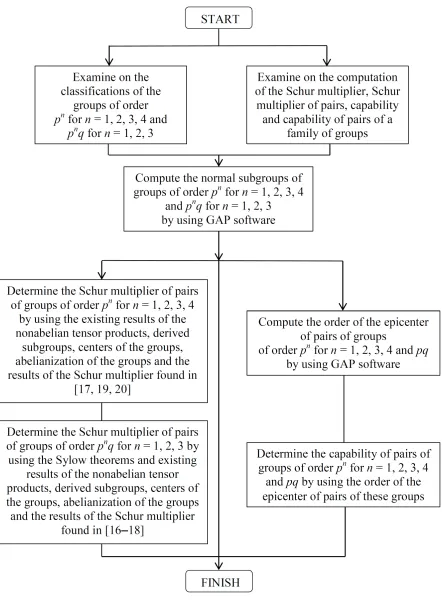
This research begins with examining the classifications of groups of orderpn forn = 1,2,3,4andpnqfor n = 1,2,3. As mentioned earlier, the classifications of groups of orderp,p2
,p3 ,p4
andp2
qare given by Burnside in [7] and the classifications of groups of order p3
q are given by Western in [8]. Jafariet al. [16] determined the Schur multiplier of groups of square free order and groups of orderp2
qandpq2 where p and q are primes and p < q while Rashid [17] determined the Schur multiplier of groups of orderp2
andp3
q forp < q. In 2011, Rashidet al.[18] computed the Schur multiplier of groups of orderp2
qwherepandqare primes. In 2013, Zainalet al.[19] computed the Schur multiplier of groups of orderp3
and abelian groups of orderp4 and Ok [20] computed the Schur multiplier of some nonabelian groups of orderp4
8
9
1.8 Thesis Organization
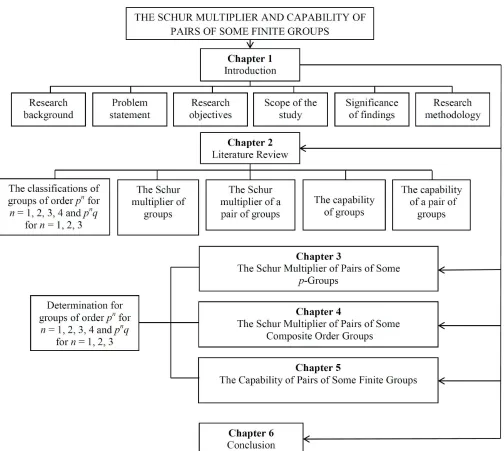
The first chapter is the introduction to the whole thesis. This chapter contains a brief introduction on the Schur multiplier of a group, Schur multiplier of a pair of groups, capability of a group and capability of a pair of groups, research background, problem statement, research objectives, scope of the study, significance of the study and research methodology.
The literature review of this research is provided in Chapter 2. The contribution of many researchers on the Schur multiplier of a group, nonabelian tensor product, Schur multiplier of a pair of groups, capability of a group and capability of a pair of groups are also included. Some concepts and established results from previous researchers that are used throughout this research are presented in this chapter. Besides, a brief introduction on Groups, Algorithms and Programming (GAP) software is also given.
Chapter 3, Chapter 4 and Chapter 5 contains the main results of this research. In Chapter 3, the computations of the Schur multiplier of pairs of groups of orderpnfor n = 1,2,3,4are presented while in Chapter 4, the computations of the Schur multiplier of pairs of groups of order pnq for n = 1,2,3 wherep and q are distinct primes are shown. In Chapter 5, the determination of the capable pairs of groups of orderpn for n = 1,2,3,4andpq wherepandqare distinct primes are presented.
10
REFERENCES
1. Schur, J. Uber die darstellung der endlichen gruppen durch gebrochen lineare¨ substitutionen. Journal f¨ur die reine und angewandte Mathematik. 1904. 127: 20– 50.
2. Ellis, G. The Schur multiplier of a pair of groups. Applied Categorical Structures. 1998. 6: 355–371.
3. Baer, R. Groups with preassigned central and central quotient group.Transactions of the American Mathematical Society. 1938. 44(3): 387–412.
4. Hall, M. and Senior, J. K. The groups of order2n(n
≤6). New York: Macmillan. 1964.
5. Hall, P. The classification of prime-power groups. J. reine angew. Math. 1940. 182(5): 613–637.
6. Ellis, G. Capability, homology, and central series of a pair of groups. Journal of Algebra. 1996. 179: 31–46.
7. Burnside, W. The Theory of Groups of Finite Order. 2nd. ed. Cambridge: Cambridge University Press. 1911.
8. Western, A. E. Groups of orderp3
q. Proc. London Math. Soc. 1898. 30(1): 209– 263.
9. Green, J. A. On the number of automorphisms of a finite group. Proceedings of the Royal Society of London. Series A, Mathematical and Physical Sciences. 1956.
237(1211): 574–581.
10. Berkovich, Y. G. On the order of the commutator subgroup and the Schur multiplier of a finitep-group. Journal of Algebra. 1991. 144(2): 269–272.
96
12. Ellis, G. On the Schur multiplier ofp-groups. Communications in Algebra. 1999. 27(9): 4173–4177.
13. Salemkar, A. R., Moghaddam, M. R. R., Davarpanah, M. and Saeedi, F. A remark on the Schur multiplier of p-groups. Communications in Algebra. 2007. 35(4): 1215–1221.
14. Niroomand, P. Characterizing finite p-groups by their Schur multipliers. C. R. Acad. Sci. Paris, Ser. I. 2012. 350: 867–870.
15. Niroomand, P. Characterizing finitep-groups by their Schur multipliers,t(G) = 5. arXiv preprint arXiv:1001.4257. 2013.
16. Jafari, S. H., Niroomand, P. and Erfanian, A. The non-abelian tensor square and Schur multiplier of groups of orders p2
q and p2
qr. Algebra Colloquium. 2012.
19(Spec 1): 1083–1088.
17. Rashid, S. The Schur Multiplier, Nonabelian Tensor Square and Capability of Some Finite Groups. Universiti Teknologi Malaysia: Ph.D. Thesis. 2012.
18. Rashid, S., Sarmin, N. H., Erfanian, A. and Mohd Ali, N. M. On the nonabelian tensor square and capability of groups of order p2
q. Arch. Math.2011. 97: 299–
306.
19. Zainal, R., Sarmin, N. H., Mohd Ali, N. M. and Rashid, S. The Schur multiplier and nonabelian tensor square of some groups of p-power order. Proceedings of the 20th National Symposium of Mathematical Sciences, December 18–20, 2012.
Melville, NY: AIP. 2013. 1522: 1039–1044. 20. Ok, K. S. Onp-groups of orderp4
. Comm. Korean Math. Soc.2001. 16(2): 205–
210.
21. Salemkar, A. R., Moghaddam, M. R. R. and Saeedi, F. The commutator subgroup and Schur multiplier of a pair of finite p-groups. Journal of the Australian Mathematical Society. 2006. 81(1): 1–10.
22. Hokmabadi, A., Mohammadzadeh, F. and Mashayekhy, B. On the order of the Schur multiplier of a pair of finitep-groups.arXiv preprint arXiv:1101.2503. 2011. 23. Moghaddam, M. R. R., Salemkar, A. R. and Davarpanah, M. The pairs of finite
97
24. Mohammadzadeh, F., Hokmabadi, A. and Mashayekhy, B. On the order of the Schur multiplier of a pair of finite p-groups II. International Journal of Group Theory. 2012. 2(3): 1–8.
25. Beyl, F. R. On groups occurring as center factor groups.Journal of Algebra. 1979. 61: 161–177.
26. Ellis, G. J. Tensor products and q-crossed modules. Journal of the London Mathematical Society. 1995. 51(2): 243–258.
27. Ellis, G. On the capability of groups. Proceedings Edinburgh Math. Soc. 1998. 41: 487–495.
28. Pourmirzaei, A., Hokmabadi, A. and Kayvanfar, S. Capability of a pair of groups. Bull. Malaysian Math. Sci. Soc. 2011. 35(1): 205–213.
29. Schur, J. Untersuchungen ¨uber die darstellung der endlichen gruppen durch gebrochene lineare substitutionen. Journal f¨ur die reine und angewandte Mathematik. 1907. 132: 85–137.
30. Karpilovsky, G. The Schur Multiplier. Oxford: Clarendon Press. 1987.
31. Bacon, M. R. and Kappe, L. C. On capable p-groups of nilpotency class two. Illinois Journal of Mathematics. 2003. 47(1-2): 49–62.
32. Mohd Ali, N. M. The homological functors of infinite 2-generator groups of nilpotency class two - The composition theorem. Proceedings of the 5th Asian Mathematical Conference (AMC2009). June 2009. 2009. 612–617.
33. Mat Hassim, H. Z., Sarmin, N. H., Mohd Ali, N. M., Masri, R. and Mohd Idrus, N. The Schur multipliers of certain bieberbach groups with abelian point groups. Proceedings of the 20th National Symposium of Mathematical Sciences, December
18–20, 2012. Melville, NY: AIP. 2013. 1522: 1069–1074.
34. Zainal, R., Mohd Ali, N. M., Sarmin, N. H. and Rashid, S. The homological functors of some abelian groups of prime power order. Jurnal Teknologi (Sciences & Engineering). 2014. 71(5): 5–7.
98
36. GAP. The groups, algorithms, and programming, version 4.7.7; http://www.gap-system. org. 2015.
37. Dummit, D. S. and Foote, R. M. Abstract Algebra. 3rd. ed. USA: John Wiley and Sons, Inc. 2003.
38. Webb, P. Semidirect product handout. Retrieved from http://www-users.math.umn.edu 2010.
39. Igusa, K. Semidirect Products. Retrieved from http://people.brandeis.edu 2002. 40. Hungerford, T. W. Algebra. New York: Spinger-Verlag. 1974.
41. Gorenstein, D. Finite Groups. New York: Harper & Row. 1968. 42. Conrad, K. Groups of orderp3
. Retrieved from http://www.math.uconn.edu. 2014. 43. Garret, P. B. Abstract Algebra. Boca Raton, FL: Chapman and Hall/CRC. 2007. 44. Brown, R. and Loday, J. L. Van kampen theorems for diagrams of spaces.
Topology. 1987. 26(3): 311–335.
45. Visscher, M. P. On the nonabelian tensor products of groups. Department of Mathematics, State University of New York at Binghamton: Ph.D. Thesis. 1998. 46. Brown, R., Johnson, D. L. and Robertson, E. F. Some computations of non-abelian
tensor products of groups. Journal of Algebra. 1987. 111: 177–202.
47. Moghaddam, M. R. R., Salemkar, A. R., and Chiti, K. Some properties on the Schur multiplier of a pair of groups. Journal of Algebra. 2007. 312: 1–8.
48. Magidin, A. Capable 2-generator 2-groups of class two. Communications in Algebra. 2006. 34: 2183–2193.
49. Niroomand, P. and Russo, F. A note on the exterior centralizer. Archiv der Mathematik. 2009. 93(6): 505–512.