78: 8–3 (2016) 33–41 | www.jurnalteknologi.utm.my | eISSN 2180–3722 |
Jurnal
Teknologi
Full PaperMULTI–STATE
ANALYSIS
OF
PROCESS
STATUS
USING
MULTILEVEL
FLOW
MODELLING
AND
BAYESIAN
NETWORK
Mohamed A. R. Khalil
a, Arshad Ahmad
a,b*, Tuan Amran Tuan
Abdullah
a,b, Ali Al-Shatri
a, Ali Al-Shanini
ca
Center of Hydrogen Energy, Institute of Future Energy, Universiti
Teknologi Malaysia, 81310 UTM Johor Bahru, Malaysia
b
Department of Chemical Engineering, Faculty of Chemical & Energy
Engineering, Universiti Teknologi Malaysia, 81310 UTM Johor Bahru,
Malaysia
c
Department of Chemical Engineering, Hadhramout University,
Mukalla, Yemen
Article history Received 19 May 2015 Received in revised form
24 March 2016 Accepted 1 May 2016
*Corresponding author:
[email protected]
Graphical abstract
Sou5 – heating water source failure
Obj1 – Heating water flow failure
Obj2 – Electrical failure
Tra13 -Pump 2 failure Tube rapture
Sou5
Sou6 Bar0
Sto1 Tra12
Failure in HV 100
Failure in tank VE110
No electrical Tra16
Cord failure Tra13
Mechanical failure Failure in HV
100
Abstract
Multilevel Flow Modeling (MFM) model maps functionality of components in a system through logical interconnections and is effective in predicting success rates of tasks undertaken. However, the output of this model is binary, which is taken at its extrema, i.e., success and failure, while in reality, the operational status of plant components often spans between these end. In this paper, a multi-state model is proposed by adding probabilistic information to the modelling framework. Using a heat exchanger pilot plant as a case study, the MFM model is transformed into its fault tree [1] equivalent to incorporate failure probability information. To facilitate computations, the FT model is transformed into Bayesian Network model, and applied for fault detection and diagnosis problems. The results obtained illustrate the effectiveness and feasibility of the proposed method.
Keywords: Functional modeling, multi–state system, multilevel flow modeling, fault tree
analysis, Bayesian network.
Abstrak
Model Permodelan Pelbagai Aras (MFM) memetakan fungsi-fungsi komponen-komponen dalam sistem secara logical dan ianya berkesan dalam meramal kadar kejayaan tugas yang dilaksanakan. Walau bagaimanapun, keluaran dari model ini adalah binari dengan nilai yang diambil pada titik ekstrema, iaitu sama ada berjaya atau gagal, sedangkan pada keadaan sebenar, status operasi komponen loji sering menjangkau titik-titik di antara kedua ekstrema tersebut. Dalam artikel ini, model pelbagai keadaan dicadangkan dengan menambah maklumat kebarangkalian kepada rangka kerja model. Dengan menggunakan loji perintis penukar haba sebagai kajian kes, model MFM itu ditukar menjadi model yang setara dalam format pokok gagal [1] yang menggabungkan maklumat kebarangkalian kegagalan. Untuk memudahkan pengiraan, model FT itu diubah kepada format model rangkaian Bayesian, dan digunakan untuk permasalahan pengesanan dan diagnosis kerosakan. Keputusan yang diperolehi menggambarkan keberkesanan dan kesesuaian kaedah yang dicadangkan.
Kata kunci: Pemodelan berasaskan berfungsi, sistem pelbagai keadaan, model aliran
pelbagai aras, analisis pokok gagal, rangkaian Bayesian.
1.0 INTRODUCTION
Multilevel Flow Modelling (MFM) is a functional modelling technique with high level of abstraction, and belongs to a class of artificial intelligence research called qualitative reasoning [2]. The relationship between functions and the objective or main goal of the system in MFM model is determined by cause– effect relationships, based on means–end relations to represent the process in multiple levels of functions [3]. The causal relations between the behaviour and the intention of the system components makes the MFM model suitable for system diagnosis [4], and attracts various applications. Petersen[5] used an MFM model for alarm analysis, risk monitoring systems and fault analysis, while Larsson[6] used MFM model to describe the target of the process for measurement validation, alarm analysis and fault diagnosis.
Despite these encouraging reports, the
conventional MFM model is not attractive for general use in chemical processes as it only provides binary outputs at its extrema. For applications in chemical processes, models that provide multiple states are more useful compared to those that describe the system and its components as (0, 1) and ignores their intermediate states [7, 8]. This has encouraged the development of modelling frameworks such as multi–state event tree and multi–state fault tree [9-11]. The idea of using multi– state system in engineering was popularised by [12] by expressing the expected outcomes in terms of failure probabilities or frequencies. In this paper, this idea is adopted to extend the functionality of the MFM model for the purpose of fault detection and diagnosis. By converting the fault tree developed from the MFM model into Bayesian network, the desired analysis of multi–state system can be carried out using conditional probability distribution to represent the relationship between components states and system target.
2.0 THE CAUSALITY SYSTEM IN MFM
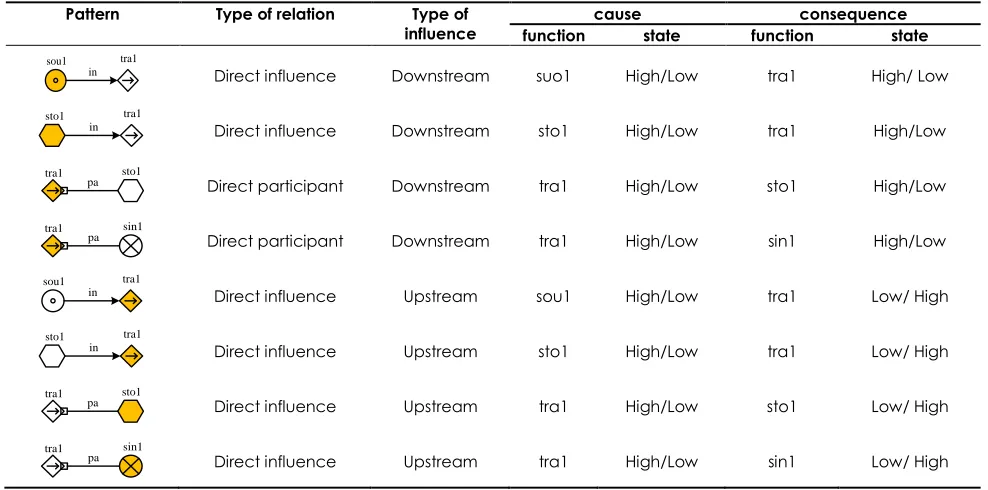
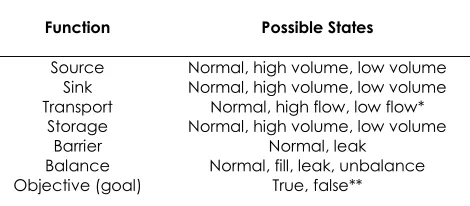
In this paper, causal dependency graphic (CDG) is used to represent the qualitative cause–consequences analysis between components in the MFM model. The states of the MFM flow functions are shown in table 1. Each function in the MFM model may only take some of these states. Besides, to guarantee success in achieving the main goal, each function must be in a normal state [13]. According to these states the CDG of system is constructed.
Table 1 The states of flow functions in MFM
Function Possible States
Source Normal, high volume, low volume Sink Normal, high volume, low volume Transport Normal, high flow, low flow*
Storage Normal, high volume, low volume
Barrier Normal, leak
Balance Normal, fill, leak, unbalance Objective (goal) True, false**
*No flow state is included as low flow state. **False state of an objective function in divided to two states, false results from the high state of functions (fault -1) while the consequences of the low state of functions is (Fault - 2).
3.0 BAYESIAN NETWORK (BN)
BN is a probabilistic graphical model that is based on directed acyclic graphs (DAG) with probability annotated. A node in a BN represents a random variable, and is linked with other variables with defined probabilistic dependencies. Using BN, qualitative and quantitative representation of the relations between variables can be established using prior and conditional probabilities of variables. Updates of these probabilities can be generated and used to represent different system probabilities. The “OR” gate in fault tree model is mapped to BN, and is equivalent to a series system, while the “AND” gate is equal to parallel system. By using BN, compactness of the model can be established by factoring the joint distribution into a local, conditional distribution for each variable given its parents. If xi denotes a value of the variable Xi and pai denotes some set of values for the parent of Xi, then P(xi | pai) denotes this conditional distribution.
4.0 CASE STUDY:
As a case study, a heat exchanger pilot plant system at Universiti Teknologi Malaysia normally used for studying heat exchange mechanisms and temperature control is examined. As illustrated in Figure 1, the plant consists of a heating medium tank (VE110), product tank (VE150), two pumps (P112, P152), heat exchanger (HX120), cooler (CL140), two heaters (HE110, HE111) and valves. Water is supplied to this plant from outside sources via hand valve HV100 and HV101 to the heating medium tank VE110 and product tank VE150
respectively. Then the water in VE110 is heated to 60 oC
4.1 Multilevel Flow Modelling (MFM) for The Heat Exchanger Pilot Plant
The heat exchanger pilot plant illustrated in Figure 1 is converted into the MFM model and is shown in Figure 2. Note that the control systems of the plant plays important role for plant operation and safety, but is not included in this study. This process has one goal (main goal) (Go0), which is to maintain water temperature in tank VE150, and five objectives (sub - goals) for more details (Khalil et al., 2016). In this plant, heat exchanger
is the core of the system. It has two purposes, the main function is to transfer energy from the hot water to the cold water, and a secondary purpose to prevent mixing between hot and cold water via tube wall that represents in the model by barrier (Bar0). The heat exchange mechanism is represented by the balance function in the MFM model, Bal3 and Bal6 for cooling and heating water respectively for mass flow, and by Bal10 and Bal12 for energy flow structure (EFS0).
Figure 1The heat exchanger pilot plant [14]
Figure 2 The MFM of the heat exchanger pilot plant [14] HV136
HV154
HV100
FY121
P112 HV124
HX120
VE150
P152 HV111
HV134 CL140
HV141
HV101
T
Temp. Sensor
HV150 HV110
VE110 HE110
Tra4
Sou4
Sou6 Sou3
Sou2
Sou1 Sou0
Sou5
Sin0
Sin1
Sin2
Sin3
Sin4
Sin6
Sin5
Tra1 Tra2
Tra0 Bal0
Tra6
Tra3
Tra5
Tra10
Tra7 Tra8 Tra9
Tra11 Sto0
Sto1
Tra16
Tra12 Tra13 Tra14 Tra15
Bal1
Bal2
Obj0
Bal3 Bal4
Bal5 Bal6 MFS0
Bar0
Tr
a1
6
Tr
a1
1
Tr
a6
Tr
a1
4
Tr
a8
Go0
Obj1
Obj2 Obj3
Obj4
EFS3
EFS2
(Keep the pump2 running) MFS1
EFS1
EFS0
in0 pa0 in1 pa1
in3
pa2 in2
pa3
in 5
pa
5
in4 pa4
in6 pa6
in7 pa7 in8 pa8 in9 pa9
in12 pa12 in13 pa13 in14 pa14 in15 pa15 in10 pa10
in11 pa11
in16 pa16
in17 pa17
(Keep the pump1 running)
(Keeping the flow of cooling water)
(Keeping the flow of heating water) (Maintaining the temp.
in the product tank)
(Heating water in the VE110)
Mass flow of cooling water
Energy flow in pump
Energy flow in pump
Mass flow of heating water Energy flow in heater
Energy flow of heating water Enery flow of cooling
water
m
a0
en a0
pp
0
m
a4
ena4
m
a1
ena1
m
a2
ena2
m
a3
ena3
Tr
4.2 Fault Tree of MFM
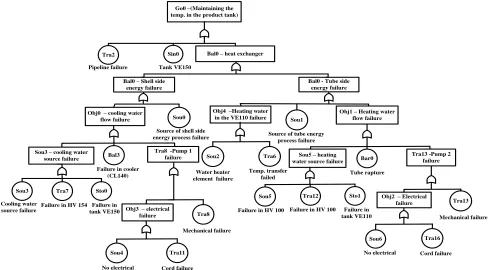
Figure 3 shows the fault tree model that is mapped from MFM model to incorporate probabilistic information into the modelling framework. The FT model represents the relationship between events of
the heat exchanger pilot plant, with the top event TE assumed to occur when a fault is occurring in only one component at any time. Note that in this analysis, the prior probability distributions of basic components are considered independent.
Go0 –(Maintaining the temp. in the product tank)
Sou5 – heating water source failure Bal0 – heat exchanger
Bal0 - Tube side energy failure
Obj1 – Heating water flow failure Bal0 – Shell side
energy failure
Sou3 – cooling water source failure
Obj0 – cooling water flow failure
Tra8 -Pump 1 failure
Obj2 – Electrical failure
Tra13 -Pump 2 failure
Obj3 – electrical failure
Sin0 Tra2
Obj4 –Heating water in the VE110 failure Pipeline failure
Source of shell side energy process failure
Failure in cooler (CL140)
Tank VE150
Sou0
Tra6 Bal3
Sto0
Tra8
Sou1
Sou3 Tra7
Cooling water source failure
Failure in tank VE150
Tube rapture
Failure in HV 154
Source of tube energy process failure
Cord failure No electrical
Mechanical failure
Sou4 Tra11
Sou5
Sou6
Sou2 Bar0
Water heater element failure
Temp. transfer failed
Sto1 Tra12
Failure in HV 100 Failure in
tank VE110
No electrical
Tra16
Cord failure Tra13
Mechanical failure Failure in HV 100
Figure 3 The FT of the MFM of the heat exchanger pilot plant [14]
Note that in Figure 3, all gates are “Or”, reflecting that the components can be represented by a series system in the MFM model. TE represents the failure to maintain water temperature in tank VE150 at the desired set point. Since this is the main function of the plant, for the MFM model, it is considered as the main goal. The failure to satisfy this main goal may results from the failure in one or more intermediate gates, i.e., Bal0 (heat exchanger fails to functioning) which results from the failure in the tube or shell sides, Obj0 (failure to cool water), Obj1 (heat exchanger fails to heat a water), Obj2 (electrical failure to provide electricity to the pump 2), Obj3 (electrical failure to provide electricity to the pump 1), Obj4 (heater in tank V110 fails to heat a water), Tra8 (pump 1 fails to transfer the cool water to the heat exchanger), Tra13 (pump 2 fails to transfer the water), Sou3 (failure to provide the system for the cold water), Sou5 (failure to provide the system for the hot water). All these will lead to the TE being false. The fault tree model of the system included only significant changes of plant states that are dependent on implicit assumptions about plant functions and operating conditions.
Sou5 tra12 highvol
Normvol
lowvol
highflow Normflow
lowflow
sto1 tra13 Bal5 tra13 Bal6
highvol Normvol
lowvol
highflow Normflow
lowflow
highflow Normflow
lowflow Fill
Normvol
Leak
Fill Normvol
Leak
tra15 highflow Normflow
lowflow
Sin5 highvol Normvol
lowvol
Figure 4The Causal Dependency Graph between functions of the MFM in Figure2.
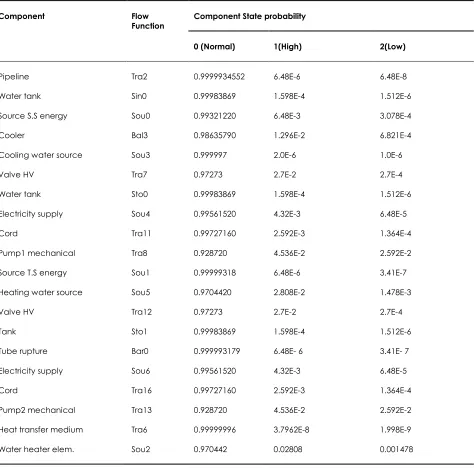
According to Table 1, the components are set in three states 0, 1, 2, where 0 is normal operation state, 1 is a state of fault state 1(high or fill), 2 is fault state 2 (low or leak). Unbalance state is included in the leak
state in this study. The prior probability distributions of root nodes of the system shown in Table 3 are obtained by statistics and analysis of failure data of the elements of the system.
Table 2 Direct influences relationships between flow functions in MFM model in Figure 2
Pattern Type of relation Type of
influence function cause state function consequence state
sou1 tra1
in Direct influence Downstream suo1 High/Low tra1 High/ Low
sto1 tra1
in Direct influence Downstream sto1 High/Low tra1 High/Low
tra1
pa sto1 Direct participant Downstream tra1 High/Low sto1 High/Low
tra1
pa sin1 Direct participant Downstream tra1 High/Low sin1 High/Low
sou1 tra1
in Direct influence Upstream sou1 High/Low tra1 Low/ High
sto1 tra1
in Direct influence Upstream sto1 High/Low tra1 Low/ High
tra1
pa sto1 Direct influence Upstream tra1 High/Low sto1 Low/ High
tra1
pa sin1 Direct influence Upstream tra1 High/Low sin1 Low/ High
Prediction
Table 3 Prior probability distribution of root nodes of the system in Figure 3
Component Flow
Function Component State probability
0 (Normal) 1(High) 2(Low)
Pipeline Tra2 0.9999934552 6.48E-6 6.48E-8
Water tank Sin0 0.99983869 1.598E-4 1.512E-6
Source S.S energy Sou0 0.99321220 6.48E-3 3.078E-4
Cooler Bal3 0.98635790 1.296E-2 6.821E-4
Cooling water source Sou3 0.999997 2.0E-6 1.0E-6
Valve HV Tra7 0.97273 2.7E-2 2.7E-4
Water tank Sto0 0.99983869 1.598E-4 1.512E-6
Electricity supply Sou4 0.99561520 4.32E-3 6.48E-5
Cord Tra11 0.99727160 2.592E-3 1.364E-4
Pump1 mechanical Tra8 0.928720 4.536E-2 2.592E-2
Source T.S energy Sou1 0.99999318 6.48E-6 3.41E-7
Heating water source Sou5 0.9704420 2.808E-2 1.478E-3
Valve HV Tra12 0.97273 2.7E-2 2.7E-4
Tank Sto1 0.99983869 1.598E-4 1.512E-6
Tube rupture Bar0 0.999993179 6.48E- 6 3.41E- 7
Electricity supply Sou6 0.99561520 4.32E-3 6.48E-5
Cord Tra16 0.99727160 2.592E-3 1.364E-4
Pump2 mechanical Tra13 0.928720 4.536E-2 2.592E-2
Heat transfer medium Tra6 0.99999996 3.7962E-8 1.998E-9
Water heater elem. Sou2 0.970442 0.02808 0.001478
5.0 RESULT AND DISCUSSION
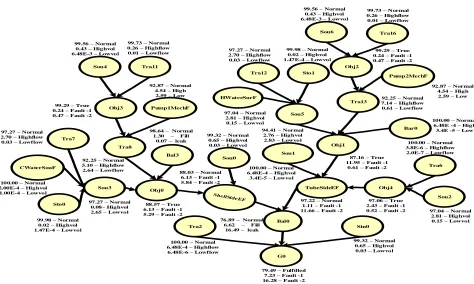
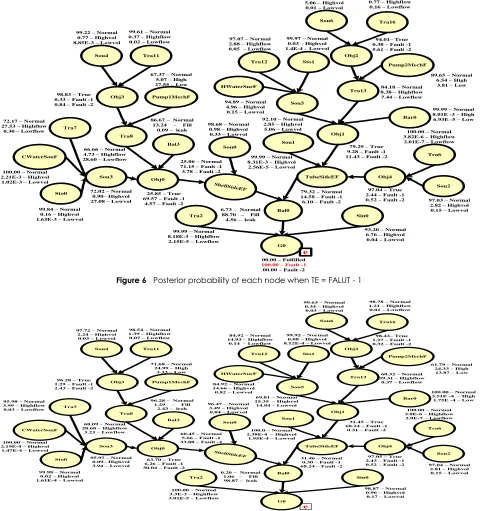
Based on the BN model of the heat exchanger, using the prior probability of components and the CPT of the top event (G0), and by applying accurate reasoning Bucket elimination algorithm [15] to calculate the probability, the probabilities are determined, giving value for the node G0, P(G0 = FAULT-1) = 0.0723, P(G0 = FAULT-2) = 0.1628, as shown in Figure 5. Note that in cases of no evidence, the probability of node G0 and intermediate nodes cannot be determined.
Similarly, the posterior probability of each node can be deduced when the system is in completely
fault-1 state (G0 (FAULT-1) = 1) or in case of completely fault–2 state (G0 (FALUT–2 = 1), as is shown in Figure 6, Figure 7.
In the case of given evidence that G0 is completely fault state (G0 = FALUT-1 or G0 = FALUT-2), all conditional probabilities for component nodes can be calculated.
Table 4 The failure probability of each component when system top node (TE) fault
Component
node Tra2 Fault -1 Fault -2 Sin0 Fault -1 Fault -2 Sou0 Fault -1 Fault -2
G0 (Fault -1) 8.18E-5 2.15E-7 6.76E-2 4.0E-4 9.8E-3 3.3E-3
G0 (Fault -2) 3.3E-6 3.01E-7 9.6E-3 1.7E-3 3.49E-2 4.0E-4
Component
node Bal3 Fault -1 Fault -2 Sto0 Fault -1 Fault -2 CWaterSouF Fault -1 Fault -2
G0 (Fault -1) 0.1324 9.0E-4 1.6E-3 1.63E-5 2.21E-5 1.02E-5
G0 (Fault -2) 1.93E-2 3.7E-3 2.0E-4 1.61E-6 2.19E-6 1.47E-6
Component
node Tra7 Fault -1 Fault -2 Pump1MechF Fault -1 Fault -2 Sou4 Fault -1 Fault -2
G0 (Fault -1) 0.2753 3.0E-3 5.07E-2 0.2755 7.7E-3 8.85E-5
G0 (Fault -2) 3.99E-2 3.0E-4 0.2499 3.33E-2 2.24E-2 3.0E-4
Component
node Tra11 Fault -1 Fault -2 Sou1 Fault -1 Fault -2 Bar0 Fault -1 Fault -2
G0 (Fault -1) 3.7E-3 2.0E-4 8.31E-5 2.56E-7 8.01E-5 6.93E-7
G0 (Fault -2) 1.39E-2 7.0E-4 2.38E-6 1.95E-6 3.51E-6 1.75E-6
Component
node HwaterSouF Fault -1 Fault -2 Tra12 Fault -1 Fault -2 Sto1 Fault -1 Fault -2
G0 (Fault -1) 4.96E-2 1.5E-3 2.88E-2 5.0E-4 3.0E-4 1.6E-6
G0 (Fault -2) 0.1466 8.2E-3 0.1493 8.2E-3 8.0E-4 8.12E-6
Component
node Sou6 Fault -1 Fault -2 Tra16 Fault -1 Fault -2 Pump2MechF Fault -1 Fault -2
G0 (Fault -1) 5.06E-2 1.0E-4 7.7E-3 1.6E-3 6.54E-2 3.81E-2
G0 (Fault -2) 3.4E-3 3.0E-4 1.21E-2 1.0E-4 0.2433 0.1387
Tra16 Sou6
Obj2
Pump2MechF
Tra13
Obj1
Bar0 HWaterSurF
Sto1 Tra12
Sou5
TubeSideEF
Tra6
Sou2 Sou1
Obj4 CWaterSouF
Sto0 Tra7
Sou3
Bal0
Sin0
G0 Tra2
Sou0 Bal3
Obj0 Pump1MechF Obj3
Tra8
Sou4 Tra11
79.49 – Fulfilled 7.23 – Fault -1 16.28 – Fault -2 100.00 – Normal
6.48E-4 – Highflow 6.48E-6 – Lowflow 97.27 – Normal
2.70 – Highflow 0.03 – Lowflow
99.32 – Normal 0.65 – Highvol 0.03 – Lowvol 76.89 – Normal
6.62 – Fill 16.49 – leak 97.27 – Normal
0.08– Highvol
2.65 – Lowvol 97.04 – Normal
2.81 – Highvol 0.15 – Lowvol 100.00 – Normal 3.8E-6 – Highflow 2.0E-7 – Lowflow 87.16 – True
11.95 – Fault -1 0.61 – Fault -2
97.06 – True 2.43 – Fault -1 0.52 – Fault -2 97.22 – Normal
1.11 – Fault -1 11.66 – Fault -2
100.00 – Normal 6.48E -4 – High 3.4E -5 – Low 92.25 – Normal
7.14 – Highflow 0.61 – Lowflow
92.87 – Normal 4.54 – High 2.59 – Low 99.29 – True
0.24 – Fault -1 0.47 – Fault -2 99.73 – Normal 0.26 – Highflow 0.01 – Lowflow 99.56 – Normal
0.43 – Highvol 6.48E-3 – Lowvol
100.00 – Normal 6.48E-4 – Highvol
3.4E-5 – Lowvol
99.98 – Normal 0.02 – Highvol 1.47E-4 – Lowvol
94.41 – Normal 2.76 – Highvol 2.83 – Lowvol 97.04 – Normal
2.81 – Highvol 0.15 – Lowvol 97.27 – Normal 2.70 – Highflow 0.03 – Lowflow
99.98 – Normal 0.02 – Highvol 1.47E-4 – Lowvol 99.56 – Normal
0.43 – Highvol 6.48E-3 – Lowvol
99.73 – Normal 0.26 – Highflow 0.01 – Lowflow
92.87 – Normal 4.54 – High 2.59 – Low 99.29 – True
0.24 – Fault -1 0.47 – Fault -2
99.32 – Normal 0.65 – Highvol 0.03 – Lowvol 98.64 – Normal
1.30 – Fill 0.07 – leak
88.03 – Normal 6.13 – Fault -1 5.84 – Fault -2
88.57 – True 6.13 – Fault -1 5.29 – Fault -2 92.25 – Normal
5.10 – Highflow 2.64 – Lowflow
100.00 – Normal 2.00E-4 – Highvol 1.00E-4 – Lowvol
Tra16 Sou6 Obj2 Pump2MechF Tra13 Obj1 Bar0 HWaterSurF Sto1 Tra12 Sou5 TubeSideEF Tra6 Sou2 Sou1 Obj4 CWaterSouF Sto0 Tra7 Sou3 Bal0 Sin0 G0 ShellSideEF Tra2 Sou0 Bal3 Obj0 Pump1MechF Obj3 Tra8 Sou4 Tra11
00.00 – Fulfilled
100.00 – Fault -1
00.00 – Fault -2 99.99 – Normal
8.18E-3 – Highflow 2.15E-5 – Lowflow 72.17 – Normal
27.53 – Highflow 0.30 – Lowflow
93.20 – Normal 6.76 – Highvol 0.04 – Lowvol 6.73 – Normal
88.70 – Fill 4.56 – leak 72.02 – Normal
0.90– Highvol
27.08 – Lowvol 97.03 – Normal
2.82 – Highvol 0.15 – Lowvol 100.00 – Normal 3.82E-6 – Highflow 2.01E-7 – Lowflow 79.29 – True
9.28 – Fault -1 11.43 – Fault -2
97.04 – True 2.44 – Fault -1 0.52 – Fault -2 79.32 – Normal
14.58 – Fault -1 6.10 – Fault -2
99.99 – Normal 8.01E -3 – High 6.93E -5 – Low 84.18 – Normal
8.38 – Highflow 7.44 – Lowflow
89.65 – Normal 6.54 – High 3.81 – Low 94.01– True
0.38 – Fault -1 5.61 – Fault -2 99.07 – Normal 0.77 – Highflow 0.16 – Lowflow 94.93 – Normal
5.06 – Highvol 0.01 – Lowvol
99.99 – Normal 8.31E-3 – Highvol
2.56E-5 – Lowvol
99.84 – Normal 0.16 – Highvol 1.63E-3 – Lowvol
92.10 – Normal 2.85 – Highvol 5.06 – Lowvol 94.89 – Normal
4.96 – Highvol 0.15 – Lowvol 97.07 – Normal 2.88 – Highflow 0.05 – Lowflow
99.97 – Normal 0.03 – Highvol 1.4E-4 – Lowvol 99.22 – Normal
0.77 – Highvol 8.85E-3 – Lowvol
99.61 – Normal 0.37 – Highflow 0.02 – Lowflow
67.37 – Normal 5.07 – High 27.55 – Low 98.83 – True
0.33 – Fault -1 0.84 – Fault -2
98.68 – Normal 0.98 – Highvol 0.33 – Lowvol 86.67 – Normal
13.24 – Fill 0.09 – leak
25.06 – Normal 71.15 – Fault -1 3.78 – Fault -2
25.85 – True 69.57 – Fault -1
4.57 – Fault -2 66.66 – Normal
4.73 – Highflow 28.60 – Lowflow
100.00 – Normal 2.21E-3 – Highvol 1.02E-3 – Lowvol
e
Figure 6 Posterior probability of each node when TE = FALUT - 1
Tra16 Sou6 Obj2 Pump2MechF Tra13 Obj1 Bar0 HWaterSurF Sto1 Tra12 Sou5 TubeSideEF Tra6 Sou2 Sou1 Obj4 CWaterSouF Sto0 Tra7 Sou3 Bal0 Sin0 G0 ShellSideEF Tra2 Sou0 Bal3 Obj0 Pump1MechF Obj3 Tra8 Sou4 Tra11
00.00 – Fulfilled 00.00 – Fault -1
100.00 – Fault -2
100.00 – Normal 3.3E-3 – Highflow 3.01E-5 – Lowflow 95.98 – Normal
3.99 – Highflow 0.03 – Lowflow
98.87 – Normal 0.96 – Highvol 0.17 – Lowvol 0.20 – Normal
1.06 – Fill 98.87 – leak 95.97 – Normal
0.09– Highvol
3.94 – Lowvol 97.04 – Normal
2.81 – Highvol 0.15 – Lowvol 100.00 – Normal 3.8E-6 – Highflow 2.0E-7 – Lowflow 31.45 – True
68.24 – Fault -1 0.31 – Fault -2
97.05 – True 2.43 – Fault -1 0.52 – Fault -2 31.46 – Normal
0.30 – Fault -1 68.24 – Fault -2
100.00 – Normal 3.51E -4 – High 1.75E -4 – Low 60.32 – Normal
39.31 – Highflow 0.37 – Lowflow
61.79 – Normal 24.33 – High 13.87 – Low 98.42– True
1.27 – Fault -1 0.32 – Fault -2 98.78 – Normal 1.21 – Highflow 0.01 – Lowflow 99.63 – Normal
0.34 – Highvol 0.03 – Lowvol
100.0 – Normal 2.38E-4 – Highvol
1.95E-4 – Lowvol
99.98 – Normal 0.02 – Highvol 1.61E-4 – Lowvol
69.81 – Normal 15.35 – Highvol 14.84 – Lowvol 84.92 – Normal
14.66 – Highvol 0.82 – Lowvol
84.92 – Normal 14.93 – Highflow
0.14 – Lowflow
99.92 – Normal 0.08 – Highvol 8.12E-4 – Lowvol 97.72 – Normal
2.24 – Highvol 0.03 – Lowvol
98.54 – Normal 1.39 – Highflow 0.07 – Lowflow
71.68 – Normal 24.99 – High
3.33 – Low 96.28 – True
1.29 – Fault -1 2.43 – Fault -2
96.47 – Normal 3.49 – Highvol 0.04 – Lowvol 96.28 – Normal
1.29 – Fill 2.43 – leak
60.45 – Normal 5.66 – Fault -1 33.88 – Fault -2
63.70 – True 6.26 – Fault -1 30.04 – Fault -2 68.09 – Normal
28.68 – Highflow 3.23 – Lowflow 100.00 – Normal
2.19E-4 – Highvol 1.47E-4 – Lowvol
e
Figure 7 Posterior probability of each node when TE = FALUT - 2
6.0 CONCLUSION
A multi-state functional model based on MFM that has been transformed into an equivalent BN model has been used for fault detection and diagnosis in a heat exchanger pilot plant. Qualitative analyses have been represented by causal dependency graph (CDG) and failure probabilities of the root nodes as a quantitative analysis has been applied in a heat exchanger pilot plant. The results show the strength of this approach and can be considered as a useful
strategy for dealing with complex chemical processes.
Acknowledgement
References
[1] Ericson, C. A. 2005, Hazard Analysis Techniques for System
Safety: John Wiley & Sons, Inc., 2005: 183.
[2] Lind, M. 2011a. Nuclear Safety and Simulation. 2: 22. [3] Lind, M. 2011b. Advances in Safety, Reliability and Risk
Management: ESREL 2011. 383.
[4] Gofuku, A., S. Koide, N. Shimada. 2006. SICE-ICASE.
International Joint Conference: IEEE, 2006: 497.
[5] Petersen, J. 2000. Proceedings of the cognitive systems
engineering in process control (CSEPC 2000). 36.
[6] Larsson, J.E. 2002. Knowledge-Based Systems, 2002: 103. [7] Mi, J., Y. Li, H.-Z. Huang, Y. Liu, X. Zhang. 2012. Quality,
Reliability, Risk, Maintenance, and Safety Engineering (ICQR2MSE). International Conference on: IEEE, 2012: 1117.
[8] Caldarola, L. 1980. Nuclear Engineering and Design. 58: 127.
[9] Yi, R., K. Leixing. 2011. Reliability, Maintainability and Safety (ICRMS), 9th International Conference on, 2011: 920. [10] Kai, Y. 1990. Reliability Engineering & System Safety. 28: 1. [11] Bossche, A. 1984. Microelectronics Reliability. 24: 707. [12] Barlow, R. E., A. S. Wu. 1978. Mathematics of Operations
Research. 3: 275.
[13] Dahlstrand, F. 1999. Research and Development in Expert
Systems XV. 173.
[14] Khalil, M. A. A., Arshad. Abdullah, Tuan Amran T. Al-shanini, Ali. 2016. Chemical Product and Process Modeling. [15] Dechter, R. 1998, Learning In Graphical Models: Springer,
![Figure 1 The heat exchanger pilot plant [14]](https://thumb-us.123doks.com/thumbv2/123dok_us/1270155.1159566/3.612.67.498.213.668/figure-heat-exchanger-pilot-plant.webp)