1Faculty of Education, Universiti Teknologi Malaysia, Johor, Malaysia, *E-mail: [email protected]
A SINGLE CASE STUDY ON THE PRACTICE OF
SCHOLARSHIP OF TEACHING AND LEARNING
Hadijah Jaffri1*, Narina A. Samah1, Lokman Mohd Tahir1 and Sanitah Mohd Yusof1
This study examines the conception and importance of the scholarship of teaching and learning (SoTL) as perceived by a lecturer teaching in an engineering faculty in a local university in Malaysia. A case study was used to explore the way SoTL is understood and the extent the participant engages in research in teaching. Typical case sampling was used as sampling design to investigate the conception and practice of research in teaching and learning which might influence the effort and engagement in any activity related to the SoTL by lecturer. The qualitative finding showed that the importance of SoTL is undervalued due to lack of understanding of SoTL and its importance to students’ learning and development. SoTL is perceived as less important as compared to conducting research related to one expertise. SoTL is also regarded as a distinctive form of research that is commonly involved academics in social science fields especially education. It was also found that the pedagogical practice of the respondent is adopted from the pedagogical practice of his lecturers and senior faculty members that serve as his mentors. Even though the pedagogy of a discipline is related to its content knowledge, yet from this study, it was found that the respondent perceives that as long as one posseses the mastery of the content knowledge, one will have the mastery of the pedagogical knowledge. This assumption indirectly undermines the importance of pedagogical knowledge to be mastered as compared to the content knowledge. Based on the findings of this study, it further actions are suggested be taken into consideration to enhance the engagement of lecturers from scientific and technical based faculties in the scholarship of teaching and learning to enhance their teaching practice and their students’ learning. Keywords: scholarship of teaching and learning (SoTL); practitioner research; research into teaching; engineering lecturer; case study
Introduction
As purported by Harland (2012), other than conducting research in the field of expertise, teaching in higher level institutions demands lecturers to engage in researching their teaching practice through action research. In addition, teaching in specific field of study is highly contextualized and it is based on the discipline of a study where it is practiced (Healey, 2000). Therefore, SoTL should not be regarded as a research niche only for academics in the field of social science especially education, in specific.
Findings from a study to explore the readiness of SoTL among Malaysian lecturers by the Higher Education Leadership Academy (AKEPT) in 2011 revealed that academics from non-social science faculties perceived that research into teaching should be conducted by academics from education or social science faculties (AKEPT, 2012). However, since SoTL is highly contextualized as suggested by Healey (2000), research into teaching which relevant and related to specific field of expertise must be conducted by the experts of that particular field. This is because experts from the education faculties might be specialized on theoretical aspects of teaching and learning, yet they are not the experts about the content and subject matter in engineering faculties. Therefore, it is important for practitioners in a specific field such as engineering to explore their teaching and learning practice through action research.
In Malaysia, the concept of scholarship of teaching and learning is still unfamiliar by academicians in Malaysia. A study by Harland, Raja Maznah and Aishah (2013) found that majority of Malaysian academicians undervalue SoTL due to lack of understanding about the importance of SoTL to enhance their teaching and learning practice. In their study, it was found that only small number of academicians who are actively engaged in SoTL because they perceive SoTL as an important tool to reflect and improve their teaching and learning through research. Harland, Raja Maznah and Aishah (2013) stated that those who are currently involved in SoTL among Malaysian academicians are considered as a minority of self-sustaining researchers in SoTL.
unfamiliarity with diverse methodological approaches relating to social science research might contribute extra challenges to conduct SoTL as a means to enhance their teaching and learning practice (Hubball and Clarke, 2010).
In addition, teaching and learning practice is influenced by the way learning process is represented which often reflected upon existential knowledge and previous experience of being taught (Finlay, 2008). In this regards, academicians’ previous experience as students might shape the way they perceive teaching and learning practice and the importance to conduct research to explore the effectiveness of their teaching and learning practice. According to Harland (2012), academicians are trained in conducting research in their respective fields and the research skills that they have trained with can be transferred into other areas such as conducting research on their teaching and learning practice. In short, Harland (2012) proposed that SoTL can be practiced by academicians regardless of their fields of expertise as long as they are motivated to improve and enhance their teaching and learning practice and determine how their teaching affect their students’ experience in learning through systematic inquiry of action research.
Research Methodology
The exploration of the conception of SoTL and perception of the importance of SoTL practice by a lecturer used qualitative research approach. The researchers are interested in questions, such as what is the conception of SoTL in general as perceived by a lecturer who is currently teaching in a science and technical based faculty?, how does the lecturer perceive the importance of conducting research on his teaching practice and sharing it to others later on (the importance of SoTL)? and how does the lecturer perceive learning? The three research questions are posed in the interview in open ended questions manner. According to Creswell (2008) the qualitative research is explorative, subjective and emphasizes the unique experience and understanding of an individual understudies. Therefore, the data collection procedures and data analysis which were used in this study reflect the nature of qualitative research in general.
Research Design
This study used case study to explore the conceptions of SoTL by a lecturer who is a faculty member in a science and technical based faculty. A single case study was used in this study because it necessitates the researchers to gather data from interviews which underlie narrative explanation of a lecturer who is teaching in a science and technical based faculty. According to Yin (2009) case study design is commonly used by researchers who aim explore participants’ characteristics of social phenomena or life events.
involved in a process or action or interaction. The selection of participants in this regards are intentional and focused on the issues being studied. In this study, only one participant was selected based on the teaching and research experience as a junior academic staff in a local university. Even though the participant has less than ten years of teaching experience, yet the participant is actively involved in the implementation of Problem-based learning (PBL) in his lab. An observation was conducted for nearly three hours in the lab to observe how he facilitates the students in the PBL lab. However, when he was asked about the effectiveness of the PBL activities in his class, he explained that at the end of each semester, all lecturers are required to prepare a report and provide evidences in a form of assessment rubric as well as samples of students’ assignments. To improve their teaching, they would review the previous reports prior to planning for any improvement. From the observation and a brief interview, it shows that the participant has engaged in the act of researching into his teaching practice, even though he does not perceive it as an activity of SoTL. Based on this justification, the participant was selected as the participant of this study in which his effort and engagement will be explored in detailed to capture any activity related to SoTL, even though the participant might not familiar with the concept of SoTL theoretically. Other than uncovering recognizable aspects of SoTL that he might already put into practice, this study also aims to explore his background and previous experience that might offer an insight of his current teaching practice.
As a general rule, prior to interview, the researchers have briefed the participant about the rights as participant in the study and research procedures. In addition, the participant was given an inform consent form that was signed prior to interview after the briefing. According to Kvale and Brinkmann (2009), inform consent serves as a binding contract to protect the rights of the participant and the researchers if any conflict might arise related to the research.
Data analysis procedure
Interview data has been transcribed prior to analysis. According to Halcomb and Davidson (2006), transcription is a process to transform verbal interview recording into written transcript by the researchers or transcribers. In addition, transcribing involves the act of transcribers to engage in interpretive process (Denzin, 1995). According to Tilley (2003a) transcribing is a process in which transcriber uses its lens to construct the final text with has potential influence to the way a researcher will analyze the data. In this regards, transcribing is not only a process to transform verbal expression of interview into written words but also an act of interpretation of the interview data. In this study, in order to minimize transcription error, the researchers involved in the process of transcribing themselves and also used a transcriptionist to assist them in the process of transcribing. According to Maclean
et al. (2004), the use of a transcriptionist is permissible in a qualitative or mixed
method research using interviews. According to Tilley (2003b) using a transcriptionist could also enrich educational experiences of a researcher and transcriptionist. In this study, other than transcribing, the transcriptionist also assisted the researchers by listening to the audio record of interview several times in order to ensure the accuracy of the transcript. According to Matheson (2007), replaying interview recording more than once is essential to ensure that transcripts are transcribed accurately. After the transcribing, the researchers sent a copy of the verbal record and its transcript to the participant for verification and validation process. According to Silverman (2011), taking the transcript to the participant who involved in the interview is regarded as a form of respondent validation. In this study, respondent validation takes place twice which is after the transcribing process as well as after the analysis of the data to ensure that the transcript as well as findings conform to the participant’s experience.
Data analysis
After the researchers have extracted responses and coded them based on Finlay’s proposition of representation of learning, the codes are organized based on common themes. This process is known as refining themes. As proposed by Attride-Stirling (2001), thematic analysis involves the process of refining themes by creating thematic network. Thematic network consists of arranging themes into patterns which resulted from grouping sub-themes and themes based on common features or characteristics. In this regards, a thematic network would represent data in hierarchical-like representation. In addition to thematic network, elaboration of the patterns and its themes should be backed up by relevant literature (Aronson, 1994).
Findings
Initial analysis was aimed at exploring the participant’s understanding of the concept of SoTL. When asked about the concept of SoTL, the participant replied that he was not familiar with the concept of SoTL. Therefore, he did not provide any information about the importance of SoTL in his teaching and learning practice. However, to explore his ways of examining and evaluating his teaching practice, the participant was prompted further with another question of how he examine the way he teach in class. He replied that he used his previous experience being taught as a student as well as from learning from senior faculty members to reflect on his teaching practice. In this regards, the participant’s effort to reflect on this teaching practice is on surface level. There is no systematic and organized manner of evaluating his teaching practice through conducting research. To understand more about his stance on the importance of conducting research on his teaching practice, the researchers explore the participant’s perception on learning in detailed.
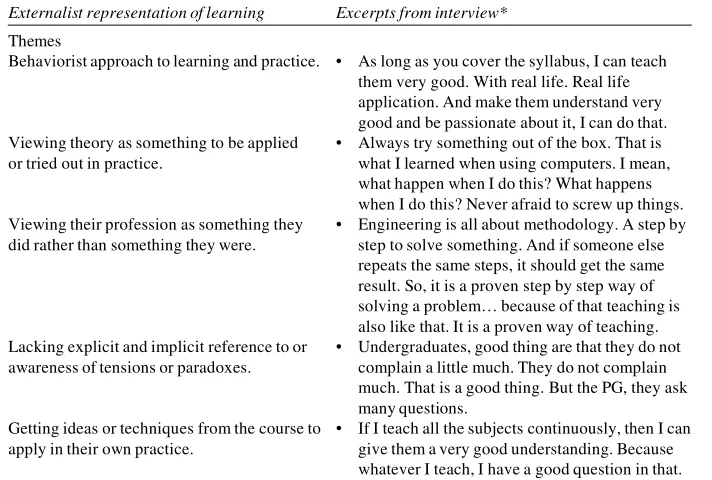
According to Trigwell et al. (2000), active participation in exploring teaching practice relates to the conceptions of teaching and learning; either the focus of learning activities is on student learning or mainly on teaching the students. To understand more about the participant’s conceptions of teaching and learning, the participant was asked about the learning activities that he conducted in his class. From his responses of learning activities in his class, it was found that his perception on learning can be linked to externalist’s view on representation of learning as proposed by Finley (2008) (Refer to Table 1 for detailed examples).
little revision or reading themselves, what he can do is to grade them accordingly. He stated that
When they design a code, I will go to their group and asked “Why do you this? Show me the code. How do you get this?” If they cannot answer, I do not know la but that does not solve the problem whether they learn or not. That is like “Oh, that part you do not know, I will deduct marks from that”. After that they will say “If we get A or B, as long as it is a passing grade, it should be alright”… I have given them assignments and mark accordingly. So, what else should I do? You get what I mean? It is not like second chance. Okay, you do not understand this, tomorrow come again and I will ask you again. No time for this.
From the above response, it can be summarized that the participant perceives learning is a process of teaching students or disseminate information without emphasizing how his students learn and how much they are able to understand by relating the new topics with previously learned topics. Another response about learning activities further revealed that he stressed on topics related to his course, not so much on students’ prior knowledge about the topics. He stated that
The thing is what they have learned in the previous course, they cannot bring it forward. What I am going to do about that? They have finished with that subject already. Hey, you are supposed to know this last semester. I am not going to repeat the same thing again. I cannot repeat that. I have something to cover for this semester. For my course, I can say, “Okay, do this, this is how you relate to your work. But what I am telling is already related to what you have learned before. And that one you forgotten already, you know. What am I going to do? I cannot teach you that. That one is related to second year subject. And this one is fourth year subject”. It is something, the baggage comes behind so, yeah.
When asked about theories related to teaching and learning, he stated that he does not know any educational theory in specific. However, when asked about what theory means in his field i.e. engineering, he perceives theory as a standard of procedures to solve a problem. He clarifies by saying
There are many problems available, everyday problems can already be solved with the knowledge that we have. We do not have to go extra mile to do research. Only some complicated problem that you need to do research. That you need to come out with new formulas, or new techniques which need to be validated or verified… so, theory refers to standard, you refer to a few ways of procedures of doing it, it is all about applying that to a different problem.
involves systematic and structured process which can be repeated by different practitioners. In this regards, he does not perceive teaching and learning process as something evolving and flexible towards change based on the needs of the students. In addition, the participant perceives that as long as he has the mastery of content knowledge which related to engineering subject matters, he is also able to teach well which relates to pedagogical mastery.
Due to this, there is a lack of explicit and implicit reference to and awareness of tensions or paradoxes in his understanding of students’ learning in reference to Finlay’s representation of learning (2008). In one of his responses, he perceives lack of feedback from students as something positive, rather than an indicator that perhaps the students are still struggling to articulate their thoughts in understanding a concept or a topic. He stated that
Undergraduates, good thing are that they do not complain a little much. They do not complain much. That is a good thing. But the PG (post graduates), they ask many questions.
When asked further about how he evaluates his teaching practice, he reflected upon his experience in teaching courses repeatedly for several semesters in which he stated that
If I teach all the subjects continuously, then I can give them a very good understanding. Because whatever I teach, I have a good question in that.
In this regards, teaching a particular course for several semesters gives him ample experience to evaluate the students’ learning through assessments. His response on ‘whatever I teach, I have a good question in [sic] that’ exemplifies his conception of teaching practice and how he represents learning in general.
Discussion
In this study, the researchers aim to investigate the conception of SoTL as held by a lecturer in a science and technical based faculty. The qualitative data revealed that unfamiliarity of the concept of SoTL hinders the participant to involve actively in conducting research on this teaching practice. This finding is similar with findings in a study by Harland, Raja Maznah and Aishah (2013) which revealed that the concept of SoTL is still regarded as unfamiliar concept among Malaysian academicians.
TABLE 1: THEMES AND EXAMPLES OF EXCERPTS BASED ON FINLAY’S REPRESENTATION OF LEARNING (2008)
Externalist representation of learning Excerpts from interview* Themes
Behaviorist approach to learning and practice. • As long as you cover the syllabus, I can teach them very good. With real life. Real life application. And make them understand very good and be passionate about it, I can do that. Viewing theory as something to be applied • Always try something out of the box. That is or tried out in practice. what I learned when using computers. I mean,
what happen when I do this? What happens when I do this? Never afraid to screw up things. Viewing their profession as something they • Engineering is all about methodology. A step by did rather than something they were. step to solve something. And if someone else
repeats the same steps, it should get the same result. So, it is a proven step by step way of solving a problem… because of that teaching is also like that. It is a proven way of teaching. Lacking explicit and implicit reference to or • Undergraduates, good thing are that they do not awareness of tensions or paradoxes. complain a little much. They do not complain
much. That is a good thing. But the PG, they ask many questions.
Getting ideas or techniques from the course to • If I teach all the subjects continuously, then I can apply in their own practice. give them a very good understanding. Because
whatever I teach, I have a good question in that. *Note: The excerpts are some examples of responses from the participant from interview.
importance of SoTL in his teaching practice. In this regards, it can be foreseen that SoTL will take longer time to be embraced and practiced by Malaysian academicians even though AKEPT offers continuous training modules on SoTL. Based on the findings of this study, it is suggested that further actions be taken into consideration to enhance the involvement of lecturers from scientific and technical based faculties in the scholarship of teaching and learning to enhance their teaching practice and their students’ learning.
Acknowledgment
We acknowledged the participation and cooperation of the participant from the Faculty of Electrical Engineering, Universiti Teknologi Malaysia for involvement in the study as described in this paper. This study is a part of a research funded by Fundamental Research Grant Scheme (FRGS) (Ref. No: PY/2013/01215) Cost Center No: R.J130000.7831.4F400 from the Ministry of Education Malaysia, awarded to H. Jaffri, N. A. Samah, and L. M. Tahir and S. M. Yusof.
References
Aronson, J. (1994). ‘A pragmatic view of thematic analysis’. The Qualitative Report, 2 (1) : N/A. Attride-Stirling, J. (2001). ‘Thematic networks: An analytic tool for qualitative research’.
Boshier, R. (2009). ‘Why is the scholarship of teaching and learning such a hard shell?’, Higher Education Research and Development, 28 (1): 1-15. doi: 10.1080/07294360802444321. Boyatzis, R. E. (1998). Transforming qualitative information: Thematic analysis and code
development. Thousand Oaks, California: Sage.
Bucher, R. C., Fritz, E. & Quarantelli, E. L. (1956). ‘Tape recorded interviews in social research’, American Sociological Review, 21: 359-364.
Creswell, J.W. (2008). Educational Research: Planning, Conducting, and Evaluating Quantitative and Qualitative Research. 3rd ed. New Jersey: Pearson Education.
Creswell, J.W. (2013). Educational Research: Planning, Conducting, and Evaluating Quantitative and Qualitative Research. 4th ed.New Jersey: Pearson Education.
Creswell, J.W. (2013). Qualitative inquiry and research design. Thousand Oaks, California: Sage.
Denzin, N. K. (1995). ‘On hearing the voices of educational research’. Curriculum Inquiry, 25: 313-329.
Finlay, I. (2008). ‘What’s learning for? Interrogating the scholarship of teaching and learning’, in R. Murray (ed.), The Scholarship of Teaching and Learning in Higher Education, pp. 16-24. Berkshire, England: Society for Research into Higher Education & Open University Press.
Halcomb, E. J. & Davidson, P. M. (2006). ‘Is verbatim transcription of interview data always necessary?’, Applied Nursing Research, 19: 38-42.
Harland, T. (2012). University teaching: An introductory guide. London: Rutledge.
Harland, T., Raja Maznah R. H., and Aishah A. B. (2014). ‘The scholarship of teaching and learning: challenges for Malaysian academics’, Teaching in Higher Education, 19: 1-11. doi :10.1080/13562517.2013.827654.
Healey, M. (2000). ‘Developing the scholarship of teaching in higher education: A discipline-based approach’, Higher Education Research & Development, 19 (2): 169-189.. doi: 10.1080/ 072943600445637.
Higher Education Leadership Academy (AKEPT) (2012). The learning and teaching practices in Malaysian higher education institutions: a research summary, Putrajaya: Ministry of Higher Education.
Hubball, H & Clarke, A. (2010). ‘Diverse methodological approaches and considerations for SoTL in higher education’, The Canadian Journal for the Scholarship of Teaching and Learning, 1 (1): 1-11. doi: 10.5206/cjsotl-rcacea.2010.1.2.
Kvale, S. & Brinkmann, S. (2009). Inter Views: Learning the craft of qualitative research interviewing. London: Sage.
Lapadat, J. C. & Lindsay, A. C. (1999). ‘Transcription in research and practice: From standardization of technique to interpretive positionings’. Qualitative Inquiry, 5 (1): 64-86.
Matheson, J. L. (2007). ‘The voice transcription technique: Use of voice recognition software to transcribe digital interview data in qualitative research’. The Qualitative Report, 12 (4): 547-560.
Nicholls, G. (2004). ‘Scholarship in teaching as a core professional value: what does this mean to the academic?, Teaching in Higher Education, 9 (1): 29-42. doi: 10.1080/ 1356251032000155812.
Seidman, I. (2006). Interviewing as qualitative research: A guide for researchers in education and the social services. New York: Teachers College Press.
Silverman, D. (2011). Interpreting qualitative data. 4th ed. Thousand Oaks, California: Sage.
Tilley, S. A. (2003a). ‘Challenging” research practices: Turning a critical lens at the work of transcription’. Qualitative Inquiry, 9 (5): 750-773.
Tilley, S. A. (2003b). ‘Transcription work: Learning through coparticipation in research practices’. International Journal of Qualitative Studies in Education, 16 (6): 835-851.
Trigwell, E. M., Bejamin, J., & Prosser, M. (2000). ‘Scholarship of teaching: A model’, Higher Education Research & Development, 19 (2): 155-168.