75:3 (2015) 1–6 | www.jurnalteknologi.utm.my | eISSN 2180–3722 |
Jurnal
Teknologi
Full Paper
T
HE
C
ONCEPT OF
T
ECHNOLOGY
S
UPPORTED
F
ACE
-
TO
-F
ACE
C
OLLABORATIVE
L
EARNING VIA
D
IGITAL
I
NTERACTIVE
A
UDIO
C
APTURING
T
OOL
Abdul Rahim Hj Salam
a*, Faizal Yamimi Mustaffa
a, Tina Abdullah
a,
Md. Sah Hj Salam
ba
Language Academy, Universiti Teknologi Malaysia, 81310 UTM
Johor Bahru, Johor, Malaysia
b
Computer Graphic and Multimedia, Faculty of Computing
Universiti Teknologi Malaysia, 81310 UTM Johor Bahru, Johor,
Malaysia
Article history Received 3 December 2013 Received in revised form
2 July 2014 Accepted 25 November 2014
*Corresponding author
[email protected]
Graphical abstract
Abstract
This paper shares the researcher’s experience in employing the technology supported face-to-face collaborative learning. In achieving this, a digital interactive audio capturing tool (DIACT) was used to digitally capture the interactive event of collaborative learning among English as second language (ESL) teacher trainees in a “Computer Integrated Classroom” (CiC) environment. Having merely online learning of computer support which ignores the elements of face-to-face (F2F), the impact of “collaboration” seems seriously lacking. With the emergence of DIACT in a CiC environment, the researcher attempts to see how those co-located ESL teacher trainees manage to effectively communicate face-to-face and collaborate among themselves to build knowledge. The interaction was captured and transferred to computer assisted qualitative data analysis software (CAQDAS) to be analyzed for evidence of impactful knowledge building. Findings indicated that the use of DIACT in a F2F CiC environment has significantly helped students in collaborative knowledge building.
Keywords: Computer supported collaborative learning environment, face-to-face,
interaction, computer integrated classroom, knowledge building
© 2015 Penerbit UTM Press. All rights reserved
1.0 INTRODUCTION
The approach presented in this study on ESL teacher trainees focuses on a technology supported face-to-face collaborative knowledge building (TF2F CKB) that encourages small group participation. One of the technology tools used is DIACT. Integrated within a CiC environment, it advocates a collaborative learning joint activity with the trainee as task performer. Having DIACT as the Collaborative Learning Conversation/Communication tool software, trainees were provided a specific platform to display and record their F2F conversational turns while concurrently tracking, annotating and improvising their group cognition of negotiated perspectives on
individual’s screen. The usage of this technology tool is to encourage social interactions and to facilitate joint problem solving in order to construct richer knowledge, thus complementing what lacking in either F2F or Computer Mediated Communication alone.
case, DIACT seemed to be the suitable tool for capturing the interaction process.
In relation to the production and interaction process, the study takes language into consideration as a fundamental tool through which students elaborate thoughts, explain results, evaluate solutions through appropriate feedback, explore and clarify inconsistencies and knowledge gaps, link the verbal information to new strategies, and also benefit from the cognitive restructuring that underpins cognitive change [2]. The organization of the classroom into small groups established in this study fosters the verbalization of ideas [3], and the sequencing of actions compiled through group interactions using DIACT. In this sequence of “cognitive reflection”, every student in the classroom is expected to verbalize his/her ideas in order to convince him/herself and his/her group mates of the appropriacy of his/her views. This allows students to explore variations between their own and their partner’s knowledge [2]. In achieving this, DIACT played its role within CiC environment.
2.0 LITERATURE REVIEW
DIACT requires a good support from CiC infrastructure. This kind of infrastructure is not similar to the established online learning situation of joint activity among learners who are separated by different locations and time. Instead, a customized classroom is required for learners to coexist via online at one location with computer technology supported as in a traditional classroom setting for learning purposes. Computer integrated classroom (CiC) is a concept of learning with technology [4] that is suitable for implementation of small group joint activity [5]. DIACT in this case could work well as the main verbal communication tool of the joint activity.
Computer integrated classroom (CiC) could belooked upon as the future pedagogical practices in schools and higher institutions. CiC could perhaps be seen as a way to integrate face-to-face in a Computer Supported Collaborative Learning setting (CSCL). What happens in this environment is similar to a typical classroom situation where a group of learners sit together to discuss a topic. In other words, it is a learning environment where students communicate face-to face and simultaneously use a collaborative technology through DIACT. The assumption is that these collaborative situations can be improved with the appropriate collaborative technology. Clearly, “studying this complex interplay within a collaborative classroom setting has hardly been addressed in educational research and practice.” In fact there is a high probability that tomorrow’s learning will still take place in schools where learners meet face-to-face to collaborate, discuss and solve problems [6].
2.1 The Need of DIACT for Computer Supported Collaborative Learning Studies
Basically, there are two important reasons for DIACT to be in the picture of Computer Mediated Collaborative Learning studies. First, the idea of “collaborative” itself requires optimum computer-mediated interaction that should not compromise the students’ cognitive ability in terms of delivery of ideas. Second, the issue of “media richness” seems obviously lacking in the interaction that ignores the elements of F2F when collaboration takes place. These two reasons are vital if a more accurate study on “Computer Mediated Collaborative Learning” to be carried out. In this case, DIACT in CiC is seen as a promising instrument to complement what has been missing in CSCL environment: problems in media richness or lacking natural conversational elements in a collaborative situation. This will definitely affect the utmost potential of knowledge delivery and richer development of ideas during a computer-mediated interaction of joint activity collaborative work.
both F2F and Computer-Mediated concurrently, thus able to be maximize the use of computer, personally converse and record the interaction for future reference.
Having said that, DIACT in CiC could in a significant way help to further explore what happens in discussions among ESL teacher trainees’ learning. This is necessary because evidence from previous research shows that by nature; CSCL has not really represented its utmost capability to really record students’ utmost cognitive process of responses or feedback. Media richness: “the medium’s capacity for immediate feedback, the number of cues and senses involved, personalization, and language variety” [9] appears to be missing in asynchronous and synchronous mode of interaction in CSCL and this shows that they still need a setting which complement face-to-face with respect to media richness. For that reason, DIACT was relevantly used and needed in this study to look at the microteaching lesson planning activities that provide helpful discussion for teacher trainees’ to develop group cognition pedagogically.
3.0 METHODOLOGY
The nature of DIACT in CiC has always been in this study to assist the possibility of maximizing the concurrent F2F verbal interactivity among the trainees. The CiC system was exploited by the researcher to manage the users’ participation and co construction of a solution in a collaborative discussion process. In other words, CiC works as an important component for DIACT to function as a communicative tool to capture the interaction that occurs among the group of trainees.
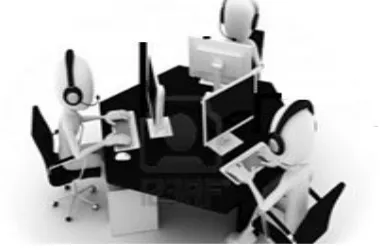
Co-located in the classroom, trainees sat in front of their own screen pc with an attached microphone headset and communicate F2F. This is depicted in Figure 1.
Figure 1 Co-located trainees using DIACT
DIACT which appeared on individual screen enabled the interactions to be recorded, saved and retrieved at anytime possible through the network. As depicted in Figure 2, using the classroom management software, the facilitator identified the
groups and put them into a “pair discussion” mode so that they could interact verbally with one another. The researcher/teacher could control and monitor the individuals’ workstations as he desired by activating “workstation control”.
Figure 2 A snapshot of “pair” discussion activation program for F2F collaborative learning/knowledge building
Connection was indicated by the pc number appeared at the top left hand corner of DIACT as depicted in Figure 3. This allowed interaction with the facilitator individually or with the group members. With the feature of DIACT, the trainees were able to save, record, play and listen to the discussion activity easily at their own pace.
Figure 3 A snapshot of DIACT for F2F collaborative knowledge building
fact the participants seemed to be more focused on the ideas and statements made by members. Perhaps, the nature of the listening environment which is similar to the nature of telephone conversation quality had influenced the trainees to concentrate on the messages delivered through the headphones. In a phone conversation situation, people give their utmost attention to the utterance and take no notice of other matters around them. This happened in TF2F discussions while recording was taking place. During recording, with the headphones on, the trainees were like an operator handling an authentic group conference by listening and focusing on task at hand and at the same time seamlessly able to relate F2F closely with one another even better than a usual F2F situation. In other words, the conversations that occurred in a TF2F were more ‘task focused”. In a way, the physical presence of members at close proximity was seen sufficient to complement the “innovative” and “unique” way that the communication tool software and the technology offered to the environment. The conversations were recorded and saved in mp3 format to a dedicated server workspace. This was later retrieved and examined using CAQDAS.
3.2 Object Highlighting
The second part of the application is highlighting the regions, which have the same HSV value as the centre of the circle. In coding aspect, two thresholds are used for the filtering process. The low threshold is an array which contains the minimum of the HSV value whereas the high threshold holds the maxima of HSV value. Figure 1 shows the color benchmark, which consists of 10 different colours such as black, yellow, orange, green, purple, pink, cyan, blue, grey and red. It also have different shapes according to the color and have different sizes of sphere for red color. The prototype color detection assistive device, for experimental purposes only detects 4 base colours and HSV within its range. Besides the HSV range, the result will display unknown or not detected.
4.0 FROM DIACT TO CAQDAS
The interaction data saved from DIACT produced good sound quality for transcribing and analyzing. Unlike normal mp3 recorder, DIACT which was integrated in CiC managed to capture digitally noise-free verbal interaction withn the help of gadgets like headphone and microphone attached closely to the trainees. This really helped when working with the analysis. Hence, specific computer assisted qualitative data analysis (CAQDAS) was used in looking at the interaction. Traditionally, with the manual techniques such as the use of index cards, file folders, the linking of segments to each other would only have been possible with the investment of enormous temporal and human resources [10]. It is the nature of this study
that data emerged from interactions and a large amount of data were collected from audio source. This required tedious transcription process. As such, the manual system was not relevant, as it consumes a lot of time and at the same time the data may get lost. Thus, an appropriate system such as CAQDAS was required to analyse data accurately.
4.1 The Need of DIACT for Computer Supported Collaborative Learning Studies
The main advantage of using a computer program is that it simplifies and speeds up the mechanical aspects of data analysis without sacrificing flexibility, thereby freeing the researcher to concentrate to a greater extent on the more creative aspects of theory building. In this case, computers can bring the real benefits to qualitative researchers, making their productive and potentially more thorough [11]. However, the actual/strategic planning still relies on the researcher [12].
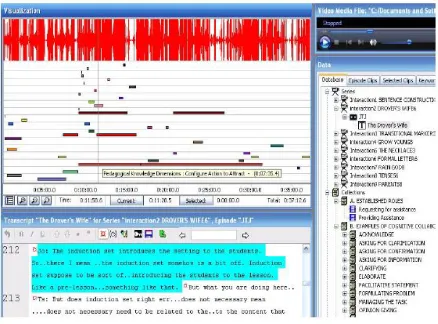
In transcribing the discussion the researcher used Transana software [13] which was developed at the Wisconsin Center for Education Research, University of Wisconsin- Madison that includes Jeffersonian Transcription Notation. Transana helps to facilitate the transcription and analysis of Mp3 data of the recording. It provides tools for identifying and organizing analytically interesting portions of the recording, as well as for attaching categories to those recordings. It also features database and file manipulation tools that facilitate the organization and storage of large collections of digitized data. The verbal recordings were combined using Transana Software for easy management in transcribing, coding, and analyzing verbal response among trainees.
Figure 4 Interface of Transana Software as a tool for transcribing and analyzing
5.0 RESULTS AND DISCUSSION
The discussions the trainees engaged in constituted of a series of conversational turns episodes in which trainees develop knowledge about teaching an ESL lesson. Specific structures were identified towards impactful knowledge building through DIACT.
The researcher was able to identify three stages in the F2F collaborative learning using DIACT: opening, development, and closing.
In the first stage, trainees determined expertise, i.e. who was familiar with the pedagogical knowledge and who was not. In this opening stage, the trainees discussed directly the problem area in planning the lesson. From observation, at this point concurrently while using the cursor, the trainees highlighted and viewed the statement appearing on their individual shared screen so as to indicate attention was given. The events served to determine who needed assistance and who could provide it.
In the second stage, the trainees developed some knowledge about the problem or issue raised. The development took different forms and, depending on how the trainees decided to work on the issue, the levels of expertise, and the specific problem. This problem was first verbally highlighted and immediately tracked on individual’s screen to get a clearer idea of what the utterance meant in the context of the discussion. This longest stage was characterized by “assistance” given during discussions which exemplified the role of novice and expert. The “expert” trainee provided insights in relation to the discussion and at the end of a collaboration activity whereas the “novice” trainee began to express understanding by thanking others for their help, taking some time using track changes feature on the individual pc screen to annotate, edit, record/save the work or “process” some information, and/or verifying new information. These important changes and improvement were all tracked and documented on their individual shared screen and
thus, leading to a revised lesson plan as seen on individual’s screen.
Finally and evidently, the researcher could see how representation process of co-construction and pedagogical knowledge development among trainees was displayed in F2F collaborative learning activity using DIACT. In relation to this study, the researcher found out that transformative process of collaborative knowledge building (CKB) occurred in the conversations had specifically involved trainees to own perception, show comprehension, notice problem, restate ideas, compromise to consent, reach decision, empathize/sympathize, specify/initiate ideas, rationalize ideas and share perspectives, before finally internalizing knowledge. For future references, trainees recorded, documented and saved what they have internalized in a network space accessible for them.
This whole event relied significantly on the influence of assistance between the novice and expert and also dependent on the technology as the medium for “innovative” communicating via DIACT.
6.0 CONCLUSIONS
The idea of collaboration requires optimum computer mediated interaction which does not hamper students’ delivery of ideas. In turn, this computer-mediated interaction must not ignore the elements of F2F which provide interaction rich collaboration. The disadvantage of none F2F interactions in a research setting (such as email and chat) is that the researcher could not study students’ cognition as well as their verbal ability (utterances, vocal expressions, intonation). The inclusion of DIACT in CiC helps students maximize their F2F verbal interactivity as well as provides the researcher the means to further explore what happens in discussions among these students. Consequently, the rich data which were obtained using DIACT was then analysed using CAQDAS, a tool which greatly helps in the analysis stage by firstly simplifying and speeding up the mechanical aspects of data analysis such as transcripting, thereby freeing the researcher to concentrate on analysis and theory building.
group collaboratively completed the task. During these three stages, the trainees were involved in interaction activities such as owning perception, showing comprehension, noticing problems, initiating/specifying/rationalizing/ and restating ideas, compromising, consenting, reaching decision, emphatizing, sharing perspectives, and finally internalizing knowledge.
References
[1] Koschmann, T. 1996. Paradigm Shifts and Instructional Technology. In T. Koschmann (Ed.). CSCL: Theory and Practice of an Emerging Paradigm. Mahwah, NJ: Lawrence Erlbaum. 1-23.
[2] Fawcett, L. M., & Garton, A. F. 2005. The Effect of Peer Collaboration on Children’s Problem-solving Ability. British
Journal of Educational Psychology. 75: 157-169.
[3] Artzt, A. F., & Armour-Thomas, E. 1992. Development of Cognitivemetacognitive Framework for Protocol Analysis of Group Problem Solving in Mathematics. Cognition and
Instruction. 9(2):137-175.
[4] Hoppe, H. U., Baloian, N., & Zhao, J. 1993. Computer Support for Teacher-centered Classroom Interaction. Paper presented at the ICCE ’93. Taipei, Taiwan. 15-17 December 1993.
[5] Baloian, N., Pino, J. A. & Hoppe, H. U. 2008. Dealing with the Students' Attention Problem in Computer Supported
Face-to-Face Lecturing. Educational Technology & Society. 11(2):192-205.
[6] Overdijk, M. and Diggelen, W. van. 2007. Small-group Face-to-face Discussions in the Classroom: A New Direction of CSCL Research. CSCL 2007. Rutgers University. 16-21 July 2007. 727-736
[7] Kreijns, K., Kirschner, P., & Jochems, W. 2003. Identifying the Pitfalls for Social Interaction in Computer-supported Collaborative Learning Environments: A Review of the Research. Computers in Human Behavior. 19: 335-353. [8] Lengel, R.H. and Daft, R.L. 1988. The Selection of
Communication Media as an Executive Skill. Academy of
Management Executive. 2(3):225-232.
[9] Rice. 1993. Media Appropriateness: Using Social Presence Theory to Compare Traditional and New Organizational Media.Human Communication Research. 19:452-453. [10] Kelle, U. 1995. Computer-aided Qualitative Data Analysis:
Theory, Methods and Practice. London: Sage.
[11] Fielding, N. G. & Lee, R. M. 1991. Using Computers in
Qualitative Research. London: Sage.
[12] Pandit, N. R. 1996. The Creation of Theory. A Recent Application of the Grounded Theory Model. The
Qualitative Report. 2(4): December 1996.
[13] Woods, D.K. 2008. Transana Manual. Wisconsin Center for Education Research. The Board of Regents of the University of Wisconsin System.
[14] Lewins, A. & Silver, C. 2009. Choosing a CAQDAS Software Package. A working paper. CAQDAS Networking Project.
Retrieved from internet 13 January 2009: