DOCUMENT RESUME
ED 255 360 SE 045 434
AUTHOR Dillashaw, F. Gerald; Bell, Samuel R.
TITLE Learning Outcomes of Computer Programmih; Instruction for Middle-Grades Students: A Pilot Study.
PUB DATE 85
NOTE llp.; Paper presented at the Annual Meeting of the National Association for Research in Science Teaching
(58th, French Lick Springs, IN, April 15-18,
1985).
PUB TYPE Reports - Research/Technical (143) --Speeches /Conference Papers (150)
EDRS PRICE MF01/PC01 Plus Postage.
DESCRIPTORS Computer Science Education; Intermediate Grades; *Logical Thinking; *Programing; Science Education; *Skill Development
IDENTIFIERS Science Education Research ABSTRACT
This pilot study tested the hypothesis that the logical thinking skills of middle-grades students are enhanced by teaching them computer programming using the BASIC programming language. A quasi-experimental design was used with 36 students randomly selected and assigned to one of two treatment groups: 18 students received no instruction in programming (the comparison
group) and 18 students received programming instruction for 10 weeks (the experimental group). The Test of Logical Thinking (TOLT) was used as a pretest and posttest measure of logical thinking skills.
The posttest scores were analyzed using analysis of covariance
procedures with the pretest TOLT scores as the covariate, The results indicate no significant differences in level of logical thought at the .10 level of significance (F=2.52; p=.12), suggesting that
instruction in computer programming does not significantly enhance growth in logical thinking skills. However, this conclusion must be considered as tentative due to the small sample size and limited scope of the study. In addition, 10 weeks may be too short a time period to expect much growth in logical thinking skills.
(Author/JN)
*********************************************************************** Reproductions supplied by EDRS are the best that can be made
from the original document.
V
CZ
hi
BEST COPY AVAILABLE
U.S. DEPARTMENT OF EDUCATION NATIONAL INSTITUTE OF EDUCATION I DUCA I IONA! Hf SOURCES INF ORMA lION
CIN IA if MCI
linos do, konld has liven olloodotoci ds
tet.t)ved hunt thl 1)(qsch, In otg000donn oinvomoulo
Mann (.1.(ogt-, rm.'. hypo mole to unfouvo ',Tonto( boo othihoi
ID point.,
11,11011!: iil.Sdoet,
meat do not net t....ditly tepleSItnt of NIE
posmon poin
Learning Outcomes of Computer Programming Instruction for Middle-Grades Students: A Pilot Study
F. Gerald Oillashaw Samuel R. Bell Bradley University Peoria, Illinois 61625
PERMISSION TO REPRODUCE THIS MATERIAL HAS BEEN GRANTED BY
F,6gralckipaLathau
TO THE EDUCATIONAL RESOURCES INFORMATION CANTER
(ER;C).-A paper presented at the (ER;C).-Annual Meeting of the National Association for Research in Science Teaching
French Lick Springs, Indiana Apri! 15-18, 1985
Learning Outcomes of Computer Programming Instruction for Middle-Grades Students: A Pilot Study
Purpose of the Study
Educators and computer specialists are trumpeting the microcomputer as the most significant educational resource yet
developed. The educational and popular literature is ampe:
with ;es of the introductic.n of the
small computer into the educational setting. The early 1980's saw an immense literature develop which touted the microcomputer
panacea. Some even saw schools facing an "Apple-gap" (Goens,
1983). More recently, the issues of cost and quality of
educational software have led to more cautionary statements <Bork, 1984).
Yet, some authors see the potential as so great that they fear that schools will fall out-of-step with our technological society if they do not effectively incorporate microcomputers.
And the schools, still relying primarily
part.r-and-pencil exercises, will have little choice but to serve as holding tanks for youngsters who are receiving the profoundest aspect of their education in other quarters <Waglichal, 1984, p.254).
However, careful analysis of these claims reveals that there is not a well-developed empirical base for most of these
statements.
Though the microcomputer has many applications in the school setting, the major ones involve computer assisted
instruction <CAI), word processing, and the teaching of students to program the machines. This pilot project examined one of
Learning Outcomes Page 2
these applications of microcomputers in the elementary and
secondary classroom -- instruction in computer programming. In
our region, programming instruction, while being introduced at a
variety of grade levels including the middle grades (4-6), is generally done via the language of BASIC. Our interest was not whether this age child can master the programming of a
microcomputer in BASIC, but rather ilhether there are any
corollary benefits such as improvement of the child's skills in problem solving and logical thinking.
Rationale
To write a computer program that solves a problem requires the programmer to be able to formulate a tentative solution to the problem, identify variables, construct logical relationships betweer, the procedural steps in the program, test the possible solution (the program), and make modifications in the program as necessary. Learning to program computers appears to demand much use of the logical thinking skills described by Inhelder and Piaget (1958) as being characteristic of formal operational
thought. The middle-grade student age coincides with the early
transition between the Piagetian stages of concrete and formal operations. Other research (Padilla et al., 1983) has shown a significant relationship between level of formal thinking
ability and science process skill ability. The thought
processes required in programming are similar to the thought processes inherent in the integrated science process skills. Thus, there seems to be a logical relationship between learning
to program ar.d logical thinking skills.
BEST COPY AVAILABLE 4
Learning Outcomes Page 3
Our experience with the literature on microcomputers in education has revealed numerous articles that looked at various methods of teaching programming to students, that assessed
attitudes of students toward the learning of programming, or stated opinions which advocated that schools either should or should not provide instruction in programming. However, no studies were found that attempted to address the particular question in this study - does instruction in computer
programming enhance the development of logical thinking skills? Procedure
This pilot study used a quasi-experimental design to test the hypothesis that the logical thinking skills of middle grades
students are enhanced by teat! -ing them computer programming.
The student population of grades 4-6 of a local elementary
school which serves the University neighborhood was used in th!s
study. This target populat'on was selected because the stud>,
was to be conducted outside the school day (8:00 - 8:50 a.m.). Geographic proximity to the microcomputer laboratory at the
University was important because students would have to walk to school at the conclusion of the programming lessons.
Additionally, the student population of this particular school is quite representative of the midwestern, industrial city in which the university is located.
A letter which explained the study and in)ited the children to apply for participation in the project was sent to parents of
all 108 fourth, fifth, and sixth grade students at the school.
Seventy. two students applied for inclusion in the project.
Learning Outcomes Page 4
Though the researchers were not able to ascertain why the
remainder did not apply, they did not appear to differ from the total group on any demographic variable such as grade level, race, gender, or socioeconomic status. The pool of 72 students applying represented the full range of academic ability.
From the pool of applicants, two stratified random sample of 18 students each were selected to serve as the experimental
and comparison groups. The samples were stratified according to grade level (six students per grade level>. The subjects were randomly assigned to either the experimental or comparison
group.
Prior to beginning the programming instruction, both groups were pretested on logical thinking ability using the Test of
Logical Thinking (S in & Capie, 1981). This test is a 10-item test scored on a scale of 0 to 10. Reliability of the Test of istaical Thinking is .85 (coefficient a ).
The experimental group received ten weeks of instruction in BASIC programming on Apple microcomputers. The group meet four days per week (Monday - Thursday) for fifty minutes each morning before school. The Creative Programming (1983) materials
were used as the basis of the instruction. At the conclusion of the instruction phase of the study, both groups were again
tested with the Test of Lodi cal Thinking (TOLT).
The study experienced some experimental mortality. One student from the experimental group moved out of the district and another student quit attending the programming classes and
did not take the posttest. Three students from the comparison
Learning OLtcomes Page 5
group were not available for the posttest at the conclusion of
the study. There did not appear to be any systematic bias on
any variable that would influence the results among these
students.
Results
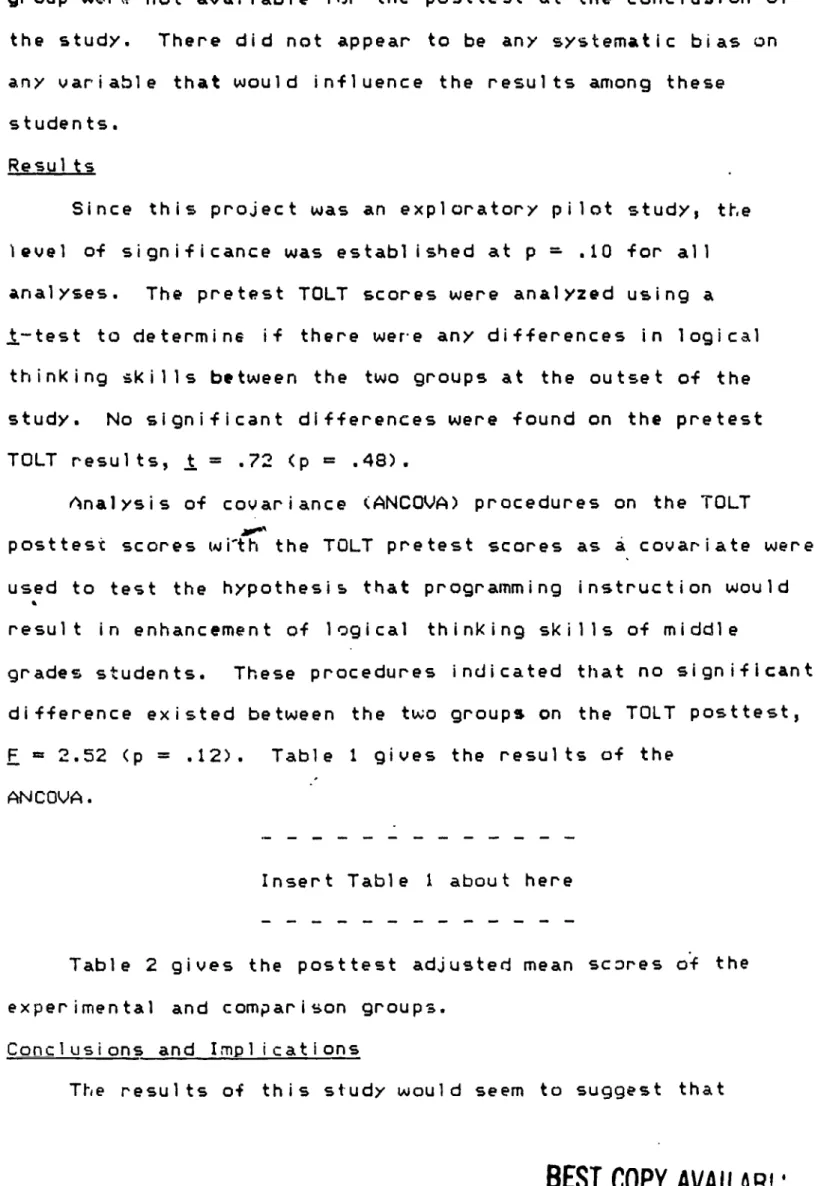
Since this project was an exploratory pilot study, the level of significance was established at p = .10 for all
analyses. The pretest TOLT scores were analyzed using a
ttest to determine if there were any differences in logical thinking skills between the two groups at the outset of the
study. No significant differences were found on the pretest
TOLT results, t = .72 (I) = .48).
Analysis of covariance (ANCOVA) procedures on the TOLT
posttest scores with the TOLT pretest scores as a covariate were used to test the hypothesis that programming instruction would result in enhancement of logical thinking skills of middle
grades students. These procedures indicated that no significant difference existed between the two groups on the TOLT posttest, F = 2.52 (p = .12). Table 1 gives the results of the
ANCOVA.
Insert Table 1 about here
Table 2 gives the posttest adjusted mean scores of the experimental and comparison groups.
Conclusions and Implications
The results of this study would seem to suggest that
7
Learning Outcomes Page 6
instruction in computer programming does not significantly
enhance growth in logical thinking skills. However, th conclusion must be considered as tu.ntative due to the
sample size and limited scope of this study. Additionaliy, ten weeks may be too short a time period to expect much growth in
logical thinking skills.
Claims that the microcomputer is one of the most significant educational resources to be developed may be
exaggerated. Educators have not developed a strong empirical base for any particular use (computer assisted instruction, programming, etc.) of the microcomputer. Yet, schools are
rapidly purchasing computers in increasing numbers without much thought given to how this technology is to be used. There may be sound, compellkirreasons for teaching programming to
students, but this study suggests that enhancement of logical thinking skills is not one of these reasons. Perhaps BASIC is not the appropriate language to use with middle grades students. LOGO may be a more appropriati: language. Continued cooperative efforts between researchers and schools are needed to explore
the potential outcomes of use of computers and to develop the needed empirical base for use of computers in schools.
Learning Outcomes Page 7
REFERENCES
Bork, A. Computers in education today and some possible
futures. (1984). Phi Delta Kappan, AA, 239-243.
Creative Programming. (1983). Creative Programming Inc. Arlington Heights, Illinois.
Ovens, G. Getting to the core of the Apple-gap. (1983): Phi Delta.Kkaula, 65, 130-131.
Inhelder, B., & Piaget, J. (1958). The growth of logical thinking from childhood to adolescence. New York: Basic Books.
Padilla, M., Okey, J., & Dillashaw, G. (1983). The
relationship between science process skill and formal thinking abilities. Journal of Research in Science Teaching, 20, 239-246.
Tobin, K., & Capie, W. (1981). The development and validation of a group test of logical thinking. Educational and
Psychological Ogasurement, 41, 413-423.
Wagschal, P. A last chance for computers in the schools'
(1984). Phi Delta Kaaaan, 66, 251-254.
Learning Outcomes Page 8
Table 1
ANCOVA of TOLT Postteit Scores with TOLT Pretest Scores
-..
Source of Degreres200, of Sum of Mean F Probability
Variation Freedom Squares Square of F
Main Etfects 1 4.92 4.92 2.52 0.12
Residual 30 58.67 5.70
4 .
Learning Outcomes Page 9
0
Table 2
Group Size and Adjusted Mean Scores on TOLT Pot>ttest
Group
Experimental 16
Comparison 15
0.94 1.70