• MA XIM UMPERFORM A N C E • P AT E N TE D PURITY PRO CE SS
READ
THE
LABEL
BEFO
RE US
ING
HORT
ICULT
URAL
SPRA
Y OIL
FOR I
NSEC
T AND
PEST
MAN
AGEM
ENT
A SUP
ERIOR
WHIT
E HOR
TICUL
TURA
L SPRA
Y OIL
FOR I
NSEC
T, MIT
E AND
DISEA
SE CO
NTRO
L
ESL091505 REV092906 641001/1
ACTIVE INGREDIENT: BY WEIGHT.
Petroleum Oil ... 98.00% INERT INGREDIENTS: ... 2.00% TOTAL 100.00% Unsulfonated Residue ... 99.00% (minimum) Aromatic Composition by ASTM D2140 ... 0.00%
KEEP OUT OF REACH OF CHILDREN
CAUTION
See Inside For Additional Precautionary Statements
G
G
R
R
E
E
E
E
N
N
NET 30U.S. GAL.(113.6 L)
NET 2.5 U.S. GAL.(9.5L)
NET 275 U.S. GAL.(1041 L)
FIRST AID
Have the product container or label with you when calling a poison control center or doctor or going for treatment. If swallowed:
If in eyes:
If on skin or clothing:
If inhaled:
• Immediately call a poison control center or doctor.
• Do not induce vomiting unless told to by a poison control center or doctor. • Do not give any liquid to the person.
• Do not give anything by mouth to an unconscious person.
• Hold eye open and rinse slowly and gently with water for 15-20 minutes.
• Remove contact lenses, if present, after the first 5 minutes, then continue rinsing eye. • Call a poison control center or doctor for treatment advice.
• Take off contaminated clothing.
• Rinse skin immediately with plenty of water for 15-20 minutes. • Call a poison control center or doctor for treatment advice. • Move person to fresh air.
• If person is not breathing, call 911 or an ambulance, then give artificial respiration, preferably mouth-to-mouth if possible.
• Call a poison control center or doctor for further treatment advice.
NOTE TO PHYSICIAN:Petroleum distillate poses aspiration pneumonia hazard. Only minor irritation should be expected from any
type of exposure other than pulmonary aspiration. Ingestion may result in some gastroenteritis and mild diarrhea. Since systemic toxicity is not expected, the added risk of aspiration from attempts to induce vomiting or lavage are deemed not warranted. FOR A MEDICAL EMERGENCY INVOLVING THIS PRODUCT CALL:
PETRO-CANADA 403-296-3000, CANUTEC TRANSPORTATION: 613-996-6666, POISON CONTROL CENTRE.
EPA REG. NO. 69526-9
EPA EST. NO. 79693-CAN-001
PRECAUTIONARY STATEMENTS
Hazards to Humans & Domestic Animals
CAUTION
Harmful if swallowed or absorbed through skin or inhaled. Prolonged or frequently repeated skin contact may cause allergic reaction in some indi-viduals. This product is a potential skin sensitizer. Causes moderate eye irritation. Avoid contact with eyes, skin, or clothing. Avoid breathing spray mist. Wash thoroughly with soap and water after handling. Remove contaminated clothing and wash clothing before reuse.
Personal Protective Equipment:Some materials that are chemical-resistant to this product are listed below. If you want more options, follow
the instructions for category E on the EPA chemical resistance category selection chart.
Applicators and other handlers must wear:Long-sleeved shirt and long pants, chemical-resistant gloves (such as Barrier Laminate, Nitrile
rub-ber, Butyl, Neoprene rubber or Viton) and shoes plus socks. Follow manufacturer’s instructions for cleaning and maintaining PPE. If no such instruc-tions for washables, use detergent and hot water. Keep and wash PPE separately from other laundry.
Engineering controls statements:When handlers use closed systems or enclosed cabs in a manner that meets with requirements listed in the
Worker Protection Standard (WPS) for agricultural pesticides [40 CFR 170.240 (d) (4-6)], the handler PPE requirements may be reduced or modi-fied as specimodi-fied in the WPS.
USER SAFETY RECOMMENDATIONS
Users should: Wash hands before eating, drinking, chewing gum, using tobacco or using the toilet. Remove clothing immediately if pesticide gets inside. Then wash thoroughly and put on clean clothing. Remove PPE immediately after handling this product. Wash the outside of gloves before removing. As soon as possible, wash thoroughly and change into clean clothing.
ENVIRONMENTAL HAZARDS
This product is toxic to fish. Do not apply directly to water, or to areas where surface water is present or to intertidal areas below the mean high water mark. Do not contaminate water when disposing of equipment wash waters. Apply this product only as specified on the label.
DIRECTIONS FOR USE
It is a violation of Federal law to use this product in a manner inconsistent with its labeling. Do not apply this product through any type of irriga-tion system. Do not apply this product in a way that will contact workers or other persons, either directly or through drift. Only protected handlers may be in the area during application. For any requirements specific to your State or Tribe, consult the agency responsible for pesticide regulation. Do not apply this product aerially.
AGRICULTURAL USE REQUIREMENTS
Use this product only in accordance with its labeling and with the Worker Protection Standard, 40 CFR part 170. This Standard contains requirements for the protection of agricultural workers on farms, forests, nurseries, and greenhouses, and handlers of agricultural pesticides. It contains requirements for training, decontamination, notification, and emergency assistance. It also contains specific instructions and exceptions pertaining to the statements on this label about personal protective equipment (PPE), and restricted-entry interval. The require-ments in this box only apply to uses of this product that are covered by the Worker Protection Standard.
Do not enter or allow worker entry into treated areas during the restricted entry interval (REI) of 4 hours.
PPE required for early entry to treated areas that is permitted under the Worker Protection Standard and that involves contact with anything that has been treated, such as plants, soil, or water, is: coveralls over long-sleeved shirt and long pants, shoes and socks and chemical-resist-ant gloves ( such as Nitrile, Butyl, Neoprene, and/or Barrier Laminate).
NON-AGRICULTURAL USE REQUIREMENTS
The requirements in this box apply to uses of this product that are NOT within the scope of the Worker Protection Standard for agricultural pesticides (40 CFR Part 170). The WPS applies when this product is used to produce agricultural plants on farms, forests, nurseries, or green-houses. Keep children and pets out of the treated area until sprays have dried.
STORAGE AND DISPOSAL
Do not contaminate water, food or feed by storage and disposal.PESTICIDE STORAGE: Keep out of reach of children and animals. Store in original containers only. Store in a cool, dry place and avoid excess heat. Carefully open containers. After partial use, replace lids and close tightly. Do not put concentrate or dilute material into food or drink containers. In case of spill, avoid contact, isolate area and keep out animals and unprotected persons. Confine spills. To confine spill: If liquid, dike surround-ing area or absorb with sand, cat litter or commercial clay. If dry material, cover to prevent dispersal. Place damaged package in a holdsurround-ing con-tainer. Identify contents.
PESTICIDE DISPOSAL: Wastes resulting from the use of this product may be disposed of on site or at an approved waste disposal facility. CONTAINER DISPOSAL: Metal: Triple rinse (or equivalent). Then offer for recycling or reconditioning, or puncture and dispose of in a sanitary land-fill, or by other procedures approved by state and local authorities. Do not cut or weld metal containers.
Plastic: Triple rinse (or equivalent). Then offer for recycling or reconditioning, or puncture and dispose of in a sanitary landfill, or incineration, or, if allowed by state and local authorities, by burning. If burned, stay out of smoke.
MIXING DIRECTIONS
Use only in equipment with sufficient agitation to keep spray thoroughly mixed. Be sure tank is clean. With agitator running, start filling tank with water; add oil when tank is about 1/2 full. Pump this mixture through the overflow and back into tank for about two minutes. If this mixture turns white, it indicates good emulsification. Fill the tank with water, adding other desired materials as tank is filling. If wettable powders are used, add and thoroughly mix before adding oil. Observe all cautions and limitations on labeling of all products used in mixtures. Keep agitator running at all
times. If an injector is used, first add 25 to 50 gals. of water to tank with engine running to provide good pressure. Put injector suction tube into the measured amount of spray oil, opening injector valve to allow the oil to be sucked into the tank, then fill the tank with water.
DO NOT USE THIS MATERIAL IF IT DOES NOT EMULSIFY.
Preharvest Interval - This product may be used up to the day of harvest. To ensure the best coverage, dilute applications (greater than 150 gallons of spray solution per acre) are recommended. Concentrate applications (usually from 20 to150 gallons of spray solution) may reduce the coverage and thus the effectiveness. Application volumes depend on the crop type, crop size and target pest. Adjust the spray volume to obtain the best cov-erage without runoff. Extreme care should be taken when using concentrate sprays as the potential for enhanced crop phytotoxicity is increased. A concentrate application can provide satisfactory results as long as the spray unit is properly engineered, calibrated and operated.
Note: Use efficient equipment of the proper type. Avoid spraying during or immediately prior to hot or freezing weather (over 95°F.or under 32°F.), hot dry winds, rain or other unsuitable conditions; avoid over spraying or double spraying. Plants should be sprayed only when in vigorous condi-tion and when their moisture condicondi-tion is suitable. Before using, make certain spray tank is free of sulfur residues.
Sulfur: On Grapes:Do not apply sulfur within 10 days of an oil application.On all other Crops: Do not apply micronized sulfur within 10 days
of an oil application and do not apply oil within 14 days of an application of wettable or dusting sulfur.
Do not use the following chemicals: captan, Folpet, oxythioquinox (Morestan) organic tin compounds (Du-Ter), during, with or following an oil spray. This product has not been tested on all species or varieties. Before treating a large area, treat a small area and observe prior to full scale applica-tion. A period of 14 days must elapse before any of the following chemicals are used before or after an application of this product: anilazine (Dyrene), chlorothalonil (Bravo), dicloran (Botran), dicofol (Kelthane), Dikar, dinocap (Karathane), permethrin (Ambush, Pounce). Do not use chlorothalonil (Bravo) or dimethoate (Cygon) in a spray program with this product on grapes, ornamentals and strawberries. Do not use dicofol (Kelthane) in a spray program with this product on ornamentals and strawberries. Do not use propargite (Omite) with an oil spray or within 30 days before or after an oil spray.
PESTS
APPLES AND PEARS:European Fruit
Lecanium Scale, Olive Scale, San Jose Scale, European Red Mite Eggs
DORMANT OR DELAYED DORMANT:Use 1 to 2 gals. per 100 gals. of water at 100 to 800
gals. per acre. (Concentrate Spray: Use 3 to 8 gals. per acre in a minimum of 20 to 100 gals. water per acre.)
Two Spotted Spider Mite, Pacific Red Mite, European Red Mite
FOLIAR SPRAY (Post Bloom):
East of the Mississippi:Use 1quart -1 1/2 gallons per 100 gals. of water at 100 to 800 gals.
per acre. Do not exceed more than 1 1/2 gals. per acre per application for SUMMER treatments. (Concentrate Spray: Do not exceed more than 11/2 gals. per acre per application. Apply a mini-mum of 50 gals. water per acre.)
West of the Mississippi:Use 1 qt. to 11/2 gals. per 100 gals. water at 100 to 800 gals. per
acre. (Concentrate Spray: Do not exceed more than 11/2 gals per acre per application. Apply a minimum of 20 to 100 gals. water per acre).
APPLES ONLY:Rosy Apple Aphid Eggs,
Apple Aphid Eggs
DORMANT OR DELAYED DORMANT:Use 1 to 2 gals. per 100 gals. of water at 100 to 800
gals. per acre. (Concentrate Spray: Use 3 to 8 gals per acre in a minimum of 20 to 100 gals. water per acre.)
Fruit Tree Leafroller, Apple Red Bug, Scurfy Scale European Red Mite
GREEN TIP TO DELAYED DORMANT:Use 1 to 3 gals. per 100 gals. of water at 100 to 800
gals. per acre. (Concentrate Spray: Use 3 to 12 gals. per acre in a minimum of 20 to 100 gals. water per acre.)
Comments: Delayed dormant preferred APPLICATION RATE AND TIMING
APPLES AND PEARS
PESTS San Jose Scale Forbes Scale
DORMANT, GREEN TIP TO DELAYED DORMANT:Use 1 to 2 gals. per 100 gals. of water at
100 to 800 gals. per acre. (Concentrate Spray: Use 3 to 8 gals. per acre in a minimum of 20 gals. to 100 gals. water per acre.)
PEARS ONLY: Pear Psylla
DORMANT:Use 1 to 2 gals. per 100 gals. of water at 100 to 800 gals. per acre. (Concentrate
Spray: Use 3 to 8 gals. per acre in a minimum of 20 to 100 gals. water per acre.) Comments: Apply before eggs are laid.
Fruit Tree Leafroller Pear Leaf Blister Mite
DORMANT:Use 1 to 3 gals. per 100 gals. of water at 100 to 800 gals. per acre. (Concentrate
Spray: Use 3 to 12 gals. per acre in a minimum of 20 to 100 gals. water per acre.) APPLICATION RATE AND TIMING
APPLES AND PEARS con’t:
PESTS
Black Scale, European Fruit Lecanium Scale, San Jose Scale, Olive Scale, Frosted Scale, Aphid Eggs, European Red Mite Eggs, Brown Mite Eggs, Fruit tree Leafroller Eggs
DORMANT AND DELAYED DORMANT: Use 1 to 3 gals. per 100 gals. of water at 300 to 600 gals. per acre. (Concentrate Spray: Use 6 to 8 gals. per acre in a minimum of 20 gals. of water per acre.)
Comments: Preferred times of application for European Fruit Lecanium Scale and European Red Mite Eggs is Green Tip to Delayed Dormant, and for San Jose Scale is Dormant, Green Tip to Delayed Dormant.
Terrapin Scale DELAYED DORMANT: Use 2 to 3 gals. per 100 gals of water at 300 to 600 gals. per acre. (Concentrate Spray: Use 8 to 12 gals. per acre in a minimum of 20 gals. of water per acre.)
Two-spotted Spider Mite, Pacific Mite,
European Red Mite, Brown Mite FOLIAR SPRAY: Use 1/2 to 11/2 gals. per 100 gals. of water at 300 to 600 gals. per acre.(Concentrate Spray: Do not use more than 4 gals. per acre in a minimum of 20 gals. water per acre.) Comments: Certain varieties of plums and prunes may be injured by oil sprays, check for tolerance prior to treatment. Do not apply to trees lacking moisture.
APPLICATION RATE AND TIMING
ALMONDS, APRICOTS, CHERRIES, NECTARINES, PEACHES, PISTACHIO, PLUMS AND PRUNES:
(Directions: for use on Plums and Prunes in California's Sacramento Valley can be found in the table
following this one):
Cottony Peach Scale DORMANT: Use 2 to 3 gals. per 100 gals. of water at 300 to 600 gallons per acre. (Concentrate Spray: Use 8 to 12 gals. per acre in a minimum of 20 gals. of water per acre.)
White Peach Scale on Peaches: Only for use in Georgia, Florida, South Carolina, North Carolina, and Alabama.
DORMANT:Use 11/2 to 2 gals. per 100 gals. of water at 300 to 600 gals. per acre.
(Concentrate Spray: Use 6 to 8 gals. per acre in a minimum of 20 gals. of water per acre.) Comments: Apply before buds begin to swell in the spring. Make 2 applications 7 to 14 days apart, according to local recommendations, during the dormant period.
PESTS
Black Scale, European Fruit Lecanium Scale, San Jose scale, Olive Scale, Frosted Scale, Mealy Plum Aphid Eggs, Leaf Curl Plum Aphid Eggs, Brown Mite Eggs, European Red Mite Eggs
PRE-BLOOM WHEN FRUIT BUDS SHOW GREEN TIPS:Use 11/2 to 2 gals. per 100 gals. of
water at 300 to 600 gals. per acre. (Concentrate Spray: Use 6 to 8 gals. per acre in a minimum of 20 gals. water per acre.)
Comments: Application at this time is preferred.
Two-spotted Spider Mite, Pacific Mite, European Red Mite, Brown Mite
FOLIAR SPRAY:Use 1/2 to 1 gals. per 100 gals. water at 300 to 600 gals. per acre.
(Concentrate Spray: Use 4 to 6 gals. per acre in a minimum of 20 gals. water per acre.) Comments: Oil sprays may injure certain varieties of plums and prunes, check for tol-erance prior to treatment.
APPLICATION RATE AND TIMING
PLUMS AND PRUNES: (Sacramento Valley of California Only)
PESTS
Avocado Brown Mite, Thrip, Pracea Mite
Use 1/2 to 1 gal. per 100 gals. of water with thorough coverage in 400 to 3000 gal. per acre. (Concentrate Spray: Use 4 to 15 gals. per acre in a minimum of 50 to 100 gals. per acre.) Comments: Apply through late fall. Consult with your local University of California Cooperative Extension Service for proper timing and application parameters. APPLICATION RATE AND TIMING
AVOCADOS:
BANANAS, PLANTAINS:
PESTS
Black Leaf Streak (Mycosphaerella fijien-sis), Black Sigatoka (Mycosphaerella fijiensis var. difformis) Yellow Sigatoka (Mycosphaerella musicola)
Use 1/2 to 11/2 gals. in 20 to 100 gals. of water per acre. (Mist Blower: Use 11/2 gals. in 6 gals. of water per acre.)
Comments: Begin application when disease first appears and continue every 10 to 15 days during rainy periods or as is needed. Do not apply when daytime temperatures exceed 80° F as injury may occur. Phytotoxicity may be affected by the quantity of oil used, vigor of trees and temperature at the time of application. Bag fruits, or use a directed spray on unbagged fruits. Bagged fruit improves crop safety where as
unbagged fruit may show phytotoxicity.This application is also effective in loosening
Sooty Mold Fungus and in preventing it’s formation by the control of Aphids, Mealybugs, Scales and Whitefly.
APPLICATION RATE AND TIMING
PESTS
Mites, Powdery MIldew, Rust 0.75-1.5
Comments: Using ground equipment, spray for optimum coverage of leaf surfaces. For fungal diseases use at least 200 psi spray pressure.
APPLICATION RATE AND TIMING (gallons of oil per 100 gallons of water)
PESTS
Mites: Citrus Bud, Citrus Flat, Citrus Red, Citrus Rust,
Scales: Black, Brown Soft, California Red, Citricola, Purple, Yellow, Red
Central California:Apply 1/2 to 11/2 gals. of oil per 100 gals. of water as thorough coverage
spray (TC). Alternately, use a low volume spray (LV) to apply 1 to 10 gals. of oil per acre. Comments: Apply July through September.
Apply up to 10 gals. of oil per acre on bearing trees up to 10 feet in height. Add 1 gal. of oil per acre for each foot of tree height over 10 feet. Apply as a low volume spray (LV) 1 to 10 gals. of oil per acre.
APPLICATION RATE AND TIMING
CITRUS:(California Only) - Lemons, Grapefruit, and Oranges (Navel and Valencia), Limes,
Tangerines and Tangelos and other citrus hybrids.
Apply as a low volume spray (LV) 1 to 10 gals. of oil per acre.
Comments: For Lemons and Limes, make applications in all months except December through February; for Grapefruit make applications July through October; for Oranges make applications on Navels July through September and on Valencias, Tangelos and Tangerines and other citrus hybrids July through October.
Mites: Citrus Bud, Citrus Flat, Citrus Red, Citrus Rust,
Scales: Black, Brown Soft, California Red, Citricola, Purple, Yellow, Red
Southern California: Apply 1/2 to 11/2 gals. of oil per 100 gals. water as a thorough cover-age spray (TC). Alternately, use a low volume spray (LV) to apply 1 to 10 gals. of oil per acre. Comments: For Coastal Lemons and Limes, apply May and June and/or September through December. For Interior Lemons and Limes, apply in April and May and/or September through November.
Apply up to 10 gals. of oil per acre on bearing trees up to 10 feet in height. Add 1 gal. of oil per acre for each foot of tree height over 10 feet. Apply as a low volume spray (LV) 1 to 10 gals of oil per acre
Apply as a low volume spray (LV) 1 to 10 gals. of oil per acre.
Comments: For Lemons and Limes, make applications in all months except December through February; for Grapefruit make applications July through October; for Oranges make applications on Navels July through September and on Valencias, Tangelos and Tangerines and other citrus hybrids July through October.
Oxnard Plains Area: Apply 1/2 to 11/2 gals. of oil per 100 gals. of water as a thorough cover-age spray (TC). Alternately, use a low volume spray (LV) to apply 1 to 10 gals. of oil per acre. Apply up to 10 gals. of oil per acre on bearing trees up to 10 feet in height. Add 1 gal. of oil per acre for each foot of tree height over 10 feet. Apply as a low volume spray (LV) 1 to 10 gals. of oil per acre.
Make applications as needed throughout the year. Mites: Citrus Bud, Citrus Flat, Citrus Red,
Citrus Rust,
Scales: Black, Brown Soft, California Red, Citricola, Purple, Yellow, Red
Thorough coverage spray (TC): Applications achieving a uniform film wetting of all portions of the tree at 250 to 4500 gallons of spray solution per acre, the total volume is dependent of the size of the trees. Low-volume spray (LV): Applications with droplet depositions achieved on all inte-rior and exteinte-rior parts of the tree using 10 to 100 gallons of spray solution per acre. Do not apply pinte-rior to or during a period of excessively high temperatures. Do not apply oil spray when trees show stress.
PESTS
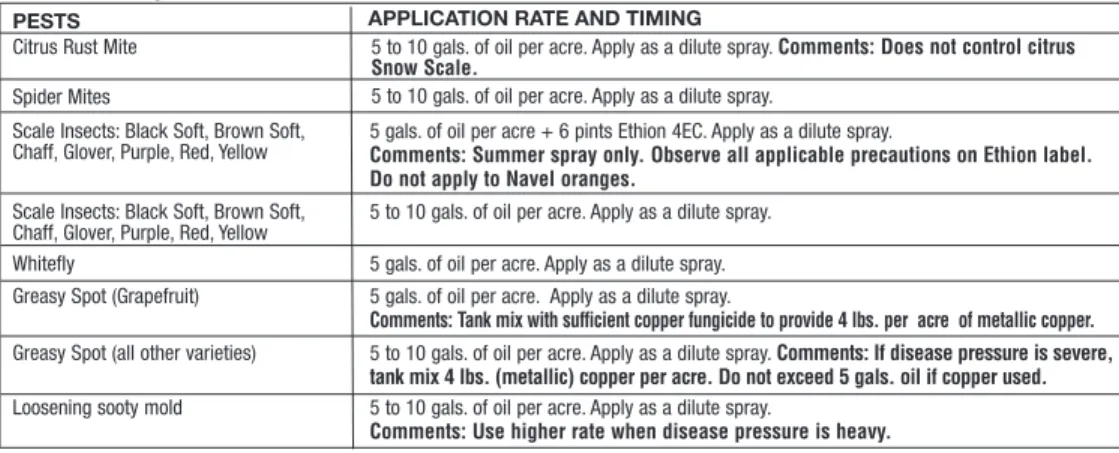
Citrus Rust Mite 5 to 10 gals. of oil per acre. Apply as a dilute spray.Comments: Does not control citrus Snow Scale.
APPLICATION RATE AND TIMING
CITRUS: (Florida and Texas)- Grapefruit, Lemons, Limes, Oranges, Tangelos and Tangerines and
other citrus hybrids.
5 gals. of oil per acre + 6 pints Ethion 4EC. Apply as a dilute spray.
Comments: Summer spray only. Observe all applicable precautions on Ethion label. Do not apply to Navel oranges.
Scale Insects: Black Soft, Brown Soft, Chaff, Glover, Purple, Red, Yellow
Dilute spray: Apply the spray oil application rate in up to 4500 gallons of water per acre, or 30 to 35 gallons per tree, to over 45 gallons per tree for large trees. Best results can be obtained when the oil is added to a partially filled spray tank under proper agitation and all foliage is thor-oughly covered. Precautions in the use of oil include: Do not apply oil spray when trees are wilting. Do not apply oil and sulfur within 3 weeks of each other in Florida or Texas. Oil spray applied after October 1 may increase susceptibility of trees to cold damage and may reduce the fruit crop the following year. Oil sprays applied in the fall may inhibit solids formation in the juice and retard coloring of fruit and should not be applied within 60 days of anticipated harvest. Sensitive foliage may be injured. Florida growers consult the Florida Citrus Spray and Dust Schedule, or your Agricultural Experiment Station or State Extension Service Specialist for complete details on the spraying program best suited to your locale. Texas growers consult with your Agricultural Experiment Station or State Extension Specialist for complete details on the spraying program suited to your locale.
Spider Mites 5 to 10 gals. of oil per acre. Apply as a dilute spray.
5 to 10 gals. of oil per acre. Apply as a dilute spray. Scale Insects: Black Soft, Brown Soft,
Chaff, Glover, Purple, Red, Yellow
5 gals. of oil per acre. Apply as a dilute spray. Whitefly
5 gals. of oil per acre. Apply as a dilute spray.
Comments: Tank mix with sufficient copper fungicide to provide 4 lbs. per acre of metallic copper. Greasy Spot (Grapefruit)
5 to 10 gals. of oil per acre. Apply as a dilute spray.Comments: If disease pressure is severe, tank mix 4 lbs. (metallic) copper per acre. Do not exceed 5 gals. oil if copper used. Greasy Spot (all other varieties)
5 to 10 gals. of oil per acre. Apply as a dilute spray.
Comments: Use higher rate when disease pressure is heavy. Loosening sooty mold
PESTS
Green Scale Use 3 to 6 gallons in 100 gallons of water per acre. Use only water as a diluent.
Comments: Apply when insects appear and treat as necessary at 30 to 60 day intervals. Do not exceed 18 gallons of oil per acre in a growing season. Do not apply with in 30 days of harvest when berries are hand picked. Oil residues make picking difficult.
APPLICATION RATE AND TIMING
COFFEE:
Do not apply this product through any type of irrigation system. Phytotoxicity may be affected by the quantity of oil used, vigor of trees and tem-perature at the time of application.
PESTS
Fig Scale 1-3 Comments: Dormant or Delayed Dormant
APPLICATION RATE AND TIMING (gallons of oil per 100 gallons of water)
FIGS:
PESTS
Mealybug, Mites, Leafhopper*, Whiteflies*, Powdery Mildew.
Use 1 to 3 gals. plus the appropriate label rate of insecticide registered for use on grapes in 200 to 300 gals. of water per acre.
Comments: Do not apply over 300 gals. of water per acre.
Using ground equipment, spray for optimum coverage of leaf surfaces. Repeat sprays every 10-14 days.
For powdery mildew- Make first application pre-bloom and continue every ten days to three
weeks depending on level of disease pressure. Use higher rate and/or shorter spray interval when disease conditions are severe.
Oil will remove the bloom on grapes. Table grapes should not be sprayed within 60 days of harvest. On grapes, do not tank mix oil and copper more than once/season. Do not use copper and oil together with fruit present.
APPLICATION RATE AND TIMING
GRAPES:
PESTS
Olive (Parlatoria) Scale, Oleander Scale, Black Scale.
POSTBLOOM THROUGH AUGUST AND POST HARVEST:Use 1 to 11/2 gals. per 100 gals.
of water at 400 to 1500 gals. per acre. APPLICATION RATE AND TIMING
OLIVES:
Mites 1.5 gals. per 100 gals. of water Comments: Prebloom to Postbloom Buckshot
PESTS
Scales, Aphids (eggs), Mites (eggs) Use 2 to 3 gallons in 100 gallons of water using a minimum of 200 gallons of water per acre. Use the lower rate of oil when trees are in a weakened condition. (Concentrate Spray: Use 6 to 8 gallons per acre in a minimum of 20 to 125 gallons of water.)
Comments: Apply from late February until buds first break. APPLICATION RATE AND TIMING
PECANS:
PESTS
Leafminers*, Mites, Powdery Mildew 0.75 Comments: Spray at no less than 400 psi using ceramic spray nozzles (ALBUZ® ATR, lilac color or their equivalent).
APPLICATION RATE AND TIMING (gallons of oil per 100 gallons of water)
STRAWBERRIES:
PESTS
KIWI - Latania Scale, Greedy Scale, Oleander Scale, San Jose Scale
Use 4 to 6 gallons of oil in a minimum of 100 gallons of water per acre. Use higher rate when scale populations are high.Comments: Do not apply after budbreak. Do not use on weak or stressed vines, or where soil moisture is inadequate.
APPLICATION RATE AND TIMING
TROPICAL FRUIT: Kiwi, Mango, Papaya and Pineapple.
MANGO - Mites, Powdery Mildew Use 1 to 1.5 gallons of oil in 100 gallons of water per acre.
Comments: Apply every 2 to 3 weeks as necessary depending on level of pest pres-PAPAYA - Mites, Powdery Mildew, Papaya
Ringspot Virus
Use 0.75 to 1.5 gallons in 100 gallons of water per acre.
Comments: For Powdery Mildew/Mites: Spray every 10 to 14 days depending on the level of pest pressure. For Virus: Initiate spray when seeds are germinated. Spray weekly using 400 psi spray pressure and ceramic hollow cone nozzles. PINEAPPLE - Mealybugs, Bud Moth,
Chinese Rose Beetle
Spray -Use 1 to 2 gallons of oil in 100 gallons of water per acre
Dip-Use 1 to 2 gallons of oil in 100 gallons of water, dip for 30 seconds. Comments: Allow fruit to dry for 1 hour before being stored.
PESTS
Black Scale, Calico Scale, European Fruit Lecanium Scale, Frosted Scale, Olive Scale, San Jose Scale
European Red Mite Eggs, Walnut Aphid Eggs
DELAYED DORMANT:Use 4 to 6 gals. per acre in 200 to 500 gallons of water per acre.
Comments: Use only on trees that have not suffered from lack of moisture at anytime during the growing season. Do not apply to orchards where soil moisture is low. Trees must be fully dormant. Do not apply after husk split.
APPLICATION RATE AND TIMING
WALNUTS:
Spider Mites, Soft Scales SUMMER FOLIAR (when leaves fully expanded):Use 4 to 6 gals. per acre in 200 to 500 gals. water per acre.
PESTS
Aphids, Mites, Beetle Larvae, Leafminers, Thrips, Leafhopper, Whitefly
0.75-1
Comments: For virus control on cucurbits use 0.75 gallons per 100 g. Spray once or twice weekly depending on the rapid growth of the crop and / or vector pres-sure. When using to control insect transmitted diseases, use higher pressure 400 psi and ceramic hollow cone nozzles.
APPLICATION RATE AND TIMING (gallons of oil per 100 gallons of water)
VEGETABLE CROPS
BEANS, BEETS, CABBAGE, CAULIFLOWER and other Cole crops, CUCURBITS, EGGPLANT,
LETTUCE, MELON, PEPPER, PUMPKIN, RADISH, SQUASH, TOMATO:
PESTS
Aphids, Adelgids 1-2.5 oz. per gallon.
Comments: Summer (Foliar or Cover): Do not spray plants during flowering. APPLICATION RATE AND TIMING (ounces of oil per gallon of water)
ORNAMENTALS
FOLIAGE ORNAMENTALS & BEDDING PLANTS:
PESTS
Aphids, Adelgids, Eriophyid Mites, Gall Mites, Honey Locust Plant Bug, Lace Bug, Leaf Beetle Larvae, Leafminer, Leafrollers, Mealybugs, Psyllids (imma-ture), Red Mites, Sawfly (larvae), Scales (immature), Spider Mites, Webworms, Whiteflies
Winter Dormant Period:2.5-4 oz. per gallon Summer (Foliar or Cover):1-2.5 oz. per gallon
CAUTION:Spray no more than 4 times during the growing season; Use a 2 week minimum
application Interval. Do not spray when there is obvious moisture deficit in leaves, or the plant is under stress. For fall dormant applications, reduce rate to 2 gallons oil per 100 gallons water and limit use only to: American Red Oak, Japanese Black Pine, Dogwood, Weeping Cherry, Cornelian Cherry, Crabapple, Norway Maple, Purple Plum.
NOTE:May cause discoloration of Blue Spruce. Do not use on conifers or ferns not tolerant to
oil sprays. Use enough spray solution to completely penetrate the leaf canopy and cover both top and bottom of all of the leaves and stems until wet but without significant runoff. Do not spray during flowering.
APPLICATION RATE AND TIMING (ounces of oil per gallon of water)
SHADE TREES** AND SHRUBS INCLUDING CONIFERS, DECIDUOUS BROADLEAF EVERGREENS
& WOODY ORNAMENTALS, ORNAMENTAL TREES**, ALONG CITY STREETS, OTHER
RIGHTS-OF-WAY, IN RESIDENTIAL AREAS AND IN LANDSCAPES:
PESTS
Same as above Winter Dormant Period:2.5-4 oz. per gallon Comments: Do not spray during flowering. APPLICATION RATE AND TIMING (ounces of oil per gallon of water)
PESTS
Scale (soft & hard) (immature) 2-3 Comments: Winter
APPLICATION RATE AND TIMING (ounces of oil per gallon of water)
CHRISTMAS TREES **:
Spider Mites 0.75-2 Comments: Summer
Use a lower concentration for more sensitive plants.
** This product removes the glaucous (blue) bloom from such evergreens as Colorado Blue Spruce and Koster Spruce. Always use lower dosage or test spray oil sensitive plants such as Cryptomeria, Smoke Tree, Chamaecypris, Juniper, Japanese Holly and Spruce.
Tendency toward sensitivity: Red Cedar and Douglas Fir.
PESTS
Aphids, Fungus Gnats, Leafminers, Mealybugs, Scales (soft & hard), Spider Mites, Thrips, Whitefly
0.5-1
Comments: Due to varietal differences in response to a treatment of this product at the recommended rate, we recommend conducting a small test on 1 or 2 plants of the specific variety to be treated.
APPLICATION RATE AND TIMING (gallons of oil per 100 gallons of water)
AGERATUM, FERNS, PETUNIA:
Frequency of Application:For the greenhouse pests listed, use once a week initially, then as the pest is controlled, decrease the frequency to
every 2-3 weeks as needed.
Application safety during bloom period should be determined for each individual species of plant to be treated by conducting a small test.
GREENHOUSE AND CONTAINER
PESTS
Aphids, Fungus Gnats, Leafminers, Mealybugs, Scales (soft & hard), Spider Mites, Thrips, Whitefly
1-2
Comments: Due to varietal differences in response to a treatment of this product at the recommended rate, we recommend conducting a small test on 1 or 2 plants of the specific variety to be treated.
APPLICATION RATE AND TIMING (gallons of oil per 100 gallons of water)
BEGONIAS, CARNATION, CHRYSANTHEMUM, COLEUS, NEW GUINEA IMPATIENS, PORTULACA,
REIGER BEGONIAS:
Some plants are more sensitive to oil treatments if any of the following conditions are present when application is made: High humidity (74%), an overcast or cloudy day, inadequate air flow, a small greenhouse where the sunlight is magnified causing a fast build-up of temperature and light intensity.
PESTS
Aphids, Mites, Leafminers, Corn Earworm, Rootworm, Armyworm, Whitefly
Corn:1-2
Sugar Beets:2
APPLICATION RATE AND TIMING (gallons of oil per 100 gallons of water)
CORN (Sweet & Field), SUGAR BEETS:
FIELD CROPS
PESTS
Mites, Powdery Mildew
APPLICATION RATE AND TIMING (gallons of oil per 100 gallons of water)
HOPS*:
1-2
Comments: For powdery mildew: Initiate sprays at early leaf stage. Continue sprays every 10-14 days. Mite control will be effective under the same spray interval as pow-dery mildew sprays. Discontinue sprays at burr development.
PESTS
Aphids, Mites, Beetle Larvae, Leafminers, Thrips, Leafhopper, Whitefly
APPLICATION RATE AND TIMING (gallons of oil per 100 gallons of water)
TOBACCO:
0.75-1
*Asterisk denotes crop, pest Not approved in California.
This product has not been tested on all species or varieties. Before treating a large area, treat a small area and observe prior to full scale application.
NOTICE:
IT IS IMPOSSIBLE TO ELIMINATE ALL RISKS INHERENTLY ASSOCIATED WITH THE USE OF THIS PRODUCT. CROP INJURY, INEFFECTIVENESS, OR OTHER UNINTENDED CONSEQUENCES MAY RESULT BECAUSE OF SUCH FACTORS AS WEATHER CONDITIONS, PRESENCE OF OTHER MATERIALS, OR THE MANNER OF USE OR APPLICATION, ALL OF WHICH ARE BEYOND THE CONTROL OF PETRO-CANADA, THE MANUFACTURER OR SELLER. IN NO CASE SHALL PETRO-CANADA, THE MANUFACTURER OR SELLER BE LIABLE FOR CONSEQUENTIAL, SPECIAL OR INDIRECT DAMAGES RESULT-ING FROM THE USE OR HANDLRESULT-ING OF THIS PRODUCT. ALL SUCH RISKS SHALL BE ASSUMED BY THE BUYER.
EXCEPT AS EXPRESSLY PROVIDED HEREIN, PETRO-CANADA, THE MANUFACTURER OR SELLER MAKES NO WARRANTIES, GUARANTEES, OR REPRE-SENTATIONS OF ANY KIND, EITHER EXPRESS OR IMPLIED, OR BY USAGE OF TRADE, STATUTORY OR OTHERWISE, WITH REGARD TO THE PRODUCT SOLD, INCLUDING, BUT NOT LIMITED TO, MERCHANTABILITY, FITNESS FOR A PARTICULAR PURPOSE, USE OR ELIGIBILITY OF THE PRODUCT FOR ANY PARTICULAR TRADE USAGE. BUYER’S OR USER’S EXCLUSIVE REMEDY, AND PETRO-CANADA’S, THE MANUFACTURER’S OR SELLER’S TOTAL LIABILITY, SHALL BE FOR DAMAGES NOT EXCEEDING THE COST OF THE PRODUCT.
*Petro-Canada - Trademark
FORMULATED FOR PETRO-CANADAORGANIC HORTICULTURAL SPRAY OIL FOR DISEASE AND PEST CONTROL READ LABEL BEFORE USING
ACTIVE INGREDIENT: BY WEIGHT Petroleum Oil...98.00% INERT INGREDIENTS: ...2.00% TOTAL 100% Unsulfonated Residue...99.00% (minimum) Aromatic Composition by ASTM D2140...0.00%
KEEP OUT OF REACH OF CHILDREN
CAUTION
See Inside For Additional Precautionary Statements
FIRST AID: Have the product container or label with you when calling a poison control center or doctor or going for treatment.
PURESPRAY
TMGREEN
HORTICULTURAL SPRAY OIL FOR INSECT AND PEST MANAGEMENT
If swallowed • Immediately call a poison control center or doctor.
• Do not induce vomiting unless told to by a poison control center or doctor. • Do not give any liquid to the person.
• Do not give anything by mouth to an unconscious person.
If in eyes • Hold eye open and rinse slowly and gently with water for 15-20 minutes. • Remove contact lenses, if present, after the first 5 minutes, then continue rinsing eye. • Call a poison control center or doctor for treatment advice.
If on skin or clothing:
• Take off contaminated clothing.
• Rinse skin immediately with plenty of water for 15-20 minutes. • Call a poison control center or doctor for treatment advice.
If inhaled • Move person to fresh air.
• If person is not breathing, call 911 or an ambulance, then give artificial respiration, preferably mouth-to-mouth if possible.
• Call a poison control center or doctor for further treatment advice.
NOTE TO PHYSICIAN:Petroleum distillate poses aspiration pneumonia hazard. Only minor irritation should be expected from any type of exposure other than pulmonary aspiration. Ingestion may result in some gastroenteritis and mild diarrhea. Since systemic toxicity is not expected, the added risk of aspiration from attempts to induce vomiting or lavage are deemed not warranted.
FOR A MEDICAL EMERGENCY INVOLVING THIS PRODUCT CALL: PETRO-CANADA 403-296-3000, CANUTEC TRANS-PORTATION: 613-996-6666, POISON CONTROL CENTRE.
EPA REG. NO. 69526-9 EPA EST. NO. 79693-CAN-001 PRECAUTIONARY STATEMENTS Hazards to Humans & Domestic Animals
CAUTION
Harmful if swallowed or absorbed through skin or inhaled. Prolonged or frequently repeated skin contact may cause allergic reaction in some individuals.This product is a potential skin sensitizer.Causes moderate eye irritation.Avoid contact with eyes, skin, or clothing. Avoid breathing spray mist. Wash thoroughly with soap and water after handling. Remove contaminated clothing and wash clothing before reuse.
Personal Protective Equipment:Some materials that are chemical-resistant to this product are listed below. If you want more options, follow the instructions for category E on the EPA chemical resistance category selection chart. Applicators and other handlers must wear:Long-sleeved shirt and long pants, chemical-resistant gloves (such as Barrier Laminate, Nitrile rubber, Butyl, Neoprene rubber or Viton) and shoes plus socks. Follow manufacturer’s instructions for clean-ing and maintainclean-ing PPE. If no such instructions for washables, use detergent and hot water. Keep and wash PPE separately from other laundry.
Engineering controls statements:When handlers use closed systems or enclosed cabs in a manner that meets with requirements listed in the Worker Protection Standard (WPS) for agricultural pesticides [40 CFR 170.240 (d) (4-6)], the han-dler PPE requirements may be reduced or modified as specified in the WPS.
USER SAFETY RECOMMENDATIONS- Users should: Wash hands before eating, drinking, chewing gum, using tobacco or using the toilet. Remove clothing immediately if pesticide gets inside. Then wash thoroughly and put on clean clothing. Remove PPE immediately after handling this product.Wash the outside of gloves before removing.As soon as possible, wash thoroughly and change into clean clothing.
ENVIRONMENTAL HAZARDS -This product is toxic to fish. Do not apply directly to water, or to areas where surface water is present or to intertidal areas below the mean high water mark. Do not contaminate water when disposing of equipment wash waters. Apply this product only as specified on the label.
DIRECTIONS FOR USE - It is a violation of Federal law to use this product in a manner inconsistent with its labeling. Do not apply this product through any type of irrigation system. Do not apply this product in a way that will contact workers or other persons, either directly or through drift. Only protected handlers may be in the area during application. For any requirements specific to your State or Tribe, consult the agency responsible for pesticide regulation.Do not apply this product aerially.
AGRICULTURAL USE REQUIREMENTS -Use this product only in accordance with its labeling and with the Worker Protection Standard, 40 CFR part 170.This Standard contains requirements for the protection of agricultural workers on farms, forests, nurseries, and greenhouses, and handlers of agricultural pesticides. It contains requirements for training, decontamination, notification, and emer-gency assistance. It also contains specific instructions and exceptions pertaining to the statements on this label about personal protec-tive equipment (PPE), and restricted-entry interval. The requirements in this box only apply to uses of this product that are covered by the Worker Protection Standard. Do not enter or allow worker entry into treated areas during the restricted entry interval (REI) of 4 hours. PPE required for early entry to treated areas that is permitted under the Worker Protection Standard and that involves contact with any-thing that has been treated,such as plants,soil,or water,is:coveralls over long-sleeved shirt and long pants,shoes and socks and chem-ical-resistant gloves ( such as Nitrile, Butyl, Neoprene, and/or Barrier Laminate).
NON-AGRICULTURAL USE REQUIREMENTS -The requirements in this box apply to uses of this prod-uct that are NOT within the scope of the Worker Protection Standard for agricultural pesticides (40 CFR Part 170). The WPS applies when this product is used to produce agricultural plants on farms, forests, nurseries, or greenhouses. Keep children and pets out of the treated area until sprays have dried. STORAGE AND DISPOSAL:Do not contaminate water, food or feed by storage and disposal.
PESTICIDE STORAGE:Keep out of reach of children and animals. Store in original containers only. Store in a cool, dry place and avoid excess heat. Carefully open containers. After partial use, replace lids and close tightly. Do not put concentrate or dilute material into food or drink containers. In case of spill, avoid contact, isolate area and keep out animals and unprotected persons. Confine spills.To confine spill: If liquid, dike surrounding area or absorb with sand, cat litter or commercial clay. If dry material, cover to prevent dispersal. Place damaged package in a holding container. Identify contents.
PESTICIDE DISPOSAL:Wastes resulting from the use of this product may be disposed of on site or at an approved waste disposal facility.
CONTAINER DISPOSAL: Metal:Triple rinse (or equivalent).Then offer for recycling or reconditioning, or puncture and dispose of in a sanitary landfill, or by other procedures approved by state and local authorities. Do not cut or weld metal containers. Plastic:Triple rinse (or equivalent).Then offer for recycling or reconditioning, or puncture and dispose of in a sanitary landfill, or incineration, or, if allowed by state and local authorities, by burning. If burned, stay out of smoke.
MIXING DIRECTIONS: Use only in equipment with sufficient agitation to keep spray thoroughly mixed. Be sure tank is clean. With agitator running, start filling tank with water; add oil when tank is about 1/2 full. Pump this mixture through the overflow and back into tank for about two minutes. If this mixture turns white, it indicates good emulsification. Fill the tank with water, adding other desired materials as tank is filling. If wettable powders are used, add and thoroughly mix before adding oil. Observe all cautions and limitations on labeling of all products used in mixtures. Keep agitator running at all times. If an injec-tor is used, first add 25 to 50 gals. of water to tank with engine running to provide good pressure. Put injecinjec-tor suction tube into the measured amount of spray oil,opening injector valve to allow the oil to be sucked into the tank, then fill the tank with water. DO NOT USE THIS MATERIAL IF IT DOES NOT EMULSIFY.
Preharvest Interval - This product may be used up to the day of harvest. To ensure the best coverage, dilute applications (greater than 150 gallons of spray solution per acre) are recommended. Concentrate applications (usually from 20 to150 gal-lons of spray solution) may reduce the coverage and thus the effectiveness. Application volumes depend on the crop type, crop size and target pest. Adjust the spray volume to obtain the best coverage without runoff. Extreme care should be taken when using concentrate sprays as the potential for enhanced crop phytotoxicity is increased. A concentrate application can provide satisfactory results as long as the spray unit is properly engineered, calibrated and operated.
Note: Use efficient equipment of the proper type. Avoid spraying during or immediately prior to hot or freezing weather (over 95°F.or under 32°F.), hot dry winds, rain or other unsuitable conditions; avoid over spraying or double spraying. Plants should be sprayed only when in vigorous condition and when their moisture condition is suitable. Before using, make certain spray tank is free of sulfur residues.
Sulfur: On Grapes:Do not apply sulfur within 10 days of an oil application.On all other Crops: Do not apply micronized sulfur within 10 days of an oil application and do not apply oil within 14 days of an application of wettable or dusting sulfur. Do not use the following chemicals: captan, Folpet, oxythioquinox (Morestan) organic tin compounds (Du-Ter), during, with or following an oil spray.
This product has not been tested on all species or varieties. Before treating a large area, treat a small area and observe prior to full scale application. A period of 14 days must elapse before any of the following chemicals are used before or after an application of this product: anilazine (Dyrene), chlorothalonil (Bravo), dicloran (Botran), dicofol (Kelthane), Dikar, dinocap (Karathane), permethrin (Ambush, Pounce). Do not use chlorothalonil (Bravo) or dimethoate (Cygon) in a spray program with this product on grapes, ornamentals and strawberries. Do not use dicofol (Kelthane) in a spray program with this product on ornamentals and strawberries. Do not use propargite (Omite) with an oil spray or within 30 days before or after an oil spray.
NOTICE
IT IS IMPOSSIBLE TO ELIMINATE ALL RISKS INHERENTLY ASSOCIATED WITH THE USE OF THIS PRODUCT. CROP INJURY, INEF-FECTIVENESS, OR OTHER UNINTENDED CONSEQUENCES MAY RESULT BECAUSE OF SUCH FACTORS AS WEATHER CONDI-TIONS,PRESENCE OF OTHER MATERIALS,OR THE MANNER OF USE OR APPLICATION,ALL OF WHICH ARE BEYOND THE CON-TROL OF PETRO-CANADA, THE MANUFACTURER OR SELLER. IN NO CASE SHALL PETRO-CANADA, THE MANUFACTURER OR SELLER BE LIABLE FOR CONSEQUENTIAL, SPECIAL OR INDIRECT DAMAGES RESULTING FROM THE USE OR HANDLING OF THIS PRODUCT.ALL SUCH RISKS SHALL BE ASSUMED BY THE BUYER.EXCEPT AS EXPRESSLY PROVIDED HEREIN,PETRO-CANADA, THE MANUFACTURER OR SELLER MAKES NO WARRANTIES, GUARANTEES, OR REPRESENTATIONS OF ANY KIND, EITHER EXPRESS OR IMPLIED, OR BY USAGE OF TRADE, STATUTORY OR OTHERWISE, WITH REGARD TO THE PRODUCT SOLD, INCLUDING, BUT NOT LIMITED TO, MERCHANTABILITY, FITNESS FOR A PARTICULAR PURPOSE, USE OR ELIGIBILITY OF THE PRODUCT FOR ANY PARTICULAR TRADE USAGE. BUYER’S OR USER’S EXCLUSIVE REMEDY,AND PETRO-CANADA’S,THE MANUFACTURER’S OR SELLER’S TOTAL LIABILITY, SHALL BE FOR DAMAGES NOT EXCEEDING THE COST OF THE PRODUCT.
*Petro-Canada - Trademark FORMULATED FOR PETRO-CANADA 385 SOUTHDOWN ROAD, MISSISSAUGA, ONTARIO
L5J 2Y3 CANADA