Abstract. Knowledge sharing is a key aspect of knowledge management activities. The purpose of this study is to investigate the effect of personal competence on knowledge sharing intention which mediated by interpersonal trust. The data were collected from student's Postgraduate Program Universitas Negeri Semarang as many 146 in numbers. Analysis path was proposed for measuring effect of cultural intelligence and self-efficacy on knowledge sharing intention. The role of interpersonal trust as mediation was being measured too. The results show that the cultural intelligence which is owned by an individual will lead to trust among individuals and then to share one's knowledge, also the person who have self-efficacy will increase his desire to share knowledge with fellow students. All hypothesis supported except cultural intelligence, which was unsupported affect the willingness to share knowledge.
Keywords: cultural intelligence, self-efficacy, interpersonal trust, knowledge sharing intention.
Abstrak. Proses berbagi pengetahuan merupakan aspek kunci dalam manajemen pengetahuan. Penelitian ini bertujuan untuk mengetahui pengaruh kompetensi individu dan kepercayaan pada keinginan berbagi pengetahuan. Data dalam penelitian ini diambil dari mahasiswa Pascasarjana Unnes sebanyak 146 mahasiswa. Model analisis jalur diajukan guna melihat pengaruh kecerdasan budaya dan efikasi diri secara langsung pada keinginan berbagi pengetahuan. Peran mediasi kepercayaan antar individu diukur untuk menjadi perantara hubungan tidak langsung. Hasil menunjukkan bahwa kecerdasan budaya yang dimiliki oleh seorang individu akan menimbulkan kepercayaan antar individu untuk saling berbagi pengetahuan dan efikasi diri seseorang akan meningkatkan keinginannya untuk berbagi pengetahuan dengan sesama mahasiswa. Semua hipotesis terdukung kecuali kecerdasan budaya yang tidak terdukung mempengaruhi keinginan berbagi pengetahuan.
Kata Kunci: kecerdasan budaya, efikasi diri, kepercayaan antar individu, keinginan berbagi pengetahuan.
*Corresponding author. Email: [email protected] Received: 20 September 2015, Revision: 18 April 2016, Accepted: 24 Mei 2016
Print ISSN: 1412-1700; Online ISSN: 2089-7928. DOI: http://dx.doi.org/10.12695/jmt.2016.15.1.5
Copyright@2016. Published by Unit Research and Knowledge, School of Business and Management - Institut Teknologi Bandung (SBM-ITB)
Building Knowledge Sharing Intention with Interpersonal Trust
as a Mediating Variable
Whisnu Elianto and Nury Ariani Wulansari
the ability to understand and considers it appropriately in any situations characterized by cultural diversity (Ang and Dyne, 2008).
Someone who has intelligent culture will tend to feel comfortable in interacting and communicating in a new culture, which in turn these conditions push the intention to share knowledge (Messarra et al. 2008; Putranto and Ghazali 2013; Chen and Lin 2013). This statement shows that the higher the intelligence cultures of a person, the higher also his intention to share his knowledge with colleagues who come from other cultural backgrounds.
Cultural intelligence also helps someone to know and understand the similarities and differences between their cultures with other cultures. The smart one upon his culture will appraise someone else's culture after knowing and understanding it, and ultimately o v e r c o m i n g n e g a t i v e r e a c t i o n a n d misunderstanding toward it.
The absence of negative reaction and misunderstanding between themselves will encourage interpersonal trust (Rocksthul and Ng, 2008; Gregory et al., 2009; Li et al., 2012). The higher the intelligence culture of a person's, thus increased his interpersonal trust. High trust between individuals which are encouraged by cultural intelligence, will eventually affect the intention to share knowledge. This shows that the influence of cultural intelligence toward intention to share knowledge can be mediated by interpersonal trust (Chua et al., 2012). Thus, the higher the cultural intelligence of someone would increase the trust between individuals in diverse environments, which in turn it can increase intention to share his knowledge. From the above description, the hypotheses can be formulated as follows:
H2a: Cultural intelligence affects positively at intention to share knowledge.
H2b:Cultural intelligence affects positively at interpersonal trust.
H2b:Interpersonal trust mediates the effects of cultural intelligence to intention to share knowledge.
Self-Efficacy
Self-efficacy is an individual competence which refers to the belief a person to be able to organize and carry out an action that is required to reach a certain goal (Bandura, 1997). Someone who feels certain and confident to perform a specific activity, will tend to try harder (Susanto and Wulansari, 2015).
When someone has confidence in his ability and knowledge, he will tend to be more confident to interact and share knowledge with people from other cultural backgrounds. Researches done by Hosseini et al. (2014), Zawawi et al. (2011), Li (2012), and Chou (2012) show that, someone's self-efficacy influences positively on the availability of knowledge sharing. The higher his self-efficacy means the higher also his intention to share his knowledge. From the description, it can be formulated a hypothesis as follows:
H3: Self-efficacy affects positively at intention to share knowledge.
Based on the description above, the research model as follows:
Jurnal
Manajemen Teknologi Vol.15 | No.1 | 2016
68 JurnalManajemen Teknologi
Vol.15 | No.1 | 2016
69
Introduction
In the era of economy which based on knowledge, organization does not only rely on natural and physical resources but also starts to focus on ideas, knowledge and creativity as well (Powell and Snellman, 2004). Thus, source of knowledge becomes one of the most i m p o r t a n t f a c t o r s i n o r g a n i z a t i o n . Organization which is already able to execute the sources of knowledge can score a lot of benefits for that particular organization. The activities to manage knowledge is called as knowledge management (Fitriasmi, 2010; Putranto and Ghazali, 2013). One of the most impor tant aspects in manag ement of knowledge is the process of sharing knowledge (Young, 2014). In academic department, process of sharing knowledge plays an important role in increasing the quality and the ability of conducting research and learning activity (Goh et al., 2013).
The process of sharing knowledge is classified as an exchange and spreading of information, ideas, and knowledge either tacit or explicit occurring in social interaction without any formal and systematic planning (Hsu, 2012). Tacit Knowledge is knowledge which taking root on somebody's attitude, experience, and intuition. While explicit knowledge is knowledge in the form of words and numbers such as data, scientific formulae, subsections and books (Nonaka and Konno, 1998). The process or sharing knowledge can be seen from the aspect of intention or behavior. Both refer to the theory of planned behavior (Ajzen, 1991). Theory of planned behavior is the development of the theory of reasoned action (Ajzen, 1991).
Ajzen (1991; 2002), explains that an intention is the captor of motivational factors which effect on certain behaviors, degree of bravery towards trying something new, level of someone's attempt to plan something, , and the closest aspect related to the next behaviors. The intention to share knowledge is the closest aspect toward the attitude of sharing knowledge which shown with how strong his intention to share it.
In the diverse environment, however, the intention of someone to share knowledge cannot be easily built, because there are a lot of factors which can hamper it. (Li, 2010; Vajjhala and Vucetic, 2013; Noh, 2013). Therefore, reviewing the factors which can encourage someone in the diverse environments becomes very paramount to be done. Issues to be answered in this research are: what are the factors to encourage the intention to share knowledge in the diverse environments, and how creating those factors.
Knowledge Sharing Intention
The desire to share knowledge indicates how likely someone will share knowledge. It is because desire is a main aspect that is closest to the behavior (Ajzen, 1991; 2002). Knowledge sharing is a form of perception intention related to the desire and willingness to share knowledge (Wang and Noe, 2010) Knowledge sharing intention in the diverse environments can be motivated through interpersonal trust and individual competition including cultural intelligence and self-efficacy (Chou, 2012; Messara et al. 2008; Hosseini et al. 2014).
Interpersonal Trust
In a diverse environment, trust between individuals is the level of someone's belief in the truth, ability, and his good intentions, as well as the belief that the cultural differences between them will not interfere with each other's interests (Kramer, 2010). When someone possesses trust to her colleagues, thus increasing communication frequency and availability to share infor mation and knowledge (Hauge, 2012; Wang et al., 2014; Park et al. 2015). As a result, the higher interpersonal trust of each side means availability to share infor mation and knowledge. From this explanation, some hypotheses can be drawn:
H1: Interpersonal trust affects positively toward knowledge sharing intention.
Cultural Intelligence
Cultural Intelligence was first stated by Earley and Ang (2003). Cultural intelligence is a special form of intelligence that is focused on
Knowledge Sharing Intention Interpersonal Trust Cultural Intelligence Self-efficacy
Figure 1. Research Model
Research Methodology
The population in this study was students of post graduate Program of Unnes with samples of 146 respondents. Sample was selected from the post graduate program's students because they come from different regions and cultures in Indonesia. Thus, they need ability and knowledge to adapt in the new environment (Putranto and Ghazali, 2013; Khanifah and Palupiningdyah, 2015).
the ability to understand and considers it appropriately in any situations characterized by cultural diversity (Ang and Dyne, 2008).
Someone who has intelligent culture will tend to feel comfortable in interacting and communicating in a new culture, which in turn these conditions push the intention to share knowledge (Messarra et al. 2008; Putranto and Ghazali 2013; Chen and Lin 2013). This statement shows that the higher the intelligence cultures of a person, the higher also his intention to share his knowledge with colleagues who come from other cultural backgrounds.
Cultural intelligence also helps someone to know and understand the similarities and differences between their cultures with other cultures. The smart one upon his culture will appraise someone else's culture after knowing and understanding it, and ultimately o v e r c o m i n g n e g a t i v e r e a c t i o n a n d misunderstanding toward it.
The absence of negative reaction and misunderstanding between themselves will encourage interpersonal trust (Rocksthul and Ng, 2008; Gregory et al., 2009; Li et al., 2012). The higher the intelligence culture of a person's, thus increased his interpersonal trust. High trust between individuals which are encouraged by cultural intelligence, will eventually affect the intention to share knowledge. This shows that the influence of cultural intelligence toward intention to share knowledge can be mediated by interpersonal trust (Chua et al., 2012). Thus, the higher the cultural intelligence of someone would increase the trust between individuals in diverse environments, which in turn it can increase intention to share his knowledge. From the above description, the hypotheses can be formulated as follows:
H2a: Cultural intelligence affects positively at intention to share knowledge.
H2b:Cultural intelligence affects positively at interpersonal trust.
H2b:Interpersonal trust mediates the effects of cultural intelligence to intention to share knowledge.
Self-Efficacy
Self-efficacy is an individual competence which refers to the belief a person to be able to organize and carry out an action that is required to reach a certain goal (Bandura, 1997). Someone who feels certain and confident to perform a specific activity, will tend to try harder (Susanto and Wulansari, 2015).
When someone has confidence in his ability and knowledge, he will tend to be more confident to interact and share knowledge with people from other cultural backgrounds. Researches done by Hosseini et al. (2014), Zawawi et al. (2011), Li (2012), and Chou (2012) show that, someone's self-efficacy influences positively on the availability of knowledge sharing. The higher his self-efficacy means the higher also his intention to share his knowledge. From the description, it can be formulated a hypothesis as follows:
H3: Self-efficacy affects positively at intention to share knowledge.
Based on the description above, the research model as follows:
Introduction
In the era of economy which based on knowledge, organization does not only rely on natural and physical resources but also starts to focus on ideas, knowledge and creativity as well (Powell and Snellman, 2004). Thus, source of knowledge becomes one of the most i m p o r t a n t f a c t o r s i n o r g a n i z a t i o n . Organization which is already able to execute the sources of knowledge can score a lot of benefits for that particular organization. The activities to manage knowledge is called as knowledge management (Fitriasmi, 2010; Putranto and Ghazali, 2013). One of the most impor tant aspects in manag ement of knowledge is the process of sharing knowledge (Young, 2014). In academic department, process of sharing knowledge plays an important role in increasing the quality and the ability of conducting research and learning activity (Goh et al., 2013).
The process of sharing knowledge is classified as an exchange and spreading of information, ideas, and knowledge either tacit or explicit occurring in social interaction without any formal and systematic planning (Hsu, 2012). Tacit Knowledge is knowledge which taking root on somebody's attitude, experience, and intuition. While explicit knowledge is knowledge in the form of words and numbers such as data, scientific formulae, subsections and books (Nonaka and Konno, 1998). The process or sharing knowledge can be seen from the aspect of intention or behavior. Both refer to the theory of planned behavior (Ajzen, 1991). Theory of planned behavior is the development of the theory of reasoned action (Ajzen, 1991).
Ajzen (1991; 2002), explains that an intention is the captor of motivational factors which effect on certain behaviors, degree of bravery towards trying something new, level of someone's attempt to plan something, , and the closest aspect related to the next behaviors. The intention to share knowledge is the closest aspect toward the attitude of sharing knowledge which shown with how strong his intention to share it.
In the diverse environment, however, the intention of someone to share knowledge cannot be easily built, because there are a lot of factors which can hamper it. (Li, 2010; Vajjhala and Vucetic, 2013; Noh, 2013). Therefore, reviewing the factors which can encourage someone in the diverse environments becomes very paramount to be done. Issues to be answered in this research are: what are the factors to encourage the intention to share knowledge in the diverse environments, and how creating those factors.
Knowledge Sharing Intention
The desire to share knowledge indicates how likely someone will share knowledge. It is because desire is a main aspect that is closest to the behavior (Ajzen, 1991; 2002). Knowledge sharing is a form of perception intention related to the desire and willingness to share knowledge (Wang and Noe, 2010) Knowledge sharing intention in the diverse environments can be motivated through interpersonal trust and individual competition including cultural intelligence and self-efficacy (Chou, 2012; Messara et al. 2008; Hosseini et al. 2014).
Interpersonal Trust
In a diverse environment, trust between individuals is the level of someone's belief in the truth, ability, and his good intentions, as well as the belief that the cultural differences between them will not interfere with each other's interests (Kramer, 2010). When someone possesses trust to her colleagues, thus increasing communication frequency and availability to share infor mation and knowledge (Hauge, 2012; Wang et al., 2014; Park et al. 2015). As a result, the higher interpersonal trust of each side means availability to share infor mation and knowledge. From this explanation, some hypotheses can be drawn:
H1: Interpersonal trust affects positively toward knowledge sharing intention.
Cultural Intelligence
Cultural Intelligence was first stated by Earley and Ang (2003). Cultural intelligence is a special form of intelligence that is focused on
Knowledge Sharing Intention Interpersonal Trust Cultural Intelligence Self-efficacy
Figure 1. Research Model
Research Methodology
The population in this study was students of post graduate Program of Unnes with samples of 146 respondents. Sample was selected from the post graduate program's students because they come from different regions and cultures in Indonesia. Thus, they need ability and knowledge to adapt in the new environment (Putranto and Ghazali, 2013; Khanifah and Palupiningdyah, 2015).
Coefficients a Models Collinearity Statistics Tolerance VIF (Constant) / υżΪυΛ¯ż Intelligence 1.205 Self-efficacy 1.378 Interpersonal Trust 1.310 a. Dependent Variable: knowledge sharing intention
b υ ǾĎĠΛ Indicator Loading Factors Notes Expected Values >0,5 1 {9 .733 valid 2 SE2 .765 valid 3 SE4 .666 valid 4 SE5 .637 valid 5 SE6 .672 valid 6 SE7 .597 valid 7 SE8 .750 valid 8 CI1 .590 valid 9 CI2 .710 valid 10 CI3 .666 valid 11 CI4 .712 valid 12 CI5 .618 valid 13 CI6 .709 valid 14 CI7 .674 valid 15 CI8 .798 valid 16 CI9 .741 valid 17 IT1 .598 valid 18 IT2 .801 valid 19 IT3 .545 valid 20 IT4 .551 valid 21 IT6 .532 valid 22 IT7 .618 valid 23 IT8 .779 valid 24 IT9 .814 valid 25 IT10 .543 valid 26 KSI2 .586 valid 27 KSI3 .726 valid 28 KSI4 .652 valid 29 KSI5 .766 valid
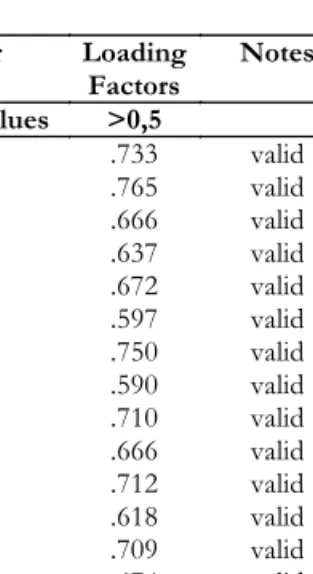
There are four invalid indicators; therefore it is not included in the subsequent processing. Here are the results of the factor analysis test after throwing such invalid indicators:
Table 3. Analysis of the Second Factors
Jurnal
Manajemen Teknologi Vol.15 | No.1 | 2016
70 JurnalManajemen Teknologi
Vol.15 | No.1 | 2016
71 The sampling technique used in this research is
purposive sampling. Criteria selection of respondents is derived from the different areas. Research variables used in this study include variable of cultural intelligence, self-efficacy as an independent variable, interpersonal trust as a mediating variable, while the intention to share knowledge as the dependent variable. The variable of knowledge sharing intention is measured by five-item questions from Knowledge Sharing Intention Scale developed by Bock et al. (2005). Knowledge sharing intention scale of Bock et al (2008), based on implicit knowledge and explicit knowledge (Nonaka and Konno, 1998).
Variable of interpersonal trust is measured by eleven items from Interpersonal Tr ust Measures questions developed by McAllister (1995). While cultural intelligence is measured using nine items questions from efficacy variable was measured with eight items of questions in New General Self Efficacy Scale
developed Chen et al. (2001). NewGeneral Self Efficacy Scale views someone's confidence in general in handling various tasks and demands (Chen et al., 2001).
Data analysis using path analysis with help from SPSS is employed to see the role of mediation of interpersonal trust. Data instrumental test is completely needed before doing data analysis, instrumental test using Cronbach Alpha's and Confirmatory Factor Analysis. Besides, parametric test also requires the assumption of normality, multicoloniearity, and heteroscedasticity data so the normality tests are done with the Kolmogorov-Smirnov, multicollinearity with the value of Tolerance and Variance Inflation Model (VIF), and heteroscedasticity with Glejser.
Results and Discussions
Validity Test ResultsThis test was done with Confirmatory Factor Analysis (CFA). The first step that must be done is to test the KMO and Bartlett's Test. Value of KMO Measure of Sampling Adequacy (MSA) should be more than 0.5, or KMO and
Bartlett's Test indicated by the significance (sig) < 0.05. Here are the values of KMO and Bartlett's Test each variable:
Table 1. KMO and Bartlett's Test
From the table above it can be concluded that the value of KMO and Bartlett's Test meets the criteria expected value so that it can be done the next step which is the analysis of factors:
Table 2. The Analysis of Factors
Reliability Test Results
Reliability test is done using Cronbach alpha (α). A construct or a variable is stated to be reliable if the value of Cronbach alpha is > 0.70. Reliability test results are as follows:
Based on the table above, cronbach's alpha value of each variable is > 0.70 therefore the entire instrument is declared a reliable research.
Normality Test Results
Normality test aims to test whether the regression model or residual confounding variables have normal distribution, as it is well known that the t test and F assuming that the value of the residuals follows a normal distribution. If this assumption is violated, the statistical test is not valid for small sample quantities. The test results of normality with the Kolmogorov-Smirnov Test are as follow: Table 5. Normality Test Results
One-Sample Kolmogorov-Smirnov Test
Unstandardi zed Residual
N 146
Normal Parametersa,b
Mean 0E-7 Std. Deviation 2.38428568 Most Extreme Differences Absolute .076 Positive .072 Negative -.076 Kolmogorov-Smirnov Z .916
Asymp. Sig. (2-tailed) .371 From table 5, it is obtain the value of Asymp sig (2-tailed) 0.371 > 005, which means distributed normal data.
Test Results of Multicollinearity
Multicollinearity test is using Tolerance value and variance inflation factor (VIF). If the value of Tolerance is > 0.1 and VIF is < 10 it can be said that Multicollinearity does not occur. Multicollinearity test results are as follows:
No Variables MSA Sig
Expected values >0.5 <0.05 1 Self Efficacy 0.829 0.000 2 Cultural Intelligence 0.725 0.000 3 Interpersonal Trust 0.875 0.000 4 Knowledge Sharing Intention 0.796 0.000
Table 4. Research Variable Reliability Test
No Variable Cro n b ac h 's > Criteria 1 Sharing Knowledge 0.785 0.7 reliable 2 Cultural Intelligence 0.822 0.7 reliable 3 Self-Efficacy 0.868 0.7 reliable 4 Interpersonal Trust 0.915 0.7 reliable
Table 6. Test Result of Multicollinearity
Number Indicators Loading Factors Notes Expected Values >0,5 1 SE1 .588 valid 2 SE2 .659 valid 3 SE3 .465 invalid 4 SE4 .610 valid 5 SE5 .738 valid 6 SE6 .567 valid 7 SE7 .738 valid 8 SE8 .751 valid 9 CI1 .650 valid 10 CI2 .768 valid 11 CI3 .668 valid 12 CI4 .698 valid 13 CI5 .622 valid 14 CI6 .696 valid 15 CI7 .681 valid 16 CI8 .760 valid 17 CI9 .785 valid 18 IT1 .563 valid 19 IT2 .775 valid 20 IT3 .525 valid 21 IT4 .541 valid 22 IT5 .464 invalid 23 IT6 .521 valid 24 IT7 .631 valid 25 IT8 .765 valid 26 IT9 .790 valid 27 IT10 .573 valid 28 IT11 .368 invalid 29 KSI1 .426 invalid 30 KSI2 .607 valid 31 KSI3 .689 valid 32 KSI4 .559 valid 33 KSI5 .765 valid
Coefficientsa Models Collinearity Statistics Tolerance VIF (Constant) Cultural Intelligence .830 1.205 Self-efficacy .726 1.378 Interpersonal Trust .764 1.310
a. Dependent Variable: knowledge sharing intention Number Indicator Loading
Factors Notes Expected Values >0,5 1 SE1 .733 valid 2 SE2 .765 valid 3 SE4 .666 valid 4 SE5 .637 valid 5 SE6 .672 valid 6 SE7 .597 valid 7 SE8 .750 valid 8 CI1 .590 valid 9 CI2 .710 valid 10 CI3 .666 valid 11 CI4 .712 valid 12 CI5 .618 valid 13 CI6 .709 valid 14 CI7 .674 valid 15 CI8 .798 valid 16 CI9 .741 valid 17 IT1 .598 valid 18 IT2 .801 valid 19 IT3 .545 valid 20 IT4 .551 valid 21 IT6 .532 valid 22 IT7 .618 valid 23 IT8 .779 valid 24 IT9 .814 valid 25 IT10 .543 valid 26 KSI2 .586 valid 27 KSI3 .726 valid 28 KSI4 .652 valid 29 KSI5 .766 valid
There are four invalid indicators; therefore it is not included in the subsequent processing. Here are the results of the factor analysis test after throwing such invalid indicators:
Table 3. Analysis of the Second Factors
The sampling technique used in this research is purposive sampling. Criteria selection of respondents is derived from the different areas. Research variables used in this study include variable of cultural intelligence, self-efficacy as an independent variable, interpersonal trust as a mediating variable, while the intention to share knowledge as the dependent variable. The variable of knowledge sharing intention is measured by five-item questions from Knowledge Sharing Intention Scale developed
by Bock et al. (2005). Knowledge sharing
intention scale of Bock et al (2008), based on
implicit knowledge and explicit knowledge (Nonaka and Konno, 1998).
Variable of interpersonal trust is measured by eleven items from Interpersonal Trust Measures questions developed by McAllister (1995). While cultural intelligence is measured using nine items questions from efficacy variable was measured with eight items of
questions in New General Self Efficacy Scale
developed Chen et al. (2001).New General Self
Efficacy Scale views someone's confidence in general in handling various tasks and demands
(Chen ., 2001).et al
Data analysis using path analysis with help from
SPSS is employed to see the role of mediation of interpersonal trust. Data instrumental test is completely needed before doing data analysis,
instrumental test using Cronbach Alpha's and
Confirmatory Factor Analysis. Besides, parametric test also requires the assumption of normality,
multicoloniearity, and heteroscedasticity data
so the normality tests are done with the
Kolmogorov-Smirnov, multicollinearity with
the value of Tolerance and Variance Inflation
Model (VIF), and heteroscedasticity with
Glejser.
Results and Discussions
Validity Test Results
This test was done with Confirmatory Factor
Analysis (CFA). The first step that must be done is to test the KMO and Bartlett's Test. Value of KMO Measure of Sampling Adequacy (MSA) should be more than 0.5, or KMO and
Bartlett's Test indicated by the significance (sig) < 0.05. Here are the values of KMO and Bartlett's Test each variable:
Tabl 1.e KMO and Bartlett's Test
From the table above it can be concluded that the value of KMO and Bartlett's Test meets the criteria expected value so that it can be done the next step which is the analysis of factors:
Table 2. The Analysis of Factors
Reliability Test Results
Reliability test is done using Cronbach alpha (α).
A construct or a variable is stated to be reliable if the value of Cronbach alpha is > 0.70. Reliability test results are as follows:
Based on the table above, c onbach's alphar
value of each variable is > 0.70 therefore the entire instrument is declared a reliable research.
Normality Test Results
Normality test aims to test whether the regression model or residual confounding variables have normal distribution, as it is well known that the t test and F assuming that the value of the residuals follows a normal distribution. If this assumption is violated, the statistical test is not valid for small sample quantities. The test results of normality with the Kolmogorov-Smirnov Test are as follow:
Table 5. Normality Test Results
One-Sample Kolmogorov-Smirnov Test
Unstandardi zed Residual
N 146
Normal Parametersa,b MeanStd. 0E-7
Deviation 2.38428568 Most Extreme Differences Absolute .076 Positive .072 Negative -.076 Kolmogorov-Smirnov Z .916 Asymp. Sig. (2-tailed) .371
From table 5, it is obtain the value of Asymp sig (2-tailed) 0.371 > 005, which means distributed normal data.
Test Results of Multicollinearity
Multicollinearity test is using Tolerance value
and variance inflation factor (VIF). If the value of Tolerance is > 0.1 and VIF is < 10 it can be
said that Multicollinearity does not occur.
Multicollinearitytest results are as follows:
No Variables MSA Sig
Expected values >0.5 <0.05 1 Self Efficacy 0.829 0.000 2 Cultural Intelligence 0.725 0.000 3 Interpersonal Trust 0.875 0.000 4 Knowledge Sharing Intention 0.796 0.000
Table 4 Research Variable Reliability Test.
No Variable Cro nb ac h 's > Criteria 1 KnowledgeSharing 0.785 0.7 reliable 2 CulturalIntelligence 0.822 0.7 reliable 3 Self-Efficacy 0.868 0.7 reliable 4 InterpersonalTrust 0.915 0.7 reliable
Table 6. Test Result of Multicollinearity
Number Indicators Loading
Factors Notes Expected Values >0,5 1 SE1 .588 valid 2 SE2 .659 valid 3 SE3 .465 invalid 4 SE4 .610 valid 5 SE5 .738 valid 6 SE6 .567 valid 7 SE7 .738 valid 8 SE8 .751 valid 9 CI1 .650 valid 10 CI2 .768 valid 11 CI3 .668 valid 12 CI4 .698 valid 13 CI5 .622 valid 14 CI6 .696 valid 15 CI7 .681 valid 16 CI8 .760 valid 17 CI9 .785 valid 18 IT1 .563 valid 19 IT2 .775 valid 20 IT3 .525 valid 21 IT4 .541 valid 22 IT5 .464 invalid 23 IT6 .521 valid 24 IT7 .631 valid 25 IT8 .765 valid 26 IT9 .790 valid 27 IT10 .573 valid 28 IT11 .368 invalid 29 KSI1 .426 invalid 30 KSI2 .607 valid 31 KSI3 .689 valid 32 KSI4 .559 valid 33 KSI5 .765 valid
Thus can be calculate as below:d
behavioral intelligences, it will increase trust between them both affective based and cognitive trust. This study supports the research conducted by Rocksthul and Ng
(2008), Gregory et al. (2009), Li et al. (2012), and
Salmon et al. (2013).
Based on the path analysis and calculation, Sobel test, it can be seen that the t statistic indirect effect (3,214) > t table (1.960). This indicates that interpersonal trust proved. It means that the cultural intelligence of Graduate student make them trust each other because both affective and cognitive aspects. The trust in turn encourages Graduate students intentions to share lecture notes, course knowledge, completing the task, or sharing the experience and expertise they acquire during lectures. T his study
complements the research conducted Chouet
al(2012), which states the role of trust between
individuals as a mediating variable only based on a brief interview. Furthermore, this study provide quantitative evidence to support Chou
et al(2012).
The results also show that self-efficacy gives positive effect on the intention to share knowledge as indicated by the t value (4,052)> (1.97). That means self-efficacy of students in facing demands during school can increase their willingness to share knowledge both implicitly and explicitly. The results of this study are consistent with research conducted
by Chou (2012), Li (2012), and Hosseini et al.
(2014) which show that self-efficacy has positive influence on the intention to share knowledge.
Students' self-efficacy is reflected in the confidence of their competence and knowledge, which generally can be shown in a variety of situations and cultural lectures. Self-efficacy in various situations in school for instance: demands to share the task, challenges on a variety of social and cultural conditions, or the demands of success in achieving a variety of objectives, encourages the intention of students to interact and share knowledge with friends in college.
Jurnal
Manajemen Teknologi Vol.15 | No.1 | 2016
72 JurnalManajemen Teknologi
Vol.15 | No.1 | 2016
73
From Table 6, it is known that all variables have tolerance values > 0.1 and FIV value <10. So it
can be said that the multicollinearity does not
occur.
Test Results of Heteroscedasticity
Heteroscedasticity test can be seen on the table of Glejser test. Test results of glejser are as follow:
Tab 7. Test Results ofle Glejser
Coefficients Models t sig (Constant) -0.402 0.688 Cultural Intelligence 0.046 0.964 Self-efficacy 1.607 0.11 Interpersonal Trust 0.468 0.641
From the output on SPSS shows that all of
variables ha score of 0, 05, therefore,ve ≥
r e g r e s s i o n m o d e d o e s n o t c a r r y Heteroscedasticity.
Table 8 Test Results of Regression 1.
Coefficientsa
Model ErrorStd. Beta t sig
(Constant) 2.027 1.628 .106
Cultural
Intelligence .053 .091 1.291 .199
Interpersonal
Trust .038 .569 8.094 .000
a.Dependent Variable: knowledge sharing intention
Table 9. Test Results of Regression 2
Table 10 Test Result of Regression 3.
Path Analysis
Path analysis is an extension of multiple regression analysis, which is used to measure the causal relationships between variables that have been previously defined. Path analysis can be used to determine the influence of indirect (mediation). The influence of cultural intelligence to knowledge sharing intention can be determined by multiplying the path coefficient of cultural intelligence on trust between individuals and interpersonal trust at knowledge sharing intention which is 0317 x 0569 = 0180
Sobel Test
To see the influence of mediation of path analysis is shown by multiplying coefficient by 0.180 whether significant or not in the formulae of sobel test. In sobel test, the first step needed to be done is looking for mediation standard error score. In addition, sobel test
calculation is as below (Preacher and Hayes,
2004) :
Table 11. Hypotheses Trial
Based on the table, it can be seen that interpersonal trust creates positive effect on the knowledge sharing intention with t score (8,094) > t table (1.97). This shows that interpersonal trust influencing the emergence of knowledge sharing intention of Unnes graduate students. Interpersonal trust in a lecture environment can increase their willingness to share knowledge both implicitly and explicitly. The results of this study are consistent with researches conducted by
Hauge (2012), Wang et al. (2014), and Parket al.
(2015).
Results show that cultural intelligence upon knowledge sharing intentions having t calculation for (1.291) < (1.97). This says that cultural intelligence is not proven to have a positive effect on the students' knowledge sharing intentions. This simply means that even though students possess high cultural intelligence, its ability to generate knowledge sharing intentions is quite low or insignificant. This is because there is other factor which influences the knowledge sharing intentions of students in Graduate Program.
This results supported by Chou (2012), which indicates that there are other factors more influential than cultural intelligence. Based on interviews at some respondents, it is known that a high possibility that other factors contribute to the high desire to share knowledge is when someone has a high tolerance to local culture. The influence of cultural intelligence on interpersonal trust shows that the values t (4.091) > t table (1.97). This shows that the intelligence culture has a positive influence on interpersonal trust. When students have cultural intelligence both metacognitive, cognitive, motivational or
Coefficientsa
Model Error BetaStd. t sig
(Constant) 3.819 7.346 .000
Cultural
Intellegence .110 .317 4.010 .000
a. Dependent Variable: Interpersonal trust
Coefficientsa
Model Beta ErrorStd. t sig
(Constant) 12.304 1.632 7.537 0.000
Self-Efficacy 0.213 0.053 4.052 0.000
a.Dependent Variable: knowledge sharing intention
Under the influence of the standard error of mediation, it is known that the value of the t statistic indirect effect (mediation) = 0,180 / 0,056 = 3,214.
Hypothesis coefficients calculationt- tablet- Results
Hypothesis 1 0.569 8.094 1.97 Supported
Hypothesis 2a 0.091 1.291 1.97 Unsupported
Hypothesis 2b 0.317 4.010 1.97 Supported
Hypothesis 2c 0.180 3.214 1.97 Supported
Thus can be calculate as below:d
behavioral intelligences, it will increase trust between them both affective based and cognitive trust. This study supports the research conducted by Rocksthul and Ng
(2008), Gregory et al. (2009), Li et al. (2012), and
Salmon et al. (2013).
Based on the path analysis and calculation, Sobel test, it can be seen that the t statistic indirect effect (3,214) > t table (1.960). This indicates that interpersonal trust proved. It means that the cultural intelligence of Graduate student make them trust each other because both affective and cognitive aspects. The trust in turn encourages Graduate students intentions to share lecture notes, course knowledge, completing the task, or sharing the experience and expertise they acquire during lectures. T his study complements the research conducted Chou (2012), which states the role of trust between individuals as a mediating variable only based on a brief interview. Furthermore, this study provide quantitative evidence to support Chou (2012).
The results also show that self-efficacy gives positive effect on the intention to share knowledge as indicated by the t value (4,052)> (1.97). That means self-efficacy of students in facing demands during school can increase their willingness to share knowledge both implicitly and explicitly. The results of this study are consistent with research conducted
by Chou (2012), Li (2012), and Hosseini et al.
(2014) which show that self-efficacy has positive influence on the intention to share knowledge.
Students' self-efficacy is reflected in the confidence of their competence and knowledge, which generally can be shown in a variety of situations and cultural lectures. Self-efficacy in various situations in school for instance: demands to share the task, challenges on a variety of social and cultural conditions, or the demands of success in achieving a variety of objectives, encourages the intention of students to interact and share knowledge with friends in college.
From Table 6, it is known that all variables have tolerance values > 0.1 and FIV value <10. So it
can be said that the multicollinearity does not
occur.
Test Results of Heteroscedasticity
Heteroscedasticity test can be seen on the table of Glejser test. Test results of glejser are as follow:
Tab 7. Test Results ofle Glejser
Coefficients Models t sig (Constant) -0.402 0.688 Cultural Intelligence 0.046 0.964 Self-efficacy 1.607 0.11 Interpersonal Trust 0.468 0.641
From the output on SPSS shows that all of
variables ha score of 0, 05, therefore,ve ≥
r e g r e s s i o n m o d e d o e s n o t c a r r y Heteroscedasticity.
Table 8 Test Results of Regression 1.
Coefficientsa
Model ErrorStd. Beta t sig
(Constant) 2.027 1.628 .106
Cultural
Intelligence .053 .091 1.291 .199
Interpersonal
Trust .038 .569 8.094 .000
a.Dependent Variable: knowledge sharing intention
Table 9. Test Results of Regression 2
Table 10 Test Result of Regression 3.
Path Analysis
Path analysis is an extension of multiple regression analysis, which is used to measure the causal relationships between variables that have been previously defined. Path analysis can be used to determine the influence of indirect (mediation). The influence of cultural intelligence to knowledge sharing intention can be determined by multiplying the path coefficient of cultural intelligence on trust between individuals and interpersonal trust at knowledge sharing intention which is 0317 x 0569 = 0180
Sobel Test
To see the influence of mediation of path analysis is shown by multiplying coefficient by 0.180 whether significant or not in the formulae of sobel test. In sobel test, the first step needed to be done is looking for mediation standard error score. In addition, sobel test
calculation is as below (Preacher and Hayes,
2004) :
Table 11. Hypotheses Trial
Based on the table, it can be seen that interpersonal trust creates positive effect on the knowledge sharing intention with t score (8,094) > t table (1.97). This shows that interpersonal trust influencing the emergence of knowledge sharing intention of Unnes graduate students. Interpersonal trust in a lecture environment can increase their willingness to share knowledge both implicitly and explicitly. The results of this study are consistent with researches conducted by
Hauge (2012), Wang et al. (2014), and Parket al.
(2015).
Results show that cultural intelligence upon knowledge sharing intentions having t calculation for (1.291) < (1.97). This says that cultural intelligence is not proven to have a positive effect on the students' knowledge sharing intentions. This simply means that even though students possess high cultural intelligence, its ability to generate knowledge sharing intentions is quite low or insignificant. This is because there is other factor which influences the knowledge sharing intentions of students in Graduate Program.
This results supported by Chou (2012), which indicates that there are other factors more influential than cultural intelligence. Based on interviews at some respondents, it is known that a high possibility that other factors contribute to the high desire to share knowledge is when someone has a high tolerance to local culture. The influence of cultural intelligence on interpersonal trust shows that the values t (4.091) > t table (1.97). This shows that the intelligence culture has a positive influence on interpersonal trust. When students have cultural intelligence both metacognitive, cognitive, motivational or
Coefficientsa
Model Error BetaStd. t sig
(Constant) 3.819 7.346 .000
Cultural
Intellegence .110 .317 4.010 .000
a. Dependent Variable: Interpersonal trust
Coefficientsa
Model Beta ErrorStd. t sig
(Constant) 12.304 1.632 7.537 0.000
Self-Efficacy 0.213 0.053 4.052 0.000
a.Dependent Variable: knowledge sharing intention
Under the influence of the standard error of mediation, it is known that the value of the t statistic indirect effect (mediation) = 0,180 / 0,056 = 3,214.
Hypothesis coefficients calculationt- tablet- Results
Hypothesis 1 0.569 8.094 1.97 Supported
Hypothesis 2a 0.091 1.291 1.97 Unsupported
Hypothesis 2b 0.317 4.010 1.97 Supported
Hypothesis 2c 0.180 3.214 1.97 Supported
Gregory, R., Prifling, M., & Beck, R. (2009). Managing cross-cultural dynamics in it offshore outsourcing relationships: the role of cultural intelligence. Second Information Systems Workshop on Global Sourcing: Services. Knowledge and Innovation, 1-25.
Hauge, B. (2012). Characteristics of expatriates' knowledge sharing practices in a humanitarian organization. [Thesis]. BI Norwegian Business School.
H o s s e i n i , S . A . , B a t h a e i , S . M . , & Mohammadzadeh, S. (2014). Does self-efficacy effect on knowledge sharing intention in e-learning system? a motivational factor analysis in open University Malaysia (oum). Kuwait Chapter of Arabian Journal of Business and Management Review, 3(11), 35-46.
Hsu, Y.S. (2012). Knowledge transfer between expatriates and host country nationals: a social capital perspective. [Thesis]. University of Wisconsin-Milwaukee.
Khanifah, S., & Palupiningdyah. (2015). Pengaruh kecerdasan emosional dan budaya organisasi pada kinerja dengan komitmen org anisasi. Management Analysis Journal ,4(3), 200-211.
Kramer, R. M. (2010). Trust barriers in cross-cultural negoitations: a social psychological analysis. Saunders, Mark N. K. et al. (Ed). Organizational Tr ust: A Cultural Perspective. Hal: 182-204 New York: Cambridge University.
Li, W. (2010).Virtual knowledge sharing in a cross-cultural context. Jour nal of Knowledge Management ,14 (1): 38-50 Li, Ye., Li, H., Mädche, A., & Rau, P.L.P. (2012).
Are You a Trustworthy Partner in a Cross-cultural Virtual Environment? – Behavioral Cultural Intelligence and Receptivity-based Trust in Virtual Collaboration. Session: Intercultural Communication: 87-96. Li, C.Y. (2012). Does self-efficacy contribute to
knowledge sharing and innovation effectiveness? a multi-level perspective. National Taichung University of Technology and Science, Taiwan.
McAllister, A. J. (1995). Affect and cognition- b a s e d t r u s t a s f o u n d a t i o n s f o r i n t e r p e r s o n a l c o o p e r a t i o n i n organizations. Academy of Management Journal ,38 (1), 24-59.
Messarra, L.,Karkoulin, S., & Younes, A. ( 2 0 0 8 ) . Fo u r f a c e t s o f c u l t u r a l intelligence predictors of knowledge sharing intentions. Review of Business Research, 8(5), 26-131.
Noh, J.H.(2013). Employee knowledge sharing in wor teams: effect of team diversty, emergent states, and team leadership. [Thesis]. University of Minnesota
Nonaka, I., & Konno, N. (1998). The concept of “Ba”: building a foundation for k n o w l e d g e c r e a t i o n . C a l i f o r n i a Management Review, 40 (3), 40-54.
Park, M.J., Lambazar,T.D.U., & Rh, J.J . (2015). The effect of organizational social factors on employee performance and the mediating role of knowledge sharing: focus on e-g over nment utilization in Mongolia. Information Development , 31 (1): 53-68
Powell, W. W., & Snellman, K. (2004). The Knowledge Economy. Annu. Rev. Sociol, 30, 199-220.
Preacher, K. J., & Hayes, A.F. (2004). SPSS and SAS procedures for estimating indirect effects in simple mediation models.
Behavior Research Methods, Instruments, & Computers, 36(4), 717-731.
Putranto, N.A.R., & Ghazali, A. (2013). The effect of cultural intelligence to knowledge sharing behavior in university students. School of Business and Management ITB, Bandung:1-9.
Rockstuhl, T., & K.Y Ng. (2008). The effects of cultural intelligence on interpersonal trust in multicultural teams. S. Ang and L.V Dyne (Ed) Handbook of cultural intelligence: theory, measurement, and applications. Hal: 206-220 New York:M.E Sharpe, Inc.
Salmon, E.D., Gelfand, M.J., Celik, A.B., Kraus, S., Wilkenfeld, J., & Inman, M. (2013). Cultural contingencies of mediation: effectiveness of mediator styles in intercultural disputes. Journal of Organizational Behavior, 34, 887-909. Susanto, T, & Wulansari, N.A. (2015).
Pengaruh motivator insentif pada kinerja karyawan dengan kepercayaan diri sebagai mediasi. Management Analysis Journal ,4(2),163-170.
Jurnal
Manajemen Teknologi Vol.15 | No.1 | 2016
74 JurnalManajemen Teknologi
Vol.15 | No.1 | 2016
75
Conclusions
The conclusion of this study is, self-efficacy and interpersonal trust belong to very important factors to increase the intention to share someone's knowledge in the diverse environments. Although in this study the cultural intelligence is not proven to improve the knowledge sharing intention, but cultural intelligence is still an important factor that needs to be held to foster trust between individuals in diverse environments.
Based on the results of research and interview, post graduate students should further enhance the potential of such cultural intelligence, and self-efficacy by conducting language training and communication with other cultures, as well as training courses of various expertise of institutions that can be taken. It is intended to further enhance trust and knowledge sharing intention in diverse environments. The institutions of post graduate Program in general need to provide a forum for cultural training (training culture forum), to improve t h e k n o w l e d g e a n d c r o s s - c u l t u r a l communication skills of its members.
In addition, the institution need to provide training to develop the talent and personal skills of students, thus expected to increase the confidence and the desire to share knowledge between them (Widodo, 2012). This study is still far from the word perfect as the limitation done in some issues especially in the retrieval of respondents in the academic environment. Further research needs to be taken to the respondent in the organizational environment such as employees to generalize the results of this study. This study is also being limited to the sharing of knowledge viewed from the aspect of "intention". The next research is hoped to connect aspects of "knowledge sharing intention" to "knowledge sharing behavior".
References
Ajzen, I. (1991). The theory of planned behavior. Behavior and Human Decision Processes 50: 179-211
Ajzen, I. (2002). Perceived behavioral control, self-efficacy, locus of control, and the theory of planned behavior. Journal of Applied Social Psychology, 22(4), 665-683. A n g , S . , & V a n D y n e , L . ( 2 0 0 8 ) .
Conceptualization of cultural intelligence, definition, distinctiveness, and nomological network. S. Ang and L. Van Dyne (Ed), Handbook of cultural intelligence: theory, measurement, and applications. New York: M.E Sharpe. Hal: 3-15. Bandura, A. (1997). Self efficacy: the exercise of
control. New York: W.H. Freedman and Company.
Bock, G.W., Zmud, R.W., Kim, Y.G., & Lee, J.N.(2005). Behavioral intention for mation in knowledge sharing: examining the roles of extrinsic motivators, social-psychological forces, and org anizational climate. MIS Quarterly 29 (1): 87-111.
Chou, Y. M. (2012). Virtual teamwork and human factors: a study in the cross-national environment. [Thesis]. RMIT University, Australia.
Chen, M.L., & Lin, C.P. (2013). Assessing the effects of cultural intelligence on team knowledge sharing from a socio-cognitive perspective. Human Resources Management ,52(5), 675-695.
Chen, G., Gully, S.N., & Eden, D. (2001). Validation of a new general self-Efficacy scale. Organizational Research Methods, 4 (1), 62-83. Sage Publications, Inc.
Chua, R.Y.J., Morris, M.W., & Mor, S. (2012). Collaborating across cultures: cultural metacognition and affect-based trust in creative collaboration. Organizational Behavior and Human Decision Processes, 116-131
Earley, P.C., & Ang, S. (2003). Cultural intelligence: individual across culture.
California: Stanford University Press. Fitriasmi, & Mulya, S. (2010). Evaluasi
k e s u k s e s a n a p l i k a s i k n o w l e d g e management dalam organisasi. Jurnal Dinamika Manajemen, 1(1), 18-26.
Goh, S. K., & Sandhu, M.S. (2013). Knowledge sharing among Malaysian academics: influence of affective commitment and trust. Electronic Journal of Knowledge Management, 11(1),38-48.
Gregory, R., Prifling, M., & Beck, R. (2009). Managing cross-cultural dynamics in it offshore outsourcing relationships: the role of cultural intelligence. Second Information Systems Workshop on Global Sourcing: Services. Knowledge and Innovation, 1-25.
Hauge, B. (2012). Characteristics of expatriates' knowledge sharing practices in a humanitarian organization. [Thesis]. BI Norwegian Business School.
H o s s e i n i , S . A . , B a t h a e i , S . M . , & Mohammadzadeh, S. (2014). Does self-efficacy effect on knowledge sharing intention in e-learning system? a motivational factor analysis in open University Malaysia (oum). Kuwait Chapter of Arabian Journal of Business and Management Review, 3(11), 35-46.
Hsu, Y.S. (2012). Knowledge transfer between expatriates and host country nationals: a social capital perspective. [Thesis]. University of Wisconsin-Milwaukee.
Khanifah, S., & Palupiningdyah. (2015). Pengaruh kecerdasan emosional dan budaya organisasi pada kinerja dengan komitmen org anisasi. Management Analysis Journal ,4(3), 200-211.
Kramer, R. M. (2010). Trust barriers in cross-cultural negoitations: a social psychological analysis. Saunders, Mark N. K. et al. (Ed). Organizational Tr ust: A Cultural Perspective. Hal: 182-204 New York: Cambridge University.
Li, W. (2010).Virtual knowledge sharing in a cross-cultural context. Jour nal of Knowledge Management ,14 (1): 38-50 Li, Ye., Li, H., Mädche, A., & Rau, P.L.P. (2012).
Are You a Trustworthy Partner in a Cross-cultural Virtual Environment? – Behavioral Cultural Intelligence and Receptivity-based Trust in Virtual Collaboration. Session: Intercultural Communication: 87-96. Li, C.Y. (2012). Does self-efficacy contribute to
knowledge sharing and innovation effectiveness? a multi-level perspective. National Taichung University of Technology and Science, Taiwan.
McAllister, A. J. (1995). Affect and cognition- b a s e d t r u s t a s f o u n d a t i o n s f o r i n t e r p e r s o n a l c o o p e r a t i o n i n organizations. Academy of Management
Messarra, L.,Karkoulin, S., & Younes, A. ( 2 0 0 8 ) . Fo u r f a c e t s o f c u l t u r a l intelligence predictors of knowledge sharing intentions. Review of Business Research, 8(5), 26-131.
Noh, J.H.(2013). Employee knowledge sharing in wor teams: effect of team diversty, emergent states, and team leadership. [Thesis]. University of Minnesota
Nonaka, I., & Konno, N. (1998). The concept of “Ba”: building a foundation for k n o w l e d g e c r e a t i o n . C a l i f o r n i a Management Review, 40 (3), 40-54.
Park, M.J., Lambazar,T.D.U., & Rh, J.J . (2015). The effect of organizational social factors on employee performance and the mediating role of knowledge sharing: focus on e-g over nment utilization in Mongolia. Information Development , 31 (1): 53-68
Powell, W. W., & Snellman, K. (2004). The Knowledge Economy. Annu. Rev. Sociol, 30, 199-220.
Preacher, K. J., & Hayes, A.F. (2004). SPSS and SAS procedures for estimating indirect effects in simple mediation models.
Behavior Research Methods, Instruments, & Computers, 36(4), 717-731.
Putranto, N.A.R., & Ghazali, A. (2013). The effect of cultural intelligence to knowledge sharing behavior in university students. School of Business and Management ITB, Bandung:1-9.
Rockstuhl, T., & K.Y Ng. (2008). The effects of cultural intelligence on interpersonal trust in multicultural teams. S. Ang and L.V Dyne (Ed) Handbook of cultural intelligence: theory, measurement, and applications. Hal: 206-220 New York:M.E Sharpe, Inc.
Salmon, E.D., Gelfand, M.J., Celik, A.B., Kraus, S., Wilkenfeld, J., & Inman, M. (2013). Cultural contingencies of mediation: effectiveness of mediator styles in intercultural disputes. Journal of Organizational Behavior, 34, 887-909. Susanto, T, & Wulansari, N.A. (2015).
Pengaruh motivator insentif pada kinerja karyawan dengan kepercayaan diri sebagai mediasi. Management Analysis Journal ,4(2),163-170.
Conclusions
The conclusion of this study is, self-efficacy and interpersonal trust belong to very important factors to increase the intention to share someone's knowledge in the diverse environments. Although in this study the cultural intelligence is not proven to improve the knowledge sharing intention, but cultural intelligence is still an important factor that needs to be held to foster trust between individuals in diverse environments.
Based on the results of research and interview, post graduate students should further enhance the potential of such cultural intelligence, and self-efficacy by conducting language training and communication with other cultures, as well as training courses of various expertise of institutions that can be taken. It is intended to further enhance trust and knowledge sharing intention in diverse environments. The institutions of post graduate Program in general need to provide a forum for cultural training (training culture forum), to improve t h e k n o w l e d g e a n d c r o s s - c u l t u r a l communication skills of its members.
In addition, the institution need to provide training to develop the talent and personal skills of students, thus expected to increase the confidence and the desire to share knowledge between them (Widodo, 2012). This study is still far from the word perfect as the limitation done in some issues especially in the retrieval of respondents in the academic environment. Further research needs to be taken to the respondent in the organizational environment such as employees to generalize the results of this study. This study is also being limited to the sharing of knowledge viewed from the aspect of "intention". The next research is hoped to connect aspects of "knowledge sharing intention" to "knowledge sharing behavior".
References
Ajzen, I. (1991). The theory of planned behavior. Behavior and Human Decision Processes 50: 179-211
Ajzen, I. (2002). Perceived behavioral control, self-efficacy, locus of control, and the theory of planned behavior. Journal of Applied Social Psychology, 22(4), 665-683. A n g , S . , & V a n D y n e , L . ( 2 0 0 8 ) .
Conceptualization of cultural intelligence, definition, distinctiveness, and nomological network. S. Ang and L. Van Dyne (Ed), Handbook of cultural intelligence: theory, measurement, and applications. New York: M.E Sharpe. Hal: 3-15. Bandura, A. (1997). Self efficacy: the exercise of
control. New York: W.H. Freedman and Company.
Bock, G.W., Zmud, R.W., Kim, Y.G., & Lee, J.N.(2005). Behavioral intention for mation in knowledge sharing: examining the roles of extrinsic motivators, social-psychological forces, and org anizational climate. MIS Quarterly 29 (1): 87-111.
Chou, Y. M. (2012). Virtual teamwork and human factors: a study in the cross-national environment. [Thesis]. RMIT University, Australia.
Chen, M.L., & Lin, C.P. (2013). Assessing the effects of cultural intelligence on team knowledge sharing from a socio-cognitive perspective. Human Resources Management ,52(5), 675-695.
Chen, G., Gully, S.N., & Eden, D. (2001). Validation of a new general self-Efficacy scale. Organizational Research Methods, 4 (1), 62-83. Sage Publications, Inc.
Chua, R.Y.J., Morris, M.W., & Mor, S. (2012). Collaborating across cultures: cultural metacognition and affect-based trust in creative collaboration. Organizational Behavior and Human Decision Processes, 116-131
Earley, P.C., & Ang, S. (2003). Cultural intelligence: individual across culture.
California: Stanford University Press. Fitriasmi, & Mulya, S. (2010). Evaluasi
k e s u k s e s a n a p l i k a s i k n o w l e d g e management dalam organisasi. Jurnal Dinamika Manajemen, 1(1), 18-26.
Goh, S. K., & Sandhu, M.S. (2013). Knowledge sharing among Malaysian academics: influence of affective commitment and trust. Electronic Journal of Knowledge Management, 11(1),38-48.
Jurnal
Manajemen Teknologi Vol.15 | No.1 | 2016
76
Vajjhala, N. R., & Vucetic, J. (2013). Key bar riers to knowledge sharing in medium-sized enterprises in transition economies. International Journal of Business and Social Science, 4(13), 90-98
Wang, S., & Noe, R.A (2010). Knowledge sharing: a review and directions for f u t u r e r e s e a r c h .H u m a n R e s o u r c e Management Review, 20, 115–131.
Wang, H.K., Tseng, J.F., & Yen, Y. F.(2014). How do institutional norms and trust influence knowledge sharing? An i n s t i t u t i o n a l t h e o r y. I n n o v a t i o n : Management, Policy & Practice ,16, 374-391. Widodo, J. (2012). Studi deskriptif kepuasan
mahasiswa terhadap kinerja lembaga program studi dan pasca sarjana Unnes.
Jurnal Dinamika Manajemen, 3(2), 141-147.
Young, M. L. (2014). The formation of concern for face and its impact on k n ow l e d g e s h a r i n g i n t e n t i o n i n knowledg e manag ement systems.
Knowledge Management Research & Practice,
12,36-47.
Zawawi, A. A., Zakaria, Z., Kamarunzaman, N.Z., Noordin, N., Sawal, M.Z.H.M., Junos, N.M., & Najid, N.S.A. (2011). The Study of Bar rier Factors in Knowledge Sharing: A Case Study in Public University. Management Science and Engineering, 5(1),59-70.