Chapter 7
Flow Problems
7.1 Introduction and definitions
Problems related to transport have been investigated since the early fifties. The problem is to route some goods, called commodities, from production sites to consumption sites, through a network consisting of communication links inter-connecting the sites (pipe-lines, routes, telecommunication networks). Moreover, each link has a maximum admissible throughput, called thecapacityof the link.
In general, most of the sites of the network do not produce nor consume anything, they are only used to interconnect links. To each production or consumption site is associated some real number that corresponds to the maximum production or consumption.
The main objective is to maximize the throughput of the traffic.
We first consider networks with directed links, i.e., that can be used in one direction. For-mally, aflow networkis defined as follows.
Definition 7.1(Flow network). Aflow networkis a four-tuple(G,prmax,comax,c)such that:
• Gis a digraph (or a mulitdigraph), the vertices of which represent the sites and the arcs represent the links;
• prmax is a function fromV(G)to IR+∪+∞; prmax(v)corresponds to the maximum pro-duction possible inv. Ifvis not a production site, then prmax(v) =0.
• comax is a function fromV(G)to IR+∪+∞;comax(v)corresponds to the maximum con-sumption possible inv. Ifvis not a consumption site, thencomax(v) =0.
• cis a function fromE(G)to IR+∪+∞;c(e)corresponds to the capacity of the linke.
Definition 7.2(Flow). Theflowis a tripleF = (pr,co,f)where
- pris a function of production such that, for any vertexv, 0≤ pr(v)≤prmax(v); 91
- cois a function of consumption such that, for any vertexv, 0≤co(v)≤comax(v); - f is a function overE, calledflow functionthat satisfies the following constraints:
Positivity: ∀e∈E(G), f(e)≥0 Capacity constraint: ∀e∈E(G), f(e)≤c(e) Flow conservation: ∀v∈V(G),
∑
(u,v)∈E(G) f((u,v)) +pr(v) =∑
(v,u)∈E(G) f((v,u)) +co(v)By summing, the|V(G)|equations of flow conservation, we get:
∑
v∈V(G)
pr(v) =
∑
v∈V(G)
co(v)
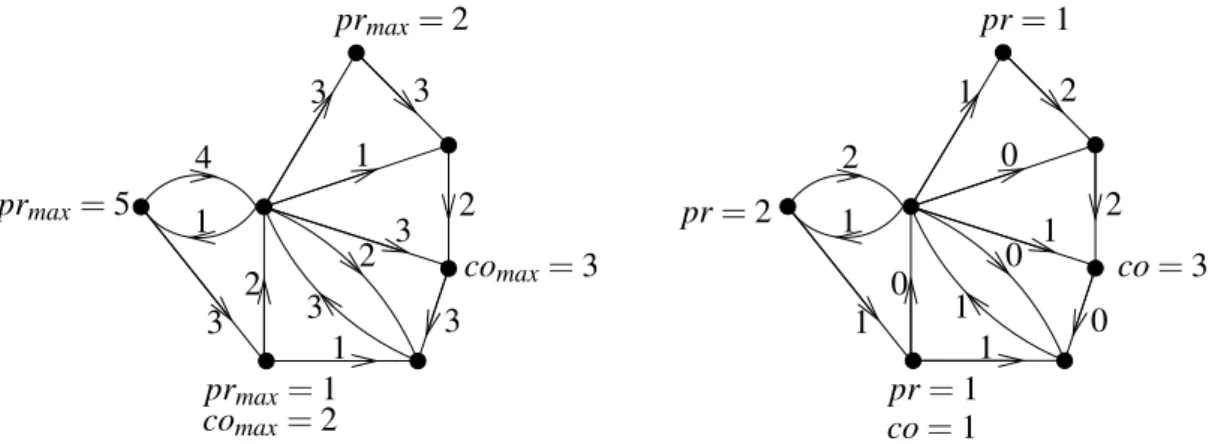
In other words, the sum of all produced commodities equals the sum of all consumed commodi-ties. This value corresponds to the amount of routed traffic, it is the flow value, denoted by v(F). 2 1 1 2 1 1 2 0 1 0 1 0 0 4 3 3 2 3 3 3 1 1 3 2 1 2 co=3 prmax=5 prmax=2 comax=3 comaxprmax==21 pr=2 pr=1 co=1 pr=1
Figure 7.1: Example of flow network (left) and a flow of value 4 in it (right)
Hence, the problem is the following: Problem 7.3(Maximum Flow).
Instance: a flow networkN. Find: a flow with maximum value.
A flow with maximum value is said to be amaximum flow.
7.2 Reducing to an elementary network
Before studying this problem, we show that it is equivalent to consider an elementary prob-lem where there is a unique production site with infinite maximum production and a unique consumption site with infinite maximum consumption.
7.2. REDUCING TO AN ELEMENTARY NETWORK 93 Definition 7.4(Elementary network). A flow network(G,∞s,∞p,c)iselementary:
- sand pare two distinct vertices wheresis asource(i. e. d−(s) =0) and pis asink(i.e. d+(p) =0);
- ∞s(s) = +∞and∞s(v) =0 for allv�=s;
- ∞p(p) = +∞and∞p(v) =0 for allv�= p. We denote(G,∞s,∞p,c)by(G,s,p,c).
Definition 7.5(Associated elementary network). IfN= (G,prmax,comax,c)is a flow network, itsassociatedelementary network is the following elementary networkN= (G,¯ s,p,c¯)obtained
fromNin the following way: - add a sourcesand a sinkp;
- linksto all verticesvwith non-null production with an arc(s,v)of capacity prmax(v); - link all verticesvwith non-null consumption to pwith a link(v,p)of capacitycomax(v);
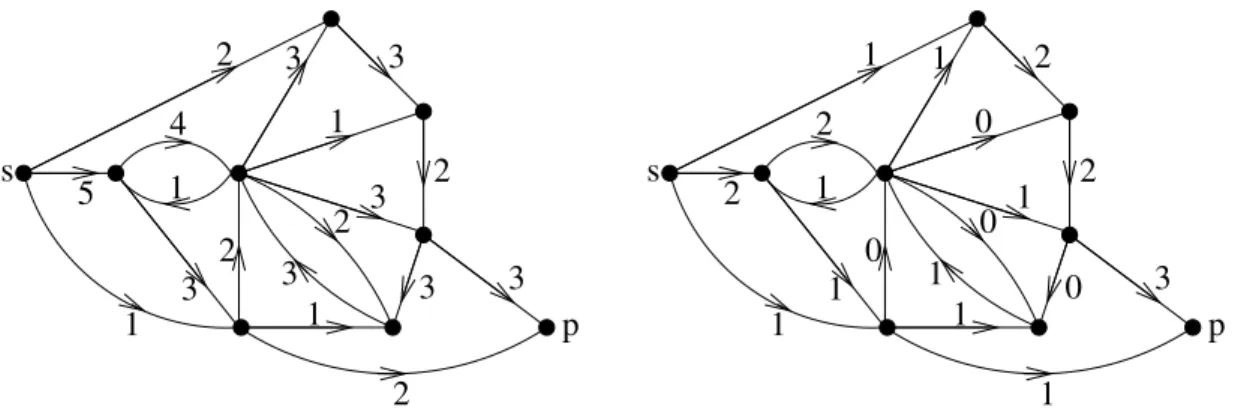
0 4 3 3 2 3 3 3 1 1 3 2 1 2 p s 1 5 2 3 2 2 p s 1 3 2 1 1 1 2 0 1 1 0 1 2 1 0 1
Figure 7.2: Elementary network associated to the flow network depicted in Figure 7.1 (right) and the flow in this network corresponding to the one of Figure 7.1 (left)
It is easy to see that there is a one-to-one correspondence between any flowF = (pr,co,f)
of the elementary network and a flowF�= (pr�,co�,f�)of the initial problem defined as follows: for any production siteu, pr�(u) = f((s,u)); for any consumption sitev,co�(v) = f((v,p))and for any arc(x,y), f�((x,y)) = f((x,y)).
Clearly, both flows have same valuev(F) =v(F�) = pr(s) =co(p). Hence:
Finding a maximum flow in a flow network is equivalent to finding a maximum flow solve in its associated elementary network.
Note that, in an (elementary) flow networkN= (G,s,p,c), the flow conservation constraint can be written: ∀v∈V(G)\ {s,p},
∑
(u,v)∈E(G) f((u,v)) =∑
(v,u)∈E(G) f((v,u))Moreover, a flowF= (pr,co,f)of an (elementary) flow network is well defined by the flow
function f since, by the flow conservation constraint insandp, we have v(F) = pr(s) =
∑
u∈V(G),(s,u)∈E(G) f((s,u)) = co(p) =∑
u∈V(G),(u,p)∈E(G) f((u,p))Therefore, for ease of presentation, we often identify a flowF with its function f, and we note the flow value byv(f).
To simplify the notations in the sequel, for a flow f or a capacityc, and an arc (u,v), we
write f(u,v)instead of f((u,v)), andc(u,v)instead ofc((u,v)).
7.3 Cut and upper bound on the maximum flow value
We will show that the value of a maximum flow in a network is limited by the existence of some bottlenecks through which the traffic must go. Roughly, to go from the source to the sink, the flow must cross the border of a set of vertices, its size (the sum of the capacities of the corresponding edges) will limit the value of the flow. Such a border is called acut.
Definition 7.6 (Cut). In a flow network N = (G,s,p,c), an (s,p)-cut, or simply a cut, is a
bipartitionC= (Vs,Vp)of the vertices ofGsuch thats∈Vsand p∈Vp. The arcs formVstoVp (i.e. with tail inVsand head inVp) are thearcs of C. Their set is denoted byE(C). Thecapacity of the cutC, denoted byδ(C), is the sum of the capacities of its arcs:∑e∈E(C)c(e).
Let f be a flow andC= (Vs,Vp)be a cut,out(f,C)denotes the flow on arcs leavingVs and in(f,C)the flow enteringVs :
out(f,C) =
∑
(u,v)∈E(C),u∈Vs,v∈Vp f(u,v) in(f,C) =∑
(u,v)∈E(G),u∈Vp,v∈Vs f(u,v)Note that the flow conservation implies that
for all cutC, v(f) =out(f,C)−in(f,C)
In particular, the value of the flow is always at mostout(f,C). But clearlyout(f,C)≤δ(C),so
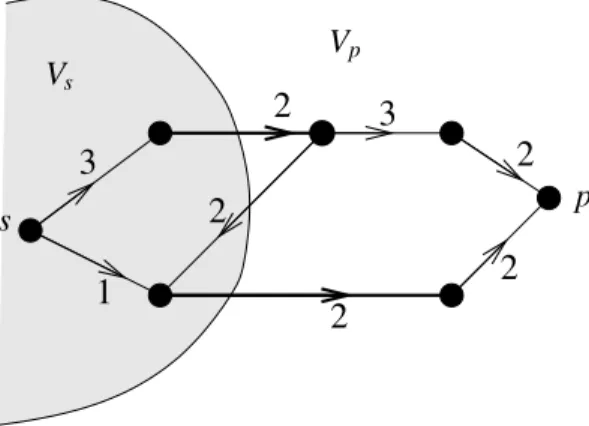
7.4. AUXILIARY NETWORK AND “PUSH” ALGORITHM 95 2 3 1 2 2 3 2 2 Vp s p Vs
Figure 7.3: A flow network and a cut with capacity 4. Bold arcs are those of the cut
A cut can be viewed as a set of arcs that the flow must cross and whose capacity limits the value of the flow.
Letvmax=max{v(f),f a flow} andδmin=min{δ(C), Ca cut}. Equation 7.1 applied to a maximum flow and a minimum-capacity cut yields
vmax ≤δmin. (7.2)
In fact, the next theorem,due to Ford and Fulkerson, states that there is equality.
Theorem 7.7(Ford & Fulkerson). The maximum value of a flow equals the minimum capacity of a cut, i.e.,
vmax =δmin.
We often say thatmax flow equals min cut. It is an example of“min-max theorem”
There are many proofs of this theorem, some being non-constructive proof of this theorem. In the next section, we present the original proof which is based on an algorithm computing a maximum flow and a cut with minimum capacity.
7.4 Auxiliary Network and “push” Algorithm
Most of the algorithms for computing maximum flows are based on the following idea: Starting from an existing flow (initially, it may be null), the flow is increased by going from the source to the sink by “pushing” the commodity where it is possible.
The difference between the algorithms mainly consists of the way used to decide where and how to push some flow.
For this purpose, we define anauxiliary network. This graph, denoted byN(f), depends on
Definition 7.8 (Auxiliary network). Given a flow network N = (G,s,p,c) and a flow f, we
build the auxiliary networkN(f) = (G(f),s,p,cf)as follows. For any pair of vertices(u,v), let
cf(u,v) =c(u,v)−f(u,v) + f(v,u)
withc(u,v), f(u,v)and f(v,u)equal to 0 when they are not defined (if(u,v)is not an arc ofG).
Note thatcf(u,v)≥0 sincec(u,v)−f(u,v)≥0. Then,G(f)is defined as follows V(G(f)) = V(G)
E(G(f)) = {(u,v)|cf(u,v)>0}
Note thatcf(u,v) +cf(v,u) =c(u,v) +c(v,u). Intuitively,cf(u,v)is the sum of the remain-ing capacity on the arc (u,v), i.e.,c(u,v)− f(u,v), plus a virtual capacity f(v,u), that allows
to ”remove” some flow on the arc(v,u), which corresponds to virtually push some flow along (u,v). See examples in Figures 7.4 and 7.5.
Note that the auxiliary network has no arc with capacity 0. This is important because it ensures that, for any directed pathPinG(f), the minimum capacity of the arcs ofPis positive.
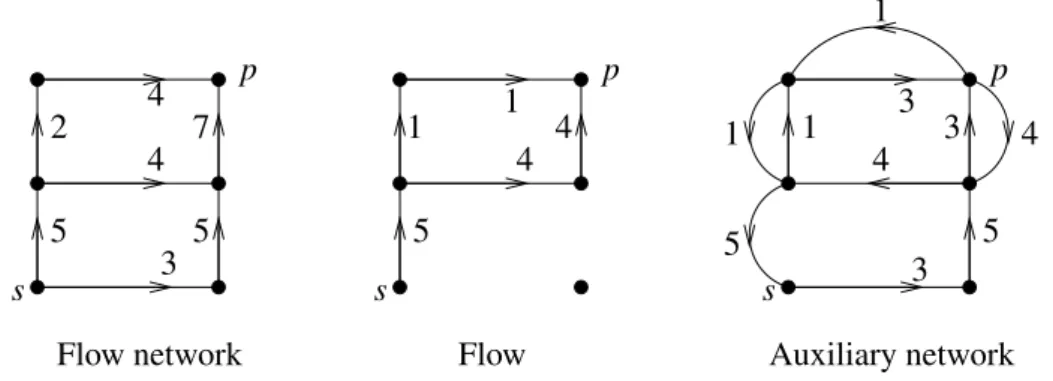
4 1 5 7 2 5 5 4 1 4 4 3 3 4 3 1 1 3 5 4 1 5 s
Flow network Flow Auxiliary network
s
p
s
p p
Figure 7.4: A flow network, a flow and the corresponding auxiliary network
LetPbe a directed(s,p)-path inN(f)where the minimum capacity of an arc inPisε>0. The flow f�obtained bypushingεunits of flowalongPis defined by:
For any arc (u,v)∈E(P), we push the flow along (u,v), that is, we increase the flow with ε
units on(u,v). Two cases may happen:
- If the remaining capacity of (u,v)is sufficient for theε units of flow, i.e., f(u,v) +ε≤
c(u,v), then f�(u,v) = f(u,v) +εand f�(v,u) = f(v,u).
- If the remaining capacity of (u,v) is not sufficient for theε units of flow, i.e., f(u,v) +
ε>c(u,v), then, by definition of the auxiliary network, we have f(v,u)≥ f(u,v) +ε−
c(u,v)>0. Hence, (v,u) has a flow excess of f(u,v) +ε−c(u,v) units that we must
7.4. AUXILIARY NETWORK AND “PUSH” ALGORITHM 97 If (u,v) and (v,u) do not belong toP, the flow remains unchanged on these arcs, f�(u,v) =
f(u,v)and f�(v,u) = f(v,u).
Lemma 7.9. If f is a flow of value v(f), then f�is a flow of value v(f) +ε.
Proof. See Exercice 7.5.
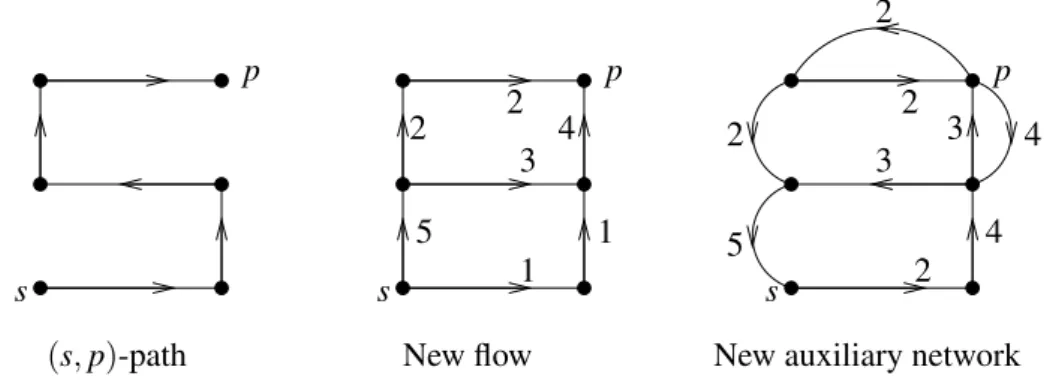
For instance, from the flow depicted in Figure 7.4, by taking the directed(s,p)-path depicted
in Figure 7.5 with minimum capacity 1 and pushing the flow, we obtain the new flow and the new auxiliary network depicted in Figure 7.5.
5 4 3 4 5 1 1 3 2 2 2 4 3 2 2 2 s
(s,p)-path New flow New auxiliary network
p
s p
s p
Figure 7.5: Push along a directed(s,p)-path of the auxiliary network in Figure 7.4.
Now, we have some elements of an algorithm: 1. Start with any flow f;
2. Compute the auxiliary networkN(f);
3. Find a directed path fromsto pinG(f);
4. If such a directed pathPexists, then push some flow alongPand update f.
Note that, if there is no directed path from the source to the sink in the auxiliary graph, the previous algorithm does nothing. We will see that, in this case, the existing flow is maximum. Proposition 7.10. If G(f)does not contain a path from the source to the sink, then the flow f
is maximum.
Proof. LetVsbe the set of all vertices that can be reached fromsinG(f). Vs does not contain
the sink since there are no(s,p)-paths. Hence, p∈Vp=V\Vs. LetCbe the cut(Vs,Vp). Let(u,v)be an arc ofC. By definition ofVs, the arc(u,v)is not inG(f). So, by definition
ofG(f), this means thatcf(u,v) =0. Hence, f is such that f(u,v) =c(u,v)and f(v,u) =0. We get thatout(f,C) =δ(C)andin(f,C) =0. Informally, there is no flow enteringVs and all arcs ofC(that is leavingVs) are saturated.
Butv(f) =out(f,C)−in(f,C), therefore
v(f) =δ(C)
The current flow has the same value as the capacity of the cutC. Hence, f is maximum by Equation (7.2).
Note that this proof also exhibit a cut(Vs,Vp)with same capacity as the maximum value of a flow. Hence it is a minimum-capacity cut. It shows that it is easy to find a minimum-capacity cut(Vs,Vp)from a maximum flow:Vsis the set of the vertices reachable from the source in the auxiliary network andVpits complement.
Now, we can prove Theorem 7.7.
Proof of Theorem 7.7: Let f be a flow with maximum value in a flow network(G,s,p,c), and
let N(f) be the auxiliary network. In G(f), there are no directed (s,p)-paths, otherwise we
obtain a flow with greater value by pushing some flow along this path (Lemma 7.9). Hence, by the proof of Proposition 7.10, the cutC= (Vs,Vp), where Vs is the set of vertices v such that there is a directed(s,v)-path inG(f), has capacityv(f) =vmax. Therefore,δmin≤δ(C)≤vmax. �
7.5 Ford-Fulkerson algorithm
We now have the following algorithm:Algorithm 7.1(Ford and Fulkerson (1956)). 1. Start with null flow f =0;
2. Compute the auxiliary networkN(f);
3. Look for a directed path fromsto pinG(f);
4. If such a directed pathPexists, then push some flow alongP, update f and go to 2; 5. Else terminate and return f.
This algorithm is correct in the sense that If the algorithms terminates, then it returns a maximum solution. But
1) does it always terminate?
7.5. FORD-FULKERSON ALGORITHM 99 The answer to question 1 is somehow yes and no: we will see that the algorithm always terminates if the capacities are rational, but it can take infinite time if capacities are real. Be-sides, even when the capacities are integers, the running time depends linearly on the value of the maximum flow that may be huge.
Analysis of Ford-Fulkerson Algorithm
Proposition 7.11. (i) If all capacities are integers, then Algorithm 7.1 terminates after at most vmax searches of a directed path.
(ii) If all the capacities are rational, then Algorithm 7.1 terminates after at most µ·vmax searches of a directed path, with µ the least common multiple of the denominators of the capac-ities.
Proof. (i) If capacities are integers, at each iteration, the algorithm pushes at least one unit of flow (since, in this case, ε is integral). Each iteration requires the search of a path froms to p inG(f). This can be done in timeO(|E(G)|)by any search algorithm (See
Chapter 2). Hence, its total running time is at most O(vmax· |E(G)|).
(ii) If capacities are rational, the algorithm terminates since the flow increases of at least 1µ at each iteration. µcan be very large, but it is fixed. Actually, we can solve the problem by multiplying all capacities by µ and by solving the integral problem obtained: it is proportional the initial one.
Remark 7.12. If some capacities are integers, then the Ford-Fulkerson algorithm returns a maximum flow with integral value.
Proposition 7.13. If the capacities are real, the algorithm may not terminate. Moreover, the increasing sequence of the flow value may converge to a value a lot smaller than the optimal value.
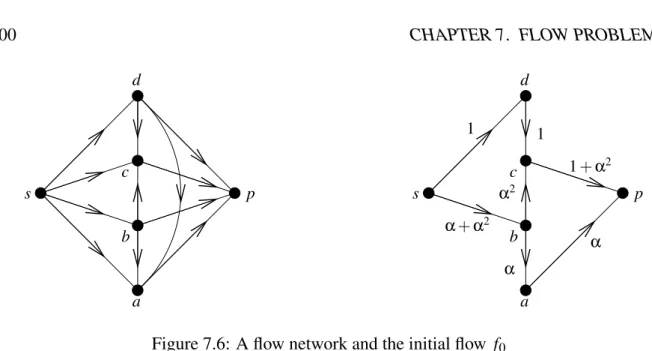
Proof. Consider the flow network shown in Figure 7.6 for which the capacities of all edges are infinite (or if the reader prefers, a huge integerM). Letαdenote the positive root ofx3+x−1=
0. Clearly 1/2<α<1. Let the initial flow f0be as shown in Figure 7.6.
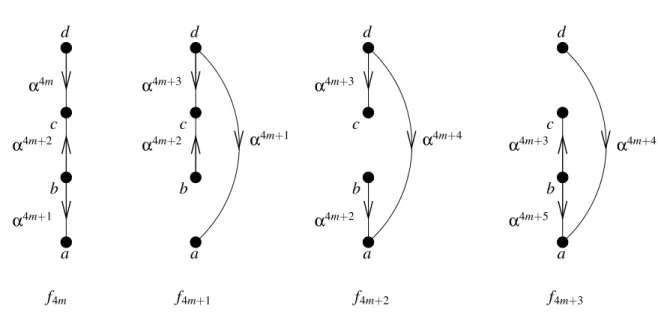
We shall prove that by employing a well (or very badly) chosen sequence of four augmenting paths over and over, Algorithm 7.1 will produce an infinite sequence of flows, the values of which are monotone increasing and which converge to a limit not exceeding 16. For anym≥0, start from the flow f4m and push along the directed path (s,c,d,a,b,p). The pushed amount is α4m+1 because of arc (a,b) in the auxiliary network. The resulting flow is f
4m+1. Push
along the directed path(s,c,b,a,d,p)an amount ofα4m+2(because of(c,b)) to produce f4m+2,
α d p c b a s d p c b a s 1 1 1+α2 α+α2 α α2
Figure 7.6: A flow network and the initial flow f0
f4m+3 and push along the directed path(s,a,d,c,b,p)an amount ofα4m+4 (because of(a,d))
to produce f4m+4. See Figure 7.7.
Fork≥1, the augmentation of the value from fk−1to fkisαkand hence
v(fk) = v(f0) +α+α2+···+αr = (1+α+α2) +α+α2+···+αr = 1 α(α+α2+α3+α2+α3+···+αr+1) = α1(α+α2+ (1−α) +α2+α3+···+αr+1) = α1(1+2α2+α3+···+αr+1) < 1 α(1+α+α2+α3+···+αr+1) < 1 α−α2 = 1 α4 <16.
From this construction, it is easy to construct an example of a network where some ca-pacities are irrational such that even starting with a null flow, the sequence of flows obtained by pushing along some directed paths converges to a value less than 16, while the value of a maximum flow is infinite (or arbitrarily large). See Exercise 7.9.
Remark 7.14. While the termination is not ensured in case of irrational capacities, Theorem 7.7 (vmax =δmin) remains valid. We prove the real case by taking the limit of the rational case. In practice, the rational case is the only important problem, since computers works with a finite precision.
7.6. PUSHING ALONG SHORTEST PATHS 101 f4m d c b a α4m α4m+2 α4m+1 d c b a α4m+2 α4m+3 α4m+4 d c b a α4m+2 α4m+3 α4m+1 d c b a α4m+3 α4m+5 α4m+4 f4m+1 f4m+2 f4m+3
Figure 7.7: The sequence of flows. The arcs leavingsand the arcs enteringpare not drawn
The bound of Proposition 7.11 on the number of pushes is not good because it depends on the value of the maximum flow which may be huge. Figure 7.8 shows an example wherevmax pushes, if they are badly chosen, are necessary to reach a flow with maximum value. Indeed, if
1 s p k k b a k k
Figure 7.8: Example where 2k=vmax pushes may be performed.
the pushes are alternatively performed alongP1= (s,a,b,p)andP2= (s,b,a,p), then one unit
of flow is pushed at each iteration because the capacity of(a,b)or(b,a)equals 1. Therefore,
2k=vmax pushes are necessary (kalongP1andkalongP2).
To improve the previous algorithm and to ensure its quick termination in all cases, the idea is to consider the pushes on some specific directed paths.
7.6 Pushing along shortest paths
Instead of pushing the flow along an arbitrary directed path(s,p)-path in the auxiliary network,
path, we mean a shortest path in terms of number of arcs, not of total capacity.
Algorithm 7.2(Edmonds-Karp, 1970). 1. Start with null flow f =0;
2. Compute the auxiliary networkN(f);
3. Look for a shortest directed path fromstopinG(f);
4. If such a pathPexists, push some flow alongP, update f and go to 2; 5. Else terminate and return f.
We will show that such an algorithm performs at most|E(G)||2V(G)|iterations. That is, its time complexity is at most |E(G)||V(G)|
2 times the complexity of finding a shortest path. Note that,
contrary to the Ford-Fulkerson Algorithm (7.1), this bound is independent from the capacities. The proof is based on two simple properties.
1) During the iterations, the distance betweensandpin the auxiliary graph cannot decrease. 2) During the iterations, the distance between s and premains unchanged at most |E(G)|
consecutive iterations.
Let f0be a flow and letG0=G(f0); We set:
- E�the set of arcs ofG0that belong to a shortest path fromsto pinG0; - E�− the arcs obtained by reversing the ones inE�;
- G1the graph obtained fromG0by adding the arcs inE�−.
Lemma 7.15. The graph G1has the following properties:
(i) A directed path from s to p with length distG0(s,p)does not use any arc in E�−.
(ii) The distance from s to p in G1is distG0(s,p);
Proof. (i) LetPbe a directed(s,p)-path inG1that contains some arcs inE�−, and let(v,u)be
the last arc of E�− that belongs toP. Let us show that Pis not a shortest directed (s,p)-path. Since (u,v)belongs to a shortest directed (s,p)-path, we have distG0(u,p) =distG0(v,p) +1.
Since betweenuandp, the pathPuses only arcs inG0, its length isl+1+distG0(u,p)(wherel
is the length of the subpath ofPbetweensandv). Hence,Phas lengthl+2+distG0(v,p). The
pathP�obtained by followingPuntilvand then using a shortest directed(v,p)-path has length l+distG0(v,p) =l+distG0(v,p). Therefore,Pis not a shortest directed(s,p)-path.
7.7. ALGORITHM USING A SCALE FACTOR 103 Theorem 7.16. Algorithm 7.2 performs at most|E(G)||V(G)|iterations. Its time-complexity is |E(G)||V(G)|searches of shortest directed paths, so O(|E(G)|2|V(G)|).
Proof. During a push, we add to the auxiliary network the arcs inE�−. By Lemma 7.15, it does not decrease the distance betweensand p. The algorithm consists of|V|steps corresponding to the set of all possible distances betweensand p. A step consists of a set of iterations when the distance betweensand premains unchanged.
Let us consider successive iterations that let the distancedist(s,p)unchanged. During some
iterations, the auxiliary network G0 changes since some arcs are added and other arcs are
re-moved. However, sinced(s,p)remains the same, the paths along which pushes are performed
use only arcs ofG0. Since at each iteration, at least one arc ofG0is removed (we push the
max-imum possible along the chosen path, so one arc is removed), at most|E(G)|such iterations are
performed.
Sincedist(s,p)≤ |V(G)|, we have at most |V(G)|steps of at most|E(G)|iterations each.
At each iteration we mainly have to find a shortest directed (s,p)-path. This can be done
in time O(|E(G)|) by any search algorithm (See Chapter 2). Hence the total complexity is
O(|E(G)|2|V(G)|).
7.7 Algorithm using a scale factor
If the capacities are integral then Algorithm 7.1 may take time to find the maximum flow be-casue of the disparity of the values of the capacities. In the example in Figure 7.8, the pushes may be performed along an arc with capacity 1, while there is a path between the source and the sink with capacityk. This problem may be overcome by using a scale factor. The idea is to try to work with capacities with similar values, to saturate them and then to consider capacities with smaller values. The idea is to start with the greatest capacities, to push some flow in a network that consists only of these links and to try to saturate them as much as possible. Then, the network is replaced by the current auxiliary network to which we add new links with smaller capacities than the one considered yet.
Algorithm 7.3(Scaling Algorithm).
0. Compute the smallest integermsuch thatc(e)<2mfor any arce. For alle∈E(G), setc(e) =∑mj=−012jcj(e)withcj(e)∈ {0,1}. 1. k:=m−1; for alle∈E(G),c�(e):=0 and f(e):=0;
2. Ifk<0, then terminate, else for alle∈E(G),c�(e):=c�(e) +2kck(e).
Clearly, this algorithm computes a maximum flow because, at the end, all capacities are taken into account.
Let us consider the complexity of this algorithm. For this purpose, we need the following proposition the proof of which is left in Exercise 7.10.
Proposition 7.17. Let N = (G,s,p,c) be a flow network and α a positive real. Let e be an
arc of G and N� be the flow network (G,s,p,c�) where c� is defined by c�(e) =c(e) +α and c�(f) =c(f)for all f �=e. Then vmax(N�)≤vmax(N) +α.
Theorem 7.18. Algorithm 7.3 performs less than(log2(vmax) +1)· |E(G)|pushes. Proof. Letc�
i=∑mj=−i12jcjbe the capacity at Step 3 whenk=i,gibe the flow added during this step, and fi+1be the total flow before this step. Hence fi= fi+1+gi.
Let us prove by decreasing induction that at Step 3-(i) Algorithm 7.3 performs at most
|E(G)|pushes and that fi(e)is a multiple of 2ifor every arce.
The results holds trivially for i=n. Suppose now that the results holds for i+1. Since the
capacityc�
iand the flow fi+1are multiple of 2i, in the auxiliary network, the capacity of the arcs are multiples of 2i. Hence findingg
i corresponds to finding a maximum flowg�i in the network with integral capacities (G,s,p,(ci�− fi+1)/2i)with v(g�i)≤v(gi)/2i. Moreover, at the end of Step 3-(i+1), the flow could not be increased anymore, therefore, there are no directed paths
with minimum capacity 2i+1. Hence, at Step 3.(i), any directed path in the auxiliary network
has minimal capacity 2i. Hence, each iteration pushes exactly 2iunits of flow at Step 3.(i). Thus v(gi)≤2i· |E(G)| and so v(gi�)≤2i|E(G)|. By Proposition 7.11, finding g�i andgi is done in at most|E(G)|pushes. In addition, by Remark 7.12, the flowg�ihas integral values and so the
values ofgiare multiple of 2i.
Leti0 be the largest integer such that a push has been done at i0. If 2i0 ≥vmax, then after
pushing once at Step 3-(i0), we obtained a flow of value 2i0, which must be a maximum flow.
Otherwise, i0 <log2(vmax) and for each i, 0≤i ≤i0, Algorithm 7.3 performs at most
|E(G)|pushes. Hence in total, the number of pushes it at most(i0+1)|E(G)| ≤(log2(vmax) + 1)· |E(G)|.
7.8 Flows in undirected graphs
Until now, we have considered the problem in directed graphs. However, there are some con-texts in which the corresponding network is undirected. For instance, when the links are bidi-rectional. In this case, each link has one maximum capacity but the flow may circulate in both directions if the sum of the two traffics is at most the capacity of the link.
Aundirected flow network N= (G,prmax,comax,c) is defined similarily to the direct case. The definition of the flow is a bit modified since two values must be associated to each edgeuv:
f(u,v)corresponds to the traffic fromutovand f(v,u)corresponds to the traffic fromvtou.
7.8. FLOWS IN UNDIRECTED GRAPHS 105 - pris a function of production such that, for any vertexv, 0≤ pr(v)≤prmax(v);
- cois a function of consumption such that, for any vertexv, 0≤co(v)≤comax(v);
- f is a function over the ordered pair (u,v)(with u andv adjacent), calledflow function
that satisfies the following constraints:
Positivity: ∀e∈E , f(e)≥0 Capacity constraint: ∀uv∈E, f((u,v)) + f((v,u))≤c(uv) Flow conservation: ∀v∈V,
∑
(u,v)∈E f((u,v)) +pr(v) =∑
(v,u)∈E f((v,u)) +co(v)As in the directed case, thevalue of the flow F is v(F) =
∑
v∈V
pr(v) =
∑
v∈V co(v)
LetN= (G,prmax,comax,c)be an undirected flow network. The (directed) flow network as-sociatedtoNis�N= (G,� prmax,comax,�c)obtained by replacing each edgeuvby an arc(u,v)and an arc (v,u) each of which has capacityc(u,v). Formally,(G� = (V(G), �
uv∈E(G)
{(u,v),(v,u)})
and�c((u,v)) =�c((v,u)) =c(uv).
Clearly, a flow function f inN and a flow function�f in�N satisfy the same constraints but the capacity constraint. The one inN:
∀uv∈E(G),f((u,v)) +f((v,u))≤c(uv)
is stronger than the one in�N:
∀uv∈E(G), �f((u,v))≤c(uv)et�f((v,u))≤c(uv)
Hence, any flow ofN is a flow in�N. Hence, the maximum value of a flow inN is at most the maximum value of a flow in�N. In other words,vmax(N)≤vmax(�N). We show that they are equal.
Definition 7.20(simple flow). A flow issimpleif, for any pair of vertices{u,v}, we have either
f(u,v) =0 or f(v,u) =0. To any flow, there is a corresponding simple flow defined as follows.
If f(u,v)≥ f(v,u)>0 then ˜f(u,v) = f(u,v)− f(v,u) and ˜f(v,u) =0. It is easy to see that
v(f) =v(f˜)since f(v,s) =0 for any vertexvbecaused−(s) =0 and so f(s,v) = f˜(s,v).
Proposition 7.21. Let N be an undirected flow network and let�N be the associated flow net-work:
vmax(N) =vmax(�N)
Proof. Let�F = (pr,co, �f)be a flow in�N. Let F = (pr,co,f)be the simple flow of �F. Then v(F) =v(�F). SinceF is simple, for any edge uv∈E(G), we have f(u,v) =0 or f(v,u) =0.
Besides, the capacity constraint in�N gives f(u,v)≤c(uv)ou f(v,u)≤c(uv). Hence, for any uv∈E(G), f((u,v)) + f((v,u))≤c(uv). Then,F is a flow forN.
Therefore, any flow of�Ncorresponds to a flow ofNwith same value.
This proposition allows us to reduce the undirected problem to the directed case. To find a maximum flow in an undirected network, it is sufficient to solve the problem in the associated directed network and to take the corresponding simple flow.
7.9 Applications of flows
7.9.1 Connectivity in graphs
Menger’s Theorem (Theorem 5.18 is very closely related to Theorem 7.7. Observe that the arc set of an (s,p)-cut in a flow network corresponds to an (s,p)-edge-separator. Hence one can
deduce Menger’s Theorem from Theorem 7.7. We now do it for Theorem 5.18-(ii) for digraphs. In fact the proof of this results we gave in Section 5.6 was using the push technique (in disguise). Proof of Theorem 5.18-(ii) for digraphs. LetG be a digraph. The edge-connectivityκ�(s,t) is the value of the capacity of a cut in the flow network N obtained by assigning to each arc a capacity of 1, and choosingsas source andt as sink. Indeed, ifC= (Vs,Vt)is a cut, then after
the removal of the arcs ofC, there remain no(s,t)-paths. Henceκ�(s,t)≤δmin(N). Reciprocally,
letE�be an arc-separator ofGandG�=G\E�. LetVs be the set of verticeswofG� such that there exists a directed(s,w)-path inG�, andVt=V\Vu. By definition ofVs, any arc(x,y)with
x∈Vs andy∈Vt is inE�. Hence,δ((Vs,Vt))≤ |E�|. Therefore,δmin(N)≤κ�(s,t).
From Theorem 7.7, there is a flow of value κ�(s,t) in this network. Moreover, by Re-mark 7.12, we may assume that this flow is integral. Since the edges have unit capacity, the flow of valueκ�(s,t)can be decomposed into a set ofκ�(s,t)pairwise edge-disjoint(s,t)-paths. Henceκ�(s,t) =Π�(s,t).
The other cases of Menger’s Theorem may also be derived from Theorem 7.7. See Exer-cise 7.13. Thus Menger’s Theorem can be viewed as a particular case of Theorem 7.7. In fact, they are equivalent and it is not too difficult to prove Theorem 7.7 from Menger’s Theorem. See Exercise 7.14.
7.9.2 Maximum matching in bipartite graphs
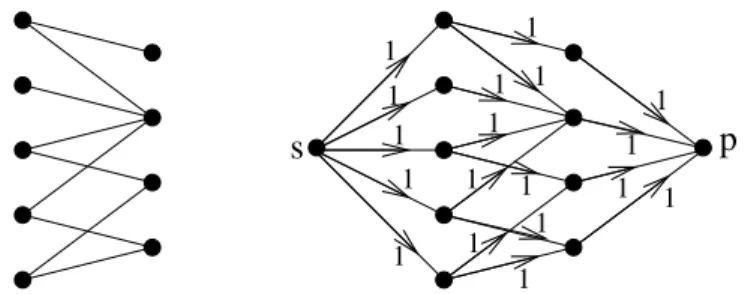
The theorems on matching in bipartite graphs that we proved in Chapter 6 are direct applications of flows. Indeed to every bipartite graph G= ((A,B),E), one can associate the flow network
NG= (H,s,p,c)defined as follows:H is the digraph obtained fromGby orienting all edges of GfromAtoBand adding a sourcesand a sink p, all arcs(s,a)fora∈Aand(b,p)forb∈B;
the capacity equals 1 for all arcs. See Figure 7.9.
1 s p 1 1 1 1 1 1 1 1 1 1 1 1 1 1 1 1 1
7.9. APPLICATIONS OF FLOWS 107 There is a one-to-one correspondence between the matchings ofGand the integral flows in
NG: to every matchingMcorresponds the flow fMwith value 1 on the arc set�(a,b)∈E(G){(s,a),(a,b),(b,p)}.
Moreover the size ofMis equal to the value of the flow fM. In addition, anM-augmenting path inGcorresponds to a directed(s,p-path in the auxiliary networkNG(fM). Hence Algorithm 6.2
is a particular case of Algorithm 7.1.
One can also deduce all the results of Chapter 6 from Theorem 7.7. For example, we now give a proof of Theorem 6.3 (“Let G= (A,B)bipartite, there is a matching of size k if and only
if ∀S⊂A,|A| − |S|+|N(S)| ≥k”) using flows.
Proof of Theorem 6.3. Let us prove that the maximum sizeµof a matching inGis equal to the maximum value of a flow inNG. IfMis a matching of sizeµinG, then fM has valueµ. Hence µ≤vmax. Reciprocally, from Remark 7.12, there is a maximum flow f with integral values. It is in one-to-one correspondence with a matchingMof sizev(f) =vmax. Hence,µ≥vmax.
LetC= (Vs,Vp)be a minimum cut. Let As =A∩Vs andBs =B∩Vs. If there is a vertex b∈(B∩N(As))\Bs, then settingC�= (Vs∪ {b},Vp\ {b}), we getδ(C�)≤δ(C)−1+1=δ(C). So, by adding the vertices of(B∩N(As))\BsinVsif needed, we may assume that the minimum cut that we consider is such thatN(As)⊆Bs.
Let us consider the capacity ofC.
δmin=δ(C) = |{(s,a)|a∈A\As}|+|{(b,p)|b∈Bs}|+|{(a,b)} |a∈As,b∈B\Bs}|
= |A| − |As|+|Bs|
Since N(As)⊆ Bs, it follows that δmin ≥ |A| − |As|+|N(As)|. Moreover, the cut (As∪ N(As),V(H)\(As∪N(As))) has capacity |A| − |As|+|N(As|. So δmin =|A| − |As|+|N(As)|. We conclude that
δmin=min{S⊂A| |A| − |S|+N(S)}
Hence, from Theorem 7.7,µ=vmax=δmin=min{S⊂A| |A| − |S|+N(S)}.
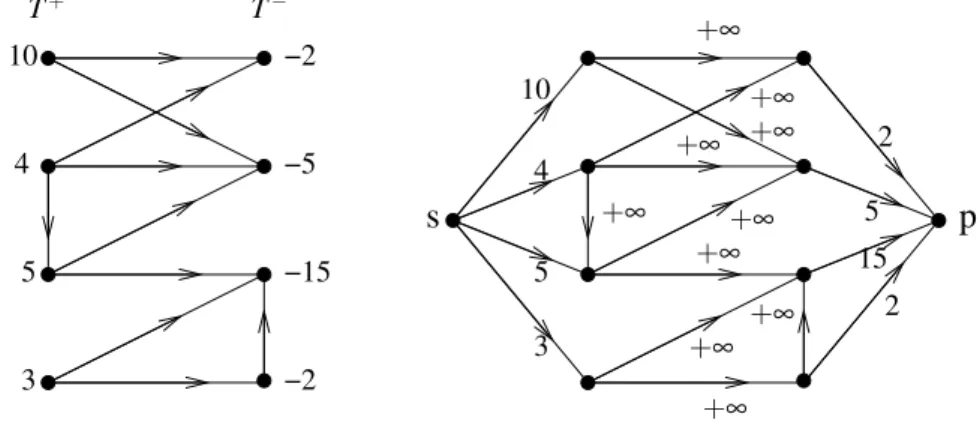
7.9.3 Maximum-gain closure
In this problem, we have several tasks. Each taskt ∈T is associated to a gaing(t). The gain
may be negative (if so, it corresponds to a loss). We noteT+ (resp. T−)the set of tasks with positive gain (resp., negative gain).
Besides, there are several closure constraints.That is, the choice of a task may imply the choice of one or several other tasks. We represent this closure relation (e.g., implication relation) by animplication digraph DT: its vertices are the tasks and there is an arc(t1,t2)if and only if
the choice oft1implies the choice oft2.
The objective is to find a set ofcompatibletasks with maximum gain, that is a subsetAofT such that:
- there are no arcs leavingA(E((A,A)) = /0) i.e. Ais aclosureinDT;
Let us show how this problem can be reduced to a problem of cut with minimum capacity, hence to a maximum flow problem. Let N = (G,s,p,c) be the following flow network (See
Figure 7.10:
- V(G) =T∪ {s,p};
- for any task t with positive gain, link the source s to the taskt with an arc (s,t) with
capacityc(s,t) =g(t);
- for any taskt with non-positive gain, linkt to the sink pwith an arc(t,p)with capacity
c(t,p) =−g(t);
- if a taskt1implies a taskt2, we add the arc(t1,t2)with infinite capacity in the network.
10 4 5 3 −2 −5 −15 −2 3 5 4 10 15 2 2 5 p s +∞ T− +∞ T+ +∞ +∞ +∞ +∞ +∞ +∞ +∞ +∞
Figure 7.10: An implication digraph and its corresponding flow network
Let us consider a cutC= (Vs,Vp)with finite capacity in the network. We haveS={s} ∪A withA⊂T. Moreover, since the cut has finite capacity, its arc set contains no arcs ofDT, soA is a set of compatible tasks. LetA+ =A∩T+andA−=A∩T−. The capacity ofCis:
δ(C) =
∑
t∈T+\A+ c(s,t) +∑
t∈A− c(t,p) =∑
t∈T+\A+ g(t)−∑
t∈A− g(t) =∑
t∈T+ g(t)−∑
t∈A+ g(t)−∑
t∈A− g(t) =∑
t∈T+ g(t)−∑
t∈A g(t)Since∑t∈T+g(t), the sum of all positive gains, is a constant, minimizing the capacity of the cut S={s} ∪Ais equivalent to maximizing the gain ofA.
7.10. EXERCICES 109
7.10 Exercices
Exercise 7.1. Let N be the flow network and f0 the(s,p)-flow in N as depicted in the figure
below. 3 1 2 2 2 2 2 1 1 2 2 2 2 4 3
network initial flow
p s
p s
1) Start from f0and find a maximum(s,p)-flow. Detail the steps of the algorithm.
2) Describe a minimum cut of this network.
Exercise 7.2. Find a maximum (s,p)-flow and a minimum(s,p)-cut in the network depicted
below. (Detail the steps of the “push” algorithm.)
5 3 2 6 5 2 2 2
p
s
Exercise 7.3. There are 3 production sites A,B,C and 5 consumption sites 1,2,3,4,5; their production and consumption, respectively, are given in the following tables.
A B C 5 4 7 1 2 3 4 5 3 4 5 2 1
Finally, each production sites can only serve the consumption sites as summarized in the fol-lowing table.
A B C
13 24 345
The problem is to satisfy the consumption sites. Model the following problem in terms of flows and give a solution to the problem or explain why it could not exist.
Exercise 7.4. Prove the following property: for all(s,p)-cut C= (Vs,Vp), v(f) =out(f,C)−
in(f,C). Why is the hypothesiss∈Vsand p∈Vpimportant?
Exercise 7.5. Prove Lemma 7.9. Verify that the positivity, the capacity constraint and the flow conservation are satisfied for f�.
Exercise 7.6. Thesupport of a flow is the set of arcs on which the flow function is positive. Show that there always exists a maximum flow whose support has no directed cycle.
Exercise 7.7. Let N = (G,s,p,c) be a flow netwrok such that, for all arc e, c(e) is an even
integer.
1) Prove that the maximum value of a flow is an even integer. 2) Show that there is a maximum flow f such that, for all arce, f(e)is an even integer.
Exercise 7.8. Modify Algorithm 7.1 to obtain an algorithm finding a minimum cut in a flow network.
Exercise 7.9. Construct a flow network for which Algorithm 7.1 produces a sequence of flow whose values converges to a finite value when pushing on some sequence of directed paths, while the value of a maximum flow is infinite (or arbitrarily large).
Exercise 7.10. Prove Proposition 7.17.
Exercise 7.11. In this exercise, we study a variant of the algorithm for finding a maximum flow, in which we push the flow along a directed path of maximum residual capacity.
1) Give an algorithm finding a directed path of maximum residual capacity.
2) Show that if we push an amount ofxat one step, then we push an amount of at leastxat each following step.
Exercise 7.12. LetN= (G,s,p,c)be a flow network. To each vertex v∈V(G), we associate
an real w(v). We want to compute a flow f of maximum value satisfying the following extra
constraint: ∀v∈V(G)the flow enteringvis at most w(v)(i.e. ∑u∈N−(v) f(uv)≤w(v)). Show how to find such a flow by computing a maximum flow on a network obtained fromNby slight modifications.
Exercise 7.13. Deduce Menger’s Theorem (5.18) from Theorem 7.7 . (Hint: One can use Exercise 7.12 to prove Theorem 5.18-(i).
Exercise 7.14. Deduce Theorem 7.7 from Menger’s Theorem (5.18).
Exercise 7.15. Several companies send members to a conference; the ith company send mi members. During the conference, several workshops are organized simulteanously; the ith workshops can receive at most nj participants. The organizers want to dispatch participants into workshops so that two members of a same company are not in a same workshop. (The workshop do not need to be full.)
a) Show how to use a flow network for testing if the constraints may be satisfied.
b) If there are p companies and qworkshops indexed in such a way that m1≥ ··· ≥ mp andn1≤ ··· ≤nq. Show that there exists a dispatching of participants into groupes satisfying
the constraints if and only if, for all 0≤k≤pand all 0≤l ≤q, we havek(q−l) +∑lj=1nj≥ ∑ki=1mi.
7.10. EXERCICES 111 Exercise 7.16(Unsplittable flow). We consider a flow network with one production sitesand many consumption sites, say p1,p2, . . .pn. The consumption at site piisdi. We want to route commodities forsto pi with the following additionnal constraint: the traffic fromsto pi must be routed along a unique directed path (it cannot be split).