Imperial College London
Department of Computing
Model Checking and Compositional
Reasoning for Multi-Agent Systems
Andrew Vaughan Jones
2015
Submitted in partial fulfilment of the requirements for the degree of Doctor of Philosophy in Computing of Imperial College London
The copyright of this thesis rests with the author and is made avail-able under a Creative Commons Attribution-Non Commercial-No Derivatives licence. Researchers are free to copy, distribute or transmit the thesis on the condition that they attribute it, that they do not use it for commercial purposes and that they do not alter, transform or build upon it. For any reuse or distribution, researchers must make clear to others the license terms of this work.
Declaration
I herewith certify that all material in this dissertation that is not my own work has been properly acknowledged.
Andrew Vaughan Jones
Abstract
Multi-agent systems are distributed systems containing interactingautonomous agentsdesigned to achieve shared and private goals. For safety-critical systems where we wish to replace a human role with an autonomous entity, we need to make assurances about the correctness of the autonomous delegate.
Specialised techniques have been proposed recently for the verification of agents against mentalistic logics. Problematically, these approaches treat the system in a monolithic way. When verifying a property against a single agent, the approaches examine all behaviours of every component in the system. This is both inefficient and can lead to intractability: the so-calledstate-space explosion problem. In this thesis, we consider techniques to support the verification of agentsin isola-tion. We avoid the state-space explosion problem by verifying an individual agent in the context of aspecificationof the rest of the system, rather than the system itself. We show that it is possible to verify an agent against its desired properties without needing to consider the behaviours of the remaining components. We first introduce a novel approach for verifying a system as a whole against specifications expressed in a logic of time and knowledge. The technique, based on automata over trees, supports an efficient procedure to verify systems in an
automata-theoreticway using language containment.
We show how the automata-theoretic approach can be used as an underpinning forassume-guarantee reasoningfor multi-agent systems. We use a temporal logic of actions to specify the expected behaviour of the other components in the system. When performing modular verification, this specification is used to exclude behaviours that are inconsistent with the concrete system.
We implement both approaches within the open-source model checkermcmas
and show that, for the relevant properties, the assume-guarantee approach can significantly increase the tractability of individual agent verification.
“
An algorithm that forgets its past is doomed to
repeat it
”
Acknowledgements
My initial thanks of course have to go to Alessio Lomuscio for our discussions during my doctoral research and for providing me with the chance to conduct research at Imperial.
My thanks also go to Franco Raimondi and Marek Sergot, my examiners. Their exhaustive comments have been invaluable in improving my thesis.
I am also extremely grateful to Wojciech Penczek who originally enlightened me to the existence of alternating automata, and their applications to model checking for branching-time logics. Wojciech’s suggestions very much influenced a large part of the direction of this thesis.
I was fortunate enough have a collaboration with Francesco Belardinelli at the early stages of my Ph.D. on which parts of this thesis are built – this was extremely beneficial, and I am thankful to still consider Francesco a collaborator.
Where would these acknowledgements be without thanks to my parents – for their love, emotional and, of course, financial support.
As always, the best and most important are relegated to the end of the list: my uncountable thanks (no, they cannot be mapped toN!) to Kim – for her constant support,
love, proof-reading, endless hours spent not having fun, just to get me to the end . . . . . . time to go diving!
Contents
List of Tables . . . 15
List of Figures . . . 17
1 Introduction. . . 19
1.1 Motivation . . . 19
1.2 Definition of the Problem . . . 23
1.2.1 Aims and Objectives . . . 23
1.3 Contributions . . . 24
1.4 Relevance and Applications . . . 26
1.5 Collaboration and Publications . . . 27
1.6 Summary of Contents . . . 27
2 Related Work. . . 29
2.1 Compositional Verification . . . 29
2.1.1 Assume-Guarantee Reasoning . . . 30
2.1.2 Learning-based Assume-Guarantee Reasoning . . . 32
2.2 Logics for Reasoning about Computations . . . 35
2.2.1 Modular Model Checking and Module Checking . . . 35
2.2.2 Model Checking with Path Criterion . . . 36
2.2.3 Local and Modular Specifications . . . 38
2.2.4 Automata-Theoretic Verification for Branching Structures . . . . 39
2.3 Reducing the State Space for Multi-Agent Systems . . . 41
2.3.1 Symmetry Reduction . . . 41
2.3.2 Partial Order Reduction . . . 42
2.3.3 Parametric Verification . . . 42
2.3.4 Existential Abstraction . . . 42
2.3.5 Modular Verification for Multi-Agent Systems . . . 43
2.3.6 Modular Verification for Multi-Modal Epistemic Logic . . . 45
2.4 Identified Shortcomings and Potential Opportunities . . . 45
3 Background and Preliminaries . . . 47
3.1 Modal Logic and Kripke Structures . . . 47
3.1.1 Propositional Modal Logic . . . 47
3.1.2 Semantics and Abbreviations . . . 48
3.1.3 Multi-Modal Logic . . . 49
3.2 Temporal Logics . . . 50
3.2.1 Transition Systems . . . 50
3.2.2 Linear Temporal Logic . . . 51
3.2.3 LTL Semantics and Abbreviations . . . 51
3.2.4 Computational Tree Logic . . . 52
3.2.5 CTL Semantics and Abbreviations . . . 52
3.2.6 Further Logics . . . 53
3.3 Reasoning about Multi-Agent Systems . . . 54
3.3.1 Interpreted Systems . . . 55
3.3.2 Compositions . . . 56
3.4 Automata . . . 60
3.4.1 Automata on Infinite Words . . . 61
3.4.2 Automata on Infinite Trees . . . 63
3.4.3 Expressivity of Automata . . . 67
3.5 Model Checking . . . 68
3.5.1 For LTL . . . 69
3.5.2 For CTL . . . 70
3.5.3 For CTLK . . . 72
4 Automata-Theoretic Verification for Temporal-Epistemic Logic . . . 77
4.1 Introduction . . . 77
4.2 From Interpreted Systems to Trees . . . 78
4.2.1 High-level Methodology . . . 79
4.2.2 Example – Unwinding an Interpreted System . . . 80
4.2.3 CTLK over Trees . . . 83
4.3 Weak Epistemic Alternating Automata . . . 84
4.4 From CTLK to Automata . . . 85
4.4.1 Example –Lmto WEAA . . . 89
4.5 Constructing the Product Automaton . . . 90
4.5.1 Example – The Product AutomatonAP,ϕ. . . 92
4.6 Concluding Remarks . . . 93
5 Compositional Verification for Multi-Agent Systems . . . 95
5.1 Introduction . . . 95
5.2 A Modular Formalisation for Interpreted Systems . . . 98
5.2.1 Interaction-Defined Interpreted Systems . . . 99
Contents 13
5.2.3 Behaviours and Languages . . . 105
5.2.4 Satisfaction Preservation . . . 108
5.3 Assumption-Based Model Checking . . . 113
5.3.1 Action-Based Model Checking of Linear Assumptions . . . 113
5.3.2 State-Based Model Checking of Branching Guarantees . . . 120
5.3.3 Semantics of|=CTLK ϕ . . . 123
5.4 Libi Epistemic Alternating Automata . . . 125
5.4.1 Automata Structure . . . 126
5.4.2 Translation from∀CTLK to LEAAs . . . 126
5.4.3 Correctness of LEAA-Based Model Checking . . . 129
5.5 Compositional Model Checking of Agents . . . 129
5.5.1 Assume-Guarantee Reasoning for Multi-Agent Systems . . . 130
5.6 Concluding Remarks . . . 133
6 Implementation and Evaluation . . . 135
6.1 Introduction . . . 135
6.2 An Epistemic Tree Automata Verifier . . . 136
6.2.1 Implementation:ETAV. . . 136
6.2.2 Evaluation . . . 140
6.2.3 Conclusion . . . 145
6.3 Automatically Constructing Closure Environments . . . 146
6.3.1 AboutLTL2DSTAR. . . 146
6.3.2 Implementation:DRA2ISPL. . . 147
6.3.3 Example . . . 148
6.4 Extensions toMCMAS. . . 152
6.4.1 AT-MCMAS– Automata-TheoreticMCMAS. . . 153
6.4.2 Acceptance of Runs . . . 154
6.4.3 Detecting Invalid Runs using Three Valued Semantics . . . 156
6.4.4 State-based Verification of Guarantees . . . 158
6.4.5 Action-based Verification of Assumptions . . . 161
6.4.6 Implementation:AGR-MCMAS. . . 162
6.5 Evaluating ModularMCMAS . . . 163
6.5.1 Not-so-faulty Train-Gate-Controller . . . 163
6.5.2 Software Development Protocol . . . 170
6.5.3 Comparison to Other Techniques . . . 183
6.6 Concluding Remarks . . . 184
7 Conclusions . . . 187
7.1 Overview and Summary . . . 187
7.1.1 Strengths and Weaknesses . . . 188
7.1.2 Summary of Contributions . . . 190
7.2 Future Work . . . 192
7.2.1 “Many Agent Systems” . . . 192
7.2.2 Application of Automata Learning Frameworks . . . 194
7.2.3 Truly “Modular” Interpreted Systems . . . 195
7.2.4 Richer Assumptions . . . 196
7.2.5 Symbolic Rabin Fairness . . . 198
7.2.6 Symbolic Encoding of the Product Automaton . . . 199
7.3 Closing Remarks . . . 199
List of Tables
3.3 Common Acronyms for Automata . . . 63
3.4 The structure of the transition relation for an alternating automata for a CTL formula . . . 71
4.1 The transition functionδ in the automatonAD,ψ . . . 87
5.1 Satisfaction of a∀CTLK formula inM{i,ϕ} . . . 124
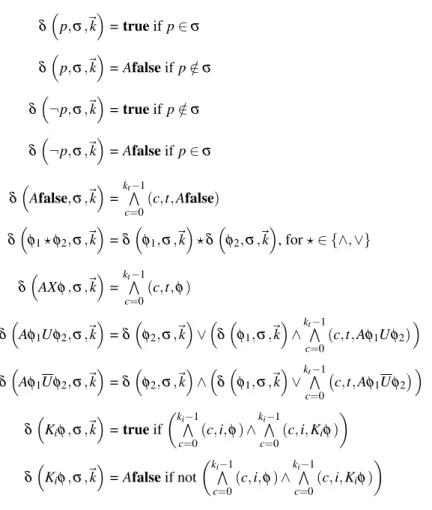
5.2 The transition functionδ for a LEAA based on a∀CTLK formula . . . 127
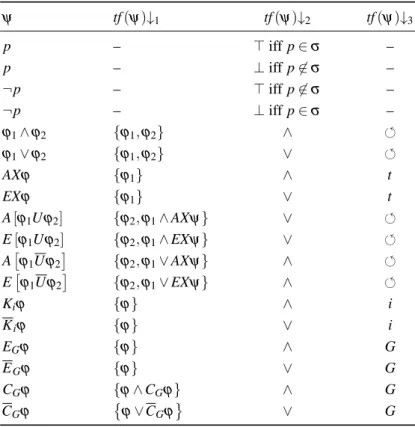
6.1 The rules for constructing the data structuretf for a formulaψ. . . 138
6.2 Gossip Protocol Specifications . . . 141
6.3 Model Checking The Gossip Protocol . . . 142
6.4 Faulty Train-Gate-Controller Specifications . . . 144
6.5 Model Checking The Train-Gate-Controller . . . 144
6.6 Boolean Operators Over Three Values . . . 157
6.7 Acceptance Criteria . . . 159
6.8 Train-Gate-Controller: Comparison 1 – Memory and Time . . . 167
6.9 Train-Gate-Controller: Comparison 1 – BDD Variables and Reachable States . . . 168
6.10 Train-Gate-Controller: Comparison 2 – BDD Variables and Reachable States . . . 169
6.11 Train-Gate-Controller: Comparison 2 – Memory and Time . . . 169
6.12 Contract Violation Criteria for the Insurance Company . . . 171
6.13 Satisfaction of Guarantees in the Software Development Protocol. . . 176
6.14 Software Development Protocol: Guarantee Check – States, Time and Memory . . . 177
6.15 Software Development Protocol: Assumption Check – Time . . . 179
6.16 Software Development Protocol: Assumption Check – Memory . . . 180 6.17 Software Development Protocol: Assumption Check – Reachable States 181
6.18 Software Development Protocol: Assumption Check – BDD Variables and Representable States . . . 183
List of Figures
2.1 A Typical Assume-Guarantee Inference Rule . . . 31
2.2 Learning Assumptions for Assume-Guarantee Reasoning . . . 33
3.1 Equivalence betweenω-automata. . . 63
3.2 Non-deterministic Büchi Automaton forGp. . . 68
3.3 Deterministic Rabin Automaton forGp. . . 68
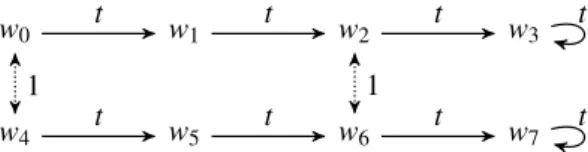
4.1 An example of an interpreted system . . . 80
4.2 The epistemic alternating tree automaton “unwinding” of the interpreted system in Figure 4.1 . . . 82
4.3 A sub-tree of the automatonAP,ϕ. . . 93
5.1 An excerpt of an ISPL evolution function . . . 100
5.2 The temporal evolution for the exemplary agentAgenti. . . 106
5.3 The temporal evolution for the exemplary agentAgent1. . . 107
5.4 The temporal evolution for the exemplary agentAgent2. . . 108
5.5 The temporal evolution for the exemplary agentAgent1. . . 110
5.6 The temporal evolution for the exemplary agentAgent2. . . 110
5.7 The temporal evolution for the exemplary agentAgent3. . . 111
5.8 The DRAAϕforF G a. . . 118
5.9 The agentSimple. . . 119
5.10 Invalid Runs and Epistemic Formulae . . . 128
5.11 The simple interaction-defined interpreted system modelM . . . 130
5.12 Inference rules for linear-branching assume-guarantee . . . 131
5.13 Translation of inference rules, shown in Figure 5.12, to their model checking equivalents . . . 131
5.14 Inference rules forn-agent linear-branching assume-guarantee . . . 133
6.1 Train-Gate-Controller Example . . . 143
6.2 ltl2dstarworkflow for converting a given A-LTL formulaϕin an
ISPL file . . . 148
6.3 Thespinnever claim for the NBA of the formulaG(p→FGq) generated byltl2ba. . . 149
6.4 A visualisation of the NBA from Figure 6.3 . . . 150
6.5 The GraphVizdotdiagram for the DRA ofG(p→FGq)automatically generated byltl2dstar . . . 151
6.6 A partial ISPL snippet for a deterministic Rabin observer agent . . . 152
6.7 A partial ISPL snippet for a deterministic Rabin property agent . . . 153
6.8 An example model with two invalid successors and one valid successor 158 6.9 Workflow usingagr-mcmas . . . 162
6.10 Interactions in the Train-Gate-Controller Model . . . 164
6.11 Example ISPL for a Single Train . . . 165
6.12 Property environment for a train . . . 166
6.13 Interactions in the Software Development Protocol . . . 171
6.14 ISPL for the Insurance Company . . . 174
6.15 Modified Property Environment for the Insurance Company Assumption 175 7.1 Inference rules forn-agent, multi-assumption linear-branching assume-guarantee reasoning . . . 192
7.2 Inference rules forn-agent, multi-assumption linear-branching assume-guarantee-based model checking . . . 193
Chapter 1
Introduction
1.1 Motivation
Multi-agent systems(MAS) are systems composed of multiple components, or agents, which exhibit autonomous behaviour, as well as social abilities such as learning and cooperation. So-calledrationalagents are those with the ability to achieve their goals without being given an explicit procedure on how to do so, as well as making decisions that “make sense”.
Given the autonomous behaviour of individual agents, it is common for systems that contain few agents (or even a single agent) interfacing with an environment to be classed as an “autonomous system”. These so-called autonomous systems have gained extreme prominence within recent years, especially in the context of vehicles. Examples include autonomous surface vehicles (ASVs), unmanned aerial vehicles (UAVs) and autonomous underwater vehicles (AUVs).
In light of the rational and autonomous facets that these agents possess, it has become common to specify properties about the mental attitudes of these agents. This has given rise to the use of mentalistic logics such as epistemic logic(the logic of knowledge),deontic logic(the logic of obligations),doxastic logic(the logic of belief) andcoalitional logic(logics dealing with strategies and what groups of agents can achieve) when wanting to reason about the behaviours of agents.
In this thesis, we particularly focus on the use of epistemic logic and in trying to decide what an agent can “know” about its own behaviour and the environment in which it is situated.
The formal verification of computer systems is a set of techniques oriented to enable the designers to provide assurances about quality and correctness. Model checking is one such approach; it is an automated technique for reasoning about the behaviours of a system with respect to a property specified in a given logic. The problem of reasoning about the knowledge of agents in a given multi-agent system is known as
temporal-epistemic model checking.
While considerable work has been carried out in the field of model checking for multi-agent systems [Lomuscio and Penczek, 2012], the current state-of-the-art still falls short of enabling engineers to verify industrial-scaled multi-agent systems. It therefore remains of paramount importance to either develop new and novel techniques, or improve those that already exist, such that model checking toolkits are able to tackle complex multi-agent systems.
One problem that limits the wider application of model checking is the state-space explosion problem. This is where the number of states of the system increases expo-nentially with the number of components comprising that system. Furthermore, the complexity of modern systems is starting to push the limit of what can feasibly be verified with current methods [Emerson, 2008].
The state-space explosion problem has a particularly adverse effect in multi-agent systems, as they are inherently based on multiple, distributed components interacting. While also having to overcome the state-space explosion, the verification of multi-agent systems also has to cater for specialised procedures enabling the reasoning about the mental attitude of each agent. Although recent research has led to considerable advances in the verification of agent-based systems [Lomuscio and Penczek, 2012], we are—once again—reaching the limits of what can be feasibly verified when dealing with the system as a whole.
One solution to the state-space explosion problem is the family of techniques that fall under the umbrella of “compositional reasoning” [de Roeveret al., 1998]. The aim of these techniques is to support verification in a divide-and-conquer manner. By taking advantage of the natural decompositions of a system into its components, and then verifying these components in isolation, it is possible to avoid the aforementioned combinatorial blow-up.
A proposed solution.
Given that each agent in a multi-agent system is typically developed in isolation, it would be practical to also verify each agent in this manner. This is analogous to how modern software is constructed: components are constructed without knowing the exact implementation details of the other components. Each component is, however, constructed with the knowledge of aspecificationof the other components’ interface and expected behaviour. In modern software development, such a specification would be theapplication programming interface(API) of the components we wish to interact with.
Assume-guarantee reasoningis one particular approach to compositional verifica-tion [Berezinet al., 1998; Clarkeet al., 1999]. Under assume-guarantee reasoning, components are examined in isolation and verified against aguaranteein the context of anassumption. The assumption is an assertion about the rest of the system in which the component is situated; as with traditional software, this assumption could be based
1.1 Motivation 21
on the specification of the system in which the agent (or component) is expected to execute. By comparison, the guarantee is a logical specification of the component’s requirements, expressing its desired mental evolution over time. Therefore, in this context, the verification task is to ascertain if a given component, when acting in any environment satisfying the given assumption, meets the guarantee.
Consider the parallel execution of an arbitrary agentAgentwith an environmentEnv; we denote byEnvkAgentthis composition. Under this parallel execution, the agent and the environment “communicate” by observation of the actions that the other performs. Further, we can take the specification ofEnv, and formalise this as an assumption
Ass, such that the behaviours ofEnvare a subset of (or equal to) the behaviours ofAss
(i.e.,Assis anabstraction—in the sense that it can exhibit more behaviours—ofEnv). It follows that, as theAgent’s behaviour depends on the behaviour ofEnv(due toAgent
observingEnv’s actions), composing theAgentwith a component that has more possible behaviours will lead to more potential behaviours in theAgent.
In such a scenario, we therefore have the following (where “Behaviours” encapsulates thetemporal evolutionof a component or a composition):
Behaviours(Env)⊆Behaviours(Ass)
⇓
Behaviours(EnvkAgent)⊆Behaviours(AsskAgent)
That is ifAsscan do everything thatEnvcan do, then it follows that every sequence of behaviours ofAgentcomposed withEnvwill also be a sequence of behaviours in the
composition betweenAgentandAss.
Further, if the behaviours exhibited byAsscomposed withAgent(i.e.,AsskAgent) are a subset of the “good” or desirable behaviours of the system then, following the transitivity of the subset operator, we have that all of the behaviours ofEnvkAgent
should also be “good”. More precisely:
Behaviours(Env)⊆Behaviours(Ass) and
Behaviours(AgentkAss)⊆Good Behaviours ⇓
Behaviours(AgentkEnv)⊆Good Behaviours
Under the assume-guarantee paradigm, we can therefore decompose the verification problem into two parts:
1. Checking that the behaviours of the environment are a subset of those permitted by the assumption
2. Checking that the agent, when composed with its environmental assumption, satis-fies its own requirements
To make this approach practical, the size of the assumption, when represented as a finite-state transition system, should be significantly smaller than the size of the environment. While this may lead to a possible over-calculation of the behaviours of the agent, this is still an easier problem than calculating the full behaviours for the original composition. By composing the “agent under test” with the assumption rather than the genuine environment, this also allows us to effectively hide the other components in the system. This further increases the scalability and efficacy of the verification approach. While there have been numerous alternative approaches to alleviate the state-space explosion problem in MAS-based verification by attempting to reduce the size of the
input system[Lomuscio and Penczek, 2012], they fall under two common categories:
• Support for homogeneous components – under approaches such assymmetry
re-duction[Cohenet al., 2009a; Cohenet al., 2009b] orparametric verification [Kou-varos and Lomuscio, 2013a; Kou[Kou-varos and Lomuscio, 2013b], we can reduce the state-space for instances that contain many replicated agents of the same type, by removing duplicated identical components
• Variable hiding/slicing – techniques such asexistential abstraction[Cohenet al., 2009c; Lomuscioet al., 2010b] work by clustering states together and, by “hiding” information in the system, reduce its overall size
However, with compositional reasoning, we are able to break apart the verification problem even with two heterogeneous components (compared to parametric verification), and we also verify theactualagent program and not a transformed version with fewer states (compared to existential abstraction).
Verifying an agent exactly as specified is extremely useful as it allows us to be more certain that an error identified by the decision procedure may be genuine, rather than due to an oversimplification in the verification methodology (e.g., as can be the case in existential abstraction [Clarkeet al., 1994]). However, while a positive result carries across to the full composition in the assume-guarantee paradigm, a negative result is still somewhat problematic: this could either be a genuine problem in the component, or the assumption selected may have been too weak to exclude erroneous behaviours that do not exist in the genuine system.
Still, by focusing onreusable components, which should meet their specifications (i.e., the guarantee) in any environment meeting certain criteria (i.e., the assumption), it is clear that a negative result here means the component does not satisfy its requirements in all environments that the agent may potentially be situated in.
1.2 Definition of the Problem 23
1.2 Definition of the Problem
The family of techniques classed as “modular reasoning” attempt to alleviate the state-space explosion problem by dealing with each component individually, and therefore avoiding the combinatorial explosion when taking these components in composition. However, so far very little attention has been paid to applying compositional methods to either multi-agent systems or to richer mentalistic logics (e.g., temporal-epistemic logics). This is the area that this thesis aims to explore.
In traditional “reactive systems” verification, all of the information needed to cal-culate the “next-state” relation used for both building the state-space and verifying temporal formulae can be derived automatically from the program text. However, this is not the case for epistemic logic. To verify an epistemic formula, the “next-state” relation for knowledge can only be derived given a concrete local configuration for the agent and the set of all reachable states. As such, verifying temporal-epistemic formulae—even in a non-compositional way—introduces a selection of theoretical issues that need to be overcome.
While some techniques do exist for automatically performing compositional verifica-tion—none supporting temporal-epistemic logic—most techniques are manual. This requires the user to provide animplementationof the assumption, rather than using a specification directly [Henzingeret al., 1998; Henzingeret al., 2002]. As such, it is necessary not only for the user to implement a correct assumption, but the tools do not endeavour to show if the real environment is a refinement of the selected assumption (i.e., by automatically showing that all behaviours of the environment are contained within the assumption).
To this end, this thesis also considers an approach to the verification of multi-agent systems using automata. Model checking via Büchi automata, originally considered by Vardiet al.[Vardi and Wolper, 1986], is one of the foremost approaches in the verifica-tion of reactive systems and constitutes the basis of the model checkerspin[Holzmann, 2004]. The original work [Vardi and Wolper, 1986] covered linear-time only; this was extended to branching-time logic in [Kupfermanet al., 2000], where the formalism of alternating tree automata (ATA) was applied. Consequently, we investigate the use of alternating tree automata for the verification of multi-agent systems.
1.2.1 Aims and Objectives
Given the current shortcomings of the state-of-the-art, this thesis proposes an advance-ment of the existing compositional reasoning techniques to support not only the multi-agent paradigm, but also their associated knowledge-based properties.
Research Hypothesis
Model checking techniques based on modular reasoning will make the ver-ification of multi-agent systems more tractable when compared to the ex-isting monolithic approaches.
In our hypothesis, we have three criteria fortractable: shrinking the number of reachable states, lowering the time taken for verification and reducing the maximum memory required.
In this vein, this thesis will develop methods of compositional reasoning, i.e., divide-and-conquer approaches, for the verification of multi-agent systems that support suitable mentalistic logics. This work aims to have both a theoretical contribution (i.e., a formal and correct basis of compositional reasoning of agents), as well as an implementation of an automated verification tool for multi-agent systems, supporting techniques for ameliorating the state-space explosion problem.
The high-level objectives of this thesis are as follows:
i Investigate novel techniques for the verification of multi-agent systems, based in part on a notion ofmodularity.
ii Implement selected techniques as either new tools or extensions to existing tools. iii Compare the effectiveness of the solutions using benchmarks selected from the
literature.
1.3 Contributions
The research outcomes and contributions presented in this thesis are:
i Two novel techniques for the verification of multi-agent systems (one based on automata and one based on modularity)
ii A new tool (etav) and three tool extensions (two extendingmcmas-1.0:at-mcmas andagr-mcmas, and one extendingltl2dstar:dra2ispl)
iii Experimental results obtained by comparing the various extensions to an existing state of the art model checker for multi-agent systems
On our route to a flexible approach for modular reasoning, we introduce a novel verification method based onautomata. Unlike existing approaches adopted currently for the verification of multi-agent systems that use symbolic representations (e.g., based on binary decision diagrams [Raimondi and Lomuscio, 2005; Raimondi and Lomuscio, 2004] or via a reduction to Boolean satisfiability [Penczek and Lomuscio, 2003a]), the automata-based approach [Vardi and Wolper, 1986] supports a language-theoretic
1.3 Contributions 25
means for the verification of multi-agent systems. Similar to techniques for linear-temporal logic, we note that checking a linear-temporal-epistemic formula can be transformed to checking the language non-emptiness for an automaton representing a composition of the system and the formula.
Furthermore, we break down the main contributions as follows: 1. Methodological
• We introduce a novel automata-theoretic model checking approach for
multi-agent systems.
• We present a modular reasoning-based approach to verifying an individual
agent in an isolated manner against both parts of an assume-guarantee rule. 2. Theory
• We provide proofs of correctness for the automata-theoretic approach of Chap-ter 4 (both in the conversion of formulae to automata, Theorem 4.1, and in the correctness of model checking transformed to language non-emptiness, Theorem 4.2).
• We also prove the correctness of preservation of various temporal and temporal-epistemic formulae when applying compositional verification in a multi-agent systems context (Theorem 5.1, Theorem 5.2, Theorem 5.3, Theorem 5.4, Theo-rem 5.5 and Proposition 5.5).
• We give an algorithm for checking the acceptance of a path with respect to both an assumption and a guarantee (Algorithm 2).
3. Conceptual
• We identify the classes of multi-agent systems where it is possible to apply modular-style reasoning to individual agents.
• We suggest a new logic for specifying assumptions based on actions, as well as identifying a suitable fragment for guarantees.
4. Implementations
We developed and implemented various toolkits to evaluate experimentally the theory presented in the thesis. Namely:
• etav– a novel model checker developed to perform explicit-state
automata-theoretic verification of multi-agent systems.
• at-mcmas– an extension ofmcmas-1.0[Lomuscioet al., 2009] to perform
“hybrid-state” automata-theoretic verification of multi-agent systems.
• agr-mcmas– an extension ofat-mcmas(Section 6.4.1) to support the modular verification of multi-agent systems (i.e., for the verification of the two “parts” of an assume-guarantee rule).
• dra2ispl– an extension ofltl2dstar[Klein and Baier, 2006] to support the generation of both “assumption enforcing” environments and “temporal observer” agents from linear-time action-based specifications.
As an outcome of implementing the developed theory, we draw attention to
agr-mcmas’s ability to verify individual agents in MAS against formulae
spec-ified in a linear-time logic using action-based propositions. 5. Empirical
• We show that, for some specific classes of problems, explicit-state model
checking can scale better than symbolic model checking.
• We provide an empirical justification of Vardi’s statement [Vardi, 1995] that, while the complexity of modular reasoning might seem prohibitively high, when applied to practical problems, this worst-case complexity may be avoided.
1.4 Relevance and Applications
The work in this thesis has pertinence to the classes of multi-agent systems that generate state-spaces too large to verify directly using traditional verification techniques. As multi-agent systems are usually loosely-coupled this generally means that they inher-ently generate large state-spaces. When compared to hardware verification, where the synchronous communication between multiple components can remove a large proportion of possible states, the loose-coupling of multi-agent systems does not remove these possible sequences of behaviours.
Furthermore, it is common in the software development world to design software with an expectation of how it will be used. This expectation is similar to our use of assumptions here. As such, a modular approach, similar to that which we introduce, allows for the verification of an individual agent earlier in the development process as we do not require the rest of the system to provide assurances about the correctness of this single agent.
Therefore, being able to deal with the verification of multi-agent systems in a modular way (even on a restricted class of systems) is of definite benefit. This directly allows for the verification ofre-deployableagents, that do not have be re-proven every time they are deployed in a requisite environment.
1.6 Summary of Contents 27
1.5 Collaboration and Publications
The theory presented in Chapter 4 extends work done in collaboration with Francesco Belardinelli and Alessio Lomuscio [Belardinelliet al., 2010; Belardinelliet al., 2011]. Francesco Belardinelli assisted with the proofs of Theorem 4.1 and Theorem 4.2.
The remaining contributions of this thesis—the modular verification framework of Chapter 5 and the implementation and evaluation of this technique (Sections 6.3 to 6.5.2)—are my own work.
1.6 Summary of Contents
We now summarise the remaining contents of the thesis.
In the next chapter, Chapter 2, we briefly survey the work related to the core themes of this thesis. We conclude this chapter by highlighting some of the shortcomings of these works that this thesis hopes to address.
In the subsequent chapter, Chapter 3, we then cover the theoretical prerequisites on which this thesis depends.
In Chapter 4 we introduce an original automata-theoretic approach for the verification of multi-agent systems. We present epistemic alternating tree automata, an extension of alternating tree automata [Kupfermanet al., 2000], and use them to represent specifi-cations in the temporal-epistemic logic CTLK (Section 3.3.2.4). We prove that model checking a memory-less interpreted system against a CTLK property can be reduced to checking the language non-emptiness of the composition of two epistemic tree automata.
In Chapter 5 we present a novel technique for the compositional model checking of multi-agent systems. Compositional techniques take a “divide-and-conquer” approach to verification and attempt to alleviate the state-space explosion problem by verifying each component in isolation. In this chapter, we extend Vardi’slinear-branching assume-guarantee paradigm[Vardi, 1995] to support action-based linear-time assumptions and state-based branching-time temporal-epistemic guarantees. Action-based linear-time assumptions are used to specify the interaction between a component and its environment. By comparison, branching-time temporal-epistemic guarantees are used to specify the behaviour of the “agent under test”. We prove that for agent-local assumptions and guarantees the modular approach is sound.
Chapter 6 presents the implementation of the theory for the two proceeding chapters. We report on the experimental implementations and discuss preliminary results. We evaluate the effectiveness of the technique using three real-life scenarios: a gossip protocol, the (faulty) train-gate-controller and a contract-regulated software development protocol.
Finally, Chapter 7 compares and contrasts with existing methods from the literature, and concludes.
Chapter 2
Related Work
In this chapter we explore the existing literature related to the central themes of this thesis. We begin by surveying approaches for modular verification ofreactive systems
(Section 2.1); in this context, we are concerned with properties pertaining only to the evolution of the system over time, and not richer properties such as knowledge. For these temporal-only specifications, either a “maximal tableau” for the formula is constructed (Section 2.1.1.1), or modern learning-based approaches are applied to automatically construct a candidate abstraction (Section 2.1.2).
Subsequently (Section 2.2), we introduce extensions to well-established semantics for certain temporal logics, that—while not always identified by the original authors—have a potential application in compositional reasoning/modular verification. In Section 2.2.3,
we discuss some of the related literature surrounding a notion ofcomponent-local
specifications, which we build upon when it comes to constructing specifications for modular reasoning in Chapter 5. These component-local specifications are useful, as they are immediately amenable to modular verification, without pertaining to components other than those being verified.
In the penultimate section of this chapter (Section 2.3), we discuss recent approaches to alleviate the state-space explosion problem in the context of multi-agent systems. We also survey related works that investigate modular-esque reasoning in a multi-agent systems context.
Finally, to conclude the chapter (Section 2.4) we identify some shortcomings of the state-of-the-art that we endeavour to address as part of this thesis.
2.1 Compositional Verification
Compositional reasoning[de Roeveret al., 1998] is a “divide-and-conqueror” approach to verification. Rather than verifying the system as a whole and using alternative methods to alleviate the state space explosion problem (e.g., efficient data structures), the idea
is to try and tackle individual components in isolation. In doing so, the combinatorial explosion problem can (hopefully) be avoided.
Concisely, compositional reasoning can be summarised as follows:
The specification of a program should be verified on the basis of specifi-cations of its constituent components, without knowledge of the interior construction of those components.
– Job Zwiers [Zwiers, 1989] That is, a component should be verifiable in the context of a formal specification of the other parts of the system, rather than the concrete components themselves. Under such a focus, we use these specifications to effectively hide the implementational specificsof the other components. This is potentially advantageous as it is hoped that the specifications of the components are, ideally, significantly smaller than the components themselves. By verifying the component when “composed” with the specifications, these compositional techniques endeavour to ameliorate the state-space explosion problem, by reducing the size of the model to be considered when performing verification.
However, any modular technique should hope to besound. Following a set of
inferences (e.g., similar to those shown in the next section), if the modular technique decides that a formula is true on the full structure, then it should be avalid inference
and the result should be correct.
It is often the case (as is with this work) thatcompleteness will not be consid-ered [Namjoshi and Trefler, 2010]. This is where compositional verification can support both positive and negative inferences over the concrete system.
2.1.1 Assume-Guarantee Reasoning
One compositional reasoning technique that has been studied widely is that of assume-guarantee reasoning[Berezinet al., 1998; Clarkeet al., 1999]. The crux of assume-guarantee reasoning is the tuple
hAiMhGi
which has the following interpretation:
Informally, a component M satisfieshAiMhGiif the environment of M violates A before the component M fails to satisfy G.
– de Roeveret al.[de Roeveret al., 2001] In such a rule, we denote byAtheassumptionand byGtheguarantee. In a modular verification task, the specificationAis used to constrain the behaviours ofMto only those that adhere toA. The guaranteeGis therefore the “high-level” specification that we wish to show is satisfied byM. If the environment can also be shown to satisfyA
2.1 Compositional Verification 31
andMsatisfiesGin the context ofA(given certain restrictions on the syntax ofG), then
Mshould satisfyGin any environment also satisfyingA.
2.1.1.1 Assume-Guarantee Model Checking
Using assume-guarantee reasoning, it is therefore possible that the verification task can be divided into its natural decompositions [Berezinet al., 1998]. That is, the verification task can be decomposed into a verification task of consistent parts, under the assumption that the other components in the system behave in a certain fashion. In this context, a typical assume-guaranteeproof strategyis shown in Figure 2.1.
htrueiM1hψi
hψiM2hϕi
htrueiM1kM2hϕi
Fig. 2.1.A Typical Assume-Guarantee Inference Rule
The inference rules in Figure 2.1 attempt to establish the following:
• ThatM1trivially satisfies the assumptionψ, by further using the assumption “true” (i.e., under no assumption)
• And thatM2satisfiesϕin the context of an environment that satisfiesψ
• Finally, if the above hold, then it is a valid inference that the composition ofM1and M2(denotedM1kM2) should also satisfyϕ
The advantage of such a verification approach is that it is never necessary to consider the composition ofM1kM2. Instead, it is only necessary to first check thatM1satisfies ψ(in isolation) and then check thatϕis satisfied byM2under the assumptionψ.
Berezinet al.[Berezinet al., 1998] continue with a discussion on how to implement the proof rule in Figure 2.1, using the “simulation pre-order” () from [Grumberg and Long, 1994]. Two models are related under the pre-order, writtenMM0, ifM0has
more behavioursthanM. That is,M0can simulate the behaviour ofM(but possibly do more).
By considering only the universal fragment of CTL (Section 5.2.4.1), the authors are able to use themaximal modelfor the formula. A modelM satisfies a universal propertyϕ (i.e.,M|=ϕ) iff the modelM is a refinement in the pre-order () of the tableau construction of greatest modelMϕsuch thatMϕ|=ϕ. From [Grumberg and
Long, 1994], the authors note that we have the following:
That is, under the simulation pre-orderfrom [Grumberg and Long, 1994], there exists a maximal model for a formulaϕsuch that all models satisfyingϕare simulated by this maximal model.
Using the notion of maximal models, we further have:
hϕiMhψi iff MkMϕ|=ψ
Finally, to implement the inference rule shown in Figure 2.1, the authors [Grumberg and Long, 1994] use the following:
htrueiM0h
ϕi iff M0Mϕ
hϕiMhψi iff MkMϕ|=ψ
htrueiMkM0hψi iff MkM0|=ψ
As shown above, it is noted that holds iff|=holds; therefore the checkM0Mϕ
can be performed using model checking to establishM0|=ϕ. Consequently, it follows that all of the above steps can be performed using model checking. The soundness of this approach was shown in [Grumberg and Long, 1994; Berezinet al., 1998].
2.1.2 Learning-based Assume-Guarantee Reasoning
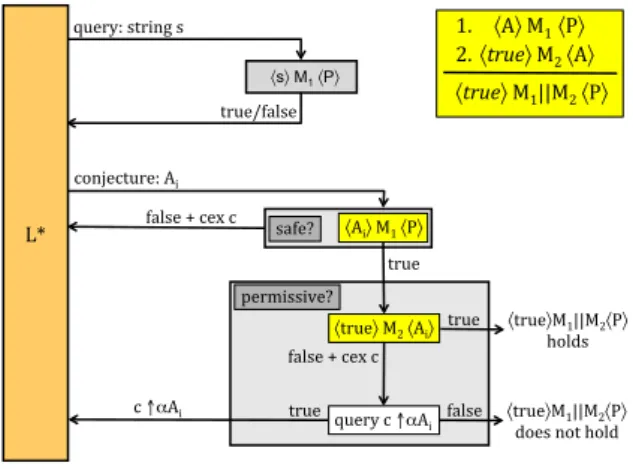
In 2003, Cobleighet al.[Cobleighet al., 2003] introduced the application of learning-based frameworks to compositional reasoning. Concisely, their idea was to apply an off-the-shelf learning algorithm to automatically generate assumptions in an iterative, incremental and automated fashion. The high-level methodology attempted in these works [Cobleighet al., 2003; Nam and Alur, 2006; Cobleighet al., 2008] is shown in Figure 2.2 (reproduced from [Giannakopoulou and Pasareanu, 2013]).
At a high-level, and as shown in Figure 2.2, theL∗learning algorithm (Section 2.1.2.1) is used to construct incrementally an assumption for assume-guarantee reasoning. The technique starts by learning those stringssthat keepM1“safe” relative to the property P. Eventually,L∗will generate a “candidate assumption”Aiencapsulating all known
“safe” strings. IfM1, when composed withAi, is also safe with respect toP, it is then
necessary to check ifAiis a valid assumption to abstract the moduleM2. If either of these two checks fail, the evidence generated by the model checker for this failure can be used to refine and re-learn the next candidate assumption.
2.1.2.1 L∗Algorithm
TheL∗ algorithm was originally introduced by Angluin [Angluin, 1987], while the
complexity bounds and efficiency of the original procedure were later improved by Rivest and Schapire [Rivest and Schapire, 1993].
2.1 Compositional Verification 33 conjecture: Ai safe? true false + cex c true permissive? c ↑αAi 1. 〈A〉 M1 〈P〉 2. 〈true〉 M2 〈A〉 〈true〉 M1||M2 〈P〉 〈true〉 M2 〈Ai〉 false + cex c false true 〈Ai〉 M1 〈P〉 query c ↑αAi 〈true〉M1||M2〈P〉 holds 〈true〉M1||M2〈P〉
does not hold query: string s
〈s〉 M1〈P〉 true/false
L*
Fig. 2.2.Learning Assumptions for Assume-Guarantee Reasoning
L∗ learns an unknown regular languageU, over an alphabetΣ, and produces a
deterministic finite automaton (DFA)C, such that the language accepted byCisU. To learnU, theL∗algorithm interacts with a “minimally adequate teacher” (teacher). The algorithm queries the teacher with two kinds of question:
1. Membership Query– this asks, given a stringσ∈Σ∗, whetherσ ∈U. When σ∈Uthe teacher returns true, and false in all other cases.
2. Equivalence Query– an equivalence query takes the form of a conjecture byL∗, i.e., the algorithm generates a possible candidate DFACand asks if L(C), the language accepted byC, is the same asU. WhenL(C) =U the teacher returns true. When it returns false, the teacher also returns a counterexample, which
is an element in the symmetric difference between LandU (i.e., a member of
((L(C)\U)∪(U\ L(C)))).
L∗collects information about strings which are, or are not, members of the language
U. This is done by building an observation table containing the set of suffixes and prefixes that have been learnt to be included in the language.
2.1.2.2 Assume-Guarantee Reasoning for Labelled Transition Systems
Various authors [Cobleighet al., 2003; Cobleighet al., 2008; Pasareanuet al., 2008] have appliedL∗-based learning for assumptions to the problem of compositional verification for labelled transition systems (LTS) and trace-based properties. For further details on LTS, we refer the reader to [Magee and Kramer, 1999].
In the following, letActbe a set of universal observable actions and letπdenote an error state. Trivially, for a given safety property, when an LTS enters an error state, then it is in violation of the property.
Properties.
An LTS that contains noπstates is called a “safety LTS”. A safety property is specified as a safety LTSP, where the language ofL(P)specifies all of the safe behaviours over a set of actionsαP.
An LTSM“satisfies” the safety LTSPiff:
∀σ∈ L(M) (σ↓αP)∈ L(P)
i.e., all of the traces ofM, when restricted (denoted↓αPin the above) to the alphabet ofP, are also traces ofP.
To check an LTS safety propertyP, an “error LTS”Perris constructed, which traps
violations ofPin the error stateπ. Given an LTS safety propertyP=hQ,αP,δ,q0i, Perr=hQ∪ {π},αPerr,δ0,q0i, whereαPerr=αPand:
δ0=δ∪(q,a,π)|a∈αPand@q0∈Q: q,a,q0∈δ
That is, the transition relationδ0for the safety LTSPerris the (potentially non-serial)
transition relation forP, but for every transition that does not exist inP,Perrtransitions
to the error stateπ.
To check the conformance ofM toP, the parallel composition ofMkPerr is
con-structed, and then it is verified ifM|=Pis true by checking ifπ is not reachable in
MkPerr.
Learning-based assume-guarantee reasoning.
To check if an assume-guarantee triple hAiMhPiholds for a componentM, where
bothAandPare given as safety LTS, it is possible to simply check if the stateπ is accessible inAkMkPerr. Ifπ is not reachable, thenhAiMhPiis satisfied. The
learning-based approaches consider the application of learning in the context of the following assume-guarantee rule with safety properties:
htrueiM1hAi
hAiM2hPi
htrueiM1kM2hPi as per Section 2.1.1.1.
The learning algorithmL∗is applied to learn a candidate assumptionArepresenting
2.2 Logics for Reasoning about Computations 35
to still satisfyP. That is, ifAistoo muchof an abstraction ofM1(i.e., it allows more potential behaviours), then this could leadM2to be potentially unsafe.
To find a suitable assumption AofM1, L∗ constructs an assumptionA over the alphabetAct, such that the stringt∈ Act∗is in the language ofAiffhtiM2hPi. As beforehtiM2hPiholds iffπis unreachable intkM2kPerr.
L∗ can then be used to iteratively learn an assumptionA, over the alphabetAct, which is:
• strongenough to constrain the behaviour ofM2such thathAiM2hPiholds, and • weakenough such thathtrueiM1hAiholds.
The learned assumption therefore contains all traces ofM1, abstracted toAct∗, that preventM2from violatingP.
While the techniques of Cobleighet al.were implemented in theltsatool [Magee and Kramer, 1999], there are a number of extensions to these works, taken in different contexts. For example, Guptaet al.[Guptaet al., 2008] apply SAT-based algorithms and Aluret al.[Aluret al., 2005a; Nam and Alur, 2006; Namet al., 2008] apply the technique to learn assumptions in the context of safety properties innusmv.
2.2 Logics for Reasoning about Computations
We now discuss some logical formalisms related to the theme of modular verification.
We begin by surveying approaches based on modularmodel checking andmodule
checking(Section 2.2.1) using the standard semantics for various temporal logics. In Section 2.2.2, we then consider non-standard semantics of temporal logics. We highlight that these semantics are of interest as they potentially support modular verification.
2.2.1 Modular Model Checking and Module Checking
We now introduce module and modular model checking.
2.2.1.1 Modular Model Checking
The idea of modular model checking [Kupferman and Vardi, 1997a; Kupferman and Vardi, 2000] is very closely akin to the compositional approach of Long [Grumberg and Long, 1994] presented in the previous section. The authors demonstrate how an automata-theoretic verification forfair model checking can be suitably extended to support space-efficient verification of a CTL∗guarantee against themaximal modelof a
The authors present both a space-efficient model checking procedure based on au-tomata, as well as investigating the complexity of the various approaches.
A specific case of modular model checking is that oflinear-branching modular model checking, which was introduced in [Vardi, 1995]. In the linear-branching paradigm, Vardi considers the verification of a branching-time guarantee in the context of a linear-time assumption. We investigate this further in Chapter 5.
2.2.1.2 Module Checking
Modular model checking was further advanced tomodule checkingin [Kupferman
and Vardi, 1996; Kupferman and Vardi, 1997b; Kupferman et al., 2001]. In these
works, the authors consider verification of a given component in a completely chaotic
environment [Roscoeet al., 1996; Sidorova and Steffen, 2001; Leino and Logozzo,
2005]. This was called “open satisfaction”. For an “open system”M(i.e., a system that receives input/can communicate with its environment), the “open satisfaction” problem is to decide ifMsatisfies a formulaϕfor all possible environmentsE.
In [Kupferman and Vardi, 1996], the authors consider module checking in the context of compositional reasoning. That is, for an assumptionψand for all environmentsE such thatE |=ψ, doesMkE |=ϕ?
In a similar way to their previous works for modular model checking, the authors only consider the complexity of the underlying approach, rather than developing a practical and implementable verification technique.
2.2.2 Model Checking with Path Criterion
There have been approaches for verifying CTL properties against “path criteria”. It is common for these to be applied when verifying CTL properties, and using the criterion to decide which paths should be considered when performing path quantification.
The works of both [Kupferman and Vardi, 2006] and [Niebertet al., 2008] consider similar settings. In [Niebertet al., 2008], the authors introduceEmCTL∗(“Embedded CTL∗”). In Embedded CTL∗, the branching-time operators for quantifying over paths contain an additional argument of an LTL formula. Ifϕis an LTL formula, then∀ϕXψ is an EmCTL∗formula, where the satisfaction ofψat the next state is only checked for paths that satisfyϕ. Using such an approach, it is therefore possible to ignore paths that do not satisfy some categorisation of “good” paths in the model.
Kupferman and Vardi [Kupferman and Vardi, 2006] introduce an earlier work to EmCTL∗, called mCTL∗for “memoryful CTL∗”. Unlike EmCTL∗, which introduces new modalities for path quantification, mCTL∗presents new semantics for path quantification based on the special propositionpresent. When checking the formulaEFϕin mCTL∗
2.2 Logics for Reasoning about Computations 37
at a states, the approach of Kupferman and Vardi is to first generate the new proposition
presentsuch that it holds only ats, and then to check if there exists a path starting at the initial state that satisfiesFϕ. To obtain the regular semantics for CTL∗, the proposition
presentcan be used as follows:
EFϕ≡EF (present∧Fϕ)
Where the left-hand expression is a standard CTL formula, and the right-hand is its mCTL∗equivalent. It clearly follows that the formulaEF(present∧. . .)is sufficient for us to “return to” the statesin order to begin evaluatingFϕ. Checking this formula under the mCTL∗semantics then means thatϕis only checked at the states.
Therefore, an immediate embedding of EmCTL∗into mCTL∗is possible:
∃ϕ
ψ≡E((ϕ)∧F(present∧ψ))
It is argued however [Niebertet al., 2008] that, although mCTL∗subsumes EmCTL∗, the complexity of the model checking procedure for EmCTL∗is lower and therefore a native approach for EmCTL∗can be favourable.
Related to these works is the approach for MCTL [Josko, 1987] (“Modular CTL”). Josko’s presentation of MCTL is directed towards modular verification, although his language of assumptions is not that of a full LTL, as is supported in [Kupferman and Vardi, 2006; Niebertet al., 2008]. By comparison, in MCTL, it is only possible to use nesteduntilformulae, without negations, and Boolean expressions over propositions, nested under a top levelgloballyformula. When checking a CTL “guarantee” in MCTL, the quantification of paths occurs only over those paths that satisfy the assumption. While semantics are provided, as well as hinting to the complexity of the technique and suggesting the application to modular reasoning, unlike [Kupferman and Vardi, 2006; Niebertet al., 2008], Josko [Josko, 1987] does not provide an algorithmic approach for verifying an MCTL formula.
2.2.2.1 Modular Verification for Software using Filters
Following from the above, and still while considering the ability to “mask” undesirable behaviours from the state-space, the works [Dwyer and Pasareanu, 1998; Pasareanuet al., 1998; Pasareanuet al., 1999] consider the idea of model checking in the context of
filters. These filters can be used to “refine” (via filtering out) a generated state-space to assist in model checking.
These works consider using an LTL formula (and later a CTL formula) to remove those states from an analysis that do not meet the specification. As such, in an assume-guarantee context, an LTL filter can be used as the assumption and then it can prune states from the component under test that are not considered with the formula.
To support this, they consider a restricted class of safety formulae. For this class of formulae, the authors note [Pasareanuet al., 1999] that it is possible to obtain a deterministic finite automaton that corresponds to themaximal tableauof a formula. The finite automaton is obtained by first constructing the non-deterministic Büchi automaton for the formula, then by “ignoring the acceptance conditions”[Pasareanuet al., 1999], the authors obtain a finite automaton.
In this finite automaton, it is claimed that every path in the tableau trivially satisfies the formula. Consequently, it is possible to perform assume guarantee reasoning by composing the component under test with the tableau, and then performing model checking using the standard approaches.
2.2.3 Local and Modular Specifications
As we further motivate in Chapter 5, when performing modular verification, it is a sensible restriction to only consider specifications defined over components we wish to verify. We now discuss some works with a similar motivation.
In [Engelhardtet al., 1998], the authors present an approach for reasoning about individual agents using local propositions. Using an observation we also use in Chapter 5, it is shown that the verification of knowledge can be suitably reformulated under a logic of “local propositions”, where these propositions can be generated “at run-time”. For example, when checking knowledge it is necessary to consider all possible states where an agent has a current configuration; if it is possible to assert a propositionpithat only
holds at states satisfying this configuration, then it is possible to checkG(pi→ϕ). That
is, do all states satisfyingpialso satisfy the epistemic subformula being verified?
In an epistemic setting, this framework is the basis of [Hoek and Wooldridge, 2002] and is used to implement epistemic model checking on top of the model
checkerspin [Holzmann, 1997; Holzmann, 2004]. Furthermore, the work of [van
Ditmarschet al., 2012] considers the schemas and logical validities in such a logic In [Caleiroet al., 2005], the authors introduce DTL, a distributed temporal logic, containing component local specifications. As an integral part of the logic, is it possible to specify properties that pertain to an individual agent in the system using the syntax:
@i[Li]
where @iis read “at the agenti”, andLiis the set ofi-local formulae with the syntax: Li::=Acti|Propi| ⊥ | Li→ Li| LiULi| LiSLi|@j[Lj]
whereActiis a set of propositions overi’s actions andPropiis a set of propositions over
2.2 Logics for Reasoning about Computations 39
It can be seen that, although components’ local specifications are able to “branch” to other components using the operator @j, a majority of the specification language
pertains to only the current agenti. We note that in [Caleiroet al., 2005], a large number of presented specifications are purelyi-local, and therefore do not make use of the @j
modality in aLiformula.
In a similar context [Filippidiset al., 2012] considers “Local LTL” formulae for synthesising LTL controllers for individual components based on their private specifica-tions. Although specifications are provided individually, it is possible to ensure that the overall system can achieve the desired goals by allowing agents to communicate their synthesised controller to other agents.
In the context of assume-guarantee, [Lomuscioet al., 2013] makes explicit the
application of local specifications to modular verification. The work places a restriction on the modular framework to verify a global specificationϕwhich is the conjunction of a component-specific guarantees. Therefore, the component-specific guaranteeϕi
is a local specification defined only over the component Mi. Additionally,
component-specific assumptions, manually specified as Büchi automaton (Section 3.4) are used to check if each component satisfies its guarantee. It then immediately follows that if each component separately satisfies its guarantee, and if the top-level specification is a conjunction of all of these formulae, the full composition trivially meets its requirements.
Furthermore, in a temporal-epistemic context, Russo [Russo, 2011] considers a multitude of agent-local specifications, applied to both multi-agent card games and to a software development protocol example we consider ourselves later in this thesis (Section 6.5.2).
2.2.4 Automata-Theoretic Verification for Branching Structures
We now consider automata-theoretic approaches for various branching structures and logics. As we present in Section 3.3, knowledge forms abranchingstructure, and cannot be verified in the same way as linear-time properties.
2.2.4.1 Automata-Theoretic Verification of Knowledge
We begin by discussing, to the best of our knowledge, the only approach for applying automata theory to the verification of temporal-epistemic formulae.
In [van der Meyden and Shilov, 1999], the authors consider an automata-based ap-proach for the verification of multi-agent systems against linear-time temporal-epistemic formulae. They adopt the semantics of synchronous perfect recall[Faginet al., 1995]. This is where all agents have a common, synchronous and observable clock – as well as being endowed with the ability to recall all possible states. To achieve the verification
of this, the authors present a notion of “forests of trees”, where each forest emanating from a node in the tree is the set of states that a particular agent considers possible.
To verify a linear-time temporal-epistemic formula, the authors suggest using an infinite number of Büchi automata, each of which can be used to verify if a subtree satisfies a given formula. As such, for each instance where a knowledge operator needs to be evaluated in the tree,nBüchi automata (one for each subtree) need to be created and their acceptance checked. When descending through a formula, each time an epistemic subformula is considered, then its nesting depth is decreased by one. As such, while a potentially infinite number of Büchi automata are required, this is bounded by the nesting depth of the formula, as a new forest is only required for each epistemic modality that occurs in the formula.
Unfortunately, as the authors consider the synchronous perfect recall semantics with common knowledge they show that various aspects of the model checking procedure are undecidable. Furthermore, the authors themselves state that “the algorithm [to check if a formula is satisfied in an environment] is not yet fully operational” (i.e., the procedure is not complete/finished in algorithmic terms). This is due to needing to calculate the set of states where an LTL formulaϕholds, which was not well established at the time of writing.
We also note that the approach is not a purely language-theoretic (i.e., based on language containment) method for deciding if a given multi-agent system satisfies a formula. While Büchi automata are used to check the satisfaction of the linear-time formulae, it is a procedure external to the automata that is used to check the epistemic modalities.
We note that Mohaliket al.[Mohalik and Ramanujam, 2010] consider automata as a foundational structure for representing and capturing epistemic knowledge. While they allude to the benefits of verification of epistemic properties by automata—and that it is a little explored field—they do not consider their theory in such a setting.
2.2.4.2 Symbolic Automata-based CTL Model Checking
In [Qian and Nymeyer, 2006], Qianet al.present a method for checking language
emptiness of a certain class of automata (Section 3.4.2.3) usingbinary decision diagrams
(BDDs) [Bryant, 1986; McMillan, 1992] rather than standard, explicit-state methods. BDDs are reduced, canonical representations of Boolean formulae. Importantly, they allow for the efficient calculation of operations such asand,orandnegation. There exists a large body of existing work in applying symbolic methods (in particular BDDs) to set-theoretic approaches to model checking. These approaches have been shown to be very efficient [Burchet al., 1992].
As will be shown in Chapter 4, model checking a structure against a formula can be translated to checking the (non-)emptiness of the product automaton for the formula
2.3 Reducing the State Space for Multi-Agent Systems 41
and the structure. Qian et al.[Qian and Nymeyer, 2006] apply a method of “state
recording” to emulate the double depth-first search approach [Holzmannet al., 1997] of explicit-state model checkers to decide if a path is accepting or not.
Using BDDs, they construct the “AND/ORgraph” for the non-emptiness problem of the product structure, and then perform reachability checking to find a solution for the graph. In their work, the authors prove the following: theAND/ORgraph for product automaton ofKandϕ,AK,ϕ, has a solution graph iff the language ofAK,ϕis non-empty
(i.e., the structureKsatisfiesϕ).
The idea behind state-recording is to duplicate the set of state variables. These duplicates can then be used to detect if a state has been visited previously in an accepting run. This is similar to the strongly-connected component detection in explicit-state approaches.
Their technique, implemented into the symbolic (i.e., BDD-based) model checker nusmv, achieved results suggesting the automata-theoretic approach can be preferable to the standard set manipulation approaches.
2.3 Reducing the State Space for Multi-Agent Systems
We now briefly survey some recent developments in the area of state-space reductions for verifying multi-agent systems. We purposefully exclude approaches dealing with efficient representation of the state-space (e.g., SAT-based or BDD-based methods), and concern ourselves with approaches that reduce theinputstate-space to be verified.
2.3.1 Symmetry Reduction
Symmetry reduction for MAS [Cohenet al., 2009a; Cohenet al., 2009b] attempts to reduce the size of the state-space by identifying isomorphic subgraphs of the state-space due to replicated components. As such, while the traces of the components may be different, they are automorphic based on the reordering of local states in the set of global states. By taking these duplicated behaviours into consideration, it is therefore possible to collapse the size of the reachable states.
Following the so-called counterpart semantics, under symmetry reduction it is pos-sible to demonstrate that the abstract system and its concrete counterpart satisfy the same set of formulae. This is because the automorphism preserves the relations between states in both the concrete structure and the reduced one.
2.3.2 Partial Order Reduction
The idea behind partial order reduction for multi-agent systems [Lomuscioet al., 2010a] is that not all interleavings of actions are of interest when considering formulae without the “next-time” (X,AXorEX) operator. Therefore, to avoid the state-space explosion problem, it is possible to construct a model that does not contain all of the interleavings for the independent actions of all of the agents in the model.
In this setting, the authors are only able to consider the class of interleaved (asyn-chronous), and not synchronous, multi-agent systems that we consider in this thesis.
2.3.3 Parametric Verification
Parametric verification for MAS was studied [Kouvaros and Lomuscio, 2013a; Kouvaros and Lomuscio, 2013b] by looking at the possibility of identifying acut-off for temporal-epistemic model checking. Given a family of homogeneous agents (i.e., identical), the parametric technique will identify a cut-off parameterk, such that if a composition
containingk agents satisfies a formula, then a composition containing any number
of agents (even aninfinitenumber) will also satisfy the formula. Verifying a model containing a cut-off number of agents allows the technique to decide the satisfaction of a formula irrespective of the number of agents in that composition.
It is noted that parametric verification induces a simulation pre-order between the larger model and its cut-off; therefore, the technique is not complete (i.e., an answer of “false” could be either due to a fault in the model or due to the simulation not being strong enough).
2.3.4 Existential Abstraction
Existential abstraction looks atclusteringstates under a quotient structure, and comput-ing an over-approximation of the state-space. That is, by sacrificcomput-ing preciseness in the calculation of the exact state-space, efficiencies can be obtained.
By clustering local states of the agents together, and inserting a local transition between two clustered states if there exists a transition in that agent’s unclustered equivalents, we observe that the behaviour of the abstract agent is an over-approximation of the behaviour of the concrete one.
In [Cohenet al., 2009c; Lomuscioet al., 2010b], it is proven that, if an abstract model satisfies a universal temporal-epistemic property, then so does its concrete equivalent. However, a negative result in the abstract domain does not carry across to the concrete
2.3 Reducing the State Space for Multi-Agent Systems 43
domain: the formula may either be genuinely false or the over-approximation may have included spurious behaviours.
2.3.4.1 Abstraction Refinement
Given an over-approximation of the state-space, if a formula is false, it is therefore necessary to decide if this formula was genuinely false, or if it was caused by the abstraction methodology. To address this deficiency, the approach ofcounterexample guided abstraction refinement(CEGAR) has been advanced to a MAS-based setting by various authors [Jones and Lomuscio, 2011; Zhouet al., 2011; Koleiniet al., 2013].
When performing CEGAR, two steps are added to the abstraction methodology: 1. Counterexample validation – this is where a possibly spurious counterexample is
checked for validity against the concrete components. If the counterexample is shown to be valid, then the process can terminate with a definitivefalseresult. 2. Abstraction refinement – however, if the formula is shown to be spurious, the
clustering function used to preform abstraction is modified to remove the possibility of this spurious behaviour.
These two steps can be incrementally performed until either:a) the method returns true;b) the method returns false and the counterexample is shown to be valid; orc) the refinement reaches the original concrete model, and therefore one final check can be performed to generate a definitive answer.
2.3.5 Modular Verification for Multi-Agent Systems
We now discuss some of the works that aim to look at modular verification of multi-agent systems. We note that, to the best of our knowledge, there exist no works applying the assume-guarantee paradigm to the verification of multi-agent systems against the rich properties we consider in this thesis (Section 3.3.2.4).
Hierarchical verification.
In 2002, Engelfrietet al.[Engelfrietet al., 2002] introduced an approach for composi-tional verification against formulae intemporal multi-epistemic logic. However, this work considers the compositional verification properties in the face ofaggregation
rather thanparallel composition(i.e., of properties from hierarchies of structures, rather than concurrent systems). Furthermore, the compositional verification approach also follows aproof theoreticmethod; rather than verifying components in the face of an environmental abstraction (e.g., an assumption in the assume-guarantee paradigm), they