THE IMPLEMENTATION OF SCIENTIFIC APPROACH ON SPEAKING SKILL AT SECOND GRADE STUDENTS BASED ON LEARNING STYLE IN SMAN 1 PRINGSEWU
Maria Tyasti G. C., Ag. Bambang Setiyadi, Mahpul English Department, University of Lampung
Abstrak. Penelitian ini bertujuan untuk mengetahui i) bagaimana implementasi pendekatan saintifik dapat meningkatkan kemampuan berbicara siswa dan ii) apakah gaya belajar siswa mempengaruhi kemampuan siswa. Penelitian ini menggunakan desain pre-experimental. Sasaran penelitian sebanyak 28 siswa kelas XI di SMAN 1 Pringsewu. Kuesioner dan tes berbicara digunakan sebagai alat untuk pengambilan data. Hasil penelitian menunjukkan bahwa adanya peningkatan kemampuan berbicara siswa yang signifikan dengan tingkat signifikansi 0.05 setelah pengimplementasian pendekatan saintifik. Gaya belajar siswa juga terbukti berpengaruh terhadap nilai kemampuan berbicara siswa. Hal ini menandakan bahwa dengan pengaplikasian prosedur yang tepat, pendekatan saintifik dapat diimplementasikan untuk meningkatkan kemampuan berbahasa Inggris siswa. Hasil juga membuktikan bahwa faktor internal seperti gaya belajar juga berpengaruh akan suksesnya siswa dalam belajar berbahasa.
Abstract. The objectives of this study were to find out i) the effect of implementation of scientific approach on students‟ speaking achievement and ii) whether students‟ learning style preferences affect students‟ speaking capability. The research used pre-experimental design. The subjects were 28 second year science class students of SMAN 1 Pringsewu. Questionnaires were employed to collect the data of the students‟ learning style preferences and speaking tests were conducted to identify students‟ speaking achievement. The results showed that there was a significant improvement of students‟ speaking achievement after the implementation of scientific approach with significant level 0.05. Students‟ learning style preferences also affected speaking ability. The results suggest that scientific approach facilitates the students to improve their English proficiency. In addition, learning style preferences also contributed to students‟ success in acquiring language.
2
1. INTRODUCTION
Speaking skill is important for students to master because language usually focuses more on oral production than on written production. Speaking ability also indicates how capable students are on their language comprehension since speaking engages all three important components of language; vocabulary, grammar, and pronunciation. If the students are able to speak well, they will comprehend those three linguistic components well.
However, as a matter of fact in Indonesia, many students do not feel confident to express their ideas. They are afraid of speaking English. This is because the students have not been provided with techniques that encourage them to keep speaking.
Nowadays, Indonesia Education Ministry is now developing an approach called Scientific Approach in 2013 curriculum for all subjects including English. This approach is a focused-on-student approach which aims to develop students‟ affective skill, cognitive skill, as well as performative skill. This approach has five stages in whilst-activity; they are (1) observing, (2) questioning, (3) experimenting, (4) associating, and (5) communicating. This approach seems to be able to develop students‟ speaking skill since it encourages students to speak in the stages included.
There have been several studies concerning the implementation of scientific approach and speaking skill. Utami (2016) implements scientific approach to teach speaking to junior high school students, and she found out the facts that many students got high score (87,93% are above passing grade). Related research was done by Henelawati (2015). She implemented scientific approach to help Arjuna Vocational School Students in mastering speaking skill. The finding of her research shows that the students made an improvement in the post-test, comparing to the pre-test.
However, curriculum is not the only one factor affecting students‟ capability in English. As the development of the technology, teachers nowadays could use many different kinds of methods, techniques, materials, as well as media to teach speaking. Government is also supporting teachers by obligating some training to develop teachers‟ professionalism. Teachers are trained to have better understanding about language approaches, broader knowledge about methods and techniques, more interesting and relevant English materials, as well as wider preferences for teaching speaking media.
Being focused on teachers‟ professionalism is not totally wrong; however there are still many factors that could increase students‟ achievement. According to Reid (1987), educational study has recognized a number of factors for some of the differences in how students learn. Dunn and Griggs (1989) add that one of these factors, that is learning style, is of widespread interest in the education area. For addition, Ellis (2005) also lists seven factors while explaining individual learner differences, namely beliefs, affective state, age, aptitude, learning style, motivation, and personality.
We cannot say that learning style is ability; it is more likely how people prefer to use their ability. Keefe (1982) defines learning styles as “cognitive, affective and physiological traits that serve as relatively stable indicators of how learners perceive, interact with, and respond to the learning environment‟ and which „reflect genetic coding, personality development, and environmental adaptation”. Language learning styles and strategies emerge to be among the most important variables affecting
3
performance in a second language; this statement is suggested by Moenikia and Zahed-Babelan (2010). As the researcher has mentioned, teachers now are concerning with only teaching style (methods, techniques, media), yet they are unaware of how their students learn. Thus, it is important to pay attention on the students‟ learning style.
There have been several studies related to students‟ learning styles and their English performance. The first study was done by Jhaish, M.A. (2010). He conducted a research entitled The Relationship among Learning Styles, Language Learning Strategies, and the Academic Achievement among the English Majors at Al-Aqsa University, and found that there was a presence of correlation between students' learning style and the academic achievement. It was found that there is statistically significant correlation coefficient between the academic achievement and auditory learners.
The second research was conducted by Chavosh and Davoudi (2016). They were going to find out the relationship between perceptual learning styles and reading comprehension performance of 60 Iranian EFL learners. The result of this study revealed that tactile and kinesthetic learning styles had a significant relationship with L2 reading comprehension performance.
A more complex research was also carried out by Moenikia and Babelan (2010) which investigated the role of learning styles in second language learning. They used TOEFL examination including four sections (listening, writing, structure, and reading) as a criterion for second language learning. The result discovered that the average scores of students with different learning styles were significantly different.
Based on those researches, the researcher believes that the understanding of students‟ learning style is fundamental to consider approaches, methods, as well as techniques to use in teaching our students.
There have been many researches relating to the implementation of scientific approach in improving students‟ speaking skill; even though there are still many mistakes and error in the application of each step, scientific approach is proven able to improve students‟ speaking performances. However, there has been no research intending to find out the implementation of the approach with concerning students‟ learning styles. Thus, this study was carried out with the research questions:
1. How could the implementation of scientific approach improve students‟ speaking achievement?
2. Do learning style preferences affect students‟ speaking achievement?
2. METHODS
This study was a quantitative research which used one group pretest-posttest design. The population of this research was the second grade students of SMAN 1 Pringsewu in academic year of 2016/2017. The sample was XI IPS 1 which was consisted of 28 students. The instruments of this research were speaking test which consisted of pretest and posttest, as well as questionnaire. The researcher conducted three meetings of treatments to implement scientific approach. The test was considered as valid in content validity since the test of writing constituted a representative sample of the language skill and structure and also the material used were chosen based on 2013 Curriculum for second year of senior high school. Then, the test was constructed
4
and scored based on speaking theory. The results of inter-rater reliability tend to be very high reliability which were respectively 0.859 and 0.919 in pre-test and post-test.
3. RESULTS
3.1. How the Implementation of Scientific Approach could Improve Students’ Speaking Achievement
In the first meeting of the treatment, there were three main steps of activities which were done. There were pre activity, main activity, and post activity. In the pre activity the researcher greeted the students. After that, the researcher asked students to pray. Afterwards, teacher checked the students‟ attendance, explain the purposes and benefit of the lesson, and explain the activities that were going to do by students.
In the main activity, the researcher implemented scientific approach. First step was observing. The researcher played a video related to the topic: offering help. The video showed an activity in an office. There were several persons in the office, and there was a woman who offered her helps to her work-mate. The researcher asked the students to pay attention to the video which was played for three times. The researcher also asked the students to take a note if they noticed something important or if they had questions.
The second step was questioning. In this stage, the students are supposed to ask questions related to their understanding of the video. However, when the researcher asked the students “Do you have any questions?”, no one of the students raised their hand. So to overcome this situation, the researcher instead asked questions to the students such as “Can you mention the characters in the video?” and “What is the problem that the man has?”. When the researcher asked some questions, several students raised their hands trying to answer the questions. It turned out that the students understand the video.
The third step was reasoning. In this stage, the students are supposed to associate the material that they had got. The researcher started this stage by saying “Okay, students, you have watched a video about offering help. Now would you tell me what kind of sentence or phrase that we can use to offer help to people?” Then some students raised their hands, and the researcher asked the students to come forward one by one to type the phrase they know on the laptop which was connected to the projector. After that, the researcher asked the students to discuss the phrase together whether there were any mistakes on the grammar or spelling. The researcher corrected the phrases together with the students and then asked the students to pronounce the expressions of offering help together. The researcher firstly demonstrated the pronunciation then asked the students to repeat after her.
The fourth stage in the main activity is experimenting. The researcher asked the students to work in pair and tried out what they had learnt. The researcher firstly asked the students to identify some problems that they might face as students. From the identified problems, the students were asked to offer helps to their friends to overcome the problems. Each pair made a dialogue based on the problem and the help offered. Then the teacher asked the students to practice their dialogue on their seats.
The fifth stage is communicating. Especially in this first meeting, the researcher did not ask the students to present their dialogue in front of the class. The students were asked to record their dialogue in form of video. Since the video could not be recorded
5
straightly in the class, the students practice their dialogue on seats. The researcher went around the class to make sure that all students practice the dialogue with their friends. The researcher also corrected the students if they made mistake especially on the pronunciation and grammar.
In the post-activity or the end of the class, teacher provided positive feedback and reinforcement to the students. The aim of this activity was for making the students become interested in learning. The researcher also reminded the students to record their video before closing the class.
The second meeting of the treatment was still similar with the first one. In the second meeting of the treatment, there were three main steps of activities which were done. There were pre activity, main activity, and post activity. In the pre activity the researcher greeted the students. After that, the researcher asked students to pray. Afterwards, teacher checked the students‟ attendance, explain the purposes and benefit of the lesson, and explain the activities that were going to do by students.
In the main activity, the researcher implemented scientific approach. First step was observing. Since the students had submitted their videos about offering help, the researcher chose to play some videos created by the students. The students paid attention to the videos, and they sometimes laughed to their friends‟ acts in the video.
The second and the third step were questioning and reasoning. In this meeting, the researcher combined both steps. The teacher asked the students to tell their experiences or ask if they had difficulties while creating the video. Some students were really enthusiastic in telling their experiences and asking some questions such as: “Miss, how to pronounce this?” or “Miss, can we use this phrase?”. Thus, the researcher answered their questions and gave explanation in order to strengthen their knowledge.
The fourth stage in the main activity is experimenting. The researcher asked the students to work in pair and tried out what they had learnt. The researcher firstly asked the students to identify some problems that they might face as students. From the identified problems, the students were asked to offer helps to their friends to overcome the problems. Each pair made a dialogue based on the problem and the help offered. Then the teacher asked the students to practice their dialogue on their seats.
The fifth stage is communicating. Especially in this first meeting, the researcher did not ask the students to present their dialogue in front of the class. The students were asked to record their dialogue in form of video. Since the video could not be recorded straightly in the class, the students practice their dialogue on seats. The researcher went around the class to make sure that all students practice the dialogue with their friends. The researcher also corrected the students if they made mistake especially on the pronunciation and grammar.
In the post-activity or the end of the class, teacher provided positive feedback and reinforcement to the students. The aim of this activity was for making the students become interested in learning. The researcher also reminded the students to record their video before closing the class.
The second meeting of the treatment was still similar with the first one. In the second meeting of the treatment, there were three main steps of activities which were done. There were pre activity, main activity, and post activity. In the pre activity the researcher greeted the students. After that, the researcher asked students to pray. Afterwards, teacher checked the students‟ attendance, explain the purposes and benefit of the lesson, and explain the activities that were going to do by students.
6
In the main activity, the researcher implemented scientific approach. First step was observing. The researcher played a video related to the topic: offering help. The video showed an activity in an office. There were several persons in the office, and there was a woman who offered her helps to her work-mate. The researcher asked the students to pay attention to the video which was played for three times. The researcher also asked the students to take a note if they noticed something important or if they had questions.
The second step was questioning. In this stage, the students are supposed to ask questions related to their understanding of the video. However, when the researcher asked the students “Do you have any questions?”, no one of the students raised their hand. So to overcome this situation, the researcher instead asked questions to the students such as “Can you mention the characters in the video?” and “What is the problem that the man has?”. When the researcher asked some questions, several students raised their hands trying to answer the questions. It turned out that the students understand the video.
The third step was reasoning. In this stage, the students are supposed to associate the material that they had got. The researcher started this stage by saying “Okay, students, you have watched a video about offering help. Now would you tell me what kind of sentence or phrase that we can use to offer help to people?” Then some students raised their hands, and the researcher asked the students to come forward one by one to type the phrase they know on the laptop which was connected to the projector. After that, the researcher asked the students to discuss the phrase together whether there were any mistakes on the grammar or spelling. The researcher corrected the phrases together with the students and then asked the students to pronounce the expressions of offering help together. The researcher firstly demonstrated the pronunciation then asked the students to repeat after her.
The fourth stage in the main activity is experimenting. The researcher asked the students to work in pair and tried out what they had learnt. The researcher firstly asked the students to identify some problems that they might face as students. From the identified problems, the students were asked to offer helps to their friends to overcome the problems. Each pair made a dialogue based on the problem and the help offered. Then the teacher asked the students to practice their dialogue on their seats.
The fifth stage is communicating. Especially in this first meeting, the researcher did not ask the students to present their dialogue in front of the class. The students were asked to record their dialogue in form of video. Since the video could not be recorded straightly in the class, the students practice their dialogue on seats. The researcher went around the class to make sure that all students practice the dialogue with their friends. The researcher also corrected the students if they made mistake especially on the pronunciation and grammar.
In the post-activity or the end of the class, teacher provided positive feedback and reinforcement to the students. The aim of this activity was for making the students become interested in learning. The researcher also reminded the students to record their video before closing the class.
3.1.1. The Improvement of Students’ Speaking Achievement
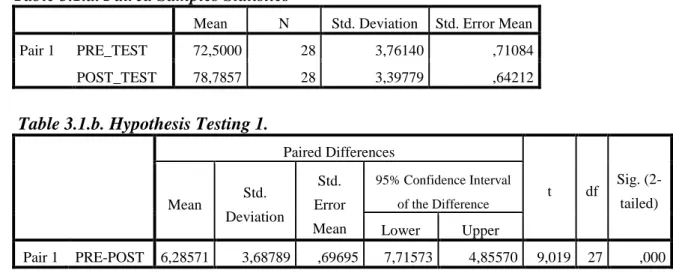
After the implementation of scientific approach, there is a significant improvement of students‟ speaking capability. This finding is proven by the average score of post-test
7
which is higher than pre-test score. Table below shows the progress of students‟ speaking achievement after the implementation of scientific approach.
Table 3.1.a.Paired Samples Statistics
Mean N Std. Deviation Std. Error Mean
Pair 1 PRE_TEST 72,5000 28 3,76140 ,71084
POST_TEST 78,7857 28 3,39779 ,64212
Table 3.1.b. Hypothesis Testing 1.
Paired Differences t df Sig. (2-tailed) Mean Std. Deviation Std. Error Mean 95% Confidence Interval of the Difference Lower Upper Pair 1 PRE-POST 6,28571 3,68789 ,69695 7,71573 4,85570 9,019 27 ,000
The table shows that the average score of the pre-test and post-test respectively are 72,50 and 78,78. It proves that there is an improvement after the implementation of scientific approach of 6,28 points. The significant level is 0.000. So it can be categorized that there is a significant different of students‟ speaking skill between pre-test and post-pre-test since p < 0.05. The t-count is 9,019 which is higher than the t-table (2,052). Thus, the researcher can conclude that there is a significant improvement of students‟ speaking skill after the implementation of scientific approach.
3.1.2. The Improvement of Speaking Aspects
This research is also intended to find out which speaking component improves the most after the implementation of scientific approach. To obtain the answer of this research question, the researcher used Multiple Paired-Samples T-test to compare the components of speaking. The researcher input the data in Ms. Excel first, to know each gain of each component. Gain could be defined by the result of the post-test subtracted by the pre-test. After getting the gain, the researcher input it to SPSS 22 and analyzed the data. The following table shows the improvement of speaking components after the implementation of the approach.
Table 3.2. Improvement of Students’ Speaking Components No. Component Pre-Test Post-Test Improvement
1 Comprehension 14,52 15,57 1,05
2 Grammar 14,23 15,29 1,06
3 Fluency 15,09 15,82 0,73
4 Pronunciation 13,93 16,11 2,18 5 Vocabulary 14,73 15,89 1,16
The table shows each gain of each component. From the table we can see that pronunciation is a speaking component which gets the highest gain; 2,18 points.
8
Vocabulary follows behind with 1,16 points, followed by grammar and comprehension respectively 1,06 and 1,05, while fluency gets the lowest gain which is 0,73 points.
As we can see in the table, students‟ pronunciation in pre-test achieved the lowest score (13,93). According to the scoring criteria, 12 means “pronunciation problems necessitate concentrated listening and occasionally lead to misunderstanding”, while 16 means “always intelligible through on is conscious of definite accent”. The students‟ average score is between the two criteria, so it means that students‟ pronunciation is already acceptable and understandable yet there were still some problems.
Meanwhile, the other four components are getting around 15 points (14,23 – 15,09). Consistent with the scoring criteria, 16 points mean that students‟ speaking capability is only affected by slight problems, such as grammatical errors which do not obscure meaning, or probably inappropriate terms in the vocabulary aspects. However, students‟ speaking performances are still well and understandable.
Despite having the lowest achievement in pre-test, pronunciation managed to score the highest in the post-test. The improvement of pronunciation aspect could reach approximately two times bigger than the other four components.
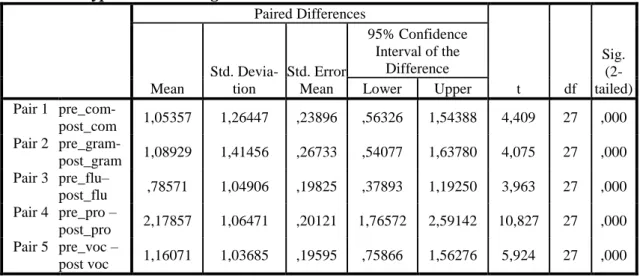
Related to the second research question, the researcher also did the statistical analysis in SPSS 22. The hypothesis testing could be seen on the following table.
Table 3.3. Hypothesis Testing 2
Paired Differences t df Sig. (2-tailed) Mean Std. Devia-tion Std. Error Mean 95% Confidence Interval of the Difference Lower Upper Pair 1 pre_com- post_com 1,05357 1,26447 ,23896 ,56326 1,54388 4,409 27 ,000 Pair 2 pre_gram- post_gram 1,08929 1,41456 ,26733 ,54077 1,63780 4,075 27 ,000 Pair 3 pre_flu– post_flu ,78571 1,04906 ,19825 ,37893 1,19250 3,963 27 ,000 Pair 4 pre_pro – post_pro 2,17857 1,06471 ,20121 1,76572 2,59142 10,827 27 ,000 Pair 5 pre_voc – post voc 1,16071 1,03685 ,19595 ,75866 1,56276 5,924 27 ,000
Each speaking components obtained different gains at 0,000 significant level, which proves that the result is significantly difference since p < 0,05.The table shows that the t-count of the statistical analysis are each higher than the t-table (2,052). This means that there is a significant effect of the treatment on each component of speaking.
3.3. The Effect of Learning Style Preferences on Students’ Speaking Achievement
The second research question of this study is intended to find out how far learning style affect students‟ speaking skill. To answer this research question, the researcher distributed questionnaire to the students. The questionnaire, which was adapted from Yufrizal (2007), consists of 40 items. Each item should be answered by
9
putting mark on the scale chosen. The scale are 4 (strongly agree), 3 (agree), 2 (disagree), and 1 (strongly disagree).
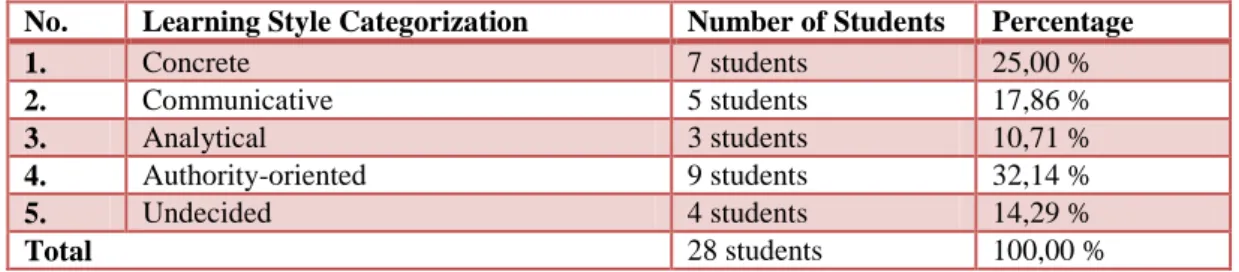
Every students‟ answer to each question was assigned the relevant number (1 for concrete category, 2 for communicative category, 3 for authority-oriented category and 4 for analytical category) and these were added up to yield a numerical total for each set. The set which has the highest total then was concluded to be predominant style for that student. So it means that the students‟ preference in learning was defined from the set of questions. There is one more category labeled as undecided for those who do not have particular preferences of learning style. The number and percentage of students‟ learning styles and their English achievement is shown in the following table.
Table 3.4. The Number of Percentage of students and their Learning Style No. Learning Style Categorization Number of Students Percentage
1. Concrete 7 students 25,00 % 2. Communicative 5 students 17,86 % 3. Analytical 3 students 10,71 % 4. Authority-oriented 9 students 32,14 % 5. Undecided 4 students 14,29 % Total 28 students 100,00 %
As seen on the table, from the total sample of 28 students, it is found that there are 7 students with concrete learning style, 5 students with communicative learning style, 3 students with analytical learning style, 9 students with authority-oriented learning style, and 4 students who are categorized as undecided. From statistical analysis, it can be seen that students with authority-oriented learning style dominate the sample.
After getting the data of students‟ learning style preferences, the researcher then analyzed students‟ learning style and their speaking achievement to identify whether learning style preferences affects students‟ speaking capability after the implementation of scientific approach. The following table shows how students‟ learning style preferences affect students‟ speaking scores.
Table 3.5. How Learning Style Preferences affect Students’ Speaking Achievement
No. Learning Styles Pre-Test Post-Test Improvement
1 Concrete 72,57 77,50 4,93
2 Communicative 69,30 80,20 10,90
3 Analytical 71,17 76,17 5,00
4 Authority 73,94 80,22 6,28
5 Undecided 73,75 77,50 3,75
Table 3.5. indicates that students‟ speaking achievement shows significance difference among different learning style. Students with communicative learning style get the lowest average (69,30), and students who get the highest mean (73,94) are those with authority-oriented learning style. Different with the pre-test, the result of speaking post-test shows significant different between the highest and lowest score. The highest mean score, achieved by authority-oriented students, is 80,22, while the lowest mean score differs around 3,95 points which is merely 76,17 scored by analytical students. This attainment on the post-test is significantly correlated with the gain. Students with
10
communicative and undecided learning style get respectively 10,90 and 3,75 points of gain which are the highest and the lowest gain.
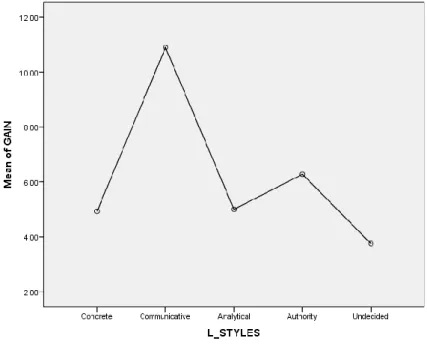
As the second research question stated, this research intends to find out whether learning style preference affects students‟ speaking performance. Thus, the researcher compared the gain of each type of learning style to examine how significant learning style affects the scores. The results are drawn on the plot below.
The plot shows that communicative has the most significant gain after the implementation of scientific approach. To prove whether the hypothesis proposed by the researcher was accepted or not, the researcher did the hypothesis testing using One Way Anova in SPSS 22. The following table shows the statistical analysis result of hypothesis testing.
Table 3.6. Hypothesis Testing 3.
Sum of Squares df Mean Square F Sig.
GAIN Between Groups 150,021 4 37,505 4,407 ,009
Within Groups 195,720 23 8,510
Total 345,741 27
The result of calculation for the first hypothesis shows that the significance level is 0.009, and it is lower than 0,05. The F count which is 4,407 is also higher that the F-table which is 2,795. Therefore, for the hypothesis, the null hypothesis was rejected and the research hypothesis was accepted. It means that learning style preferences affects students‟ speaking achievement.
To understand further about how the implementation of scientific approach affected students‟ speaking achievement, the researcher did the advanced statistical analysis using Post-Hoc in One Way Anova in SPSS 22. The post-hoc test used is LSD (Least Significance Different). This method could determine whether the averages of those five learning styles are statistically different or not. The following table shows the statistical analysis result of hypothesis testing.
11 Table 4.7. Post Hoc Test
(I) L_STYLES (J) L_STYLES
Mean Difference (I-J) Std. Error Sig. 95% Confidence Interval Lower Bound Upper Bound Concrete Communicative -5,97143* 1,70809 ,002 -9,5049 -2,4380 Analytical -,07143 2,01300 ,972 -4,2356 4,0928 Authority -1,34921 1,47009 ,368 -4,3903 1,6919 Undecided 1,17857 1,82840 ,526 -2,6038 4,9609 Communicative Concrete 5,97143* 1,70809 ,002 2,4380 9,5049 Analytical 5,90000* 2,13036 ,011 1,4930 10,3070 Authority 4,62222* 1,62709 ,009 1,2563 7,9881 Undecided 7,15000* 1,95686 ,001 3,1019 11,1981 Analytical Concrete ,07143 2,01300 ,972 -4,0928 4,2356 Communicative -5,90000* 2,13036 ,011 -10,307 -1,4930 Authority -1,27778 1,94474 ,518 -5,3008 2,7452 Undecided 1,25000 2,22798 ,580 -3,3589 5,8589 Authority Concrete 1,34921 1,47009 ,368 -1,6919 4,3903 Communicative -4,62222* 1,62709 ,009 -7,9881 -1,2563 Analytical 1,27778 1,94474 ,518 -2,7452 5,3008 Undecided 2,52778 1,75297 ,163 -1,0985 6,1541 Undecided Concrete -1,17857 1,82840 ,526 -4,9609 2,6038 Communicative -7,1500* 1,95686 ,001 -11,198 -3,1019 Analytical -1,25000 2,22798 ,580 -5,8589 3,3589 Authority -2,52778 1,75297 ,163 -6,1541 1,0985 *. The mean difference is significant at the 0.05 level.
The table suggests that communicative learning style has the most significant average difference compared to the other learning style. The symbol of star (*) shows significance between one learning style and another. The table especially in communicative learning style shows that all mean differences got stars, and the significance are all below 0,05.
4. DISCUSSION
4.1. How the Implementation of Scientific Approach could Improve Students’ Speaking Achievement
The finding of this research shows that there is an improvement of students‟ speaking skill after the implementation of scientific approach. This means that scientific approach which was proposed by the education ministry for 2013 curriculum is able to increase students‟ English proficiency; in this case especially students‟ speaking capability. An improvement of 6,27 points and significance level of 0,000 proves that there is a significant progress of after the execution of scientific approach at the second grade students of senior high school.
This finding is similar with a study done by Biantoro (2014). He used scientific approach to improve the speaking performance and participation of the tenth grade students at SMK Negeri 12 Malang. He then found out that the average score of the post-test was able to increase 10% or to 77.8 in the second speaking test. Related research was done by Henelawati (2015). She implemented scientific approach to help Arjuna Vocational School Students in mastering speaking skill. The finding of her research shows that the students made an improvement in the post-test, comparing to the
12
pre-test. Even though she did not mention the exact number of the improvement, she could conclude that the implementation of scientific approach can improve students‟ speaking ability. Another research conducted by Utami (2016) also concerned with the implication of scientific approach to teach speaking, but with junior high school students as the subject. The finding shows that by implementing scientific approach, 87,93% students are able to reach score above the passing grade.
Those three previous researches confirmed this research that scientific approach can be used in school to improve students‟ speaking capability. Speaking demands students to be well in three language features namely pronunciation, vocabulary, and grammar. It also requires the students to have good fluency and comprehension. As scientific approach has several procedures in teaching, it might help the students to mastering all five components in speaking.
Ur as cited in Utami (2016) states that there are some ways that teacher can do in solving problems in speaking; they are: (1) use group work, (2) base the activity on easy language, (3) make a careful choice of topic and task to stimulate interest, (4) give some instruction or training in discussion skill, and (5) keep students speaking the target language. Scientific approach can summarize what Ur has stated. At first, the choice of topic has been standardized in the 2013 Curriculum. Then, in observing phase, the teacher demanded the students to work in group. In observing, they were also shown some videos using easy language. This stage, added by questioning stage, is expected to stimulate the interests of the students. In associating phase, the students need to develop their discussion skill. The teacher gave them some assignments that they have to do in group, so they should discuss with their friends how to do the tasks. Overall in the procedure of scientific approach, the students were demanded to keep speaking English, moreover when it came to experimenting and communicating phase. In experimenting, students try to re-make what they have learned from the observation stage, while in communicating step, students have to communicate what the teacher demands related to the topic being learned. Students should leave their fear and hesitation behind when they, for example, present dialogues in front of the class or record their own speaking video.
The researcher also finds other researches related to the implementation of scientific approach and other skills in English. Panjaitan (2015) implements scientific approach to teach reading comprehension at SMK N 3 Jambi, and he finds out that the test result showed that the students improved their score from cycle to cycle. Zaim (2017) also finds out that scientific approach is effective to make the students actively involved in the classroom activities so that their speaking and listening skills can be improved. Nurviyani (2013) conducts a similar research related to the implementation of scientific approach concerning with writing skill. She finds out that the students are able to get better score in writing test of post-test. The progress is not too high but the improvement of their capability in writing Narrative text is significant. Thus, it can be concluded that the implementation of scientific approach can lead Indonesian students to be more proficient in English.
The answer of the second research question compares five components in speaking and the gain of each component. The finding shows that pronunciation gets the highest gain (2,18), followed by vocabulary (1,16), grammar (1,06), comprehension (1,05), and fluency (0,73) respectively.
Pronunciation gets the highest gain probably because the students learned pronunciation from the native speakers. In the observing phase, the students were
13
watching video about the topic related to the material. The video showed the conversation between two or more native speakers. Students need to watch the video carefully, observe how the speakers pronounce the words, as well as the grammar and the vocabulary they use. By observing the speakers thoroughly, the students will be able to speak quite as well as the native speakers. Not only in the observing phase, but also in the associating stage, the teacher asks the students to try out what they have heard by repeating after the teacher. In the procedure of experimenting, the students are demanded to re-create similar dialogs, and try it out with their partner. The teacher, as facilitator, goes around the class to see how the process of creating and rehearsing the dialogue of the students. The teacher also aids some students who have difficulty and ask some questions, and also corrects students‟ pronunciation if they make mistakes. When it comes to communicating, the students present their dialogs in front of the class or record it to be submitted.
To conclude, the process of learning speaking with the implementation of scientific approach is able to improve students‟ pronunciation significantly because the use of a drill in the stages. A drill is a technique which is usually used in classroom to practice new language, in this case English. It involves the teacher modeling a word or a sentence and the learners repeating it. A drill is also a form of language habituation. By drilling, the performance of the students will get better because they expose they ability to the utmost.
The second component of speaking that improves the best is vocabulary. Just like pronunciation, in the observing phase, the students also detect the vocabulary that the speakers say. The teacher also asks the students to make a note for some new words they get from the video. Besides, in the associating stage, the teachers give some assignments for the students to do, in pair well as in group. The assignments are arranging jumbled conversation, completing dialogues, and also making dialogues based on provided pictures. The students are insisted to find new vocabulary, and they will either ask the teacher if they do not understand or find the words by themselves in the dictionary. This process demands the students to get new words, and the teacher then asks them to use the new words when they make sentences or dialogues. This is probably why the students‟ vocabulary improves well.
This finding is similar to what Mursyidto (2014) found out. He used audio – video media to improve speaking skill of ten grade students in SMK Ambarrukmo 1 Sleman, and he finds out that pronunciation is the speaking component which improves the best. Vocabulary also experience significant improvement, because he states that video as authentic material provides a list of vocabularies that students can acquire. Parker (2000) also states that video and audio activities are good to improve students‟ pronunciation and grammar. She also asserts that these activities address students‟ needs and desires to improve their pronunciation and also speaking proficiency.
Regarding to comprehension and fluency which get the least improvement, it does not mean that the implementation of scientific approach can not improve those two components. It is probably because the comprehension and fluency of the students are already good at the pre-test, so they do not really improve significantly at the post-test. Moreover, the researcher also gives more emphasis on three main language aspects; grammar, pronunciation, and vocabulary. So the result of this result has already been satisfying.
From the findings and the discussion of the first and second research questions, the researcher could conclude that the implementation of scientific approach can
14
improve students‟ English proficiency in general, not only in speaking skill but also in listening, reading, and writing capability. Furthermore, the implementation of scientific approach can lead significant improvement on three important aspects in English namely grammar, pronunciation, and vocabulary. This is probably why the education ministry established this approach in the latest curriculum.
4.2. The Effect of Learning Style Preferences on Students’ Speaking Achievement
The finding of the research is seen from different perspective when learning style preference is added as moderator variable. Willing as cited in Yufrizal (2007) mentioned four categories of learning styles of language learners; they are communicative students, concrete students, analytical students, and authority-oriented students. There is one more categorization of learning style named undecided for those who do not seem to have highest preference of four identified learning style.
In her research in SMAN 1 Pringsewu, the researcher could find all the five learning style preferences on the subject. Authority-oriented category appears to be a category which most students prefer (32,14%), followed by concrete (25%), communicative (17,86%), undecided (14,29%), and analytical learning style (10,71%). According to the theory, authority-oriented learners are dependable and responsible learners. It means that mostly students in SMAN 1 Pringsewu are reliable learners. In contrast, analytic learners are learners who prefer to study by themselves and find their own mistakes in language, or they can be referred to as independent learners. This type of learners have the least percentage consisting of only three students.
Comparing the identification of learning styles and the achievement of students, the researcher also gets significant result. Students with communicative learning style get the highest score on post-test (after the treatment) as well as the highest gain (post-test subtracted by pre-(post-test). This group of learning style managed to score 80,20, with total gain of 10,90 points. Authority-oriented learning style students get the second highest gain, followed by analytical students, concrete learners, and undecided students. The gain difference of the highest and the lowest group is quite far. The lowest group, undecided students, is only able to improve 3,75 points.
Communicative learners, as have stated before, like to learn English by watching, listening to native speakers, learning by conversation, and talking to friends in English. This is why these learners get the highest score in speaking post-test as well as the highest gain. As it has been explained, this researcher uses the implementation of scientific approach as the treatment. The procedure of this approach, especially in observing and communicating step, really fits this group of learners. In observing, the students were watching English video and listening to native speakers, while in communicating stage, they were presenting dialogues in front of the class, which means the same as learning by conversation.
On the contrary, undecided or mixed-learners can only improve their speaking score 3,75 points; from 73,75 to 77,50. This number shows that unlike the communicative learners, the undecided learners can not involve in the learning process well. This group of students should be treated better than students with other types of learning styles. By giving more treatments, the students are expected to have better understanding of themselves so they could have the appropriate preferences to learn language, especially English.
15
Understanding the finding of this research, the researcher can conclude that learning style preferences has significant effect on students‟ speaking skill. The implementation of scientific approach also can be used to improve students‟ speaking ability from all types of learning style.
5. CONCLUSIONS AND SUGGESTIONS 5.1. Conclusions
1. By applying the right procedure, scientific approach can be implemented to significantly improve students‟ English proficiency. Scientific approach has been proven able to develop students‟ language skill; particularly speaking skill in this research. In some researches mentioned, the implementation of scientific approach has successfully engaged students‟ satisfactory achievement on listening skill, reading comprehension, and writing capability.
2. Being able to improve three language aspects, the implementation of scientific approach is believed to have good outcome in teaching and learning process. This research has provided evidence that scientific approach can be implemented to advance students‟ pronunciation, expand students‟ vocabulary, and enhance students‟ grammar. After having three language aspects improved, students are expected to have better self-confidence to use English in their daily life.
3. Causing different result of students‟ speaking achievement, learning style preference is believed to have significant effect on English language learning. It proves that what makes successful language learners is not only from external factors, such as methods and media, but also from internal factors; one of these is learning style preference.
5.2. Suggestions and Implications
1. Since the government has established scientific approach as the main approach for teaching in 2013 Curriculum, teachers should learn this approach carefully before implementing it in the class. Teachers also should arrange the procedure of teaching carefully so all steps, including observing, questioning, associating, experimenting, and communicating, can be applied properly and competently. All steps should be able to elevate students‟ competency in all components of language. The most important thing is to prepare the method, material, and media which are suitable with the students. Rehearsing before teaching is also needed especially for inexperienced teachers, so every step could be implemented properly.
2. Understanding that learning style preference could significantly affect students‟ achievement, it is necessary for teachers to identify students‟ learning styles at the very first meeting. Teachers should understand their students well; what type of learners the students are. Then the teachers should be able to arrange good steps in teaching which could facilitate all the children properly. Since there will not be class with all same type of learners, the teachers should be creative and innovative in deciding the teaching methods as well as media. In consequence, all of the students with different types of learning style would be able to acquire English effectively.
3. Since the subject of this research is very small, there should be conducted further research concerning in the implementation of scientific approach, speaking skill, and learning style preferences with larger number of samples. Further research
16
regarding other skills in English is also needed since there are not yet researches observing scientific approach and learning style preferences with listening, reading, and writing capability.
6. REFERENCES
Chavosh, M. & M. Davoudi. 2016. The relationship between perceptual learning styles and reading comprehension performance of Iranian EFL learners.
Dunn, R.S. & S.A. Griggs. 1989. Learning styles: Quiet revolution in American secondary schools. Clearing House, 65(1); 40-42
Ellis, Rod. 2005. Principles of instructed language learning. ELSEVIER System.
Henelawati, I. A. 2015. The effect of implementing scientific approach in KTSP to help Arjuna Vocational School students in mastering speaking skill. Jogjakarta: Sanata Dharma University.
Keefe, J. W. 1982. Student learning styles and brain behavior: Programs, instrumentation, research. Reston, VA: National Association of Secondary School Principals.
Moenikia, M. and Ahmad Z. 2010. The role of learning styles in second language learning among distance education students. Procedia Social and Behavioral Sciences;2:1169– 1173.
Mursyidto, M. I. 2014. Using audio – video media to improve speaking skill of grade x vocational students of SMK Pi Ambarrukmo 1 Sleman in the academic year of 2013/2014. Yogyakarta: Yogyakarta State University.
Nurviyani, Vina. 2013. Improving students’ ability in writing narrative text through scientific approach. JOEPALLT; ISSN 2338-3739; Cianjur: FKIP UNSUR.
Panjaitan, Sonang. 2015. The implementation of scientific approach in teaching reading comprehension at SMK Negeri 3 Jambi in the academic year 2014/2015. Jambi: FKIP Universitas Jambi.
Parker, Maria. 2000. Pronunciation & grammar: using video and audio activities. Retrieved from Research Gate website: https://www.researchgate.net/publication/242579821 Reid, J. M. 1987. The learning style preferences of ESL students. TESOL Quarterly, 21(1). Utami, W. 2016. The implementation of scientific approach to teach speaking to junior high
school students (A case study at the seventh grade students of SMP Negeri 12 Surakarta in second term of 2014/2015 academic year). Surakarta: Sebelas Maret University.
Yufrizal, H. 2007. Negotiation of meaning by Indonesian EFL learners. Bandung: Pustaka Reka Cipta.
Zaim, M. 2017. Implementing scientific approach to teach English at senior high school in Indonesia. Asian Social Science; 13(2). Retrieved from Asian Social Science Journal website: http://dx.doi.org/10.5539/ass.v13n2p33