Developing 21
stCentury Skills through
a Constructivist-Constructionist Learning Environment
1Lay Ah-Nam, 2Kamisah OsmanFaculty of Education, The National University of Malaysia Bangi, Selangor, Malaysia
1[email protected], 2[email protected]
Abstract
Science and technology innovation and 21st century skills are increasingly important in the
21st century workplace. The purpose of this study is to propose an instructional strategy that develop
constructivist-constructionist learning environment that simultaneously develop chemistry knowledge and 21st century skills. Based on constructivist and constructionist learning theories, we identified
three central guiding principles for this study: (1) engage students in discovery and problem solving task through teamwork, (2) provide opportunities for communicating ideas, and (3) involve students in the process of design. An intervention module, Malaysian Kimia (chemistry) Digital Game known as MyKimDG, was developed as a mechanism for creating the learning environment. In this study, students were required to work collaboratively to design educational media that help their peers who face difficulty in learning particular concept. They were guided to go through the IDPCR (Inquiry, Discover, Produce, Communicate and Review) phases. It is hypothesized that MyKimDG can create learning environment that allows students to deepen subject content knowledge and practice various 21st century skills in real situation. This study employed quasi-experimental study with non-equivalent
control group pretest-posttest control group design. Results suggest that this approach is able to improve the acquisition of chemistry knowledge and high productivity skill.
Keywords 21st century skills, constructionism, constructivism, IDPCR model, learning through designing
Introduction
As science and technology (S&T) innovations are increasingly important in the global
economy market of the 21st century, Malaysia needs to produce students who are capable of
generating S&T innovation to contribute to the well-being of mankind as well as to trigger the country’s economic growth. To become S&T innovators, students must be STEM
(Science, Technology, Engineering and Mathematics) literate. STEM literate students will be capable of identifying, applying, and integrating STEM concepts to understand complex problems and generate innovation to solve the problems (Chew, Noraini, Leong & Mohd Fadzil, 2013). Thus, STEM literate students must have mastered the knowledge of science. Competent STEM literate students also need to become proficient in various new skills that
are known as “21st century skills”. For instance, innovation and problem solving in today’s
world is driven by the formation of networks with multiple parties including experts and
researchers with related interests as well as consumers and customers. 21st century skills
enable one to communicate and collaborate effectively with various parties.
Nevertheless, Malaysian students’ achievement in science and 21st century skills are
not satisfactory. For instance, in the Programme for International Student Assessment (PISA) 2012 (OECD, 2014b) results, Malaysian students’ achievement in science and
mathematics ranked in the bottom third of participating countries. In addition, Trends in the International Mathematics and Science Study (TIMSS) 2011 (IEA, 2012) revealed that up to 38 percent of Malaysian students did not meet the minimum benchmarks in science. In
206 K-12 STEM Education
terms of 21st century skills, studies have reported that Malaysian students’ development of
21st century skills is not encouraging across all levels of education from the secondary to the
undergraduate level. For example, the results of PISA 2012 assessment on creative problem-solving (OECD, 2014a) showed that the achievement of 15-year-old students in tackling real-life problems is ranked 39th out of 44 participating countries. Additionally, Tengku Faekah (2005) and Hew and Leong (2011) reported that the level of Form Four and Pre-University students’ information and communications technology (ICT) skills is low. Moreover, Hazilah, Johari, Zaihosnita, Saidah and Hamizah (2013) found that the
communication and problem solving skills for undergraduate students is at the moderate level.
The above problems and situations have raised concerns about the lack of S&T human capital for the nation’s economic growth by 2020. Hence, science education in
Malaysia should emphasize simultaneously acquiring science knowledge and 21st century
skills. Based on constructivist and constructionist theories of learning, the Malaysian Kimia (chemistry) Digital Game module (MyKimDG) has been developed as a mechanism for accomplishing the desired goals. The primary focus of MyKimDG is on creating learning
environments that promote the acquisition of science knowledge and 21st century skills. In
MyKimDG, students were guided to go through the IDPCR (Inquiry, Discover, Produce, Communicate and Review) phases. The purpose of this paper is to describe the conceptual
framework of the MyKimDG module and its impact on students’ scientific knowledge and 21st
century skills.
Conceptual Framework of MyKimDG
Principles derived from learning theories play an important role in the development of MyKimDG. Two important theories in learning and education that have been incorporated into the MyKimDG development are constructivism and constructionism. The former focuses on the role of learners as builders of meanings and ideas while the latter added that the building of new ideas occur best through constructing real-world artefacts.
According to the constructivist theory of learning, the individual learner actively constructs new knowledge pursuant to his/her existing knowledge. The learner does not receive knowledge passively, but he/she interprets the knowledge received and then modifies the knowledge in a form acceptable to him/her. In addition, the process of knowledge construction can be improved through social interaction and discovery.
Interaction between learner and teacher or more skilful peers will provide scaffolding to the learner within what Vygotsky (1978) referred to as the Zone of Proximal Development to construct new knowledge. However, no interaction would be beneficial if the new
information is presented to learners traditionally. Instead, learners should be given the opportunity to explore or discover new knowledge. Bruner (1966) believed that learning and problem solving emerged out of exploration of new knowledge.
In addition to the constructivist theory, the constructionist theory of learning asserts that the construction of new knowledge happens felicitously in a context where learners are consciously involved in the production of sharable external artefacts (Papert, 1991). This theory goes beyond the idea of learning-by-doing (Papert, 1999b). Indeed, this theory emphasizes the role of design (Kafai & Resnick, 1996) and digital technologies (Papert, 1999a) in facilitating the knowledge construction. Constructionism challenges the learners to design artefacts by applying the knowledge being learned. In this process, computers or digital technologies can be used as a building material. According to Papert and Franz (1988), a computer can be a “material to be messed about with” to encourage exploration. Besides, the introduction of computers in artefact design projects enables the addition of unique and powerful aspects to the learning process. For instance, computers can serve as a convivial tool (Falbel, 1991) and the willingness of learners to learn will increase (Papert,
Vol. 3, No. 2, Apr-Jun 2017 207
1991). Papert (1980) has stated that “The computer is the Proteus of machines. Its essence is its universality, its power to simulate. Because it can take on a thousand forms and can serve a thousand functions, it can appeal to a thousand tastes”. However, he stressed that the main focus is not on the computer but on the minds of learners (Papert, 1980).
In summary, the constructivist and constructionist learning theories assert the following ideas:
Knowledge reconstruction: Learner constructs new understanding pursuant to
his/her existing knowledge.
Collaboration: Peer collaboration may trigger cognitive conflict and this may result
in reconstruction of ideas.
Exploration: Understanding is lifted when learners discover new knowledge
themselves.
Learning through designing: Learning can be enhanced if learners are involved in
designing artefacts from their own ideas.
Technological literacy: Learners use technology efficiently and effectively to
achieve specific goals.
Based on the constructivist and constructionist learning theories, the authors identified three central guiding principles for this study:
1. Engage students in discovery and problem solving tasks through teamwork.
Students should be allowed to work together to learn and discover idea or concepts. Therefore, it is essential to engage students in collaborative discovery task. Taking part in these collaborative task deepen students’ understanding as they discover or construct new understanding for themselves. Group members help each other and act as co-constructors of knowledge. This approach also assists students in acquiring problem-solving skills,
scientific literacy, and stimulating their own thinking. Furthermore, it improves students’ 21st
century skills such as collaboration, communication and interpersonal skills because students are able to practice in real world contexts.
2. Provide opportunities for communicating ideas.
Students should have opportunities to engage in discussion, and to share and exchange ideas in groups. Design justification is one way to engage students in discussion or communicating ideas. When engaging in design justification, students listen to input from peers and defend their ideas. Peer input may trigger cognitive conflict and sharpen students’ awareness of their alternative ideas when they share their ideas from their own perspective. Such scaffolding will inevitably result in self-assessing and restructuring of existing ideas, and hence towards deeper levels of understanding. Justification of design is parallel to the strategy of argumentation in science education (Bryan, Moore, Johnson, & Roehrig, 2016). Collaborative and argument-driven classrooms were reported to be more successful than traditional classrooms for improving academic achievement (Capar & Tarim, 2015; Demircioglu & Ucar, 2015).
3. Involve students in the process of design.
Problem solving requires students to integrate knowledge across disciplines, especially engineering and technology (Lee & Kamisah, 2015). Therefore, it is important to engage students in design projects as design projects are often interdisciplinary, bringing together knowledge from STEM subjects as well as other disciplines (Resnick, 2003). Design projects allow students to apply the science and mathematics to the engineering design (Bryan et al., 2016). The applications of science knowledge and practices to engineering have contributed to the technologies and the systems that support them that serve people today (National Research Council, 2012). ITEA (2000) defines technology as “the innovation, change, or modification of the natural environment in order to satisfy perceived human wants and
208 K-12 STEM Education
needs”. Clearly, technology means innovations or products that solve problems and extend human capabilities. However, the focus is not on the technology or product alone, but also on the process of design. The ultimate aim is promoting technological literacy. Students must be technologically literate to live, learn, and work successfully in today’s Digital Age.
To establish a learning environment based on the three central constructivist-constructionist guiding principles, activities in MyKimDG were designed so that students engage in discovery activities through teamwork. In addition, they are required to work collaboratively to design educational media that help their peers who face difficulty in learning particular science concepts. In this process, the designers (or students) create educational media based on their understanding. The products may be used for discussion - they share their products and design process with others, and reflect on their experiences. Eventually, they refine their products based on group consensus. Contemporary
technologies such as ICT can be leveraged to communicate, collaborate, solve problems, accomplish tasks and as construction material.
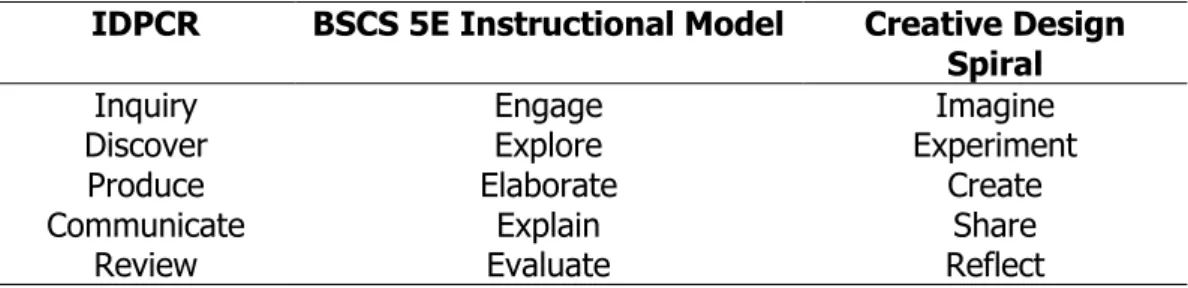
The discovery and educational media design activities in MyKimDG have been formulated based on the BSCS 5E Instructional Model (Bybee et al., 2006) and Creative Design Spiral (Rusk, Resnick, & Cooke, 2009). To increase the effectiveness of MyKimDG, the phases of the BSCS 5E Instructional Model and Creative Design Spiral have been modified and standardized. The resultant phases are Inquiry, Discover, Produce, Communicate and Review (IDPCR). The acronym IDPCR also aims to help students
remember the five important domains of 21st century skills, i.e. Inventive thinking,
Digital-age literacy, high Productivity, effective Communication and spiritual values (nilai
keRohanian) identified by Kamisah and Neelavany (2010). Table 1 shows the IDPCR phases, and related phases of the BSCS 5E Instructional Model and Creative Design Spiral. It is important to point out that the IDPCR phases do not always follow in order. For instance, at any phase, students can communicate information or findings to people from many different backgrounds and specialties to gain input from them. They are also encouraged to
communicate in groups and report back with their findings at any phase. In Table 2, the authors present the instructional activities outline of MyKimDG.
Table 1. IDPCR phases and related phases of the BSCS 5E Instructional Model and Creative Design Spiral
IDPCR BSCS 5E Instructional Model Creative Design
Spiral
Inquiry Engage Imagine
Discover Explore Experiment
Produce Elaborate Create
Communicate Explain Share
Vol. 3, No. 2, Apr-Jun 2017 209
Table 2. Outline of instructional activities in MyKimDG
IDPCR
Phase Purpose Activity
Inquiry 1. Arouse students’
interest
2. Access students’ prior
knowledge
3. Elicit students’ ideas
and misconceptions
4. Clarify and exchange
current conceptions
1. Teacher shows discrepant events.
2. Students make observations and explain
the phenomena at the sub-microscopic and symbolic levels.
3. Students discuss in groups and compare
their ideas with their peers.
Discover 1. Expose to conflicting
situations 2. Modify current conceptions and develop new conceptions 3. Provide opportunities for students to demonstrate their conceptual understanding, and skills
1. Students perform hands-on and minds-on
activities in groups.
2. Students are encouraged to engage in
discussions and information seeking.
3. Students are asked to communicate in
groups and report back with their findings.
4. Students generate an explanation of the
phenomenon.
5. Students also listen to the teacher's
explanations. Teacher’s input may guide them towards a deeper level of
understanding. The key concepts involved may be described with computer
animation.
6. Students compare their ideas with the
teacher's explanations.
7. Students practise the skills needed in an
experiment or activity.
Produce 1. Challenge and deepen
students’ conceptual understanding and skills
2. Provide additional
time and experiences that contribute to the generation of new understanding
Students apply their understanding of the concept by conducting additional activities:
1. Students play an existing game.
2. Students are asked to differentiate
between a good game and a bad game.
3. Students are asked to improve the game
they played to make it more educational and entertaining based on IDPCR phases: Inquiry: Students brainstorm the design of the game in groups and select a favourite design from their brainstorming session and sketch their chosen design. Discover: Students create their designs using PowerPoint.
Produce: Students are encouraged to test frequently and think critically about their designs, and rebuild as needed. Communicate: Students share their designs and digital games and get input from other groups.
210 K-12 STEM Education
Review: Students describe the key strengths and weaknesses of their designs and digital games. Students create their own digital game in groups that incorporates the best aspects of all the designs.
Communicate 1. Provide opportunities
for students to share their new
understanding and skills
2. Provide opportunities
for students to exchange their new understanding
1. Students communicate their ideas,
process and new findings.
2. Students engage in argument from
evidence.
3. Students also listen to input from peers
and defend their ideas. Peer’s input may guide them towards a deeper level of understanding.
Review 1. Students assess their
understanding, skills and competencies.
2. Teachers evaluate
student progress toward achieving the learning outcomes.
1. Students reflect upon the extent to which
their understanding, abilities and competencies have changed.
2. Teacher conducts tests to determine the
level of understanding of each student.
Objectives
The authors developed the MyKimDG and carried out the study to identify the
effectiveness of MyKimDG on students’ achievement in chemistry and 21st century skills. It is
hypothesised that the MyKimDG may help deepen students’ conceptual understanding in
chemistry. At the same time, it provides students with opportunities to develop their 21st
century skills.
Methodology
Research design
The study is quasi-experimental with a non-equivalent control group pretest-posttest design. There were two intervention groups: the treatment group and the control group. Subjects in the treatment group learned the Salt topic using the MyKimDG developed by the authors. On the other hand, the control group subjects were instructed in conventional methods using learning materials (i.e. text book and practical book) mandated by the national curriculum for Chemistry.
Subjects of study
A total of 138 (56 males and 82 females) Form Four students (16 years old) from four secondary schools in one of the districts in Malaysia were involved in the study. Two schools were randomly selected as the treatment group and another two schools were assigned as the control group. The students then completed the pre-test to ensure that students from the both groups were homogenous in terms of existing knowledge in the Salt
topic and 21st century skills. Independent-samples t-test results showed that both groups
Vol. 3, No. 2, Apr-Jun 2017 211
Instruments
Achievement test
The achievement tests were administered in the form of a pre-test and post-test before and after the intervention. Items in the pre-test and the post-test were similar in terms of the level of Bloom’s taxonomy and the concepts tested. The pre-test was used to identify students’ existing knowledge before interventions. The post-test scores were used to compare the effectiveness of interventions (i.e. conventional method and MyKimDG) in increasing student achievement in the topic of Salt.
M-21CSI questionnaire
This questionnaire is a Likert scale questionnaire developed by Tuan Mastura,
Kamisah and Nurazidawati (2012). There are five domains of 21st century skills involved:
digital age literacy, inventive thinking, effective communication, high productivity, and spiritual values. The Cronbach’s alpha of each of the domains ranged from 0.80 to 0.93. The overall Cronbach’s alpha of the M-21CSI was 0.97. The questionnaire was given to the subjects before and after the interventions. The pre-test was used to measure students’ existing 21st century skills level before interventions. The pre-test and post-test scores were
used to evaluate the impact of the interventions in increasing students’ 21st century skills
level.
Results and Findings
Achievement test
Data screening was carried out prior to statistical procedures. No missing data or outlier were found in the control group. On the other hand, two samples of the treatment group in the original sample had missing data on either pre or post achievement test. Five outliers were detected on pre-test, post-test or both among the sample in the treatment group. After deletion of cases with missing data and outliers, the numbers of samples in the treatment group were reduced to 72. Assumption regarding the normality of sampling was met for both pre and post-test scores of control and treatment group.
An independent-samples t-tests was conducted to evaluate the impact of the interventions on students’ scores in the achievement test. Table 3 shows the descriptive statistics and results of the independent-samples t-test for achievement post-test. The results showed that there was a statistically significant difference in post-test scores for the treatment (M = 37.15, SD = 12.70) and the control groups (M = 19.29, SD = 10.99); t(129) = -8.50, p < 0.001. The magnitude of the differences in the means (mean difference = 17.86, 95% Cl: 13.70 to 22.01) was large (eta squared = 0.36). Descriptive statistics showed that students who learned the Salt topic with the MyKimDG module were achieving higher results compared with the control groups who learned the same topic using the conventional method. Hence, the MyKimDG developed in the study was proven to have ability to help students produce better content achievement in the Salt topic.
Table 3. Descriptive statistics and results of independent-samples t-test for achievement post-test
Group N M SD t Sig.(2-tailed)
Control 59 19.29 10.99 -8.50 0.000
Treatment 72 37.15 12.70
212 K-12 STEM Education
21
stcentury skills
A doubly-multivariate analysis of variance was performed to investigate the group
differences in 21st century skills at two time points (pre and post interventions). No data
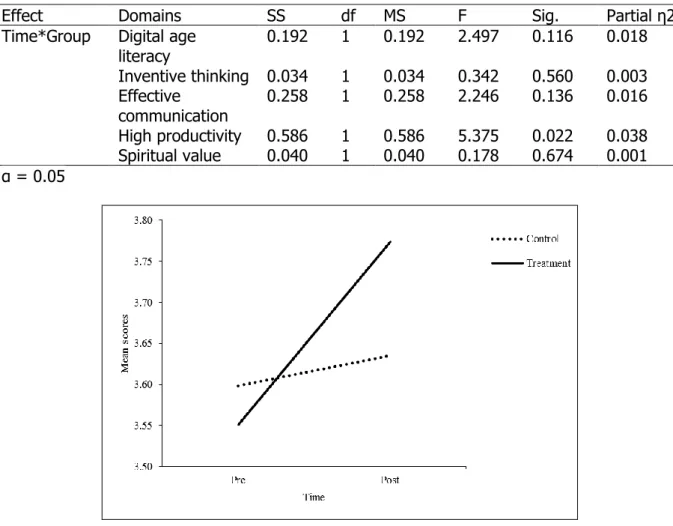
were missing. Preliminary assumption testing for normality, univariate and multivariate outliers, homogeneity of variance-covariance matrices, linearity and multicollinearity showed that no violations were found. Results (Table 4) showed that the interaction between group and time is statistically significant for high productivity [F(1, 136) = 5.375, p = 0.022; partial eta squared = 0.038]. Figure 1 shows the changes of high productivity scores across time point by intervention groups.
Table 4. Univariate test for each domain of 21st century skills
Effect Domains SS df MS F Sig. Partial η2
Time*Group Digital age
literacy 0.192 1 0.192 2.497 0.116 0.018 Inventive thinking 0.034 1 0.034 0.342 0.560 0.003 Effective communication 0.258 1 0.258 2.246 0.136 0.016 High productivity 0.586 1 0.586 5.375 0.022 0.038 Spiritual value 0.040 1 0.040 0.178 0.674 0.001 α = 0.05
Figure 1. High productivity scores across time point by intervention group
As shown in Table 5, further analyses of the interaction between group and time for high productivity scores revealed that there was no significant differences between groups at pre-test [t(136) = 0.782, p = 0.436], but there was a significant differences between groups at post-test [t(136) = -2.266, p = 0.025]. An inspection of the post-test mean scores indicated that treatment group reported slightly higher levels of high productivity (M = 3.77, SD = 0.36) than control group (M = 3.63, SD = 0.36). The magnitude of the differences in the means (mean difference = 0.14, 95% Cl: 0.02 to 0.26) was small (eta squared = 0.04). Further analyses as presented in Table 6 also showed that the high productivity scores improved significantly between pre-test and post-test for treatment group, t(136) = -3.949, p < 0.001. These findings showed that students who used the MyKimDG were achieving higher in high productivity skills compared with the control groups who were taught by conventional methods. Hence, the MyKimDG was shown by support of the hypothesis to have the ability to increase students’ high productivity skills.
Vol. 3, No. 2, Apr-Jun 2017 213
Table 5. Descriptive statistics and results of independent-samples t-test for high productivity
Time Group N M SD t Sig. (2-tailed)
Pre Control 59 3.60 0.38 0.782 0.436
Treatment 79 3.55 0.33
Post Control 59 3.63 0.36 -2.266 0.025
Treatment 79 3.77 0.36
α = 0.05
Table 6. Descriptive statistics and results of paired-samples t-test for high productivity
Group Test N M SD t Sig. (2-tailed)
Control Pre 59 3.60 0.38 -0.680 0.499 Post 59 3.63 0.36 Treatment Pre 79 3.55 0.33 -3.949 0.000 Post 79 3.77 0.36 α = 0.05
Discussion
Our findings suggested that learning through MyKimDG was more effective than the
conventional method at supporting a higher achievement in the salt topic as well as the 21st
century skills level. In particular, it is shown that MyKimDG may help students develop one
of the domains of 21st century skills, namely, high productivity skill. The high productivity
skill in this study consists of three dimensions: (i) prioritize, plan, and manage for results, (ii) effective use of real-world tools, and (iii) ability to produce relevant and high-quality products.
Generally, the practice in Malaysian science classrooms is very much taught by conventional methods that use learning materials mandated by the Ministry of Education (i.e. text book and practical book). The conventional methods employed by science teachers generally focus on knowing content in the learning materials for summative assessment purposes (Ministry of Education, 2013). In some science classrooms, teachers’ practices do not reflect the real constructivist learning approach required by the Malaysian Science Curriculum (Sim & Mohammad Yusof, 2015; Tan & Mohammad Yusof, 2014). In addition, there was little evidence of discussion. Teachers tend to think that only practical activity promotes understanding and forget that understanding can be supported through discussion (Newton, 2005). Discussion which involves idea exchange, reasoning and argument from evidence may sharpen students’ awareness of their alternative ideas to promote deep understanding. In this partially student-centred approach, direct teaching and rote learning were generally still dominant. As a result, students had difficulties understanding science concepts meaningfully.
Contrary to the conventional method, MyKimDG created a learning environment that allows students to work together to learn and discover ideas or concepts. Activities in MyKimDG were designed to engage students in self-assessing their ideas, communicating their ideas and making decisions based on the group’s consensus. They were also engaged in design or product justification. In these processes, students listened to input from peers and defended their ideas. Peer input might have triggered cognitive conflict and resulted in reconstruction of existing ideas. Such support or mental scaffolding can deepen students’ understanding. Furthermore, they were given opportunities to engage in collaborative digital games modifying and designing projects. They were required to carefully plan, utilize time
214 K-12 STEM Education
peers who face difficulty in learning a particular chemical concept. At the end of the project, they were also asked to improve and produce higher quality games that incorporate the best aspects of other groups’ designs. The findings showed that this approach was able to
increase students’ high productivity skill because students were able to immerse themselves in the real-world practice.
Conclusion
MyKimDG has been developed to establish constructivist-constructionist learning
environments that simultaneously put conceptual understanding and 21st century skills
development in the center of learning. The implementation of MyKimDG immersed students in collaborative discovery and problem solving. Students were guided through the IDPCR phases to explore subject content knowledge and design educational media related to science concepts using ICT. They applied the knowledge they had learned to create
educational media in groups. The findings showed that the MyKimDG developed in the study was proven to have the ability to increase students’ achievement in chemistry and their high productivity skills. In conclusion, the MyKimDG can create a learning environment that
allows students to deepen subject content knowledge and practice various 21st century skills
in real situations, hence produce students who have a strong foundation of science knowledge and design process, as well as able to work and communicate effectively in groups to generate innovations.
Dr. Kamisah Osman, is a Professor from UKM in Bangi in the
Department of Teaching and Learning Innovation, Faculty of Education. Dr. Kamisah Osman earned her master’s and Ph.D. studies at the University of Manchester, United Kingdom. She was the executive editor of Asian Journal of Learning and Teaching in Higher Education
(2013–2014), an active editorial board member of the Eurasian Journal of Science and Mathematics Education, International Journal of
Education in Mathematics, Science and Technology, Science Education Review, Malaysian Journal of Education, Malaysian Action Research Journal, AKADEMIKA Journal of Southeast Asia Social Sciences and Humanities and more recently Educational Process: International Journal. Her expertise is STEM education specializing in the assessment of problem-solving and higher order thinking as well as innovative pedagogical approaches in STEM learning.
Lay Ah-Nam is a PhD candidate at the Faculty of Education, The National University of Malaysia (UKM). After receiving his B.Sc.Ed. from UKM in 2000, he taught chemistry at Keningau Technical Secondary School, Sabah. He later obtained M.Ed. in Chemistry Education from Universiti Teknologi Malaysia in 2008. Currently, he is a lecturer attached at Institute of Teacher Education, Sultan Abdul Halim Campus in Sungai Petani, Kedah, Malaysia. His research interests include pedagogical approaches in STEM education and 21st century skills.
Vol. 3, No. 2, Apr-Jun 2017 215
References
Bruner, J. S. (1966). Toward a theory of instruction. Cambridge, MA: Harvard University Press.
Bryan, L. A., Moore, T. J., Johnson, C. C., & Roehrig, G. H. (2016). Integrated STEM education. In C. C. Johnson, E. E. Peters-Burton, & T. J. Moore (Eds.), STEM road map: A framework for integrated STEM education (pp. 23–37). New York, NY: Routledge.
Bybee, R. W., Taylor, J. A., Gardner, A., Van Scotter, P., Powell, J., Westbrook, A., & Landes, N. (2006). The BSCS 5E instructional model: Origins and effectiveness. Colorado Springs, CO: Biological Sciences Curriculum Studies.
Capar, G., & Tarim, K. (2015). Efficacy of the cooperative learning method on mathematics achievement and attitude: A meta-analysis research. Educational Science: Theory & Practice, 15(2), 553–559.
Chew, C. M., Noraini Idris, Leong, K. E., & Mohd Fadzil Daud. (2013). Secondary school assessment practices in science, technology, engineering and mathematics (STEM)
related subjects. Journal of Mathematics Education, 6(2), 58–69.
Demircioglu, T., & Ucar, S. (2015). Investigating the effect of argument-driven inquiry in
laboratory instruction. Educational Research and Evaluation, 15(1), 267–283.
Falbel, A. (1991). The computer as a convivial tool. In I. Harel & S. Papert (Eds.), Constructionism (pp. 29–37). Norwood, NJ: Ablex Publishing Corporation.
Hazilah Mohd Amin, Johari Jaafar, Zaihosnita Hood, Saidah Saad, & Hamizah Mohd Amin. (2013). Kemahiran insaniah pelajar prasiswazah: Analisis perbezaan jantina. Jurnal Teknologi (Social Sciences), 61(1), 19–25.
Hew, T. S., & Leong, L. Y. (2011). An empirical analysis of Malaysian pre-university students’ ICT competency gender differences. International Journal of Network and Mobile Technologies, 2(1), 15–29.
International Association for the Evaluation of Educational Achievement (IEA). (2012). TIMSS 2011 international results in science. Chestnut Hill, MA: TIMSS & PIRLS International Study Center.
ITEA. (2000). Standards for technological literacy: Content for the study of technology. Reston, VA: International Technology Education Association.
Kafai, Y. B., & Resnick, M. (1996). Introduction. In Y. Kafai & M. Resnick (Eds.),
Constructionism in practice: Designing, thinking, and learning in a digital world (pp. 1–8). Mahwah, NJ: Lawrence Erlbaum Associates, Inc.
Kamisah Osman, & Neelavany Marimuthu. (2010). Setting new learning targets for the 21st century science education in Malaysia. Procedia - Social and Behavioral Sciences, 2, 3737–3741.
Lee, C. H., & Kamisah Osman. (2015). An interdisciplinary approach for Biology, Technology, Engineering and Mathematics (BTEM) to enhance 21st century skills in Malaysia. K-12 STEM Education, 1(3), 137–147.
Ministry of Education. (2013). Pelan Pembangunan Pendidikan Malaysia 2013-2025. Putrajaya: Kementerian Pendidikan Malaysia.
National Research Council. (2012). A framework for K-12 science education: Practices, crosscutting concepts, and core ideas. Washington, DC: The National Academies Press.
216 K-12 STEM Education
Newton, L. D. (2005). Pupil’s learning in science. In L. D. Newton (Ed.), Meeting the standards in secondary science: A guide to the ITT NC (pp. 122–142). Abingdon, Oxfordshire: Routledge.
OECD. (2014a). PISA 2012 results: Creative problem solving: Students’ skills in tackling real-life problems (Volume V). PISA, OECD Publishing.
OECD. (2014b). PISA 2012 results: What students know and can do – Student performance in mathematics, reading and science (Volume I, Revised edition, February 2014). PISA, OECD Publishing.
Papert, S. (1980). Mindstorm: Children, computers, and powerful ideas. New York: Basic Books.
Papert, S. (1991). Situating constructionism. In I. Harel & S. Papert (Eds.), Constructionism (pp. 1–28). Norwood, NJ: Ablex Publishing Corporation.
Papert, S. (1999a). Eight big ideas behind the constructionist learning lab. Retrieved from http://stager.org/articles/8bigideas.pdf
Papert, S. (1999b). Introduction: What is Logo? Who needs it? In C. Fonseca, G. Kozberg, M. Tempel, S. Soprunov, E. Yakovleva, H. Reggini, … D. Cavallo (Eds.), Logo philosophy and implementation (pp. IV–XVI). Canada: Logo Computer System Inc. Papert, S., & Franz, G. (1988). Computer as material: Messing about with time. Teachers
College Record, 89(3), 408–417.
Resnick, M. (2003). The clubhouse learning approach: Learning by designing. Retrieved from http://web.media.mit.edu/~mres/clubhouse/handouts/design-v6.pdf
Rusk, N., Resnick, M., & Cooke, S. (2009). Origins and guiding principles of the Computer Clubhouse. In Y. B. Kafai, K. A. Peppler, & R. N. Chapman (Eds.), The Computer Clubhouse: Constructionism and creativity in youth communities (pp. 17–25). New York, NY: Teachers College.
Sim, W. S. L., & Mohammad Yusof Arshad. (2015). Inquiry practices in Malaysian secondary classroom and model of inquiry teaching based on verbal interaction. Malaysian Journal of Learning and Instruction, 12, 151–175.
Tan, Y. P., & Mohammad Yusof Arshad. (2014). Teacher and student questions: A case study in Malaysian secondary school problem-based learning. Asian Social Science,
10(4), 174–182.
Tengku Faekah Tengku Ariffin. (2005). Gender differences in computer attitudes and skills. Jurnal Pendidikan, 30, 75–91.
Tuan Mastura Tuan Soh, Kamisah Osman, & Nurazidawati Mohamad Arsad. (2012). M-21CSI: A validated 21st century skills instrument for secondary science students. Asian Social Science, 8(16), 38–44.
Vygotsky, L. S. (1978). Mind in society: The development of higher psychological processes. Cambridge, MA: Harvard University Press.