http://waikato.researchgateway.ac.nz/
Research Commons at the University of Waikato
Copyright Statement:
The digital copy of this thesis is protected by the Copyright Act 1994 (New Zealand). The thesis may be consulted by you, provided you comply with the provisions of the Act and the following conditions of use:
Any use you make of these documents or images must be for research or private study purposes only, and you may not make them available to any other person.
Authors control the copyright of their thesis. You will recognise the author’s right to
be identified as the author of the thesis, and due acknowledgement will be made to the author where appropriate.
You will obtain the author’s permission before publishing any material from the thesis.
TRANSFORMATIVE PRACTICE IN TEACHING
How experienced teachers explain the profound transformative influences
on their teaching practice.
A thesis
submitted in partial fulfillment of the requirements for the degree
of
Master of Educational Leadership
at
The University of Waikato
by
CYNTHIA HOLDEN
____________ The University of Waikato
2010
ABSTRACT
The social transformation represented by a shift from the industrial economy to the knowledge economy presents a challenge to the education sector. That challenge is to provide high-quality teaching that results in improved outcomes for students who are developing the habit of continuous learning. A challenge such as this may be met by teachers transforming their teaching practice.
This small-scale qualitative research project seeks an understanding of and insight into those factors which influence transformative practice for experienced
teachers. It uses semi-structured interviews to gather the perspectives of seven experienced teachers and explores the themes derived from their stories of transformative practice in relation to themes derived from the literature. The literature reveals four significant dimensions of influence on transformative practice: professional development, individual factors, school factors, and an emerging theme of communities of practice.
The research findings confirm that experienced teachers‟ perceptions of the profound transformative influences on their teaching practice are consistent with some of the literature. These congruencies include teachers working individually or collaboratively on problems of practice using a process of trial and error experimentation, and where workplace conditions support risk-taking and
promote ownership of learning. The findings confirm that transformative practice is driven by powerful emotions that connect teachers to the learning needs of their students, and is sustained by intrinsic rewards.
The research findings reveal two significant areas of divergence. The literature identifies the need for depth and breadth of content knowledge and assessment knowledge, and for critical reflection on the effectiveness of transformative teaching practices on student outcomes, neither of which were identified by participants as factors which influenced transformative practice. This indicated that teachers were unlikely to be developing local knowledge-of-practice, a
necessary prerequisite for linking the purpose of transformative practice with its goal – to improve outcomes for students.
Drawing on the understandings of, and insights into, transformative practice, this research presents a diagrammatic representation of a framework to illustrate the transformative influences on teaching practice. It also presents a knowledge-building learning cycle as a diagrammatic representation of the process required to generate knowledge-of-practice.
This research project includes recommendations suggesting that teachers develop a rich understanding of the concept of knowledge-of-practice and embed this practice in their daily work. It recommends that the knowledge-building learning cycle is facilitated by leaders of learning who have the skills to activate teacher learning, and that during the knowledge-building learning cycle, teachers develop depth and breadth of content knowledge and assessment knowledge. It
recommends that leaders of learning guard against transformative practice becoming an end in itself, and suggests that utilizing the knowledge-building learning cycle could lead to a new form of professionalism that is continuous and sustainable. This study proposes that by acting on these recommendations, leaders of learning may enhance their ability to influence transformative teaching practice where students receive high-quality teaching which simultaneously achieves improved outcomes for students.
ACKNOWLEDGEMENTS
To the teacher participants who so generously gave of their time to share their stories about transformative practice in teaching, I extend my sincere gratitude. Without your input, this thesis would not be possible. The richness of your stories sustained my interest and commitment to this research project, and has greatly contributed to my personal learning.
To my supervisor, Michele Morrison, I convey my grateful thanks. I have deeply appreciated your patient guidance and support, together with your respectful challenge to my thinking that has extended my learning. I thank you also for your meticulous attention to detail during the editing process.
To the Ministry of Education, for a part-time study award that has enabled me to immerse myself in academia for extended periods of time away from my school and the role of principal, I extend my sincere appreciation.
To the University of Waikato, for the award of the John Allan Scholarship, I express my humble gratitude.
To Debra Harrod, my Deputy Principal, and Whaea Ripeka, my Assistant Principal, I extend my sincere thanks for enabling me to distance myself from school operations and immerse myself in this research project. You have been selfless in accepting the additional workload created by my absence, and I am deeply grateful.
To my husband, Bill, for your unquestioning tolerance of my lengthy periods of solitude to complete this thesis, and for your endless love, support and
TABLE OF CONTENTS
ABSTRACT ... i
ACKNOWLEDGEMENTS ... iii
TABLE OF CONTENTS ... iv
LIST OF FIGURES ... viii
1 CHAPTER ONE INTRODUCTION ... 1
1.1 Background ... 1
1.2 Transforming Teaching Practice ... 2
1.3 Researcher Orientation ... 3
2 CHAPTER TWO LITERATURE REVIEW ... 5
2.1 Introduction ... 5
2.2 Professional Development as a Factor Influencing Change ... 5
2.3 Models of Professional Development ... 6
2.4 Design Principles of Effective Professional Development ... 7
2.5 Characteristics of High-Quality Professional Development ... 9
2.5.1 Content Characteristics ... 9
2.5.2 Process Variables ... 12
2.5.3 Context Characteristics ... 16
2.6 Individual Factors Influencing Change ... 17
2.6.1 Teachers’ Purpose ... 18
2.6.2 The Teacher as a Person ... 19
2.7 School Factors Influencing Change ... 20
2.7.1 School Culture ... 20
2.7.2 School Leadership ... 21
2.8 Emerging Themes ... 22
2.8.1 A New Paradigm of Professional Development ... 22
2.8.2 Professional Learning Communities ... 22
2.8.3 Discourse Communities ... 23
2.8.4 Learning Processes ... 24
2.8.6 Learning Conversations ... 27
2.9 Summary ... 28
3 CHAPTER THREE METHODOLOGY ... 29
3.1 Introduction ... 29 3.2 Research Paradigm ... 29 3.3 Research Design ... 30 3.3.1 Qualitative Approach ... 30 3.3.2 Interviews ... 31 3.4 Data Collection... 34 3.4.1 Research Participants ... 34 3.4.2 Research Ethics ... 35 3.5 Data Analysis ... 37 3.5.1 Data Preparation ... 37 3.5.2 Data Analysis ... 37
3.6 Representation and Reflexivity ... 40
3.7 Issues of Quality ... 41
3.8 Summary ... 43
4 CHAPTER FOUR FINDINGS ... 44
4.1 Introduction ... 44
4.2 Catalysts for Change ... 44
4.2.1 Forced Change ... 44
4.2.2 Unplanned Voluntary Change ... 45
4.2.3 Planned Voluntary Change ... 47
4.3 Career Cycle of Teaching... 49
4.4 Sources of Knowledge that Influence Practice ... 50
4.4.1 External Expert... 50
4.4.2 External Expert with Internal Support ... 51
4.4.3 Internal Expert with External Influence ... 52
4.4.4 Internal Expert ... 55
4.5 Individual or Collective Approach to Learning ... 56
4.5.1 Individual Approach... 56
4.6 Mode of Learning ... 57
4.6.1 Crafting Practice... 57
4.6.2 Learning from Talk ... 58
4.7 Impact of Learning on Teaching Practice ... 59
4.7.1 Adapting Practice ... 59
4.7.2 Adopting Practice ... 60
4.8 Sustaining New Learning ... 61
4.8.1 Self-efficacy ... 61
4.8.2 Student Success ... 62
4.8.3 Job Satisfaction ... 63
4.9 School Factors that Influence Change ... 64
4.9.1 School Structure and Organisation... 64
4.9.2 Collegial Relationships ... 64
4.9.3 Culture of Learning ... 65
4.9.4 Leadership Opportunities ... 66
4.10 Impact of Extending High Standards Across Schools ... 67
4.11 Summary ... 68
5 CHAPTER FIVE DISCUSSION ... 69
5.1 Introduction ... 69
5.2 Catalysts for Change ... 69
5.3 Career Stages in Teaching ... 70
5.4 Models of Professional Development ... 71
5.4.1 Expert Model ... 71
5.4.2 Interactive/Inquiry Model ... 71
5.4.3 Craft Model ... 72
5.4.4 Silences ... 72
5.4.5 Blended Models ... 73
5.5 Individual or Collective Approach to Learning ... 74
5.5.1 Individual Approach... 74
5.5.2 Collective Approach... 75
5.6 Characteristics of Professional Development ... 76
5.6.1 Process Variables ... 77
5.6.3 Context Characteristics ... 79
5.7 School Factors that Influence Change ... 79
5.7.1 Culture of Learning ... 79
5.7.2 Leadership Opportunities ... 80
5.8 Design Principals of Effective Professional Development ... 81
5.9 Impact of Extending High Standards Across Schools ... 82
5.10 Professional Learning Communities ... 83
5.10.1 Discourse Communities ... 83
5.10.2 Learning Conversations ... 84
5.10.3 Inquiry as Stance ... 85
5.11 Individual Factors Influencing Change ... 86
5.11.1 Emotional Involvement ... 86
5.11.2 Beliefs ... 87
5.12 Strategies that Effect Change ... 88
5.13 Summary ... 90
6 CHAPTER SIX CONCLUSION ... 92
6.1 Introduction ... 92
6.2 Constructing a Framework for Transformative Practice ... 92
6.3 Conceptualizing a Cycle of Learning for Transformative Practice . 93 6.4 Recommendations for Influencing Transformative Practice ... 95
6.5 Limitations of the Research ... 98
6.6 Further Research ... 98 6.7 Conclusion ... 99 REFERENCES ... 100 APPENDIX 1 ... 110 APPENDIX 2 ... 111 APPENDIX 3 ... 112 APPENDIX 4 ... 114 APPENDIX 5 ... 115 APPENDIX 6 ... 116 APPENDIX 7 ... 117
LIST OF FIGURES
Figure 1: Framework of underlying principles of influence on transformative
teaching practice... 94 Figure 2: Knowledge-building learning cycle ... 96
1
CHAPTER ONE
INTRODUCTION
1.1 Background
As the 20th century drew to a close, the age of social transformation was in its infancy (Drucker, 1994). This transformation represents a shift from an industrial economy to a knowledge economy, marked by the emergence of a new group of workers performing a new kind of work. „Knowledge workers‟ were replacing the formerly dominant group of „manufacturing workers‟ and the new work they were doing required a new form of preparation. Knowledge workers require “a good deal of formal education and the ability to acquire and to apply theoretical and analytical knowledge. They require a different approach to work and a different mindset. Above all, they require a habit of continuous learning" (Drucker, 1994, p. 62). A social transformation on the scale described, demands a different mindset and presents education with a major challenge – the challenge to adequately prepare 21st century students for participation in a more complex society (Hargreaves, 2003b).
New Zealand has responded in part to this challenge by producing a national curriculum that has “as its starting point a vision of our young people as lifelong learners who are confident and creative, connected, and actively involved” (Ministry of Education, 2008a, p. 4). This identifies a broad goal of education compatible with the expectations of a worker prepared for the workforce of a knowledge economy. In achieving this goal, Karen Sewell, Secretary for
Education, signals that “the challenge now is to build on this framework, offering our young people the most effective and engaging teaching possible and
supporting them to achieve to the highest of standards” (Ministry of Education, 2008a, p. 4). For many experienced teachers currently in the workforce, this expectation has profound implications. With 62% of primary teachers aged 40 years or older (Ministry of Education, 2008b), the majority of teachers in classrooms today are likely to be workers raised in the industrial economy who have only ever themselves experienced learning from a style of teaching suited to the industrial economy – the transmission model of teaching, with a focus on
developing production-line skills based on technical accuracy. Their
“apprenticeship-of-observation” (Lortie, 1975, p. 65) will have prepared them for a traditional style of teaching.
In an age of social transformation, with change its constant companion, a static one-size-fits-all education born of the industrial economy with a focus on
technical accuracy is unlikely to be appropriate for a knowledge economy with its hallmarks of diversity, complexity, uncertainty and innovation. “A knowledge economy runs not on machine power but on brain power – the power to think, learn and innovate” (Hargreaves, 2003a, p. 181). Education must reflect these demands by producing knowledge workers who are able to continuously create and innovatively apply new knowledge. If life-long learning and ingenuity is the currency of the knowledge economy, teachers will need to transform their teaching practice from that designed for the linear certainty of the industrial economy to a style more suited to the “non-linear chaotic world” (Collarbone, 2003, p. 378) associated with the knowledge economy.
1.2 Transforming Teaching Practice
In teaching, professional development is a critical vehicle for change and perhaps the most likely agent for transforming practice. The ultimate goal of professional development is high-quality teaching accompanied by high-quality outcomes for students. This goal resonates with Karen Sewell‟s challenge. Changing teachers‟ practice is a complex and demanding endeavour as evident in the themes
conveyed by the breadth of literature on teacher professional development and change, and the diversity of views this literature represents. There is some literature to suggest that teachers have historically been resistant to change (McLaughlin, 1987; Putman & Borko, 2000; Richardson, 1990; Sarason, 1990) and that professional development has failed to make a meaningful difference to teachers‟ work (Fullan, 2007b; Goldenberg, 1991; Hartle & Hobby, 2003; Hawley & Valli, 1999; Sykes, 1999). There is some literature to suggest that although teachers continuously change their practice, the changes they make are superficial, ineffective and are neither enduring nor sustainable (Ball & Cohen, 1999; Elmore,
2000; Guskey, 1991; Showers, Joyce, & Bennett, 1987). There is also a body of literature that suggests a great deal is known about what constitutes the high-quality professional development that transforms teaching practice and impacts positively on student learning (Darling-Hammond, 1998; Darling-Hammond & McLaughlin, 1995; Darling-Hammond & Richardson, 2009; Garet, Porter,
Desimone, Birman, & Yoon, 2001; Goldenberg, 1991; Guskey, 1986, 1994, 2003, 2005, 2006; Guskey & Sparks, 1996; Hawley & Valli, 1999; Holloway, 2006; Knapp, 2003; Lieberman, 1995; Horsley & Matsumoto, 1999; Loucks-Horsley, Styles, & Hewson, 1996; McLaughlin, 1991; Mundry, 2005b; Mundry & Loucks-Horsley, 1999; Timperley, Wilson, Barrar, & Fung, 2007). While much is known about the characteristics of effective professional development, authors claiming this are not necessarily in agreement with each other (Guskey & Sparks, 1996). This broad and sometimes divergent literary landscape makes
transformative practice for teachers a complex area of pursuit.
1.3 Researcher Orientation
I am an experienced teacher and the principal of a primary school. I have worked in education for nearly three decades and am myself a product of an education steeped in the one-size-fits-all system befitting of the industrial model. I was enormously grateful to one of my primary teachers who saw fit to allow me movement outside the boundaries of a linear system and to stretch beyond the confines of an educational strait-jacket. This teacher was comfortable with the uncertainty this approach encouraged, and welcomed the chaos resulting from the messiness of student-centred learning. This innovative teacher ignited my interest in teaching as a profession, and my passion for learning has fueled it ever since.
This early learning experience confirmed my own aspirations in education that every child experiences the pleasure of learning from the rich opportunities that emerge from creative and innovative learning environments. I was keen for the students in my own class to be stimulated by boundless learning opportunities that would expand their thinking in creative and innovative ways, and to achieve highly. As a principal, the goal has not changed. It has simply moved from one of
direct influence on student learning to one of indirect influence (Southworth, 2005). I aspire to the practice of learning-centred leadership (Collarbone, 2003; Fullan, 2003; Southworth, 1998; Stoll & Bolam, 2005; Stoll, Fink, & Earl, 2003), and to indirectly influencing the learning of students in my school by directly influencing teaching practice. This raises a question about those influences that are effective in transforming experienced teachers‟ practice, and provides the stimulus for this research.
Anecdotal evidence, gleaned from the breadth of my own experience in schools, confirms my hunch that while teachers enjoy professional development
opportunities and return from them refreshed and inspired, little in the classroom changes as a consequence. While this view is consistent with some of the
literature, it contrasts with other areas of the literature and serves to increase my curiosity about factors which have a profound transformative influence on teaching practice. In view of the age of social transformation and in light of the demographics of the teaching population, this investigation seems timely. I am hopeful that completion of this research project will greatly inform my own contribution to developing a school in which students develop „brain power‟ as a consequence of high-quality teaching that produces improved outcomes for diverse students.
The question this research inquiry asks is “How do experienced teachers explain the profound transformative influences on their teaching practice?” It is hoped that the findings of this research inquiry, together with the recommendations that emerge, will inform the future practice of leaders of learning in all schools.
2
CHAPTER TWO
LITERATURE REVIEW
2.1 Introduction
This chapter focuses on the literature around change in teaching practice. Multiple factors influence teachers‟ classroom practice to engender transformative change, therefore a review of the literature will be divided into four sections. The first section examines the literature on professional development and its relationship to change in teaching practice. The second section takes a humanistic perspective and examines the literature suggesting that factors associated with the individual teacher and their personal development influence teacher change. The third section examines school factors linked to the context within which teachers work as being influential in teacher change. In the final section, emerging themes of communities of practice will be explored as factors that influence change. These are relevant in today‟s educational climate that expects change in teaching practice to achieve improved student outcomes.
2.2 Professional Development as a Factor Influencing Change
The goal of professional development is to promote teacher learning that will lead to improved teacher practice, and the ultimate goal of improved teacher practice is to improve student outcomes. Guskey (2005) argues that “powerful professional development consists of highly effective professional learning experiences that accomplish their specified purpose: to significantly improve the capacity of educators to help all students learn at high levels” (p. 38).
A review of the literature suggests three approaches to examining highly effective professional development learning experiences. One approach is to examine the different types or models of professional development. A second approach is to consider the principles that are associated with effective professional
high-quality professional development – content characteristics, process variables, and context characteristics.
2.3 Models of Professional Development
Staff development, according to Sparks and Loucks-Horsley (1996), is a process for improving the job-related knowledge, skills and attitudes of teachers with the purpose of improving student learning through enhanced teacher performance. They argue it can be acquired in different ways according to five different models. The Individually Guided Model describes a process of teachers learning on their own, both formally and informally, through professional reading, by engaging in discussions with colleagues, or by experimenting with their teaching practice. A key feature of this model is that teachers design their own learning by determining a goal and selecting appropriate activities to achieve that goal. The
Observation/Assessment Model is dependent upon teachers being observed in class and receiving feedback about their performance. One form of this model is peer coaching. The Development/Improvement Process Model fosters teacher learning when teachers adapt programmes or curriculum designs and engage in school improvement processes. A key feature of this model is that the learning process typically originates from a work-specific problem and, through the solution-seeking process, opportunities for learning, sometimes through trial and error, are experienced. The Training Model, possibly the most familiar to
teachers, is characterised by an expert presenter who provides training according to a specific set of outcomes which may be knowledge or skill based. This model is most effective, according to Joyce and Showers (1988), when it follows a format of exploration of theory, demonstration or modeling of the skill, practice of the skill under simulated conditions, feedback about the performance, and follow up coaching in the workplace. The Inquiry Model is based on the belief that teachers have the ability to formulate valid research questions, gather and analyse data in pursuit of objective answers to their questions, and utilise their findings to improve their classroom practice (Sparks & Loucks-Horsley, 1996).
An alternative set of models has been put forward by Sprinthall, Reiman and Thies-Sprinthall (1996) who identify three models. The Craft Model recognises the accumulated wisdom garnered from the dailiness of teachers‟ classroom experience as pedagogical knowledge, while acknowledging that it “stands or falls on the concept of learning how to extract new meaning from the „rich‟ lode of experience” (Sprinthall et al., 1996, p. 678). They caution that unless teachers are able to learn from their experiences through the process of reflection, there is no guarantee that new learning will occur. The Expert Model is based on the assumption that a core of information and skills developed by experts and
professional teacher educators will be delivered in short or long-term workshops. While the time frame is variable, the knowledge base forms the framework for the programme. The Interactive Models embrace a range of forms of professional development each focused on developing complex cognition through active participation in the learning process by the teacher. Examples of the interactive model include the teacher as a reflective practitioner, teacher as peer coach, and teacher as action researcher (Sprinthall et al., 1996).
While each of these models offers a structure for the delivery of professional development, Hawley and Valli (1999) contend that the quality of learning can vary markedly within them. They argue that many professional development programmes do not give sufficient attention to an important outcome of teacher learning – “consistent and appropriate use of newly acquired knowledge” (p. 136), as it is only by using this knowledge that improved student outcomes can be achieved. Hawley and Valli (1999) postulate eight design principles that are the key to effective professional development claiming that “professional
development is more likely to result in substantive and lasting changes in the knowledge, skills, and behaviours of educators that strengthen student learning when it includes these characteristics” (p. 137).
2.4 Design Principles of Effective Professional Development
The design principles associated with effective professional development, identified by Hawley and Valli (1999), are based on their synthesis of proposals
made in reports issued at national level and from the conclusions of research reviews. They include the following eight elements:
Goals and Student Performance: Professional development should be student-centered and driven by an analysis of the gap between the goals and standards of student learning and actual student performance.
Teacher Involvement: Professional development should be learner-centred and promote active participation by the teacher-learner in the learning process by involving them in identifying their learning needs, planning their learning experiences, and designing the process to be used.
School Based: Professional development should be school based and an integral part of the school‟s strategic development to promote learning that is meaningful and relevant to the immediate context of the teacher-learner, and form part of a cohesive plan of school improvement.
Collaborative Problem-Solving: Professional development should provide learning opportunities that address individual needs while at the same time are based on collaborative problem solving methods that allow teachers to work together to identify causes and solutions to common problems of practice.
Continuous and Supported: Professional development should be continuous and on-going, and supported by both internal and external experts to ensure further learning.
Information Rich: Professional development should incorporate evaluation of multiple sources of information, including information about student outcomes as well as information about the implementation process of new teacher-learning. This should be conducted by teachers as well as external evaluators.
Theoretical Understanding: Professional development should provide
theoretical understandings of the practical knowledge and skills to be learned and used.
Part of a Comprehensive Change Process: Professional development should be integral to a comprehensive change process that is cognizant of the accelerators and barriers to implementation of new practices that facilitate student learning (Hawley & Valli, 1999).
Based on these design principles, Hawley and Valli (1999) claimed a “new
consensus” (p. 127) about the content, design and context of effective professional development. Concurring with the notion of a developing consensus on what constitutes effective professional development, Knapp (2003) and Supovitz and Turner (2000) identify six key elements that contribute to high-quality
professional development. They contend that powerful professional learning experiences must: emphasise high learning standards and assist teachers to link student performance to the standards; be focused on subject-matter knowledge and deepen teachers‟ pedagogical content skills; immerse participants in inquiry, questioning, and experimentation, thereby modelling inquiry forms of teaching; engage teachers in concrete teaching tasks based on teachers‟ experiences with students that are school-based and directly related to their classroom work; be intensive, sustained over a longer period of time and connected to a coherent plan; and be connected to other aspects of school change as part of school
improvement.
This developing consensus of effective professional development based on design principles is viewed from an alternative perspective by Guskey and Sparks (1996) who provide a framework for examining professional development. It is also utilized by Timperley et al. (2007), and is based on the characteristics of high-quality professional development. High-high-quality professional development, claim Guskey and Sparks (1996) and Timperley et al. (2007), is that which is linked to improved student outcomes. The framework includes content characteristics, process variables, and context characteristics, and will be used to examine the literature that relates to each characteristic.
2.5 Characteristics of High-Quality Professional Development
2.5.1 Content Characteristics
Content covers what is learned and is central to professional development experiences. Without content, there can be no basis for developing deeper understanding of, and skill in teaching, and therefore no foundation for change
(Timperley et al., 2007). Content covers four broad dimensions – content knowledge, the subject-matter of a particular curriculum area; pedagogical knowledge, the broad range of theory and skills relating to teaching and learning; pedagogical content knowledge, the combination of subject-specific content knowledge and subject-specific teaching and learning skills; and student knowledge, how students learn. The Best Evidence Synthesis (BES) of teacher professional learning and development (Timperley et al., 2007) found that opportunities to engage in professional learning about knowledge, especially where no one particular kind of knowledge was addressed in isolation from other kinds, had a substantial impact on student learning.
Mundry (2005a) confirms the importance of professional development that is focused on both content knowledge and pedagogical content knowledge, stating that “research evidence suggests that professional development that is most closely linked to improved student learning deepens teachers‟ understanding of the content and how to teach it” (p. 11). Kennedy (1999) concurs that professional development that focuses on depth of content knowledge in a particular subject and understanding how students learn it has the greatest impact on student learning. Loucks-Horsley, Styles and Hewson (1996) argue that one of the defining characteristics of effective professional development for teachers is providing “opportunities to develop knowledge and skills to broaden their
teaching approaches so they can create better learning opportunities for students” (p. 3). This confirms the impact on student learning of professional development for teachers in which content knowledge across the knowledge domains is the focus of teacher learning.
A study of the Eisenhower Professional Development Program (the U.S. federal government‟s largest investment to support high-quality professional development in mathematics and science) by Porter, Garet, Desimone and Birman (2003) found that professional development with a focus on content increases teacher
knowledge and skill which, in turn, influences change in teaching practices. Their longitudinal study over three years, based on teacher self-reporting of classroom practice in the first year, professional development in the second year, and classroom practice in the third year, found that teachers who report enhanced
knowledge and skills are also likely to report changing their teaching practice, thus suggesting a strong relationship between professional development with a content focus and change to teacher practice.
Borko (2004) adopts a situative perspective to locate evidence that professional development can have a positive impact on teacher learning. This perspective conceptualises learning as changes in participation in the social activity of teaching, as well as changes in an individual‟s use of knowledge as a result of their social construction of that knowledge. For teacher-learners, this translates as a process of increasing a teacher‟s participation in the practice of teaching and, as a result of that participation, becoming more knowledgeable in and about
teaching. focusing on the individual teacher as the unit of analysis, Borko (2004) sought to determine whether a relationship exists between professional
development and teacher learning. To explore this relationship, the extent of individual teacher change was examined in relation to the degree of teacher learning that occurred in regard to subject-matter, student thinking and
instructional practices. The findings confirmed that teacher awareness and depth of knowledge had increased in each of the three areas and Borko (2004)
concluded that “intensive professional development programmes can help teachers to increase their knowledge and change their instructional practices” (p. 5).
Professional development, claim Hawley and Valli (1999), should be student-centred and driven by goals that are determined through an analysis of the gap between school goals for student achievement and actual student achievement. Knapp (2003) concurs that powerful professional development should focus on high learning standards and on evidence of students achieving those standards. This signals a need to develop teachers‟ pedagogical knowledge about assessment and, in particular, the ability to identify what the learner currently understands, and what needs to be taught next. Timperley et al. (2007) found that developing a deep understanding of assessment, together with the skills to analyse and use assessment data, helps teachers view student learning as a function of teaching and use assessment information to improve their classroom practice.
The teaching-learning relationship is also influenced by teacher expectations of learners. High-quality professional development that challenges teachers‟ attitudes and beliefs about achievement goals for certain groups of students, such as ethnic minorities, students from low socio-economic backgrounds, and those with disabilities, can influence classroom practice (Bishop, Berryman, Tiakiwai, & Richardson, 2003; Bishop & Glynn, 2003; Timperley et. al., 2007). Where professional development is sustained over a period of time and focused on challenging teacher beliefs, a reframing of teachers‟ social construction of students occurs, partnered by a rise in student achievement (Timperley et al., 2007). Increasing teachers‟ pedagogical knowledge of assessment can have a profound transformative effect on teaching practice.
Hawley and Valli (1999) argue that theoretical understandings need to be linked with the knowledge and skills of teaching practice as they relate to general
pedagogical knowledge, content knowledge, and pedagogical content knowledge. They claim that teachers often cite lack of understanding and limited access to knowledge as the reason for not putting theory into practice. Timperley et.al. (2007) emphasize the importance of providing support for teachers in translating theoretical presentations of content knowledge into practice, without which there is limited impact on teaching practice and on student learning.
The above discussion draws on evidence from research to support the belief that high-quality professional development opportunities that help teachers increase their knowledge in the four domains of content knowledge facilitate changes in their teaching practice. Some elements of teachers‟ knowledge and practice are more easily changed than others, and the change process itself can be slow
(Borko, 2004). The change process is influenced by the design of the learning, the how of teacher learning.
2.5.2 Process Variables
How teachers learn is influenced by the style or form of the learning experience and the learning activities they engage with.
Form
The literature refers to the form of professional development as being of either traditional or reform style. The traditional style refers to a “one-shot workshop” (Goldenberg, 1991, p. 69) where teachers passively receive information from experts, as compared with the reform style which is sustained over a longer period of time with greater active involvement by the participants. Research by Saxe, Gearhart and Nasir (2001), comparing traditional learning with two reform styles of professional development, found one of the reform styles to be particularly effective, possibly due to its longer duration. Birman, Desimone, Porter and Garet (2000) claim that reform style learning is more effective and has a greater
influence in changing teacher practice because it is likely to actively involve participants and be of longer duration.
The traditional form of professional development needs radical rethinking (Ball, 1996; Lieberman, 1995; Sykes, 1996). In today‟s educational world, in which teachers are expected to help students develop skills that are more complex and analytical using methods that actively engage them in experiencing, creating and solving real problems, a traditional form of professional development for teacher learning is fundamentally at odds with the new form of student learning.
Lieberman (1995) argues that teachers learn in much the same way as their students learn and that professional development programmes should be shaped accordingly. Teachers should, as an integral part of their school life, experience professional development through active involvement in opportunities to discuss, think about, develop, and try out new ideas with their students. This new form of professional development would ensure learning is responsive to the individual contexts and concerns of teachers, thus making their learning more meaningful. Lieberman (1995) concludes that effective professional development must move away from the traditional style and toward long-term, continuous learning in the context of the school and the classroom, aided by the support of colleagues.
Breaking away from the traditional form of learning and embracing a different conception of professional development is supported by Darling-Hammond and McLaughlin (1995) who argue that the new vision of learning for today‟s students requires teachers to practice in ways that are consistent with this vision. This
means that teachers need to „unlearn‟ many of the teaching beliefs and practices that have dominated their professional lives and begin teaching in ways they have neither used nor experienced before (Ball, 1996; Darling-Hammond &
McLaughlin, 1995). Developing new ways of teaching demands a form of
professional development that allows teachers to reflect critically on their practice in order to develop new knowledge and beliefs about content, pedagogy and learners. Effective professional development of this nature must engage teachers in the concrete tasks of teaching; be grounded in inquiry, reflection and
experimentation that are participant-driven; be collaborative within a community of teacher-learners; be connected to and derived from teachers‟ work with their students; be sustained, on-going, intensive and supported by modeling, coaching, and the collective solving of specific problems of practice; and be connected to other aspects of school change (Darling-Hammond, 1998; Darling-Hammond & McLaughlin, 1995).
This form of professional development is consistent with a vision of learning in which new knowledge is constructed by, and with, teachers for use in their own contexts. It requires alternative types of learning activities.
Activities
One activity that requires on-going active collegial involvement in the inquiry of specific problems of practice is peer coaching, as recommended by Joyce and Showers (1988). In their seminal work they describe it as a collaborative problem-solving process that is experimental in nature where „coach observers‟ give non-evaluative feedback to the „teacher experimenter‟ as part of the cycle of analysis, study, hypothesis-forming and testing. Peer coaching, as an activity, is focused on changing practice to improve student learning.
Loucks-Horsley and Matsumoto (1999) recommend the inclusion of activities such as immersing teachers in a specific field of inquiry by actually „doing‟ science or mathematics, so that teachers learn about new curriculum materials by experiencing the material as a teacher-learner, while an expert teacher
demonstrates its implementation. They recommend examining teaching practice using actual artefacts of practice such as student work, video clips of teaching,
narrative cases or achievement data. They suggest learning to develop craft wisdom through working collaboratively in networks of teachers within and across schools. While these activities may stand alone, Loucks-Horsley and Matsumoto (1999) recommend they are best used in combination or in sequence. An example of activities used in combination might include teachers learning how to implement new curriculum materials at a workshop, followed by regular
coaching in their classrooms. An example of activities used in sequence might be learning how to use new curriculum units, followed by case discussions and action research focused on the units.
Klentschy (2005) recommends lesson study as an activity that transforms practice and describes it as a problem-solving process that “facilitates systematic
examination of teaching-learning processes through initial planning, teaching, observation and reflection of teaching practices” (p. 4). This cyclic process provides a means for teachers to draw on shared knowledge in order to improve their practice. This type of knowledge, called practitioner knowledge, is especially useful because the knowledge created has its origins in a specific problem of practice that is grounded in the context of the teacher‟s own work. Mundry (2005a) also recommends the use of lesson study and concurs with Loucks-Horsley and Matsumoto (1999) that activities used in combination can provide powerful professional development opportunities. She describes combining lesson study with a content-based institute as an example of a „practice-based‟ approach to on-going, collective inquiry that deepens teachers‟ content knowledge as well as knowing how best to teach this to improve student outcomes.
Timperley et al. (2007) give examples of a wide range of activities that actively involve teachers in learning. They include demonstrations and examples of teaching practice, observation and feedback, using assessment to refine teaching, discussing practice with colleagues, and describing/prescribing practice. Their research, however, concluded that no particular activity was more effective than another. What was important for teachers was the chance to “engage in multiple and aligned opportunities that supported them to learn and apply new
understandings and skills” (p. xxxv). This suggests that teachers, like their students, need many opportunities to learn through a range of activities.
A variety of on-going, job-embedded activities that engage teachers in active learning, appear necessary to prompt change to teacher practice and improve student outcomes (Darling-Hammond, 1998; Darling-Hammond & McLaughlin, 1995; Hirsh, 2004; Holloway, 2006; Lieberman, 1995). The conditions that promote and support teacher learning are dependent upon the context characteristics of the learning environment.
2.5.3 Context Characteristics
Professional development is most effective when the context within which learning takes place exhibits certain characteristics. These include coherence and collective learning.
Coherence
Principals can enhance the effectiveness of professional development by
developing a coherent plan of learning that links curriculum and assessment with professional development activities, as this reduces fragmentation and the
disjointed delivery of learning (Ball & Cohen, 1999). Firestone, Mangin, Martinez and Polovsky (2005) confirm the importance of coherence. In a comparative study of three different approaches to professional development in three separate United States districts, a coherent, content-focused professional development programme had the greatest influence on teacher-reported change in practice. Birman,
Desimone, Porter and Garet (2000) concur that coherence of professional development increases teacher learning and improves teaching practice. Guskey (1994) supports the view that new innovations should be part of a coherent framework that forms part of a comprehensive change process.
The change process should develop incrementally, beginning with small steps that are part of a larger picture, and where support removes barriers to change and pressure ensures its momentum (Guskey, 1994). New learning is not only hard work but takes time because teachers need multiple opportunities over an extended period in which to construct meaning and embed new learning in practice (Porter et. al., 2003; Supovitz & Turner, 2000; Timperley et. al., 2007). They also need follow-up support, from sources both within and outside the
school, so that learning is continuous and ongoing (Hawley & Valli, 1999; Supovitz & Turner, 2000; Timperley et al., 2007).
Timperley et al. (2007) claim that transformative practice, resulting in positive student outcomes, requires the engagement of an external expert to facilitate the substantive new learning and new ways of learning required to make these changes. As teachers work with new knowledge, implement ideas and review the impact they have on students, new learning needs are identified and these need to be met through supportive networks. If they are not met, motivation to continue learning diminishes (Hawley & Valli, 1999). Each of these processes requires that structural and organisational support is provided as part of a coherent process (Chappuis, Chappuis, & Stiggins, 2009; Hawley & Valli, 1999; Timperley et al., 2007).
Collective Learning
To alleviate the discomfort that often accompanies change in practice, Guskey (1994), Chappuis et al. (2009) and Sparks (2009) argue for teams of educators working together. Successful change occurs when regular opportunities are provided for “participants to share perspectives and seek solutions to common problems in an atmosphere of collegiality and professional respect” (Guskey, 1994, p. 45). Concurring with this view, Darling-Hammond and Richardson (2009) claim that when groups across grade levels, departments or schools combine, they create a critical mass for changed practice and provide support for each other.
2.6 Individual Factors Influencing Change
In the search to identify those factors that are associated with effective professional development, Timperley et al. (2007) illustrate the complex relationship between professional learning and student outcomes. Their model reveals a second “black box” (p. 7) situated between professional learning experiences for teachers and the impact they have on teachers‟ practice. This black box mediates between what is experienced and what is implemented. To
focus solely on the professional development experience and the features associated with high-quality professional development may result in some important mediating factors in the change process being overlooked. Fullan and Hargreaves (1992) argue that an incomplete understanding of teacher
development occurs unless consideration is given to the total teacher – the teacher‟s purpose and the teacher as a person.
2.6.1 Teachers’ Purpose
Teaching, claim Fullan and Hargreaves (1992), is more than a technical craft of learned skills and behaviours that are executed with efficiency against a
background of given rules. It is a moral craft, where teachers, as part of their daily work, are continuously making informed discretionary judgments based on
professionalism and moral principles:
Because it is a moral craft, it has purpose for those who do it. There are things that teachers value, that they want to achieve in their teaching. There are also things that they disvalue, things they fear will not work or will actually do harm to the children in their charge. Teachers‟ purposes motivate what teachers do. (Fullan & Hargreaves, 1992, p. 29)
Stoll, Fink and Earl (2003) suggest that teachers need a catalyst or sense of urgency before embracing change. They claim teachers are motivated by change which is practical, useful and relevant to their particular class of students, and where there is a good reason to change. Another dimension of change that can filter actions is teacher beliefs. Fullan and Hargreaves (1992) concur with Stoll et al. (2003) that unless an innovation is related to, or integrated with, the teachers‟ beliefs, purpose or context, resistance is a likely outcome. Fullan and Hargreaves (1992) argue that teachers are motivated by „psychic rewards‟ – the joy and satisfaction of working with children, and by an „ethic of care‟ – teachers concern for care and nurturing of others and connectedness to others. An understanding of these motivating factors is necessary for a comprehensive understanding of factors which influence teachers‟ transformative practice.
2.6.2 The Teacher as a Person
Teachers are people, not just vehicles for the delivery of knowledge and skills, therefore “age, stage of career, life experiences, and gender factors make up the total person. They affect people‟s interest in and reaction to innovation and their motivation to seek improvement” (Fullan & Hargreaves, 1992, p. 39). Stoll et al. (2003) identify experience, motivation and beliefs, confidence, and individuality as factors influencing teacher learning.
Experience
Sikes (as cited in Fullan & Hargreaves, 1992) suggests that age as part of the “life cycle of the teacher” (p. 37) impacts on the amount of energy and enthusiasm a teacher has for their work. Teachers‟ individual career cycles also influence their disposition towards professional learning and development. Huberman (1992) identifies five stages through which teachers‟ career paths progress. The first stage is survival and discovery where teachers focus on getting through each day and enjoying new found successes. The second stage involves a period of stabilization during which teachers make a commitment to the profession and resolve notions of uncertainty. From this stage, one of two pathways may be followed. One pathway is that of experimentation or activism where teachers attempt to become more effective through experimentation and take action to overcome the sentiment of becoming stale. An alternative pathway is one of taking stock or of self doubt during which a gnawing sense of routine and a developing sense of limited possibilities outside of the profession takes hold. The fourth stage of serenity, is a phase of relaxed activity in the classroom, coupled with greater confidence and self-acceptance. The fifth and final stage can also take one of two pathways. One pathway is conservatism, bemoaning the new generations accompanied by a greater sense of nostalgia. The alternative is a pathway of disengagement, a gradual disengagement from work to other engagements (Huberman, 1992).
Self-efficacy
Stoll et al. (2003) suggest the level of confidence a teacher has in their belief that they can “make a difference” (p. 85) to student outcomes, influences their own learning. Research by Smylie (1988) states that “the direct relationship between personal teaching efficacy and change suggests that teachers are more likely to
change their behaviour in directions that may improve their classroom
effectiveness if they believe that they themselves are instrumental to the learning of their students” (p. 23). While confidence increases the likelihood of change, professional development can enhance efficacy and also increase the chance of change in practice. Invargson, Meiers and Beavis (2005) found that professional development that focuses on subject-specific content knowledge helps teachers develop rich conceptual understandings that enhance their teaching skill, and increases their self-efficacy. Stein and Wang (1988) found that when teachers implemented an innovation successfully, their perception of self-efficacy increased. Cheeseman (2008) found that the impact of self-efficacy is highly motivating and this sustains a teacher‟s willingness to maintain change in practice. It appears that self-efficacy influences teacher change.
2.7 School Factors Influencing Change
2.7.1 School Culture
The culture of a school determines whether it will be learning-enriched or learning-impoverished (Rozenholtz, as cited in Hopkins, Ainscow, & West, 1994). A learning-enriched school, in which the focus is specifically on learning, includes teacher learning as well as student learning. While teachers learn from a variety of sources, one powerful source of learning is from colleagues within their own workplace. This type of learning occurs within a collaborative culture. It is defined by Hopkins et al. (1994) as one of “mutual support, joint work and a broad agreement on educational values” (p. 93).
The characteristics of a collaborative culture (Little, as cited in Hopkins et. al., 1994) include a workplace environment in which teachers engage in precise talk about teaching practice, developing an understanding of the complexity of teaching and what distinguishes the virtue of one practice from another. It includes teachers observing each other teaching, and building up a common language of reference to talk about effective teaching practice. It is a place in which teachers plan, design, prepare and evaluate teaching materials together, and
develop a deeper understanding of teaching and learning. This type of „joint work‟ facilitates professional learning and development in a process where educators “teach each other the practice of teaching” (Hopkins et. al., 1994, p. 95).
Collaborative cultures create rich and meaningful learning environments for teachers, but do not occur by chance. They need to be deliberately cultivated and this requires input from school leadership (Sparks, 2009). Principals are pivotal in creating a culture of trust where risk-taking and reflection is the norm, and where raising issues and resolving puzzles of practice are supported through joint work in a culture of collaborative inquiry (Bryk, Camburn, & Louis, 1999).
2.7.2 School Leadership
In addition to cultivating a collaborative culture, research by Robinson (2007) found that leaders who actively participate with their staff in professional learning as the leader, a learner, or both leader and learner, have a significant positive effect on student outcomes through their influence on teacher practice. DuFour and Marzano (2009) argue that schools need “learning leaders” (p. 63) who are deliberately focused on evidence of learning. By shifting the focus of their leadership towards working collaboratively with teams of teachers to examine evidence of student learning, principals would build leadership capacity amongst teachers and provide positive pressure to change their practice. Elmore (as cited in DuFour & Marzano, 2009) states:
teachers have to feel there is some compelling reason for them to practice differently, with the best direct evidence being that students learn better; and teachers need feedback from sources they trust about whether or not students are actually learning what they are taught. (p.68)
Building the capacity for teachers to collaborate in teams and become mutually accountable provides a powerful mechanism for teacher change and school improvement. Fullan (2007a) defines capacity building as “any strategy that increases the collective effectiveness of a group to raise the bar and close the gap of student learning” and suggests that “capacity building with a focus on results” (p. 33) is highly motivating for teachers, and provides positive pressure for
change. King and Newmann (2001) concur with this view of building school capacity. They argue that professional development programmes that stress three dimensions of capacity: the knowledge, skills and dispositions of individual teachers, professional community, and school programme coherence, are effective in fostering the individual and organisational learning needed to achieve improved student outcomes across the whole school.
2.8 Emerging Themes
2.8.1 A New Paradigm of Professional Development
The elements that together constitute high-quality professional development – content characteristics, process variables, and context characteristics – comprise what has been called the new paradigm of professional development (Darling-Hammond & Richardson, 2009). This form of professional development is
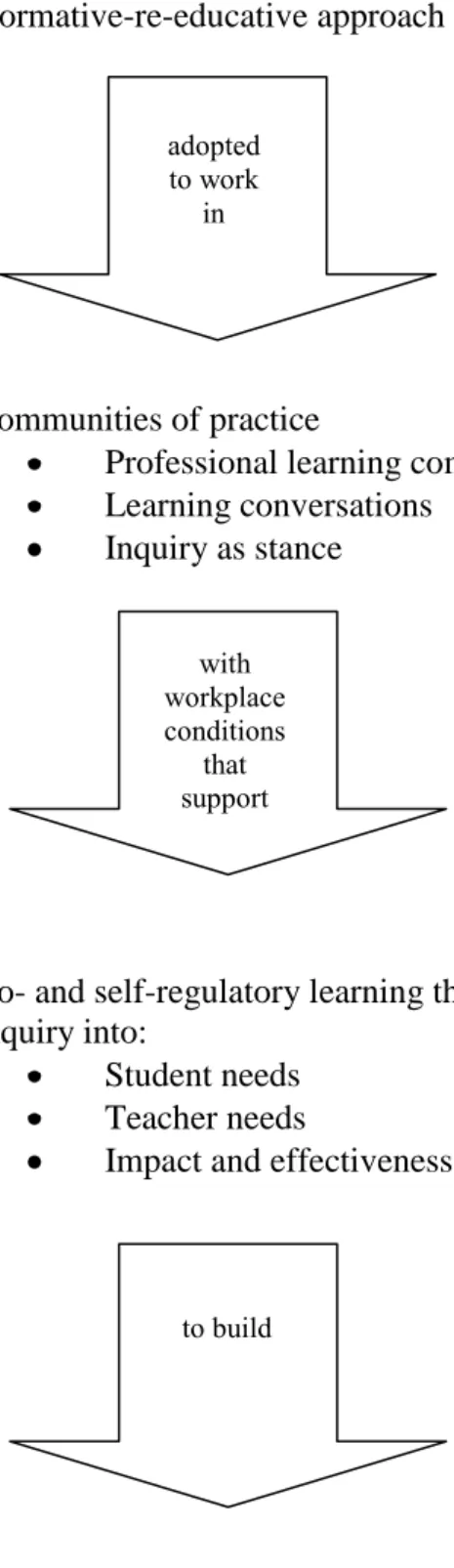
consistent with a vision of learning in which new knowledge is constructed by and with teachers for use in their own contexts. It contrasts with a traditional „top-down‟ model of professional development in which knowledge is delivered to consumers in bite-sized chunks ready for direct application or implementation. It is a shift away from the empirical-rational strategy, a linear process of change in which teachers “are told about the change topic, it is demonstrated to them, and, as rational human beings they are expected to implement it” (Richardson & Placier, 2001, p. 906), towards a normative-re-educative strategy where “change is enhanced through deep reflection on beliefs and practices. Because the change process entails understanding one‟s beliefs and knowledge and determining whether or not to change them, dialogue has been used as a critical element of this process” (Richardson & Placier, 2001, p. 906). One approach that meets the criteria for the new paradigm is the professional learning community.
2.8.2 Professional Learning Communities
Professional learning communities can “change practice and transform student learning – when they have in place the processes and structures that make true joint work possible and desirable” (Darling-Hammond & Richardson, 2009, p.
52). Darling-Hammond and Richardson (2009) argue that the structures required for a professional community include supportive leadership, mutual respect, and a climate that invites risk-taking and innovation. The processes needed for effective professional community are an understanding of the way teachers talk and interact when seeking to improve teacher practice – the norms of interaction that accept silence and use difference and conflict productively.
Ball and Cohen (1999) argue that the complexity of teaching is such that no amount of training can fully prepare teachers for every eventuality in teaching, therefore much of what they need to learn must be learned in and from practice. They claim that teachers‟ everyday work could be the source of constructive professional development if teachers were able to learn about practice that is centred in practice. Using artefacts of practice, such as copies of student work, videotapes of lessons, teacher journals, and written case studies, as the focus of collaborative inquiries that interrogate and analyse teaching and learning, provides an opportunity for examining and interrupting teachers‟ taken-for-granted ways of seeing and knowing. Creating some disequilibrium is necessary to generate this type of learning and therefore communities of practice need to adopt new conventions for substantial professional discourse.
2.8.3 Discourse Communities
„Learning talk‟ is a form of discourse that supports professional learning in, and from, practice that engages teachers in talk at three levels – analytical, critical and challenging (Annan, Lai, & Robinson, 2003). “Learning talk is talk about teaching which analyses, evaluates, and/or challenges the impact of teaching practices on student learning outcomes, and/or creates more effective ones to replace
ineffective ones” (Annan et al., 2003, p. 31). This collaborative inquiry engages teachers in a powerful form of discourse that acts as a mechanism for changing teacher thinking and practice. It is most effective when a skilful facilitator works with the inquiry group to assist them in moving their talk through the three different levels. Without facilitation, it can fail to reach its goal of influencing teacher practice. Both Hawley and Valli (1999) and Timperley et al. (2007) caution that collaborative team work can sometimes be detrimental to the
improvement of practice as, in some instances, particularly where it is not facilitated skillfully, collaboration has the potential to reinforce an ineffective status quo.
2.8.4 Learning Processes
Developing new understandings and skills that serve to generate more effective teaching practices rather than reinforce ineffective ones, depends on a series of learning processes. Timperley et al. (2007) describe three learning processes that can lead to substantive change to teaching practice. The first learning process involves cueing and retrieving prior knowledge for the purpose of either consolidating known information or examining it and reviewing its adequacy. Teacher engagement is activated when teacher-learners examine their taken for granted teaching practices that are routine and tacit, develop an understanding of the theories that underpin these practices and, from the perspective of viewing these now explicit practices, evaluate the adequacy of them to decide what should be changed (Timperley et. al., 2007). This engagement is critical to change. Without it, teachers are likely to either reject the new information or believe that they „already do this‟.
During the second process in the learning cycle, teachers become aware of new information, whether superficial or more substantive, and integrate it into their existing values and beliefs system because they recognise it as being consistent with current values and beliefs. An example of this could be when teachers recognise the limitations of their curriculum knowledge in mathematics, or science, or any other curriculum area where they feel less confident and seek new knowledge (Timperley & Alton-Lee, 2008). While the outcome of this process may be change to teacher practice, it cannot be assumed that this will impact positively on student outcomes. Timperley et al. (2007) express concern that many of the studies in their meta-analysis showing change to teacher practice were linked to either neutral or negative outcomes for students. They recognise that constructed meaning from new information is either adopted or adapted by teachers to fit existing conceptual frameworks, whether or not these frameworks are problematic. In some instances, teachers‟ values and beliefs actually limit
student learning despite changed practices, and these limited conceptions need to be challenged and either discarded or reconstructed. To achieve this, a third process in the learning cycle is necessary.
During the third process of learning, dissonance is created when teachers find that new information is not consistent with existing values and beliefs. Dissonance “challenges tacit knowledge, creates philosophical tension, and requires current knowledge to be reconstructed” (Timperley et.al., 2007, p. 13). Teachers‟ tacit knowledge is built up over a period of time and embraces all that they do
intuitively in their practice, because they have come to believe that it works. This tacit knowledge needs to be made explicit so it can be discussed, examined and questioned. Teachers may respond to this process by rejecting new theories and practices, in which case there is no change to their teaching practice.
Alternatively, teachers may resolve dissonance by reconstructing meaning, or repositioning their beliefs and values, resulting in change to their teaching practice.
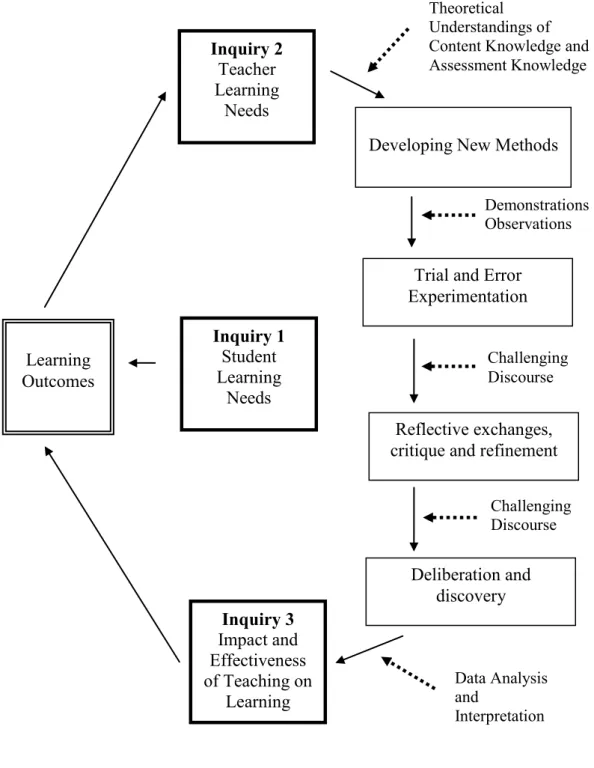
These three processes are central to professional development learning experiences if change to teacher practice is to be effected. If, however, this process is to be on-going and sustained, a fourth process is necessary. The fourth learning process engages teachers in an on-going inquiry in which “teachers collectively and individually identify important issues, become drivers for
acquiring the knowledge they need to solve them, monitor their impact, and adjust practice accordingly” (Timperley & Alton-Lee, 2008, p. 353). This process is called co-regulation and self-regulation. As teachers draw meaning from the analysis and interrogation of assessment information, and consider the
implications for pedagogical content knowledge, they develop deep understanding of teaching practice (Timperley & Alton-Lee, 2008).
2.8.5 Inquiry as Stance
Professional development that arises from inquiry, as suggested by Ball and Cohen (1999), Annan et al. (2003), Timperley et al. (2007), and Timperley and Alton-Lee (2008), and outlined above, signals a paradigmatic move away from
prescription and transmission towards a paradigm based on constructivism. New visions of professional development, claim Cochran-Smith and Lytle (2001), may have many similarities on the surface, but significant underlying differences. Their vision of professional development is based on very different underlying assumptions and goals of professional development, and different conceptions of teacher knowledge and learning. They propose that a
legitimate and essential purpose of professional development is the development of an inquiry stance on teaching that is critical and transformative, a stance linked not only to high standards for the learning of all students but also to social change and social justice and to the individual and collective professional growth of
teachers. (Cochran-Smith & Lytle, 2001, p. 46)
Inquiry as stance needs to be understood from the perspective of three types of knowledge which Cochran-Smith and Lytle (1999) call knowledge-for-practice, knowledge-in-practice and knowledge-of-practice. Each type of knowledge is generated using an inquiry approach in which the knowledge is constructed through social interactions. The first type of knowledge, knowledge-for-practice, can be thought of as formal knowledge and theory for teachers to use. It is the knowledge required for teaching and is centred on enhancing teachers‟ knowledge of subject matter, pedagogy and subject-specific pedagogy. The second type of knowledge, knowledge-in-practice, can be thought of as practical knowledge. It is knowledge which teachers use when they are in action in the classroom and is embedded in what expert teachers do intuitively as they fine-tune their craft. It encompasses the wisdom and artistry they have come to know as a result of their experience as a teacher. The third type of knowledge, knowledge-of-practice, cannot be thought of as either formal knowledge or practical knowledge that is already known from theory or from experts, but as knowledge that is generated by teachers, irrespective of whether the teacher is an expert or novice:
It is assumed that the knowledge teachers need to teach well is generated when teachers treat their own classrooms and schools as sites of intentional investigation at the same time that they treat the knowledge and theory produced by others as generative material for interrogation and interpretation. In this sense, teachers learn
when they generate local knowledge-of-practice by working within the contexts of inquiry communities to theorize and construct their work and to connect it to larger social, cultural, and political issues. (Cochran-Smith & Lytle, 1999, p. 250)
Local knowledge generated from inquiry as stance can have a significant impact on the lives of teachers and on the lives of students. It can have a profound transformative influence on teachers‟ practice and on student achievement. In the New Zealand context, this could mean influencing the lives of students by
reducing the long tail of underachievement reflected in the achievement data of schools throughout the nation.
2.8.6 Learning Conversations
Earl and Timperley (2008) seek similar goals for professional development, aiming for genuine and continual improvement in schooling, especially for those students who have traditionally been underserved by our education system. They argue these goals can be achieved through the use of a powerful collaborative inquiry process called learning conversations. Learning conversations are distinguished by three critical characteristics: having an inquiry habit of mind, using relevant data, and embracing relationships of respect and challenge. An inquiry habit of mind requires one to accept a position of not knowing, yet be determined to seek clarity and understanding, to be open to ambiguity, and to reserve judgment until issues have been viewed from multiple perspectives. Using relevant data means seeking evidence that fits the purpose of the inquiry. It means using high-quality data that is neither inaccurate nor misleading. It means using statistical information knowledgeably and wisely so that interpretation of the data provides valid statements. Relationships of respect and challenge within an inquiry facilitate engagement in dialogue that probes rather than accepts the viewpoints of others. This enables greater understanding of others‟ interpretations of evidence and of their supporting reasoning. Holding productive evidence-informed conversations is neither straightforward nor simplistic. It is an “iterative process based on asking questions, examining evidence and thinking about what that evidence means in the particular context” (Earl & Timperley, 2008, p. 3). In
an example of the process in action, Lai and McNaughton (2008) describe how one group of participants held rigorous conversations that explored difficult issues around teachers practice that positively influenced the reading achievement of their students. By putting student achievement ahead of their own comfort, they were able to generate local knowledge-of-practice. This had a transformative influence on their teaching practice combined with improved outcomes for their students.
2.9 Summary
This literature review has focused on four dimensions of influence on
transformative practice: professional development, individual factors, school factors, and the emerging theme of communities of practice. Each dimension reveals multiple layers of influence on teaching practice. Research exploring these multilayered dimensions highlights the positive outcomes for students associated with many of these factors.
This research project seeks to understand how experienced teachers explain the profound transformative influences on their teaching practice. The next chapter outlines the approach adopted for this research inquiry.