IMPROVING THE LEARNING DESIGN OF MASSIVE OPEN ONLINE COURSES
Wilfred Rubens
Open Universiteit - Welten-instituut, Onderzoekscentrum voor doceren, leren en technologie, bezoekadres: Valkenburgerweg 177 Heerlen, postadres: Postbus 2960 6401 DL Heerlen
Dr. Marco Kalz
Open University in the Netherlands
Prof. Dr. Rob Koper
Open University in the Netherlands
ABSTRACT
Massive Open Online Courses (MOOCs) can be regarded as a promising next step in the evolution of distance education. However, they have been criticised for their poor learning design. This article describes the development of an adequate learning design in a series of nineteen MOOCs (called online master classes). A formative evaluation focuses on participation and user satisfaction. A total amount of 2083 individual learners enrolled in online master classes. Overall the user satisfaction is positive and stable. Thirteen pedagogical requirements for MOOCs form the output of this evaluation. It is concluded that the learning design that has been developed, matches with the pedagogical principles of distance education for adult learners. The format has proven to support more a diverse group of learners than the still dominant MOOC formats.
INTRODUCTION
Distance education allows learners and instructors to maintain communication although they are physically apart (Keegan, 1986). It has emerged from correspondence education, teaching by technical media (mass media radio and television) to digitized education (Peters, 2010).
Massive Open Online Courses (MOOCs) can be regarded as a promising next step in the evolution of distance education. Gaebel (2013) describes MOOCs as online courses with no formal entry requirement, no participation limit, free of charge, but for which the learners do not earn credits. Originally MOOCs have their roots in the Open Education Movement that aims to enable education and knowledge development at no costs while the content can be reused and modified (Yuan & Powell, 2013).
Despite of the potential, MOOCs have been criticised for their poor learning design (Cooper & Sahami, 2013; Gaebel, 2013; Yuan & Powell, 2013). Kalz and Specht (2013) have summarized that the current learning design of the two major design approaches is for the one format too open and unstructured and might therefore be only suited for a very self-directed population of learners with high media literacy (the so-called cMOOC). The other format is reproducing a classical lecture oriented approach without exploiting interaction and feedback opportunities (the so-called xMOOC). The Open University of the Netherlands (OU) has recently developed an approach to MOOCs that aims to improve the learning design. These MOOCs are offered to the learners as 'online master classes'. They are aimed at adult learners whose primary objective is to keep up-to-date in their profession.
The main characteristics of these online master classes are: • There is no limit to the number of learners.
• Learners can participate at various levels of intensity. • It is an online format.
• Every master class has a turn-around time (of a week) and learning goals.
• They are freely accessible. Learners who want to receive a certificate pay a fee. They have access to additional resources.
In this article we present the learning design that has been developed for these online master classes. In the next part we briefly discuss the state-of-the-art of the design and development of MOOCs in respect of pedagogical principles of distance education. Based on this discussion we describe the learning design of the online master classes. Furthermore we report about a formative evaluation. A list of 13 pedagogical requirements forms the result of this evaluation. In the last section conclusions are drawn and suggestions for future work are formulated.
Although the first MOOCs were initiated in 2008, the interest in MOOCs has increased since Ivy League-universities like Stanford and Harvard started to offer online courses for free on a large scale (Sharples et al, 2013). According to Yuan and Powell (2013) MOOCs offer the opportunity for massive up-scaling of course participants and increasing access of education, for example to reach working professionals as a new target group (Gaebel, 2013). However, Yuan and Powell (2013) stress concerns about the pedagogy and quality of current MOOCs, mainly due to their poor learning design. The question is if the learning design of these MOOCs matches with the pedagogical principles of distance education for adult learners.
According to Holmberg (2003) distance education does not only imply non-contiguous teaching and learning, it also includes mediated interaction between learners and instructors (two-way traffic). Additionally, Holmberg (2003) stresses the importance of interaction for supporting learners, and personal relations including feelings of empathy and belonging (to motivate learners). Wagner (1994) defines interaction as “reciprocal events that require at least two objects and two actions. Interactions occur when these objects and events mutually influence one another”. Interaction has been regarded as important for processing information, for learner control, for the adaption of learning programs based on learners’ input, for constructing knowledge and for the creation of learning communities (Anderson, 2003).
Rhode (2009) concludes that engagement in interaction can lead to enrichments of learning, while it can be identified as a central element and catalyst of engaging learning experiences. According to Khalil and Ebner (2013) the interaction quality and quantity in online learning environments are important factors that influence learner satisfaction and indirectly influence dropout rates.
In education three types of interactions can be distinguished: content, instructor and student-student. Student-student interaction is the exchange of information and ideas amongst learners. Real-time presence of an instructor is not necessary to facilitate this. Student-instructor interaction is interaction between learner and expert to foster improved understanding of the content by learners, such as student guidance or feedback. Alexander (2003) emphasizes the importance to acknowledge that there is a difference between experts and professionals who are competent but not experts. Therefore these so-called ‘non-experts’ should be able to learn from experts. Moore (1989) described student-content interaction as "a defining characteristic of education”. Processing tasks like assignments and tests are examples of student-content interaction. This third type of interaction facilitates processing and internalization of information students encounter in learning. Student-content interaction results in improved understanding, changed perceptions and changes in cognitive structures of the mind of the learner (Moore, 1989).
In his theory of transactional distance (TD), Moore (1997, 2007) claims that in distance education the essential distance is a pedagogical one between teacher and learner and not a time- and space-dependent distance. Psychological and communication distance creates the transactional distance, which may lead to insufficient reciprocal understanding. According to Moore (2007) this distance needs to be reduced to facilitate learning. The key components to minimize transactional distance are dialogue between learners and teachers to support learning, flexibility of structure of the educational program (e.g. learning goals and meeting individual learning needs) and autonomy of the learner over the learning process. If dialogue, flexibility of structure and learner’s autonomy are decreasing, the transactional distance will increase.
Vaughan and Carlson (1992) and Jansen (2004) underline that structuring education improves study progress. Although this requirement is developed on basis of research on curricula, one could argue that structure supports learning in other learning activities as well.
Hrastinski (2007) emphasized the different purposes of asynchronous and synchronous communication. He concludes that synchronous communication supports a more intense interaction that stimulates personal participation and motivation, while asynchronous communication facilitates cognitive and reflective types of participation. Both forms of communication complement each other.
According to Merrill (2002) learning takes place when learners have to cope with real-world problems, when relevant previous experience is activated, when instruction demonstrates what has to be learned, when learners are required to apply new knowledge to solve problems, and when learners are encouraged to integrate new knowledge in their daily practice. This implies more learner control.
Additionally, they conclude that learners should have pacing control and that navigational support has to be offered.
Roediger and Karpicke (2006) conclude that testing is a powerful way of improving memorization of learning content. In fact, tests enhance later retention more than additional study of the material. Moreover, feedback is not a necessity to foster retentions. They conclude that self-tests, which can be done recurrently, can be used to improve retrieval of information. This phenomenon is known as the testing effect (Roediger & Karpicke 2006). This implies that tests not only can be used for assessment or explicit activation of prior knowledge, but also as a learning activity on its own.
Currently from the perspective of theories on distance education, the learning design of the dominant format of xMOOCs can be compared with the e-learning courses of the beginning of the 21st century:
• Fixed design with repeated activities.
• Focus on learner-content interaction and learner-learner interaction (not embedded in the curriculum of the course).
• Assessments with multiple-choice questions. • Focus on instruction.
• No adaption of the content of the course is possible during runtime (for example based on the feedback of learners).
Thus our aim was to develop a new learning design for MOOCs, based on theories of distance education. A secondary goal was to attract a group of learners that did not participate in learning activities of the Open University of the Netherlands before.
DEVELOPMENT PROCESS
For the development of the online master classes we applied an iterative process that was oriented at principles of agile software development (see Beck et al. 2001). According to agile software development requirements can change during the development process in which ‘business people’ and developers collaborate together. Changes to the format are delivered frequently (e.g. in a timescale of a couple of weeks) while there is always a working solution in use.
Three teams worked together during the reflective development process. A technical development team has been responsible for delivery platform, technical functionalities and the design of the template, used for online master classes. A pedagogical development team has been responsible for the development of a pedagogical approach. The third team has been responsible for efficient process for the organization and realization of online master classes.
The first three online master classes were exploratory in nature: the pedagogical concept and the different technologies were explored and tested. After each run of an online master class we evaluated all its aspects: technically, content, format, experiences of learners, and the contribution of experts, moderator and session leader. Based on this qualitative assessment we proposed and implemented improvements. After the third online master class we used an online questionnaire for the learners to assess their opinions about the online master class. The results of these evaluations were used as one of the inputs for improvements of the design.
THE LEARNING DESIGN OF THE ONLINE MASTER CLASSES
The pedagogical development team developed the setup of the learning design of online master classes, based on distance education theory (described above). In doing so the pedagogical development team was confronted with an important design challenge: realizing a balance between flexibility and the three types of interaction. Flexibility and freedom of choice for learners on one hand, and coherent activities (like related instructions, interactions and processing tasks) for the benefit of learning on the other hand are correlated. Thus it is important to find the right balance for the target group of online master classes.
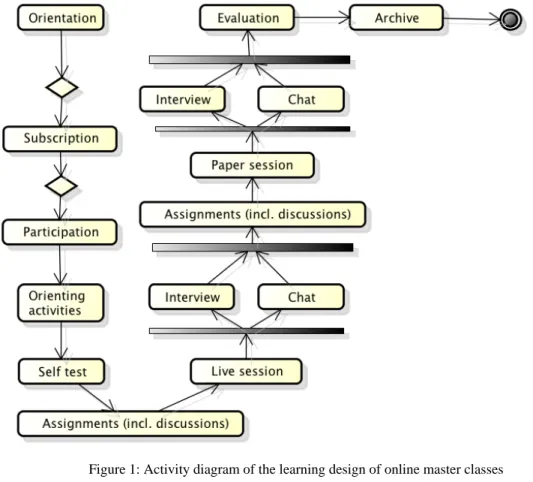
Figure 1: Activity diagram of the learning design of online master classes
In this figure the flow starts at ‘orientation’ and end with ‘archive’. In the first step learners orientate themselves on the content and procedure of the online master class. After enrolment, they are able to view additional information about the subscribed learners, and the preparatory learning activities. At the start of the online master class, the first additional learning activities are provided to the learners. They can access different learning activities each day. A variety of learning activities have been included into the learning design to stimulate active participation, like asynchronous and synchronous discussion and reflection. Learners are stimulated to demonstrate their knowledge in the group, apply the knowledge on challenging problems/cases, and are challenged to provide examples of the application of the knowledge in their practice. The first day is focused on orientation and activation of prior knowledge. An orientation test and self-test are used for these purposes. Moreover, the self-test is used for improving memorization of learning content. An asynchronous discussion in an available group-wall is used for orientation as well. During the second day learners are able to make assignments to deepen their theoretical insights on the topic of the online master class and to apply relevant theories in their daily practice. Learners study resources like articles and papers to conduct this assignment. An example of a theoretical assignment is: "Study the Horizon report on higher education. Choose one of the described six trends, and describe this trend using the presented theoretical framework of Sharples (page 17-21). Please focus on the level of the learning activity".
The third day is dedicated to the live session. The discussion assignments provide input for the live session. During a live session learners view a live stream video and have the possibility to use a chat. Learners make remarks or ask questions. Other learners can respond. A moderator (backstage) selects questions and submits these questions by a separate chat channel to the session leader. During the live session the session leader asks these questions to the expert, who responds.
When the live session is over, the recording and the chat discussion are made available for learners. Moreover, learners have the opportunity to continue working on the assignments of the first two days. At day 6 of the
week-FORMATIVE EVALUATION
The first three online master classes (October 2011-December 2011) were considered as a pilot and were not evaluated with a questionnaire.
Between January 2012 and March 2013 nineteen online master classes were organized, with a diverse set of topics. Twelve topics were related to the field of technology-enhanced learning (such as ‘Tablet computers in education’ or ‘The future of the virtual learning environment’). The other seven subjects were related to learning sciences in general (e.g. ‘Effective learning strategies’ or ‘Education for highly gifted students’).
This section provides an overview of the learners, the user satisfaction and a list of pedagogical requirements that are the result of the formative evaluation.
Overview learners
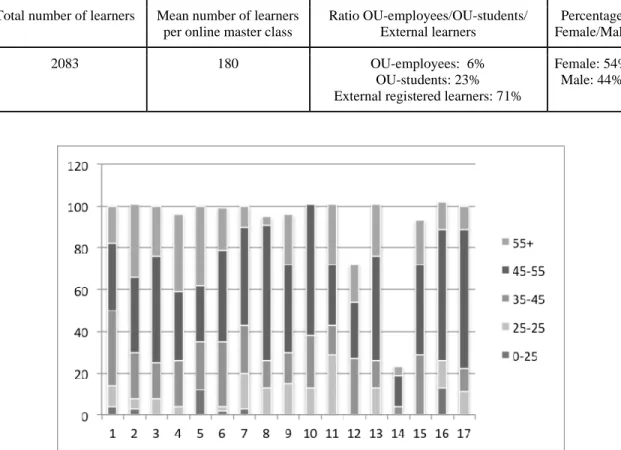
Table 1 provides an overview about the total number of learners, the mean number of learners, the ratio between OU-employees, OU-students and external learners and the ratio between male and female learners. The number of learners ranged from 91 learners to 448 learners. Seventy one per cent of the learners did not take part in any educational activity of the organization previously. The gender ratio was balanced. Since we did not know in advance which target group would be attracted by the educational format we have also analysed the age range of learners as depicted in figure 2.
Table 1: Learner details online master classes Total number of learners Mean number of learners
per online master class
Ratio OU-employees/OU-students/ External learners Percentage Female/Male 2083 180 OU-employees: 6% OU-students: 23% External registered learners: 71%
Female: 54% Male: 44%
Figure 2: Age learners per online master class
In fourteen online master classes the largest group of learners was 45-55 years old. In some cases the largest group was older than 55 years. Hardly anyone younger than 25 years joined the online master classes. 89% of the learners were older than 35 years.
The majority of learners only visited one online master class (63 %). 17% attended two online master classes, while 11% participated in three online master classes. The rest of the learners visited four or more online master classes (1,7% of the learners joined 16 or more online master classes).
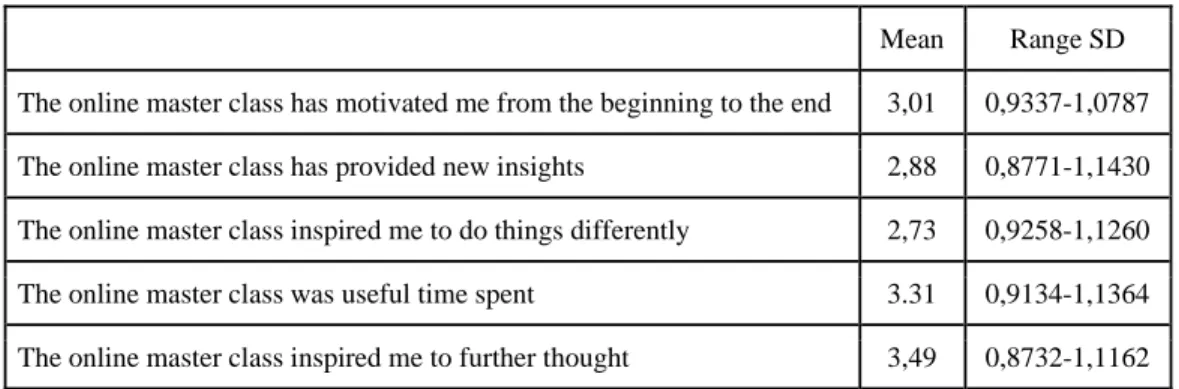
In the evaluation of online master class 4-7 five questions were asked related to satisfaction (5-Point Likert scale). Table 2 presents an overview of these questions, including the scores (mean of the ratings of the four online master classes, range of standard deviation).
Table 2: Satisfaction master classes 4-7
Mean Range SD
The online master class has motivated me from the beginning to the end 3,01 0,9337-1,0787 The online master class has provided new insights 2,88 0,8771-1,1430 The online master class inspired me to do things differently 2,73 0,9258-1,1260 The online master class was useful time spent 3.31 0,9134-1,1364 The online master class inspired me to further thought 3,49 0,8732-1,1162 The learners were satisfied with three of four online master classes. One online master class received on every question a score lower than 3. A qualitative analysis of the open questions indicated that there were technical issues during the fifth online master class that might have influenced the score.
Moreover, the following open question was asked: Did you find the content of the online master class sufficiently practical or did you prefer a more scientific approach to the subject? The answers showed that learners had different expectations about the online master classes. An analysis of the response to this question showed that in general, there was a group of learners that did prefer a more scientific approach, while another group wanted to learn about practical guidelines. A third group believed that there was a sufficient balance between theory and practice.
In the evaluation of online master class 8-22 learners were asked to grade the online master class on an ordinal scale from 1-10. Table 3 presents the outcomes:
Table 3: User satisfaction online master classes nr. 8-22.
Online master class nr. Mean SD
08 6.87 1,01 09 7,32 1,03 10 6,85 1,26 11 7,00 0,66 12 6,65 1,58 13 6,60 1,23 14 7,10 1,18 15 7,57 0,53 16 7,50 0,55 17 7,86 0,69 18 6,87 0,78 19 6,20 1,09 20 5,75 2,63 21 7,00 1,15 22 7,50 0,52
Based on internal evaluations and user feedback it was concluded that online master classes should increase their scientific depth. Moreover, it was concluded that online master classes should have additional possibilities for activation of prior knowledge and enhancing retrieval of information. From the ninth online master class an online paper presentation by PHD-students was added. The intention of this online paper session was to provide
Despite the changes in the learning design of the online master classes the satisfaction of learners stayed on a relatively high level. The learners positively reviewed all evaluated online master classes, except three. Five-point Likert scales were used to ask if learners expected to receive practical guidelines and to identify if learners expected to hear new theoretical views. The average scores of the first question ranged from 3,16 to 4,6 (SD: 0,53-1,72), while the average scores of the second question ranged from 3,78 to 4,91 (SD: 0,35-1,30). Learners still expect to receive practical guidelines and scientific insights in an online master class.
Pedagogical requirements
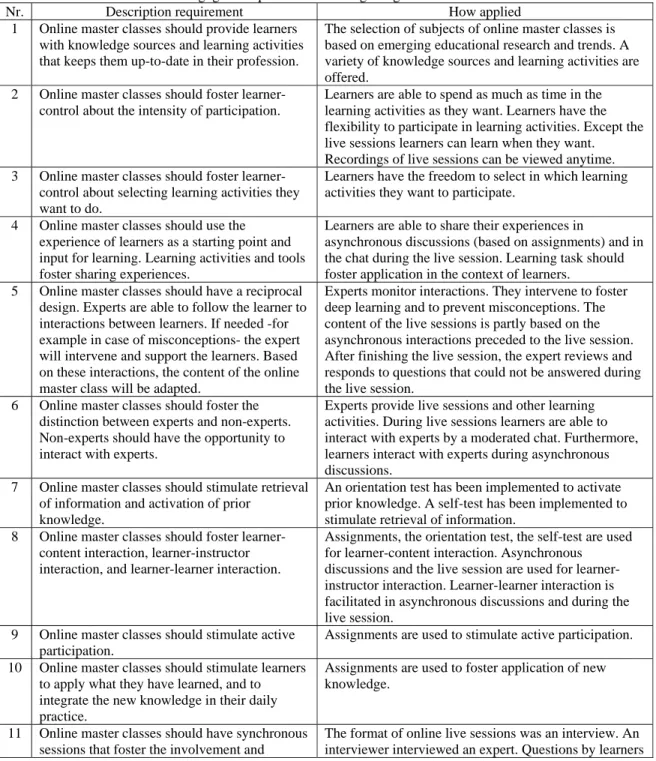
The following pedagogical requirements can be regarded as the backbone of a learning design for online master classes for professional development. They are the result of the application of theory on distance education (described previously), and the evaluation of the organized online master classes.
Table 4: Pedagogical requirements learning design online master classes Nr. Description requirement How applied
1 Online master classes should provide learners with knowledge sources and learning activities that keeps them up-to-date in their profession.
The selection of subjects of online master classes is based on emerging educational research and trends. A variety of knowledge sources and learning activities are offered.
2 Online master classes should foster learner-control about the intensity of participation.
Learners are able to spend as much as time in the learning activities as they want. Learners have the flexibility to participate in learning activities. Except the live sessions learners can learn when they want. Recordings of live sessions can be viewed anytime. 3 Online master classes should foster
learner-control about selecting learning activities they want to do.
Learners have the freedom to select in which learning activities they want to participate.
4 Online master classes should use the experience of learners as a starting point and input for learning. Learning activities and tools foster sharing experiences.
Learners are able to share their experiences in
asynchronous discussions (based on assignments) and in the chat during the live session. Learning task should foster application in the context of learners.
5 Online master classes should have a reciprocal design. Experts are able to follow the learner to interactions between learners. If needed -for example in case of misconceptions- the expert will intervene and support the learners. Based on these interactions, the content of the online master class will be adapted.
Experts monitor interactions. They intervene to foster deep learning and to prevent misconceptions. The content of the live sessions is partly based on the asynchronous interactions preceded to the live session. After finishing the live session, the expert reviews and responds to questions that could not be answered during the live session.
6 Online master classes should foster the distinction between experts and non-experts. Non-experts should have the opportunity to interact with experts.
Experts provide live sessions and other learning activities. During live sessions learners are able to interact with experts by a moderated chat. Furthermore, learners interact with experts during asynchronous discussions.
7 Online master classes should stimulate retrieval of information and activation of prior
knowledge.
An orientation test has been implemented to activate prior knowledge. A self-test has been implemented to stimulate retrieval of information.
8 Online master classes should foster learner-content interaction, learner-instructor interaction, and learner-learner interaction.
Assignments, the orientation test, the self-test are used for learner-content interaction. Asynchronous discussions and the live session are used for learner-instructor interaction. Learner-learner interaction is facilitated in asynchronous discussions and during the live session.
9 Online master classes should stimulate active participation.
Assignments are used to stimulate active participation. 10 Online master classes should stimulate learners
to apply what they have learned, and to integrate the new knowledge in their daily practice.
Assignments are used to foster application of new knowledge.
11 Online master classes should have synchronous sessions that foster the involvement and
The format of online live sessions was an interview. An interviewer interviewed an expert. Questions by learners
motivation of the learners. in a moderated chat were used as input for the interview. A live session lasts one hour. The alternation between speaker, interviewer and learners fostered the involvement and motivation of the learners. 12 Online master classes should have an explicit
structure of learning activities that are conducted during a defined amount of time.
An explicit structure of learning activities, with a turn-around time of a week, had been applied to stimulate participation. Learners could decide when and how intense they wanted to learn, within the framework of this structure.
13 Online master classes should foster learners to increase scientific depth.
Adding an online paper presentation by PhD-students to the learning design of the online master classes
enhanced the balance between the theoretical background and practice-related knowledge. The intention of this online paper session was to provide learners, who were more interested in research and theory, the opportunity to gain more scientific insights. During a separate live session two PhD-students gave a fifteen minutes-presentation about a research paper on the subject of the online master class. At the end of the presentation the PhD-students answered several questions that were asked by learners in the chat. As a consequence student-student and student-instructor interaction were enhanced.
DISCUSSION
This article has described the development of an adequate learning design for MOOCs. Based on theory and experiences we formulated 13 pedagogical requirements that have guided the iterative development of the learning design in the various runs. This educational format did attract a group of learners that previously did not participate in learning activities of the Open University. Seventy one per cent of the learners in online master classes were no employees or current students of our university, and 89% of the learners were older than 35 years.
An important design challenge was to find a balance between flexibility and the three forms of interaction. Our assumption was that, the option to be able to choose the amount of time spent for the new format would contribute to satisfaction of learners. In general, this assumption can be confirmed. The explicit breakdown of the learning activities in a turn-around time of one week led to more structure. Nevertheless, the use of more structure restricts flexibility, while flexibility is seen as an important characteristic of a learning design for distance education. Moreover, more options for interaction might suggest an increased workload for learners. Although learners still are able to decide what they want to learn and how much time they want to invest, the changed structure and possibilities for interaction may indicate that the flexibility to learn 'just in time' and 'just enough' has declined. In addition, synchronous sessions limit the possibility to learn whenever learners want although they can view the recordings in their own time.
With exception of three online master classes, the user satisfaction is positive and stable. The positive and stable user satisfaction can be interpreted as an indication for the learners' appreciation of the learning design, including the pedagogical requirements. Arguably, an explanation is that the balance between easy accessible participation and flexibility for learners and consistent learning activities (including interactions) has been realized. However, user satisfaction is influenced by more factors than the learning design.
The educational format of online master classes complies with important pedagogical principles described in the theory. Arguably, this result combined with the enrolment of hundreds of learners and user satisfaction nourishes the conclusion that online master classes are an appropriate format for distance education for adult learners. Currently, the learning design of the dominant format of MOOCs (cMOOCs and xMOOCs) is not based on pedagogical principles of distance education for adult learners. Since online master classes have similar characteristics as a MOOC, application of the pedagogical requirements and the learning design of online master
large amount of concurrent users would be lead to an unmanageable tsunami of interactions. However, it is questionable if MOOCs are an effective format for distance education when meaningful learner-instructor interactions are impossible to have. While some of the experiences from designing the format of online master classes can inform the design of Massive Open Online Courses, some aspects of the design might have a more limited transferability. A turnaround time of a week was consciously chosen to offer professionals an opportunity to plan and manage their learning activities in a reasonable amount of time. In a classical higher education context these turnaround times could be much longer.
CONCLUSIONS AND FUTURE WORK
We have developed an adequate learning design for MOOCs that is attractive for new groups of learners. The online, accessible and flexible characteristics of the format, combined with expert knowledge and interaction possibilities, provide opportunities for large groups of professionals to keep up with their discipline while the pedagogical requirements and the learning design fit with the characteristics based on distance education theories. Different forms of interaction have been used in the online master classes: synchronous (chat), asynchronous (especially online forums and group-walls), among learners, with content and with instructors/experts. Research underlines the importance of these interactions from the perspective of learning. The developed learning design and pedagogical requirements will lead to stronger design for MOOCs, compared to the current designs. This format is less open and unstructured than the design of the cMOOC format that attracts self-directed learners with high media literacy. Furthermore, the developed learning design and pedagogical requirements will lead to a more learner-controlled and interactive design than the classical lecture oriented xMOOC format (Kalz & Specht, 2013).
However, there are still plenty of questions left for future research. Further improvements and especially further evaluations of the learning design are needed. The user evaluation is now restricted towards satisfaction. This is informative, but not sufficient to access the real fit with the learners needs. Obviously, satisfaction is not an indicator of learning results or improvement of performance. These effects are not evaluated, while they could have an impact on the learning design of online master classes.
Finally, it should be investigated more thoroughly if the learning design of the online master classes is applicable on large-scale courses with thousands of learners. The question is if there is a maximum to the amount of learners that can participate in a MOOC that fosters meaningful learner-instructor interaction.
ACKNOWLEDGEMENTS
We thank Saskia Brand-Gruwel, Wendy Kicken and José Janssen for their contributions to the realisation of the concept of the online master classes. We thank Kiavash Bahreini, Charlotte Wolff, Mat Heinen, Marcel Vos, Jeroen Berkhout, Jeroen Storm, Sabine Roks, Ludo van Meeuwen, Jérôme Gijselaers, Liesbeth Kester, Eric Kluijfhout, Marcel van der Klink and Marcel Wigman for their support in organizing and enabling online master classes. We want to thank all the experts and learners who contributed to the online master classes, and Gino Camp for the literature suggestions. We want to thank the management and staff of the Schloss Dagstuhl International Conference and Research Centre for Computer Science for the stimulating and well-organized environment for writing this research paper.
REFERENCES
Alexander, P. A. (2003). The Development of Expertise: The Journey From Acclimation to Proficiency. Educational Researcher, 32(8), 10–14. doi:10.3102/0013189X032008010
Anderson, T. (2003). Getting the Mix Right Again: An Updated and Theoretical Rationale for Interaction. The International Review of Research in Open and Distance Learning. Retrieved from
http://www.irrodl.org/index.php/irrodl/article/view/149/230
Beck, K., Beedle, M., Van Bennekum, A., Cockburn, A., Cunningham, W., Fowler, M., … Thomas, D. (2001). Agile Manifesto. Software Development. San Francisco, CA: Miller Freeman, Inc. Retrieved from http://agilemanifesto.org/
Clark, R.C & Mayer, R.E. (2011). E-learning and the Science of Instruction. San Francisco: Pfeiffer. Cooper, S. & Sahami, M. (2012). Reflections on Stanford's MOOCs. Communications of the ACM, 56, 2
2013), 28-30
Gaebel, M (2013). MOOCs. Massive Open Online Courses. EUA Occasional Papers. Brussels: European University Association. Retrieved from
http://www.eua.be/Libraries/Publication/EUA_Occasional_papers_MOOCs.sflb.ashx
Holmberg, B. (2003). Distance Education in Essence. An overview of theory and practice in the early twenty-first century (2nd edition). Oldenburg: BIS-Verlag der Carl von Ossietzky Universität Oldenburg
Hrastinski, S. (2007). Participating in Synchronous Online Education (PHD-thesis). Lund: Department of Informatics School of Economics and Management, Lund University.
Jansen, E. P. W. A. (2004). The influence of the curriculum organization on study progress in higher education. Higher Education, 47(4), 411–435.
Kalz, M., & Specht, M. (2013). If MOOCS are the answer, did we ask the right questions? Implications for the design of large-scale online courses. Working paper 2013/25. Maastricht School of Management, Maastricht.
Keegan, D. (1986). Foundations of Distance Education. London: Croom Helm.
Khalil, H., & Ebner, M. (2013). Interaction Possibilities in MOOCs – How Do They Actually Happen? International Conference on Higher Education Development. Mansoura: Mansoura University. 1-24. Merrill, M. D. (2002). First principles of instruction. In: C. M. Reigeluth & A. Carr-Chellman Alison (Eds.).
Educational Technology Research & Development, 50(3), 43–59. doi:10.1007/BF02505024
Moore, M. G. (1989). Editorial: Three types of interaction. American Journal of Distance Education, 3(2), 1–7. doi:10.1080/08923648909526659
Moore, M.G. (1997). Theory of transactional distance. In: Keegan, D. (ed.) (1997) Theoretical principles of distance education. London: Routledge, 22–38.
Moore, M.G. (2007). Handbook of distance education, 2nd ed. Mahwah, NJ: Erlbaum
Peters, O. (2010). Distance Education in Transition. Developments and Issues (5th ed.) Oldenburg: BIS-Verlag der Carl von Ossietzky Universität Oldenburg
Rhode, J. F. (2009). Interaction Equivalency in Self-Paced Online Learning Environments : An Exploration of Learner Preferences. International Review of Research in Open and Distance Learning, 10, 1–23. Roediger, H. L., & Karpicke, J. D. (2006). The Power of Testing Memory Basic Research and Implications for
Educational Practice. Perspectives on Psychological Science, 1(3), 181–210. doi:10.1111/j.1745-6916.2006.00012.x
Sharples, M., McAndrew, P., Weller, M., Ferguson, R., FitzGerald, E., Hirst, T., & Gaved, M. (2013). Innovating Pedagogy 2013: Open University Innovation Report 2. Milton Keynes: The Open University Vaughan, C., & Carlson, C. (1992). Teaching and learning One-Course-At-A-Time. Innovative Higher
Education, 16(4), 263–276. doi:10.1007/BF00917812
Wagner, E. D. (1994). In support of a functional definition of interaction. American Journal of Distance Education. doi:10.1080/08923649409526852
Yuan, L., & Powell, S. (2013). MOOCs and Open Education: Implications for Higher Education (p. 21). Bolton: Cetis.