Worcester Polytechnic Institute
Digital WPI
Interactive Qualifying Projects (All Years)
Interactive Qualifying Projects
May 2009
The Effectiveness of Mastery Learning
Alysia M. Hayes
Worcester Polytechnic Institute
Samuel Morrison Bailey
Worcester Polytechnic InstituteSimon M. Goldish
Worcester Polytechnic InstituteFollow this and additional works at:
https://digitalcommons.wpi.edu/iqp-all
This Unrestricted is brought to you for free and open access by the Interactive Qualifying Projects at Digital WPI. It has been accepted for inclusion in Interactive Qualifying Projects (All Years) by an authorized administrator of Digital WPI. For more information, please [email protected].
Repository Citation
Hayes, A. M., Bailey, S. M., & Goldish, S. M. (2009).The Effectiveness of Mastery Learning. Retrieved from https://digitalcommons.wpi.edu/iqp-all/54
The Effectiveness of Mastery Learning in the
ASSISTment Tutoring System
An Interactive Qualifying Project Report
submitted to the Faculty
of the
WORCESTER POLYTECHNIC INSTITUTE
in partial fulfillment of the requirements for the
Degree of Bachelor of Science
By
Alysia Hayes
Simon Goldish
Samuel M. Bailey
Date: May 5, 2009
Project number: NTH-0864
ii | P a g e
Abstract
A study to evaluate the effectiveness of mastery learning for MCAS mathematics
tutoring among middle school students was performed. The ASSISTment system
was used to create variabilized templates for the creation of mastery learning
problem sets. The ASSISTment system was used to generate pre-tests and
post-tests to evaluate the overall gain of the students involved in the experiment. The
experiment concluded that there was an overall gain in test scores and mastery
learning was effective to some extent
iii | P a g e
Acknowledgement
We would like to express our sincere thanks to our advisors Professor Neil Heffernan
and Cristina Heffernan for their guidance and feedback throughout the duration of our
work. We would also like to acknowledge their organization of the project, the
maintenance of communication among the group members, and their help previewing
and editing all of our work. We also would like to thank the rest of the ASSISTment
team for helping to make sure the system and the project were running smoothly.
Finally, we are appreciative to the participating school, the teacher Mrs. Zietek, and the
students who cooperated with our study.
iv | P a g e
1 Table of Contents
Abstract...ii Acknowledgement...iii 1 Introduction...1 1.1 Purpose... 1 1.2 Hypothesis... 2 2 Background... 32.1 Massachusetts Comprehensive Assessment System (MCAS)... 3
2.2 ASSISTment System ... 6
2.3 Content Builder... 6
2.4 Building Variabilized ASSISTments and problem... 7
3 Literature Review ... 10
4 Design Process... 15
4.1 Organization...…..15
4.2 Experiment Participants...…..15
5 Experimental Design...…..16
5.1 Problem Set Creation...…..16
5.2 Implementation...…..16
5.3 Execution of mastery learning...…..17
6 Data Analysis... 18
6.1 Data Collection... 18
6.2 Accentuate the Negative... 19
6.2.1 Accentuate the Negative data... 19
6.2.2 Data Rejection... 21
v | P a g e
6.3 Comparing and Scaling... 23
6.3.1 Comparing and Scaling data... 23
6.3.2 Interpretation of Comparing and Scaling data ... 25
6.4 Probability Review ... 25
7 Suggestions... 26
8 Conclusions... 28
9 References... 29
10 Appendix A: Accentuate the Negative... 30
11 Appendix B: Comparing and Scaling... 196
12 Appendix C: Probability Review... 309
vi | P a g e
Table of Figures
Figure 2‐1: 2008 MCAS Math exam sample page... 4
Figure 2‐2: ASSISTments content builder ... 7
Figure 2‐3: Regular vs. Variabilized ASSISTment... 9
vii | P a g e
Table of Tables
Table 6‐1: Accentuate the Negative Pre-test Data... 19
Table 6‐2: Accentuate the Negative Post-test Data... 20
Table 6‐3: Accentuate the Negative Overall Gain Score Data... 20
Table 6‐4: Accentuate the Negative Data, Post “Goofer” Removal... 21
Table 6-5: Opting Out Comparison Data………...………...…………23
Table 6-6: Comparing and Scaling Pre-test Data ... 23
Table 6‐7: Comparing and Scaling Post-test Data... 24
Table 6‐8: Comparing and Scaling Gain Score Data... 24
Table D-1: Accentuate the Negative Data……….………. ……….…….424
Table D-2: Accentuate the Negative Data, Post “Goofer” Removal………...………427
1 | P a g e
1. Introduction
The ASSISTment Project, founded in 2003, was designed to assist students in
improving MCAS scores using an online tutoring system. The purpose of the
experiment was to determine the effectiveness of the ASSISTment tutoring with
respect to the teacher‟s instruction. The ASSISTment system was designed as a
way to test students on fine-grained skills, provide tutoring, and report their progress
to teachers.
1.1 Purpose
The purpose of the study was to build content related to the MCAS skill sets and
to determine if the tutoring was effective.
Each member of the team built a pre-test, a post-test (which was a morph
1of the
pre-test), and mastery learning problem sets.
The students were divided into a control group and an experimental group, which
received the mastery learning. The experiment was designed to test if there was
greater improvement in the students that received the mastery learning.
Statistical analysis was performed to ascertain the validity of the data.
1
2 | P a g e
1.2 Hypothesis
It was expected that the scores of students who received mastery learning would
improve on the post-test. This is because the mastery learning approach
provided step by step instruction on how to solve each problem. Students who
completed mastery learning were expected to become familiar with the format of
questions on the pre-test and should therefore be able to break down and solve
each corresponding problem on the post test.
On the other hand, if both the control and experimental group showed near
identical improvement, it would be difficult to determine the effectiveness of
mastery learning. In this situation, it is likely that the teacher‟s lectures are as
effective as the tutoring provided in ASSISTments or a large percentage of the
students “opted out” of the mastery learning problem set by answering their first
mastery learning problem correctly.
3 | P a g e
2. Background
2.1 Massachusetts Comprehensive Assessment System (MCAS)
The Massachusetts Comprehensive Assessment System (MCAS) is designed to
meet the requirements of the Education Reform Law of 1993. This law specifies that
the testing program must test all public school students in Massachusetts, including
students with disabilities and limited English proficient students; measure
performance based on the Massachusetts Curriculum Framework learning
standards; report on the performance of individual students, schools, and districts.
4 | P a g e
Figure 2-1: 2008 MCAS Math Exam Sample Page
5 | P a g e
Grade 7 mathematics were divided into several categories. The categories
covered in this report are:
Accentuate the Negative
order of operations
sorting fractions and decimals from least to greatest
scientific notation
absolute value
Comparing and Scaling
ratios
percentages
averages
Probability Review
random selection
combinations
permutations
compound and simple probabilities (i.e. multiplying the probabilities of 2 or
more outcomes vs. just one outcome)
6 | P a g e
2.2 ASSISTment system
The mission statement of the ASSISTment system is “To provide cognitively
based continuous assessment of students”. The ASSISTment system is a web
based tutoring program that prepares student for the MCAS exam by providing
them with similar problems, as well as tutoring. The tutoring was design to be
simple and direct so as to provide a clear path to the solution. The program also
allows teacher to track their students‟ progress by providing them with a report
that shows how long each student spent on a problem, how many hints they
looked at and for how long, and what problems they answered incorrectly.
2.3 Content Builder
The builder was the software used for creating the ASSISTments and their
problem sets. Figure 2-2 below shows a screenshot of the builder. In order to
create a problem or problem set, one would need to log in as a content creator
and click create new ASSISTment under the build tab. This brings up a panel
with various buttons, tabs, and text boxes for creating the main problem,
answers, and tutoring strategies. There also is a dropdown menu for changing
the ASSISTment type to variabilized.
7 | P a g e
Figure 2-2: ASSISTments Content Builder
2.4 Building Variabilized ASSISTments and Problem Sets
The main difference between building a variabilized ASSISTment and building a
regular ASSISTment is the use of variables to replace numbers. This enables
the builder to generate multiple problems from one template. Figure 2-3 shows a
side by side comparison of a regular ASSISTment and its variabilized
counterpart. The variables can be randomly generated numbers within a
determined range. These variabilized templates were used to generate the
mastery learning problem sets. Each mastery learning problem set required fifty
problems pertaining to each specific problem on the MCAS pretest. Creating so
many problems would be a time consuming process. But the variabilized
templates simplify the process by automating the creation of problems for the
mastery learning problem sets.
8 | P a g e
The variabilized templates were created by replacing key numbers and words in
an ASSISTment with an integer or string variable respectively. The main
challenge here was determining how to find an appropriate range of values that
would provide reasonable answers to the problems and to create formulas for
displaying answers. For example: If x must be divisible by 3, then the variable is
described by 3*(random y), where (random y) is a randomly generated integer
between 0 and y.
Variables could be placed in a „set‟, so that if one particular value were randomly
chosen for one variable, the corresponding value would be chosen for all other
variables within the set. For example: If one variable could be aquarium, parking
lot, or pet store and another could be shark, car, or dog, then if aquarium were
randomly picked for the first variable, a set would require shark to be selected for
the second variable. This was primarily useful in allowing the variabilized
problems to have different cover stories, or if no equation could easily be used to
represent the problem‟s required answer.
9 | P a g e
Figure 2-3: Regular vs. Variabilized ASSISTment
10 | P a g e
3. Literature Review
In the mid 1960s, Benjamin Bloom began researching the instructional issues
involved in mastery learning. He recognized that students‟ individual differences
posed a problem for teachers because they were placed in age based classrooms.
Using traditional teaching methodology, Bloom found that only twenty percent of the
students gained a complete understanding of the material that they had been taught.
Bloom felt that the ideal teaching and learning situation occurred when a superior
tutor worked with an individual student and tried to translate this into group based
instructional settings. Bloom found that traditional tests used by teachers did little
more than show who had benefited from the initial instruction and who had not. He
recommended that teachers use these end of the unit tests to diagnose learning
difficulties and give remedial procedures. This was referred to as feedback and
correctives. He labeled this strategy “mastery learning”. He labeled the end of the
unit assessment “formative”, meaning that it would provide information regarding
what students had learned and what they needed to learn better. After students
completed their corrective activities they were able to take a second formative
assessment. This allowed teachers to verify whether the correctives had helped the
students and served to motivate the students because they had a second chance to
achieve success (Guskey).
In 1990 Kulik and Kulik conducted a meta-analysis of 108 evaluations of mastery
learning programs. The results showed that mastery learning programs did help
improve student performance, although the effects were more pronounced in relation
11 | P a g e
to social science than to math and the natural sciences. They found that mastery
learning could be adapted to a larger range of students including those that learn at
a slower pace than their fellows. They also found that the benefits of mastery
learning endured rather than being a short-term boost. They also found that low
aptitude students improved more drastically than high aptitude students. This is
likely due to the fact that high aptitude students had less room for improvement
(Davis).
The Journal of Educational Research in May of 1999 completed a study that looked
at whether or not the quality of teaching affected the outcome of mastery learning
significantly. Previous studies were shown to have not used adequate control for
teacher effects. The results of the research revealed that there was a statistically
reliable difference supporting the contention that the teacher rather than the
procedure affected student performance. In addition, the results showed that
mastery classes required twice as much of the teacher‟s time without commensurate
increase in student achievement. One of the questions raised was whether or not
mastery learning involves inefficient use of time. The study did not support the idea
that additional time on tasks increased achievement or that mastery methods are
beneficial to students who appear to be in need for additional remediation. Computer
Assisted Instruction (CAI) was recommended as a method of dramatically reducing
extra-time tasks and to track student‟s progress and even providing corrective
feedback (Martinez).
12 | P a g e
ANDES is a mastery learning physics program created by the University of
Pittsburgh. This program provides three kinds of help to students using it. ANDES
dynamically checks for errors due to minor slips such as accidentally leaving an
entry blank, a help button that explains what the student‟s doing wrong, and a series
of hints that can be accessed throughout the problem. ANDES increases student
learning by targeting and remedying errors. Because of the targeted help that was
provided with the hints it‟s proven to be a more effective method of teaching the
students than the textbook alone. The hints and repetition increased accuracy and
the depth of student knowledge (VanLehn). Figure 3-1 below is a screenshot taken
from the ANDES program.
13 | P a g e
Figure 3-1: Screenshot of ANDES Physics Tutoring System
WPI also uses a program known as Mastering Physics to assist in teaching physics.
However, it does not implement the mastery learning method of tutoring. It does
provide hints for some of the problems and gives multiple opportunities to get the
problem right.
Corbett and Anderson performed an experiment on computer science students
comparing three different methods of tutoring for learning LISP. The first method was
called “error flagging,” in which the program alerts the student of an error by highlighting
14 | P a g e
it but doesn‟t provide any assistance, in the hope that the student will realize how to fix
the error on his own. The second method was called “Feedback on Demand,” in which
the student could request the tutor to search the code for errors at any time. The third
method was called “standard immediate feedback and correction,” in which the program
would immediately call attention to and delete errors, requiring the student to try again.
Students in all three categories performed equally well, but did better than those
students who didn‟t receive any aid. Those who received feedback also required less
time to complete the exercises (Corbett).
A 2004 article on the Online Web-Based Learning System (OWL) used to accompany
chemistry textbooks outlined how mastery learning was being used online to improve
student performance. It is used for homework and assessment in introductory, organic,
and general chemistry. Students are not able to receive credit for an assignment until
they have mastered all of the skills and concepts required. Due to OWL‟s paperless
homework and automatic grading, instructors are able to customize OWL, therefore
they are able to spend more time teaching and less time on administrative chores.
Students are allowed to answer similar questions with different numbers. They are
given feedback and step by step instruction in order to elicit a correct response.
Teachers that are using the OWL program embrace it is a method of teaching and
evaluation (PR Newswire).
15 | P a g e
4. Design Process
4.1 Organization
Our team worked on the Accentuate the Negative, Comparing and
Scaling, and Probability Review sections of the MCAS. To keep all our
documents organized as well as to share them with the rest of the group we
stored everything in Google docs. For each problem that was created, we
received feedback from our advisor and once all the edits were made the content
was approved and the problem sets were ready to be used for testing.
4.2 Experiment Participants
The population of students for this experiment came from Mrs. Zietek‟s 7
thgrade
cycle 4 math lab. There were four classes of students involved in this
experiment. Two of Mrs. Zietek‟s four 7
thgrade math classes were assigned to
the experimental group, while the other two were assigned to the control group.
The experimental group would receive mastery learning, while the control group
would only receive the teacher‟s daily instruction.
16 | P a g e
5. Experimental Design
5.1 Problem Set Creation
The first step in this year‟s work with the ASSISTment program was to take last
year‟s tests and add tutoring to those problems that didn‟t already have it. Each
test consisted of anywhere from six to thirteen problems and was organized by
topic as represented on the MCAS. The first step in tutoring was choosing a
format so that all tutoring would be consistent. The number of hints present, how
much information was provided in each hint, and the specific word choice for
asking for input and communicating with the student were all standardized
between the problems. At this point variabilized templates were being
implemented in beta (beta.assistment.org) and were soon to be added as an
option to the regular ASSISTments program site. After creating mastery learning
problem sets with the variabilized templates, the original tests were duplicated
and the numbers and cover stories changed, thus generating the post-tests. The
post tests were used to determine whether or not mastery learning aided the
students in learning the material presented.
5.2 Implementation
The first data received was from all students, both control and experimental, who
took the pre-tests. From there, the students in the experimental group were
tutored through mastery learning using the mastery learning problem sets. See
section 4.4 for an explanation of how mastery learning was executed.
17 | P a g e
Approximately two weeks after the pre-test was taken and the experimental
group had sufficient time to receive mastery learning tutoring, both the control
and experimental group were reevaluated with the post-tests.
5.3 Execution of Mastery Learning
For every mastery learning problem set, students who correctly answered the
first question “opted out” and were not required to complete further mastery
learning problems for that problem set. However, if a student got the first
question wrong, in order to master the problem set they would then need to
correctly answer three mastery learning problems consecutively.
18 | P a g e
6. Data Analysis
6.1 Data Collection
After each student completed the pre-test, post-test, and, if in the experimental
group, mastery learning, the data from each class was exported to a Microsoft
excel spreadsheet. The spreadsheet contained the following information:
Problem set id
ASSISTment id
Teacher
Student Name
Pre-test score
Pre-test problem answers and scores
Post-test score
Post-test problem answers and scores
The spreadsheets can be viewed in Appendix D.
The first step was to organize the data in the spreadsheet by group (i.e. control
or experimental). The next step was to reject useless data, such as that from
students designated as “goofers” (see section 5.2.2) or students who completed
ASSISTments but weren‟t on the class roster. For both the control and the
mastery groups, averages, standard deviations, and gain scores were calculated
19 | P a g e
to determine the amount of improvement between the pre and post tests for each
group. A t-test was also calculated to determine if the improvement in the
mastery learning group was statistically reliable.
6.2 Accentuate the Negative
6.2.1 Accentuate the Negative Data
The following procedure was completed in order to gain analytical insight
on the data received from the accentuate the negative tests.
First, the average score of each student on the pre-test was calculated
from the control group and the group that received Mastery Learning.
Next, a t-test was performed on the data for the pre-test. The results are
listed in Table 5-1.
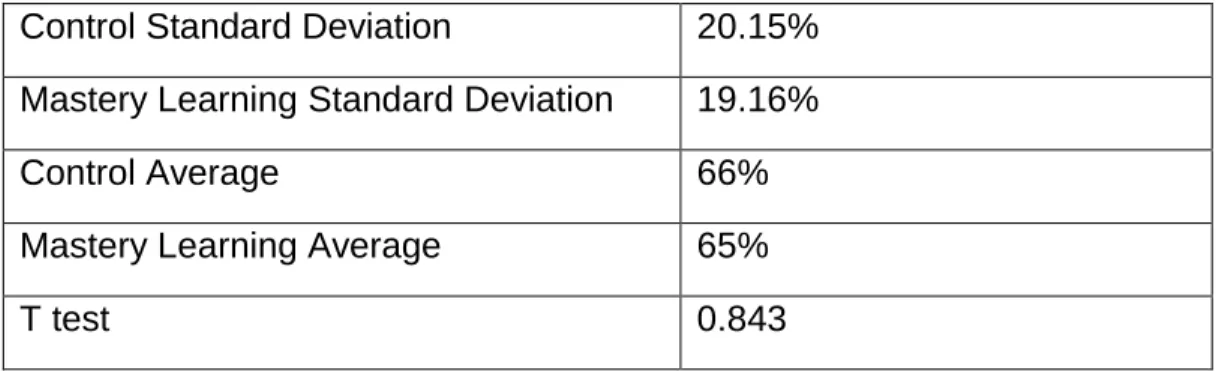
Control Standard Deviation
20.15%
Mastery Learning Standard Deviation
19.16%
Control Average
66%
Mastery Learning Average
65%
T test
0.843
Table 6-1: Accentuate the Negative Pre-test Data
The t value is greater than .05. Therefore, the null hypothesis can‟t be
rejected and we can confidently conclude that the data did come from two
random selections drawn from a single uniform population.
20 | P a g e
Next, we calculated the average score on the post test for the students
from the control group and the group that received Mastery learning. A
t-test was also performed. The results are listed in Table 5-2.
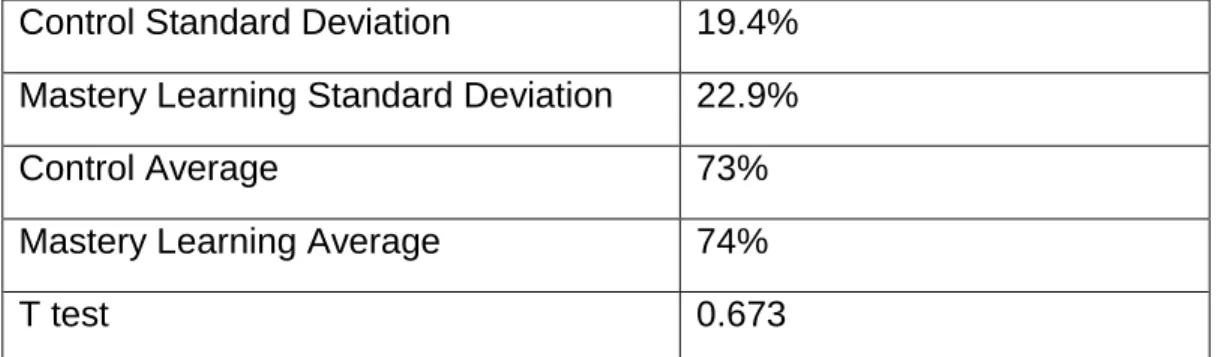
Control Standard Deviation
19.4%
Mastery Learning Standard Deviation
22.9%
Control Average
73%
Mastery Learning Average
74%
T test
0.673
Table 6-2: Accentuate the Negative Post-test Data
Once again, the t value is greater than .05. The null hypothesis cannot be
rejected and we can confidently conclude that the data did come from two
random selections drawn from a single uniform population.
Finally, the impact of Mastery learning was analyzed by calculating the
gain score between the pre-test and post-test for the control group and the
group that received Mastery Learning. The results are listed in Table 5-3.
Control Standard Deviation
18.5%
Mastery Learning Standard Deviation
22.1%
Control Gain Score
7%
Mastery Learning Gain Score
10%
T test
0.540
Table 6-3: Accentuate the Negative Overall Gain Score Data
Looking at the table above, the value of the overall t-test was 0.5403. The
t value is greater than .05, meaning that the null hypothesis cannot be
21 | P a g e
rejected and we can confidently conclude that the data did come from two
random selections drawn from a single uniform population. This proved
that there was no statistically reliable difference between learning in the
control group and in the group that received Mastery Learning. There was
7% overall learning in the control group and 10% overall learning in the
experimental group.
6.2.2 Data Rejection
We checked if there was a reliable difference between control and
experimental performance if data from the non-learners designated
“goofers”, students who refused to follow the instructions of ASSISTments
or their teacher, were thrown out. The reasoning behind this is that there
was no reason for unlearning, other than that students were guessing.
Throwing out the “goofers” still did not prove that there was any
statistically reliable difference between the control group and the group
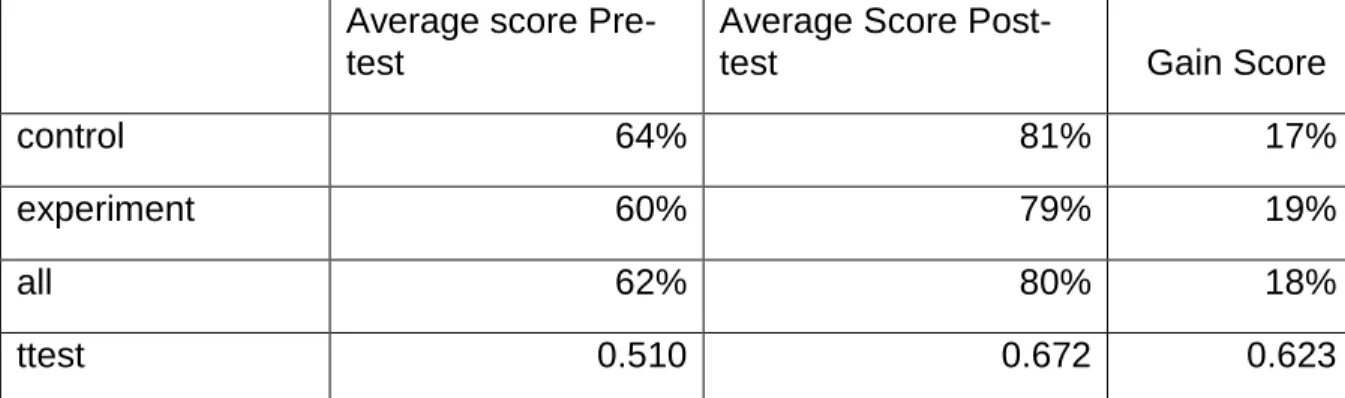
that received mastery learning. The results are summarized in Table 5-4.
Table 6-4: Accentuate the Negative Data, Post “Goofer” Removal
Average score
Pre-test
Average Score
Post-test
Gain Score
control
64%
81%
17%
experiment
60%
79%
19%
all
62%
80%
18%
22 | P a g e
There was more learning if the un-learners are disregarded, 17% overall
learning for the control group and 19% overall learning for the group that
received Mastery Learning, However, the value of the t-test is 0.62337.
The t value is greater than .05, meaning that the null hypothesis cannot be
rejected and we can confidently conclude that the data did come from two
random selections drawn from a single uniform population.
6.2.3 Interpretation of Accentuate the Negative Data
While both the control and experimental group showed considerable
improvement between the pre-test and the post-test, the t-test of this data
demonstrates that the improvement was relatively equal for both groups.
Therefore, we cannot conclude if the mastery learning was the cause for
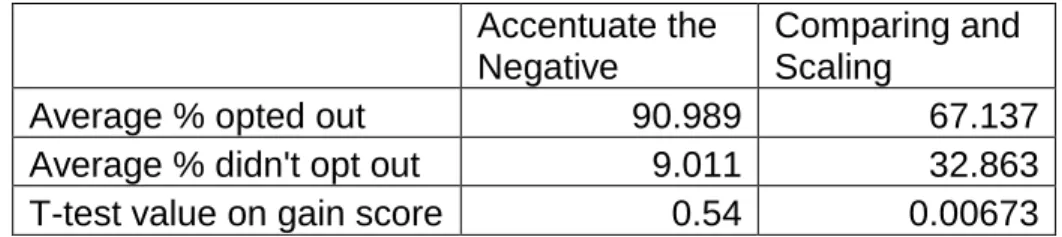
the improvement. The most likely reason for this is the fact that an
average of 91% of students who received Accentuate the Negative
mastery learning opted out, and therefore were unable to gain a significant
advantage from it. This is shown in table 6-5 below. Another possible
reason for this identical improvement is that the material is more
straightforward then other types of MCAS testing material. It is also
possible that the teacher‟s instruction was similar and just as effective as
the tutoring presented in mastery learning.
23 | P a g e
Accentuate the
Negative
Comparing and
Scaling
Average % opted out
90.989
67.137
Average % didn't opt out
9.011
32.863
T-test value on gain score
0.54
0.00673
Table 6-5: Opting Out Comparison Data
6.3 Comparing and Scaling
6.3.1 Comparing and Scaling Data
First, we calculate the average score on the pretest in both the control
group and the group that received Mastery Learning. Then we perform a
t-test upon the data for the pretest. Table 5-5 shows the results.
Control Standard Deviation
20.2%
Mastery Learning Standard Deviation
24.8%
Control Average
62.0%
Mastery Learning Average
60.7%
T test
0.781
Table 6-6: Comparing and Scaling Pre-test Data
That the t value is greater than .05 means that the null hypothesis can‟t be
rejected and we can confidently conclude that the data did indeed come
from two random selections drawn from a single uniform population.
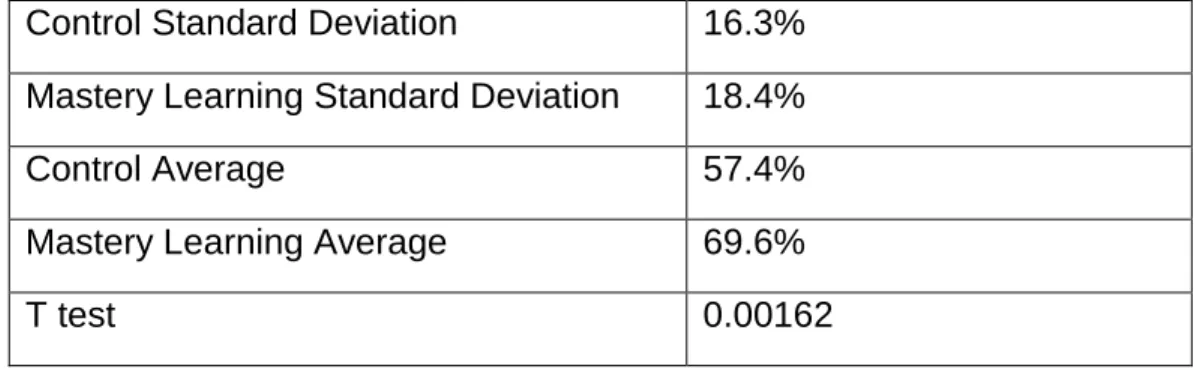
Next, we calculate the average score on the post-test in both the control
group and the group that received Mastery Learning. Table 5-6 shows the
results.
24 | P a g e
Control Standard Deviation
16.3%
Mastery Learning Standard Deviation
18.4%
Control Average
57.4%
Mastery Learning Average
69.6%
T test
0.00162
Table 6-7: Comparing and Scaling Post-test Data
That the t value is less than .05 means that the null hypothesis can be
rejected and we can confidently conclude that the Mastery Learning had a
sizeable enough impact that the two groups can no longer be random
selections from a uniform population.
But to determine whether the impact of Mastery Learning was a positive
one or a negative one, next we calculate the gain score between the
pretest and the post-test for both the control group and the group that
received Mastery Learning. Table 5-7 shows the results.
Control Standard Deviation
22.3%
Mastery Learning Standard Deviation
23.1%
Control Average
-4.6%
Mastery Learning Average
8.95%
T test
0.00673
Table 6-8: Comparing and Scaling Gain Score Data
The gain score for the control group is a negative value, from which we
can conclude that between the pretest and the post-test there was
observable unlearning of the material presented. The gain score for the
25 | P a g e
Mastery Learning group, however, is a positive value, from which we can
conclude that between the pretest and the post-test there was observable
learning of the material presented. That the t value is less than .05 means
that the null hypothesis can be rejected and we can confidently conclude
that the students who received Mastery Learning learned more than those
who did not.
6.3.2 Interpretation of Comparing and Scaling Data
Based on the gain score of the students who received mastery learning
with respect to those who did not, it is obvious that there was considerable
improvement due to the mastery learning tutoring. The fact that the t-test
was less than 0.05 confirms that the improvement was statistically reliable
and mastery learning was a success for the types of problems presented
in comparing and scaling.
6.4 Probability Review
Unfortunately, no data is readily available for this section because testing
is currently being conducted. However, this data will hopefully be
26 | P a g e
7. Limitations and Future Suggestions
Although the project was successful in helping students gain a better
understanding of the material, there are some improvements that could be made
to the experiment and to ASSISTments as a whole.
First, in order to simplify the logistics of conducting this experiment, the control
group and the experimental group each contained two randomly selected classes
rather than an equal number of randomly selected students. The benefit of
randomly selecting individual students is that it reduces the probability of one
group starting out with a better grasp of the material than another.
Due to time constraints, not all of the material we created was used in the
experiment by the time the report was written. This is due to the fact that
teachers can only present a limited amount of material during this time interval.
One way to improve this would be to increase the number of schools which
participate in the experiment. This would not only allow for more material to be
tested, but it would also provide a larger population from which to draw
conclusions.
Also, some mastery learning problem sets were associated with complex
ASSISTments, and contained problems testing several different skills. The
problem with this is that students who correctly answered the first mastery
learning problem they received “opted out” of the mastery learning problem set,
and therefore only received tutoring in one of the skills tested by the problem set.
27 | P a g e
If they were having trouble with the associated problem because of one particular
skill, they may never receive mastery learning aid on that skill. Then when they
receive a problem on the post-test that requires one of the skills they didn‟t see
tutoring for, they would show no sizable improvement since the pre-test. The
suggestions to improve this are to:
a) create more, simpler ASSISTments tagged with only one skill
b) remove the opt out option
c) assign the system such that students only complete mastery learning once
they correctly answer problems with each skill tagged
Some improvements should be made in the ASSISTment system. For example,
adding a spell-check to the builder and an easier method of inserting fractions,
equations, tables and images would allow for the faster creation of more
professional looking problems. Another improvement would be to increase the
number of characters that can be listed in a variabilized ASSISTment set. The
current value is 256 characters, which is insufficient for problems that have a
large range of answers. Another improvement would be some system of error
flagging for variabilized ASSISTments that would point out undeclared variables,
improper data types, etc.
28 | P a g e
8. Conclusions
From the analysis of our data on Accentuate the Negative, there was no
meaningful difference in the gain scores of the students in the mastery learning
group and the students in the control group. However, in Comparing and Scaling
the t-test confirmed that the improvement among mastery learning students was
reliably greater than that of the students in the control group.
If mastery learning had been implemented more effectively (as suggested in
section 6), these results could have been more consistent between the different
topics.
Also, the environment in which the experiment was conducted was not ideal.
For example, if students received help from their peers or their teacher during the
testing process this would affect the results of the tests. Furthermore, if there are
students who refuse to use the ASSISTment system and are just trying to
complete the tests it is likely that they‟ll just click hints in an attempt to reach the
final answers as quickly as possible, without actually learning the material.
Although there are several unknown variables which could have affected the
outcome of this experiment, the fact that there was an overall improvement
among students who received mastery learning confirms that it is a helpful tool in
assisting the learning efforts of students. Since our group only had two sets of
data to analyze, we cannot confidently say that mastery learning is the superior
approach to tutoring.
29 | P a g e
9. References
Guskey, Thomas. “Defining the Differences between Outcome-based Education
and Mastery Learning.” School Administrator. 34. (1994).
Martinez, Joseph and Nancy Martinez. “Teacher Effectiveness and Learning for
Mastery.” The Journal of Educational Research. 279. (1999)
“Thomson Higher Education Provides Online Web-Based Learning (OWL) to
Accompany Chemistry Textbooks; Online System Uses Mastery Learning to
Improve Student Performance; Increase Retention of Learned Content.” PR
Newswire. (2004)
Davis, D., & Sorrell, J. (1995, December). Mastery learning in public schools.
Paper prepared for PSY 702: Conditions of Learning. Valdosta, GA: Valdosta
State University. Available online:
[http://chiron.valdosta.edu/whuitt/files/mastlear.html]
VanLehn, Kurt et al. “The Andes Physics Tutoring System: Lessons Learned.”
International Journal of Artificial Intelligence in Education, 15(3), 2005.
Corbett, Albert T. and John R. Anderson. “Feedback Control and Learning to
Program with the CMU Lisp Tutor.”
http://act-r.psy.cmu.edu/papers/165/FeedbackControl_CorJRA.pdf
http://www.doe.mass.edu/mcas/2008/retest/nov_items.pdf
http://www.doe.mass.edu/mcas/overview.html
30 | P a g e
10 Appendix A: Accentuate the Negative
Problem Set "7th Grade Accentuate the Negative Test V1.0 With Tutoring (13 items)" id:[5312] 1) Assistment #27965 "27965 - 27965 Accentuate the Negative 7th - Ordering Integers and Fractions"
Arrange these numbers from least to greatest. -1/4, 1.5, -0.33, 7/4 Multiple choice: -1/4, 1.5, -0.33, 7/4 -1/4, 1.5, 7/4, -0.33 -1/4, 7/4, -0.33, 1.5 -1/4, 7/4, 1.5, -0.33 -1/4, -0.33, 7/4, 1.5 -1/4, -0.33, 1.5, 7/4 -0.33, 7/4, 1.5, -1/4 -0.33, 7/4, -1/4, 1.5 -0.33, 1.5, -1/4, 7/4 -0.33, 1.5, 7/4, -1/4 -0.33, -1/4, 1.5, 7/4 -0.33, -1/4, 7/4, 1.5 7/4, 1.5, -1/4, -0.33 7/4, 1.5, -0.33, -1/4 7/4, -0.33, 1.5, -1/4 7/4, -0.33, -1/4, 1.5 7/4, -1/4, -0.33, 1.5 7/4, -1/4, 1.5, -0.33 1.5, 7/4, -1/4, -0.33 1.5, 7/4, -0.33, -1/4 1.5, -1/4, -0.33, 7/4 1.5, -1/4, 7/4, -0.33 1.5, -0.33, 7/4, -1/4 1.5, -0.33, -1/4, 7/4 Scaffold:
One way to order the numbers from least to greatest is to convert them all to decimals.
Let's start by converting -1/4 to a decimal. What is -1/4 written as a decimal? Fill in:
-0.25 -.25 Hints:
31 | P a g e Remember, ¼ is a quarter
If you relate this to money, one quarter is 25 cents or 0.25 of a dollar. -1/4 is -0.25. Type in -0.25
Scaffold:
Now we have -0.25, 1.5, -0.33, and 7/4.
What is 7/4 written as a decimal? Fill in: 1.75 Hints: We know ¼ is equal to 0.25 So 7/4 would be 7 * 0.25 0.25 + 0.25 + 0.25 + 0.25 + 0.25 + 0.25 + 0.25 1.00 + 0.75 = 1.75 So 7/4 equals 1.75. Type in 1.75 Scaffold:
We know negative numbers are less than positive numbers. Therefore, 1.5 and 7/4 are not the smallest.
Now, let's find what number is the smallest. Which is smaller -0.33 or -1/4? Multiple choice: -0.33 -1/4 Hints:
Remember, -1/4 is the same as -0.25
32 | P a g e -0.33 is less than -0.25 or -0.33 is less than -1/4.
Select -0.33 Scaffold:
Which of the positive numbers is greater, 1.5 or 7/4? Multiple choice:
A. 7/4 B. 1.5 Hints:
Remember, 7/4 is 1.75 in decimal form.
Arrange 1.5 and 1.75 on a number line to visualize the order.
33 | P a g e Scaffold:
Now, lets return to the original question.
What is the order of -1/4, 1.5, -0.33, 7/4 from least to greatest? Multiple choice: -1/4, 1.5, -0.33, 7/4 -1/4, 1.5, 7/4, -0.33 -1/4, 7/4, -0.33, 1.5 -1/4, 7/4, 1.5, -0.33 -1/4, -0.33, 7/4, 1.5 -1/4, -0.33, 1.5, 7/4 -0.33, 7/4, 1.5, -1/4 -0.33, 7/4, -1/4, 1.5 -0.33, 1.5, -1/4, 7/4 -0.33, 1.5, 7/4, -1/4 -0.33, -1/4, 1.5, 7/4 -0.33, -1/4, 7/4, 1.5 7/4, 1.5, -1/4, -0.33 7/4, 1.5, -0.33, -1/4 7/4, -0.33, 1.5, -1/4 7/4, -0.33, -1/4, 1.5 7/4, -1/4, -0.33, 1.5 7/4, -1/4, 1.5, -0.33 1.5, 7/4, -1/4, -0.33 1.5, 7/4, -0.33, -1/4 1.5, -1/4, -0.33, 7/4 1.5, -1/4, 7/4, -0.33 1.5, -0.33, 7/4, -1/4 1.5, -0.33, -1/4, 7/4 Hints:
Because negative numbers are less than positive numbers we can exclude some of the options. Choose from -1/4, -0.33, 7/4, 1.5 -1/4, -0.33, 1.5, 7/4 -0.33, -1/4, 1.5, 7/4 -0.33, -1/4, 7/4, 1.5
We know -0.33 is less than -1/4, so choose from these: -0.33, -1/4, 1.5, 7/4
34 | P a g e We know 7/4 is the largest number,
so the number order from least to greatest is -0.33, -1/4, 1.5, 7.4. Select -0.33, -1/4, 1.5, 7.4.
2) Assistment #27966 "27966 - 27966 Accentuate the Negative 7th- Ordering Decimals" Arrange these numbers from least to greatest
0.28, 0.064, -1.03, -0.17 Multiple choice: 0.28, 0.064, -1.03, -0.17 0.28, 0.064, -0.17, -1.03 0.28, -1.03, -0.17, 0.064 0.28, -1.03, 0.064, -0.17 0.28, -0.17, 0.064, -1.03 0.28, -0.17, -1.03, 0.064 0.064, 0.28, -0.17, -1.03 0.064, 0.28, -1.03, -0.17 0.064, -0.17, -1.03, 0.28 0.064, -0.17, 0.28, -1.03 0.064, -1.03, 0.28, -0.17 0.064, -1.03, -0.17, 0.28 -1.03, -0.17, 0.28, 0.064 -1.03, -0.17, 0.064, 0.28 -1.03, 0.28, 0.064, -0.17 -1.03, 0.28, -0.17, 0.064 -1.03, 0.064, -0.17, 0.28 -1.03, 0.064, 0.28, -0.17 -0.17, -1.03, 0.064, 0.28 -0.17, -1.03, 0.28, 0.064 -0.17, 0.28, 0.064, -1.03 -0.17, 0.28, -1.03, 0.064 -0.17, 0.064, 0.28, -1.03 -0.17, 0.064, -1.03, 0.28 Scaffold:
Are positive or negative numbers smaller? Multiple choice:
A. Positive B. Negative Scaffold:
35 | P a g e We know negative numbers are less than positive numbers.
Therefore 0.28 and 0.064 are not the smallest. Now, let's find what number is the smallest. Which is smaller -1.03 or -0.17? Multiple choice: A. -1.03 B. -0.17 Hints:
Arrange these numbers on a number line to visualize the order.
0.17 is closer to zero then -1.03. Therefore -1.03 is smaller than -0.17.
Select -1.03 Scaffold:
For the positive numbers 0.28 and 0.064, which number is greater? Multiple choice: A. 0.28 B. 0.064 Hints: 0.28 = 28/100 = 280/1000
0.064= 64/1000
280/1000 is greater than 64/1000.Therefore 0.28 is greater than 0.064. Select 0.28
Scaffold:
Now, we can return to the original problem.
36 | P a g e Multiple choice: 0.28, 0.064, -1.03, -0.17 0.28, 0.064, -0.17, -1.03 0.28, -1.03, -0.17, 0.064 0.28, -1.03, 0.064, -0.17 0.28, -0.17, 0.064, -1.03 0.28, -0.17, -1.03, 0.064 0.064, 0.28, -0.17, -1.03 0.064, 0.28, -1.03, -0.17 0.064, -0.17, -1.03, 0.28 0.064, -0.17, 0.28, -1.03 0.064, -1.03, 0.28, -0.17 0.064, -1.03, -0.17, 0.28 -1.03, -0.17, 0.28, 0.064 -1.03, -0.17, 0.064, 0.28 -1.03, 0.28, 0.064, -0.17 -1.03, 0.28, -0.17, 0.064 -1.03, 0.064, -0.17, 0.28 -1.03, 0.064, 0.28, -0.17 -0.17, -1.03, 0.064, 0.28 -0.17, -1.03, 0.28, 0.064 -0.17, 0.28, 0.064, -1.03 -0.17, 0.28, -1.03, 0.064 -0.17, 0.064, 0.28, -1.03 -0.17, 0.064, -1.03, 0.28 Hints:
Negative numbers are less than positive numbers, so we can exclude some of the options. Choose from: -1.03, -0.17, 0.28, 0.064 -1.03, -0.17, 0.064, 0.28 -0.17, -1.03, 0.064, 0.28 -0.17, -1.03, 0.28, 0.064
We know -1.03 is less than -0.17, so choose from these:
-1.03, -0.17, 0.28, 0.064 -1.03, -0.17, 0.064, 0.28
We know 0.28 is the largest number,
37 | P a g e
Select -1.03, -0.17, 0.064, 0.28.
3) Assistment #27967 "27967 - 27967 Accentuate the Negative 7th- Ordering Integers" The table below shows the low temperatures of four cities on one winter night.
Low Temperatures of Four Cities One Night City Temperature Boston 4°F Lowell -1°F Springfield 7°F Worcester -3°F
Which city had the lowest temperature that night? Multiple choice: A. Boston B. Lowell C. Springfield D. Worcester Scaffold:
Let's start by trying to make sense of the temperatures given.
Are positive or negative temperatures lower? Multiple choice:
A. Positive B. Negative Scaffold:
38 | P a g e
Which city had the lowest temperature that night? Multiple choice: A. Boston B. Lowell C. Springfield D. Worcester Hints:
We know that negative numbers are lower than positive number
We also know that Boston and Springfield can be excluded as having the lowest temperatures because they are positive.
Arrange the temperature of Lowell and Worcester from least to greatest on a number line.
-3 is less than -1 because it is further away from zero. Therefore, Worcester has a lower temperature.
Select Worcester.
4) Assistment #27969 "27969 - 27969 Accentuate the Negative 7th-Scientific Notation" Wrangell–St. Elias National Park and Preserve in Alaska covers 148,000,000 acres.
What is 148,000,000 written in scientific notation?
39 | P a g e Multiple choice: A. 1.48 x 10⁵ B. 1.48 x 10⁶ C. 1.48 x 10⁸ D. 1.48 x 10⁷ Scaffold:
Scientific notation is a method of writing a number in terms of a decimal number between 1 and 10 multiplied by a power of 10.
Let's start by working backwards.
What is 1.48 * 10? Algebra:
14.8 Hints:
A shortcut to multiplying by 10 is to move the decimal over one place to the right.
If you move the decimal one place to the right, you get 14.8 Therefore, 1.48 * 10 = 14.8 Type 14.8 Scaffold: Now try 1.48 * 104.
What is this number is standard form? Algebra:
14,800 Hints:
Each time you multiply by 10, you move the decimal to the right one place. You are multiplying 1.48 by ten four times.
1.48 * 104 = 1.48 * 10 * 10 * 10 * 10
40 | P a g e Add zeros to hold your place.
So 1.48 * 104 = 14,800. Type 14,800
Scaffold:
Now, you are ready to do the original problem.
Wrangell-St. Elias National Park and Preserve in Alaska covers 148,000,000 acres. What is 148,000,000 written in scientific notation?
A. 1.48 * 105 B. 1.48 * 106 C. 1.48 * 108 D. 1.48 * 107 Multiple choice: A. 1.48 x 10⁵ B. 1.48 x 10⁶ C. 1.48 x 10⁸ D. 1.48 x 10⁷ Hints:
Lets start with 1.48 * 105. This is 1.48 * 10 * 10 * 10 * 10 *10
41 | P a g e 1.48 * 105 = 148,000
This is too small.
Next, try 1.48 * 106. This is 1.48 * 10 * 10 * 10 * 10 * 10 * 10
Move the decimal 6 places to the right:
1.48 * 106 = 1,480,000 This is still too small.
Now try 1.48 * 108. This is 1.48 * 10 * 10 * 10 * 10 * 10 * 10 * 10 * 10
Move the decimal 8 places to the right:
1.48 * 108 = 148,000,000.
This is the number you were looking for. Therefore, you do not have to go any further.
Choose 1.48 * 108.
42 | P a g e 5) Assistment #27970 "27970 - 27970 Accentuate the Negative 7th - Absolute Value"
What is the value of the expression below? |7| + |-11| Algebra: 18 -4 Scaffold:
The absolute value of a number is the distance that number is from zero.
What is the value of |7|? Algebra:
7 Hints:
Place 7 on a number line to see how far it is from zero.
|7| = 7 because 7 is 7 units away from zero.
Type in 7. Scaffold:
What is the value of |-11|? Algebra:
11 Hints:
43 | P a g e |-11| = 11 because -11 is 11 units away from zero.
Type in 11. Scaffold:
Now try the original problem again.
What is the value of the expression below? |7| + |-11|
Algebra: 18 Hints:
Rewrite |7| + |-11| without the absolute values. |7| + |-11| = 7 + 11 Since, |7| + |-11| = 7 + 11 = 18 The value of |7| + |-11| is 18. Type in 18.
6) Assistment #27971 "27971 - 27971 Accentuate the Negative 7th- Exponents" What is the value of this expression?
(4-7)2
Fill in: 9 Scaffold:
You can use order of operations to find the value of the expression (4-7)2. Remember the Order of Operations
1. Parenthesis
2. Exponents (powers, roots, etc)
3. Multiplication & Division (from left to right) 4. Addition & Subtraction (from left to right) This can be remembered as PEMDA
S
.
So first, simplify the expression, by simplifying what is inside the parentheses. What is the value of (4-7)?
Algebra: -3
44 | P a g e Hints:
Use a number line. Start at 4 and go back 7 spaces. Your number line should look like this:
7 spaces to the left of 4 is -3.
Therefore, the value of (4-7) is -3. Type in -3 Scaffold:
Now let's go back to the original problem.
What is the value of the expression (4-7)2? Algebra:
9 Hints:
We found that when you solved inside the parentheses you get,
(4-7)2 = ( -3)2
Remember, (-3) 2 is the same as -3 * -3.
A negative number times a negative number results in a positive product.
(-3) 2 = -3 * -3 = 9
Therefore, the value of the expression (4-7)2 is 9. Type in 9.
7) Assistment #27972 "27972 - 28760 Accentuate the Negative 7th- Addition and Subtraction" A) Find the sum.
45 | P a g e Algebra:
-1/2 Hints:
When adding or subtracting fractions you must first make sure that the denominators (bottom of the fraction) are equal. In this case they are both 4.
Now we just have to evaluate the numerators (top of the fraction) like you would normal integers. Here is a numberline to help visualize the problem.
-3 + 1 = -2
Now we put the denominator back and we get the answer of -2/4 B) Find the difference.
-20 - (-60) Algebra:
40 Hints:
To make this problem easier you should first simplify the signs.
Subtracting a negative number is the same thing as adding a positive number -20 - (-60)
-20 + 60
46 | P a g e Start at -20, move 60 places to the right (the positive direction) and end at 40, therefore the answer is 40.
You could also use the rule for adding integers, that is if two integers have different signs, subtract them and add the sign of the number with the highest absolute value (furthest from 0)
60 - 20 = 40 60 > 20 40
C) Find the Sum. 3.7 + -1.5 Algebra: 2.2 Hints:
Adding a negative is the same as subtracting. 3.7 + -1.5
3.7 - 1.5
This should be how the problem is set up on your paper.
47 | P a g e
Now evaluate the next number
The answer is 2.2, type in 2.2.
8) Assistment #27973 "27973 - 28765 Accentuate the Negative 7th- Mutliplication and Division" A) Find the product:
1
/2 * -10 = ?
Algebra: -5 Hints:
When you multiply two integers, remember to First: Multiply the numbers while ignoring the signs Then: Determine what the sign should be
Applying this process to 1/2 * -10 = ? First, since 10/1 = 10, multiply 1/2 *10/1 to get 10/2
Then, determine the proper sign.
Since there is one negative (-10) and one positive (1/2), the sign is negative, making the answer -10/2
or simplified, -5
B) What is the value of p that makes the statement true? -20 / p = -4
48 | P a g e 5
Hints:
You can use these rules to determine what sign P has to be.
For the answer to be negative, P must be positive, just like the 2nd example above. Ignoring the signs, we need to find 20 divided by what equals 4.
20/?=4
We know that 20/5=4 Therefore -20/5=-4
Since P has to be positive for the signs to work out,
p=5
9) Assistment #27974 "27974 - 27974 Accentuate the Negative 7th- Order of Operations" Find the value:
(7 - 34) ÷ 32 - 6(-3) Fill in: 15 Scaffold:
We can use order of operations to find the value of the expression (7 - 34) ÷ 32 - 6(-3).
Remember the Order of Operations 1. Parenthesis
2. Exponents (powers, roots, etc)
49 | P a g e 4. Addition & Subtraction (from left to right)
This can be remembered as PE
MD
AS.
So first, simplify what is in the parentheses. What is the value of 7 - 34?
Algebra: -27 Hints:
The easiest way to picture this is to use a number line.
Start at 7 and move 34 spaces to the left.
After seven steps to the left, you will reach zero and be in the negatives. You will have to go 34 - 7 = 27 steps into the negative side.
So, 7 - 34 = -27. Type in -27
Scaffold:
Now, you should have this written on your paper:
(7 - 34) ÷ 32 - 6(-3) = -27 ÷ 32- 6(-3).
Next, the exponents must be simplified. What is the value of 32? Algebra: 9 Hints: 32 is the same as 3 * 3. 3 * 3 = 9
The value of 32is 9. Type in 9 Scaffold:
After simplifying the exponents, you should have this written on your paper:
(7 - 34) ÷ 32 -6(-3) = -27 ÷ 32- 6(-3) = -27 ÷ 9 - 6(-3)
50 | P a g e Next, perform multiplication and division operations in order from left to right.
What the expression be if all the multiplication and division steps are simplified? Multiple choice: A. 3 - (-18) B. 3 - 18 C. -3 - (-18) D. -3 - 18 Hints:
To simplify the expression, move from left to right and do all division and multiplication operations.
First look at -27 ÷ 9. -27 ÷ 9 is -3. So we have -3 - 6(-3) Next, look at 6(-3). This is the same as 6 * -3. 6 * -3 = -18. So we have -3- (-18).
If all the multiplication and division steps are simplified, the expression is -3 - (-18). Choose -3 - (- 18).
Scaffold:
Now, we can return to the original problem.
What is the value of (7 - 34) ÷ 32 - 6(-3)? Algebra:
15 Hints:
So far, we have followed order of operations and done this much of the problem: (7 - 34) ÷ 32 - 6(-3) = -27 ÷ 32 - 6(-3). = -27 ÷ 9 - 6(-3). = -3 - (-18)
All we have left to do is add and subtract. -3 - (-18) is the same as -3 + 18. -3 + 18 = 15
Therefore, the value of (7 - 34) ÷ 32 - 6(-3) is 15. Type 15.
10) Assistment #27975 "27975 - 27975 Accentuate the Negative 7th- Order of Operations" Find the value:
8 - [30 ÷ (-3 x 2) - 5] x 22
51 | P a g e 48
32 Scaffold:
Order of operations can be used to find the value of the expression 8 - [30 ÷ (-3 x 2) - 5] x 22.
Remember the Order of Operations
1. Parenthesis
2. Exponents (powers, roots, etc)
3. Multiplication & Division (from left to right)
4. Addition & Subtraction (from left to right)
This can be remembered as PEMDAS.
So first work on what is inside the outer brackets, the part in blue.
8 - [30 ÷ (-3 x 2) - 5] x 22.
Which part inside of the blue brackets needs to be done first?
Multiple choice:
A. Multiplication inside Parentheses B. Division
C. Subtraction Scaffold:
We know we need to do the multiplication inside the parentheses first. Then, we can do the division.
So, what is the value of the part in blue?
8 - [30 ÷ (-3 x 2) - 5] x 22? Algebra:
-5 Hints:
First, do what is inside the parentheses.
8 - [30 ÷ (-3 x 2) - 5] x 22 8 - [30 ÷ (-6) - 5] x 22
Now you simplify what is left in blue:
8 - [30 ÷ (-3 x 2) - 5] x 22 8 - [30 ÷ (-6) - 5] x 22
52 | P a g e 8 - [30 ÷ (-3 x 2) - 5] x 22
8 - [30 ÷ (-6) - 5] x 22 8 - [-5 - 5] x 22
THe value of 30 ÷ (-3 x 2 ) is -5 type in -5 Scaffold:
Now you can finish simplifying what is inside the brackets.
What is the value of the blue part inside the brackets?
8 - [30 ÷ (-3 x 2) - 5] x 22 Algebra:
-10 Hints:
We have done the part in red so far. 8 - [30 ÷ (-3 x 2)- 5] x 22
8 - [30 ÷ (-6)- 5] x 22 8 - [-5 -5] x 22
-5 + -5 = -10. so we can finish the part inside the bracket. 8 - [30 ÷ (-3 x 2) - 5] x 22 8 - [30 ÷ (-6) - 5] x 22 8 - [-5 - 5] x 22 8 - [-10] x 22
The part inside the brackets is -10. Type in -10 Scaffold:
Now that we know the value of what is inside the brackets, we can simplify the expression. 8 - [30 ÷ (-3 x 2) - 5] x 22 8- [30 ÷ (-6) - 5] x 22 8- [-5 - 5] x 22 8 - (-10) x 22
So next, perform exponential operations. What is the value of 22? Algebra:
4 Hints:
53 | P a g e 8 - [30 ÷ (-3 x 2) - 5] x 22 8- [30 ÷ (-6) - 5] x 22 8- [-5 - 5] x 22 8 - (-10) x 22 8- (-10) x (2 x 2) 2 * 2 is 4. 8 - [30 ÷ (-3 x 2) - 5] x 22 8- [30 ÷ (-6) - 5] x 22 8- [-5 - 5] x 22 8 - (-10) x 22 8- (-10) x (2 x 2) 8- (-10) x 4
The value of 22 is 4. Type in 4 Scaffold:
Now, we can finish the original problem.
What is the value of 8 - [30 ÷ (-3 x 2) - 5] x 22 ? Algebra:
48 Hints:
Now, you should have this on your paper: 8 - [30 ÷ (-3 x 2) - 5] x 22 8- [30 ÷ (-6) - 5] x 22 8- [-5 - 5] x 22 8 - (-10) x 22 8 - (-10) x (2 x 2) 8 - (-10) x 4
Now, we have to perform any multiplication/ division operations from left to right. Then, add and subtract from left to right
The only multiplication operation left in the expression (-10) x 4. -10 x 4 = -40 8 - [30 ÷ (-3 x 2) - 5] x 22 8- [30 ÷ (-6) - 5] x 22 8- [-5 - 5] x 22 8 - (-10) x 22 8 - (-10) x (2 x2) 8 - (-10) x 4 8 - (-40)
54 | P a g e 8 - (-40) is the same as 8 + 40 because a negative minus a negative is a positive.
Now, this should be written on your paper: 8 - [30 ÷ (-3 x 2) - 5] x 22 8- [30 ÷ (-6) - 5] x 22 8- [-5 - 5] x 22 8 - (-10) x 22 8 - (-10) x (2 x 2) 8 - (-10) x 4 8 - (-40) 8 + 40 48
55 | P a g e Problem Set "7th Grade Accentuate the Negative Post Test V1.0 With Tutoring (13 items)" id:[5866]
1) Assistment #31003 "31003 - 27965 Accentuate the Negative 7th- Ordering Fractions and Integers" Arrange these numbers from least to greatest.
1/4, -1.7, 0.55, -6/4 Multiple choice: 1/4, -1.7, 0.55, -6/4 1/4, -1.7, -6/4, 0.55 1/4, 0.55, -1.7, -6/4 1/4, 0.55, -6/4, -1.7 1/4, -6/4, 0.55, -1.7 1/4, -6/4, -1.7, 0.55 -1.7, -6/4, 1/4, 0.55 -1.7, -6/4, 0.55, 1/4 -1.7, 0.55, -6/4, 1/4 -1.7, 0.55, 1/4, -6/4 -1.7, 1/4, 0.55, -6/4 -1.7, 1/4, -6/4, 0.55 0.55, 1/4, -1.7, -6/4 0.55, 1/4, -6/4, -1.7 0.55, -1.7, 1/4, -6/4 0.55, -1.7, -6/4, 1/4 0.55, -6/4, -1.7, 1/4 0.55, -6/4, 1/4, -1.7 -6/4, 0.55, -1.7, 1/4 -6/4, 0.55, 1/4, -1.7 -6/4, 1/4, 0.55, -1.7 -6/4, 1/4, -1.7, 0.55 -6/4, -1.7, 1/4, 0.55 -6/4, -1.7, 0.55, 1/4 Scaffold:
One way to order the numbers from least to greatest is to convert them all to decimals.
Let's start by converting 1/4 to a decimal. What is 1/4 written as a decimal? Algebra:
0.25 Hints:
Remember, ¼ is a quarter
56 | P a g e 1/4 is 0.25. Type in 0.25
Scaffold:
Now we have 0.25, -1.7, 0.55, and -6/4.
What is -6/4 written as a decimal? Algebra: -1.50 Hints: We know ¼ is equal to 0.25 So 6/4 would be 6 * 0.25 0.25 + 0.25 + 0.25 + 0.25 + 0.25 + 0.25 1.00 + 0.50 = 1.50
Replace the negative sign. Therefore -6/4 equals -1.50. Type in -1.50 Scaffold:
We know negative numbers are less than positive numbers. Therefore, 1/4 and 0.55 are not the smallest.
Now, let's find what number is the smallest. Which is smaller -6/4 or -1.7? Multiple choice: -1.7 -6/4 Hints:
Remember, -6/4 is the same as -1.5
Arrange the numbers on a number line in order to visualize the order.
-1.7 is less than -1.5 or -1.7 is less than -6/4. Select -1.7
Scaffold:
57 | P a g e Multiple choice:
A. 1/4 B. 0.55 Hints:
Remember, 1/4 is 0.25 in decimal form.
Arrange 1/4 and 0.55 on a number line to visualize the order.
0.55 is greater than 0.25 or 0.55 is greater than 1/4. Select 0.55. Scaffold:
Now, lets return to the original question.
What is the order of 1/4, -1.7, 0.55, -6/4 from least to greatest? Multiple choice: 1/4, -1.7, 0.55, -6/4 1/4, -1.7, -6/4, 0.55 1/4, 0.55, -1.7, -6/4 1/4, 0.55, -6/4, -1.7 1/4, -6/4, 0.55, -1.7 1/4, -6/4, -1.7, 0.55 -1.7, -6/4, 1/4, 0.55 -1.7, -6/4, 0.55, 1/4 -1.7, 0.55, -6/4, 1/4 -1.7, 0.55, 1/4, -6/4 -1.7, 1/4, 0.55, -6/4 -1.7, 1/4, -6/4, 0.55 0.55, 1/4, -1.7, -6/4 0.55, 1/4, -6/4, -1.7 0.55, -1.7, 1/4, -6/4 0.55, -1.7, -6/4, 1/4 0.55, -6/4, -1.7, 1/4
58 | P a g e 0.55, -6/4, 1/4, -1.7 -6/4, 0.55, -1.7, 1/4 -6/4, 0.55, 1/4, -1.7 -6/4, 1/4, 0.55, -1.7 -6/4, 1/4, -1.7, 0.55 -6/4, -1.7, 1/4, 0.55 -6/4, -1.7, 0.55, 1/4 Hints:
Because negative numbers are less than positive numbers we can exclude some of the options. Choose from -1.7, -6/4, 1/4, 0.55 -1.7, -6/4, 0.55, 1/4 -6/4, -1.7, 1/4, 0.55 -6/4, -1.7, 0.55, 1/4
We know -1.7 is less than -6/4, so choose from these: -1.7, -6/4, 1/4, 0.55
-1.7, -6/4, 0.55, 1/4
We know 0.55 is the largest number,
so the number order from least to greatest is -1.7, -6/4, 1/4, 0.55 Select -1.7, -6/4, 1/4, 0.55
2) Assistment #31094 "31094 - 27966 Accentuate the Negative 7th- Ordering Decimals" Arrange these numbers from least to greatest
-0.35, 0.053, -1.63, 0.57 Multiple choice: -0.35, 0.053, 0.57, -1.63 -0.35, 0.053, -1.63, 0.57 -0.35, 0.57, 0.053, -1.63 -0.35, 0.57, -1.63, 0.053 -0.35, -1.63, 0.57, 0.053 -0.35, -1.63, 0.053, 0.57 0.053, -0.35, 0.57, -1.63 0.053, -0.35, -1.63, 0.57 0.053, 0.57, -0.35, -1.63 0.053, 0.57, -1.63, -0.35 0.053, -1.63, 0.57, -0.35
59 | P a g e 0.053, -1.63, -0.35, 0.57 -1.63, 0.053, -0.35, 0.57 -1.63, 0.053, 0.57, -0.35 -1.63, 0.57, 0.053, -0.35 -1.63, 0.57, -0.35, 0.053 -1.63, -0.35, 0.053, 0.57 -1.63, -0.35, 0.57, 0.053 0.57, -1.63, -0.35, 0.053 0.57, -1.63, 0.053, -0.35 0.57, 0.053, -1.63, -0.35 0.57, 0.053, -0.35, -1.63 0.57, -0.35, 0.053, -1.63 0.57, -0.35, -1.63, 0.053 Scaffold:
Are positive or negative numbers smaller? Multiple choice:
A. Positive B. Negative Scaffold:
We know negative numbers are less than positive numbers. Therefore 0.053 and 0.57 are not the smallest.
Now, let's find what number is the smallest. Which is smaller -0.35 or -1.63? Multiple choice: A. -0.35 B. -1.63 Hints:
Arrange these numbers on a number line to visualize the order.
60 | P a g e -0.35 is closer to zero then -1.63.
Therefore -1.63 is smaller than -0.35.
Select -1.63 Scaffold:
For the positive numbers 0.053 and 0.57, which number is greater? Multiple choice: A. 0.053 B. 0.57 Hints: 0.053 = 53/1000
0.57= 57/100 = 570/1000
570/1000 is greater than 53/1000.Therefore 0.57 is greater than 0.053 Select 0.57
Scaffold:
Now, we can return to the original problem.
What is the order of -0.35, 0.053, -1.63, 0.57 from least to greatest? Multiple choice: -0.35, 0.053, 0.57, -1.63 -0.35, 0.053, -1.63, 0.57 -0.35, 0.57, 0.053, -1.63 -0.35, 0.57, -1.63, 0.053 -0.35, -1.63, 0.57, 0.053 -0.35, -1.63, 0.053, 0.57 0.053, -0.35, 0.57, -1.63 0.053, -0.35, -1.63, 0.57 0.053, 0.57, -0.35, -1.63 0.053, 0.57, -1.63, -0.35 0.053, -1.63, 0.57, -0.35 0.053, -1.63, -0.35, 0.57 -1.63, 0.053, -0.35, 0.57 -1.63, 0.053, 0.57, -0.35 -1.63, 0.57, 0.053, -0.35 -1.63, 0.57, -0.35, 0.053 -1.63, -0.35, 0.053, 0.57 -1.63, -0.35, 0.57, 0.053
61 | P a g e 0.57, -1.63, -0.35, 0.053 0.57, -1.63, 0.053, -0.35 0.57, 0.053, -1.63, -0.35 0.57, 0.053, -0.35, -1.63 0.57, -0.35, 0.053, -1.63 0.57, -0.35, -1.63, 0.053 Hints:
Negative numbers are less than positive numbers, so we can exclude some of the options. Choose from: -1.63, -0.35, 0.053, 0.57 -1.63, -0.35, 0.57, 0.053 -0.35, -1.63, 0.57, 0.053 -0.35, -1.63, 0.053, 0.57
We know -1.63 is less than -0.35, so choose from these:
-1.63, -0.35, 0.053, 0.57 -1.63, -0.35, 0.57, 0.053
We know 0.57 is the largest number,
so the number order from least to greatest is -1.63, -0.35, 0.053, 0.57
Select -1.63, -0.35, 0.053, 0.57
3) Assistment #31083 "31083 - 27967 Accentuate the Negative 7th-Ordering Integers"
The table below shows the low temperatures of four New England cities on one winter night.
Low Temperatures of Four Cities One Night City Temperature Concord, NH -5°F Boston, MA 4°F Hartford, CN 8°F Augusta, ME -4°F
Which city had the lowest temperature that night?
62 | P a g e Multiple choice: A. Concord, NH B. Boston, MA C. Hartford, CN D. Augusta, ME Scaffold:
Let's start by trying to make sense of the temperatures given.
Are positive or negative temperatures lower? Multiple choice:
A. Positive B. Negative Scaffold:
Now, we are ready to try the original problem again.
Which city had the lowest temperature that night? Multiple choice: A. Concord, NH B. Boston, MA C. Hartford, CN D. Augusta, ME Hints: