AN OPTIMAL APPLICATION OF SYMBOLS
Montserrat Alsina
Universitat Politècnica de Catalunya BarcelonaTech (SPAIN)
Abstract
In this paper, an optimal application of symbols is described, in the context of European Higher Education Area (EHEA) for engineering degrees. Handling mathematical symbols and foreign language are common competences, and the proposal is to deal with both at the same time.
On-line resources as Class-Talk help university lecturers and students to communicate more effectively in the classroom when a foreign language is used. In that setting the use of mathematics symbols at engineering degrees highlighted the difficulties in the equivalence of verbal and symbolic languages. To manage them, some resources have been developed, mainly the application Multilingual Formulae presented in this paper.
Keywords: Mathematical symbols, foreign languages, on-line resources.
1 INTRODUCTION
From the Bologna Declaration, European higher-educational institutions are adapting their curricula according the basic principles of quality, mobility, diversity and competitiveness, in order to constitute a global reference frame for Education and Research. Beside the excellence level at the contents, transversal competences play an important role. In that landscape, it becomes a challenge to success in getting optimal global results, balancing contents and competences.
We will focus on some aspects. By one hand, it is clear that a good command of several languages is a core competence to be internationally competitive and multiculturally aware. To improve students’ command of foreign language, a current common tool is teaching contents in that language, in a similar way to what is called Content and Language Integrated Learning (CLIL) at other educational levels, as recommended by the European Commission at [1]. By the other hand, in Science and Engineering Education and Research, handling Mathematical Symbolic Language is also essential to deal with most of contents. It is included, for example, in the list of core competences of KOM project, cf. [2]. In fact, it is well known that lack of command in the equivalence between verbal and symbolic language implies difficulties in posing and solving problems.
Both aspects have a lot in common: a language is involved, a language made up of symbols, a language intended to be a bridge of communication that could become a barrier, as Galileo wrote: “... questo grandissimo libro checontinuament ci sta aperto innanzi a gli occhi (io dico l'universo), ma non si può intendere se prima non s'impara a intender la lingua e conoscer i caratteri, ne' quali èscritto. Egli è scritto in lingua matematica, e i caratteri son triangoli, cerchi, ed altre figure geometriche, senza i quali mezzi è impossibile a intenderne umanamente parola; senza questi è un aggirarsi vanamente per un oscuro laberinto.”
The proposal is based on the equivalence between formal and verbal language. A discussion about that can be found at [3] and [4]. We think that the use of the symbols in a foreign language force and encourage the specification of that equivalence. Thus, it can be applied to improve comprehension, even in terms of content, creating synergy. In that sense it could be called an optimal application of symbols.
The main result is the open access on-line resource Multilingual Formulae. It is an application (available at http://mformulae.epsem.upc.edu) designed to give support to the equivalence of languages, not found in textbooks or research papers.
As a reference we fix English language as foreign language, and look for information about English proficiency in academic contexts, with the scope of CLIL methodology. Some research has been done, but there is little published data. See [5] and [6] for some overview in Catalonia, Spain and Europe. It is also true that there is much variation among different schools even at the same university due to geographical or academic reasons. At this point we considered as reference a center without limited admission conditions, open to students accepted by the Higher Education system, as the Escola Politècnica Superior d’Enginyeria de Manresa (EPSEM) of the Universitat Politècnica de Catalunya BarcelonaTech (UPC).
2.1 Students
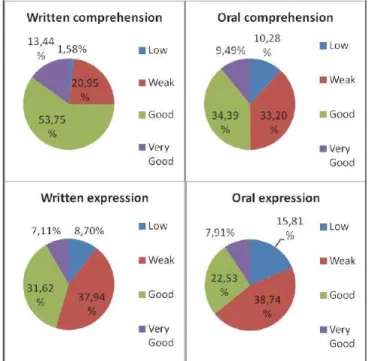
A study of the English language skills was conducted for the incoming students, with the aim to realise about their own perception. Fig. 1 shows the results for a sample of 400 students enrolled in the new degrees on the academic courses 2011-12 and 2012-13. Results comparing both academic years can be found at [7]. Data confirms that scaffolding and support material was really necessary for teaching content through English.
Fig. 1. Students results on English language skills.
With respect the level of use of symbolic language we didn’t know about any previous formal study on students at university level, but the experience as lecturers at first year degrees certainly confirms the need of improving this competence. It would be desirable to conduct a study of their influence on solving problems skill, with numerical data. Anyway, even to achieve this competence is assumed, no other methodology apart from practice is carried out in general.
We conclude students have difficulties related to both competences, use of foreign language and use of symbolic language, so new resources are needed in order to guaranty learning quality.
2.2 Lecturers
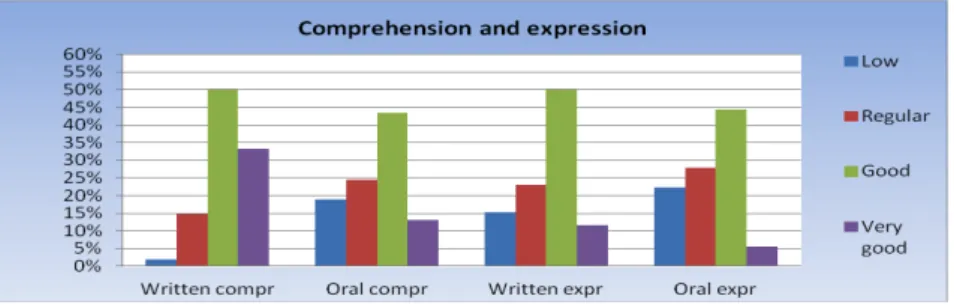
In order to plan the strategy for introducing CLIL approach, information on teaching staff was also collected. A questionnaire was voluntary answered by 70% of lecturers at the school of reference. An overview of the results about their own perception on comprehension and expression skills in their third language can be seen in Fig. 2.
Fig. 2. Results on communication skills in English as third language.
Questionnaires also collected complementary information having a positive impact on this approach. By one side, about which official english language acreditations were more common, and by the other side about research/teaching foreign experiences, even there are no mandatory rules about that for lecturers. Results are displayed in Fig. 3.
Fig. 3. Results on official accreditations and foreign experience of lecturers.
Data on lecturers suggest they may be ready to deal with both competences if support resources are made available to them. Of course, use of symbolic language by lecturers is clearly assumed, as it is widely used in research papers, but no special methodology is fixed to teach about it.
3 RESULTS
In the context of previous analysis, first step was the elaboration of the online resource Class-Talk, with the collaboration of several professors of the same school and the Language Service of UPC.
CLASS-TALK is a multilingual phrasebook in Catalan, Spanish and English including a wide range of university classroom situations. The aim of this phrasebook is to help university lecturers and students to communicate more effectively in the classroom, when using a language that is not their mother tongue. Classroom expressions are classified according usual situations: starting the lecture, using visuals aids, in the laboratory, etc. Audio files are provided to improve oral expression and comprehension. Fig. 4. shows an image of Class-Talk home page at http://www.upc.edu/slt/classtalk/.
d’Enginyeria de Manresa (EPSEM-UPC), which consists of more than twenty lecturers from six different departments.
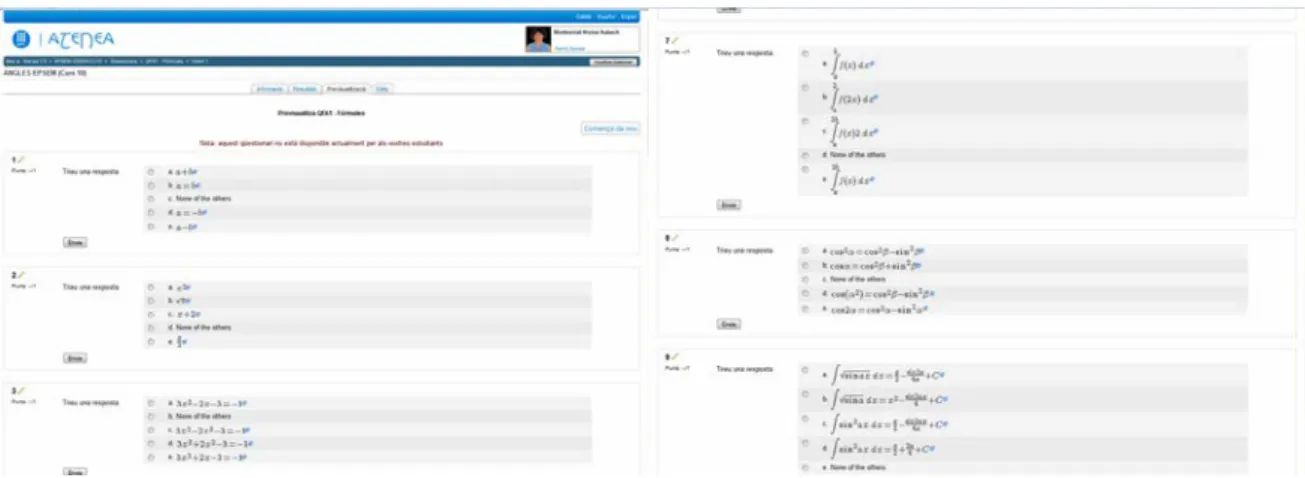
Next step was to investigate the relation between symbolic language and natural languages. Test on formulas with linked audio files were used to study the difficulties of students and lecturers. Questionnaires of different levels were prepared and a systematic use revealed that the tests can be used as self-learning tools, offering the written transcription of some symbols. The following Fig. 5 shows an example of used tests.
Fig. 5. Initial questionnaires implemented at digital campus platform Atenea UPC (Moodle). But to provide models for learning the equivalence of symbolic and natural language a new on-line open access resource was designed, called Multilingual Formulae.
More concretely the application Multilingual Formulae (at http://mformulae.epsem.upc.edu) presents tables and sets of formulas with the corresponding written and oral version in different languages. It is implemented in a collaborative setting, using Plone and the Javascript library MathJax to render mathematics in LaTeX.
The resources is organized in three sections: formulas, symbols and notations. Basic symbols are collected in tables, as basic tools, as shown in Fig. 6.
Fig. 6. Example of table of symbols at Multilingual Formulae.
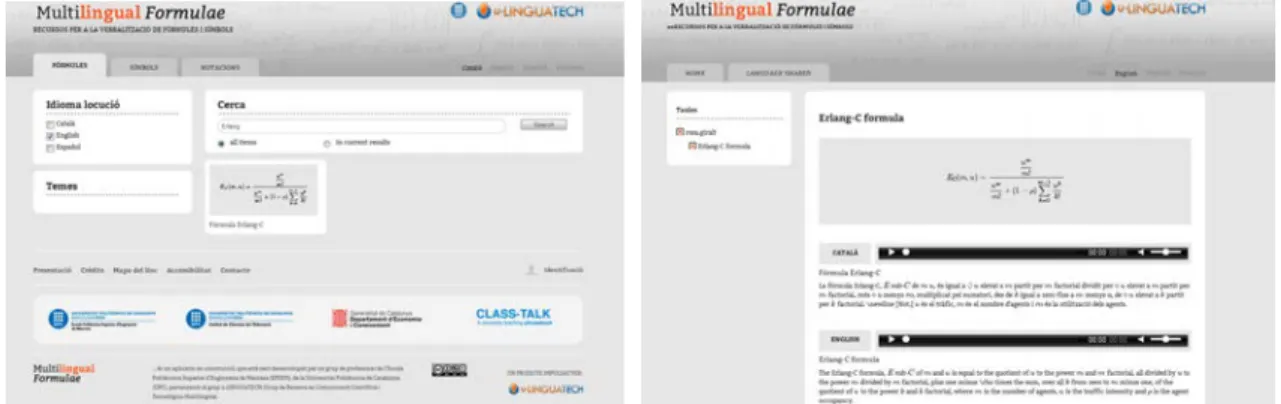
A previous draft version was presented at the 2012 SEFI Annual Conference, see [8]. Current version has a better performance, as a multilingual website supporting a multifaceted search for the formulas. Each formula has a graphical version, using LaTeX, and written transcription in different languages, as well as associated audio files. It is illustrated in Fig.7.
Fig. 7. Example of table of multifaceted search and of formula, at Multilingual Formulae. With the aim to be more complete, as the formulas are related to different areas in engineering, such as electronic or chemical, for example, tables of notation are included too. Fig. 8. shows an example.
Fig. 8. Example of table of chemical notations at Multilingual Formulae.
The project is addressed to lecturers, students and researchers as a support to ensure the effective communication when symbolic language is used in a foreign language. It has been experimented as a helpful tool to improve self-learning and to increase the self-confidence.
In the next future, studies to analyze the impact of this new resource will be conducted, in order to evaluate the achievement of the goals of the research group, and to develop new resources useful for a wide range in the educative community.
REFERENCES
[1] Council of Europe (1995), “Teaching and Learning, towards the learning Society”, White Paper on Education and Training, COM(95) 590.
[2] Niss, M. (2003). Mathematical competencies and the learning of mathematics: The Danish KOM project. In A. Gagatsis and S. Papastravidis eds. 3rd Mediterranean Conference on Mathematics Education, Hellenic Math. Soc. And Cyprus Math. Soc. pp.115-124.
[3] Alsina, M. and Bonet-Dalmau, J. (2012). Improving Symbolic Language Comprehension.. Proceedings of 16th SEFI-Mathematics Working Group Seminar, Universidad de Salamanca, ISBN: 978-84-695-3960-6.
[6] Lasagabaster, D. (2008). Foreign Language Competence in Content and Language Integrated Courses. The Open Applied Linguistics Journal Vol.1:31-42.
[7] Alsina, M., Fortuny,J. and Giralt, R. (2012). Elaboració de recursos multimedia per a
l’ensenyament/ aprenentatge en anglès en graus tecnològics. Proceedings of CIDUI (Congrés Internacional de Docència Universitària i Innovació), ISBN: 978-84-695-4073-2.
[8] Bonet, J. and Alsina, M. (2012). Teaching symbolic language to non-native speakers. Proceedings of the 40th SEFI Annual Conference 2012, ISBN: 978-2-87352-005-2.