of Scientific Articles
Dissertation
zur
Erlangung der Doktorwürde
der Neuphilologischen Fakultät
der Ruprecht-Karls-Universität Heidelberg
vorgelegt
von
Daraksha Parveen
aus India
Automatic text summarization is one of the eminent applications in the field of Natural Language Processing. Text summarization is the process of generat-ing a gist from text documents. The task is to produce a summary which con-tains important, diverse and coherent information, i.e., a summary should be self-contained. The approaches for text summarization are conventionally extractive. The extractive approaches select a subset of sentences from an input document for a summary. In this thesis, we introduce a novel graph-based extractive sum-marization approach.
With the progressive advancement of research in the various fields of science, the summarization of scientific articles has become an essential requirement for researchers. This is our prime motivation in selecting scientific articles as our
dataset. This newly formed dataset contains scientific articles from the PLOS
Medicinejournal, which is a high impact journal in the field of biomedicine.
The summarization of scientific articles is a single-document summarization task. It is a complex task due to various reasons, one of it being, the important informa-tion in the scientific article is scattered all over it and another reason being, scien-tific articles contain numerous redundant information. In our approach, we deal with the three important factors of summarization: importance, non-redundancy and coherence. To deal with these factors, we use graphs as they solve data spar-sity problems and are computationally less complex.
We employ bipartite graphical representation for the summarization task, exclu-sively. We represent input documents through a bipartite graph that consists of sentence nodes and entity nodes. This bipartite graph representation contains en-tity transition information which is beneficial for selecting the relevant sentences for a summary. We use a graph-based ranking algorithm to rank the sentences in a document. The ranks are considered as relevance scores of the sentences which are further used in our approach.
Scientific articles contain reasonable amount of redundant information, for
exam-ple,IntroductionandMethodologysections contain similar information regarding
the motivation and approach. In our approach, we ensure that the summary con-tains sentences which are non-redundant.
Though the summary should contain important and non-redundant information of the input document, its sentences should be connected to one another such that it becomes coherent, understandable and simple to read. If we do not ensure that a summary is coherent, its sentences may not be properly connected. This leads to an obscure summary. Until now, only few summarization approaches take care of coherence. In our approach, we take care of coherence in two different ways: by using the graph measure and by using the structural information. We employ outdegree as the graph measure and coherence patterns for the structural information, in our approach.
We use integer programming as an optimization technique, to select the best sub-set of sentences for a summary. The sentences are selected on the basis of rele-vance, diversity and coherence measure. The computation of these measures is tightly integrated and taken care of simultaneously.
We use human judgements to evaluate coherence of summaries. We compare
ROUGE scores and human judgements of different systems on thePLOS Medicine
dataset. Our approach performs considerably better than other systems on this dataset. Also, we apply our approach on the standard DUC 2002 dataset to com-pare the results with the recent state-of-the-art systems. The results show that our graph-based approach outperforms other systems on DUC 2002. In conclusion, our approach is robust, i.e., it works on both scientific and news articles. Our approach has the further advantage of being semi-supervised.
Automatische Textzusammenfassung ist eine der bedeutendsten Anwendungen auf dem Gebiet des Natural Language Processing. Textzusammenfassung ist der Prozess der Erzeugung eines Kerns aus Textdokumenten. Die Aufgabe besteht darin, eine Zusammenfassung zu erzeugen, die wichtige, vielfältige und kohärente Informationen enthält, d.h. eine Zusammenfassung sollte in sich geschlossen sein. Die Ansätze zur Textzusammenfassung sind herkömmlich extraktiv. Die extraktiven Ansätze wählen eine Teilmenge von Sätzen aus einem Eingabedoku-ment für eine Zusammenfassung aus. In dieser Arbeit stellen wir einen neuar-tigen grafischen Extraktionsansatz vor. Mit der fortschreitenden Förderung der Forschung in den verschiedenen Bereichen der Wissenschaft ist die Zusammen-fassung von wissenschaftlichen Artikeln, eine wesentliche Voraussetzung für die Forscher geworden. Dies ist unsere primäre Motivation bei der Auswahl wis-senschaftlicher Artikel als unseren Datensatz. Dieser neu gegründete Datensatz enthält wissenschaftliche Artikel aus der Zeitschrift PLOS Medicine, einem hochwis-senschaftlichen Journal auf dem Gebiet der Biomedizin.
Die Zusammenfassung von wissenschaftlichen Artikeln ist eine Einzeldokumen-tation. Es ist eine komplexe Aufgabe aus verschiedenen Gründen, einer davon ist, dass die wichtige Information in dem wissenschaftlichen Artikel überall verstreut ist und ein weiterer Grund ist, dass wissenschaftliche Artikel zahlreiche redun-dante Informationen enthalten. In unserem Ansatz befassen wir uns mit den drei wichtigen Faktoren: Wichtigkeit, Nicht-Redundanz und Kohärenz. Dazu verwen-den wir Graphen, da sie Datenprobleme lösen und rechnerisch weniger komplex sind.
Wir verwenden exclusiv eine bipartite grafische Darstellung für die Verdichtungsauf-gabe. Wir repräsentieren Eingangsdokumente durch einen bipartiten Graphen, der aus Satzknoten und Entitätsknoten besteht. Diese bipartite Graphdarstel-lung enthält Entitätsübergangsinformationen, die für die Auswahl der relevanten Sätze für eine Zusammenfassung vorteilhaft sind. Wir verwenden einen grafis-chen Klassifizierungsalgorithmus, um die Sätze in einem Dokument zu ordnen. Die Reihen werden als Relevanz-Scores der Sätze betrachtet, die in unserem
Ansatz weiter verwendet werden. Wissenschaftliche Artikel enthalten eine be-trächtliche Menge an redundanten Informationen, so enthalten z.B. die Abschnitte Einleitung und Methodik ähnliche Informationen über die Motivation und den Ansatz. In unserem Ansatz stellen wir sicher, dass die Zusammenfassung Sätze enthält, die nicht-redundant sind. Obwohl die Zusammenfassung wichtige und unredundante Informationen des Input-Dokuments enthalten sollte, sollten die Sätze so miteinander verbunden sein, dass es kohärent, verständlich und einfach zu lesen ist. Wenn wir nicht sicherstellen, dass eine Zusammenfassung kohärent ist, könnten die Sätze nicht korrekt verbunden sein. Dies führt zu einer undurch-sichtigen Zusammenfassung. Bisher kümmern sich nur wenige Verdichtungsan-sätze um Kohärenz.
In unserem Ansatz kümmern wir uns um die Kohärenz auf zwei verschiedene Arten: durch Verwendung der graphischen Maßnahme und durch Verwendung der strukturellen Informationen. Wir verwenden outdegere als Diagrammmaß und Kohärenzmuster für die Strukturinformation in unserem Ansatz. Wir verwenden Integer-Programmierung als Optimierungstechnik, um die beste Teilmenge von Sätzen für eine Zusammenfassung auszuwählen. Die Sätze werden auf Basis von Relevanz, Diversität und Kohärenzmaß ausgewählt. Bei der Berechnung dieser Maßnahmen wird auf enge Integration und Gleichzeitigkeit geachtet. Wir ver-wenden menschliche Bewertungen, um die Kohärenz der Zusammenfassungen zu beurteilen/evaluieren. Wir vergleichen ROUGE Scores und menschliche Be-wertungen verschiedener Systeme auf dem PLOS Medicine Datensatz. Unser Ansatz ist wesentlich besser als andere Systeme dieses Datensatzes. Darüber hin-aus wenden wir unseren Ansatz auf den Standard DUC 2002-Datensatz an, um die Ergebnisse mit den jüngsten state-of-the-art-Systemen zu vergleichen. Die Ergebnisse zeigen, dass unser grafischer Ansatz andere Systeme auf DUC 2002 übertrifft. Zusammenfassend ist unser Ansatz robust, d.h. er funktioniert sowohl bei Artikeln auf wissenschaftlicher Ebene als auch bei Zeitungsartikeln. Unser Ansatz hat den weiteren Vorteil, dass er halbüberwacht ist.
First, I would like to thank my advisor Prof. Dr. Michael Strube. His persistent support made my PhD possible. I really appreciate his patience, listening to my ideas; and correcting the draft version of my papers. He even went to the extent of making me learn using articles in the English language. He has been a very supportive and helpful supervisor. I could not have imagined, a better supervisor for my thesis.
I would also like to thank my colleagues, Nafise Moosavi, Mohsen Mesgar, An-gela Fahrni, Sebastian Martschat, Alex Judea, Yufang Hou, and Mark-Christopher Muller, who were also human judges in one of my experiments. Moreover, they helped me in correcting the thesis by giving their useful comments. I am highly obliged for this.
I would again like to thank my colleague, Nafise Moosavi, for the tea breaks we had, whenever she ran her feature mining algorithm on the stanford system. Her love and care turned even my worst days cheerful.
I would like to thank my colleague, Mohsen Mesgar, for the coherence patterns he built which later I used in my approach. Working with him made me learn, teamwork and cooperation.
I would like to thank my family and friends for always being supportive. My parents, Mr. Jabbar Ali Ansari and Mrs. Shahista Parveen Ansari, support has been unrelenting force which motivated me to stand where I do now. Their simple advice could solve even the most complicated problems of my life. I thank my husband, Squadron Leader Sameer Tahir, for being right at my side in all my ups and downs. His endless optimism and patience gave me the strength to leap over all my hurdles. He has been constantly, encouraging and inspiring me throughout the research. I would like to thank my sister, Alisha Parveen, for being always present; physically being in Heidelberg and mentally, for being at the forefront of my joy and my distress. I hope she has learned from my mistakes and submit her own thesis with flying colors. I also would like to thank my uncle, Mr. Mohd. Afroz, for his inception to convince my parents for starting my PhD from Heidel-berg, Germany. I really appreciate the support I got during my research from my
extended family, Mr. Tahir Iqbal and Mrs. Rana Tahir, who patiently listened to rantings of my problems without flinching.
Lastly, I would like to thank HITS, Heidelberg for the PhD scholarship and AIPHES, Darmstadt for travel grants.
1 Introduction 1
1.1 Automatic Summarization . . . 2
1.2 Types of Summarization . . . 3
1.3 General Architecture for Extractive Summarization . . . 7
1.4 Scientific Articles . . . 8 1.5 Research Goals . . . 9 1.5.1 Representation of Documents . . . 9 1.5.2 Important Information . . . 10 1.5.3 Non-redundant Information . . . 10 1.5.4 Coherent Information . . . 11
1.5.5 Robustness and Scalability across Different Domains . . . 11
1.6 Research Contributions . . . 11
1.6.1 A New Dataset for Summarization . . . 12
1.6.2 Identifying Relevant Information . . . 12
1.6.3 Detecting Coherent Information . . . 12
1.6.4 Global Optimization . . . 13
1.6.5 High Robustness and Scalability . . . 13
1.7 Outline of this Thesis . . . 13
1.8 Published Work . . . 15 2 Dataset 17 2.1 PLOS Medicine . . . 19 2.2 Scientific Articles . . . 19 2.3 News Articles . . . 22 2.4 Summary . . . 23
3 Mixed Integer Programming 25 3.1 Simplex . . . 29
3.3 Implicit Enumeration . . . 38
3.4 Cutting Planes . . . 40
3.5 Summary . . . 43
4 Latent Dirichlet Allocation 45 4.1 Details of LDA . . . 46
4.2 Dirichlet Distribution . . . 49
4.3 Posterior Computation for LDA . . . 50
4.3.1 Gibbs Sampling Algorithm . . . 51
4.3.2 Mean-field Algorithm . . . 52
4.4 Assumptions of LDA . . . 53
4.5 Summary . . . 54
5 Methodology 57 5.1 Document Representation . . . 57
5.1.1 Entity Graph Representation . . . 58
5.1.2 Topical Graph Representation . . . 60
5.2 Ranking of Sentences . . . 62
5.3 Non-Redundancy . . . 63
5.4 Coherence Measure . . . 65
5.4.1 Coherence Measure Considering Outdegree . . . 66
5.4.2 Coherence Measure Considering Coherence Patterns . . . 68
5.5 Optimization . . . 73
5.5.1 Entity Graph and Outdegree . . . 74
5.5.2 Topical Graph and Weighted Outdegree . . . 76
5.5.3 Entity Graph and Coherence Patterns . . . 78
5.6 Summary . . . 81 6 Experiments 83 6.1 Preprocessing . . . 83 6.2 Tools . . . 83 6.3 Experimental Setup . . . 85 6.3.1 Entity Graphs . . . 85 6.3.2 Topical Graphs . . . 85 6.3.3 Coherence Patterns . . . 86 6.3.4 Optimization . . . 86 6.4 Evaluation Metrics . . . 86 6.4.1 Relevance Evaluation . . . 86
6.4.2 ROUGE-1 . . . 87
6.4.3 ROUGE-2 . . . 87
6.4.4 ROUGE-SU4 . . . 88
6.4.5 Coherence Evaluation . . . 88
6.4.6 Kendall’s Coefficient of Concordance (W) . . . 88
6.5 Approaches for the Evaluation . . . 89
6.6 Evaluation onPLOS Medicine . . . 90
6.6.1 Egraph Model . . . 90
6.6.2 Tgraph Model . . . 93
6.6.3 Structural Coherence Model . . . 94
6.7 Evaluation on DUC 2002 . . . 96
6.8 Human Coherence Judgement . . . 98
6.9 Summary . . . 100
7 Related Work 101 7.1 Classical Approaches . . . 102
7.1.1 Luhn (1958) . . . 102
7.1.2 Edmundson (1969) . . . 103
7.1.3 Pollock & Zamora (1975) . . . 103
7.1.4 Carbonell & Goldstein (1998) . . . 104
7.1.5 Gong & Liu (2001) . . . 104
7.1.6 Radev et al. (2004b) . . . 105
7.2 Corpus-based Approaches . . . 106
7.2.1 Kupiec et al. (1995) . . . 106
7.2.2 Myaeng & Jang (1999) . . . 107
7.2.3 Aone et al. (1999) . . . 107
7.2.4 Lin & Hovy (2000) . . . 108
7.2.5 Reeve et al. (2007) . . . 108
7.2.6 Toutanova et al. (2007) . . . 109
7.3 Discourse Structure-based Approaches . . . 109
7.3.1 Barzilay & Elhadad (1997) . . . 110
7.3.2 Marcu (1997a) . . . 110
7.3.3 Strzalkowski et al. (1998) . . . 111
7.3.4 Boguraev & Kennedy (1999) . . . 112
7.3.5 Teufel & Moens (1999) . . . 112
7.3.6 Ercan & Cicekli (2008) . . . 113
7.3.7 Louis et al. (2010) . . . 114
7.3.9 Christensen et al. (2013) . . . 115
7.3.10 Liakata et al. (2013) . . . 115
7.3.11 Jha et al. (2015) . . . 116
7.4 Graph-based Approaches . . . 116
7.4.1 Mihalcea & Tarau (2004) . . . 116
7.4.2 Radev et al. (2004b) . . . 117
7.4.3 Nastase (2008) . . . 118
7.5 Topic Modelling-based Approaches . . . 118
7.5.1 Lawrie et al. (2001) . . . 118
7.5.2 Haghighi & Vanderwende (2009) . . . 119
7.5.3 Guo et al. (2015) . . . 119
7.6 Citation-based Approaches . . . 120
7.6.1 Qazvinian & Radev (2008) . . . 120
7.6.2 Teufel et al. (2006) . . . 121
7.6.3 Abu-Jbara & Radev (2011) . . . 121
7.6.4 Xu et al. (2015) . . . 122
7.6.5 Cohan & Goharian (2015) . . . 123
7.7 Integer Programming-Based Approach . . . 123
7.7.1 McDonald (2007) . . . 123
7.7.2 Galanis et al. (2012) . . . 124
7.7.3 Hirao et al. (2013) . . . 125
7.7.4 Gorinski & Lapata (2015) . . . 126
7.7.5 Schluter & Søgaard (2015) . . . 127
7.7.6 Yogatama et al. (2015) . . . 127
7.8 Neural Network-based Approaches . . . 128
7.8.1 Liu et al. (2012) . . . 128 7.8.2 Cao et al. (2015) . . . 130 7.8.3 Kobayashi et al. (2015) . . . 130 7.9 Summary . . . 131 8 Discussion 133 8.1 Future Work . . . 134 8.1.1 Domain Dependent . . . 134 8.1.2 Evaluation Metrics . . . 134 List of Figures 137 List of Tables 139
Bibliography 141
Introduction
The topic of this thesis is a graph-based approach for the summarization of scientific articles. Summarization is a task that has drawn the attention of researchers in natural language pro-cessing and recently also in artificial intelligence and information retrieval. In automatic text summarization, we give text documents as an input and obtain a coherent gist as an output, also referred to as a summary.
Summaries should consist of relevant but non-redundant information from the input text documents. Moreover, summaries should be readable to the users, hence they should be co-herent and grammatically correct. The main goal of various summarization approaches is to extract important and non-redundant information from the input document, for instance, maximal marginal relevance (Carbonell & Goldstein, 1998) based approaches (Chapter 7).
We can broadly categorize summarization approaches as: extractive summarization and abstractive summarization. In case of an extractive summarization, grammaticality is not a concern as complete sentences are extracted from text documents. In contrast, an abstrac-tive summary contains the same information as an input text but may not consists of same sentences as the input text. In this thesis, we mainly focus on the extractive summarization approach.
In this thesis, we represent text documents graphically (Chapter 5), where the graphs are bipartite graphs based on the entity grid (Barzilay & Lapata, 2008). However, to our knowl-edge, the entity grid has not been used directly in extractive summarization to ensure the coherence of a summary. In our summarization approach, the three factors; importance, non-redundancy and coherence, are incorporated in a principled way. Our approach has the further benefit of being completely robust and scalable, which is shown in Chapter 6.
We apply our graph-based approach to scientific articles from thePLOS Medicinejournal
and the standard dataset for single-document summarization (DUC 2002). We discuss in detail about this journal and DUC 2002 in Chapter 2.
In the end of this chapter, we will discuss the research questions dealt in this thesis and the research contributions. We then outline the thesis structure (Section 1.7) and indicate our publications related to this thesis (Section 1.8).
1.1
Automatic Summarization
The exponential growth of World Wide Web (WWW) has resulted in a well-known problem of information overload. A large amount of information available online has overwhelmed the user and rendered the information useless, when needed in a short amount of time. For in-stance, in the field of medical science, the researchers have to make some important decisions by considering all the information available to them. To enable a user to have an understand-ing of important information out of the large expanse of data available online; the automatic summarization technique is pre-eminent.
Automatic summarization is a technique which takes large documents as an input, extracts the most important content from it, and then output the important content in a condensed form to the user. In this section, we introduce the basic idea of automatic text summarization.
The Automatic summarization technique simplifies the tedious task of manually summa-rizing various texts to gather meaningful information. This technique is useful in various inevitable information sources such as:
• A Newspaper Headline
• A Handheld PC
• A Movie Review
• An Abstract of a Scientific Article
• A Table of Contents
• A catalog of Products
• A Medical record
The applications of the automatic summarization technique can be found in nearly every writ-ten medium (Mani & Maybury, 1999).
In the above examples, it is evident that the output summaries can be in different formats like videos, texts or pictures. Similarly, the input data to the summarizer can also be in diverse formats. It is also possible that the source format is different from the output format. For example, a meeting summarizer gives condensed information about the meeting to a user, it captures audio recorded voice during meeting and gives summarized text output. A summary
necessarily may not contain the exact texts from the source, for example, "an abstract of a scientific article".
The different variants of text summaries depend on the methodology of condensation of textual information from the source, as per the user’s requirement. In other words, with the same input source, we can have different summaries based on the requirement of the reader or the application. For example, a researcher while traveling would prefer to read the condensed form of an article on their Personal Digital Assistant (PDA), so that they can decide whether that article is of their interest. In the medical domain, for a long term treatment a doctor would prefer to study a patient’s medical history in detailed version without losing any meaningful information to decrease the risk factor, however, he would want to read a summarized history of a patient who is in emergency, so that he can treat him as soon as possible by knowing his important details.
Depending on the requirement of applications, the length of a summary (number of words/ number of sentences) is determined. Fundamentally, summary’s length should range from just shorter than the input document to something more than 0% of the input document, which defines the compression rate. For example, a news headline of a long news story only contains a few words, which is approximately 99% compression rate. However, an abstract of scientific articles has important information which amounts to a compression rate of approximately 10%.
The above description of text summarization shows that there are some research areas which can potentially improve the quality of output summaries, if included in the automatic text summarization technique. For example, information extraction is helpful in extracting important information for a summary. Similarly, question answering system can be used as one of the components of query-based summarization, where user gives a query, based on which, the summarizer produces a summary.
In the next section, we will discuss different parameters for the automatic text summariza-tion task.
1.2
Types of Summarization
Automatic summarization varies in respect of output summaries and source documents. A ba-sic distinction in automatic text summarization is determined by various different parameters as shown in Figure 1.1 (Mani, 2001). These parameters are distinguished not only by the type of output summaries but also by the type of source documents:
• Relation to Source: This parameter defines the type of units which can be included in a
summary. A summary which is composed of extracts having exact sentences of a source
Autom ati c T ext Sum mar izatio n Re lat ion to sou rce Fu nctio n Co he ren ce Spa n Aud ience Co mpr essio n Ra te Genr e La ng ua ge Med ia Figure 1.1: The parameteres for summarization.
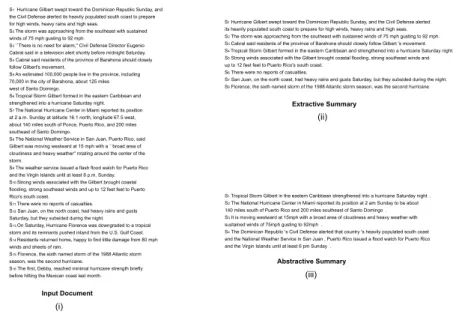
if a summary gives the same information as the input document (Figure 1.2,i) but is not
using the exact sentences is known as an abstractive summary (Figure 1.2,iii).
S1 Hurricane Gilbert swept toward the Dominican Republic Sunday, and the Civil Defense alerted its heavily populated south coast to prepare for high winds, heavy rains and high seas.
S2 The storm was approaching from the southeast with sustained winds of 75 mph gusting to 92 mph.
S3 ``There is no need for alarm,'' Civil Defense Director Eugenio Cabral said in a television alert shortly before midnight Saturday. S4 Cabral said residents of the province of Barahona should closely follow Gilbert's movement.
S5 An estimated 100,000 people live in the province, including 70,000 in the city of Barahona, about 125 miles west of Santo Domingo.
S6 Tropical Storm Gilbert formed in the eastern Caribbean and strengthened into a hurricane Saturday night. S7 The National Hurricane Center in Miami reported its position at 2 a.m. Sunday at latitude 16.1 north, longitude 67.5 west, about 140 miles south of Ponce, Puerto Rico, and 200 miles southeast of Santo Domingo.
S8 The National Weather Service in San Juan, Puerto Rico, said Gilbert was moving westward at 15 mph with a ``broad area of cloudiness and heavy weather'' rotating around the center of the storm.
S9 The weather service issued a flash flood watch for Puerto Rico and the Virgin Islands until at least 6 p.m. Sunday. S10 Strong winds associated with the Gilbert brought coastal flooding, strong southeast winds and up to 12 feet feet to Puerto Rico's south coast.
S11 There were no reports of casualties. S12 San Juan, on the north coast, had heavy rains and gusts Saturday, but they subsided during the night. S13 On Saturday, Hurricane Florence was downgraded to a tropical storm and its remnants pushed inland from the U.S. Gulf Coast. S14 Residents returned home, happy to find little damage from 80 mph winds and sheets of rain.
S15 Florence, the sixth named storm of the 1988 Atlantic storm season, was the second hurricane.
S16 The first, Debby, reached minimal hurricane strength briefly before hitting the Mexican coast last month.
S1 Tropical Storm Gilbert in the eastern Caribbean strengthened into a hurricane Saturday night . S2 The National Hurricane Center in Miami reported its position at 2 am Sunday to be about 140 miles south of Puerto Rico and 200 miles southeast of Santo Domingo . S3 It is moving westward at 15mph with a broad area of cloudiness and heavy weather with sustained winds of 75mph gusting to 92mph .
S4 The Dominican Republic 's Civil Defense alerted that country 's heavily populated south coast and the National Weather Service in San Juan , Puerto Rico issued a flood watch for Puerto Rico and the Virgin Islands until at least 6 pm Sunday .
S1 Hurricane Gilbert swept toward the Dominican Republic Sunday, and the Civil Defense alerted its heavily populated south coast to prepare for high winds, heavy rains and high seas. S2 The storm was approaching from the southeast with sustained winds of 75 mph gusting to 92 mph. S3 Cabral said residents of the province of Barahona should closely follow Gilbert 's movement. S4 Tropical Storm Gilbert formed in the eastern Caribbean and strengthened into a hurricane Saturday night. S5 Strong winds associated with the Gilbert brought coastal flooding, strong southeast winds and up to 12 feet feet to Puerto Rico's south coast.
S6 There were no reports of casualties.
S7 San Juan, on the north coast, had heavy rains and gusts Saturday, but they subsided during the night. S8 Florence, the sixth named storm of the 1988 Atlantic storm season, was the second hurricane.
Abstractive Summary Extractive Summary Input Document (ii) (iii) (i)
Figure 1.2: An example of abstractive and extractive summarization.
• Function: This is one of the traditional distinctions for the output summary (Borko &
Bernier, 1975). In this parameter summary can be indicative, informative or critical de-pending on its usage. The relationship between these three types of summaries is shown in Figure 1.3. An indicative summary may not contain any important information from the input document but is rather used to convince the user to further read the correspond-ing documents, for example, a review at the back of a book. An informative summary consists of useful and important information from source documents, for example, an abstract of a scientific article. A critical summary expresses the summarizer’s views on the quality of work in the source article, for example, a movie review is written by a critic who summarizes the story of the movie in a commentative way.
• Coherence: A coherent summary is easy to read and understand (Figure 1.4). In
coher-ent text scoher-entences are connected with each other via some relations, for instance, lexical or semantic relations (Mesgar & Strube, 2015). In contrast, an incoherent summary may not contain any ordered or connected sentences as shown in Figure 1.4. The reason for this can be unresolved anaphors, repetitive sentences, and badly organized sentences, etc (Mani, 2001).
• Span: This parameter quantifies the source documents to be summarized. The source
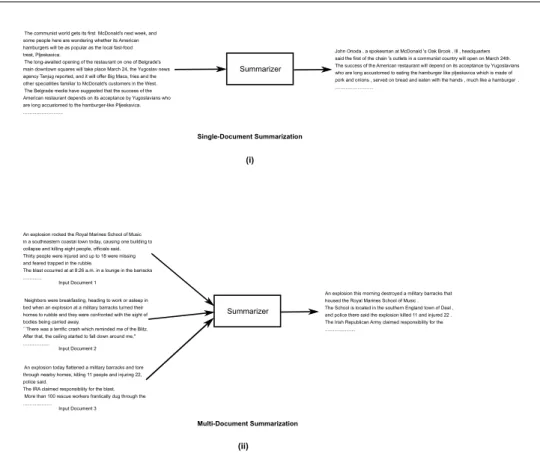
may contain single document, i.e., single document summarization (Figure 1.5, i) or
Indicative
Informative
Critical
Figure 1.3: Relationship between indicative, informative and crtitical summaries (Mani, 2001).
Prince Philip toured the severely damaged Royal Marines School of Music , and visited those injured in Friday 's blast. He warned all military bases of the danger of additional attacks. British Defense Secretary Tom King said that private security firms provide a useful service , and that they will continue in service at `` low-risk '' military establishments.
Grieving relatives and the political opposition want military personnel to provide security at all bases.
Local clergy , conducting Sunday services , asked relatives and friends of the dead and injured to try to forgive the perpetrators of the terrible event.
He warned all military bases of the danger of additional attacks. British Defense Secretary Tom King said that private security firms provide a useful service , and that they will continue in service at `` low-risk '' military establishments.
Local clergy , conducting Sunday services , asked relatives and friends of the dead and injured to try to forgive the perpetrators of the terrible event.
Prince Philip toured the severely damaged Royal Marines School of Music , and visited those injured in Friday 's blast. Grieving relatives and the political opposition want military personnel to provide security at all bases.
Coherent Summary Incoherent Summary
Figure 1.4: An example of a coherent and an incoherent summary.
• Purpose: This parameter differentiates between query-based summaries or generic
maries. In query-based summarization, a query is given by the user, and the output sum-mary contains information relevant to the query. In generic summarization, the sumsum-mary contains important information from the source document without any specific demand by the user.
• Compression Rate: This parameter gives us the information about the length of a
sum-mary with respect to the input document. The compression rate is determined by the application of the summary. For instance, for a headline of a news, a summarizer may need a compression rate of 10%, whereas for an abstract of a scientific article requires 15% compression rate.
• Genre: A summarizer uses different approaches for different genres. For example,
in the summarization of news articles, top few sentences are commonly considered as good candidates for a final summary whereas this approach is not applicable in the summarization of scientific articles.
• Language: A summarizer can be monolingual or multilingual. The monolingual
sum-marizer uses only one language, and produces an output summary in the same language as the input document whereas, the multilingual summarizer uses multiple languages,
An explosion rocked the Royal Marines School of Music in a southeastern coastal town today, causing one building to collapse and killing eight people, officials said. Thirty people were injured and up to 18 were missing and feared trapped in the rubble.
The blast occurred at at 8:26 a.m. in a lounge in the barracks ...
Input Document 1
Neighbors were breakfasting, heading to work or asleep in bed when an explosion at a military barracks turned their homes to rubble and they were confronted with the sight of bodies being carried away.
``There was a terrific crash which reminded me of the Blitz. After that, the ceiling started to fall down around me,'' ...
Input Document 2
An explosion today flattened a military barracks and tore through nearby homes, killing 11 people and injuring 22, police said.
The IRA claimed responsibility for the blast. More than 100 rescue workers frantically dug through the ...
Input Document 3
Summarizer
An explosion this morning destroyed a military barracks that housed the Royal Marines School of Music . The School is located in the southern England town of Deal , and police there said the explosion killed 11 and injured 22 . The Irish Republican Army claimed responsibility for the ...
Summarizer
John Onoda , a spokesman at McDonald 's Oak Brook , Ill , headquarters said the first of the chain 's outlets in a communist country will open on March 24th. The success of the American restaurant will depend on its acceptance by Yugoslavians who are long accustomed to eating the hamburger like pljeskavica which is made of pork and onions , served on bread and eaten with the hands , much like a hamburger . ...
(i)
(ii)
Multi-Document Summarization The communist world gets its first McDonald's next week, and
some people here are wondering whether its American hamburgers will be as popular as the local fast-food treat, Pljeskavica.
The long-awaited opening of the restaurant on one of Belgrade's main downtown squares will take place March 24, the Yugoslav news agency Tanjug reported, and it will offer Big Macs, fries and the other specialities familiar to McDonald's customers in the West. The Belgrade media have suggested that the success of the American restaurant depends on its acceptance by Yugoslavians who are long accustomed to the hamburger-like Pljeskavica. ...
Single-Document Summarization
Figure 1.5: An example of multi-document and single-document summarization.
and gives an output summary in one of the languages from the input document.
• Media: Multimedia summarization consists of various media formats as an input and
produces output summary in one of the media types.
1.3
General Architecture for Extractive Summarization
In this section, we will discuss the general architecture of summarization which can be fol-lowed by any approach. The general architecture for summarization is shown in figure 1.6. This is an abstract architecture in which each block can be fulfilled in numerous ways. This architecture first takes source documents as an input and then processes them in the document representation block. In the document representation block, the representation of documents takes place after preprocessing the documents. The representation can be achieved by various methods, for example, documents can be represented by calculating the frequency of words in the documents (term frequency method) (Luhn, 1958) or by representing the documents graphically (Mihalcea & Tarau, 2004; Erkan & Radev, 2004; Parveen & Strube, 2014). The document representation is then used in calculating the importance of the unit in the anal-ysis phase, for example, using some statistical measure by considering the term frequency
or graph importance measure such as betweenness, centrality etc. Here, units are referred to as sentences, as we only focus on extractive summarization in this thesis. The selection of sentences is then achieved on the basis of the importance measure, i.e., units with a high importance measure leads to the next phase. In the final phase of summary generation, the candidates from the earlier phase are included in the summary on the basis of compression rate and other factors if applicable.
Document Analysis
Candidate
Selection SummaryGeneration
Source Text
Figure 1.6: A general architecture for the summarization approach.
1.4
Scientific Articles
There are various types of text documents like scientific articles, news articles, reviews, records, etc. We have chosen the dataset consisting of scientific articles in this thesis. There are several reasons for selecting this dataset in our work:
• Researchers, in any domain, are referring to scientific articles, books, or web sources as
a source of information to facilitate their research (Mani, 2001).
• There is a dire requirement of summaries of scientific articles in digital repositories for
researchers, to facilitate quick access of necessary information (Mani, 2001).
There are various factors which makes scientific articles distinct from general texts (Teufel & Moens, 2002):
• Time: In news articles, an occurrence of some incident is reported in chronological
order. The chronological order of news articles is important because it makes their summarization fairly easy. A summarizer exploits the chronological property of news articles by considering recently occurred incidents more important than the previous incidents. In contrast, scientific articles do not follow any time dependent events. In-stead, they report the intellectual work done by researchers within a certain time frame.
However, in scientific articles,related worksection may consist chronological order of
• Writing Style:Scientific articles have a diverse writing style which may vary signifi-cantly as per the requirements. For example, a review article contains the review of various research works in a specific field, whereas some articles argue with the results of the state-of-the-art in their field. Some articles only discuss about the implementa-tion of a tool developed by the author, others combine various methods from different fields into interdisciplinary fields, for instance, computational analysis of a text is a well known interdisciplinary field, i.e., computational linguistics.
• Bias: Scientific articles are biased by authors because they illustrate the research from
their own point of view. They are written by researchers for recognition in the commu-nity. In contrary to this, editors of news articles write reports without being biased, i.e., their reports are generally neutral. This bias factor of scientific articles can be exploited in summarization techniques.
Scientific articles do not follow any specific pattern even though they are written by the same author. It is difficult to analyze scientific articles when compared with general texts. Summarization of scientific articles is considerably difficult because scientific articles do not have any specific document structure.
This thesis is specific to scientific articles of biomedical domain because biomedical sci-entific articles are from diverse interdisciplinary fields. Hence, this motivates us to develop a domain independent approach for summarizing scientific articles.
1.5
Research Goals
Automatic text summarization is a task to reduce a text document automatically in order to produce a summary which contains important information from the document. To accomplish this task, many researchers use various techniques of natural language processing, machine learning, data mining and information retrieval. These techniques can be applied in various manner to obtain the summary of an input document.
In this thesis, we are focusing on the summarization of scientific articles. We mainly analyse (1) the different document representations of scientific articles (2) the important in-formation in scientific articles (3) the non-redundant inin-formation in scientific articles (4) the coherence of a summary (5) robustness and scalability across different domains of text docu-ments. We explain in detail these research questions in the following sections.
1.5.1
Representation of Documents
Various representations of text documents have been explored in the field of natural language processing, for instance, the vector space model (Luhn, 1958) or the graphical model
(Mi-halcea & Tarau, 2004) for representing a text document. There are several approaches for summarization that use the graphical representation of a text document, such as Mihalcea & Tarau (2004) introduce a graphical representation of a text document, where nodes are
sen-tences and then apply thePageRank algorithm (Brin & Page, 1998) on the graph to extract
important sentences from the document. This type of graphical representation connects the two sentences on the basis of their similarity; however, this graph only contains bag-of-word information (Harris, 1954) that is not sufficient for the summarization task. In this task, un-derstanding of a text is very important. Consequently, the document representation should be informative to comprehend the text.
Question 1. What type of graphical representation can be used to produce informative
summaries?
1.5.2
Important Information
In the summarization task, a summary of a document must contain important information. This aspect of summarization is taken care of by many approaches. Some approaches calcu-late the importance of a sentence in a supervised manner, such as, Liakata et al. (2013) use conditional random fields to obtain important sentences, whereas other approaches give the importance score to a sentence in an unsupervised manner (Luhn, 1958; Edmundson, 1969).
In summarization, obtaining the training dataset is a demanding task. There are some recent approaches which attempt to create the training data. However, the scope of these approaches is very limited (Contractor et al., 2012). Thus, an unsupervised way to obtain important information is more suitable for summarization.
Question 2. How to deal with the importance aspect of the summarization task in an
unsupervised manner?
1.5.3
Non-redundant Information
Scientific articles contain plenty of redundant information, such as,Introductionand
Conclu-sionsections contain a lot of similar information. There are few approaches which consider
non-redundancy while summarizing scientific articles. Usually, these approaches deal with non-redundancy using word overlapping among sentences. However, these approaches do not consider two sentences redundant if they share same information but different words.
Question 3. How to extract the non-redundant information while summarizing scientific
1.5.4
Coherent Information
A summary of a document must contain coherent information, i.e., it should be readable for users. Only few works have considered coherence while summarizing scientific articles, such as, Abu-Jbara & Radev (2011) introduce an approach which refine the summary sentences to improve readability. However, none of them deal with the problem of coherence within the task of sentence selection. The selection of sentences and the assurance of coherent sum-maries are not tightly integrated in their techniques to obtain best possible set of sentences which are important, non-redundant and coherent. Moreover, they model coherence in sum-marization by only considering adjacent sentences which may not be coherent. It is possible that some sentences that are few sentences apart are more coherent as compared to the adjacent sentences.
There are few methods (Hirao et al., 2013; Gorinski & Lapata, 2015) which integrate coherence concisely. These methods do not take into account the overall structure of the summary, however.
Question 3. How to incorporate coherence aspect while extracting the important and
non-redundant information for the summary?
1.5.5
Robustness and Scalability across Different Domains
Now a days, information in different fields are increasing exponentially due to which summa-rization is required in every field. If we develop a summasumma-rization approach which is extremely domain dependent, then we need to build numerous summarization approaches. Thus, a sum-marization approach should be less domain dependent so that it is easy to switch from one domain to another domain with few minor changes in the approach.
Until now, most of the approaches are not scalable and robust. They do not perform
ef-fectively if the size or the domain of the input document varies. For instance, Mead is a
summarizer, which performs substantially well with news articles, as it considers the property
of news articles1 while summarizing them (Radev et al., 2004a). However, Mead may not
perform efficiently with some other domain that does not have the same property as the news articles.
Question 4.How to create a robust and scalable summarizer?
1.6
Research Contributions
The research contributions of this thesis are: a novel summarization approach and the new dataset of scientific articles. We introduce the new dataset in Chapter 2 and the proposed
approach in Chapter 5.
1.6.1
A New Dataset for Summarization
In this thesis, we introduce a new dataset of scientific articles for the summarization task. This dataset has several advantages over already available datasets (Joseph & Radev, 2007; Teufel & Moens, 2002). Unlike other datasets, we do not consider abstracts as human summaries for evaluation. In our dataset, every scientific article is accompanied with a summary not written by the author. In contrast to abstracts, these summaries have general perspective about scientific articles. We discuss in detail the benefits of using this dataset in Chapter 2.
Contribution 1. We propose a new dataset of scientific articles for the summarization
task.
1.6.2
Identifying Relevant Information
We use the graphical representation of documents as they are computationally less expensive as compared to vector space model (Wolfram, 2003). Graphical representation has been used frequently for the summarization task; however, they do not contain sufficient information about the document. Since the approach for summarization must have the deep understanding of the document, we utilize more informative graphical representation (Guinaudeau & Strube, 2013), i.e., a bipartite graph, of the document which consists of discourse entities. We show in the results (Chapter 6) that bipartite graphs provide more relevant summary as compared to the other graph-based approaches. Using the graphical representation of the document, we extract information from a document for the summary which is important but non-redundant. This leads to our research contribution:
Contribution 2.We show that bipartite graphs are more informative and proficient for the
summarization task than general graphs and are more capable of obtaining relevant informa-tion.
1.6.3
Detecting Coherent Information
Only few approaches for summarization take care of the coherence of a summary. However, these approaches incorporate coherence by considering adjacent sentences, which is not suffi-cient to generate coherent summaries.
To overcome these problems, we propose a novel graph-based method for creating a coher-ent summary. Mesgar & Strube (2015) use the frequency of coherence patterns (Daneš, 1974) to rank documents by coherence and readability. Instead of ranking summaries by coherence, we use coherence patterns directly to extract sentences for creating a coherent summary. Thus,
we extract not only important and non-redundant sentences from the input document but also coherent ones. This leads to our third research contribution:
Contribution 3. We introduce a method that is not limited to the adjacent sentences and
show that long distance sentences can make better coherent summaries.
1.6.4
Global Optimization
Until now, approaches for summarization do not deal with coherence, importance and non-redundancy simultaneously. In general, these approaches use greedy techniques to select the sentences for a summary, however only few approaches employ the global optimization tech-nique. The advantage of using global optimization is that it attempts to extract the set of sentences which are best among all the other possible set of sentences in the document.
In the proposed approach, we produce globally optimized summaries by maximizing over the factors: relevance, non-redundancy and coherence. Unlike greedy approaches, these fac-tors are tightly integrated in our approach.
Contribution 4. We show that a global optimization approach produces better summaries
as compared to greedy approaches.
1.6.5
High Robustness and Scalability
We introduce a new dataset in this thesis which consists of scientific articles. We apply our approach on this dataset and a standard dataset. We show in the results that the proposed approach is largely scalable and robust across domains and it only needs a few modifica-tions. Our proposed approach achieves state-of-the-art results on the datasets from different domains. This indicates that the importance, non-redundancy and coherence measures are domain independent, at least for the domains we take into account.
Contribution 5. Our proposed summarization approach is highly robust across different
domains and achieves state-of-the-art results. This approach performs efficiently with short and long documents; hence it is fairly scalable.
1.7
Outline of this Thesis
This thesis consists of eight chapters. We first describe the new scientific articles’ dataset in-troduced by us; we use for the evaluation of the proposed method (Chapter 2). Further, we describe the techniques, which are used in the proposed method: Mixed Integer Programming (Chapter 3) and Latent Dirichlet Allocation (Chapter 4). Afterwards, we explain our approach (Chapter 5) in detail. Then, Chapter 6 gives the detailed description of the setup for the ex-periments and the results of the proposed approach on different data sets. Further, we discuss
the related work of the summarization task in Chapter 7. Finally, we conclude with some discussions over the proposed method and results and mention the future research directions (Chapter 8). We discuss the content of each chapter in detail as follows:
1. Introduction: In this chapter, we introduce summarization broadly. Then, the
parame-ters that distinguishes the automatic text summarization task. Afterwards, we provide the general architecture of summarization. We provide the research questions that are addressed in this thesis and summarize the contribution of this thesis. Moreover, this chapter contains the outline of this thesis and indicate to previously published work.
2. Dataset: Many standard datasets are being used for the summarization task. Document
Understanding Conferences (DUC) build datasets for the summarization task with dif-ferent goals, for instance, DUC 2002 is a dataset for generic single-document summa-rization whereas DUC 2005 is a topic-based multi-document summasumma-rization dataset. In this chapter, we introduce a new dataset for summarization (Question 4). This dataset consists of scientific articles from a well-known biomedicine journal. We also give the detailed description of the standard dataset for a generic single-document summariza-tion (Quessummariza-tion 4).
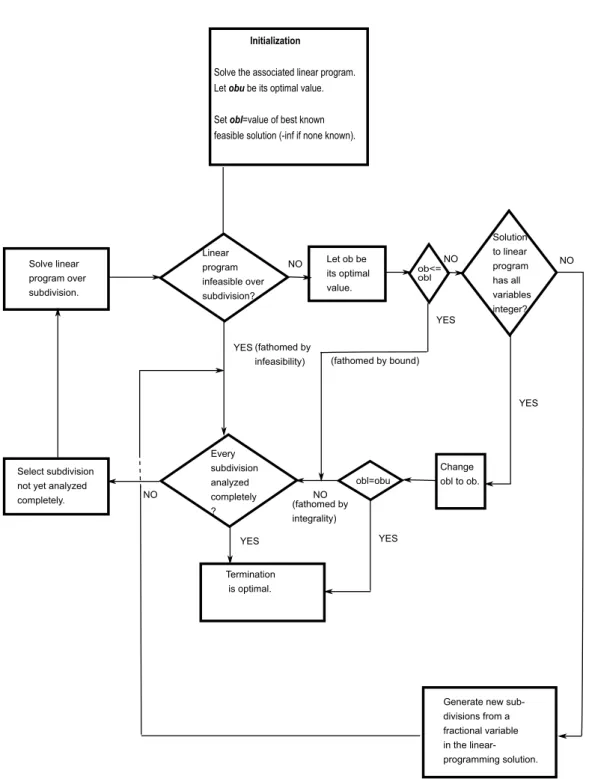
3. Mixed Integer Programming: In the proposed approach, we utilize mixed integer
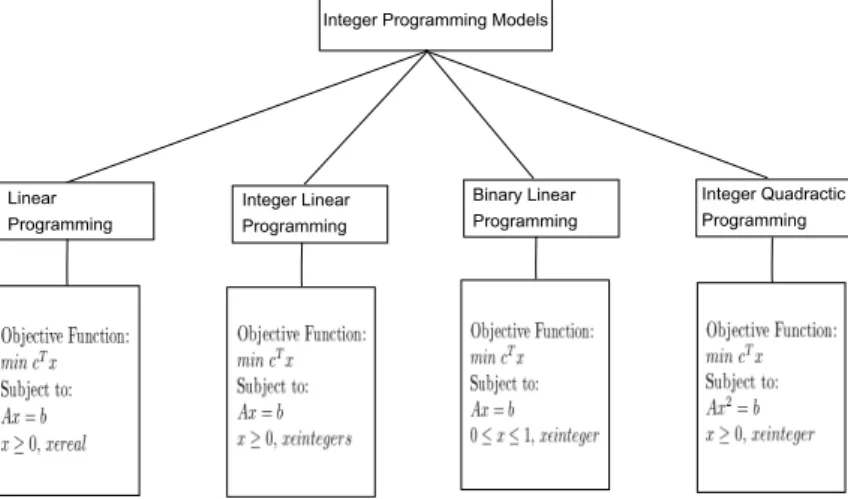
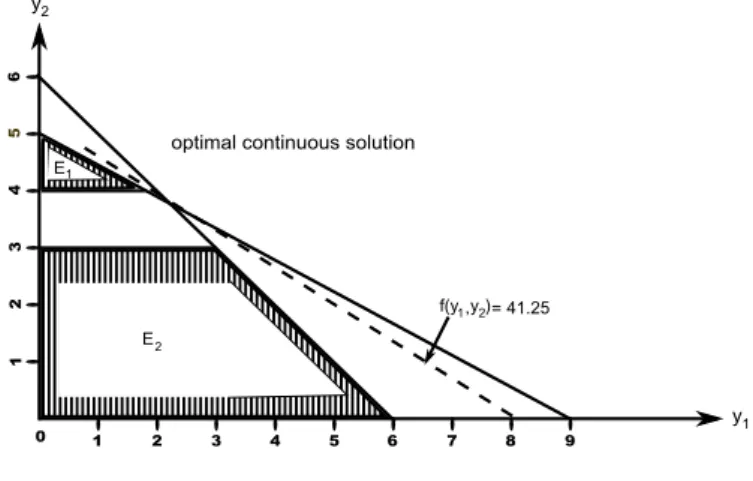
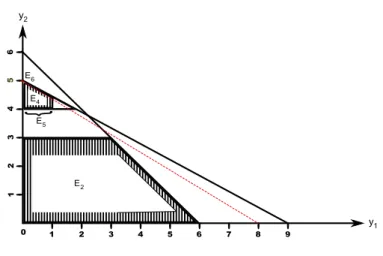
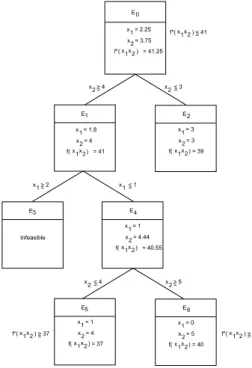
pro-gramming to achieve globally optimized results. In this chapter, we describe in detail various approximation techniques to solve the integer programming problems. We also discuss different types of integer programming problems and their solutions using the approximation techniques. This optimization technique tightly integrates importance, non-redundancy, and coherence in our approach.
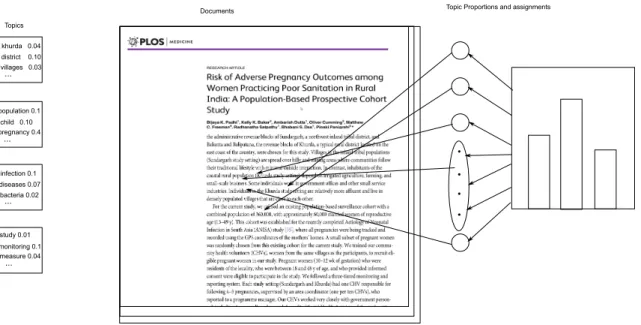
4. Latent Dirichlet Allocation: We represent the documents graphically in our proposed
approach. For that, we utilize latent dirichlet allocation to find the topics in documents. In this chapter, we discuss about the topic models and give the detailed description of latent dirichlet allocation (a fundamental topic model). Then, we discuss about the assumptions in latent dirichlet allocation and drawbacks of these assumptions.
5. Methodology: In this chapter, we give the detailed description of our approach. We
discuss in detail, how we incorporate importance, non-redundancy and coherence in our method. In this chapter, we address mainly Question 2 and Question 3. We discuss the intuition of our approach for the summarization task.
6. Results: In this chapter, we give the details of experimental setup of our approach. We
discuss in detail the tools utilized in this approach. We employ the gurobi optimization tool to achieve globally optimized results. Further, we compare the results of different
versions of our approach to some baselines and state-of-the-art approaches. We em-ploy two levels of evaluation: relevance evaluation and coherence evaluation. For the relevance evaluation, ROUGE scores are used to compare the results and for the coher-ence evaluation, we employ human cohercoher-ence assessments. We present some analysis to examine the effectiveness of the proposed approach (Question 1-4).
7. Related Work: Automatic text summarization is an important topic in various fields,
including Artificial Intelligence, Data Mining, Information Extraction, and Information Retrieval. In this chapter, we give the insight of ongoing research on summarization. We begin with the classical approaches and finish with the deep learning approaches for the summarization task. We focus on corpus-based approaches, discourse-based approaches, graph-based approaches, topic modeling-based approaches, integer linear programming-based approaches, and neural network-based approaches.
8. Conclusions and Future Work: In this chapter, we summarize the results obtained by
the proposed approach and indicate the future research directions.
1.8
Published Work
Most of the contributions and ideas described in this thesis are published in various confer-ences. We have employed the entity graph representation for multi-document summarization. This work is presented in Parveen & Strube (2014). Our approach which is based on the en-tity graph and outdegree for summarization along with the new dataset of scientific articles has been published in Parveen & Strube (2015). Our approach based on the weighted topical graph and weighted outdegree for summarizing scientific articles is presented in Parveen et al. (2015). Our approach based on coherence patterns is presented in Parveen et al. (2016). Table 1.1 exhibits the relation between the published work and this thesis.
Published Work Chapters
Parveen & Strube (2014) Chapter 7
Parveen & Strube (2015) Chapter 2, 5, 6
Parveen et al. (2015) Chapter 5, 6
Parveen et al. (2016) Chapter 5, 6
Dataset
In this thesis, we introduce a new dataset of scientific articles for the task of summarization. This dataset consists of scientific articles from the field of biology and medicine and is derived
from thePLOS Medicinejournal. The journal has a high impact factor in the field of medicine
and is openly accessible to everyone. We discuss in Section 1.4, how the genre of scientific articles is different from that of the other genre.
We chose biomedicine as a domain for a number of reasons. One reason is that it is a domain in which numerous researches are being conducted. Hence, this domain has a large number of research articles. This makes the formation of the dataset less difficult. The more notable reason is that the biomedicine domain is a heterogeneous domain as it consists of research articles from different disciplines. Consequently, the structure of documents in this domain varies substantially. Due to which we are forced to select an approach which is domain
independent, to summarize scientific articles from thePLOS Medicine journal. In short, our
dataset consists of complex scientific articles for the summarization task. We discuss the
reasons for choosing scientific articles fromPLOS Medicinein Sections 2.1 and 2.2
Furthermore, we discuss the details of the DUC 2002 dataset. This dataset was introduced by the Document Understanding Conference (DUC) in year 2002. This dataset is a standard dataset for single-document summarization. The articles in DUC 2002 belong to the news genre.
The PLOS Medicinejournal and dataset has been described in detail in Section 2.1 and
2.2, respectively. The statistics of the DUC 2002 dataset and its comparison with thePLOS
2.1
PLOS Medicine
Researchers in the field of medicine desire to publish in a high impact and openly accessible
journal like PLOS Medicine. This journal issues articles on environmental, biomedical and
political determinants of health and society. The journal has been established in 2004, and
offers following advantages1:
• Open Access for reading, educating, and applying
In PLOS Medicine, research articles are available to everyone at no cost as soon as they are published. There is no subscription or one-time registration cost involved in accessing the publications. These publications are accessible to everyone worldwide, i.e., Educators, students, clinicians, researchers, patients, and policy makers without any barriers of cost or access control. Hence, the published works in this journal can be utilized by anyone to advance their research.
• Editors’ summaries
Every month there is one professional editor who explains the context, methods, results and its implications in a comprehensible language so that any amateur can understand
the summary. This makesPLOS Medicinejournal beneficial for students, education of
patients, researchers from other fields and non-physicians, and enables them to learn from it.
• No arbitrary constraints on article length or presentation
There is no arbitrary page limit in PLOS Medicine journals which gives the flexibility to authors to explain their research in detail. The research articles, on submission, should explain the methods and the obtained results in detail after performing the experiments explained in the paper.
2.2
Scientific Articles
The dataset being used in this thesis consists of scientific articles fromPLOS Medicine, which
have been created for summarization. The foremost reasons for using the PLOS Medicine
journal articles as a dataset for automatic text summarization are discussed below:
• Evaluation
In summarization, evaluation of summaries has always been a challenge. The evaluation of summaries is only possible if there are gold summaries or human written summaries
of source documents available. It is arduous, demanding and expensive to create gold summaries. Moreover, it is difficult to achieve high inter-annotator agreement for the gold summaries. Inter-annotator agreement is a measure of how effectively two or more annotators can make the same decision for a certain category.
In PLOS Medicine, every article is accompanied with its editor’s summary which can be used as a gold summary. As discussed above, editors’ summaries have a very general perspective, which can easily be understood by any non-expert.
In conclusion, the editor’s summaries can be considered as high standard gold sum-maries. We are using abstracts of scientific articles as gold summaries, too. However, our goal is to produce summaries which are comparable to the editors’ summaries. In the results, we emphasize more on the scores obtained by our approach using them as gold summaries. An example of this summary is shown in Figure 2.1
Cardiometabolic diseases—cardiovascular diseases that affect the heart and/or the blood vessels and metabolic diseases that affect the cellular chemical reactions needed to sustain life—are a growing global health concern. In sub-Saharan Africa, for example, the prevalence (the proportion of a population that has a given disease) of adults with diabetes (a life-shortening metabolic disease that affects how the body handles sugars) is currently 3.8%. By 2030, it is estimated that the prevalence of diabetes among adults in this region will have risen to 4.6%. Similarly, in 2004, around 1.2 million deaths in sub-Saharan Africa were attributed to coronary heart disease, heart failure, stroke, and other cardiovascular diseases. By 2030, the number of deaths in this region attributable to cardiovascular disease is expected to double. Globally, cardiovascular disease and diabetes are now responsible for around 17.3 million and 1.3 million annual deaths, respectively, together accounting for about one-third of all deaths.
Experts believe that increased consumption of saturated fats, sugar, and salt and reduced physical activity are partly responsible for the increasing global prevalence of cardiometabolic diseases. These lifestyle changes, they suggest, are related to urbanization—urban expansion into the countryside and migration from rural to urban areas. If this is true, the prevalence of unhealthy lifestyles should increase as rural areas adopt urban characteristics. Sub-Saharan Africa is the least urbanized region in the world, with about 60% of the population living in rural areas. However, rural settlements across the subcontinent are increasingly adopting urban characteristics. It is important to know whether urbanization is affecting the health of rural residents in sub-Saharan Africa to improve estimates of the future burden of cardiometabolic diseases in the region and to provide insights into ways to limit this burden. In this cross-sectional study (an investigation that studies participants at a single time point), the researchers examine the distribution of urban characteristics across rural communities in Uganda and the association of these characteristics with lifestyle risk factors for cardiometabolic diseases.... For their study, the researchers used data collected in 2011 by the General Population Cohort study, a study initiated in 1989 to describe HIV infection trends among people living in 25 villages in rural southwestern Uganda that collects health-related and other information annually from its participants. The researchers quantified the “urbanicity” of the 25 villages using a multi-component scale that included information such as village size and economic activity. They then used statistical models to examine associations between urbanicity and lifestyle risk factors such as body mass index (BMI, a measure of obesity) and self-reported fruit and vegetable consumption for more than 7,000 study participants living in those villages. None of the villages had paved roads or running water. However, urbanicity varied markedly across the villages, largely because of differences in economic activity, civil infrastructure, and the availability of educational and healthcare services. Notably, increasing urbanicity was associated with an increase in lifestyle risk factors for cardiovascular diseases. So, for example, people living in villages with the highest urbanicity scores were nearly 20% more likely to be physically inactive and to eat less fruits and vegetables and nearly 50% more likely to have a high BMI than people living in villages with the lowest urbanicity scores.
These findings indicate that, across rural communities in Uganda, even a small increase in urbanicity is associated with a higher prevalence of potentially modifiable lifestyle risk factors for cardiometabolic diseases. These findings suggest, therefore, that simply classifying settlements as either rural or urban may not be adequate to capture the information needed to target strategies for cardiometabolic disease management and control in rural areas as they become more urbanized. Because this study was cross-sectional, it is not possible to say how long a rural population needs to experience a more urban environment before its risk of cardiometabolic diseases increases. Longitudinal studies are needed to obtain this information. Moreover, studies of other countries in sub-Saharan Africa are needed to show that these findings are generalizable across the region. However, based on these findings, and given that more than 553 million people live in rural areas across sub-Saharan Africa, it seems likely that increasing urbanization will have a substantial impact on the future health of populations throughout sub-Saharan Africa.
Figure 2.1: An example of an editor’s summary.
• XHTML Format
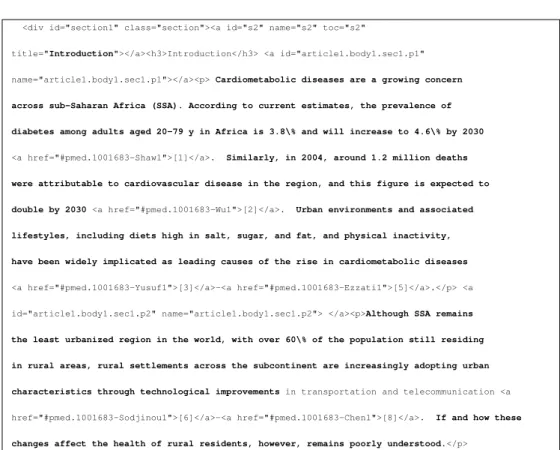
In PLOS Medicine, articles can be downloaded in the Extensible Hypertext Markup Language (XHTML) format as shown in Figure 2.2. It is an extended version of widely used Hypertext Markup Language (HTML). It is convenient to extract sentences of sci-entific articles from XHTML than extracting them from the Portable Document Format (PDF). In the example (Figure 2.2), sentences of a scientific article are shown in bold with boundary tags in the XHTML format.
<div id="section1" class="section"><a id="s2" name="s2" toc="s2"
title="Introduction"></a><h3>Introduction</h3> <a id="article1.body1.sec1.p1"
name="article1.body1.sec1.p1"></a><p> Cardiometabolic diseases are a growing concern
across sub-Saharan Africa (SSA). According to current estimates, the prevalence of
diabetes among adults aged 20-79 y in Africa is 3.8\% and will increase to 4.6\% by 2030
<a href="#pmed.1001683-Shaw1">[1]</a>. Similarly, in 2004, around 1.2 million deaths
were attributable to cardiovascular disease in the region, and this figure is expected to
double by 2030 <a href="#pmed.1001683-Wu1">[2]</a>. Urban environments and associated
lifestyles, including diets high in salt, sugar, and fat, and physical inactivity,
have been widely implicated as leading causes of the rise in cardiometabolic diseases
<a href="#pmed.1001683-Yusuf1">[3]</a>-<a href="#pmed.1001683-Ezzati1">[5]</a>.</p> <a
id="article1.body1.sec1.p2" name="article1.body1.sec1.p2"> </a><p>Although SSA remains
the least urbanized region in the world, with over 60\% of the population still residing
in rural areas, rural settlements across the subcontinent are increasingly adopting urban
characteristics through technological improvements in transportation and telecommunication <a
href="#pmed.1001683-Sodjinou1">[6]</a>-<a href="#pmed.1001683-Chen1">[8]</a>. If and how these
changes affect the health of rural residents, however, remains poorly understood.</p>
Figure 2.2: An example of XHTML format of a scientific article
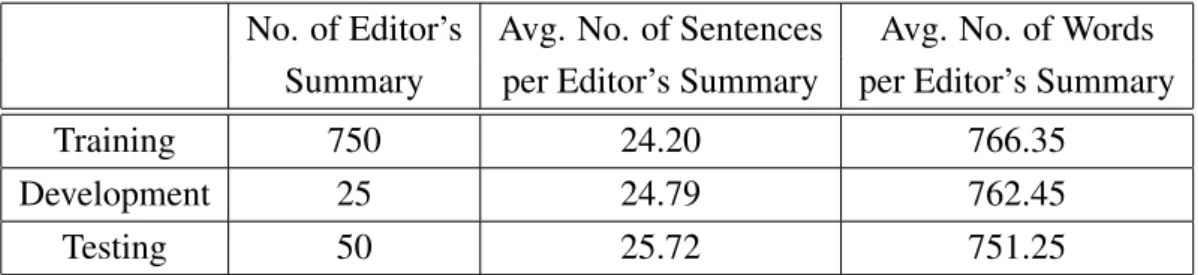
The PLOS Medicine journal has been publishing 10 to 15 articles per month since 2004. We categorize all the PLOS Medicine articles up to January 2014 into training, development and testing data. The statistics of training, development and testing data is shown in Table 2.1. Also, the statistics of editors’ summaries and abstracts are shown in Table 2.2 and Table 2.3 respectively.
No. of Documents Avg. No. of Sentences Avg. No. of Words
per Document per Document
Training 750 265.09 6013.96
Development 25 274.46 6159.35
Testing 50 154 4756
No. of Editor’s Avg. No. of Sentences Avg. No. of Words
Summary per Editor’s Summary per Editor’s Summary
Training 750 24.20 766.35
Development 25 24.79 762.45
Testing 50 25.72 751.25
Table 2.2: Statistics of editor’s summary of thePLOS Medicinedataset
No. of Documents Avg. No. of Sentences Avg. No. of Words
per Abstract per Abstract
Training 750 13.20 365.97
Development 25 13.54 362.19
Testing 50 14.9375 369.1875
Table 2.3: Statistics of abstract of thePLOS Medicinedataset
2.3
News Articles
We also perform experiments on the DUC 2002 dataset which is a standard dataset for single-document summarization (Figure 2.3). DUC is a Document Understanding Conference for summarization. It is sponsored by Advanced Research and Development Activity (ARDA). The conference series are managed by National Institute of Standards and Technology (NIST) to motivate researchers in the field of Natural language Processing (NLP) to participate in large-scale experiments.
The statistics of DUC 2002 is shown in Table 2.4. These statistics show that articles in
PLOS Medicineare longer than the articles in the DUC 2002 dataset.
We show the statistics of the DUC 2005 dataset which is being used for query based multi-document summarization in Table 2.4. In the DUC 2005 dataset, average number of
sentences per document is28.72which is comparatively shorter than the average number of
sentences per article in the PLOS Medicine dataset. Moreover, in case of summarization of
scientific articles, non-redundancy must be considered, as they might contain many redundant
information in different sections, for example,Introduction andMethodology sections of an
article gives the main idea of the article. Hence, summarization ofPLOS Medicinearticles is
as difficult as multi-document summarization.
Table 2.5 exhibits the statistics of the gold summaries of DUC 2002 and DUC 2005. The gold summaries of DUC 2002 are generic abstracts of the documents with a length of approx-imately 100 words. The abstract consists of grammatically correct and complete sentences.
No. of Documents Avg. No. of sentences Avg. No. of words
per document per document
DUC 2002 576 25 627
DUC 2005 1593 28.72 710.39
Table 2.4: Statistics of DUC 2002 and DUC 2005 dataset
No. of Documents Avg. No. of sentences Avg. No. of words
per document per document
DUC 2002 1112 5.61 113.46
DUC 2005 300 12.42 250
Table 2.5: Statistics of DUC 2002 and DUC 2005 gold summaries
2.4
Summary
In this chapter, we have provided the details of the datasets used in this thesis. We have introduced a new dataset of scientific articles of biomedicine domain. We have explained the benefits of this dataset for the summarization task. Further, we have described the stan-dard dataset for single-document summarization. We then compared the statistics of both the datasets.
In the end, we have provided a brief description of the standard dataset for multi-document summarization. We have concluded that summarizing scientific articles is as difficult as sum-marizing multi-documents.
<DOC>
<DOCNO>AP880911-0016 </DOCNO>
<FILEID>AP-NR-09-11-88 0423EDT</FILEID>
<FIRST>r i BC-HurricaneGilbert 09-11 0339</FIRST>
<SECOND>BC-Hurricane Gilbert,0348</SECOND>
<HEAD>Hurricane Gilbert Heads Toward Dominican Coast</HEAD>
<BYLINE>By RUDDY GONZALEZ</BYLINE>
<BYLINE>Associated Press Writer</BYLINE>
<DATELINE>SANTO DOMINGO, Dominican Republic (AP) </DATELINE>
<TEXT>
Hurricane Gilbert swept toward the Dominican Republic Sunday, and the Civil Defense alerted its
heavily populated south coast to prepare for high winds, heavy rains and high seas. The storm
was approaching from the southeast with sustained winds of 75 mph gusting to 92 mph. “There is
no need for alarm,” Civil Defense Director Eugenio Cabral said in a television alert shortly
before midnight Saturday. Cabral said residents of the province of Barahona should closely follow
Gilbert’s movement. An estimated 100,000 people live in the province, including 70,000 in the city
of Barahona, about 125 miles west of Santo Domingo. Tropical Storm Gilbert formed in the eastern
Caribbean and strengthened into a hurricane Saturday night. The National Hurricane Center in Miami
reported its position at 2 a.m. Sunday at latitude 16.1 north, longitude 67.5 west, about 140
miles south of Ponce, Puerto Rico, and 200 miles southeast of Santo Domingo. The National Weather
Service in San Juan, Puerto Rico, said Gilbert was moving westward at 15 mph with a “broad area of
cloudiness and heavy weather” rotating around the center of the storm....
</TEXT>
</DOC>