Practical Dynamic Grammars for Dynamic Languages
Lukas Renggli, St´
ephane Ducasse, Tudor Gˆırba, Oscar Nierstrasz
To cite this version:
Lukas Renggli, St´
ephane Ducasse, Tudor Gˆırba, Oscar Nierstrasz. Practical Dynamic
Gram-mars for Dynamic Languages. 4th Workshop on Dynamic Languages and Applications (DYLA
2010), 2010, Malaga, Spain. 2010.
<
hal-00746253
>
HAL Id: hal-00746253
https://hal.inria.fr/hal-00746253
Submitted on 28 Oct 2012
HAL
is a multi-disciplinary open access
archive for the deposit and dissemination of
sci-entific research documents, whether they are
pub-lished or not.
The documents may come from
teaching and research institutions in France or
abroad, or from public or private research centers.
L’archive ouverte pluridisciplinaire
HAL
, est
destin´
ee au d´
epˆ
ot et `
a la diffusion de documents
scientifiques de niveau recherche, publi´
es ou non,
´
emanant des ´
etablissements d’enseignement et de
recherche fran¸cais ou ´
etrangers, des laboratoires
publics ou priv´
es.
Practical Dynamic Grammars for Dynamic Languages
∗
Lukas Renggli
Software Composition Group, University of Bern, Switzerlandscg.unibe.ch
Stéphane Ducasse
RMoD, INRIA-Lille NordEurope, France rmod.lille.inria.fr
Tudor Gîrba
Sw-eng. Software Engineering GmbH, Switzerland
www.sw-eng.ch
Oscar Nierstrasz
Software Composition Group, University of Bern, Switzerlandscg.unibe.ch
ABSTRACT
Grammars for programming languages are traditionally spec-ified statically. They are hard to compose and reuse due to ambiguities that inevitably arise. PetitParsercombines ideas from scannerless parsing, parser combinators, parsing expression grammars and packrat parsers to model grammars and parsers as objects that can be reconfigured dynamically. Through examples and benchmarks we demonstrate that dy-namic grammars are not only flexible but highly practical.
1.
INTRODUCTION
It is common practice to define formal grammars using a dedicated specification language which is then transformed into executable form by code generation. Typically these transformation algorithms validate that the grammar is a subset of Context Free Grammars (CFGs), such as LL(k), LR(k), or LALR(k). Then the algorithm optimizes and transforms the grammar into a parser. While this process can give parse-time guarantees and ensure that the parse is unambiguous, the resulting parsers are inherently static. The grammar is hard-coded and cannot be easily changed (at run-time) nor can it be easily composed with other grammars. Numerous researchers have addressed these issues in the past [10, 2, 15, 5]. Earley and SGLR(k) parsers are composeable [6, 16], however the parse results are usually ambiguous and the grammar definition is static and cannot be changed after compilation.
In this paper we present PetitParser, a parser framework that makes it easy to dynamically reuse, compose, trans-form and extend grammars. We can reflect on the resulting grammars and modify them on-the-fly. We report on the “dy-namic” features of this framework and how this is beneficial to grammar development.
The remainder of this paper is structured as follows:
Sec-∗In4th Workshop on Dynamic Languages and Applications
(DYLA 2010), Malaga, Spain.
Permission to make digital or hard copies of all or part of this work for personal or classroom use is granted without fee provided that copies are not made or distributed for profit or commercial advantage and that copies bear this notice and the full citation on the first page. To copy otherwise, to republish, to post on servers or to redistribute to lists, requires prior specific permission and/or a fee.
Copyright 20XX ACM X-XXXXX-XX-X/XX/XX ...$10.00.
tion 2 introduces the PetitParser framework. Section 3 dis-cusses important aspects of a dynamic approach, such as composition, correctness, performance and tool support. Sec-tion 4 presents a short overview of the related work, and Section 5 concludes the paper.
2.
PETITPARSER
PetitParser takes four existing parser methodologies and combines the best properties of each:
• Scannerless Parsers [16] combine lexical and
context-free syntax into one grammar. This avoids the common problem of overlapping token sets when grammars are composed. Furthermore language definitions become more concise as there is only one uniform formalism.
• Parser Combinators[11] are building blocks for parsers
modeled as a graph of composable objects; they are modular and maintainable, and can be changed, recom-posed and reflected upon.
• Parsing Expression Grammars (PEGs) [8] provide
or-dered choice. Unlike CFGs, the oror-dered choice of PEGs always follows the first matching alternative and ig-nores other alternatives. PEGs are closed under union, intersection, and complement; and can recognize non-context free languages.
• Packrat Parsers [7] give linear parse time guarantees
and avoid problems with left-recursion in PEGs through memoization [17]. For efficiency reasons PetitParser does not memoize each rule, but only selected ones [1]. PetitParser is implemented in Pharo Smalltalk1
. A detailed description of the API and instructions on how to download the framework and examples can be found in a blog article of the first author2
. Grammars are specified by composing primitive parser objects using a series of overloaded operators forming an internal domain-specific language. For example, the grammar of identifiers is implemented as follows:
identifier := #letter asParser ,
(#letter asParser / #digit asParser) star.
The expressions#letter asParserand#digit asParserreturn parsers that accept a single character of the respective charac-ter class; the ‘,’ operator combines two parsers to a sequence;
1
http://www.pharo-project.org/
2
the ‘/’ operator combines two parsers to an ordered choice; and the ‘star’ operator accepts zero or more instances of an-other parser. As a result we end up with a graph of connected parser objects that can be used to parse input:
identifier parse:'id12'. ”consumes input and returns a default AST”
identifier parse:'123'. ”returns parse failure: letter expected at 1”
At all times the graph of parser objects remains accessible and mutable. We are able to recompose, transform and change an existing grammar, as we shall see in upcoming examples.
3.
PETITPARSER IN PRACTICE
In the remainder of this paper we use a Smalltalk grammar as the running example. The grammar consists of 242 prim-itive parser objects that are grouped into 78 productions. One of these productions is the identifier rule we have seen in the previous section. The parser produces a standard Smalltalk AST and passes all 296 unit tests of the original hand-written parser.
3.1
Grammar Specialization
Although complex grammars can be defined using a script, we provide a convenient way to define grammars as part of a class. Each production is implemented using an in-stance variable and a method returning the grammar of the rule. Productions within the grammar are referred to by accessing the instance variable. This allows us to resolve mutually recursive productions by initializing all slots with a forward reference that is resolved by subsequently calling the production methods [3].
Furthermore, defining grammars in classes enables devel-opers to take advantage of the existing development tools. Additionally, we gain the ability to extend grammars by subclassing, as proposed by Bracha [3]. For example, the Smalltalk grammar is split into various classes inheriting fromSmalltalkGrammar, which defines the language grammar only. The subclassSmalltalkParseradds production actions to build the abstract syntax-tree (AST):
SmalltalkGrammar>>variable
ˆ identifier
SmalltalkParser>>variable
ˆ super identifier ==>[ :token|VariableNode token: token ]
As described in our previous work [14], subclassing gives us the possibility to reuse the same grammar with different tools, such as compiler, editor (syntax highlighting, code comple-tion) and debugger (code evaluacomple-tion). In a statically typed language this would be more difficult, as each of the grammar subclasses returns its own dedicated data structures.
3.2
Grammar Composition
PetitParser is built around composition: simple parsers are combined into more complex ones. Grammars can arbitrarily be reused and composed. For example, to reuse the gram-mar for a Smalltalk method declaration we can ask for its production, which is a working parser by itself. Furthermore we can then combine this production with the grammar of another language, such as SQL:
SmalltalkGrammar new methodDeclaration , SqlGrammar new.
Language Boxes [13] implement an adaptive language model for fine-grained language changes and language com-position. The Language Box implementation is built on top of PetitParser and performs a dynamic grammar composition of the host language and the language extensions active in the given compilation context.
Composing grammars is difficult using traditional table based grammars, as the tables need to be merged while resolving possible conflicts. Dynamically recompiling table based grammars is often not viable due to space and time concerns.
3.3
Grammar Conflicts
The downside of being able to arbitrarily compose gram-mars is that this might lead to subtle problems. In the following example we use a language extension that makes it possible to put SQL expressions anywhere in Smalltalk code. The problem in the following example is that the embedded SQL expression could also be parsed as a valid Smalltalk expression3
:
Person>>load
ˆ SELECT∗FROM ”Person”
While the parse is always unambiguous (because of the or-dered choice), the result of the above expression depends on the order in which the two languages have been composed. In previous work [13] we argued that this specific language em-bedding is relatively safe, since SQL is a restrictive language that cannot parse typical Smalltalk expressions. While this works well in practice for this particular example, it might not be feasible for other examples and emerging problems might stay unnoticed.
To avoid this problem we introduced an unordered choice at the merge points. This enforces that exactly one of the two grammar fragments parses. Interestingly the unordered choice ‘|’ is trivial to implement using the semantic negation predicate ‘!’ of PEG parsers (‘not’ in our implementation), however to our knowledge has not been documented.
Parser>>|aParser
”Answer a new parser that either parses the receiver or aParser, fail if both pass (exclusive or).”
ˆ (self not , aParser) / (aParser not , self)
The resulting parser enforces that only one of the two choices parses. Contrary to the unordered choice in CFGs our implementation does not work statically, but dynamically at parse-time. Note that the unordered choice should not be used as the default choice operator as it can lead to exponential parse times if both choices are followed on each parse.
On top of that we can define other operators such as a
dynamicChoice:, which lets the user disambiguate and poten-tially change the grammar on-the-fly:
Parser>>dynamicChoice: aParser
ˆ self|aParser / [ :stream| |resolution|
resolution := UIManager default
chooseFrom:{self name. aParser name}
values:{self. aParser}
title:'Resolve ambiguity at', stream position asString. resolution parseOn: stream ] asParser
3
In Smalltalk the expression would represent the multiplica-tion of the variablesSELECTandFROM, and”Person”would be a comment.
With these extensions, the difference between CFGs and PetitParser is similar to the difference between statically and dynamically typed languages. In both PetitParser and dynamically typed languages, static errors (such as grammar ambiguities or type errors) are detected at run-time only, at the gain of additional flexibility at run-time.
3.4
Grammar Transformations
The ability to transform grammars is powerful and goes beyond static extensibility by single inheritance: transforma-tions can be applied on-demand and multiple transformatransforma-tions can be chained.
To highlight code, we can instantiate the basic grammar definition and wrap all parsers that create a token with an action block that highlights the character range in the editor. The backtracking that might occur during the parse is not a problem, because the methodhighlight:range:overrides the style if set previously. In any case the highlighting purely happens as a side-effect of the parsing.
grammar := SmalltalkGrammar new. highlighter := grammar transform: [ :parser|
parser class = TokenParser ifTrue: [ parser ==>[ :token|
anEditor highlight: token style range: token interval ] ] ifFalse: [ parser ] ].
Thetransform:method walks over the complete grammar, replacing each parser it finds by the result of evaluating the transformation block. Here, token parsers are transformed to perform the highlighting action.
A problem with this solution is that highlighting only works for valid source code, and stops after the first syntax error. With another transformation we can make the grammar “fuzzy” and try to skip to the next statement separator in
case an error arises while parsing expressions:
fuzzyHighlighter := highlighter transform: [ :parser|
parser name = #expression
ifTrue: [ parser / [ :stream|stream upTo: $. ] asParser ] ifFalse: [ parser ] ].
In a similar manner other kinds of common errors can be skipped and the user can be warned while writing the code.
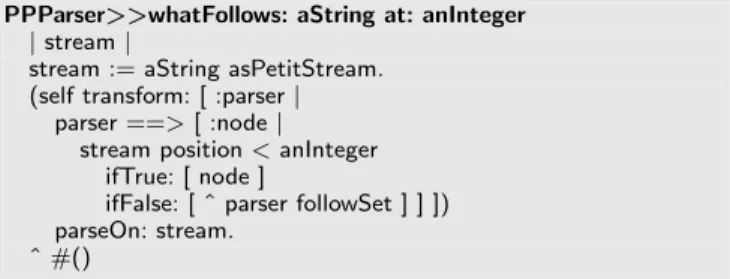
PetitParser also provides a query interface to reflect on parsers: aParser allParsersreturns a collection of all parsers in the grammar;aParser firstSetreturns the parsers that consume input first inaParser;aParser followSetreturns the parsers that followaParser;etc. We can combine the same transformation techniques and the reflective facilities to dynamically generate a grammar to answer other questions, such as what could possibly follow at a specific point in a source file:
PPParser>>whatFollows: aString at: anInteger |stream|
stream := aString asPetitStream. (self transform: [ :parser|
parser ==>[ :node|
stream position<anInteger ifTrue: [ node ]
ifFalse: [ ˆ parser followSet ] ] ]) parseOn: stream.
ˆ #()
Furthermore grammars can be searched and transformed using a declarative transformation engine. We are using an unification algorithm on the grammar graph that tries to substitute the patterns in a search expression with actual
parsers. If a match is found, the replacement rule is instanti-ated with the matched parsers and inserted into the grammar. This allows us to concisely specify grammar optimizations.
3.5
Tool Support
Figure 1 displays a grammar workspace which provides a rich set of static and dynamic tools that directly work on the object model of PetitParser.
Figure 1: The PetitParser grammar workspace dis-playing the currently selected production.
The static tools consist of all elements that work on the specification of the grammar. Thesourcetab enables editing of productions; thegraphtab displays the graphical structure of productions; theexampletab displays random examples for the selected production, which is useful to spot errors in the grammar definition; thecycles tab lists direct cycles that could cause inefficient grammars; and thefirst andfollow
tabs display the respective set of parsers that consume input first and that follow the selected production.
Figure 2: Progress of an example parse with backtracking in choice operator. The dynamic tools work on
the currently selected produc-tion and an input to parse: The parse tab displays and optionally opens an inspec-tor on the resulting AST; the
tally tab displays the absolute and relative activation count of each production; theprofile
tab displays absolute and rela-tive time spent in each produc-tion; the progress tab visual-izes the progress of the parser through the input — from left-to-right the input string is de-picted (whitespaces in white), from top-to bottom the time (see Figure 2 for an example); and thedebuggertab gives the
possibility to step forwards and backwards through the in-put while highlighting the consumed text and the active productions.
3.6
Performance
Parser Combinators, PEGs, and even Packrat parsers are often accused of being slow, due to their dynamic nature. Our experience however has shown the contrary: when the grammar is carefully written PetitParser can compete with a highly optimized LALR table based parser. Efficient gram-mars can be achieved with automatic grammar optimization tramsformations (Section 3.4) and the help of the static and dynamic tools (Section 3.5).
Parser characters/sec
Hand-Written Parser 553 492
PetitParser 138 053
LALR Parser 122 888
Table 1: Average throughput in characters per sec-ond parsing the Smalltalk collection hierarchy on a MacBook Pro 2.8 GHz Intel Core 2 Duo.
In Table 1 we list the average throughput of different Small-talk parsers producing an identical AST. The hand-written recursive descent parser is a clear winner, being almost 5 times as fast as the other two parsers. We expected the LALR parser [4] to perform better, given the sophisticated opti-mization algorithms implemented in this compiler-compiler. Profiling the parsers reveals that the LALR parser spends most of its time looking up, decoding and dispatching values from its tables. PetitParser on the other hand shows a deep nesting of message sends, something a dynamic language language like Smalltalk can do very efficiently.
4.
RELATED WORK
OMeta[18] is an object-oriented pattern matcher based on a variant of PEGs. OMeta uses itself to transform grammar specifications to host language code. Rats! [9] is a packrat parser framework that provides a sophisticated infrastructure to transform and optimize grammars using the visitor design pattern. Both frameworks support grammar composition, but due to their code generation make it impossible to change the grammar after compilation.
Various other object-oriented frameworks for parser com-binators have been proposed: JParsec,Scala Parser Com-binators [12], andNewspeak [3]. All implementations use the host language to build an object model of parser objects. Extensibility is achieved through subclassing or mixing mech-anisms of the respective host languages. Although we expect that grammar transformations are possible on these models, we are unaware if this has actually been done in practice.
Composing and reusing table based parsers is an ongoing research topic [10, 2, 5]. All approaches have limitations in composability and can be described as difficult at best. Grammar changes require an expensive recompilation of the new grammar. Schwerdfegeret al. [15] propose a solution to efficiently compose table based grammars at specific exten-sion points.
5.
CONCLUSION
Our work on language embedding made us wonder why grammar definitions in dynamic languages are still mostly hard-coded statically. In this paper we advocate the use of dynamic grammars. We have presented several examples and some basic performance analysis that show the benefit of having grammars be accessible and changeable at run-time.
Acknowledgments
We gratefully acknowledge the financial support of the Swiss National Science Foundation for the project “Bringing Models Closer to Code” (SNF Project No. 200020-121594, Oct. 2008
– Sept. 2010). We also like to thank Jorge Ressia and the anonymous reviewers for their feedback on this paper.
6.
REFERENCES
[1] R. Becket and Z. Somogyi. DCGs + Memoing = Packrat parsing, but is it worth it? InPractical Aspects of Declarative Languages, volume LNCS 4902, pages 182–196. Springer, Jan. 2008.
[2] C. Brabranda and M. I. Schwartzbach. The metafront system: Safe and extensible parsing and transformation.
Science of Computer Programming, 68(1):2–20, 2007. [3] G. Bracha. Executable grammars in Newspeak.
Electron. Notes Theor. Comput. Sci., 193:3–18, 2007. [4] J. Brant and D. Roberts. SmaCC, a Smalltalk
Compiler-Compiler.
http://www.refactory.com/Software/SmaCC/.
[5] M. Bravenboer and E. Visser. Parse table composition. InSoftware Language Engineering, volume LNCS 5452, pages 74–94. Springer, 2009.
[6] J. Earley. An efficient context-free parsing algorithm.
Commun. ACM, 13(2):94–102, 1970.
[7] B. Ford. Packrat parsing: simple, powerful, lazy, linear time, functional pearl. InICFP 2002, volume 37/9, pages 36–47. ACM, 2002.
[8] B. Ford. Parsing expression grammars: a
recognition-based syntactic foundation. InPOPL 2004, pages 111–122. ACM, 2004.
[9] R. Grimm. Better extensibility through modular syntax. InPLDI 2006, pages 38–51. ACM, 2006. [10] J. Heering, P. Klint, and J. Rekers. Incremental
generation of parsers. InPLDI 1989, pages 179–191. ACM, 1989.
[11] G. Hutton and E. Meijer. Monadic parser combinators. Technical Report NOTTCS-TR-96-4, Department of Computer Science, University of Nottingham, 1996. [12] A. Moors, F. Piessens, and M. Odersky. Parser
combinators in Scala. Technical report, Department of Computer Science, K.U. Leuven, Feb. 2008.
[13] L. Renggli, M. Denker, and O. Nierstrasz. Language boxes: Bending the host language with modular language changes. InSoftware Language Engineering, volume LNCS 5969, pages 274–293. Springer, 2009. [14] L. Renggli, T. Gˆırba, and O. Nierstrasz. Embedding
languages without breaking tools. InECOOP 2010, LNCS. Springer, 2010. To appear.
[15] A. Schwerdfeger and E. V. Wyk. Verifiable parse table composition for deterministic parsing. InSoftware Language Engineering, volume LNCS 5969, pages 184–203. Springer, 2010.
[16] E. Visser. Scannerless generalized-LR parsing. Technical Report P9707, Programming Research Group, University of Amsterdam, July 1997. [17] A. Warth, J. R. Douglass, and T. Millstein. Packrat
parsers can support left recursion. InPEPM 2008, pages 103–110. ACM, 2008.
[18] A. Warth and I. Piumarta. OMeta: an object-oriented language for pattern matching. InDLS 2007, pages 11–19. ACM, 2007.