1. Introduction
The cognitive neuroscience of sleep has undergone a
re-markable resurgence in recent times. A significant
propor-tion of work has focused on the role of sleep in relapropor-tion to
learning and memory. There is now a large body of data
de-scribing the dependence of certain types of learning on
sleep, already complemented by cellular and molecular
theories (Benington & Frank 2003; Graves et al. 2001;
Sej-nowski & Destexhe 2000; Steriade 1999; Tononi & Cirelli
2001). However, the field remains considerably divided,
with some supporting and some repudiating the role of
sleep in memory consolidation (Maquet 2001; Siegel 2001;
Smith 2001; Stickgold et al. 2001; Vertes & Eastman 2000).
As a result, there is still a lack of consensus regarding the
precise stage or stages of memory development where
sleep is considered important or unimportant.
In this target article, I begin by discussing the basic
char-acteristics of sleep and memory formation, then consider
evidence regarding the role of sleep in the process of
mem-ory development, focusing primarily on procedural
learn-ing. Based on these data, I propose a new neurocognitive
framework that separates out several discrete stages of
memory formation, demonstrating the existence of at least
two specific forms of consolidation following memory
ac-quisition; one of
stabilization
and one of
enhancement.
Us-ing this new model, we can consider three issues: (1) at what
stage of memory formation is sleep important? (2) what
types of sleep are important? and (3) what are the candidate
biological mechanisms underlying sleep-dependent
learn-ing? By presenting this heuristic model, I hope, first, that a
more clear understanding of memory stage development
can be agreed upon. Second, such discussions may also help
move away from an all-or-nothing contemplation for the
role of sleep in memory formation, and instead, shift to a
more subtle conception of how wake, sleep, and time can
all play their parts in acquiring, stabilizing, and enhancing
memory representations.
1.1. Sleep architecture and neurobiology
Human sleep has been broadly classified into two distinct
types; non-rapid eye movement (NREM) sleep and rapid
eye movement (REM) sleep, with NREM sleep being
fur-ther divided into four substages (1–4) corresponding in that
order to increasing depth of sleep (Rechtschaffen & Kales
1968). REM and NREM sleep alternate across the night in
BEHAVIORAL AND BRAIN SCIENCES (2005)
28,
51–104
Printed in the United States of America
A refined model of sleep and the
time course of memory formation
Matthew P. Walker
Department of Psychiatry, Beth Israel Deaconess Medical Center, Harvard Medical School, Boston, MA 02215
Abstract:Research in the neurosciences continues to provide evidence that sleep plays a role in the processes of learning and memory. There is less of a consensus, however, regarding the precise stages of memory development during which sleep is considered a require-ment, simply favorable, or not important. This article begins with an overview of recent studies regarding sleep and learning, predomi-nantly in the procedural memory domain, and is measured against our current understanding of the mechanisms that govern memory formation. Based on these considerations, I offer a new neurocognitive framework of procedural learning, consisting first of acquisition, followed by two specific stages of consolidation, one involving a process of stabilization,the other involving enhancement,whereby de-layed learning occurs. Psychophysiological evidence indicates that initial acquisition does not rely fundamentally on sleep. This also ap-pears to be true for the stabilization phase of consolidation, with durable representations, resistant to interference, clearly developing in a successful manner during time awake (or just time, per se). In contrast, the consolidation stage, resulting in additional/enhanced learn-ing in the absence of further rehearsal, does appear to rely on the process of sleep, with evidence for specific sleep-stage dependencies across the procedural domain. Evaluations at a molecular, cellular, and systems level currently offer several sleep specific candidates that could play a role in sleep-dependent learning. These include the upregulation of select plasticity-associated genes, increased protein syn-thesis, changes in neurotransmitter concentration, and specific electrical events in neuronal networks that modulate synaptic potentia-tion.
Keywords:consolidation; enhancement; learning; memory; plasticity; sleep; stabilization
Matthew P. Walkeris currently the director of the
Sleep and Neuroimaging Laboratory at Harvard Med-ical School. He received his PhD from the MedMed-ical Research Council, UK, in 1998. His broad research interests encompass the effects of sleep on human cognition. Currently his laboratory has a particular in-terest in sleep-dependent learning and memory pro-cessing, together with associated brain plasticity, as well with the functional anatomy of human sleep.
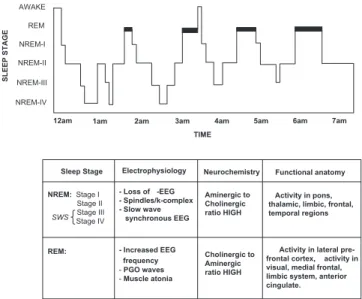
an ultradian pattern every 90 minutes, with NREM sleep
(particularly stages 3 and 4) dominating the first half of the
night, while REM sleep and stage 2 NREM sleep prevail in
the latter half of the night (Fig. 1).
During the descent into NREM sleep,
electroen-cephalographic (EEG) activity begins to slow, with a
dom-inance of theta activity (4–8 Hz) in the early stages.
Throughout stage 2 NREM, there is also the presence of
phasic electrical events including K-complexes (large
elec-trical sharp waves in the EEG) and sleep spindles (short
synchronized EEG waveform oscillations in the frequency
domain of 7–14 Hz) (Steriade & Amzica 1998). Stages 3
and 4 NREM are often grouped together under the term
“slow wave sleep” (SWS) because of the occurrence of high
amplitude waves in the delta range (0.5–4 Hz) and below
(
!
1 Hz), an expression of underlying cortical synchrony
(Amzica & Steriade 1995).
With the occurrence of REM sleep, however, EEG
os-cillations once again become desynchronized, together
with the emergence of high frequency synchronous activity
in the 30–80 Hz (“gamma”) range, similar to wake (Llinas
& Ribary 1993; Steriade et al. 1996). Episodic bursts of
rapid horizontal eye movement also take place, a defining
characteristic of REM sleep, while muscle tone decreases
significantly compared to both NREM sleep and wake
(Chase & Morales 1990). There is evidence indicating that
rapid eye movements, and the process of REM sleep itself,
are associated (perhaps causally) with the occurrence of
phasic endogenous wave forms expressed in the pons (P),
geniculate nuclei of the thalamus (G), and the occipital
cor-tex (O), and as such, have been termed “PGO waves”
(Call-away et al. 1987).
The changes in brain electrical activity across different
REM and NREM sleep stages are accompanied by distinct
patterns of functional anatomy. During NREM SWS,
ros-tral brain stem regions, thalamic nuclei, basal ganglia,
pre-frontal and cingulate cortices, together with medial regions
of the temporal lobe all show decreased activity relative to
waking (Braun et al. 1997; Maquet et al. 1996). In contrast,
during REM sleep, significant elevations in activity are seen
in the pontine tegmentum, thalamic nuclei, occipital
cor-tex, mediobasal prefrontal lobes, and limbic regions
in-cluding the amygdala, hippocampus, and anterior cingulate
cortex relative to waking and NREM SWS (Braun et al.
1997; 1998; Maquet et al. 1996; Nofzinger et al. 1997). At
the same time, the dorsolateral prefrontal cortex, posterior
cingulate, and parietal cortex show even greater decreases
in activity during REM sleep compared with both NREM
and waking (Braun et al. 1997; Maquet et al. 1996).
Throughout the respective sleep stages, the brain also
undergoes dramatic alterations in neurochemistry. In
NREM sleep, subcortical cholinergic systems in the brain
stem and forebrain become markedly less active (Hobson
et al. 1975; Lydic & Baghdoyan 1988) while firing rates
of serotonergic raphé neurons and noradrenergic locus
coeruleus neurons are also reduced relative to waking
lev-els (Aston-Jones & Bloom 1981; Shima et al. 1986). During
REM sleep, both these aminergic populations are strongly
inhibited while cholinergic systems become as active or
more active compared with wake (Kametani & Kawamura
1990; Marrosu et al. 1995), resulting in a brain state largely
devoid of aminergic modulation and dominated by
acetyl-choline. A summary of these physiological sleep
character-istics is presented in Figure 1.
2. The time course of learning and the
contributions of different brain states
2.1. Memory systems in the brainThe process of acquiring information (such as facts,
experi-ences, actions, skills, etc.) and modifying that knowledge
over time can be considered the process of memory
forma-tion, expressed behaviorally as learning. Once developed,
the size of the mammalian cerebral cortex is largely fixed,
placing anatomical and functional limitations on
informa-tion storage (Kass 2000). Therefore, to maintain the ability
for continued memory formation, the adult cortex must, by
necessity, continually modify its central representations in
a dynamic balancing act to ensure that the most salient
in-formation is retained and available in the organism’s
be-havioral repertoire.
A widely accepted mechanism of memory formation is
brain “plasticity,” a lasting change in neuronal properties
(such as structure or function) in response to a stimulus
Walker: A refined model of sleep and the time course of memory formation
NREM: Stage I Stage II Stage III Stage IV REM: - Loss of -EEG - Spindles/k-complex - Slow wave synchronous EEG - Increased EEG _frequency -PGO waves -Muscle atonia Sleep Stage Electrophysiology
SWS
Activity in pons, thalamic, limbic, frontal, temporal regions
Activity in lateral pre-frontal cortex, activity in visual, medial frontal, limbic system, anterior cingulate. Functional anatomy Neurochemistry Aminergic to Cholinergic ratio HIGH Cholinergic to Aminergic ratio HIGH
12am 1am 2am 3am 4am 5am 6am 7am
SLEEP STAGE REM AWAKE NREM-I NREM-II NREM-III NREM-IV TIME
Figure 1. The sleep cycle and respective biological properties. Across the night, NREM and REM sleep cycle every 90 minutes in an ultradian manner, although the ratio of NREM to REM sleep shifts so that early in the night stages 3 and 4 of NREM dominate, while stage 2 NREM and REM sleep prevail in the last half of the night. EEG patterns also differ significantly between sleep stages, with electrical oscillations such as k-complexes and sleep spindles occurring during stage 2 NREM, and slow delta waves developing in NREM SWS (slow wave sleep). Synchronized electrical events are also proposed in REM sleep, expressed in the pons (P), genic-ulate nuclei of the thalamus (G), and the occipital cortex (O), termed PGO waves.In addition, significant changes in neuro-chemistry take place across the sleep cycle. Relative to the wake state, activity of aminergic and cholinergic neurons is reduced during NREM. During REM sleep, aminergic activity continues to fall, while activity of cholinergic neurons now returns to similar levels observed during the wake state. The functional anatomy of sleep is also nonhomogeneous, with NREM SWS exhibiting marked deceases in activity throughout subcortical regions im-portant for arousal as well as regions of the limbic system. How-ever, in REM sleep, areas of the occipital and medial frontal cor-tices increase in their activity, together with the anterior cingulate and temporal lobe structures, while lateral regions of the pre-frontal lobe undergo continued decrease in activation.
(such as an experience). There now exists a plethora of
mechanisms which can provide the foundation of brain
plasticity, ranging from the reorganization of cortical
net-works at a macroscopic level, to the disinhibition of existing
circuitry, the modification of synaptic strengths, and the
structural remodeling of synaptic connections at a
micro-scopic level (Buonomano & Merzenich 1998; Martin et al.
2000; Pascual-Leone 2001).
While several theories have offered common underlying
mechanisms of memory, it is important to note that
mem-ory is not a single entity, at least not in humans. Human
memory has been subject to several different
classifica-tions, many of which include discrete neuroanatomical
re-gions. The most popular of these taxonomies is based on the
distinction of declarative versus non-declarative memory
(for review see Squire & Zola [1996]).
Declarative memory may be considered as the conscious
memory for fact-based information (i.e., knowing “what”),
and is usually acquired with relatively few exposures to the
information, such as just one or two readings of a text, or
one exposure to an event. Several subcategories of the
de-clarative system exist, including episodic memory (memory
for events of one’s past) and semantic memory (memory for
general knowledge, not tied to a specific event) (Tulving
1972). Current neural models of declarative memory
for-mation emphasize the critical importance of structures in
the medial temporal lobe, including the hippocampus
(Eichenbaum 2000), which is thought to form a temporally
ordered retrieval code for neocortically stored information.
In contrast, non-declarative memory can be regarded as
non-conscious. The non-declarative category includes
pro-cedural memory (i.e., the knowing “how”), such as the
learning of actions, habits, and skills, as well as implicit
learning, which is characterized as a passive process
involv-ing the acquisition of knowledge simply through exposure
(Dienes & Perner 1999). Procedural learning of perceptual
and motor skills often requires longer periods of acquisition
compared to declarative memory, and is usually achieved
through periods of performance repetition. The neural
structures involved in procedural learning are diverse,
in-volving both cortical and subcortical networks. While
dif-ferent perceptual-motor skills may share some anatomical
commonalities, the networks modulating specific kinds of
procedural learning are often defined by the sensory
(in-put) and motor (out(in-put) demands of the task (e.g., Grafton
et al. 1998; Jancke et al. 2001; Karni et al. 1995; Schwartz
et al. 2002).
2.2. The current status of sleep, learning, and memory
The idea that sleep may participate in the process of
learn-ing and memory formation is not new. Some of the earliest
evidence was provided by researchers such as David
Hart-ley (1801) and Jenkins and Dallenback (1924) indicating
that the strength of a memory representation (“trace”) may
be more preserved by periods of sleep compared to
equiv-alent periods of time awake. Following the discovery of
dis-crete sleep stages (Aserinsky & Kleitman 1953), research
investigating the influence of sleep on memory has become
gradually more complex at both a behavioral and
mecha-nistic level.
Studies using animal models have provided evidence for
the role of sleep in primarily hippocampal dependent tasks;
although these cannot be classed as declarative since no
“declaration” as such can be made. Learning of spatial tasks
and avoidance paradigms during waking have been shown
to trigger alterations in proceeding sleep stage
characteris-tics, relative to sleep periods without prior learning
(Am-brosini et al. 1992; Datta 2000; Hennevin & Hars 1987;
Mandile et al. 2000; Smith et al. 1980). Furthermore, sleep
deprivation following task acquisition can result in learning
impairments at future retests (Beaulieu & Godbout 2000;
Fishbein et al. 1974; Hennevin & Hars 1987;
Marti-Ni-colovius et al. 1988; Oniani et al. 1987; Pearlman 1969;
Shi-romani et al. 1979; Smith & Kelly 1988; Smith & Lapp
1986). It is important to note, however, that a proportion of
this early animal literature has been criticized for its lack
of control regarding the confounds of sleep deprivation
(Siegel 2001; Vertes & Eastman 2000). More recently,
how-ever, refined experiments have also demonstrated that
se-lective deprivation of specific sleep stages, and even
spe-cific sleep-stage time windows, can cause significant
deficits in memory consolidation (Smith & Butler 1982), as
opposed to long durations of deprivation which may cause
nonspecific effects on memory recall.
The majority of early work investigating sleep and
learn-ing in humans focused on classical tests of declarative
mem-ory (for detailed review see Peigneux et al. 2001a; Smith
2001). These findings offered mixed and contradictory
con-clusions, some in support of sleep-associated learning;
oth-ers starkly against any role for sleep in memory formation.
For example, Meienberg (1977) found no evidence of
al-tered post-training sleep architecture following learning of
a verbal memory task. However, De Koninck et al. (1989)
demonstrated significant increases in post-training REM
sleep after intensive learning of a foreign language, with the
degree of successful learning correlating with the
percent-age increase of REM sleep. Similar inconsistencies have
been reported in the degree to which intensive learning
ex-periences during wake can alter subsequent sleep-stage
properties, as well as the learning impairments that follow
selective sleep deprivation (Chernik 1972; Empson &
Clarke 1970; Lewin & Glaubman 1975; Meienberg 1977;
Plihal & Born 1997; Zimmerman et al. 1970; 1978).
This lack of agreement between studies may reflect
in-appropriate retest schedules. Alternatively, it may be a
con-sequence of the significant differences in task
characteris-tics, such as the degree of experimental difficulty (Empson
& Clarke 1970; Tilley & Empson 1978), or the emotional
salience of the test (Wagner et al. 2001), each of which may
drive sleep dependency. An examination of different
de-clarative memory categories, including episodic and
se-mantic forms has also not been fully investigated (Cipolli &
Salzarulo 1980), and may add further to the apparent
con-tradictions in the degree to which sleep is or is not
impor-tant.
It is also possible that the effects of sleep on declarative
memory are more protracted, making the identification of
sleep-dependent learning more difficult to measure. For
example, the influence of sleep on declarative memory
could be one of subtle maintenance, preventing decay over
time. Therefore, retesting memory several days or weeks
following sleep deprivation, rather than the next day, could
prove a more informative measure of long-term retention.
However, Smith et al. have tested subjects’ retention for
de-clarative material one week after first-night selective or
to-tal sleep deprivation following encoding (Smith 1995), still
reporting no evidence of impairment.
Regardless of the reasons, a clear understanding of the
role of sleep in declarative memory formation remains to be
established in humans, and represents a significant
chal-lenge to researchers in the field of sleep and memory.
In contrast to the declarative system, evidence for the
re-liance of procedural memory on sleep in humans has been
incredibly robust, and currently offers the most promising
and informative model of sleep-dependent learning
(Buchegger & Meier-Koll 1988; Fischer et al. 2002; Gais et
al. 2000; Karni et al. 1994; Smith & MacNeill 1994;
Stick-gold et al. 2000a; 2000b; Walker et al. 2002; 2003b). In the
light of this consistency, we will now focus on recent
ad-vances in understanding the specific stages of procedural
memory development, and discuss the differing
contribu-tions that time, wake, and sleep offer.
2.3. Behavioral stages of procedural memory formation: A contemporary model
Memory formation does not transpire as a solitary event,
but instead evolves in several discrete stages (McGaugh
2000; Schacter & Tulving 1994). Classically, the process of
memory formation is considered to develop in a
time-de-pendent manner, resulting in a more permanent memory
representation.
The time course of behavioral modification, and changes
in brain plasticity, also appear to be diverse, with rapid
changes on the order of seconds to minutes taking place
during or soon after an experience; while more delayed
changes can occur in the subsequent hours or days after
that event (e.g. Igaz et al. 2002; Karni et al. 1998). In some
cases, this latent phase of plasticity has been suggested to
occur across weeks, but it may simply reflect the continued
cycling of a process occurring across several hours or days,
with repeated exposure to the specific experience
in-be-tween. Two of the most recognized stages of memory
for-mation are the initial
acquisition
phase, followed by a
con-solidation
phase.
2.3.1. Acquisition: Behavioral time course and brain-state dependence.
In the procedural memory domain,
ac-quisition can be measured by a specified performance level
within an exposure period or a practice session. This
usu-ally requires a training interval involving repeated
engage-ment with the procedure being learned (Rattoni & Escobar
2000). Training for procedural skills generally requires time
periods ranging from several minutes to several hours.
Rarely does engagement last longer since practice benefits
will often asymptote, although this does not mean the
ca-pacity for learning has ended. Continued practice can not
only render little additional improvement, because of
sys-tem fatigue or decreased motivation and attention, but can
even result in decreased performance, the effects of which
can be reduced by brief periods of daytime sleep (Mednick
et al. 2002). In general, acquisition itself involves learning,
since behavioral performance often improves across the
session, and by definition, successful acquisition
corre-sponds to achieving a certain level of task proficiency.
2.3.1.1. Mechanisms of acquisition and its brain-statede-pendency.
Rapid learning within brief training sessions, or
shortly after, is presumably too fast for extensive structural
change involving the synthesis of new proteins, and the
for-mation of new synapses. Instead, a common mechanism
un-derlying acquisition may be the disinhibition, or
“unmask-ing,” of already existing cortical connections. Using regional
blockade of GABAergic activity, Jacobs and Donoghue
(1991) have demonstrated the ability to rapidly disinhibit
latent horizontal connections in the motor cortex,
connec-tions that are suppressed by feed-forward inhibition.
Com-parable effects have been described in humans using
centrally acting pharmacology targeting GABA
Areceptors
(Butefisch et al. 2000). Similar mechanisms of early
learn-ing involvlearn-ing the rapid alteration of intra-cortical
horizon-tal connections have been proposed in the visual (Gilbert
& Wiesel 1989; Trachtenberg & Stryker 2001), auditory
(Buonomano & Merzenich 1998; Wang et al. 2000), and
somatosensory cortices (Micheva & Beaulieu 1995). Such
rapid removal of local inhibition would allow the fine
tun-ing of existtun-ing networks, and may explain the short-term
functional and electrophysiological changes revealed at a
systems level during acquisition (Müller et al. 2002;
Naata-nen et al.1993). At a molecular level, there is evidence that
these early stages of memory formation result in the
“tag-ging” of activity-dependent synapses (Frey & Morris 1998).
As a consequence, these synaptic tags are thought to act as
request signals for plasticity-related proteins that become
available several hours later, meaning that only selective
synaptic connections are facilitated over the long-term.
Regarding the brain-state dependency of memory
acqui-sition, the majority of studies indicate that wake, rather than
sleep, is most preferable, being a time of focused
percep-tual attention to external stimuli (Joseph et al. 1997), and
the ability for conscious driven motor output (e.g.
Brashers-Krug et al. 1996; Karni et al. 1998; Muellbacher et al. 2002;
Shadmehr & Brashers-Krug 1997). Evolutionarily, this trait
for rapid improvement
during
the waking repetition of a
new skill makes considerable sense, particularly if it were
a beneficial procedure. It would not seem logical to have a
system that requires hours or days, or periods of sleep,
be-fore the first signs of improvement emerge.
Nevertheless, this is not to say information cannot be
as-similated in such a way during sleep (for recent review, see
Coenen & Drinkenburg 2002). Hennevin and colleagues
have demonstrated that new associations can be formed
when information is presented during REM sleep in rats.
Furthermore, the influence of this REM sleep experience
can be identified in subsequent waking behavior (Hennevin
et al. 1995). At the human level, Cheour et al. (2002b) have
described electrophysiological evidence that human
new-borns are able to acquire the ability to discriminate
be-tween simple vowel sounds throughout all stages of sleep.
Information not only appears to be accessible to the brain
during sleep, but may be preferentially dealt with. For
ex-ample, Portas et al. (2000) have provided neuroimaging
data to suggest that emotionally salient auditory
informa-tion (the subject’s own name) is differentially processed at
a higher cortical level relative to a “beep” tone during
NREM sleep. In addition, the emotionally salient stimulus
was processed in a functionally different manner in NREM
sleep compared to perception of the same stimulus during
wake.
Continued acquisition and further modification of
infor-mation learned during prior waking also appears to be
pos-sible during sleep. Several studies (Guerrien et al. 1989;
Smith & Weeden 1990) have demonstrated that auditory
learning during waking can be further modified by
presen-tation of similar auditory cues during phasic REM sleep
riods (REM sleep epochs with eye movements), leading to
improved waking performance. No such learning occurred
during episodes of tonic REM (REM sleep epochs without
eye movements).
Although intriguing, there would seem to be little
ad-vantage offered by the sleep state compared with wake for
the acquisition of information, apart from perhaps a
reduc-tion in the number of competing stimuli likely to occur.
Furthermore, just because acquisition can take place
dur-ing sleep does not necessarily mean sleep serves that
pur-pose. This would also seem to be the most parsimonious
explanation, considering that most species seek a sleep
lo-cation based not only on its degree of safety but its reduced
degree of sensory stimulation, dramatically decreasing the
amount of information available for learning.
2.3.2. Consolidation: Behavioral time course and brain-state dependence.
The early changes in both behavior and
neural dynamics during acquisition are often fragile and
vulnerable to interference. Additional changes are required
before the newly formed memory becomes more
perma-nent. Following acquisition of a procedural skill, it is widely
accepted that a specific map of that information, or
repre-sentation,
is formed within the brain. This representation
appears to undergo several stages of modification, although
classifying these stages can be problematic depending on
the tool of measurement, for example, behavioral,
neuro-physiological, molecular, and so on.
Upon successful completion of acquisition, a slowly
de-veloping process, termed
consolidation,
is believed to
evolve. Classically, consolidation has referred to a process
whereby a newly formed memory becomes increasingly less
susceptible to interference from a variety of amnesic agents
such as trauma or experimental interventions such as
elec-troconvulsive shock (for recent review, see McGaugh
2000). Indeed, it is the degree of stability or resistance to
interference that is usually taken as the defining measure of
successful consolidation.
Until recently, the process of consolidation was
consid-ered to evolve with the simple passage of time, albeit
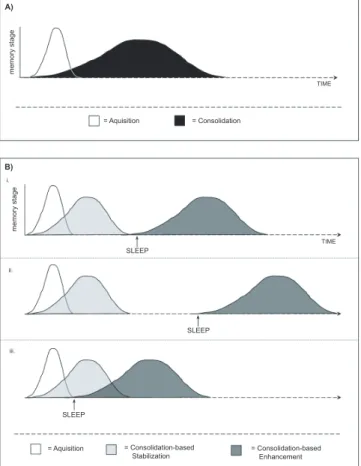
re-quiring many underlying biological mechanisms (Fig.
2A). However, several new studies suggest that
consolida-tion of procedural memory is not simply determined by
time
per se, but instead, is more strictly determined by time
spent in specific brain states such as wake or sleep, or even
certain stages of sleep (Brashers-Krug et al. 1996; Fischer
et al. 2002; Gais et al. 2000; Karni et al. 1994; Muellbacher
et al. 2002; Shadmehr & Brashers-Krug 1997; Stickgold et
al. 2000a; 2000b; Walker et al. 2002; 2003b). Yet, this
prem-ise rests critically on one issue: the definition of
consolida-tion. Based on new psychophysical data, I propose here that
consolidation in the procedural domain can be separated
into at least two different behavioral (and possibly
mecha-nistic) stages: (1)
Consolidation-based stabilization
(CBS)
and, (2)
Consolidation-based enhancement
(CBE). This
contemporary model is outlined in Figure 2B. Previously,
the concept of consolidation as stabilization or
enhance-ment has been suggested in an “and/or” proposition (Abel
& Lattal 2001; Hoffman & McNaughton 2002), but a clear
separation has never been outlined. As will be discussed,
not only does this definition offer a new behavioral
frame-work of procedural memory formation, it can help in
disso-ciating wake or time-dependent learning from
sleep-de-pendent learning.
2.3.2.1. Consolidation-based stabilization.
As noted,
consol-idation has historically been considered the conversion of a
memory representation from an initially labile state to a
more stable form, allowing information to be retained after
a set period of time. Although a specific representation may
have become resistant to disrupting or competing factors,
this process is one of
maintenance
only, simply permitting
the same expression of performance level to that
accom-plished during acquisition, and nothing more.
There are now several studies demonstrating that a
process of consolidation-based stabilization (CBS) can be
Walker: A refined model of sleep and the time course of memory formation
memory stage = Aquisition = Consolidation = Aquisition = Consolidation-based Stabilization = Consolidation-based Enhancement m e m o ry s ta g e SLEEP SLEEP SLEEP TIME TIME i. ii. iii. B) A)
Figure 2. Classical and new models of procedural memory stage formation. (A) Classical, time-dependent course of memory for-mation: The process of memory formation begins with an acqui-sition stage involving engagement with an experience or task to be learned, resulting in a specific memory representation in the brain. By the end of this experience or shortly after, an additional stage of consolidation evolves in a time-dependent, but not brain-state-dependent manner. Following the passage of a specific time period, information learned during acquisition is now retained in a more permanent form. (B) Contemporary brain-state-depen-dent course of memory formation: In this alternative model, the process again starts with an acquisition stage requiring a period of exposure to the task or experience. Following or during acquisi-tion, another time-dependent (but not sleep-dependent) mecha-nism occurs, involving a process of consolidation-based stabiliza-tion. As a result, the memory representation is now resistant to interference, while behavioral performance (learning) is main-tained, but not improved. However, only during periods of sleep can the additional process of consolidation-based enhancement, a brain-state-dependent process, take place, regardless of whether this is immediately after acquisition (i), or several hours later (ii and iii). As a consequence, behavioral performance indicates ad-ditional learning over and above that achieved during acquisition.
effectively achieved during periods of wake, without
re-quiring sleep. Using procedural visual and motor skill tasks,
Stickgold et al. (2000b) and Walker et al. (2002; 2003b) have
outlined the time course of behavioral improvement across
subsequent periods of wake (and sleep; see below)
follow-ing task acquisition. In these studies, time periods of 3–12
hours of intervening wake offered no improvement in
skilled behavioral performance on either task, only
main-tenance. Although not specifically testing memory stability
by way of interference probes, these examples, first,
indi-cate the preservation of learning across periods of wake
without decrement, and, second, demonstrate the lack of
any additional learning attributable to the passage of
wak-ing time.
Muellbacher et al. (2002) have directly addressed the
question of stabilization in the human brain across periods
of wake using a skilled motor task. Brief periods of practice
on the task produced considerable gains in performance
during the training session. Following a 15 minute rest
pe-riod, subjects showed retention of that same performance
level at retesting. A second group of subjects experienced
an identical training session, but during the intervening 15
minute rest, underwent repetitive transcranial magnetic
stimulation (rTMS) applied to the primary motor cortex;
this is a technique that can interfere with local neural
ac-tivity. In contrast to the first group of subjects, when
retested 15 minutes later, performance had decreased back
to pre-training values, suggesting that rTMS had interfered
with maintenance of the motor memory. A third group of
subjects were also trained on the task, but instead of
re-ceiving rTMS to the motor cortex immediately after
train-ing, received rTMS after a prolonged 6 hour waking time
period. Despite being applied in the same location, when
retested after this 6 hour period, rTMS now had no
inter-ference effect, with performance levels again being
main-tained relative to the end of training. Therefore, a process
of stabilization had occurred sometime between 15 minutes
and 6 hours following the end of training, and as a result,
the memory representation was no longer susceptible to the
interference effects of rTMS. It is important to note,
how-ever, that neither 15 minutes nor 6 hours of time awake
could offer any additional learning benefit relative to the
end of training, only stability and thus maintenance of
per-formance.
An equally clear dissection of the stabilization process
has been demonstrated by Shadmehr and colleagues. In the
second of several experiments (see below), subjects were
trained on a skilled reaching task during functional imaging
of the brain (Shadmehr & Brashers-Krug 1997). When
retested after 6 hours of wake (a period that had previously
been shown to be necessary for stabilization)
(Brashers-Krug et al. 1996), behavioral performance was again
main-tained, but not improved, relative to performance levels
during acquisition. In contrast to the lack of change in
be-havior, a significantly different pattern of regional brain
ac-tivation had developed, with greater recruitment of
pre-motor, parietal, and cerebellar regions after 6 hours. These
data indicate that the functional stability offered by the
pas-sage of time awake was associated with a change in the
neural representation of this skill.
Collectively, this evidence suggests that periods of wake
can successfully provide a time-dependent stabilization
process in the first 6 hours after acquiring certain
proce-dural skills. Nevertheless, while the time awake is clearly
not amnesic in and of itself, it does not offer the ability for
any additional learning to occur, independent of rehearsal.
2.3.2.2. Consolidation-based enhancement.
In the current
model, the process of consolidation-based enhancement
(CBE) posits that a specific representation is not only more
stable and impervious to interference, but is now further
enhanced
following a night of sleep. As a consequence,
be-havioral performance indicates that
additional
learning has
taken place in the absence of any further rehearsal or
ex-perience. Several studies have now established data
indica-tive of CBE, and each example has taken place across a time
period containing a night of sleep, some of which explicitly
determine sleep as the causal trigger.
As discussed above, a study by Shadmehr and
Brashers-Krug (1997) illustrated that 6 hours after the end of
train-ing on a skilled motor reachtrain-ing task, subjects’ behavioral
performance was not changed, but the pattern of functional
activity observed using brain imaging was significantly
dif-ferent. In a prior study using the same task, Shadmere and
colleagues (Brashers-Krug et al. 1996) demonstrated that
the first 4 hours following training represented a
suscepti-ble time to interference from competing behavioral
move-ments, but that after this critical time window had passed,
performance could not be altered by such competition.
That is to say stabilization had been achieved, similar to the
study of Muellbacher and colleagues. However, instead of
being retested after 6 hours (Shadmehr & Brashers-Krug
1997), or following interference (Brashers-Krug et al.
1996), a separate group of subjects were simply retested 24
hours after training without any interference challenges
(Brashers-Krug et al. 1996). Following this intervening
time, containing a night of sleep, subjects now displayed
additional learning relative to initial training, instead of
sim-ply maintaining performance levels, as was the case after 6
hours of waking. Similar evidence of delayed learning
across 24 hours following training has been shown using a
skilled hand-cursor apparatus (Krakauer et al. 1999) and a
sequential finger-tapping task (Karni et al. 1998).
We thus saw that improvement or enhancement of
cer-tain motor skills continues for at least 24 hours following
training, yet the relative contributions of time spent awake
and asleep were still not clear. Walker and colleagues
re-cently addressed this question (Walker et al. 2002; 2003b),
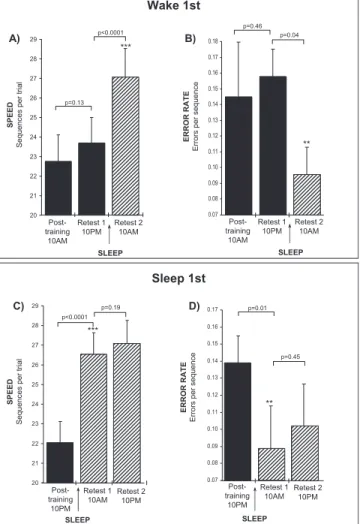
again using a sequential finger-tapping motor task (Fig. 3).
In their initial study, subjects were trained either at 10:00
a.m. or 10:00 p.m. and then retested at subsequent
inter-vals across 24 hours. Initial practice on the motor skill task
improved performance by nearly 60% within the training
session for all groups equally, regardless of time of day.
However, subjects went on to demonstrate remarkably
dif-ferent time courses of subsequent motor skill
improve-ment, specifically dependent on sleep. In contrast, subjects
trained at 10:00 in the morning showed no significant
im-provement when retested later that same day after 12 hours
of wake (Fig. 3, A and B). Yet when retested a second time
at 10:00 the next morning, following a night of sleep,
sub-jects now showed an average 20% improvement in speed
and a 39% improvement in accuracy. Subjects trained at
10:00 in the evening demonstrated equally large significant
improvements the next morning in both speed and
accu-racy overnight, just 12 hours post-training, following sleep,
but showed no significant additional improvement after a
further 12 hours of wake later that day (Fig. 3, C and D).
An alternative explanation of these results was that motor
activity during the wake period prevented motor skill
con-solidation, and sleep was therefore simply a passive time of
hand-rest allowing enhancement. To eliminate this
possi-bility, an additional group of subjects were trained at 10:00
a.m. and then wore mittens for the duration of the waking
interval to prevent skilled finger movements before being
retested at 10:00 p.m. Yet again, the waking episode, with
total hand rest during the day, resulted in no significant
im-provement in performance, and actually led to an increase
in errors, while large improvements were again seen after
the night of sleep.
Significant delayed improvement was, therefore, seen
only across a night of sleep and not over an equivalent
pe-riod of wake, regardless of whether the time awake or time
asleep came first. Furthermore, when the degree of
overnight improvement in motor skill speed was correlated
with sleep-stage recordings, a significant positive
correla-tion with the percentage of stage 2 NREM sleep was
evi-dent, particularly late in the night, further implicating sleep
in the observed learning effect. Fischer et al. (2002) have
recently confirmed these findings, with the additional
evi-dence that sleep on the first night following training is
crit-ical for these delayed improvements to develop, and that
sleep during the day triggers similar performance gains to
those achieved following nocturnal sleep. However, these
authors reported a correlation with REM sleep and not
stage 2 NREM.
In the second of their studies, Walker et al. (2003b) have
gone on to investigate the temporal evolution of motor
learning before and after sleep, the effects of different
training regimens, and the long-term development of
mo-tor learning across multiple nights of sleep. These data
demonstrate that overnight, sleep-dependent learning
al-ters the capacity for rehearsal-based improvement during
subsequent waking episodes, so that prior to a night of
sleep, practice continues to trigger small, within-session
performance benefits, but following sleep, this capacity is
diminished. Secondly, doubling the duration of training
does not appear to alter the amount of subsequent
sleep-dependent learning. Thirdly, the amount of
practice-de-pendent learning during training does not correlate with
the amount of subsequent sleep-dependent learning,
sug-gesting that these two stages (initial acquisition and the
later sleep-dependent enhancement) are functionally
dis-tinct and regulated by different mechanisms. Finally, while
the majority of sleep-dependent motor skill learning
ap-pears to occur during the first night of sleep, additional
nights of sleep still offer continued improvements over
time.
This pattern of sleep-dependent learning is not solely
re-stricted to the motor system. In the perceptual domain,
Karni et al. (1994) have demonstrated that learning on a
vi-sual texture discrimination task, which has been shown not
to benefit from periods of 4–12 hours of wake following
ac-quisition (Stickgold et al. 2000b), improves significantly
fol-lowing a night of sleep. Furthermore, Karni et al. (1994)
es-tablished that selective disruption of REM, but not NREM
sleep, results in a loss of this performance gain. Using the
same task, Stickgold et al. (2000a) have shown that these
de-layed performance benefits are absolutely dependent on
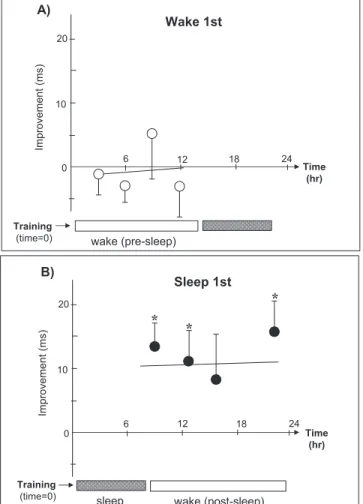
the first night of sleep following acquisition (Fig. 4), and
that the sleep-dependent gains are correlated positively
with the amount of SWS early in the night, as well as the
amount of REM sleep late in the night (Stickgold et al.
2000b). Also following training on this same visual skill task,
Gais et al. (2000) have selectively deprived subjects of sleep
early in the night (dominated by SWS), and sleep late in the
night (dominated by REM and stage 2 NREM), inferring
that consolidation is triggered by SWS related processes,
while REM sleep may promote additional consolidation,
only after periods of SWS sleep have occurred.
Although the original report of these effects
demon-strated that most subjects required a night of sleep before
the delayed learning was expressed (Karni & Sagi 1993), it
should be noted that two out of nine subjects did display
some improvement without a night of sleep, some 8 hours
Walker: A refined model of sleep and the time course of memory formation
Retest 2 10AM Post-training 10AM Retest 1 10PM 20 21 22 23 24 25 26 27 28 29 SPEED
Sequences per trial
p=0.13 p<0.0001 *** SLEEP Wake 1st SLEEP 0.07 0.08 0.09 0.10 0.11 0.12 0.13 0.14 0.15 0.16 0.17 p=0.01 p=0.45 Post-training 10PM Retest 1 10AM SLEEP Retest 2 10PM 0.07 0.08 0.09 0.10 0.11 0.12 0.13 0.14 0.15 0.16 0.17 0.18 p=0.46 p=0.04 ERROR RATE Errors per sequence Retest 2 10AM Post-training 10AM Retest 1 10PM SLEEP ** ** Post-training 10PM Retest 1 10AM Retest 2 10PM 20 21 22 23 24 25 26 27 28 29 p<0.0001 p=0.19 *** Sleep 1st C) D) A) B) SPEED
Sequences per trial
ERROR
RATE
Errors
per
sequence
Figure 3. Sleep-dependent learning on a motor skill task. (A. & B.) Subjects in the Wake 1st group (n "15), trained at 10:00 a.m., showed no significant change in either speed (A) or error rate (B) at the first retest following 12 hours of wake (Retest 1, filled bars). However, by the second retest, following a night of sleep (retest-2, filled hatched bars), performance improved significantly, with speed increasing by 19% and error rate decreasing by 39%. (C. & D.) In contrast, subjects in the Sleep 1st group (n "15), trained in the evening (filled bars), immediately showed significant im-provements in (C) speed (#20%), and (D) error rate ($36%), just 12 hours after training following a night of sleep (retest-1, filled hatched bars). Subjects displayed no further significant change in speed or error rate with an additional 12 hours of wake (Retest 2, filled hatched bars). (Modified from Walker et al. 2002; 2003b.) Asterisks represent degree of significance. *"P ! 0.1; **"P !
0.05; ***"P ! 0.005; Error Bars "SEM (Standard Error of the Mean).
later. However, subsequent studies using this task have not
been able to find evidence of delayed learning during wake
(Stickgold et al. 2000b).
While the sleep-dependency of this visual task is now
well established, the neural correlates are still relatively
un-investigated. Using functional MRI (fMRI) in humans,
Schwartz et al. (2002) have recently measured brain
activ-ity 24 hours after training on the visual discrimination task.
At the 24-hour retest, greater activation was observed in the
retinotopic area of V1 corresponding to the trained visual
field. However, these data were unable to determine
whether this enhanced activity was present immediately at
the end of training before sleep, or developed during the
sleep period.
Maquet et al. (2003) have also demonstrated evidence of
sleep-dependent enhancement using a procedural
visuo-motor task in combination with fMRI. Subjects were
trained on the task and subsequently retested three days
later. Half of the subjects were deprived of sleep the first
night following training, and then allowed two subsequent
recovery nights of sleep before being retested. The
re-maining half of the subjects slept all three nights. Relative
to the sleep-deprived group, subjects who slept all three
nights showed both enhanced behavioral performance and
a selective increase in activation in the superior temporal
sulcus at the later retest, while subjects deprived of the
sleep the first night showed no such change. These results
are also in accordance with previous data by Smith and
MacNeill (1994), demonstrating that selective late night
sleep deprivation, particularly related to the loss of stage 2
NREM, can impair retention of a similar visuo-motor task.
Curiously, Eysenck and Frith (1977) have shown that,
following practice on a visuomotor task, very brief periods
of rest (e.g. 5–15 minutes) also result in performance
en-hancements relative to post-training values without the
need for sleep, an effect termed
reminiscence.
However,
this rest-induced enhancement can be short lived,
decreas-ing back to post-traindecreas-ing values if retestdecreas-ing continues for
several minutes (Denny 1951). The effect of reminiscence
has been considered as a form of consolidation, although
al-ternative suggestions posit that these improvements more
accurately reflect the relief of inhibitory factors that build
up across training. The latter hypothesis would seem to
ex-plain why sustained retesting following the rest period
quickly returns performance back to post-training levels,
arguing against instantiation of permanent learning. Of
note for the current theory, there is evidence that a 24-hour
rest period following training on this task (presumably
con-taining sleep), in contrast to a 10-minute rest period,
simi-larly enhances performance relative to the end of practice,
but these improvements are instead sustainable across
con-tinued retesting, without any rapid decline over time
(Hol-land 1963). A longer rest period, containing a night of sleep,
may therefore confer a true enhancing effect, more
re-flective of consolidation, rather than a temporary relief of
practice-induced inhibition.
While the majority of research investigating the effects
of sleep on procedural learning has so far focused on visual
and motor systems, pioneering work by Atienza and
col-leagues have also described evidence of both time- and
sleep-dependent memory development in the auditory
do-main (Atienza et al. 2002; 2003), suggesting that the
influ-ence of sleep may be ubiquitous throughout perceptual
sensory and motor domains.
Together, these studies show that within the procedural
memory system, a process of continued (sustainable)
learn-ing can occur after trainlearn-ing has stopped, but that this
process of CBE develops only during intervening periods
of sleep and not during wake.
The dependence on REM and SWS for the visual skill
task is in contrast to the stage 2 NREM relationship
identi-fied in the motor domain. Such a difference may have
sev-eral possible explanations. First, the degree of task
com-plexity may be a determining factor (Tweed et al. 1999),
with more complex skilled tasks showing a greater
sensitiv-ity to REM sleep deprivation, while relatively simple tasks
appear more sensitive to stage 2 NREM deprivation.
Sec-ond, within the procedural domain, different sleep-stage
dependencies may reflect distinctions between the input
(sensory/perceptual) and output (motor) roles of these
sys-Walker: A refined model of sleep and the time course of memory formation
Improvement (ms) 6 12 0 10 20 wake (pre-sleep) Training (time=0) Time (hr) 18 24 Wake 1st Improvement (ms) 6 12 18 24 0 10 20
sleep wake (post-sleep)
Training (time=0) Time (hr) Sleep 1st * * * A) B)
Figure 4. Sleep-dependent learning of a visual discrimination task.Subjects were trained and then retested at a later time, with the respective improvement (in milliseconds) in performance il-lustrated across time. Each subject was retested only once, and each point represents a separate group of subjects. (A) Wake 1st: Subjects were trained and then retested either 3, 6, 9, or 12 hours later on the same day (open circles) without any intervening sleep. No significant improvement was evident as a consequence of the passage of waking time across at any of the four time points. (B) Sleep 1st: Subjects were trained and then retested 8, 12, 15, or 23 hours after a night’s sleep (filled circles), with a significant im-provement occurring as a consequence of sleep. In total, n "57, with n "7–9 for individual points. (Modified from Stickgold et al. 2000b.) Asterisks represent individual groups showing signifi-cant improvement at P ! 0.001. Error bars "SEM.
tems, each of which could require functionally different
brain states for effective consolidation. Indeed, if memory
development is one of the many functions that sleep serves,
it would seem careless
not
to exploit these multiple stages.
After all, evolution has fought vehemently to preserve each
of these physiologically distinct brain states, an
accom-plishment that has required both considerable effort and
mechanistic complexity. If there are several different
mem-ory systems in the brain, why utilize only one sleep stage,
such as REM? Instead, the reliance of subtly different
forms of memory on different stages of sleep appears to
make biologically efficient sense.
In summary, the available evidence demonstrates the
ex-istence of two discrete stages of consolidation in the
proce-dural memory system. The first is a process of stabilization,
resulting in the maintenance of performance level, but
without further learning. This stabilization process can
oc-cur effectively in a time-dependent manner across waking
episodes without requiring sleep. The second process of
en-hanced learning involves further modification of the
mem-ory representation, resulting in additional performance
gains rather than simple maintenance. This process does
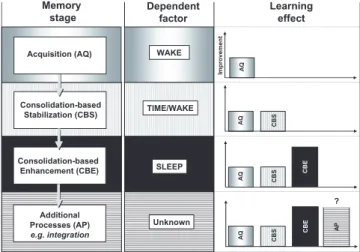
appear to depend on sleep. A model of the dynamics
be-tween time, wake, and sleep and different memory stages
is outlined in Figure 5.
2.3.3. The relationship to previous models of sleep and memory.
Several models of memory development that
con-sider either time or sleep have previously been offered
(Buzsaki 1998; Giuditta et al. 1995; Hasselmo 1999; Karni
et al. 1998; Smith 2001; Stickgold 1998). As discussed
be-low, the model presented here is consistent with several
features of these aforementioned ideas. It also introduces
several new concepts by which we are able to dissect
be-haviorally different stages of memory and relate their
de-pendencies to discrete brain states and time courses, the
ev-idence for which, until recently, has not been available.
Advancing an earlier framework of Buzsaki (1998),
Has-selmo (1999) has proposed a two-stage model of
hip-pocampal episodic memory transfer based on opposing
lev-els of acetylcholine (ACh) during wake and slow wave sleep.
During wake, hippocampal levels of ACh are high,
promot-ing a dominant flow of information into the hippocampus
from the neocortex – ideal conditions for memory
encod-ing. Then, during subsequent SWS, when ACh
concentra-tions are low, this directional flow is reversed, and although
the newly established hippocampal connections remain,
novel associative connections are now established out in the
neocortex. This alternating pattern of information flow
dur-ing wake and sleep is therefore able to promote different
network strengths throughout hippocampal and neocortical
structures. In this model, the term
consolidation
refers to
an integration of newly acquired information within
asso-ciative memory networks, and thus differs in its
interpreta-tion relative to the forms of consolidainterpreta-tion proposed in the
current model. While being pertinent to declarative
mem-ory, this hippocampal based model also holds less relevance
to procedural memory, since learning of skilled sensory and
motor tasks can occur without requiring integrity of medial
temporal lobe structures (Corkin 1968; Squire et al. 1984).
Smith (2001) has argued in an impressively
comprehen-sive manner, that simple declarative memory demonstrates
no reliance on REM sleep, while procedural memory,
to-gether with a less established memory category termed
cog-nitive procedural memory,
does appear to require sleep for
consolidation. Again, the ideas put forward in the current
theory are certainly consonant with the notions of Smith,
but here we separate out several unique stages of
proce-dural memory, and relate those stages to different brain
states, not only during sleep, but also across wake/time.
Giuditta (Giuditta et al. 1995), and later Stickgold (1998)
have offered a two-stage model of memory development
within sleep, suggesting the sequential influence of
multi-ple sleep stages across the night. The first step towards
successful consolidation takes place during SWS which
pre-dominates early in the sleep cycle. A subsequent,
comple-mentary process then develops during REM sleep, which
predominates later in the night, finally completing the goal
of consolidation. As can been seen, the current model does
not contradict such a process; simply that the sequential
hy-pothesis of Giuditta and Stickgold focuses specifically on
sleep and the temporal order of sleep stages, without
de-tailed discussion of the differential effects of initial wake/
time in producing behaviorally unique forms of
consolida-tion. Indeed, it may be that for certain tasks (e.g., a visual
discrimination paradigm), consolidation-based
enhance-ment is achieved by a successive, early and late sleep-stage
mechanism as proposed by these authors. This does not,
however, appear to be the case for procedural motor
learn-ing (Walker et al. 2002).
Finally, Karni et al. (1998) have proposed an innovative
model of procedural learning which also involves two
suc-cessive time-dependent stages. An initial “fast” stage of
Walker: A refined model of sleep and the time course of memory formation
Consolidation-based Stabilization (CBS) Consolidation-based Enhancement (CBE) Additional Processes (AP) e.g. integration Improvement Memory stage Dependent factor Learning effect AP ? CBE WAKE TIME/WAKE SLEEP Unknown AQ CBE AQ AQ AQ CBS Acquisition (AQ) CBS CBS
Figure 5. Procedural memory stages and the contributions of time, wake, and sleep in behavioral improvement.The initial stage of memory formation begins with acquisition (AQ), a process that occurs most commonly during waking, resulting in early behav-ioral improvement (learning). Following acquisition, a process of consolidation-based stabilization (CBS) evolves in a time-depen-dent manner across 0–6 hours, developing efficiently during pe-riods of being awake. As a consequence, the memory representa-tion becomes more resistant to interference, but there is no further learning relative to the end of acquisition. Following CBS, a process of consolidation-based enhancement (CBE) ensues. This stage of consolidation offers additional learning in the ab-sence of further practice, and explicitly requires episodes of in-tervening sleep. Ancillary memory stages such as integration or re-consolidation following memory reactivation may take place either during (in parallel) or following (serial) CBS or CBE, but these additional processes (AP) are less well understood, as are the time/wake/sleep contributions.
learning occurs during task engagement, similar to the
ac-quisition stage outlined in the current theory. Following
these practice-dependent improvements, a second “slow”
incremental learning phase then continues for hours to
weeks, which may or may not need additional task
engage-ment to develop over the long term. In this sense, the
sec-ond stage is akin to a process of general consolidation
de-veloping as a function of time per se, similar to the classical
model outlined in Figure 2A. While the current model does
not suggest that the tenets of this former theory are
incor-rect, it is uniquely different to the slow and fast learning
model of Karni et al. It builds on this model in terms of both
the very specific behavioral forms of consolidation that it
describes – one conferring stabilization, the other
en-hancement – and differs also in its dissociation regarding
the contributions of specific brain states and sleep stages.
Based on the conception of different forms of consolidation
as outlined here, it is possible to suggest that the slowest
learning components described by Karni et al. over many
weeks is actually the continuing cycle of task repetition
fol-lowed critically by subsequent sleep, and thus CBE. In this
sense, there is a multiplicative effect of CBE during
re-peated nights of sleep with intervening task exposure over
long time periods.
In summary, the model of procedural memory formation
described thus far clearly supports several aspects of
previ-ously conceived theories of learning and consolidation. It
also advances these concepts, adding new descriptive and
mechanistic levels of memory stage formation, and
sepa-rates out the unique contributions of different brain states
and time.
2.4. Considerations on mechanisms of learning during sleep
In the remainder of this article, I will focus on several
spec-ulative biological mechanisms, relating specifically to
sleep-dependent learning, which could produce CBE. I will
ini-tially consider the basic processes that regulate synaptic
modification, and follow with a discussion of several
candi-date mechanisms of sleep-dependent plasticity at three
de-scriptive levels: (a) electrophysiological (b) neurochemical
and (c) molecular and cellular.
2.4.1. Regulation of synaptic plasticity.
Many neuronal
models of synaptic plasticity focus on rules of Hebbian
learning (Hebb 1949). While Hebbian learning remains
controversial (Abbott & Nelson 2000), there is evidence
that it forms at least one of the processes regulating
plas-ticity by modulation of synaptic sensitivity, termed
potenti-ation
(for recent reviews, see Abel & Lattal 2001; Soderling
& Derkach 2000). Through the action of both
neurochem-ical and neurophysiologneurochem-ical signals, synapses can either be
potentiated, leading to enhanced sensitivity over time
(long-term potentiation – LTP) or depotentiated, leading to
reduced sensitivity (long-term depression – LTD).
In the case of LTP, the release of a presynaptic
neuro-transmitter in coincidence with the subsequent excitation
of a postsynaptic action potential will strengthen a
particu-lar synapse. During this scenario, excitation of glutamate
NMDA receptors allows extracellular calcium to flood the
postsynaptic terminal. This triggers a variety of
intracellu-lar events such as the activation of kinase enzyme cascades,
together with the release of additional intracellular calcium.
As a result, key genes important to plasticity are
upregu-lated, leading to the phosphorylation of additional
recep-tors and enhancement of synaptic sensitivity. (Abel &
Lat-tal 2001; Soderling & Derkach 2000).
If there is no subsequent postsynaptic action potential, or
its coincidence is not tightly coupled with the presynaptic
action, the synapse will instead undergo LTD. The
mecha-nisms of LTD appear to rely on low-frequency trains of
stimulation in the 0.5- to 4-Hz range (Braunewell &
Man-ahan-Vaughan 2001; Kemp & Bashir 2001; Lisman 1989).
As a result, NMDA receptors are stimulated at
subthresh-old levels, triggering much lower levels of calcium in the
postsynaptic terminal relative to the condition of LTP. The
lower concentration and prolonged calcium entry elicits a
different set of chemical cascades, primarily involving
phos-phatase activity (Lisman 1989). Synaptic sensitivity is
there-fore reduced, because of dephosphorylation of
postsynap-tic receptors (Braunewell & Manahan-Vaughan 2001;
Kemp & Bashir 2001). LTD is considered to be as
impor-tant for efficient plasticity as LTP, since continued
potenti-ation alone would eventually lead to a grossly
over-potenti-ated and inefficient network. Subtle adjustments of these
two processes are therefore able to help regulate the
synap-tic anatomy of learned behaviors.
How then does the neurobiology of the sleeping brain
re-late to such processes? Below I consider several
non-mu-tually exclusive mechanisms that have the potential to
reg-ulate synaptic plasticity during sleep at a variety of different
levels.
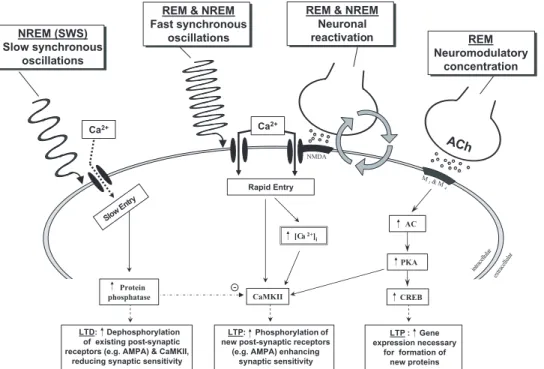
2.4.2. Electrophysiology: Sleep oscillations, burst activ-ity, and reactivation.