THE IMPACT OF ISO 9000 CERTIFICATION ON TQM
IMPLEMENT ATION PROCESS: IN THE CASE OF
BEDELE BREWERY
A
research project
submitted to college
of Business and
Economics
in partial
fulfillment
of
the
requirements for the award of
the
Degree
of
Master of
Business
Administration
Advisors: A.RAMAKRISHNAN (PhD) EBIA T EGUSSIE (BSe, MPA)
JIMMA UNIVERSITY
COLLEGE
OF
BUSINESS
AND
ECONOM[CS
DEPARTME
T
OF MA AGEME
T
MBAPROGRAM
June 2013 Jimma, Ethiopia
The impact of ISO 9000 certifi
c
ation
on TQ
M
hnp~cm
entatir.m
Process:
THE CASE OF BEDfLf BREWERY FACTOn}'"Dr. N. PRAVEEN KUMAR
REDD
\
__.~Mg().!1l.·.~~~:9..:~.t:v1:B...~.,~.I.t~'~ .ProfesS9rin Commerce & 1\1 I 1"
t":f.):·»~·~::~l:/:~<:t 19n<l11:r·.~
Declaration
undersigned declare that this research report is my original work and has not been presented for a degree in any other University, and that all the materials used for this study have been duly acknowledged.
Name ~ k-
~~(
;
?-
e:P
S ignature _.__~f:t
?
f
.
_
This research report has been submitted for examination with our approval as a university advisor.
Signature __ Date:
Abstract
Total Quality Management (TQM) is one of the popular modern management concepts
with emphasis on quality in the entire organization and extends from supplier to
customer. The main purpose of this study is to assess the adoption of TQM elements in
180 9000 certified company in case of Bedele Brewery. In this study Bedele brewery was
selected as it has been certified in ISO 9000 Quality management system since 2007. Out
of 345 employees' 181 were selected using stratified random sampling and five
department heads were included. A total of 143usable questionnaires were received and
the overall response rate was 79percent. The result of the study shows that the company
practiced TQM at a moderate level. Among the elements of TQM; process management,
customer focus and supplier relationship implement at a high level. Leadership,
employees' participation, education and training, and reward and recognition are
implemented at moderate level. However, continuous improvement is practiced at low
level. The result indicated that ISO 9000 implementation contributes towards the
adoption of Total Quality Management. Even though the company is moderate in
Acknowledgment
First, I would like to express my gratitude to my advisors Dr. A.Ramakirshnan and Nebiat Negussie for their continuous support and guidance in all the time of doing this research.
Second, I would also want to express my heartfelt thanks to Bedele Brewery for allowing me to pursue my study, and special thanks go to all the study participants who have willingly shared their precious time to fill the questionnaires and during the process of interviewing.
Finally, yet importantly, I am very grateful thanks to Fantahun Admas and to my family who always supported me throughout the entire process
Table of Contents Abstract i Acknowledgment ii Table of Contents iii List of Tables vi Acronyms vii
CHAPTER ONE: INTRODUCTION 1
1.1. Background 1 1.2. Statement of the problem 3 1.3. Objective of the study 5 1.3.1 General objective 5 1.3.2. Specific objectives 5 1.4. Significance of the study 5 1.5.Scope of the study 5 1.6. Limitations ofthe study 6 1.7. Organization of the paper 6 CHAPTER TWO: LITERATURE REVIEW 7 2. Introduction 7 2.1. Definition of Quality and TQM 7 2.2. Concepts ofTotal Quality management.. 9 2.2.1. The philosophy ofTQM from quality gurus 9
2.2.1.1. Deming Approach to TQM 9
2.2.1.2. Juran Approach to TQM 11
2.2.1.3. Crosby's approach to achieve TQM 11 2.2.2. TQM from Quality Award Models 12
2.2.2.1. The Deming prize 12 2.2.2.2. The European Foundation for Quality Management (EFQM) 13 2.2.2.3. Malcolm Baldrige National Quality Award (MBNQA) 14
2.2.2.4. Ethiopian Quality Award (EQA) 14
2.2.2.5. Comparison of Ethiopia Quality Award with other quality awards 16 2.2.2.6. ISO 9000 Quality management system 17 2.3. Review ofTQM from empirical literatures 19 2.3.1. Is ISO 9000 as a stepping stone for TQM? 19
2.3.2. Critical Elements ofTQM 20
2.3.3. Tools and Techniques ofTQM 28
2.3.4. Constraints/ failure/ factors ofTQM 28
2.3.5. Benefits ofTQM 29
2.4. Theoretical framework of the study 29
2.5. Summary 31
CHAPTER THREE: RESEARCH METHODOLOGy 32
3. Introduction 32 3.1. Study area 32 3.2. Research Design 32 3.2.1. Sampling 32 3.2.2. Sample size 33 3.3. Data type and collection 34 3.3.1. J. Data type 34 3.3.1.2. Method of Data collection 34
3.4. Validity and reliability 35
3.5. Data analysis 36
3.6. Ethical consideration 36
CHAPTER FOUR: RESULT AND DISCUSSION 37
4. Introduction 37
4.1. Respondents' background information 37
4.2. Assessment of Total Quality management.. 39
4.3. Discussion 50
CHAPTER FIVE: SUMMARY, CONCLUSION AND RECOMMENDATION 54
5. Summary, conclusion and recommendation 54
5.1. SuITIITIary 54
5.2. Conclusion 55
5.3 Recommendation and Suggestion 55
Reference 58
List of Tables
Table 2. IElements of the European Foundation for Quality Management 14 Table 2.2 Elements of the Ethiopian Quality Award 15 Table 2. 3 comparison of Ethiopian Quality Award with other Quality Awards 16 Table 2. 4Summary of critical success factors ofTQM 27
Table 4. I Employee educational background 37
Table 4. 2 Respondents work experience 38
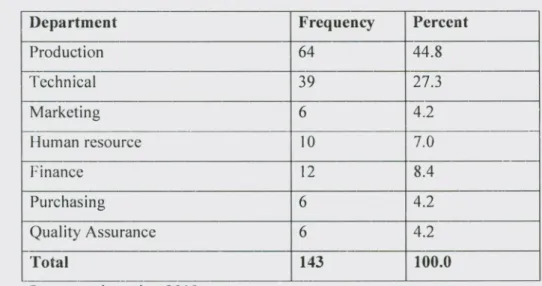
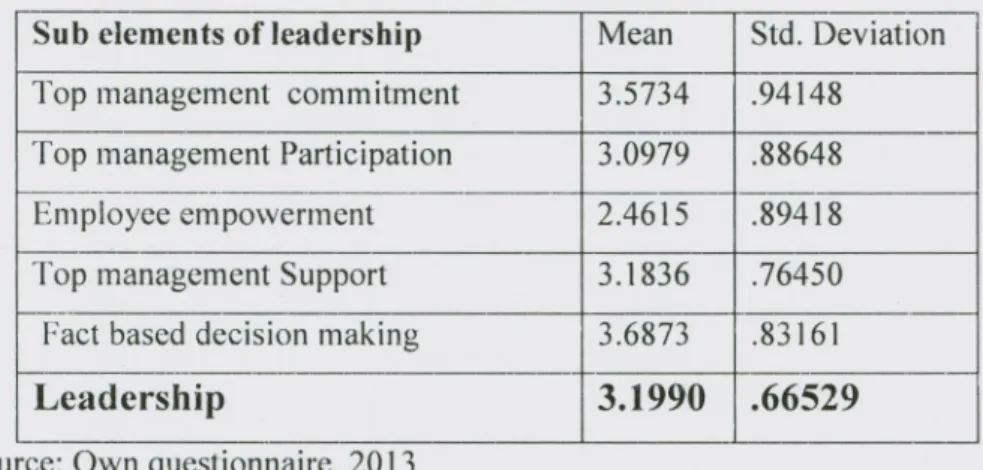
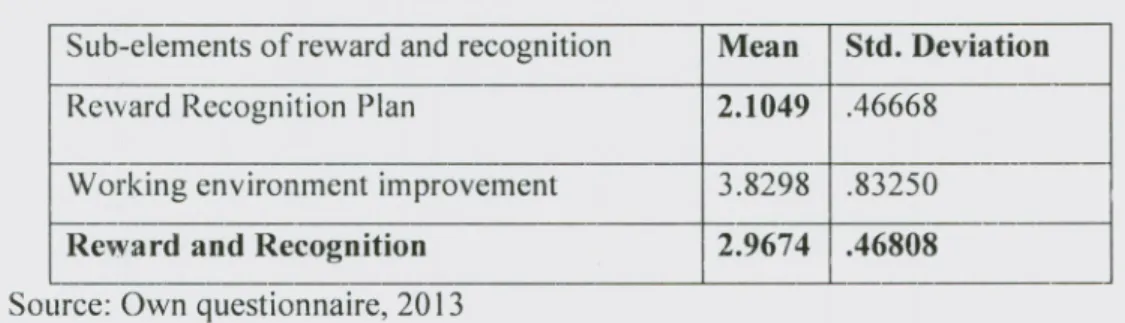
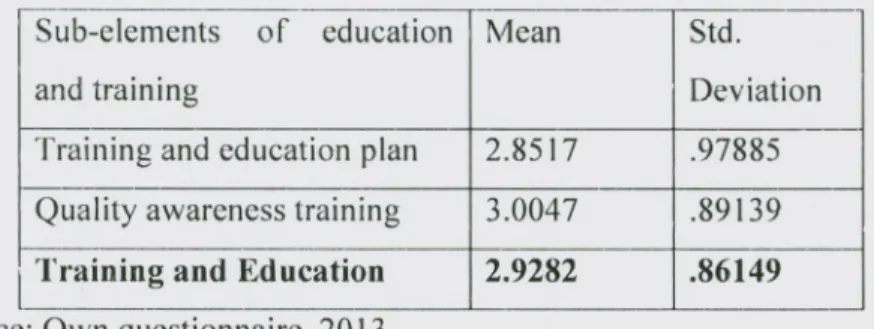
Table 4.3 Respondents working department.. 39 Table 4. 4Mean score analysis of sub-elements ofleadership 40 Table 4. 5Mean score analysis of sub-elements of employee participation 41 Table 4. 6 Mean score analysis of reward and recognition 41 Table 4. 7Mean score analysis of education and training 42 Table 4.8 Mean score analysis of Continuous improvement.. 42
Acronyms
TQM ---Total Quality Management
QMS---Quality Management System
ISO--- International Organization for Standard ization
MBNQA---Malcolm Baldrige National Quality Award
EFQM---European Foundation for Quality Management
EQ A--- Eth iop ian Qual ityAward
PDCA---Plan, Do, Check, Act
CHAPTER ONE: INTRODUCTION
1.1. Background"We all are demanding Total Quality Management (TQM) in our life" (Zairi, 1994 p.6). Zairi (1994) explained about the necessity of total quality management as" TQM is all around us, it is being demanded even in the context of public sector and non-profit making organizations" which is a global and universal philosophy of management.
Total Quality Management (TQM) is one of the popular modern management concepts with emphasis on quality in the entire organization and from supplier to customer (Ozden, 2003). Total Quality Management isan integrated system of principles, methods, and best practices that provide a framework for organizations to strive for excellence in everything they do (Total Quality Management, 20I0).
TQM has been widely implemented throughout the world and effective TQM implementation can improve competitive abilities and provide strategic advantages in the marketplace. Several studies have shown that the adoption of TQM has led to improvements in quality, productivity, and can allow firms to compete globally (Zairi,
1994).
Over the years, Total Quality Management has becomes a strategic tool for manufacturing organizations to grow and sustain in a highly competitive business environment. The historical evolution of Total Quality Management has taken place in four stages; quality inspection, quality control, quality assurance and Total Quality Management. The first stage started in the 1910s when the Ford Motor Company's 'T' Model car rolled off the production line (Dahlgaard, etal., 2007).
The success of Japan in 1970's changed the emphasis from aquality control approach to a quality assurance approach requiring more of the business functions to be involved in the management of quality and requiring longer implication. The 1980s became an era of competitive challenge between westerns and Japan with an increasing number of companies adopting quality management (Mongabay, 1999).
TQM employs management techniques, productivity improvement initiatives, and various problem solving tools with the ultimate objective of achieving customer satisfaction all the time. The primary elements of TQM includes leadership, customer focused, total employee involvement, process- centered, supplier relationship management, integrated system, human resource management, continual improvement, fact based decision making and communication are core values and principles on which organization is to operate (The global voice of quality, 2012).
Companies make concerted efforts for improving quality to meet customer expectations and to compete in the market. Besides their efforts company's also try to improve quality through different quality assurance and quality management systems. Among the well known and accepted quality management systems, ISO 9000 standard is one route for companies strive to achieve quality. Gotzamani and Tsiotras (2006) findings showed that the development and application of a quality assurance system help companies to better organize and synchronize their operations by documenting their process, clearing out ambiguities and clearly defining duties and responsibilities among employees and departments. For business, ISO 9000 is a strategic tool that reduces costs by minimizing waste and errors and increasing productivity. It help companies to access new markets, level the playing field for developing countries and facilitate free and fair global trade (ISO, 2012).
Gotzamani & Tsiotras (2006) findings indicated that ISO 9000 standard implementation help companies to achieve an initial improvement in their quality performance, but it cannot guarantee that this improvement will continue after certification rather it depends on the motivation of the company for certification. The extent ofTQM adoption in a third world country like Ethiopia has never been fully explored.
1.2. Statement of the problem
Many researchers argue that ISO 9000 standard implementation alone is not enough to compete in the world market (Coleman & Douglas, 2003; Wiele, et ai, 2000; Gotzamani, et ai, 2006), they argued that organization go beyond ISO 9000 standard implementation in order to compete in globalized market. Zhang (2000) states that ISO 9000 has lower effects on business performance than TQM. They indicate that ISO 9000 implementation gives a way for TQM adoption by providing basic building blocks for moving towards TQM implementation. However, many organizations still perceive that ISO 9000 certification is an end of their quality journey, rather than a means to an end (Han, et al., 2007).
ISO 9000 standards as compared to TQM has many shortages but careful and consistent implementation of this standards can offer a good first step towards TQM for which there are no clear requirements and directions (Gotzamani, et al., 2006). Rao et al. (1997) indicated that companies that are ISO 9000-registered had higher levels of TQM than non-registered companies and Wiele, et al. (2000) claimed that ISO 9000 considered as a basic level of TQM maturity. They indicated that proper implementation of ISO 9000 provides a transition to TQM. For developing countries like Ethiopia, ISO 9000 certification provide an introduction to quality in global context and opportunity to move towards adoption ofTQM.
The growing liberalization of trade and the globalization of market create difficult challenges to companies in developing countries. Ethiopia is on its way to liberalize the market as a result many foreign companies' have emerged in the local market in different sectors (Ethiopian Trade and Investment, 2012). The emergency of foreign companies in local market seems to create tough competition and also brings technology transitions to host country. To survive and compete in this competitive market, indigenous companies may need to update themselves to the modern quality management philosophy called TQM.
A number of studies have been conducted on the area of TQM implementation, benefits and barriers, however such studies only deals with the developed countries' context and have proposed an implementation framework (Ebrahimpour & Sila, 2002).
Between 1989 and 2000 majority of TQM researches published were done in setting of developed countries such as USA, UK and Australia. Even though, there is no adequate information about the nature and implementation of TQM in developing countries in Africa (Ebrahimpour & Sila, 2002). In Ethiopia also there is a shortage of literature available about TQM and its implementation which gives an insight about the current status ofTQM practices.
This study conducted in ISO 9000 certified company in order to measure the degree of implementation of TQM elements and to look the contribution of ISO 9000 in TQM adoption. An ISO 9000 certified company was selected because different researchers argued and found that ISO 9000 standard implementation can serve as a stepping stone towards TQM (Rao, et aI., 1997; Quazi, 2002; Gotzamani &Tsiotras, 200 I; Gotzamani, et aI., 2006). For this study an ISO 9000 certified case company; Bedele brewery was selected which has six years of certification experience. The company certified since 2007 in ISO 900 I :2000 version and now certified in ISO 9001: 2008. This study at least will give the chance to managers and practitioners' to think about total quality management and the possibility oftransition from ISO 9000 to TQM.
Therefore, this research is conducted to assess the practice of TQM in ISO 9000 certified company and to know the contribution of ISO 9000 standard implementation for adoption ofTQM by raising following research questions:
A. What is the extent of adoption ofTQM practices in Bedele Brewery? B. Which elements ofTQM are more effectively implemented?
C. What is the contribution of ISO 9000 certification for adoption of potential factors of TQM?
1.3. Objective of the study
1.3.1 General objective
The objective of this study is to assess the potential factors of TQM in the case of ISO 9000 certified company and the contribution of ISO 9000 standard implementation for adoption ofTQM.
1.3.2. Specific objectives
I. To assess the level of TQM practices adopted by the company 2. To identify which elements ofTQM more effectively implemented 3. To assess the contribution of ISO 9000 certification to adoption ofTQM 1.4. Significance of the study
This research is conducted to assess the extent ofTQM practice in an ISO 9000 certified company in case of Bedele Brewery. The result of this study provides a good insight about the current status of TQM practice in the company and the result can be used by managers to prioritize those factors which have greater impact on performance of the organization and to make a full adoption of TQM in the company. It also provides the current TQM practice in the factory and future researchers can study TQM in the industry level and can develop implementation framework that fit with the inherent quality culture of the industry. This study also contributes to TQM literature in Ethiopia by presenting empirical data on the TQM status in Bedele Brewery.
1.5. Scope of the study
This study delimited to assessment of Total Quality Management practices in case of Bedele brewery. This study covers the period of time between Januarys to May 2013. The researcher tried to assess the extent to which TQM practices are adopted and implemented in the company.
1.6. Limitations of the study
The study has many limitations and constraints. Among these limitations, mainly finance and time limit the scope of coverage of the study. As this study is conducted only in a single company, so it cannot be generalized to the industry. Despite these limitations, the study is carried out with all possible thoroughness. It endeavor extract the truth and relevant Issues from the mass of data and information collected using appropriate methods.
1.7. Organization of the paper
This study is organized into five chapters consisting of introduction, literature review, research methodology, result and discussion, and conclusion and suggestion.
Chapter one gives a brief description about the main part of research. Chapter two describe and discuss the concept ofTQM both in theoretical and empirical. Chapter three present the methodological perspectives of this research. The strategies adopted in this research are discussed in detail. Chapter four deals with data presentation, analysis and discussion of primary data collected from respondents. Finally, chapter five present summary, conclusion and suggestion for future studies.
Operational definition
Total Quality Management: TQM is a management philosophy of seeking excellence in all aspects of business through organization-wide participation in the quest for quality with customer satisfaction.
CHAPTER TWO: LITE
R
ATURE
R
EVIEW
2. IntroductionChapter two introduces the fundamental concepts that are necessary to understand and to use total quality management in an organization. These include a definition of quality and total quality management, critical elements of total Quality Management and the contribution of other quality systems to TQM adoption. This chapter also discusses the benefits and constraints of total quality management implementation. This chapter structured in two main categories: theoretical and empirical aspect ofTQM. The first part present TQM from Quality gurus, quality award model and other quality management systems and the second part present literature reviews on empirical studies about TQM.
2.1. Definition of Quality and TQ M
2.1.1. What is quality?
Many scholars agreed that quality is expressed as a relative concept and can be different things to different people.
Different quality gurus' define quality from different perspectives; Oakland (2003) defined 'quality is meeting the customer requirements'. The most common definition of quality by quality gurus' is:
~ Fitness for purpose or use -Juran
~ Conformance 10requirements or specification --Crosby
~ Quality should be aimed at the needs of the consumer, present and future
--Deming
~ 'Degree to which a set of inherent characteristics fulfils requirements' -- ISO
(EN) 9000:2000 Quality Management Systems =fundamentals and vocabulary
(Oakland, 2003, p.4)
Stevenson (1996 P.94) defined "quality is the ability of products or service to consistently meet or exceed customer expectation", and have the following dimensions; performance, special feature, conformance, reliability, durability, perceived quality and service after sale.
2.1.2. Why organizations concern for quality?
The quality of the product and service can affect the organization in different ways. For
example poor quality affects the organization in loss of business, liability costs and productivity (Stevenson, 1996). Poor quality increase certain costs like rework and scrap
cost, warranty costs, replacement and repair costs, and other costs. The cost of quality includes failure cost (internal and external), appraisal costs and prevention costs. Failure costs incurred by defective product or parts or faulty services, failures may be internal and external. Appraisal costs include costs for activities to assure there is no defective or to uncover defective products or parts and preventive costs are costs incurred to prevent occurring of defectives.
2.1.3. Evolution of Quality management
Quality management has had many meanings over years. In early 1900s, quality means
inspection, which was the primary method used to ensure quality product. In 1940s,
quality took on a statistical connotation as statistical method was used to control quality. In 1960s, the meaning of the term quality management was expanded to include the entire organization as all functions helped in designing and producing quality. Now
quality is taking broader meaning including continuous improvement, competitive advantage and customer focus. (Dahlgaard, eta!., 2007)
2.1.4. What is total quality management?
There are different definitions of total quality management by different authors and researchers, among the many the most comprehensive definition of total quality
management is by Kanji (1990) cited in Dahlagaard, et a!. (2007 P.14) defined Total
Quality Management as follow:
"TQM is the way of life of an organization committed to customer satisfaction
through continuous improvement. This way of life varies from organization to organization andfrom one country to another but has certain essential principles which can be implemented to secure greater market share, increase profits and reduce cost".
Total quality management is a 'philosophy that involves everyone in an organization in
the quest for quality with customer satisfaction as a driving force' (Stevenson, 1996
p.IOI).
It is widely believed that total quality management evolved gradually and took place in
four stages namely, quality' inspection, quality control, quality assurance and Total
Quality Management (Dahlgaard et aI, 2007). Total Quality Control (TQC) developed by
A.v. Feigenbaum in 1960 never achieved the total acceptance in western companies
rather it was accepted in Japan and they call it" company -wide quality control" (CWQC)
which is now called TQM in western (Dahlgaard, et a\., 2007). He defined 'TQC is an
effective system for integrating the various initiatives in the field of quality to enable
production and services to be carried out as cheaply as possible consistent with customer
satisfaction'. In his definition he didn't mention management's commitment for quality
improvement and TQC is left to quality department. To fill this gap the TQM philosophy
is emerged by incorporating top management commitments and leadership.
In the definition ofTQM all give emphasize total involvement of all employees' from top
executives to first line workers, customer satisfaction is the focal point, and supplier
relationship are the most common elements in the definition of TQM. TQM emphasizes
top management's role in leading a total quality effort on which all employees at all levels
must focus. All employees are responsible for continuous quality improvement and
quality is the focal of all organizational functions. TQM also emphasize quality is a
strategic issue. The organization must understand what the customer wants in terms of
quality and then use strategic planning encompassing all functional areas to achieve goals
for quality.
2.2.
Concepts of Total Quality management
2.2.1.
The philosophy of TQM from quality gurus
2.2.1.1. Deming Approach to TQM
William Edwards Deming is one of the gurus of quality who contribute to the
development of TQM. He contributes 14 points for approach to TQM and seven deadly
disease and sins that should be eliminated. Deming advocate quality is the responsibility
of everybody In the organization includes all employees and top management.
Organizations should eliminate the seven deadly disease and sins that impede organizations to produce and deliver high quality products. Deming's 14 points can be used for curing and overcoming those deadly diseases and sins. Deming's 14 principles and seven deadly diseases are presented below (American Society for Quality, 2013; Oakland, 2003; Rungtusanatham, et al., 2003 and Dahlgaard, et aI., 2007):
, =-->Create constancy of purpose out fear. (Encourage employees to improvement of product and service. (Plan speak up.)
to stay in business.) =>Break down barriers between .=>Adopt the new philosophy. (Stop tolerating departments.
I poor quality or refuse to accept non
I
=>Eliminate slogans, exhortations, andcan forrnance) targets for the work force.
, =-~>Cease dependence on inspection to achieve => Eliminate work standards that prescribe quality. (Improve the process.) numerical quotas.
:::=>End the practice of awarding business on => Remove barriers to pride in workmanship. the basis of price tag alone. (Seek longer- (Poor supervisors, poor materials,
term supplier relationships; reduce the inadequate equipment, lack of training,
number of suppliers.) etc.)
=> Improve constantly and forever every => Institute a vigorous program of education process in the system of planning, and self-improvement for everyone. production, and service. =>Place everybody in the company to work , => Institute modern training (for everybody!). to accomplish the transformation and
I=-> Institute modern methods of supervision. create a structure in top management that (The responsibility of foremen must be will push every day on the above points.
changed from total numbers to QUALITY.)
Deming's Deadly Sins and Diseases
For properly implementing Deming's 14 points, he recommended for western organization to avoid bad practices he called "unforgivable sins or deadly diseases" (Rungtusanatham, et aI., 2003). Deming's deadly sins and diseases are: lack of constancy,
short-term profits, performance appraisals, job-hopping (mobility of management) and use of visible figures only.
2.2.1.2. Juran Approach to TQM
Juran characterizes his quality program as a quality trilogy made up of quality planning,
quality control and quality improvement. He added the human element to quality in broadening from its statistical origin and then he makes the quality management into Total quality management. He also contributes ten steps towards quality improvement. Juran's ten steps to quality improvement were:
=> Build awareness of the need and opportunity for improvement: realize that all processes are improvable
=> Set goals for improvement
=> Organize to reach the goals (establish a quality council, identify problems, select projects, appoint teams and designate facilitators).
::.::> Provide training
=> Carry out projects to solve problems-Juran's trilogy
~-=
>
Report progress=
-
-
>
Give recognition=> Communicate results
=> Keep score
=> Maintain momentum by making annual improvement part of the regular systems and processes of the company (Rai University, 2008).
Generally juran contributions are top management involvement, Pareto principle, training in quality management, definition of quality as fitness for use, project-by-project approach (Juran trilogy) and standard reference the Quality Control Handbook.
2.2.1.3. Crosby's approach to achieve TQM
Philip Crosby, who spent his time as Quality Director of lIT and he is famous in his phrase 'quality is free'. He had four absolutes for quality management and 14 steps for quality improvement. Crosby's four absolutes are (Oakland, 2003 Pp.19):
~ Definition - conformance to requirements.
~ System quality - prevention.
~. Performance standard - zero defects.
);> Measurement of quality - price of non-conformance. He also offered 14 management steps to quality improvement:
1. Make it clear that management is committed to quality.
2. Form quality improvement teams with representatives from each department. 3. Determine where current and potential quality problems lie.
4. Evaluate the cost of quality and explain its use as a management tool. 5. Raise the quality awareness and personal concern of all employees.
6. Take actions to correct problems identified through previous steps. 7. Establish a committee for the zero defects program.
8. Train supervisors to actively carry out their part of the quality improvement program.
9. Hold a 'zero defects day' to let all employees realize that there has been a change.
10. Encourage individuals to establish improvement goals for themselves and their groups.
11. Encourage employees to communicate to management the obstacles they face in attaining their improvement goals.
12.Recognize and appreciate those who participate.
13. Establish quality councils to communicate on a regular basis.
14. Do it all over again to emphasize that the quality improvement program never ends.
2.2.2. TQM from Quality Award Models
Quality Awards are one of TQM implementation models. Among the known national quality awards: Malcolm Baldrige National Quality Award (MBNQA) in United States, European Foundation for Quality Management (EFQM) in European Union, the Deming Prize in Japan and Ethiopian Quality Award (EQA) in Ethiopia are some of the quality award models.
2.2.2.1. The Deming prize
The Deming Prize is one of the highest awards on Total Quality Management in the world. It was established in 1951 in commemoration of the late Dr. William Edwards
Deming who contributed greatly to Japan's proliferation of statistical quality control after
the World War II. His teachings helped Japan build its foundation by which the level of Japan's product quality has been recognized as the highest in the world. The Deming Prize defines TQM as follow:
"TQM is a set of systematic activities carried out by the entire organization to effectively
and efficiently achieve the organization's objectives so as to provide products and
services with alevel of quality that satisfies customers at the appropriate time and price" (JUSE, 2010)
The Deming prize committee clearly defined TQM requires top management's commitment and leadership by establishing clear long-term vision and strategy as well as quality policies and strategies. TQM requires involvement of everyone at all levels in the company to achieve the objective of the company.
The Deming prize advocates that companies can adopt TQM that is appropriate to their business and scale. Organizations do not force to follow a similar model/format ofTQM with other organizations. There are four types of Deming prizes: Deming prize for individuals, Deming distinguished service award for dissemination and promotion, Nikkei QC Literature Prize and Deming application prize.
Deming application prize isan annual prize given to organizations that implement TQM
suitable for its management philosophy, scope/type/scale of business, and management environment. Any organization can apply to the prize regardless of its type, size, scale or ownership.
Expected results of Deming prize on organization who try to win and who won the prize are quality stabilization and improvement, productivity improvement/ cost reduction, expanded sales, increased profits, thorough implementation of management Plans/Business Plans, and realization of top management dreams, etc. (JUSE, 2010)
2.2.2.2. The European Foundation for Quality Management (EFQM)
EFQM was established in 1988 on the initiative of 14 leading European companies and awarded for the first time on 15October 1992 to Rank Xerox Limited.
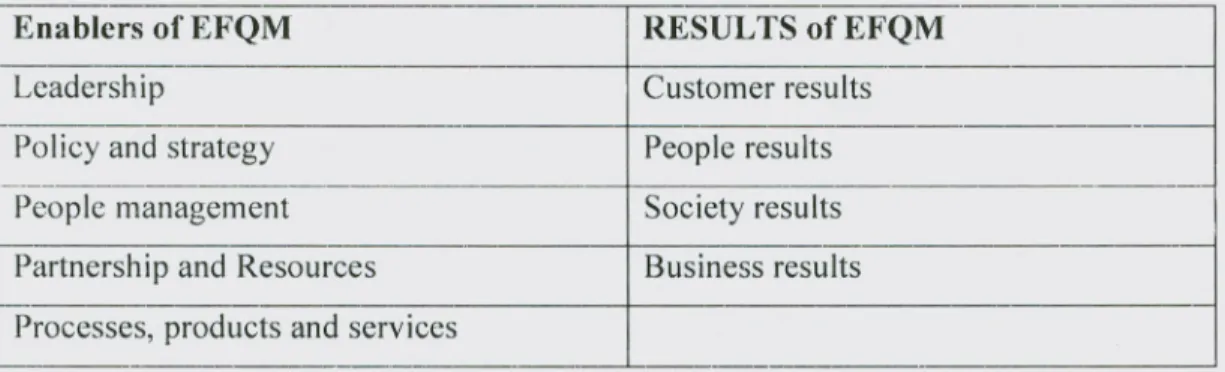
The model consists of nine elements grouped in two groups, one group comprises five
elements which are enablers and the other four elements are the results. (EFQM, 2012)
Table 2. 1Elements of the European Foundation for Quality Management
Enablers ofKFQM RESULTS ofEFQM
Leadership Customer results
-
-Policy and strategy People results
--
--People management Society results
Partnership and Resources Business results
Processes, products and services
-Any company can implement EFQM excellence model to improve their business
performance. To begin EFQM for the first time, an organization first assesses its current
situation using three assessment tools. This assessment tools are the Quick check, simple
questionnaire and determining excellence.
2.2.2.3. Malcolm Baldrige National Quality Award (MBNQA)
The MBNQA was established in 1987 by the US congress to promote quality awareness,
to recognize quality and business achievements of US organization and to publicize these
successful organizations performance strategies. The Baldrige Award is presented
annually to U.S. organizations by the President of the United States. Awards are given in
manufacturing, service, small business, education and health care (NIST, 2010). The
MBNQA has seven criteria for performance excellence. The MBNQA seven criteria's
are:- Leadership, Strategic Planning, Customer Focus, Measurement, Analysis and
Knowledge Management, Workforce Focus, Operations Focus and Results (NIST, 2011).
2.2.2.4. Ethiopian Quality Award (EQA)
EQA was established in January of 2008 to design an award that recognizes
achievements of Ethiopian companies based on a partnership agreement signed between
the Addis Abeba University and Walta Information Center in August of 2007 for
encouraging Ethiopian manufacturing and service industry to incorporate and implement
EQA has the following criteria to evaluate industries performance and to give award;
leadership, policy and strategy, resources management, process management, customer satisfaction, business performance and impact on the society (Beshah, 2011).
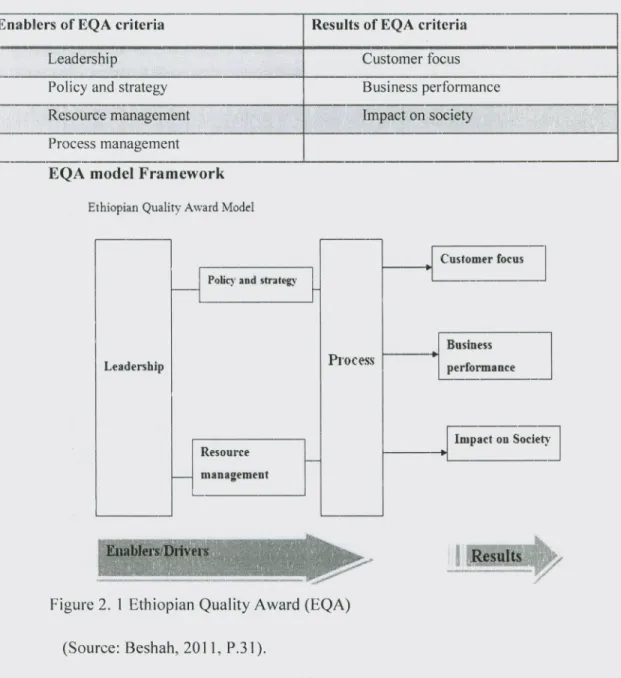
The Ethiopian quality award criteria categorized into enablers and results, under enablers
leadership, policy and strategy, resource management and process whereas under result category customer focus, business performance, and impact on the society. Ethiopian Quality Award has seven main criteria categorized into two Enablers and Results: -Table 2. 2 Elements of the Ethiopian Quality Award
Enablers of EQA criteria Results of EQA criteria
-
-Leadership Customer focus
---
-
-Policy and strategy Business performance
-
-
.-
-Resource management Impact on society
-Process management
-.
-EQA model Framework Ethiopian Quality AwardModel
-
I
I
cus:~er rocu_s_J
H.POliCYand strategy ~
Business
Leadership Process performance
'----
--~act on Society
Resource I
--- management
I
Figure 2. 1Ethiopian Quality Award (EQA)(Source: Beshah, 2011, P .31).
2.2.2.5. Comparison of Ethiopia Quality Award with other quality
awards
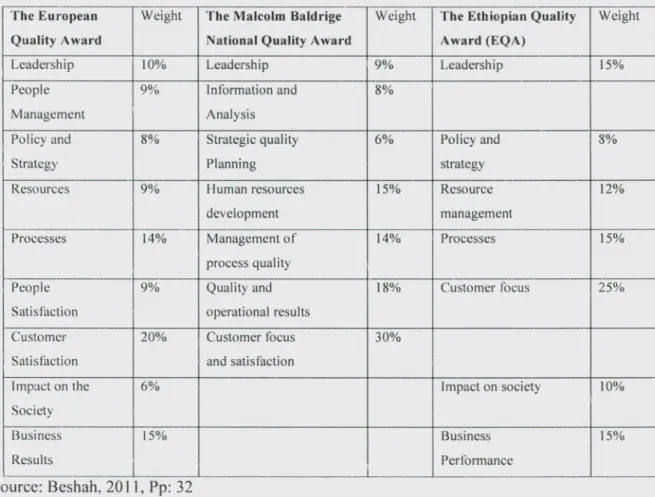
The most known quality awards like European Quality Award (EQA), Malcolm Baldrige Quality Awards (MBQA) are models for TQM implementation and developed from the principles of total quality management. Ethiopian Quality Award also developed based
on principles of TQM. Beshah (2011) make a comparison of Ethiopian Quality Award
model with other known national quality award models with European Quality Award,
Malcolm Baldrige National Quality Award and Australian Quality Awards. All quality award models are derived from the principles of quality management. However, they
have some differences in their focus area and weight of criteria.
Table 2. 3 comparison of Ethiopian Quality Award with other Quality Awards
The European Weight The Malcolm 8aldrige Weight The Ethiopian Quality Weight
Quality Award National Quality Award Award (EQA)
Leadership 10% Leadership 9% Leadership 15%
People 9% Information and 8%
Management Analysis
Policy and 8% Strategic quality 6% Policy and S%
Strategy Planning strategy
--12%
Resources 9% Human resources 15% Resource
development management
f--. _._-- f--.
Processes 14% Management of 14% Processes 15%
process quality
People 9% Quality and 18% Customer focus 25%
Satisfaction operational results
Customer 20% Customer focus 30%
Satisfaction and satisfaction
Impact on the 6% Impact on society 10%
Society
Business 15% Business 15%
Results Performance
Source: Beshah, 2011, Pp: 32
From table 2.3 we can understand that the Ethiopian Quality Award model is similar to European Quality Award model.
2.2.2.6. ISO 9000 Quality management system
International Organization for Standardization (ISO) was established In 1946 when
delegates from 25 countries met at the Institute of Civil Engineers in London and the
organization officially began operations in February 1947.
International Organization for Standardization have different acronyms ITl different
languages (IOS in English, OIN in French for Organisation internationale de
normalisation), but founders decided to give it the short form ISO. ISO is derived from
the Greek isos, meaning equal. Whatever the country, whatever the language, the short
form of the name is always ISO.
ISO is a voluntary organization whose members are recognized authorities on standards,
each one representing one country. The purpose of ISO is to promote worldwide
standards that will improve operating efficiency, improve productivity and reduce costs.
Today the organization has members from 163 countries and 3,368 technical bodies to
take care of standard development. More than 150 people work full time for ISO's
Central Secretariat in Geneva, Switzerland (ISO, 2013)
ISO 9000
There are many types of ISO standard among this, ISO 9000 series is a set family of
quality management and quality assurance standards developed by the International
Organization for Standardization. The standards provide guidance and tools for
companies and organizations who want to ensure that their products and services
consistently meet customer's requirements and that quality is consistently improved
(ISO, 2013). ISO 9000 series are revised in different years among these ISO 9000:1994,
ISO 9000:2000, and currently ISO 9000:2008.
ISO 9001 :2008
ISO 9001:2008 sets out the criteria for a quality management system; it can be used by any organization large or small and regardless of its field of activity. ISO 900 I :2008 is implemented by over one million companies and organizations in all over the world. This is the latest improved version of ISO 9000 quality management system released prior. The ISO 9000 quality management system provides eight quality management principles as well as process approach to achieve continuous improvement. ISO 9000:2008 quality management system has the following basic principles (ISO, 2013):
I. Customer focus: Organizations depend on their customers and therefore should understand current and future customer needs and meet customer requirements and strive to exceed customer expectations. Understanding what the customer wants is the first step in being able to fulfill customer expectation.
2. Leadership: Leaders establish unity of purpose and direction of the organization. They should create and maintain the internal environment in which people can become fully involved in achieving the organization's objectives. Top management is required to take a lead in communicating the importance of meeting customer and statutory requirements, in setting quality objectives and deploying them throughout the organization, and in ensuring effective communication throughout the organization.
3. Involvement of people: People at all levels are the essence of an organization and their full involvement enables their abilities to be used far the organization's benefit.
4. Process approach: A desired result is achieved more efficiently when related resources and activities are managed as a process.
5. System approach to management: Identifying, understanding and managing a system of interrelated processes for a given objective improves the organization's effectiveness and efficiency.
6. Continual improvement: Continual improvement should be a permanent objective of the organization.
7. Factual approach to decision making: Effective decisions are based on the analysis of data and information
8. Mutually beneficial supplier relationship: An organization and its suppliers are interdependent, and a mutually beneficial relationship enhances the ability of both to create value.
2.3. Review of TQM from empirical literatures 2.3.1. Is ISO 9000 as a stepping stone for TQM?
A number of quality related research studies have been reported on the potential of ISO 9000 as foundation for TQM and the possibility of existence progress towards TQM. However, there is a shortage of research in this area in Ethiopia.
ISO 9000 standards provide a documented system that depicts the activities in an organization which can provide a base for TQM. ISO 9001 :2000 and 2008 versions has take into consideration TQM and even laid down pointers for those organizations who want to implement TQM.
The literature extensively cites ISO 9000 as a foundation for TQM or framework on which TQM can be developed (Askey & Dale, 1994; Chan & Lee, 1999; McAdam &
Jackson, 2002). ISO and TQM should not be viewed as either or situation but as a complementary (McAdam & Jackson, 2002). In a comparative study in Hong Kong by Chan & Lee (1999) concluded through empirical evidence that, companies' with ISO 9000 achieved improved implementation ofTQM practices. Rao, et al. (1997) found that ISO 9000 registered companies exhibit higher levels of leadership, information and analysis, strategic quality planning, human resource development, supplier relationship and customer orientation.
McAdam & Jackson (2002) conducted a study on 90 ISO 9000 certified UK and Irish brewing companies to know the possibility of transition from ISO 9000 to TQM. They found that both ISO 9000 and TQM has a complementarity relationship and successful progression towards TQM only occur if a non-bureaucratic inclusive approach to ISO 9000 implementation is adopted.
Gotzamni, et a\. (2006) discussed the importance of ISO 9000 certification as a first step to TQM adoption. ISO 9000 well structured requirements and the existence of a clear and measurable end make top management's commitment to the standards much easier than to the so-called "philosophy" or "never-ending" process ofTQM.
McAdam & Jackson (2002) recommended that TQM is best implemented within a controlled environment and having a quality assurance foundation like ISO 9000; having an ISO 9000 system have an impact on the attainment of a number of the important TQM requirements. In summary, it is evident from the literature that acceptance of the link between [SO 9000 and TQM, including ISO as stepping stone towards TQM, has been accepted.
2.3.2. Critical Elements of TQM
In TQM, factors that influence success or failure in TQM implementation have received much research interest and many researchers identified different factors that are critical for TQM implementation.
TQM constructs/ critical elements discussed in the literature vary from author to author.
However, there are common themes in findings that are critical for successful implementation and sustaining of TQM. Researchers' categorize those factors into soft and hard factors.
Das, et al., (2008) make a literature review on the constructs of TQM and identified the most common elements of TQM; top management commitment, supplier quality management, continuous improvement, employee involvement, reward and recognition, education and training, customer focus, product innovation and benchmarking. Ahmadi & Helms (1995) identified the critical elements of TQM i.e. customer focus, process improvement, total involvement and continuous improvement. Anderson et a\. (1994) cited in Rungtusanatham, et al. (2003) developed TQM constructs based on Deming approach and empirically tested in US manufacturing and finally he set out the following elements/constructs of TQM: visionary leadership, internal and external cooperation, continuous improvement, process management, employee fulfillment, customer satisfaction and learning.
Sila & Ebrahimpour (2003) conducted a study to identify the critical factor for TQM across different countries. They conduct extensive reviewing on 347 researches done between 1989-2000 across in North America, Europe and Asia. They identify the most common critical factors of TQM across countries and their findings showed that the following are critical factors of TQM mentioned across countries; leadership and top management commitment, customer focus, training, supplier management, employee involvement and empowerment, continuous improvement, process management,
strategic management, information analysis, team work, human resource, process control, and quality assurance.
The constructs or critical success factors identified in TQM put into two categories as a soft and hard dimension of TQM. "Hard" components of TQM concentrate on the tools and techniques, systems and the supplementary measurement and control of the work process whereas "soft" components relate to areas behavioral concerns such as increasing customer orientation, employee management, organizational and quality culture. These dimensions are interrelated and together are very important for the successful
implementation ofTQM. (Rahman, 2004 and Oakland, 2003).
Based on the literature review the following elements are used as a critical element of TQM; leadership, customer focus, supplier relationship, employees' involvement, reward and recognition, training and education, process management and continuous improvement. Based on these elements a questionnaire and interview was prepared to assess TQM practice in the company.
2.3.2.1. Leadership
Leadership is the foundation to establish unity of purposes and directions for the institution in order to reach desired outcome. Since, everyone's involvement is prerequisite for TQM; management must exercise leadership abilities to influence the behavior of others that is why Grover, et al (2006) decides without top management involvement no discussion about TQM. A sound foundation for initiating TQM activities is to be laid by top management. Before the implementation of TQM, it is necessary the management decide on the vision, mission, goals, values, ethics and attitude for the organization to follow.
Top management should actively develop quality plans to meet business objectives and communicate company's philosophy to the employees and involve them in the TQM effort and improvement activities, encourage employees to achieve their objectives and ensure adequate resources for employee education and training. Top management should demonstrate their involvement in quality management through commitment, resource allocation and providing leadership in actions rather than words and announcing of quality policy (Das, et a\., 2008 p.55).
The TQM literature clearly portray that without top management involvement it is impossible to implement TQM successfully. All quality awards; Malcolm Baldrige National Quality Award (MBNQA) and European Foundation for Quality Management (EFQM), Ethiopian Quality Award (EQA), and IS09000 quality management system placed leadership factors at the top of their criteria for successful quality management implementation.
Quality gurus' stressed the importance of leadership and top management commitment; Juran and Crosby acknowledge that above 80% of the problems are due to top management. They give great attention to leadership of top management. Deming (1986) in the transformation process of business philosophy calls for managers to institute leadership rather than supervisors. Juran (1993) considers the failure of the quality initiative is due to lack of personal involvement from senior management in quality management movements. Whereas Feigenbaum (1961) states that achieving results and organizational commitment depends greatly on top management's commitment. Top management's commitment to quality management is an absolute precedence for preparing organizational culture before TQM practices can be implemented, top management can facilitate the unity of purpose as well as change process management and learning processes. Top management leadership and commitment element can be positioned at the soft side ofTQM. (Jung, et a\., 2009).
2.3.2.2. Supplier relationship Management
The philosophies behind the various TQM and excellence models support the establishment of partnerships with suppliers and lay down principles and guidelines for them. Developing partnership with suppliers is one of the major factors for successful
TQM implementation. An efficient supply chain process, built on strong confident partnerships, will create high levels of people satisfaction, customer satisfaction and support and, in turn, good business results (Oakland, 2003 pp. 64).
There are various ways of ensuring the partnership processes work well for an organization. These range from the use of quality management system audits and reviews, performance reviews and joint action plans. Supplier quality management can be defined as the set of supplier-related quality management practices for improving suppliers' quality of products and services. Supplier quality management can be emphasize product quality as the criterion for supplier selection, participation 111 suppliers, communication with suppliers, understanding of supplier performance, and supplier quality audit (Zhang, et al., 2000). Supplier quality management is an important dimension of quality management as defective incoming materials and parts lead to process and product quality problems. Extensive, long-term relationship with the suppliers' helps minimize inspection cost of the raw materials.
2.3.2.3. Continuous Improvement
Continuous improvement is very essential for the survival of a company due to ever changing tastes of customers and pressures from competitors. The tendency of the institution to purse incremental and innovative improvements of its process, products and services should be the deriver to achieve continuous improvement. Continuous improvement of processes and product quality leads to increased revenues through product reliability and reduced costs through process efficiency.
The Deming PDCA wheel "Plan-Do-Check-Act" can be used as a tool for continual improvement. The "Plan" establishes the objectives and processes necessary to deliver results in accordance with customer requirements and the organizations policies: the "Do" implements the processes, the "Check" monitors and measures the processes and products against policies, objectives and requirements and reports on the results, and the
"Act" takes actions to continually improve process and system performance. (Lewis, et
al., 2006).
Empowering and involving employees for making continuous improvement is essential clement for TQM, because employees will have more enthusiasm toward change processes, and thus result in more participation (Jung, et aI., 2009).
2.3.2.4. Education and Training
Training refers to the acquisition of specific skills or knowledge. Training programs attempt to teach employees how to perform particular activities or a specific job. Education, on the other hand, is much more general, and attempts to provide employees with general knowledge that can be applied in many different settings (Zhang, et aI., 2000).
In order to effectively participate IJ1 quality management, employees need to be adequately trained and explained about principles and benefits of the TQM practices and management must ensure an organization-wide training program (Jung, et aI., 2009).
2.3.2.5. Employees' Participation
Management participation in quality activities is not enough to contribute to quality improvements as costs of total quality is difficult to control by management alone. Employees' participation is very important elements for successful implementation of TQM. Employee participation can be defined as the degree to which employees in a firm engage in various quality management activities. Employees' can be participated OJ'
involved in the form of teamwork and employee suggestions.
Employees should be empowered as they are the center of TQM approach and involved in managing and improving process and serving customers. Employee empowerment is giving workers the responsibility and authority to make changes for improvement. This puts decision making into the hands of those who are closest to the job and have considerable insight into problems and solutions (Dahlgaard, et aI., 2007). Employees' should be empowered and encouraged to provide innovation and creativity at all levels of the work force and total employee involvement is necessary to ensure excellence in all quality dimensions (Mehra, et a\., 200 I).
Employees' can participate in the organization through team and by providing improvements and suggestions. Teams can be cross-functional or Quality Circle which is
composed of different department representatives and who are necessary to implement
TQM throughout the organization. Quality circle is small groups which are voluntarily
carrying out quality control activities within its own work area (Dahlgaard, et aI., 2007).
Each member in the group participates and carries out quality control continuously, as a
part of a company's total quality control activities and using quality control activities
within its own work area.
2.3.2.6. Customer Focus
Customer focus can be defined as the degree to which a firm continuously satisfies
customer needs and expectations. Obtaining customer complaint information is to seek
opportunities to improve product and service quality (Zhang, et aI., 2000). To improve
customer focus efforts, customer complaints should therefore be treated with top priority
(.Juran & Gryna, 1993). In the TQM philosophy, customer satisfaction is the goal of the
entire system. The term customers in the quality management literature refer to both
internal and external customers. The external customer is the consumer or client is the
end user of the products or services being offered. An internal customer is a second
process or department within the organization which depends on the product of the first.
These internal customers receive products and information from other groups of
individuals within their organization. Thus, satisfying the needs of these internal
customers is an essential part of the process of supplying the final external customer with
a quality product. Every party in a process has three roles: supplier, processor, and
customer (Lakshman, 2006). The ability to manage the customer relations is crucial for
an organization in sustaining a competitive advantage.
2.3.2.7. Process Management
From the quality management perspective, process management is described as an
arrangement of the necessary elements for creating quality and as a means to allocate and
coordinate constituent activities of typical processes of quality management. The related
processes are systematically designed, managed, and innovatively improved.
Process management best practices are (Oakland, 2003 pp. 169):
• Identifying the key (core) business processes: prioritizing on the basis of the value chain, customer needs and strategic significance, and using process models and definitions.
• Managing processes systematically: giving process ownership to the most appropriate individual or group and resolving process interface issues through meetings or ownership models.
• Reviewing processes and setting improvement targets: empowering process-owners to set targets and collect data from internal and external customers.
• Changing processes and evaluating the benefits: through process improvement or re-engineering teams, project management and involving customers, and suppliers.
2.3.2.8. Reward and Recognition
Recognition and rewards are one of the important soft factors of TQM which are very important element for successfully implementing and sustaining TQM. Recognition defined as the public acknowledgment of superior performance of specific activities. Reward is defined as benefits, such as increased salary, bonuses and promotion, which are conferred for generally superior performance with respect to goals. (Juran & Gryna,
1993).
The three types of recognition that all companies can build on: company awards for quality, awards for teams with successful track records, and awards for staff who meet customer expectations. (managementstudyguide.com, 2013). Employees are parts of the firm's process and improving quality at lower cost can only be achieved when the
company has good, committed and satisfied employees. Recognition is the most important factor which acts as a catalyst and drives employees to work hard as a team and deliver their best. Mehra, et aI., (2001) recommended that the reward system should be team-based and the need to switch the incentive systems from individual- to group-oriented.
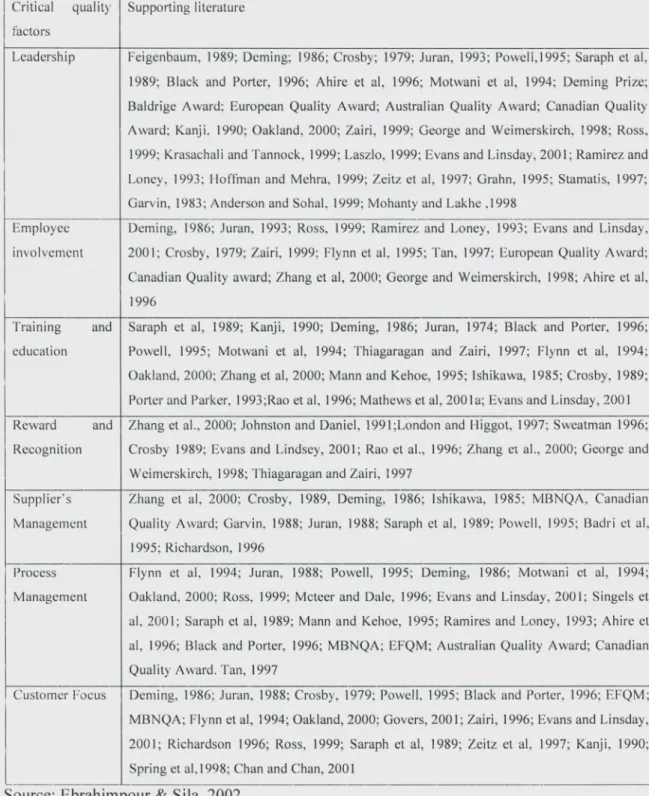
Table 2. 4 Summary of critical success factors of TQM
Critical quality Supporting literature
factors
Leadership Feigenbaum, 1989; Deming; 1986; Crosby; 1979: Juran, 1993; Powell,1995; Saraph et ai,
1989; Black and Porter, 1996; Ahire et ai, 1996; Motwani et ai, 1994; Deming Prize;
Baldrige Award; European Quality Award; Australian Quality Award; Canadian Quality
Award; Kanji, 1990; Oakland, 2000; Zairi, 1999; George and Weimerskirch, 1998; Ross,
1999; Krasachali and Tannock, 1999; Laszlo, 1999; Evans and Linsday, 2001; Ramirez and Loney, 1993; Hoffman and Mehra, 1999; Zeitz et ai, 1997; Grahn, 1995; Stamatis, 1997;
Garvin, 1983; Anderson and Sohal, 1999; Mohanty and Lakhe ,1998
r~--~---+~-~~-~~~----~=~~--~~~--~--~~--~~~:---~~~~
Employee Deming, 1986; Juran, 1993; Ross, 1999; Ramirez and Loney, 1993; Evans and Linsday,
2001; Crosby, 1979; Zairi, 1999; Flynn et ai, 1995; Tan, 1997; European Quality Award;
Canadian Quality award; Zhang et ai, 2000; George and Weimerskirch, 1998; Ahire et ai,
1996 involvement Training education Recognition Supplier's Management
and Saraph et ai, 1989; Kanji, 1990; Deming, 1986; Juran, 1974; Black and Porter, 1996; Powell, 1995; Motwani et ai, 1994; Thiagaragan and Zairi, 1997; Flynn et ai, 1994;
Oakland, 2000; Zhang et ai, 2000; Mann and Kehoe, 1995; Ishikawa, 1985; Crosby, 1989;
Porter and Parker, 1993;Rao etai, 1996; Mathews etai, 2001a;Evans and Linsday, 2001
and Zhang et al., 2000; Johnston and Daniel, 1991;London and i-1iggot, 1997; Sweatman 1996;
Crosby 1989; Evans and Lindsey, 2001; Rao et al., 1996; Zhang et al., 2000; George and
Weimerskirch, 1998; Thiagaragan and Zairi, 1997
Zhang et al, 2000; Crosby, 1989, Deming, 1986; Ishikawa, 1985; MBNQA, Canadian
Quality Award; Garvin, 1988; .luran, 1988; Saraph et ai, 1989; Powell, 1995; Badri ct ai, 1995; Richardson, 1996
Process Flynn et ai, 1994; Juran, 1988; Powell, 1995; Deming, 1986; Motwani ct ai, 1994;
Oakland, 2000; Ross, 1999; Mcteer and Dale, 1996; Evans and Linsday, 200I; Singels et
al, 2001; Saraph et ai, 1989; Mann and Kehoe, 1995; Ramires and Loney, 1993; Ahire et
ai, 1996; Black and Porter, 1996; MBNQA; EFQM; Australian Quality Award; Canadian
Quality Award. Tan, 1997
Customer Focus Deming, 1986; .luran, 1988; Crosby, 1979; Powell. 1995; Black and Porter, 1996; EFQM;
l
'
MBNQA; Flynn etai, 1994; Oakland, 2000; Govers, 200 I; Zairi, 1996; Evans and Linsday,2001; Richardson 1996; Ross, 1999; Saraph et ai, 1989; Zeitz et ai, 1997; Kanji, 1990;
Spring et ai,1998; Chan and Chan, 2001
--- ..---'-.---.---'
Source: Ebrahimpour & Sila, 2002
Management
2.3.3. Tools and Techniques of TQM
Total quality management has been developed around a number of critical factors.
However, TQM is much more than a number of critical factors; it also includes other components, such as tools and techniques for quality improvement. The seven quality control tools includes: cause and effect diagram, Pareto diagram, Stratification, Check sheet, Histogram, Control chart and Scatter diagram, and techniques includes: Analytical hierarchy, Matrix diagram, Affinity analysis and Matrix data analysis (Dahlgaard, et a\., 2007).
2.3.4. Constraints/ failure/ factors of TQM
Different studies in a lot of countries were especially accomplished to assess the TQM implementation and its barriers. This were accomplished to promote the awareness about the best quality practices and to overcome the global competitive challenge. We can learn from these studies to implement TQM properly.
There are many organization face failures in TQM implementation; Martins &de Toledo
(2000) mentioned some of the failure factor of TQM are inadequacy of planning and
incomplete implementation programs, lack of appropriate quality management reference model, an emphasis on image rather than business results, focused on minimum standard
existent, non alignment with strategic objective, and lack of continuity of the
implementation program. They recommend the use of implementation frameworks that
guides Total Quality Management implementation to avoid failures. Zairi (1994)
recommended that it is more important to understand how it works as a philosophy and appreciate it for its long-term nature for successful implementation.
Tamimi and Sebastianelli (1998) cited in Lau & Idris (2001) identified that 48 percent of the barriers to TQM implementation were caused by people (soft elements). Lau &Idris
(2001) finding showed that soft elements are critical to TQM tangible effects
(productivity, market competitiveness and cost reduction). They mentioned the soft elements ofTQM are top management leadership on quality, training and education, team work, employee involvement and trust. Human factors are the most influential on the implementation ofTQM as compared to other factors (Grover, et a\., 2006).
Improvement in the soft elements is important since there is adequate research proving that business performance is more heavily influenced by these elements of TQM (Gotzamani &Tsiotras, 2006).
Macdonald (1996) mentioned some of principal reasons for unsuccessfulness of TQM implementation in companies. These are:- lack of management commitment, the people were not really involved, lack of vision and planning, satisfaction with the quick fix, the process became tool bound, and Satisfaction with customer satisfaction, Culture change versus project approach, Quality management became institutionalized: throwing its quality problems over the wall to the "quality people".
2.3.5. Benefits of TQM
The adoption of quality conscious culture can help organizations to improve their performance through a cyclical effect: improved quality lead to improved customer satisfaction, which in turn lead to improved product reputation which can in turn led to increased sales and profits. Walsh, et a!. (2002) identified that the adoption of TQM philosophy has many benefits to organizations among these: elimination of defects, reduced scrap and rework, reduced level of cost, increased level of efficiency and productivity and increase employee morale and motivation. Talavera (2005) finding showed that adoption of TQM helps company to improve productivity, reduction in cost and overall change in the way employees' value their work and organization, thereby resulting in significant improvement in performance and competitiveness.
2.4. Theoretical framework of the study
Based on the literature and previous studies a TQM model has been adopted to evaluate the practices of TQM in a manufacturing organization to be surveyed. TQM provides a generic concept for continuous improvement in quality and other performances.
Several authors agree that TQM is a philosophy that stresses a systematic, integrated, and consistent perspective involving everyone and everything. However, the definitions of TQM elements vary a lot. For examples, ISO 9000:2000 refers to eight principles of quality management and, the Malcolm Baldrige National Quality Award (MBNQA)
shows seven dimensions for a framework of quality management. In this study 8 dimensions ofTQM are used toevaluate the TQM practices in Bedele brewery context. This study adopt a TQM implementation frame work developed by Zhang, et aI., (2000) which constitutes eight critical TQM implementation elements (enablers). This study guided by this framework.
TQM implementation frame work
=r
particiP::J
Reward and
and Training focus Education Customer Recognition Leadership Quality Product Continuous Process improvement Supplier Quality Management Management
2.5. Summary
TQM is one of the management philosophies which emphasizes quality in the entire organization and extends from supplier to customer. TQM is based on the following principles top management leadership, customer focus, continuous improvement, employee participation, reward and recognition, education and training, supplier relationship and process management.
Different quality experts contribute for the development of TQM. Among the quality guru, who contribute towards TQM are Deming, Juran, and Crosby. Quality award models can be used as an implementation framework for TQM. These quality awards are: the Deming Prize in Japan the European Foundation for Quality Management (EFQM) in Europe, and the Malcolm Baldrige National Quality Award (MBNQA) in the United States of America and Ethiopian Quality Award (EQA) in Ethiopia, and ISO 900 1:2008.
In addition, some TQM literatures from other researchers were reviewed. In this study,
TQM consists of 8 constructs; leadership, customer focus, continuous improvement,
process management, supplier relationship, employee participation, reward and recognition, and training and education.
CHAPTER THREE: RESEARCH METHODOLOGY
3. Introduction
This chapter discusses methodology adopted for the study and aspects of the research methodology including research design, data collection and data analysis methods.
3.1. Study area
This study was conducted at Bedele Brewery from March 1 to March 15, 2013. Bedele Brewery Share Company was established on October, 1993 under the ownership of the Federal government of Ethiopia. It is located in the South Western of Ethiopia, Oromia Region, Illubabor Zone, Bedele City, and 483 km from Addis Ababa. The company has production capacity of 300,000 hectoliter or 75,000,000 bottles of beer per year. The company sells its product in domestic and foreign markets. Heineken, the leading Dutch brewer owned Bedele brewery since August 2011 from the government of Ethiopia (Bedele Brewery Share company, 2012).
3.2. Research Design
The study adopted descriptive research design and both quantitative and qualitative methods were used. The role of research design is to connect the questions to data. Design sits between the two showing how the research questions will be connected to the data tools and procedures to use in answering them. Descriptive research design is a scientific method which involves observing and describing the behavior of a subject without influencing it in any way. Descriptive study sets out to collect, organize, and summarize information about the matter being studied (Punch, 2006).
3.2.1. Sampling
For this study an ISO 9000 certified company is selected judgmentally from Ethiopian manufacturing company; Bedcle brewery is selected as it fulfills ISO 9000 certification and proximity to the researcher. ISO 9000 certification with at least three years of experience is used as minimum selection criteria (Gotzamani, et al., 2006) and the reason that ISO 9000 implementation is stepping-stone towards TQM journey (R &Tan, 20 II; Dahlgaard, et al., 2007; McAdam & Jackson, 2002). Bedele Brewery fulfills this criteria
and the company certified starting from 2007 in ISO 900 I :2000 version and now certified in 2008 version of ISO 9000 so the company suit for this study.
The populations of the study were employees working in the company. Employees from the company were selected randomly through stratified random sampling method. The population of the study stratified in departments for giving equal chance to all workers in all departments and to minimizing sampling errors. The reason to use stratified sampling is, first as the TQM philosophy implies that everyone who is working in the organization should be involved in quality improvement and responsible for quality. Second stratified sampling increases precision or help to get the maximum precision in estimation of the population parameters (Cochran, 1977). To incorporate all departments in the study, employees from each department selected based on proportional random sampling. Proportional random sampling used to minimize sampling error in selecting samples from the company and to avoid bad sample. In simple random sampling some departments may not be,included if as they have small employees' and others may dominate because of large number. In addition to employees' department heads selected for interview.
3.2.2. Sample size
The total number of employees' currently working in Bedele brewery is 490 out of this janitorial workers, clerks, guards and temporary workers were excluded and finally 345 employees were considered as potential respondents for this study. Stratified random sampling method was used to select respondents; departments were used as strata to classify employees' in to non overlapping groups, finally proportional stratified random sampling was used to select respondents from seven strata (departments).
Cochran sample size determination is used for determining sample from the population. The sample size calculated at 95% confidence level and at 5% confidence interval {margin of error). Cochran's (1977) correction formula was used to calculate the final sample size. By using Cochran's formula for sample size determination, 181 samples were selected, for reserving to non response 10% of the sample size was added and totally 199 questionnaire were distributed.