INTERIM REPORT ON MREL
REPORT ON IMPLEMENTATION AND DESIGN OF
THE MREL FRAMEWORK
2
Contents
Executive summary 5
Provisional recommendations 7
1. Introduction 10
2. State of play on MREL and TLAC implementation 12
3. Quantitative findings 18
3.1 The sample 18
3.2 Data limitations and caveats 20
3.3 Options on the scope of MREL-eligible instruments and scenarios for calibration 21 3.4 Key findings on MREL of banks operating in the EU 25
4. Options for the reference base (denominator) of MREL 32
4.1 Current reference base: total liabilities and own funds 32 4.2 Risk-weighted assets with a leverage ratio exposure backstop 35 4.3 Connections with other provisions of the BRRD 39
5. Relationship between MREL and other regulatory requirements 41
5.1 Stacking of CET1 buffers 41
5.2 Consequences of breach of MREL 44
5.3 Approval for redemption of MREL-eligible liabilities 50
5.4 Relationship between MREL and NSFR 51
6. Eligibility criteria for MREL 54
6.1 Subordination and compliance with the No Creditor Worse Off (NCWO) safeguard 54 6.2 Third country recognition of resolution powers 61
7. Calibration of the MREL requirement 63
7.1 MREL floors and interaction with firm-specific requirements 63 7.2 Calibration of MREL for banks by business model 66 7.3 Minimum bail-in rule to access resolution funds 68 7.4 Options for simplification of the RTS on MREL if the Level 1 text is amended 70
8. Intragroup issues 71
8.1 Goals of a framework for setting MREL requirements below consolidated level 71
8.2 Allocation and calibration of internal MREL 72
8.3 Eligibility requirements for internal MREL 73
Annex 1: BRRD Mandate for a report on MREL 76
Annex 2: Policy approach of EU resolution authorities to MREL implementation and calibration 78 Annex 3: Comparison between MREL, TLAC term sheet and US/Swiss planned implementation of TLAC
3
List of figures
Figure 1: Assumptions regarding the calibration of MREL ... 23
Figure 2: Assumption regarding the calibration of MREL for Group 2 banks according to Twice capital requirements + Buffers scenario, but with lower recapitalisation amount (50% instead of 100%) ... 24
Figure 3: Assumptions regarding the scope of eligible liabilities and the MREL ratio ... 25
Figure 4: Average MREL ratio (% of total liabilities and own funds) ... 26
Figure 5: Average MREL ratio (% of RWA)... 26
Figure 6: Composition of MREL by banks’ systemic importance (% of own funds and total liabilities) ... 27
Figure 7: Financing needs under scenarios P1 only, LA buffer and Buffer/8% (from left to right) (in EUR billion) ... 28
Figure 8: MREL ratio as a % of TLOF ... 30
Figure 9: Financing needs (in EUR billion) for Group 2 banks under two different variants of the LA buffer scenario: with 100% and 50% recapitalisation ... 31
Figure 10: Components of MREL and the NSFR ... 52
Figure 11: Assumption regarding the scope of eligible liabilities and the MREL ratio ... 59
Figure 12: Additional financing need if senior unsecured debt were excluded from MREL-eligible instruments and had to be rolled-over into junior instruments ... 59
Figure 13: MREL ratio of retail deposit-funded banks vs other banks (threshold at 40% of total liabilities) ... 67
List of tables
Table 1: Results of the quantitative survey on MREL ... 15Table 2: Number of banks, differentiated by size, systemic importance and international activity, across Member States ... 19
Table 3: Number of mainly retail deposit-funded banks and other banks for two alternative thresholds of 30% and 40% in retail deposits relative to total liabilities and own funds ... 20
Table 4: Data limitations and caveats ... 21
4 Table 6: Financing need (in EUR billion and as % of total liabilities and own funds) and number of non-compliant banks for Group 2 banks under the LA buffer scenario with 50% recapitalisation only ... 30 Table 7: Summary of existing powers to respond to breach of MREL ... 49
5
Executive summary
The minimum requirement for own funds and eligible liabilities (MREL) is an essential complement to the bail-in mechanism laid down by the Bank Recovery and Resolution Directive (the BRRD)1.
The BRRD2 mandates the EBA to deliver a report to the European Commission on the implementation of MREL. The report shall cover a number of areas, including proposals on appropriate adjustments to the parameters of the minimum requirement, and consistency with international standards. The report is due by 31 October 2016 and is meant to inform a legislative proposal of the European Commission on the ‘harmonised application’ of MREL to be issued by the end of the year3.
The European Commission has committed to bringing forward, by the end of 2016, a combined legislative proposal reviewing MREL as well as implementing the FSB’s TLAC standard4 in the European Union.
This interim report on the MREL framework is intended to provide timely input into the Commission’s deliberations, ahead of the preparation of the EBA’s final report, and to elicit input from other stakeholders. It has been prepared by the EBA in close cooperation with the Single Resolution Board (SRB) and national resolution authorities, in order to draw lessons from their experience so far of the early stages of MREL implementation. The Single Supervisory Mechanism (SSM) and European Commission were also involved. The interim report contains a number of provisional recommendations relating to the MREL framework. These recommendations may be revised in the final report based on further analysis or feedback, including broader impact analysis that could not be achieved in this interim report. This interim report does not seek to address all of the issues in the mandate. The remaining issues will be further developed in the EBA’s final report.
At this stage the EBA has not identified a need to change the principles underlying the recently endorsed RTS on MREL5 on criteria for setting MREL on an institution-by-institution basis6. These key principles were: first, that for each bank MREL should be set at a level necessary and sufficient to implement the resolution strategy by absorbing losses and recapitalising the institution; and
1
Directive 2014/59/EU of the European Parliament and of the Council of 15 May 2014 establishing a framework for the recovery and resolution of credit institutions and investment firms, OJ L 173, 12.6.2014, p. 190–348.
2
Article 45(19) and (20) of the BRRD.
3
Article 45(18) of the BRRD.
4
Financial Stability Board, Principles on absorbing and Recapitalisation Capacity of G-SIBs in Resolution, Total Loss-absorbing Capacity (TLAC) Term Sheet, 9 November 2015.
5
Commission Delegated Regulation of 23 May 2016 with regard to regulatory technical standards specifying the criteria relating to the methodology for setting the minimum requirement for own funds and eligible liabilities, not yet published.
6
Throughout this report investment firms are also meant to be covered insofar as the relevant provisions of the BRRD extend to such firms.
6 second, that this calibration exercise should be consistent with the prudential capital requirements applicable to the institution before and after resolution. The EBA does, however, provisionally consider that maintaining a coherent link between MREL and capital requirements would be simpler if both used a consistent denominator.
Consistency between the MREL and capital frameworks would also be improved by a consistent approach to the stacking of capital buffers with minimum requirements of all kinds, as proposed in the FSB TLAC standard. Accordingly the EBA’s provisional view is that this change should be introduced, following careful consideration of the interaction with automatic restrictions on voluntary distributions.
The EBA’s analysis highlights that the choice about whether the subordination of MREL-eligible instruments should be required, and the consequent marginal cost of refinancing existing instruments, will be a major determinant of the impact of MREL on institutions. The EBA intends to carry out further work, in its final report and beyond, on how best to meet the additional information needs of investors, who need to better understand their position in the creditor hierarchy and how these hierarchies differ across the EU.
This interim report provides preliminary quantitative findings on the financing capacity and needs of banking groups operating in the EU. These findings are subject to several methodological caveats and must be treated with caution. In particular, in the absence of MREL decisions for institutions to date, and given the limited information on authorities’ MREL policy approach, assumptions had to be made as to the scope and calibration of MREL. These assumptions are by definition different from the actual levels of MREL that will ultimately be determined for each institution and group.
7
Provisional recommendations
The EBA invites interested parties to comment on specific questions (in italics below) addressed to stakeholders. The deadline for the submission of responses is 30 August 2016.
Number Topic Provisional recommendation.
1
Reference base for MREL requirement (denominator)
The EBA’s provisional view is that the preferred option should be to change the reference base of MREL to RWAs. The changed reference base should be complemented with a leverage ratio exposure backstop in parallel with the phase-in of the leverage ratio requirement within the capital framework. This approach achieves alignment with CRR / CRD regulatory requirements and with the FSB’s TLAC proposal standard and reduces complexity without major substantive changes to the MREL setting process.
If this change is not made, the EBA recommends changing the reference base of MREL from total liabilities and own funds to the leverage ratio exposure as a more consistently applied non-risk sensitive measure.
If neither of these changes is made, the EBA considers that clarification of the definition of the existing denominator is necessary, either in the Level 1 text or through the introduction of a Level 2 mandate.
2
Relationship with regulatory requirements
The EBA’s provisional view is that, in principle, the usability of regulatory capital buffers would be best preserved if they stack on top of MREL – i.e. that banks would not be able to use CET1 capital to meet MREL and also to meet regulatory capital buffers.
However the implementation of this approach should carefully consider the interaction with automatic maximum distributable amount (MDA) restrictions on voluntary distributions and the supervisory review and evaluation process (SREP). This is particularly relevant for banks which rely mainly on capital instruments to meet MREL because of limited access to debt capital markets.
The EBA’s provisional view is that interactions between MREL and the net stable funding ratio (NSFR) do not give rise to any need for policy change.
8
3 Breach of MREL
The EBA provisionally considers that resolution authorities should have clear responsibility and a leading role in responding to a breach of MREL. Achieving this objective would require additional powers and an accelerated procedure for the use of their powers to address
impediments to resolvability. This accelerated procedure should allow resolution authorities to act on the basis of a previous assessment of resolvability and to shorten the timeline currently foreseen by the BRRD (in the context of Art 17). An accelerated procedure should be without prejudice to the need for proper consultation and cooperation with the competent authority.
Competent authorities may also respond to breaches of MREL. Where this is the case the EBA’s provisional view is that the legal basis for the use of competent authorities’ existing powers in response to a breach of MREL should be further strengthened. The existing reference in EBA guidelines on triggers for use of early intervention
measures7 could be incorporated in the Level 1 legislation and the ability to respond based on a persistently low level of MREL as well as a rapid deterioration clarified.
Resolution and competent authorities should closely cooperate and coordinate, including by notifying and consulting each other in advance, on respective actions taken in response to a breach of MREL.
The EBA invites stakeholders’ comments on whether and in what circumstances a breach of MREL should result in the Competent Authority making an assessment of whether the institution is failing or likely to fail.
4 Adequacy and calibration
The EBA provisionally recommends that calibration of MREL should in all cases be closely linked to and justified by the institution’s resolution strategy. Business models may be worth considering when calibrating MREL to the extent they translate into /lead to differences in resolution strategies.
The EBA provisionally recommends that the current MREL assessment framework (under BRRD Article 45 and the RTS on MREL) be retained as the basis for setting ‘Pillar
7
Guidelines on triggers for use of early intervention measures pursuant to Article 27(4) of Directive 2014/59/EU, EBA/GL/2015/03, 28 July 2015, available at https://www.eba.europa.eu/documents/10180/1151520/EBA-GL-2015-03_EN+Guidelines+on+early+intervention+measures.pdf/9d796302-bbea-4869-bd2c-642d3d817966.
9 specific MREL requirements. This means that MREL should be set as the higher of the requirement resulting from this assessment and any Pillar 1 requirement, should one be introduced. Firm specific requirements should only be set at levels necessary to implement the resolution strategy.
5 Eligibility
The EBA’s provisional view is that for at least some banks mandatory subordination of MREL-eligible liabilities would improve resolvability and contribute to clarity for investors. Subordination requirements introduced in Level 1 legislation should focus on establishing to which other liabilities MREL-qualifying liabilities need to be subordinated, rather than specifying the legal form of that subordination (contractual, statutory or structural).
Regardless of whether additional subordination requirements are introduced, the EBA’s provisional view is that relevant information should be available to bank creditors on banks’ creditor hierarchies and the effects of national insolvency law.
The EBA invites stakeholders to comment on the appropriate scope of any subordination requirements. More precisely stakeholders are invited to comment on what the highest priority information and disclosure needs are, in the three areas of i) disclosure of bank balance sheet structures; ii) disclosure of banks’ MREL requirements and iii) availability of standardised information on statutory creditor hierarchies.
6 Third country recognition
The EBA’s provisional view is that some reduction of the burden of compliance with third country recognition requirements is necessary. This could be achieved by narrowing the scope of the requirement, while maintaining the effectiveness of contractual recognition for MREL liabilities.
The EBA invites stakeholders’ to comment on the practical difficulties faced in implementing the recognition clauses, specifically in the field of MREL, and on alternative approaches to improve the regime without creating incentives to evade the scope of bail-in.
10
1.
Introduction
The 2008 financial crisis led to government bailouts of banks around the world. The subsequent impact on public finances, and the undesirable incentive effects of socialising the costs of bank failure, have underscored the fact that a different approach is needed.
Significant steps have been taken to address the potential spill-overs between banks and sovereigns, and thereby to reduce the systemic risks of failing banks. The BRRD provides a common resolution regime in the EU that allows authorities to deal with failing institutions as well as ensuring cooperation between home and host authorities. In the future, the costs of bank failure will have to be borne first and foremost by shareholders and creditors, minimising moral hazard and risks to taxpayers. Removing the implicit subsidy of systemic banks by governments will avoid the build-up of excessive risk and leverage within banks and the banking system as a whole.
To avoid institutions structuring their liabilities in a way that impedes the effectiveness of bail-in or other resolution tools, and to avoid the risk of contagion or bank runs, the BRRD requires that institutions meet at all times a robust minimum requirement of own funds and liabilities eligible for bail-in expressed as a percentage of the total liabilities and own funds (TLOF) of the institutions. This MREL requirement should ensure that shareholders and creditors bear losses regardless of which resolution tool (e.g. the bail-in tool or the bridge bank tool) is applied. In this way MREL ensures sufficient loss-absorbing and recapitalisation capacity to enable orderly resolution, facilitating the continuity of critical functions without recourse to public funds.
These policy goals have also been recognised at the international level, where the Financial Stability Board’s Total Loss-absorbing Capacity (TLAC) standard8 has set minimum levels of loss absorption and recapitalisation capacity at the largest, globally systemically important banks (G-SIBs).
Although the TLAC term sheet and the MREL provisions of the BRRD are already compatible in most respects, the European Commission has committed to bringing forward a legislative proposal amending the MREL framework to ensure full implementation of the TLAC standard in the European Union. This proposal is also expected to address the mandate in Article 45(18) of the BRRD for the European Commission, if appropriate, to bring forward proposals on the harmonised application of MREL by the end of 2016.
Article 45(19) of the BRRD mandates the EBA to deliver a report to the European Commission which should serve as a basis for the European Commission proposal on the harmonised application of MREL. The report shall cover a number of areas, including proposals on appropriate adjustments to the parameters of the minimum requirement, and consistency with international standards.
8
11 This interim report is intended to provide timely input into the European Commission’s deliberations, ahead of the preparation of the EBA’s final report, and to elicit input from other stakeholders. It has been prepared by the EBA in close cooperation with the Single Resolution Board (SRB) and national resolution authorities, in order to draw lessons from their experience so far of the early stages of MREL implementation. The SSM and European Commission were also involved. The interim report contains a number of provisional recommendations. These recommendations may be revised in the final report based on further analysis or feedback, including broader impact analysis that could not be achieved in this interim report.
Next steps
This interim report does not seek to address all of the issues included in the EBA’s mandate in Article 45(19) and 45(20) of the BRRD. Analysis of the remaining issues will be further developed in the EBA’s final report, which will be provided to the European Commission by 31 October 2016. As the implementation of MREL by resolution authorities is currently at a relatively early stage, further work may be necessary in future to monitor the implementation of the MREL framework.
12
2.
State of play on MREL and TLAC
implementation
The BRRD entered into force on 1 January 2015 with a requirement to transpose bail-in and MREL provisions into national law by 1 January 2016. Transposition is now complete in 26 out of 28 Member States. As mandated by the BRRD, the EBA adopted draft regulatory technical standards specifying the criteria relating to the methodology for setting the MREL requirement. On 23 May 2016, the Commission adopted a Delegated Regulation9 endorsing, with limited amendments, the draft regulatory technical standards. This Delegated Regulation (hereafter ‘RTS on MREL’) is currently subject to the scrutiny of the European Parliament and the Council.
With the BRRD, Single Resolution Mechanism Regulation10 (SRMR) and the RTS on MREL, resolution authorities now possess a broad set of regulatory provisions to determine MREL for all credit institutions across the internal market on a consistent basis. It is now their responsibility to determine, in the context of resolution colleges and in line with resolvability assessments, the resolution strategy for each firm and the level of MREL sufficient to implement it.
At this stage, resolution planning work for most institutions is still in an early phase. A significant number of resolution colleges are scheduled to take place in the latter part of 2016 and resolution authorities are considering providing indicative MREL requirements in this context. Many institutions are already adjusting their funding structures, and projections show that, depending on the possible calibrations, many would already be in position to meet the indicative requirements.
Given that MREL policy development and the implementation of MREL decisions by resolution authorities are currently at an early stage, with no MREL decisions taken to date by EU resolution authorities11, it is expected that further work will be necessary beyond the October 2016 deadline to provide a comprehensive assessment and overview of MREL implementation across the EU. However, three resolution authorities (the Bank of England (UK)12, the SRB (Banking Union)13, and the Swedish National Debt Office (SE)14) have publicly communicated their policy intentions for setting MREL for institutions in their jurisdictions. These are the three EU resolution authorities responsible for setting MREL for G-SIBs established in the EU. Although final policy decisions have
9
Commission Delegated Regulation of 23.5.2016 supplementing Directive 2014/59/EU of the European Parliament and of the Council with regard to regulatory technical standards specifying the criteria relating to the methodology for setting the minimum requirement for own funds and eligible liabilities, C(2016)2976 final, not yet published. Available at http://ec.europa.eu/finance/bank/docs/crisis-management/160523-delegated-regulation_en.pdf .
10
Regulation (EU) No 806/2014 of the European Parliament and of the Council of 15 July 2014 establishing uniform rules and a uniform procedure for the resolution of credit institutions and certain investment firms in the framework of a Single Resolution Mechanism and a Single Resolution Fund and amending Regulation (EU) No 1093/2010
11 As of July 2016 12 Cf. http://www.bankofengland.co.uk/publications/Pages/news/2015/098.aspx 13 Cf http://srb.europa.eu/sites/srbsite/files/2nd_industry_dialoge_12-1-2016_-_mrel.pdf 14 https://www.riksgalden.se/Dokument_eng/financial%20stability/mrel-consultation-paper.pdf
13 not yet been taken and therefore these approaches remain subject to change, they do allow a comparison of the key features of MREL implementation across resolution authorities.
Annex 2 compares the key features of these approaches.
All three approaches are based on the framework established by the BRRD and RTS on MREL, which links the setting of MREL with an assessment of the amount of liabilities and own funds needed to absorb losses and to recapitalise an institution in implementing the resolution strategy. These assessments should in turn be closely linked to the institution’s prudential capital requirements.
Nevertheless a number of differences in approach are worth highlighting:
Degree of specificity: the UK and Swedish consultations set out the treatment of institutions depending on their resolution strategies and provide explicit thresholds serving as indicative proxies for those strategies; the SRB has not done this. This may in part reflect the fact that there is a greater diversity of institutions within the Banking Union than within any one Member State, making the identification of an appropriate classification of institutions challenging.
Treatment of capital buffers – stacking: the UK proposes to introduce a requirement that firms should not count CET1 towards meeting MREL and capital buffers simultaneously, and to reflect this proposes to reduce the calibration of the loss absorption component of MREL. This mirrors the approach taken in the FSB TLAC standard.
Treatment of capital buffers – recapitalisation: the UK proposes that in general it would not include capital buffers in the recapitalisation amount, whereas the Swedish proposal would include capital buffers in the recapitalisation amount. The SRB has not yet specified its approach to this issue.
Subordination: the UK proposes to require subordination of MREL-eligible liabilities for larger banks, and to make a case decision for smaller banks. The SRB proposes a case-by-case decision for all banks.
In parallel with the development of MREL policy approaches by resolution authorities, as noted above the European Commission has committed to introduce a legislative proposal on the implementation of the FSB TLAC standard for G-SIBs in Europe by the end of 201615. This will be done by amending the MREL framework where necessary, so that banks will face a single loss-absorbing capacity standard. Other G-SIB home jurisdictions (the US16 and Switzerland17)have also consulted on TLAC implementation. Annex 3 compares the key features of the current MREL framework, the FSB TLAC term sheet, and the proposed US and Swiss implementations of the term sheet. Some key points to note from this comparison are:
15 http://www.fsb.org/wp-content/uploads/TLAC-Principles-and-Term-Sheet-for-publication-final.pdf 16 https://www.federalreserve.gov/newsevents/press/bcreg/20151030a.htm 17 https://www.finma.ch/en/~/media/finma/dokumente/dokumentencenter/myfinma/faktenblaetter/faktenblatt-to-big-to-fail-regime-verstaerkt.pdf?la=en
14
Scope: both the TLAC term sheet and the US and Swiss implementations apply only to G-SIBs, whereas the MREL framework applies to a much broader set of institutions18.
Calibration: the FSB TLAC term sheet sets a minimum level of TLAC as a percentage of RWAs (18% from 2022), with a leverage ratio requirement (6.75% from 2022) as a backstop, with scope for national authorities to set additional firm-specific requirements on top of this. The US proposals do not include additional firm-specific requirements, but set the leverage ratio requirement at a higher level (9.5%)19. The Swiss proposals set both the RWA and leverage ratio requirements at a higher level than the TLAC term sheet.
Qualitative survey of resolution authorities
To assess the current readiness of European resolution authorities (i.e. the 28 national resolution authorities and the SRB) and to evaluate the potential impact of the implementation of MREL requirements on specific types of institutions20 in individual Member States, in April 2016 the EBA conducted a qualitative survey addressed to the national resolution authorities and the SRB. Twenty-six resolution authorities (including the SRB) completed the survey. Resolution authorities indicated that the answers provided were preliminary and may evolve over time. As a result, the findings should be considered as indicative policy considerations rather than reflecting the resolution authorities’ final policy stance. As of July 2016, no resolution authority has made a decision setting MREL for any institution.
Where relevant, responses received from resolution authorities in the Member States inside and outside the Banking Union are presented separately. Responses from national resolution authorities inside the Banking Union related to less significant institutions (LSIs) under their remit, and may evolve to take into account guidance provided by the SRB.
The main findings of this qualitative survey on MREL are summarised Table 1 below.
18
Note that the Canadian law implementing the TLAC standard will be applied to all DSIBs.
19
However comparability between leverage ratio requirements is limited due to differences in accounting standards (IFRS and US GAAP).
20
The quality and quantum of MREL-eligible liabilities may be a particular issue for institutions with particular legal forms or governance models, given activity and funding restrictions under national law or ability to access capital markets in general. Specific definitions of types of institutions that may find it difficult to meet the MREL requirement were not pre-defined because the main factors affecting such determination (systemic relevance, materiality criteria, funding model, legal form / governance, etc.) and their thresholds were highly variable across Member States.
15 Table 1: Results of the quantitative survey on MREL
# Finding Description 1 Resolution authorities responsible for most significant institutions in the EU have publicly communicated their proposed policy approach to setting MREL
The SRB and two national resolution authorities in Member States outside the Banking Union – the Bank of England (UK), and the Swedish National Debt Office (SE) – have publicly communicated on their intended policy approach to setting MREL. Together, these authorities are responsible for all G-SIBs established in the EU.
Resolution authorities within the Banking Union will implement MREL policy for significant institutions in line with the approach proposed by the SRB. With regards to LSIs, resolution authorities in the Banking Union will define separate MREL policies taking any SRB guidance on how to set MREL for LSIs in the Banking Union into account.
2 MREL to be set based on systemic importance and/or resolution strategy, rather than a business model
When setting MREL, resolution authorities both within and outside the Banking Union indicated their intention to follow the approach laid down in the RTS on MREL. Most resolution authorities that provided preliminary MREL policy stances intended to differentiate MREL targets based on the resolution strategy or systemic importance of an institution. A few resolution authorities considered differentiation of MREL targets based on G-SIB / O-SII21 classification, type of governance or size. Only three respondents related MREL directly to business models.
3 Resolution authorities intend to adjust loss absorption amount downwards; a few may consider upward adjustment
Resolution authorities outside the Banking Union envisaged downward adjustments to the loss absorption amount, mostly for some parts of combined buffer requirements (capital conservation, countercyclical or systemic risk buffers). Other Pillar 2 capital requirements determined on the basis of the outcome of stress tests or to cover macro-prudential risk were also considered to be excluded. Some resolution authorities considered case-by-case upward adjustments to the loss absorption amount. A few resolution authorities excluded this option in principle or considered it not probable.
For resolution authorities in the Banking Union, potential upward or downward adjustments on a case-by-case basis could be made, taking SREP information, barriers or impediments to resolvability and other information into account.
21
16 # Finding Description 4 Differing approaches to including buffer requirements in the recapitalisation amount
There were split views among resolution authorities outside the Banking Union: some were explicit that the recapitalisation amount should include buffers; one RA held the opposite view; others considered that a case-by-case assessment was needed or had no policy views.
Within the Banking Union, the recapitalisation amount is likely to be determined based on the resolution strategy and critical functions that need to be preserved.
An adjustment to maintain market confidence following a peer group comparison was supported by two resolution authorities outside the Banking Union and several resolution authorities in the Banking Union, but most resolution authorities do not have final views yet. 5 Resolution
authorities have not yet decided on their approach to
subordination
A few resolution authorities outside the Banking Union considered that subordination may be required for institutions subject to a bail-in resolution strategy. For others, the policy has not yet been developed or will be made on a case-by-case basis.
Resolution authorities within the Banking Union indicated that subordination could be required based on the feasibility and credibility of bailing-in instruments on a case-by-case basis. The preferred form of subordination differed across the Member States. A few resolution authorities referred to changes in the hierarchy of the insolvency regime to mitigate NCWO risk.
6 Deposit-funded banks, cooperative banks or other institutions with limited access to financial markets were most commonly identified as likely to find it difficult to meet MREL requirements
The predominance of covered or preferred retail deposits in the funding structure, and limited or non-existent experience in issuing debt instruments were found to be the main factors affecting institutions’ ability to meet MREL. Three resolution authorities in the Banking Union, and one outside the Banking Union, referred to potential use of the DGS. Resolution authorities reported that issuing MREL instruments may raise more acute problems for institutions in Member States with less developed capital markets. Such institutions were likely to rely on CET1 instruments to meet MREL.
7 MREL-eligible debt is usually issued
Most resolution authorities in the Banking Union reported MREL-eligible debt issuances were denominated in EUR. Resolution
17
# Finding Description under domestic law
and denominated in domestic currency
authorities outside the Banking Union indicated issuances in domestic currency and in EUR. A few resolution authorities mentioned issuance in USD.
MREL-eligible debt is usually issued under domestic law, but issuances under (foreign) English law and the law of other Banking Union Member States were frequently reported. Two resolution authorities outside the Banking Union and one national resolution authority within the Banking Union reported issuances under US law. 8 Institutional
investors are the main class of investors into MREL-eligible instruments, but in some cases retail investors may be exposed
Most resolution authorities suggested that institutional investors (investment funds, insurance companies, pension funds, other credit institutions, etc.) were the predominant type of investors holding MREL-eligible instruments. However, a few resolution authorities indicated significant exposure of retail investors to MREL instruments – in one instance they were reported to hold almost half of Tier 1 and Tier 2 instruments. A few resolution authorities reported subordinated debt instruments issued to parent institutions.
9 Besides a few established capital markets, most domestic capital markets for MREL instruments are relatively small
Most of the domestic markets were described to be of limited size and liquidity. However, resolution authorities found it difficult to assess potential market capacity. One resolution authority suggested that the largest European financial institutions (e.g. G-SIBs) had access to international markets, but it was a challenge for O-SIIs. A few resolution authorities suggested that there was limited or no access to international financial markets for deposit-funded banks. 10 Split views regarding policy approach to treating deposits as MREL-eligible liabilities
There were split views among resolution authorities on treating non-preferred medium-term deposits as liabilities eligible for MREL. Some preferred to exclude deposits because of their limited loss-absorbing capacity in resolution, and to avoid spill-over effects or unintended systemic consequences. Others suggested that deposit-funded institutions with limited access to capital markets would still have to rely on eligible deposits (beyond CET1 instruments) to meet MREL requirements.
18
3.
Quantitative findings
The EBA has analysed data on a wide sample of banks in order to assess the situation of banks operating in the EU in relation to the MREL requirement, depending on different options for the scope of MREL-eligible instruments and different scenarios for the calibration of the MREL requirements.
3.1
The sample
This report draws on data on external MREL issuance collected through the EBA’s regular Capital Requirements Directive22 (CRD) – Capital Requirements Regulation23 (CRR)/Basel III monitoring exercise as of June 2015.
The sample comprises 114 banks selected by their National Competent Authorities (NCAs) from 18 EU Member States and covers approximately 70% of total EU banking assets.
The sample includes two groups of banks:
‘Group 1’ banks, or very large banks, which have Tier 1 capital in excess of EUR 3 billion and are internationally active;
All other banks, categorised as ‘Group 2’ banks and grouped into: o large – banks with Tier 1 capital in excess of EUR 3 billion,
o medium – banks with Tier 1 capital below or equal to EUR 3 billion and above EUR 1.5 billion,
o small – banks with Tier 1 capital below or equal to EUR 1.5 billion.
In terms of balance sheet size, Group 1 banks range between circa EUR 22 billion and 2,214 billion EUR of total liabilities and own funds, while Group 2 banks range between circa EUR 0.75 billion and EUR 308 billion. This explains why Group 2 banks have been used as the relevant population for the ‘smaller bank’ scenario described below.
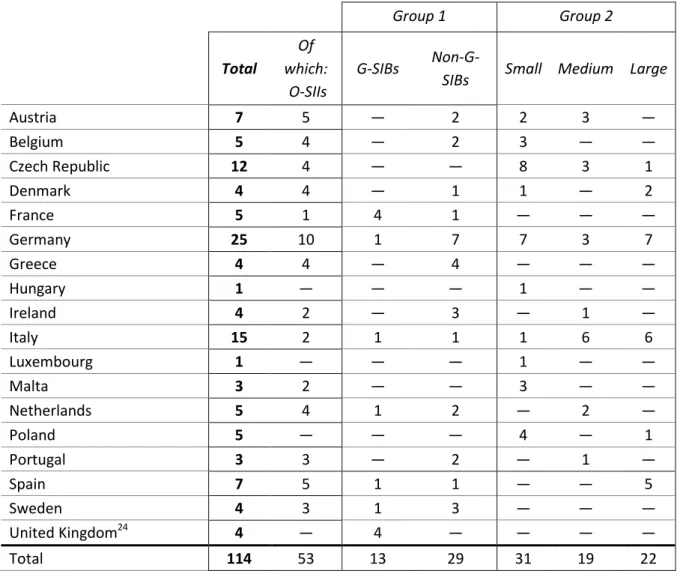
Table 2 presents the sample composition in more detail.
22
Directive 2013/36/EU on access to the activity of credit institutions and the prudential supervision of credit institutions and investment firms.
23
19 Table 2: Number of banks, differentiated by size, systemic importance and international activity, across Member States Group 1 Group 2 Total Of which: O-SIIs G-SIBs
Non-G-SIBs Small Medium Large
Austria 7 5 — 2 2 3 — Belgium 5 4 — 2 3 — — Czech Republic 12 4 — — 8 3 1 Denmark 4 4 — 1 1 — 2 France 5 1 4 1 — — — Germany 25 10 1 7 7 3 7 Greece 4 4 — 4 — — — Hungary 1 — — — 1 — — Ireland 4 2 — 3 — 1 — Italy 15 2 1 1 1 6 6 Luxembourg 1 — — — 1 — — Malta 3 2 — — 3 — — Netherlands 5 4 1 2 — 2 — Poland 5 — — — 4 — 1 Portugal 3 3 — 2 — 1 — Spain 7 5 1 1 — — 5 Sweden 4 3 1 3 — — — United Kingdom24 4 — 4 — — — — Total 114 53 13 29 31 19 22
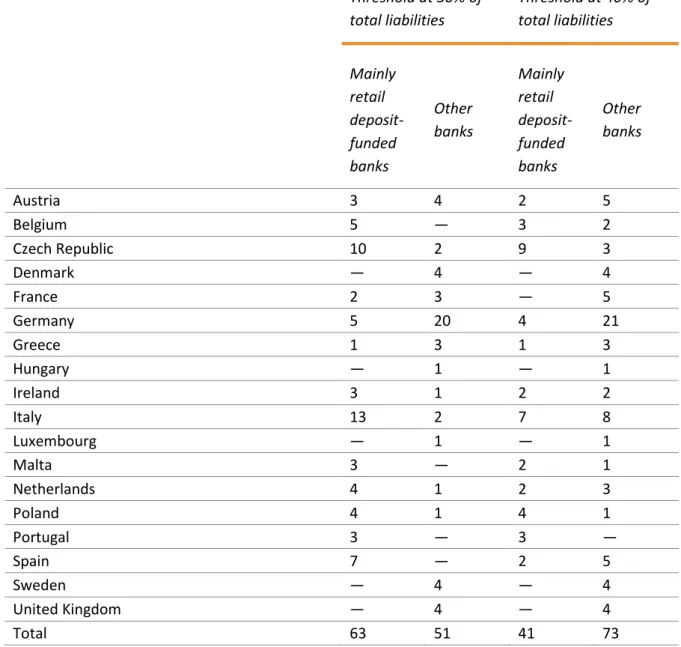
A wide range of bank business models are present across the Member States. The qualitative survey of resolution authorities referred to above indicated that the setting of MREL for typically small and medium-sized institutions which are predominantly deposit-funded may require particular attention. Given that there is no specific definition of retail-funded banks, two alternative thresholds (30% and 40% of retail deposits to total liabilities and own funds) are used as a proxy for a deposit-funded bank. Table 3 presents the composition of the sample in terms of deposit-funded banks depending on the threshold adopted. The sample includes 41 banks with 40% or higher share of deposits in their liability structure (and 63 banks if using the 30% threshold).
24
20 Table 3: Number of mainly retail deposit-funded banks and other banks for two alternative thresholds of 30% and 40% in retail deposits relative to total liabilities and own funds
Threshold at 30% of total liabilities Threshold at 40% of total liabilities Mainly retail deposit-funded banks Other banks Mainly retail deposit-funded banks Other banks Austria 3 4 2 5 Belgium 5 — 3 2 Czech Republic 10 2 9 3 Denmark — 4 — 4 France 2 3 — 5 Germany 5 20 4 21 Greece 1 3 1 3 Hungary — 1 — 1 Ireland 3 1 2 2 Italy 13 2 7 8 Luxembourg — 1 — 1 Malta 3 — 2 1 Netherlands 4 1 2 3 Poland 4 1 4 1 Portugal 3 — 3 — Spain 7 — 2 5 Sweden — 4 — 4 United Kingdom — 4 — 4 Total 63 51 41 73
Source: EBA QIS data (June 2015).
3.2
Data limitations and caveats
Resolution authorities have not yet finalised their MREL policies. As a result, assumptions had to be made on MREL calibration scenarios, i.e. what level of loss-absorbing and recapitalisation amounts would be determined by authorities, as well as the scope of MREL-eligible instruments. A limited number of policy options have been considered. Any additional restrictions to the eligibility of MREL instruments (e.g. TLAC/MREL cross-holding deductions) would increase MREL financing needs.
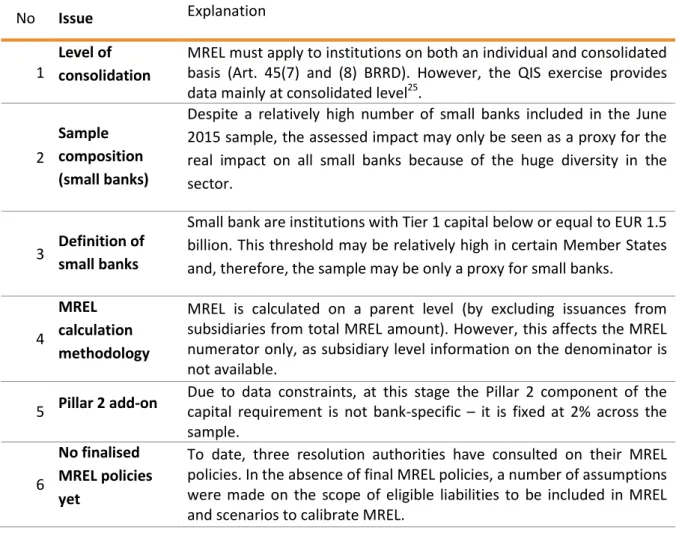
The data limitations and caveats in Table 4 should be taken into account when interpreting the results of the MREL impact assessment.
21 Table 4: Data limitations and caveats
No Issue Explanation
1
Level of consolidation
MREL must apply to institutions on both an individual and consolidated basis (Art. 45(7) and (8) BRRD). However, the QIS exercise provides data mainly at consolidated level25.
2
Sample composition (small banks)
Despite a relatively high number of small banks included in the June 2015 sample, the assessed impact may only be seen as a proxy for the real impact on all small banks because of the huge diversity in the sector.
3 Definition of
small banks
Small bank are institutions with Tier 1 capital below or equal to EUR 1.5 billion. This threshold may be relatively high in certain Member States and, therefore, the sample may be only a proxy for small banks.
4
MREL calculation methodology
MREL is calculated on a parent level (by excluding issuances from subsidiaries from total MREL amount). However, this affects the MREL numerator only, as subsidiary level information on the denominator is not available.
5 Pillar 2 add-on
Due to data constraints, at this stage the Pillar 2 component of the capital requirement is not bank-specific – it is fixed at 2% across the sample.
6
No finalised MREL policies yet
To date, three resolution authorities have consulted on their MREL policies. In the absence of final MREL policies, a number of assumptions were made on the scope of eligible liabilities to be included in MREL and scenarios to calibrate MREL.
3.3
Options on the scope of MREL-eligible instruments and
scenarios for calibration
The quantitative findings in this report rely on a number of options for the scope of eligibility of MREL instruments and scenarios regarding the calibration level of the requirement.
1)
Scenarios regarding the calibration of MREL
It is not yet possible to determine with certainty the size of institutions’ needs both to refinance existing debt in MREL-eligible (or TLAC-eligible) instruments and to issue new MREL-eligible liabilities. This will depend on resolution authorities’ MREL implementation policies and bank-specific MREL decisions which have not yet been taken. In this context, at this stage we have considered three scenarios for the calibration of MREL, based on the possibilities for MREL calibration under the BRRD and RTS on MREL as well as the indicative statements of intentions communicated by a few resolution authorities. Nonetheless, the actual MREL set by resolution authorities will be different from the assumptions made and the results should be read against this background.
25
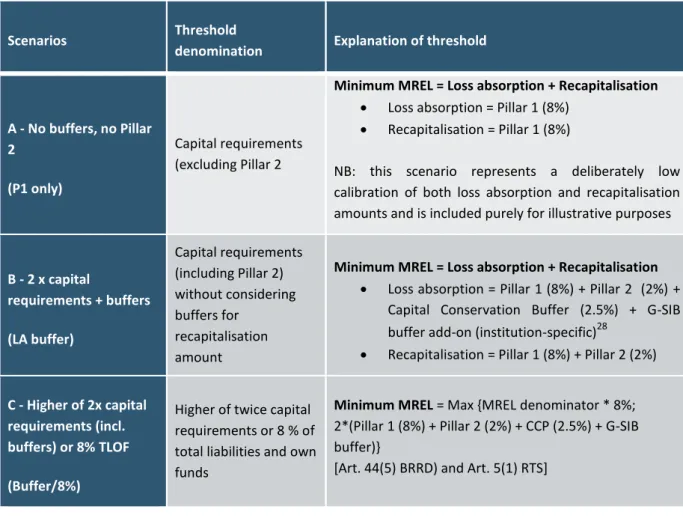
22 Three MREL calibration scenarios were considered:
The first scenario (‘No buffers, no Pillar 2’) assumes that resolution authorities do not include any Pillar 2 requirement for banks and exclude capital conservation buffer from the recapitalisation amount. This scenario is not assumed to be a likely outcome.
The second scenario (‘Twice capital requirements + Buffers’) includes a Pillar 226 component when determining both loss absorption and recapitalisation amounts and adds a capital conservation and G-SIB buffer27 to the loss absorption amount.
The third scenario (‘Higher of twice capital requirements (incl. buffers) or 8% of total liabilities and own funds’) assumes that, when calculating the recapitalisation amount the resolution authority includes all buffers and also assesses, for all banks, the potential impact of the requirement for 8% of an institution’s equity and liabilities to be bailed-in before access to resolution financing arrangements is available. As a result this is the most conservative and demanding scenario and it is also not assumed to be a likely outcome for all banks in the sample.
26
At this stage a homogeneous 2% Pillar 2 requirement has been assumed.
27
23 Figure 1 describes the three possible scenarios for MREL calibration (from least to most demanding). Please note that no resolution authority has finalised its MREL policies to date; therefore a reference to actual MREL implementation at national level cannot be made at this stage.
Figure 1: Assumptions regarding the calibration of MREL
Scenarios Threshold
denomination Explanation of threshold
A - No buffers, no Pillar 2
(P1 only)
Capital requirements (excluding Pillar 2
Minimum MREL = Loss absorption + Recapitalisation Loss absorption = Pillar 1 (8%)
Recapitalisation = Pillar 1 (8%)
NB: this scenario represents a deliberately low calibration of both loss absorption and recapitalisation amounts and is included purely for illustrative purposes
B - 2 x capital requirements + buffers (LA buffer) Capital requirements (including Pillar 2) without considering buffers for recapitalisation amount
Minimum MREL = Loss absorption + Recapitalisation Loss absorption = Pillar 1 (8%) + Pillar 2 (2%) +
Capital Conservation Buffer (2.5%) + G-SIB buffer add-on (institution-specific)28
Recapitalisation = Pillar 1 (8%) + Pillar 2 (2%)
C - Higher of 2x capital requirements (incl. buffers) or 8% TLOF (Buffer/8%)
Higher of twice capital requirements or 8 % of total liabilities and own funds
Minimum MREL = Max {MREL denominator * 8%;
2*(Pillar 1 (8%) + Pillar 2 (2%) + CCP (2.5%) + G-SIB buffer)}
[Art. 44(5) BRRD) and Art. 5(1) RTS]
It is important to note that from the data available, Pillar 2 decisions are not known with certainty for all the institutions. In addition, not all the jurisdictions within the sample have defined the specific countercyclical and systemic risk buffers. As a result a fixed Pillar 2 add-on of 2% is used across the sample and the combined buffer requirement includes only capital conservation buffers (2.5%) and specific G-SIB buffers where relevant.
It should also be noted that for the purpose of the analysis, unless stated otherwise, a static balance sheet approach is considered – i.e. it is assumed that the entity after resolution would have the same size and risks as prior to the resolution taking place.
Additional alternative recapitalisation scenario for ‘smaller’ banks
Depending on the preferred resolution strategy, for some banks, the required MREL recapitalisation amount may be lower. For example, if the resolvability assessment process concludes that it is both feasible and credible to liquidate a bank, the recapitalisation amount
28
24 should be zero. For other banks where resolution authorities assess that liquidation is not credible and feasible because of critical functions they perform, and where a resolution plan considers some assets and liabilities being transferred, a recapitalisation amount will be required, but at a lower level than a full balance sheet recapitalisation.
To demonstrate the impact of such potentially lower MREL recapitalisation requirements, an additional alternative scenario has been applied as a variant to scenario B (LA buffers). Indeed, for the 72 Group 2 banks a more detailed analysis regarding the determination of the recapitalisation amount has been conducted assuming 50% recapitalisation amounts instead of the full recapitalisation provided for under scenario B. The assumptions underpinning this alternative scenario are summarised in Figure 2. Note that this is an additional scenario, i.e. Group 2 banks remain included in the other three scenarios, even though, as shown below, their impact on aggregate needs is low.
Figure 2: Assumption regarding the calibration of MREL for Group 2 banks according to Twice capital requirements + Buffers scenario, but with lower recapitalisation amount (50% instead of 100%)
Partial recapitalisation scenario Capital requirements (including Pillar 2) without considering buffers for recapitalisation amount with reduced recapitalisation amount
Minimum MREL = Loss absorption + Recapitalisation x 50%
Loss absorption = Pillar 1 (8%) + Pillar 2 (2%) + Capital Conservation Buffer (2.5%)
25
2)
Scope of MREL-eligible instruments
Two different options have been considered in terms of the scope of instruments eligible for MREL:
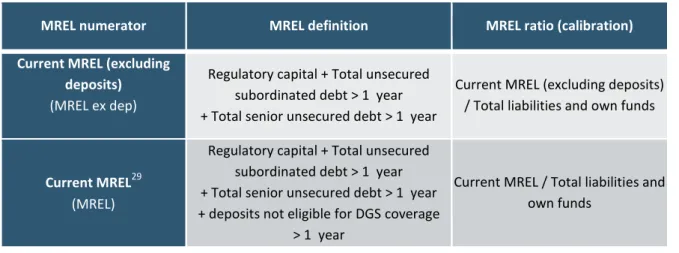
Current MREL (MREL) – all MREL-eligible instruments, including eligible deposits not covered by Deposit Guarantee Schemes (DGS) (i.e. large corporate deposits with a residual maturity of more than 1 year). These deposits might possibly be excluded from MREL if resolution authorities consider this necessary to maintain the critical functions of the resolved institutions or to avoid contagion;
Current MREL (excluding deposits) (MREL ex dep) – excludes all deposits.
Note that the implications of a generalised subordination requirement imposed on all banks are assessed in the subordination section.
Figure 3 summarises the assumptions relating to the options above. Figure 3: Assumptions regarding the scope of eligible liabilities and the MREL ratio
3.4
Key findings on MREL of banks operating in the EU
The objective of this section is to illustrate the key findings from the data analysis on the level, composition and distribution of MREL of EU banks.
1)
Level of MREL capacity
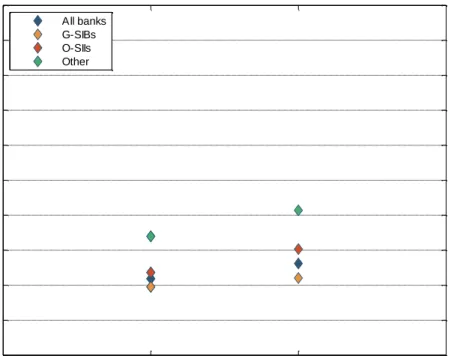
Figure 4 and Figure 5 show average MREL ratios as a percentage of total liabilities and own funds (TLOF), and as a percentage of RWAs.
Based on the current minimum MREL eligibility criteria the current average MREL ratio is 13% of TLOF or 34% of RWAs. MREL ratios tend to be slightly lower than average for G-SIBs, slightly higher for O-SIIs and significantly higher for the other (non-systemic) banks in our sample.
Excluding MREL-eligible deposits (large corporate deposits with residual maturity >1 year), the average MREL ratio falls by around 2 percentage points (as a share of TLOF).
29
Resolution authorities may ask for additional requirements.
MREL numerator MREL definition MREL ratio (calibration)
Current MREL (excluding deposits)
(MREL ex dep)
Regulatory capital + Total unsecured subordinated debt > 1 year + Total senior unsecured debt > 1 year
Current MREL (excluding deposits) / Total liabilities and own funds
Current MREL29
(MREL)
Regulatory capital + Total unsecured subordinated debt > 1 year + Total senior unsecured debt > 1 year + deposits not eligible for DGS coverage
> 1 year
Current MREL / Total liabilities and own funds
26 Figure 4: Average MREL ratio (% of total liabilities and own funds)
Source: EBA QIS data (June 2015). Cf. definitions of options in section 3.3.
Figure 5: Average MREL ratio (% of RWA)
Source: EBA QIS data (June 2015). Cf. definitions of options in section 3.3.
MREL ex dep MREL
0 5 10 15 20 25 30 35 40 45 50 A v e ra g e MR E L R a ti o ( % o f to ta l lia b ili ti e s a n d o w n f u n d s ) All banks G-SIBs O-SIIs Other
MREL ex dep MREL
0 5 10 15 20 25 30 35 40 45 50 A v e ra g e MR E L R a ti o ( % o f R W A ) All banks G-SIBs O-SIIs Other
27
2)
Composition of MREL
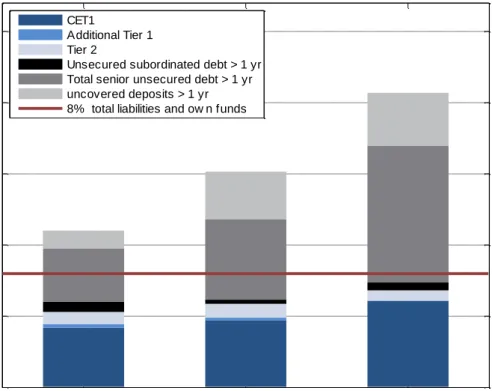
Figure 6 analyses the composition of MREL in terms of type instruments assuming the current definition of the scope of MREL. This composition varies significantly between G-SIBs, O-SIIs, and other banks (Figure 7). For G-SIBs, on average, unsecured debt and uncovered term deposits form a smaller proportion of their balance than for O-SIIs and, especially, other banks. This may in part be because G-SIB balance sheets are likely to include significant derivative portfolios.
Figure 6: Composition of MREL by banks’ systemic importance (% of own funds and total liabilities)
Source: EBA QIS data (June 2015). Cf. definitions of options in section 3.3.
3)
Financing needs
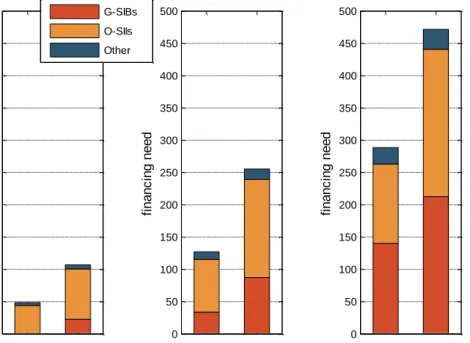
As noted above, it is not yet possible to determine with certainty the size of institutions’ needs both to refinance existing debt in MREL-eligible (or TLAC-eligible) instruments and to issue new MREL-eligible liabilities. This will depend on bank-specific MREL decisions (including resolution strategies) which have not yet been taken. We have consequently estimated banks’ MREL-related financing needs under the illustrative scenarios discussed above (Figure 7).
Based on the current minimum MREL eligibility requirements, and a calibration including capital buffers in only the loss absorption amount (‘LA buffer’ in Figure 7), the financing need of the sample banks is approximately EUR 130 billion. More than half of this is accounted for by O-SIIs,
G-SIBs O-SIIs Other
0% 5% 10% 15% 20% 25% MR E L R a ti o [ % ] CET1 Additional Tier 1 Tier 2
Unsecured subordinated debt > 1 yr Total senior unsecured debt > 1 yr uncovered deposits > 1 yr 8% total liabilities and ow n f unds
28 and more than 90% by G-SIBs and O-SIIs together. Financing needs would increase to approximately EUR 260 billion if term corporate deposits were excluded from MREL.
Applying a higher calibration including buffers in both the recapitalisation and loss absorption amounts and in addition requiring banks to have at least 8% of TLOF in MREL would increase financing needs to approximately EUR 290 billion under the current minimum MREL eligibility requirement, or EUR 470 billion if term corporate deposits were excluded.
Figure 7: Financing needs under scenarios P1 only, LA buffer and Buffer/8% (from left to right) (in EUR billion)
Source: EBA QIS data (June 2015). Cf. definitions of options in section 3.3.
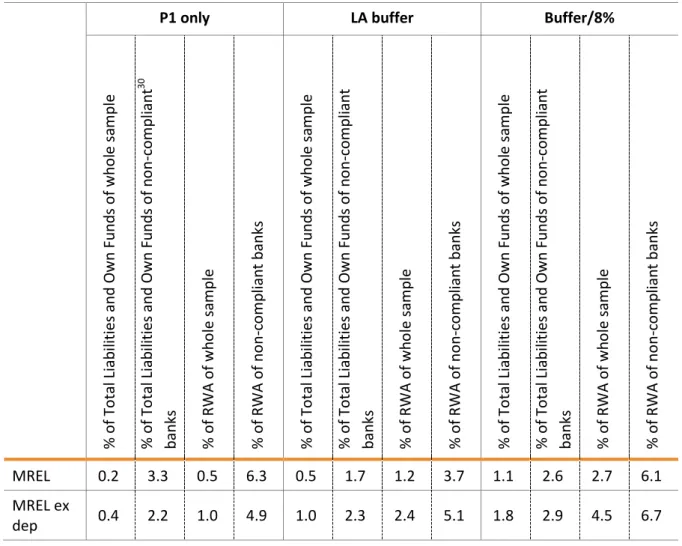
Table 5 shows these financing needs as a percentage of total liabilities and own funds and of risk-weighted assets. 0 50 100 150 200 250 300 350 400 450 500 fi n a n c in g n e e d MR EL MR EL ex d ep 0 50 100 150 200 250 300 350 400 450 500 fi n a n c in g n e e d MR EL MR EL ex d ep 0 50 100 150 200 250 300 350 400 450 500 fi n a n c in g n e e d MR EL MR EL ex d ep G-SIBs O-SIIs Other
29 Table 5: Financing need (% of total liabilities and own funds and of % RWA)
P1 only LA buffer Buffer/8%
% o f To tal Liab ilities and O wn Fu n d s o f who le sa m p le % o f To tal Liab ilities and O wn Fu n d s o f n o n -co m p lian t 30 b an ks % o f RWA o f w h o le sa m p le % o f RWA o f n o n -c o m p lian t b an ks % o f To tal Liab ilities and O wn Fu n d s o f who le sa m p le % o f To tal Liab ilities and O wn Fu n d s o f n o n -co m p lian t b an ks % o f RWA o f w h o le sa m p le % o f RWA o f no n -c o m p lian t b an ks % o f To tal Liab ilities and O wn Fu n d s o f who le sa m p le % o f To tal Liab ilities and O wn Fu n d s o f n o n -co m p lian t b an ks % o f RWA o f w h o le sa m p le % o f RWA o f no n -c o m p lian t b an ks MREL 0.2 3.3 0.5 6.3 0.5 1.7 1.2 3.7 1.1 2.6 2.7 6.1 MREL ex dep 0.4 2.2 1.0 4.9 1.0 2.3 2.4 5.1 1.8 2.9 4.5 6.7
Source: EBA QIS data (June 2015). Cf. definitions of options in section 3.3.
These scenarios are likely to be too conservative for some banks, in particular smaller banks for which full recapitalisation is unlikely to be required in resolution. For this reason a specific assessment of financing need for smaller banks under the additional alternative scenario is included at the end of this section.
MREL ratios and funding needs for ‘smaller’ banks under the alternative recapitalisation scenario
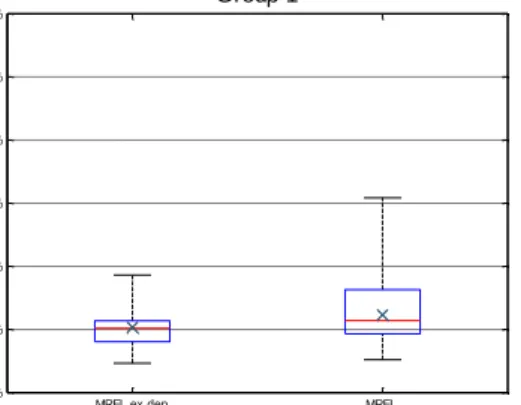
Average MREL ratios for Group 2 banks are higher than for the overall sample, at respectively 17.9% of TLOF under the current MREL scope of eligibility and 14.5% if excluding deposits. However, as shown in Figure 8, for these smaller banks there is also a greater dispersion of MREL ratios. As a result, if MREL for smaller banks were calibrated in the same way as for G-SIBs and O-SIIs, a number of them would face significant MREL shortfalls.
30
Throughout this document, ‘compliance’ or ‘non-compliance’ is understood within the strict context of the option and scenarios envisaged.
30 Figure 8: MREL ratio as a % of TLOF31
Source: EBA QIS data (June 2015). Cf. definitions of options in section 3.3.
However, this is unlikely to be an appropriate calibration of MREL for smaller institutions. As explained above, scenarios assuming full recapitalisation in resolution are likely to be ill-suited for the smaller banks in the sample. For that reason, the EBA has estimated the impact of applying to Group 2 banks32 a variant of the LA buffer scenario assuming a partial recapitalisation amount of 50% rather than 100%.
Table 6: Financing need (in EUR billion and as % of total liabilities and own funds) and number of non-compliant banks for Group 2 banks under the LA buffer scenario with 50% recapitalisation only
MREL ex dep Current MREL
Number of banks Gross financing need (absolute amount in EUR billion) Gross financing need (% of TLOF) Number of non-compliant banks Gross financing need (absolute amount in EUR billion) Gross financing need (% of TLOF) Number of non-compliant banks All 72 43.3 1.2 33 16.1 0.4 22 Large 22 35.3 1.4 8 11.8 0.5 5 Medium 19 5.6 0.7 8 2.8 0.3 4 Small 31 2.4 0.7 17 1.6 0.5 13
Source: EBA QIS data (June 2015). Cf. definitions of options in section 3.3.
Under this scenario, smaller banks would have a financing need of EUR 16 billion using the current scope of MREL, and EUR 43 billion if excluding deposits. This compares with EUR 47 billion and EUR 90 billion respectively in the full recapitalisation scenario. Table 6 further breaks down these impacts among large, medium-sized, and small members of Group 233. As shown in Table 6, under
31
Box plot shows the distribution of MREL ratio across the sample. 50% of banks in the sample have MREL ratios inside the box. 95% and 5% percentiles are shown as the whiskers at the top and the bottom of the plots. The red line indicates the median, and the ‘x’ the weighted average.
32
See table 2 and accompanying text for explanation of Group 2 membership criteria.
33
Note that even the large members of Group 2 are considerably smaller than G-SIBs.
MREL ex dep MREL
0% 10% 20% 30% 40% 50% 60% MR E L ( % T o ta l L ia b ili ti e s ) Group 1
MREL ex dep MREL
0% 10% 20% 30% 40% 50% 60% MR E L ( % T o ta l L ia b ili ti e s ) Group 2
31 this more realistic calibration, the MREL financing requirements for Group 2 banks are similar as a percentage of total liabilities and own funds to the needs of the whole sample shown in Table 5.
Figure 9: Financing needs (in EUR billion) for Group 2 banks under two different variants of the LA buffer scenario: with 100% and 50% recapitalisation
Source: EBA QIS data (June 2015). Cf. definitions of options in section 3.3.
Current MREL MREL ex dep
0 10 20 30 40 50 60 70 80 90 100 F in a n c in g n e e d s ( B ill io n E U R ) 47 90 16 43 100% recapitalisation 50% recapitalisation
32
4.
Options for the reference base
(denominator) of MREL
Article 45(19)(i) of the BRRD requires the EBA to examine ’whether it is appropriate to base the requirement on total liabilities and own funds and in particular whether it is more appropriate to use the institution’s risk-weighted assets as a denominator for the requirement‘.
This section aims assess how well the current reference base serves the purpose of the minimum requirement and identifies a number of limitations affecting its use. It further examines whether risk-weighted assets, complemented by a leverage ratio exposure, could be a more appropriate reference base. Finally it identifies a number of provisions within the BRRD and other regulations which are connected with this reference base and could be impacted by a change.
4.1
Current reference base: total liabilities and own funds
The current reference base presents some limitations with regard to achieving the goals of MREL and offering a legally certain backdrop for the requirements.
4.1.1
Achieving the goals of MREL
MREL is meant as a mechanism to prevent bail-in avoidance by banks34, to ensure that an institution can be resolved, and to ensure that losses can be absorbed and, in the proportion required to achieve the resolution strategy, capital can be restored35. These principles are reflected in the methodology set out by the RTS on MREL, and in particular the criteria for determining the amounts necessary to absorb losses and recapitalise an institution following resolution. On the one hand the regulatory framework36 and SREP37 embody a judgment about the amount of capital necessary to absorb losses. On the other, following resolution the resolved firm will need to fulfil the conditions for authorisation by the relevant competent authority to continue any activities as a credit institution, and so will need to meet capital requirements. As a result, resolution authorities who are setting MREL for individual banks need to take into account these judgments. Supervisory capital ratios are therefore expected to be a major determinant of MREL levels both for the loss absorption and recapitalisation amount.
In contrast, setting an MREL requirement based on an assessment of loss absorption and recapitalisation needs as a percentage of TLOF makes it insensitive to changes in risk in the period
34
Recital 79 of the BRRD ‘To avoid institutions structuring their liabilities in a manner that impedes the effectiveness of the bail-in tool it is appropriate to establish that the institutions meet at all times a minimum requirement’.
35
Article 45(6)(a) and (b) of the BRRD.
36
Regulation (EU) No 575/2013 of the European Parliament and of the Council of 26 June 2013 on prudential
requirements for credit institutions and investment firms and amending previous Regulation and Directive 2013/36/EU of the European Parliament and of the Council of 26 June 2016 on access to the activity of credit institutions and the prudential supervision of credit institutions and investment firms, amending and repealing previous Directives.
37
In accordance with EBA Guidelines on common procedures and methodologies for the supervisory review and evaluation process (SREP), available under https://www.eba.europa.eu/documents/10180/935249/EBA-GL-2014-13+%28Guidelines+on+SREP+methodologies+and+processes%29.pdf/
33 between MREL decisions. The level of eligible liabilities needed to absorb losses and recapitalise will depend not only on the volume of a balance sheet, but also on the average risk-weight of the bank’s assets, which may be affected by changing risk appetite, by balance sheet volatility, or by changes in economic conditions in between two annual MREL decisions. An increase in average risk-weights without a corresponding change in the MREL requirement may therefore leave institutions with inadequate loss absorption and recapitalisation capacity.
4.1.2
Defining total liabilities and own funds
The BRRD defines own funds by reference to the capital framework of the CRD and CRR. It does not, however, provide a clear definition of the total liabilities component. As a result, resolution authorities have to define and measure this component. Differing national approaches to this could stand in the way of a harmonised application of the requirement.
Accounting rules provide a relatively unambiguous framework when defining total liabilities, but also raise several practical challenges which mean this approach is not likely to result in a fully consistent implementation.
First, absent a uniform EU accounting framework for all the institutions subject to MREL, some institutions apply national GAAP rather than IFRS. Although the additional guidance of the legislation on netting of derivative liabilities, discussed below, tries to overcome the difference that is probably most significant, it cannot be excluded that differing accounting treatments might significantly impact the amount of the denominator. This contrasts with the prudential treatment of derivative netting which is harmonised.
Second, there may also be a need to further clarify how accounting liabilities interact with prudential own funds. While accounting identifies subordinated debt as liabilities, some subordinated debt is also included (wholly or in part) in the Tier 2 own funds of an institution. The MREL calculation needs to avoid double-counting the subordinated liabilities or part thereof in the denominator.
The interaction of fair value accounting for liabilities and adjustments to own funds might also give rise to ambiguity. Fair valuation of liabilities may result in decreases in the accounting value of a liability which are not associated with a reduction in the rights of a counterparty in insolvency. This fair value adjustment increases the calculated value of accounting equity, meaning that total balance sheet size is unchanged. However, as prudential own funds are corrected, in particular through the deduction of the own credit risk component and through prudent value adjustments, the value of total liabilities and own funds at the point of resolution might be underestimated.
The supervisory reporting framework (FINREP) is currently not a required reporting format for non-IFRS entities. Competent supervisory authorities may optionally extend FINREP to entities establishing their accounts under national GAAP. However, this would only provide a solution for the lack of uniform accounting basis by requiring these entities to additionally report IFRS concepts through FINREP, which would impose a significant additional reporting burden.