Trust-Oriented Service Provider Selection in
Complex Online Social Networks
Guanfeng Liu and Yan Wang
AbstractIn recent years, Online Social Networks (OSNs) with numerous partici-pants have been used as the means for rich activities. For example, employers could use OSNs to investigate potential employees, and participants could use OSNs to look for movie recommendations. In these activities, trust is one of the most impor-tant indication of participants decision making, greatly demanding the evaluation of the trustworthiness of a service provider along certain social trust paths from a service consumer. In this chapter, we first analyze the characteristics of the current generation of functional websites and the current generation of online social net-works based on their functionality and sociality, and present the properties of the new generation of social network based web applications. Then we present a new selection model considering bothadjacent andend-to-endconstraints, based on a novel concept Quality of Trust and a novel complex social network structure. More-over, in order to select the optimal one from massive social trust paths yielding the most trustworthy trust evaluation result, this chapter presents an effective and ef-ficient heuristic algorithm for optimal social trust path selection with constraints, which is actually an NP-Complete problem. Experimental results illustrate that the proposed method outperforms existing models in both efficiency and the quality of delivered solutions. This work provides key techniques to potentially lots of service-oriented applications with social networks as the backbone.
Guanfeng Liu
Department of Computing, Macquarie University, Sydney, NSW 2109, Australia, e-mail: [email protected]
Yan Wang
Department of Computing, Macquarie University, Sydney, NSW 2109, Australia, e-mail: [email protected]
1.1 Introduction
Online Social Networks (OSNs) (e.g. Facebook1and MySpace2) have become
in-creasingly popular recently and are being used as the means for a variety of rich activities. In service-oriented environment, OSNs can provide the infrastructure for the recommendation of service providers or services. According to a survey on 2600 hiring managers (i.e., service consumers) in 2008 by Career Builder3(a popular job hunting website), 22% of them used social networking sites to investigate potential employees (i.e., service providers). The ratio increased to 45% in June 2009, and 72% in January 2010. In addition, participants (i.e., service consumers) could look for the service of movie recommendation at FilmTrust4, a movie recommendation OSN. In recent years, the new generation of social network based web application systems has drawn the attention from both academia and industry. The study in [20] has pointed out that it is a trend to build up social network based web applications (e.g., e-commerce or online recruitment systems). In Oct. 2011, eBay5announced their strategic plan to deepen the relationship with Facebook1 for creating a new crop of e-commerce applications with social networking features, integrating both their e-commerce platform and social networking platform seamlessly6. In such a
situation, trust is one of the most important indications for service consumers de-cision making, greatly demanding approaches and mechanisms for evaluating the trustworthiness between a service consumer and a service provider who don’t konw each other.
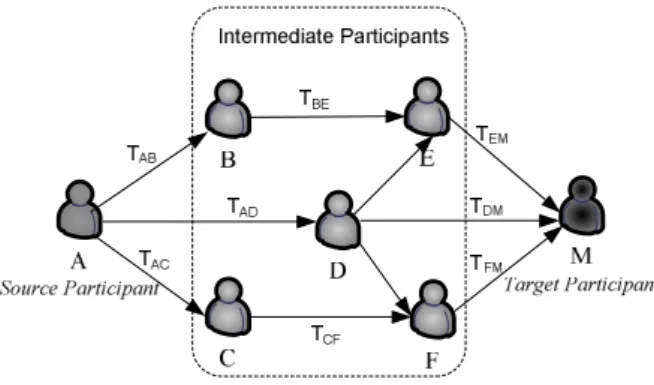
Fig. 1.1 social network structure
1http://www.facebook.com/ 2http://www.myspace.com/ 3http://www.careerbuilder.com/ 4http://trust.mindswap.org/FilmTrust/ 5http://www.ebay.com/
6 refer to the Reuters news “eBay and Facebook unveil e-commerce partnership” at
In OSNs, one participant can give a trust value to another based on their past interactions (e.g.,TABin Fig. 1.1)). If there exist a trust path (e.g,A→B→E→Min Fig. 1.1) linking two nonadjacent participants (there is no direct link between them), the source participant (i.e., the service consumer) can evaluate the trustworthiness of the target participant (i.e., the service provider) based on the trust information between the intermediate participants along the path. The path with trust information linking the source participant and the target participant is called asocial trust path
[14, 16].
In the literature, several methods have been proposed for trust evaluation in OSNs [14, 16, 19, 35]. But these models have three main drawbacks: (1) As illustrated in social psychology [1, 31], thesocial relationshipsbetween participants (e.g., the one between an employer and an employee) and therecommendation rolesof par-ticipants (e.g., a supervisor as a referee in his postgraduate’s job application) have significant influence on trust and thus should be considered in the trust evaluation of participants. However, they are not considered by existing methods. (2) As there are usually many social trust paths between participants, existing methods evaluate the trustworthiness of a participant based on all social paths incurring huge computa-tion time [14, 16]. Although a few methods [19, 35] have been proposed to address the path selection problem, they yet neglect the influence of social information on path selection. (3) In OSNs, a source participant may have different purposes in evaluating the trustworthiness of a target participant, such ashiring employeesor
introducing products. Therefore, a source participant should be able to set certain
constraints on thetrust,social relationshipandrecommendation rolein trust path selection. However, existing methods do not support these selection criteria.
1.2 Related Work
The studies of social network properties can be traced back to 1960’s when the small-world characteristic in social networks was validated by Milgram [30] (i.e., the average path length between two Americans was found to be about 6.6 hops). In recent years, sociologists and computer scientists investigated the characteris-tics of popular online social networks (OSNs) [32] (e.g., Facebook1, MySpace2and
Flickr7), and validated the small-world and power-law characteristics (i.e., the
prob-ability that a node has a degreekis proportional tok−r,r>1).
In the literature, the issue of trust becomes increasingly important in social net-works. we review the existing approaches for evaluating the trustworthiness of par-ticipants in OSNs.
Trust Network Discovery.As indicated in the disciplines of Social Psychology [9, 28] and Computer Science [14, 21], a trust network from a source to a target can provide the basis for evaluating the trustworthiness of the target as it contains some important intermediate participants, the trust relations between them and the social
context under which their interactions happened, all of which have an important influence on trust relationships and trust evaluation. Extracting such a contextual trust network is an essential step before performing any trust evaluation between two participants in social networks. In addition, the results of trust network discov-ery can affect the trustworthiness of the trust evaluation [14, 23, 24]. To address the NP-Complete trust network discovery problem [4]. In our previous work [25, 26], we have proposed a new social context-aware trust network discovery model which considers the influence of social context in trust network discovery. In addition, we have proposed two efficient and effective algorithms, i.e., an approximation algo-rithm, called SCAN, and a heuristic algoalgo-rithm, called H-SCAN, to discover trust networks.
Trust Evaluation based on Ratings Only.In this type of trust evaluation mod-els, only ratings given to a target participant are considered. For example, at eBay5, after each transaction, a buyer can give feedback with a rating of “positive”, “neu-tral” or “negative” to the seller according to the seller’s service quality. The overall positive feedback rate of the seller is calculated to reveal his/her trustworthiness, which is valuable to buyer. However, this type of trust evaluation model neglects the implicit social relationships between buyers and sellers that actually have significant influence on trust evaluation.
Trust Evaluation based on All Social Trust Paths.In some other trust eval-uation models, the trustworthiness of a target participant is evaluated based on all social trust paths between a source participant and the target participant. For ex-ample, in [14], the trust value of a target participant is computed by averaging all trust values along all social trust paths. In [35], Walteret al.propose a trust-based recommendation system. In their model, all social trust paths between a buyer and a seller selling the products preferred by the buyer are taken into account to evaluate the trustworthiness of the seller.
This type of trust evaluation methods neglects the social information with sig-nificant influence on trust evaluation. In addition, evaluating the trustworthiness of a target participant based on all social trust paths consumes huge computation time and thus they can not be applied in large-scale social networks.
Trust Evaluation based on Selected Social Trust Paths.In the literature, there are only a few works addressing the social path selection problem. InSmallBlue
[19], an online social network constructed for IBM staff, between a source par-ticipant and a target parpar-ticipant, up to 16 social paths with no more than 6 hops are selected and the shortest one is taken as the optimal one that delivers the most trustworthy trust evaluation result. But this method neglectstrust information,
rec-ommendation rolesandsocial relationshipsbetween participants. In [16], the social
trust path with the maximum of propagated trust value is selected as the most trust-worthy one. Their model neglects recommendation roles and social relationships. In addition, none of these models considers different preferences of source partici-pants.
Social Trust Influence on Service Selection.As indicated in social psychol-ogy [6, 12], in the reality of our society, a person prefers the recommendation from his/her trusted friends over those from others. In addition, in the discipline of
com-puter science, based on statistics, Bedi et al., [5] has demonstrated that, given a choice between recommendations from trusted friends and those from recommender systems, trusted friends’ recommendations are more preferred in terms of quality and usefulness. Furthermore, in several recent studies, some researchers [8, 10] have investigated how and to what extent a participant’s service selection behavior (e.g., installing a specific application software) impacts on his/her friends’ decision-making in service selection. These studies have indicated that the recommendations from trusted friends have significant influence on service or target selection, not only in the society in the real world, but also in online social networks.
Although a complete social network based trust-oriented service recommenda-tion system does not yet exists, it has become an important research topic in recent years. Some researchers [15, 27] have proposed several models to provide more accurate recommendations of products and/or services by taking some social con-text information into consideration. In these studies, social trust path selection is a critical problem.
1.3 A New Categorization of Functional Websites and Online
Social Networks
Golbeck et. al [13] propose the criteria of OSNs as follows. 1) OSNs could be accessible over the web with a web browser; 2) Users of OSNs must explicitly state their relationships with other people; 3) The web-based online social network system has explicit built-in support for users to make social connections, and 4) Each relationship is visible and browseable to users. Boyd et. al[7] propose the definition of social networking sites as Web-based services that allow individuals to 1) construct public or semi-public profiles within a bounded system; 2) articulate a list of other users with whom they share connections; and 3) view and traverse their list of connections and those made by others with the system. Obviously, Facebook1 and MySpace2are in accordance with these definitions.
However, many other websites, lik eeBay5, YouTube8, Blogs and online forums, where people can share their experience and carry out business. But relationships between participants on this type of Websites are implicit. Thus, it is still a puzzling problem whether these Websites belong to the scope of OSNs. In the following context, we first analyze the characteristics of these websites based on their func-tionality and sociality and present the properties of the new generation of online social network based web applications [20].
1.3.1 The Current Generation of Functional Websites
The current generation of functional websites are premature with rich functionality but implicit social relations, such as eBay5 which supports e-commerce activities
and the buying-selling relations by default but does not care other social relations among the set of buyers and seller. We summarize the characteristics of the current generation of functional websites as below.
1. They have weak sociality where the relationships between participants are im-plicit; and participants do not keep their friendship lists and thus they can not make new friends with friends of friends.
2. Then have rich functionality, such as email, Blogs, e-commerce, and video and photo sharing etc.
1.3.2 The Current Generation of OSNs
As the sociality of the above websites is too weak for people to make rich social interactions, the current generation of OSNs, such as MySpace2 and Facebook1
emerged in 2003 and 2005 respectively. They can explicitly express simple social relations, but the functionality is limited to a very small scope, like information shar-ing. We summarize the characteristics of the current generation of OSNs as below.
1. They have medium sociality where the social relationships between participants are explicit and binary (friendship or non-friendship) which can be specified by participants; and participants can make new friends with a friend’s friends, which is stronger than that of the current generation of functional websites.
2. They provide a platform where participants can make new friends and conduct some simple activities (e.g., sharing photos and videos) which are not as rich as those in the current generation of functional websites.
1.3.3 The New Generation of Online Social Network based Web
Applications
Technically, we can envisage that in the near future social networks can become the backbone to extend a number of traditional systems. For example, the traditional e-commerce system can have a social network of its buyers, and the friends’ friends of buyers. Likewise, the traditional CRM (Customer Relation Management) systems can be extended to be supported by a social network of customers and other people with social relations to these customers. Thus, the new generation of social network systems can be expected to support both rich social relations and rich functionality. In these systems, it would be easier to introduce products (e.g., from a retailer) or
good sellers (e.g., from a buyer) to buyers, and the friends or the friends’ friends of buyers. We summarize the characteristics of the new generation of online social network based web applications as below.
1. They have strong sociality where the social relationships are explicit and complex rather than the binary (friendship or non-friendship) in the current generation of OSNs.
2. They provide a platform where participants can conduct rich activities, such as, e-commerce, CRM system, recommendation systems.
1.4 Complex Social Networks
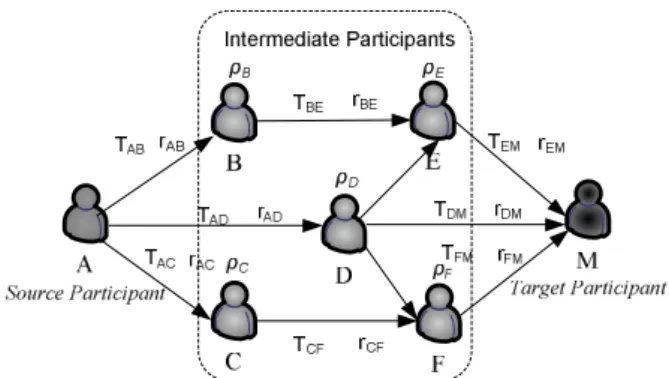
As the current functional website and OSNs can hardly illustrate real-world complex social information of social networks in real world scenarios [22], we present a complex social network structure, as depicted in Fig. 1.2, modeling well the social networks in real life. It contains the attributes of three impact factors, i.e.,trust,
social intimacy degreeandrole impact factor, which influence trust evaluation and
hence the decision making of participants.
1.4.1 A Complex Social Network Structure
1.4.2 Trust
In human societies, trust is a complex topic subject to a lot of factors, such as previ-ous experience, and other people’s recommendations [14]. Many different trust def-initions have been proposed addressing different aspects. Alunkalet al. [2] define that “trust is the value attributed to a specific entity, including an agent, a service, or a person, based on the behaviors exhibited by the entity in the past”. Golbecket al. [14] define that “trust in a person is a commitment to an action based on a belief that the future action of that person will lead to a good outcome”.
In the context of this chapter, trust between participants in social networks can be defined as follows.
Definition 1.Trustis the belief of one participant in another, based on their interac-tions, in the extent to which the future action to be performed by the latter will lead to an expected outcome.
Let TAB∈[0,1]denote the trust value that participant Aassigns to participant
B. IfTAB=0, it indicates that Acompletely distrustsBwhile TAB=1 indicatesA completely believesB’s future action can lead to the expected outcome.
1.4.3 Social Intimacy Degree
As illustrated in social psychology [3], a participant can trust the participants with whom he/she has more intimate social relationships more than those with whom he/she has less intimate social relationships. Therefore, we introduce the social inti-macy degree between participants into complex social networks structure, and give its definition as follows.
Definition 2.rAB∈[0,1]is theSocial Intimacy Degreebetween any given partici-pantsAandBin online social networks.rAB=0 indicates thatAandBhave no social relationship whilerAB=1 indicates they have the most intimate social relationship.
1.4.4 Role Impact Factor
Rich activities of participants in social networks can be categorized into different domains (e.g., hiring employees or product sale) based on their characteristics [36]. As illustrated in social psychology [1], in a certain domain of interest, recommenda-tions from a domain expert are more credible than that from a beginner. Therefore, we introduce the role impact factor of a participant into the complex social network structure, and give its definition as follows.
Definition 3.ρA∈[0,1]is the value of theRole Impact Factor, illustrating the impact of participantA’s recommendation role on trust propagation.ρA=1 indicates thatA is a domain expert whileρA=0 indicates thatAhas no knowledge in the domain.
Though it is difficult to construct social relationships and comprehensive role hierarchies in all domains for the whole society, and obtain their global values, it is feasible to build them up in a specific social community.
For example, in the work by Mccallumet al. [29], through mining the subjects and contents of emails inEnronCorporation9, the social relationship between each email sender and receiver can be discovered and their roles can be known. Then the corresponding social intimacy degree and role impact factor values can be estimated based on probabilistic models. In addition, in academic social networks formed by large databases of Computer Science literature (e.g, DBLP10 or ACM Digital
Li-brary11), the social relationships between two scholars (e.g., co-authors, a supervisor and his/her students) and the role of scholars (e.g., a professor in the field of data mining) can be mined from publications or their homepages. The social intimacy degree and role impact factor values can be calculated as an example by applying the PageRank model [34]. Furthermore, in addition to mine these values, the social position of a participant can be specified directly [37]. If the participant becomes a recommender, this social position information could illustrate his/her role impact factor in the recommendation of a specific domain.
Based on the above discussion, in addition to participants and the links between them, we propose a new structure for complex social networks that models trust, social intimacy degree and role impact factors, as depicted in Fig. 1.2.
1.5 Multiple QoT Constrained Social Trust Path Selection
To satisfy the different preferences of a source participant in social trust path se-lection, in this section, we introduce a novel concept Quality of Trust (QoT) and present a multiple QoT constrained social trust path selection model.
1.5.1 Quality of Trust (QoT)
Similar to the Quality of Service (QoS) in service-oriented computing, we present a new concept,Quality of Trustin social trust path selection.
Quality of Trust(QoT) is the ability to guarantee a certain level of trustworthiness
in trust evaluation along a social trust path, taking trust (T), social intimacy degree (r), and role impact factor (ρ), as attributes.
9http://www.cs.cmu.edu/ enron/
10http://www.informatik.uni-trier.de/ ley/db/ 11http://portal.acm.org/
1.5.2 QoT Constraint
To be adaptive to the rich activities in OSNs, a source participant should be able to set certain constraints of QoT attributes in selecting the optimal social trust path. They include two types:Adjacent QoT Constraint (AQC)andEnd-to-End QoT
Con-straint (EEQC).
1.5.2.1 Adjacent QoT Constraint (AQC)
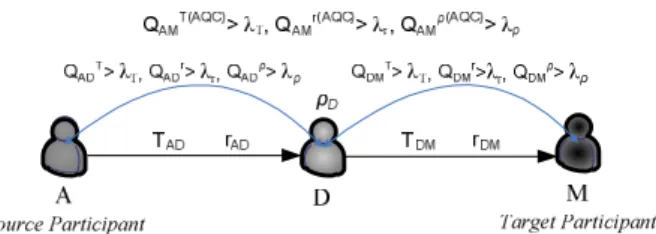
Fig. 1.3 Adjacent QoT constraints
An Adjacent QoT Constraint (AQC) is the constraint of a QoT attribute (i.e.,T,
rorρ) between any two adjacent participants in a social trust path. In the complex social network depicted in Fig. 1.2, letQµAM(AQC) (µ∈ {T, r, ρ}) denote the AQC for the path between source participantAand target participantM.QAMµ(AQC)>λµ
(0<λµ <1) means that the value of QoT attribute µ between any two adjacent participants in a selected social trust path should be larger thanλµ. For example, if the AQCs specified by A can be satisfied at A→D, and D→M, then social trust pathA→D→M satisfies the AQCs. In our model, a source participant can specify different AQCs. E.g., in hiring employees,A, a retailer manager specifies AQCs asQTAM(AQC)>0.3,QAMr(AQC)>0.3 andQρAM(AQC)>0.8. But when looking for new customers forselling products,Acan specifyQrAM(AQC)>0.8, if he/she believes the social relationships between participants are more important.
1.5.2.2 End-to-End QoT Constraint (EEQC)
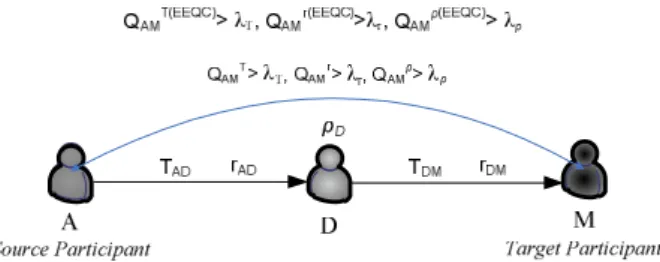
In our model, a source participant can set multiple End-to-End QoT Constraints (EEQCs) for QoT attributes (i.e.,T randρ) as the requirements of trust evaluation in a social trust path. In Fig. 1.2, letQµAM(EEQC) (µ∈ {T, r, ρ}) denote the EEQC between source participantAand target participantM.QAMµ(EEQC)>λµ (0<λµ <1) means the aggregated value of QoT attributeµin a social trust path betweenAand
Fig. 1.4 End-to-End QoT constraints
different EEQCs. E.g., inhiring employees,Acan set EEQCs asQTAM(EEQC)>0.3,
QrAM(EEQC)>0.3 andQρAM(EEQC)>0.8. But when looking for new customers forselling
products,Acan specifyQrAM(EEQC)>0.8, if he/she believes the social relationships
between participants are more important.
1.5.3 Utility Function
Based on our proposed QoT attribute aggregation method [22], we define the utility (denoted asF) in path p(a1, ...,an)as Eq. (1.1), which is the measurement of the trustworthiness ofp(a1, ...,an)in trust evaluation.
Fp(a1,...,an)=ωT∗Tp(a1,...,an)+ωr∗rp(a1,...,an)+ωρ∗ρp(a1,...,an) (1.1)
whereTp(a
1,...,an),rp(a1,...,an) andρp(a1,...,an) are the aggregated value of trust, social
intimacy degree and role impact factor of pathp(a1, ...,an)respectively,ωT,ωrand ωρ are the weights ofT,randρ respectively; 0<ωT,ωr,ωρ <1 andωT+ωr+ ωρ=1.
1.6 A Heuristic Algorithm for the MQCSTP Selection Problem
In optimal social trust path selection, if we consider trust values only, Dijkstra’s shortest path algorithm [11] works well. However, if multiple AQCs and EEQCs can be specified and should be considered, this problem becomes the classical Multi-Constrained Optimal Path (MCOP) selection problem, which is NP-Complete [17]. Therefore, we propose an effective and efficient heuristic algorithm H MQCSTP. This algorithm first investigates whether there exists apotential solution, which sat-isfies the EEQCs and may or may not satisfy AQCs. If yes, it investigates whether there exists afeasible solution, which is satisfies both AQCs and EEQCs.In order to investigate whether a path is a potential solution, we propose an ob-jective function in Eq. (1.2). From Eq. (1.2), we can see that if and only if each aggregated QoT attribute of a social trust pathpsatisfies the corresponding EEQC,
δ(p)≤1; otherwiseδ(p)>1. δ(p),max{( 1−Tp 1−QTp(EEQC) ),( 1−rp 1−Qrp(EEQC) ),( 1−ρp 1−Qρp(EEQC) )} (1.2) In addition, we adopt Dijkstra’s shortest path algorithm [11] twice in both
back-wardandforwardsearch, together with our proposed novel heuristic search
strate-gies to select the optimal social trust path.
Backward Search:In the backward search, H MQCSTP aims to identify the path ps from the targetvt to the sourcevs with the minimalδ based on Dijkstra’s shortest path algorithm [11]. In this searching process, at each nodevk(vk̸=vt), the path fromvt tovkwith the minimalδ (denoted aspk) is identified. MeanwhileTpk,
rpk andρpkare aggregated and recorded.
TheBackward Searchprocedure can always identify the path with the minimal
δ. Ifδmin>1, it indicates that there is no potential solution in the sub-network. If δmin≤1, it indicates that there exists at least one potential solution and the identified path is a potential one.
Forward Search: If there exists one potential solution in the sub-network, a heuristic forward search is executed fromvs tovt. This process adopts the infor-mation provided by the above Backward Searchto investigate whether there is a feasible solutionpt. In this procedure, H MQCSTP first searches the path with the maximal utility fromvs. Assume nodevm∈ {neighboring nodes o f vs}is selected based on Dijkstra’s shortest path algorithm [17] as the utility of the path fromvsto
vm(denoted as pathp(vsf→) vm)is the maximal. Letp (b)
vm→vt denote the path fromvmtovt
identified in theBackward Searchprocedure. Then aforeseen pathfromvstovtvia
vm(denoted as f pvs→vm→vt =p (f)
vs→vm+p (b)
vm→vt) is identified. According to whether
f pvs→vm→vt is feasible, H MQCSTP adopts the following searching strategies. Situation 1:If f pvs→vm→vt is a feasible solution, then H MQCSTP chooses the
next node fromvmwith the maximal utility following Dijkstra’s shortest path algo-rithm.
Situation 2:If f pvs→vm→vt is not a feasible solution, then H MQCSTP does not
search any path fromvmand linkvs→vmis deleted from the sub-network. Subse-quently, H MQCSTP performs theForward Searchprocedure to search other path fromvsin the sub-network.
Since H MQCSTP adopts twice Dijkstra’s shortest path algorithm, they have the same time complexity ofO(N2)when implementing the priority queue with a disordered array, which can be optimized toO(NlogN+E)by adopting a Fibonacci heap to store the priority queue [11] (Nis the number of nodes andEis the number of links in the sub-network). H MCOP [17] which is the most promising algorithm for the NP-Complete MCOP selection problem, has the same time complexity as H MQCSTP. But our proposed heuristic algorithm adopts a better objective function and better searching strategies and thus can significantly outperform H MCOP in both efficiency and the quality of selected social trust paths
0 5 10 15 20 25 0 0.1 0.2 0.3 0.4 0.5 0.6 0.7 0.8
ID of sub−network with 4 hops
Utility H_MQCSTP H_MCOP S1: Same S2: Better S3: Feasible 0 5 10 15 20 25 0 0.1 0.2 0.3 0.4 0.5 0.6 0.7
ID of sub−network with 5 hops
Utility H_MQCSTP H_MCOP S1: Same S2: Better S3: Feasible 0 5 10 15 20 25 0 0.1 0.2 0.3 0.4 0.5 0.6 0.7
ID of sub−network with 6 hops
Utility H_MQCSTP H_MCOP S1: Same S2: Better S3: Feasible 0 5 10 15 20 25 0 0.1 0.2 0.3 0.4 0.5 0.6 0.7 0.8
ID of the sub−network with 7 hops
Utility H_MQCSTP H_MCOP S1: Same S2: Better S3: Feasible
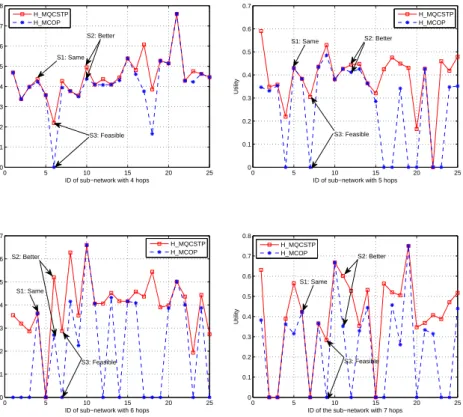
Fig. 1.5 Path utility of sub-networks
1.7 Experiments
1.7.1 Experiment Settings
In order to validate our proposed algorithm, we need a dataset which contains so-cial network structures. TheEnronemail dataset9 has been proved to possess the small-world and power-law characteristics of social networks, it has been widely used in the studies of social networks [21, 23, 24, 29, 33]. Thus, we selectEnron
email dataset9, containing 87,474 nodes (participants) and 30,0511 links (formed by sending and receiving emails) for our experiments. From this dataset, social inti-mate degree and role impact factor can be mined from the subjects and contents of emails [29], fitting our proposed complex social network structure well.
H MCOP is the most promising algorithm for MCOP selection [17]. Based on it, several approximation algorithms [18] [38] have been proposed for quality-driven service selection. But as pointed in [22], they can not be applied in large-scale com-plex social networks. Thus, to study the performance of our proposed heuristic
al-0 5 10 15 20 25 0 10 20 30 40 50 60 70 80 90 100
ID of sub−network with 4 hops
Execution time (sec)
H_MQCSTP H_MCOP 0 5 10 15 20 25 0 50 100 150 200 250 300 350
ID of the sub−network with 5 hops
Execution time (sec)
H_MQCSTP H_MCOP 0 5 10 15 20 25 0 200 400 600 800 1000 1200
ID of sub−network with 6 hops
Execution time (sec)
H_MQCSTP H_MCOP 0 5 10 15 20 25 0 500 1000 1500 2000 2500 ID of sub−network of 7 hops
Execution time (sec)
H_MQCSTP H_MCOP
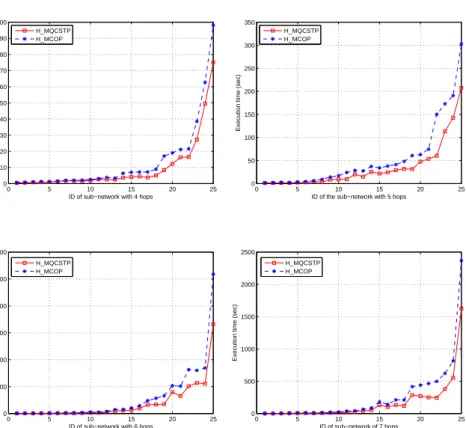
Fig. 1.6 Execution time of sub-networks
gorithm H MQCSTP, we have a comparison with H MCOP [17] in both execution time and the utilities of identified social trust paths. In our experiments, theT,r
andρ values are randomly generated. The EEQCs specified are set asQ(EEQC)=
{QT(EEQC)>0.05,Qr(EEQC)>0.001,Qρ(EEQC)>0.3}and the adjacent QoT con-straints are set asQ(AQC)={QT(AQC)>0.1, Qr(AQC)>0.05, Qρ(AQC)>0.1}. The weights of attributes in the utility function are set as ωt =0.25, ωr =0.25 and ωρ=0.5.
Each of H MQCSTP and H MCOP is implemented using Matlab R2008a run-ning on an Lenovo ThinkPad SL500 laptop with an Intel Core 2 Duo T5870 2.00GHz CPU, 3GB RAM, Windows XP SP3 operating system and MySql 5.1.35 relational database. The results are plotted in Fig.1.5 to Fig. 1.6, where the execu-tion time and the utilities of the extracted trust network for each of the algorithms are averaged based on 5 independent runs.
Table 1.1 The comparison in utility and execution time
Algorithm Sum of utility Sum of execution time (sec) 4 hops 5 hops 6 hops 7 hops 4 hops 5 hops 6 hops 7 hops H MQCSTP 11.2014 9.7113 9.9469 10.1747 245.8564 871.8128 1.9528e+003 4.3005e+003
H MCOP 10.3047 6.5274 6.6006 6.1979 340.4162 1.3571e+003 3.0024e+003 6.6996e+003 difference 10.87% more 14.88% more 18.87% more 16.42% more 27.78% less 35.76% less 34.96% less 35.81% less
1.7.2 Performance in Social Trust Path Selection
In this experiment, we first randomly select 100 pairs of source and target par-ticipants from theEnronemail dataset9. We then extract 100 corresponding sub-networks between them by using the exhaustive searching method, among which the maximal length of a social trust path varies from 4 to 7 hops following the
small-worldcharacteristic (i.e., the average path length between two nodes is about
6 hops in a social network [38]). The smallest case sub-network has 33 nodes and 56 links (4 hops), while the most complex sub-network has 1695 nodes and 11175 links (7 hops).
Fig. 2 plots the utilities of the social trust paths identified by H MQCSTP and H MCOP respectively, ordered by the number of hops. From Fig. 2, we can ob-serve that in any case, our H MQCSTP does not yield any utility worse than that of H MCOP (see caseS1 in Fig. 2) while in most networks (61% of all sub-networks), the utilities of social trust paths identified by H MQCSTP are better than those of H MCOP (see caseS2 in Fig. 2). In addition, H MCOP sometimes returns an infeasible solution even when a feasible solution exists. In contrast, H MQCSTP can identify a feasible solution if it exists, (see case S3 in Fig. 2). As illustrated in Table 1.1, the utility summarization of all social trust paths identified by our H MQCSTP algorithms is greater than that of H MCOP in all 4 groups. This is be-cause when a social trust path with the maximal utility is a feasible solution in a sub-network, both H MCOP and H MQCSTP can identify it as the optimal solu-tion; however, when the social trust path with the maximal utility is not a feasible solution, since the objective function is not well defined, H MCOP can hardly find a solution that is as good as that from H MQCSTP and may even return an infeasible one even when a feasible solution exists.
Fig. 3 plots the execution time of both H MQCSTP and H MCOP, each of which is average of 5 independent executions. From Table 1.1, we can see that our pro-posed heuristic algorithm is much faster than H MCOP in all 4 groups. This is be-cause that in the searching process of H MQCSTP, the node leading to an infeasible solution is not regarded as a candidate to be selected for the next searching step, which can reduce much search space and thus significantly save execution time.
Through the above experiments, we can see that H MQCSTP is much superior to H MCOP in both efficiency and the quality of delivered solutions
1.8 Application Scenarios
Our proposed model and algorithm can provide key techniques to lots of potential applications with social networks as the backbone. Some examples are listed below.
1. A New Generation CRM System. Our proposed method can be applied into a new generation CRM (Customer Relation Management) system, which maintains a complex social network containing the social relationship between customers, and the recommendation roles of these customers. With this information, the new CRM system can help a retailer identify new trustworthy customers and introduce products to them, which can bring enormous commercial opportunities to retailers.
2. A New Generation Employment System. Our methods can also be applied in a new generation employment system which maintains a complex social network containing employees, their recommendation roles (e.g., a professor in computer science), and the social relationship between them (e.g., the relationship between a supervisor and his/her student). In such an application our methods can help a hiring manager evaluate the trustworthiness of all potential employees and find trustworthy persons to be employed, which in turn can bring great benefits for the employment of companies.
3. A New Generation Recommendation System. Our proposed method can be used in a new generation recommendation system, which maintains a social network of buyers, sellers and the complex social information, including social relation-ships and recommendation roles. In this system, our proposed method can be applied to help a buyer identify the most trustworthy seller from all those sellers selling the product preferred by the buyer.
1.9 Conclusions
In this chapter, we have analyzed the characteristics of the current generation of functional websites and the current generation of OSNs, and presented the prop-erties of the new generation of online social network based web applications. Our proposed new complex social network takestrust,social relationshipsand
recom-mendation roles into account, and can reflect the real-world situations better. In
addition, our proposed heuristic algorithm H MQCSTP can solve the optimal so-cial trust path selection problem with multiple both adjacent and end-to-end QoT constraints. The results of experiments conducted on a real dataset of social net-works demonstrate that H MQCSTP significantly outperforms existing methods in both efficiency and the quality of delivered solutions. The proposed model and al-gorithm can provide key techniques to the new generation of social network based web applications.
References
1. P. S. Adler. Market, hierarchy, and trust: The knowledge economy and the future of capitalism.
Organization Science, 12(12):215–234, 2001.
2. B. Alunkal, I. Valjkovic, and G. Laszewski. Reputation-based grid resource selection. In
Proceedings of the Workshop on Adaptive Grid Middleware, USA, September 2003. 3. R. Ashri, S. Ramchurn, J. Sabater, M. Luck, and N. Jennings. Trust evaluation through
rela-tionship analysis. InAAMAS, pages 1005–1011, 2005.
4. S. Baase and A. Gelder.Computer Algorithms Introduction to Design and Analysis. Addision Wesley, 2000.
5. P. Bedi, H. Kaur, and S. Marwaha. Trust based recommender system for semantic web. In
IJCAI, pages 2677–2682, 2007.
6. E. Berscheid and H. T. Reis. Attraction and close relationships, volume 2 ofThe Handbook of Social Psychology. Oxford University Press, 4th edition, 1998.
7. D. Boyd and N. Ellison. Social network sites: Definition, history and scholarship.Journal of Computer-Mediated Communication, 13:1, 2007.
8. Y. Cho, G. Steeg, and A. Galstyan. Co-evolution of selection and influence in social networks. InAAAI, pages 779–784, 2011.
9. B. Christianson and W. S. Harbison. Why isn’t trust transitivie? InInternational Workshop on Security Protocols, pages 171–176, 1996.
10. P. Cui and F. Wang. Item-level social influence prediction with probabilistic hybrid factor matrix factorization. InAAAI, pages 331–336, 2011.
11. E. Dijkstra. A note on two problems in connexion with graphs. Numerische Mathematik, pages 269–271, 1959.
12. S. Fiske.Social Beings: Core Motives in Social Psychology. John Wiley and Sons, 2009. 13. J. Golbeck. The dynamics of web-based social networks: Membership, relationships, and
change.First Monday, 12:11, 2007.
14. J. Golbeck and J. Hendler. Inferring trust relationships in web-based social networks. ACM Transactions on Internet Technology, 6(4):497–529, 2006.
15. S. Guo, M. Wang, and J. Leskovec. The role of social networks in online shopping information passing, price of trust, and consumer choice. InEC’11, pages 130–137, 2011.
16. C. Hang, Y. Wang, and M. Singh. Operators for propagating trust and their evaluation in social networks. InAAMAS’09, pages 1025–1032, 2009.
17. T. Korkmaz and M. Krunz. Multi-constrained optimal path selection. InINFOCOM’01, pages 834–843.
18. L. Li, Y. Wang, and E. Lim. Trust-oriented composite services selection and discovery. In
ICSOC’09, pages 50–67, 2009.
19. C. Lin, N. Cao, S. Liu, S. Papadimitriou, J. Sun, and X. Yan. Smallblue: Social network analysis for expertise search and collective intelligence. InICDE’09, pages 1483–1486, 2009. 20. G. Liu, Y. Wang, and L. Li. Trust management in three generations of web-based social networks. InSymposia and Workshops on Ubiquitous, Autonomic and Trusted Computing, pages 446–451, 2009.
21. G. Liu, Y. Wang, M. Orgun, and E.-P. Lim. A heuristic algorithm for trust-oriented service provider selection in complex social networks. InSCC, pages 130–137, 2010.
22. G. Liu, Y. Wang, and M. A. Orgun. Optimal social trust path selection in complex social networks. InAAAI’10, pages 1397–1398, 2010.
23. G. Liu, Y. Wang, and M. A. Orgun. Finding k optimal social trust paths for the selection of trustworthy service providers in complex social networks. InICWS’11, pages 41–48, 2011. 24. G. Liu, Y. Wang, and M. A. Orgun. Trust transitivity in complex social networks. InAAAI’11,
pages 1222–1229, 2011.
25. G. Liu, Y. Wang, and M. A. Orgun. Social context-aware trust network discovery in complex contextual social networks. InAAAI, 2012.
26. G. Liu, Y. Wang, M. A. Orgun, and H. Liu. Discovering trust networks for the selection of trustworthy service providers in complex contextual social networks. InICWS, 2012.
27. H. Ma, T. Zhou, M. Lyu, and I. King. Improving recommender systems by incorporating social contextual informaiton.ACM Transactions on Information Systems, 29(2), 2011. 28. R. Mansell and B. Collins.Trust and crime in information societies. Edward Elgar Publishing,
2005.
29. A. Mccallum, X. Wang, and A. Corrada-Emmanuel. Topic and role discovery in social net-works with experiments on Enron and academic email. Journal of Artificial Intelligence Re-search, 30(1):249–272, 2007.
30. S. Milgram. The small world problem.Psychology Today, 2(60), 1967.
31. R. Miller, D. Perlman, and S. Brehm. Intimate Relationships. McGraw-Hill College, 4th edition, 2007.
32. A. Mislove, M. Marcon, K. Gummadi, P. Druschel, and B. Bhattacharjee. Measurement and analysis of online social networks. InACM IMC’07, pages 29–42, 2007.
33. F. L. S. Yoo, Y. Yang and I. Moon. Mining social networks for personalized email prioritiza-tion. InKDD’09, pages 967–976, 2009.
34. J. Tang, J. Zhang, L. Yan, J. Li, L. Zhang, and Z. Su. Arnetminer: Extraction and mining of academic social networks. InKDD’08, pages 990–998, 2008.
35. F. Walter, S. Battiston, and F. Schweitzer. A model of a trust-based recommendation system on a social network.AAMAS Journal, 16(1):57–74, February 2008.
36. Y. Wang and V. Varadharajan. Role-based recommendation and trust evaluation. InIEEE EEE’07, pages 278–295, 2007.
37. S. Yang, J. Zhang, and I. Chen. Web 2.0 services for identifying communities of practice. In
SCC’07, pages 130–137.
38. T. Yu, Y. Zhang, and K. Lin. Efficient algorithms for web services selection with end-to-end qos constraints.ACM Transactions on the Web, 1(1), 2007.