American students have numerous oppor-tunities to learn and practice presentation skills in both high school and college. In contrast, public speaking has played a minor role in Japanese education. However, the Ministry of Education is calling for renewed emphasis on oral skills, and this has prompted Japanese educators to reconsider their position.
Public speaking is one of the most feared context-based apprehensions in Japan (Pribyl, Keaten, Sakamoto, & Koshikawa, 1998) when measured by the Personal Report of Communication Apprehension (PRCA-24;
McCroskey, 1978). Nishida (1988) noted that Japanese females report higher levels of anxiety in the public speaking context, a result replicated by Pribyl et al. (1998). Research data do not, however, reveal a clear pattern of gender difference in levels of communication apprehension (CA) among Americans (Leary & Kowalski, 1995).
There are three major methods of reducing public speaking anxiety: conditioned anxiety-reduction interventions (i.e., systematic de-sensitization); negative thought interventions (i.e., rational emotive therapy, cognitive
1Requests for reprints should be addressed to: Masahiro Sakamoto, Department of Foreign Languages, Hokuriku University, 1-1, Taiyogaoka, Kanazawa, Ishikawa 920-1180, Japan.
2A part of the experiment described in this paper was presented at the 61st Annual Convention of the Japanese Psychological Association.
3Now with Gallup Organization, Tokyo, Japan.
© 2001 Japanese Psychological Association. Published by Blackwell Publishers Ltd, 108 Cowley Road,
The effectiveness of a skills-based program
in reducing public speaking anxiety
1,2CHARLES B. PRIBYL3
Department of Foreign Languages, Hokuriku University, Taiyogaoka, Kanazawa 920-1180, Japan
JAMES KEATEN
Department of Speech Communication, University of Northern Colorado, Greeley, Colorado, USA
MASAHIRO SAKAMOTO
Department of Foreign Languages, Hokuriku University, Taiyogaoka, Kanazawa 920-1180, Japan
Abstract:Research was conducted to test the effectiveness of a skills-based program as a method for reducing anxiety during public speaking. Twenty-five Japanese college sophomores were exposed to a systematic approach for developing a presentation that was theoretically linked to mechanisms to reduce communication apprehension (CA). Students gave four presentations that were graded by both teacher and peer evaluation. Results indicated that the experimental group reported a significantly greater drop in public speaking anxiety than did a control group of 86 students.
Key words:public speaking anxiety, skills training, English ability, gender differences, cross-cultural research.
restructuring, and visualization); and skills training (i.e., skills training and rhetori-therapy). For a review of CA, see Sakamoto, Pribyl, and Keaten (1998), and for an overview of behavioral treatment programs, see Keaten, Sakamoto, and Pribyl (1999).
Evidence suggests that a combination of the three intervention methods (cognitive modification, systematic desensitization, and skills training) is more effective in alleviating public speaking anxiety than any single method (Allen, Hunter, & Donohue, 1989). However, Friedrich, Goss, Cunconan, and Lane (1997) note that systematic desensitization works best when the nature of the problem is situation specific (e.g., public speaking as opposed to a more generalized dysfunction) and when the problem does not reflect a major skills deficit (p. 316). There are also reports of skills training programs having measurable success (see Allen et al., 1989). As noted earlier, presentation skills classes in English are not commonplace in Japan. Aida (1994) notes that people tend to experience anxiety when expressing them-selves in a foreign language in which they do not have full competence (p. 157). McCroskey, Fayer, and Richmond (1985) found a negative correlation between English ability and CA among Puerto Rican students, bolstering the supposition that competence in a foreign language is a correlate of anxiety.
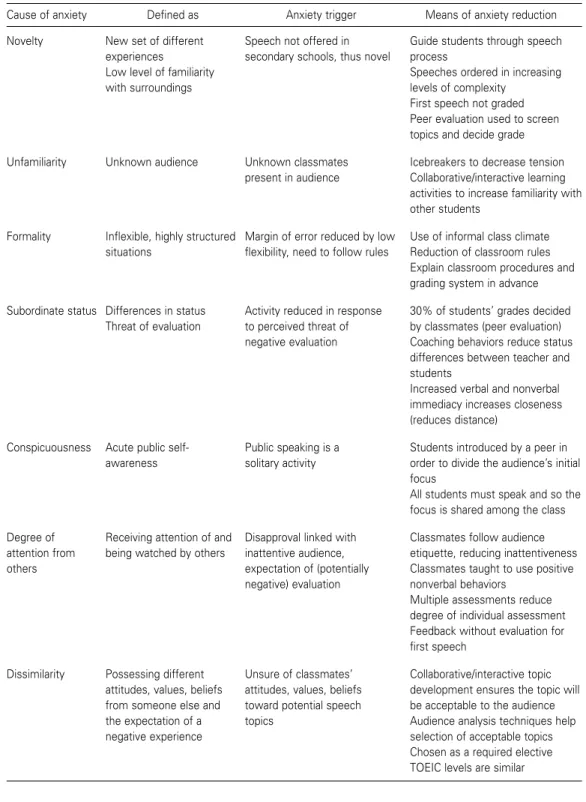
As seen in Table 1, Buss (1980) developed a taxonomy of perceived situational causes of anxiety, which were further developed into seven measurable components: novelty, un-familiarity, formality, subordinate status, con-spicuousness, degree of attention from others, and dissimilarity. Buss based his framework largely on empirical evidence in studies of social evaluation anxiety (Buss, 1986, pp. 39–40), while Beatty offered evidence supporting the validity and reliability of instruments derived from the seven components (Beatty, 1988; Beatty, Balfantz, & Kuwabara, 1989; Beatty & Friedland, 1990).
In sum, public speaking anxiety may stem from numerous sources, such as public speaking skills, fluency in a foreign language, emotional predispositions toward public
speaking, and characteristics of the public speaking situation itself. Based upon a review of the literature, the following hypotheses and research questions were advanced.
HQ1: Japanese students will report higher levels of anxiety before skills training than do American students.
HQ2: A skills-based public speaking class will reduce reported levels of public speaking anxiety among Japanese students.
RQ1: How does gender affect reported levels of public speaking anxiety?
RQ2: How does English ability affect reported levels of public speaking anxiety?
Method
Instrument
The Personal Report of Public Speaking Anxiety (PRPSA; McCroskey, 1970) was chosen for this study. It consists of 34 questions measuring feelings associated with giving a presentation and has been reported to be unidimensional. Richmond and McCroskey (1998) reported that normalized PRPSA scores fall into five categories (numbers in parentheses are percentages of a normalized population fitting each category): scores of 34–84 indicate low anxiety (5%); 85–92 moderately low anxiety (5%); 93–110 moderate anxiety (20%); 111–119 moderately high anxiety (30%); and 120–170 high anxiety (40%). Mean scores on the PRPSA have rarely been reported, as the instrument was designed and used primarily for identifying highly anxious students. “Highly anxious” is defined operationally as someone with a PRPSA score equal to or greater than 120. The questionnaire is scored by first summing the 22 positive items, then summing the scores of the reversed items, and finally subtracting the total from 132. Scores range from 34 to 170, with a higher score repre-senting more public speaking anxiety. Translation procedures for the PRPSA were carried out with the goal of obtaining equivalency (Newmark, 1988), using the same
Table 1. Cause of anxiety, anxiety trigger, and presumed means of reduction (Beatty, 1988; Buss, 1980) Cause of anxiety Defined as Anxiety trigger Means of anxiety reduction Novelty New set of different Speech not offered in Guide students through speech
experiences secondary schools, thus novel process
Low level of familiarity Speeches ordered in increasing
with surroundings levels of complexity
First speech not graded Peer evaluation used to screen topics and decide grade Unfamiliarity Unknown audience Unknown classmates Icebreakers to decrease tension
present in audience Collaborative/interactive learning activities to increase familiarity with other students
Formality Inflexible, highly structured Margin of error reduced by low Use of informal class climate situations flexibility, need to follow rules Reduction of classroom rules
Explain classroom procedures and grading system in advance Subordinate status Differences in status Activity reduced in response 30% of students’ grades decided
Threat of evaluation to perceived threat of by classmates (peer evaluation) negative evaluation Coaching behaviors reduce status
differences between teacher and students
Increased verbal and nonverbal immediacy increases closeness (reduces distance)
Conspicuousness Acute public self- Public speaking is a Students introduced by a peer in awareness solitary activity order to divide the audience’s initial
focus
All students must speak and so the focus is shared among the class Degree of Receiving attention of and Disapproval linked with Classmates follow audience attention from being watched by others inattentive audience, etiquette, reducing inattentiveness others expectation of (potentially Classmates taught to use positive
negative) evaluation nonverbal behaviors Multiple assessments reduce degree of individual assessment Feedback without evaluation for first speech
Dissimilarity Possessing different Unsure of classmates’ Collaborative/interactive topic attitudes, values, beliefs attitudes, values, beliefs development ensures the topic will from someone else and toward potential speech be acceptable to the audience the expectation of a topics Audience analysis techniques help negative experience selection of acceptable topics
Chosen as a required elective TOEIC levels are similar
back-translation methods employed by Keaten, Kelly, and Pribyl (1997).4
Participants
Participants were sophomore English majors at the first author’s university. All students must choose a “seminar” class taught by a foreign instructor. The 25 who chose the first author’s class, presentation skills, served as the experi-mental group. There were 3 men (12%) and 22 women (88%). The remaining 86 sophomores served as control group. There were 24 men (28%) and 62 women (72%). The entire sopho-more class was given the pre-test question-naire, but incomplete post-test data reduced the size of the control group. Because partici-pants were not assigned randomly to treatment groups, and pre-test public speaking anxiety scores were controlled for, the research design is best described as quasi-experimental.
Experimental manipulation
The presentation skills class was designed to introduce students to a systematic process for developing and giving presentations in English (see Appendix). In particular, students were taught, in both one-on-one and seminar formats, how to prepare, practice, deliver, and reflect on a presentation. All presentations were video-taped and students were able to review past performances. The class, in terms of length and scope, was similar to a typical presentation skills class found in the United States. One exception was that the Japanese program was completed over one year (45 hours), but in the United States a typical program lasts one semester (48 hours).
Procedures
All participants were given the pre-test in May, 1996. The post-test was distributed to all participants during the last three weeks of the school year. With participant approval at a debriefing session, scores on the Test of English for International Communication (TOEIC) were utilized to measure English ability.
Results
Pre-test and post-test PRPSA scores were examined for internal consistency by Cronbach’s alpha. The PRPSA showed extremely high levels of internal consistency for both the pre-test (α= .94) and post-test (α= .93). The test-retest correlation of the PRPSA was .71.
To determine pre-test equivalency between the experimental and control groups,5 an
independent samples t-test was run on pre-test mean scores. The two groups were not signifi-cantly different, t(108) = .27, ns. Participants were then divided statistically into three groups based on PRPSA score: low, medium and high. Levels were determined by calculating one standard deviation from the mean (M= 115.01,
SD= 19.41, N= 105). There were no gender differences on the PRPSA pre-test, t(107) = .49,
ns, power = .045.
An analysis of covariance (ANCOVA) was conducted using the treatment condition as the independent variable and post-test PRPSA score as the dependent variable, with pre-test PRPSA and TOEIC scores as covariates. Results indicated a significant effect for treat-ment, F(1, 11) = 7.56, p ,.02, when controlling for pre-test PRPSA scores and TOEIC scores. In addition, the covariate pre-test PRPSA scores were correlated significantly with post-test PRPSA scores (t= 3.267, p,.010, η2= .493),
while the TOEIC score was not correlated significantly with the post-test PRPSA score (t= –0.039, ns, power = .046). The covariance model explained approximately 65% of the variance in the post-test PRPSA scores.
As shown in Table 2, analysis of pre-test and post-test PRPSA scores in the experimental and control groups revealed a significant dif-ference between groups in the mean reduction in anxiety, t = 3.63, p , .010 (one-tailed), 5For the sake of comparison, the non-parametric statistical results (Mann-Whitney U rank test for mean differences, corrected for ties) are as follows (number in parenthesis is the N, while the U indicates the number of times a score in group one is larger than that in group two): differences between pre-test experimental and control PRPSA scores: U (110) = 982, p = .8918; dif-ferences between post-test experimental and control PRPSA scores: U (16) = 10, p = .047
4A copy of the translated questionnaire can be obtained by contacting any of the authors.
η2= .422, R2= .422. Significant gender
differ-ences were observed neither for post-test highly anxious individuals (t= .92, ns, power = .045), nor for the whole sample (t= .86, ns, power = .171).
To compare American and Japanese samples across cultures, z-tests for proportions were calculated, comparing the distribution of PRPSA scores in the current study with normative percentages reported by Richmond and McCroskey (1998): low anxiety (scores 34–84), 4.5% (z = –.22, ns); moderately low anxiety (scores 85–92), 10.0% (z = 2.41, p , .20); moderate anxiety (scores 93–110), 27.3% (z = 1.91, p , .10); moderately high anxiety (scores 111–119), 17.3% (z= –2.91, p= .004); and high anxiety (scores 120–170), 40.9% (z= .19, ns). As can be seen in Figure 1, the
distribution of Japanese and American college students was not significantly different in the low, moderate and high anxiety categories, but more Japanese students were classified in the moderately low anxiety category, and more Americans were classified in the moderately high anxiety category.
Discussion
The purpose of this research was to measure the effectiveness of a skills training program on public speaking anxiety. In brief, students receiving skills training reported a significantly higher drop in public speaking anxiety when compared with members of a control group.
Japanese and American college students have similar distributions of high, medium, and low public speaking anxiety. Japanese college students report more moderately low levels of anxiety, while Americans report more moderately high levels of anxiety. The overall pattern suggests that more students are classified as higher in public speaking anxiety in both countries when using the distributions proposed by Richmond and McCroskey (1998).
Although both Japanese and American col-lege students reported similar levels of public speaking anxiety, the cause of the anxiety may not necessarily be similar. Until the causes of public speaking anxiety are investigated, researchers cannot assume that all treatment strategies used in the United States will be appropriate for Japanese students.
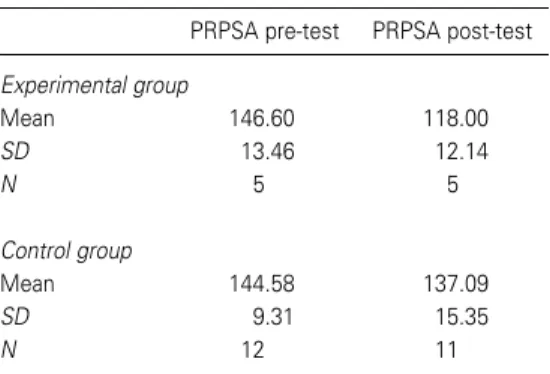
Members of the treatment group were taught presentation skills. The foundational assump-tion of skills training is that students lack adequate skills and are thus anxious (Phillips, 1991). Because none of the students in the experimental group had ever taken a presen-tation skills class, it is possible to assume that they lacked formal public speaking skills. After being exposed to a year-long presentation skills class, students classified as highly anxious reported a reduction of almost 30 points in PRPSA scores (Table 2), in contrast to highly anxious students in a control group, who reported a six-point drop.
Table 2. Mean pre-test and post-test PRPSA scores for highly anxious students
PRPSA pre-test PRPSA post-test Experimental group Mean 146.60 118.00 SD 13.46 12.14 N 5 5 Control group Mean 144.58 137.09 SD 9.31 15.35 N 12 11
Figure 1. Comparison of the percentages of American (norms) and Japanese (this study, pre-test) falling into the PRPSA categories.
Prior research in the United States has shown that various interventions, including skills-based training programs, have been successful in treating public speaking anxiety (Kelly, 1997). Table 1 offers an outline of the factors which Buss (1980) and Beatty (1988) proposed as situational causes of CA, along with the methods used in the presentation skills class. As shown in the Appendix, a line-by-line analysis of the causes (and mechanisms) of situational anxiety and of the features of the skills-based class points toward the possibility that following this curriculum can lead to a reduction in the situational causes of public speaking anxiety. However, we cannot ascertain whether the treatment effect is due to increased skill, reduced situational anxiety, a relaxed classroom atmosphere, or a combination of all three.
To determine whether the reason for the lack of gender differences was due to the question-naire, the six questions which deal with public speaking in the PRCA-24 were extracted from the PRPSA and treated as a separate variable.
Post hoc analysis failed to reveal significant
differences between genders for those six items, which leads us to believe the cause of the discrepancy in gender differences is probably not the questionnaire. Three prior studies (McCroskey, Gudykunst, & Nishida, 1985; Nishida, 1988; Pribyl et al., 1998) suggested gender differences in levels of public speaking anxiety exist among Japanese populations, but this study found no significant gender differences in PRPSA scores. These results are tentative at best, as only three males were in the experimental group.
Finally, evidence collected in this study indicated that public speaking anxiety and English ability are not significantly correlated. In other words, the negative relationship that was theorized to exist between English ability and CA was not supported.
Although skills training appears to be an effective way of reducing self-reported public speaking anxiety, future research needs to assess the causal nature of public speaking anxiety among Japanese college students. Further research is also required to identify the
relative contribution of increased skill, reduced situational anxiety, and relaxed classroom atmosphere to anxiety reduction. Identifying underlying mechanisms of public speaking anxiety will likely increase the effectiveness of the interventions.
Evidence supporting the internal consistency and content validity of the PRPSA among Japanese students was found. What needs to be determined next, in a cross-cultural context, is whether the PRPSA is able to predict behav-ioral manifestations of public speaking anxiety, such as unnatural body language, lack of fluency, and behavioral disruptions.
References
Aida, Y. (1994). Examination of Horwitz, Horwitz, and Cope’s construct of foreign language anxiety: The case of students of Japanese. Modern Language Journal, 78, 155–168.
Allen, M., Hunter, J. E., & Donohue, W. A. (1989). Meta-analysis of self-report data on the effect-iveness of public speaking anxiety treatment techniques. Communication Education, 38, 54–76. Beatty, M. J. (1988). Situational and predispositional correlates of public speaking anxiety. Com-munication Education, 37, 28–39.
Beatty, M. J., & Friedland, M. H. (1990). Public speaking state anxiety as a function of selected situational and predispositional variables.
Communication Education, 39, 142–147. Beatty, M. J., Balfantz, G. L., & Kuwabara, A. Y.
(1989). Trait-like qualities of selected variables assumed to be transient causes of performance state anxiety. Communication Education, 38, 277–289.
Buss, A. H. (1980). Self-consciousness and social anxiety. San Francisco: W. H. Freeman. Buss, A. H. (1986). A theory of shyness. In Shyness:
Perspectives on research and treatment
(pp. 39–46). New York: Plenum Press.
Friedrich, G., Goss, B., Cunconan, T., & Lane, D. (1997). Systematic desensitization. In J. A. Daly, J. C. McCroskey, J. Ayres, T. Hopf, & D. M. Ayers (Eds.), Avoiding communication: Shyness, reticence, and communication apprehension(2nd ed., pp. 305–329). Creskill, NJ: Hampton Press. Keaten, J. A., Kelly, L., & Pribyl, C. B. (1997).
Communication apprehension in Japan: Grade school through secondary school. International Journal of Intercultural Relations, 21, 319–343.
Appendix. Curriculum of the
presentations skills program
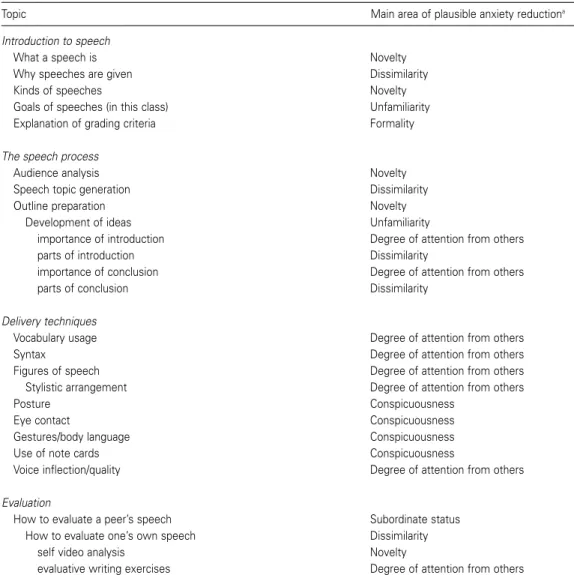
The goal of the program (Table 3) was to give students the necessary background in order for them develop an effective presentation in English, to teach the students the specific techniques needed to give an effective presen-tation, as well as to provide them with a chance to practice the skills learned. The curriculum was designed with the following in mind. First, students enrolling in the presentation skills class had no experience in presentations skills, thus the basics needed to plan and deliver a presentation were outlined. Second, the students were non-native speakers of English, thus the explanations were conducted in depth.
Skills were nested in each other and intro-duced step by step. For example, when visual aids were introduced, students were given a chance to use them in their second presen-tation for a weighted score of only 10% of their grade. During the next presentation, the weighting for the visual aid was increased to 20%, and the weighting was further increased to 30% for the final presentation.
Students were encouraged to look at the process of making a presentation as a circular one. The process does not come to an end when the presentation finishes, but instead moves through to evaluation in the form of peer and teacher feedback. Although the steps are distinct, they are interrelated. Thus the end of one presentation becomes the basis of audience analysis for the next presentation.
Keaten, J. A., Sakamoto, M., & Pribyl, C. B. (1999). A review of selected behavioral treatment programs designed to reduce communication apprehension, inhibition and avoidance (CAIA).
Japanese Journal of Behavior Therapy, 25, 51–66. Kelly, L. (1997). Skills training as a treatment for communication problems. In J. A. Daly, J. C. McCroskey, J. Ayres, T. Hopf & D. M. Ayers (Eds.), Avoiding communication: Shyness, reticence, and communication apprehension (2nd ed., pp. 331–366). Creskill, NJ: Hampton Press. Leary, M. R., & Kowalski, R. M. (1995). Social
anxiety. New York: Guilford Press.
McCroskey, J. C. (1970). Measures of communication-bound anxiety. Speech Monographs, 37, 269–277. McCroskey, J. C. (1978). Validity of the PRCA as
an index of oral communication apprehension.
Communication Monographs, 45, 192–203. McCroskey, J. C., Fayer, J. M., & Richmond, V. P.
(1985). Don’t speak to me in English: Com-munication apprehension in Puerto Rico.
Communication Quarterly, 33, 185–192. McCroskey, J. C., Gudykunst, W. B., & Nishida, T.
(1985). Communication apprehension among Japanese students in native and second language.
Communication Research Reports, 2, 11–15. Newmark, P. (1988). A textbook of translation. New
York: Prentice Hall.
Nishida, T. (1988). Daigakusei no Komyunikeishon tuan. [Communication apprehension among Japanese college students.] Kokusaikenkyu Nihon Daigaku [Nihon University Studies on Inter-national Relations], 8, 171–183. (In Japanese with English abstract.)
Phillips, G. M. (1991). Communication incom-petencies: A theory of training oral performance behavior. Carbondale, IL: Southern Illinois University Press.
Pribyl, C. B., Keaten, J. A., Sakamoto, M., & Koshikawa, F. (1998). Assessing the cross-cultural content validity of the Personal Report of Communication Apprehension scale (PRCA-24). Japanese Psychological Research, 40, 47–53. Richmond, V. P., & McCroskey, J. C. (1998).
Communication: Apprehension, avoidance, and effectiveness (5th ed.). Needham Heights, MA: Allyn & Bacon.
Sakamoto, M., Pribyl, C. B., & Keaten, J. A. (1998). Komyunikeishon Kaihi Kenkye no rekishi to ginjo. [History and current state of communication avoidance research.] Shinrigaku Kenkyu [Japanese Journal of Psychology], 68, 491–507. (In Japanese with English abstract.) (Received Feb. 12, 1999; accepted Sept. 2, 2000)
Table 3. Course topics and areas of anxiety reduction
Topic Main area of plausible anxiety reductiona
Introduction to speech
What a speech is Novelty
Why speeches are given Dissimilarity
Kinds of speeches Novelty
Goals of speeches (in this class) Unfamiliarity Explanation of grading criteria Formality The speech process
Audience analysis Novelty
Speech topic generation Dissimilarity
Outline preparation Novelty
Development of ideas Unfamiliarity
importance of introduction Degree of attention from others
parts of introduction Dissimilarity
importance of conclusion Degree of attention from others
parts of conclusion Dissimilarity
Delivery techniques
Vocabulary usage Degree of attention from others
Syntax Degree of attention from others
Figures of speech Degree of attention from others
Stylistic arrangement Degree of attention from others
Posture Conspicuousness
Eye contact Conspicuousness
Gestures/body language Conspicuousness
Use of note cards Conspicuousness
Voice inflection/quality Degree of attention from others Evaluation
How to evaluate a peer’s speech Subordinate status How to evaluate one’s own speech Dissimilarity
self video analysis Novelty
evaluative writing exercises Degree of attention from others
a Although each topic has multiple anxiety reduction mechanisms, only the main area of anxiety is shown, for the sake of brevity.