Title Page
Defining and Developing the Feedback-Providing and Mentoring Competencies of Clinical Preceptors
by
David Charles Beck, Jr.
Bachelor of Science, Saint Francis University, 2004
Master of Physician Assistant Science, Saint Francis University, 2005
Submitted to the Graduate Faculty of the School of Education in partial fulfillment
of the requirements for the degree of Doctor of Education
University of Pittsburgh 2020
Committee Page
UNIVERSITY OF PITTSBURGH
SCHOOL OF EDUCATION
This dissertation was presented by
David Charles Beck, Jr.
It was defended on June 30, 2020 and approved by
M. Kathleen Kelly, Associate Professor, Department of Physical Therapy Carl Fertman, Associate Professor, Department of Health and Physical Activity
Scott Massey, Associate Professor, Department of Physician Assistant Studies
Dissertation Director: Jill Perry, Associate Professor of Practice, Department of Administrative and Policy Studies
Copyright © by David Charles Beck, Jr. 2020
Title Page
Defining and Developing the
Feedback-Providing and Mentoring Competencies of Clinical Preceptors
David Charles Beck, Jr., EdD University of Pittsburgh, 2020
Physician Assistant (PA) education is based on a model of didactic instruction followed by clinical experiences under the supervision of practicing health care providers, termed “clinical preceptors.” These supervised clinical practice experiences provide real-world opportunities for students to practice the skills of patient care and are a key part of preparing students for their own clinical practice upon graduation. In addition to their supervisory roles, clinical preceptors are charged with the specific tasks of providing feedback and mentoring to students. Review of administrative data at the University of Pittsburgh PA Studies Program revealed suboptimal student evaluation scores regarding the performance of these competencies by their preceptors, and the program did not have mechanisms for selecting clinical preceptors based on their competencies in providing feedback and mentoring or for developing these competencies in current preceptors.
This project followed an improvement science approach, in which online learning modules regarding the competencies of providing feedback and mentoring were developed and presented to 46 current clinical preceptors. Using a pre-post model, knowledge and self-competence regarding these competencies were measured among the total population and by demographics, including age, gender, location, specialty of practice, and profession. The data were analyzed using descriptive and inferential statistics, where possible, and revealed that knowledge and self-competence scores improved overall and in almost every demographic group.
This study provides proof of concept for the use of online learning modules in the professional development of clinical preceptors of the University of Pittsburgh PA Studies Program, specifically in the competencies of providing feedback and mentoring. The findings will be disseminated through a manuscript to be submitted to a professional journal, and will serve as a basis for further efforts to improving the competencies of clinical preceptors at the program, across PA education, and in the education of other health care providers.
Table of Contents
Preface ... xii
1.0 Introduction ... 1
1.1 Problem Area ... 1
1.2 Problem of Practice ... 2
2.0 Review of Supporting Scholarship and Professional Knowledge ... 4
2.1 Introduction ... 4
2.2 Development and Main Models of PA Education ... 5
2.3 Clinical Education of PAs and Other Health Care Professionals ... 7
2.3.1 Clinical Education by Profession ...8
2.3.1.1 Medical Education. ... 8
2.3.1.2 Nursing Education. ... 9
2.3.1.3 PA Education. ... 10
2.4 Supervision as Pedagogy in Health Care Education ... 12
2.4.1 The Mediated Model of Supervisory Learning ...12
2.4.1.1 Role Modeling. ... 13
2.4.1.2 Feedback. ... 14
2.5 Mentoring in Health Care Education ... 17
2.6 Synthesis ... 19
3.0 Methods ... 20
3.1 Inquiry Questions ... 20
3.2.1.1 Competence. ... 23
3.2.1.2 Competence and Continuing Professional Development. ... 23
3.3 Inquiry Methods ... 24
3.4 Inquiry Setting ... 25
3.5 Population ... 26
3.6 Data Collection ... 27
3.7 Data Analysis ... 30
3.8 Institutional Review Board ... 31
4.0 Findings ... 32
4.1 Participants ... 32
4.2 Findings Related to Inquiry Question 1 ... 34
4.3 Findings Related to Inquiry Question 2 ... 38
4.3.1 Feedback Self-Competence ...38
4.3.2 Mentoring Self-Competence ...41
4.4 Findings Related to Inquiry Question 3 ... 44
4.4.1 Knowledge ...44 4.4.2 Feedback Self-Competence ...47 4.4.3 Mentoring Self-Competence ...50 5.0 Discussion... 52 5.1 Conclusion ... 52 5.2 Limitations ... 53
5.3 Implications for Future Inquiry ... 54
5.4.1 University of Pittsburgh PA Studies Program ...55
5.4.2 Across PA and Other Healthcare Education Programs ...57
Appendix A Driver Diagram... 59
Appendix B Demographic Survey ... 60
Appendix C Pre-Module Test/Survey ... 61
Appendix D Immediate Post-Module Test/Survey ... 65
Appendix E Delayed Post-Module Test/Survey ... 68
Appendix F Items ... 71
Appendix G Institutional Review Board Approval ... 77
List of Tables
Table 1 Description of Analytic Sample ... 33 Table 2 Knowledge Question Scores for Participants on Pre- and Immediate Posttests ... 34 Table 3 Pre- and Immediate Posttest Analysis ... 34 Table 4 Description of the Participants who Completed All Pre-, Immediate Post-, and
Delayed Posttests ... 35 Table 5 Knowledge Question Scores for Participants on Pre- and Delayed Posttests... 36 Table 6 Pre- and Delayed Posttest Analysis ... 36 Table 7 Knowledge Question Scores for Participants on Immediate and Delayed Posttests ... 37 Table 8 Immediate and Delayed Posttest Analysis ... 37 Table 9 Description of the Participants who Completed All Feedback Self-Competence Items
... 39 Table 10 Feedback Self-Competence Items and Total Mean Scores (n = 28) ... 40 Table 11 Feedback Self-Competence Scale Scores from Pre-, Immediate Post-, and Delayed Post-Surveys ... 40 Table 12 Description of the Participants who Completed All Mentoring Self-Competence
Items ... 42 Table 13 Mentoring Self-Competence Items and Total Mean Scores (n = 29) ... 43 Table 14 Mentoring Self-Competence Scale Scores from Pre-, Immediate Post-, and Delayed Post-Surveys ... 43 Table 15 Mean Knowledge Question Scores by Gender, Location, and Age ... 45
Table 16 Mean Knowledge Question Scores by Profession and Specialty ... 46 Table 17 Mean Feedback Self-Competence Scale Scores by Gender, Location, and Age ... 48 Table 18 Mean Feedback Self-Competence Scale Scores by Profession and Specialty ... 49 Table 19 Mean Mentoring Self-Competence Scale Scores by Gender, Location, and Age.. 50 Table 20 Mean Mentoring Self-Competence Scale Scores by Profession and Specialty ... 51 Table 21 Knowledge of Feedback and Mentoring – Item Response Distribution ... 71 Table 22 Self-Competence Scales – Item Response Distribution from Pre-Surveys ... 74 Table 23 Self-Competence Scales – Item Response Distribution from Immediate
Post-Surveys ... 75 Table 24 Self-Competence Scales – Item Response Distribution from Delayed Post-Surveys
List of Figures
Figure 1 Driver Diagram Demonstrating the Theory of Improvement ... 59 Figure 2 Study Approval from WISER Research Committee... 77 Figure 3 Institutional Review Board Supporting Enduring WISER Research Committee
Preface
My doctoral education and this dissertation were a team effort, and I am grateful for the love and support of many individuals, including:
• First and foremost, thank you to my wonderful family, especially my loving and supportive wife, Julie Beck, and my understanding children, Charlie and Roxie.
• Many thanks to my dissertation committee members: Jill Perry, M. Kathleen Kelly, Carl Fertman, and Scott Massey. Your guidance and support have strengthened my work and my professional development.
• Thank you to the all of the faculty of the Doctor of Education Program for helping me achieve my academic and professional goals.
• This study was supported in part through funding received from the SHRS Research Development Fund, School of Health and Rehabilitation Sciences, University of Pittsburgh. Thank you to Dean Anthony Delitto, Vice Dean Debora Miller, and the rest of the staff and faculty of my school for the encouragement.
• Thank you to Debby Farkas, John Lutz, and the team at the UPMC Peter M. Winter Institute for Simulation, Education, and Research and to Maria Rodgers for their assistance in collecting and analyzing the data from this project and in supporting my professional development.
• Finally, thank you to the clinical preceptors, students, alumni, staff, faculty of the University of Pittsburgh Department of Physician Assistant Studies. Your dedication to improving the health of patients everywhere by supporting and growing the physician assistant field is noble and inspiring.
1.0Introduction
1.1Problem Area
Physician Assistant (PA) education is based on a model of didactic instruction followed by clinical experiences under the supervision of practicing health care providers, termed “clinical preceptors.” These supervised clinical practice experiences (SCPEs) provide real-world opportunities for students to practice the skills of “comprehensive patient assessment and involvement in patient care decision making” (ARC-PA, 2018, p. 30) and are a key part of preparing students for their own clinical practice upon graduation. In addition to their supervisory roles, clinical preceptors are charged with the specific tasks of “providing feedback and mentoring to students” (ARC-PA, 2018, p. 23).
Though accreditation mandates these requirements for clinical preceptors, the overall lack of academic or professional literature in the field of PA education on defining the preceptor competencies of providing feedback and mentoring, and guides and examples of effective development in these competencies is nonexistent. Though it is common, practical knowledge that the 246 accredited PA programs must demonstrate compliance with the accreditation standard regarding the feedback and mentoring provided by clinical preceptors to students, programs are left to define these competencies on their own and to rely upon the literature of other health care professions for guidance.
Two complicating factors in the pursuit of excellence in providing feedback and mentoring is the existing shortage of clinical preceptors for PA students (Herrick & Pearl, 2015; Keahey, 2017; PA Education Association [PAEA], 2017a; PAEA, 2017b) and that clinical precepting is
most often a voluntary effort (PAEA, 2018). PA programs depend on clinical preceptors to serve as the faculty for this part of the curriculum, and being in such need has limited the ability of programs to select preceptors who have proven their competencies of providing feedback and mentoring limited or impossible. Additionally, PA programs must be judicious in requesting or requiring that clinical preceptors add training activities that would develop these competencies to their workloads at the risk of losing these important volunteers.
1.2Problem of Practice
The accreditation standards of PA education mandate that programs demonstrate that their clinical preceptors provide feedback to and mentor the students in their charge (ARC-PA, 2018). Despite this common expectation among the 246 accredited programs, there is no supporting academic or professional literature in the field of PA education to guide the definition of these competencies or to guide the development of preceptors as they seek to attain or improve upon them. Further, review of administrative data regarding student feedback on clinical preceptors from the 2018 and 2019 calendar years reveals that only 75% of students reported receiving feedback and mentoring from their preceptors and that feedback and mentoring varied in quality with some preceptors providing minimal feedback only when required by the program via mid- and end-of-rotation evaluation forms. Specifically, and locally, my problem of practice is that the University of Pittsburgh PA Studies Program does not have mechanisms for selecting clinical preceptors based on their competencies in providing feedback and mentoring, or for developing these competencies in current preceptors.
In the context of our program and its geographically and professionally disparate base of clinical preceptors, of initial importance is to assess the feedback and mentoring practices of the clinical preceptors and what they need to perform these competencies. Though our program has maintained its accreditation, the lack of mechanisms for selecting clinical preceptors or developing their competencies increases the likelihood that such competencies are not being performed optimally by all preceptors for all students.
In my position as the chair of the Department of PA Studies that includes the PA Studies Program and a dedicated and adequate team of faculty and staff, I am in a unique position to investigate this problem of practice on behalf of the students, clinical preceptors, faculty, and administrative stakeholders who depend on our program to deliver high-quality clinical education. By defining, exploring, and developing the competencies of feedback delivery and mentoring to PA students, I aimed to deepen my understanding on the needs and methods for developing clinical preceptors to improve PA education. The approach used in this project involves the development and implementation of online professional development modules for the competencies of providing feedback and mentoring.
2.0Review of Supporting Scholarship and Professional Knowledge
2.1Introduction
Physician assistant (PA) education is based on a model of didactic instruction followed by clinical experiences under the supervision of practicing clinicians, termed “preceptors.” This clinical education provides real-world opportunities for students to practice the skills of “comprehensive patient assessment and involvement in patient care decision making” (ARC-PA, 2018, p. 30) under the guidance of a seasoned practitioner (the preceptor). Thus, preceptors hold an important role in the education of physician assistants. Their placement, preparation, and interaction with the PA program is guided by accreditation standards. These standards require programs to document how the preceptors observe and oversee student performance during their SCPEs (ARC-PA, 2018), including that preceptors effectively provide feedback and mentoring to students (ARC-PA, 2018). Though accreditation mandates these requirement for preceptors, the academic and professional literature in the field of PA education to further define the competencies of the preceptor or to guide their development as instructional faculty capable of meeting the accreditation standards is scant. Programs are left to design these competencies on their own. For example, the University of Pittsburgh PA Studies Program, the site of my inquiry, does not have mechanisms for selecting or developing oversight and mentoring competencies in program preceptors.
The following review of scholarship and knowledge designed to provide an understanding of the history and present status of PA education and practice. In the first section, information pertaining to the development of the profession is provided with a brief overview of the origins of
PA education is provided. The second section presents information on the clinical education of physicians, nurses, and PAs to demonstrate the importance of clinical preceptors in training competent health care providers. The third section examines supervision as a pedagogical method in health care education for the development of the student self-efficacy as preceptors provide role modeling and feedback. Lastly, the concept of mentoring and its importance in the education of health care professionals is presented. I conclude with a summary of how these areas have informed my thinking and understanding of the role of preceptors in medical education and PA training more specifically.
2.2Development and Main Models of PA Education
The education of PAs has evolved significantly since the inception of the profession. The first program designed specifically for PA education was developed at Duke University in Durham, North Carolina and graduated its first cohort in 1967 (Coombs & Pedersen, 2017). The Duke program followed the medical model, in which students began their education with classroom and laboratory instruction before transitioning to the clinical instruction that takes place in health care settings through bedside teaching and patient rounding (Cooke, Irby, & O’Brien, 2010; Hooker & Cawley, 2003; Shulman, 2005). The University of Pittsburgh PA Studies Program, which served as the site of inquiry for this investigation, follows the Duke model by completing all didactic coursework before a year of clinical education (University of Pittsburgh, 2018).
A second type of PA education, known as the Child Health Associate model, was developed by Henry Silver, MD, and Loretta Ford, RN, at the University of Colorado as a means
of training assistants to provide preventive and routine pediatric care under the supervision of a pediatrician (Hooker & Cawley, 2003). The third model of PA education was developed in 1969 when Richard Smith, MD, began the Medex program (a term derived from the words medical and extension meant to symbolize that PAs extend the care of physicians to more patients) to advance the training of military medical corpsmen (Hooker & Cawley, 2003). Though similar to the Duke model, Medex capitalized on the field experience and training of its students by decreasing the amount of didactic instruction and focusing most of this training in clinical preceptorships (Coombs & Pedersen, 2017).
The stature and rigor of PA education has progressed over the past five decades, from offering the first bachelor’s degree in 1970 by Alderson Broaddus College (Piemme, Sadler, Carter, & Ballweg, 2013), to the standardization of the master’s degree (Miller & Coplan, 2017), to the limited but growing number of doctoral programs operating today. Programs vary in length from 17 to 36 months, with most programs lasting either 24 or 27 months, with the final year in all programs including clinical preceptorships (Physician Assistant Education Association [PAEA], 2018). Additionally, since 1971, PAs have extended their training through residency programs in various medical specialties, though this is not required for certification or clinical practice (Asprey & Helms, 1999; Hooker, 2013; Polansky, 2007; Rosen, 1986). As of November 2018, over 90 of these postgraduate programs existed (The Association of Postgraduate PA Programs, 2018), lasting from 12 to 24 months beyond the initial training.
The peer-reviewed accreditation of PA training programs first occurred by the AMA in 1971 with the formation of the Joint Review Committee for Educational Programs for the Assistant to the Primary Care Physician (ARC-PA, 2018b; Coombs & Pedersen, 2017). The committee was later renamed the ARC-PA before ultimately becoming an independent agency in 2001. It remains
the only accreditor of PA programs in the nation (ARC-PA, 2018b). All PAs seeking to practice in the United States must graduate from a program accredited by the ARC-PA (National Commission on Certification of Physician Assistants [NCCPA], 2018b). Accreditation of programs is achieved and maintained by demonstrating compliance with the Accreditation
Standards for PA Education, and this requires initial and regular site visits by the ARC-PA and a
continuous process of data-driven self-study (ARC-PA, 2018).
2.3Clinical Education of PAs and Other Health Care Professionals
The education of health care professionals has historically followed the apprenticeship model with formal didactic training becoming a common method only in the past two centuries (Fink, 2012). As noted by Shulman (2005), such bedside training and clinical rounding is considered a signature pedagogy of health care education, much like the Socratic question-and-answer sessions led by an instructor of law students, as it involves the surface structure of sharing information, the deep structure of applying known principles to the patient at hand, and the implicit structure of role-modeling and mentorship.
The work of Abraham Flexner (1910) in the early 1900s served as both the first survey of medical education and a vehicle for reformation through the regulation and standardization of curricula and educational practices. Commissioned by the Carnegie Foundation for the Advancement of Teaching to report on the state of medical education in the US and Canada, Flexner (1910) focused on several factors, including the history of medical education, the financial aspects, reconstruction (or a call for revised standards), comparison of the medical sects and state boards, the status of women and Black people, and the creation of a database of all American and
Canadian medical schools. To achieve this, Flexner visited 155 medical schools and examined “five principle areas at each school: entrance requirements, size and training of the faculty, size of endowment and tuition, quality of laboratories, and availability of a teaching hospital whose physicians and surgeons would serve as clinical teachers” (Beck, 2004, p. 2139).
The main outcome of the Flexner report were reforms that formalized medical education by moving it into the structure of the “science-based university education followed by internship” (Kenny, Mann, & MacLeod, 2003, p. 1203). This progression was supported by the description of clinical settings as laboratories that provide student the opportunity to gather and analyze information gathered from their patients, while also building relationships with the patients and their fellow clinicians (Flexner, 1910). According to Flexner (1910), the role of the clinical instructor in this laboratory is to review “everything, pointing out omissions, errors, [and] misinterpretation” (p. 97).
2.3.1Clinical Education by Profession
As the signature pedagogy of health care education (Shulman, 2005), clinical instruction is pervasive in both practice and the accreditation standards for training programs. The following is an analysis of the current state of clinical education across the medical, nursing, and PA professions.
2.3.1.1 Medical Education.
Cooke, Irby, and O’Brien (2010) describe the current state of medical education, including the clinical experiences that occur during the third and fourth years of this four-year training. Specifically, Cooke et al. (2010) note that the third year is “a legacy of the Flexnerian reforms” (p.
82) and is “dedicated to patient care and investigation of clinical problems presented by…patients” (p. 82). This full-time clinical learning is “typically organized into a series of specialty-specific block rotations ranging from four to twelve weeks” (Cooke et al., 2010, p. 82) and occurs in both inpatient and outpatient settings.
Though the accreditation standards for allopathic and osteopathic schools do not dictate the specialties and settings of the clinical experiences, they generally include the core clerkships of internal medicine, family medicine, surgery, pediatrics, obstetrics and gynecology, and psychiatrics (American Osteopathic Association [AOA], 2017; Association of American Medical Colleges [AAMC] & AMA, 2018; Cooke et al., 2010). Both types of medical education also allow elective training in other medical specialties (AOA, 2017; AAMC & AMA, 2018). Though the accreditation standards for both types of medical education require that clinical preceptors be qualified and trained to supervise students, only the standards for allopathic schools require the provision of resources to develop teaching and assessment skills (AOA, 2017; AAMC & AMA, 2018). Interestingly, the focus of clinical medical education is on the successful achievement of outcomes instead of specific durations or other patient experience quotas.
2.3.1.2Nursing Education.
Benner, Sutphen, Leonard, and Day (2010) described the current state of nursing programs that prepare registered nurses (RNs), noting that clinical instruction begins “as soon as students formally enter a nursing program, whether directly as part of community college or a diploma program, or after two years of general education in a baccalaureate program” (p. 41). This deviates from the Flexnerian model by mixing the didactic and clinical instruction throughout the training. Students enter clinical settings to experience actual patient care under the co-instruction of a preceptor nurse (who is charged with caring for the patients and providing supervision to the
students) and a nursing faculty member (who reinforces the application of prior classroom concepts to these experiences) (Benner et al., 2010). Though not the standard method, preceptorships (one-on-one matchings with a clinician instead of having multiple instructors) have been implemented successfully for undergraduate RN students (Mantzorou, 2004). The clinical education may occur in either the inpatient or outpatient setting. The education of advanced practice nurses (nurse practitioners, nurse anesthetists, nurse midwives, and clinical nurse specialists) generally follows the Flexnerian model of didactic preparation before supervised clinical practicum coursework (Clark, Kent, & Riesner, 2018; Foster & Flanders, 2014; Malina & Izlar, 2014; Marzalik, Feltham, Jefferson, & Pekin, 2018).
Regarding accreditation standards, the Commission on Collegiate Nursing Education (CCNE) (2018) requires that the parent institution of any nursing program must ensure that preceptors are “academically and experientially qualified for their role” (p. 11) and that there are policies, procedures, and documentation regarding preceptor qualification and evaluation. While there is specific language on the support of professional development, the language refers to the requirement that “faculty have opportunities for ongoing development in teaching” (CCNE, 2018, p. 12). Much like medical education, there are no specified requirements on the duration of clinical education; instead, the focus is on the achievement of student outcomes (CCNE, 2018).
2.3.1.3PA Education.
Early PA education capitalized on the previous health care experience of its students and focused on bedside training. Over the five decades of PA education, especially as it was standardized using accreditation standards, the Flexnerian model of didactic before clinical instruction has become ubiquitous, as all programs have distinct didactic and clinical phases (Hooker & Cawley, 2003; PAEA, 2018). The accreditation standards of the ARC-PA (2018)
require accredited programs to include SPCEs in their curricula, and to demonstrate that these experiences are sufficient for students to meet the intended outcomes and to be prepared for practice as a PA. Specifically, these experiences must occur in the inpatient, outpatient, emergency department, and operating room settings (ARC-PA, 2018). SCPEs occur with precepting clinicians (physicians, PAs, or other licensed providers) in the disciplines of family medicine, internal medicine, general surgery, emergency medicine, obstetrics and gynecology, pediatrics, and behavioral and mental health (ARC-PA, 2018). Like medical and nursing education, there is no specific duration or other logistical requirements. For context, the clinical curriculum of the University of Pittsburgh PA Studies Program is divided into nine, five-week SCPEs that occur with at least one preceptor at each site, so every student has at least nine preceptors over the course of the clinical year (University of Pittsburgh, 2018).
Regarding preceptors, the ARC-PA (2018) standards of accreditation indicate that they must be licensed clinicians who are oriented to the learning outcomes of the students. Additionally, preceptors are to provide “observation and supervision of student performance while on [SCPEs] and…feedback and mentoring to students” (ARC-PA, 2018, p. 23). No other criteria for the selection of preceptors exist, and the standards do not mandate any obligation for their training or professional development (ARC-PA, 2018). The preceptors of the University of Pittsburgh PA Studies Program, for example, are selected based on their availability and their meeting the technical qualifications of licensing and current practice. No selection criteria regarding their instructional ability before precepting exist and no training or professional development opportunities have been put forth by the program.
2.4Supervision as Pedagogy in Health Care Education
Flexner and all of the health care education programs before and since his report indicated that the supervision provided by clinical education facilitates supervisee learning. Specifically, in PA education, the ARC-PA (2018) accreditation standards state that preceptors must supervise student performance while on SCPEs and provide feedback and mentoring to students. Though it is common, practical knowledge that the 246 accredited PA programs must demonstrate compliance with the accreditation standard regarding the feedback and mentoring provided by clinical preceptors to students, the literature is scant on how supervision is operationalized as a pedagogical method.
2.4.1The Mediated Model of Supervisory Learning
Goodyear (2014) asserted “the supervisory relationship is necessary to enable supervisee learning” (p. 83), and that “the quality of that relationship will predict supervisees’ perceptions of the extent to which their experience constitutes ‘good supervision’” (pp. 83-84). Based on this perspective, Goodyear (2014) proposed a mediated model of supervisory learning based on the four learning mechanisms (role modeling, feedback, direct instruction, and critical reflection) that reasonably reflected the interventions identified by supervision scholars (McLeod, Steinert, Meagher, & McLeod, 2003; Milne, Aylott, Fitzpatrick, & Ellis, 2008). The model establishes the supervisor as a mediator of each of the four mechanisms to facilitate supervisee learning through direct and indirect methods, and it uses the supervisory relationship as the means of this mediation (Goodyear, 2014). The model reflects the influence of social identities, personalities, and other factors on the supervisor-supervisee relationship and accounts for their impact on supervisee
learning (Goodyear, 2014), with specific attention to culture, gender, race/ethnicity, supervisory alliance, supervisor’s model, supervisor style, supervision modality, supervisor ethical behavior, level of supervisee development, supervisor/supervisee personalities, and supervisor credibility.
This section provides a review of role modeling and feedback mechanisms, and it is framed by my review of supervision literature and the literature of the education of health care professionals as well as the theory of self-efficacy posited by Bandura (1977). This approach focuses on the supervision in health care education and PA education in particular.
2.4.1.1 Role Modeling.
Merton (1957) first described the concept of role modeling in reference to individuals who demonstrate the behaviors associated with their given role. Supervisors generally serve as role models for their supervisees, and this is important to the professional development of novice professionals (McLeod et al., 2003). Goodyear (2014) explained that supervisees identify with and model the behaviors of those who are similar to them, as well as of those who they would like to be. This identification and the resulting internalization of attitudes and behaviors is reflected in the work of Bandura (1977), who explained that the vicarious experience of live modeling impacts the internal assessment of self-efficacy by the observer.
Irby (1986) noted “role-modeling is a powerful technique and one especially well-suited to the apprenticeship system of medical education” (p. 38). Modeling involves articulating one’s mental processes for consideration (and, ultimately, incorporation), exemplifying clinical competence, and demonstrating other professional characteristics (Irby, 1986). In health care education, the importance and developmental effects of role modeling have been described in the medical (Irby, 1986; Kenny, Mann, & MacLeod, 2003; Wright, Kern, Kolodner, Howard, & Brancati, 1998) and nursing (Moked & Drach-Zavahy, 2015; Shaikh, 2017) literature. Role
modeling is absent from the standards for medical (both allopathic and osteopathic) and nursing education (AAMC & AMA, 2018; AOA, 2017; CCNE, 2018).
In PA education, some literature can be found about role modeling. Forister, Jones, and Liang (2011) studied the personal statements written by applicants to PA programs, finding that the mention of a PA role model was statistically significant as a predictor of matriculation. The PAEA (2011) published the Preceptor Orientation Handbook for use by member programs in preparing clinical preceptors. It specifies that “preceptors will serve as role models for the student” (PAEA, 2011, p. 2), but this resource lacks a definition of the role model term and other directions for operationalizing this expectation. Finally, Hooker and Cawley (2003) noted that a preceptor (specifically a physician) serves as a role model for a PA student, since “the cardinal learning experiences of medicine – exploring, examining, and cutting into the human body;…accepting the limitations of medical science; and being confronted with death – will be experiences the physician will guide the PA through to professional self-actualization” (p. 88). At the University of Pittsburgh PA Studies Program, preceptors are informed of the associated ARC-PA (2018) accreditation standard regarding serving as a role model, but no additional definition of the term or guidance on how to perform this function exist.
2.4.1.2Feedback.
The concept of feedback was adapted from the field of electrical engineering for use in social psychology by Kurt Lewin to refer to the adjustment of a process based on its results or effects (Yalom, 1995). In the context of this model of supervisory learning, Goodyear (2014) stated “feedback is indispensable to supervisee learning” (p. 87). As such, the performance feedback provided by a supervisor influences the supervisee to reduce the discrepancy between what they know and are able to do and the goal for what they should know and do (Goodyear,
2014). In the context of self-efficacy, performance feedback informs the experiences of the individual and their sense of efficacy expectations and mastery of an action or behavior (Bandura, 1977).
Ende (1983) framed the importance of feedback in the development of expertise, as “without feedback, mistakes go uncorrected, good performance is not reinforced, and clinical competence is achieved empirically or not at all” (p. 778). Methods for providing and the effects of feedback have been studied in the context of health care education. In medical education, reviews on feedback and its impact on performance identified the influences on providing feedback, from its timing and volume to reflective feedback conversations that develop learner self-assessment skills (Cantillon, 2008; Ramani & Krackov, 2012). Fluit, Bolhuis, Grol, Laan, & Wensing (2010) performed a systematic review and identified that instruments available for assessing clinical teaching were commonly assessed for internal consistency and reliability.
The role of feedback has also been assessed from multiple perspectives in nursing education literature. Clynes and Raftery (2008) outlined “the nature and importance of feedback in the clinical learning environment (p. 405) to assist with improving preceptor feedback processes. Calleja, Harvey, Fox, and Carmichael (2016) developed and studied resources and a process for assisting students with reflecting on the feedback they receive. Finally, Plakht, Shiyovich, Nusbaum, and Raizer (2013) recognized the importance of consistently providing high-quality feedback and evaluated the impact of feedback on clinical performance, self-assessment and other outcomes. The authors indicated that “high-quality positive feedback is associated with higher grades, higher contribution of the clinical practice to the student and over-self-evaluation whereas high-quality negative feedback is related to an accurate self-evaluation of the students’ performance” (Plakht et al., 2013, p. 1264).
As with role modeling, the importance of feedback is established in the professional literature but not in the academic literature of PA education. The Preceptor Orientation Handbook
states that preceptors are responsible for providing “ongoing and timely feedback regarding clinical performance, knowledge base, and critical thinking skills” (PAEA, 2011, p. 3). The handbook also states that daily feedback will improve student performance, though there are no citations to support this statement (PAEA, 2011). Finally, the handbook directs preceptors to academic and professional resources for preceptors as references for the development of their feedback skills (PAEA, 2011). This handbook is distributed to all clinical preceptors of the University of Pittsburgh PA Studies Program and students are surveyed at the end of each SCPE on the competencies and quality of their preceptors, but there is no direct instruction on, practice of, or formative assessment of feedback skills.
The accreditation standards for PA education indicate that programs must document that preceptors are providing feedback to students, but there are no citations to support this expectation nor direction on the content or frequency of what is considered feedback (ARC-PA, 2018). This is similar to the accreditation standards of allopathic medical (AAMC & AMA, 2018) education programs, which identify the requirement of formal, formative feedback during educational experiences in a timely manner and consistently throughout the experiences, especially in the case of clinical education. The AAMC and AMA (2018) provide guidance on the purpose of feedback as “intended to modify the student’s thinking or behavior in order to improve his or her subsequent learning and performance in the medical curriculum” (p. 24). Feedback is not specifically addressed in the accreditation standards for osteopathic medical (AOA, 2017) or nursing (CCNE, 2018) education programs.
2.5Mentoring in Health Care Education
Mentoring is an important part of health care education and precepting. Garmel (2004) defined mentoring as “an intentional process of interaction between two individuals that includes nurturing to promote growth and development of the protégé (mentee)” (p. 1351). This is similar to the concept of supervision as pedagogy presented by Goodyear (2004), and it is rooted in the vicarious experience (through modeling) and verbal persuasion (through suggestion and exhortation) aspects of the development of self-efficacy (Bandura, 1977). This section presents mentoring in the context of medical, nursing, and PA education.
Mentoring is considered an important part of medical education and, consequently, a wealth of academic scholarship on the topic can be found. Sambunjak, Straus, and Marušić (2006) performed a systematic review of 42 articles to describe the prevalence of inquiry into mentorship, especially the factors associated with successful mentoring and the impact of mentoring on career satisfaction and productivity. Sambunjak et al. (2006) identified two studies that supported the claim that “the perceived importance of mentorship was related to career satisfaction” (p. 1108); additionally, three studies “found that mentors were seen as an important career-enhancing factor for medical students” (p. 1108).
A later review by Sambunjak, Straus, and Marušić (2009) found nine studies that focused on the characteristics of mentorship in academic medicine. The authors identified that mentoring can be formally assigned (much like the SCPEs designated for a PA student), but the outcomes can prove to be successful (though this depends on the qualities of the individuals involved), less effective, or even negative (if mentees feel forced into the relationship) (Sambunjak et al., 2009). Regarding successful assigned mentorship, the referenced study by Koopman and Thiedke (2005) is a qualitative inquiry of 13 medical school chairs regarding the mentoring of junior faculty, and
the authors do not further describe the qualities of the involved individuals that made assigned mentoring relationships successful. Regarding described mentor characteristics, the authors identified a variety of qualities that are inherent (e.g., altruistic, honest, patient), to be teachable (e.g., active listener, accessible), or professional (e.g., senior in field, experienced, knowledgeable) (Sambunjak et al., 2009).
The qualities and outcomes of mentoring have also been studied in nursing education. Jokelainen, Turunen, Tossavainen, Jamookeah, and Coco (2011) performed a systematic review of two decades of nursing research articles that included 23 articles with two emergent themes. First, the mentor has a role in creating a supportive learning environment, with subthemes including planning learning in advance, assuring support, familiarizing the student with the environment, and cooperating with stakeholders before, during, and after the training experience (Jokelainen et al., 2011). The authors also identified the role of the mentor in strengthening the professionalism of their mentees, especially through fostering the development of professional identity and enhancing professional competence (Jokelainen et al., 2011). Huybrecht, Loeckx, Quaeyhaegens, De Tobel, and Mistiaen (2011) analyzed the survey and semi-structured interview responses of 112 nursing mentors with attention to the tasks, drawbacks, and benefits of precepting. Key findings include the common responses that it is important for mentors to be able and have adequate time to give feedback, as well as the qualities of being trustworthy and capable of solving problems (Huybrecht et al., 2011).
Mentoring has not been investigated or presented in the academic literature of PA education. However, the practice of mentoring is included in one ARC-PA (2018) accreditation standard regarding clinical preceptors. Specifically, the standard states programs are required to document that “preceptors are providing…mentoring to students” (p. 23); the University of
Pittsburgh PA Studies Program does not have a mechanism for directing or assessing if or how preceptors are serving as mentors.
The ARC-PA standard is similar to that of the CCNE (2017) for nursing education regarding preceptors (also termed mentors in their document), as they must be academically and experientially qualified for their role. The medical, nursing, and PA education accreditors do not specify the definition of mentoring or the technicalities of the qualifications for mentors (AAMC & AMA, 2018; ACPE, 2015; ARC-PA, 2018; CCNE, 2017).
2.6Synthesis
This review of scholarly and professional literature reinforces the key role of clinical preceptors in the education of PA students. The students’ development into future health care providers depends on high-quality clinical education experiences that provide opportunities to apply their knowledge, skills, and attitudes to real patients. Equally as important is that the students receive guidance on their performance in order to reinforce and/or improve their practice. The education of physicians and nurses have demonstrated the importance of such experiences in their curricula and have analyzed data to identify models and guidance for the providing of feedback and mentoring. Especially in light of the accreditation requirements for PA programs to demonstrate that preceptors perform these functions, the lack of literature in the field of PA education leaves the field susceptible to missed opportunities to select and develop preceptors who are capable of performing this vital aspect of clinical education in a competent and successful manner.
3.0Methods
3.1Inquiry Questions
This study was guided by three inquiry questions:
1. How does participation in a series of online professional development modules improve participants’ understanding of evidence-based methods for providing feedback and mentoring to clinical students?
2. How does self-competence in providing feedback and mentoring change among the baseline, immediate, and follow-up assessments of participants?
3. How do the baseline knowledge and self-competence of clinical preceptors before and after the online professional development modules differ among preceptors of various genders, ages, primary practice locations, professions, and specialties?
3.2Inquiry Design
This project followed an improvement science approach. Improvement science has evolved over the past 80 years into a common method for the practical application of statistical data analysis in quality control and improvement efforts (Shewart, 1939; Deming, 1950; Deming, 1993; Langley et al., 2009). The science of improvement calls upon individuals seeking to analyze their systems and organizations to follow an iterative model based on an understanding of the goal of the change, effective measurement, and rational and informed
theorizing on incremental change efforts (Langley et al., 2009). Based on this foundation, the model also includes one or more PDSA cycles as “the framework for an efficient trial-and-learning methodology” (Langley et al., 2009, pp. 24-25). In this context, “planning” is the gathering of data and the design of a change effort, “doing” is the execution of the effort and data collection following a planned measurement scheme, “studying” is the analysis of the data and the subsequent drawing of conclusions, and “acting” is the integration, scaling, rejection, or adjustment of the change effort for future practice and the consideration of entering another “planning” phase.
Improvement science and its associated PDSA cycles have been used successfully in the education and practice of health care professionals. One notable example is the improvement effort described by Pronovost et al. (2006) that used a safety program and other interventions to generate a large and sustained reduction of infections across 108 intensive care units. Additionally, White et al. (2012) presented an improvement effort regarding compliance with proper hand hygiene, noting an increase from less than 68% to over 95% by physicians at a hospital. The improvement science approach is appropriate for this project because there is a recognized problem in my program, that clinical preceptors are not providing feedback and mentoring at an acceptable level, and my program does not ensure that they have those competences (either by screening for them when selecting preceptors or by developing those competencies after they have agreed to precept).
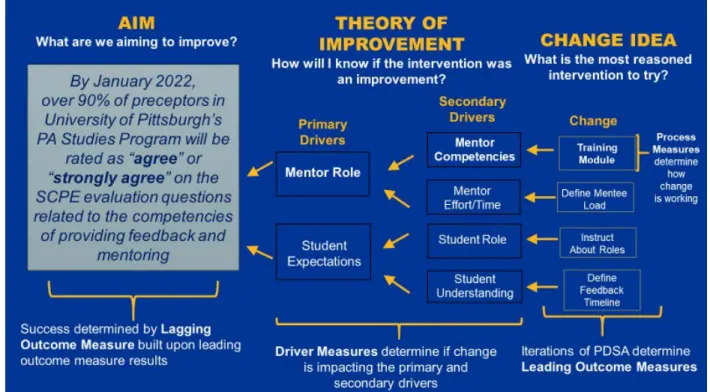
The theory of improvement guiding this project was that online professional development modules develop preceptors’ competencies in providing feedback and mentoring, leading to improved student perceptions and quality of clinical education. The overall aim of my inquiry and improvement effort is that by January 2022, over 90% of the
clinical preceptors of the University of Pittsburgh PA Studies Program will be rated as “agree” or “strongly agree” on the student clinical rotation evaluation questions related to the competencies of providing feedback and mentoring. To achieve this aim, I followed the improvement theory that the practice of clinical preceptors in the areas of providing feedback and mentoring will benefit from professional development provided through online professional development modules. The driver diagram that illustrates the theory of improvement and aim is presented in Appendix A.
This improvement science design investigated how, in my position as the chair of the Department of PA Studies that includes the PA Studies Program, I can develop an effective, measurable change that results in an improvement in the self-competence and knowledge of clinical preceptors (Langley et al., 2009). This project included a change intervention that professionally educates the participants on effective practices of feedback providing and mentoring in order to improve their knowledge and self-competence; importantly, it collected data to identify if and to what extent a change in any of these areas occurred (Langley et al., 2009). This project also examined the relationship among demographic variables and pre-module assessments of self-competence and knowledge, as well as changes that occurred after completing the online professional development modules.
This project involves background data collection and an initial PDSA cycle represented by the development and implementation of online professional development modules on providing feedback and mentoring by clinical preceptors. Analysis of all project data, especially those related to the outcomes of the modules on preceptor competence and knowledge of evidence-based practices for providing feedback and mentoring, will be used in
future decision-making regarding revisions to and the ongoing use of the modules for developing these competencies (Langley et al., 2009).
3.2.1.1Competence.
An important component in developing the online professional development modules, tests, and surveys for this project (and in any professional education or development activity) is the construct known as competence. The construct of competence is most simply defined as “an organism’s capacity to interact effectively with its environment” (White, 1959, p. 297). Axley (2008) presented an analysis of the concept of competency that identified the practical definitions and applications of the term, as it can refer to abilities, actions, behaviors, or expectations; however, there was a common theme of demonstrating effectiveness and the prudent consideration of outcomes. The construct is central to competence motivation theory advanced by Harter (1978), which organizes the reasons why an individual would interact with and attempt to master their environment, and self-determination theory (Deci & Ryan, 1985), which identifies the need for competence as an innate driver of individuals to grow and integrate into their environment and presents a continuum of amotivation, extrinsic, and intrinsic motivation with considerations of controlled versus autonomous motivation. Of significant importance in this project is the idea that clinical preceptors have baseline levels of competence in providing feedback and mentoring, and that improving these capacities positively impacts the perceptions and outcomes of PA students.
3.2.1.2Competence and Continuing Professional Development.
Self-determination theory (Deci & Ryan, 1985) and the development and maintenance of competence are key aspects of continuing professional development, which is defined as the “continuing process, outside formal undergraduate and postgraduate training, …to maintain and
improve standards of … practice through the development of knowledge, skills, attitudes, and behavior” (The Royal College of Obstetricians and Gynecologists, 2010, p. 1). This process is primarily self-directed (Tjin A Tsoi, de Boer, Croiset, Koster, & Kusurkar, 2016) and therefore relies upon the motivations of the individual professional (Deci & Ryan, 1985). Tjin A Tsoi et al. (2016) identified that both the controlled, extrinsic motivation of licensure requirements and the autonomous, intrinsic motivation to practice effectively and safely drive the professional development activities of pharmacists. Several, studies have identified the benefits of continuing medical education and other professional development activities on the practice and competence of health care providers (Ahmed et al., 2013; Davis & Galbraith, 2009). Finally, and directly related to this project, several studies have demonstrated that online modules are an effective delivery method for such continuing professional development (Hugenholtz, de Croon, Smits, van Dijk, & Nieuwenhuijsen, 2008; Khatony, Nayery, Ahmadi, Haghani, & Vehvilainen-Julkunen, 2009).
3.3Inquiry Methods
Using an improvement science inquiry design, I investigated how, as the chair of the department that houses a PA Studies Program, I can develop an effective, measurable change that results in an improvement in the perception of self-competence and knowledge of clinical preceptors This project included a change intervention that professionally educates the participants on effective practices for providing feedback and mentoring students in order to improve their knowledge, perceptions of their self-competence, and competencies in these areas; importantly, the project collected data to identify if and to what extent a change in any
of these areas occurs (Langley et al., 2009). The project also examined the relationship among demographic variables and pre-module assessments of self-competence and knowledge, as well as changes that occur after completing the module. This project represented the background data collection and the PDSA cycle that supports progress towards the overall aim, and it will inform future iterations of the improvement process for my program and, potentially, for other PA programs (Langley et al., 2009).
3.4Inquiry Setting
I am the chair of the department that houses the University of Pittsburgh PA Studies Program in Pittsburgh, Pennsylvania. During the clinical phase (or second year) of our curriculum, each of our 60 students completes nine, five-week SCPEs across a variety of medical specialties and settings, from family medicine offices to the operating theaters of general surgery. To accomplish this, we maintain a base of 93 clinical preceptors who host up to 18 students per academic year at their places of practice without compensation. Geographically, clinical preceptors are located mostly in Western Pennsylvania and the surrounding states, though we have preceptors in Hawaii and Alaska. Importantly, our program is affected by the preceptor shortage and there is a perpetual scramble to recruit additional preceptors to meet our needs; as a result, we are not in a position to select preceptors who have the best-developed abilities of providing feedback and mentoring to students.
The Director of Clinical Education of our program is primarily responsible for the curricular design, implementation, quality assurance, administration, and coordination of the clinical phase. For the eight years preceding this project, there was no other faculty support and
minimal administrative assistance in performing these tasks and they did not have the time or infrastructure to focus on clearly defining or improving the competencies of providing feedback and mentoring by clinical preceptors. Clearly, the large number and wide geographic distribution of our clinical preceptors, along with an understaffed and limited system for supporting and developing them, had constrained our program to this problem.
Fortunately, our program was in a position to explore the problem of defining and developing in clinical preceptors the competencies of providing feedback and mentoring to students. We have since added a faculty member and a dedicated administrative assistant to the clinical education team. I have also made it a personal mission to dedicate time, attention, and support to the clinical education aspect of our program, the human capital necessary for better understanding and solving this problem is in place. Additionally, the University of Pittsburgh has a strong infrastructure for gathering information about this problem via its Peter M. Winter Institute for Simulation, Education, and Research (WISER), which has expertise in and systems for the design, implementation, and measurement of professional development and other trainings that can be used to further explore this problem and trial an intervention using an improvement science approach.
3.5Population
A total population sampling approach included the 93 clinical preceptors of the University of Pittsburgh PA Studies Program, due to the relatively small size of the population and their shared characteristics of being health care providers who serve the program as clinical preceptors. Though a demographic profile of this group had not been performed prior to the study, it was
known that they include PAs, physicians, and nurse practitioners. Geographically, preceptors were known to be mostly located in Pennsylvania, however, they may practice anywhere in the United States. The data from this project was collected between November 2019 and April 2020. Participants were recruited via email to respond to the tests/surveys and to complete the online professional development modules about the importance of providing feedback and mentoring, as well as formal, evidence-based methods for how to effectively perform these competencies. Completion was incentivized, as those who completed the modules and all assessments were awarded Continuing Medical Education credit through the UPMC Center for Continuing Education in the Health Sciences. Response and completion rates were reported, as well as the demographic data of the participants.
3.6Data Collection
This project followed a pre-post model by implementing surveys that gathered information on demographics, self-competence, and user satisfaction with online professional development modules, as well as knowledge tests regarding the constructs of providing feedback and mentoring. Specifically, the construct of feedback is defined as “information communicated to the learner that is intended to modify the learner’s thinking or behavior for the purpose of improving learning” (Shute, 2008). Similarly, mentoring is defined as the process by which “a more-experienced member of an organization maintains a relationship with a less-experienced, often new member to the organization and provides information, support, and guidance so as to enhance the less-experienced member's chances of success in the organization and beyond” (Campbell & Campbell, 1997). The test/survey schedule was as follows: The pretest/survey was administered immediately
before beginning the modules, the immediate posttest/survey after completing the final module, and the delayed posttest/survey approximately two months after the modules were completed.
Items related to demographics included asking the participants with which gender they most identify, their age, in which of the United States their primary practice setting is located, their profession, and their main specialty of practice. See Appendix B for the items.
An item was included on the pre-module survey that assessed participant opinions on the impact of the common barriers to providing feedback to graduate medical students (Anderson, 2012), as these barriers are expected to be the same for PA students. These barriers included the amount of observation of the student needed in order to base preceptor input, concerns for the emotion and reaction of the student, time constraints, and a personal concern for the ability of the preceptor to provide meaningful feedback and mentoring in an effective manner. Though not included in the inquiry questions, this information will inform the theory of improvement and future PDSA iterations.
The items regarding self-competence were developed by using assessments of confidence levels (presented in Appendices C, D, and E) by adapting the Confidence in Learning Mathematics Scale that is part of the Fennema-Sherman Mathematics Attitudes Scales (Fennema & Sherman, 1976). Shortened versions of the Fennema-Sherman Mathematics Attitudes Scales have been used in multiple studies of attitudes regarding confidence levels in learning and applying mathematics (Ren, Green, & Smith, 2016; Sachs & Leung, 2007). The aim of adapting the Confidence in Learning Mathematics Scale was to capture the attitudes of clinical preceptors regarding learning and applying the constructs of providing feedback and mentoring.
The items regarding the self-perception of competencies (presented in Appendices C, D, and E) were adapted from the Perceived Competence Scale first developed by Williams and
Deci (1996) and adapted in various studies to assess participants’ experiences of feeling able to successfully perform tasks (Williams et al., 2009; Williams, McGregor, Zeldman, Freedman, & Deci, 2004). The aim of adapting the Perceived Competence Scale was to capture clinical preceptors’ experiences in feeling able to successfully provide feedback to and mentor of PA students. Also included were items related to user satisfaction with the learning module (adapted from Allen & Nimon, 2007), a knowledge test regarding the constructs of providing feedback and mentoring, and several open-ended questions that ask for general feedback about the learning module and suggestions on other topics that should be considered for professional development of clinical preceptors (see Appendices C, D, and E for the instruments).
All survey and test items were assessed for content validity, or “how well the items of a scale represent the full domain or range of content a scale is intended/should be measuring” (Nevo, 1985) through administration of the Content Validity Index (Lynn, 1986; Waltz & Bausell, 1981). This process involved the recruitment of six experts (fellow PA educators) as raters who reviewed items and focused on content “relevance” and “clarity” of each item and the full scale. According to Lynn (1986), five of six (83%) raters scoring items high on such a scale would establish content validity beyond the 0.05 level of significance, and “items that do not achieve the required minimum agreement of the experts should be eliminated or further revised” (p. 384). Finally, the content validity of each instrument was assessed by determining the proportion of total items judged content valid. The survey and test instruments were similarly reviewed by a group of six practicing clinicians who no longer serve as clinical preceptors. All input from this process was reviewed and no changes to the items were made before administration to the study population.
3.7Data Analysis
The investigator used statistical software for data analysis to answer the inquiry questions. For Inquiry Question 1, mean overall scores on the knowledge questions from all three observation points (pre-module, immediate post-module, and delayed post-module) are presented in tabular form, along with the mean scores and standard deviations for the individual knowledge questions. Paired t-testing was used to compare scores at each of the three observation points according to the following sets: pre-module and immediate post-module scores, pre-module and delayed post-module scores, and immediate post-module and delayed post-module scores.
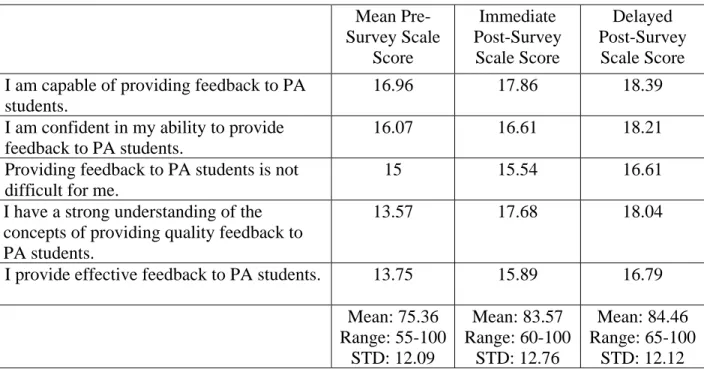
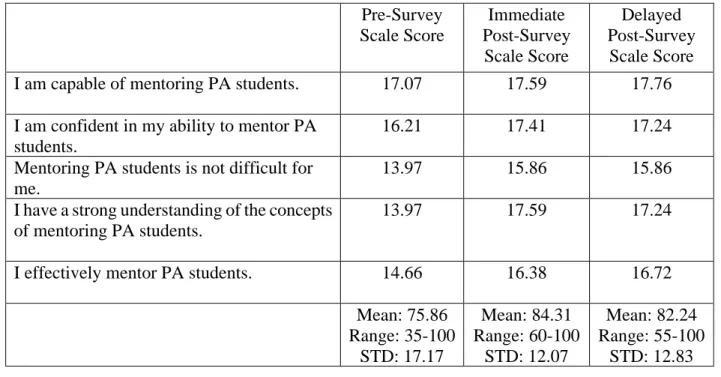
For Inquiry Question 2, responses to the five items on self-competence regarding feedback were converted to the following scale: “not at all” was rated “0,” “slightly” was rated “5,” “somewhat” was rated “10,” “mostly” was rated “15,” and “completely” was rated “20.” This generated a “feedback self-competence scale score” for each participant; as such, the maximum score on the scale was 100. The same approach was used for the five items on self-competence regarding mentoring to generate a “mentoring self-self-competence scale score” of up to 100 for each participant.
The mean scores for each scale from all three observation points (pre-module, immediate post-module, and delayed post-module) were presented in tabular form, along with the mean scores and standard deviations for the individual questions. One-way ANOVA testing was used to compare sets of scores from the three observation points. These sets included pre-survey and immediate post-pre-survey scores, pre-pre-survey and delayed post-pre-survey scores, and immediate post-survey and delayed post-survey scores.
For Inquiry Question 3, the investigator sought to determine whether relationships exist between the knowledge and self-competence scores at each point in time and the demographics of gender, age, primary practice location, profession, and specialty of practice. Descriptive statistics (means and standard deviations) were used to present the demographic data. Where necessary, groupings among the demographic responses were performed to facilitate analysis. For example, responses to the item on age were combined into the following groups: 24-29 years, 30-39 years, 40-49 years, and 50+ years of age.
3.8Institutional Review Board
This study was approved on November 19, 2019, by the WISER Research Committee under their comprehensive protocol for exempt studies granted by the Institutional Review Board of the University of Pittsburgh. Documentation of approval is included as Appendix G.
4.0Findings
4.1Participants
The population for this study was the clinical preceptors of the University of Pittsburgh Physician Assistant Studies Program, and a total population sample was recruited. The investigator began recruiting efforts in January 2020 and the data were collected between January 2020, and April 2020. The investigator emailed all 93 clinical preceptors and invited them to participate in the online professional development modules and to answer all survey and test instruments. Of the 93 clinical preceptors, 46 (for a response rate of 46.2%) fully completed the pretest and pre-survey instruments; 34 (36.6%) fully completed the modules and all pre- and posttest instruments; and 28 (30%) fully completed the modules and all pre- and post-survey instruments. Demographic information of the analytic sample is shown in Table 1.
Table 1 Description of Analytic Sample n % Total 46 100% Gender Female 35 76.1% Male 11 23.9%
Age (in years)
20-29 8 7.4% 30-39 25 54.3% 40-49 5 10.9% 50+ 8 17.4% Primary Profession Nurse Practitioner 4 8.7%
Physician (Not a Surgeon) 8 17.4%
Physician Assistant 32 69.6% Surgeon 1 2.2% Unknown 1 2.2% Specialty of Practice Behavioral Health/Psychiatry 2 4.3% Emergency Medicine 3 6.5% Family Medicine 8 17.4%
General Internal Medicine 4 8.7%
General Pediatrics 6 13%
General Surgery 5 10.9%
Hospital Medicine 7 15.2%
Obstetrics and Gynecology 7 15.2%
Unknown 4 8.7%
Primary Practice Location
Pennsylvania 36 78.3%
Other State 7 15.2%
4.2Findings Related to Inquiry Question 1
Regarding Inquiry Question 1, participant performance on the knowledge questions related to evidence-based methods for providing feedback and mentoring to clinical students on the pretest and immediate posttest were assessed using descriptive statistics and paired t-testing, and the data and analysis findings are presented in Tables 2 and 3. Data from three of the 46 participants was removed from the set due to null data for one or both tests.
Table 2 Knowledge Question Scores for Participants on Pre- and Immediate Posttests
n Mean Score Median Score Standard Deviation Pretest 43 0.713 0.667 0.210 Immediate Posttest 43 0.942 1.000 0.088
Table 3 Pre- and Immediate Posttest Analysis
Mean Change T-Test P value
0.229 6.687 0.000
As indicated in Tables 2 and 3 there is a statistically significant difference (p = 0.000) between the mean scores on the Pretest and Immediate Posttest performances by these participants and the T-score of 6.687 indicates a strong difference between the mean scores of the two groups.
Knowledge retention by the participants between the pretests and delayed posttests were assessed using descriptive statistics and paired t-testing. Thirty-four participants completed all items in both instruments, and their demographic data are presented in Table 4. Item response distributions are presented in Appendix F.
Table 4 Description of the Participants who Completed All Pre-, Immediate Post-, and Delayed Posttests
n %
Total 34 100%
Gender
Female 28 82.4%
Male 6 17.6%
Age (in years)
20-29 6 17.6% 30-39 21 61.8% 40-49 4 11.8% 50+ 3 8.8% Primary Profession Nurse Practitioner 3 8.8%
Physician (Not a Surgeon) 4 11.8%
Physician Assistant 26 76.5% Surgeon 0 0% Unknown 1 3% Specialty of Practice Behavioral Health/Psychiatry 1 3% Emergency Medicine 3 8.8% Family Medicine 5 14.7%
General Internal Medicine 3 8.8%
General Pediatrics 5 14.7%
General Surgery 4 11.8%
Hospital Medicine 6 17.6%
Obstetrics and Gynecology 3 8.8%
Unknown 4 11.8%
Primary Practice Location
Pennsylvania 30 88.2%
Other State 3 8.8%
Data and the associated analysis regarding the data and analysis findings are presented in Tables 5 and 6.
Table 5 Knowledge Question Scores for Participants on Pre- and Delayed Posttests
n Mean Score Median Score Standard Deviation Pretest 34 0.716 0.667 0.219 Delayed Postest 34 0.882 1.000 0.151
Table 6 Pre- and Delayed Posttest Analysis
Mean Change T-Test P value
0.167 4.254 0.000
There was a statistically significant difference (p = 0.000) between the mean scores on the pretest and delayed posttest performances by these participants and the T-score of 4.254 indicates a strong difference between the mean scores of the two groups.
Assessment of the retention of knowledge over the two-month period by participants between the immediate posttest and delayed posttest was assessed using descriptive statistics and paired t-testing, and the data and analysis findings are presented in Tables 7 and 8.