
SOFTWARE TESTING, VERIFICATION AND RELIABILITY
Modeling methods for web
application verification and
testing: State of the art
Manar H. Alalfi, James R. Cordy, Thomas R. Dean
∗School of Computing, Queen’s University Kingston, Ontario, K7L 3N6, Canada
SUMMARY
Models are considered an essential step in capturing different system behaviors and simplifying the analysis required to check or improve the quality of software. Verification and testing of web software requires effective modeling techniques that address the specific challenges of web applications. In this study we survey 24 different modeling methods used in website verification and testing. Based on a short catalogue of desirable properties of web applications that require analysis, two different views of the methods are presented: a general categorization by modeling level, and a detailed comparison based on property coverage. Copyright c2008 John Wiley & Sons, Ltd.
Received 1 November 2007; Revised 9 September 2008
KEY WORDS: Analysis Models, Web Application Testing, Web Application Verification.
1. Introduction
Like many software domains, web applications are becoming more complex. This complexity arises due to several factors, such as a larger number of hyperlinks, more complex interaction, and the increased use of distributed servers. Modeling can help to understand these complex systems, and several papers in the literature have studied the specific problem of modeling web applications. In some cases, new models have been proposed, while in other cases, existing modeling techniques have been adapted from other software domains. Modeling can help designers during the design phases by formally defining the requirements, providing multiple levels of detail, and providing support for testing prior to implementation. Support from modeling can also be used in later phases to support validation and verification.
Most of the early literature concentrates on the process of modeling the design of web applications. It proposes forward engineering-based methods designed to simplify the process of building highly
interactive web applications [1,2,3,4]. Other research uses reverse engineering methods to extract models from existing web applications in order to support their maintenance and evolution [5,6,7]. This paper surveys a range of different analysis models that are currently applied in the field of verification and testing of web applications. Design modeling methodologies such as those reviewed in [8,9,10] are outside the scope of our study. Our survey focusses on the modeling methods used. Thus testing and verification methods as a whole, such as user session-data testing [11] and bypass testing [12] are also outside the scope of this survey.
While reviewing different analysis methods in our scope, we found that some of the literature focuses on modeling the navigational aspects of web applications [13,14,15,16], while others concentrate on solving problems arising from user interaction with the browser in a way that affects the underlying business process [17,18]. Still others are interested in validating the correctness and completeness of web page contents [19,20,21,22]. The surveyed models are interested in modeling and verifying either the static or the dynamic behaviors and features of web applications [23,24].
In this paper, we categorize, compare and analyze 24 different methods according to the level of web application modeling - navigation, behavior, and content. In each category, methods are sorted according to the kind of notation employed. While we tried to choose the most recent methods for our study, the list of methods considered is not exhaustive and the number of new and not yet considered methods is rising rapidly.
The rest of this paper is organized as follows. Section 2 motivates our work. Section 3 gives a brief introduction to web applications and web services and the challenges that affect the analysis and modeling of web applications. Section 4 describes the set of comparison and categorization criteria used in our study. In Section 5 we give a brief summary and a comparative analysis of the 24 modeling methods. Section 6 adds descriptions some other related methods. Finally, we conclude and suggest some of the open problems in the area in Section 7.
2. Motivation
Previous surveys have compared methods proposed for web application development [9,10]. Most concentrate on design methods, methods that focus on the preliminary phases of the software life cycle. Cuaresma et al. [8] on the other hand concentrate on comparing methods dedicated to requirements engineering. The work most similar to our study is the survey done by Di Lucca and Fasolino [25], but their focus is on the functional testing of web applications, while ours is on the analysis models underlying web application verification and testing. We are interested in those methods that propose models to capture different properties related to the structure (navigation), behavior, and content of web applications, and whether these properties are static, dynamic, or interactive.
To date, no one has analyzed modeling methods devoted to verification and testing of web applications taking into consideration the capabilities of those methods in capturing, verifying or testing the set of desired web application properties that we discuss in this paper. This study is undertaken to investigate the current state of the art in the field of web application verification and testing, and to distill what is being done and what still needs to be done to help researchers interested in this field to fill the gaps. For web engineers interested in modeling, this study may provide an insight to the different models and notations used to capture the different features in web applications, and encourage them to propose new improved models. For those interested in web application verification
Figure 1. Web Application Components (from [26])
and testing, the analysis provided here may suggest new directions that need to be investigated to improve the quality of web applications. In addition, it provides an overview of the range of analyses that are being used to support web application verification and testing which may help in the integration of different methods to derive new, improved techniques.
3. Web Application Modeling
In this section we set our work in the context of the web environment, web applications and services, introduce the major challenges in the analysis and modeling of web applications for verification and testing, and outline the desirable properties of web application models that form the basis of our study.
3.1. Web Applications
For the purpose of this survey, a web application is a software application that is accessible via a thin client (i.e. web browser) over a network such as the Internet or an intranet. A web application is often structured as a three-tiered application. As shown in Figure1, the web browser represents the first tier. The web server that implements CGI, PHP, Java Servlets or Active Server Pages (ASP), along with the application server that interacts with the database and other web objects is considered the middle tier. Finally, the database along with the DBMS server forms the third tier.
Web applications generate web pages, comprising different kinds of information such as text, images and forms. These web pages can be eitherstaticordynamic. Static pages reside on a web server and contain only HTML and client side executable code (e.g JavaScript) and are served by the web server. Dynamic pages are generated as the result of the execution of various scripts and components on the server. These pages contain a mixture of HTML source and executable code, and are served by the application server.
In our study we treat the terms web application and website as synonymous. Some researchers consider a website to be simply a set of related web pages grouped together by some means on a server, or in a folder on a server. Such pages are static pages that don’t use dynamic features and thus need not be processed by the application servers.
We are interested in all methods that propose models to capture different properties related to the structure (navigation), behavior, and content of web applications; and whether these properties are static, dynamic, or interactive. Another level that could be considered is the presentation level, which describes how information is to be presented to users. Issues related to this level include attributes such as color and font as well as cascading style sheets. In this study we concentrate on the semantics of web applications rather than presentation issues.
3.2. Web Services
Web services are a standardized way of integrating web-based applications using separate service communication interfaces that can be used by other web applications. They are primarily used as a means for businesses to communicate with clients and each other without exposing detailed knowledge of each other’s IT systems. Communication is usually in XML, and not tied to any particular operating system or programming language. Web services don’t require the use of browsers or HTML, and don’t provide the user with a GUI. Web services are outside the scope of the present study, but may be a future direction for our work.
3.3. Challenges In Analysis And Modeling Of Websites
Web applications are evolving rapidly, as many new technologies, languages, and programming models are used to increase the interactivity and the usability of web applications. This inherent complexity brings challenges to modeling, analysis, testing, and verification of this kind of software. Some of these challenges are:
• The diversity and complexity of the web application environment increases the risk of non-interoperability and the complexity of integration. Web applications interact with many components that run on diverse hardware and software platforms. They are written in diverse languages and they are based on different programming approaches such as procedural, OO, interpreted, and hybrid languages such as Java Server Pages (JSPs). The client side includes browsers, HTML, embedded scripting languages and applets. The server side includes CGI, JSPs, Java Servlets, and .NET technologies. They all interact with diverse back-end engines and other components that are found on the web server or other servers. The integration of such components and the web system in general is extremely loose and dynamically coupled, which
provides powerful abstraction capabilities to the developers, but makes analysis for testing and verification extremely difficult.
• Another major challenge comes from the dynamic behavior, including dynamically generated client components, dynamic interaction among clients and servers, and the continual changes in the system context and web technologies.
• Web applications may have several entry points, and users can engage in complicated interactions that the web application cannot prevent. Web applications often contain database components and may provide the same data to different users. In these cases, applying access control mechanisms becomes an important requirement for safe and secure access to web application resources, and the process of implementing and applying such rules is considered a great challenge.
• Web applications have the property of low observability, due to the difficulty of tracking some outputs. Usually the output that is observed and analyzed consists of the HTML documents sent back to the user. But there are also other kinds of output, such as the changed state of the server or the database, messages sent to other web applications and services, and so on. It is considered a challenge to perform a precise analysis of web applications that takes into account all of this information.
3.4. Desirable Properties For Website Modeling
We can view web applications from three orthogonal perspectives (levels of modeling): web navigation, web content and web behavior. We first present an initial categorization of the desirable properties of web applications based on the level of modeling, and in Section4we further categorize the properties according to the static, dynamic, or interaction aspects as applicable:
1. Web Navigation
• Static navigation properties:Most of the early literature on web analysis and modeling
concentrates on dealing with static links, treating web applications as hypermedia applications. It addresses the checking of properties such as broken links, reachability (e.g., return to the home page), consistency of frame structure, and other features related to estimating the cost of navigation, such as longest path analysis.
• Dynamic navigation properties:This analysis focuses on aspects that make the navigation
dynamic. That is, the same link may lead to different pages depending on given inputs. The inputs could be user inputs transferred via forms, or system inputs depending on some state in the server such as date, time, session information, access control information or information in hidden fields.
• Interaction navigation properties:This analysis focuses on properties that are related to
user navigation that happens outside the control of the web application, such as user interaction with the browser. This includes features such as use of the back or forward buttons.
2. Web Content
• Static content properties: Consistency of the original web page content with respect to
correctness. When verifying the completeness of a web application the model should enforce that a given web page contains some information, links between web page exist and sometimes even check that the web pages exist (broken links). Correctness implies that the information provided on a web page is valid based on the application requirements.
• Dynamic content properties:Consistency of the syntax and semantics of dynamic content.
This analysis requires the ability to check the dynamically generated content that results from the execution of script code by the application server. Some technologies are also able to generate new connections, some of which may be to a different server. New web components could be generated at run time, and these components must also be analyzed.
3. Web Behavior
• Security properties:This issue is related to access control mechanisms that are employed
on the web content or web links. This issue could also be employed on the back-end, as the database may contain data reserved to specific users. Non-authorized users must not be able to access such data. These properties are also tied to session control mechanisms.
• Instruction processing properties: These issues include both server and client side
execution. We define client-side execution as any process changing the state of the application without communication with the web server. Server-side execution is defined by all instructions processed on a web server in response to a client’s request. A modeling method should to be able to model these features and to recognize whether execution is done on the server or on the client.
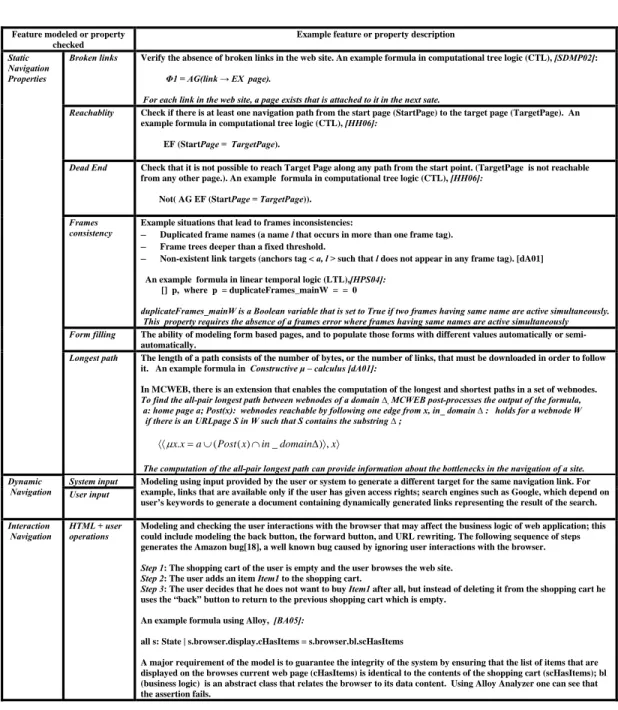
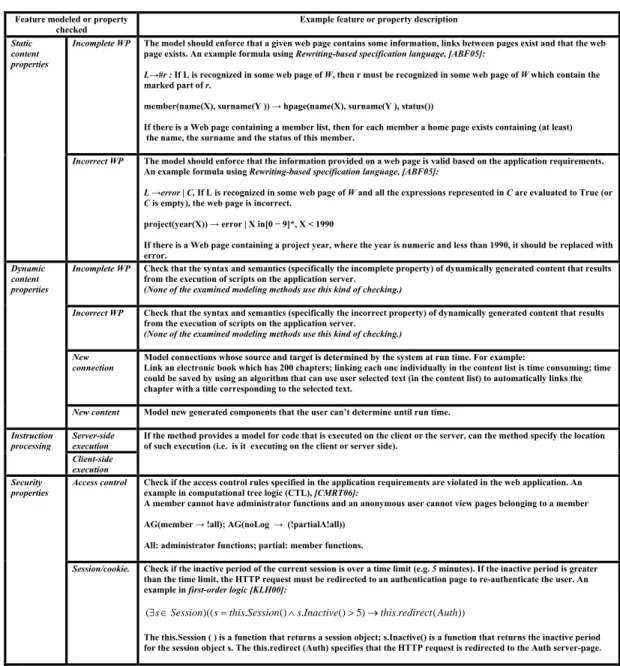
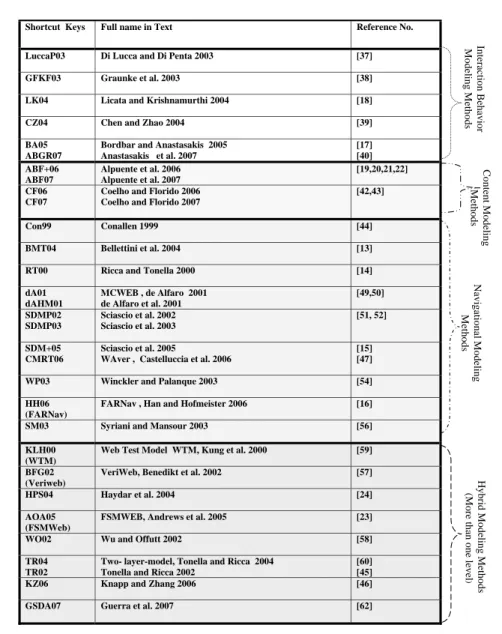
TablesI andII provide descriptions and examples of these properties. The list is not complete, but it provides a summary of the set of properties that the reviewed methods are interested in modeling, checking or testing. We use symbolic keys in the tables (e.g. SDMP02) to refer to the surveyed methods. Please refer to TableIIIin Section 5 for details on the symbolic keys.
4. Comparison And Categorization Criteria
In our study we reviewed 24 different modeling methods that are applied in the field of testing and verification of web applications. Following is a brief description of the main comparison criteria that are used in our review:
1. Feature Type:The web application features that are being captured by the proposed models, and
the properties that the modeling methods are capable of checking. These features are categorized first in Section 3.4 based on the level of web application modeling into features related to web application navigation, content, or behavior. In this section, we add another categorization dimension, static, dynamic, or interactive. This additional information can help us to identify the improvements that the modeling methods are trying to achieve at each level of web application modeling. We relate each category to the properties described in Section3.4at the end of its description.
• Static Features:These include the static properties of web applications, such as links that
Feature modeled or property checked
Example feature or property description
Static Navigation Properties
Broken links Verify the absence of broken links in the web site. An example formula in computational tree logic (CTL), [SDMP02]:
Φ1 = AG(link → EX page).
For each link in the web site, a page exists that is attached to it in the next sate.
Reachablity Check if there is at least one navigation path from the start page (StartPage) to the target page (TargetPage). An example formula in computational tree logic (CTL), [HH06]:
EF (StartPage = TargetPage).
Dead End Check that it is not possible to reach Target Page along any path from the start point. (TargetPage is not reachable from any other page.). An example formula in computational tree logic (CTL), [HH06]:
Not( AG EF (StartPage = TargetPage)).
Frames consistency
Example situations that lead to frames inconsistencies:
– Duplicated frame names (a name l that occurs in more than one frame tag).
– Frame trees deeper than a fixed threshold.
– Non-existent link targets (anchors tag < a, l > such that l does not appear in any frame tag). [dA01] An example formula in linear temporal logic (LTL),[HPS04]:
[] p, where p = duplicateFrames_mainW = = 0
duplicateFrames_mainW is a Boolean variable that is set to True if two frames having same name are active simultaneously. This property requires the absence of a frames error where frames having same names are active simultaneously Form filling The ability of modeling form based pages, and to populate those forms with different values automatically or
semi-automatically.
Longest path The length of a path consists of the number of bytes, or the number of links, that must be downloaded in order to follow it. An example formula in Constructive µ – calculus [dA01]:
In MCWEB, there is an extension that enables the computation of the longest and shortest paths in a set of webnodes.
To find the all-pair longest path between webnodes of a domain ∆, MCWEB post-processes the output of the formula,
a: home page a; Post(x): webnodes reachable by following one edge from x, in_ domain ∆ : holds for a webnode W if there is an URLpage S in W such that S contains the substring ∆ ;
〈〈µx.x=a∪(Post(x)∩in_domain∆)〉,x〉
The computation of the all-pair longest path can provide information about the bottlenecks in the navigation of a site. Dynamic
Navigation System input Modeling using input provided by the user or system to generate a different target for the same navigation link. For example, links that are available only if the user has given access rights; search engines such as Google, which depend on user’s keywords to generate a document containing dynamically generated links representing the result of the search.
User input Interaction
Navigation
HTML + user operations
Modeling and checking the user interactions with the browser that may affect the business logic of web application; this could include modeling the back button, the forward button, and URL rewriting. The following sequence of steps generates the Amazon bug[18], a well known bug caused by ignoring user interactions with the browser.
Step 1: The shopping cart of the user is empty and the user browses the web site.
Step 2: The user adds an item Item1 to the shopping cart.
Step 3: The user decides that he does not want to buy Item1 after all, but instead of deleting it from the shopping cart he uses the “back” button to return to the previous shopping cart which is empty.
An example formula using Alloy, [BA05]:
all s: State | s.browser.display.cHasItems = s.browser.bl.scHasItems
A major requirement of the model is to guarantee the integrity of the system by ensuring that the list of items that are displayed on the browses current web page (cHasItems) is identical to the contents of the shopping cart (scHasItems); bl (business logic) is an abstract class that relates the browser to its data content. Using Alloy Analyzer one can see that the assertion fails.
Feature modeled or property
checked Example feature or property description
Static content properties
Incomplete WP The model should enforce that a given web page contains some information, links between pages exist and that the web
page exists. An example formula using Rewriting-based specification language, [ABF05]:
L→#r : If L is recognized in some web page of W, then r must be recognized in some web page of W which contain the
marked part of r.
member(name(X), surname(Y )) → hpage(name(X), surname(Y ), status())
If there is a Web page containing a member list, then for each member a home page exists containing (at least) the name, the surname and the status of this member.
Incorrect WP The model should enforce that the information provided on a web page is valid based on the application requirements.
An example formula using Rewriting-based specification language, [ABF05]:
L →error | C, If L is recognized in some web page of W and all the expressions represented in C are evaluated to True (or
C is empty), the web page is incorrect. project(year(X)) → error | X in[0 − 9]*, X < 1990
If there is a Web page containing a project year, where the year is numeric and less than 1990, it should be replaced with error.
Dynamic content properties
Incomplete WP Check that the syntax and semantics (specifically the incomplete property) of dynamically generated content that results
from the execution of scripts on the application server.
(None of the examined modeling methods use this kind of checking.)
Incorrect WP Check that the syntax and semantics (specifically the incorrect property) of dynamically generated content that results
from the execution of scripts on the application server.
(None of the examined modeling methods use this kind of checking.) New
connection Model connections whose source and target is determined by the system at run time. For example: Link an electronic book which has 200 chapters; linking each one individually in the content list is time consuming; time
could be saved by using an algorithm that can use user selected text (in the content list) to automatically links the chapter with a title corresponding to the selected text.
New content Model new generated components that the user can’t determine until run time.
Instruction processing
Server-side execution
If the method provides a model for code that is executed on the client or the server, can the method specify the location of such execution (i.e. is it executing on the client or server side).
Client-side execution Security
properties
Access control Check if the access control rules specified in the application requirements are violated in the web application. An
example in computational tree logic (CTL), [CMRT06]:
A member cannot have administrator functions and an anonymous user cannot view pages belonging to a member AG(member → !all); AG(noLog → (!partialΛ!all))
All: administrator functions; partial: member functions.
Session/cookie. Check if the inactive period of the current session is over a time limit (e.g. 5 minutes). If the inactive period is greater
than the time limit, the HTTP request must be redirected to an authentication page to re-authenticate the user. An example in first-order logic [KLH00]:
)) ( . ) 5 () . () . )((
(∃s∈Session s=thisSession ∧sInactive > →thisredirectAuth
The this.Session ( ) is a function that returns a session object; s.Inactive() is a function that returns the inactive period for the session object s. The this.redirect (Auth) specifies that the HTTP request is redirected to the Auth server-page.
or a static link, a request is sent to the server in order to fetch a page. The server responds to the request by retrieving the required page from its storage and sends it back to the client. In this category properties from Section3.4related to static navigation and static content can be checked.
• Dynamic Features:These features include dynamic links and dynamic content properties.
Dynamic links describe the connection between HTML pages and code that must to be executed on the server in order to generate the required information, build it into an HTML page, and return it to the client. The processing done by the server may depend on input that is provided by the user or the system. User inputs are usually sent by filling a form or by hidden fields in the HTTP request. System inputs depend on the server state, such as server time, or on some kind of interaction with other resources, such as database servers or web objects. The output could be constructed as new content, or a link in a new HTML page. Properties from Section3.4that fall into this category are those related to dynamic navigation, dynamic content, security, and instruction processing properties.
• Interaction Features: The browser’s influence on the navigation behavior of the web
application should be taken into consideration when modeling or analyzing web applications, since user interaction with the browser can interactively modify navigation paths. This category includes properties from Section3.4related to user interaction with the browser.
2. Notation:Modeling methods use different notations; some of them are formal, while others are
either semi- or informal. The main notations used by the reviewed methods are: • Statecharts [27].
• UML and OCL [28] [29]
• UML-based Web Engineering (UWE) [30] • Alloy [31].
• Finite State Machines (FSM) [32]
• Directed Graphs and Control Flow Graphs (CFG) [33] [34] • Specification and Description Language (SDL) [35]. • Term Rewriting Systems (TRS) [36]
3. Level of modeling: Web application modeling can be viewed from different perspectives.
We compare the modeling methods here according to three basic levels: content, structure (navigation), and behavior. These three levels in turn could have a static or a dynamic flavor.
4. Application of the model:In our study we focus on methods that are concerned with modeling
web applications for the purpose of testing or verification; this also could include design verification.
5. Source code required?: Modeling methods may apply a white-box analysis, which requires
source code, or a black-box analysis which does not require source code.
6. Model optimization:Complex systems in general have a state explosion problem or they generate
a large complex model. In all cases such models need some sort of optimization. In web applications, this problem becomes a major challenge to the success of any method that attempts to analyze and model a scalable web system.
5. Comparative Analysis.
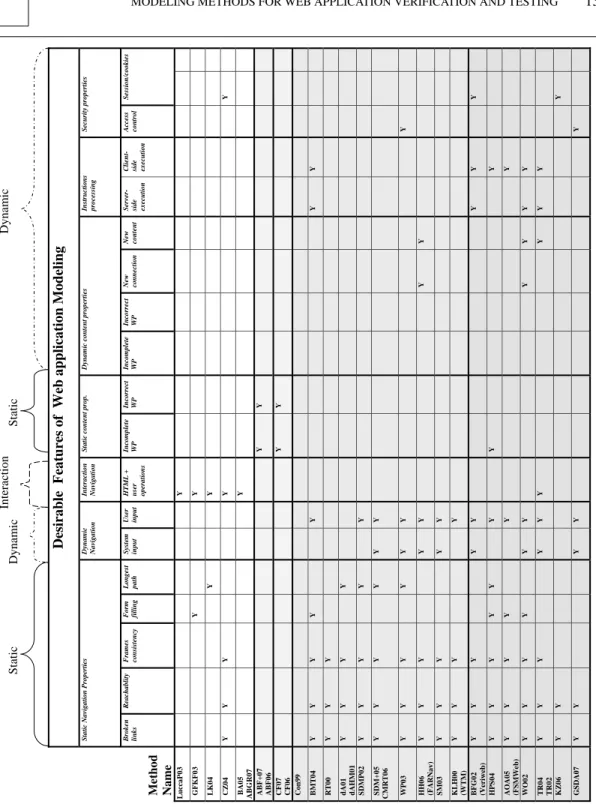
Our study produced two different views of the surveyed methods: a general categorization by modeling level, and a detailed comparison by property coverage. To minimize space in tables and text, we identify each modeling method with a key based on the last name of authors and the date of publication. Table IIIgives these keys along with the full name in text and the citation for the method.
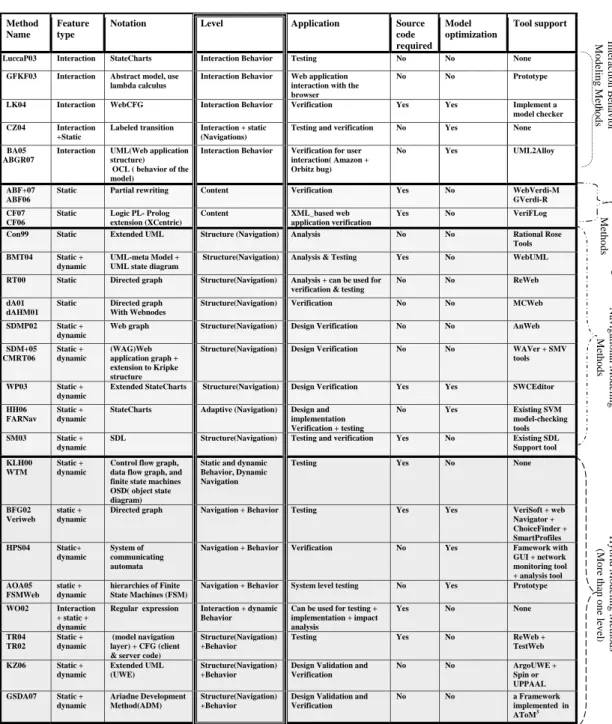
TableIVsummarizes the first view, categorizing each of the methods based on the level of modeling: as interaction behavior modeling methods, navigation modeling methods, content modeling methods or hybrid modeling methods (methods that model more than one level). In each category, methods are sorted according to the notation used by the method. At the same time, comparison between the methods was also done based on other the other criteria presented in section 4.
The second comparison, shown in TableV, compares some of the more specific details of methods in the same category, in particular, and with other methods in other categories in general. The comparison is based on a combination of feature type and the level of web application modeling, using the comparison criteria outlined in Section3.4as desirable properties for web site modeling.
In the remainder of this section we discuss and compare the characteristics of the methods summarized in these tables. Our presentation is organized by the levels in TableIV, that is, we first discuss interaction modeling methods in section 5.1, then content modeling methods in section5.2 followed by navigation modeling methods in section5.3, and finally hybrid methods in section5.4. The categories are not disjoint; some methods are discussed more than once since they have aspects that address multiple levels, but we try to make the presentation consistent with TableIVotherwise. For example methods in each category are discussed based on the notation employed by those methods in order to identify how specific notation can affect the capability of the modeling methods to capture different features.
5.1. Interaction Behavior Modeling Methods
Dealing with user operations (interactions) is very important. Such interactions are problematic, for example: clicking the back button forces the computation to resume at a prior interaction point; submitting multiple forms then clicking the back button causes computations at the same interaction point to resume many times. These operations happen in the browser and are not reported to the web application. Consequently, the browser interacts with the web application in an unexpected manner. Modeling methods that do not take into account this kind of behavior are incomplete and unrealistic. The methods discussed here refer to the first section of TablesIVandV. The presentation follows the chronological order of the methods unless specific relationships between methods need to be identified. Di Lucca and Di Penta (LuccaP03) [37] model the browser loading a page as a Statechart with four basic states: Back Disabled, Forward Disabled (BDFD); Back Enabled, Forward Disabled (BEFD); Back Enabled, Forward Enabled (BEFE); Back Disabled, Forward Enabled (BDFE), as shown in Figure2(a). The user navigation is modeled as transitions between those basic states and the transition has four different labels: forward, backward, reload and link, to indicate if the transition is activated by clicking on regular links or by clicking browser navigational buttons. The state transitions are also labeled with guard conditions to specify the navigation sequence restrictions. Possible interactions with the browser are generated using test cases to satisfy defined coverage criteria, such as all states, all transitions, all transition k-tuples, and all round-trip paths. Potential inconsistencies are collected
Shortcut Keys Full name in Text Reference No.
LuccaP03 Di Lucca and Di Penta 2003 [37] GFKF03 Graunke et al. 2003 [38] LK04 Licata and Krishnamurthi 2004 [18] CZ04 Chen and Zhao 2004 [39] BA05
ABGR07
Bordbar and Anastasakis 2005 Anastasakis et al. 2007 [17] [40] ABF+06 ABF07 Alpuente et al. 2006 Alpuente et al. 2007 [19,20,21,22] CF06 CF07
Coelho and Florido 2006 Coelho and Florido 2007
[42,43]
Con99 Conallen 1999 [44]
BMT04 Bellettini et al. 2004 [13] RT00 Ricca and Tonella 2000 [14] dA01 dAHM01 MCWEB , de Alfaro 2001 de Alfaro et al. 2001 [49,50] SDMP02 SDMP03 Sciascio et al. 2002 Sciascio et al. 2003 [51, 52] SDM+05 CMRT06 Sciascio et al. 2005
WAver , Castelluccia et al. 2006
[15] [47] WP03 Winckler and Palanque 2003 [54] HH06
(FARNav)
FARNav , Han and Hofmeister 2006 [16] SM03 Syriani and Mansour 2003 [56] KLH00
(WTM)
Web Test Model WTM, Kung et al. 2000 [59] BFG02
(Veriweb)
VeriWeb, Benedikt et al. 2002 [57] HPS04 Haydar et al. 2004 [24] AOA05
(FSMWeb)
FSMWEB, Andrews et al. 2005 [23]
WO02 Wu and Offutt 2002 [58]
TR04 TR02
Two- layer-model, Tonella and Ricca 2004 Tonella and Ricca 2002
[60] [45] KZ06 Knapp and Zhang 2006 [46] GSDA07 Guerra et al. 2007 [62]
Int eract io n B ehavi or Mo del in g Met h o d s Cont en t M o del in g Met h o d s Navi gat ional Mo del in g Met h o d s Hy bri d M o del ing M et h ods (M or e t h an one lev el)
Table III. Reference linking summary tables with text
by executing the browser test cases and comparing the results with an oracle, taking into account the verification of the chosen coverage criteria. The authors propose a way to integrate their browser model with other web application testing models to make them browser interaction aware methods. Unlike the following methods, this method is applied in web application testing rather than verification.
Method Name
Feature type
Notation Level Application Source code required
Model optimization
Tool support
LuccaP03 Interaction StateCharts Interaction Behavior Testing No No None GFKF03 Interaction Abstract model, use
lambda calculus
Interaction Behavior Web application interaction with the browser
No No Prototype
LK04 Interaction WebCFG Interaction Behavior Verification Yes Yes Implement a model checker CZ04 Interaction
+Static
Labeled transition Interaction + static (Navigations)
Testing and verification No Yes None
BA05 ABGR07
Interaction UML(Web application structure) OCL ( behavior of the model)
Interaction Behavior Verification for user interaction( Amazon + Orbitz bug)
No Yes UML2Alloy
ABF+07 ABF06
Static Partial rewriting Content Verification Yes No WebVerdi-M GVerdi-R CF07
CF06
Static Logic PL- Prolog extension (XCentric)
Content XML_based web application verification
Yes No VeriFLog
Con99 Static Extended UML Structure (Navigation) Analysis No No Rational Rose Tools BMT04 Static +
dynamic
UML-meta Model + UML state diagram
Structure(Navigation) Analysis & Testing Yes No WebUML
RT00 Static Directed graph Structure(Navigation) Analysis + can be used for verification & testing
No No ReWeb
dA01 dAHM01
Static Directed graph With Webnodes
Structure(Navigation) Verification No No MCWeb
SDMP02 Static + dynamic
Web graph Structure(Navigation) Design Verification No No AnWeb
SDM+05 CMRT06 Static + dynamic (WAG)Web application graph + extension to Kripke structure
Structure(Navigation) Design Verification No No WAVer + SMV tools
WP03 Static + dynamic
Extended StateCharts Structure(Navigation) Design Verification Yes Yes SWCEditor
HH06 FARNav
Static + dynamic
StateCharts Adaptive (Navigation) Design and implementation Verification + testing No Yes Existing SVM model-checking tools SM03 Static + dynamic
SDL Structure(Navigation) Testing and verification Yes No Existing SDL Support tool KLH00
WTM
Static + dynamic
Control flow graph, data flow graph, and finite state machines OSD( object state diagram)
Static and dynamic Behavior, Dynamic Navigation
Testing Yes No None
BFG02 Veriweb
static + dynamic
Directed graph Navigation + Behavior Testing Yes Yes VeriSoft + web Navigator + ChoiceFinder + SmartProfiles HPS04 Static+ dynamic System of communicating automata
Navigation + Behavior Verification No Yes Famework with GUI + network monitoring tool + analysis tool AOA05 FSMWeb static + dynamic hierarchies of Finite State Machines (FSM)
Navigation + Behavior System level testing No Yes Prototype
WO02 Interaction + static + dynamic
Regular expression Interaction + dynamic Behavior
Can be used for testing + implementation + impact analysis Yes No None TR04 TR02 Static + dynamic (model navigation layer) + CFG (client & server code)
Structure(Navigation) +Behavior
Testing Yes No ReWeb + TestWeb KZ06 Static + dynamic Extended UML (UWE) Structure(Navigation) +Behavior
Design Validation and Verification No No ArgoUWE + Spin or UPPAAL GSDA07 Static + dynamic Ariadne Development Method(ADM) Structure(Navigation) +Behavior
Design Validation and Verification No No a Framework implemented in AToM3 Int eract io n Behavi or Mo del in g Met h o d s Cont en t M o del ing Met h o d s Navi gat ional Mo del in g Met h o d s Hy bri d M odel ing M et h ods (M or e t h an one lev el )
Desirable Features of Web a pplication Modeling Method Name St ati c Na vi gat io n Pro p ert ies Dyna m ic Na viga ti on In tera ct io n Na viga ti on St ati c cont ent p rop . Dyna m ic co nt ent p rop erti es In str u ctio ns pr oce ssin g Securi ty pr op ert ie s Broken lin k s Reach a blity Fra m es co ns is tency For m fi lli ng Lo ng est pa th Syste m inpu t Us er inpu t HTML + use r op er at io ns Inc o m p le te WP Inc o rr ec t WP Inc o m p le te WP Inc o rr ec t WP New conne ction New con ten t Serve r-si de execu tion Client- side execu tion Acces s con tr o l Sess io n/cook ies Lu cca P0 3 Y GFKF0 3 Y Y L K 04 Y Y CZ 04 Y Y Y Y Y BA 05 ABG R 0 7 Y A B F + 07 ABF0 6 Y Y C F 07 C F 06 Y Y Co n 9 9 BMT0 4 Y Y Y Y Y Y Y R T 00 Y Y Y dA 01 dA H M 01 Y Y Y Y SD MP 02 Y Y Y Y Y SD M+ 05 CMRT0 6 Y Y Y Y Y Y WP 03 Y Y Y Y Y Y Y H H 06 (F ARNa v ) Y Y Y Y Y Y Y SM0 3 Y Y Y Y Y KLH0 0 (WT M ) Y Y Y Y B F G 02 (V eri w eb) Y Y Y Y Y Y Y Y H P S04 Y Y Y Y Y Y Y Y AOA0 5 (F SMWe b) Y Y Y Y Y Y WO 02 Y Y Y Y Y Y Y Y Y Y T R 04 T R 02 Y Y Y Y Y Y Y Y Y KZ 06 Y Y Y GS DA0 7 Y Y Y Y Y Static Static Dyna m ic Dyna m ic Inter action
Graunke et al. (GFKF03) [38] detect data inconsistency problems such as the “Orbitz” bug [18] and bugs caused by form input. Problems are detected dynamically by modifying the server run-time system. An abstract model encodes user interactions with either the application or the browser using its navigation buttons (e.g., forward, backward) in terms of three rewriting rules (pattern/replacement pairs describing changes in state): fillform, switch, andsubmit. The model is focussed on sequential web interaction and thus is limited to a single server and a single client (Figure 2(b)). Dynamic features are limited to client-side forms with arbitrary client-side navigation (such as back and forward buttons) represented using the rewrite rules, allowing for detection of navigation bugs such as the Orbitz problem.
Licata and Krishnamurthi (LK04) [18] have built a model checker that uses the Graunke et al. model to reduce user operations to two main rewriting rules:submitandswitch. Their method differs from Graunke et al. in that it is a static method that can provide guarantees about all possible execution sequences using a control flow graph (CFG) to model the web application. User operations are added to extend the graph to aWebCFGconstructed automatically from the source of the application. The WebCFG is built using a standard CFG construction technique followed by a graph traversal to add web interaction nodes and edges which model the user interactions with the browser. The resulting model is checkable using language containment, implemented as constraint automata optimized by automatically generating constraints to rule out redundant forward paths.
Chen and Zhao (CZ04) [39] model user interactions with web browsers using a much more complete model. As well as modeling the back button, forward button and URL rewriting functionalities, their method is distinguished from other methods in its ability to represent the history stack and its impact on navigation, the local cache and its influence on the freshness of web pages, and authentication sessions. While this method builds a navigational model taking into account interaction with the browser, dynamic links are not represented in the assumed page navigation diagram, and in the functionality provided by session/cookie techniques of the application under test, Chen and Zhao have chosen to model only session control. The proposed model (Figure3(d)) is a labeled transition system (LTS) consisting of a set of statesS, a set of labelsLand a set of transition rules mapping between states. States maintain a page id to denote the current page and an error page for invalid accesses, a history stack of current URLs in the session history, a set of page ids for locally cached pages, and a boolean to represent the authentication status of the session. Labels encode user actions as entry (a manually entered URL), back, forward, err (navigation redirected to a special error page), or one of a number of specific user actions such as signin or signout. A fresh/cache flag indicates whether the resulting page is from the server or the local cache.
In this model, the example rule shown in the Figure3can be translated as: “If the user can sign-in from pagepinto pageqandqis in the cache, then there is a transition from the current statepto the one with pageq, whereqis put into the history stack”. In the new state, the guard is set true to indicate that the session for authentication is now open, and the label on the transition indicates that this is a sign-in action.
Bordbar and Anastasakis (BA05) [17] create an abstract model, called Abstract Description of Interactions (ADI) to depict the interactions between the browser and business logic. This model consists of four classes: the browser with its functionality, the business logic that relates to the browser and it’s data content, the data that are exchanged between the server and the browser, and the generic functionality of the web page that contains data which could be altered from the user interface. Figure 3(e) shows their proposed model.
B
Di Lucca and Di Penta Method:
• Model the browser loading a page as a statechart with four basic states
Licata & Krishnamurthi Method (not shown):
• Model user navigation and interaction using a Web Control Flow Graph (WEBCFG) • Use Graunke et al. method to minimize user interactions to submit and switch • Unlike Graunke, static method using source code to generate the model
Di Lucca and Di Penta (LuccaP03) Method
Graunke et al. (GFKF03) Method
Interaction Behavior Modeling Methods
Graunke et al. Method :
• Encode user operations using rewriting rules • Detect data inconsistency problems in form filling
A
C
Figure 2. Interaction Behavior Modeling Methods: the Di Lucca and Di Penta (LuccaP03) [37], Graunke et al. (GFKF03) [38] and Licata and Krishnamurthi (LK04) [18] models.
While Licata and Krishnamurthi (LK04) [18] built their own model checker, Anastasakis et al. [40] use the Alloy [31] model checker to find interaction bugs. The main difficulty of this method is the process of building the ADI model from the Platform Independent Models (PIM) for web applications which are large and complex. The construction process requires a projection of the PIM and deletion of the unrelated model elements, which is currently done manually.
To summarize, the authors in this section are able to model the interactions of web applications with the browser by using abstract models represented in different notations. All of the surveyed methods are able to model the basic browser back and forward operations. Some of the methods also model other browser features such as the history stack, the page cache and user sessions. These methods manually integrate the interaction model with a static navigational model. Some detect bugs in the interaction between the web application and the browser by implementing their own model checker or by using existing testing and model checking techniques. None of the models demonstrate integration with dynamic web applications, or how dynamic features affect the interaction models.
Bordbar and Anastasakis Method (BA05)
Interaction Behavior Modeling Methods
Bordbar and Anastasakis Method :
Impl. & Analysis via MDA
A template for ADI interaction Analysis of UML models using UML2Alloy
• 20 transition rules, for example
Chen and Zhao Method:
• Labeled transition system is a quadruple (S, L,!, s0), where D E HTML Parser History stack Browser Cache Object Model User Interface
HTTP Module Cache Management
Internet Request Response
……
Web Server 1 Web Server 2 Web Server N
Chen and Zhao Method (CZ04) Presentation Module
Network Interface
Figure 3. Interaction Behavior Modeling Methods (cont’d): the Bordbar and Anastasakis (BA05) [17] and Chen and Zhao (CZ04) [39] models.
5.2. Content Modeling Methods
These methods check the completeness and the correctness properties of web application content. As the examples in TableIIdemonstrate, these methods must be able to enforce and check that certain information is available on a given web page, links between pages exist, or even the existence of the web pages themselves (completeness property). Furthermore, web application content may need to be checked against semantic conditions to see if they are met by the web document (correctness property). This kind of checking must handle both static and dynamic content. The methods discussed here refer to the second section of Tables IVandV. The presentation follows the chronological order of the methods unless specific relationships between methods need to be identified.
Alpuente et al. in (ABF+06,ABF07) [19, 20,21,22] propose a method for verifying static web applications for both syntactic and semantic properties using partial rewriting. In this method, web pages are modeled as the ground terms (constant formulae) of a term algebra, and the entire web site is represented as a set of such ground terms [36]. Rewriting rules specify pattern/replacement pairs for
modifications to the formulae. A checking specification is a triple(R, IN, IM), whereRis a set of global function definitions used in the rules,INis the set of correctness constraints encoded as partial rewriting rules, andIMis the set of completeness constraints encoded as partial rewriting rules. Table IIshows an example of completeness and correctness rules using this method.
The Alpuente et al. method is implemented in GV erdi, a graphical evolution of the VERDI verification system, and improved in a new prototypeW ebV erdi−M(Web Verification and Rewriting for Debugging Internet sites with Maude) (ABF+07) [22], which implements a more scalable, efficient and usable verification system that can be used as a web service from anywhere by any user.
GV erdi−Ris an improved GVerdi system able to repair faulty web pages semi-automatically [20]. Ballis and Romero in [41] have improved the level of automation of the GVerdi-R system by decreasing the amount of information to be changed and the number of repair actions to be made to correct a faulty web site.
In place of the partial rewriting applied in the Alpuente et al.’s approach, which uses tree simulation for recognizing patterns inside semi-structured documents (HT M L/XM L). Coelho and Florido (CF06,CF07) [42,43] use an extension of Prolog called XCentric to check and repair the syntactic and semantic properties for the content of XML-based web sites. The XML web document is translated into a temporary document which is composed of logical terms corresponding to the XML tags in the original document, then, a sequence of checking and repairing rules is applied on the translated document to verify the semantic of its content. The verified document is then translated back to its original representation, XML. The framework was first implemented in Coelho and Florido (CF06) VeriFLog [42], then improved in Coelho and Florido (CF07) [43].
While the focus of the above methods is on verifying the static content of web applications, up until now none has studied the verification of dynamic content for correctness and completeness. Such a study will be required to help with the increasing dynamism of web applications.
5.3. Navigation Modeling Methods
The methods discussed here refer to the third section of TablesIVandV. In this group, some methods share the same underlying modeling notation, so we discuss methods based first on the notation then to take into consideration the chronological order. The discussion begins with the UML-based models, continues with graph-based models, then Statechart-based models and finally an SDL-based model.
UML Navigation Models.Conallen (Con99) [44] extends UML notation to represent web application
components with both static and dynamic features. These extensions include stereotypes, tagged values and constraints. Stereotypes in UML allow the definition of new semantics for a modeling element. In this method, this idea is used to define two kinds of web pages, client pages and server pages, and a web page is modeled as a class with the semantics of either a client or server page as defined by the stereotype. The relation between server and client pages is defined using the stereotypehhbuildii and relations between web pages are expressed using the stereotypehhlinkii. Other HTML elements, such as JavaScript, Java applets, ActiveX controls, forms, and frames, are similarly represented as stereotyped classes. Tagged values, which represent new properties that can be associated with model elements, are used here to define the parameters that are passed along with a link request, for example thelinkassociation tagged valueParametersis a list of parameter names (and optional values) that are expected and used by the server page that processes the request. Finally, constraints specify new conditions under which a model can be considered ”well-formed”.
Tonella and Ricca (TR02) UML meta-model
UML-based Models
UWE Navigation Package (KZ06)
Conallen Method (not shown):
• Extension of UML notation to represent static and dynamic components using stereotypes • No method proposed for modeling
Tonella and Ricca Method:
• Proposed meta-model for static web application navigation
• Used in reverse engineering methodology
UML Web Engineering (UWE):
• Used in forward engineering methodology • Web application design phase
A
B
C
Figure 4. UML-Based Models: the Tonella and Ricca (TR02) [45] and Conallen (Con99) [44] models , and the
Knapp and Zhang (KZ06) [46] UWE basis model.
While Conallen does not himself present a modeling method for any of the web application development phases, his UML extensions form the basis of many modeling methods applied in different phases of web development. The main benefit of this method is that it allows representation of all components of a web application using standard UML notation.
Like Conallen, Tonella and Ricca (TR02) [45] propose a UML meta-model for modeling web applications, specifically to represent static navigation. The main difference between the two approaches is that Conallen’s model describes web applications from a design point of view, without proposing a method for design or for designing the navigation aspects of a web application. Tonella and Ricca on the other hand use their model in a reverse engineering method, in order to extract a model of the web application to aid in maintenance and evolution. Their model is therefore aimed more at analysis rather than design, and specifically at modeling and analyzing navigation features. The Tonella and Ricca method is semi-automatic; it requires user interaction to complete the model extraction process. Since user input from POST access methods is not normally logged by most web servers, the web server or the web application must be augmented with extra tracing. Also, server responses
may be cached (by the client or by a proxy), so some values must be reconstructed heuristically. The input values used during model extraction are not generated automatically, but instead are provided by extensive user interaction. Source code running on the browser, such as Javascript and applets, that are executed by the web server are not currently analyzed. However, their analysis allows treatment of these components as white-boxes. Figure4(b) shows the Tonella-Ricca model.
Bellettini et al. (BMT04) [13] use a model similar to the Conallen [44] and Tonella and Ricca [45] models to extract a model instance (in particular class and state diagrams) from the analyzed web application. Their method differs from Tonella and Ricca in that Bellettini’sWebUMLrequires minimal user interaction. Class diagrams are used to describe the structure and the components of the web application (forms, frames, Java applets, input fields, cookies, scripts, and so on), while state diagrams are used to represent the behavior and navigational structures (client-server pages, navigation links, frames sets, inputs, and scripting code flow control). WebUML employs a mix of techniques based on source code static and dynamic analysis. Static analysis is performed using simple parsers based on a pattern matching scanner. Dynamic analysis is performed through source code mutational techniques combined with simulated web application execution. This technique avoids heavy language analysis, but requires the implementation of a simple map of mutant operators.
Castelluccia et al. (CMRT06) [47] and Di Sciascio et al. (SDM+05) [15] use the Conallen model in order to build a diagram for the web application, where the aim is to verify the design of the application. In order to apply model checking techniques to any model, the models must be formal. Di Sciascio et al. implement a component, XMI2SMV, that converts UML diagrams in XMI format into a Web Application Graph (WAG). The WAG can be translated, in turn, into a Symbolic Model Verifier (SMV) model which is given as input to the NuSMV model checker [48].
A similar conversion idea was applied by Bordbar and Anastasakis (BA05) [17] which is described in section5.1. They also designed a model translation tool, UML2Alloy, that in their case maps from a UML diagram to an Alloy model, which can then be model checked using Alloy.
Graph Navigation Models. UML diagrams provide a valid support to verify web applications
requirements; however, they need to be turned into a formal model; so other researchers prefer to start with a formal model rather than doing the conversion.
In MCWEB [49,50] de Alfaro et al. model web applications using awebgraph, an extension to the simple flat directed graph model in which web pages are modeled as nodes, and links, anchors and frame (sub-frame) tags are modeled as edges. The model supports natural connectivity analysis of the web, where web graph nodes (webnodes) form a hierarchical frame structure, generated by the grammarwebnode ::=U RLpage(name webnode)∗. AU RLpageis the result of fetching a given URL from the web application using a GET method, and each(name webnode)pair consists of the name of a subframe and the subframe content. The edges of the graph correspond to links between web pages, where the destination webnode is obtained by updating the frame structure as specified in the HTML standard. Based on this model, de Alfaro verifies properties expressed in constructive
µ−calculusagainst static web applications. The MCWEB tool downloads a web site from a given URL and builds an abstract representation of it in the form of a graph. Figure5(a) shows an example of the structure of a web site in this model.
Like de Alfaro, Ricca and Tonella (RT00) [14] address the issue of hierarchical frame structure of web pages but in a different way. In their model, nodes and edges of the graph representation are partitioned into different subsets. The nodes are split into the set of all web pages, the set of frames for one web page, and the set of all frames. The edges are split into three subsets according to the type of
Graph based models
MCWEB (dAHM01) Model
ReWeb (RT00) Model
AnWeb (SDMP02) Model
de Alfaro et al. Model (MCWEB):
• Webnodes take into account hierarchical
structure of the web page Ricca and Tonella Model (ReWeb)• Nodes split into set of nodes : • Edges split into set of links
• Applied to static pages with or without frames
Di Sciascio et al. Model (AnWeb):
• Node can be window, page or link A
B
C
Figure 5. Graph-Based Models: the MCWEB [49], Ricca and Tonella (RT00) [14] and Di Sciascio et al. (SMP02, SMP03) [51,52] models.
target node. This includes a set of hyper-links between pages or a relation showing the composition of web page into frames (E1); a set of the relations between frames and pages as they show which page in which frame is loaded (E2); and a set of relations showing the loading of a page into a particular frame (E3) as shown in Figure5(b). The name of the frame is given as a label next to the link. This model is implemented in ReWeb. ReWeb can download and analyze a web site, and also provides a graphical user interface for searching and navigating the analysis results. ReWeb’s purpose is understanding web applications, but it is also used to generate a UML model that can be used by TestWeb, a tool implemented by Ricca for the purpose of web application testing [53]. ReWeb can be applied to static web pages with, or without, frame structure.
Di Sciascio et al. (SMP02,SMP03) [51,52] model the frame structure of web pages by proposing a new state window that corresponds to a page that could be divided into one or more frames that, in turn, can load one or more web pages. Each node can be window, page or link, as shown in Figure 5(c). In this work, client side scripts are modeled as static pages. For server-side scripts the dynamic redirection actions depend on user input from forms. Other dynamic features that require white-box
analysis for the scripts, such as server contact with the database and other resources, are not considered. Such pages are considered static pages.
Di Sciascio et al. (SDM+05) [15] extend their previous model by adding actions to the set of states. Web applications are modeled as a finite state machine, where pages, links, windows and actions are states. Their method, AnWeb, is shown in Figure6(d).
Castelluccia et al.(CMRT06) extend the web application graph in the verification tool WAver [47] by adding some important features related to web application access policies. The extension was made by assigning some resources to two categories of users:
• Authorized users: They can view specific areas of the web application not accessible to
anonymous users.
• Administrators:They can insert or cancel a new user, view the list of authorized users and access
all the resources of the web application.
By introducing this extension, Castelluccia et al. are able to model important features related to access control, and are able to verify properties related to this feature using axioms formulated in CTL (computational tree logic). The main advantage of this method is its ability to perform a priori verification of web application design by applying the verification process to the UML-design of web application in a single automated process using the verification tool WAver. Figure6(e) shows the proposed model.
To summarize, graph-based models can be used to verify page reachability, dominators of the navigation path, navigation path length, strongly connected components, broken links and frame errors. It is also possible to do pattern matching to find out if the navigation model contains a diamond structure, tree structure or index structure.
Statechart Navigation Models.Winckler and Palanque (WP03) [54] have created an extension of
Statecharts [55] called StateWebCharts (SWCs) which is similar to the Conallen model in that it creates an extension to an existing notation (Statecharts, instead of UML in the Conallen case). Thus they can help designers in building a formal model of their web application that can be directly model-checked. Currently SWCs are used to describe the navigation between documents rather than the interaction between objects. They have created a tool, SWCEditor, that supports their proposed notation and helps designers create, edit, visualize and simulate SWC models.
Han and Hofmeister (HH06) [16] also use a formal model for navigation. Their method, FARNav, uses Statecharts [27] to model adaptive navigation - web applications that can semi-automatically improve their organization and presentation by learning from visitor access patterns. In this model, the authors use parallel (ANDed) sub-states to represent learned navigation patterns. The main sub-state contains a state machine with one state per web page, and transitions between pages for the navigation links. When a web application has only simple (non-adaptive) navigation, this sub-state comprises the entire navigation model. The model is created by observing the behavior of the web application and treating screens that provide similar kinds of content as one web page. They attempt to scale their model by making use of the hierarchical features of Statecharts. Like Di Sciascio et al., their model is converted into the SMV modeling language CTL to be verified. An existing approach is used for translation of the Statechart model to CTL. Since FARNav uses Statecharts, the limitations of state machines’ modeling capabilities make it difficult to verify certain properties that are easy to verify with a graph-based model such as the de Alfaro, Di Sciascio et al. and Ricca and Tonella methods. For example, it is difficult to count the length of the navigation path, which can provide information about
Graph based models
Di Sciascio et al. WAG Modeling (SDM+05)
Castelluccia et al. WAG Modeling (CMRT06)
Di Sciascio et al. WAG Model (SDM+05):
• Web applications modeled as FSM, where pages, links and actions are states
Castellucia et al. WAG Model:
• Extends Di Sciascio method with resources for two categories of users: authorized users and administrators
D
E
Figure 6. Graph-Based Models (cont’d): the Di Sciascio et al. (SDM+05) [15] and Castelluccia et al. (CMRT06) [47] methods.
bottlenecks in the navigation of a site, using this method. In addition, none of these models supports adaptive navigation.
SDL Navigation Models.Syriani and Mansour (SM03) [56] use the Specification and Description
Language (SDL) [35] to model web applications. SDL is a modeling language used to describe real-time systems. SDL is used to model the details of a system, which can then be simulated and proven, whereas UML is used to model at a higher level of abstraction [35]. Using SDL, Syriani and Mansour are able to model pages, hyperlinks, the behavior of the web page on both the client side and the server side, and client-server and distributed-server communication. In this method, each web page is represented by an agent, and hyperlinks between pages are represented by signals. A hyperlink in a web application represents a navigational path through the system, and this relationship is represented in the SDL model by a signal sent between agents using a channel association. Signals may carry parameters such as user name and password that are sent with the signals to login to a server. SDL tools are used to do the testing of their model and to help them in verifying the consistency of a web application implementation with its specification.
![Figure 1. Web Application Components (from [26])](https://thumb-us.123doks.com/thumbv2/123dok_us/1904973.2779009/3.918.211.777.152.503/figure-web-application-components-from.webp)
![Figure 2. Interaction Behavior Modeling Methods: the Di Lucca and Di Penta (LuccaP03) [37], Graunke et al.](https://thumb-us.123doks.com/thumbv2/123dok_us/1904973.2779009/15.918.203.786.138.587/figure-interaction-behavior-modeling-methods-lucca-luccap-graunke.webp)
![Figure 3. Interaction Behavior Modeling Methods (cont’d): the Bordbar and Anastasakis (BA05) [17] and Chen and Zhao (CZ04) [39] models.](https://thumb-us.123doks.com/thumbv2/123dok_us/1904973.2779009/16.918.185.754.166.596/figure-interaction-behavior-modeling-methods-bordbar-anastasakis-models.webp)
![Figure 4. UML-Based Models: the Tonella and Ricca (TR02) [45] and Conallen (Con99) [44] models , and the Knapp and Zhang (KZ06) [46] UWE basis model.](https://thumb-us.123doks.com/thumbv2/123dok_us/1904973.2779009/18.918.177.754.161.594/figure-based-models-tonella-ricca-conallen-models-knapp.webp)
![Figure 5. Graph-Based Models: the MCWEB [49], Ricca and Tonella (RT00) [14] and Di Sciascio et al](https://thumb-us.123doks.com/thumbv2/123dok_us/1904973.2779009/20.918.183.753.162.595/figure-graph-based-models-mcweb-ricca-tonella-sciascio.webp)