Working papers
New Trends in accounting
and management
University of Lleida
Department of Business
Administration
Audit expectation gap
A comparative study Romania-Spain
Sorin Briciu
University "1 Decembrie 1918" Romania
José Luís Gallizo
University of Lleida
PhD Ioana-Iuliana Pop
University "1 Decembrie 1918" Romania
WORKINGPAPERS “NEWTRENDSINACCOUNTINGANDMANAGEMENT”
Editorial Committee
José Luís Gallizo Larraz (Director)
Department of Business Administration University of Lleida
Oriol Amat i Salas
Department of Economic and Business University of Pompeu Fabra
Leonor Fernandes Ferreira
Faculdade de Economia Universidade Nova de Lisboa
Stuart McLeay
Division of Financial Studies Bangor University
Ricard Monclús Guitart
Department of Business Management University of Rovira i Virgili
Joaquim Rabaseda Tarres
Department of Business University of Girona
Ramon Saladrigues Solé
Department of Business Administration University of Lleida
Ana M. Vendrell Vilanova (Coordinator)
Department of Business Administration University of Lleida
OBJECTIVES
The collection pretends to be an instrument of diffusion of the current research. Research realised in the field of Business Administration, by members of the Universities and visitingresearchers. This research has to be original and no previouslypublished in another review or book. This publication pretends to announce the current state of the research with the aim that it was argued and improved from the suggestions received.
Working papers
New Trends in accounting
and management
Audit expectation gap
A comparative study Romania-Spain
Sorin Briciu
University "1 Decembrie 1918" Romania
José Luís Gallizo
University of Lleida
PhD Ioana-Iuliana Pop
University "1 Decembrie 1918" Romania
DL: L-427-2009 ISSN: 2013-4916
Impressió: Service Point Disseny de coberta: cat & cas
Maquetació: Edicions i Publicacions de la UdL © Edicions de la Universitat de Lleida, 2009 © AEGERN (UdL)
c/ Jaume II, 73 (25001 Lleida) Tf. 973 70 32 06 / Fax: 973 70 33 43 e-mail: [email protected]
AUDIT EXPECTACION GAP A COMPARATIVE STUDY ROMANIA-SPAIN Abstract
This article is based on an empirical study of the role, utility and independence of the financial audit. The statistical sample consists of three groups involved in the audit: auditors, financial managers and users of the audited financial information in Romania and Spain. The results of the questionnaire have been processed with the help of the Kruskal Wallis and Mann Whitney tests, and we have tested the hypothesis that there are differences between the expectations of the three groups analyzed in Spain and Romania, in terms of functionality, usefulness and independence of the current practice of financial audit. We have conducted a complete interpretation and have proposed a model of differences of perspectives on and expectations of the role, utility and independence of the financial audit. From this model we have determined the differences between perspectives and expectations, indicating the causes that lead to the existence of these differences. At the end of the study we have proposed solutions that will lead to closing the gap in expectations between the three groups.
Keywords: differences of perspectives, expectations, the role of the audit, models in the economic sciences, the independence of the auditors
1. INTRODUCTION
For several decades, the differences in perspectives and expectations of the financial audit have been between the financial auditors and the users of the audited accounting information. These differences generally refer to themes such as the role and the utility of the financial audit, the independence of the auditor and the means of expressing of the mission’s results in the audit Report. These differences have been amplified during the last few years as a result of the world economic crises which began in 2008, further complicating opinion on the financial audit domain in Europe.
Given this economic context, we have begun to investigate the differences in perspectives and expectations in the two European countries, both of which have started the process of harmonisation of the financial audit., but are at different stages of economic development and have a different level of history and experience in this field. And here we refer to the fact Spain enacted its first Law to audit in 1988 and Romania, which, because of its political and economic characteristics, introduced its first law eleven years later (O.U.G. nr. 75/1999).
Both countries have transposed the regulations of the European Directives concerning the financial audit in the national legislation and have initiated the way towards adopting the International Standards of Audit, necessary to reach uniformity and comparability of the audited accounting information at the European and International level.
The hypothesis, from which this research starts, is the fact that there are differences of perspectives and expectations between the financial auditors, financial managers of the audited firms and the users of the audited accounting information from Romania and Spain concerning the role, utility and the independence of the present financial audit.
To demonstrate this hypothesis we have proposed the following objectives of the research: -Determining the type of differences of perspectives and expectations between the financial auditors, the financial managers of the audited firms and the users of the audited accounting information;
-Determining the causes which lead to the existence of these differences of perspectives and expectations;
-Looking for solutions which will lead to getting closer to the expectations between the three groups.
In order to reach these objectives we sent a questionnaire to the financial auditors , financial managers of the audited firms and the users of the audited accounting information in Romania and Spain which contained statements connected to the role, utility, the independence of the auditor and the audit Report. As the results obtained are many and varied taking up many pages, we decided to synthesise them inside a “Model of differences of perspectives on and expectations of the role, utility and independence of the financial audit”.
2. DATES AND METHODOLOGY OF RESEARCH
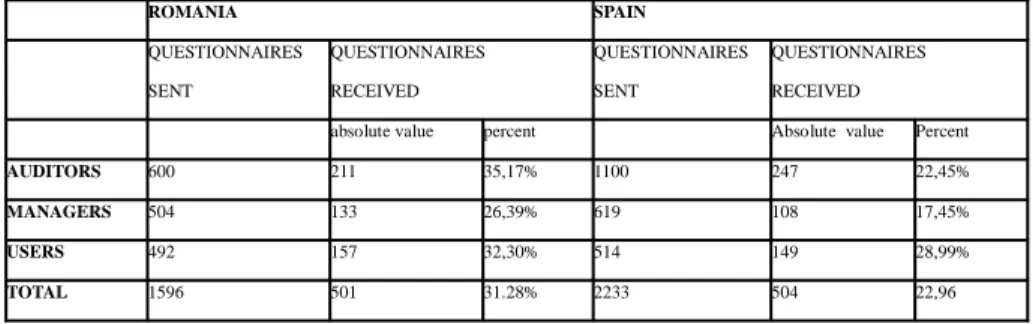
To demonstrate the hypothesis and to reach the objectives of the research we have made an empirical study. The statistical sample was chosen from the financial auditors, financial managers of the audited firms and the users of the audited accounting information from Romania and Spain. The structure of the sample is the following:
Table 1. The total of the statistical sample
ROMANIA SPAIN QUESTIONNAIRES SENT QUESTIONNAIRES RECEIVED QUESTIONNAIRES SENT QUESTIONNAIRES RECEIVED
absolute value percent Absolute value Percent
AUDITORS 600 211 35,17% 1100 247 22,45%
MANAGERS 504 133 26,39% 619 108 17,45%
USERS 492 157 32,30% 514 149 28,99%
TOTAL 1596 501 31.28% 2233 504 22,96 Source: own processing
The questionnaire addressed to the three groups from the two countries, which was translated into both Romanian and Spanish, contains closed questions and has six parts:
-Data relating to the position held by the person questioned – age, sex and number of years experience.
´-Statements about the role of the financial audit; -Statements about the utility of the financial audit; -Statements about the independence of the financial audit; -Statements about the audit report;
- An open question about what the interviewee considers the most important problem currently with the financial audit.
To make it easier for the person who fills in the form and to be able to quantify the answers, we limited the answers to five, on a value scale from 1 to 5, according to Likert Scale, where 1 represents the maximum level of agreement, 5 represents the maximum level of disagreement, 3 represents the neutral value and 2 and 4 intermediate values of agreement and disagreement. Only one answer is to be chosen.
The answers have been centralised by an informatics Excel programme, specially designed for it and interpreted with the help of econometric models Kruskal Wallis and Mann Whitney, which have shown whether the differences for each statement of the questionnaire between the three involved categories are significant or not.
Based on the results obtained, tables were made which allowed the global interpretation of the results and facilitated the building of the model of the differences of perspectives on and expectations of the role, utility and independence of the financial audit.
“The model is an isomorphic representation of the objective reality and represents a simplified and fundamental description for the logical structure of the system, phenomenon or the process which it represents, which facilitates the discovery of some connections and laws very hard to find using other ways” (Păun and Hartulari, 2004). Also, “the model is a description of a problem situation” (Păun and Hartulari, 2004), in our case the problem being the existence of the differences in perspectives and expectations between financial auditors, the financial managers of the audited firms and the users of the audited accounting information in Romania and Spain, on some themes such as the role, utility and the independence of the financial audit, in the present economic context.
This model has been made by correlating it to the models found in the specialist literature. It represents a personal concept and hopefully something new for the Romanian and Spanish specialist literature.
3. PREVIOUS STUDIES
It is said that periods of economic crises periods lead to an increase in empirical studies regarding the perception and expectations of the users of the audited accounting information. In the last few years at the international level a lot of empirical and comparative studies have been carried out concerning the financial audit.
Firstly, we must remember that the European Commission introduced a comprehensive process of consultations (European Commision, 2010) between the EU member countries on the themes relating to; paperwork of the financial audit, the independence of the auditors, information shared in the audit report, the concentration of the audit market in the Big Four and the problems related to corporate governance.
When we talk about the role and the utility of the financial audit there are researchers which state the fact that if only the financial audit hadn’t been imposed to the firms as a legal obligation but as a voluntary one it could have been proved how appreciated its role is by the firms and users. Other studies sustain the necessity of the financial audit and its regulations by the professional organisms, considering the protection of the users in the capital markets (Humphrey et al, 2009).
Concerning the term “audit expectation gap” there are studies which sustain the necessity of educating the public regarding the limits of the financial audit (Fowzia, 2010; Porter, 2009). In the last few years studies have appeared which debate the role of the financial audit during periods of economic crises. In these, the characteristics of the audit committees from firms affected by the crises and from those which haven’t been affected are analysed (Rahmat et al, 2009) and the challenges and opportunities which crises offer to the financial auditors are exposed (Fraser and Pong, 2009), or a reflection on the actual audit practices is offered, especially referring to auditing new forms of investments and complex financial
instruments (Sikka et al, 2009). Also, based on the information gathered from the managers of some financial institutions, the present financial crises are analysed from the perspective of corporate governance (Haspeslagh, 2010). The most recent is the study, PriceWaterhouse Cooper (2011) which analyses the perception of investors from England on the role and utility of the financial audit in the context of the actual economic crises.
Other studies refer to the fact that the capital market bases its investment decisions on the information offered by the financial auditors, and the delay or poor quality of these can totally influence these decisions (Citron et al, 2008; Phillips and Freeman, 2003). Others demonstrate that punctual presentation of the Audit Report helps to raise the confidence of the investors (Owusu Ansah&Leventis, 2006). Contrary to the studies presented above we do have studies which sustain a very low level of using the information contained in the Audit Report (Lee, 2009).
In Spain we find a series of empirical and comparative studies concerning the same themes. The problem is that, due to the period in which they have been elaborated, they do not have the novelty elements introduced by the Directive 43/2006/CE, nor the problems and the influences of the actual economic crises on the perceptions of the players from the economic arena about the financial audit. Among them we can mention the following: García et al, 1993; Blasco, 1994; Sierra and Orta, 2005; Monterrey and Sánchez, 2007; Manchado, 2008.
I
nvestigate if there are differences between the perspective and expectations of the auditors, the directors of the companies audited and the users of the audit information.In Romania we do not have many empirical studies on themes of financial audit. Although recently, some specialist magazines have appeared, but generally they are few. Some examples might be: Jaba et al., 2011 which refers to the connection and direct effect which the independence of the auditor has on the financial performance of the audit firm; Dobroţeanu et al, 2011, which deals with the role of the external audit and of corporate governance in the credibility of the financial report of the firms; Dobroţeanu et al, 2011, an empirical study about the degradation of the perceptions of a group of students on the problems of audit expectation gap before the start of financial crises and afterwards; The importance of the information offered by the financial audit for managers, investors and financial analysts, Ştefănescu, 2012 – an empirical study which refers to determining the degree of appreciation of the information delivered by the audit report by the users. These few articles study the perceptions or the expectations that different categories have about the financial audit in Romania. What hasn’t been encountered/found at all in the Romanian specialist literature are some comparative studies between Romania and other European countries which study the differences between perceptions and expectations given the current economic crises.
The concept audit expectation gap, was first used by Liggio in 1974, who defined it as a contradiction between the public’s expectations and the job of the auditors. Over time these differences of expectations have been comprised within some models which try to define the term of audit expectation gap. From this perspective we can mention: The Model of the Commission McDonald (Bahr, 2003), which defined the term AEG as a contradiction
between what is expected and what we get from the auditors; Porter model (Porter, 1990), which defines the term AEG as a difference between what the public expects and what the auditors do; Behr model (Behr, 1996), which sustains that the financial auditors and those responsible for the financial situation are responsible for the existent differences Heering model (Heering, 2000) which basis its building on ”reasonable expectations” and “unjustified expectations”.
4. THE MODEL OF DIFFERENCES OF PERSPECTIVES AND EXPECTATIONS ON THE ROLE, UTILITY AND THE INDEPENDENCE OF THE FINANCIAL AUDIT
The modelling process represents a procedure which helps our understanding of some processes or phenomena, which are being produced in a certain field, and it can lead to improving the performances in that field.
In order to elaborate this model, we have looked for the causal connections between the studied elements, with the help of which we have realised a logical construction, based on personal views resulting from the global analysis of the results obtained through the questionnaire. This way, we have grouped similar elements or those having common properties and eliminated those elements with irrelevant properties. Therefore our opinion is that the most suitable definition for the term audit expectation gap is the one given by McDonald Commission (Bahr, 2003) which says that this concept refers to the difference between what is expected from the financial auditors and what we can justifiably expect from those.
The criteria from which we started building this model are: -the legal tasks of the financial auditors; -the tasks that the users are expecting from them;
-the tasks which are imposed in the new actual economic context.
The perspectives mean different “opinions” or “points of view” which the three groups may have of the financial auditors. Our opinion is that the actual perspectives of the three groups influence their future expectations.
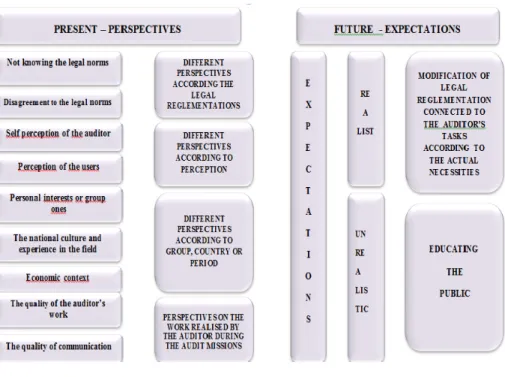
”The Model of the differences of perspectives on and expectations of the role, utility and independence of the financial audit”, looks this way:
Table 2.The Model of the differences of perspectives on and expectations of the roleutility and independence of the financial audit
Source: own processing
As you can see from fig. 2, the analyses of the answers received from the questionnaire have resulted 8 main causes which determine different types of perspectives from the three groups. These causes are:
- Not knowing the norms connected to the tasks of the auditors; -Disagreement with the legal norms;
-The auditor’s perception of his own activity;
-The users’ perception of the activity carried out by the financial auditors; -The personal or group interests of the persons questioned;
-The national culture or experience in the field of audit; -The current economic context;
-The quality of communication of the mission’s results by the financial auditor. In our opinion, these 8 causes determine 4 types of differences of perspectives namely: - Differences of perspectives on the legal norms;
- Differences of perspectives according to perception;
- Differences of perspectives according to the group, country or period;
-Differences of perspectives on the work carried out by the financial auditor during the audit mission.
All these differences of actual perspectives determine future different expectations, different “expectations” of the users of audited accounting information and of the financial auditors. These expectations can be realistic or non-realistic. Therefore the model offers two types of solutions, to these expectations:
-Where expectations are realistic, but the expected tasks are not comprised within the actual legal norms of the financial auditors, we propose the modifying of the legal norms of agreement with the actual necessities;
-Where expectations are non-realistic we propose educating the public, so as to reduce those differences between the perspectives and expectations.
Next we will present a part of the questionnaire results which lead to establishing the 8 causes which determine the different perspectives from the three studied groups:
a) Not-knowing the legal norms
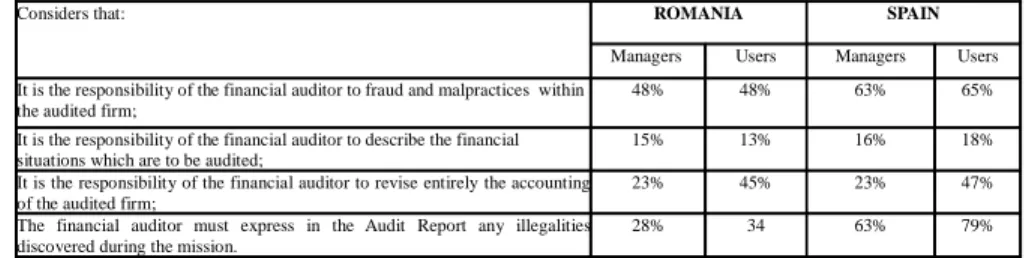
The results of the questionnaire demonstrate that some of the financial managers of the audited firms and the users of the accounting audited information do not know legal regulations connected to the tasks of the financial auditors. From this perspective we will present the following percentages:
Table 3. Not-knowing the legal norms
Considers that: ROMANIA SPAIN
Managers Users Managers Users It is the responsibility of the financial auditor to fraud and malpractices within
the audited firm;
48% 48% 63% 65% It is the responsibility of the financial auditor to describe the financial
situations which are to be audited;
15% 13% 16% 18% It is the responsibility of the financial auditor to revise entirely the accounting
of the audited firm;
23% 45% 23% 47% The financial auditor must express in the Audit Report any illegalities
discovered during the mission.
28% 34 63% 79%
b) Disagreement with the legal norms
As it will be shown in the presentation of the following percentages, some of the financial managers of the audited firms and the users of the audited accounting information express disagreement with the legal norms which establish the tasks of the auditors:
Table 4 Disagreement with the legal norms
Declare that would extend the work of the auditor so that to allow him to state an opinion on:
ROMANIA SPAIN
Managers Users Managers Users Efficiency of the management of the audited firm 31% 46% 34% 50% The future evolution of the audited firm; 50% 34% 67% 47% Profitability of the audited firm; 25% 23% 41% 39% Solvency of the audited firm. 59% 29% 64% 40%
Source: own processing
Disagreement to the legal norms refers to the fact that the Audit Standards are not being adjusted to the actual needs of the users, so that the results of the audit missions cause a perception discrepancy. Here we could refer to the fact that the users of the audited accounting information expect “detecting fraud and irregularities in the audited firm something that is not stated in the Audit Standards as a responsibility of the auditor, that “the managing of the firm is adequate or that the firm is solvent are important aspects for the users in these strong economic crises conditions.
There is an important percentage of the users of the audited accounting information who openly expressed dissatisfaction regarding the role and the objectives of financial audit, which are in fact very well described in the Audit Standards. At the same time these have declared themselves as being the sustainers of extending the work of the auditor, therefore of the statements of the standards, so that their work to be in agreement to the actual necessities of the users.
Still as an observation to the statements of the Audit Standards are the users answers which state the fact that the Audit Report is excessively standardised or that it uses a very technical language. The structure of the Audit Report is described in much detail in ISA 700 or in the Technical Norm on the Audit Report from Spain, where the compulsory terms or phrases to be used are specified.
The two causes presented so far, not-knowing the legal norms or disagreement with them, lead to the existence of the differences of perspectives on the legal norms.
c) The users’ perception of the financial auditors’ work
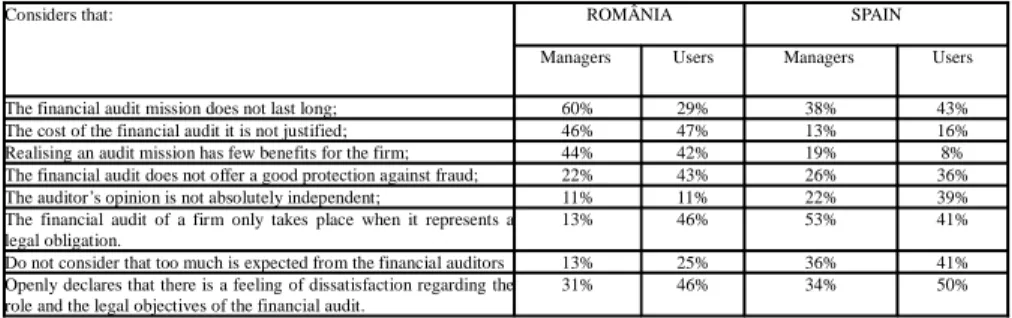
Some of the financial managers of the audited firms and some of the users of the audited accounting information from Romania and Spain have shown pretty negative perceptions of the themes in thequestionnaire. For example:
Table 5. The users ‘perception of the users of the financial auditors’ work
Considers that: ROMÂNIA SPAIN
Managers Users Managers Users The financial audit mission does not last long; 60% 29% 38% 43% The cost of the financial audit it is not justified; 46% 47% 13% 16% Realising an audit mission has few benefits for the firm; 44% 42% 19% 8% The financial audit does not offer a good protection against fraud; 22% 43% 26% 36% The auditor’s opinion is not absolutely independent; 11% 11% 22% 39% The financial audit of a firm only takes place when it represents a
legal obligation.
13% 46% 53% 41% Do not consider that too much is expected from the financial auditors 13% 25% 36% 41% Openly declares that there is a feeling of dissatisfaction regarding the
role and the legal objectives of the financial audit.
31% 46% 34% 50%
Source: own processing
d) The financial auditor’s perception of his own work
In the current economic context we can say that the financial auditor’s perception of his own work has modified/changed. The answers from the questionnaire demonstrate a series of surprises from this perspective: 16% of the financial auditors in Romania and 29% in Spain do not consider that the users of the audited accounting information expect “too much” from them.
Also, 43% of the financial auditors in Romania and 34% in Spain are aware and admit the fact that there is a feeling of dissatisfaction from the users of audited accounting information regarding the role and the legal objectives of the financial audit.
So, 26% of the financial auditors in Romania and 43% from Spain think that the financial audit is realised “only” if it represents a legal obligation, the financial audit market falling continuously in the actual economic crises, and 21% of the financial auditors in Romania and 28% from Spain admit that they wish to satisfy the management of the audited firms in order to maintain their clients.
In these conditions, more and more auditors give up at the tasks of the users of the audited accounting information to extend the area of the legal attributions:
Table 6. The financial auditor’s perception of his own work
Accepts the spread of its attributions connected to the pronunciation on the : AUDITORS IN ROMÂNIA AUDITORS IN SPAIN
Efficacy of the firm management; 19% 35% The future evolution of the audited firm; 23% 40% Profitability of the audited firm; 30% 36% Solvency of the audited firm 30% 40% Will express in the audit report any kind of irregularity observed during the
development of the firm;
37% 30%
Source: own processing
If we speak about accepting new tasks from the financial auditors, we have to note that 65% of the financial auditors in Romania and 33% of the financial auditors in Spain consider that carrying out an audit mission in general takes a long time. This presents a contradiction which worth explaining. Accepting new attributions would mean introducing new stages,
therefore it means that the audit mission should last longer, a fact which would determine new costs for the users, a which is also a sensitive issue. This leads to negotiation between the interested groups, to reduce the present and future differences in perspective and expectations.
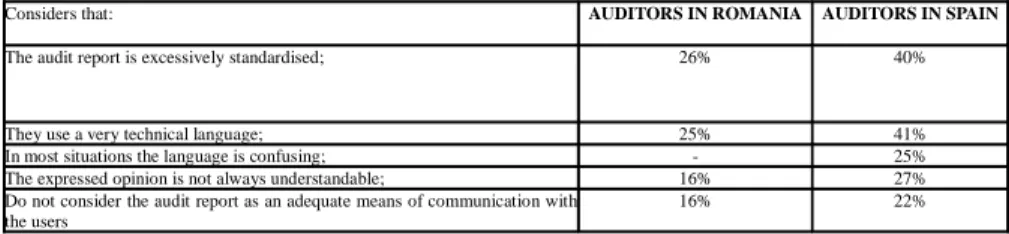
If we refer to the financial auditor’s perceptions of the Audit Report, which represents the result of the work developed by them, we notice that:
Table 7. The perception some of auditors on the audit report
Considers that: AUDITORS IN ROMANIA AUDITORS IN SPAIN
The audit report is excessively standardised; 26% 40%
They use a very technical language; 25% 41% In most situations the language is confusing; - 25% The expressed opinion is not always understandable; 16% 27% Do not consider the audit report as an adequate means of communication with
the users
16% 22%
Source: own processing
All the percentages connected to the auditors’ perceptions of their own work demonstrate that, though most of the financial auditors do not accept new tasks or consider the audit report as being an adequate means of communication with the users, there are more and more voices who, due to the new economic context understand the real necessities of the users and accept the expectations.
In our opinion, all these users’ perceptions of the work carried out by the financial auditors and the financial auditors’ perceptions of their own work, determine the differences of perspectives according to perceptions, presented inside the Model.
e) Personal or group interests
As we have shown inside the Model, one of the causes that determines the perspective differences between the three groups that have participated in the study are the personal or group interests of the persons interviewed. These appeared mostly in the statements connected to the auditors’ independence.
For example, the users of the audited accounting information are very interested in getting an independent opinion on the financial situations from the financial auditors. The majority of the users do not accept any kind of additional services from the auditors for the firms they audit.
Table 8. The polarisation of the answers from the financial managers and from the users of audited accounting information, according to the group interests
Financial MANAGERS USERS ROMANIA SPAIN ROMANIA SPAIN
DO NOT AGREE AGREE
Establishing a maximum working period at one firm for the auditors 56% 45% 49% 77% Limiting the earnings of the auditors from a single audited firm; 61% 45% 41% 47% It should be necessary for the financial auditors to be named and their
fees to be fixed by an independent organism;
67% 9% 39% 56% The prohibition of shareholding by the partners of the audit mission. 64% 57% 59% 79%
Source: own processing
Regarding the “other services” apart from the financial audit of the audited firms it can be noticed that the financial managers accept the financial auditors doing other services, whereas the users do not accept it, believing that this way the independence of the auditors will be affected.
The position of the financial auditors is different from the position of the users and that of the financial managers of the audited firms. 75% of the financial auditors in Romania and 72% from Spain declare themselves in favour of doing another type of services for the firms that they DO NOT audit, and 56% of the financial auditors in Romania and 64% from Spain DO NOT think that it is necessary for the auditors to be appointed and especially their fees to be fixed by an independent organism.
In the following cases we notice how a good part of the financial auditors accept the legal regulations that are imposed on them: 27% of the auditors in Romania and 51% from Spain agree on the limitation of the auditors earnings from a single audited firm, 40% of the auditors in Romania and 45% from Spain agree on fixing a maximum period of exercise for the same firm, and 47% of the auditors in Romania and 66% from Spain agree on the prohibition of owning shares in the audited firm.
f
) The national culture or experience in the financial audit fieldAs a result of analysing the results of the questionnaire we noticed that the national culture or experience during the years in the field of financial audit in a country has a great influence on the professionals’ experience. For example, 43% of the financial auditors in Romania agree on the fact that the financial audit is ONLY being done when it represents a legal obligation. In Spain the situation is different, as 44% of the financial auditors DO NOT agree on this statement while 72% of the financial managers express NO opinion.
We notice that in Romania almost half of the financial auditors are convinced that the financial audit is only carried out if it represents a legal obligation, and the rest are unconvinced or undecided, and in Spain almost half are convinced that the financial audit is carried out even if it does not represent a legal obligation, the others expressing no opinion or disagreement. The statistics from this country show that 24% of the total of the audits carried out are voluntary (a significant percent), and the rest represents a compulsory audit. In Romania we did not find any statistic which would separate the voluntary audit from the
compulsory one, but according to the financial auditors opinion there is a feeling of dissatisfaction towards the attitude of the firms regarding the voluntary audit. We notice that 46% of the financial managers in Romania declare that they call for the services of the audit only if it is compulsory, while in Spain only 13% from the financial managers state this thing. In Romania this feeling that the audit is necessary will be won in time. Now it is still seen as something new, having a role and objectives still unclear.
To our knowledge in Romania “the legal obligations” are still important the fact that it is compulsory and imposed. If there is a law no one talks much about it, they simply apply it. The role and the power of the state are not questioned or contested as they are in Spain. In Spain it seems that as well as the role of the state, there is also the role of the “market economy”, of democracy. The citizens and professionals are accustomed to clearly expressing
their dissatisfactions and needs and are listened to. This is the reason the polarisation of the answers in Spain is higher than in Romania. The financial auditors are not giving up the rights they have and the already established tasks. In Spain, the financial managers and the users of the audited accounting information are more vocal than in Romania, in demanding change in the tasks of the financial auditors according to the new economic context and their new needs. It is a country where the democratic laws function, and the political powers represent the needs of the citizens.
To support to our statements are the answers of those questioned when referring to “who” uses the audited accounting information. During the research we have realised a hierarchy of the users of the audited accounting information in the two countries. In Romania the state occupies fourth place as a user of the audited accounting information, while in Spain the state occupies seventh places. In public opinion is in first place, where as in Romania it is only in third place. From this, we ascertain the fact that in Spain the role of the State is to support public opinion and serve public opinion, while in Romania it seems that the role of the citizens is only to apply the laws imposed by the state.
Another aspect that comes from the analyses of the answers of the questionnaire is the one referring to increasing the compulsory auditing limits. 79% from of the financial auditors in Romania want an increase in the compulsory auditing limits, and 59% of the financial auditors in Spain do not want this. These figures demonstrate once again the maturity of the audit market in Spain. Though in this country the compulsory audit limits are lower than in Romania, the power of buying is bigger and the firms reach these limits more easily and they do not want them to increase. In Romania, although the compulsory limits are higher, the power of buying is lower, so the firms reach the limits with more difficulty, the financial auditors in Romania want them to rise.
From this comes the idea that in Romania the benefits that the financial audit has for the audited accounting information and for the economic environment in general are unknown, necessitating public education from this perspective.
g) The current economic context
The economic situation at a global level is strongly affected by the internationalisation of the economic exchanges, by the “globalisation of the old national economies and the growth of the importance of the financial markets” (Florea et al, 2008).
Due to the financial scandals which started around 2000 in the United States and then continued in Europe, the users of the audited accounting information have lost confidence in the audited financial situations. ”they talk about an international situation of losing confidence in the informing systems” (Florea et al, 2008). In most cases the image of the auditors has been associated to the failures, a fact which has depredated the perceptions of the users of audited accounting information regarding the ethics of the financial users. Then in 2008 the current world economic crises started extending quickly all around the world. At the international level there are studies which state the effects of the economic crises on the perceptions of the financial auditors. One such study is that of the firm Price Waterhouse Cooper (2011), which underlined the fact that the investors need a higher level of assurance from the auditors, clear information about the companies that the auditors audit plus extra information on the going concern, on the financial performance, corporate governance and strategic staff of the audited firm. It clearly states a redefinition of the profession of the auditor giving solutions such as: the possibility that the users of the audited accounting information be able to contact with the auditors to be able to ask details about the audited financial situations, the possibility that the financial auditors to meet repeatedly with the shareholders of the firm and the committee of the audit during the mission and there are proposals connected to the way of reporting the mission’s results in a less rigid form , imposed or in the form of marks, the same as the rating agents. Also, there is a need for attention in view of new more complex financial products and of a better transparency of the operations.
In the current economic context the role and utility of the financial audit has become a controversial theme. The differences of perspectives and expectations are highlighted as the users’ have lost confidence in the auditors work, and their independent image has suffered. The economic conditions tempt the financial managers to distort the financial situations, a fact that makes it harder for the financial auditors to give a “reasonable assurance” that the financial situation presents “a clear image” of the audited firm.
The three causes presented- the personal or the group, the national culture and the experience in the field and the current economic context- determines the so-called differences of perspectives according to the group, country or period.
h) The quality of the work carried out by the financial auditor
The quality of the work carried out by the financial auditor during the mission refers to the actual activity undertaken by the auditors, to their respecting the International audit Standards of the norms of the Ethical Code, and to theirrespecting the quality norms during the audit missions.
The truth is that the statements from this questionnaire referred less to these aspects, as we consider that they refer to particular concrete cases, and not to general perceptions, which is
what we are analysing.
A statement which refers in a certain way to the aspects connected to the quality of work carried out by the auditors is that the financial auditor will bring an added value to the audited society. It is supposed that if the financial auditor acts according to the International Standards, the Ethical Norms and the International Quality Standards a correct and credible audit mission will result. Respecting these Standards supposes the fact that the auditor has respected the moral and professional legal attributions, so the audited accounting information is more credible, and the users can take decisions based on it with a lot more confidence.
According to this perspective 80% of the users in Romania and 65% in Spain agree that the financial audit brings “added value” to the audited firm. From this, we can state the fact that for the majority of users of audited accounting information there is the belief that the work of the financial auditors at the mission level is positively appreciated.
i) The quality of communication
Table 9. The perception of the audit report
Considers that: ROMANIA SPAIN
Managers Users Managers Users
The audit report is excessively standardised ; 12% 59% 25% 67% The language that the auditors use in the report is very technical 17% 61% 23% 48% The language that the auditors use in the report is very unclear; 26% 6% 19% 26% The expressed opinion in the audit report is NOT understandable; 16% 7% 16% 17% The objective of the audit is not very clearly expressed in the audit report; 8% - 18% 11% The audit report IS NOT a good means of communication with the users 11% 50% 22% 25%
Source: own processing
From the percentages shown, we can deduce that some of the users have negative perspectives on the work realised by the financial auditors, both in developing the mission and in presenting the results of the mission in the audit Report. The causes which produce the differences of perspectives on the work carried out by the auditor during an audit mission can be the financial auditors who during the mission do not respect certain standards or legal norms or can be due to the legal regulations that establish very strictly the form and content of the audit report.
As we have shown, the four categories of actual perspectives determine future expectations different from those of the users of audited accounting information. These expectations can be realistic or non-realistic.
In our opinion the realistic expectations are those “expectations in accord with the legal regulations and also the “necessary expectations” owing to the changes that have been produced by the economic context. The role of the financial auditor must change continuously, in step with the economic, social or political environment. The “social” role of the financial audit must not be forgotten. The objectives of the discussions on “audit expectation gap” are those of “leading towards an evolution of the role of the auditor and his concrete tasks” ( urlea et al, 2012).Ț
The non realistic expectation is the “expectations” of the financial managers of the audited firms and of the users of the audited accounting information towards the possible performances of the auditors. The problem is that the expectations of some of the financial managers are connected to the “making of financial situations” or the “keeping the accounting at the audited firm” by the auditors, aspects which are impossible given the conditions of respecting the Professional Ethics Code, and the expectations of some users of audited accounting information are connected with aspects such as “detecting the fraud and irregularities”, “the way of managing the audited”, “the solvency of the audited firm”,“the profitability of the audited firm” or “expressing in the audit Report any kind of irregularity noticed during the development of the mission”.
What we have to state is that all expectations – both the realistic and the non-realistic ones have only been expressed in a moderate form in Romania and in Spain, inviting discussions and negotiation with the auditors as to a way of accepting new responsibilities from them. We also have to note the fact that the answers of some of the financial auditors indicate the fact that in their opinion they accept the need for negotiation of new responsibilities, due to understanding the new economic context and also the social role of the financial audit.
5. CONCLUSIONS
By presenting a selection of the results obtained by a questionnaire, we consider that the hypothesis, from which this research started, namely the fact that differences in perspectives and expectations between the financial auditors, financial managers of the audited firms and the users of the audited accounting information in Romania and Spain concerning the role, utility and the independence of the actual financial audit exist, has been demonstrated. Therefore with the help of the model we have determined four types of perspective differences, including the causes that lead to their appearance. The Model itself proposes solutions to reduce the differences in perspectives and expectations: therefore, in the case of realistic expectations, it recommends taking measures to educate the public about the real tasks of the auditors. It is necessary a to create a bond between these two points - what the financial auditor does and what the users think he should do.
We consider that the validation of the Model is given by the “explicit force of the obtained construction” (Iona cu,ș 2007) and by the results of the questionnaire that have lead to proposing the two solutions which partially are the same as the European Commission proposal presented in the work Document of the Commission Services (2011). The main objective of the European Commission is related to the current economic crises and to the crisis of confidence in the audit profession, being that “to contribute to the efficient functioning of the financial markets and the non-financial ones by consolidating the market role of the profession of auditor”. One of the most difficult problems stated by the Commission is the ”discrepancy between expectations and reality” which there is between the interested factors of the financial audit .In order to obtain the general objective the Commission proposes specific objectives which are the same to the solutions proposed by our model.
The first solution of the model built by us is “modifying the legal regulations connected to the auditors tasks according to the actual needs”, and the specific objectives of the Commission refer to:
-“Redefining the domain of the statutory audit in order to eliminate the discrepancy between the expectations and reality” and proposes “options of improving the information given by the auditor to the users” withthe help of the audit;
-”The consolidation of the independence and of the professional scepticism of the statutory audit and of the audit societies”, proposing from this perspective “options of reducing the risk of appearance of some possible conflicts of interests due to other services different from the audit ones”, “options of reducing the risk of appearance of some possible conflicts of interests due to the current system in which “the entity selects and pays the auditor”,” and “options of reducing the risk of appearance of some possible conflicts of interests due to “the danger of familiarisation”.”
The second solution of our model refers to “educating the public” by a better informing of it on the real tasks of the auditor and on the results of the auditor work, to give confidence in the auditor job and the audited financial information. In this perspective the European Commission specifies in the same document that there “is a clear lack of communication between the auditors and surveillance authorities” and proposes “options of improving the channels of communication between the auditors and the surveillance authorities” of the firms or “improving the communication between the auditor and the audit committee”. It is also proposed “a growth of transparency regarding the quality of the audit (publishing the inspection reports) and the audit societies (for example publishing the financial situations of the societies)”. This way we see how the Commission is looking for possibilities of informing the users on the real tasks of the financial auditors and on the quality of work carried out during the audit missions.
We notice therefore how the actual problems of the financial audit in Romania and Spain two European countries which have a different experience in the financial audit domain; reflect in the general problems of the European audit.
“The last two decades have represented a period of great changes in the business environment”(Tabără and Briciu, 2012) and therefore the financial audit couldn’t remain unchanged. On the contrary it had to be a step ahead, to give confidence in the transactions developing on the market. ”The XXIst century is considered, as being the century of the performance revolution in which will dominate the management and the audit of the performance…”(Tabără and Briciu, 2012). The phenomenon of globalisation and the world economic crises which started in 2008 have influenced and will influence the structure and the content of the legislation concerning the financial audit.
References
Bahr, A. (2003). Vertrauen in Wirtschaftsprufer. Konzeptioneller Bezugsrahmen fur eine realwissenschaftliche Teorie der Rewartungsluke, University Verlag, Germany, quoted by Țurlea et other, 2012
Blasco, J. (2004). El informe de auditoria: expectativas, Partida Doble, nov.2004, page 22-26
Block, C. (2011). Die Performance Gap des Abschlussprufers, Gabler Verlag, Ț
Wiesbaden, 2011, quoted by urlea et other, 2012
Behr, G. (1996). Expectation Gap – Rolle der Rechnungslegung, Der Schweizer
Treuhander 7- 8, page 539-546, quoted by urlea et other, 2012 Ț
Cernea, O., Ştefănescu, C. (2012). The importance of the offered information by the financial Audit for the managers, investors and financial annalists, Financial Audit
Magazine, January 2012, 42-50.
Citron, D.B., Taffler, R.J., Uang, J.Z. (2008). Delays in reporting price – sensitive information:The case of going concern, Journal of Accounting and Public Policy, nr. 27, 19-37
Directive nr. 2006/43/CE of the European Parliament from May 17th 2006 which refers to the legal audit of the financial situations and annual consolidated accounts, which modify
the Directives IV-a and VII and erases Directive 84/253/CEE, published in the Official. Journal of the European Union nr. 157/9 June 2006
Dobroţeanu, L., Coman, N. and Dobroţeanu, C.L. (2011). The external auditors and the corporative governance under the impact of the financial crises, Financial
Audit magazine, march 2011, 16-26
Dobroţeanu, L., Manea, D. and Dobroţeanu, C.L. (2011). The dynamic of the perceptions regarding the external audit under the impact of the financial crises,
Financial Audit magazine, February 2011, 18-27
European Commision (2010). oct., Green Paper – Audit policy: lessons from the
crisis, http://ec.europa.eu/internal_market/auditing/docs/market/consultation2008/summary
European Commission (2011). authorised contributions to be edited regarding the Green
Book Of the European Commission from October 13th 2010. The audit policy: the crises lessons and the summary of these contributions, accessed on May 3rd 2011 and
available online
http ://ec.europa.eu/internal_market/consultations/2010/green_paper_audit_en.htm
European Commission (2011). The work document of the Commission Services
which Accompanies the Direct Proposal of the European Parliament and Council of modifying The Directive 2006/43/CE of the European Parliament and Council regarding the Financial audit of the annual consolidated accounts and the proposal of
the Regulation of the European Parliament and Council specific disposals referring the statutory audit of the public interest entities, Brussels, 30.11.2011,
http://www.eecs.europa.eu
European Commission (2011). A proposal of Regulation of the European Parliament and of
the Council regarding the specific tasks referring the Statutory audit of public interest entities, Brussels, 30.11.2011, available online
http://ec.europa.eu/internal_market/auditing/docs/reform/directive_ro.pdf
Florea, I., Macovei, I.C., Florea, R., Berheci, M. (2008). Introduction in the accounting
expertise And in the financial audit, The second revised and enlarged, CECCAR,
Bucharest
Fowzia, R. (2010). An empirical Study on Audit Expectation Gap: Role of auditing
Education in Bangladesh, available on line http://mpra.ub.uni-muenchen.de/22708/, MPRA nr. 22708;
Fraser, I., Pong, C. (2009). The future of the external audit function, Managerial
Auditing Journal, Vol. 24, Iss: 2, 104 – 113
García, M.A., Humphrey, C., Moizer, P. and Turley, S. (1993). Auditing expectations and Performance in Spain and Britain: A Comparative Analysis, The International Journal
of Accounting, vol. 28, 281-307.
Haspeslagh, P. (2010). Corporate governance and the current crisis, Corporate
Governance,Volume 10, Issue 4, 2010
Heering, D. (2000). Die Prufung IAS-konformer Konzernabschlusse: Besonderheiten vor
dem Hintergrund der Erwartungslucke bei der Abschlussprufung, Lang, Frankfurt am
Main, zugl. Diss. Universitat Innsbruck, 2000, quoted by urlea et other, 2012Ț
Humphrey, C., Loft, A., Woods, M. (2009). The global audit proession and the international financial architecture: Understanding regulatory Relationship at a time of financial crisis’, Accounting, Organizations and Society, 34(6-7), 810-825
ș
Iona cu, I. (2007). Epistemology of the accounting, Economic publishing House, Bucharest
Jaba, E., Robu, I.B. (2011). Exploring the statistics of the audit market to appreciate the auditor, The financial audit magazine, 06/2011, 28-36
Lee, R.D., Johnson, R.W., Joyce, P.D. (2009). Budgeting the public systems, Jones&Bartlett Learning publishing house, Sudbury, Massachusetts, USA
Law nr. 19 from July 12th 1988 regarding the financial audit from Spain, published in
B.O.E. nr. 169/ July 15th 1988
Liggio, C.D. (1974). The expectation gap: The Accountant’s Legal Waterloo, Journal
of Contemporary Business, nr. 3, vol. 3, page 27-44, quoted by Block (2011)
markets: the case of Portugal, Journal of Accounting and Financas, vol.19, no. 47, may aug., 102-111
Monterrey, J.A., Sánchez, A.(2007). Un estudio empírico de los honorarios del auditor, Cuadernos de Economía y dirección de empresa, no. 32, 81-110
O.U.G. nr. 75/1999 regarding the financial activity of audit from Romania
republished in Official Monitor of Romania nr. 67, august 31st 2002
Owusu, A. S., Leventis, S. (2006). Timeliness of corporate annual financial reporting in Greece, European Accounting Review, no. 15, 273-287
Păun, M., Hartulari, C. (2004). The process of modelling inside the analyses of the
economic systems, chapter IV, availible on line http://www.asecib.ase.ro/Paun/cap4-ads-intern.PDF
Phillips, R., Freeman, R.E., Wicks, A.C. (2003). What stakeholder theory is not,
Bussines Ethics Quarterly, 13(4), 479-502
Porter, B.A. (1990). The Audit Expectation-Performance-Gap and the Roll of External
Auditors in Society, NewZeeland, quoted by urlea et other, 2012 Ț
PriceWaterhouse Cooper UK (2011). Study ”Audit Today and Tomorrow, accessed at http://www.pxc.uk/eng/publications/audit-today-tomorrow-investor-survey.htlm
Rahmat, M.M., Iskandar, T.M., and Saleh, N.M. (2009). Audit committee characteristics in financially distressed and non-distressed companies. Managerial Auditing
Journal, Vol.24, No. 7, page 62
Sikka, P., Filling, S., and Liew, P. (2009). The Audit Crunch: Reforming Auditing,
Managerial Auditing Journal, 24(2), 135 –155
Sierra, G., Orta, M. (2005). La experiencia y el comportamiento ético de los auditores: un estudio empírico, Revista Española de Financiación y contabilidad, vol. XXXIV, no. 126, iuly-septembrie, 731-754
Tabără, N., Briciu S. (2012). Actualities and perspectives in accounting and
market control, Tipo Moldova House, Ia iș
The Economic Committee and Social European (2011). Preliminary Project of the study
„The audit policy”, regarding the Green Book „ The audit policy: the crises lessons”,
debated in the public meeting on April 28th 2011, Brussels, http: //www.eecs.europa.eu The Economic Committee and Social European (2011). regarding The Green Book “The
248/92 from August 28th 2011, http://www.eecs.europa.eu
Ţurlea, E., Ştefãnescu, A., Mocanu, M.A. (2012), Model regarding the discrepancies of perception on the independence in the financial audit, Financial Audit
Magazine, October 2012, 22-29
Țugui, V. (2013). The audit of the financial situations in Romania according to
the European and International tasks, PH Thesis, Târgovi te, available onlineș at http://www.scoaladoctorala.valahia.ro/upload/rezumattugui.pdf
RULES FOR SUBMISSION AND PRESENTATION OF WORK Rules for submission of work
1. Senda copy of the original, along with a CD containing the document in Word, to the Editorial Coordinator or can be sent by email to the following address: Mailing Address for submission of papers:
Working Papers "New trends in accounting and management" Anna Vendrell Vilanova
Editorial coordinator
Department of Business Administration Faculty of Law and Economics c/JaimeII, 73
25001 Lleida (Cappont Campus) Tel: 973 7032 22
Fax: 973 7033 43
E-mail: [email protected]
In separate sheet must state the name of the author/s by the institution to which he belongs currently. In addition, must provide the contact postal, telephone and electronic mailing of first or one author.
All papers will be evaluated by the committee or persons appointed by the committee. 2. As an international publication are accepted in other languages, mainly
English, Castilian and Catalan.
3. The Editorial Committee may accept other items as notes, communications, papers, abstracts of contributions, book reviews, which should not exceed 15 pages.
4. The submitted works will review anonymously.
5. Written reply will be given on the evaluation of the article for acceptance, acceptance with suggestions or rejection.
6. By submitting work for evaluation, the author agree transfer the copyright to: Working Paper "New trends in accounting and management ", for publication in print and/or electronically.
7. At least will be published one working paper annually.
Standards of presentation and style of work
1. The maximum length of the work will be 36 pages, including graphics on them, figures, pictures, tables, footnotes, appendices or annexes and literature. The first page will contain the title, name and affiliation of the author/s, an abstract of 200 words or less, and multiple keywords (4 to6).
2. The abstract should be in English and in the original language. The abstract shall indicate the nature of the document (if it is a product of research, reflection, or a review of a topic), objective of the document (which seeks the document),the methodology research and the main conclusion of the document or evidence. Also keywords must appear in English and the original language.
3. It used single-spaced, Times New Roman, size 12 and margins of 3cm (top, bottom, left and right). For notes as footnotes: single-spaced, Times New Roman, size 9.
4. In the final part of the article, the literature and other sources used in order alphabetically by author or, failing that, by title, other wise respecting the guidelines for references to footnotes.
5. The headings of the article is structured in the manner shown below, placing the mat the beginning of the line, without bleedingin any text you want follows:
1.CAPTIONSINCAPITAL LETTERS 1.1. Subheadings in boldlower case
1.1.1. Paragraphsin italics
1.1.1.1. Subsections in normal letters
6. Tables, charts, graphs and figures should be numbered consecutively with arabic characters, carrying a concise heading and footnotes explaining the symbols and clarifications, referring to the text as Table 1, Chart 1, Graph 1, Figure 1. Mathematical expressions are listed in the right margin.
7. References appointments are entered foot notes and listing shall be continuous (not to be by chapters).
8. The bibliographical references cited in the text of the work will be presented in two ways, depending on the context and the wording of the paragraph to include: a)indicating in brackets the name of the author/s, followed by the year and page number, for example: (Hall, 1946, p. 23) or (Stiglitzet al., 1986, p. 25-35).
b) Identifying the author's name and, in parentheses, the year, for example: Rodriguez (1956) or Ruiz and others (1996) or Ruiz, Martin and Aldin (1976).
for example: (Hall, 1946, p. 23) or (Stiglitzet al., 1986, p. 25-35).
9. References are ordered alphabetically put after work, and chronologically in the case of several works by the same author. They put in italics the name of thereview and the title of the books. The score and the order will be adjusted to the following models: •Journal articles:
Berger, A. and Udell, G., (1992): "Some Evidence on the Empirical Significance of Credit Rationing", Journal of Political Economy, vol. 100,(5), pp. from 1047 to 1077.
• Books:
Brealey, R. and Myers, S. (2003): Principles of Corporate Finance, McGraw-Hill (ed.), Madrid.
•Book chapters:
Rymes, T. K. (1990): "On the publicness of Fiat Money", in A. Asimakopulos, R.D. Cains and C. Green[ed.]: Economic Theory, Welfare and the State, p. 409-420. London: Macmillan.
•Technical reports, communications and working papers:
Ministry of Industry and Energy (1992): Statistical mining of Spain, 1974-1991. Madrid: Ministry of Industry and Energy.
Aybar, C.etal., (2000): "Emerging Approaches around the Capital Structure: The Case of SMEs", Finance Forum VIII. Spanish Finance Association (AEFIN). Madrid, pp. 1-29. Narula, R. and Hagedoorn, J. (1997): Globalization, Organisational Modes and the Growth of International Strategic Alliances. (Working Paper 97-017). Maastricht: Maastricht Economics Research Institute on Innovation and Technology (MERIT).