HAL Id: hal-01403967
https://hal.inria.fr/hal-01403967v2
Submitted on 14 Dec 2016
HAL
is a multi-disciplinary open access
archive for the deposit and dissemination of
sci-entific research documents, whether they are
pub-lished or not. The documents may come from
teaching and research institutions in France or
abroad, or from public or private research centers.
L’archive ouverte pluridisciplinaire
HAL
, est
destinée au dépôt et à la diffusion de documents
scientifiques de niveau recherche, publiés ou non,
émanant des établissements d’enseignement et de
recherche français ou étrangers, des laboratoires
publics ou privés.
Energy-Efficient Service Function Chain Provisioning
Nicolas Huin, Andrea Tomassilli, Frédéric Giroire, Brigitte Jaumard
To cite this version:
Nicolas Huin, Andrea Tomassilli, Frédéric Giroire, Brigitte Jaumard. Energy-Efficient Service
Func-tion Chain Provisioning. [Research Report] RR-8980, Inria Sophia Antipolis; Université Côte d’Azur;
Cnrs; Concordia University. 2016, pp.15. �hal-01403967v2�
ISSN 0249-6399 ISRN INRIA/RR--8980--FR+ENG
RESEARCH
REPORT
N° 8980
November 2016 Project-Team CoatiEnergy-Efficient Service
Function Chain
Provisioning
Nicolas Huin, Andrea Tomassilli, Frédéric Giroire, and Brigitte
Jaumard
RESEARCH CENTRE
SOPHIA ANTIPOLIS – MÉDITERRANÉE
2004 route des Lucioles - BP 93 06902 Sophia Antipolis Cedex
Energy-Efficient Service Function Chain
Provisioning
Nicolas Huin
∗, Andrea Tomassilli
∗, Frédéric Giroire
∗, and
Brigitte Jaumard
†Project-Team Coati
Research Report n° 8980 — November 2016 — 15 pages
Abstract: Network Function Virtualization (NFV) is a promising network architecture con-cept to reduce operational costs. In legacy networks, network functions, such as firewall or TCP optimization, are performed by specific hardware. In networks enabling NFV coupled with the Software Defined Network (SDN) paradigm, network functions can be implemented dynamically on generic hardware. This is of primary interest to implement energy efficient solutions, which imply to adapt dynamically the resource usage to the demands. In this paper, westudy how to use NFV coupled with SDN to improve the energy efficiency of networks. We consider a setting in
which a flow has to go through a Service Function Chain, that is several network functions in a specific order. We propose a decomposition model that relies on lightpath configuration to solve the problem. We show that virtualization allows to obtain between 30% to 55 % of energy savings for networks of different sizes.
Key-words: Network Function Virtualization, Service Function Chains, Software Defined Net-works, Energy Efficiency, Optimization, Column Generation.
∗N. Huin, A. Tomassilli, and F. Giroire have been partially supported by ANR program
ANR-11-LABX-0031-01 and Mitacs.
†B. Jaumard was supported by a Concordia University Research Chair (Tier I) and by an NSERC (Natural
Affectation économe en énergie de chaînes de services
Résumé : La virtualisation des fonctions réseaux (NFV) est un concept d’architecture réseaux prometteur pour réduire les coûts opérationnels. Dans les réseaux traditionnels, les fonctions réseaux, comme un firewall ou un optimisateur TCP, sont effectués sur des équipements spé-cifiques. Dans les réseaux permettant la NFV ainsi que les réseaux logiciels (Software Defined Networks), les fonctions réseaux peuvent être implémentée dynamiquement sur des équipements génériques. Cela est très prometteur pour mettre en pratique des solutions efficaces en énergie qui implique une adaptation dynamique des ressources aux demandes. Dans ce paper, nous étudions comment utiliser les technologies NFV et SDN pour améliorer l’éfficacité énergétique des réseaux. Nous considérons un cadre dans lequel un flôt doit passer au travers d’une chaîne de fonctions de service, c’est-à-dire par une séquence de fonctions réseaux dans un ordre donné. Nous proposons un modèle de décomposition pour résoudre le problème. Nous montrons que la virtualisation permet d’obtenir entre 30 et 55% de gains énergétiques pour des réseaux de différentes tailles.Mots-clés : Virtualisation des fonctions réseaux, Chaînes de fonctions de service, Réseaux logiciels, Efficacité énergétique, Optimisation, Génération de Colonnes
Energy-Efficient Service Function Chain Provisioning 3
1
Introduction
Nowadays, network operators are trying to reduce their operational costs by smartly upgrading their networks. To this end, two recent paradigms are particularly promising: Software Defined Networks (SDNs) and Network Function Virtualization (NFV). SDN decouples the data plane from the control plane, and puts the intelligence into a centralized controller. This allows the deployment of advanced dynamic protocols and, thus, a finer network optimization based on metrology data, regularly collected by network nodes and sent to the controller.
For security and efficiency reasons, network flows have to go through a number of network functions. Examples of network functions are firewall, load balancers, Video Optimizer Con-troller,... Network functions are traditionnally implemented on specific harware. This leads to inefficiency as the hardware is provisionned for peak traffic. The principle of the NFV paradigm is to virtualize the functions to obtain Virtualized Network Functions (VNFs). This allows to implement these functions on generic hardware. Coupled with SDN, VNFs can be installed dynamically when needed, at the best position in the network, at the best time, and for only the adequate traffic. This allows a reduction of hardware cost (Capex) and of operational cost (Opex).
One of the important operational cost is the energy used by the nework. With the sharp increase of Internet traffic, networks have to be more energy efficient [1]. To this end, Energy-Aware Routing solutions have been proposed, see e.g. [2, 3]. The principle is to aggregate traffic on a number of network equipements as small as possible, in order to turn off the unused ones. SDN and NFV will allow to put the proposal into practice by enabling dynamic routing and network function provisionning.
In this paper, we explore the potential of network virtualization to reduce network energy consumption. We consider a setting in which a network flow has to go through aService Function Chain (SFC), that is an ordered sequence of VNFs. We study the problem of minimizing network
energy consumption, while satisfying at the same time the link and node capacity constraints and the SFCs constraints. We call this problem the Capacitated Energy Efficient Service Function Chain Provisioning Problem (EE-SFCP),
Several optimization models were proposed in the litterature to solve the problem of SFC-provisioning. [4, 5, 6, 7, 8]. However, these works do not consider the minimization of the network energy consumption under a dynamic traffic. In [9], we introduce a new Integer Linear Program to model the problem of Energy-Efficient SFC provisioning and a heuristic algorithm to solve large instances. However, no garantees are provided on the heuristic algorithm efficiency. In this paper, we remedy this limitation by comparing it with a decomposition model. Our contributions are the following:
• We propose a column generation model to solve the problem of EE-SFC-provisioning on large instances.
• The energy-efficiency problem is a difficult optimization problem. As a matter of fact, it contains a sharp On-Off phenomena, as a network device consumes a large portion of its energy as soon as it is used, even if very lightly used. We thus discuss several variants of the model to reduce the integrality gap.
• We use the decomposition model to carry out extensive simulations on network of different sizes. We show that between 30% to 55% of energy can be saved while respecting the constraints of the service chains.
• We compare the results obtained from the decomposition model to the one of Green-Chains. The decomposition model succeeds in finding better solutions than the heuristic
4 Huin & Tomassilli & Giroire & Jaumard
algorithm. However, the results are not very far. This validates the heuristic algorithm, which finds solutions not far from optimal for an important number of cases.
2
Statement of the Problem: SFC and VNF Placement
2.1
Notations
We assume the network to be represented by a directed graphG= (V, L), whereV is the set of
nodes (indexed byv) and L is the set of links (indexed by `). Each nodev ∈V has a a set of
compute, storage and network resources denoted by Cv to host network functions. Within the
cope of this study, we will assume that the resources are described by a given number of cores. Traffic is described by a set of demand requests D, in which each demand dis defined by a
3-tuple(vs, vd, c), wherevs is the source of the demand,vd its destination, andc the requested
service chain. Let Dc
sd be the bandwidth requirement of demand d. Indeed, each demandd is
associated with a given application, which is required to pass through a given service function chain (SFC), i.e., a sequence of virtual functions. Let Dc
sd be the bandwidth requirement of
demandd.
LetF be the overall set of virtual functions arising in the service chains, indexed byf, and C be the set of service chains, indexed by c. Each service chain c corresponds to a sequence
of nc functions f1c, . . . , fic, . . . , f c
nc, where f
c
i denotes the ith function of chain c. Note that
some functions may appear more than once in a given chain and that for various reasons (e.g., resiliency, privacy), two different functionsf and f0 may not be allowed to be installed in the
same node. Each virtual functionf has its one resource requirement and we denote by∆f the
number (fraction) of cores required by functionf per bandwidth unit.
The Energy Efficient Service Function Chain Provisioning (EE-SFCP) consists in jointly
provisioning a set D of demand requests coupled with service function chains C and placing
virtual functions arising in the chains, in order to minimize the network energy consumption, subject to link and node capacities.
2.2
Power Model
Campaigns of measures of power consumption (see, e.g., [10]) show that a network device con-sumes a large amount of its power as soon as it is switched on and that the energy consumption does not depend much on the load. Following this observation, on/off power models have been proposed and studied. Later, researchers and hardware constructors have proposed more energy proportional hardware [11]. To cover the different models for different hardware, we use a hybrid power model in which the power of an active link`is expressed as follows:
P`=P`on+ bw` C` Pmax ` . (1) wherePon
` represents the energy used when the link`is switched on, bw` the bandwidth that
is carried on `, andPmax
` the energy consumed by `when it is fully capacitated, i.e., when the
amount of carried bandwidth equals the transport capacity (Clink
` ) of link `.
We assume that links can be put into sleep mode, by putting to sleep both endpoint interfaces. Two links in opposite direction (` = (v, v0) and `0 = (v0, v)) between a pair of nodes will be
assumed to be in the same state (active or in sleep mode), as the send and receive elements of a unidirectional fiber are usually controlled by the same interface. Routers cannot be put into sleep mode, as there are the sources or destinations of network traffic. However, cores may be
Energy-Efficient Service Function Chain Provisioning 5
put into sleep mode and the power used by nodes is given by
Pv=Pvunit ×#cores, (2)
wherePunit
v represents the energy consumption of a single core.
2.3
Layered Graph
Following a similar idea as in [12, 13], we use a layered graphGlthat is defined as follows. The initial network graphG is transformed into alayered graph Glby adding max
c∈Cnc layers to the
graph (counting Gas the base layer) and each layer is an exact copy of the original graph. For
every nodev∈V, letvi denote the corresponding node in theith layer(i= 0,1, . . . , nc). Every (i−1, i)layer pair is connected vertically by links fromvi−1 tovi. We denote byL(Gl)and by
V(Gl)the set of links and nodes of graphGl, respectively.
Provisioning of a chain and node placement of its functions amounts to find a path from node
vs on the first layer (graphG) to node vd on thencth layer. Placement of a function on a node
is given by the endpoints of the link used to switch between layers.
We next set a column generation model forEE-SFCP, which makes use of the layered graph
Gl.
3
Decomposition Models
We first present here a model using Column Generation, CG-simple. We then introduce two
variants of the models,CG-cuts, andCG-cut+. Indeed, problems dealing with energy-efficiency
frequently lead to large integrality gap and bad precision. This is due to the On-Off phenomena of power models, which translates into large steps of the objective function. We thus try to improve the precision of the model by introducing different sets of constraints. We discuss the precision of the models in Section 5.2.
3.1
Column Generation Formulation
We propose a column generation formulation that relies on the concept of chaining & function placement configurations: each configurationγis associated with a 3-uplet(vs, vd, c)and defines:
(i)a potential route for demandDc
sdassociated with node pair(vs, vd)for chaincand,(ii)node
placement of the functions of chaincalong the potential route. Route is described by parameters δγ`, equal to 1 if link`belongs to the path, 0 otherwise. Node placement is given byaγvf
i, equal
to 1 if the ith functionfi ofc is located at nodev, 0 otherwise. We denote by Γthe overall set
of configurations.
We now define the set of variables.
• x`∈ {0,1}. x`= 1if link `is on (active), 0 otherwise. Note that links are powered off by
pair, i.e.,x`=(v,v0)=x`0=(v0,v)
• yγd ∈ {0,1}. yγd = 1 if demanddis routed using configurationγ, 0 otherwise.
• reqv ∈N. reqv=# required cores in nodev.
The objective, i.e., the minimization of the energy, can be written
6 Huin & Tomassilli & Giroire & Jaumard min X `∈L Pon ` x` | {z }
link switch on energy
+X `∈L X γ∈Γ δ`γ X d=(vs,vd,c)∈D Dc sd Clink ` P`max y γ d | {z }
link bandwidth energy
+ X
v∈Vnfv
Pvreqv
| {z }
node resource energy
. (3)
The constraint set decomposes into several sets of contraints, which are next described. One path per demand
X γ∈Γd yγd = 1 d= (vs, vd, c)∈D. (4) Link capacity X d=(vs,vd,c)∈D X γ∈Γd Dsdc δγ` yγd ≤x`C`link `∈L. (5) Node capacity X d=(vs,vd,c)∈D X γ∈Γd Dsdc nc X i=1 ∆fia γ vfi ! yγd ≤reqv≤Cvnode v∈Vnfv. (6)
The CG-cuts model. To reduce the integrality gap, we add cuts, which are next described.
Inequalities (7) states that, for each node, at least one incident link should always be on. Moreover, at least n−1 links should be on to have a connected network (or different if not
all-to-all). Inequality (8) enforce that last condition.
X `∈ω+(v) x`≥1 v∈V (7) X `∈L x`≥n−1. (8)
The CG-cut+ model. For the second variant, we add the following set of constraints:
x`≥
X
γ∈Γd
δγ` ydγ `∈L, γ∈Γd (9)
Following Equation (4), we have that P
γ∈Γd
δγ` yγd ≤1. This allows us to circumvent the use of a
big M formulation at the expense of a large number of constraints.
3.2
Solution Scheme
There is a configuration generator, i.e., pricing problem, for each d= (vv, vd, c)∈D. Two sets
of decision variables are required. First set is made of variables ϕi` such that ϕi` = 1 if the
provisioning of demandduses link `in layeriof the layered graphGl, 0 otherwise. Second set contains variablesai
vsuch thataiv= 1if theith function (fi) of chaincfor demandd= (vv, vd, c)
is placed on NFV nodev, 0 otherwise.
min X `∈L Pmax D c sd Clink` nc X i=0 ϕi` − u (4) sd + X `∈L u(5)` Dcsd nc X i=0 ϕi` + Dcsd X v∈V u(6)v nc X i=0 ∆fia i v. (10) Inria
Energy-Efficient Service Function Chain Provisioning 7
Path computation (flow conservation constraints):
X `∈ω+(v) ϕi` − X `∈ω−(v) ϕ`i+aiv−avi−1= 0 v∈V,0< i < nc (11) X `∈ω+(v) ϕ0` − X `∈ω−(v) ϕ0`+a0v= ( 1 ifv=vs 0 else v∈V (12) X `∈ω+(v) ϕn`c − X `∈ω−(v) ϕn`c−anvc= ( −1 ifv=vd 0 else v∈V. (13) Link capacity Dcsd nc X i=0 ϕi`≤C`link `∈L. (14) Node capacity Dcsd nc X i=0 ∆fia i v≤Cvnode v∈Vnfv. (15)
4
GreenChains
Heuristic
In [13], we proposed a heuristic algorithm calledGreenChainsto solveEE-SFCP. We briefly
recall it below. HeuristicGreenChainssolvesEE-SFCPin three steps.
- First, the routing problem is to compute a path for each demand, respecting the link
capacity constraints.
- Second, the goal of theservice chain placement problemis to find a placement of the NVF
respecting the capacities of the nodes and the order defined by the service chains.
- Last, the energy saving problem tries to put into sleep mode as many links and cores as
possible to decrease the energy consumption of the network.
Routing Step. Demands are considered one at a time. For each demand, we compute a weighted shortest path on a residual graph. The weight of a link is equal to the inverse of its spare capacity. This favours the links with lower loads. The idea is to spread as much as possible the demands to find a feasible routing. To compute the residual graph, when the path is computed, we reduce the link capacities by the value of the demand. Furthermore, when considering a new demand to be routed, we remove links with a residual capacity smaller than the demand.
Service Chain Placement Step. When the paths for all demands are set, we place the service chains. We consider the different service chains separately. For a given chain, we consider the paths of all the demands with this chain. We then sort the nodes of the networks in the decreasing order of the number of such paths they are involved in. We then try to place all the functions of the chains on the nodes following this order. If it is possible in a nodeu, we place the functions.
We then assign some of the paths to the cores of nodeu, till its capacity is full. We then actualize
the ordered list of nodes considering only the paths not yet assigned.
Energy Saving Step. We attempt to greedily put links into sleep mode. It starts with the graph G = (V, L). It first launches the routing module and then the service chain placement
module. If they both succeed, it creates a list U of all links according to their usage (volume of
traffic). It then chooses the less loaded link`minas a candidate to be put in sleep mode. It now
8 Huin & Tomassilli & Giroire & Jaumard
Service Chain Chained VNFs rate % traffic
Web Service NAT-FW-TM-WOC-IDPS 100 kbps 18.2%
VoIP NAT-FW-TM-FW-NAT 64 kbps 11.8%
Video Streaming NAT-FW-TM-VOC-IDPS 4 Mbps 69.9%
Online Gaming NAT-FW-VOC-WOC-IDPS 50 kbps 0.1%
Table 1: Service Chain Requirements [4]
NAT: Network Address Translator, FW: Firewall, TM: Traffic Monitor, WOC: WAN Optimization Controller, IDPS: Intrusion Detection Prevention System, VOC: Video
Optimization Controller 0 0.2 0.4 0.6 0.8 1 0 5 10 15 20 Traffic [normalized] Daily time (h) D1 D2 D3 D2 D4 D4 D5 D3 D3 0.3 0.4 0 0.6 0.8 1.0 0 5 10 15 20 24
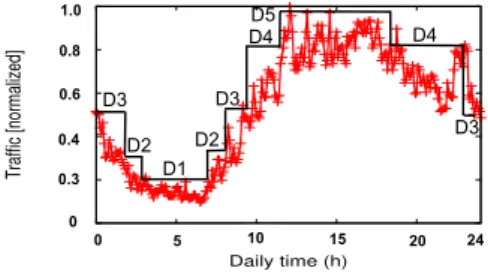
Figure 1: Normalized daily variation of traffic of a France Telecom network link and multi-period approximation.
considers the graphG0= (V, L\ {`min}). It launches again the routing and placement modules.
If they succeed,`minis definitely put in sleep mode. The listU is updated with the new routing,
as well as the less loaded link. If at least one of the two modules fails,GreenChainsconsiders
that `min cannot be into sleep mode and the link is definitely kept active in the final solution.
The second element ofU is then considered. The algorithm goes on till all links have been tried
and set either as definitely in sleep mode or definitely active.
5
Numerical Experiments
In this section, we investigate the energy savings obtained by the Column Generation model. We compare the results with ones of theGreenChainsheuristic algorithm, proposed in [9]. We
first present the data sets we use for the experiments. We then take a look at the precision of the solutions obtained by the Column Generation model and GreenChains. We investigate
different improvements of the model presented in Section 3. We then present the energy savings obtained for network topologies of different sizes. Last, we discuss the impact of the solutions on link usage and path lengths.
5.1
Data sets
In networks, each type of flows has to go through a different chain of network services. In our experiments, we consider the four of the most frequent types of flows as presented in Table 1: Video Streaming, Web Service, Voice-over-IP (VoIP), and Online Gaming. The traffic percentage are from [14]. For each one, we give the ordered set of functions required and the bandwidth used. In total, 6 different functions are used, and each function requires a different amount of cores to be executed.
Energy-Efficient Service Function Chain Provisioning 9 D1 D2 D3 D4 D5 Time periods 0 2000 4000 6000 8000 10000 12000 Energy used No cut Simple Enhanced
(a) Energy used
D1 D2 D3 D4 D5 Time periods 0.0 0.2 0.4 0.6 0.8 1.0 1.2 1.4 1.6 1.8 ε ratio No cut Simple Enhanced (b)ε= (˜zilp−z ? lp)/z ? lp
Figure 2: Comparison of the performance of different Column Generation Models forpdh.
D1 D2 D3 D4 D5 Time periods 0.00 0.05 0.10 0.15 0.20 0.25 0.30 ε ratio atlanta germany50 pdh
Figure 3: ε ratio for the pdh, atlanta, and germany50
net-works for varying amount of traffic.
We tested the CG model and GreenChains on three topologies of different sizes from
SNDlib [15]: pdh (11 nodes and 64 directed links), alanta (15 nodes and 44 directed links),
andgermany50(50 nodes and 176 directed links).
For each network, we generate a set of demands from the traffic matrices provided in SNDLib: we divide each aggregate flow from a source to a destination into four demands corresponding to the four different types of traffic. The original load of the flow is conserved and each subflow load is given by the distribution of the last column of Table 1. For example, a flow with a charge of 1 is splitted into a Web Service, a VoIP, a Video Streaming and an Online Gaming sub-flows with a respective charge of 0.182, 0.118, 0.699 and 0.001.
We tested the solution on a daily traffic to see how much energy can be saved during the day or at night. The variations of traffic come from a trace of a typical France Telecom link shown in Figure 1. Previous work [16] shows that most of the energy savings can be obtained by using a small number of configurations during the day. In our case, we considered 5 different levels of traffic called D1 to D5. D1 represents the period with the lowest amount of traffic and D5 the one with the highest.
5.2
Quality of the Column Generation models
In Section 3, we propose three different models using Column Generation, CG-simple,CG-cuts,
andCG-cut+. We now study the impact of the different sets of constraints on the final objective
value of the Column Generation and on the ratio between the Integer Reduced Master Problem (RMP) and its Fractional counterpart,ε= (˜zilp−z?
lp)/z
?
lp. In Figure 2, we compare the solutions founded by the three CG models for the pdh network and for the 5 different levels of traffic.
Energy used is given in Figure 2a (Error bars represents the energy used found by the RMP) and ε ratio in Figure 2b. The first observation is that the three models obtain similar energy
savings: almost always equal forCG-simple and CG-cuts, and a little bit better (put percent)
for CG-cut+. However, the εratio is dramatically different. Adding the cuts improves greatly
the ratio: ε forCG-simple varies between 169% for the D1 period and 64% for the D5 period,
when, forCG-cuts,εis between 8 to 30%. The ratio is further improved withCG-cut+: between
2 and 7%. As the energy savings are similar for the three models, this shows that thethree CG models provide solutions that are few percent from optimal, but that this is easier for Cplex to prove it for the CG-cutsandCG-cut+models.
For the following results, wefocus on the CG-cuts model, as its ratio is a lot better than the
one ofCG-simple, and, asCG-cut+requires too much memory to solve large networks. We are
not able to solve the problem for the pdhnetwork for the D3 and D4 period.
We provide in Figure 3 the values of theεratio for the three studied topologies from SNDLib. RR n° 8980
10 Huin & Tomassilli & Giroire & Jaumard D1 D2 D3 D4 D5 Time periods 0 10 20 30 40 50 60 70 80 90 100 Energy used CG Heuristic (a) pdh D1 D2 D3 D4 D5 Time periods 0 10 20 30 40 50 60 70 80 90 100 Energy used CG Heuristic (b) atlanta D1 D2 D3 D4 D5 Time periods 0 10 20 30 40 50 60 70 80 90 100 Energy used CG Heuristic (c) germany50
Figure 4: Comparison of the energy used and saved between GreenChains and the Column
Generation model forpdhnetwork.
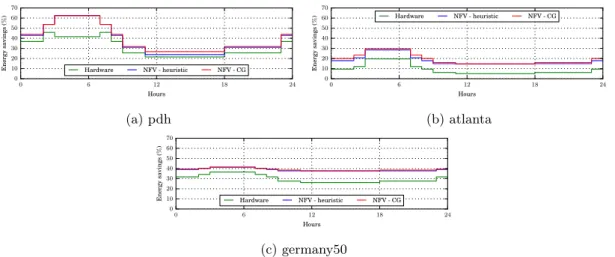
0 6 12 18 24 Hours 0 10 20 30 40 50 60 70 Energy savings ( % ) Hardware NFV - heuristic NFV - CG (a) pdh 0 6 12 18 24 Hours 0 10 20 30 40 50 60 70 Energy savings ( % ) Hardware NFV - heuristic NFV - CG (b) atlanta 0 6 12 18 24 Hours 0 10 20 30 40 50 60 70 Energy savings ( % ) Hardware NFV - heuristic NFV - CG (c) germany50
Figure 5: Energy savings during the day.
On pdh, the ratio increases from 7% at the D1 period to 17% at the D5 period. For atlanta,
the ratio decreases from 19% at D1 to 8% at D3, before increasing back to 27% at D5. For
germany50, the ratio steadily increases from 20 to 26%.
Energy Savings. We compare the savings obtained by our solutions with the legacy scenario,
which serves as a baseline, and a hardware scenario. The legacy scenario considers a legacy
network which does not implement SDN nor NFV. The routing is thus static and the network functions are not virtualized. They are executed by specific hardware, which are installed at given positions in the network. The demands use the shortest paths between the sources, hardwares implementing the network functions of their services chains, and the destination. Thehardware scenariocorresponds to the one of an SDN (non virtualized) networks in which an operator tries
to reduce its energy consumption by adapting the routing to the demands. In this scenario, the network functions are carried out by some specific hardware placed at given positions in the network.
We provide in Figure 4 the energy used for the 5 levels of demands D1, D2, D3, D4 and D5 for the SNDLib networks. The values are normalized: 100 corresponds to the legacy scenario. We also present in Figure 5 the corresponding energy savings during the day for thegermany50
network. We see that we obtained important savings using virtualization: between 25 and 62 % forpdh, 15 and 30 % foratlanta, and 38 and 42 % forgermany50.
Heuristic vs the Column Generation model. We compare in Figure 5 the Column
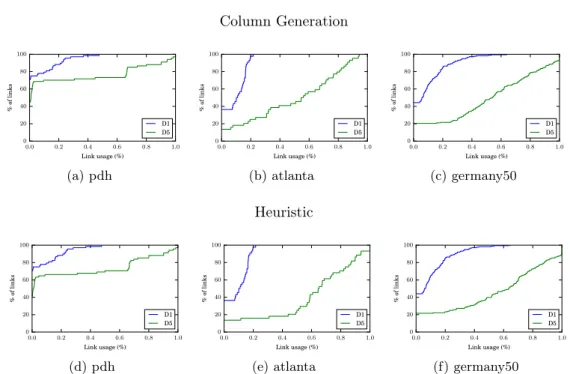
Energy-Efficient Service Function Chain Provisioning 11 Column Generation 0.0 0.2 0.4 0.6 0.8 1.0 Link usage (%) 0 20 40 60 80 100 % of links D1 D5 (a) pdh 0.0 0.2 0.4 0.6 0.8 1.0 Link usage (%) 0 20 40 60 80 100 % of links D1 D5 (b) atlanta 0.0 0.2 0.4 0.6 0.8 1.0 Link usage (%) 0 20 40 60 80 100 % of links D1 D5 (c) germany50 Heuristic 0.0 0.2 0.4 0.6 0.8 1.0 Link usage (%) 0 20 40 60 80 100 % of links D1 D5 (d) pdh 0.0 0.2 0.4 0.6 0.8 1.0 Link usage (%) 0 20 40 60 80 100 % of links D1 D5 (e) atlanta 0.0 0.2 0.4 0.6 0.8 1.0 Link usage (%) 0 20 40 60 80 100 % of links D1 D5 (f) germany50
Figure 6: Cumulative distribution function of the links load for the lowest and highest traffic period.
eration model and the heuristic. Error bars on the CG solutions represent the lower bounds, that is the relaxation of the RMP (zlp?). For all three topologies and for all time periods, the
difference between the heuristic and the Column Generation model is small. For the lowest traffic periods (D1 and D2), both methods provide similar solutions. The CG model provides slightly better solutions when the traffic is higher, with a difference of 4, 7 and 5% forpdh,atlantaand germany50respectively in the D5 period. The important thing to note here is that, even though
the Column Generation does not provide a much better solution than the heuristic, it does show (by providing theεratio) that the heuristic gives good results, regardless of the traffic period.
5.3
Load of links
To reduce the amount of energy used by the network, we reroute some of the flows to be able to put links into sleep. This means that the remaining active links are more loaded. In Figure 6, we look at the link load for the highest and lowest traffic periods. First, we see that foratlanta
and germany50, with no surprise, the number of links with no traffic is higher when the traffic
is low, with around 40% of the links that forward no traffic at all. When the network is at its highest utilization it drops to 20% or less. Thepdh network, due to its higher link density, can
have more links put into sleep mode. Indeed, between 45% and 70% of the links have no traffic. Moreover, at the lowest traffic period no links are used at 100%. They are at most used up to 50%, 22% and 63% of their capacity, forpdh,atlantaandgermany50respectively. At rush hour, germany50andpdh have about 5 and 10% at full capacity, whileatlantalinks are at most used
at 92%.
12 Huin & Tomassilli & Giroire & Jaumard
5.4
Delay
pdh D1 D2 D3 D4 D5 Time periods 1 2 3 4 5 6 7 8 Delay (ms) (a) Legacy D1 D2 D3 D4 D5 Time periods 1 2 3 4 5 6 7 8 Delay (ms) (b) Hardware D1 D2 D3 D4 D5 Time periods 1 2 3 4 5 6 7 8 Delay (ms) (c) Column Generation Atlanta D1 D2 D3 D4 D5 Time periods 1 2 3 4 5 6 7 8 Delay (ms) (d) Legacy D1 D2 D3 D4 D5 Time periods 1 2 3 4 5 6 7 8 Delay (ms) (e) Hardware D1 D2 D3 D4 D5 Time periods 1 2 3 4 5 6 7 8 Delay (ms) (f) Column Generation Germany D1 D2 D3 D4 D5 Time periods 1 2 3 4 5 6 7 8 Delay (ms) (g) Legacy D1 D2 D3 D4 D5 Time periods 1 2 3 4 5 6 7 8 Delay (ms) (h) Hardware D1 D2 D3 D4 D5 Time periods 1 2 3 4 5 6 7 8 Delay (ms)(i) Column Generation
Figure 7: Distribution of delay for the 5 traffic periods on the pdh, atlanta and germany50. The box represents the 1st and 3rd quartile. The median is represented by the red line and the whiskers represents the 1st and 9th decile.
Again, when some links are put into sleep mode, some of the paths between sources and destinations are becoming longer. We investigate the impact of these changes on the delays in the network. To compute the delays, we assume that they are proportional to the distances traveled along the paths [17]. SNDLib provides the geographical coordinates of the nodes of
germany50. We thus derived the link lengths based on these coordinates. For the other two
networks, no data is available. We thus use the average delay of 1.8 ms founded ingermanyas
the link length.
In Figure 7, we look at the delay of the request for each period of time. The median remains the same onpdh andatlantaall day long. Ongermany50, it slightly decreases for higher traffic
periods, as more links are active. At most, requests experience delay of about 7, 14 and 25 on
pdh,atlantaandgermany50respectively. An important observation is that the maximum delay
Energy-Efficient Service Function Chain Provisioning 13
of every path stays below 50 ms, which is a classic value for the maximum delay in Service Level Agreements [18].
6
Conclusion
In this work, we investigate the potential of network virtualization to reduce the energy consump-tion of networks. We propose a Column Generaconsump-tion model to solve the problem of minimizing network energy consumption while satisfying the constraints of service chains of virtualized net-work functions. We obtain between % of energy savings for netnet-work topologies of different sizes.
14 Huin & Tomassilli & Giroire & Jaumard
References
[1] D. Matsubara, T. Egawa, N. Nishinaga, V. P. Kafle, M.-K. Shin, and A. Galis, “Toward future networks: a viewpoint from itu-t,” IEEE Communications Magazine, vol. 51, no. 3,
pp. 112–118, 2013.
[2] L. Chiaraviglio, M. Mellia, and F. Neri, “Minimizing isp network energy cost: Formulation and solutions,” in IEEE/ACM Trans. Netw.’11.
[3] R. Modrzejewski, L. Chiaraviglio, I. Tahiri, F. Giroire, E. Le Rouzic, E. Bonetto, F. Musumeci, R. Gonzalez, and C. Guerrero, “Energy Efficient Content Distribution in an ISP Network,” in IEEE Global Communications Conference (GLOBECOM 2013), Atlanta,
United States, Dec. 2013.
[4] M. Savi, M. Tornatore, and G. Verticale, “Impact of processing costs on service chain place-ment in network functions virtualization,” inIEEE Conference on Network Function Virtu-alization and Software Defined Network (NFV-SDN), Nov. 2015, pp. 191–197.
[5] A. Gupta, M. F. Habib, P. Chowdhury, M. Tornatore, and B. Mukherjee, “Joint virtual network function placement and routing of traffic in operator networks,” UC Davis, Davis, CA, USA, Tech. Rep, 2015.
[6] B. Martini, F. Paganelli, P. Cappanera, S. Turchi, and P. Castoldi, “Latency-aware com-position of virtual functions in 5g,” in 1st IEEE Conference on Network Softwarization (NetSoft), 2015, pp. 1–6.
[7] A. Mohammadkhan, S. Ghapani, G. Liu, W. Zhang, K. Ramakrishnan, and T. Wood, “Virtual function placement and traffic steering in flexible and dynamic software defined networks,” in The 21st IEEE Int. Workshop on Local and Metropolitan Area Networks,
2015, pp. 1–6.
[8] R. Riggio, A. Bradai, T. Rasheed, J. Schulz-Zander, S. Kuklinski, and T. Ahmed, “Virtual network functions orchestration in wireless networks,” inNetwork and Service Management (CNSM), 2015 11th International Conference on. IEEE, 2015, pp. 108–116.
[9] A. Tomassilli, N. Huin, F. Giroire, and B. Jaumard, “Energy-efficient service chains with network function virtualization,” pp. 1–17, 2016, Inria Res. Report RR-8979.
[10] J. Chabarek, J. Sommers, P. Barford, C. Estan, D. Tsiang, and S. Wright, “Power awareness in network design and routing,” in IEEE Annual Joint Conference of the IEEE Computer and Communications Societies - INFOCOM, 2008, pp. 1130–1138.
[11] L. Niccolini, G. Iannaccone, S. Ratnasamy, J. Chandrashekar, and L. Rizzo, “Building a power-proportional software router,” inPresented as part of the 2012 USENIX Annual Tech-nical Conference (USENIX ATC 12), 2012, pp. 89–100.
[12] A. Dwaraki and T. Wolf, “Adaptive service-chain routing for virtual network functions in software-defined networks,” inWorkshop on Hot topics in Middleboxes and Network Function Virtualization (HotMIddlebox), 2016, pp. 32–37.
[13] A. Tomassilli, N. Huin, F. Giroire, and B. Jaumard, “Energy-efficient service chains with network function virtualization,” insubmitted, 2017, pp. 1–6.
Energy-Efficient Service Function Chain Provisioning 15
[14] C. V. N. Index, “Cisco visual networking index: Forecast and methodology 2015-2020,”
White paper, CISCO), 2015.
[15] S. Orlowski, M. Pióro, A. Tomaszewski, and R. Wessäly, “SNDlib 1.0–Survivable Network Design Library,” Networks, vol. 55, no. 3, pp. 276–286, 2010.
[16] J. Araujo, F. Giroire, J. Moulierac, Y. Liu, and M. Remigiusz, “Energy efficient content distribution,” Computer Journal, pp. 1–18, 2016.
[17] B.-Y. Choi, S. Moon, Z.-L. Zhang, K. Papagiannaki, and C. Diot, “Analysis of point-to-point packet delay in an operational network,”Computer networks, vol. 51, no. 13, pp. 3812–3827,
2007.
[18] F. Giroire, A. Nucci, N. Taft, and C. Diot, “Increasing the robustness of ip backbones in the absence of optical level protection,” inINFOCOM 2003. Twenty-Second Annual Joint Conference of the IEEE Computer and Communications. IEEE Societies, vol. 1. IEEE,
2003, pp. 1–11.
RESEARCH CENTRE
SOPHIA ANTIPOLIS – MÉDITERRANÉE
2004 route des Lucioles - BP 93 06902 Sophia Antipolis Cedex
Publisher Inria
Domaine de Voluceau - Rocquencourt BP 105 - 78153 Le Chesnay Cedex inria.fr