INFORMATION FLOWS IN THE SOCIAL DEVELOPMENT GRANT PROCESS: A
USER EXPERIENCE PERSPECTIVE
by
XOLILE NTSHAM
Thesis
submitted in fulfilment
of the requirements for the degree
Master of Technology:
Information Technology
in the Faculty of Informatics and design
at the Cape Peninsula University of Technology
Supervisor: Dr Izak van Zyl
Co-supervisor: Prof Retha de la Harpe
Cape Town
November 2014
CPUT copyright information
The dissertation/thesis may not be published either in part (in scholarly, scientific or technical journals), or as a whole (as a monograph), unless permission has been obtained from the University
DECLARATION
I, Xolile Ntsham, declare that the contents of this dissertation/thesis represent my own unaided work, and that the dissertation/thesis has not previously been submitted for academic examination towards any qualification. Furthermore, it represents my own opinions and not necessarily those of the Cape Peninsula University of Technology.
ABSTRACT
This study focuses on information flows in the social grant process from a user experience perspective. The study was conducted with the South African Social Security Agency (SASSA), which is responsible for the administration and distribution of social grants to underprivileged citizens. Social grants help poor citizens to attain equitable income on a monthly basis. Grants play an increasingly important role in reducing poverty and inequality in South Africa, but are also subject to challenges like dependency, mismanagement and corruption.
Information flow within SASSA is essential for the coordination of the grant process. The success of administering any social grant process depends largely on efficient communication practices and stable information technology. Communication among grant users requires the transfer of relevant information from its point of inception to the next point(s) of use. Government departments are transposing their paper-based systems into digital systems, which pose new implications for grant administration, however. Accordingly, the use of electronic services in government should mean faster information flow and, thus, more effective service delivery. The literature reveals, however, that non-technical aspects like user experience (UX) are essential in designing meaningful e-government systems.
With a focus on user experience, this study uncovers the problems that SASSA and grant users face in the grant process and works toward possible solutions to resolve these problems. This research lays an important foundation in terms of gaining a better understanding of information flows, e-government, and user experiences in the grant process. This research is exploratory in nature and adopts a qualitative interpretivist approach. To gain a deeper understanding of the perspectives and experiences of grant users, the researcher employed the „Institutionalise User Experience in Government‟ (IUXG) methodology. The study targeted individuals that had knowledge of the social grants. A purposive sampling technique was used to select the research participants. Furthermore, the researcher adopted a thematic analysis method to code and analyse data.
The findings of this study revealed the centrality of user experience in the grant process, notably in terms of the many challenges associated with information flow. The findings also revealed that factors such as social grant awareness, availability and use of information technology, digital divide, and grant accessibility bring enormous impact on grant processes and service delivery. The study contributes a landscape model for depicting the information flows in processing grants, and develops a broader understanding of how technology can help users to better disburse, access, and utilise grants. The study also informs
e-government practitioners about the design and implementation of user-centred design with emphasis on information flows.
ACKNOWLEDGEMENTS
I wish to express my gratitude to the Almighty God for giving me courage, perseverance, determination, and strength to complete my thesis. The completion of this thesis would have been impossible without the treasured support and valuable input from the beloved individuals I mentioned below:
My supervisor Dr. Izak van Zyl for always being there, guiding me and going the extra mile to ensure that this thesis is a success. I would like to express my sincere gratitude to him for pushing and challenging me in order to keep improving.
The staff at SASSA who welcomed me with warm hands, always supportive and assisted me despite their busy schedule.
To all the people who took time to participate in this study without their participation this study would have been impossible.
To my parents Mzimkhulu Ntsham and Nocawe Ntsham, where would I be without their constant support, encouragements, sacrifices, and prayers! I will forever be grateful to have them. I wish God could bless them with many years, so that they could see the fruitful product of their creation.
To my lovely sisters, more especially to Ntombizandile Ntsham, Nomgcobo Ntsham, and Neliswa Ntsham. I would like to express my heartfelt appreciation to them for supporting and guiding me into the right directions.
To my friends who made this journey exciting and memorable, more especially Siyabulela Nofemela, his continued support and motivation kept me on my toes, I will forever be grateful.
DEDICATION
TABLE OF CONTENTS
DECLARATION ... ii
ABSTRACT ... iii
ACKNOWLEDGEMENTS ... v
DEDICATION... vi
TABLE OF CONTENTS ... vii
LIST OF FIGURES ... x
LIST OF TABLES ... x
ACRONYMS AND ABBREVIATIONS ... xi
DEFINITION OF TERMS ... xiv
CHAPTER ONE: INTRODUCTION OF THE STUDY ... 1
1.1 INTRODUCTION ... 1
1.2 BACKGROUND ... 3
1.3 STATEMENT OF THE RESEARCH PROBLEM ... 4
1.4 RESEARCH QUESTIONS ... 7
1.5 RESEARCH PURPOSE AND OBJECTIVES ... 7
1.6 CONTRIBUTION OF THE RESEARCH ... 8
1.7 RESEARCH SETTING ... 9
1.8 CONCEPTUAL AND THEORETICAL FRAMEWORK ... 9
1.8.1 E-Government ... 11 1.8.1.1 Technology ... 12 1.8.1.2 Communication Media ... 13 1.8.2 Information Science ... 14 1.8.3 User Experience ... 15 1.9 METHODOLOGY ... 17 1.10 RESEARCH DESIGN ... 18 1.11 DELINEATION ... 18 1.12 ETHICAL CONSIDERATIONS... 19
CHAPTER TWO: LITERATURE REVIEW ... 20
2.1 OVERVIEW: OF SOCIAL GRANTS IN SOUTH AFRICA ... 20
2.2 SOCIAL GRANT ACCESSIBILITY ... 22
2.3 E-GOVERNMENT ... 23
2.4 THE ADVANTAGES OF E-GOVERNMENT ... 24
2.5 E-GOVERNMENT IN SOUTH AFRICA ... 25
2.6 E-PARTICIPATION ... 29
2.7 INFORMATION FLOWS AND INFORMATION SHARING WITHIN E-GOVERNMENT ... 30
2.8 INFORMATION MANAGEMENT ... 33
2.8.1 Information needs ... 34
2.8.2 Information acquisition ... 34
2.8.3 Information storage ... 34
2.8.4 Development of information products ... 35
2.8.5 Information dissemination ... 35
2.8.6 Information Use ... 35
2.9 USER EXPERIENCE ... 36
2.10 CONNECTION BETWEEN USER EXPERIENCE AND E-GOVERNMENT ... 37
2.11 GEO-POLITICAL LANDSCAPE ... 39
2.11.1 Metropolitan Municipality ... 42
2.11.2 District Municipality ... 43
2.11.3 Local Municipality ... 43
2.12 CASE SETTING ... 43
2.13 OFFICIAL GRANT PROCESS ... 47
2.13.1 Intake ... 47
2.13.2 Queue walker ... 48
2.13.3 Medical assessment (for disability grant applicants) ... 48
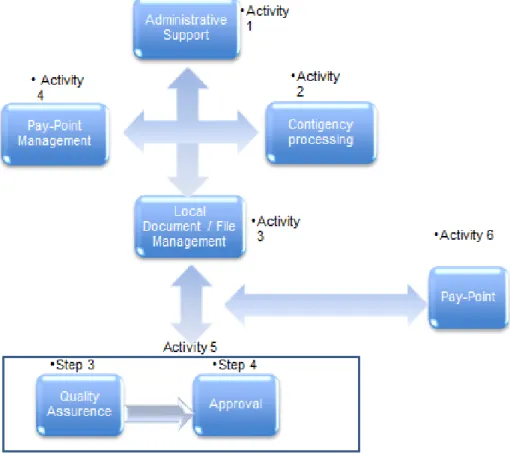
2.13.5 Attester ... 50 2.13.6 Quality Assurance ... 50 2.13.7 Verifications / Approvals ... 50 2.13.8 Enrolment ... 51 2.14 SERVICE POINT ... 52 2.15 BACK OFFICE ... 53 2.15.1 Contingency processing ... 53 2.15.2 Administrative support ... 54 2.15.3 Pay-point management ... 54
2.15.4 LO document/ File management (Registry) ... 55
2.15.5 Payment methods ... 56
2.16 FLOW OF FUNDS ... 58
2.16.1 National revenue fund ... 58
2.16.2 SASSA national office ... 59
2.16.3 SASSA regional office ... 59
2.17 CHAPTER SUMMARY ... 59
CHAPTER THREE: METHODOLOGY ... 61
3.1 INTRODUCTION ... 61
3.2 RESEARCH DESIGN ... 61
3.2.1 Research Approach ... 62
3.3 RESEARCH METHODOLOGY ... 62
3.3.1 Research Process ... 62
3.3.2 User Research Methodology ... 64
3.3.2.1 Define goals ... 64
3.3.2.2 Respondent selection and user profile ... 64
3.3.2.3 Plan the user research ... 65
3.3.2.4 Run the session ... 66
3.3.3 Design tools ... 67
3.3.4 Data analysis methods ... 69
3.3.5 Ethical and logical concerns ... 70
3.3.6 Trustworthiness ... 71
3.4 CHAPTER SUMMARY ... 73
CHAPTER FOUR: RESEARCH FINDINGS ... 74
4.1 INTRODUCTION ... 74
4.2 INTERVIEW AND OBSERVATIONAL FINDINGS... 74
4.2.1 Theme 1: Recognition and visibility ... 76
4.2.2 Theme 2: Motivation ... 80
4.2.3 Theme 3: Qualification ... 81
4.2.4 Theme 4: Benefits ... 83
4.2.5 Theme 5: Satisfaction... 84
4.2.6 Theme 6: Difficulties ... 86
4.2.7 Theme 7: Recommendations and suggestions ... 90
4.2.8 Summary: Thematic map ... 93
4.3 USER EXPERIENCE OF SOCIAL GRANTS ... 94
4.3.1 Personas ... 95
4.3.2 Scenarios ... 98
4.3.3 Storyboards ... 100
4.3.4 User journey mapping ... 102
4.3.5 Touch points ... 103
4.4 USER EXPERIENCE ATTRIBUTES ... 104
4.4.1 Motivation ... 105
4.4.2 Emotions or moods ... 105
4.4.3 Environment / Social settings ... 106
4.4.4 Expectations ... 106
4.4.5 Satisfaction ... 107
4.5 CHAPTER SUMMARY ... 107
5.1 INTRODUCTION ... 109
5.2 FACTORS THAT AFFECT THE INFORMATION FLOW OF THE GRANT PROCESS ... 109
5.3 IMPACTS OF TECHNOLOGY DEPLOYMENT ON THE PROCESS OF INFORMATION FLOW ... 112
5.4 SOCIAL GRANT AWARENESS ... 114
5.5 SOCIAL GRANT ACCESSIBILITY ... 115
5.6 USER EXPERIENCE IN E-GOVERNMENT ... 116
5.6.1 Involving users in the planning and design of e-government services ... 116
5.6.2 Assessing information needs in e-government ... 117
5.6.3 E-Participation ... 118
5.6.4 The level and extent of satisfaction with services rendered by SASSA ... 119
5.7 CHAPTER SUMMARY ... 120
CHAPTER SIX: CONCLUSIONS, KEY FINDINGS AND RECOMMENDATIONS ... 121
6.1 INTRODUCTION ... 121
6.2 SUMMARY OF THE FINDINGS ... 121
6.2.1 The nature of services provided by SASSA ... 122
6.2.2 ICT types that are utilised by SASSA ... 122
6.2.3 Experiences of grant clients concerning grant awareness ... 123
6.2.4 Motivation to apply for a social grant ... 123
6.2.5 Social grant eligibility criteria ... 124
6.2.6 Social grant benefits ... 124
6.2.7 User-centred design and e-government ... 124
6.2.8 Challenges faced by SASSA ... 125
6.3 RECOMMENDATIONS... 126
6.3.1 Information flow strategy ... 126
6.3.2 Introducing improved ICT tools for social grant processing ... 127
6.3.3 Putting users at the centre of e-government ... 128
6.3.4 Internet availability and network interruptions ... 128
6.3.5 Training ... 129
6.3.6 Improved SASSA services ... 130
6.3.7 Training in deployment and use of ICT tools ... 131
6.3.8 Grant Landscape from a user experience perspective ... 132
6.4 SUGGESTIONS FOR FURTHER RESEARCH ... 134
6.5 CONCLUSIONS ... 134
LIST OF FIGURES
Figure 1: Conceptual and theoretical framework during grant process consisting of
interrelated elements ... 10
Figure 2: The geo-political canvas around Khayelitsha Township in South Africa ... 41
Figure 3: Map of Khayelitsha - Showing different sites, areas and routes (http://www.mapland.co.za/khayelitsha) ... 44
Figure 4: Informal settlements in Khayelitsha ... 45
Figure 5: Formal settlements in Khayelitsha ... 45
Figure 6: Public toilets in Khayelitsha ... 46
Figure 7: The SASSA local operating model and grant process ... 47
Figure 8: The grant process at Service Points... 52
Figure 9: The SASSA local operating model and grant process at the back office ... 53
Figure 10: Shows social grant schedule dates for pay-out ... 54
Figure 11: The flow of funds from Nation Revenue to grant beneficiaries... 58
Figure 12: The intercoder reliability test that was adopted in this study ... 72
Figure 13: Thematic map showing the final two main themes ... 93
Figure 14: Persona of the grant applicant ... 95
Figure 15: Persona of the grant beneficiary ... 96
Figure 16: Social grant official persona ... 97
Figure 17: Storyboard of grant awareness ... 100
Figure 18: Storyboard of the grant process as perceived by users ... 101
Figure 19: Storyboard of the actual grant process ... 102
Figure 20: User journey map for grant users ... 103
Figure 21: Social grant touch points ... 104
Figure 22: SASSA technology deployment in Khayelitsha local office ... 113
Figure 23: Grant process as perceived by users ... 116
Figure 24: Social grant landscape, indicating the different aspects that characterise the grant process from a user experience perspective. ... 132
LIST OF TABLES
Table 1: Grant eligibility criteria ... 21ACRONYMS AND ABBREVIATIONS
3G: Third generation
AOD: Acknowledgement of Debts
ADSL: Asymmetric Digital Subscriber Line ATMs: Automated Teller Machines
BO: Back Office
BPMN: Business Process Modelling Notations
CDG: Care Dependency Grant
CEO: Chief Executive Officer
CPS: Cash Payment Service
CSG: Child Support Grant
CVM: Contract and Vendor Management
DFD: Data Flow Diagrams
DG: Disability Grant
DH: Department of Health
DHA: Department of Home Affairs
DPSA: Department of Public Service and Administration
DSD: Department of Social Development E-Government: Electronic Government
E-Mails: Electronic Mails
E-Natis: National Traffic Information System E-Participation: Electronic Participation
ERD: Entity Relationship Diagrams E-Voting: Electronic Voting
FCG: Foster Care Grant
G2B: Government-to-business
G2C: Government-to-citizen
G2E: Government-to-employee
GAP: Grant Administration Programme
GIA: Grant-in-aid
GMT: Government Motor Transport
ICASA: Independent Communications Authority of South Africa ICT: Information and Communication Technology
ID: Identity Document
IEC: Independent Electoral Commission
IGAP: Improved Grants Administration Programme
IM: Information Management
IP: Internet Protocol
IT: Information Technology
IUXG: Institutionalise User Experience in Government LOOM: Local Office Operations Manager
MMS: Multimedia Messaging Services MPCCs: Multi-Purpose Community Centres
MTN: Mobile Telephone Network
OPG: Older Persons Grant
PERSAL: Personal Administration System
PO: Post Office
POS: Point of Sale
QA: Quality Assurer
RMC: Record Management Centre
RO: Regional Office
SABC: South African Broadcasting Corporation SARS: South African Revenue Services
SASSA: South African Social Security Agency SDLC: System Design Life Cycle
SITA: State Information Technology Agency
SMS: Short Message Service
SOCPEN: Social Pension Database
SUSE: System und Software Entwicklung UPS: Uninterested Power Supply
USA: United States of America
UX: User Experience
VPNs: Virtual Private Networks
WiMAX: Worldwide Interoperability for Microwave Access
DEFINITION OF TERMS
Applicant: a person who applies for a social grant personally or on behalf of another person.
Beneficiary: a person who receives any type of social grant.
Client: a person who applies for or receives a social grant.
Information Flow: the transfer of information between two or more grant users or entities, or between grant processes, and technologies, from a point of higher information content to the point of lower information content.
Means Test: an evaluation of someone‟s assets, income and savings to determine whether a social grant is needed.
User: a person, who receives, uses, manages and/or renders a social grant.
Social Development Grant: benefit given by the government in the form of money to poor citizens that are eligible.
User Experience: the overall experience of a person encountered while using a service or system, or users‟ perceptions / prior experiences, frustrations, moods, and skills that result to an anticipated use of service or system.
Information and Communication Technology: sometimes substituted with „digital technology‟, ICT is the electronic means for communicating information, which takes place via media and systems such as smart devices, mobile technology, the Internet, and social networks.
CHAPTER ONE:
INTRODUCTION OF THE STUDY
1.1 INTRODUCTION
The South African government has introduced social grants in its effort to alleviate poverty. Before 2004, provincial governments were responsible for the administration and implementation of social grants. However, the government faced many challenges associated with provincial administration, including inconsistency on salary levels in different provinces, problems in accessing payments, and delays in social grants processing. Therefore, the South Africa government formed the South African Social Security Agency (SASSA) in 2006 in order to administer, manage and distribute the social grants to the right person at the right time. Social grants comprise of old age grant, disability grant, foster care grants, child support grants, care dependency grants and war veterans‟ grants (SASSA, 2013). SASSA has the national office, nine regional offices, district offices, and local offices.
Social grants provide income support to the most vulnerable citizens in South Africa. However, certain eligibility criteria have to be met before grants could be awarded to the applicants. The South African government invests more than R118 billion a year in social grants and this money provides support to approximately 15.8 million underprivileged South Africans (South African Government News Agency, 2014). The Government is therefore faced with the challenges of distributing these social grants to eligible recipients (Vorster, 2006). These challenges can be directory connected to the exclusion of users in the development and implementation of the systems. The quality of user experience (UX) is thus becoming an even more critical in big organisations, because it enables organisations to easily get information of usability problems, and capture constructive experiences (Ramsay, 2012).
Many researchers state that UX has multiple names such as an experience of the user, user centred, and overall user experience. However, there is no name that is intrinsically better than the other, whatever name used to describe UX is equally important. The concept of UX has been widely adopted in many different fields such as engineering, IT, the travel industry, and commercials. UX is a broad and fast growing multidisciplinary field, and it would be complex for the researcher to study it as a single entity. In addition to evaluate UX successfully requires a much greater understanding of such user‟s perceptions and responses. For example, how user‟s perceptions and responses should be incorporated into a system.
In recent years, government departments worldwide are increasingly making use of technology (Thakur, 2013). Information and communication technology (ICT) has the ability to restructure workplaces through the manner in which it is incorporated to the daily lives of the employees. ICT allows the organisations to automate their operations and reduce communicational restrictions of space and time. Digital solutions have steadily replaced paper-based records to provide more consistent, integrated, distributed, and timely sharing of information (Xiong, 2006). However, the handling of grant information in South Africa is still a combination of paper-based records, handwritten notes; information displays on white boards, digital records, and printed documentation. Information here manifests in different media, and it is therefore challenging to maintain consistency among multiple information resources. This in turn complicates the information flow of the social grant process, resulting in an unstructured, incoherent and sporadic movement of information.
Information flow within the social grant process is pervasive and essential for the coordination and collaboration among grant officials for achieving their daily work. Government officials spend a great amount of time dealing with large quantities and complex movement of information in the course of administering grants. In order to provide the best possible service to clients, officials working in different stages of the grant application must work collaboratively to ensure all the necessary information is communicated so that the grant applications can be processed effectively. Grant applicants and beneficiaries are also subjected to complex information flows. This research addresses specific and fundamental communication during the application and disbursing processes of social grants, which have not received adequate academic attention and technological support.
Specifically, this study explores the information and technological issues around social grant processes in Khayelitsha, an informal township in the Western Cape of South Africa, and identifies possible solutions to these issues. The study also examines existing work practices during the grant process, with special attention to information flows and the types of information and communication technology (ICT) tools employed. In addition, the researcher examines the impact of technology deployments on information flow as a means to understand how technology can better support or improve current practices. The remainder of this chapter discusses the research background and contribution, describes the problem and goals of the research, explains the methodological approach used, and provides an overview of the ethics followed in this study.
1.2 BACKGROUND
Social grants have played an important role in supporting citizens in townships to attain equitable income, and in ensuring a minimum living standard for poor people with the aim of alleviating poverty and promoting household development. In addition, social grants in South Africa, notably in townships have significantly contributed to achieving the goals of human development, which includes improved health conditions and better education (Durieux, 2012). In South Africa, Neves et al. (2009) found that social grants do not just improve households in the townships, but also generate economic benefits such as supporting the development of local markets, and facilitate investments and savings.
According to Vorster (2006), the provision of social grant benefits constitutes the largest part of the South African government‟s poverty alleviation programme. In 2005, there were an estimated number of 10 million people receiving social grants. However, the number of beneficiaries has since increased immensely. In 2013, SASSA reported that approximately 15.8 million people are directly benefiting from social grants (SASSA, 2013). It is also estimated that social grant beneficiaries' represent more than 22% of South African population, which excludes other members of the family who may be benefiting directly or indirectly by virtue of residing with grant beneficiaries. On the other hand according to Makiwane (2007), social grants create dependency and lead to pregnancy. In other words, grants create weak and financially needy people. People in the townships go to greater lengths in order to receive these grants. The author points out that grants created an incentive that contributed to the high pregnancy rate, notably to young woman, which are deliberately having children in order to access the grants.
Although social assistance programmes in South Africa have improved, social grants remain ineffectively administered. Certain regional departments that are accountable for social grant administration incurred substantial loss of finances due to many court cases. SASSA has caught a total number of 21.8 thousand cases since its establishment. Because of fraud and corruption, SASSA lost a total amount of R238, 046, 903 during the financial years from 2005 to 2011 (Dlamini, 2014). According to Mpedi (2008), fraud has been a predominant challenge facing the rolling out and disbursing of social grants. This is worsened by the fact that the department of finance that is accountable for detecting fraud has a vacancy rate of 49.2%. In some instances, beneficiaries who do not have the right to receive social grants are receiving them because of fraud and corruption (ibid.). There are reports of cases whereby some officials receive social grants on behalf of deceased beneficiaries. As
a result, grant officials were arrested after being found with a total number of 127 unregistered grant cards (Dlamini, 2014).
The grants application process has often been sub-optimum, and the Department of Social Development (DSD) and South African Social Security Agency (SASSA) have often failed to provide adequate services. In some instances, applicants have had to apply more than once due to inaccurate eligibility checks, and grant applications can take inordinately long to be processed. The DSD tends, in most instances, to have heavy case loads and there are long delays in the Foster-Care Grant process where applicants can wait for more than a year for an appointment with a social worker from DSD (Sephton & Nieuwmeyer, 2010).
The level of services rendered by SASSA has suffered as a result. Grant processing is still inefficient, and grant officials still lack important skills such as of customer care, interpersonal skills, and soft skills. The Department of Social Development does not have a pool of highly skilled employees that could allow the department to deliver on its mandate. Officials have also been historically accused of mistreating clients by being rude and disrespectful, reluctant to carry out their work, disclosing confidential information, lacking skills of using ICT tools, and lacking customer-service skills (Mpedi, 2008).
In this context, information and communication technology continues to play an important role, and has become an essential tool in the operational processes of SASSA (See Ajuwon & Rhine, 2008). ICT is regarded as an umbrella term that encompasses any type of information and communication devices or application, including radio, cellular phones, computers and networks, hardware and software, as well as the variety of services and applications affiliated with such devices. However, ICT has often not been effectively integrated within regional government departments, and SASSA continues to face a series of information technology problems (San-Jose et al., 2009). This includes equipment failure, problems in information flows, data loss and software complexities. For example, anti-virus software was out-dated.
1.3 STATEMENT OF THE RESEARCH PROBLEM
The problem addressed in this thesis is that social grant system is not running effectively and there is some user experience we are not aware of: this is likely because there are little or no studies that have been dedicated on investigating the dynamics of social grant information flow practices and general lack of grant users
input in the design, development and implementation of technologies to enhance the flow of information and services in the grant process.
The social grant process (in informal areas) is constrained by a lack of transparency, as well as a lack of structured information flow: social grant clients still report of being confused and uncertain of many requirements of the grant application process. The process of putting together all the necessary documents for social grant applications and establishing the qualifications needed for approval are points of difficulty. Each of the social grants has specific requirements such as disabilities or qualifying age. However, many applicants are still confused as to why SASSA officials reject their applications (Mpedi, 2008).
Consequently, grant clients voiced concerns about officials who reject their application after only partially reviewing their documents and application forms (Dlamini, 2014). Applicants do not seem to understand why officials had turned them down; they reported when they go to SASSA to make an application for the first time (first visit) it appears that grant officials‟ rejects their grant applications as soon as they find a first fault in their documents, without the officials checking all the required documents. On the following visits, with the first fault corrected, they might find another fault in the documents that they did not check, resulting in another rejection of the application (Costello & Gilbert, 2005).
As part of government stakeholders‟ information flow, DSD and SASSA officers correspond by a formal written letter via postal address or physically deliver it where the postal address is not available. Unfortunately, this process makes information access cumbersome, involves much paperwork, and is time consuming. Moreover, SASSA officials have to transfer applicants‟ information from their handwritten forms into their systems, which are time-consuming and prone to errors (Gorton & Low, 2009).
This is notably the case in the DSD and SASSA representative offices in informal and township settings. When applying for social grants, the problem of accessibility to the nearest offices is still a major concern as it is very challenging for most applicants to travel to the representative/issuing offices, which can be great distances away. It is also evident that without information access, awareness, user experience, and sustainable social grant processes, which government stakeholders cannot exploit, local citizens will remain under served.
Many authors are of the opinion that UX emerges when directly or indirectly interacting with the service or system. They also have a common understanding that UX is very dynamic and can change over time. Furthermore, many research papers and interpretations of UX indicate that the field has gained attention in scientific research. Even though UX has gained attention, designing for UX presents many challenges, since it appears that there is a lack of a clear and common understanding of UX. UX field is unique, ambiguous, and very personal (Glanznig, 2012). However, Redish (2011) argues that the theoretical knowledge of UX is not a problem. The major challenge is on making this knowledge suitable and sustainable for needs of the people in the real world.
This study demonstrates the importance of evaluating user experience in the grant process at SASSA, because grant processes require grant users to be part of interaction. Therefore, the user experiences should lead the design and implementation of the grants process. The literature indicates that designing for user experience requires an approach that is multidisciplinary and considers aspects of usability, which affect how users think, experience, and feel. It went further by suggesting that the organisation could formulate a content based model of its business or operations as a means to approach the questions of UX in a practical perspective. However, it appears that SASSA is not designing its services based on the perspectives and experiences of grant users (Kujala et al., 2013).
Given this context, the primary aim of this study is to explore the information and technology issues around social grant processes in Khayelitsha. By putting user experiences in the centre of the grants design process, SASSA can reduce the inefficiency of the grant process. As an initial step of the design and implementation process, a thorough understanding of the existing information flow practices is required as a means to identify specific areas where information technologies can play a role in improving the flow of information and ultimate grant process. It is unclear how/what this role should be, however. SASSA should put information flow structured in place as a means to achieve an efficient and quick grant process. Moreover, the process of the grants should be optimised for efficiency and effectiveness but also should be straightforward enough that it can be easily understood by all the grant users.
SASSA stands to benefit substantially from the adoption of including user experiences in the centre of the grants design process, because these user experiences yield the original problems faced by users during the grant process.
Accordingly, by being the first government agency to adopt this solution, SASSA stands to gain a considerable recognition as an agency that values the input of its users. Optimisation of the current grant system or adoption of new efficient and effective practices is essential to grant users. In this study, steps for effective implementation of UX and technology deployment are suggested.
1.4 RESEARCH QUESTIONS
Following the stated problem, two main research questions were derived as follows: 1) How does information flow during the social grant process, from the
perspective of users (officials and clients)?
2) How can information technology play a role in making the social grant process more effective?
Sub-questions:
What are the information challenges faced by the different users of the social grant process?
What information is essential to complete each activity of the social grant process?
How do computer-based and paper-based artefacts influence users‟ role in the information flow?
How do clients access and use information? 1.5 RESEARCH PURPOSE AND OBJECTIVES
The purpose of this study is to explore the information and technology issues around social grant processes in Khayelitsha, from within a user experience perspective, and to identify possible solutions to these issues. Research objectives were formulated as follows:
Describe the information flow from different user perspectives. To achieve the stated objective, the researcher interviewed grant users and collected data from related literature (in addition to SASSA brochures and reports). The researcher focused on the basic dynamics of the processes of information flows, the content of communicated information, and describing the existing information flow sources (including ICTs and human), in order to identify the most important information and their impact on the social grants process. The term “user perspectives” refer to how the grant users (both officials and clients) perceive the grant process and how this perception constitutes their reality. Du Toit et al. (1998) describe user perspectives and experiences as needs, emotions, behaviour and values of the person on a
conscious and unconscious level. The implications of user experiences and perspectives cannot be determined accurately from outside without engaging the person concerned. The experiences and perspectives of grants users were determined by engaging them in a dialogical process.
Acquire a deepened understanding of the flow of information in the social grant process. To achieve this objective, the researcher conducted observations in SASSA local offices, focusing on information content communicated during the different grant processes. The researcher described the existing information technology tools used to transmit information, focusing on the dynamics of the information flow, communicative aspects (including verbal and written communications), and the information (re)sources involved (including electronic- and paper-based artefacts).
Understand the impact of technology deployment on the process of social grant information flow. To investigate the deployment of information technology, the researcher interviewed several officials and clients, and observed all the activities undertaken to complete the grant process. The researcher explored how ICTs supported or impeded current grant practices, focusing on information flow and technical issues.
1.6 CONTRIBUTION OF THE RESEARCH
This study will contribute an improved understanding of the social grant process. The major contributions from this research are as follows:
This study identifies the practices, basic dynamics, and information media that facilitate information flow during the social grants process. Most previous research focused on the role of social grants in alleviating poverty, promoting households, and supporting local economic development (Kalula, 2009). The results from previous research have not looked at how information flows in the grant process.
Landscape model depicting the flows of information for processing social grants
Description of clear user experiences
This study identifies the deployment of information technology concerning the processes of social grants, and points out the directions for information technology solutions to facilitate the flow of information.
This study can aid DSD and SASSA policy makers to eliminate unnecessary expenditures in the processes of social grant application.
This study makes a significant contribution to a broader understanding of how technology can help users to better disburse access and provision of the grants. The study shows the use of services AS-IS and informs e-government about the design and implementation of UX. This study contributes to the understanding of user experience and its effect on the information flows of the grant process. This is demonstrated through a series of observations and interviewing grant users. The study also contributes new knowledge to the body of UX field, by showing the cultural diversity because the researcher conducted the study in underprivileged areas, which makes the study unique. Proper application of UX concepts and processes can help the government departments and agencies achieve effective service delivery and assessable online services. Information held by DSD and SASSA is essential and valuable for citizens; consequently, it provides citizens with knowledge and insight about the operations of the department. In addition, the expected contribution of this study is to enhance our understanding of the nature of information flows, how it is used, and how it can be improved in the social grant process (rolling out and disbursing).
1.7 RESEARCH SETTING
Khayelitsha, meaning “new home” when translated from isiXhosa and is the biggest township in the Western Cape Province of South Africa. It is situated on the periphery of the City of Cape Town approximately 35km from town, directly adjacent to Mitchell‟s Plain (Cole, 2007). Khayelitsha is the selected research area due to a vast number of user experiences of individuals who are in the daily process of obtaining social grants as a source of income. Khayelitsha has one of the smallest DSD and SASSA representations (ibid). These offices serve a large number of grant applicants on a daily basis, and deal with substantial information flows.
1.8 CONCEPTUAL AND THEORETICAL FRAMEWORK
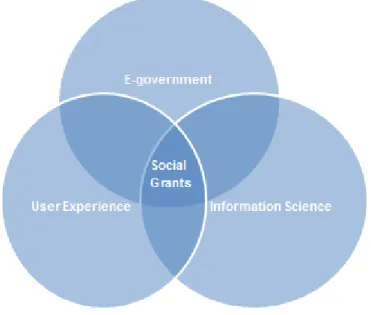
To study the social grant process, this framework focuses on three intersecting aspects namely: e-government, information science, and user experience. The above mentioned factors are not stand-alone components that are independently contributing to the process of the social grant but are interconnected. To illustrate, the kind of technology used influences the way administration of the grants and the way in which grant users communicate. Most organisations are aiming at eradicating paper-based systems with a purpose of building technology-based information distribution, and deliver the services according to customer needs (Jain, 2012). Social grant activities may also exhibit some characteristic patterns at a collective level,
which potentially allow others to orient and coordinate their activities for accomplishing tasks.
Firstly, for every organisation to be successful has to start by identifying the existing and various sources of information inflow. Then it has to find a better way to create a common information channel, which can collectively capture this information and direct it to the appropriate channel for filtering. Here, all the irrelevant and redundant data is removed and the relevant data passes onto the various stages of the business flow within the organisation on its way to the final destination. Therefore, the identified information is now going to be a knowledge base.
Figure 1: Conceptual and theoretical framework during grant process consisting of interrelated elements
The remaining part of this section describes in detail each factor of the conceptual and theoretical framework. Even though, it is possible for the researcher to explain this conceptual and theoretical framework beginning from any of the framework factors, the researcher started from the e-government, because information and communication technology is the primary objective during the social grant. The discussion of the conceptual and theoretical framework then moves to information science, and user experience describing the interconnections and relationships between these aspects. The contribution of this conceptual and theoretical framework is to provide a comprehensive view of the grant process key factors.
1.8.1 E-Government
E-Government is the application of ICT to the processes of government operations in order to render effective and efficient services to the public (Almarabeh & AbuAli, 2010). This generally involves the use of ICT tools by government agencies to share information among other government departments, with citizens, and businesses. E-government helps in improving the quality of services, provides quick and efficient service delivery, increases the revenue, and re-structuring of administrative operations in government departments (Oakley, 2012).
The emergence of ICT has provided means for quick and better communication, efficient storage, quick retrieval and processing of data, and sharing of information among its users. With rapid growth of computerised processes and Internet connectivity, this process has presently reached a stage where it motivates many users to modify or change their ways of doing things in order to leverage the advantages that ICT provides. Therefore, e-government has led to business process re-engineering within SASSA. With the majority of citizens using the ICT tools such as Internet, and providing confidential information the government needs to enhance its security in order to maintain high level of privacy. Many government departments across the world have noticed the importance of UX, although, much progress has been made in institutionalising UX with e-government (Jetter & Gerken, 2006).
ICT ensures faster and better processing of information leading to better experiences of users. It enhances the access to information, efficient service delivery and transparency in dealings and interactions between users and the government. Within the increasing awareness of ICT among citizens, information science plays a huge role by ensuring that the users share information effectively using ICT tools. Information science provides transparency, accountability of activities, and quick responses within e-government. It makes use of ICT very imperative towards achieving user experience. It has also led to the realisation that users could use such technologies to achieve better service delivery and thorough understanding of the grant process.
ICT transform the relationship among the government, businesses, citizens, and agencies. While recognising the potential of ICT in transforming the operations of the government departments, it also ensures deeper involvement of the citizens. It provides improved quality of services and better access of information for citizens. E-government makes available reliable and timely information. It provides an immediate impact in terms of reducing long queues, saving time and money. The application of
e-government and information science to governance may lead to reduction of redundant processes, simplification of complicated processes, and simplification in structures within the government agencies.
1.8.1.1 Technology
Every organisation has to use technologies to store information, create databases that are operations-oriented, record business transactions, facilitate and simplify centralised data collection, and marketing campaign tools. It is important to manage information using technology. Without technology, there would be distortion and unstructured flow of information throughout the organisation without effective sharing. To enhance information sharing the organisation must use the right tools that will integrate the existing practices with the newly developed practices (Jain, 2012). According to Jain (2012), in trying to incorporate the information with the existing operations and business processes, the organisation ought to take into consideration the following factors:
The organisation must identify the existing issues and potential issues in their information management
The organisation must define the information flow method
Educate information users so that they can become more knowledgeable on information technologies
Formulate the applications of the legacy enterprise for the integration with the information management system
The organisation has to redesign/ modernise its functional activities to ensure that they meet the needs of the clients
The organisation must make performance measures to redesigned its business practices and assign the activities to specific individuals within the team for monitoring at various stages of the system build-up
SASSA extensively use ICT tools to coordinate collaborative work during the grant processes. Grant users use ICT to coordinate the delivery of the grants. Examples include desktop computers, SOCPEN, printers, biometric system, and large whiteboards. ICTs material influences the type of information that it may carry, whereas grant officials use some ICT types for specific activities. Therefore, it is necessary to have multiple ICT tools that will carry all the necessary information during the grant process. Although, the flow of information may be overlapping in multiple ICT tools, data redundancy tools are crucial in avoiding and minimising the danger of inaccurate communication, which can in turn help anticipate information
breakdown. Furthermore, the use of multiple technologies can help grant users to acquire a better understanding of the grant tasks performed during the grants, the status quo, and the prediction of future plans. Without ICT, grant officials cannot fulfil the majority of their tasks during the grant process.
In modern years, government departments are replacing paper-based systems with digital systems for remote information access by citizens. This shift from paper-based to electronic records significantly changes the concept and view of information availability and accessibility such that flexibility does not always constitute part of the information seeking and retrieval process. Nevertheless, most organisations keep some manual documentation so that they can mediate certain cooperative work and activities through physical artefacts that have no link to a computer based system (Xiao et al., 2007).
1.8.1.2 Communication Media
According to Spaho (2013), there are various ways to facilitate the flow of communication. This facilitation is achieved through use of communication channels such as telephones, e-mails, face-to-face, written communication, and notice boards. Of these communication channels SASSA uses paper artefacts, notice boards, and broachers to mediate communication among grant users through textual and free form annotations. Written communication is the most used communication channel by SASSA. However, it regularly makes it difficult for grant users to interact in this form of communication medium, due to the lack of postal addresses for grant clients thereby hinders the communication process. In the modern years, mediated communication has become the most important form of communication, because after the user posts the information into the system it becomes available for multiple parties to view.
The Internet has transformed the way people communicate in the society. It has opened a new effective medium of communication for people and government departments. It has provided opportunities to communicate and obtain information on real time (Hickel, 2010). Organisations archive effective and quick information flow through the coordination of multiple communication Medias, which allow the flow of information through specific ICTs and artefacts in a timely and effective manner. Thus, most organisations utilise many channels of communication to assist and facilitate group interactions and collaborations (Yates & Orlikowski, 2002). The increasing digitisation of information improves the communication flow. The advent of the Internet has increased the effective flow of communication. It enables long
distance communication, whereby many people communicate instantly, form relationships and maintain them online.
According to Yates and Orlikowski (2002), face-to-face communication is the best way of interacting and it offers the best quality of communication. However, if not recorded the life span of verbal communication is ephemeral. Technologies such as e-mails and SMS, telephones, and group pages offer improved means of communication by connecting users in a timely manner across different places. In fact, deploying multiple ICT tools provide flexibility of using different mode of communication for accomplishing work related tasks. Thus, SASSA should choose a suitable channel of communication for specific kinds of information. For example, officials should choose a face-to-face communication when they discuss confidential information with clients.
1.8.2 Information Science
Information Science is the study of information, and the way in which people within organisations use it. Information Science plays an essential role in everything we do in the modern society, and it is important to the operations and business process of an organisation. Generally, information science is the nucleus of any organisation and it sits at the intersection of technology, information, people, and organisations. Information sciences‟ ultimate focus is on information and ICT tools used by people to share and manage information within the organisation. The factors of information science include information elicitation, information processing, information storage, information retrieval, and communication of information.
Information science also includes the frameworks within the organisation in which information is used, and the types of information systems that support the usage of information. Flow of information in SASSA is an essential pre-condition for the effectiveness of the grants process. ICT greatly facilitate the flow of information and knowledge offering to unaware communities in order to attain their own entitlements.
According to Hickel (2010), in any organisation information is one of the most essential and valuable assets. If organisation handles information efficiently, the strategies rolled out by the management have likelihood to succeed. Information is very important in collaborative work and it is the essence of communication in SASSA. Information is pivotal in accomplishments of the grant processes and delivering client care. Communicating pertinent information across grant processes is essential to the operation continuity. Therefore, information communicated during
social grant process directly influences the quality of the services provided by SASSA. For social grant purposes, information includes awareness, instructions, experiences, facts, and meanings received and interpreted.
During social grant process, grant users often communicate information that is work-related. In this case, the work-related information is typically focusing on the grant process. The efficient and effective information flow during the grants process facilitates the continuity of client care, which will in turn lead to reduce the grant problems and communication errors during grants process. Timely and accurate information is essential in completing a grant application effectively and efficiently.
Without information flow strategy that guides grant users as to what information they must communicate, the contents of information would exhibit an extreme level of inconsistency in both quality and quantity. The most important information for discussions during the grants process is grant awareness, eligibility criteria, screening, and documents verification. Therefore, the type of information needed for grants process should also reflect the nature of services at SASSA. It is important to have a work plan detailing all the information flows around grant processes. This set of information enables the grant officials to ensure that they communicate all the necessary information, because it is difficult to know certain information is missing or incorrect information has crept in during the approval of the grants.
The identification of missing and incorrect information contributes to grant delays and causes poor service delivery. In contrast, with proper guidelines in place officials would easily prevent such information. SASSA should locate its information in places where grant clients need it the most. For example, SASSA can place information in community halls where grant clients always meet. Information centres structure impacts how effective information flow takes place and whether it adequately supports service delivery.
1.8.3 User Experience
UX has become the main topic for many disciplines, notably for information architects, interaction designers, and usability engineers. Various disciplines use UX mainly to describe the requirements for creating a successful event that provides users with an effective, efficient, easy, and pleasurable experience of a service or system (Redish, 2011). It is the overarching perception of all the facets of interaction with a company, its services, and its products. These requirements must meet the needs and expectations of the user on the issues of usability and utility. Furthermore, to merge
various products or service aspects into one seamless, experiential flow of UX needs to be taken into consideration (Ramsay, 2012). Users can judge the value of UX as both tangible values that include factors like efficiency and effectiveness, or more intangibly or perceived value, which includes factors like credibility, emotion, pleasure, aesthetics, social reward, behaviour, and entertainment value (Glanznig, 2012).
UX is concerned with what users encounter while interacting with the services of e-government (Glanznig, 2012). According to Obrist et al. (2009) there are three contributors that form UX namely: human factors, usability, and human-computer interaction. Government agencies are starting to focus on the benefits and values that UX could bring to the e-government. Incorporating UX into the government services during the design and development cycle, and usability evaluation could enhance the government information systems. UX is a key enabler between users and e-government. It makes information sharing much quicker and easier within a government agency, between government agencies, and between government agencies and their users.
Clearly, there is more to UX than the pragmatic usefulness aspects. These hedonics factors contribute much to the overall experience of the user. A user‟s assessment of the pragmatic experience focused on the product or service, its utility and usability in relation to complete tasks while hedonics focuses on the personal motivators and views of the self. This is, in this way, somewhat more socially motivated than the strictly pragmatic. Novelty and change, personal growth, self-expression and feeling part of a social group are just some aspects in which people may find pleasure. One has to bear in mind that social context cannot be omitted from UX because there are expectations and influence that people have on each other, and people‟s willingness to socialise (Redish, 2011).
UX is not constant or based upon first impressions; UX changes from time to time as soon as users become more familiar with it. Therefore, it is important for a designer to spend more time and probe these perceptions and feelings in order to get valuable feedback (Glanznig, 2012). Therefore, the research of UX is very useful throughout the planning and development stages of any new interactive technology. UX can reveal the expectations that the organisation aims for in order to meet the needs of the users (Law et al., 2009).
UX enables organisations to obtain valuable information. This trajectory information is particularly important to grant officials work activities. They must find out whether the applicants are eligible in order to be able to perform the appropriate grant process. Grant users need to understand how technology works in order to complete the grant process. Officials make schedules to minimise temporal ambiguity by arranging grant process in a chronological order. Time assigned to the process varies in settings. Nevertheless, the screening process is time consuming, resulting in delays and inabilities to meet the needs of the clients. Therefore, SASSA should evaluate the assigned and the actual time taken for screening in order to achieve an effective grant process balance between the quality of information flow and service delivery.
The proper sequence of information access is significant for achieving the information flow best outcome. Officials must take into consideration the sequence of information access and time during the grant process in order to deliver the services in a timely and efficient manner. Identification of how grant users perceive, understand, and feel about the overall grant process is an important aspect of user experience. The way in which grant users share their experiences on how they perceive the technology and SASSA services are important. It is important to note and understand that UX is not a standalone factor in this study, it points out the perspectives, frustrations, feelings, and views of grant users during the grant process. According to Law et al. (2009), there are two aspects of user experiences. The first aspect of UX reflects upon feelings during usage of the service, for example the first impression of experiencing the service. The second aspect emerges after specific usages of the services over several periods of use.
1.9 METHODOLOGY
To accomplish the stated aim and objectives, the researcher adopted a qualitative interpretivist approach that was exploratory in nature to address the topic under study and to establish the demographic profile of the participants in the specified context (Korpela et al., 2008). This study set out to depict a landscape around social grant information flow, with Khayelitsha serving as empirical case. This study used IUGX methodology to present vital and necessary features of a landscape of social grants processes in a geographic form that consists of a canvas and four layers (Mursu et al., 2007). The canvas depicted the fundamental geographic layout around government stakeholders that are accountable for social grant processes (Korpela et al., 2008). IUXG methodology was also utilised to gain the perspectives and experience of the grant users. Personas and scenarios were employed to depict the
different users‟ experiences landscape analysis to present different flows of information.
According to Fossey et al. (2002), qualitative research describes a person‟s life experience, interactions, behaviour, stories and social context without using quantification or procedures of statistics. This generally links to the topic under question. Furthermore, Neuman (2006) defines a qualitative research study as an inquiry process of understanding a social or human problem based on building a complete holistic picture that is formed with words, reporting detailed views of informants and conducted in a natural setting. Furthermore, qualitative research captures the freedom of respondents, and natural development of action and representation. This gives respondents flexibility of demonstrating their actions and giving their views in a more open-ended manner.
1.10 RESEARCH DESIGN
The research design of this study draws from case study approaches (Yin, 2014) and stresses the importance of contextual detail and deep description, the function of multiple sources of data, and exploratory explanation-building. The research design was chosen in order to develop an initial rough understanding of the experiences and perceptions of the social grant users. This section is thoroughly explained in Chapter 3.
1.11 DELINEATION
Khayelitsha is the biggest township in the Western Cape Province, which is however, delineated as part of the Substructure of Tygerberg and falls under management structures (authority) of the Cape Town Metropolitan Council. The Metropolitan of Cape Town is a vast area that is sub divided into six sub-regional substructures (Dyantyi & Frater, 1998). The scope of this study is limited to Khayelitsha SASSA offices.
The research will focus mainly on exploring the information and technology issues around social grant processes in Khayelitsha, with the purpose to suggest improvements using ICT in order to facilitate the grants process. The researcher uses IUGX methodology to depict the landscape of the grants process, and gain the perspectives and experience of the grant users. The area chosen in this study is typically having the vast number of user experiences of people who are in the daily process of obtaining social grants as a source of income.
1.12 ETHICAL CONSIDERATIONS
Common concerns relating to ethical issues are confidentiality and socio-cultural sensitivity. Therefore, in order to adhere to ethical guidelines the researcher must take appropriate and constructive steps to uphold the research participants‟ cultures, anonymity, and confidentiality (Creswell, 2009). The principles of ethical consideration concern people‟s values and quality of life of all who affirms the accountability and obligation to protect fundamental human rights and to respect the diversity of all cultures within a particular society (ACM, 1992). Throughout this study, the researcher ensured that he observed the ethical guidelines of the Research Committee of the Cape Peninsula University of Technology. Long-Sutehall and Addington-Hall (2010) suggest that there are issues that researchers should consider during data analysis. The authors emphasise the point that researchers need to be aware of these issues during the process of conducting the research. The researcher considered the following ethical issues in particular:
Informed consent: the researcher sought informed consent from all the participants that contributed to the study. The researcher provided prior information about the objectives and nature of the research to all participants. The researcher informed participants about the purpose, data collection methods, and the contribution of the study.
Risk and harm: there were no risks or harm anticipated during the participation of this research study. The interviews took place in a proper and protected environment (SASSA local office) that was convenient and preferable for social grant users. The researcher assured participants that no dangerous situations would result from participation in the research.
Confidentiality and anonymity: the researcher will protect the identities of his participants and will keep the data gathered during this study confidential. All the participants will remain anonymous in future publications or results emanating from this work.
Voluntary participation: the researcher assured participants that the study was of a particular fulfilment of education. Therefore, participation was strictly voluntary; refusal to participate during the data collection of this study involved no penalty and the researcher made the participants aware that they might opt out at any stage of the research without prejudice.
When in doubt about any ethical matter during this research, the researcher sought the constructive advice of his supervisors.
CHAPTER TWO:
LITERATURE REVIEW
2.1 OVERVIEW: OF SOCIAL GRANTS IN SOUTH AFRICA
In South Africa, three government agencies are accountable for the issuing of social grants to eligible citizens. The first agency is DSD, which is responsible for the South African social welfare system and is accountable for the development of policy with respect to social assistance. The second agency is the National Treasury (Ministry of Finance), which has the authority to dispense funds, and which funds social assistance. The third agency is SASSA, which is the implementation agency responsible for administering disbursement of social grants and is overseen by DSD. SASSA contracts payment service providers to deliver social grants payments. The funding is coordinated through DSD; hence, the National Treasury does not possess a direct link to SASSA for financial inclusion. However, the perceived costs, budget, and values of the inclusion of finances among these three particular government agencies differ (South African Country Report, 2011).
SASSA was established independently in April 2005. National government established SASSA with the aim of streamlining government operations by centralising social grant payments. Its mandate is to ensure that social grants administration is effective, managing social grants, and paying out social grants to the right people at the right time (South African Country Report, 2011). In order to apply for social grants an applicant must engage the nearest offices of SASSA, which are usually located inside the DSD building and the applicant has to see an official of SASSA. Social grants applicants must be a South African citizen or permanent resident and must have a valid ID (adult) or birth certificate (child) (SASSA, 2013).
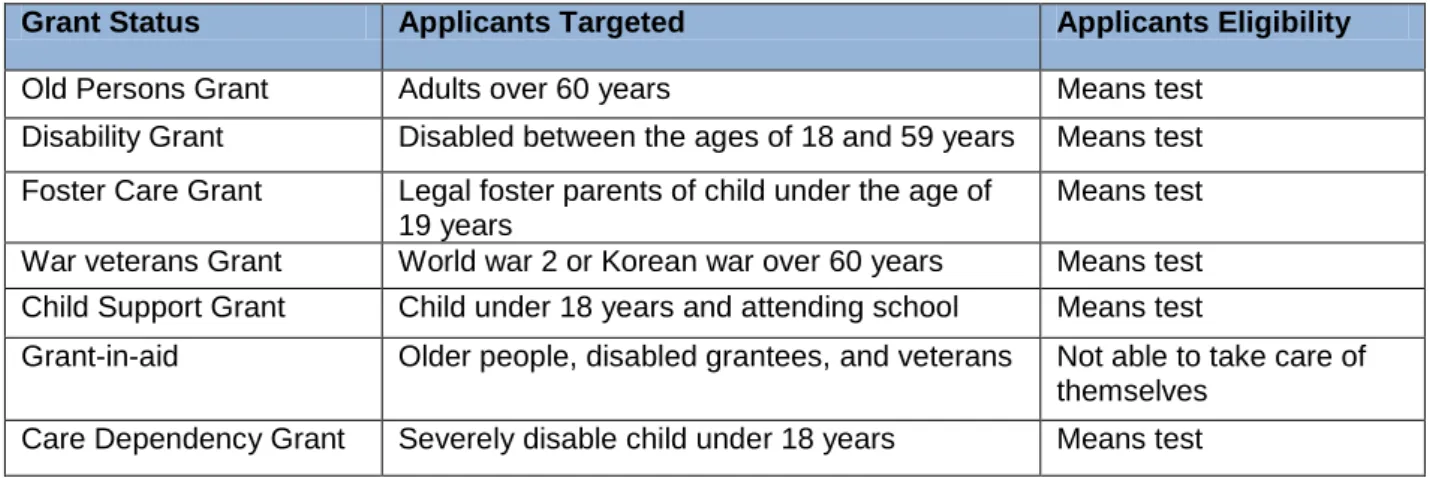
However, applicants who do not have a bar-coded 13 digits ID or birth certificate for children may still apply for social grants and get it within a period of 3 months, but within that period of 3 months, they must at least produce a proof confirming that they have applied for an ID. A client who has a part-time job can also apply for a social grant, but SASSA has a sliding scale whereby they calculate the amount of grant they have to pay to a particular applicant. In this case, an applicant might not receive the full amount of the grant. Applicants must meet the eligibility criteria as stipulated in the table below: