Introduction
This thesis addresses the incorporation of computer-generated haptic feedback into
interfacesforcomputer-basedmusicalinstruments. Indoingso,itdrawsuponawide
range of topics including haptic perception, haptic simulation, music synthesis and
control, human motor control, and human motor skillacquisition.
The term \haptic," derived from the Greek word \haptesta" (to touch), refers to
combinedfeedbackfromtactile sensorsinthe skinand kinestheticsensors inmuscles
and joints. Thoughspread throughoutour bodies,tactileand kinestheticsensors are
mostconcentrated inour handsand lips. It isno accident, therefore,that musicians
are acutely aware of an instrument's \feel," since the actions of blowing, bowing,
plucking, pressing, and tapping used to play most instruments are carried out by
hands and lips.
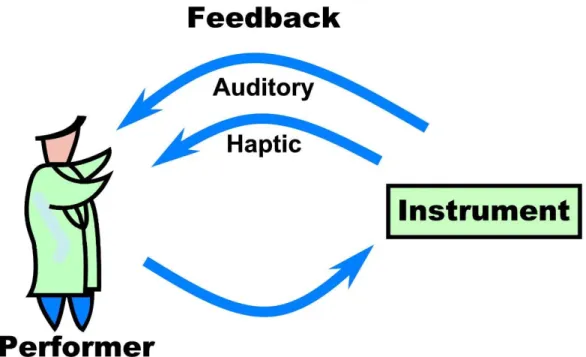
The fundamental principle explored in this work is that haptic feedback can
sup-port auditory feedback to inform performers of the consequences of their actions,
playing acrucial role inthe performer/instrumentinteraction loop. Where itexists,
a mechanical coupling between player and instrument provides a secondary sensory
feedback channel through which much information about an instrument's state can
Fig.1.1. Hapticandauditoryfeedbackpathsinthemusician/instrumentinteraction
loop.
Leveraging the musician'sexisting sensitivity to the relationshipbetween an
instru-ment'sfeeland itssound,thiswork exploresthe implicationsof incorporatinghaptic
feedback into interfaces and controllers for computer-based musical instruments, in
other words, the implications of closing a feedback loop between instrument and
performer via a second sensory modality, touch. This fundamental principle is the
1.1 Control of Computer-Based Musical
Instru-ments
Music performance can be described at its most basiclevel asthe evolution in time
of four parameters | time, pitch, dynamics (or amplitude), and timbre. For the
performer,the manipulationofthese dimensionsisembodiedinphysicalactionssuch
as striking a piano key or bowing a string. In real instruments these \instrumental
gestures"aredeterminedbythesound-producingmechanismsoftheinstrument. The
sound produced, in turn, carries the characteristics of the movement that gave rise
to it (Cadoz, 1988). A by-product of sound synthesis techniques such as physical
modeling (Smith, 1998) is the ability to decouple the synthesis of an instrument's
sound from the physics of the instrument's sound-producing mechanism. Thus the
aordances of a synthetic music controller can be very dierent from those of the
instrumentbeingcontrolled. Apianokeyboard,forexample,mightbeusedtocontrol
a physical modelof a trumpet. The advantage of sucha modular approachis that a
player can perform on instruments with no knowledge of specic playing technique.
This is not to say that the player lacks skill, for to be successful it is necessary to
maximize the capabilities of the controller being used. More crucial to the success
of the paradigm than the player's skill, however, is the mapping between physical
gestureandsoundsynthesisparameters,therelationshipbetween theplayer'sactions
and the instrument's response.
It is an unfortunate accident of history that early music controllers were
predomi-nantly based on the piano keyboard. Forthe piano, more than for any other
instru-ment(exceptingpercussioninstruments), thereexistsa one-to-onemappingbetween
a note and the movement that produced it. Thus the subsequent development of
MIDI (MusicalInstrumentDigitalInterface), the serialprotocolby whichcontrollers
and synthesizerscommunicate,is predicated onthe assumptionthat each note isan
isolated event with controls for its pitch, duration, timbre and amplitude,that
slurred phrase will be executed with one bow stroke and hence a single arm
move-ment. Not only doesthis singlearm movement cause notes of a phrase to be linked
byacommonbowstroke,butitstrajectoryalsoembodiesexpressivenuance,shaping
the dynamic and timbralarc of the phrase. Parametersfor dynamics and tone color
are thereby correlated and co-vary in response to the trajectory of the movement
of the arm. To capture such nuance in performance and convey its subtleties to a
synthesis modelrequiresacontrolarchitecturewherethegesture,not thenote, isthe
primary unit of musicaltime.
Several researchers (most notably Cadoz, 1988; Chafe, 1988; McMillen, 1994) have
proposed that music controllers and the protocol that supports their
communica-tion with synthesis algorithms should be founded on an asynchronous hierarchical
structure with the performance gesture, not the score-based note list, as its unit of
currency. As McMillen(1994) pointsout, playersof non-keyboard instrumentshave
beenreluctanttoembracethe digitalrevolutioninmusic. Woodwinds,bowedstrings,
andbrassinstrumentsallplacetheplayerindirectphysicalcontactwiththevibrating
element| reeds, strings,or columns of air|providing the playerwith ne control
of a single note or a small group of notes. Most commerciallyavailable control
de-vicesprovidelimitedcontrolofmultiplenotesandare inappropriateformostmelodic
instruments. Faced withtradingne controlof arealinstrumentforthe innite
tim-bralpossibilitiesbut coarse controlof today's synthesis models,mostplayers opt to
remain inthe realworld. Evenin those caseswhere realinstruments are adaptedto
transmitMIDI messages,orso-calledhybrid controllers,the limitationsof MIDI still
present a signicantbottleneck.
In order to better understand the demands of real-timecontrol of non-keyboard
in-struments, Chafe (1988) developed a control language and supporting architecture
to controla physical modelof a bowed string usingsimulated performance gestures.
The system'sinputconsistedof listsof descriptors forphysicalactionssuch asnger
placementand bowing gesture (staccato,martello,etc). Insofar asthe input \score"
instru-tablature notation than the sta notation of a conventional musical score. Rather
thanrepresentinggesturesinactual physicalterms,the systemrepresentsgesturesin
terms of their eect onthe string. There is therefore nonotion of the extent or rate
ofmotionoftheboworthe movementsofthe ngers. Eachhandisrepresented
sepa-ratelyinthescore, andasupra-handschedulerorganizestheirinteraction,correlating
parametertrajectoriesthatare coupledby thesamephysicalgesture. This
hierarchi-calstructure that cansimultaneouslyrepresent both low-levelmovement trajectories
andhigher-levelmusicalarticulationtrajectoriesprovidesanidealmodelonwhichto
build acontrol architecture for gesture-driven interaction.
Inallpreviousworkonmusiccontrollers,onlyGillespie(1996)andCadoz(1988)have
considered the possibility that the instrument's \feel" plays a key role in a player's
ability tocontrolit. Do performers gravitatetoward hybrid controllersbecausethey
provide a tight coupling between their actions or gestures and the instrument's
re-sponse, because they simply \feel" right? Certainly for Cadoz, the instrumental
gesture, with its associated haptic feedback, is the musician's way of apprehending
and being fully conscious of the sound-producing object. This consciousness is an
integral part of the musician'smastery of the instrument.
If, as Cadoz suggests, the musician's understanding of the instrument's behavior
is tightlycoupled toits haptic response, then addingappropriate haptic feedback to
computer-basedmusicalinstrumentcontrollersshouldgreatlyenrichperformer/instrument
interactionand restoresomelevel of support for the instrumentalgesture and hence
ner control. However, for haptic feedback to be useful and meaningful, it is
neces-sarytounderstanditsroleinthe musician'smentalrepresentationofaninstrument's
behavior. This work presents a new perspective on the design of musiccontrollers,
by focusing onmovement controland itsassociated sensory feedbackas the primary
1.2 Scope of Thesis
The implicationsof closing the loop by providing haptic feedback about an
instru-ment'sstate directly to a player's hands or lipsare far-reaching. Firstly, we need to
understand how the human sensorimotorsystem gathersknowledge about the
aor-dancesof itsenvironment,i.e.,how aplayerlearnstoplay anewmusicalinstrument.
Secondly, we need to design haptic interactions that make sense within the context
of a giventask.
Currently,noformalmethodologyexiststoinvestigatetheprocessesbywhichaplayer
builds an internal representation of the behavior of an instrument. Sensor
technol-ogy is not suÆciently advanced to allow for unobtrusive monitoring of a player's
movements and the vibrations and reaction forces generated in response to these
movements. In studying the potential role for haptic feedback in musiccontrollers,
therefore, this work borrows concepts of experimentaldesign and performance
eval-uation from the elds of manual skill acquisition, telepresence and virtual reality
research. In doing so, this dissertation attempts to formulate a theoretical
founda-tionfor the design of haptic feedback for digitalmusicalinstruments.
1.3 Research Contributions
The primary contribution of this work to the eld of computer music research is a
newapproachtothe designofcomputer-basedmusicalinstrumentswhichtakesasits
starting point the human sensorimotorsystem. This approach diers from previous
research in that the movementsrequired to execute notes and sequences of notes, in
conjunctionwith their associatedsensory feedback, are considered tobethe vehicles
of musicalexpression.
Because performance gestures are inextricably bound up with the dynamics of the
instrument being played, this work explores the processes by which the musician
presented that support the hypothesis that haptic feedback is a part of thisinternal
representation. Further, thiswork providesevidencethat computer-generatedhaptic
feedbackcanpotentiallysupportthetransferofskillfromrealtovirtualenvironments.
Finally, this work contributes techniques for constructing haptic feedback for two
classes of computer-based musical instruments: those that are entirely novel, and
those that simulate the feel of real-world instruments. In addition to detailing the
designof theseinstruments,thisworksuggestssomegoalsforhardware and software
musiccontrolprotocolsthatmust bemet ifhaptic feedbackis tobecome anintegral
part of controllersfor computer-basedmusicalinstruments.
1.4 Outline of this Dissertation
Theremainingchaptersofthisdissertationareorganizedasfollows: Chapter2reviews
previousresearchinhapticfeedbackformusicapplicationsandpresentsndingsfrom
the literature of haptic interaction design relevant to the present work. Studies on
the role of motor learning in acquisition of musicalskill are also reviewed. Chapter
3 drawsupon the body of research in human manualskillacquisitionto posita role
for haptic feedback in the musician/instrument interaction loop. In particular, this
chapter suggests a changing role for sensory feedback in the process of learning to
play a new musical instrument. Chapters 4 and 5 present the four experimental
studies that are the core of this research. Experiments I and II explore mappings
between audioand hapticresponsesfor anewmusicalinstrument,whileexperiments
III and IV simulate the feel of an existing instrument to examine the role haptic
cues play inthe learningprocess. Chapter 6 summarizesthe resultsof these studies
and discusses their relevance to the design of computer-based musical instrument
controllers. Chapter 6 also outlines some of the hardware and software goals that
need to be met in order to provide performers, composers, and musical instrument
designerswiththetoolstheyneedtomakehapticfeedbackincomputer-basedmusical